

- Industry Size (2026)
- USD 9.82 Bn
- Forecast (2036)
- USD 13.72 Bn
- CAGR (2026 to 2036)
- 3.4%
Biocide Market Size, Market Forecast and Outlook By FMI
The biocide market was valued at USD 9.50 billion in 2025, projected to reach USD 9.82 billion in 2026, and is forecast to expand to USD 13.72 billion by 2036 at a 3.4% CAGR. Steady demand from water treatment infrastructure, agrochemical formulation, and industrial preservation applications sustains baseline consumption, while regulatory review cycles under the EU Biocidal Products Regulation (BPR) and US EPA antimicrobial registration requirements create both compliance costs and barriers to entry that shape the competitive structure. FMI analysts observe that the moderate growth rate reflects a mature market where volume expansion is constrained by regulatory restrictions on certain active substances, partially offset by the expansion of treated water infrastructure in Asia and Latin America.
Summary of Biocide Market
- The market is forecast to reach USD 13.72 billion by 2036.
- The market is expected to grow at a CAGR of 3.4% from 2026 to 2036.
- The market was estimated at USD 9.50 billion in 2025.
- The forecast period represents an incremental opportunity of USD 3.90 billion.
- Industrial/Technical Grade accounts for 41.2% of the grade segment in 2026, reflecting the volume-intensive nature of water treatment, oil and gas, and pulp and paper applications.
- Water Treatment holds 22.3% of the end use segment, supported by expanding municipal and industrial wastewater treatment infrastructure across Asia and Latin America.
- Halogen Compounds capture 29.3% of the product type segment, driven by proven efficacy in eliminating a broad spectrum of microorganisms across disinfection and preservation applications.
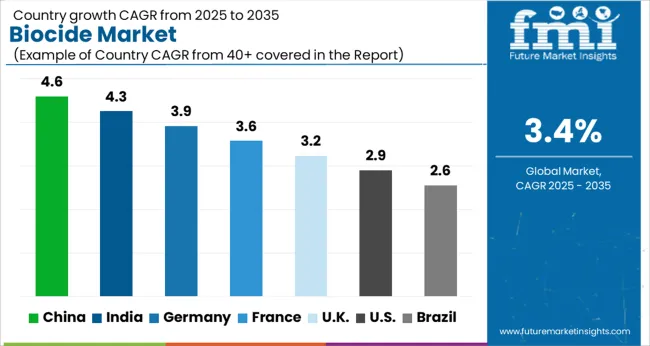
- China leads country-level growth at 4.6% CAGR, propelled by the 14th Five-Year Plan water pollution control targets and wastewater treatment capacity expansion.
The USD 3.90 billion incremental opportunity between 2026 and 2036 is distributed across multiple end-use sectors, with water treatment providing the most stable demand base at 22.3% share in 2026. Based on FMI's report, the market dynamics are characterized by active substance rotation as regulatory agencies restrict older chemistries and approve newer alternatives, creating product lifecycle management challenges for manufacturers who must maintain registration portfolios across multiple jurisdictions simultaneously. Industrial and technical grade products command 41.2% share, reflecting the volume-intensive nature of water treatment, oil and gas, and pulp and paper applications.
China leads at 4.6% CAGR, driven by the expansion of municipal and industrial wastewater treatment capacity under the 14th Five-Year Plan water pollution control targets. India follows at 4.3%, supported by the Jal Jeevan Mission water supply infrastructure expansion and the Food Safety and Standards Authority of India (FSSAI) food processing hygiene standards. Germany registers 3.9%, anchored by BPR compliance requirements and the established wood preservative and industrial coating preservation markets. France tracks at 3.6%, the UK at 3.2%, the USA at 2.9% reflecting the mature market with stable replacement demand, and Brazil at 2.6%.
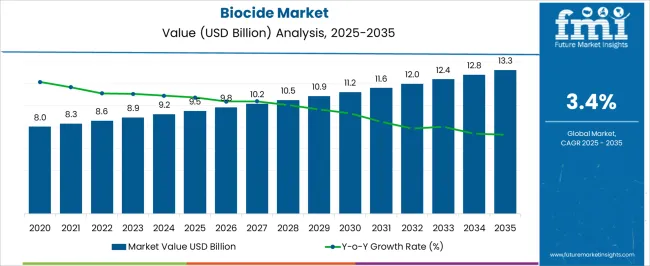
Biocide Market Key Takeaways
| Metric | Details |
|---|---|
| Industry Size (2026) | USD 9.82 billion |
| Industry Value (2036) | USD 13.72 billion |
| CAGR (2026-2036) | 3.4% |
Source: Future Market Insights, 2026
Biocide Market Definition
Biocides are chemical substances or microorganisms intended to destroy, deter, render harmless, or exert a controlling effect on harmful organisms through chemical or biological mechanisms. Product categories include halogen compounds, metallic compounds, organic acids, organo-sulfur compounds, nitrogen-based biocides, and phenolic agents. Grades span industrial/technical, food, and pharmaceutical specifications serving water treatment, agrochemicals, food and beverages, paints and coatings, cosmetics, oil and gas, pulp and paper, wood preservation, and cleaning applications.
Biocide Market Inclusions
Market scope covers global and regional revenue sizing for biocidal active substances and formulated products across all grades and end uses. The forecast spans 2026 to 2036 with segmentation by grade, product type, and end use. Regulatory registration tracking across EU BPR, US EPA, and major national jurisdictions is included.
Biocide Market Exclusions
The scope excludes pharmaceutical antibiotics and antiviral agents used in human therapeutic applications, agricultural pesticides classified separately from biocides under regulatory frameworks, and disinfection equipment hardware without chemical product revenue.
Biocide Market Research Methodology
- Primary Research: Analysts engaged with production facility managers, procurement specialists, and downstream application engineers to map the decision gates triggering technology adoption and supplier qualification.
- Desk Research: Data collection phases aggregated regulatory compliance schedules, industry standards ratification timelines, and public procurement disclosure databases from primary source institutions.
- Market-Sizing and Forecasting: Baseline values derive from a bottom-up aggregation of product volumes and average selling prices, applying region-specific adoption curves to project future demand velocity.
- Data Validation and Update Cycle: Projections are tested against publicly reported financial guidance from leading producers and cross-referenced with trade body shipment statistics.
Why is the Biocide Market Growing?
The biocide market is demonstrating steady expansion, supported by its essential role in ensuring hygiene, safety, and operational efficiency across industries such as water treatment, food processing, healthcare, paints and coatings, and oil and gas. Increasing demand is being driven by stricter regulations on microbial control, growing industrialization, and heightened awareness regarding the prevention of contamination in critical applications.
Rising investment in water and wastewater treatment infrastructure, particularly in emerging economies, is reinforcing the demand for biocides that comply with international safety standards while maintaining high effectiveness. Technological advancements are also fostering the development of more environmentally friendly and targeted formulations that minimize ecological impact while delivering long-lasting protection.
The heightened focus on sustainability and stricter regulatory frameworks are encouraging companies to innovate new solutions that balance performance with compliance As industries place greater emphasis on operational reliability and safety, the adoption of biocides is expected to accelerate, creating opportunities for specialized and high-value product offerings in the global market.
Segmental Analysis
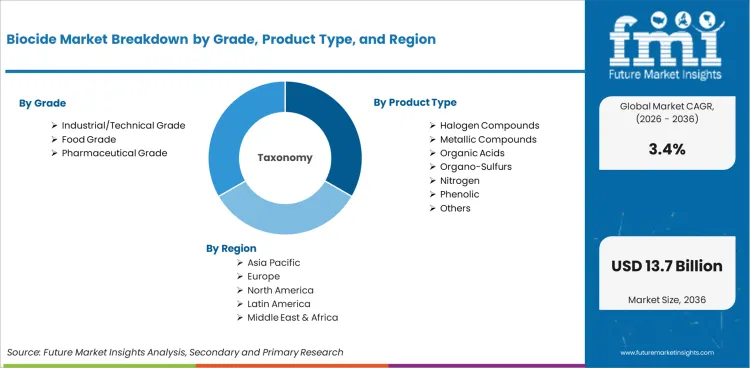
The biocide market is segmented by grade, product type, end use, and geographic regions. By grade, biocide market is divided into Industrial/Technical Grade, Food Grade, and Pharmaceutical Grade. In terms of product type, biocide market is classified into Halogen Compounds, Metallic Compounds, Organic Acids, Organo-Sulfurs, Nitrogen, Phenolic, and Others.
Based on end use, biocide market is segmented into Water Treatment, Agrochemicals, Food & Beverages, Paints & Coatings, Cosmetics & Personal Care, Oil & Gas, Pulp & Paper, Wood Preservatives, Cleaning Agents, and Others. Regionally, the biocide industry is classified into North America, Latin America, Western Europe, Eastern Europe, Balkan & Baltic Countries, Russia & Belarus, Central Asia, East Asia, South Asia & Pacific, and the Middle East & Africa.
Insights into the Industrial/Technical Grade Segment
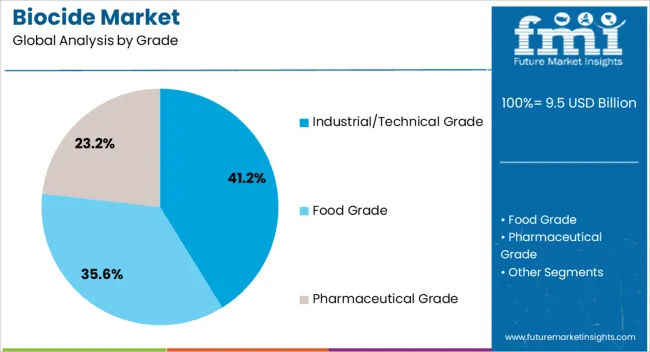
The industrial and technical grade segment is projected to represent 41.2% of the biocide market revenue share in 2026, establishing itself as the leading grade. Its dominance is being driven by extensive usage in large-scale industrial applications, including oil and gas, water treatment, pulp and paper, and manufacturing processes where microbial control is critical to operational efficiency.
This grade is preferred due to its strong effectiveness in controlling a wide range of microorganisms and its suitability for challenging environments that demand long-term protection. The segment’s growth is further supported by rising investments in industrial infrastructure and the increasing need to maintain compliance with health and safety standards across industries.
The scalability of industrial and technical grade formulations ensures that they remain cost-effective for bulk usage, thereby making them the choice for large operations requiring consistent microbial protection With industries prioritizing operational continuity and safety, the segment is expected to maintain its leadership in the global market.
Insights into the Halogen Compounds Product Type Segment
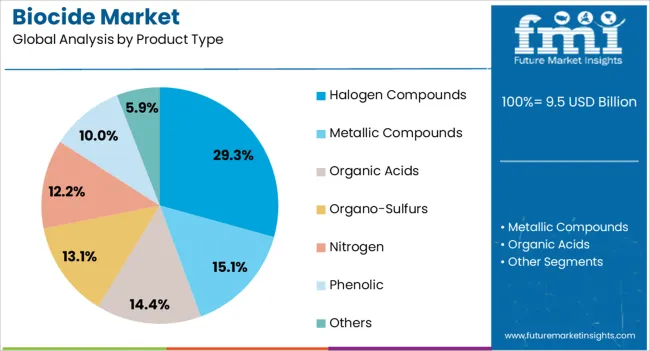
The halogen compounds segment is expected to account for 29.3% of the biocide market revenue share in 2026, making it the leading product type. Its dominance is being reinforced by the proven efficacy of halogen-based formulations such as chlorine and bromine in eliminating a broad spectrum of microorganisms. These compounds are highly effective, versatile, and widely used in disinfection, sanitation, and preservation across industries.
Their ability to deliver rapid action and long-term effectiveness in water treatment, healthcare, and industrial processes has positioned them as a preferred solution. The segment is also benefiting from ongoing innovation to improve stability and reduce environmental impact, addressing regulatory pressures while maintaining performance.
Their relatively low cost and adaptability across multiple applications are contributing to sustained adoption As industries seek reliable solutions for microbial control that balance performance, affordability, and compliance, halogen compounds are expected to retain their strong position in the global biocide market.
Insights into the Water Treatment End Use Segment
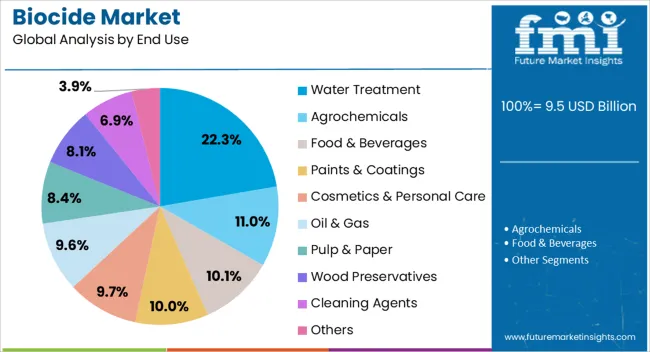
The water treatment segment is anticipated to hold 22.3% of the biocide market revenue share in 2026, making it the largest end use segment. Its growth is being driven by the increasing global demand for clean and safe water, supported by rising urbanization, industrial activity, and heightened regulatory focus on water quality management.
Biocides are playing a crucial role in preventing microbial contamination, scaling, and biofilm formation in both municipal and industrial water treatment systems. With water scarcity and quality issues becoming more critical, governments and private entities are heavily investing in water infrastructure, thereby increasing reliance on effective microbial control agents.
The segment is also benefiting from the expansion of wastewater recycling and desalination projects, where biocides are essential to maintaining system integrity and efficiency As water security emerges as a global priority, the use of biocides in water treatment is expected to expand further, cementing the segment’s position as a key driver of market growth.
Market Overview
Biocide Market Overview
Biocides are the chemicals or certain metals which are used to kill different categories of micro-organisms at different life stages. Biocides are widely used in drinking and waste water treatment, healthcare and the consumer goods industry. Consumer products include cosmetics, cleaning products, detergents, some toothpastes and general disinfectant products. In addition, biocides are used in food industry at a sub-lethal level to act as preservatives which impart a longer shelf life.
There is an increased demand for bromine and its derivatives from the enduse sectors such as agriculture, oil & gas, textile, electronics, ship & automotive, pharmaceutical and water treatment plants. The biocide market can be segmented by type as metallic compounds, halogen-based derivatives, organic acids, organ sulphurs, and phenol-based compounds. Glutaraldehyde and sodium hydroxide are some other types of biocides. Biocide will finds its highest growth in the wastewater treatment sector (one-fourth of market revenue) followed by the food & beverages industry, the personal care segment and metalworking fluids.
Halogen compounds are the most common type of biocides used in large number of industries followed by organic acids. They account for nearly one-fourth of the total biocide market share. Various enduse industries such as water and wastewater treatment plants, paper and pulp industries, and cooling systems usehalogen-based biocides in their daily operations. Organic acid is the next type of biocide which accounts for thesecond largest share in thebiocidesmarket. It is prominently used in areas related to disinfectant water and wastewater treatment. Metallic compounds are largely used for disinfection of industrial wastewater systems.However, their market potential seems to be dipping primarily due to rising environmental concerns and human side effect risks. Greater concern over public health willdrive the demand for phenol-based biocides at a CAGR of 6.8% (2026-2026) in hospitals, railway stations, retail outlets and other public places.
Geographically, North America with 40% share in the global biocide market is expected to continue to dominate the marker over the next five years. However, Latin America and the APAC biocide marketsare also anticipated to remain a promising market.The prime reasons behind the North America growth trajectory are advanced technological solutions, concentration on the food & beverages and healthcare industries. Though North America is surely the global leader in the biocide market, itsgrowth will see a stagnant phase due to stringent environmental regulations.
Latin America will be the future market for biocides. With the rise in GDP, technological advancement, and advent of better healthcare facilities, Latin America will offer a lucrative biocides market. Though its market share in terms of value was just 8% of the global market in 2026, itwill witness tremendous growth in next5 years. Brazil is seen as the market with the most potential in Latin America for biocides. The Brazilian government is now boosting its infrastructure and healthcare system. These efforts will act as a catalyst for the development of the biocides market in the country. Also, being an active member of BRICS, Brazil will witness heavy investment in various industry verticals which, in turn, will furtherboost the biocide market in Brazil.
Future demands are likely to come from the emerging economies like India, China, South Africa, Indonesia, and Vietnam, among others.
The major players of biocides include theLonza Group, the Dow Microbial Control, ISP Chemicals Inc., Ashland Inc., Champion Technologies, BASF SE, Troy Corporation, and Thor Specialties Inc.
Large numbers of government and environmental regulations are imposed at various levels of the value chain in the biocide market right from manufacturers to distributors.Thisacts as potential threat for a new entrant having less knowledge of labelling and safety. Numerous laws exist in different countries regarding labelling and storage of biocide products, and their leftover disposal. Therefore the market of biocides is expected to grow at a moderate CAGR between 2026 and 2026.The research report presents a comprehensive assessment of the market and contains thoughtful insights, facts, historical data, and statistically supported and industry-validated market data. It also contains projections using a suitable set of assumptions and methodologies. The research report provides analysis and information according to categories such as market segments, geographies, types, technology and applications.
The report covers exhaustive analysis on
- Market Segments
- Market Dynamics
- Market Size
- Supply & Demand
- Current Trends/Issues/Challenges
- Competition & Companies involved
- Technology
- Value Chain
Regional analysis includes
- Argentina
- Brazil
- Mexico
- Rest of Latin America
The report is a compilation of first-hand information, qualitative and quantitative assessment by industry analysts, inputs from industry experts, and industry participants across the value chain. The report provides an in-depth analysis of parent market trends, macro-economic indicators and governing factors, along with market attractiveness within the segments. The report also maps the qualitative impact of various market factors on market segments and various geographies.
Analysis of Biocide Market By Key Countries
.webp "Top Country Growth Comparison Biocide Market Cagr (2026 2036)")
| Country | CAGR |
|---|---|
| China | 4.6% |
| India | 4.3% |
| Germany | 3.9% |
| France | 3.6% |
| UK | 3.2% |
| USA | 2.9% |
| Brazil | 2.6% |
Source: FMI analysis based on primary research and proprietary forecasting model
Country-wise Analysis
The Biocide Market is expected to register a CAGR of 3.4% during the forecast period, exhibiting varied country level momentum. China leads with the highest CAGR of 4.6%, followed by India at 4.3%. Developed markets such as Germany, France, and the UK continue to expand steadily, while the USA is likely to grow at consistent rates. Brazil posts the lowest CAGR at 2.6%, yet still underscores a broadly positive trajectory for the global Biocide Market. In 2024, Germany held a dominant revenue in the Western Europe market and is expected to grow with a CAGR of 3.9%. The USA Biocide Market is estimated to be valued at USD 3.5 billion in 2026 and is anticipated to reach a valuation of USD 4.7 billion by 2036. Sales are projected to rise at a CAGR of 2.9% over the forecast period between 2026 and 2036. While Japan and South Korea markets are estimated to be valued at USD 459.8 million and USD 331.6 million respectively in 2026.
Key Players in the Biocide Market
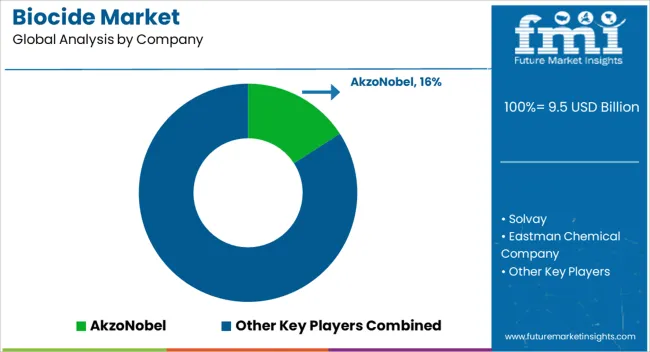
- AkzoNobel
- Solvay
- Eastman Chemical Company
- Albemarle Corporation
- Lonza Group
- Chemours
- Olin Corporation
- Syngenta
- Bio-Cide International, Inc.
- BASF Performance Products
Scope of the Report
| Metric | Value |
|---|---|
| Quantitative Units | USD 9.82 billion to USD 13.72 billion, at a CAGR of 3.4% |
| Market Definition | Biocides are chemical substances or microorganisms intended to destroy, deter, render harmless, or exert a controlling effect on harmful organisms through chemical or biological mechanisms. Product categories include halogen compounds, metallic compounds, organic acids, organo-sulfur compounds, nitrogen-based biocides, and phenolic agents. Grades span industrial/technical, food, and pharmaceutical specifications serving water treatment, agrochemicals, food and beverages, paints and coatings, cosmetics, oil and gas, pulp and paper, wood preservation, and cleaning applications. |
| Segmentation | Grade: Industrial/Technical Grade, Food Grade, Pharmaceutical Grade; Product Type: Halogen Compounds, Metallic Compounds, Organic Acids, Organo-Sulfurs, Nitrogen, Phenolic, Others; End Use: Water Treatment, Agrochemicals, Food & Beverages, Paints & Coatings, Cosmetics & Personal Care, Oil & Gas, Pulp & Paper, Wood Preservatives, Cleaning Agents, Others |
| Regions Covered | North America, Latin America, Europe, East Asia, South Asia, Oceania, Middle East & Africa |
| Countries Covered | China, India, Germany, France, UK, USA, Brazil, and 40 plus countries |
| Key Companies Profiled | AkzoNobel, Solvay, Eastman Chemical Company, Albemarle Corporation, Lonza Group, Chemours, Olin Corporation, Syngenta, Bio-Cide International, Inc., BASF Performance Products |
| Forecast Period | 2026 to 2036 |
| Approach | Forecasting models apply a bottom-up methodology starting with global production and consumption metrics and projecting adoption rates by region. |
Biocide Market by Segments
Grade:
- Industrial/Technical Grade
- Food Grade
- Pharmaceutical Grade
Product Type:
- Halogen Compounds
- Metallic Compounds
- Organic Acids
- Organo-Sulfurs
- Nitrogen
- Phenolic
- Others
End Use:
- Water Treatment
- Agrochemicals
- Food & Beverages
- Paints & Coatings
- Cosmetics & Personal Care
- Oil & Gas
- Pulp & Paper
- Wood Preservatives
- Cleaning Agents
- Others
Region:
- North America
- USA
- Canada
- Mexico
- Latin America
- Brazil
- Chile
- Rest of Latin America
- Western Europe
- Germany
- UK
- Italy
- Spain
- France
- Nordic
- BENELUX
- Rest of Western Europe
- Eastern Europe
- Russia
- Poland
- Hungary
- Balkan & Baltic
- Rest of Eastern Europe
- East Asia
- China
- Japan
- South Korea
- South Asia and Pacific
- India
- ASEAN
- Australia & New Zealand
- Rest of South Asia and Pacific
- Middle East & Africa
- Kingdom of Saudi Arabia
- Other GCC Countries
- Turkiye
- South Africa
- Other African Union
- Rest of Middle East & Africa
Bibliography
- 1. European Chemicals Agency. (2025). Biocidal Products Regulation: Active substance approval programme status. ECHA.
- 2. United States Environmental Protection Agency. (2025). Antimicrobial pesticide registration: Active ingredient review schedule. USA EPA.
- 3. Ministry of Ecology and Environment, China. (2024). 14th Five-Year Plan: Water pollution prevention and control action plan. MEE.
- 4. Food Safety and Standards Authority of India. (2025). Food processing hygiene standards: Biocide usage guidelines. FSSAI.
- 5. World Health Organization. (2024). Guidelines for drinking-water quality: Chemical disinfection. WHO.
- 6. Organisation for Economic Co-operation and Development. (2025). OECD biocide programme: Mutual recognition of data. OECD.
This bibliography is provided for reader reference. The full Future Market Insights report contains the complete reference list with primary research documentation.
Frequently Asked Questions
How large is the demand for Biocide in the global market in 2026?
Demand for biocide in the global market is estimated to be valued at USD 9.82 billion in 2026.
What will be the market size of Biocide in the global market by 2036?
Market size for biocide is projected to reach USD 13.72 billion by 2036.
What is the expected demand growth for Biocide between 2026 and 2036?
Demand for biocide is expected to grow at a CAGR of 3.4% between 2026 and 2036.
Which Grade is poised to lead global sales by 2026?
Industrial/Technical Grade accounts for 41.2% share in 2026, reflecting its established commercial scale and procurement volume concentration.
How is Product Type distributed in 2026?
Halogen Compounds leads with 29.3% share in 2026, driven by regulatory compliance requirements and end-user specification mandates.
What is China's growth outlook in this report?
China is projected to grow at a CAGR of 4.6% during 2026 to 2036.
What is the scope of this Biocide report?
The report covers market sizing, segmentation analysis, regional forecasts, competitive assessment, and regulatory compliance mapping for the biocide market from 2026 to 2036.
How does FMI build and validate the Biocide forecast?
Forecasting models apply a bottom-up methodology starting with global production and consumption metrics and cross-validate projections against public financial disclosures and trade body statistics.
Preview the report firsthand - request a free sample
Get SampleGet the brochure for pricing and purchase details.
Get PDFTable of Content
- Executive Summary
- Global Market Outlook
- Demand-side Trends
- Supply-side Trends
- Technology Roadmap Analysis
- Analysis and Recommendations
- Market Overview
- Market Coverage / Taxonomy
- Market Definition / Scope / Limitations
- Research Methodology
- Chapter Orientation
- Analytical Lens and Working Hypotheses
- Market Structure, Signals, and Trend Drivers
- Benchmarking and Cross-market Comparability
- Market Sizing, Forecasting, and Opportunity Mapping
- Research Design and Evidence Framework
- Desk Research Programme (Secondary Evidence)
- Company Annual and Sustainability Reports
- Peer-reviewed Journals and Academic Literature
- Corporate Websites, Product Literature, and Technical Notes
- Earnings Decks and Investor Briefings
- Statutory Filings and Regulatory Disclosures
- Technical White Papers and Standards Notes
- Trade Journals, Industry Magazines, and Analyst Briefs
- Conference Proceedings, Webinars, and Seminar Materials
- Government Statistics Portals and Public Data Releases
- Press Releases and Reputable Media Coverage
- Specialist Newsletters and Curated Briefings
- Sector Databases and Reference Repositories
- FMI Internal Proprietary Databases and Historical Market Datasets
- Subscription Datasets and Paid Sources
- Social Channels, Communities, and Digital Listening Inputs
- Additional Desk Sources
- Expert Input and Fieldwork (Primary Evidence)
- Primary Modes
- Qualitative Interviews and Expert Elicitation
- Quantitative Surveys and Structured Data Capture
- Blended Approach
- Why Primary Evidence is Used
- Field Techniques
- Interviews
- Surveys
- Focus Groups
- Observational and In-context Research
- Social and Community Interactions
- Stakeholder Universe Engaged
- C-suite Leaders
- Board Members
- Presidents and Vice Presidents
- R&D and Innovation Heads
- Technical Specialists
- Domain Subject-matter Experts
- Scientists
- Physicians and Other Healthcare Professionals
- Governance, Ethics, and Data Stewardship
- Research Ethics
- Data Integrity and Handling
- Primary Modes
- Tooling, Models, and Reference Databases
- Desk Research Programme (Secondary Evidence)
- Data Engineering and Model Build
- Data Acquisition and Ingestion
- Cleaning, Normalisation, and Verification
- Synthesis, Triangulation, and Analysis
- Quality Assurance and Audit Trail
- Market Background
- Market Dynamics
- Drivers
- Restraints
- Opportunity
- Trends
- Scenario Forecast
- Demand in Optimistic Scenario
- Demand in Likely Scenario
- Demand in Conservative Scenario
- Opportunity Map Analysis
- Product Life Cycle Analysis
- Supply Chain Analysis
- Investment Feasibility Matrix
- Value Chain Analysis
- PESTLE and Porter’s Analysis
- Regulatory Landscape
- Regional Parent Market Outlook
- Production and Consumption Statistics
- Import and Export Statistics
- Market Dynamics
- Global Market Analysis 2021 to 2025 and Forecast, 2026 to 2036
- Historical Market Size Value (USD Million) Analysis, 2021 to 2025
- Current and Future Market Size Value (USD Million) Projections, 2026 to 2036
- Y-o-Y Growth Trend Analysis
- Absolute $ Opportunity Analysis
- Global Market Pricing Analysis 2021 to 2025 and Forecast 2026 to 2036
- Global Market Analysis 2021 to 2025 and Forecast 2026 to 2036, By Grade
- Introduction / Key Findings
- Historical Market Size Value (USD Million) Analysis By Grade , 2021 to 2025
- Current and Future Market Size Value (USD Million) Analysis and Forecast By Grade , 2026 to 2036
- Industrial/Technical Grade
- Food Grade
- Pharmaceutical Grade
- Industrial/Technical Grade
- Y-o-Y Growth Trend Analysis By Grade , 2021 to 2025
- Absolute $ Opportunity Analysis By Grade , 2026 to 2036
- Global Market Analysis 2021 to 2025 and Forecast 2026 to 2036, By Product Type
- Introduction / Key Findings
- Historical Market Size Value (USD Million) Analysis By Product Type, 2021 to 2025
- Current and Future Market Size Value (USD Million) Analysis and Forecast By Product Type, 2026 to 2036
- Halogen Compounds
- Metallic Compounds
- Organic Acids
- Organo-Sulfurs
- Nitrogen
- Phenolic
- Others
- Halogen Compounds
- Y-o-Y Growth Trend Analysis By Product Type, 2021 to 2025
- Absolute $ Opportunity Analysis By Product Type, 2026 to 2036
- Global Market Analysis 2021 to 2025 and Forecast 2026 to 2036, By End Use
- Introduction / Key Findings
- Historical Market Size Value (USD Million) Analysis By End Use, 2021 to 2025
- Current and Future Market Size Value (USD Million) Analysis and Forecast By End Use, 2026 to 2036
- Water Treatment
- Agrochemicals
- Food & Beverages
- Paints & Coatings
- Cosmetics & Personal Care
- Oil & Gas
- Pulp & Paper
- Wood Preservatives
- Cleaning Agents
- Others
- Water Treatment
- Y-o-Y Growth Trend Analysis By End Use, 2021 to 2025
- Absolute $ Opportunity Analysis By End Use, 2026 to 2036
- Global Market Analysis 2021 to 2025 and Forecast 2026 to 2036, By Region
- Introduction
- Historical Market Size Value (USD Million) Analysis By Region, 2021 to 2025
- Current Market Size Value (USD Million) Analysis and Forecast By Region, 2026 to 2036
- North America
- Latin America
- Western Europe
- Eastern Europe
- East Asia
- South Asia and Pacific
- Middle East & Africa
- Market Attractiveness Analysis By Region
- North America Market Analysis 2021 to 2025 and Forecast 2026 to 2036, By Country
- Historical Market Size Value (USD Million) Trend Analysis By Market Taxonomy, 2021 to 2025
- Market Size Value (USD Million) Forecast By Market Taxonomy, 2026 to 2036
- By Country
- USA
- Canada
- Mexico
- By Grade
- By Product Type
- By End Use
- By Country
- Market Attractiveness Analysis
- By Country
- By Grade
- By Product Type
- By End Use
- Key Takeaways
- Latin America Market Analysis 2021 to 2025 and Forecast 2026 to 2036, By Country
- Historical Market Size Value (USD Million) Trend Analysis By Market Taxonomy, 2021 to 2025
- Market Size Value (USD Million) Forecast By Market Taxonomy, 2026 to 2036
- By Country
- Brazil
- Chile
- Rest of Latin America
- By Grade
- By Product Type
- By End Use
- By Country
- Market Attractiveness Analysis
- By Country
- By Grade
- By Product Type
- By End Use
- Key Takeaways
- Western Europe Market Analysis 2021 to 2025 and Forecast 2026 to 2036, By Country
- Historical Market Size Value (USD Million) Trend Analysis By Market Taxonomy, 2021 to 2025
- Market Size Value (USD Million) Forecast By Market Taxonomy, 2026 to 2036
- By Country
- Germany
- UK
- Italy
- Spain
- France
- Nordic
- BENELUX
- Rest of Western Europe
- By Grade
- By Product Type
- By End Use
- By Country
- Market Attractiveness Analysis
- By Country
- By Grade
- By Product Type
- By End Use
- Key Takeaways
- Eastern Europe Market Analysis 2021 to 2025 and Forecast 2026 to 2036, By Country
- Historical Market Size Value (USD Million) Trend Analysis By Market Taxonomy, 2021 to 2025
- Market Size Value (USD Million) Forecast By Market Taxonomy, 2026 to 2036
- By Country
- Russia
- Poland
- Hungary
- Balkan & Baltic
- Rest of Eastern Europe
- By Grade
- By Product Type
- By End Use
- By Country
- Market Attractiveness Analysis
- By Country
- By Grade
- By Product Type
- By End Use
- Key Takeaways
- East Asia Market Analysis 2021 to 2025 and Forecast 2026 to 2036, By Country
- Historical Market Size Value (USD Million) Trend Analysis By Market Taxonomy, 2021 to 2025
- Market Size Value (USD Million) Forecast By Market Taxonomy, 2026 to 2036
- By Country
- China
- Japan
- South Korea
- By Grade
- By Product Type
- By End Use
- By Country
- Market Attractiveness Analysis
- By Country
- By Grade
- By Product Type
- By End Use
- Key Takeaways
- South Asia and Pacific Market Analysis 2021 to 2025 and Forecast 2026 to 2036, By Country
- Historical Market Size Value (USD Million) Trend Analysis By Market Taxonomy, 2021 to 2025
- Market Size Value (USD Million) Forecast By Market Taxonomy, 2026 to 2036
- By Country
- India
- ASEAN
- Australia & New Zealand
- Rest of South Asia and Pacific
- By Grade
- By Product Type
- By End Use
- By Country
- Market Attractiveness Analysis
- By Country
- By Grade
- By Product Type
- By End Use
- Key Takeaways
- Middle East & Africa Market Analysis 2021 to 2025 and Forecast 2026 to 2036, By Country
- Historical Market Size Value (USD Million) Trend Analysis By Market Taxonomy, 2021 to 2025
- Market Size Value (USD Million) Forecast By Market Taxonomy, 2026 to 2036
- By Country
- Kingdom of Saudi Arabia
- Other GCC Countries
- Turkiye
- South Africa
- Other African Union
- Rest of Middle East & Africa
- By Grade
- By Product Type
- By End Use
- By Country
- Market Attractiveness Analysis
- By Country
- By Grade
- By Product Type
- By End Use
- Key Takeaways
- Key Countries Market Analysis
- USA
- Pricing Analysis
- Market Share Analysis, 2025
- By Grade
- By Product Type
- By End Use
- Canada
- Pricing Analysis
- Market Share Analysis, 2025
- By Grade
- By Product Type
- By End Use
- Mexico
- Pricing Analysis
- Market Share Analysis, 2025
- By Grade
- By Product Type
- By End Use
- Brazil
- Pricing Analysis
- Market Share Analysis, 2025
- By Grade
- By Product Type
- By End Use
- Chile
- Pricing Analysis
- Market Share Analysis, 2025
- By Grade
- By Product Type
- By End Use
- Germany
- Pricing Analysis
- Market Share Analysis, 2025
- By Grade
- By Product Type
- By End Use
- UK
- Pricing Analysis
- Market Share Analysis, 2025
- By Grade
- By Product Type
- By End Use
- Italy
- Pricing Analysis
- Market Share Analysis, 2025
- By Grade
- By Product Type
- By End Use
- Spain
- Pricing Analysis
- Market Share Analysis, 2025
- By Grade
- By Product Type
- By End Use
- France
- Pricing Analysis
- Market Share Analysis, 2025
- By Grade
- By Product Type
- By End Use
- India
- Pricing Analysis
- Market Share Analysis, 2025
- By Grade
- By Product Type
- By End Use
- ASEAN
- Pricing Analysis
- Market Share Analysis, 2025
- By Grade
- By Product Type
- By End Use
- Australia & New Zealand
- Pricing Analysis
- Market Share Analysis, 2025
- By Grade
- By Product Type
- By End Use
- China
- Pricing Analysis
- Market Share Analysis, 2025
- By Grade
- By Product Type
- By End Use
- Japan
- Pricing Analysis
- Market Share Analysis, 2025
- By Grade
- By Product Type
- By End Use
- South Korea
- Pricing Analysis
- Market Share Analysis, 2025
- By Grade
- By Product Type
- By End Use
- Russia
- Pricing Analysis
- Market Share Analysis, 2025
- By Grade
- By Product Type
- By End Use
- Poland
- Pricing Analysis
- Market Share Analysis, 2025
- By Grade
- By Product Type
- By End Use
- Hungary
- Pricing Analysis
- Market Share Analysis, 2025
- By Grade
- By Product Type
- By End Use
- Kingdom of Saudi Arabia
- Pricing Analysis
- Market Share Analysis, 2025
- By Grade
- By Product Type
- By End Use
- Turkiye
- Pricing Analysis
- Market Share Analysis, 2025
- By Grade
- By Product Type
- By End Use
- South Africa
- Pricing Analysis
- Market Share Analysis, 2025
- By Grade
- By Product Type
- By End Use
- USA
- Market Structure Analysis
- Competition Dashboard
- Competition Benchmarking
- Market Share Analysis of Top Players
- By Regional
- By Grade
- By Product Type
- By End Use
- Competition Analysis
- Competition Deep Dive
- AkzoNobel
- Overview
- Product Portfolio
- Profitability by Market Segments (Product/Age /Sales Channel/Region)
- Sales Footprint
- Strategy Overview
- Marketing Strategy
- Product Strategy
- Channel Strategy
- Solvay
- Eastman Chemical Company
- Albemarle Corporation
- Lonza Group
- Chemours
- Olin Corporation
- Syngenta
- Bio-Cide International, Inc.
- BASF Performance Products
- AkzoNobel
- Competition Deep Dive
- Assumptions & Acronyms Used


