

- Market Size (2026)
- USD 0.6 Bn
- Forecast (2036)
- USD 2.3 Bn
- CAGR (2026 to 2036)
- 14.6%
How big is Flash Loans Market in 2026?
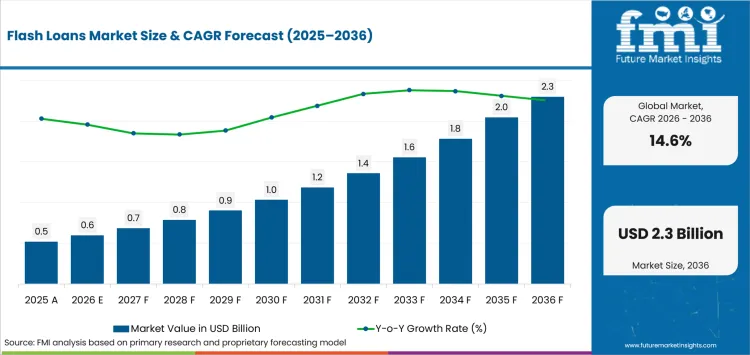
USD 0.6 billion in 2026 and USD 2.3 billion by 2036 at a 14.6% CAGR.
Demand for flash loans is projected to expand at 14.6% CAGR between 2026 and 2036, increasing valuation from USD 0.6 billion in 2026 to USD 2.3 billion by 2036. Growth is attributable to the expansion of decentralized-finance infrastructure capable of supporting complex on-chain transactions with sufficient speed, liquidity and reliability. Aave Labs reported in November 2025 that Aave V3 on Aptos had reached full production readiness following independent reviews and network-specific engineering work. The milestone reflects continued maturation of flash-loan infrastructure across emerging blockchain ecosystems. The production-ready Aptos release makes deployable code the commercial bottleneck because DeFi technology earns fees only after atomic borrowing survives integration testing and live execution.
Regulatory treatment changes how quickly institutional demand becomes paid protocol activity because approved custody routes determine which public pools trading desks can use. FCA consumer research published in December 2025 found that 25% of crypto users were more likely to invest if cryptoassets were more regulated. The survey result favors custody-compatible execution in the USA and licensed routes in Singapore while UK approval work becomes more formal. Crypto security controls therefore influence integration budgets beside liquidity depth and transaction-cost economics for institutional desks.
Key Takeaways of Flash Loans Market
- Demand rises as algorithmic trading desks use temporary onchain capital for atomic arbitrage, liquidation and collateral refinancing without prefunding each transaction.
- By protocol category, decentralized lending protocols are estimated to hold 47.0% in 2026 owing to direct reserve access that reduces intermediary contract calls during atomic borrowing.
- In 2026, arbitrage trading is expected to lead primary use case with 42.0% share because short-lived price gaps reward same-block capital deployment.
- Institutional traders are set to lead the user category with 36.0% share in 2026 due to repeated execution that justifies dedicated simulation and approval resources.
- Smart-contract exploits, oracle failures and transaction-ordering exposure raise review costs before institutions approve public liquidity pools for repeat automated use.
- Key players in the flash loans market include Aave Labs, Morpho Labs, Euler Labs, Spark, Uniswap Labs, Balancer DAO, Curve Finance, and Instadapp.
Analyst Perspective
"Trading desks lose the economics of flash loans when route complexity raises gas, oracle or transaction-ordering risk before repayment. Protocol teams earn repeat institutional fees by proving callback behavior and route costs in simulation, then preserving those controls during live same-block execution."
- Rahul Pandita, Principal Consultant, Future Market Insights
How is the Flash Loans Market segmented?
The flash loans market is segmented by protocol category, primary use case, user category, blockchain network, execution mechanism and region.
Protocol category includes decentralized lending protocols, liquidity aggregation platforms, yield optimization platforms and DeFi infrastructure services. Primary use case covers arbitrage trading, liquidation services, collateral refinancing and smart-contract testing. User category includes institutional traders, individual traders, crypto asset managers, decentralized autonomous organizations and developers. Blockchain network covers Ethereum, BNB Chain, Polygon, Arbitrum, Avalanche, Optimism, Base and Solana. Execution mechanism covers smart-contract automation, cross-chain execution, API integration and MEV protection.
What supports Ethereum in the Blockchain Network category?
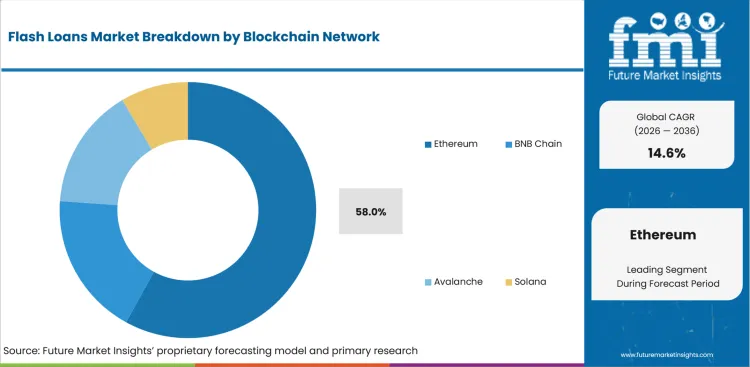
Ethereum concentrates lending pools and exchange liquidity inside one programmable environment while each deployment carries different gas conditions and security assumptions that developers must test through blockchain infrastructure before production use.
- Ethereum is projected to hold 58.0% share in 2026 owing to protocol density that gives developers more same-environment routing options.
- Uniswap Labs launched v4 in January 2025 on ten chains after nine audits and a USD 15.5 million bug bounty. Developers still test each deployment's liquidity and security assumptions before allowing automated atomic execution through newly supported pools. Route selection then becomes a network-specific engineering decision for every live strategy.
What makes Decentralized Lending Protocols central to the Protocol Category?
Direct lending protocols control the reserve and callback contract that determine whether temporary capital returns within the same transaction. Aave governance proposed v3.4 in March 2025 with native GHO flash loans and a fee model that removed supplier fee injection. Smart contract systems therefore become an execution requirement instead of a separate software layer during deployment.
- Based on protocol category, decentralized lending protocols are projected to account for 47.0% in 2026 due to reserve access that reduces intermediary calls during atomic borrowing.
- Integration teams still test supported assets and repayment behavior before deployment because deeper reserves do not remove contract-specific failure risk or fee sensitivity.
Why does Arbitrage Trading lead the Primary Use Case category?
Arbitrage needs capital only for the block in which a price difference can be captured and repaid. Crypto APIs let automated desks compare quotes and routing before network fees or slippage erase an observed spread during execution.
- By primary use case, arbitrage trading is forecast to represent 42.0% in 2026 driven by same-transaction funding that avoids idle capital on every venue.
- An EBA-ESMA report published in January 2025 estimated decentralized exchange flows at roughly 10% of global spot crypto trading volume. The reported scale leaves enough route competition for automated desks, although transaction ordering and gas costs can erase a quoted spread before repayment.
How do Institutional Traders shape the User Category?
Institutional desks spread engineering and compliance costs over repeated strategies while preserving formal limits on assets and counterparties. In February 2026 Morpho announced an Anchorage Digital integration that gave institutional clients access to selected onchain lending vaults through regulated custody infrastructure. The integration shows why tokenization infrastructure and custody workflows increasingly shape access decisions for regulated trading organizations.
- Institutional traders are likely to capture 36.0% share in 2026 attributable to repeated strategies that justify automated monitoring and formal governance controls.
- Trading desks still reject pools whose oracle design, callback behavior or custody path cannot be documented before an automated strategy enters production.
What are the drivers, restraints and opportunities in the Flash Loans Market?
Programmable liquidity increases execution capacity, security review limits approved use and permissioned routing expands the institutional revenue path.
- Driver: Trading and refinancing software can source temporary capital at execution time instead of parking equivalent balances on every venue.
- Restraint: Contract exploits, weak oracle inputs and transaction-ordering exposure can turn an economically sound strategy into a failed or loss-making transaction.
- Opportunity: Permissioning, transaction simulation and private routing can place public liquidity inside operating controls that regulated institutions already understand.
Temporary capital becomes commercially useful after protocol interfaces reach enough networks and assets to justify repeated engineering work. Morpho moved into infrastructure mode in January 2025 and deployed its stack on seven named EVM networks outside its original base. Morpho's seven-network deployment gives developers more places to reuse lending logic without assuming identical liquidity conditions. Web 3.0 blockchain adoption therefore raises demand for tooling that tests each route before capital is borrowed.
Security teams block wider deployment because flash loans compress several contract calls into one irreversible execution path. The EBA-ESMA January 2025 report found that roughly 20% of value stolen in 2024 DeFi smart-contract hacks corresponded to flash-loan attacks. Protocol teams therefore budget for audits and transaction simulation before expanding approved use to additional assets and automated strategies. Blockchain AI may improve anomaly detection only where risk teams can inspect the model inputs and response rules.
Institutional revenue expands significantly where compliance rules enter the trading venue before execution rather than after settlement. Uniswap Labs introduced Permissioned Pools in July 2026 with onchain allowlists for approved participants and assets. Flash-loan providers can apply the same control logic to eligible borrowers while retaining atomic repayment. Crypto payment gateways offer an adjacent integration route for firms that need controlled movement between tokenized balances and approved transaction systems.
Which country CAGRs are profiled in the Flash Loans Market?
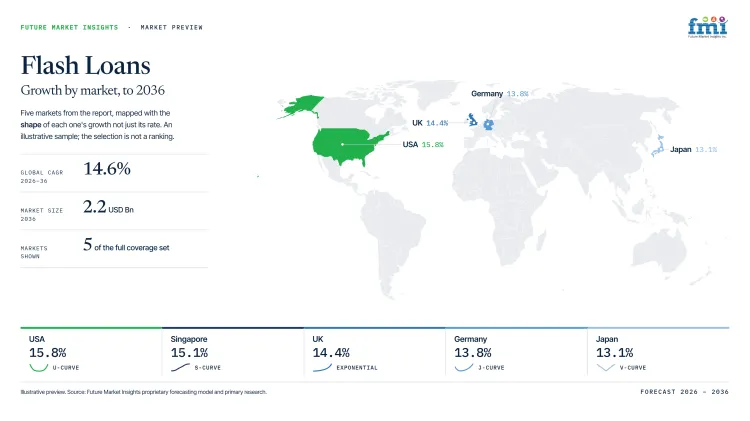
| Country | CAGR |
|---|---|
| USA | 15.8% |
| Singapore | 15.1% |
| UK | 14.4% |
| Germany | 13.8% |
| Japan | 13.1% |
How do country-level CAGRs compare in the Flash Loans Market?
Country forecasts span a narrow 2.7 percentage points between USA at 15.8% and Japan at 13.1%. USA and Singapore form the upper band because institutional cryptocurrency platforms absorb custody and licensing controls. UK and Germany follow under authorization regimes while Japan's transfer rules impose heavier records on crypto movements.
- USA: Dollar-stablecoin depth lets automated desks size same-block positions without prepositioned cash.
- Singapore: Regional exchange connectivity shortens routing between Asian pools and dollar stablecoins.
- UK: London trading desks pair global exchange access with regulated institutional custody.
- Germany: Frankfurt custody providers give institutional desks local relationships for digital assets.
- Japan: Yen trading hours create price gaps within a narrower approved set.
Country ranking reflects approval cost beside protocol access and executable liquidity in each jurisdiction. The full report provides country-level CAGR analysis across North America, Latin America, Europe, East Asia, South Asia, Oceania and the Middle East and Africa.
Country-wise Analysis
- In USA, dollar-stablecoin pools give trading firms ample same-block liquidity, but regulated institutions need a control path before public contracts reach production. Qualified custody provides that control path without changing the permissionless protocol or its repayment logic. Flash-loan demand in the USA is forecast to rise at 15.8% CAGR from 2026 to 2036 because larger desks can route onchain execution through approved custody relationships. In May 2025 the Office of the Comptroller of the Currency confirmed that national banks may outsource crypto custody and execution services subject to third-party risk management. The OCC permission favors providers whose simulations and transaction records fit bank controls before capital reaches a public liquidity pool.
- Licensed payment institutions mediate supervised digital-token activity, giving algorithmic desks a local route into onchain liquidity while retaining custody and transfer controls. On August 24 2026 the Monetary Authority of Singapore directory listed 37 major payment institutions authorized for digital payment token services. The main friction is proving that same-block routing preserves transaction monitoring while a strategy borrows from permissionless pools outside the institution's direct perimeter. Adoption of flash loans in Singapore is estimated to expand at 15.1% CAGR through 2036 given regional exchange connectivity and regulated digital-token distribution. The licensing base gives integration providers a practical institutional channel without lowering supervisory expectations for each execution route.
- Preparing for the wider authorization perimeter changes how British crypto firms budget for custody, resilience and lending controls during permissionless-liquidity integration. Flash-loan activity in the UK is projected to grow at 14.4% CAGR through 2036 owing to clearer rules for regulated onchain services. The Financial Conduct Authority stated in June 2026 that the regime followed ten consultation papers and will expand regulated activities from October 25 2027. Firms can use that implementation window to map contract permissions and custody responsibility against the new perimeter in practice, although authorization failures can delay paid institutional deployment until compliance work is complete.
- Euro treasury limits coexist with deeper dollar-stablecoin liquidity, forcing institutions to choose eligible assets before testing flash-loan economics. Bundesbank President Joachim Nagel stated in March 2026 that 99% of the stablecoin market was pegged to the US dollar. Germany is estimated to post 13.8% CAGR from 2026 to 2036 tied to regulated digital-asset infrastructure and access to global onchain liquidity. Thinner euro-denominated liquidity raises friction for teams that must keep treasury exposure aligned with internal currency limits during live execution. The currency mismatch keeps euro treasury policy separate from protocol liquidity even as regulated service providers expand digital-asset coverage.
- Registered exchanges and transfer controls shape how institutions reach permissionless liquidity, leaving fewer acceptable external routes for automated borrowing than in less constrained jurisdictions. Originator and beneficiary records add operating work whenever a strategy transfers assets between registered providers and external protocol addresses. The Financial Services Agency added 30 jurisdictions to an existing group of 28 in June 2025 with coverage effective August 1. Flash-loan demand in Japan is forecast to rise at 13.1% CAGR from 2026 to 2036 as registered exchange access gives automated desks dependable asset entry points. Compared with the USA or Singapore, Japan offers a narrower approved path despite access to the same protocol liquidity.
Who are the notable companies in the Flash Loans Market?
Aave Labs, Morpho Labs, Euler Labs, Spark, Uniswap Labs, Balancer DAO, Curve Finance, and Instadapp are the notable organizations serving this market.
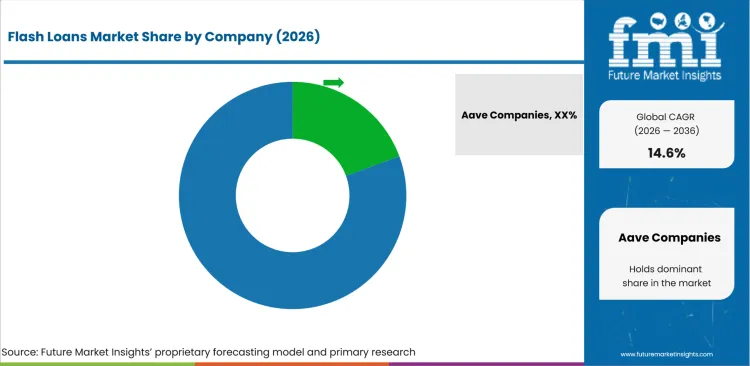
Competition is split between protocols that control lendable reserves and platforms that control execution or routing. Entry barriers come from audited contract behavior, liquidity depth and the work required to support several networks without fragmenting risk controls. Protocol organizations with documented interfaces are easier to automate while transparent repayment logic reduces integration uncertainty for external engineering teams.
- Direct lending and liquidity platforms: Aave Labs, Morpho Labs, Euler Labs and Spark compete through programmable credit markets and deployable liquidity pools.
- Trading and pooled-liquidity venues: Uniswap Labs, Balancer DAO and Curve Finance compete on pool depth, routing design and same-block execution options.
- Automation middleware: Instadapp packages lending and position-management actions so developers can execute complex account changes through a controlled contract layer.
Competitive Benchmarking: Flash Loans Market
| Company | Atomic Liquidity Access | Execution Tooling | Multi-network Integration | Geographic Reach |
|---|---|---|---|---|
| Aave Labs | High | High | High | Global |
| Morpho Labs | Medium | High | High | Global |
| Euler Labs | Medium | High | Medium | Ethereum and selected EVM networks |
| Spark | Medium | Medium | High | Ethereum and major EVM networks |
| Uniswap Labs | Medium | High | High | Global |
| Balancer DAO | Medium | High | High | Ethereum and major EVM networks |
| Curve Finance | Medium | High | High | Global |
| Instadapp | Medium | High | High | Ethereum and major EVM networks |
Scoring basis: High atomic liquidity access requires a documented native same-transaction borrowing function or direct control of a liquidity layer used for atomic execution. Medium identifies a documented lending or exchange venue that participates in flash-loan workflows without a comparable native endpoint. High execution tooling requires contract interfaces plus automation or routing support that can support production integrations. Medium execution tooling requires usable protocol integration with narrower automation or routing depth than the High threshold. High multi-network integration requires active deployments on at least five networks under the same protocol organization. Medium multi-network integration covers two to four networks while Low identifies one active network under verified current evidence. Geographic reach records current network coverage and is descriptive rather than scored.
Key Developments in the Flash Loans Market
- In August 2025, Aave Labs launched the Horizon RWA instance and released production V3 SDKs plus a public API for integrators.
- In October 2025, Uniswap Labs acquired Guidestar to deepen automated market design and smart-order-routing research for onchain execution.
- In September 2025, Morpho Labs was selected by Société Générale FORGE to power lending and borrowing for MiCA-compliant EURCV and USDCV stablecoins.
Key Players in the Flash Loans Market
Programmable Lending and Liquidity Platforms
- Aave Labs
- Morpho Labs
- Euler Labs
- Spark
Trading and Pooled-Liquidity Venues
- Uniswap Labs
- Balancer DAO
- Curve Finance
Automation and Position Infrastructure
- Instadapp
Flash Loans Market - Report Scope
| Coverage field | Report scope |
|---|---|
| Market breakdown | By protocol category, primary use case, user category, blockchain network, execution mechanism and region. |
| Quantitative Units | USD Billion. |
| Market Definition | Revenue includes flash-loan premiums, flash-mint fees, liquidity-pool charges, execution-routing fees and software or analytics revenue tied directly to flash-loan activity. Borrowed principal, trading profits, gas expenditure, regular lending interest and adjacent DeFi revenue are excluded. |
| Regions Covered | North America, Latin America, Western Europe, Eastern Europe, East Asia, South Asia and Pacific and Middle East and Africa. |
| Countries Covered | USA, Singapore, UK, Germany, Japan, and 20+ countries included in the full report. |
| Key Companies Profiled | Aave Labs, Morpho Labs, Euler Labs, Spark, Uniswap Labs, Balancer DAO, Curve Finance, and Instadapp. |
| Forecast Period | 2026 to 2036. |
| Approach | Primary and secondary research with market triangulation. |
Flash Loans Market - Research Methodology
| Method | Approach |
|---|---|
| Primary Research | FMI analysts gathered input from manufacturers, service providers, technology developers, distributors, end users, procurement teams, and subject-matter experts. Interviews examined purchasing decisions, product or service evaluation, adoption barriers, approval requirements, pricing considerations, and expectations for technical or commercial support. Respondents were also asked what evidence is required before a trial, pilot, or initial order develops into regular purchasing. |
| Desk Research | Desk research covered government statistics, regulatory publications, trade data, industry associations, technical literature, standards, company filings, product information, and official corporate announcements. Sources were reviewed for relevance, publication date, geographic coverage, and consistency with the defined market scope. Claims relating to performance, applications, approvals, capacity, investment, and commercial activity were retained only when supported by credible public evidence. |
| Market Sizing and Forecasting | The market model combined the baseline value with historical performance, segment structure, pricing and volume indicators, adoption levels, company participation, and country-level demand conditions. Forecast assumptions considered economic activity, investment trends, regulatory developments, technology adoption, purchasing cycles, supply availability, and barriers to wider market use. Segment and regional estimates were reconciled before the final market total was calculated. |
| Data Validation | Estimates were checked against multiple independent indicators, including public data, company activity, trade patterns, industry developments, and findings from primary interviews. Validation also tested whether products, services, applications, and company revenues fell within the defined market boundaries. Adjacent categories, unsupported claims, overlapping revenues, and activities without direct market relevance were excluded to reduce double counting and maintain consistency across segments and countries. |
Flash Loans Market by Segments
Flash Loans Market segmented by Protocol Category:
- Decentralized Lending Protocols
- Overcollateralized Protocols
- Multi-asset Lending Pools
- Liquidity Aggregation Platforms
- Flash Liquidity Pools
- Multi-chain Liquidity
- Yield Optimization Platforms
- Leverage Optimization
- Yield Rebalancing
- DeFi Infrastructure Services
- Developer Toolkits
- Protocol Analytics
Flash Loans Market segmented by Primary Use Case:
- Arbitrage Trading
- Cross-exchange Arbitrage
- DEX Arbitrage
- Liquidation Services
- Collateral Liquidation
- Bad Debt Recovery
- Collateral Refinancing
- Debt Restructuring
- Liquidity Migration
- Smart Contract Testing
- Audit Simulation
- Risk Assessment
Flash Loans Market segmented by User Category:
- Institutional Traders
- Hedge Funds
- Algorithmic Trading Firms
- Individual Traders
- DeFi Participants
- Quantitative Traders
- Crypto Asset Managers
- Digital Asset Funds
- Decentralized Autonomous Organizations
- Developers
- Blockchain Developers
- Security Researchers
Flash Loans Market segmented by Blockchain Network:
- Ethereum
- Ethereum Mainnet
- Layer 2 Ethereum
- BNB Chain
- Polygon
- Arbitrum
- Avalanche
- Optimism
- Base
- Solana
- Solana Mainnet
- Test Networks
Flash Loans Market segmented by Execution Mechanism:
- Smart Contract Automation
- Automated Execution
- Atomic Transactions
- Cross-chain Execution
- Cross-protocol Integration
- Low-latency Settlement
- Application Programming Interface Integration
- Protocol Interoperability
- Transaction Bundling
- MEV Protection
- Secure Transaction Routing
- Real-time Validation
Flash Loans Market by Region:
- North America
- United States
- Canada
- Latin America
- Brazil
- Mexico
- Argentina
- Chile
- Western Europe
- Germany
- France
- United Kingdom
- Italy
- Spain
- Benelux
- Nordics
- Eastern Europe
- Poland
- Czech Republic
- Romania
- Hungary
- East Asia
- China
- Japan
- South Korea
- South Asia and Pacific
- India
- ASEAN
- Australia and New Zealand
- Middle East and Africa
- GCC Countries
- South Africa
- Türkiye
- Israel
Research Sources and Bibliography
- Aave Labs. (2025, November 17). Aptos: Aave V3 Full Launch.
- Financial Conduct Authority. (2025, December 16). Research Note: Cryptoassets consumer research 2025.
- Aave governance. (2025, March 26). [ARFC] BGD. Aave v3.4.
- European Banking Authority & European Securities and Markets Authority. (2025, January 16). The EBA and ESMA analyse recent developments in crypto-assets.
- Morpho. (2026, February 12). Morpho Now Available to Institutional Clients via Anchorage Digital.
- Uniswap Labs. (2025, January 31). Uniswap v4 is Here - A New Era of DeFi.
- Morpho. (2025, January 29). Morpho Everywhere: Infrastructure Mode.
- European Banking Authority & European Securities and Markets Authority. (2025, January 16). Joint Report on the recent developments in crypto-assets (Article 142 of MiCAR).
- Uniswap Labs. (2026, July 23). Introducing Permissioned Pools on Uniswap v4.
- Office of the Comptroller of the Currency. (2025, May 7). OCC Clarifies Bank Authority to Engage in Crypto-Asset Custody and Execution Services.
- Monetary Authority of Singapore. (2026, August 24). Financial Institutions Directory: Digital Payment Token Service.
- Financial Conduct Authority. (2026, June 30). Overview of our cryptoassets regime policy statements.
- Nagel, J. (2026, March 1). Central banking in an age of geoeconomic fragmentation and global uncertainty. Deutsche Bundesbank.
- Financial Services Agency of Japan. (2025, June 25). Jurisdictions subject to travel rules.
- Aave Labs. (2025, September 1). AL Development Update | August 2025.
- Uniswap Labs. (2025, October 6). Guidestar Joins Uniswap Labs.
- Morpho. (2025, September 30). Société Générale FORGE selects Morpho as DeFi lending infrastructure.
- Uniswap Labs. (2025, February 11). Unichain Mainnet is Here - A New Home for DeFi.
- Balancer DAO. (2025, February 4). [BIP-774] Initial Gauges on Arbitrum and Base.
- Uniswap Labs. (2026, February 11). Uniswap Labs and Securitize Partner to Unlock DeFi Liquidity for BlackRock’s BUIDL.
- Morpho. (2026, February 17). Taurus Integrates Morpho, Enabling Institutional Access to Onchain Lending.
- Spark. (2026, January 15). Spark Partners with Anchorage Digital to Expand Support of Institutional Lending Infrastructure.
- Aave Labs. (2025, December 1). AL Development Update | November 2025.
- Morpho. (2025, September 18). Morpho is now Powering USDC Lending on Coinbase.
- Euler DAO. (2025, July 10). Integrate rsETH on Euler Arbitrum.
- Spark. (2025, October 21). Savings V2 Launches.
- Uniswap Labs. (2026, June 25). Spark Moves $150M of Liquidity to v4 with DualPool Hook Coming Soon.
- Balancer DAO. (2025, April 21). [BIP-817] Add Balancer V3 Initial Gauges on Avalanche.
- Curve Finance. (2026, July 15). Llamalend v2 is live on Ethereum.
- Taurus. (2025, April 9). Taurus Launches First Interbank Network for Digital Asset Collaboration
This bibliography is provided for reader reference and is not exhaustive. The full report contains the complete reference list and detailed citations.
This Report Answers
- What is the Flash Loans Market size and 2036 forecast?
- Which execution conditions increase flash-loan demand?
- Why do decentralized lending protocols lead Protocol Category?
- How does arbitrage trading use temporary liquidity?
- Why do institutional traders lead User Category?
- How do country growth rates differ?
- Which organizations provide liquidity and execution infrastructure?
- How do security and regulation affect adoption?
- What should teams assess before provider integration?
Frequently Asked Questions
How big is the flash loans market in 2026?
The flash loans market is valued at USD 0.6 billion in 2026 and is projected to reach USD 2.3 billion by 2036. Growth is driven by automated trading and refinancing strategies that use temporary capital inside atomic transactions.
What is the CAGR of the flash loans market from 2026 to 2036?
The flash loans market is projected to grow at a CAGR of 14.6% between 2026 and 2036. Expansion is supported by wider onchain liquidity access and better execution tooling for automated strategies.
Which protocol category leads the flash loans market?
The decentralized lending protocols segment is expected to hold 47.0% of the flash loans market in 2026 because direct reserve access reduces intermediary contract calls. Its position also depends on reliable callback behavior and auditable fee logic during repeated production integrations.
Which primary use case leads the flash loans market?
The arbitrage trading segment is expected to hold 42.0% of the flash loans market in 2026 because same-transaction funding fits short-lived price differences. Commercial returns depend on gas costs, slippage controls and routing quality during live automated execution.
Which companies are active in the flash loans market?
Key companies operating in the market include Aave Labs, Morpho Labs, Euler Labs, Spark, Uniswap Labs, Balancer DAO, Curve Finance, and Instadapp. These organizations compete through liquidity access, routing design, protocol integrations and execution tooling for automated onchain workflows.
Preview the report firsthand - request a free sample
Get SampleGet the brochure for pricing and purchase details.
Get PDFTable of Content
- Key Takeaways
- Market Size and CAGR
- Top Growth Driver
- Fastest Growing Segment
- Leading Region
- Key Companies
- Emerging Opportunities
- Executive Summary
- Global Market Outlook
- Demand-side Trends
- Supply-side Trends
- Technology Roadmap Analysis
- Analysis and Recommendations
- Analyst Perspective (What is happening? Why now? What should investors know?)
- Key Questions Answered
- How large is the market?
- What is the CAGR?
- What are key trends?
- Which region dominates?
- Who are the leaders?
- Market Overview
- Market Coverage / Taxonomy
- Market Definition / Scope / Limitations
- Research Methodology
- Chapter Orientation
- Analytical Lens and Working Hypotheses
- Market Structure, Signals, and Trend Drivers
- Benchmarking and Cross-market Comparability
- Market Sizing, Forecasting, and Opportunity Mapping
- Research Design and Evidence Framework
- Desk Research Programme (Secondary Evidence)
- Expert Input and Fieldwork (Primary Evidence)
- Tooling, Models, and Reference Databases
- Data Engineering and Model Build
- Quality Assurance and Audit Trail
- Market Background
- Market Dynamics (Drivers, Restraints, Opportunity, Trends)
- Scenario Forecast (Optimistic, Likely, Conservative)
- Impact Analysis
- AI Impact
- Sustainability Impact
- Regulatory Impact
- Technology Impact
- Consumer / Buyer Analysis
- Purchase Drivers
- Adoption Barriers
- Buyer Journey
- Opportunity Map Analysis
- Product Life Cycle Analysis
- Supply Chain Analysis
- Investment Feasibility Matrix
- Value Chain Analysis
- PESTLE and Porter's Analysis
- Regulatory Landscape
- Regional Parent Market Outlook
- Production and Consumption Statistics
- Import and Export Statistics
- Global Market Analysis and Forecast, 2021 to 2036
- Historical Market Size Value (USD Billion) Analysis, 2021 to 2025
- Current and Future Market Size Value (USD Billion) Projections, 2026 to 2036
- Y-o-Y Growth Trend Analysis
- Absolute $ Opportunity Analysis
- Global Market Pricing Analysis, 2021 to 2036
- Global Market Analysis and Forecast, By Protocol Category, 2021 to 2036
- Introduction / Key Findings
- Historical Market Size Value (USD Billion) Analysis By Protocol Category, 2021 to 2025
- Current and Future Market Size Value (USD Billion) Analysis and Forecast By Protocol Category, 2026 to 2036
- Decentralized Lending Protocols
- Overcollateralized Protocols
- Multi-asset Lending Pools
- Liquidity Aggregation Platforms
- Flash Liquidity Pools
- Multi-chain Liquidity
- Yield Optimization Platforms
- Leverage Optimization
- Yield Rebalancing
- DeFi Infrastructure Services
- Developer Toolkits
- Protocol Analytics
- Decentralized Lending Protocols
- Y-o-Y Growth Trend Analysis By Protocol Category, 2021 to 2025
- Absolute $ Opportunity Analysis By Protocol Category, 2026 to 2036
- Global Market Analysis and Forecast, By Primary Use Case, 2021 to 2036
- Introduction / Key Findings
- Historical Market Size Value (USD Billion) Analysis By Primary Use Case, 2021 to 2025
- Current and Future Market Size Value (USD Billion) Analysis and Forecast By Primary Use Case, 2026 to 2036
- Arbitrage Trading
- Cross-exchange Arbitrage
- DEX Arbitrage
- Liquidation Services
- Collateral Liquidation
- Bad Debt Recovery
- Collateral Refinancing
- Debt Restructuring
- Liquidity Migration
- Smart Contract Testing
- Audit Simulation
- Risk Assessment
- Arbitrage Trading
- Y-o-Y Growth Trend Analysis By Primary Use Case, 2021 to 2025
- Absolute $ Opportunity Analysis By Primary Use Case, 2026 to 2036
- Global Market Analysis and Forecast, By User Category, 2021 to 2036
- Introduction / Key Findings
- Historical Market Size Value (USD Billion) Analysis By User Category, 2021 to 2025
- Current and Future Market Size Value (USD Billion) Analysis and Forecast By User Category, 2026 to 2036
- Institutional Traders
- Hedge Funds
- Algorithmic Trading Firms
- Individual Traders
- DeFi Participants
- Quantitative Traders
- Crypto Asset Managers
- Digital Asset Funds
- Decentralized Autonomous Organizations
- Developers
- Blockchain Developers
- Security Researchers
- Institutional Traders
- Y-o-Y Growth Trend Analysis By User Category, 2021 to 2025
- Absolute $ Opportunity Analysis By User Category, 2026 to 2036
- Global Market Analysis and Forecast, By Blockchain Network, 2021 to 2036
- Introduction / Key Findings
- Historical Market Size Value (USD Billion) Analysis By Blockchain Network, 2021 to 2025
- Current and Future Market Size Value (USD Billion) Analysis and Forecast By Blockchain Network, 2026 to 2036
- Ethereum
- Ethereum Mainnet
- Layer 2 Ethereum
- BNB Chain
- Polygon
- Arbitrum
- Avalanche
- Optimism
- Base
- Solana
- Solana Mainnet
- Test Networks
- Ethereum
- Y-o-Y Growth Trend Analysis By Blockchain Network, 2021 to 2025
- Absolute $ Opportunity Analysis By Blockchain Network, 2026 to 2036
- Global Market Analysis and Forecast, By Execution Mechanism, 2021 to 2036
- Introduction / Key Findings
- Historical Market Size Value (USD Billion) Analysis By Execution Mechanism, 2021 to 2025
- Current and Future Market Size Value (USD Billion) Analysis and Forecast By Execution Mechanism, 2026 to 2036
- Smart Contract Automation
- Automated Execution
- Atomic Transactions
- Cross-chain Execution
- Cross-protocol Integration
- Low-latency Settlement
- Application Programming Interface Integration
- Protocol Interoperability
- Transaction Bundling
- MEV Protection
- Secure Transaction Routing
- Real-time Validation
- Smart Contract Automation
- Y-o-Y Growth Trend Analysis By Execution Mechanism, 2021 to 2025
- Absolute $ Opportunity Analysis By Execution Mechanism, 2026 to 2036
- Global Market Analysis and Forecast, By Region, 2021 to 2036
- Introduction
- Historical Market Size Value (USD Billion) Analysis By Region, 2021 to 2025
- Current Market Size Value (USD Billion) Analysis and Forecast By Region, 2026 to 2036
- North America
- Latin America
- Western Europe
- Eastern Europe
- East Asia
- South Asia and Pacific
- Middle East & Africa
- Market Attractiveness Analysis By Region
- North America Market Analysis and Forecast, By Country, 2021 to 2036
- Historical Market Size Value (USD Billion) Trend Analysis By Market Taxonomy, 2021 to 2025
- Market Size Value (USD Billion) Forecast By Market Taxonomy, 2026 to 2036
- By Country
- USA
- Canada
- By Protocol Category
- By Primary Use Case
- By User Category
- By Blockchain Network
- By Execution Mechanism
- By Country
- Market Attractiveness Analysis
- By Country
- By Protocol Category
- By Primary Use Case
- By User Category
- By Blockchain Network
- By Execution Mechanism
- Key Takeaways
- Latin America Market Analysis and Forecast, By Country
- Historical Market Size Value (USD Billion) Trend Analysis By Market Taxonomy, 2021 to 2025
- Market Size Value (USD Billion) Forecast By Market Taxonomy, 2026 to 2036
- By Country
- Brazil
- Mexico
- Chile
- Rest of Latin America
- By Protocol Category
- By Primary Use Case
- By User Category
- By Blockchain Network
- By Execution Mechanism
- By Country
- Market Attractiveness Analysis
- By Country
- By Protocol Category
- By Primary Use Case
- By User Category
- By Blockchain Network
- By Execution Mechanism
- Key Takeaways
- Western Europe Market Analysis and Forecast, By Country
- Historical Market Size Value (USD Billion) Trend Analysis By Market Taxonomy, 2021 to 2025
- Market Size Value (USD Billion) Forecast By Market Taxonomy, 2026 to 2036
- By Country
- Germany
- UK
- Italy
- Spain
- France
- Nordic
- BENELUX
- Rest of Western Europe
- By Protocol Category
- By Primary Use Case
- By User Category
- By Blockchain Network
- By Execution Mechanism
- By Country
- Market Attractiveness Analysis
- By Country
- By Protocol Category
- By Primary Use Case
- By User Category
- By Blockchain Network
- By Execution Mechanism
- Key Takeaways
- Eastern Europe Market Analysis and Forecast, By Country
- Historical Market Size Value (USD Billion) Trend Analysis By Market Taxonomy, 2021 to 2025
- Market Size Value (USD Billion) Forecast By Market Taxonomy, 2026 to 2036
- By Country
- Russia
- Poland
- Hungary
- Balkan & Baltic
- Rest of Eastern Europe
- By Protocol Category
- By Primary Use Case
- By User Category
- By Blockchain Network
- By Execution Mechanism
- By Country
- Market Attractiveness Analysis
- By Country
- By Protocol Category
- By Primary Use Case
- By User Category
- By Blockchain Network
- By Execution Mechanism
- Key Takeaways
- East Asia Market Analysis and Forecast, By Country
- Historical Market Size Value (USD Billion) Trend Analysis By Market Taxonomy, 2021 to 2025
- Market Size Value (USD Billion) Forecast By Market Taxonomy, 2026 to 2036
- By Country
- China
- Japan
- South Korea
- By Protocol Category
- By Primary Use Case
- By User Category
- By Blockchain Network
- By Execution Mechanism
- By Country
- Market Attractiveness Analysis
- By Country
- By Protocol Category
- By Primary Use Case
- By User Category
- By Blockchain Network
- By Execution Mechanism
- Key Takeaways
- South Asia and Pacific Market Analysis and Forecast, By Country
- Historical Market Size Value (USD Billion) Trend Analysis By Market Taxonomy, 2021 to 2025
- Market Size Value (USD Billion) Forecast By Market Taxonomy, 2026 to 2036
- By Country
- India
- ASEAN
- Australia & New Zealand
- Rest of South Asia and Pacific
- By Protocol Category
- By Primary Use Case
- By User Category
- By Blockchain Network
- By Execution Mechanism
- By Country
- Market Attractiveness Analysis
- By Country
- By Protocol Category
- By Primary Use Case
- By User Category
- By Blockchain Network
- By Execution Mechanism
- Key Takeaways
- Middle East & Africa Market Analysis and Forecast, By Country
- Historical Market Size Value (USD Billion) Trend Analysis By Market Taxonomy, 2021 to 2025
- Market Size Value (USD Billion) Forecast By Market Taxonomy, 2026 to 2036
- By Country
- Kingdom of Saudi Arabia
- Other GCC Countries
- Türkiye
- South Africa
- Other African Union
- Rest of Middle East & Africa
- By Protocol Category
- By Primary Use Case
- By User Category
- By Blockchain Network
- By Execution Mechanism
- By Country
- Market Attractiveness Analysis
- By Country
- By Protocol Category
- By Primary Use Case
- By User Category
- By Blockchain Network
- By Execution Mechanism
- Key Takeaways
- Key Countries Market Analysis
- USA
- Pricing Analysis
- Market Share Analysis, 2025
- By Protocol Category
- By Primary Use Case
- By User Category
- By Blockchain Network
- By Execution Mechanism
- Canada
- Pricing Analysis
- Market Share Analysis, 2025
- By Protocol Category
- By Primary Use Case
- By User Category
- By Blockchain Network
- By Execution Mechanism
- Mexico
- Pricing Analysis
- Market Share Analysis, 2025
- By Protocol Category
- By Primary Use Case
- By User Category
- By Blockchain Network
- By Execution Mechanism
- Brazil
- Pricing Analysis
- Market Share Analysis, 2025
- By Protocol Category
- By Primary Use Case
- By User Category
- By Blockchain Network
- By Execution Mechanism
- Chile
- Pricing Analysis
- Market Share Analysis, 2025
- By Protocol Category
- By Primary Use Case
- By User Category
- By Blockchain Network
- By Execution Mechanism
- Germany
- Pricing Analysis
- Market Share Analysis, 2025
- By Protocol Category
- By Primary Use Case
- By User Category
- By Blockchain Network
- By Execution Mechanism
- UK
- Pricing Analysis
- Market Share Analysis, 2025
- By Protocol Category
- By Primary Use Case
- By User Category
- By Blockchain Network
- By Execution Mechanism
- Italy
- Pricing Analysis
- Market Share Analysis, 2025
- By Protocol Category
- By Primary Use Case
- By User Category
- By Blockchain Network
- By Execution Mechanism
- Spain
- Pricing Analysis
- Market Share Analysis, 2025
- By Protocol Category
- By Primary Use Case
- By User Category
- By Blockchain Network
- By Execution Mechanism
- France
- Pricing Analysis
- Market Share Analysis, 2025
- By Protocol Category
- By Primary Use Case
- By User Category
- By Blockchain Network
- By Execution Mechanism
- India
- Pricing Analysis
- Market Share Analysis, 2025
- By Protocol Category
- By Primary Use Case
- By User Category
- By Blockchain Network
- By Execution Mechanism
- ASEAN
- Pricing Analysis
- Market Share Analysis, 2025
- By Protocol Category
- By Primary Use Case
- By User Category
- By Blockchain Network
- By Execution Mechanism
- Australia & New Zealand
- Pricing Analysis
- Market Share Analysis, 2025
- By Protocol Category
- By Primary Use Case
- By User Category
- By Blockchain Network
- By Execution Mechanism
- China
- Pricing Analysis
- Market Share Analysis, 2025
- By Protocol Category
- By Primary Use Case
- By User Category
- By Blockchain Network
- By Execution Mechanism
- Japan
- Pricing Analysis
- Market Share Analysis, 2025
- By Protocol Category
- By Primary Use Case
- By User Category
- By Blockchain Network
- By Execution Mechanism
- South Korea
- Pricing Analysis
- Market Share Analysis, 2025
- By Protocol Category
- By Primary Use Case
- By User Category
- By Blockchain Network
- By Execution Mechanism
- Russia
- Pricing Analysis
- Market Share Analysis, 2025
- By Protocol Category
- By Primary Use Case
- By User Category
- By Blockchain Network
- By Execution Mechanism
- Poland
- Pricing Analysis
- Market Share Analysis, 2025
- By Protocol Category
- By Primary Use Case
- By User Category
- By Blockchain Network
- By Execution Mechanism
- Hungary
- Pricing Analysis
- Market Share Analysis, 2025
- By Protocol Category
- By Primary Use Case
- By User Category
- By Blockchain Network
- By Execution Mechanism
- Kingdom of Saudi Arabia
- Pricing Analysis
- Market Share Analysis, 2025
- By Protocol Category
- By Primary Use Case
- By User Category
- By Blockchain Network
- By Execution Mechanism
- Türkiye
- Pricing Analysis
- Market Share Analysis, 2025
- By Protocol Category
- By Primary Use Case
- By User Category
- By Blockchain Network
- By Execution Mechanism
- South Africa
- Pricing Analysis
- Market Share Analysis, 2025
- By Protocol Category
- By Primary Use Case
- By User Category
- By Blockchain Network
- By Execution Mechanism
- USA
- Market Structure Analysis
- Competition Dashboard
- Competition Benchmarking
- Market Share Analysis of Top Players
- By Regional
- By Protocol Category
- By Primary Use Case
- By User Category
- By Blockchain Network
- By Execution Mechanism
- Emerging Startups
- Innovation Benchmarking
- Competition Analysis
- Competition Deep Dive
- Aave Companies
- Overview
- Product Portfolio
- Profitability by Market Segments
- Sales Footprint
- Strategy Overview
- Marketing Strategy
- Product Strategy
- Channel Strategy
- Balancer Labs
- Uniswap Labs
- MakerDAO
- dYdX Trading Inc.
- Compound Labs, Inc.
- Curve Finance
- Yearn Finance
- Morpho Labs
- Instadapp
- Aave Companies
- Case Studies
- Success Stories
- Recent Developments
- Competition Deep Dive
- Assumptions & Acronyms Used


