

- Industry Size (2026)
- USD 138.0 Mn
- Forecast (2036)
- USD 935.0 Mn
- CAGR (2026 to 2036)
- 21.1%
Fluorescent Tracer Food-Grade PP Sorting Market Size, Market Forecast and Outlook By FMI
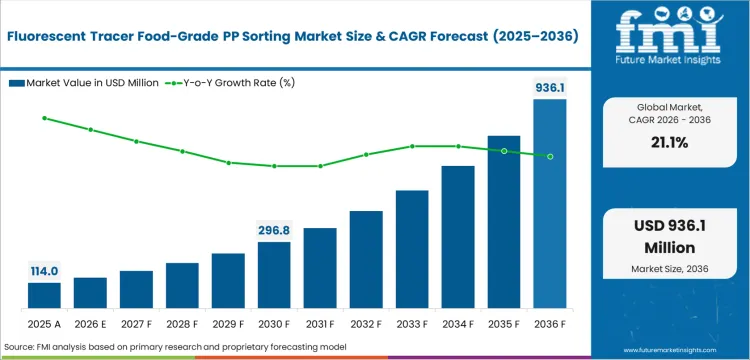
In 2025, the Fluorescent Tracer Food-Grade PP Sorting market crossed a valuation of USD 120.0 million and is projected to reach USD 138.0 million in 2026 and USD 935.0 million by 2036, reflecting a CAGR of 21.1%, with momentum tied to compliance thresholds compressing upgrade cycles for municipal recovery facilities.
Absolute dollar growth of USD 797.0 million between 2026 and 2036 highlights a rapid infrastructure shift. Regulators reprioritize compliance gates, shifting specifications toward verifiable closed-loop systems, and conversion occurs during municipal procurement windows. Revenues move from USD 120.0 million to USD 138.0 million and USD 935.0 million. In September 2025, Waste Management invested USD 47 million in new recovery lines [1]. Procurement concentrates around sorting lines capable of yielding verified circular feedstocks.
Summary of Fluorescent Tracer Food-Grade PP Sorting
- Fluorescent Tracer Food-Grade PP Sorting Market Definition
- Commercial application of luminescent markers and compatible detection equipment to isolate specific resins within mechanical recycling streams.
- Demand Drivers in the Market
- Imposition of recycled content mandates in consumer packaging.
- Shortage of high-purity post-consumer resin.
- Advancements in optical detection speeds and algorithmic accuracy.
- Key Segments Analyzed in the FMI Report
- Technology Component: Fluorescent polymer tracers (45%) versus detection & sorting hardware, software & analytics, and integration services.
- Application: Food & beverage packaging (47% of total volume) versus consumer goods, automotive & industrial PP, and healthcare packaging.
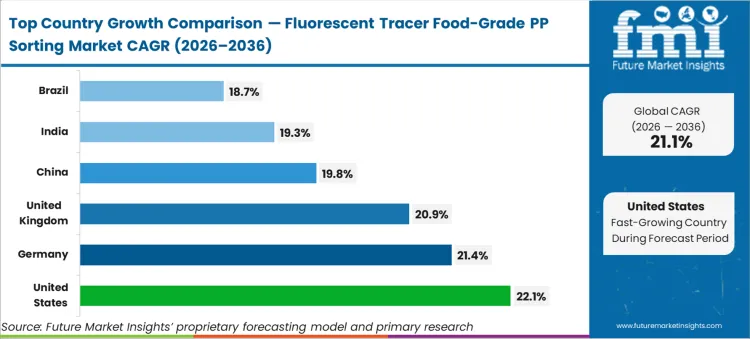
- Geography: High-growth North America and Europe (United States 22.1%, Germany 21.4%, United Kingdom 20.9%) versus scaling Asia-Pacific and Latin America (China 19.8%, India 19.3%, Brazil 18.7%).
- Analyst Opinion at FMI
- Ismail Sutaria, Principal Consultant for Packaging at Future Market Insights, opines, “In our ongoing assessment of the Fluorescent Tracer Food-Grade PP Sorting Market, my team and I have concluded that the competitive edge will not come from tracer chemistry alone, but from ecosystem alignment. Brand owners are under pressure to demonstrate food-grade recycled PP integration without regulatory risk. Fluorescent tagging introduces a verifiable pathway to segregate compliant material streams. The real inflection point will occur when detection systems, regulatory frameworks, and resin certifications converge to create a commercially viable closed-loop polypropylene economy.”
- Strategic Implications/Executive Takeaways
- Shift focus from generic recovery to verified separated streams.
- Integrate tracer modules into existing mechanical processing lines.
- Align capital upgrades with state-level packaging mandates.
- Methodology
- Validated through first-hand corporate production and capacity data.
- Zero reliance on speculative third-party market research reports.
- Based on verifiable industrial benchmarks and verified sources.
Fluorescent Tracer Food-Grade PP Sorting Market Key Takeaways
| Metric | Details |
|---|---|
| Industry Size (2026) | USD 138.0 million |
| Industry Value (2036) | USD 935.0 million |
| CAGR (2026-2036) | 21.1% |
As stated by Edward Kosior, Founder and CEO of Nextek Ltd, "In the US, NEXTLOOPP has received FDA approval for the use of recycled polypropylene in food-grade applications. That’s a milestone-it highlights how we’re moving from ambition to reality in making PP circularity achievable." [2]
Across United States (22.1% CAGR), Germany (21.4% CAGR), United Kingdom (20.9% CAGR), China (19.8% CAGR), India (19.3% CAGR) and Brazil (18.7% CAGR), growth concentrates where mandate alignment dictates budget timing. Country dispersion mirrors compliance exposure, as operators clear procurement faster on verified detection capabilities rather than generic capacity additions.
Fluorescent Tracer Food-Grade PP Sorting Market Definition
The Fluorescent Tracer Food-Grade PP Sorting market refers to the commercial deployment of luminescent marker additives and compatible optical detection systems designed to identify and separate polypropylene within mixed plastic waste streams. The sector encompasses integrated hardware, software, and additive technologies that enable high-speed recognition of tracer-embedded resins during material recovery operations. Market valuation focuses on technology-layer revenues that facilitate the production of food-grade post-consumer recycled polypropylene, supporting circular polymer supply chains.
Fluorescent Tracer Food-Grade PP Sorting Market Inclusions
The scope includes commercial sales of fluorescent tracer additives incorporated into virgin or recycled polypropylene for identification purposes. It captures capital expenditure on specialized sorting equipment equipped with fluorescent detection modules, as well as software licensing revenues for machine-vision algorithms managing separation accuracy. Professional services related to system integration, calibration, and technical consulting for industrial deployment are also included.
Fluorescent Tracer Food-Grade PP Sorting Market Exclusions
The scope excludes conventional near-infrared sorting systems that lack fluorescent detection capability. Revenue derived from the sale of finished recycled granulate or end-use packaging products is not included. Alternative identification technologies such as digital watermarking systems that do not rely on luminescent tracers fall outside this definition, as do laboratory-scale pilot projects without commercial implementation.
Fluorescent Tracer Food-Grade PP Sorting Market Research Methodology
- Primary Research: Analysts conducted structured interviews with sorting equipment original equipment manufacturers and material recovery facility managers to validate deployment capacities.
- Desk Research: Investigators reviewed United States Food and Drug Administration clearance databases and European Food Safety Authority compliance logs to track commercial approvals.
- Market-Sizing and Forecasting: Consultants developed bottom-up models using facility-level optical sorter installation counts multiplied by average tracer unit costs.
- Data Validation and Update Cycle: Findings undergo variance checks against production datasets published by trade associations prior to finalizing forecast models.
Segmental Analysis
Fluorescent Tracer Food-Grade PP Sorting Market Analysis by Technology Component
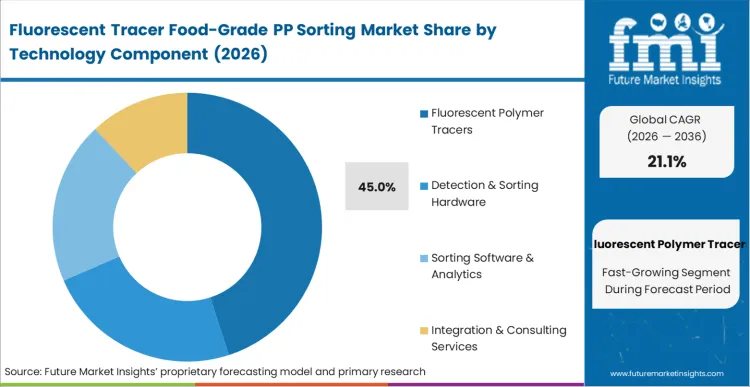
Fluorescent polymer tracers command 45% of sector activity in 2026, driven by continuous consumption across packaging manufacturing cycles. Consumable markers require ongoing replenishment by resin producers, generating recurring revenue models unlike singular hardware expenditures. According to FMI's estimates, detection hardware secures secondary capital allocation as material recovery facilities retrofit lines to capture high-margin streams. Facilities face intense pressure to supply verified post-consumer resin to global brands aiming for ambitious circularity targets.
- Regulatory signal: Stringent safety standards compel operators to guarantee polymer origins, necessitating verifiable marker systems.
- Procurement trigger: Deficits in available food-contact resin force buyers to finance advanced separation technologies. Polysecure GmbH expanded luminescent licensing agreements with recyclers during 2025, securing critical feedstock access [4].
- Supply-side move: Original equipment manufacturers embed specialized detection algorithms into standard platforms to lower adoption barriers.
Fluorescent Tracer Food-Grade PP Sorting Market Analysis by Application
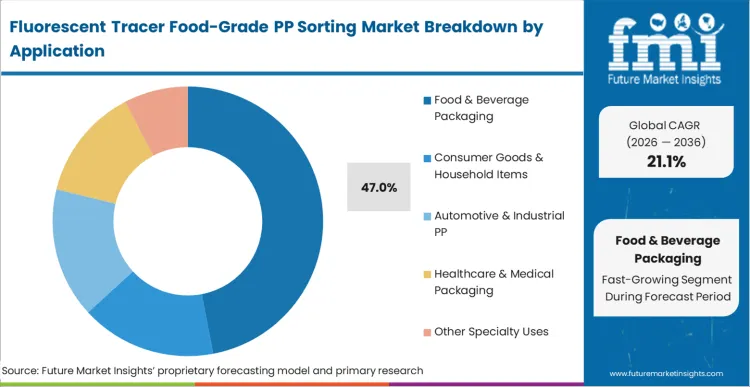
Food and beverage packaging commands 47% of commercial activity in 2026, reflecting intense regulatory scrutiny over material migration risks. Brands face stringent consumer safety regulations dictating post-consumer recycled content purity, necessitating absolute separation from non-food containers. Consumer goods represent secondary adoption vectors, where brand owners seek premium recycled inputs to satisfy corporate commitments. As per FMI's projection, automotive streams utilize identical sorting infrastructure to recover technical-grade resins for durable goods manufacturing.
- Buyer priority: Consumer packaging brands prioritize verifiable recyclate origins to comply with incoming legal mandates.
- Technology shift: Advancements in supercritical fluid decontamination synchronize with precision sorting to yield virgin-like material properties.
- Policy driver: State-level mandates targeting 50% recycled content by 2033 stimulate infrastructure upgrades. Regional operators utilize funding grants to deploy optical enhancements capable of separating beverage containers [8].
Fluorescent Tracer Food-Grade PP Sorting Market Drivers, Restraints, and Opportunities
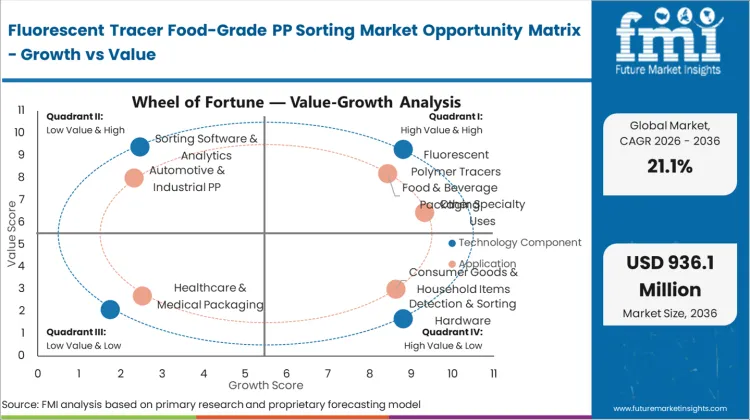
Recycled content mandates dictate capital expenditure across consumer packaging supply chains. Lawmakers increasingly enforce strict post-consumer inclusion targets for beverage containers, compelling brands to secure verified feedstocks. Standard mechanical recycling yields mixed polymers unsuitable for direct contact applications due to unverified origins and potential chemical contamination. Facilities must deploy advanced separation technologies capable of identifying specific food-contact items prior to extrusion. Optical equipment paired with luminescent markers provides necessary documentation to satisfy regulatory safety audits. More than 60% of United States households gained access to recycle clear beverage cups by early 2026, expanding available feedstock bases [9]. Operators recognizing pricing premiums attached to certified circular polymers accelerate facility upgrades to capture early margins. Equipment manufacturers exploit mandate timelines by offering modular retrofits that bring existing lines into compliance without severe downtime.
Capital expenditure constraints restrict deployment velocity among independent material recovery facilities. Implementing high-speed fluorescent detection modules requires substantial upfront investment, alongside significant facility downtime during complex commissioning phases. Municipal operators operating on thin margins struggle to justify technology acquisition without guaranteed off-take agreements from consumer brands. System functionality relies on packaging manufacturers voluntarily incorporating tracer additives into virgin production runs, creating dependency on upstream adoption. United States overall plastic recovery rates hovered near 5% in 2025, highlighting massive infrastructural deficits hindering advanced sorting feasibility [11].
- Premium Resins: Food-grade polymers command significant market premiums over mixed industrial recyclate streams. Certified circular resins currently account for roughly 10% of 45 million tons of annual recycled capacity, indicating massive expansion potential [12].
- Certification Services: Regulatory complexity creates demand for specialized compliance consultants navigating approval frameworks. Regulators issued specific clearances during 2024 for recycled plastics in food packaging, reflecting intense legal activity [3].
- Flexible Packaging: Extending marker technology to soft plastics presents entirely new high-volume material streams. Sustainable packaging coalitions noted significant collection gaps for flexible films in 2025, presenting untouched infrastructure targets [7].
Regional Analysis
Based on regional analysis, Fluorescent Tracer Food-Grade PP Sorting market is segmented into North America, Latin America, Europe, East Asia, South Asia, Oceania and Middle East & Africa across 40+ countries. Full report also offers market attractiveness analysis based on regional trends.
.webp "Top Country Growth Comparison Fluorescent Tracer Food Grade Pp Sorting Market Cagr (2026 2036)")
| Country | CAGR (2026 to 2036) |
|---|---|
| United States | 22.1% |
| Germany | 21.4% |
| United Kingdom | 20.9% |
| China | 19.8% |
| India | 19.3% |
| Brazil | 18.7% |
Source: Future Market Insights (FMI) analysis, based on proprietary forecasting model and primary research
North America Fluorescent Tracer Food-Grade PP Sorting Market Analysis
North America experiences intense infrastructure revitalization directed by consortium grants and incoming packaging mandates. Material recovery facilities face mounting pressure to extract maximum value from existing collection streams to offset rising operational costs. Equipment vendors target regional operators with modular optical upgrades capable of isolating high-value beverage containers from municipal bales. FMI analysts opine that clear post-consumer cups constitute a valuable fraction requiring precise identification algorithms to achieve mandated purity.
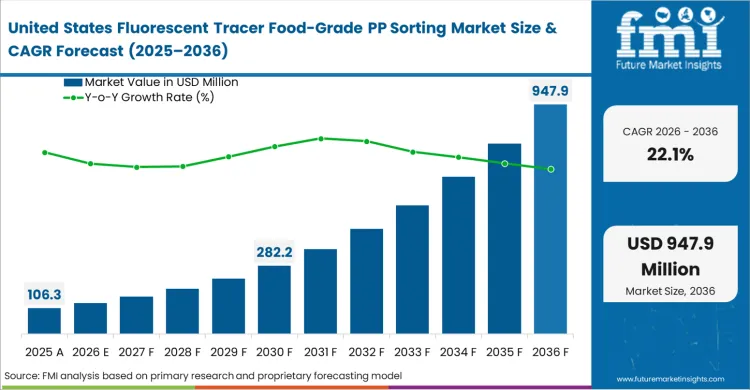
- United States: Demand for fluorescent tracer food-grade PP sorting in United States is anticipated to grow at 22.1% CAGR through 2036, supported by state mandates before procurement and budgeting cycles translate into higher deployment volumes.
FMI's report includes detailed analysis covering North America, highlighting growth dynamics shaping provincial investments. Canada and Mexico present compelling expansion corridors as cross-border brand owners seek unified post consumer recycled plastic packaging supplies across continental borders. Procurement teams should monitor harmonized labeling standards influencing capital upgrades.
Europe Fluorescent Tracer Food-Grade PP Sorting Market Analysis
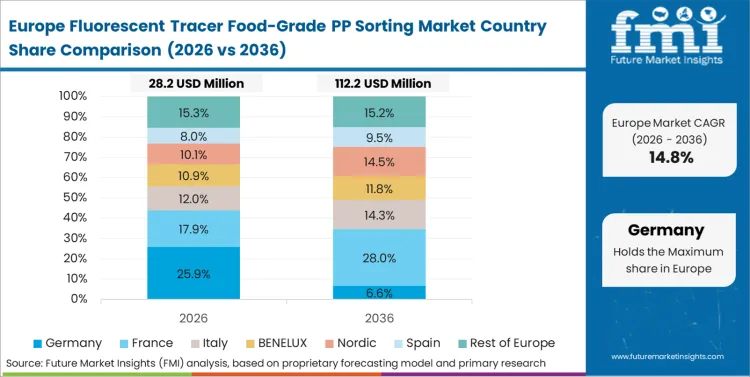
European facilities prioritize circularity targets governed by strict continental packaging directives. Lawmakers aggressively penalize virgin plastic consumption, forcing consumer brands to acquire verified post-consumer material regardless of pricing premiums. Regional sorting operators upgrade near-infrared systems with specialized ultraviolet modules to isolate marker-enhanced containers efficiently. Collaborative industry initiatives rapidly scale tracer implementation across localized supply chains to guarantee material provenance.
- Germany: Sales of fluorescent tracer food-grade PP sorting in Germany are projected to rise at 21.4% CAGR from 2026 to 2036 as aggressive recycling targets create a clearer pathway from policy intent to purchase orders.
- United Kingdom: United Kingdom sector is poised to expand at 20.9% CAGR during 2026 to 2036 because brand commitments lift utilization rates and justify technology refresh decisions.
FMI's report includes comprehensive assessments of European recovery infrastructure evolution. France, Italy, and Spain reflect opportunistic markets where localized packaging taxes accelerate transition toward circular models. Suppliers must navigate divergent municipal collection frameworks when designing mechanical recycling systems for food grade plastic upgrades.
Asia Pacific Fluorescent Tracer Food-Grade PP Sorting Market Analysis
Asia Pacific processors pivot toward advanced separation to satisfy international export standards and domestic environmental targets. Rapid urbanization generates immense municipal solid waste volumes, overwhelming traditional manual sorting infrastructure. Facilities adopt automated optical arrays to process mixed rigid containers efficiently, targeting high-value polymers for resale to global consumer brands. Regional resin producers begin incorporating luminescent additives to maintain competitiveness within regulated international supply chains. According to FMI's estimates, global plastic pollution volume reached 130 million tonnes in 2025, directing intense governmental focus toward scaling mechanized recovery networks [10].
- China: Demand for fluorescent tracer food-grade PP sorting in China is expected to grow 19.8% CAGR in tracer demand over 2026 to 2036 as urban waste legislation tightens the link between operational constraints and adoption-led investment. Primary plastic manufacturing dominates regional output, forcing facility operators to deploy automated capacity.
- India: In India, demand is forecast to advance at 19.3% CAGR through 2036, with growth anchored in extended producer responsibility frameworks that convert into measurable budget allocation. Global brands mandate traceable supply chains, accelerating mechanical recycling deployment.
FMI's report includes specialized intelligence regarding Asian processing advancements. Japan, South Korea, and Indonesia offer substantial secondary opportunities as regional consortiums fund advanced recovery pilots. Investors should track extended producer responsibility legislation dictating infrastructure upgrades across rapidly modernizing municipal networks seeking verifiable polypropylene recovery.
Latin America Fluorescent Tracer Food-Grade PP Sorting Market Analysis
Latin American material processors seek operational efficiencies to capture export value from recovered polymers. Municipalities struggle with informal collection networks, pushing corporate entities to finance private sorting facilities equipped with modern optical technology. Brand owners operating across continental borders mandate verified recycled inputs, stimulating targeted capital expenditure among dedicated recovery partners. Regional integration of tracer systems allows local recyclers to access premium international commodity pricing. Alcamare International Group joined American tracer initiatives in 2025, connecting localized recovery networks with global standards [13].
- Brazil: In Brazil, adoption is gaining strong momentum as corporate sustainability mandates push suppliers to align offerings with evolving procurement priorities. Leading consumer goods manufacturers are increasingly demanding verified material inputs, prompting investments in localized advanced sorting and recovery infrastructure. These structural shifts are expected to support growth at an 18.7% CAGR over the forecast period.
FMI's report includes tactical evaluations of Latin American recovery networks. Mexico, Chile, and Argentina represent critical expansion frontiers as international brands standardize packaging across hemispheric boundaries. Operations managers evaluating facility upgrades must consider autonomous sorting for flexible plastic waste technologies to maximize material capture rates.
Competitive Aligners for Market Players
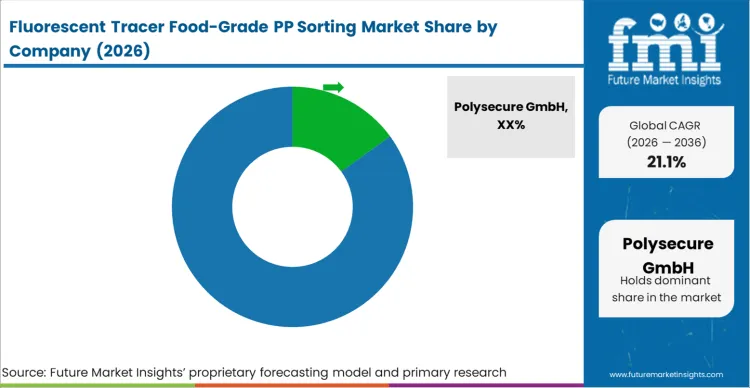
FMI analysts opine that market structure consolidates around integrated technology providers capable of delivering both proprietary markers and synchronized detection hardware. Companies operating closed-loop intellectual property portfolios dictate system architecture, forcing material recovery facilities into long-term technological commitments. Successful vendors establish early partnerships with global consumer brands, embedding specific fluorescent signatures into massive packaging volumes prior to collections. Operators prioritize equipment suppliers offering guaranteed detection accuracy over complex, multi-layered material streams.
FMI analysts opine that regulatory compliance capabilities aggressively differentiate tier-one equipment suppliers from generic optical machinery manufacturers. Vendors must demonstrate separation algorithms consistently yield polymer purity levels satisfying stringent health agency requirements. System integrators secure municipal contracts by providing verifiable data logs documenting separation efficiency and contamination removal rates. Manufacturers failing to secure authorized safety validations face severe procurement friction during municipal tender processes.
Recent Developments
The report includes full coverage of key trends from competitive benchmarking. Some of the recent developments covered in the reports:
- In October 2025, L’Oréal became the first major brand owner to join NEXTLOOPP Americas, supporting closed-loop, food-grade recycled polypropylene for food-contact packaging across the region. [5]
- In November 2025, Nextloopp Americas received FDA Letter of No Objection for its food-grade recycled polypropylene process, enabling 100% food-contact use and advancing AI-based sorting partnerships. [6]
Key Players in Fluorescent Tracer Food-Grade PP Sorting Market
- Polysecure GmbH
- Nextek Ltd
- TOMRA Recycling
- Digimarc Corporation
- MCC Verstraete
- Pellenc ST
Scope of the Report
| Metric | Value |
|---|---|
| Quantitative Units | USD 138.0 Million (2026) to USD 935.0 Million (2036), at a CAGR of 21.1% |
| Market Definition | Commercial deployment of photoluminescent markers and corresponding detection hardware to separate food-contact polypropylene from mixed post-consumer waste streams. |
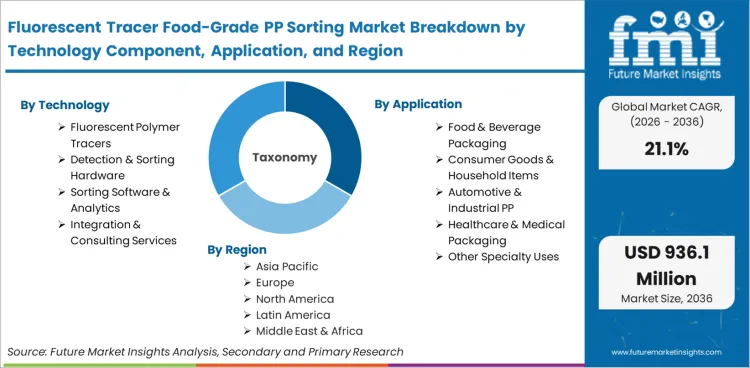
| Technology Component Segmentation | Fluorescent Polymer Tracers, Detection & Sorting Hardware, Sorting Software & Analytics, Integration & Consulting Services |
| Application Segmentation | Food & Beverage Packaging, Consumer Goods & Household Items, Automotive & Industrial PP, Healthcare & Medical Packaging, Other Specialty Uses |
| Regions Covered | North America, Latin America, Europe, East Asia, South Asia, Oceania, Middle East and Africa |
| Countries Covered | United States, Canada, Mexico, Brazil, Argentina, Germany, France, United Kingdom, Italy, Spain, China, India, Japan, South Korea, Indonesia, Australia and 40 plus countries |
| Key Companies Profiled | Polysecure GmbH, Nextek Ltd, TOMRA Recycling, Digimarc Corporation, MCC Verstraete, Pellenc ST |
| Forecast Period | 2026 to 2036 |
| Approach | Hybrid top-down and bottom-up market modeling validated through primary interviews with sorting equipment OEMs and facility managers, supported by trade data benchmarking. |
Fluorescent Tracer Food-Grade PP Sorting Market Analysis by Segments
Technology Component
- Fluorescent Polymer Tracers
- Detection & Sorting Hardware
- Sorting Software & Analytics
- Integration & Consulting Services
Application
- Food & Beverage Packaging
- Consumer Goods & Household Items
- Automotive & Industrial PP
- Healthcare & Medical Packaging
- Other Specialty Uses
Region
- Asia Pacific
- India
- China
- Japan
- South Korea
- Indonesia
- Australia & New Zealand
- ASEAN
- Rest of Asia Pacific
- Europe
- Germany
- Italy
- France
- United Kingdom
- Spain
- Benelux
- Nordics
- Central & Eastern Europe
- Rest of Europe
- North America
- United States
- Canada
- Mexico
- Latin America
- Brazil
- Argentina
- Chile
- Rest of Latin America
- Middle East & Africa
- Kingdom of Saudi Arabia
- United Arab Emirates
- South Africa
- Turkey
- Rest of Middle East & Africa
Bibliography
- [1] Waste Today Magazine. (2025, September). WM invests $47M in new PP/PE recycling facilities.
- [2] TOMRA Recycling. (2025, September). TOMRA Recycling welcomes NEXTLOOPP for hands-on trials of advanced PP sorting.
- [3] Interplas Insights. (2025, September). NextLoopp receives USA FDA approval for 100% food-grade recycled PP.
- [4] Plastics News. (2025). Polysecure technology promotes product transparency, circularity.
- [5] Packaging Europe. (2025, October). L’Oréal becomes first big brand owner in NextLoopp’s food-grade PP project.
- [6] Packaging World. (2025, November). NextLoop Americas receives FDA LNO, develops AI sorting.
- [7] Nextek Ltd. (2025). Nextek and Coveris join forces.
- [8] Sierra Club. (2025, December). State EPR fact sheets.
- [9] GreenBlue. (2026, February). How2Recycle upgrade announcement.
- [10] The Pew Charitable Trusts. (2025, December). Breaking the plastic wave 2025.
- [11] Beyond Plastics. (2025, December). Reports.
- [12] ISCC System. (2025). Market insights.
- [13] Recycling Today. (2025). Alcamare joins NextLoopp Americas food-grade polypropylene project.
This bibliography is provided for reader reference and is not exhaustive. The full report contains the complete reference list and detailed citations.
This Report Addresses
- Market intelligence to enable structured strategic decision making across mature and emerging resin recovery economies
- Market size estimation and 10 year revenue forecasts from 2026 to 2036, supported by validated capacity and trade benchmarks
- Growth opportunity mapping across hardware and marker additives with emphasis on high-purity packaging transitions
- Segment and regional revenue forecasts covering detection equipment, software licensing, and varied end-use applications
- Competition strategy assessment including integration models, capacity positioning, and compliance capability benchmarking
- Regulatory influence tracking including FDA clearances and regional recycled content mandates shaping capital allocation
- Market report delivery in PDF, Excel, PPT, and interactive dashboard formats for executive and operational use
Frequently Asked Questions
How large is the demand for Fluorescent Tracer Food-Grade PP Sorting in the global market in 2026?
Demand for Fluorescent Tracer Food-Grade PP Sorting in the global market is estimated to be valued at USD 138.0 Million in 2026.
What will be the market size of Fluorescent Tracer Food-Grade PP Sorting in the global market by 2036?
Market size for Fluorescent Tracer Food-Grade PP Sorting is projected to reach USD 935.0 Million by 2036.
What is the expected demand growth for Fluorescent Tracer Food-Grade PP Sorting in the global market between 2026 and 2036?
Demand for Fluorescent Tracer Food-Grade PP Sorting in the global market is expected to grow at a CAGR of 21.1% between 2026 and 2036.
Which Technology Component is poised to lead global sales by 2026?
Fluorescent Polymer Tracers segment is expected to lead with 45% market share in 2026, driven by continuous consumption across packaging manufacturing cycles.
How significant is the role of Food & Beverage Packaging in driving Fluorescent Tracer Food-Grade PP Sorting adoption in 2026?
Food and beverage packaging represents a critical segment, projected to hold a substantial 47% share of the total market in 2026 as consumer safety regulations enforce stringent purity requirements.
What is driving demand in United States?
Incoming state-level mandates and accelerated regulatory clearances for recycled plastics in food packaging drive capital allocation across domestic material recovery facilities.
What compliance standards or regulations are referenced for United States?
United States Food and Drug Administration Letters of No Objection regarding recycled plastic use in food packaging serve as primary compliance benchmarks.
What is the United States growth outlook in this report?
The United States is projected to grow at a CAGR of 22.1% during 2026 to 2036.
Why is Europe described as a priority region in this report?
European growth is governed by aggressive continental packaging directives penalizing virgin plastic consumption, forcing rapid upgrades to recycling infrastructure.
What type of demand dominates in Europe?
Demand driven by circular economy mandates for premium-grade, high-consistency post-consumer resin dominates regional consumption.
What is Germany growth outlook in this report?
Germany is projected to expand at a CAGR of 21.4% during 2026 to 2036.
Does the report cover United Kingdom in its regional analysis?
Yes, United Kingdom is included within Europe under the regional scope of analysis.
What are the sources referred to for analyzing United Kingdom?
European Food Safety Authority compliance logs, trade association datasets, and primary company disclosures regarding facility expansions serve as reference sources.
What is the main demand theme linked to United Kingdom in its region coverage?
Demand is associated with intense brand commitments lifting utilization rates and justifying technological refresh decisions across sorting facilities.
Does the report cover China in its regional analysis?
Yes, China is included within East Asia under the regional coverage framework.
What is the main China related demand theme in its region coverage?
Urban waste legislation tightening operational constraints forces facility operators to deploy automated capacity for high-volume primary plastic streams.
Which product formats or configurations are strategically important for North America supply chains?
Modular optical upgrades utilizing fluorescent detection software are prioritized due to lower operational disruption and rapid alignment with regulatory purity thresholds.
What is Fluorescent Tracer Food-Grade PP Sorting and what is it mainly used for?
It involves commercial deployment of photoluminescent markers and corresponding detection hardware to separate food-contact polypropylene from mixed post-consumer waste streams.
What does Fluorescent Tracer Food-Grade PP Sorting mean in this report?
The market refers to commercial sales of fluorescent markers, specialized sorting hardware, and associated software licensing enabling high-purity polymer recovery.
What is included in the scope of this Fluorescent Tracer Food-Grade PP Sorting report?
Scope covers fluorescent polymer tracers, detection equipment, software analytics, and professional integration services utilized across packaging recovery applications.
What is excluded from the scope of this report?
Standard near-infrared sorters, revenue from final recycled polypropylene granulate, and alternative digital watermarking systems are excluded from calculations.
What does market forecast mean on this page?
Market forecast represents a model-based projection built on defined facility-level operational assumptions for strategic planning purposes.
How does FMI build and validate the Fluorescent Tracer Food-Grade PP Sorting forecast?
Forecast is developed using hybrid top-down and bottom-up modeling validated through trade data, capacity checks, and interviews with equipment suppliers.
What does zero reliance on speculative third party market research mean here?
Primary interviews and verifiable public datasets are utilized instead of unverified syndicated market estimates to construct commercial models.
Preview the report firsthand - request a free sample
Get SampleGet the brochure for pricing and purchase details.
Get PDFTable of Content
- Executive Summary
- Global Market Outlook
- Demand-side Trends
- Supply-side Trends
- Technology Roadmap Analysis
- Analysis and Recommendations
- Market Overview
- Market Coverage / Taxonomy
- Market Definition / Scope / Limitations
- Research Methodology
- Chapter Orientation
- Analytical Lens and Working Hypotheses
- Market Structure, Signals, and Trend Drivers
- Benchmarking and Cross-market Comparability
- Market Sizing, Forecasting, and Opportunity Mapping
- Research Design and Evidence Framework
- Desk Research Programme (Secondary Evidence)
- Company Annual and Sustainability Reports
- Peer-reviewed Journals and Academic Literature
- Corporate Websites, Product Literature, and Technical Notes
- Earnings Decks and Investor Briefings
- Statutory Filings and Regulatory Disclosures
- Technical White Papers and Standards Notes
- Trade Journals, Industry Magazines, and Analyst Briefs
- Conference Proceedings, Webinars, and Seminar Materials
- Government Statistics Portals and Public Data Releases
- Press Releases and Reputable Media Coverage
- Specialist Newsletters and Curated Briefings
- Sector Databases and Reference Repositories
- FMI Internal Proprietary Databases and Historical Market Datasets
- Subscription Datasets and Paid Sources
- Social Channels, Communities, and Digital Listening Inputs
- Additional Desk Sources
- Expert Input and Fieldwork (Primary Evidence)
- Primary Modes
- Qualitative Interviews and Expert Elicitation
- Quantitative Surveys and Structured Data Capture
- Blended Approach
- Why Primary Evidence is Used
- Field Techniques
- Interviews
- Surveys
- Focus Groups
- Observational and In-context Research
- Social and Community Interactions
- Stakeholder Universe Engaged
- C-suite Leaders
- Board Members
- Presidents and Vice Presidents
- R&D and Innovation Heads
- Technical Specialists
- Domain Subject-matter Experts
- Scientists
- Physicians and Other Healthcare Professionals
- Governance, Ethics, and Data Stewardship
- Research Ethics
- Data Integrity and Handling
- Primary Modes
- Tooling, Models, and Reference Databases
- Desk Research Programme (Secondary Evidence)
- Data Engineering and Model Build
- Data Acquisition and Ingestion
- Cleaning, Normalisation, and Verification
- Synthesis, Triangulation, and Analysis
- Quality Assurance and Audit Trail
- Market Background
- Market Dynamics
- Drivers
- Restraints
- Opportunity
- Trends
- Scenario Forecast
- Demand in Optimistic Scenario
- Demand in Likely Scenario
- Demand in Conservative Scenario
- Opportunity Map Analysis
- Product Life Cycle Analysis
- Supply Chain Analysis
- Investment Feasibility Matrix
- Value Chain Analysis
- PESTLE and Porter’s Analysis
- Regulatory Landscape
- Regional Parent Market Outlook
- Production and Consumption Statistics
- Import and Export Statistics
- Market Dynamics
- Global Market Analysis 2021 to 2025 and Forecast, 2026 to 2036
- Historical Market Size Value (USD Million) Analysis, 2021 to 2025
- Current and Future Market Size Value (USD Million) Projections, 2026 to 2036
- Y-o-Y Growth Trend Analysis
- Absolute $ Opportunity Analysis
- Global Market Pricing Analysis 2021 to 2025 and Forecast 2026 to 2036
- Global Market Analysis 2021 to 2025 and Forecast 2026 to 2036, By Technology Component
- Introduction / Key Findings
- Historical Market Size Value (USD Million) Analysis By Technology Component , 2021 to 2025
- Current and Future Market Size Value (USD Million) Analysis and Forecast By Technology Component , 2026 to 2036
- Fluorescent Polymer Tracers
- Detection & Sorting Hardware
- Sorting Software & Analytics
- Integration & Consulting Services
- Fluorescent Polymer Tracers
- Y-o-Y Growth Trend Analysis By Technology Component , 2021 to 2025
- Absolute $ Opportunity Analysis By Technology Component , 2026 to 2036
- Global Market Analysis 2021 to 2025 and Forecast 2026 to 2036, By Application
- Introduction / Key Findings
- Historical Market Size Value (USD Million) Analysis By Application, 2021 to 2025
- Current and Future Market Size Value (USD Million) Analysis and Forecast By Application, 2026 to 2036
- Food & Beverage Packaging
- Consumer Goods & Household Items
- Automotive & Industrial PP
- Healthcare & Medical Packaging
- Other Specialty Uses
- Food & Beverage Packaging
- Y-o-Y Growth Trend Analysis By Application, 2021 to 2025
- Absolute $ Opportunity Analysis By Application, 2026 to 2036
- Global Market Analysis 2021 to 2025 and Forecast 2026 to 2036, By Region
- Introduction
- Historical Market Size Value (USD Million) Analysis By Region, 2021 to 2025
- Current Market Size Value (USD Million) Analysis and Forecast By Region, 2026 to 2036
- North America
- Latin America
- Western Europe
- Eastern Europe
- East Asia
- South Asia and Pacific
- Middle East & Africa
- Market Attractiveness Analysis By Region
- North America Market Analysis 2021 to 2025 and Forecast 2026 to 2036, By Country
- Historical Market Size Value (USD Million) Trend Analysis By Market Taxonomy, 2021 to 2025
- Market Size Value (USD Million) Forecast By Market Taxonomy, 2026 to 2036
- By Country
- USA
- Canada
- Mexico
- By Technology Component
- By Application
- By Country
- Market Attractiveness Analysis
- By Country
- By Technology Component
- By Application
- Key Takeaways
- Latin America Market Analysis 2021 to 2025 and Forecast 2026 to 2036, By Country
- Historical Market Size Value (USD Million) Trend Analysis By Market Taxonomy, 2021 to 2025
- Market Size Value (USD Million) Forecast By Market Taxonomy, 2026 to 2036
- By Country
- Brazil
- Chile
- Rest of Latin America
- By Technology Component
- By Application
- By Country
- Market Attractiveness Analysis
- By Country
- By Technology Component
- By Application
- Key Takeaways
- Western Europe Market Analysis 2021 to 2025 and Forecast 2026 to 2036, By Country
- Historical Market Size Value (USD Million) Trend Analysis By Market Taxonomy, 2021 to 2025
- Market Size Value (USD Million) Forecast By Market Taxonomy, 2026 to 2036
- By Country
- Germany
- UK
- Italy
- Spain
- France
- Nordic
- BENELUX
- Rest of Western Europe
- By Technology Component
- By Application
- By Country
- Market Attractiveness Analysis
- By Country
- By Technology Component
- By Application
- Key Takeaways
- Eastern Europe Market Analysis 2021 to 2025 and Forecast 2026 to 2036, By Country
- Historical Market Size Value (USD Million) Trend Analysis By Market Taxonomy, 2021 to 2025
- Market Size Value (USD Million) Forecast By Market Taxonomy, 2026 to 2036
- By Country
- Russia
- Poland
- Hungary
- Balkan & Baltic
- Rest of Eastern Europe
- By Technology Component
- By Application
- By Country
- Market Attractiveness Analysis
- By Country
- By Technology Component
- By Application
- Key Takeaways
- East Asia Market Analysis 2021 to 2025 and Forecast 2026 to 2036, By Country
- Historical Market Size Value (USD Million) Trend Analysis By Market Taxonomy, 2021 to 2025
- Market Size Value (USD Million) Forecast By Market Taxonomy, 2026 to 2036
- By Country
- China
- Japan
- South Korea
- By Technology Component
- By Application
- By Country
- Market Attractiveness Analysis
- By Country
- By Technology Component
- By Application
- Key Takeaways
- South Asia and Pacific Market Analysis 2021 to 2025 and Forecast 2026 to 2036, By Country
- Historical Market Size Value (USD Million) Trend Analysis By Market Taxonomy, 2021 to 2025
- Market Size Value (USD Million) Forecast By Market Taxonomy, 2026 to 2036
- By Country
- India
- ASEAN
- Australia & New Zealand
- Rest of South Asia and Pacific
- By Technology Component
- By Application
- By Country
- Market Attractiveness Analysis
- By Country
- By Technology Component
- By Application
- Key Takeaways
- Middle East & Africa Market Analysis 2021 to 2025 and Forecast 2026 to 2036, By Country
- Historical Market Size Value (USD Million) Trend Analysis By Market Taxonomy, 2021 to 2025
- Market Size Value (USD Million) Forecast By Market Taxonomy, 2026 to 2036
- By Country
- Kingdom of Saudi Arabia
- Other GCC Countries
- Turkiye
- South Africa
- Other African Union
- Rest of Middle East & Africa
- By Technology Component
- By Application
- By Country
- Market Attractiveness Analysis
- By Country
- By Technology Component
- By Application
- Key Takeaways
- Key Countries Market Analysis
- USA
- Pricing Analysis
- Market Share Analysis, 2025
- By Technology Component
- By Application
- Canada
- Pricing Analysis
- Market Share Analysis, 2025
- By Technology Component
- By Application
- Mexico
- Pricing Analysis
- Market Share Analysis, 2025
- By Technology Component
- By Application
- Brazil
- Pricing Analysis
- Market Share Analysis, 2025
- By Technology Component
- By Application
- Chile
- Pricing Analysis
- Market Share Analysis, 2025
- By Technology Component
- By Application
- Germany
- Pricing Analysis
- Market Share Analysis, 2025
- By Technology Component
- By Application
- UK
- Pricing Analysis
- Market Share Analysis, 2025
- By Technology Component
- By Application
- Italy
- Pricing Analysis
- Market Share Analysis, 2025
- By Technology Component
- By Application
- Spain
- Pricing Analysis
- Market Share Analysis, 2025
- By Technology Component
- By Application
- France
- Pricing Analysis
- Market Share Analysis, 2025
- By Technology Component
- By Application
- India
- Pricing Analysis
- Market Share Analysis, 2025
- By Technology Component
- By Application
- ASEAN
- Pricing Analysis
- Market Share Analysis, 2025
- By Technology Component
- By Application
- Australia & New Zealand
- Pricing Analysis
- Market Share Analysis, 2025
- By Technology Component
- By Application
- China
- Pricing Analysis
- Market Share Analysis, 2025
- By Technology Component
- By Application
- Japan
- Pricing Analysis
- Market Share Analysis, 2025
- By Technology Component
- By Application
- South Korea
- Pricing Analysis
- Market Share Analysis, 2025
- By Technology Component
- By Application
- Russia
- Pricing Analysis
- Market Share Analysis, 2025
- By Technology Component
- By Application
- Poland
- Pricing Analysis
- Market Share Analysis, 2025
- By Technology Component
- By Application
- Hungary
- Pricing Analysis
- Market Share Analysis, 2025
- By Technology Component
- By Application
- Kingdom of Saudi Arabia
- Pricing Analysis
- Market Share Analysis, 2025
- By Technology Component
- By Application
- Turkiye
- Pricing Analysis
- Market Share Analysis, 2025
- By Technology Component
- By Application
- South Africa
- Pricing Analysis
- Market Share Analysis, 2025
- By Technology Component
- By Application
- USA
- Market Structure Analysis
- Competition Dashboard
- Competition Benchmarking
- Market Share Analysis of Top Players
- By Regional
- By Technology Component
- By Application
- Competition Analysis
- Competition Deep Dive
- Polysecure GmbH
- Overview
- Product Portfolio
- Profitability by Market Segments (Product/Age /Sales Channel/Region)
- Sales Footprint
- Strategy Overview
- Marketing Strategy
- Product Strategy
- Channel Strategy
- Nextek Ltd
- TOMRA Recycling
- Digimarc Corporation
- MCC Verstraete
- Pellenc ST
- Polysecure GmbH
- Competition Deep Dive
- Assumptions & Acronyms Used


