

- Market Size (2026)
- USD 2.9 Bn
- Forecast (2036)
- USD 5.8 Bn
- CAGR (2026 to 2036)
- 7.2%
How big is Frozen Bao Market in 2026?
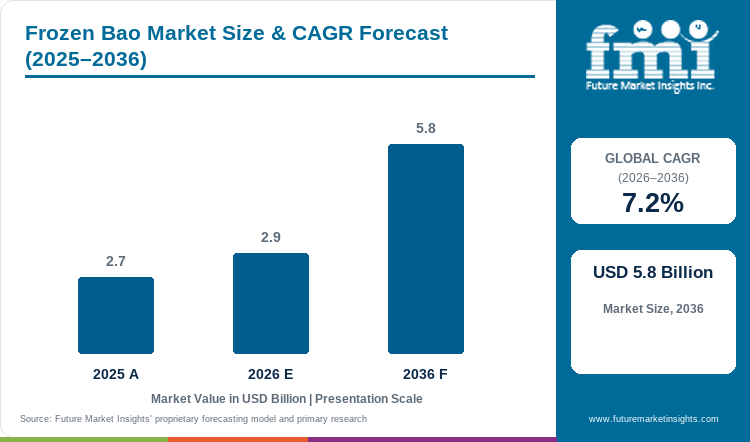
USD 2.9 Billion in 2026 and USD 5.8 Billion by 2036 at a 7.2% CAGR.
Sales of frozen bao are estimated to rise from USD 2.9 Billion in 2026 to USD 5.8 Billion by 2036 at a 7.2% CAGR. The market was valued at USD 2.7 Billion in 2025. The category sits where steamed bread, frozen convenience food and Asian meal occasions overlap. China remains the anchor production and consumption base, while grocery expansion in North America, Europe and Oceania is giving frozen bao a wider retail role. Sanquan Food reported that China's quick-frozen flour and rice products market reached RMB 77.1 Billion in 2024. In the United States, Wow Bao says its frozen products are available in more than 18,000 grocery stores. Sanquan's scale shows the depth of the East Asian frozen flour-and-rice base, while Wow Bao's grocery footprint shows how frozen bao is extending through mainstream US retail. The broader frozen food market provides the cold-chain infrastructure and freezer-space competition within which bao brands must operate.
Bao dough must remain soft around the filling after freezing and reheating. Too much moisture can weaken the seal; too little can leave the bun dry. Household packs need clear preparation instructions and manageable portions. Foodservice cases need consistent piece weight and recovery in a steamer during service. These requirements shape different retail and catering products.
Key Takeaways
- The market is estimated at USD 2.9 Billion in 2026 and USD 5.8 Billion by 2036 at a 7.2% CAGR. The 2025 base is USD 2.7 Billion.
- Closed filled bao holds 61.0% of Product Type demand in 2026 because the format combines the bun and filling in one frozen unit that can move directly from freezer to steamer or microwave.
- Meat & poultry fillings account for 47.0% of Filling Type demand. Pork, chicken and duck give brands familiar savory variants for both Asian-specialty and mainstream retail.
- Household/Retail represents 63.0% of End Use demand. Foodservice remains important where operators want consistent buns without managing dough proofing and bun production on site.
- Supermarkets & Hypermarkets account for 46.0% of Sales Channel demand, while 250-500 g packs hold 41.0% of Pack Size demand because the format fits multi-serve household occasions without requiring a large freezer commitment.
- Country CAGRs range from 8.8% in the USA to 5.9% in Japan from 2026 to 2036. Distribution expansion has more influence in newer retail markets, while established Asian markets grow from a broader frozen flour-and-rice base.
Analyst Perspective
Steaming should restore a soft bun without leaving the filling cold or the dough wet. Formulation and seals must withstand frozen storage. Retail packs need reliable household cooking instructions; foodservice buns must hold their shape during batch reheating.
- Nandini Roy Choudhury, Principal Consultant, Future Market Insights
How is the Frozen Bao Market segmented?
The Frozen Bao Market is segmented by Product Type, Filling Type, End Use, Sales Channel, Pack Size, and Region.
Product Type covers Closed Filled Bao, Folded Gua Bao Buns, Plain/Mantou-Style Buns and Specialty Sweet/Dessert Bao. Filling Type includes Meat & Poultry, Vegetarian & Vegan, Sweet Fillings, Seafood and Other/Unfilled. End Use is divided into Household/Retail, Foodservice/HoReCa and Institutional/Other. Sales Channel covers Supermarkets & Hypermarkets, Asian Specialty Retail, Online Grocery/DTC, Convenience Stores and Foodservice Distributors. Pack Size is split into Below 250 g, 250-500 g, 500 g-1 kg and Above 1 kg. Regional coverage spans North America, Latin America, Western Europe, Eastern Europe, East Asia, South Asia & Pacific, and Middle East & Africa.
Why does Closed Filled Bao lead the Product Type category?
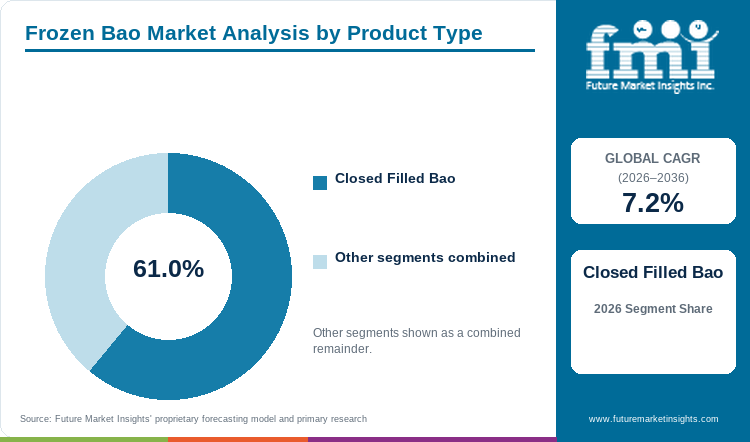
Closed filled bao packages dough and filling as one finished frozen unit. That lowers the number of preparation steps for households and gives foodservice operators a consistent piece count. Pork, chicken and vegetable buns can be steamed directly from frozen, while several consumer brands also support microwave preparation. The format therefore competes across snack, breakfast and light-meal occasions. Folded gua bao buns remain commercially useful because they let the buyer add a separate filling, but they shift more labor and ingredient handling to the user. The related frozen bakery market shows the wider role of freezer-stable bread formats, but bao differs because steaming performance and filling interaction matter more than oven bake-off.
- Closed Filled Bao holds 61.0% of Product Type demand in 2026.
- Wei-Chuan USA lists frozen cha shu, pork, chicken and vegetable-linked steamed buns with steamer and microwave preparation, showing how one closed-bun architecture can support multiple fillings.
Why do Meat & Poultry fillings lead the Filling Type category?
Savory meat fillings give frozen bao a direct route into meal and snacking occasions. Pork remains central in Chinese-style cha shu and cabbage-pork buns, while chicken allows brands to adapt teriyaki, barbecue and breakfast flavors for wider retail audiences. Duck also appears in UK grocery ranges. These proteins work with sweet-savory sauces that remain recognizable after frozen storage and steam reheating. Vegetarian, vegan and sweet buns expand the addressable audience, but meat-filled formats still cover a wide set of traditional and crossover products across current company portfolios.
- Meat & Poultry fillings account for 47.0% of Filling Type demand in 2026.
- Wow Bao markets frozen cheeseburger, breakfast, barbecue pork and other filled bao in the USA, while itsu carries chicken and hoisin duck frozen bao in the UK.
Why does Household/Retail lead the End Use category?
Frozen bao moves preparation work out of the home kitchen. Consumers can keep a multi-pack in the freezer and prepare only the number of buns needed for a snack or meal. That matters because fresh bao production requires dough mixing, proofing, shaping and steaming. Retail-ready frozen buns also let brands attach cooking instructions to a repeatable portion size. The same convenience mechanism supports the wider frozen cooked ready meals market, although bao is usually sold as a snack, bun component or small meal rather than a plated entree.
- Household/Retail accounts for 63.0% of End Use demand in 2026.
- Japan Frozen Food Association reported 760,385 tonnes of household frozen-food production in 2025, alongside 813,787 tonnes for foodservice, showing that both usage systems remain commercially relevant in a mature frozen-food market.
Why do Supermarkets & Hypermarkets lead the Sales Channel category?
Mainstream grocery gives frozen bao access to shoppers who may not visit an Asian specialty store. It also places bao next to dumplings, frozen snacks and ready meal components, which can encourage trial through a familiar freezer mission. The channel is demanding because brands must earn shelf space, maintain replenishment and explain preparation quickly on pack. Wow Bao's grocery footprint in the USA and itsu's listings across major UK grocers show the direction of travel. Asian specialty retail remains important for broader flavor depth and traditional brands, while foodservice distributors handle larger case formats.
- Supermarkets & Hypermarkets hold 46.0% of Sales Channel demand in 2026.
- Coles currently lists frozen BBQ pork buns and gua bao within its frozen Asian food range in Australia, indicating that bao has a defined place inside mainstream frozen world-food merchandising.
Why does the 250-500 g band lead the Pack Size category?
A 250-500 g pack gives households several buns without moving into a bulk foodservice case. It also works across mini bao and standard bun sizes, giving brands flexibility on piece count. Smaller packs reduce trial risk but can carry a higher price per kilogram. Larger packs improve value but require more freezer space and increase the risk that an occasional buyer keeps the product for too long. The middle band therefore fits weekly freezer shopping and can support both family sharing and multiple individual snack occasions.
- The 250-500 g band accounts for 41.0% of Pack Size demand in 2026.
- Kawan lists several frozen bun products at 270 g and 360 g, while FairPrice listings in Singapore show frozen bun packs around 270 g to 360 g, placing common consumer formats inside the leading band.
What are the drivers, restraints and opportunities in the Frozen Bao Market?
Mainstream freezer access supports demand, texture loss after frozen storage constrains repeat purchase, and microwave-friendly plus plant-based formats create room for portfolio expansion.
- Driver: Asian frozen snacks are moving from specialist stores into mainstream grocery, reducing the distribution barrier for consumers who want restaurant-style foods at home.
- Restraint: Frozen dough must recover softness after reheating while the filling retains moisture and flavor. Poor reheating performance can turn an easy first purchase into weak repeat demand.
- Opportunity: Microwave-steam packs, vegetarian fillings and flexible pack sizes can open additional snack and meal occasions without requiring consumers to use a bamboo steamer.
Grocery listings make bao easier to find, while clear preparation instructions help shoppers try it at home. A shopper who already buys dumplings or Asian frozen meals is more likely to trial bao when it appears in the same freezer set. The broader ethnic food market provides another route because Asian cuisine products are increasingly merchandised beyond dedicated import stores. In the UK, itsu carries frozen chicken, duck and vegetable bao alongside newer slider-style products. In the USA, Wow Bao has taken a restaurant brand into national grocery distribution. Each case reduces the education burden for a category that was once more dependent on foodservice exposure or Asian grocery shopping.
Frozen steamed dough can dry, toughen or wrinkle when formulation, packaging or temperature control is inadequate. Filling moisture can also weaken the dough or seal. The frozen dough market addresses related storage problems, but filled bao must maintain both bread texture and a stable filling through reheating. Testing must cover the stated storage period and each recommended preparation method.
Microwave and steam-in-pack formats can make bao easier to prepare in kitchens without a steamer. Household instructions must restore softness without overcooking the filling. Foodservice operators can use folded gua bao buns as a standardized bread component, adding their own protein and garnish while avoiding dough preparation during service.
Which country CAGRs are profiled in the Frozen Bao Market?
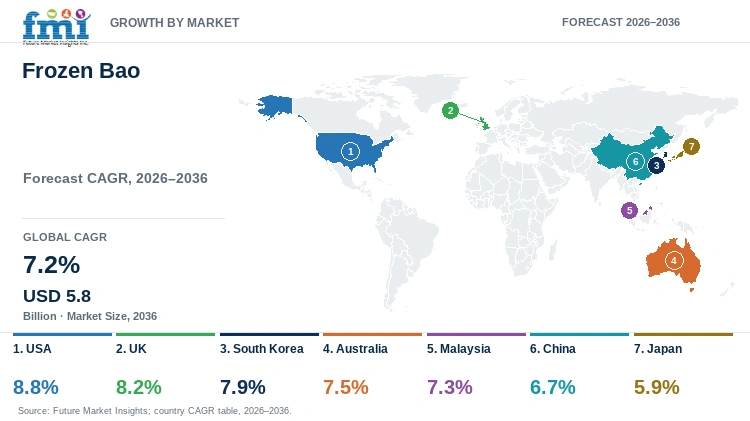
| Country | CAGR |
|---|---|
| USA | 8.8% |
| UK | 8.2% |
| South Korea | 7.9% |
| Australia | 7.5% |
| Malaysia | 7.3% |
| China | 6.7% |
| Japan | 5.9% |
How do country-level CAGRs compare in the Frozen Bao Market?
The profiled country rates run from 8.8% in the USA to 5.9% in Japan between 2026 and 2036. The USA and UK have more room for mainstream grocery conversion because bao is still moving out of specialist Asian channels. South Korea and Malaysia combine Asian frozen-food manufacturing capability with regional export routes. Australia benefits from established Asian frozen-food shelves inside major supermarkets. China grows from a much broader quick-frozen flour-and-rice base, so percentage growth is moderated by scale. Japan also starts from a mature frozen-food system, where category growth depends more on product rotation and convenience than on basic freezer adoption.
- USA at 8.8% is supported by wider grocery access and cross-over flavors that place bao into breakfast and snack occasions.
- UK at 8.2% reflects a developed frozen aisle plus retail brands that have made Asian convenience food easier to prepare at home.
- China at 6.7% and Japan at 5.9% operate from established frozen-food consumption systems, which changes the growth task from category introduction to format and occasion expansion.
Country-wise Analysis
- USA: Demand for frozen bao is forecast to expand at 8.8% CAGR from 2026 to 2036. Wow Bao states that its frozen products are available in more than 18,000 grocery stores nationwide, while Wei-Chuan USA carries multiple frozen steamed-bun variants in consumer and foodservice case formats. The commercial opportunity is wider than traditional pork bao because brands are adapting breakfast, cheeseburger and chicken flavors to familiar American occasions. Shelf competition remains intense, so repeat purchase depends on microwave performance and clear preparation instructions as much as initial curiosity.
- UK: Demand for frozen bao is forecast to expand at 8.2% CAGR from 2026 to 2036. The British Frozen Food Federation reported in March 2026 that combined UK frozen retail and foodservice sales exceeded GBP 10 Billion and that the sector had been growing around 6.6% year on year. itsu currently sells frozen duck, chicken and vegetable bao plus bao sliders. The addressable buyer is therefore moving beyond specialist Asian retail, but brands still need to defend a small freezer footprint against established frozen snacks and meals.
- South Korea: Demand for frozen bao is forecast to expand at 7.9% CAGR from 2026 to 2036. Korea already has substantial manufacturing and export capability in adjacent frozen dumpling categories. KATI reported that Korean frozen dumpling exports to Japan reached USD 9.7 Million through July 2025, up 59.4% in value from the same period of 2024. The export growth also points to cold-chain and Asian convenience-food channels that can support filled steamed buns. Product localization will determine how much of that capability converts into bao demand.
- Australia: Demand for frozen bao is forecast to expand at 7.5% CAGR from 2026 to 2036. Coles lists BBQ pork buns and gua bao within its frozen Asian range and uses frozen bao buns in recipe content aimed at everyday shoppers. That tells suppliers something practical: freezer access already exists, so the next step is increasing purchase frequency. Australia also receives frozen Asian products through regional suppliers. Brands need pack sizes that work for smaller households and preparation methods that do not assume specialist steaming equipment.
- Malaysia: Demand for frozen bao is forecast to expand at 7.3% CAGR from 2026 to 2036. Malaysia combines domestic bun consumption with export-oriented frozen-food manufacturing. Kawan Food sells frozen curry, chicken rendang, kaya, coconut, lotus, red bean and BBQ soy buns, while Foo Chow Food supplies frozen bao to restaurants and distributors and offers OEM/ODM development. This creates a market with both consumer and business-to-business demand. Growth depends on product rotation, value packs and regional cold-chain economics rather than basic category awareness.
- China: Demand for frozen bao is forecast to expand at 6.7% CAGR from 2026 to 2036. Sanquan Food reported that China's quick-frozen flour-and-rice products market reached RMB 77.1 Billion in 2024. Sanquan itself sold 621,724.6 tonnes of quick-frozen flour-and-rice products in 2025. Bao competes inside this broad, established system with dumplings, tangyuan, zongzi and other frozen staples. Suppliers therefore have to win through filling innovation, dough quality, channel fit and value rather than relying on novelty alone.
- Japan: Demand for frozen bao is forecast to expand at 5.9% CAGR from 2026 to 2036. Japan Frozen Food Association reported 1,574,172 tonnes of domestic frozen-food production in 2025 with factory shipment value of JPY 857.7 Billion. Per-capita frozen-food consumption reached 24.6 kg. A mature freezer habit supports ready-to-steam buns, but it also raises the quality threshold because consumers have many familiar frozen alternatives. Bao suppliers need reliable texture and portioning while differentiating from gyoza, shumai and other established convenience foods.
Who are the notable companies in the Frozen Bao Market?
Sanquan Food; Anjoy Foods; Wow Bao; itsu; Kawan Food; Wei-Chuan USA; Foo Chow Food
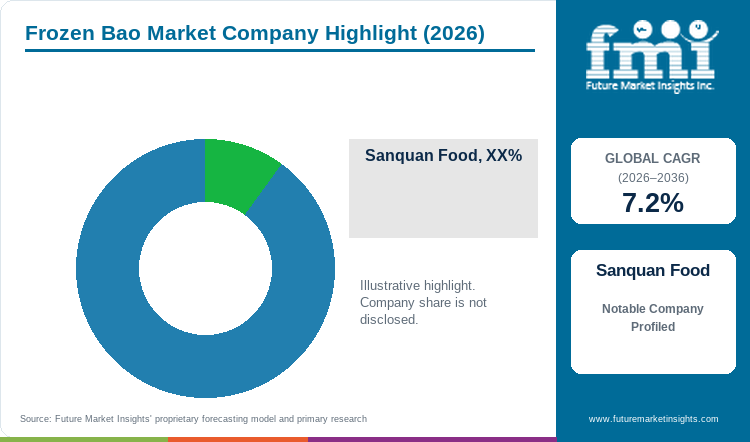
Competition is fragmented across Chinese quick-frozen food groups, Western retail brands and regional bun specialists. Sanquan Food and Anjoy Foods participate from large quick-frozen flour-and-rice portfolios in China. Wow Bao combines a restaurant brand with grocery distribution in the USA. itsu uses a grocery-led Asian convenience portfolio in the UK. Kawan Food and Foo Chow Food bring Malaysian manufacturing and wholesale capability, while Wei-Chuan USA serves a broad range of frozen steamed buns in North America. The competitive question is less about one universal product and more about which supplier can match dough style, filling, pack size and channel economics to the intended market.
- Scaled Quick-Frozen Food Platforms: Sanquan Food and Anjoy Foods operate broad frozen flour-and-rice portfolios with manufacturing depth beyond bao alone.
- Mainstream Grocery-Led Brands: Wow Bao and itsu use consumer branding and simple preparation to take bao into broader freezer aisles.
- Regional Bun and Foodservice Specialists: Kawan Food, Wei-Chuan USA and Foo Chow Food cover frozen bun ranges that include retail packs, foodservice cases or wholesale supply.
Competitive Benchmarking: Frozen Bao Market
| Company | Frozen Bao / Bun Breadth | Retail & Foodservice Coverage | Cold-Chain / Export Reach | Geographic Reach |
|---|---|---|---|---|
| Sanquan Food | High | High | High | China with overseas expansion |
| Anjoy Foods | High | High | High | China plus international operations |
| Wow Bao | High | High | Medium | USA |
| itsu | High | High | Medium | UK and selected European retail |
| Kawan Food | High | High | High | Malaysia with exports to 40+ countries |
| Wei-Chuan USA | High | High | Medium | USA and North American Asian retail |
| Foo Chow Food | High | High | Medium | Malaysia with wholesale/OEM focus |
Scoring basis: Frozen Bao / Bun Breadth reflects documented variety across filled, plain, folded or sweet bun formats. Retail & Foodservice Coverage reflects evidence of consumer packs, wholesale packs or both. Cold-Chain / Export Reach reflects documented frozen distribution beyond a single local store network. High indicates broad documented capability against the criterion. Medium indicates narrower but relevant coverage.
Key Developments in the Frozen Bao Market
- In April 2026, Sanquan Food disclosed in its 2025 annual report that 235,000 tonnes of additional supply-chain capacity was under construction. The company also reported RMB 388.4 Million of direct e-commerce revenue in 2025, up 7.1%. The development adds capacity and a direct digital route around a broad quick-frozen flour-and-rice portfolio that includes bun-type products.
- On July 4, 2025, Anjoy Foods listed on the Main Board of the Hong Kong Stock Exchange. Anjoy's official product portfolio includes steamed buns and a dedicated bun/dim-sum series within quick-frozen flour-and-rice products. The listing adds another capital-market platform for a supplier already operating multiple integrated production bases across China.
- During FY2025, Kawan Food said it prioritized product rationalization across its core range, including buns, and began packaging-reduction studies that cover Mini Bun products. The work focuses on keeping frozen bun formats affordable while reducing packaging material without compromising shelf life or product integrity.
Key Players in the Frozen Bao Market
Scaled Quick-Frozen Food Platforms
- Sanquan Food
- Anjoy Foods
Mainstream Grocery-Led Brands
- Wow Bao
- itsu
Regional Bun and Foodservice Specialists
- Kawan Food
- Wei-Chuan USA
- Foo Chow Food
Frozen Bao Market - Report Scope
| Coverage field | Report scope |
|---|---|
| Market breakdown | Product Type; Filling Type; End Use; Sales Channel; Pack Size; Region |
| Quantitative Units | USD Billion |
| Market Definition | Revenue from commercially sold frozen steamed-bread bao and bun products, including closed filled bao, folded gua bao buns, plain or mantou-style frozen buns, and specialty sweet/dessert bao. Retail and foodservice sales are included within the defined product boundary. |
| Exclusions | Fresh restaurant-prepared bao; chilled-only or ambient buns; thin-wrapper soup dumplings, gyoza, wontons and shumai; raw dough sold without a finished bao/bun format; restaurant menu revenue beyond the frozen product sale. |
| Regions Covered | North America; Latin America; Western Europe; Eastern Europe; East Asia; South Asia & Pacific; Middle East & Africa |
| Countries Covered | USA; UK; South Korea; Australia; Malaysia; China; Japan; and more than twenty-five additional countries in the full report |
| Key Companies Profiled | Sanquan Food; Anjoy Foods; Wow Bao; itsu; Kawan Food; Wei-Chuan USA; Foo Chow Food |
| Forecast Period | 2026 to 2036 |
| Approach | Hybrid bottom-up and top-down sizing that reconciles category anchors, manufacturer disclosures, retail assortment, pack-price evidence, channel structure and country adoption conditions within the defined frozen bao revenue boundary. |
Frozen Bao Market - Research Methodology
| Method | Approach |
|---|---|
| Primary Research | Market-participant evidence covers manufacturer, retailer, distributor and foodservice purchase criteria. Public management disclosures and current company product documentation are used to assess channel fit, pack formats, preparation methods and portfolio activity. |
| Desk Research | The research reviews national standards, frozen-food association statistics, company annual reports, official product catalogs, government trade material and current retail listings that are directly relevant to frozen bao or the surrounding frozen-food system. |
| Market Sizing and Forecasting | Sizing begins with quick-frozen flour-and-rice category anchors in East Asia, then separates bao/bun formats using product mix, retail assortment and manufacturer evidence. Country estimates are cross-checked with frozen-food consumption, distribution reach, pack economics and foodservice availability before forecasting 2026 to 2036. |
| Data Validation | The model is reconciled across product type, filling, end use, channel, pack size and country views to avoid double counting. Revenue from fresh restaurant bao, adjacent dumplings and downstream prepared-menu sales is kept outside the market boundary. |
Frozen Bao Market by Segments
Frozen Bao Market segmented by Product Type:
- Closed Filled Bao
- Folded Gua Bao Buns
- Plain/Mantou-Style Buns
- Specialty Sweet/Dessert Bao
Frozen Bao Market segmented by Filling Type:
- Meat & Poultry
- Vegetarian & Vegan
- Sweet Fillings
- Seafood
- Other / Unfilled
Frozen Bao Market segmented by End Use:
- Household / Retail
- Foodservice / HoReCa
- Institutional / Other
Frozen Bao Market segmented by Sales Channel:
- Supermarkets & Hypermarkets
- Asian Specialty Retail
- Online Grocery / DTC
- Convenience Stores
- Foodservice Distributors
Frozen Bao Market segmented by Pack Size:
- Below 250 g
- 250-500 g
- 500 g-1 kg
- Above 1 kg
Frozen Bao Market by Region:
- North America
- United States
- Canada
- Latin America
- Brazil
- Mexico
- Argentina
- Chile
- Western Europe
- Germany
- France
- United Kingdom
- Italy
- Spain
- Benelux
- Nordics
- Eastern Europe
- Poland
- Czech Republic
- Romania
- Hungary
- East Asia
- China
- Japan
- South Korea
- South Asia & Pacific
- India
- ASEAN
- Australia and New Zealand
- Middle East & Africa
- GCC Countries
- South Africa
- Türkiye
- Israel
Research Sources and Bibliography
- Sanquan Food Co., Ltd. 2025 Annual Report. Published April 27, 2026 through CNInfo.
- State Administration for Market Regulation / Standardization Administration of China. GB/T 47138-2026, General quality for quick-frozen food made of wheat flour and rice. Published January 28, 2026; effective August 1, 2026.
- National Health Commission of China. Q&A on GB 19295-2011, covering quick-frozen prepackaged flour-and-rice foods.
- Japan Frozen Food Association. 2025 Frozen Food Production and Consumption Statistics. Published April 16, 2026; corrected April 23, 2026.
- Federal Reserve Board. G.5A Annual Foreign Exchange Rates. January 5, 2026.
- British Frozen Food Federation. Frozen Food Manufacturing: The Data Decade Has Arrived. March 25, 2026.
- Korea Agro-Fisheries & Food Trade Corporation, KATI. Frozen dumpling export and distribution trends in Japan. September 23, 2025.
- Kawan Food Berhad. Annual Report 2025; current Buns product catalog.
- Anjoy Food Group Co., Ltd. Official rice-and-flour product catalog; company news on the July 4, 2025 Hong Kong listing.
- Wow Bao. Current frozen bao product and grocery partnership pages.
- itsu. Current frozen grocery product catalog.
- Wei-Chuan USA. Current frozen bun product pages.
- Foo Chow Food Industries. Current Frozen Bao & Dim Sum product catalog.
- Coles Australia. Current Frozen Asian Foods assortment and recipe pages.
This Report Answers
- What is the Frozen Bao Market size in 2026 and what value is forecast for 2036?
- Why do Closed Filled Bao products account for 61.0% of Product Type demand in 2026?
- How do filling choice and reheating performance influence repeat purchase?
- Why does Household/Retail account for 63.0% of End Use demand?
- How do country growth rates differ across the USA, UK, South Korea, Australia, Malaysia, China and Japan?
- How are Chinese quick-frozen food groups positioned differently from Western grocery-led bao brands?
- Which pack sizes and channels support household purchase in the Frozen Bao Market?
- What should retailers and foodservice buyers evaluate when qualifying a frozen bao supplier?
Frequently Asked Questions
What is driving growth in the Frozen Bao Market?
Growth is being supported by wider freezer distribution and easier at-home preparation. Frozen bao can serve as a snack, small meal or menu component, which gives the product more than one purchase occasion. Grocery expansion in the USA, UK and Australia exposes the format to consumers outside specialist Asian stores, while mature Asian markets continue to support a broad base of quick-frozen flour-and-rice foods.
Who are the key players in the Frozen Bao Market?
Key companies include Sanquan Food, Anjoy Foods, Wow Bao, itsu, Kawan Food, Wei-Chuan USA and Foo Chow Food. Their roles differ. Sanquan and Anjoy operate broad quick-frozen food systems, Wow Bao and itsu are consumer-facing grocery brands, while Kawan, Wei-Chuan and Foo Chow combine regional bun portfolios with wholesale or foodservice formats.
What notable restraint affects the Frozen Bao Market?
Texture recovery is a central restraint. The bun must remain soft after frozen storage and reheating while the filling stays moist without weakening the dough. A product that is easy to buy but reheats poorly can lose repeat demand quickly. Cold-chain breaks and weak packaging barriers add another risk because surface drying and ice formation are immediately visible after steaming.
Why should executives track the Frozen Bao Market?
Frozen bao is a useful indicator of how Asian foods move from restaurant discovery into packaged grocery formats. The market also shows how frozen dough technology, filling formulation and channel access work together. Suppliers that succeed in bao can apply similar learning to other steamed snacks, dumpling-adjacent products and frozen meal components without assuming the categories are identical.
What should retailers and foodservice buyers evaluate in the Frozen Bao Market?
Buyers should test frozen storage stability, seal integrity, dough softness after reheating, filling distribution and piece-weight consistency. They should also compare preparation time, pack size, case configuration, allergen labeling, shelf-life documentation and service reliability. For foodservice, steam recovery and batch handling matter. For retail, packaging clarity and freezer-space productivity matter more.
What supports long-term commercial confidence in the Frozen Bao Market?
The category has two durable demand bases. Asian markets already consume frozen flour-and-rice foods at scale, while Western markets are adding more Asian products to mainstream freezer sets. Frozen bao can also move between household and foodservice use. Long-term growth will still depend on repeat purchase, so product quality after reheating is more important than short-lived flavor novelty.
Preview the report firsthand - request a free sample
Get SampleGet the brochure for pricing and purchase details.
Get PDFTable of Content
- Key Takeaways
- Market Size and CAGR
- Top Growth Driver
- Fastest Growing Segment
- Leading Region
- Key Companies
- Emerging Opportunities
- Executive Summary
- Global Market Outlook
- Demand-side Trends
- Supply-side Trends
- Technology Roadmap Analysis
- Analysis and Recommendations
- Analyst Perspective (What is happening? Why now? What should investors know?)
- Key Questions Answered
- How large is the market?
- What is the CAGR?
- What are key trends?
- Which region dominates?
- Who are the leaders?
- Market Overview
- Market Coverage / Taxonomy
- Market Definition / Scope / Limitations
- Research Methodology
- Chapter Orientation
- Analytical Lens and Working Hypotheses
- Market Structure, Signals, and Trend Drivers
- Benchmarking and Cross-market Comparability
- Market Sizing, Forecasting, and Opportunity Mapping
- Research Design and Evidence Framework
- Desk Research Programme (Secondary Evidence)
- Expert Input and Fieldwork (Primary Evidence)
- Tooling, Models, and Reference Databases
- Data Engineering and Model Build
- Quality Assurance and Audit Trail
- Market Background
- Market Dynamics (Drivers, Restraints, Opportunity, Trends)
- Scenario Forecast (Optimistic, Likely, Conservative)
- Impact Analysis
- AI Impact
- Sustainability Impact
- Regulatory Impact
- Technology Impact
- Consumer / Buyer Analysis
- Purchase Drivers
- Adoption Barriers
- Buyer Journey
- Opportunity Map Analysis
- Product Life Cycle Analysis
- Supply Chain Analysis
- Investment Feasibility Matrix
- Value Chain Analysis
- PESTLE and Porter's Analysis
- Regulatory Landscape
- Regional Parent Market Outlook
- Production and Consumption Statistics
- Import and Export Statistics
- Global Market Analysis and Forecast, 2021 to 2036
- Historical Market Size Value (USD Billion) Analysis, 2021 to 2025
- Current and Future Market Size Value (USD Billion) Projections, 2026 to 2036
- Y-o-Y Growth Trend Analysis
- Absolute $ Opportunity Analysis
- Global Market Pricing Analysis, 2021 to 2036
- Global Market Analysis and Forecast, By Product Type, 2021 to 2036
- Introduction / Key Findings
- Historical Market Size Value (USD Billion) Analysis By Product Type, 2021 to 2025
- Current and Future Market Size Value (USD Billion) Analysis and Forecast By Product Type, 2026 to 2036
- Closed Filled Bao
- Folded Gua Bao Buns
- Plain/Mantou-Style Buns
- Specialty Sweet/Dessert Bao
- Y-o-Y Growth Trend Analysis By Product Type, 2021 to 2025
- Absolute $ Opportunity Analysis By Product Type, 2026 to 2036
- Global Market Analysis and Forecast, By Filling Type, 2021 to 2036
- Introduction / Key Findings
- Historical Market Size Value (USD Billion) Analysis By Filling Type, 2021 to 2025
- Current and Future Market Size Value (USD Billion) Analysis and Forecast By Filling Type, 2026 to 2036
- Meat & Poultry
- Vegetarian & Vegan
- Sweet Fillings
- Seafood
- Other / Unfilled
- Y-o-Y Growth Trend Analysis By Filling Type, 2021 to 2025
- Absolute $ Opportunity Analysis By Filling Type, 2026 to 2036
- Global Market Analysis and Forecast, By End Use, 2021 to 2036
- Introduction / Key Findings
- Historical Market Size Value (USD Billion) Analysis By End Use, 2021 to 2025
- Current and Future Market Size Value (USD Billion) Analysis and Forecast By End Use, 2026 to 2036
- Household / Retail
- Foodservice / HoReCa
- Institutional / Other
- Y-o-Y Growth Trend Analysis By End Use, 2021 to 2025
- Absolute $ Opportunity Analysis By End Use, 2026 to 2036
- Global Market Analysis and Forecast, By Sales Channel, 2021 to 2036
- Introduction / Key Findings
- Historical Market Size Value (USD Billion) Analysis By Sales Channel, 2021 to 2025
- Current and Future Market Size Value (USD Billion) Analysis and Forecast By Sales Channel, 2026 to 2036
- Supermarkets & Hypermarkets
- Asian Specialty Retail
- Online Grocery / DTC
- Convenience Stores
- Foodservice Distributors
- Y-o-Y Growth Trend Analysis By Sales Channel, 2021 to 2025
- Absolute $ Opportunity Analysis By Sales Channel, 2026 to 2036
- Global Market Analysis and Forecast, By Pack Size, 2021 to 2036
- Introduction / Key Findings
- Historical Market Size Value (USD Billion) Analysis By Pack Size, 2021 to 2025
- Current and Future Market Size Value (USD Billion) Analysis and Forecast By Pack Size, 2026 to 2036
- Below 250 g
- 250-500 g
- 500 g-1 kg
- Above 1 kg
- Y-o-Y Growth Trend Analysis By Pack Size, 2021 to 2025
- Absolute $ Opportunity Analysis By Pack Size, 2026 to 2036
- Global Market Analysis and Forecast, By Region, 2021 to 2036
- Introduction
- Historical Market Size Value (USD Billion) Analysis By Region, 2021 to 2025
- Current Market Size Value (USD Billion) Analysis and Forecast By Region, 2026 to 2036
- North America
- Latin America
- Western Europe
- Eastern Europe
- East Asia
- South Asia & Pacific
- Middle East & Africa
- Market Attractiveness Analysis By Region
- North America Market Analysis and Forecast, By Country, 2021 to 2036
- Historical Market Size Value (USD Billion) Trend Analysis By Market Taxonomy, 2021 to 2025
- Market Size Value (USD Billion) Forecast By Market Taxonomy, 2026 to 2036
- By Country
- United States
- Canada
- By Product Type
- By Filling Type
- By End Use
- By Sales Channel
- By Pack Size
- By Country
- Market Attractiveness Analysis
- By Country
- By Product Type
- By Filling Type
- By End Use
- By Sales Channel
- By Pack Size
- Key Takeaways
- Latin America Market Analysis and Forecast, By Country
- Historical Market Size Value (USD Billion) Trend Analysis By Market Taxonomy, 2021 to 2025
- Market Size Value (USD Billion) Forecast By Market Taxonomy, 2026 to 2036
- By Country
- Brazil
- Mexico
- Argentina
- Chile
- By Product Type
- By Filling Type
- By End Use
- By Sales Channel
- By Pack Size
- By Country
- Market Attractiveness Analysis
- By Country
- By Product Type
- By Filling Type
- By End Use
- By Sales Channel
- By Pack Size
- Key Takeaways
- Western Europe Market Analysis and Forecast, By Country
- Historical Market Size Value (USD Billion) Trend Analysis By Market Taxonomy, 2021 to 2025
- Market Size Value (USD Billion) Forecast By Market Taxonomy, 2026 to 2036
- By Country
- Germany
- France
- United Kingdom
- Italy
- Spain
- Benelux
- Nordics
- By Product Type
- By Filling Type
- By End Use
- By Sales Channel
- By Pack Size
- By Country
- Market Attractiveness Analysis
- By Country
- By Product Type
- By Filling Type
- By End Use
- By Sales Channel
- By Pack Size
- Key Takeaways
- Eastern Europe Market Analysis and Forecast, By Country
- Historical Market Size Value (USD Billion) Trend Analysis By Market Taxonomy, 2021 to 2025
- Market Size Value (USD Billion) Forecast By Market Taxonomy, 2026 to 2036
- By Country
- Poland
- Czech Republic
- Romania
- Hungary
- By Product Type
- By Filling Type
- By End Use
- By Sales Channel
- By Pack Size
- By Country
- Market Attractiveness Analysis
- By Country
- By Product Type
- By Filling Type
- By End Use
- By Sales Channel
- By Pack Size
- Key Takeaways
- East Asia Market Analysis and Forecast, By Country
- Historical Market Size Value (USD Billion) Trend Analysis By Market Taxonomy, 2021 to 2025
- Market Size Value (USD Billion) Forecast By Market Taxonomy, 2026 to 2036
- By Country
- China
- Japan
- South Korea
- By Product Type
- By Filling Type
- By End Use
- By Sales Channel
- By Pack Size
- By Country
- Market Attractiveness Analysis
- By Country
- By Product Type
- By Filling Type
- By End Use
- By Sales Channel
- By Pack Size
- Key Takeaways
- South Asia & Pacific Market Analysis and Forecast, By Country
- Historical Market Size Value (USD Billion) Trend Analysis By Market Taxonomy, 2021 to 2025
- Market Size Value (USD Billion) Forecast By Market Taxonomy, 2026 to 2036
- By Country
- India
- ASEAN
- Australia and New Zealand
- By Product Type
- By Filling Type
- By End Use
- By Sales Channel
- By Pack Size
- By Country
- Market Attractiveness Analysis
- By Country
- By Product Type
- By Filling Type
- By End Use
- By Sales Channel
- By Pack Size
- Key Takeaways
- Middle East & Africa Market Analysis and Forecast, By Country
- Historical Market Size Value (USD Billion) Trend Analysis By Market Taxonomy, 2021 to 2025
- Market Size Value (USD Billion) Forecast By Market Taxonomy, 2026 to 2036
- By Country
- GCC Countries
- South Africa
- Türkiye
- Israel
- By Product Type
- By Filling Type
- By End Use
- By Sales Channel
- By Pack Size
- By Country
- Market Attractiveness Analysis
- By Country
- By Product Type
- By Filling Type
- By End Use
- By Sales Channel
- By Pack Size
- Key Takeaways
- Key Countries Market Analysis
- United States
- Pricing Analysis
- Market Share Analysis, 2025
- By Product Type
- By Filling Type
- By End Use
- By Sales Channel
- By Pack Size
- Canada
- Pricing Analysis
- Market Share Analysis, 2025
- By Product Type
- By Filling Type
- By End Use
- By Sales Channel
- By Pack Size
- Mexico
- Pricing Analysis
- Market Share Analysis, 2025
- By Product Type
- By Filling Type
- By End Use
- By Sales Channel
- By Pack Size
- Brazil
- Pricing Analysis
- Market Share Analysis, 2025
- By Product Type
- By Filling Type
- By End Use
- By Sales Channel
- By Pack Size
- Chile
- Pricing Analysis
- Market Share Analysis, 2025
- By Product Type
- By Filling Type
- By End Use
- By Sales Channel
- By Pack Size
- Germany
- Pricing Analysis
- Market Share Analysis, 2025
- By Product Type
- By Filling Type
- By End Use
- By Sales Channel
- By Pack Size
- United Kingdom
- Pricing Analysis
- Market Share Analysis, 2025
- By Product Type
- By Filling Type
- By End Use
- By Sales Channel
- By Pack Size
- Italy
- Pricing Analysis
- Market Share Analysis, 2025
- By Product Type
- By Filling Type
- By End Use
- By Sales Channel
- By Pack Size
- Spain
- Pricing Analysis
- Market Share Analysis, 2025
- By Product Type
- By Filling Type
- By End Use
- By Sales Channel
- By Pack Size
- France
- Pricing Analysis
- Market Share Analysis, 2025
- By Product Type
- By Filling Type
- By End Use
- By Sales Channel
- By Pack Size
- India
- Pricing Analysis
- Market Share Analysis, 2025
- By Product Type
- By Filling Type
- By End Use
- By Sales Channel
- By Pack Size
- ASEAN
- Pricing Analysis
- Market Share Analysis, 2025
- By Product Type
- By Filling Type
- By End Use
- By Sales Channel
- By Pack Size
- Australia and New Zealand
- Pricing Analysis
- Market Share Analysis, 2025
- By Product Type
- By Filling Type
- By End Use
- By Sales Channel
- By Pack Size
- China
- Pricing Analysis
- Market Share Analysis, 2025
- By Product Type
- By Filling Type
- By End Use
- By Sales Channel
- By Pack Size
- Japan
- Pricing Analysis
- Market Share Analysis, 2025
- By Product Type
- By Filling Type
- By End Use
- By Sales Channel
- By Pack Size
- South Korea
- Pricing Analysis
- Market Share Analysis, 2025
- By Product Type
- By Filling Type
- By End Use
- By Sales Channel
- By Pack Size
- Poland
- Pricing Analysis
- Market Share Analysis, 2025
- By Product Type
- By Filling Type
- By End Use
- By Sales Channel
- By Pack Size
- Hungary
- Pricing Analysis
- Market Share Analysis, 2025
- By Product Type
- By Filling Type
- By End Use
- By Sales Channel
- By Pack Size
- Türkiye
- Pricing Analysis
- Market Share Analysis, 2025
- By Product Type
- By Filling Type
- By End Use
- By Sales Channel
- By Pack Size
- South Africa
- Pricing Analysis
- Market Share Analysis, 2025
- By Product Type
- By Filling Type
- By End Use
- By Sales Channel
- By Pack Size
- Australia
- Pricing Analysis
- Market Share Analysis, 2025
- By Product Type
- By Filling Type
- By End Use
- By Sales Channel
- By Pack Size
- Malaysia
- Pricing Analysis
- Market Share Analysis, 2025
- By Product Type
- By Filling Type
- By End Use
- By Sales Channel
- By Pack Size
- United States
- Market Structure Analysis
- Competition Dashboard
- Competition Benchmarking
- Market Share Analysis of Top Players
- By Regional
- By Product Type
- By Filling Type
- By End Use
- By Sales Channel
- By Pack Size
- Emerging Startups
- Innovation Benchmarking
- Competition Analysis
- Competition Deep Dive
- Sanquan Food
- Overview
- Product Portfolio
- Profitability by Market Segments
- Sales Footprint
- Strategy Overview
- Marketing Strategy
- Product Strategy
- Channel Strategy
- Anjoy Foods
- Wow Bao
- itsu
- Kawan Food
- Wei-Chuan USA
- Foo Chow Food
- Sanquan Food
- Case Studies
- Success Stories
- Recent Developments
- Competition Deep Dive
- Assumptions & Acronyms Used


