

- Market Size (2026)
- USD 76.0 Bn
- Forecast (2036)
- USD 164.0 Bn
- CAGR (2026 to 2036)
- 8.0%
Ethnic Food Market Size, Market Forecast and Outlook By FMI
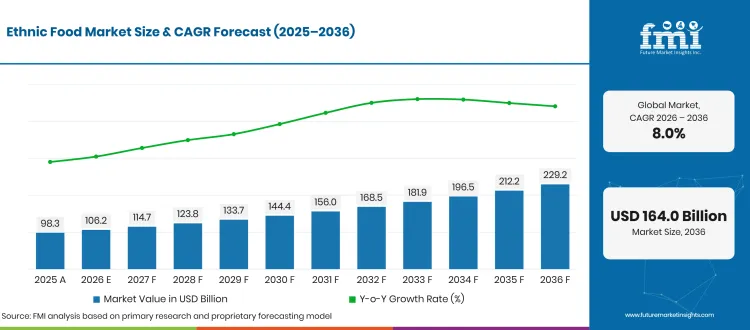
The ethnic food market was valued at USD 98.3 billion in 2025. The market is set to reach USD 76.0 billion by 2026-end and grow at a CAGR of 8.0% between 2026-2036 to reach USD 164.0 billion by 2036. Ready Meals will dominate with a 40.0% share, while Asian Cuisine will lead with a 45.0% share.
Summary of the Ethnic Food Market
- Demand and Growth Drivers
- Immigration-driven diaspora populations are anchoring baseline demand for authentic ethnic food products, while mainstream consumer food adventurism is expanding the addressable market well beyond immigrant communities.
- Retail category expansion by major grocery chains is allocating dedicated shelf space to ethnic food aisles, improving product visibility and driving trial purchases among non-diaspora consumers.
- Ready meal and meal kit formats are converting restaurant-occasion ethnic food consumption into at-home preparation, offering convenience and cost savings that increase purchase frequency.
- Product and Segment View
- Ready Meals is likely to remain the leading product segment at 40% share, supported by established demand and procurement patterns.
- Asian Cuisine is expected to hold 45% share of the cuisine segment, driven by buyer preference and usage pattern.
- Retail Consumers is likely to lead the end use segment at 65% share during the forecast period.
- Geography and Competitive Outlook
- China is likely to remain a key market at 10.53% CAGR, supported by strong demand fundamentals and expanding adoption.
- India is likely to sustain growth at 9.75% CAGR owing to rising spending and expanding infrastructure.
- Companies with broad product portfolios and multi-channel distribution are likely to gain traction during the forecast period.
- Analyst Opinion
- The ethnic food market is evolving into a more defined commercial category with clear segment leaders and established distribution patterns.
- Adoption is increasing due to rising awareness, expanding distribution, and growing influence of health and wellness trends on purchasing behavior.
- Premiumization is also supporting demand, with buyers trading up to higher quality products with validated health or functional benefits.
- Companies that can improve cost competitiveness while delivering consistent quality are likely to strengthen their position over the forecast period.
Key Takeaways, Market Size, and Forecast
- The ethnic food market was valued at USD 98.3 billion in 2025.
- By 2036, the Ethnic Food Market is expected to be worth USD 164.0 billion.
- From 2026 to 2036, the market is projected to expand at a CAGR of 8.0%.
- The market is projected to create an incremental opportunity of USD 118.61 billion between 2026 and 2036.
- In 2026, ready meals is expected to account for 40% of the product segment, driven by demand for convenient, shelf-stable meal solutions that replicate authentic regional cuisine flavors for time-constrained urban consumers.
- China (10.53%) and India (9.75%) are two of the fastest growing markets in the world.
Ethnic Food Market Definition
The ethnic food market encompasses commercially traded food products representing cuisines originating outside a consumer's domestic culinary tradition. Product categories include ready meals, sauces and condiments, snacks, frozen foods, and meal kits spanning Asian, Latin American, Middle Eastern, African, and European ethnic cuisines.
Ethnic Food Market Inclusions
Market scope covers all commercially traded ethnic food products categorized by product (ready meals, sauces and condiments, snacks, frozen foods, meal kits), cuisine (Asian cuisine, Latin American cuisine, Middle Eastern cuisine, African cuisine, European cuisine), end use (retail consumers, foodservice operators), distribution channel (offline retail, online retail), packaging (flexible packaging, rigid packaging), and pricing tier (mid range, economy, premium). The revenue range spans from 2026 to 2036.
Ethnic Food Market Exclusions
It does not include restaurant and foodservice-prepared meals consumed on-premises, raw ethnic ingredients sold without processing or value addition, or general grocery staples not marketed under ethnic food positioning.
Ethnic Food Market Research Methodology
- Primary Research: Analysts at FMI spoke to ethnic food producers, retail category managers, foodservice distributors and e-commerce grocery platform operators across the key markets.
- Desk Research - Compile data from food industry associations, scanner databases from the retail sector, immigration statistics, and surveys of consumer taste preferences.
- Market sizing and forecasting: Bottom-up aggregation of all cuisine categories and product formats with regional adoption curves adjusted for immigration rates, urbanization and food adventurism indices.
- Data validation: Quarterly cross check with retail scanner data and manufacturer shipment reports.
Why is the Ethnic Food Market Growing?
- Diaspora populations have emerged from immigration and are providing a baseline demand for authentic ethnic food products, while mainstream consumer food adventurism has opened the addressable market far beyond immigrant communities.
- Major grocery chains are expanding their retail categories by dedicating shelf space to aisles for ethnic foods, thereby increasing product visibility and encouraging trial purchases by non-diaspora consumers.
- Ready meals and meal kits are changing ethnic food consumption occasions from restaurant dining to at-home preparation, providing convenience and cost savings that drive purchase frequency.
Globalization of food preferences, immigration patterns and retail shelf space allocation are converging to expand the ethnic food market by broadening the consumer base for non-domestic cuisines. Ready meals dominate the product segment with a 40.0% share, providing a simple way to get the taste of ethnic cuisines without the complexities of preparation. Asian cuisine accounts for 45.0% of the cuisine segment, indicating the commercial maturity and widespread consumer acceptance of Chinese, Indian, Thai, Japanese and Korean food products.
End-user demand is predominantly from retail consumers (65.0%), who purchase through supermarkets, ethnic grocery stores, and online platforms. Offline retail accounts for 70.0% of distribution, with dedicated ethnic food aisles in mainstream grocery chains being the main consumer touchpoint. Mid-range pricing is 50.0%. Economy products serve diaspora staple consumption and premium products serve food-adventurist mainstream consumers.
Market Segmentation Analysis
- Ready Meals accounts for 40% of the product segment, reflecting established demand patterns.
- Retail Consumers leads the end use segment at 65% share.
The ethnic food market is segmented by product, cuisine, end use, distribution channel, packaging, pricing tier.
Insights into the Ready Meals Product Segment
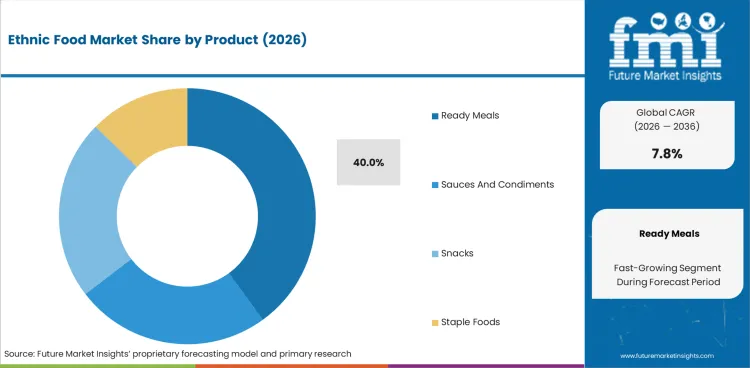
The ready meals segment is expected to account for 40.0% of the product segment in 2026. Shelf-stable, frozen and chilled ready meal formats provide time-poor consumers with convenient access to ethnic cuisine. Common microwave- and oven-ready packaging formats. Asian cuisine ready meals in stir-fry, curry and noodle formats lead by volume, with Latin American and Middle Eastern options growing from small bases.
Insights into the Asian Cuisine Segment
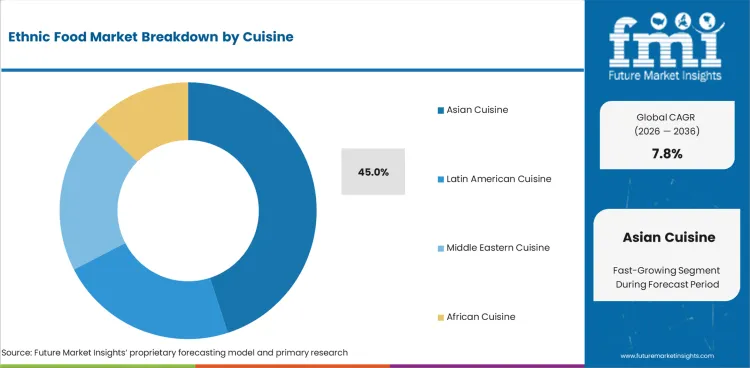
Asian food makes up 45.0% of the food segment. Chinese, Indian, Thai, Japanese and Korean foods are established product categories with broad retail distribution. The high-frequency purchase items are sauces and condiments such as soy sauce, curry paste and chili sauces. The fastest-growing segments are Japanese and Korean cuisine, supported by pop culture influence and restaurant to retail conversion trends.
Ethnic Food Market Drivers, Restraints, and Opportunities
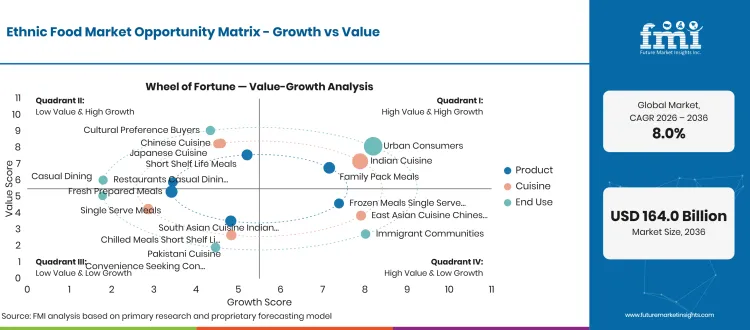
- Immigration and Diaspora Demand is creating structured demand across key segments.
- Authenticity Perception and Quality is limiting adoption velocity in price-sensitive segments.
The ethnic food market is shaped by demand-side catalysts and supply-side constraints that vary by region and price tier.
Immigration and Diaspora Demand Anchoring
Demand is affected by immigrant populations, providing a stable baseline consumption of authentic ethnic food products. In North America, Europe and the Gulf, diaspora communities provide the first level of retail distribution which then expands to the mainstream consumer through adjacency purchasing behaviour.
Mainstream Food Adventurism and Retail Expansion
The growth is indicative of the increasing openness of non-diaspora consumers to try new cuisines. Major grocery chains are devoting dedicated ethnic food shelf space to turning consumer curiosity into trial and repeat purchases at faster and faster rates.
Authenticity Perception and Quality Consistency
Consumer concerns about product authenticity and taste consistency compared to restaurant-prepared ethnic food limit adoption. “Brands have struggled to deliver restaurant-quality ethnic flavors in shelf-stable retail formats, which affects repeat purchase rates for price-sensitive consumers.
Meal Kit and Recipe Box Format Growth
Meal kit services providing domestic preparation experiences for ethnic cuisines also support growth. Recipe Boxes with pre-portioned ethnic ingredients and step-by-step instructions also translate restaurant-occasion consumption into home preparation, increasing the total addressable market.
Analysis of Ethnic Food Market By Key Countries
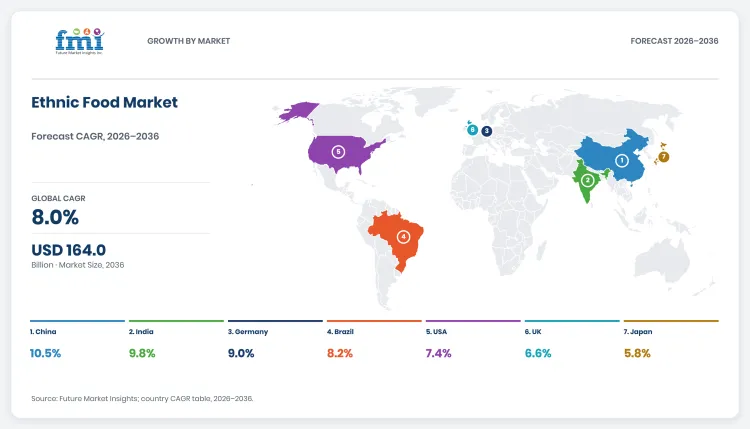
| Country | CAGR |
|---|---|
| China | 10.53% |
| India | 9.75% |
| Germany | 8.97% |
| Brazil | 8.19% |
| USA | 7.41% |
| UK | 6.63% |
| Japan | 5.85% |
- China leads with 10.53% CAGR supported by the largest demand base and increasing adoption.
- India at 9.75% has a strong demand backed by rising spending and distribution expansion.
- Germany (8,97%) and Brazil (8,19%) continue growing with the expansion of market development.
The global ethnic food market is projected to expand at 8.0% per year from 2026 to 2036. The study covers more than 30 countries.
Sales Analysis of Ethnic Food Market in China
China leads at 10.53% through 2036. Domestic demand for international cuisine formats is rising as urban consumers seek culinary variety beyond traditional Chinese food. E-commerce platforms and food delivery integration are expanding access to ethnic food products in tier-1 and tier-2 cities.
- Urban consumer demand for international culinary variety expands the ethnic food category beyond imports.
- E-commerce grocery platforms and food delivery integration improve distribution access.
- Japanese, Korean, and Southeast Asian cuisine formats are the fastest-growing ethnic food categories.
Demand Outlook for Ethnic Food Market in India
India is expanding at 9.75% through 2036. Urbanization, exposure to global cuisines through travel and media, and modern retail expansion are creating demand for non-Indian ethnic food products. Ready meal formats targeting urban professionals represent the primary growth vector.
- Urban exposure to global cuisines through travel and media is creating demand for international food products.
- Modern retail expansion including organized supermarkets improves ethnic food product availability.
- Ready meal formats targeting urban professionals represent the fastest-growing product category.
Future Outlook for Ethnic Food Market in the United States
The USA is growing at 8.0% through 2036. The most diverse consumer market globally, the USA benefits from large immigrant populations creating baseline demand across multiple cuisine categories. Major retailers including Walmart, Kroger, and Costco allocate expanding ethnic food shelf space.
- Large and diverse immigrant populations anchor baseline demand across multiple ethnic cuisines.
- Major retailers allocate expanding dedicated shelf space to ethnic food categories.
- Latin American, Asian, and Middle Eastern cuisine products are the largest ethnic food segments.
In-depth Analysis of Ethnic Food Market in Germany
Germany is expanding at 7.2% through 2036. Turkish, Asian, and Middle Eastern cuisine products benefit from established diaspora populations. EU food safety standards and retailer sustainability requirements shape product specification and packaging requirements.
- Turkish and Middle Eastern diaspora populations anchor baseline ethnic food demand.
- EU food safety standards ensure product quality across ethnic food categories.
- Major retailer groups including Aldi, Lidl, and REWE allocate growing ethnic food category space.
Opportunity Analysis of Ethnic Food Market in the United Kingdom
The UK is growing at 6.9% through 2036. The UK has one of the most developed ethnic food retail markets globally, with Indian, Chinese, and Thai cuisines deeply integrated into mainstream grocery shopping. Post-Brexit trade arrangements affect supply chain sourcing for imported ethnic ingredients.
- Indian, Chinese, and Thai cuisines are deeply integrated into mainstream UK grocery purchasing.
- The UK ethnic food market is one of the most developed globally in per-capita terms.
- Post-Brexit trade arrangements affect imported ethnic ingredient sourcing and pricing.
In-depth Analysis of Ethnic Food Market in Japan
Japan is expanding at 6.5% through 2036. Japanese consumer openness to international cuisines, combined with a strong convenience store and ready meal culture, creates favorable conditions for ethnic food retail. Korean, Thai, and Indian cuisine products are the fastest-growing segments.
- Consumer openness to international cuisines supports diverse ethnic food category growth.
- Convenience store and ready meal culture provides established distribution infrastructure.
- Korean, Thai, and Indian cuisine products represent the fastest-growing ethnic food categories.
Demand Outlook for Ethnic Food Market in Brazil
Brazil is growing at 6.2% through 2036. Japanese, Arab, and Italian diaspora communities anchor baseline demand. Urban consumer interest in international cuisines is expanding through restaurant-to-retail conversion and social media food content.
- Japanese, Arab, and Italian diaspora communities provide baseline ethnic food demand.
- Urban interest in international cuisines expands through restaurant-to-retail conversion.
- Social media food content accelerates consumer discovery of ethnic cuisine products.
Competitive Landscape and Strategic Positioning
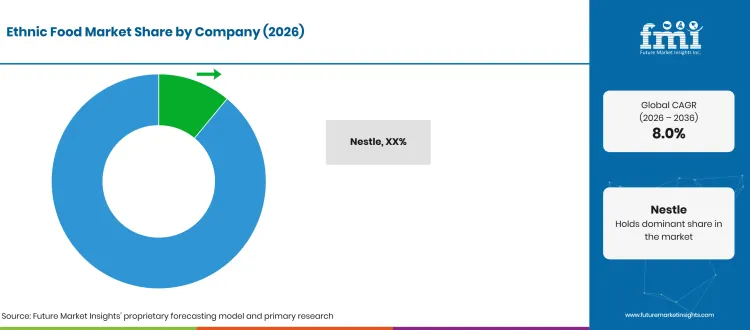
- Nestle has the largest multi-brand portfolio coverage in Asian, Latin American and European ethnic food categories, with global manufacturing, distribution and retail relationship infrastructure.
- Ajinomoto Co. Ltd. Inc. is differentiated by its specialization in Asian cuisine, umami flavor technology and brand recognition in the Japanese, Chinese and Southeast Asian food product categories.
- Associated British Foods Plc and General Mills Inc. provide ethnicity-based food segments using category-specific brands and retail relationships that gain access to shelf space within the largest grocery chains.
Competitive Landscape: The competitive landscape is marked by global players with broad portfolios and regional specialists with niche capabilities.
Key Companies in the Ethnic Food Market
Key global companies leading the ethnic food market include:
- Nestle (Switzerland), Ajinomoto Co. Inc. (Japan), and Associated British Foods Plc (UK) lead through multi-cuisine product portfolios, global manufacturing, and established retail distribution relationships.
- General Mills Inc. (USA), McCormick and Company Inc. (USA), and Orkla ASA (Norway) serve through ethnic sauce, seasoning, and ready meal brands with strong shelf space positioning in major retail chains.
- ARYZTA AG (Switzerland) and Paulig Group (Finland) are expanding through ethnic bakery and specialty food segments with regional distribution expertise.
Competitive Benchmarking: Ethnic Food Market
| Company | Cuisine Range | Product Breadth | Retail Access | Geographic Scale |
|---|---|---|---|---|
| Nestle | Very Wide | Very High | Very Strong | Global |
| Ajinomoto | Asian Focus | High | Strong | Asia, Global |
| Associated British Foods | Wide | High | Strong | Europe, Global |
| General Mills | Wide | High | Strong | N. America, Global |
| McCormick | Sauces Focus | Medium | Very Strong | Global |
| Orkla | European Focus | Medium | Strong | Europe |
| ARYZTA | Bakery Focus | Medium | Moderate | Europe |
| Paulig | Specialty | Medium | Moderate | Europe |
Source: Future Market Insights competitive analysis, 2026.
Key Developments in Ethnic Food Market
- In 2025, Nestle expanded its ethnic ready meals portfolio with a new range of Korean and Thai cuisine products targeting mainstream grocery distribution in North America and Europe.
- In 2025, Ajinomoto launched a premium Asian sauce collection in European markets featuring restaurant-grade formulations adapted for home cooking applications.
Key Players in the Ethnic Food Market
Major Global Players
- Nestle
- Ajinomoto Co., Inc.
- Associated British Foods Plc
- General Mills, Inc.
- McCormick & Company Inc.
Emerging Players/Startups
- Orkla ASA
- ARYZTA AG
- Paulig Group
- Tasty Bite
- Patak's
Report Scope and Coverage
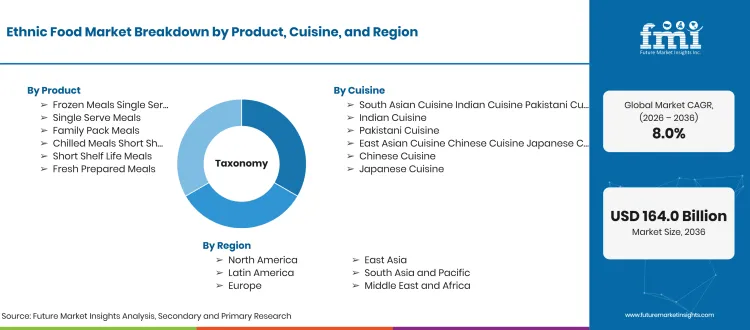
| Parameter | Details |
|---|---|
| Quantitative Units | USD 76.0 billion to USD 164.0 billion, at a CAGR of 8.0% |
| Market Definition | The ethnic food market encompasses commercially traded food products representing cuisines originating outside a consumer's domestic culinary tradition. Product categories include ready meals, sauces and condiments, snacks, frozen foods, and meal kits spanning Asian, Latin American, Middle Eastern, African, and European ethnic cuisines. |
| Regions Covered | North America, Latin America, Europe, East Asia, South Asia and Pacific, Middle East and Africa |
| Countries Covered | China, India, Germany, Brazil, USA, UK, Japan, 30 plus countries |
| Key Companies Profiled | Nestle, Ajinomoto Co., Inc., Associated British Foods Plc, General Mills, Inc., McCormick & Company Inc., Orkla ASA, ARYZTA AG, Paulig Group |
| Forecast Period | 2026 to 2036 |
| Approach | Hybrid bottom-up and top-down methodology starting with verified transaction data, projecting adoption velocity across segments and regions. |
Market Segmentation Analysis
Ethnic Food Market Segmented by Product:
- Ready Meals
- Frozen Meals
- Single Serve Meals
- Family Pack Meals
- Chilled Meals
- Short Shelf Life Meals
- Fresh Prepared Meals
- Frozen Meals
- Sauces And Condiments
- Cooking Sauces
- Curry Sauces
- Stir Fry Sauces
- Table Sauces
- Dips And Spreads
- Chutneys
- Cooking Sauces
- Snacks
- Savory Snacks
- Chips And Crisps
- Street Food Inspired Snacks
- Sweet Snacks
- Desserts
- Confectionery
- Savory Snacks
- Staple Foods
- Rice And Grains
- Basmati Rice
- Specialty Grains
- Noodles And Pasta
- Instant Noodles
- Traditional Pasta Variants
- Rice And Grains
Ethnic Food Market Segmented by Cuisine:
- Asian Cuisine
- South Asian Cuisine
- Indian Cuisine
- Pakistani Cuisine
- East Asian Cuisine
- Chinese Cuisine
- Japanese Cuisine
- Southeast Asian Cuisine
- Thai Cuisine
- Vietnamese Cuisine
- South Asian Cuisine
- Latin American Cuisine
- Mexican Cuisine
- Tacos And Tortillas
- Salsas
- Brazilian Cuisine
- Grilled Meats
- Traditional Dishes
- Mexican Cuisine
- Middle Eastern Cuisine
- Levant Cuisine
- Hummus And Dips
- Flatbreads
- Gulf Cuisine
- Rice Dishes
- Meat Preparations
- Levant Cuisine
- African Cuisine
- North African Cuisine
- Spiced Dishes
- Couscous
- Sub Saharan Cuisine
- Stews
- Grain Based Meals
- North African Cuisine
Ethnic Food Market Segmented by End Use:
- Retail Consumers
- Household Consumption
- Urban Consumers
- Convenience Seeking Consumers
- Ethnic Population Consumers
- Immigrant Communities
- Cultural Preference Buyers
- Household Consumption
- Foodservice Industry
- Restaurants
- Casual Dining
- Fine Dining
- Quick Service Restaurants
- Street Food Chains
- Takeaway Outlets
- Restaurants
Ethnic Food Market Segmented by Distribution Channel:
- Offline Retail
- Supermarkets And Hypermarkets
- Large Format Stores
- Discount Stores
- Convenience Stores
- Urban Stores
- Neighborhood Stores
- Specialty Stores
- Ethnic Food Stores
- Gourmet Stores
- Supermarkets And Hypermarkets
- Online Retail
- E Commerce Platforms
- Marketplace Platforms
- Brand Websites
- Food Delivery Platforms
- Meal Kit Services
- On Demand Grocery Delivery
- E Commerce Platforms
Ethnic Food Market Segmented by Packaging:
- Flexible Packaging
- Pouches
- Stand Up Pouches
- Retort Pouches
- Wraps
- Foil Wraps
- Plastic Wraps
- Pouches
- Rigid Packaging
- Cans
- Metal Cans
- Composite Cans
- Glass Jars
- Sauce Jars
- Pickle Jars
- Cans
Ethnic Food Market Segmented by Pricing Tier:
- Mid Range
- Branded Products
- Standard Quality Offerings
- Branded Products
- Economy
- Private Label Products
- Mass Market Offerings
- Private Label Products
- Premium
- Gourmet And Authentic Products
- Artisanal Offerings
- Organic And Clean Label Products
- Gourmet And Authentic Products
Ethnic Food Market by Region:
- North America
- USA
- Canada
- Mexico
- Latin America
- Brazil
- Chile
- Rest of Latin America
- Western Europe
- Germany
- UK
- Italy
- Spain
- France
- Nordic
- BENELUX
- Rest of Western Europe
- Eastern Europe
- Russia
- Poland
- Hungary
- Balkan & Baltic
- Rest of Eastern Europe
- East Asia
- China
- Japan
- South Korea
- South Asia and Pacific
- India
- ASEAN
- Australia & New Zealand
- Rest of South Asia and Pacific
- Middle East & Africa
- Kingdom of Saudi Arabia
- Other GCC Countries
- Turkiye
- South Africa
- Other African Union
- Rest of Middle East & Africa
Research Sources and Bibliography
- 1. Food and Agriculture Organization. (2025). FAO Global Food Trade and Consumption Patterns Report. FAO.
- 2. Euromonitor International. (2025). Ethnic and International Foods Global Market Overview. Euromonitor.
- 3. USA Census Bureau. (2024). American Community Survey: Immigration and Food Consumption Patterns. Census Bureau.
- 4. European Commission. (2024). EU Food Safety Regulation for Imported Food Products. EC.
- 5. International Organization for Migration. (2025). IOM World Migration Report: Diaspora Consumer Patterns. IOM.
This bibliography is provided for reader reference.
This Report Answers
- Estimating the market size and revenue generation from 2026 to 2036.
- Segmenting by product, cuisine, end use, distribution channel, packaging, and pricing tier.
- Providing regional insights across more than 30 markets.
- Analyzing immigration and diaspora impact on ethnic food demand.
- Assessing the competitive landscape across cuisine categories.
- Identifying investment opportunities in ready meals and meal kits.
- Tracking retail shelf space allocation and consumer adoption trends.
- Delivering data in PDF and Excel formats.
Frequently Asked Questions
How big is the ethnic food market in 2026?
The global ethnic food market is estimated to be valued at USD 76.0 billion in 2026.
What will be the size of ethnic food market in 2036?
The market size for the ethnic food market is projected to reach USD 164.0 billion by 2036.
How much will be the ethnic food market growth between 2026 and 2036?
The ethnic food market is expected to grow at a 8.0% CAGR between 2026 and 2036.
What are the key product types in the ethnic food market?
The key product types in ethnic food market are ready meals, sauces and condiments, snacks and staple foods.
Which cuisine segment is expected to contribute significant share in the ethnic food market in 2026?
In terms of cuisine, asian cuisine segment is expected to command 45.0% share in the ethnic food market in 2026.
Preview the report firsthand - request a free sample
Get SampleGet the brochure for pricing and purchase details.
Get PDFTable of Content
- Executive Summary
- Global Market Outlook
- Demand-side Trends
- Supply-side Trends
- Technology Roadmap Analysis
- Analysis and Recommendations
- Market Overview
- Market Coverage / Taxonomy
- Market Definition / Scope / Limitations
- Research Methodology
- Chapter Orientation
- Analytical Lens and Working Hypotheses
- Market Structure, Signals, and Trend Drivers
- Benchmarking and Cross-market Comparability
- Market Sizing, Forecasting, and Opportunity Mapping
- Research Design and Evidence Framework
- Desk Research Programme (Secondary Evidence)
- Company Annual and Sustainability Reports
- Peer-reviewed Journals and Academic Literature
- Corporate Websites, Product Literature, and Technical Notes
- Earnings Decks and Investor Briefings
- Statutory Filings and Regulatory Disclosures
- Technical White Papers and Standards Notes
- Trade Journals, Industry Magazines, and Analyst Briefs
- Conference Proceedings, Webinars, and Seminar Materials
- Government Statistics Portals and Public Data Releases
- Press Releases and Reputable Media Coverage
- Specialist Newsletters and Curated Briefings
- Sector Databases and Reference Repositories
- FMI Internal Proprietary Databases and Historical Market Datasets
- Subscription Datasets and Paid Sources
- Social Channels, Communities, and Digital Listening Inputs
- Additional Desk Sources
- Expert Input and Fieldwork (Primary Evidence)
- Primary Modes
- Qualitative Interviews and Expert Elicitation
- Quantitative Surveys and Structured Data Capture
- Blended Approach
- Why Primary Evidence is Used
- Field Techniques
- Interviews
- Surveys
- Focus Groups
- Observational and In-context Research
- Social and Community Interactions
- Stakeholder Universe Engaged
- C-suite Leaders
- Board Members
- Presidents and Vice Presidents
- R&D and Innovation Heads
- Technical Specialists
- Domain Subject-matter Experts
- Scientists
- Physicians and Other Healthcare Professionals
- Governance, Ethics, and Data Stewardship
- Research Ethics
- Data Integrity and Handling
- Primary Modes
- Tooling, Models, and Reference Databases
- Desk Research Programme (Secondary Evidence)
- Data Engineering and Model Build
- Data Acquisition and Ingestion
- Cleaning, Normalisation, and Verification
- Synthesis, Triangulation, and Analysis
- Quality Assurance and Audit Trail
- Market Background
- Market Dynamics
- Drivers
- Restraints
- Opportunity
- Trends
- Scenario Forecast
- Demand in Optimistic Scenario
- Demand in Likely Scenario
- Demand in Conservative Scenario
- Opportunity Map Analysis
- Product Life Cycle Analysis
- Supply Chain Analysis
- Investment Feasibility Matrix
- Value Chain Analysis
- PESTLE and Porter’s Analysis
- Regulatory Landscape
- Regional Parent Market Outlook
- Production and Consumption Statistics
- Import and Export Statistics
- Market Dynamics
- Global Market Analysis 2021 to 2025 and Forecast, 2026 to 2036
- Historical Market Size Value (USD Million) Analysis, 2021 to 2025
- Current and Future Market Size Value (USD Million) Projections, 2026 to 2036
- Y-o-Y Growth Trend Analysis
- Absolute $ Opportunity Analysis
- Global Market Pricing Analysis 2021 to 2025 and Forecast 2026 to 2036
- Global Market Analysis 2021 to 2025 and Forecast 2026 to 2036, By Product
- Introduction / Key Findings
- Historical Market Size Value (USD Million) Analysis By Product , 2021 to 2025
- Current and Future Market Size Value (USD Million) Analysis and Forecast By Product , 2026 to 2036
- Ready Meals
- Frozen Meals
- Single Serve Meals
- Family Pack Meals
- Chilled Meals
- Short Shelf Life Meals
- Fresh Prepared Meals
- Sauces And Condiments
- Cooking Sauces
- Curry Sauces
- Stir Fry Sauces
- Table Sauces
- Dips And Spreads
- Snacks
- Savory Snacks
- Chips And Crisps
- Street Food Inspired Snacks
- Sweet Snacks
- Desserts
- Staple Foods
- Rice And Grains
- Basmati Rice
- Specialty Grains
- Noodles And Pasta
- Instant Noodles
- Ready Meals
- Y-o-Y Growth Trend Analysis By Product , 2021 to 2025
- Absolute $ Opportunity Analysis By Product , 2026 to 2036
- Global Market Analysis 2021 to 2025 and Forecast 2026 to 2036, By Cuisine
- Introduction / Key Findings
- Historical Market Size Value (USD Million) Analysis By Cuisine, 2021 to 2025
- Current and Future Market Size Value (USD Million) Analysis and Forecast By Cuisine, 2026 to 2036
- Asian Cuisine
- South Asian Cuisine
- Indian Cuisine
- Pakistani Cuisine
- East Asian Cuisine
- Chinese Cuisine
- Japanese Cuisine
- Southeast Asian Cuisine
- Thai Cuisine
- Vietnamese Cuisine
- Latin American Cuisine
- Mexican Cuisine
- Tacos And Tortillas
- Salsas
- Brazilian Cuisine
- Grilled Meats
- Middle Eastern Cuisine
- Levant Cuisine
- Hummus And Dips
- Flatbreads
- Gulf Cuisine
- Rice Dishes
- African Cuisine
- North African Cuisine
- Spiced Dishes
- Couscous
- Sub Saharan Cuisine
- Stews
- Asian Cuisine
- Y-o-Y Growth Trend Analysis By Cuisine, 2021 to 2025
- Absolute $ Opportunity Analysis By Cuisine, 2026 to 2036
- Global Market Analysis 2021 to 2025 and Forecast 2026 to 2036, By End Use
- Introduction / Key Findings
- Historical Market Size Value (USD Million) Analysis By End Use, 2021 to 2025
- Current and Future Market Size Value (USD Million) Analysis and Forecast By End Use, 2026 to 2036
- Retail Consumers
- Household Consumption
- Urban Consumers
- Convenience Seeking Consumers
- Ethnic Population Consumers
- Immigrant Communities
- Cultural Preference Buyers
- Foodservice Industry
- Restaurants
- Casual Dining
- Fine Dining
- Quick Service Restaurants
- Street Food Chains
- Retail Consumers
- Y-o-Y Growth Trend Analysis By End Use, 2021 to 2025
- Absolute $ Opportunity Analysis By End Use, 2026 to 2036
- Global Market Analysis 2021 to 2025 and Forecast 2026 to 2036, By Distribution Channel
- Introduction / Key Findings
- Historical Market Size Value (USD Million) Analysis By Distribution Channel, 2021 to 2025
- Current and Future Market Size Value (USD Million) Analysis and Forecast By Distribution Channel, 2026 to 2036
- Offline Retail
- Supermarkets And Hypermarkets
- Large Format Stores
- Discount Stores
- Convenience Stores
- Urban Stores
- Neighborhood Stores
- Specialty Stores
- Ethnic Food Stores
- Gourmet Stores
- Online Retail
- E Commerce Platforms
- Marketplace Platforms
- Brand Websites
- Food Delivery Platforms
- Meal Kit Services
- Offline Retail
- Y-o-Y Growth Trend Analysis By Distribution Channel, 2021 to 2025
- Absolute $ Opportunity Analysis By Distribution Channel, 2026 to 2036
- Global Market Analysis 2021 to 2025 and Forecast 2026 to 2036, By Packaging
- Introduction / Key Findings
- Historical Market Size Value (USD Million) Analysis By Packaging, 2021 to 2025
- Current and Future Market Size Value (USD Million) Analysis and Forecast By Packaging, 2026 to 2036
- Flexible Packaging
- Pouches
- Stand Up Pouches
- Retort Pouches
- Wraps
- Foil Wraps
- Plastic Wraps
- Rigid Packaging
- Cans
- Metal Cans
- Composite Cans
- Glass Jars
- Sauce Jars
- Flexible Packaging
- Y-o-Y Growth Trend Analysis By Packaging, 2021 to 2025
- Absolute $ Opportunity Analysis By Packaging, 2026 to 2036
- Global Market Analysis 2021 to 2025 and Forecast 2026 to 2036, By Pricing Tier
- Introduction / Key Findings
- Historical Market Size Value (USD Million) Analysis By Pricing Tier, 2021 to 2025
- Current and Future Market Size Value (USD Million) Analysis and Forecast By Pricing Tier, 2026 to 2036
- Mid Range
- Branded Products
- Standard Quality Offerings
- Economy
- Private Label Products
- Mass Market Offerings
- Premium
- Gourmet And Authentic Products
- Artisanal Offerings
- Organic And Clean Label Products
- Mid Range
- Y-o-Y Growth Trend Analysis By Pricing Tier, 2021 to 2025
- Absolute $ Opportunity Analysis By Pricing Tier, 2026 to 2036
- Global Market Analysis 2021 to 2025 and Forecast 2026 to 2036, By Region
- Introduction
- Historical Market Size Value (USD Million) Analysis By Region, 2021 to 2025
- Current Market Size Value (USD Million) Analysis and Forecast By Region, 2026 to 2036
- North America
- Latin America
- Western Europe
- Eastern Europe
- East Asia
- South Asia and Pacific
- Middle East & Africa
- Market Attractiveness Analysis By Region
- North America Market Analysis 2021 to 2025 and Forecast 2026 to 2036, By Country
- Historical Market Size Value (USD Million) Trend Analysis By Market Taxonomy, 2021 to 2025
- Market Size Value (USD Million) Forecast By Market Taxonomy, 2026 to 2036
- By Country
- USA
- Canada
- Mexico
- By Product
- By Cuisine
- By End Use
- By Distribution Channel
- By Packaging
- By Pricing Tier
- By Country
- Market Attractiveness Analysis
- By Country
- By Product
- By Cuisine
- By End Use
- By Distribution Channel
- By Packaging
- By Pricing Tier
- Key Takeaways
- Latin America Market Analysis 2021 to 2025 and Forecast 2026 to 2036, By Country
- Historical Market Size Value (USD Million) Trend Analysis By Market Taxonomy, 2021 to 2025
- Market Size Value (USD Million) Forecast By Market Taxonomy, 2026 to 2036
- By Country
- Brazil
- Chile
- Rest of Latin America
- By Product
- By Cuisine
- By End Use
- By Distribution Channel
- By Packaging
- By Pricing Tier
- By Country
- Market Attractiveness Analysis
- By Country
- By Product
- By Cuisine
- By End Use
- By Distribution Channel
- By Packaging
- By Pricing Tier
- Key Takeaways
- Western Europe Market Analysis 2021 to 2025 and Forecast 2026 to 2036, By Country
- Historical Market Size Value (USD Million) Trend Analysis By Market Taxonomy, 2021 to 2025
- Market Size Value (USD Million) Forecast By Market Taxonomy, 2026 to 2036
- By Country
- Germany
- UK
- Italy
- Spain
- France
- Nordic
- BENELUX
- Rest of Western Europe
- By Product
- By Cuisine
- By End Use
- By Distribution Channel
- By Packaging
- By Pricing Tier
- By Country
- Market Attractiveness Analysis
- By Country
- By Product
- By Cuisine
- By End Use
- By Distribution Channel
- By Packaging
- By Pricing Tier
- Key Takeaways
- Eastern Europe Market Analysis 2021 to 2025 and Forecast 2026 to 2036, By Country
- Historical Market Size Value (USD Million) Trend Analysis By Market Taxonomy, 2021 to 2025
- Market Size Value (USD Million) Forecast By Market Taxonomy, 2026 to 2036
- By Country
- Russia
- Poland
- Hungary
- Balkan & Baltic
- Rest of Eastern Europe
- By Product
- By Cuisine
- By End Use
- By Distribution Channel
- By Packaging
- By Pricing Tier
- By Country
- Market Attractiveness Analysis
- By Country
- By Product
- By Cuisine
- By End Use
- By Distribution Channel
- By Packaging
- By Pricing Tier
- Key Takeaways
- East Asia Market Analysis 2021 to 2025 and Forecast 2026 to 2036, By Country
- Historical Market Size Value (USD Million) Trend Analysis By Market Taxonomy, 2021 to 2025
- Market Size Value (USD Million) Forecast By Market Taxonomy, 2026 to 2036
- By Country
- China
- Japan
- South Korea
- By Product
- By Cuisine
- By End Use
- By Distribution Channel
- By Packaging
- By Pricing Tier
- By Country
- Market Attractiveness Analysis
- By Country
- By Product
- By Cuisine
- By End Use
- By Distribution Channel
- By Packaging
- By Pricing Tier
- Key Takeaways
- South Asia and Pacific Market Analysis 2021 to 2025 and Forecast 2026 to 2036, By Country
- Historical Market Size Value (USD Million) Trend Analysis By Market Taxonomy, 2021 to 2025
- Market Size Value (USD Million) Forecast By Market Taxonomy, 2026 to 2036
- By Country
- India
- ASEAN
- Australia & New Zealand
- Rest of South Asia and Pacific
- By Product
- By Cuisine
- By End Use
- By Distribution Channel
- By Packaging
- By Pricing Tier
- By Country
- Market Attractiveness Analysis
- By Country
- By Product
- By Cuisine
- By End Use
- By Distribution Channel
- By Packaging
- By Pricing Tier
- Key Takeaways
- Middle East & Africa Market Analysis 2021 to 2025 and Forecast 2026 to 2036, By Country
- Historical Market Size Value (USD Million) Trend Analysis By Market Taxonomy, 2021 to 2025
- Market Size Value (USD Million) Forecast By Market Taxonomy, 2026 to 2036
- By Country
- Kingdom of Saudi Arabia
- Other GCC Countries
- Turkiye
- South Africa
- Other African Union
- Rest of Middle East & Africa
- By Product
- By Cuisine
- By End Use
- By Distribution Channel
- By Packaging
- By Pricing Tier
- By Country
- Market Attractiveness Analysis
- By Country
- By Product
- By Cuisine
- By End Use
- By Distribution Channel
- By Packaging
- By Pricing Tier
- Key Takeaways
- Key Countries Market Analysis
- USA
- Pricing Analysis
- Market Share Analysis, 2025
- By Product
- By Cuisine
- By End Use
- By Distribution Channel
- By Packaging
- By Pricing Tier
- Canada
- Pricing Analysis
- Market Share Analysis, 2025
- By Product
- By Cuisine
- By End Use
- By Distribution Channel
- By Packaging
- By Pricing Tier
- Mexico
- Pricing Analysis
- Market Share Analysis, 2025
- By Product
- By Cuisine
- By End Use
- By Distribution Channel
- By Packaging
- By Pricing Tier
- Brazil
- Pricing Analysis
- Market Share Analysis, 2025
- By Product
- By Cuisine
- By End Use
- By Distribution Channel
- By Packaging
- By Pricing Tier
- Chile
- Pricing Analysis
- Market Share Analysis, 2025
- By Product
- By Cuisine
- By End Use
- By Distribution Channel
- By Packaging
- By Pricing Tier
- Germany
- Pricing Analysis
- Market Share Analysis, 2025
- By Product
- By Cuisine
- By End Use
- By Distribution Channel
- By Packaging
- By Pricing Tier
- UK
- Pricing Analysis
- Market Share Analysis, 2025
- By Product
- By Cuisine
- By End Use
- By Distribution Channel
- By Packaging
- By Pricing Tier
- Italy
- Pricing Analysis
- Market Share Analysis, 2025
- By Product
- By Cuisine
- By End Use
- By Distribution Channel
- By Packaging
- By Pricing Tier
- Spain
- Pricing Analysis
- Market Share Analysis, 2025
- By Product
- By Cuisine
- By End Use
- By Distribution Channel
- By Packaging
- By Pricing Tier
- France
- Pricing Analysis
- Market Share Analysis, 2025
- By Product
- By Cuisine
- By End Use
- By Distribution Channel
- By Packaging
- By Pricing Tier
- India
- Pricing Analysis
- Market Share Analysis, 2025
- By Product
- By Cuisine
- By End Use
- By Distribution Channel
- By Packaging
- By Pricing Tier
- ASEAN
- Pricing Analysis
- Market Share Analysis, 2025
- By Product
- By Cuisine
- By End Use
- By Distribution Channel
- By Packaging
- By Pricing Tier
- Australia & New Zealand
- Pricing Analysis
- Market Share Analysis, 2025
- By Product
- By Cuisine
- By End Use
- By Distribution Channel
- By Packaging
- By Pricing Tier
- China
- Pricing Analysis
- Market Share Analysis, 2025
- By Product
- By Cuisine
- By End Use
- By Distribution Channel
- By Packaging
- By Pricing Tier
- Japan
- Pricing Analysis
- Market Share Analysis, 2025
- By Product
- By Cuisine
- By End Use
- By Distribution Channel
- By Packaging
- By Pricing Tier
- South Korea
- Pricing Analysis
- Market Share Analysis, 2025
- By Product
- By Cuisine
- By End Use
- By Distribution Channel
- By Packaging
- By Pricing Tier
- Russia
- Pricing Analysis
- Market Share Analysis, 2025
- By Product
- By Cuisine
- By End Use
- By Distribution Channel
- By Packaging
- By Pricing Tier
- Poland
- Pricing Analysis
- Market Share Analysis, 2025
- By Product
- By Cuisine
- By End Use
- By Distribution Channel
- By Packaging
- By Pricing Tier
- Hungary
- Pricing Analysis
- Market Share Analysis, 2025
- By Product
- By Cuisine
- By End Use
- By Distribution Channel
- By Packaging
- By Pricing Tier
- Kingdom of Saudi Arabia
- Pricing Analysis
- Market Share Analysis, 2025
- By Product
- By Cuisine
- By End Use
- By Distribution Channel
- By Packaging
- By Pricing Tier
- Turkiye
- Pricing Analysis
- Market Share Analysis, 2025
- By Product
- By Cuisine
- By End Use
- By Distribution Channel
- By Packaging
- By Pricing Tier
- South Africa
- Pricing Analysis
- Market Share Analysis, 2025
- By Product
- By Cuisine
- By End Use
- By Distribution Channel
- By Packaging
- By Pricing Tier
- USA
- Market Structure Analysis
- Competition Dashboard
- Competition Benchmarking
- Market Share Analysis of Top Players
- By Regional
- By Product
- By Cuisine
- By End Use
- By Distribution Channel
- By Packaging
- By Pricing Tier
- Competition Analysis
- Competition Deep Dive
- Nestlé
- Overview
- Product Portfolio
- Profitability by Market Segments (Product/Age /Sales Channel/Region)
- Sales Footprint
- Strategy Overview
- Marketing Strategy
- Product Strategy
- Channel Strategy
- Ajinomoto Co., Inc.
- Associated British Foods Plc
- General Mills, Inc.
- McCormick & Company Inc.
- Orkla ASA
- ARYZTA AG
- Paulig Group
- Others
- Nestlé
- Competition Deep Dive
- Assumptions & Acronyms Used


