

- Industry Size (2026)
- USD 36.19 Bn
- Forecast (2036)
- USD 73.91 Bn
- CAGR (2026 to 2036)
- 7.4%
Demand for Ethnic Food in USA Market Size, Market Forecast and Outlook By FMI
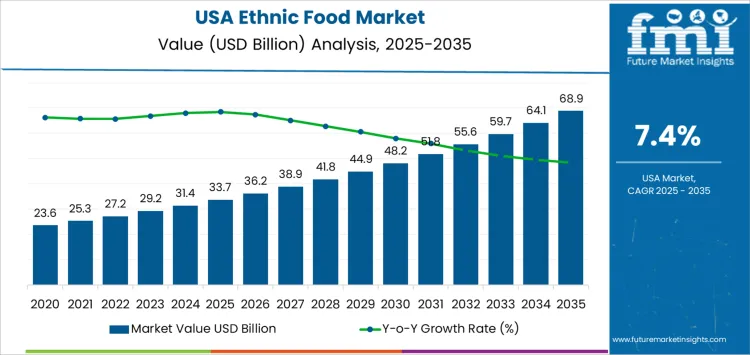
The demand for ethnic food in USA market was valued at USD 33.70 billion in 2025, projected to reach USD 36.19 billion in 2026, and is forecast to expand to USD 73.91 billion by 2036 at a 7.4% CAGR. Increasing cultural diversity, growing immigrant populations, and expanding mainstream appetite for globally inspired flavors are propelling ethnic food demand across every major distribution channel in the United States. The USA Census Bureau demographic data confirms accelerating population diversity, with first- and second-generation immigrant households driving both authentic ingredient purchasing and mainstream crossover product trial. Retail buyers at major grocery chains are expanding ethnic food aisle allocations and integrating ethnic products into mainstream category sets to capture the growing share of consumer food expenditure flowing into internationally inspired meal occasions.
Summary of Demand for Ethnic Food in USA Market
- Market Overview
- The market is valued at USD 33.70 billion in 2025 and is projected to reach USD 73.91 billion by 2036.
- The industry is expected to grow at a 7.4% CAGR from 2026 to 2036, creating an incremental opportunity of USD 37.71 billion.
- The market is a mainstream grocery category where demographic diversification, flavor innovation, and supply chain authenticity define competitive positioning across the United States.
- Demand and Growth Drivers
- USA Census data confirms accelerating population diversity, with immigrant and second-generation households driving demand for authentic ethnic ingredients while simultaneously creating crossover appeal that expands the total addressable market beyond traditional ethnic consumer segments.
- Ethnic food manufacturers are investing in ready-to-eat meal and meal kit product development, moving the category beyond raw ingredient sales into convenient prepared food formats that capture demand from time-constrained consumers seeking authentic ethnic cuisine without full home cooking preparation.
- Major USA grocery chains are restructuring store layouts to integrate ethnic food products into mainstream aisle locations rather than segregating them in specialty sections, increasing product visibility and purchase conversion rates among mainstream consumers who would not navigate to a dedicated ethnic food aisle.
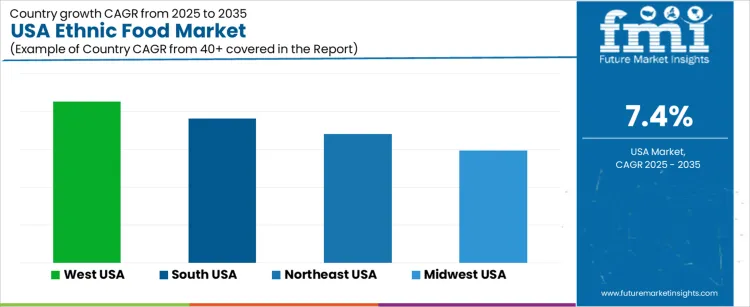
- Among key regions, West USA at 8.5%, South USA at 7.6%, Northeast USA at 6.8%, Midwest USA at 5.9%.
- Product and Segment View
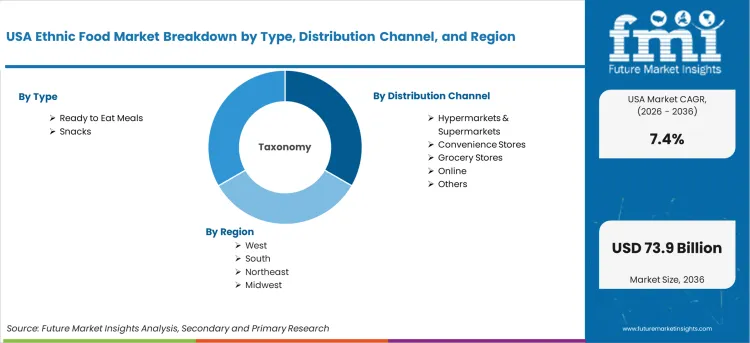
- The market includes products segmented by Type, Distribution Channel, covering Ready to Eat Meals, Snacks under Type and Hypermarkets & Supermarkets, Convenience Stores, Grocery Stores, Online, Others under Distribution Channel.
- Ready to Eat Meals leads Type segmentation with 66.0% share in 2026.
- Hypermarkets & Supermarkets leads Distribution Channel segmentation with 35.0% share in 2026.
- Geography and Competitive Outlook
- West USA is the fastest-growing area at 8.5% CAGR, while Midwest USA registers steady but lower expansion.
- Competition is shaped by product diversification, distribution reach, and pricing discipline, with key players including Ajinomoto Co. Inc., General Mills, Inc., Associated British Foods PLC, McCormick & Company Inc., Orkla ASA.
- Analyst Opinion at FMI
- Nandini Roy Choudhury, Principal Consultant at FMI, opines: 'In my analysis, I have observed that the USA ethnic food market is transitioning from a discovery-phase category to a procurement-scale category where supply chain reliability and product authenticity become the primary competitive differentiators. Companies that build direct sourcing relationships with origin-country ingredient producers will establish cost and quality positions that distributors relying on intermediary trading houses cannot replicate.'
- Strategic Implications / Executive Takeaways
- Manufacturers must establish direct sourcing relationships with origin-country spice, sauce, and specialty grain producers to ensure product authenticity and cost control.
- Product development teams should expand ethnic food offerings into ready-to-eat and meal kit formats to capture demand beyond traditional raw ingredient sales.
- Retail strategists must integrate ethnic food products into mainstream aisle layouts rather than segregated specialty sections to maximize visibility and purchase conversion.
As per FMI, the ethnic food market in the USA is transitioning from a specialty aisle category to a mainstream grocery staple as retailers restructure shelf layouts to reflect changing consumer demographics. Mexican, Asian, Indian, and Middle Eastern cuisine categories are expanding beyond traditional ingredient sales into ready-to-eat and meal kit formats. Foodservice operators are increasing ethnic menu items to meet consumer expectations for flavor diversity. Supply chain infrastructure for sourcing authentic spice blends, sauces, and specialty grains from origin countries is maturing, reducing lead times and improving product freshness at the retail shelf. Private label ethnic food programs are expanding at major grocery chains, with retailers developing store-brand versions of high-velocity ethnic food SKUs that compete with established branded products on price while matching quality expectations.
Regional demand trajectories reflect distinct structural conditions within the United States. West USA leads with a 8.5% CAGR, followed by South USA at 7.6%, Northeast USA at 6.8%, Midwest USA at 5.9%. As per FMI, these regional variations are tied to local immigrant population density, cuisine diversity exposure, and the maturity of ethnic food distribution infrastructure in each region. West USA leads growth driven by the concentration of Asian, Mexican, and Pacific Islander immigrant communities in California, Washington, and Oregon, creating deep demand for authentic ingredients and prepared ethnic food products. South USA registers the second-highest growth rate, supported by Mexican and Central American cuisine demand in Texas, Florida, and the broader Gulf Coast region. Northeast USA maintains steady expansion anchored by the ethnic food distribution infrastructure centered on major metropolitan areas. Midwest USA registers the lowest growth rate as ethnic food retail penetration remains lower relative to coastal markets, though urban centers within the region are showing accelerating adoption.
Demand for Ethnic Food in USA Market Key Takeaways
| Metric | Details |
|---|---|
| Industry Size (2026) | USD 36.19 Billion |
| Industry Value (2036) | USD 73.91 Billion |
| CAGR (2026-2036) | 7.4% |
Source: Future Market Insights, 2026
Demand for Ethnic Food in USA Market Drivers, Restraints, and Opportunities
Future Market Insights analysis indicates the ethnic food market in the USA has evolved from an immigrant community supply category into a mainstream consumer food segment with broad demographic appeal. The structural demand base now extends well beyond first-generation immigrant households to include second- and third-generation consumers seeking authentic cuisine connections, mainstream consumers pursuing flavor exploration, and health-conscious buyers adopting Mediterranean, Asian, and Latin American dietary patterns. Restaurant menu diversification has played a catalytic role in exposing mainstream consumers to ethnic flavors that subsequently translate into retail purchasing behavior as consumers attempt to replicate restaurant experiences in home cooking occasions.
Supply chain infrastructure for authentic ethnic food ingredients has matured considerably, reducing the cost and logistical complexity barriers that previously constrained retail distribution expansion. FMI opines that direct import relationships between USA distributors and origin-country producers of spice blends, specialty sauces, grain products, and prepared food ingredients are replacing multi-tier intermediary trading structures that added cost and reduced freshness. Cold chain capabilities for perishable ethnic food products have improved, enabling retailers to stock fresh and frozen ethnic meal options alongside shelf-stable products. Retailer investment in ethnic food category management expertise is increasing, with dedicated category managers who understand cuisine-specific consumer purchasing patterns replacing generalist buyers who previously managed ethnic food as a low-priority specialty section.
- Demographic Diversification: USA Census data confirms accelerating population diversity, with immigrant and second-generation households driving demand for authentic ethnic ingredients while simultaneously creating crossover appeal that expands the total addressable market beyond traditional ethnic consumer segments.
- Ready-to-Eat Format Expansion: Ethnic food manufacturers are investing in ready-to-eat meal and meal kit product development, moving the category beyond raw ingredient sales into convenient prepared food formats that capture demand from time-constrained consumers seeking authentic ethnic cuisine without full home cooking preparation.
- Retail Mainstreaming: Major US grocery chains are restructuring store layouts to integrate ethnic food products into mainstream aisle locations rather than segregating them in specialty sections, increasing product visibility and purchase conversion rates among mainstream consumers who would not navigate to a dedicated ethnic food aisle.
Demand for Ethnic Food in USA Market Definition
Ethnic food refers to packaged food products originating from or inspired by the culinary traditions of specific cultural, regional, or national cuisines that differ from the mainstream food culture of the consumption market. In the United States context, this encompasses Mexican, Chinese, Indian, Japanese, Thai, Middle Eastern, Korean, Ethiopian, and other internationally sourced or formulated food products. Categories include ready-to-eat meals, sauces, condiments, spice blends, snack items, frozen prepared foods, and specialty grains or legumes distributed through organized and unorganized retail channels.
Demand for Ethnic Food in USA Market Inclusions
Market scope includes ready-to-eat ethnic meals and ethnic snack products across all cuisine categories sold as packaged consumer goods. Distribution channel coverage spans hypermarkets and supermarkets, convenience stores, grocery stores, online retail, and other channels. Regional coverage spans West, South, Northeast, and Midwest USA with forecast projections from 2026 to 2036.
Demand for Ethnic Food in USA Market Exclusions
Fresh produce, raw meat, and unpackaged ingredients sold at ethnic grocery stores are excluded. Dine-in restaurant revenue, food delivery service fees, and catering service income fall outside the scope. Mainstream American-style food products with minor ethnic flavor additions are excluded from the valuation.
Demand for Ethnic Food in USA Market Research Methodology
- Primary Research: Analysts conducted structured interviews with supply chain managers, product procurement leads, and distribution network operators to map decision triggers that shape purchasing volumes and vendor selection criteria.
- Desk Research: Data collection phases aggregated regulatory filings, trade body publications, national consumption surveys, and public procurement records from government statistical agencies.
- Market-Sizing and Forecasting: Baseline values derive from a bottom-up aggregation of category-level consumption volumes, applying region-specific penetration curves and pricing benchmarks to project future demand trajectories.
- Data Validation and Update Cycle: Projections are cross-checked against publicly reported trade statistics, manufacturer shipment disclosures, and import-export databases maintained by customs authorities.
Why is the Demand for Ethnic Food in USA Growing?
The demand for ethnic food in the USA is growing as consumers seek diverse and authentic culinary experiences. The increasing multicultural population in the USA, along with a growing interest in exploring global cuisines, is contributing to the rising demand for ethnic food. As consumers become more adventurous and open to trying new flavors and ingredients, ethnic food offers an opportunity to experience the rich cultural heritage of different countries. This growing trend is particularly evident in urban areas with large immigrant populations, where a wide variety of ethnic food products and restaurants are thriving.
The expanding availability of ethnic food in mainstream grocery stores and restaurants is another key driver. As demand increases, food manufacturers and restaurants are introducing a wider variety of ethnic food options, including pre-packaged meals, spices, sauces, and snacks, to cater to consumers' evolving tastes. The health-conscious consumer is driving demand for ethnic foods that are often perceived as fresher and more flavorful, with many ethnic dishes incorporating fresh vegetables, herbs, and lean proteins.
Advancements in food distribution and the rise of online grocery shopping have made ethnic food more accessible to a broader audience, further fueling its growth. Challenges such as the need for specialized ingredients and the complexity of traditional cooking methods may limit adoption in certain areas. Despite these challenges, the continued interest in diverse and authentic dining experiences, combined with innovations in food production and distribution, is expected to drive sustained demand for ethnic food in the USA.
What is the Segment-Wise Analysis of Demand for Ethnic Food in USA?
Demand for ethnic food in the USA is segmented by type, distribution channel, and region. By type, ready-to-eat meals lead at 66%, followed by snacks. In terms of distribution channel, hypermarkets & supermarkets dominate with 35%, while convenience stores, grocery stores, online platforms, and other channels also contribute to the overall demand. Regionally, demand spans across West USA, South USA, Northeast USA, and Midwest USA, with varying levels of ethnic food adoption based on regional preferences and cultural diversity.
How Do Ready to Eat Meals Lead the Demand for Ethnic Food in USA?
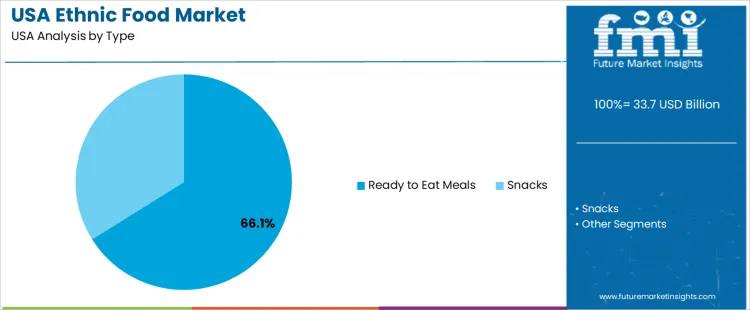
Ready-to-eat meals account for 66% of the demand for ethnic food in the USA, driven by their convenience and popularity among busy consumers seeking quick and authentic ethnic dishes. These meals offer a wide range of flavors from diverse cultures, making them appealing to individuals and families who want diverse, easy-to-prepare food. The demand for ready-to-eat meals is particularly strong in regions like the West and South USA, where there is a high concentration of multicultural populations and growing interest in global cuisines.
The increasing trend of health-conscious eating has fueled the demand for ethnic ready-to-eat meals, which often offer nutritious alternatives to traditional fast food. As more consumers seek variety in their diets and explore new culinary experiences, ready-to-eat ethnic meals continue to be a dominant product in the ethnic food market. Their convenience, combined with the rising fascination with international cuisines, ensures their leadership in the industry.
Why Do Hypermarkets & Supermarkets Lead the Demand for Ethnic Food in USA?
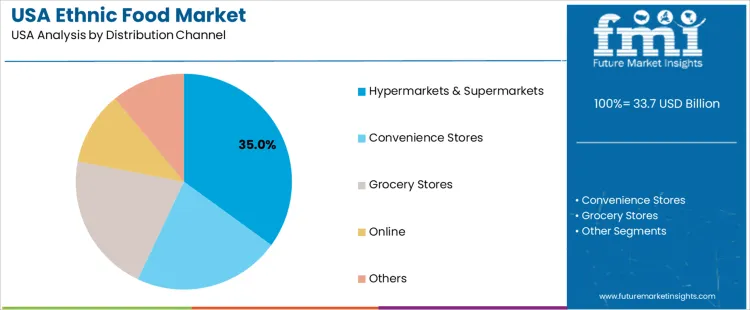
Hypermarkets & supermarkets account for 35% of the demand for ethnic food in the USA, reflecting their role as the primary destination for a wide variety of ethnic products. These large retail outlets provide consumers with convenient access to a broad selection of ethnic foods, catering to multicultural communities and those interested in exploring global cuisines. Supermarkets often have dedicated sections for international foods, making it easy for consumers to find ready-to-eat ethnic meals, snacks, and ingredients.
The demand for ethnic food in these outlets is particularly high in regions like the West and Northeast USA, where diverse populations drive interest in global flavors. The growing curiosity about ethnic cuisines, combined with the convenience of one-stop shopping, contributes to the continued dominance of hypermarkets and supermarkets as the leading distribution channel for ethnic food in the USA.
What are the Key Trends, Drivers, and Restraints in Demand for Ethnic Food in USA?
Demand for ethnic food in the USA is rising due to increasing cultural diversity and growing consumer interest in global cuisines. Immigrant populations and multicultural communities are exposing Americans to foods from Latin America, Asia, the Middle East, and more. The desire for bold flavors, health-conscious meals, and unique dining experiences further drives this trend. Convenience, through ready-to-eat meals, meal kits, and online shopping, also supports adoption. Challenges like unfamiliar flavors, higher costs, and the difficulty in sourcing authentic ingredients may limit broader acceptance. Despite these challenges, ethnic foods continue to gain popularity across the country.
What is Driving Demand for Ethnic Food in USA?
Demand for ethnic food in the USA is growing strongly due to rising cultural diversity and growing interest in global cuisines. As immigrant populations increase and multicultural communities expand, more Americans are exposed to foods from Latin America, Asia, the Middle East, and other regions, boosting demand for authentic ethnic meals and ingredients. Changing consumer tastes toward bold flavors and global food experiences also drive this demand. Interest in cuisines such as Mexican, Indian, Vietnamese, and West African has risen significantly. Growing health consciousness and the desire for varied, experience-oriented meals further support adoption. The availability of ethnic products in supermarkets, online stores, and restaurants makes access easier, encouraging both trial and repeat consumption.
How Are Trends in Lifestyle, Convenience, and Retail Channels Influencing Ethnic Food Demand in USA?
Urbanization, busy work schedules, and evolving lifestyles in the USA are increasing demand for convenient ethnic food options. Ready-to-eat meals, frozen ethnic dishes, meal kits, and restaurant-style offerings cater to consumers looking for quick, flavorful meals without extensive cooking. Supermarkets and hypermarkets are expanding their ethnic food sections, and online retail channels enable easier access to global ingredients or prepared meals, even in areas with limited local ethnic food availability.
Foodservice trends also reflect rising demand: ethnic restaurants, food trucks, and takeaway services are proliferating in metropolitan areas, making ethnic cuisines a regular part of dining-out and home meal rotations. The trend toward fusion foods and cross-cultural dishes also expands appeal, drawing consumers curious about novel flavor combinations and culinary experiences.
What Are the Key Challenges and Restraints Limiting Ethnic Food Demand in USA?
One challenge is that not all consumers are comfortable with unfamiliar flavors, spices, or ingredients, limiting ethnic food consumption to more adventurous eaters. Maintaining authenticity while catering to American taste preferences can be difficult, so some ethnic foods are "Americanized," which may disappoint food purists seeking genuine experiences. Supply chain issues and sourcing of authentic ingredients can pose difficulties, especially for niche cuisines, affecting availability or cost. Price sensitivity can also restrain demand: ethnic meals or imported ingredients can be more expensive than standard fare, making them less accessible to budget-conscious consumers. Health perceptions and dietary restrictions may deter some consumers from incorporating ethnic foods regularly.
What is the Regional Demand Outlook for Ethnic Food in the USA?
| Region | CAGR (%) |
|---|---|
| West USA | 8.5% |
| South USA | 7.6% |
| Northeast USA | 6.8% |
| Midwest USA | 5.9% |
Demand for ethnic food in the USA is growing steadily across all regions, with West USA leading at an 8.5% CAGR, driven by its diverse and multicultural population. South USA follows with a 7.6% CAGR, as consumers seek more variety in their food options, influenced by a growing Hispanic and international community. Northeast USA shows a 6.8% CAGR, fueled by a strong multicultural presence and the popularity of international cuisines. Midwest USA experiences a 5.9% CAGR, with increasing interest in ethnic food offerings as the region's food culture evolves. As the American consumer base becomes more adventurous and diverse in their tastes, the demand for ethnic food is expected to rise across the country.
How is Demand for Ethnic Food Growing in West USA?
West USA leads the demand for ethnic food, growing at an 8.5% CAGR. The region’s diverse, multicultural population plays a significant role in driving this demand. States like California, with large Hispanic, Asian, and Middle Eastern communities, foster a vibrant ethnic food culture. Cities like Los Angeles and San Francisco are hubs for international cuisines, offering a wide array of authentic dishes from around the world.
Consumers in West USA are increasingly open to exploring new flavors and trying different cultural cuisines, which contributes to the growing popularity of ethnic foods. The region's large immigrant population has made ethnic cuisine widely available in both grocery stores and restaurants. As interest in global flavors continues to rise and consumers seek more diverse dining experiences, demand for ethnic food is expected to remain strong in West USA. The region’s openness to culinary innovation will continue to drive the adoption of ethnic foods.
Why is Demand for Ethnic Food Rising in South USA?
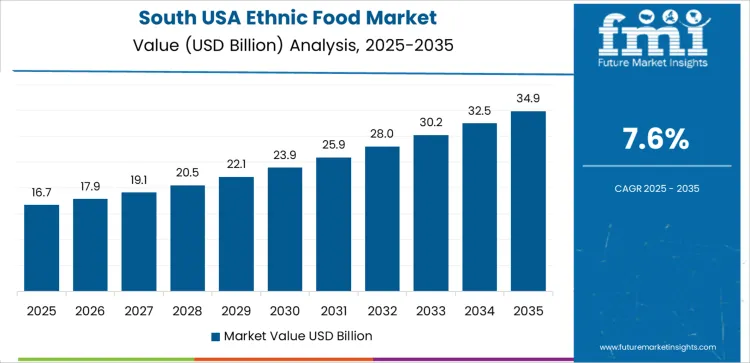
In South USA, demand for ethnic food is rising at a 7.6% CAGR. The region’s growing ethnic diversity, particularly in states like Texas, Florida, and Georgia, has contributed to the increasing demand for international cuisines. Hispanic, Caribbean, and other immigrant communities have played a significant role in bringing diverse food traditions to the region, resulting in greater acceptance and demand for ethnic foods. The rise of food festivals and events dedicated to ethnic cuisines has also increased awareness and interest.
Southern cuisine evolves, more consumers are looking for ethnic dishes and ingredients to incorporate into their meals. With increasing numbers of international restaurants, markets, and food trucks offering ethnic food, consumers have more access to global flavors. As people embrace cultural diversity and explore new culinary experiences, the demand for ethnic food will continue to grow in South USA, making it a significant player in the national food scene.
How is Demand for Ethnic Food Expanding in Northeast USA?
Northeast USA shows steady demand for ethnic food, growing at a 6.8% CAGR. The region’s longstanding multicultural presence, particularly in cities like New York, Boston, and Philadelphia, has made ethnic food a key part of its food culture. Immigrant populations, including Hispanic, Asian, and European communities, have shaped the region's food landscape, making a wide range of international cuisines readily available. As consumers become more health-conscious and open to exploring diverse flavors, ethnic food, known for its bold spices and nutrient-rich ingredients, has become increasingly popular.
The region’s emphasis on food trends, sustainability, and inclusivity aligns with the growing demand for diverse cuisines. Northeast USA is also home to a robust restaurant scene, with many establishments offering authentic ethnic dishes, further contributing to the region’s rising demand for ethnic food. As the appetite for global flavors continues to grow, ethnic food will remain a staple of the region's culinary offerings.
Why is Demand for Ethnic Food Growing in Midwest USA?
Midwest USA is experiencing steady demand for ethnic food, growing at a 5.9% CAGR. While demand is not as high as in more urbanized regions, cities like Chicago, Minneapolis, and Detroit have seen an increase in ethnic food offerings, particularly as the region’s food culture becomes more diverse. The growing immigrant populations from Eastern Europe, Asia, and the Middle East are expanding the availability of ethnic cuisine in the region.
Many consumers are eager to try global flavors, and as local communities become more diverse, ethnic food is becoming a regular part of dining options. The popularity of food trucks, ethnic grocery stores, and online food delivery services offering ethnic cuisines has made it easier for consumers in smaller cities to access diverse food options. With a growing desire for new culinary experiences and the availability of more ethnic food outlets, demand in Midwest USA is expected to keep growing steadily.
Competitive Aligners for Market Players
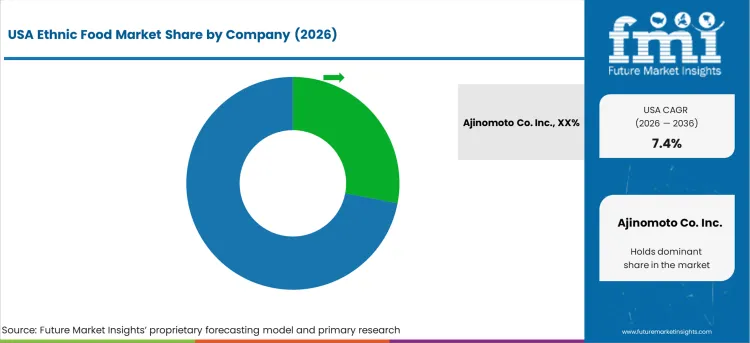
The competitive structure of the ethnic food market in the USA is fragmented across cuisine categories, with concentrated leadership within specific ethnic segments but no single company dominating the overall market. Ajinomoto Co. Inc., General Mills, Inc., Associated British Foods PLC, McCormick & Company Inc., and Orkla ASA compete through multi-cuisine brand portfolios, distribution network breadth, and the ability to serve both food service and retail channels simultaneously. Competitive differentiation is driven by product authenticity, flavor accuracy, ingredient sourcing credibility, and the breadth of SKU assortment within each cuisine category.
Companies with established relationships with origin-country ingredient suppliers achieve cost and quality advantages that domestic-only manufacturers cannot replicate. Multi-cuisine portfolio operators benefit from cross-selling opportunities and consolidated distribution logistics that reduce per-SKU costs. Food service distribution represents a critical competitive channel, as restaurant and institutional customers provide high-volume demand anchors that stabilize production planning and reduce unit costs for manufacturers who serve both retail and food service accounts.
New entrant activity is concentrated in premium, authentic, and small-batch ethnic food segments where direct-to-consumer distribution and specialty retail placement provide viable paths to market without requiring major grocery chain listing agreements. Immigrant entrepreneur brands with authentic cuisine credentials and origin-country sourcing networks are building consumer loyalty in specific ethnic food sub-categories before pursuing broader retail distribution. Private label competition is intensifying as major retailers develop store-brand ethnic food lines that target the highest-velocity product categories within each cuisine segment.
Key Players in Demand for Ethnic Food in USA Market
- Ajinomoto Co. Inc.
- General Mills, Inc.
- Associated British Foods PLC
- McCormick & Company Inc.
- Orkla ASA
Scope of the Report
| Metric | Value |
|---|---|
| Quantitative Units | USD 36.19 Billion to USD 73.91 Billion, at a CAGR of 7.4% |
| Market Definition | Ethnic food refers to packaged food products originating from or inspired by the culinary traditions of specific cultural, regional, or national cuisines that differ from the mainstream food culture of the consumption market. In the United States context, this encompasses Mexican, Chinese, Indian, Japanese, Thai, Middle Eastern, Korean, Ethiopian, and other internationally sourced or formulated food products. |
| Type Segmentation | Ready to Eat Meals, Snacks |
| Distribution Channel Segmentation | Hypermarkets & Supermarkets, Convenience Stores, Grocery Stores, Online, Others |
| Regions Covered | West USA, South USA, Northeast USA, Midwest USA |
| Key Companies Profiled | Ajinomoto Co. Inc., General Mills, Inc., Associated British Foods PLC, McCormick & Company Inc., Orkla ASA |
| Forecast Period | 2026 to 2036 |
| Approach | Bottom-up methodology starting with category-level consumption data and applying regional penetration assumptions. |
Demand for Ethnic Food in USA Market Analysis by Segments
By Type:
Ready to Eat Meals, Snacks
By Distribution Channel:
Hypermarkets & Supermarkets, Convenience Stores, Grocery Stores, Online, Others
By Region:
West USA, South USA, Northeast USA, Midwest USA
Bibliography
- 1. United States Census Bureau. (2024). American Community Survey: Immigration and Demographic Diversity Data. Census Bureau.
- 2. United States Department of Agriculture. (2024). Economic Research Service: Food Expenditure Series and Ethnic Food Category Analysis. USDA ERS.
- 3. Food and Drug Administration. (2024). Food Labeling and Import Compliance Guidelines for Specialty Food Products. FDA.
- 4. Specialty Food Association. (2024). State of the Specialty Food Industry Report. SFA.
- 5. International Trade Administration. (2024). Ethnic and Specialty Food Import-Export Trade Data. ITA.
This bibliography is provided for reader reference. The full Future Market Insights report contains the complete reference list with primary research documentation.
Frequently Asked Questions
How large is the Demand for Ethnic Food in USA Market in 2026?
The Demand for Ethnic Food in USA market is estimated to be valued at USD 36.19 billion in 2026.
What will be the market size of Demand for Ethnic Food in USA by 2036?
The Demand for Ethnic Food in USA market is projected to reach USD 73.91 billion by 2036.
What is the expected CAGR for Demand for Ethnic Food in USA between 2026 and 2036?
The Demand for Ethnic Food in USA market is expected to grow at a CAGR of 7.4% between 2026 and 2036.
Which Type is poised to lead in 2026?
Ready to Eat Meals accounts for 66.0% share in 2026, maintaining its position as the leading type segment.
Which region is projected to grow the fastest?
West USA is projected to grow at a CAGR of 8.5% during 2026 to 2036, the fastest among all covered regions.
What does Demand for Ethnic Food in USA mean in this report?
Ethnic food refers to packaged food products originating from or inspired by the culinary traditions of specific cultural, regional, or national cuisines that differ from the mainstream food culture of the consumption market. In the United States context, this encompasses Mexican, Chinese, Indian, Japanese, Thai, Middle Eastern, Korean, Ethiopian, and other internationally sourced or formulated food products.
What is included in the scope of this report?
Market scope includes ready-to-eat ethnic meals and ethnic snack products across all cuisine categories sold as packaged consumer goods. Distribution channel coverage spans hypermarkets and supermarkets, convenience stores, grocery stores, online retail, and other channels.
How does FMI build and validate the Demand for Ethnic Food in USA forecast?
Forecasting models apply a bottom-up methodology starting with category-level consumption data and cross-validate projections against trade statistics, manufacturer shipment disclosures, and regulatory filings.
Preview the report firsthand - request a free sample
Get SampleGet the brochure for pricing and purchase details.
Get PDFTable of Content
- Executive Summary
- USA Market Outlook
- Demand-side Trends
- Supply-side Trends
- Technology Roadmap Analysis
- Analysis and Recommendations
- Market Overview
- Market Coverage / Taxonomy
- Market Definition / Scope / Limitations
- Research Methodology
- Chapter Orientation
- Analytical Lens and Working Hypotheses
- Market Structure, Signals, and Trend Drivers
- Benchmarking and Cross-market Comparability
- Market Sizing, Forecasting, and Opportunity Mapping
- Research Design and Evidence Framework
- Desk Research Programme (Secondary Evidence)
- Company Annual and Sustainability Reports
- Peer-reviewed Journals and Academic Literature
- Corporate Websites, Product Literature, and Technical Notes
- Earnings Decks and Investor Briefings
- Statutory Filings and Regulatory Disclosures
- Technical White Papers and Standards Notes
- Trade Journals, Industry Magazines, and Analyst Briefs
- Conference Proceedings, Webinars, and Seminar Materials
- Government Statistics Portals and Public Data Releases
- Press Releases and Reputable Media Coverage
- Specialist Newsletters and Curated Briefings
- Sector Databases and Reference Repositories
- FMI Internal Proprietary Databases and Historical Market Datasets
- Subscription Datasets and Paid Sources
- Social Channels, Communities, and Digital Listening Inputs
- Additional Desk Sources
- Expert Input and Fieldwork (Primary Evidence)
- Primary Modes
- Qualitative Interviews and Expert Elicitation
- Quantitative Surveys and Structured Data Capture
- Blended Approach
- Why Primary Evidence is Used
- Field Techniques
- Interviews
- Surveys
- Focus Groups
- Observational and In-context Research
- Social and Community Interactions
- Stakeholder Universe Engaged
- C-suite Leaders
- Board Members
- Presidents and Vice Presidents
- R&D and Innovation Heads
- Technical Specialists
- Domain Subject-matter Experts
- Scientists
- Physicians and Other Healthcare Professionals
- Governance, Ethics, and Data Stewardship
- Research Ethics
- Data Integrity and Handling
- Primary Modes
- Tooling, Models, and Reference Databases
- Desk Research Programme (Secondary Evidence)
- Data Engineering and Model Build
- Data Acquisition and Ingestion
- Cleaning, Normalisation, and Verification
- Synthesis, Triangulation, and Analysis
- Quality Assurance and Audit Trail
- Market Background
- Market Dynamics
- Drivers
- Restraints
- Opportunity
- Trends
- Scenario Forecast
- Demand in Optimistic Scenario
- Demand in Likely Scenario
- Demand in Conservative Scenario
- Opportunity Map Analysis
- Product Life Cycle Analysis
- Supply Chain Analysis
- Investment Feasibility Matrix
- Value Chain Analysis
- PESTLE and Porter’s Analysis
- Regulatory Landscape
- Regional Parent Market Outlook
- Production and Consumption Statistics
- Import and Export Statistics
- Market Dynamics
- USA Market Analysis 2021 to 2025 and Forecast, 2026 to 2036
- Historical Market Size Value (USD Million) Analysis, 2021 to 2025
- Current and Future Market Size Value (USD Million) Projections, 2026 to 2036
- Y-o-Y Growth Trend Analysis
- Absolute $ Opportunity Analysis
- USA Market Pricing Analysis 2021 to 2025 and Forecast 2026 to 2036
- USA Market Analysis 2021 to 2025 and Forecast 2026 to 2036, By Type
- Introduction / Key Findings
- Historical Market Size Value (USD Million) Analysis By Type , 2021 to 2025
- Current and Future Market Size Value (USD Million) Analysis and Forecast By Type , 2026 to 2036
- Ready to Eat Meals
- Snacks
- Ready to Eat Meals
- Y-o-Y Growth Trend Analysis By Type , 2021 to 2025
- Absolute $ Opportunity Analysis By Type , 2026 to 2036
- USA Market Analysis 2021 to 2025 and Forecast 2026 to 2036, By Distribution Channel
- Introduction / Key Findings
- Historical Market Size Value (USD Million) Analysis By Distribution Channel, 2021 to 2025
- Current and Future Market Size Value (USD Million) Analysis and Forecast By Distribution Channel, 2026 to 2036
- Hypermarkets & Supermarkets
- Convenience Stores
- Grocery Stores
- Online
- Others
- Hypermarkets & Supermarkets
- Y-o-Y Growth Trend Analysis By Distribution Channel, 2021 to 2025
- Absolute $ Opportunity Analysis By Distribution Channel, 2026 to 2036
- USA Market Analysis 2021 to 2025 and Forecast 2026 to 2036, By Region
- Introduction
- Historical Market Size Value (USD Million) Analysis By Region, 2021 to 2025
- Current Market Size Value (USD Million) Analysis and Forecast By Region, 2026 to 2036
- West
- South
- Northeast
- Midwest
- Market Attractiveness Analysis By Region
- West Market Analysis 2021 to 2025 and Forecast 2026 to 2036, By Country
- Historical Market Size Value (USD Million) Trend Analysis By Market Taxonomy, 2021 to 2025
- Market Size Value (USD Million) Forecast By Market Taxonomy, 2026 to 2036
- By Country
- By Type
- By Distribution Channel
- By Country
- Market Attractiveness Analysis
- By Country
- By Type
- By Distribution Channel
- Key Takeaways
- South Market Analysis 2021 to 2025 and Forecast 2026 to 2036, By Country
- Historical Market Size Value (USD Million) Trend Analysis By Market Taxonomy, 2021 to 2025
- Market Size Value (USD Million) Forecast By Market Taxonomy, 2026 to 2036
- By Country
- By Type
- By Distribution Channel
- By Country
- Market Attractiveness Analysis
- By Country
- By Type
- By Distribution Channel
- Key Takeaways
- Northeast Market Analysis 2021 to 2025 and Forecast 2026 to 2036, By Country
- Historical Market Size Value (USD Million) Trend Analysis By Market Taxonomy, 2021 to 2025
- Market Size Value (USD Million) Forecast By Market Taxonomy, 2026 to 2036
- By Country
- By Type
- By Distribution Channel
- By Country
- Market Attractiveness Analysis
- By Country
- By Type
- By Distribution Channel
- Key Takeaways
- Midwest Market Analysis 2021 to 2025 and Forecast 2026 to 2036, By Country
- Historical Market Size Value (USD Million) Trend Analysis By Market Taxonomy, 2021 to 2025
- Market Size Value (USD Million) Forecast By Market Taxonomy, 2026 to 2036
- By Country
- By Type
- By Distribution Channel
- By Country
- Market Attractiveness Analysis
- By Country
- By Type
- By Distribution Channel
- Key Takeaways
- Key Countries Market Analysis
- West
- Pricing Analysis
- Market Share Analysis, 2025
- By Type
- By Distribution Channel
- South
- Pricing Analysis
- Market Share Analysis, 2025
- By Type
- By Distribution Channel
- Northeast
- Pricing Analysis
- Market Share Analysis, 2025
- By Type
- By Distribution Channel
- Midwest
- Pricing Analysis
- Market Share Analysis, 2025
- By Type
- By Distribution Channel
- West
- Market Structure Analysis
- Competition Dashboard
- Competition Benchmarking
- Market Share Analysis of Top Players
- By Regional
- By Type
- By Distribution Channel
- Competition Analysis
- Competition Deep Dive
- Ajinomoto Co. Inc.
- Overview
- Product Portfolio
- Profitability by Market Segments (Product/Age /Sales Channel/Region)
- Sales Footprint
- Strategy Overview
- Marketing Strategy
- Product Strategy
- Channel Strategy
- General Mills, Inc.
- Associated British Foods PLC
- McCormick & Company Inc.
- Orkla ASA
- Ajinomoto Co. Inc.
- Competition Deep Dive
- Assumptions & Acronyms Used


