

- Industry Size (2026)
- USD 46.36 Bn
- Forecast (2036)
- USD 79.94 Bn
- CAGR (2026 to 2036)
- 5.6%
Frozen Cooked Ready Meals Market Size, Market Forecast and Outlook By FMI
The frozen cooked ready meals market was valued at USD 43.90 billion in 2025, projected to reach USD 46.36 billion in 2026, and is forecast to expand to USD 79.94 billion by 2036 at a 5.6% CAGR. Time-constrained meal preparation habits, single-person household growth, and the quality improvement of frozen meal technology are converting frozen ready meals from an emergency meal solution into a planned weekly meal component. Blast-freezing and modified atmosphere packaging technologies now preserve flavour, texture, and nutritional profiles at levels approaching freshly prepared meals, reducing the quality perception gap that historically limited category growth.
As per FMI, vegetarian meals hold 41.0% share because plant-based and flexitarian dietary adoption is driving frozen meal manufacturers to expand vegetarian product ranges that serve both committed vegetarians and meat-reducing consumers. Tray packaging commands 43.0% share as oven-to-table and microwave-compatible tray formats deliver the reheating convenience and portion presentation that consumers expect from ready meal products. Supermarkets and hypermarkets anchor distribution at 46.0% as the frozen food aisle remains the primary retail access point for ready meal discovery and purchasing.
Summary of Frozen Cooked Ready Meals Market
- Frozen Cooked Ready Meals Market Definition
- Frozen cooked ready meals are fully prepared, portion-controlled meal products that are cooked, assembled, and blast-frozen for distribution and consumer storage. These products require only reheating via microwave, oven, or stovetop before consumption, serving as complete meal solutions for household, workplace, and institutional dining occasions.
- Demand Drivers in the Market
- Single-person household demographic growth: The expansion of single-person households across urban centres in Europe, East Asia, and North America creates a structural consumer base for portion-controlled frozen meals. FMI analysts note that cooking from scratch for one person is disproportionately inefficient in time and ingredient cost, making frozen ready meals an economically rational meal solution for single-person households.
- Freezing technology quality improvement: Based on FMI's report, blast-freezing, individual quick-freezing, and modified atmosphere packaging technologies have closed the quality gap between frozen and freshly prepared meals. Premium frozen meal brands now deliver flavour and texture profiles that pass consumer blind taste comparisons against restaurant-prepared equivalents in key meal categories.
- Plant-based frozen meal range expansion: As per FMI, frozen meal manufacturers are expanding vegetarian and vegan product ranges to serve the growing flexitarian consumer segment. Plant-based frozen meals remove the meal planning and ingredient sourcing barriers that prevent time-constrained consumers from maintaining vegetarian eating patterns through scratch cooking.
- Key Segments Analyzed in the FMI Report
- Vegetarian meal flexitarian capture: Vegetarian Meals holds 41.0% share in 2026. The flexitarian eating trend drives vegetarian frozen meal sales because time-constrained consumers who intend to reduce meat consumption find frozen vegetarian meals the most convenient pathway to maintaining plant-based eating patterns during busy weekdays.
- Tray packaging reheating convenience: Trays commands 43.0% share in 2026. Microwave and oven-compatible tray packaging eliminates the need for dish transfer before reheating and provides a presentation-ready serving vessel, delivering maximum convenience in the meal preparation workflow.
- Supermarket frozen aisle access: Supermarkets/Hypermarkets holds 46.0% share in 2026. The dedicated frozen food aisle in mainstream grocery retail provides the primary product discovery and planned purchasing environment for frozen ready meals, with fixture merchandising and promotional programmes driving category awareness.
- Analyst Opinion at FMI
- Nandini Roy Choudhury, Principal Consultant for Food & Beverage the frozen cooked ready meals market is in a premiumization cycle where consumers are trading up from commodity frozen meals to premium, clean-label, and cuisine-specific products that deliver restaurant-quality eating experiences at home. The competitive frontier has shifted from price-per-calorie to flavour-per-serving, with brands that invest in culinary development and ingredient quality capturing the margin growth in the category.
- Strategic Implications / Executive Takeaways
- Frozen meal manufacturers should invest in culinary development teams that create restaurant-quality recipes adapted for frozen preservation to capture the premium meal segment.
- Retailers should expand frozen meal fixture space and implement cuisine-based merchandising to help consumers navigate the growing variety of frozen meal options.
- Packaging suppliers should develop recyclable tray formats that meet both the functional reheating requirements and the tightening single-use plastic regulations across European and Australian markets.
- Methodology
- Primary Research: FMI conducted technical interviews with procurement specialists and operations directors across 40 countries to validate adoption timelines.
- Desk Research: Analysts aggregated public regulatory documentation, industry standards, and corporate disclosure filings.
- Market-Sizing and Forecasting: Forecasting models apply hybrid methodology starting with global production metrics and projecting adoption conversion rates.
- Data Validation and Update Cycle: Segment forecasts undergo cross-validation against quarterly and annual industry production volumes.
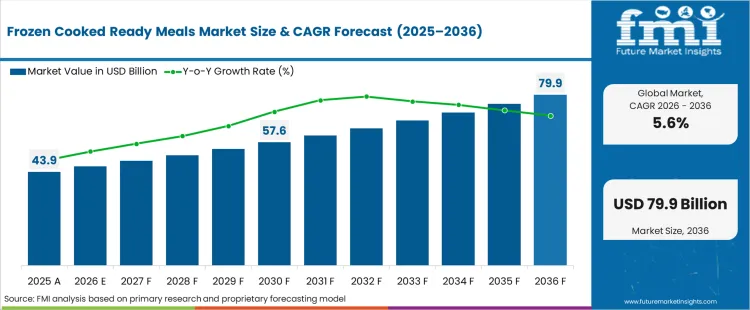
Frozen Cooked Ready Meals Market Key Takeaways
| Metric | Details |
|---|---|
| Industry Size (2026) | USD Billion 46.36 |
| Industry Value (2036) | USD Billion 79.94 |
| CAGR (2026-2036) | 5.6% |
Source: Future Market Insights, 2026
Thailand leads with a 7.2% CAGR, driven by the country's position as a major frozen meal export manufacturer serving European and North American markets while developing domestic consumption. China follows at 6.5% as the convenience food culture in urban centres and cold chain infrastructure expansion create domestic demand growth. UK registers a 4.8% pace reflecting the most mature per-capita frozen ready meal consumption market globally. Germany tracks at 4.4% as the frozen food retail channel and single-person household demographic expand. USA registers a 4.1% driven by the frozen aisle revitalization trend and premium frozen meal brand development.
Frozen Cooked Ready Meals Market Definition
Frozen cooked ready meals are fully prepared, portion-controlled meal products that are cooked, assembled, and blast-frozen for distribution and consumer storage. These products require only reheating via microwave, oven, or stovetop before consumption, serving as complete meal solutions for household, workplace, and institutional dining occasions.
Frozen Cooked Ready Meals Market Inclusions
Market scope includes vegetarian and non-vegetarian frozen cooked ready meals in tray, bag, box, and pouch packaging. The report covers global and regional market sizes from 2026 to 2036, segmented by meal type, packaging, distribution channel, and geography.
Frozen Cooked Ready Meals Market Exclusions
Frozen meal components (frozen vegetable, frozen proteins) sold individually for assembly by the consumer are excluded. Chilled ready meals with refrigerated rather than frozen shelf-life fall outside scope. Frozen desserts and frozen bakery products are excluded from the valuation.
Frozen Cooked Ready Meals Market Research Methodology
- Primary Research: Analysts engaged with procurement specialists, production managers, and supply chain directors to map purchasing cycles and supplier qualification requirements.
- Desk Research: Data collection aggregated regulatory filings, industry standards, trade association publications, and public company disclosures.
- Market-Sizing and Forecasting: Baseline values derive from hybrid top-down and bottom-up methodology, applying region-specific adoption curves through 2036.
- Data Validation and Update Cycle: Projections tested against publicly reported production volumes, trade data, and industry benchmarks with annual recalibration.
Factors Driving the Demand for Frozen Cooked Ready Meals
Shift in Consumption Patterns to Drive Sales
There has been a change in consumer eating habits, as many people have started consuming ready-to-eat meals due to changing preferences for convenience, variety, and portion control. Consumers' increasing interest in ready-made food that offers a balance of nutrition and taste is also benefiting the frozen cooked ready meals market.
Another main factor is that the rising trend of single-person households and small families calls for frozen, pre-cooked meals with portion sizes that can control consumption better and prevent food from going waste.
Growing Availability in Retail Stores to Escalate Product Demand
The availability of frozen cooked ready meals in both traditional grocery stores and online platforms has increased. Retailers are expanding their frozen food sections and offering a wider variety of ready-to-eat meals to meet the growing demand of consumers.
Several consumers have enjoyed the ease of online grocery shopping, where they can order frozen meals directly from e-commerce sites, thereby now making frozen foods available in as large a way as possible. The increased accessibility results in further growth in the market.
Key Emerging Trends in the Frozen Cooked Ready Meals Market
Preference for Specialty Meal Options
The major trend of the frozen cooked ready meals market is that of health-conscious and specialty meal options. Consumers are demanding more and more frozen meals to match their dietary preferences and health objectives, thereby fueling a rise in options such as gluten-free, plant-based, low-carb, and high-protein meals.
This trend has seen growing nutrition awareness and more desire for easier, healthier alternatives in replacement of conventional frozen meals. It further encourages producers and manufacturers to promote meals made from clean ingredients, lesser in sodium and providing better control, which accommodate so many diet-specific needs. A shift in a conscious eating lifestyle trend toward wanting meals that are healthful but accessible and easy at the same time has encouraged this transition.
Changing Consumer Trends Shaping the Frozen Cooked Ready Meals Market
Rising Demand for Ethically-sourced Ingredients
The biggest mega consumer trend in the market is the growing demand for sustainable and ethically sourced ingredients. As consumers are becoming more environmentally conscious, they seek products that fit their values, such as sustainable packaging, eco-friendly production methods, and responsibly sourced ingredients.
This trend is forcing brands to become greener, from reducing food waste, using recyclable or biodegradable packaging, and sourcing ingredients from ethical suppliers. Consumers are thus more likely to opt for frozen cooked ready meals that meet their convenience and health needs but also align with their values of sustainability and environmental stewardship.
Frozen Cooked Ready Meals Industry Analysis by Top Investment Segments
By Meal Type
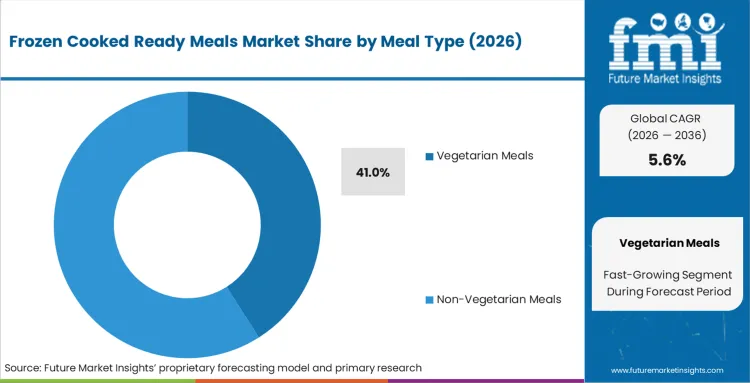
| Attributes | Details |
|---|---|
| Top Meal | Vegetarian |
| Market Share in 2025 | 41% |
In terms of meal type, the market is divided into vegetarian and non-vegetarian meals. The vegetarian segment is set to register 41% share in 2025. More consumers are adopting flexitarian or plant-forward diets, reducing meat consumption while still eating some animal products.
Vegetarian ready meals provide an easy alternative for those looking to cut down on meat without compromising on taste or nutrition. Pre-portioned vegetarian frozen meals help individuals manage caloric intake and maintain a balanced diet without the hassle of meal prep.
By Packaging
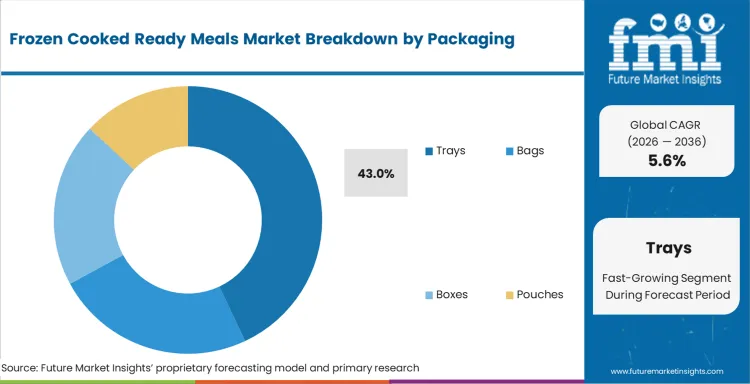
| Attributes | Details |
|---|---|
| Top Packaging | Trays |
| Market Share in 2025 | 43% |
With respect to packaging, the market is classified into trays, bags, boxes, and pouches. The trays segment is expected to observe a 43% share in 2025. Trays are ready to heat and serve, making them extremely convenient for consumers.
With a tray, customers can easily heat the meal directly in the microwave or oven without needing to transfer it to a separate container, reducing the need for additional steps in meal preparation. This simplicity is a major selling point for busy individuals or families who are looking for the quickest and easiest way to enjoy a meal.
By Distribution Channel
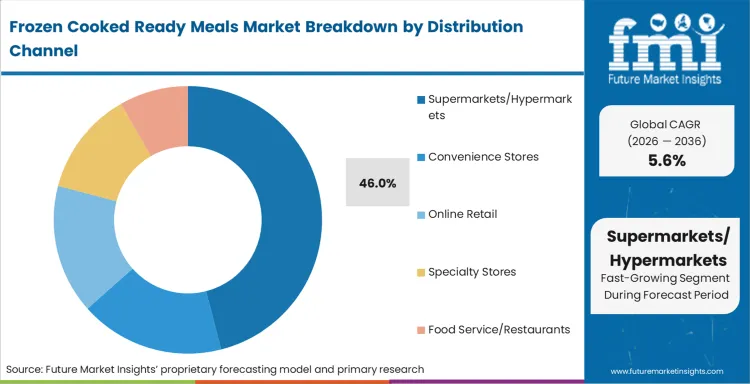
On the basis of distribution channel, the market is divided into supermarkets/hypermarkets, convenience stores, online retail, specialty stores, and food service/restaurants. Due to extensive varieties of frozen ready meals stocked in supermarkets/hypermarkets, numerous choices are readily available for a consumer in relation to brands, type of cuisine, diet, or price.
Purchasing frozen meal is also easily done at one stop while one is doing its regular grocery. This convenience and one-stop availability increase the potential of choosing the supermarket/hypermarket as a primary retail channel for frozen-ready meals.
Analysis of Top Countries Producing, Formulating, Packaging, Distributing, and Consuming Frozen Cooked Ready Meals
.webp "Top Country Growth Comparison Frozen Cooked Ready Meals Market Cagr (2026 2036)")
Rapid Urbanization in Thailand to Escalate Product Sales
The Thailand market is set to experience 7.2% CAGR during the forecast period. The country has undergone quite a high percentage of urbanization over the past decades, but most people nowadays move to towns where fast lives with busy schedules keep them from having free time to cook and prepare meals; therefore, to save time many urban dwellers look for instant, convenient and time-saving answers, such as frozen cooked ready meals, thus they can still have a healthy, delicious meal without spending long hours in the kitchen.
These are a convenient option for single working professionals, young families, and working persons who value convenience more than preparing fresh from scratch meals.
Surging Disposable Income in China to Bolster Product Demand
Growing middle class and rising disposable incomes in China allowed more consumers to afford convenience food like frozen cooked ready meals. As a result, people spend most of their income, therefore making needful searches for food that comes cheap and is easy to prepare, and frozen cooked ready meals are just what the pocket will buy.
Affordability of frozen meals combined with ease of preparation has been an attraction for consumers in the quest for speedy and low-cost solutions in light of increasing food prices and busy schedules.
Evolving Consumer Preferences to Spur Adoption in the USA
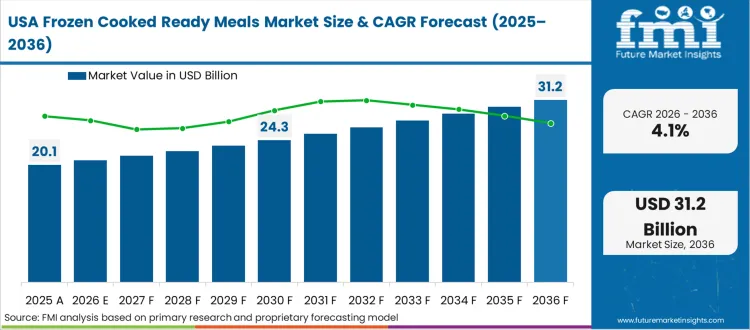
The USA is set to expand at 4.1% CAGR during the study period. The frozen cooked ready meals market in the country is growing due to a combination of lifestyle changes and evolving consumer preferences. As people lead busier lives, the demand for convenient, time-saving food options has increased, making frozen meals an attractive choice.
These meals offer quick preparation without sacrificing taste or quality, as advancements in freezing technology have enhanced flavor and texture. Frozen meals come in a myriad of dietary requirement categories, among which are now healthy, vegetarians, and dietary-restricted menus.
Frozen meals thus last longer to prevent waste or spoiling from taking place, enabling the consumer to save money at the same time. These make frozen cooked ready meals a rather sensible and pleasing choice for lots of USA households today.
Hectic Lifestyles in Canada to Bolster Sales
As more and more Canadians juggle work, family, and social commitments, the ready-to-eat frozen meal is one of those viable alternatives for saving time while still maintaining quality. Improvements in freeze technology have made frozen meals not only more flavorful, nutritious, and diverse but also health-conscious and specialty diets for every need.
Furthermore, a longer shelf life for frozen meals reduces food waste and increases their cost-effective alternative to fresh meals. This is why this market has flourished in Canada, where a growing demand for easy-to-prepare, high-quality meals fit into busy modern lives.
Innovations in Freezing Technology to Increase Uptake in the UK
These meals have become better due to advancements in freezing technology. Current diversity in frozen meals because of other dietary preferences such as vegan, gluten-free, and low-calorie meals makes them more attractive to a larger population.
Economic factors also come into the picture, where frozen meals provide an affordable option instead of the current trend in dining out or preparation from scratch. All these advantages have contributed to making frozen cooked ready meals the most in-demand products.
High Availability of Innovative Meals to Spur Demand in Germany
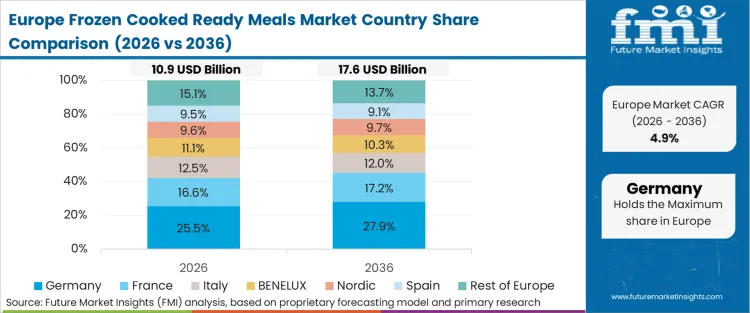
The variety of available meals has expanded, catering to a range of dietary preferences, including vegetarian, vegan, and health-conscious choices. Frozen meals also provide a longer shelf life, helping to reduce food waste and offering a cost-effective alternative to fresh meals. These factors, combined with a growing focus on convenience, have contributed to the market's growth in Germany.
Key Frozen Cooked Ready Meals Market Players and Concentration
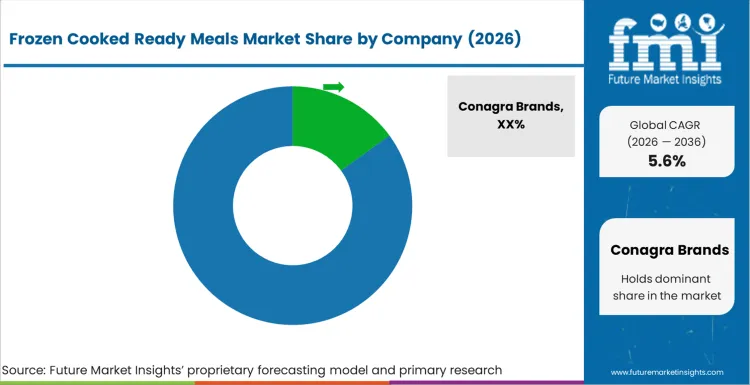
Several key players in the frozen cooked ready meals market dominate its competitive landscape. Nestlé, Conagra Brands, Unilever, and Tyson Foods are just a few names on the list, as they have all been able to take leadership roles due to the varied options in their frozen meal range. This can vary from comfort food to more niche, healthy products. For instance, Nestlé's Lean Cuisine and Stouffer's brands are targeted at the health-conscious consumer, while Conagra's Healthy Choice offers lower-calorie and nutritious meals.
Their growth strategies focus on product innovation, tapping into emerging consumer trends like plant-based diets and clean-label ingredients, as well as expanding their presence in international markets. Other companies are also emphasizing sustainability, reduction in environmental footprint, and use of ethically sourced ingredients to meet growing consumer demand for eco-friendliness.
Kellogg's along with its MorningStar Farms brand and McCain Foods have also been major market players and have made significant strides by introducing plant-based and gluten-free meal options. Their growth strategies often include targeting the growing demand for healthier, more diverse meal options while also improving packaging for better convenience and sustainability.
For example, Kellogg's has expanded its frozen ready meal portfolio to include more vegetarian and vegan offerings to attract the growing number of plant-based eaters. These companies are using alliances, diversification of their product portfolio, and e-commerce as part of their strategic actions to reach wider consumer bases and adapt to changing patterns of shopping in the post-pandemic environment.
With growing competition, these firms have been focusing both on increasing variety in products as well as on ways to engage consumers through online platforms, loyalty programs, and direct-to-consumer services.
Startups in the Frozen Cooked Ready Meals Market
In the frozen cooked ready meals market, a number of startups are gaining traction with innovation, health-conscious options, and sustainability. One such notable startup is Freshly, which specializes in delivering fully prepared, nutritious frozen meals that cater to a variety of dietary preferences, including gluten-free, keto, and paleo diets.
Freshly's growth strategy revolves around its subscription-based model, which provides customers with the convenience of regular meal deliveries to their doorstep. This approach targets busy professionals and families who prioritize convenience and health.
The startup also focuses on using high-quality, fresh ingredients with minimal preservatives, positioning itself as a healthier alternative to traditional frozen meals. Its emphasis on personalization, customer choice, and flexible subscription plans has contributed to its growing customer base.
Another emerging startup in the market is Snap Kitchen, which focuses on providing healthy, portion-controlled meals that are designed for those looking to maintain a balanced diet. Snap Kitchen's growth strategy includes the expansion of its meal options to cater to various dietary needs, such as low-carb, high-protein, and plant-based meals.
The company operates with retail partnerships along with its model of direct to consumer, helping it reach customers on the shelves of the stores, as well as online. Their appeal to eco-friendly consumers is driven by the company's use of locally sourced ingredients and sustainable packaging. Focusing on convenience, nutrition, and sustainability, a new wave of startups like Freshly and Snap Kitchen are attracting healthier consumers who find better frozen meals aligned with more modern eating styles.
Key Players in the Frozen Cooked Ready Meals Market
- Conagra Brands
- Dr. Oetker
- FRoSTA
- General Mills
- Pinnacle Foods
- Kerry Group
- Kraft Heinz
- Nestlé
- Simplot Global Food
Scope of the Report
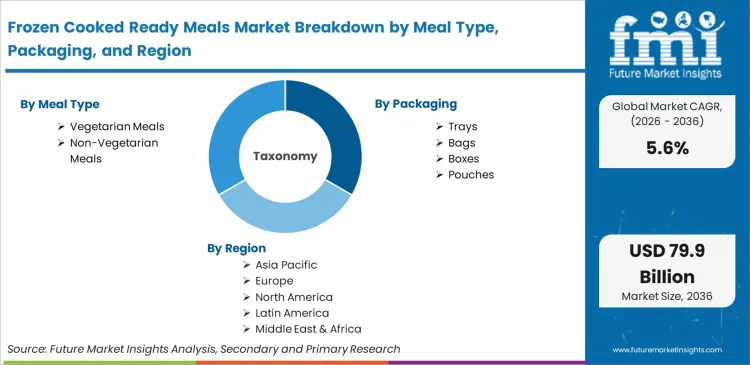
| Metric | Value |
|---|---|
| Quantitative Units | USD Billion 46.36 to USD Billion 79.94, at a CAGR of 5.6% |
| Market Definition | Frozen cooked ready meals are fully prepared, portion-controlled meal products that are cooked, assembled, and blast-frozen for distribution and consumer storage. These products require only reheating via microwave, oven, or stovetop before consumption, serving as complete meal solutions for household, workplace, and institutional dining occasions. |
| Meal Type Segmentation | Vegetarian Meals, Non-Vegetarian Meals |
| Packaging Segmentation | Trays, Bags, Boxes, Pouches |
| Distribution Channel Segmentation | Supermarkets/Hypermarkets, Convenience Stores, Online Retail, Specialty Stores, Food Service/Restaurants |
| Regions Covered | North America, Latin America, Europe, East Asia, South Asia, Oceania, Middle East & Africa |
| Countries Covered | Thailand, USA, UK, Germany, China, and 40 plus countries |
| Key Companies Profiled | Conagra Brands, Dr. Oetker, FRoSTA, General Mills, Pinnacle Foods, Kerry Group, Kraft Heinz, Nestle, Simplot Global Food |
| Forecast Period | 2026 to 2036 |
| Approach | Hybrid top-down and bottom-up modelling anchored by primary interviews and public data benchmarking |
Top Segments Studied in the Frozen Cooked Ready Meals Market Report
The market has been studied based on segments, including meal type, packaging, distribution channel, and region.
By Meal Type:
In terms of meal type, the market is divided into vegetarian meals and non-vegetarian meals
By Packaging:
With respect to packaging, the market is classified into trays, bags, boxes, and pouches.
By Distribution Channel:
On the basis of distribution channel, the market is divided into supermarkets/hypermarkets, convenience stores, online retail, specialty stores, and food service/restaurants.
By Region:
From the regional standpoint, the market is segregated into Latin America, Asia Pacific, the Middle East & Africa, North America, and Europe.
Bibliography
- European Commission. (2024). EU Quick Frozen Foods Directive 89/108/EEC, consolidated text. EUR-Lex.
- British Frozen Food Federation. (2024). Frozen Food Report: Market Data and Consumer Insights. BFFF.
- United States Department of Agriculture. (2024). Economic Research Service: Frozen Food Market Trends. USDA ERS.
- Food and Agriculture Organization of the United Nations. (2024). Cold Chain Development and Food Loss Prevention. FAO.
- Codex Alimentarius Commission. (2024). Code of Practice for the Processing and Handling of Quick Frozen Foods. FAO/WHO.
This bibliography is provided for reader reference. The full FMI report contains the complete reference list with primary research documentation.
Frequently Asked Questions
How large is the demand for Frozen Cooked Ready Meals in the global market in 2026?
Demand for Frozen Cooked Ready Meals in the global market is estimated to be valued at USD Billion 46.36 in 2026.
What will be the market size of Frozen Cooked Ready Meals in the global market by 2036?
Market size for Frozen Cooked Ready Meals is projected to reach USD Billion 79.94 by 2036.
What is the expected demand growth for Frozen Cooked Ready Meals in the global market between 2026 and 2036?
Demand for Frozen Cooked Ready Meals is expected to grow at a CAGR of 5.6% between 2026 and 2036.
Which Meal Type is poised to lead global sales by 2026?
Vegetarian Meals accounts for 41.0% share in 2026.
How significant is the role of Trays in Packaging?
Trays commands 43.0% of the packaging segment in 2026.
What is the growth outlook for Thailand?
Thailand is projected to grow at a CAGR of 7.2% during 2026 to 2036.
What is the growth rate for USA in this market?
USA is projected to expand at a CAGR of 4.1% during 2026 to 2036.
What is Frozen Cooked Ready Meals and what is it mainly used for?
Frozen cooked ready meals are fully prepared, portion-controlled meal products that are cooked, assembled, and blast-frozen for distribution and consumer storage. These products require only reheating via microwave, oven, or stovetop before consumption, serving as complete meal solutions for household, workplace, and institutional dining occasions.
What is included in the scope of this Frozen Cooked Ready Meals report?
Market scope includes vegetarian and non-vegetarian frozen cooked ready meals in tray, bag, box, and pouch packaging. The report covers global and regional market sizes from 2026 to 2036, segmented by meal type, packaging, distribution channel, and geography.
What is excluded from the scope of this report?
Frozen meal components (frozen vegetables, frozen proteins) sold individually for assembly by the consumer are excluded. Chilled ready meals with refrigerated rather than frozen shelf-life fall outside scope.
What does market forecast mean on this page?
The market forecast represents a model-based projection built on defined industry and supply chain assumptions for strategic planning purposes.
How does FMI build and validate the Frozen Cooked Ready Meals forecast?
Forecasting models apply a hybrid top-down and bottom-up methodology and cross-validate projections against publicly available industry data and primary research inputs.
What does zero reliance on speculative third-party market research mean here?
Primary interviews, verified public regulatory documentation, and official industry standards registries are used instead of unverified syndicated estimates.
Preview the report firsthand - request a free sample
Get SampleGet the brochure for pricing and purchase details.
Get PDFTable of Content
- Executive Summary
- Global Market Outlook
- Demand-side Trends
- Supply-side Trends
- Technology Roadmap Analysis
- Analysis and Recommendations
- Market Overview
- Market Coverage / Taxonomy
- Market Definition / Scope / Limitations
- Research Methodology
- Chapter Orientation
- Analytical Lens and Working Hypotheses
- Market Structure, Signals, and Trend Drivers
- Benchmarking and Cross-market Comparability
- Market Sizing, Forecasting, and Opportunity Mapping
- Research Design and Evidence Framework
- Desk Research Programme (Secondary Evidence)
- Company Annual and Sustainability Reports
- Peer-reviewed Journals and Academic Literature
- Corporate Websites, Product Literature, and Technical Notes
- Earnings Decks and Investor Briefings
- Statutory Filings and Regulatory Disclosures
- Technical White Papers and Standards Notes
- Trade Journals, Industry Magazines, and Analyst Briefs
- Conference Proceedings, Webinars, and Seminar Materials
- Government Statistics Portals and Public Data Releases
- Press Releases and Reputable Media Coverage
- Specialist Newsletters and Curated Briefings
- Sector Databases and Reference Repositories
- FMI Internal Proprietary Databases and Historical Market Datasets
- Subscription Datasets and Paid Sources
- Social Channels, Communities, and Digital Listening Inputs
- Additional Desk Sources
- Expert Input and Fieldwork (Primary Evidence)
- Primary Modes
- Qualitative Interviews and Expert Elicitation
- Quantitative Surveys and Structured Data Capture
- Blended Approach
- Why Primary Evidence is Used
- Field Techniques
- Interviews
- Surveys
- Focus Groups
- Observational and In-context Research
- Social and Community Interactions
- Stakeholder Universe Engaged
- C-suite Leaders
- Board Members
- Presidents and Vice Presidents
- R&D and Innovation Heads
- Technical Specialists
- Domain Subject-matter Experts
- Scientists
- Physicians and Other Healthcare Professionals
- Governance, Ethics, and Data Stewardship
- Research Ethics
- Data Integrity and Handling
- Primary Modes
- Tooling, Models, and Reference Databases
- Desk Research Programme (Secondary Evidence)
- Data Engineering and Model Build
- Data Acquisition and Ingestion
- Cleaning, Normalisation, and Verification
- Synthesis, Triangulation, and Analysis
- Quality Assurance and Audit Trail
- Market Background
- Market Dynamics
- Drivers
- Restraints
- Opportunity
- Trends
- Scenario Forecast
- Demand in Optimistic Scenario
- Demand in Likely Scenario
- Demand in Conservative Scenario
- Opportunity Map Analysis
- Product Life Cycle Analysis
- Supply Chain Analysis
- Investment Feasibility Matrix
- Value Chain Analysis
- PESTLE and Porter’s Analysis
- Regulatory Landscape
- Regional Parent Market Outlook
- Production and Consumption Statistics
- Import and Export Statistics
- Market Dynamics
- Global Market Analysis 2021 to 2025 and Forecast, 2026 to 2036
- Historical Market Size Value (USD Million) Analysis, 2021 to 2025
- Current and Future Market Size Value (USD Million) Projections, 2026 to 2036
- Y-o-Y Growth Trend Analysis
- Absolute $ Opportunity Analysis
- Global Market Pricing Analysis 2021 to 2025 and Forecast 2026 to 2036
- Global Market Analysis 2021 to 2025 and Forecast 2026 to 2036, By Meal Type
- Introduction / Key Findings
- Historical Market Size Value (USD Million) Analysis By Meal Type , 2021 to 2025
- Current and Future Market Size Value (USD Million) Analysis and Forecast By Meal Type , 2026 to 2036
- Vegetarian Meals
- Non-Vegetarian Meals
- Vegetarian Meals
- Y-o-Y Growth Trend Analysis By Meal Type , 2021 to 2025
- Absolute $ Opportunity Analysis By Meal Type , 2026 to 2036
- Global Market Analysis 2021 to 2025 and Forecast 2026 to 2036, By Packaging
- Introduction / Key Findings
- Historical Market Size Value (USD Million) Analysis By Packaging, 2021 to 2025
- Current and Future Market Size Value (USD Million) Analysis and Forecast By Packaging, 2026 to 2036
- Trays
- Bags
- Boxes
- Pouches
- Trays
- Y-o-Y Growth Trend Analysis By Packaging, 2021 to 2025
- Absolute $ Opportunity Analysis By Packaging, 2026 to 2036
- Global Market Analysis 2021 to 2025 and Forecast 2026 to 2036, By Distribution Channel
- Introduction / Key Findings
- Historical Market Size Value (USD Million) Analysis By Distribution Channel, 2021 to 2025
- Current and Future Market Size Value (USD Million) Analysis and Forecast By Distribution Channel, 2026 to 2036
- Supermarkets/Hypermarkets
- Convenience Stores
- Online Retail
- Specialty Stores
- Food Service/Restaurants
- Supermarkets/Hypermarkets
- Y-o-Y Growth Trend Analysis By Distribution Channel, 2021 to 2025
- Absolute $ Opportunity Analysis By Distribution Channel, 2026 to 2036
- Global Market Analysis 2021 to 2025 and Forecast 2026 to 2036, By Region
- Introduction
- Historical Market Size Value (USD Million) Analysis By Region, 2021 to 2025
- Current Market Size Value (USD Million) Analysis and Forecast By Region, 2026 to 2036
- North America
- Latin America
- Western Europe
- Eastern Europe
- East Asia
- South Asia and Pacific
- Middle East & Africa
- Market Attractiveness Analysis By Region
- North America Market Analysis 2021 to 2025 and Forecast 2026 to 2036, By Country
- Historical Market Size Value (USD Million) Trend Analysis By Market Taxonomy, 2021 to 2025
- Market Size Value (USD Million) Forecast By Market Taxonomy, 2026 to 2036
- By Country
- USA
- Canada
- Mexico
- By Meal Type
- By Packaging
- By Distribution Channel
- By Country
- Market Attractiveness Analysis
- By Country
- By Meal Type
- By Packaging
- By Distribution Channel
- Key Takeaways
- Latin America Market Analysis 2021 to 2025 and Forecast 2026 to 2036, By Country
- Historical Market Size Value (USD Million) Trend Analysis By Market Taxonomy, 2021 to 2025
- Market Size Value (USD Million) Forecast By Market Taxonomy, 2026 to 2036
- By Country
- Brazil
- Chile
- Rest of Latin America
- By Meal Type
- By Packaging
- By Distribution Channel
- By Country
- Market Attractiveness Analysis
- By Country
- By Meal Type
- By Packaging
- By Distribution Channel
- Key Takeaways
- Western Europe Market Analysis 2021 to 2025 and Forecast 2026 to 2036, By Country
- Historical Market Size Value (USD Million) Trend Analysis By Market Taxonomy, 2021 to 2025
- Market Size Value (USD Million) Forecast By Market Taxonomy, 2026 to 2036
- By Country
- Germany
- UK
- Italy
- Spain
- France
- Nordic
- BENELUX
- Rest of Western Europe
- By Meal Type
- By Packaging
- By Distribution Channel
- By Country
- Market Attractiveness Analysis
- By Country
- By Meal Type
- By Packaging
- By Distribution Channel
- Key Takeaways
- Eastern Europe Market Analysis 2021 to 2025 and Forecast 2026 to 2036, By Country
- Historical Market Size Value (USD Million) Trend Analysis By Market Taxonomy, 2021 to 2025
- Market Size Value (USD Million) Forecast By Market Taxonomy, 2026 to 2036
- By Country
- Russia
- Poland
- Hungary
- Balkan & Baltic
- Rest of Eastern Europe
- By Meal Type
- By Packaging
- By Distribution Channel
- By Country
- Market Attractiveness Analysis
- By Country
- By Meal Type
- By Packaging
- By Distribution Channel
- Key Takeaways
- East Asia Market Analysis 2021 to 2025 and Forecast 2026 to 2036, By Country
- Historical Market Size Value (USD Million) Trend Analysis By Market Taxonomy, 2021 to 2025
- Market Size Value (USD Million) Forecast By Market Taxonomy, 2026 to 2036
- By Country
- China
- Japan
- South Korea
- By Meal Type
- By Packaging
- By Distribution Channel
- By Country
- Market Attractiveness Analysis
- By Country
- By Meal Type
- By Packaging
- By Distribution Channel
- Key Takeaways
- South Asia and Pacific Market Analysis 2021 to 2025 and Forecast 2026 to 2036, By Country
- Historical Market Size Value (USD Million) Trend Analysis By Market Taxonomy, 2021 to 2025
- Market Size Value (USD Million) Forecast By Market Taxonomy, 2026 to 2036
- By Country
- India
- ASEAN
- Australia & New Zealand
- Rest of South Asia and Pacific
- By Meal Type
- By Packaging
- By Distribution Channel
- By Country
- Market Attractiveness Analysis
- By Country
- By Meal Type
- By Packaging
- By Distribution Channel
- Key Takeaways
- Middle East & Africa Market Analysis 2021 to 2025 and Forecast 2026 to 2036, By Country
- Historical Market Size Value (USD Million) Trend Analysis By Market Taxonomy, 2021 to 2025
- Market Size Value (USD Million) Forecast By Market Taxonomy, 2026 to 2036
- By Country
- Kingdom of Saudi Arabia
- Other GCC Countries
- Turkiye
- South Africa
- Other African Union
- Rest of Middle East & Africa
- By Meal Type
- By Packaging
- By Distribution Channel
- By Country
- Market Attractiveness Analysis
- By Country
- By Meal Type
- By Packaging
- By Distribution Channel
- Key Takeaways
- Key Countries Market Analysis
- USA
- Pricing Analysis
- Market Share Analysis, 2025
- By Meal Type
- By Packaging
- By Distribution Channel
- Canada
- Pricing Analysis
- Market Share Analysis, 2025
- By Meal Type
- By Packaging
- By Distribution Channel
- Mexico
- Pricing Analysis
- Market Share Analysis, 2025
- By Meal Type
- By Packaging
- By Distribution Channel
- Brazil
- Pricing Analysis
- Market Share Analysis, 2025
- By Meal Type
- By Packaging
- By Distribution Channel
- Chile
- Pricing Analysis
- Market Share Analysis, 2025
- By Meal Type
- By Packaging
- By Distribution Channel
- Germany
- Pricing Analysis
- Market Share Analysis, 2025
- By Meal Type
- By Packaging
- By Distribution Channel
- UK
- Pricing Analysis
- Market Share Analysis, 2025
- By Meal Type
- By Packaging
- By Distribution Channel
- Italy
- Pricing Analysis
- Market Share Analysis, 2025
- By Meal Type
- By Packaging
- By Distribution Channel
- Spain
- Pricing Analysis
- Market Share Analysis, 2025
- By Meal Type
- By Packaging
- By Distribution Channel
- France
- Pricing Analysis
- Market Share Analysis, 2025
- By Meal Type
- By Packaging
- By Distribution Channel
- India
- Pricing Analysis
- Market Share Analysis, 2025
- By Meal Type
- By Packaging
- By Distribution Channel
- ASEAN
- Pricing Analysis
- Market Share Analysis, 2025
- By Meal Type
- By Packaging
- By Distribution Channel
- Australia & New Zealand
- Pricing Analysis
- Market Share Analysis, 2025
- By Meal Type
- By Packaging
- By Distribution Channel
- China
- Pricing Analysis
- Market Share Analysis, 2025
- By Meal Type
- By Packaging
- By Distribution Channel
- Japan
- Pricing Analysis
- Market Share Analysis, 2025
- By Meal Type
- By Packaging
- By Distribution Channel
- South Korea
- Pricing Analysis
- Market Share Analysis, 2025
- By Meal Type
- By Packaging
- By Distribution Channel
- Russia
- Pricing Analysis
- Market Share Analysis, 2025
- By Meal Type
- By Packaging
- By Distribution Channel
- Poland
- Pricing Analysis
- Market Share Analysis, 2025
- By Meal Type
- By Packaging
- By Distribution Channel
- Hungary
- Pricing Analysis
- Market Share Analysis, 2025
- By Meal Type
- By Packaging
- By Distribution Channel
- Kingdom of Saudi Arabia
- Pricing Analysis
- Market Share Analysis, 2025
- By Meal Type
- By Packaging
- By Distribution Channel
- Turkiye
- Pricing Analysis
- Market Share Analysis, 2025
- By Meal Type
- By Packaging
- By Distribution Channel
- South Africa
- Pricing Analysis
- Market Share Analysis, 2025
- By Meal Type
- By Packaging
- By Distribution Channel
- USA
- Market Structure Analysis
- Competition Dashboard
- Competition Benchmarking
- Market Share Analysis of Top Players
- By Regional
- By Meal Type
- By Packaging
- By Distribution Channel
- Competition Analysis
- Competition Deep Dive
- Conagra Brands
- Overview
- Product Portfolio
- Profitability by Market Segments (Product/Age /Sales Channel/Region)
- Sales Footprint
- Strategy Overview
- Marketing Strategy
- Product Strategy
- Channel Strategy
- Dr. Oetker
- FRoSTA
- General Mills
- Pinnacle Foods
- Kerry Group
- Kraft Heinz
- Nestlé
- Simplot Global Food
- Conagra Brands
- Competition Deep Dive
- Assumptions & Acronyms Used


