

- Market Size (2026)
- USD 336.1 Mn
- Forecast (2036)
- USD 767.0 Mn
- CAGR (2026 to 2036)
- 8.6%
How big is the Frozen Clinical Meal Market in 2026?
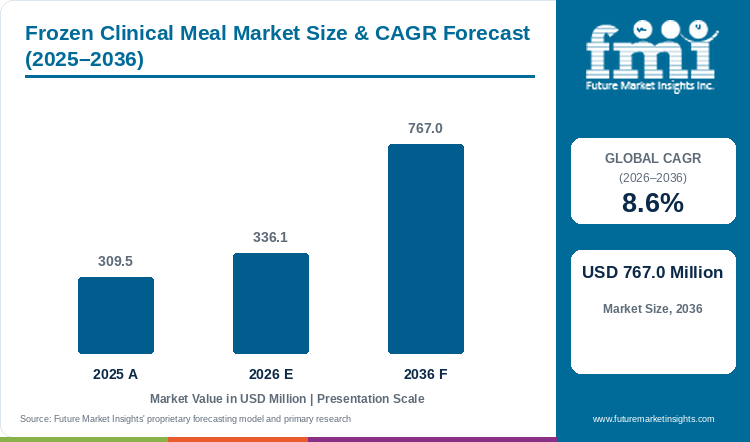
USD 336.1 Million in 2026 and USD 767.0 Million by 2036 at an 8.6% CAGR.
The frozen clinical meal market stands at USD 336.1 Million in 2026 and is projected to reach USD 767.0 Million by 2036, growing at an 8.6% CAGR. Market demand is inextricably linked to the intersection of chronic condition management and home-based care. With the Centers for Medicare & Medicaid Services reporting an estimated 69.3 million Medicare enrollees in 2025, and about 51% participating in Medicare Advantage plans, this massive payer pool is fundamentally shifting meal procurement. By structuring nutrition benefits for eligible members, health plans are moving clinical meals away from discretionary out-of-pocket spending and into managed care procurement, provided strict clinical and benefit criteria are met.[1][2]
Operating conditions vary significantly across global markets. South Korea is leveraging rapid population aging alongside public programs that integrate nutrition support for vulnerable older adults. Japan relies on a deeply established older demographic and strict Ministry of Health guidance for nutrition management in meal delivery services. In Western markets, purchasing thresholds are heavily dictated by reimbursement structures, local commissioning, and the availability of specialty diet menus. Consequently, suppliers must deliver both a highly stable frozen product and a clear access route that identifies eligible users before recurring orders can successfully scale.[12][13][14][15]
Market Size and Forecast
Table 1: Market Size and Forecast for the Frozen Clinical Meal Market (USD Million), 2025 to 2036
| Metric | Value |
|---|---|
| Estimated Market Size in 2025 | USD 309.5 Million |
| Estimated Market Size in 2026 | USD 336.1 Million |
| Projected Market Size by 2036 | USD 767.0 Million |
| CAGR, 2026 to 2036 | 8.6% |
Key Takeaways
- Demand is strongest where chronic condition nutrition can be seamlessly integrated into home-based care, payer benefits, or structured post-discharge support, rather than relying solely on self-pay consumer interest.
- Renal-Friendly Meals lead the Diet Type segment with a 42.2% share in 2026. Kidney diets require the simultaneous and precise control of sodium, potassium, phosphorus, and protein, making pre-formulated frozen meals exceptionally valuable for patient adherence.
- Medicare Advantage and Managed Care lead the Payer category at 45.2% in 2026. Qualifying supplemental benefits and health plan nutrition programs provide a critical funding mechanism for defined chronic populations.
- Direct-to-Home Frozen Delivery dominates the Delivery Model with a 50.3% share in 2026. Frozen storage provides households with vital scheduling flexibility while completely avoiding the tight spoilage windows associated with fresh or refrigerated meal programs.
- The principal purchasing friction is qualification. Payers and care teams require concrete evidence that a benefit fits an eligible condition, while suppliers must demonstrate appropriate nutrition standards, reliable fulfillment, and a format the patient can actually use.
Profiled companies include Mom's Meals (PurFoods), Magic Kitchen, ModifyHealth, BistroMD, Performance Kitchen, Hormel Health Labs, Territory Foods, and Schwan's. Public evidence reveals varying degrees of alignment with frozen clinical meals, payer pathways, and condition-specific nutrition.
Analyst Perspective
Revenue is most likely to scale when a clinically suitable frozen meal is directly connected to an eligibility decision and a repeatable referral or ordering pathway. Product quality alone cannot solve the reimbursement and enrollment hurdles that must be cleared before recurring use begins.
- Anurag Sharma, Future Market Insights
How is the frozen clinical meal market segmented?
The market is segmented by Diet Type, Payer, Delivery Model, End User and Sales Channel.
Diet Type comprises Renal-Friendly Meals, Diabetes-Friendly Meals, Cardiac / Low-Sodium Meals, Pureed & Texture-Modified Meals, and Others. Payer comprises Medicare Advantage / Managed Care, Medicaid & State Programs, Out-of-Pocket, and Others. Delivery Model comprises Direct-to-Home Frozen Delivery, Retail Frozen, Facility Supply, and Others. End User comprises Seniors at Home, Post-Discharge Patients, Long-Term Care, and Others. Sales Channel comprises Online / DTC, Health Plan Referral, Retail Frozen Aisle, Institutional, and Others.
Why do Renal-Friendly Meals lead the Diet Type category?
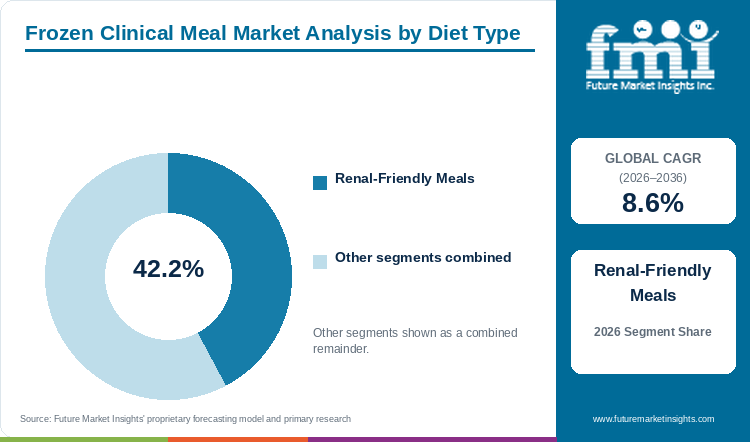
Renal-Friendly Meals hold 42.2% of Diet Type in 2026.
Renal meal planning carries an exceptionally high formulation burden because nutrient limits fluctuate based on kidney function and treatment status. The National Kidney Foundation notes that individuals with chronic kidney disease must carefully manage sodium and potassium, while phosphorus, calcium, and protein also require strict control. This complexity creates a much clearer role for portioned, prepared meals than in less restrictive dietary programs. Furthermore, frozen delivery allows households to maintain a steady stock of condition-appropriate meals for days when shopping or cooking is simply not feasible. Renal-Friendly Meals hold a 42.2% share in 2026, reflecting the critical need to control multiple nutrients simultaneously rather than relying on single ingredient substitutions.[5]
- Renal-Friendly Meals account for 42.2% of Diet Type in 2026.
- Complex Nutrient Management: The leading market position is driven by the necessity to simultaneously restrict sodium, potassium, and phosphorus while managing protein intake, a formulation challenge that makes pre-portioned clinical meals highly valuable for patient adherence.[5]
- High Addressable Patient Pool: The CDC estimated in March 2026 that 14% of US adults, or roughly 37 million people, have chronic kidney disease, providing a massive baseline of demand for specialized renal nutrition solutions.[4]
What keeps Medicare Advantage / Managed Care central to the Payer category?
Medicare Advantage / Managed Care holds 45.2% of Payer in 2026.
Managed care has the unique ability to convert clinical nutrition from an out-of-pocket choice into a defined, reimbursable benefit for eligible members. CMS permits special supplemental benefits for the chronically ill when the service has a reasonable expectation of improving or maintaining health, provided plans support those benefits with relevant clinical evidence. This framework creates a highly lucrative route to funded meals, but it also places the payer firmly between supplier demand and realized revenue. Medicare Advantage and Managed Care hold a 45.2% share in 2026, benefiting directly from large covered populations and the ability to target nutrition services specifically to qualifying chronic members.[1]
- Medicare Advantage / Managed Care accounts for 45.2% of Payer in 2026.
- Shift from Discretionary to Reimbursable Spend: The segment dominates because health plans can utilize supplemental benefits to fund meals for eligible chronic populations, moving purchases away from consumer out-of-pocket budgets into structured managed care procurement.
- Scale of Covered Populations: With CMS data showing about 51% of Medicare enrollees participating in Advantage plans in 2025, the sheer volume of potentially eligible members provides a massive, built-in distribution channel for compliant suppliers.[2]
Why is Direct-to-Home Frozen Delivery the leading Delivery Model?
Direct-to-Home Frozen Delivery holds 50.3% of Delivery Model in 2026.
Frozen delivery effectively shifts the burden of storage time from the supplier to the household. This drastically reduces the need to synchronize consumption with a short refrigerated shelf life and makes weekly or less frequent shipment patterns much easier to manage. It is especially vital for older adults or recovering patients who need predictable, reliable meals but may have highly variable appetites or complex caregiver schedules. Because this benefit is operational rather than purely clinical, logistics reliability remains a core component of the value proposition. Direct-to-Home Frozen Delivery holds a 50.3% share in 2026, as the format supports home storage and on-demand reheating, significantly reducing dependence on daily meal preparation.
- Direct-to-Home Frozen Delivery accounts for 50.3% of Delivery Model in 2026.
- Operational Flexibility for Households: By allowing patients to store meals for extended periods and reheat them on demand, the frozen model eliminates the tight spoilage windows and daily delivery pressures associated with fresh meal programs.
- Logistics and Fulfillment Reliability: The model's success relies heavily on robust cold-chain execution, as suppliers must guarantee that meals arrive safely frozen and remain viable in the home, making operational consistency just as important as the clinical recipe.
What supports Seniors at Home as the leading End User?
Seniors at Home hold 39.8% of End User in 2026.
The home represents a high-value delivery point because the aging process often makes shopping and meal preparation increasingly difficult long before a person requires institutional care. Home-delivered nutrition also integrates seamlessly with wellness checks and other community support services. The Administration for Community Living reports that 63% of respondents using Older Americans Act home-delivered meals live alone, and 42% report difficulty going outside the home. This specific demographic profile heavily favors ready-to-heat meals with simple storage and preparation requirements. Seniors at Home hold a 39.8% share in 2026, driven by the practical need to preserve independence when mobility, stamina, or cooking capacity begins to decline.[3]
- Seniors at Home account for 39.8% of End User in 2026.
- Preserving Independence: Demand is anchored by the critical need to help aging individuals remain in their own homes safely, bypassing the physical burdens of grocery shopping and daily cooking.
- Integration with Community Care: Home-delivered meals frequently serve as a touchpoint for broader wellness checks and community support, embedding the frozen clinical meal into a wider network of non-institutional elder care.
Why does Online / DTC lead the Sales Channel?
Online / DTC holds 41.9% of Sales Channel in 2026.
Online ordering provides households with direct, immediate visibility into diet filters, detailed nutrition information, and delivery cadences. It also supports self-pay access when a specific health plan benefit is unavailable. For frozen products, digital ordering pairs perfectly with parcel distribution because inventory can be safely stored between meals and reordered on a highly predictable cycle. However, the channel still requires clear clinical positioning so buyers can easily distinguish disease-specific meals from general wellness or weight management offers. Online / DTC holds a 41.9% share in 2026, reflecting direct access to specialty menus and the ability to order without waiting for an institutional procurement cycle.
- Online / DTC accounts for 41.9% of Sales Channel in 2026.
- Direct Access to Specialty Menus: Digital platforms allow consumers and caregivers to easily filter for highly specific clinical diets, bypassing the limited selection typically found in physical retail frozen aisles.
- Predictable Replenishment Cycles: The e-commerce model naturally supports automated, recurring orders, ensuring that patients maintain a steady supply of condition-appropriate meals without the friction of manual reordering.
What are the drivers, restraints and opportunities in the frozen clinical meal market?
Growth is driven by home-based chronic condition management, while reimbursement qualification and clinical fit constrain conversion, and integrated payer or post-discharge pathways create the clearest opportunity for recurring frozen meal demand.
- Driver: Aging populations and rising chronic disease prevalence increase the number of people who require nutritionally controlled meals without the burden of daily cooking.
- Restraint: Strict benefit eligibility, heavy evidence requirements, and highly individualized diet needs can delay approval or entirely exclude otherwise interested users.
- Opportunity: Suppliers can connect frozen condition-specific menus directly to health plan referrals, hospital discharge workflows, and community care programs to support repeat ordering.
The primary demand driver is the urgent need to manage chronic conditions while keeping patients safely at home. The CDC estimated 37 million US adults were living with chronic kidney disease in March 2026. Simultaneously, older adults receiving home-delivered nutrition frequently face severe mobility constraints and a high incidence of living alone. These overlapping conditions drastically increase the value of meals that arrive fully portioned and can be stored until needed. For suppliers, the commercial consequence is a rapidly expanding pool of buyers who value clinical formulation and convenience equally.[3][4]
The primary restraint appears before repeat consumption even begins. CMS requires Medicare Advantage organizations to support special supplemental benefits for the chronically ill with concrete research showing a reasonable expectation of improved health. Eligibility must also be communicated accurately to members. Therefore, suppliers need far more than just a good menu and a delivery network. They require precise nutrition specifications that fit the covered population, clinical evidence that payers can review, and operational processes that function flawlessly inside plan rules. This friction can lengthen qualification times and leave a significant portion of demand trapped in self-pay channels.[1]
The strongest opportunity lies in pairing a durable frozen format with care pathways that already identify eligible patients. A 2022 JAMA Network Open simulation estimated that broad insurance coverage of medically tailored meals for eligible US adults could be associated with 1.6 million fewer hospitalizations and USD 13.6 billion in annual net health care savings. While the study is not a financial guarantee for any single supplier, it perfectly explains the intense payer interest in the space. Vendors that can successfully connect clinical menus, benefit verification, and home fulfillment are positioned to capture that interest directly.[6]
Which country CAGRs are profiled in the frozen clinical meal market?
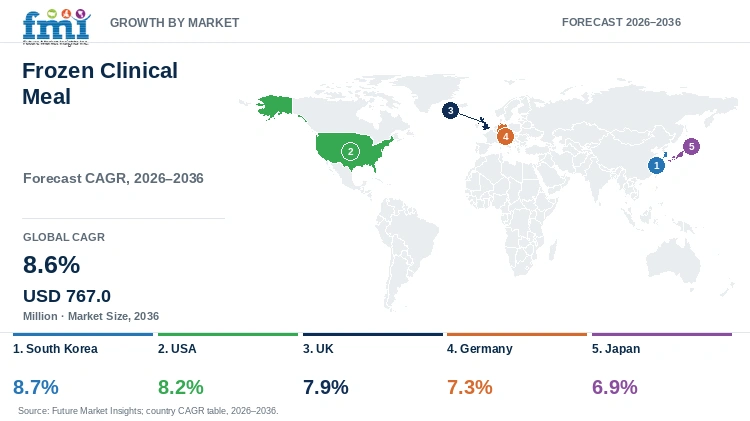
The following country CAGRs cover 2026 to 2036.
Table 2: Country CAGRs for the Frozen Clinical Meal Market (CAGR, %), 2026 to 2036
| Country | CAGR |
|---|---|
| South Korea | 8.7% |
| USA | 8.2% |
| UK | 7.9% |
| Germany | 7.3% |
| Japan | 6.9% |
Country-wise Analysis
- South Korea: South Korea is profiled at an 8.7% CAGR from 2026 to 2036, representing the highest rate in the country set. Statistics Korea reported that individuals aged 65 and over represented 20.3% of the population in 2025, projecting that share to exceed 30% by 2036. The Ministry of Health and Welfare actively includes meal management, nutrition education, and short-term post-discharge nutrition support within its tailored elder-care services. These macro conditions strongly support demand for convenient clinical nutrition at home. However, commercial success still depends entirely on how well frozen products fit local program specifications, reimbursement rules, and household preferences.[14][15]
- USA: The USA combines a massive managed care pool with a broad chronic disease burden. Its frozen clinical meal market is profiled to grow at an 8.2% CAGR from 2026 to 2036. CMS reported an estimated 69.3 million Medicare enrollees in 2025, with about 51% participating in Medicare Advantage plans. Crucially, CMS rules allow targeted supplemental benefits for qualifying chronically ill members. This creates a direct funding route for condition-specific meals, but suppliers must pass rigorous evidence and eligibility checks. Direct-to-home vendors benefit immensely when plan referral, benefit verification, and frozen fulfillment are fully integrated.[1][2]
- UK: In the UK, 8.6 million people lived alone in 2025, and nearly half were aged 65 or older, according to the Office for National Statistics. The country is profiled at a 7.9% CAGR from 2026 to 2036. This specific household structure heavily supports demand for meals that reduce shopping and cooking burdens. However, public access is far less centralized than a single national meal benefit. GOV.UK directs eligible individuals to local councils or community organizations, while local authorities like Cornwall Council list multiple frozen and specialist providers. Suppliers therefore face a route-to-market shaped by localized commissioning, self-pay choices, and specialist dietary capabilities.[7][8][9]
- Germany: Germany is profiled at a 7.3% CAGR from 2026 to 2036. Destatis reported 19.3 million people aged 65 or older in 2025, equal to 23% of the total population. Furthermore, 47% of households containing at least one older person were single-person households consisting solely of that older resident. These demographics strongly validate the need for home-ready nutrition that reduces preparation effort and portion waste. The commercial constraint is not a lack of need. Suppliers must navigate German care arrangements, strict product-label expectations, and specific payment patterns, while proving that their clinical positioning is far more specific than general senior convenience food.[10][11]
- Japan: Japan possesses one of the most mature older populations in the world. Statistics Bureau data placed the 65-and-over population at 36.19 million, or 29.4% of the total, in September 2025. The frozen clinical meal market is profiled at a 6.9% CAGR from 2026 to 2036. While growth is slower than the other profiled countries, it starts from an environment where older-age nutrition is already a massive, established service issue. Ministry of Health guidance for meal delivery businesses heavily emphasizes nutrition management, assessment at ordering, and ongoing follow-up. This raises the commercial value of documented dietary suitability and consistent service execution.[12][13]
Who are the notable companies in the frozen clinical meal market?
Mom's Meals (PurFoods), Magic Kitchen, ModifyHealth, BistroMD, Performance Kitchen, Hormel Health Labs, Territory Foods and Schwan's are the notable companies profiled in this market.
Competition in this space divides into three distinct operating models. Magic Kitchen, BistroMD, and Performance Kitchen possess public evidence of frozen ready-to-heat meal formats, offering varying levels of disease-specific breadth and payer integration. Mom's Meals (PurFoods) and ModifyHealth boast strong food-as-medicine and payer-facing capabilities, but their principal current meal programs are primarily described as refrigerated or fresh rather than delivered frozen. Hormel Health Labs holds specialized texture-modified nutrition evidence. Territory Foods explicitly documents fresh, never-frozen delivery, while Schwan's possesses broad frozen-food infrastructure without verified public evidence of current disease-specific clinical meals.[16][17][20][21][23][26][27][30][32][34]
- Frozen condition-specific specialists: Magic Kitchen, BistroMD, and Performance Kitchen combine prepared meal delivery with documented frozen storage or shipment. Performance Kitchen also demonstrates a direct health plan approval pathway.[20][21][26][27]
- Payer-integrated nutrition platforms: Mom's Meals (PurFoods) and ModifyHealth connect medically tailored nutrition with health plans, dietitians, and care programs.[16][22][23]
- Specialized and adjacent prepared-food participants: Hormel Health Labs, Territory Foods, and Schwan's add texture-modified, fresh prepared, or broad frozen-food capabilities.[30][32][34]
Competitive Benchmarking: Frozen Clinical Meal Market
Table 3: Competitive Benchmarking for the Frozen Clinical Meal Market
| Company | Condition-Specific Clinical Breadth | Care-Pathway / Institutional Integration | Frozen-Format Alignment | Geographic Reach |
|---|---|---|---|---|
| Mom's Meals (PurFoods) | High | High | Low | United States, nationwide home delivery |
| Magic Kitchen | High | Not specified | High | Continental United States, direct-to-home |
| ModifyHealth | High | High | Low | United States, nationwide nutrition-care platform |
| BistroMD | Medium | Not specified | High | United States, direct-to-consumer delivery |
| Performance Kitchen | High | High | High | United States, nationwide payer and home-delivery channels |
| Hormel Health Labs | Medium | Medium | Not specified | United States, healthcare and distributor channels |
| Territory Foods | Low | Not specified | Low | United States, 27-state fresh-meal network |
| Schwan's | Not specified | Not specified | High | United States, retail and foodservice frozen-food channels |
Scoring basis: Condition-Specific Clinical Breadth is High when several documented disease-specific or texture-specific meal programs are available, Medium when the documented scope is narrower, and Low when public materials show mainly non-clinical diet positioning. Care-Pathway / Institutional Integration is High when payer, referral, or reimbursable care pathways are documented, and Medium when healthcare distribution or institutional use is narrower. Frozen-Format Alignment is High when meals are delivered or stored frozen as a primary format, and Low when the current offer is explicitly fresh or refrigerated.
Key Developments in the Frozen Clinical Meal Market
- In September 2023, Performance Kitchen collaborated with Kroger Health to offer medically tailored meals for people with conditions including diabetes, heart disease, and cancer. Kroger stated that the meals were frozen, single-serve, and ready to heat, illustrating how retail health infrastructure can actively support a care-oriented frozen meal channel.[28]
- In October 2024, Hormel Foods sold Hormel Health Labs and related assets to Lyons Health Labs Holdco for USD 24.5 million. The divestiture changed ownership of a business with documented texture-modified nutrition products for people with swallowing disorders, highlighting how specialized clinical meal capabilities can move through portfolio transactions.[30][31]
- In June 2026, Mom's Meals (PurFoods) and Agilix Health launched a collaboration that included a Western Massachusetts pilot for up to 500 Medicare Advantage members with conditions such as heart failure, chronic kidney disease, and cancer.[18]
Key Players in the Frozen Clinical Meal Market
- Frozen condition-specific meal specialists
- Magic Kitchen
- BistroMD
- Performance Kitchen
- Payer-integrated nutrition platforms
- Mom's Meals (PurFoods)
- ModifyHealth
- Specialized and adjacent prepared-food participants
- Hormel Health Labs
- Territory Foods
- Schwan's
Frozen Clinical Meal Market - Report Scope
Table 4: Report scope for the Frozen Clinical Meal Market (USD Million), 2026 to 2036
| Coverage field | Report scope |
|---|---|
| Market breakdown | Diet Type, Payer, Delivery Model, End User and Sales Channel |
| Quantitative Units | USD Million |
| Market Definition | Revenue from fully prepared frozen clinical meals sold within the stated segmentation universe. The scope excludes fresh or refrigerated prepared meals, shelf-stable meals, meal kits requiring substantive cooking, oral nutrition supplements, general wellness groceries, downstream resale margins and other adjacent or substitute product revenue. |
| Regions Covered | North America, Latin America, Western Europe, Eastern Europe, East Asia, South Asia and Pacific, Middle East and Africa |
| Countries Covered | USA, UK, Germany, Japan, South Korea |
| Key Companies Profiled | Mom's Meals (PurFoods), Magic Kitchen, ModifyHealth, BistroMD, Performance Kitchen, Hormel Health Labs, Territory Foods, Schwan's |
| Forecast Period | 2026 to 2036 |
| Approach | Primary and secondary research with market triangulation. |
Frozen Clinical Meal Market - Research Methodology
Table 5: Research methodology for the Frozen Clinical Meal Market (USD Million), 2026 to 2036
| Method | Approach |
|---|---|
| Primary Research | FMI analysts gathered input from manufacturers, service providers, technology developers, distributors, end users, procurement teams and subject-matter experts. Interviews examined purchasing decisions, product evaluation, adoption barriers, approval requirements, pricing considerations and expectations for technical support. |
| Desk Research | Desk research covered government statistics, regulatory publications, trade data, industry associations, technical literature, standards, company filings, product information and official corporate announcements. Claims relating to performance, applications, approvals, capacity, investment and commercial activity were retained only when supported by credible public evidence. |
| Market Sizing and Forecasting | The market model combined the baseline value with historical performance, segment structure, pricing and volume indicators, adoption levels, company participation and country-level demand conditions. Forecast assumptions considered economic activity, investment trends, regulatory developments, technology adoption, purchasing cycles, supply availability and barriers to wider market use. |
| Data Validation | Estimates were checked against multiple independent indicators, including public data, company activity, trade patterns, industry developments and findings from primary interviews. Adjacent categories, unsupported claims, overlapping revenues and activities without direct market relevance were excluded to reduce double counting. |
Frozen Clinical Meal Market by Segments
Frozen Clinical Meal Market segmented by Diet Type:
- Renal-Friendly Meals
- Diabetes-Friendly Meals
- Cardiac / Low-Sodium Meals
- Pureed & Texture-Modified Meals
- Others
Frozen Clinical Meal Market segmented by Payer:
- Medicare Advantage / Managed Care
- Medicaid & State Programs
- Out-of-Pocket
- Others
Frozen Clinical Meal Market segmented by Delivery Model:
- Direct-to-Home Frozen Delivery
- Retail Frozen
- Facility Supply
- Others
Frozen Clinical Meal Market segmented by End User:
- Seniors at Home
- Post-Discharge Patients
- Long-Term Care
- Others
Frozen Clinical Meal Market segmented by Sales Channel:
- Online / DTC
- Health Plan Referral
- Retail Frozen Aisle
- Institutional
- Others
Frozen Clinical Meal Market by Region:
- North America
- United States
- Canada
- Latin America
- Brazil
- Mexico
- Argentina
- Chile
- Western Europe
- Germany
- France
- United Kingdom
- Italy
- Spain
- Benelux
- Nordics
- Eastern Europe
- Poland
- Czech Republic
- Romania
- Hungary
- East Asia
- China
- Japan
- South Korea
- South Asia and Pacific
- India
- ASEAN
- Australia and New Zealand
- Middle East and Africa
- GCC Countries
- South Africa
- Türkiye
- Israel
Research Sources and Bibliography
- [1] Centers for Medicare & Medicaid Services (2024, April 4). Contract Year 2025 Medicare Advantage and Part D Final Rule (CMS-4205-F). https://www.cms.gov/newsroom/fact-sheets/contract-year-2025-medicare-advantage-part-d-final-rule-cms-4205-f
- [2] Centers for Medicare & Medicaid Services (2026). 2026 Medicare Trustees Report.
- [3] Administration for Community Living (n.d.). Nutrition Services.
- [4] Centers for Disease Control and Prevention (2026, March 31). Chronic Kidney Disease in the United States. https://www.cdc.gov/kidney-disease/php/data-research/index.html
- [5] National Kidney Foundation (n.d.). Nutrition and Kidney Disease, Stages 1-5 (Not on Dialysis).
- [6] JAMA Network Open (2022, October 17). Association of National Expansion of Insurance Coverage of Medically Tailored Meals With Estimated Hospitalizations and Health Care Expenditures in the US. https://doi.org/10.1001/jamanetworkopen.2022.36898
- [7] Office for National Statistics (2026, April 17). Families and households in the UK: 2025.
- [8] GOV.UK (n.d.). Get meals at home (meals on wheels).
- [9] Cornwall Council (2026, January 28). Meals on wheels provision.
- [10] Federal Statistical Office of Germany (Destatis) (2026, August 18). Older people: population aged 65 and over.
- [11] Federal Statistical Office of Germany (Destatis) (2026, May 19). Private households with older people.
- [12] Statistics Bureau of Japan (2025, September 14). Statistical Topics No. 146: Elderly People in Japan.
- [13] Ministry of Health, Labour and Welfare of Japan (n.d.). Nutrition management for meal-delivery businesses supporting the health of older people in the community.
- [14] Statistics Korea (2025, September 29). 2025 Statistics on the Aged.
- [15] Ministry of Health and Welfare, Republic of Korea (2026, March 31). Tailored care service for older adults.
- [16] Mom's Meals (n.d.). Chronic Care Program.
- [17] Mom's Meals (n.d.). Frequently Asked Questions.
- [18] Mom's Meals (2026, June 18). Mom's Meals and Agilix Health Collaborate to Advance Food as Medicine. https://www.momsmeals.com/our-newsroom/moms-meals-and-agilix-health-collaborate-to-advance-food-as-medicine-/
- [19] Mom's Meals (2025, July 15). Crafting meals for wellness: A collaboration story.
- [20] Magic Kitchen (n.d.). Renal Diet Menu from MagicKitchen.com (Stages 3 & 4).
- [21] Magic Kitchen (n.d.). Home Cooked Meals Delivered to Your House.
- [22] ModifyHealth (2025, September 4). ModifyHealth Expands Its In-Network Coverage.
- [23] ModifyHealth (n.d.). How ModifyHealth Works.
- [24] ModifyHealth (2024, December 4). ModifyHealth Raises $13.5M in Funding to Expand Food-as-Medicine Solutions.
- [25] ModifyHealth (2026, March 30). ModifyHealth Featured in American College of Lifestyle Medicine's Project Remission.
- [26] BistroMD (n.d.). Premier Healthy Meal Delivery: How It Works.
- [27] Performance Kitchen (n.d.). Medically Tailored Meals.
- [28] The Kroger Co. (2023, September 15). Kroger Health Announces Collaboration with Performance Kitchen to Offer Medically Tailored Meals.
- [29] Performance Kitchen (2022, July 20). American College of Lifestyle Medicine Adds Food Is Medicine Supplier Performance Kitchen to its Lifestyle Medicine Corporate Roundtable.
- [30] Hormel Foods (2019, March 15). Hormel Health Labs Introduces Meal Kit for People With Swallowing Disorders.
- [31] U.S. Securities and Exchange Commission (n.d.). Hormel Foods Corporation acquisitions and divestitures disclosure.
- [32] Territory Foods (n.d.). Healthy Plant Based Meals, Delivered Fresh.
- [33] Territory Foods (n.d.). Where Food Feels Good.
- [34] Schwan's Company (n.d.). Our History.
This Report Answers
- How large is the Frozen Clinical Meal Market in 2026 and what value is forecast for 2036?
- Which industry pressures support demand for frozen clinical meals?
- Why do Renal-Friendly Meals hold the leading Diet Type position?
- Why does Medicare Advantage / Managed Care hold the leading Payer position?
- How do the profiled country growth rates differ from 2026 to 2036?
- Which profiled companies supply relevant frozen, medically tailored or adjacent prepared-meal capabilities?
- What limits adoption, benefit qualification or supplier switching in this market?
- What should buyers evaluate before purchasing or contracting for frozen clinical meals?
Frequently Asked Questions
How big is the Frozen Clinical Meal Market in 2026, and what is forecast for 2036?
The market is valued at USD 336.1 Million in 2026 and is forecast to reach USD 767.0 Million by 2036. The increase reflects the wider adoption of condition-specific prepared nutrition through home, payer, and care pathways.
What is the CAGR for the Frozen Clinical Meal Market from 2026 to 2036?
The market is forecast to expand at an 8.6% CAGR from 2026 to 2036. The rate reflects forecast revenue growth across frozen clinical meals.
Which Diet Type segment leads the Frozen Clinical Meal Market?
Renal-Friendly Meals lead Diet Type with a 42.2% share in 2026. Their position reflects the need to manage several nutrients together for people with kidney disease and the sheer convenience of pre-portioned prepared meals.
Which Payer segment leads the Frozen Clinical Meal Market?
Medicare Advantage and Managed Care lead the Payer segment with a 45.2% share in 2026. Managed care benefits can fund meals for eligible members, but strict benefit design and qualification rules ultimately determine whether clinical need translates into reimbursed demand.
Which profiled countries have the highest growth rates?
South Korea has the highest profiled CAGR at 8.7% from 2026 to 2036, followed by the USA at 8.2%.
Which companies are active in the Frozen Clinical Meal Market?
The profiled companies are Mom's Meals (PurFoods), Magic Kitchen, ModifyHealth, BistroMD, Performance Kitchen, Hormel Health Labs, Territory Foods, and Schwan's. Their documented roles differ significantly in clinical breadth, payer integration, and direct alignment with frozen delivery.
Preview the report firsthand - request a free sample
Get SampleGet the brochure for pricing and purchase details.
Get PDFTable of Content
- Key Takeaways
- Market Size and CAGR
- Top Growth Driver
- Fastest Growing Segment
- Leading Region
- Key Companies
- Emerging Opportunities
- Executive Summary
- Global Market Outlook
- Demand-side Trends
- Supply-side Trends
- Technology Roadmap Analysis
- Analysis and Recommendations
- Analyst Perspective (What is happening? Why now? What should investors know?)
- Key Questions Answered
- How large is the market?
- What is the CAGR?
- What are key trends?
- Which region dominates?
- Who are the leaders?
- Market Overview
- Market Coverage / Taxonomy
- Market Definition / Scope / Limitations
- Research Methodology
- Chapter Orientation
- Analytical Lens and Working Hypotheses
- Market Structure, Signals, and Trend Drivers
- Benchmarking and Cross-market Comparability
- Market Sizing, Forecasting, and Opportunity Mapping
- Research Design and Evidence Framework
- Desk Research Programme (Secondary Evidence)
- Expert Input and Fieldwork (Primary Evidence)
- Tooling, Models, and Reference Databases
- Data Engineering and Model Build
- Quality Assurance and Audit Trail
- Market Background
- Market Dynamics (Drivers, Restraints, Opportunity, Trends)
- Scenario Forecast (Optimistic, Likely, Conservative)
- Impact Analysis
- AI Impact
- Sustainability Impact
- Regulatory Impact
- Technology Impact
- Consumer / Buyer Analysis
- Purchase Drivers
- Adoption Barriers
- Buyer Journey
- Opportunity Map Analysis
- Product Life Cycle Analysis
- Supply Chain Analysis
- Investment Feasibility Matrix
- Value Chain Analysis
- PESTLE and Porter's Analysis
- Regulatory Landscape
- Regional Parent Market Outlook
- Production and Consumption Statistics
- Import and Export Statistics
- Global Market Analysis and Forecast, 2021 to 2036
- Historical Market Size Value (USD Million) Analysis, 2021 to 2025
- Current and Future Market Size Value (USD Million) Projections, 2026 to 2036
- Y-o-Y Growth Trend Analysis
- Absolute $ Opportunity Analysis
- Global Market Pricing Analysis, 2021 to 2036
- Global Market Analysis and Forecast, By Diet Type, 2021 to 2036
- Introduction / Key Findings
- Historical Market Size Value (USD Million) Analysis By Diet Type, 2021 to 2025
- Current and Future Market Size Value (USD Million) Analysis and Forecast By Diet Type, 2026 to 2036
- Renal-Friendly Meals
- Diabetes-Friendly Meals
- Cardiac / Low-Sodium Meals
- Pureed & Texture-Modified Meals
- Others
- Y-o-Y Growth Trend Analysis By Diet Type, 2021 to 2025
- Absolute $ Opportunity Analysis By Diet Type, 2026 to 2036
- Global Market Analysis and Forecast, By Payer, 2021 to 2036
- Introduction / Key Findings
- Historical Market Size Value (USD Million) Analysis By Payer, 2021 to 2025
- Current and Future Market Size Value (USD Million) Analysis and Forecast By Payer, 2026 to 2036
- Medicare Advantage / Managed Care
- Medicaid & State Programs
- Out-of-Pocket
- Others
- Y-o-Y Growth Trend Analysis By Payer, 2021 to 2025
- Absolute $ Opportunity Analysis By Payer, 2026 to 2036
- Global Market Analysis and Forecast, By Delivery Model, 2021 to 2036
- Introduction / Key Findings
- Historical Market Size Value (USD Million) Analysis By Delivery Model, 2021 to 2025
- Current and Future Market Size Value (USD Million) Analysis and Forecast By Delivery Model, 2026 to 2036
- Direct-to-Home Frozen Delivery
- Retail Frozen
- Facility Supply
- Others
- Y-o-Y Growth Trend Analysis By Delivery Model, 2021 to 2025
- Absolute $ Opportunity Analysis By Delivery Model, 2026 to 2036
- Global Market Analysis and Forecast, By End User, 2021 to 2036
- Introduction / Key Findings
- Historical Market Size Value (USD Million) Analysis By End User, 2021 to 2025
- Current and Future Market Size Value (USD Million) Analysis and Forecast By End User, 2026 to 2036
- Seniors at Home
- Post-Discharge Patients
- Long-Term Care
- Others
- Y-o-Y Growth Trend Analysis By End User, 2021 to 2025
- Absolute $ Opportunity Analysis By End User, 2026 to 2036
- Global Market Analysis and Forecast, By Sales Channel, 2021 to 2036
- Introduction / Key Findings
- Historical Market Size Value (USD Million) Analysis By Sales Channel, 2021 to 2025
- Current and Future Market Size Value (USD Million) Analysis and Forecast By Sales Channel, 2026 to 2036
- Online / DTC
- Health Plan Referral
- Retail Frozen Aisle
- Institutional
- Others
- Y-o-Y Growth Trend Analysis By Sales Channel, 2021 to 2025
- Absolute $ Opportunity Analysis By Sales Channel, 2026 to 2036
- Global Market Analysis and Forecast, By Region, 2021 to 2036
- Introduction
- Historical Market Size Value (USD Million) Analysis By Region, 2021 to 2025
- Current Market Size Value (USD Million) Analysis and Forecast By Region, 2026 to 2036
- North America
- Latin America
- Western Europe
- Eastern Europe
- East Asia
- South Asia and Pacific
- Middle East and Africa
- Market Attractiveness Analysis By Region
- North America Market Analysis and Forecast, By Country, 2021 to 2036
- Historical Market Size Value (USD Million) Trend Analysis By Market Taxonomy, 2021 to 2025
- Market Size Value (USD Million) Forecast By Market Taxonomy, 2026 to 2036
- By Country
- United States
- Canada
- By Diet Type
- By Payer
- By Delivery Model
- By End User
- By Sales Channel
- By Country
- Market Attractiveness Analysis
- By Country
- By Diet Type
- By Payer
- By Delivery Model
- By End User
- By Sales Channel
- Key Takeaways
- Latin America Market Analysis and Forecast, By Country
- Historical Market Size Value (USD Million) Trend Analysis By Market Taxonomy, 2021 to 2025
- Market Size Value (USD Million) Forecast By Market Taxonomy, 2026 to 2036
- By Country
- Brazil
- Mexico
- Argentina
- Chile
- By Diet Type
- By Payer
- By Delivery Model
- By End User
- By Sales Channel
- By Country
- Market Attractiveness Analysis
- By Country
- By Diet Type
- By Payer
- By Delivery Model
- By End User
- By Sales Channel
- Key Takeaways
- Western Europe Market Analysis and Forecast, By Country
- Historical Market Size Value (USD Million) Trend Analysis By Market Taxonomy, 2021 to 2025
- Market Size Value (USD Million) Forecast By Market Taxonomy, 2026 to 2036
- By Country
- Germany
- France
- United Kingdom
- Italy
- Spain
- Benelux
- Nordics
- By Diet Type
- By Payer
- By Delivery Model
- By End User
- By Sales Channel
- By Country
- Market Attractiveness Analysis
- By Country
- By Diet Type
- By Payer
- By Delivery Model
- By End User
- By Sales Channel
- Key Takeaways
- Eastern Europe Market Analysis and Forecast, By Country
- Historical Market Size Value (USD Million) Trend Analysis By Market Taxonomy, 2021 to 2025
- Market Size Value (USD Million) Forecast By Market Taxonomy, 2026 to 2036
- By Country
- Poland
- Czech Republic
- Romania
- Hungary
- By Diet Type
- By Payer
- By Delivery Model
- By End User
- By Sales Channel
- By Country
- Market Attractiveness Analysis
- By Country
- By Diet Type
- By Payer
- By Delivery Model
- By End User
- By Sales Channel
- Key Takeaways
- East Asia Market Analysis and Forecast, By Country
- Historical Market Size Value (USD Million) Trend Analysis By Market Taxonomy, 2021 to 2025
- Market Size Value (USD Million) Forecast By Market Taxonomy, 2026 to 2036
- By Country
- China
- Japan
- South Korea
- By Diet Type
- By Payer
- By Delivery Model
- By End User
- By Sales Channel
- By Country
- Market Attractiveness Analysis
- By Country
- By Diet Type
- By Payer
- By Delivery Model
- By End User
- By Sales Channel
- Key Takeaways
- South Asia and Pacific Market Analysis and Forecast, By Country
- Historical Market Size Value (USD Million) Trend Analysis By Market Taxonomy, 2021 to 2025
- Market Size Value (USD Million) Forecast By Market Taxonomy, 2026 to 2036
- By Country
- India
- ASEAN
- Australia and New Zealand
- By Diet Type
- By Payer
- By Delivery Model
- By End User
- By Sales Channel
- By Country
- Market Attractiveness Analysis
- By Country
- By Diet Type
- By Payer
- By Delivery Model
- By End User
- By Sales Channel
- Key Takeaways
- Middle East and Africa Market Analysis and Forecast, By Country
- Historical Market Size Value (USD Million) Trend Analysis By Market Taxonomy, 2021 to 2025
- Market Size Value (USD Million) Forecast By Market Taxonomy, 2026 to 2036
- By Country
- GCC Countries
- South Africa
- Türkiye
- Israel
- By Diet Type
- By Payer
- By Delivery Model
- By End User
- By Sales Channel
- By Country
- Market Attractiveness Analysis
- By Country
- By Diet Type
- By Payer
- By Delivery Model
- By End User
- By Sales Channel
- Key Takeaways
- Key Countries Market Analysis
- United States
- Pricing Analysis
- Market Share Analysis, 2025
- By Diet Type
- By Payer
- By Delivery Model
- By End User
- By Sales Channel
- Canada
- Pricing Analysis
- Market Share Analysis, 2025
- By Diet Type
- By Payer
- By Delivery Model
- By End User
- By Sales Channel
- Mexico
- Pricing Analysis
- Market Share Analysis, 2025
- By Diet Type
- By Payer
- By Delivery Model
- By End User
- By Sales Channel
- Brazil
- Pricing Analysis
- Market Share Analysis, 2025
- By Diet Type
- By Payer
- By Delivery Model
- By End User
- By Sales Channel
- Chile
- Pricing Analysis
- Market Share Analysis, 2025
- By Diet Type
- By Payer
- By Delivery Model
- By End User
- By Sales Channel
- Germany
- Pricing Analysis
- Market Share Analysis, 2025
- By Diet Type
- By Payer
- By Delivery Model
- By End User
- By Sales Channel
- United Kingdom
- Pricing Analysis
- Market Share Analysis, 2025
- By Diet Type
- By Payer
- By Delivery Model
- By End User
- By Sales Channel
- Italy
- Pricing Analysis
- Market Share Analysis, 2025
- By Diet Type
- By Payer
- By Delivery Model
- By End User
- By Sales Channel
- Spain
- Pricing Analysis
- Market Share Analysis, 2025
- By Diet Type
- By Payer
- By Delivery Model
- By End User
- By Sales Channel
- France
- Pricing Analysis
- Market Share Analysis, 2025
- By Diet Type
- By Payer
- By Delivery Model
- By End User
- By Sales Channel
- India
- Pricing Analysis
- Market Share Analysis, 2025
- By Diet Type
- By Payer
- By Delivery Model
- By End User
- By Sales Channel
- ASEAN
- Pricing Analysis
- Market Share Analysis, 2025
- By Diet Type
- By Payer
- By Delivery Model
- By End User
- By Sales Channel
- Australia and New Zealand
- Pricing Analysis
- Market Share Analysis, 2025
- By Diet Type
- By Payer
- By Delivery Model
- By End User
- By Sales Channel
- China
- Pricing Analysis
- Market Share Analysis, 2025
- By Diet Type
- By Payer
- By Delivery Model
- By End User
- By Sales Channel
- Japan
- Pricing Analysis
- Market Share Analysis, 2025
- By Diet Type
- By Payer
- By Delivery Model
- By End User
- By Sales Channel
- South Korea
- Pricing Analysis
- Market Share Analysis, 2025
- By Diet Type
- By Payer
- By Delivery Model
- By End User
- By Sales Channel
- Poland
- Pricing Analysis
- Market Share Analysis, 2025
- By Diet Type
- By Payer
- By Delivery Model
- By End User
- By Sales Channel
- Hungary
- Pricing Analysis
- Market Share Analysis, 2025
- By Diet Type
- By Payer
- By Delivery Model
- By End User
- By Sales Channel
- Türkiye
- Pricing Analysis
- Market Share Analysis, 2025
- By Diet Type
- By Payer
- By Delivery Model
- By End User
- By Sales Channel
- South Africa
- Pricing Analysis
- Market Share Analysis, 2025
- By Diet Type
- By Payer
- By Delivery Model
- By End User
- By Sales Channel
- United States
- Market Structure Analysis
- Competition Dashboard
- Competition Benchmarking
- Market Share Analysis of Top Players
- By Regional
- By Diet Type
- By Payer
- By Delivery Model
- By End User
- By Sales Channel
- Emerging Startups
- Innovation Benchmarking
- Competition Analysis
- Competition Deep Dive
- Mom's Meals (PurFoods)
- Overview
- Product Portfolio
- Profitability by Market Segments
- Sales Footprint
- Strategy Overview
- Marketing Strategy
- Product Strategy
- Channel Strategy
- Magic Kitchen
- ModifyHealth
- BistroMD
- Performance Kitchen
- Hormel Health Labs
- Territory Foods
- Schwan's
- Frozen condition-specific meal specialists
- Payer-integrated nutrition platforms
- Specialized and adjacent prepared-food participants
- Mom's Meals (PurFoods)
- Case Studies
- Success Stories
- Recent Developments
- Competition Deep Dive
- Assumptions & Acronyms Used


