

- Market Size (2026)
- USD 702.0 Mn
- Forecast (2036)
- USD 1601.9 Mn
- CAGR (2026 to 2036)
- 8.6%
How big is Frozen Tteokbokki Market in 2026?
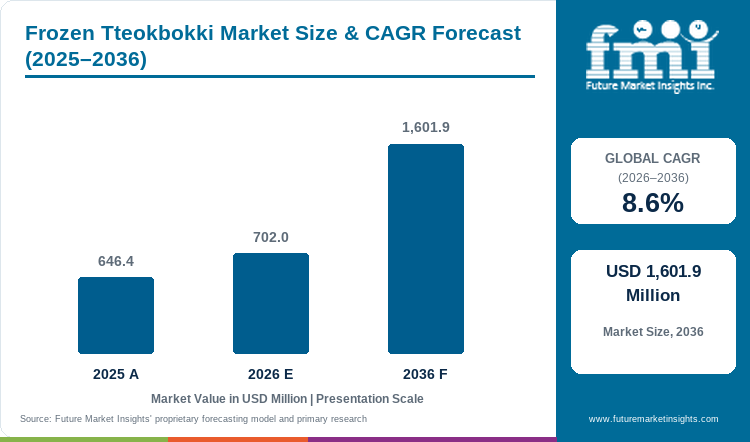
USD 702.0 Million in 2026 and USD 1,601.9 Million by 2036 at an 8.6% CAGR.
Sales of frozen tteokbokki are estimated at USD 702.0 Million in 2026 and are forecast to reach USD 1,601.9 Million by 2036 at an 8.6% CAGR. The market was valued at USD 646.4 Million in 2025. South Korea gives the category its manufacturing base. aT reported KRW 764.9 Billion of domestic rice-cake shipments in 2021, while the government later set a 2028 goal of KRW 17.0 Trillion for the broader rice-processing industry. Frozen tteokbokki occupies a narrow part of that system, where suppliers convert rice cakes into retail or foodservice packs that can travel through a cold chain rather than being prepared only at street-food stalls.
The international case is becoming easier to observe through processed-rice exports. MAFRA reported USD 248.7 Million of processed rice-based food exports through October 2024, up 41.9% from the prior-year period. In the first quarter of 2026, exports reached USD 69.3 Million, up 9.4%, with ASEAN demand helped by continued interest in Korean street food and tteokbokki rice cakes. Frozen formats fit that trade pattern when the buyer wants a more restaurant-like chew or a complete kit with fish cake and sauce. K-FOODTRADE currently lists frozen products from Cook-Tok, Goraesa, Shine-Cook, Delief and Allgroo, showing that frozen tteokbokki is already commercialized across more than one product architecture.
Growth outside Korea depends on retail execution rather than awareness alone. Pulmuone reported that its U.S. K-snack category, which includes tteokbokki, increased 182.2% in 2024. CJ Foods expanded its Oceania lineup into tteokbokki and other K-street foods and stated that bibigo products were being sold in the main frozen-food aisle rather than only Asian specialty sections. These moves connect the category with the broader ethnic food market and convenience food market. They also raise the standard for pack instructions, freezer life and sauce consistency because a mainstream shopper is less likely to compensate for a difficult cooking process.
Frozen tteokbokki competes with ambient cups and pouches that avoid cold-storage costs. Frozen packs can offer a different rice-cake texture, include fish cake or serve several people. Those features need to be apparent after cooking. In the ready-to-eat food market, storage convenience and meal quality both influence which format a household chooses.
Key Takeaways
- The market is estimated at USD 702.0 Million in 2026 and is forecast to reach USD 1,601.9 Million by 2036 at an 8.6% CAGR. The 2025 base is USD 646.4 Million.
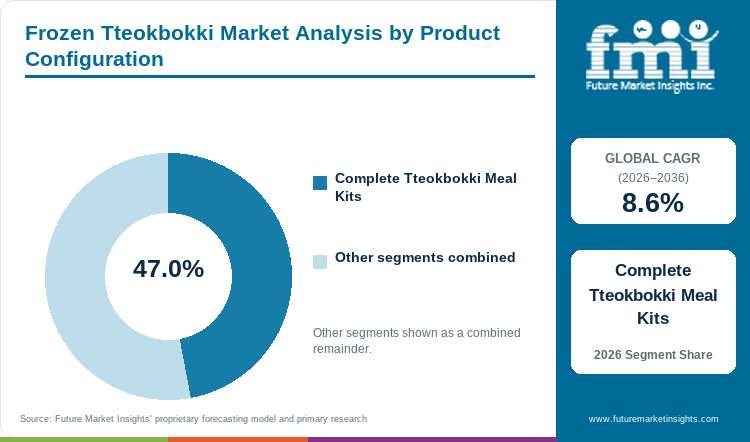
- Complete Tteokbokki Meal Kits hold 47.0% of Product Configuration demand in 2026 because they remove separate purchasing of rice cakes, sauce and common add-ins.
- Classic Gochujang accounts for 54.0% of Sauce Profile demand in 2026. It anchors the sweet-spicy flavor that consumers most closely associate with the dish.
- Rice-based Cakes represent 81.0% of Base Type demand in 2026, while wheat-based and hybrid formats address different chew, cost and recipe requirements.
- Multi-serve Pouches hold 58.0% of Pack Format demand and Supermarkets & Hypermarkets account for 40.0% of Sales Channel demand as frozen tteokbokki moves into planned household meals and shared snacking.
- Country growth ranges from 10.4% CAGR in Vietnam to 6.4% in South Korea from 2026 to 2036, reflecting different starting points in K-street-food adoption, freezer distribution and local product availability.
Analyst Perspective
Rice cakes should heat to an even chew while the sauce reaches the intended consistency. Complete frozen kits give manufacturers control over the rice-cake, sauce and fish-cake portions, but directions must work in a home kitchen. The additional cold-chain cost is easier to justify when the cooked texture and meal components give shoppers a reason to choose the frozen format.
- Nandini Roy Choudhury, Principal Consultant, Future Market Insights
How is the Frozen Tteokbokki Market segmented?
The Frozen Tteokbokki Market is segmented by Product Configuration, Sauce Profile, Base Type, Pack Format, Sales Channel and Region.
Product Configuration separates Complete Tteokbokki Meal Kits, Rice Cake + Sauce Kits and Frozen Tteokbokki Rice Cakes. Sauce Profile covers Classic Gochujang, Rose / Cream, Jjajang, Cheese and other flavors. Base Type separates Rice-based Cakes, Wheat-based Cakes and Hybrid or specialty bases. Pack Format includes Multi-serve Pouches, Single-serve Packs and Foodservice Bulk. Sales Channel covers Supermarkets & Hypermarkets, Asian / Specialty Grocery, Online Grocery / E-commerce, Warehouse Clubs and Foodservice Distributors. Regional coverage spans North America, Latin America, Western Europe, Eastern Europe, East Asia, South Asia & Pacific and Middle East & Africa.
Why do Complete Tteokbokki Meal Kits lead demand within the Product Configuration category?
A complete kit moves more of the cooking decision into the package. The buyer receives rice cakes and sauce in the same purchase, and some products add fish cake or seasoning. Cook-Tok sells a 600 g frozen home kit with fish cake and a stated six-minute cook time. Goraesa packages rice cake, fish cake and sauce in one frozen meal-kit format. That structure matters outside Korea because a new consumer may know the dish but not know which sauce, rice cake or fish cake to buy separately. A complete kit also gives the manufacturer more control over the final balance of sauce-to-rice-cake ratio.
- Complete Tteokbokki Meal Kits hold 47.0% of Product Configuration demand in 2026 because they reduce preparation uncertainty and support a higher value per pack than a frozen rice-cake-only product.
- The commercial trade-off is a more complex bill of materials and stricter cold-chain handling, especially when fish cake or other protein ingredients are included.
Why does Classic Gochujang lead demand within the Sauce Profile category?
Classic gochujang remains the reference flavor for tteokbokki. It combines chili heat with sweetness and fermented depth, giving the dish a profile that can be recognized even when the pack is sold outside Korea. Rose, cheese and jjajang variants broaden the audience, but they usually work as extensions of an established core range. MAFRA reported that Korean sauce exports reached USD 411.9 Million in 2025. Patent activity around tteokbokki sauces also increased over the past decade, which points to continuing formulation work around spice control and localization. Frozen brands can use that work to adapt heat without removing the identity of the dish.
- Classic Gochujang accounts for 54.0% of Sauce Profile demand in 2026 because it is the flavor most directly associated with conventional tteokbokki and provides a clear reference point for first-time buyers.
- Rose / Cream and Cheese variants create a softer entry point for consumers who want less direct chili intensity, while Jjajang supports a savory non-red alternative.
Why do Rice-based Cakes lead demand within the Base Type category?
Rice-based cakes preserve the chewy texture that many consumers expect from Korean tteokbokki. They also connect the product with Korea’s wider rice-processing strategy. MAFRA has identified tteokbokki and frozen rice cakes among the processed-rice formats it wants to expand overseas. Frozen rice cakes can hold that texture for long-distance distribution, but manufacturers still have to manage thawing behavior and surface cracking. Wheat-based products offer a different bite and can be attractive where cost or noodle-like chew matters. Hybrid bases give formulators another way to modify texture or cooking tolerance.
- Rice-based Cakes represent 81.0% of Base Type demand in 2026 because they maintain the expected tteokbokki identity across Korean retail and export assortments.
- K-FOODTRADE listings show both frozen rice and frozen wheat tteokbokki products, confirming that base formulation is an active point of differentiation rather than a fixed specification.
Why do Multi-serve Pouches lead demand within the Pack Format category?
Frozen tteokbokki is often used as a shared snack or light meal, which favors packs larger than a single microwave cup. A pouch also lets manufacturers separate rice cake, sauce and add-ins while keeping the outer pack compact in the freezer. Cook-Tok uses a 600 g frozen format, while Goraesa lists a roughly 520 g fish-cake tteokbokki kit. These sizes fit two-person or family use better than a single-serve bowl. The challenge is portion flexibility after opening because frozen rice cakes can clump if packaging and separation are weak.
- Multi-serve Pouches hold 58.0% of Pack Format demand in 2026 because they support shared eating occasions and provide more flexibility in how much product the household cooks at one time.
- Single-serve formats remain useful for trial and convenience, while foodservice bulk serves operators that need consistent portions without consumer-facing packaging.
Why do Supermarkets & Hypermarkets lead demand within the Sales Channel category?
Mainstream frozen retail gives the category access to shoppers who may not visit an Asian grocery. CJ Foods said its products in Oceania had moved into the main frozen aisle, which changes the commercial task from serving a specialist audience to competing for ordinary freezer space. Supermarkets can support repeat volume, but they also enforce tighter requirements around case dimensions, barcode standards, replenishment and rate of sale. Asian grocery stores remain important for assortment depth. Online channels help discovery, while warehouse clubs can create large pack opportunities when a SKU proves its velocity.
- Supermarkets & Hypermarkets account for 40.0% of Sales Channel demand in 2026 because they combine frozen infrastructure with regular household traffic and wider exposure than specialty retail alone.
- The channel also raises the cost of poor execution because slow-moving frozen packs consume valuable door space and can lose authorization faster than shelf-stable products with lower handling costs.
What are the drivers, restraints and opportunities in the Frozen Tteokbokki Market?
K-street-food export momentum supports demand, cold-chain economics restrain distribution, and texture-led frozen meal kits create a route into mainstream freezer aisles.
- Driver: Processed rice-based food exports are widening the international buyer base for tteokbokki and related K-street-food products.
- Restraint: Frozen distribution adds freight, storage and retailer freezer costs that ambient tteokbokki cups and pouches can avoid.
- Opportunity: Complete kits can justify frozen positioning by delivering better texture, fish-cake inclusion and a more meal-like eating occasion.
Export momentum is giving suppliers a larger addressable retail network. MAFRA reported that processed rice-based food exports reached USD 248.7 Million through October 2024 after a 41.9% year-on-year increase. First-quarter 2026 exports were USD 69.3 Million, with ASEAN growth supported by continued demand for Korean rice cakes including tteokbokki products. Reliable replenishment is necessary to retain those retail listings. A broader export base gives manufacturers more opportunity to build importer relationships, register products and consolidate frozen loads with other Korean food categories.
Cold storage adds cost to frozen tteokbokki relative to ambient products. Ambient tteokbokki can offer a twelve-month shelf life without cold storage, and some products are specifically engineered for export on that basis. Frozen suppliers carry transport and storage costs that room-temperature competitors do not. They also depend on the retailer having freezer capacity in the right part of the store. A frozen product therefore needs to protect texture or deliver a fuller meal experience strongly enough to cover the cold-chain premium. If a shopper sees little difference after cooking, the ambient substitute has an economic advantage.
Portioning and preparation instructions can improve the cooked result at home. Frozen rice cakes can deliver a chewier texture when thawing and cooking are controlled. Adding fish cake gives the product more similarity to a street-food serving, while separate sauce sachets let manufacturers adjust intensity by market. CJ Foods and Pulmuone show that K-snacks can move into wider grocery networks once the assortment is adapted to local channels. Smaller specialists can compete by being more focused on authentic rice-cake texture or by offering OEM formats to importers that want a private label without building manufacturing in Korea.
Which country CAGRs are profiled in the Frozen Tteokbokki Market?
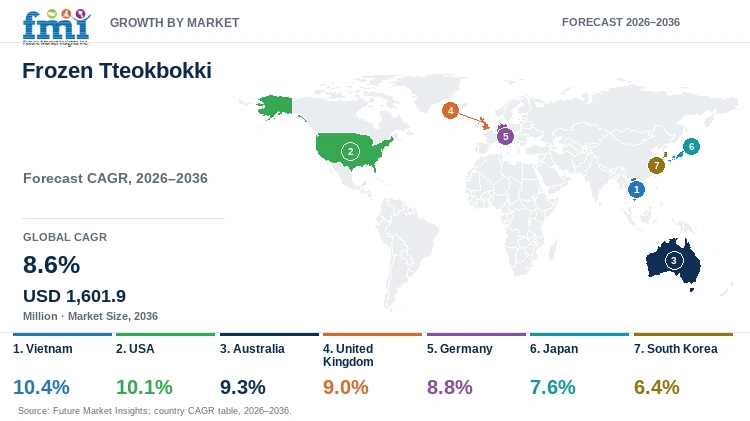
| Country | CAGR |
|---|---|
| Vietnam | 10.4% |
| USA | 10.1% |
| Australia | 9.3% |
| United Kingdom | 9.0% |
| Germany | 8.8% |
| Japan | 7.6% |
| South Korea | 6.4% |
How do country-level CAGRs compare in the Frozen Tteokbokki Market?
Growth across the profiled countries ranges from 10.4% CAGR in Vietnam to 6.4% in South Korea between 2026 and 2036. Vietnam and the USA sit above 10.0% because both markets are still adding distribution capacity for Korean processed foods from different starting points. Australia, the United Kingdom and Germany are in the 8.8% to 9.3% range as mainstream frozen channels widen access. Japan grows at 7.6% with strong K-food familiarity but a more mature packaged-food environment. South Korea has the deepest consumption base, so growth comes more from premiumization, convenience and format shifts than from first-time category entry.
- Vietnam at 10.4% reflects ASEAN demand for Korean rice cakes and street-food formats, with MAFRA reporting a 26.9% increase in first-quarter 2026 processed-rice exports to ASEAN.
- USA at 10.1% combines a specific 2025 KATI tteokbokki market study with rapid K-snack growth at Pulmuone USA and increasing processed-rice imports.
- Australia at 9.3% benefits from bibigo’s move into the main frozen-food aisle, while the United Kingdom and Germany at 9.0% and 8.8% gain from established European K-food distribution infrastructure.
- Japan at 7.6% and South Korea at 6.4% have higher consumer familiarity, so the commercial focus shifts toward repeat purchase, flavor extension and pack convenience.
Country-wise Analysis
- Vietnam: Demand for Frozen Tteokbokki is forecast to expand at 10.4% CAGR from 2026 to 2036. MAFRA linked strong ASEAN processed-rice exports in early 2026 to the continued K-street-food trend and specifically cited tteokbokki rice cakes. Vietnam has a young urban consumer base that is already familiar with Korean entertainment and Korean restaurant formats. For frozen suppliers, the commercial issue is building enough freezer distribution outside specialist Korean stores while keeping pack prices within the range of an everyday snack rather than a premium import.
- USA: Demand is forecast to expand at 10.1% CAGR. Pulmuone reported 182.2% growth in its US K-snack category in 2024, including tteokbokki sold through grocery franchises, warehouse clubs and Asian markets. Across the broader processed-rice category, MAFRA reported USD 38.4 Million of exports to the USA in the first quarter of 2026, up 7.8%. Established K-snack channels provide a route for frozen kits. Pack instructions and heat levels need to suit households preparing the dish without specialist ingredients or restaurant experience.
- Australia: Demand is projected to rise at 9.3% CAGR. CJ Foods expanded its Oceania lineup beyond mandu into frozen gimbap, tteokbokki and other K-street foods and stated that bibigo had moved into the main frozen-food aisle. That placement is important because the category is no longer restricted to specialty Korean shopping trips. Suppliers entering Australia need to fit supermarket case dimensions and deliver stable cold-chain performance across a geographically dispersed market.
- United Kingdom: Demand is projected to increase at 9.0% CAGR. CJ Foods established a UK subsidiary in 2022 as part of its European expansion and currently sells bibigo products across 27 European countries. The UK has a developed frozen and ready-meal retail system, so tteokbokki can be merchandised as a quick Korean meal rather than only as an imported ingredient. Growth depends on simplifying cooking instructions and controlling heat intensity without making the sauce generic.
- Germany: Demand is forecast to expand at 8.8% CAGR. CJ Foods entered Europe through the acquisition of German frozen-food company Mainfrost and has since built a wider European operating network. Germany therefore combines local frozen-food infrastructure with access to a broader European distribution system. A supplier can use German retail or logistics relationships to reach neighboring markets, but frozen products still have to compete against shelf-stable Korean meal kits that are easier to warehouse.
- Japan: Demand is forecast to grow at 7.6% CAGR. CJ Foods used tteokbokki alongside mandu and gimbap at KCON Japan 2025, where about 12,000 visitors came through its bibigo booth. Japan is already familiar with Korean cuisine, so growth is less dependent on explaining what tteokbokki is. Commercial differentiation comes from sauce variations, portioning and the ability to deliver a convenient snack without requiring specialty-store ingredients.
- South Korea: Demand is forecast to expand at 6.4% CAGR. aT reported KRW 764.9 Billion of domestic rice-cake shipments in 2021, while South Korean frozen-food production reached KRW 3.4506 Trillion in 2022. The category is already embedded in home meals and street-food culture. Growth therefore comes from branded meal kits, new sauce profiles and frozen formats that offer a clear texture or convenience advantage over fresh rice cakes and ambient cups.
Who are the notable companies in the Frozen Tteokbokki Market?
CJ Foods / bibigo; Pulmuone Foods; SJ CORE / Cook-Tok; Ever Blue Sea / Goraesa; meal&story / Shine-Cook; Woosin Trading / Delief; Lou Et Lang / Allgroo; Open the Table.
The competitive set mixes scaled K-food platforms with specialists that are more tightly focused on frozen rice cakes or complete kits. CJ Foods and Pulmuone bring wider retail access and can place tteokbokki next to other Korean snacks in mainstream channels. SJ CORE sells a 600 g frozen Cook-Tok kit with fish cake and an 18-month stated shelf life. Ever Blue Sea packages Goraesa fish-cake tteokbokki as a frozen meal kit. Meal&Story offers a frozen wheat-based format, while Woosin Trading and Lou Et Lang sell frozen tteokbokki rice cakes for consumers or foodservice buyers that add their own sauce. Open the Table participates through a broader HMR export platform that includes tteokbokki among its export products.
- Scaled K-food platforms: CJ Foods and Pulmuone can use existing Asian-food distribution to place tteokbokki beside dumplings, noodles, gimbap and other Korean meal formats.
- Complete frozen-kit specialists: SJ CORE and Ever Blue Sea compete through meal completeness, product-specific preparation instructions and cold-chain shelf life.
- Frozen rice-cake and export specialists: meal&story, Woosin Trading, Lou Et Lang and Open the Table give importers more flexibility across branded, component and private-label routes.
Competitive Benchmarking: Frozen Tteokbokki Market
| Company | Complete Frozen Kit | Rice-Cake Format Breadth | Retail / Export Channel Depth | Geographic Reach |
|---|---|---|---|---|
| CJ Foods / bibigo | Medium | Medium | High | Oceania, North America, Europe and Asia |
| Pulmuone Foods | Medium | Medium | High | South Korea, USA and wider export markets |
| SJ CORE / Cook-Tok | High | Medium | Medium | South Korea with export-oriented distribution |
| Ever Blue Sea / Goraesa | High | Medium | Medium | South Korea with international seafood and K-food channels |
| meal&story / Shine-Cook | High | Medium | Low | South Korea with export listing capability |
| Woosin Trading / Delief | Low | High | Medium | South Korea with international export focus |
| Lou Et Lang / Allgroo | Low | High | Medium | Europe-facing and international Korean-food distribution |
| Open the Table | Medium | Medium | High | USA, Europe, Australia, Canada and other export markets |
Scoring basis: Complete Frozen Kit measures documented inclusion of tteokbokki rice cake with sauce and relevant meal components in a frozen product. Rice-Cake Format Breadth measures documented frozen rice-cake options across base, pack or use case. Retail / Export Channel Depth measures evidence of mainstream retail, specialty grocery, importer or multi-country distribution. High indicates broad documented capability. Medium indicates narrower but active capability. Low indicates a documented limitation relative to the criterion. Geographic Reach summarizes the company’s public commercial footprint.
Key Developments in the Frozen Tteokbokki Market
- In February 2026, CJ Foods used tteokbokki alongside mandu, chicken, seaweed and kimchi at its bibigo consumer and buyer activation in Milan. The company said bibigo products were sold in 27 European countries and that European food sales had exceeded KRW 100.0 Billion in 2024, with the first three quarters of 2025 up 25.0% year on year. The move supports wider retail conversations for Korean frozen and convenience foods in Europe.
- In September 2025, CJ Foods described its Oceania lineup as extending beyond mandu into Frozen Gimbap, Tteokbokki and other K-street-food items, with bibigo products placed in the main frozen-food aisle. That placement moves tteokbokki closer to general frozen-meal shopping rather than limiting it to Asian specialty sections.
- In January 2025, Pulmuone reported that sales of its U.S. K-snack category increased 182.2% in 2024. The company identified tteokbokki among the K-snack products being sold through large grocery franchises, warehouse clubs and Asian markets, giving the category a wider retail base in the USA.
Key Players in the Frozen Tteokbokki Market
Scaled K-Food Platforms
- CJ Foods / bibigo
- Pulmuone Foods
Complete Frozen Tteokbokki Kit Specialists
- SJ CORE CO., LTD / Cook-Tok
- Ever Blue Sea Co., Ltd. / Goraesa
- meal&story Ltd. / Shine-Cook
Frozen Rice-Cake and Export Platforms
- Woosin Trading Co., Ltd. / Delief
- Lou Et Lang Co., Ltd. / Allgroo
- Open the Table
Frozen Tteokbokki Market - Report Scope
| Coverage field | Report scope |
|---|---|
| Market breakdown | Product Configuration; Sauce Profile; Base Type; Pack Format; Sales Channel; Region |
| Quantitative Units | USD Million |
| Market Definition | Revenue from frozen tteokbokki meal kits and frozen rice-cake products marketed specifically for tteokbokki preparation. Products may include sauce, fish cake or other accompaniments. |
| Regions Covered | North America; Latin America; Western Europe; Eastern Europe; East Asia; South Asia & Pacific; Middle East & Africa |
| Countries Covered | Vietnam; USA; Australia; United Kingdom; Germany; Japan; South Korea; plus additional countries in the full report |
| Key Companies Profiled | CJ Foods / bibigo; Pulmuone Foods; SJ CORE / Cook-Tok; Ever Blue Sea / Goraesa; meal&story / Shine-Cook; Woosin Trading / Delief; Lou Et Lang / Allgroo; Open the Table |
| Forecast Period | 2026 to 2036 |
| Approach | Triangulated sizing using South Korean rice-cake shipment value, frozen-food production, processed-rice exports, product assortment, retail expansion and country-level K-food distribution signals. |
Frozen Tteokbokki Market - Research Methodology
| Method | Approach |
|---|---|
| Primary Research | Market inputs are organized around buyer and supplier criteria such as rice-cake texture, sauce balance, cold-chain requirements, pack size, retailer freezer economics and foodservice preparation. |
| Desk Research | The assessment uses MAFRA export releases, aT/FIS rice-cake and frozen-food statistics, KATI market studies, K-FOODTRADE product listings, company releases and current supplier product information. |
| Market Sizing and Forecasting | The model starts with South Korea’s documented rice-cake and frozen-food revenue pools, assigns a frozen tteokbokki share, then adds export retail value and overseas local production. Forecast assumptions reflect processed-rice export growth, mainstream retail entry and substitution between frozen and ambient formats. |
| Data Validation | The market estimate is cross-checked against processed-rice export values, active frozen product listings, supplier revenue signals and country retail expansion. Shelf-stable cup tteokbokki, restaurant-made tteokbokki and frozen rice cakes not marketed for tteokbokki are excluded. |
Frozen Tteokbokki Market by Segments
Frozen Tteokbokki Market segmented by Product Configuration:
- Complete Tteokbokki Meal Kits
- Rice Cake + Sauce Kits
- Frozen Tteokbokki Rice Cakes
Frozen Tteokbokki Market segmented by Sauce Profile:
- Classic Gochujang
- Rose / Cream
- Jjajang
- Cheese
- Other Flavors
Frozen Tteokbokki Market segmented by Base Type:
- Rice-based Cakes
- Wheat-based Cakes
- Hybrid / Specialty Base
Frozen Tteokbokki Market segmented by Pack Format:
- Multi-serve Pouches
- Single-serve Packs
- Foodservice Bulk
Frozen Tteokbokki Market segmented by Sales Channel:
- Supermarkets & Hypermarkets
- Asian / Specialty Grocery
- Online Grocery / E-commerce
- Warehouse Clubs
- Foodservice Distributors
Frozen Tteokbokki Market by Region:
- North America
- United States
- Canada
- Latin America
- Brazil
- Mexico
- Argentina
- Chile
- Western Europe
- Germany
- United Kingdom
- France
- Italy
- Spain
- Benelux
- Nordics
- Eastern Europe
- Poland
- Czech Republic
- Romania
- Hungary
- East Asia
- China
- Japan
- South Korea
- South Asia & Pacific
- India
- ASEAN
- Australia and New Zealand
- Middle East & Africa
- GCC Countries
- South Africa
- Türkiye
- Israel
Research Sources and Bibliography
- Ministry of Agriculture, Food and Rural Affairs, Republic of Korea. (2026). K-Food Plus export performance, first quarter 2026.
- Ministry of Agriculture, Food and Rural Affairs, Republic of Korea. (2025). K-Food export performance by major markets, 2025.
- Ministry of Agriculture, Food and Rural Affairs, Republic of Korea. (2024). Processed rice-based food export performance and rice-processing industry policy.
- Korea Agro-Fisheries & Food Trade Corporation, FIS. (2023). 2022 Processed Food Segment Report: Rice Cakes and Hangwa.
- Korea Agro-Fisheries & Food Trade Corporation, KATI. (2025, November 19). 2025 United States Tteokbokki Market Analysis.
- K-FOODTRADE. (2024, October 16). Frozen Food Market Size and Trends 2022.
- K-FOODTRADE. Cook-Tok Tteokbokki@Home Kit product information, accessed 2026.
- K-FOODTRADE. Goraesa Fishcake Tteokbokki product information, accessed 2026.
- K-FOODTRADE. Shine-Cook Frozen Wheat Tteokbokki product information, accessed 2026.
- K-FOODTRADE. Delief Tteokbokki Rice Cake product information, accessed 2026.
- K-FOODTRADE. Allgroo Tteokbokki Rice Cake product information, accessed 2026.
- CJ Foods. (2025, September 24). Why Is CJ CheilJedang Making bibigo Mandu in Australia?
- CJ Foods. (2026). bibigo Introduces Korean Food to Global Consumers in Milan.
- Pulmuone. (2025, January 24). U.S. business growth across tofu, Asian noodles and K-snacks.
- Open the Table. Company export and channel information, accessed 2026.
This Report Answers
- What is the Frozen Tteokbokki Market size in 2026 and what value is forecast for 2036?
- Why do Complete Tteokbokki Meal Kits lead Product Configuration demand?
- Why does Classic Gochujang remain the leading Sauce Profile?
- How do Rice-based Cakes differ commercially from wheat-based and hybrid bases?
- Why do Multi-serve Pouches fit frozen tteokbokki purchase occasions?
- How do growth rates differ across Vietnam, USA, Australia, the United Kingdom, Germany, Japan and South Korea?
- Which companies participate in complete frozen kits and frozen tteokbokki rice-cake formats?
- What should retailers and importers evaluate before qualifying a frozen tteokbokki product?
Frequently Asked Questions
How big is the Frozen Tteokbokki Market in 2026?
The Frozen Tteokbokki Market is estimated at USD 702.0 Million in 2026 and is forecast to reach USD 1,601.9 Million by 2036. The 2025 base is USD 646.4 Million.
What is the CAGR of the Frozen Tteokbokki Market from 2026 to 2036?
The market is forecast to expand at an 8.6% CAGR from 2026 to 2036 as processed-rice exports widen and more Korean street-food products enter mainstream frozen retail.
Which Product Configuration leads the Frozen Tteokbokki Market?
Complete Tteokbokki Meal Kits are projected to hold 47.0% of Product Configuration demand in 2026 because one pack can include rice cakes, sauce and common accompaniments.
Which Sauce Profile leads the Frozen Tteokbokki Market?
Classic Gochujang is projected to account for 54.0% of Sauce Profile demand in 2026 because it remains the reference flavor for conventional tteokbokki.
How much value will the Frozen Tteokbokki Market add between 2026 and 2036?
The market is forecast to add USD 899.9 Million between 2026 and 2036 as frozen K-street-food distribution expands across North America, Europe and Asia-Pacific.
Which companies are active in the Frozen Tteokbokki Market?
Companies active in the market include CJ Foods / bibigo, Pulmuone Foods, SJ CORE / Cook-Tok, Ever Blue Sea / Goraesa, meal&story / Shine-Cook, Woosin Trading / Delief, Lou Et Lang / Allgroo and Open the Table.
Preview the report firsthand - request a free sample
Get SampleGet the brochure for pricing and purchase details.
Get PDFTable of Content
- Key Takeaways
- Market Size and CAGR
- Top Growth Driver
- Fastest Growing Segment
- Leading Region
- Key Companies
- Emerging Opportunities
- Executive Summary
- Global Market Outlook
- Demand-side Trends
- Supply-side Trends
- Technology Roadmap Analysis
- Analysis and Recommendations
- Analyst Perspective (What is happening? Why now? What should investors know?)
- Key Questions Answered
- How large is the market?
- What is the CAGR?
- What are key trends?
- Which region dominates?
- Who are the leaders?
- Market Overview
- Market Coverage / Taxonomy
- Market Definition / Scope / Limitations
- Research Methodology
- Chapter Orientation
- Analytical Lens and Working Hypotheses
- Market Structure, Signals, and Trend Drivers
- Benchmarking and Cross-market Comparability
- Market Sizing, Forecasting, and Opportunity Mapping
- Research Design and Evidence Framework
- Desk Research Programme (Secondary Evidence)
- Expert Input and Fieldwork (Primary Evidence)
- Tooling, Models, and Reference Databases
- Data Engineering and Model Build
- Quality Assurance and Audit Trail
- Market Background
- Market Dynamics (Drivers, Restraints, Opportunity, Trends)
- Scenario Forecast (Optimistic, Likely, Conservative)
- Impact Analysis
- AI Impact
- Sustainability Impact
- Regulatory Impact
- Technology Impact
- Consumer / Buyer Analysis
- Purchase Drivers
- Adoption Barriers
- Buyer Journey
- Opportunity Map Analysis
- Product Life Cycle Analysis
- Supply Chain Analysis
- Investment Feasibility Matrix
- Value Chain Analysis
- PESTLE and Porter's Analysis
- Regulatory Landscape
- Regional Parent Market Outlook
- Production and Consumption Statistics
- Import and Export Statistics
- Global Market Analysis and Forecast, 2021 to 2036
- Historical Market Size Value (USD Million) Analysis, 2021 to 2025
- Current and Future Market Size Value (USD Million) Projections, 2026 to 2036
- Y-o-Y Growth Trend Analysis
- Absolute $ Opportunity Analysis
- Global Market Pricing Analysis, 2021 to 2036
- Global Market Analysis and Forecast, By Product Configuration, 2021 to 2036
- Introduction / Key Findings
- Historical Market Size Value (USD Million) Analysis By Product Configuration, 2021 to 2025
- Current and Future Market Size Value (USD Million) Analysis and Forecast By Product Configuration, 2026 to 2036
- Complete Tteokbokki Meal Kits
- Rice Cake + Sauce Kits
- Frozen Tteokbokki Rice Cakes
- Y-o-Y Growth Trend Analysis By Product Configuration, 2021 to 2025
- Absolute $ Opportunity Analysis By Product Configuration, 2026 to 2036
- Global Market Analysis and Forecast, By Sauce Profile, 2021 to 2036
- Introduction / Key Findings
- Historical Market Size Value (USD Million) Analysis By Sauce Profile, 2021 to 2025
- Current and Future Market Size Value (USD Million) Analysis and Forecast By Sauce Profile, 2026 to 2036
- Classic Gochujang
- Rose / Cream
- Jjajang
- Cheese
- Other Flavors
- Y-o-Y Growth Trend Analysis By Sauce Profile, 2021 to 2025
- Absolute $ Opportunity Analysis By Sauce Profile, 2026 to 2036
- Global Market Analysis and Forecast, By Base Type, 2021 to 2036
- Introduction / Key Findings
- Historical Market Size Value (USD Million) Analysis By Base Type, 2021 to 2025
- Current and Future Market Size Value (USD Million) Analysis and Forecast By Base Type, 2026 to 2036
- Rice-based Cakes
- Wheat-based Cakes
- Hybrid / Specialty Base
- Y-o-Y Growth Trend Analysis By Base Type, 2021 to 2025
- Absolute $ Opportunity Analysis By Base Type, 2026 to 2036
- Global Market Analysis and Forecast, By Pack Format, 2021 to 2036
- Introduction / Key Findings
- Historical Market Size Value (USD Million) Analysis By Pack Format, 2021 to 2025
- Current and Future Market Size Value (USD Million) Analysis and Forecast By Pack Format, 2026 to 2036
- Multi-serve Pouches
- Single-serve Packs
- Foodservice Bulk
- Y-o-Y Growth Trend Analysis By Pack Format, 2021 to 2025
- Absolute $ Opportunity Analysis By Pack Format, 2026 to 2036
- Global Market Analysis and Forecast, By Sales Channel, 2021 to 2036
- Introduction / Key Findings
- Historical Market Size Value (USD Million) Analysis By Sales Channel, 2021 to 2025
- Current and Future Market Size Value (USD Million) Analysis and Forecast By Sales Channel, 2026 to 2036
- Supermarkets & Hypermarkets
- Asian / Specialty Grocery
- Online Grocery / E-commerce
- Warehouse Clubs
- Foodservice Distributors
- Y-o-Y Growth Trend Analysis By Sales Channel, 2021 to 2025
- Absolute $ Opportunity Analysis By Sales Channel, 2026 to 2036
- Global Market Analysis and Forecast, By Region, 2021 to 2036
- Introduction
- Historical Market Size Value (USD Million) Analysis By Region, 2021 to 2025
- Current Market Size Value (USD Million) Analysis and Forecast By Region, 2026 to 2036
- North America
- Latin America
- Western Europe
- Eastern Europe
- East Asia
- South Asia & Pacific
- Middle East & Africa
- Market Attractiveness Analysis By Region
- North America Market Analysis and Forecast, By Country, 2021 to 2036
- Historical Market Size Value (USD Million) Trend Analysis By Market Taxonomy, 2021 to 2025
- Market Size Value (USD Million) Forecast By Market Taxonomy, 2026 to 2036
- By Country
- United States
- Canada
- By Product Configuration
- By Sauce Profile
- By Base Type
- By Pack Format
- By Sales Channel
- By Country
- Market Attractiveness Analysis
- By Country
- By Product Configuration
- By Sauce Profile
- By Base Type
- By Pack Format
- By Sales Channel
- Key Takeaways
- Latin America Market Analysis and Forecast, By Country
- Historical Market Size Value (USD Million) Trend Analysis By Market Taxonomy, 2021 to 2025
- Market Size Value (USD Million) Forecast By Market Taxonomy, 2026 to 2036
- By Country
- Brazil
- Mexico
- Argentina
- Chile
- By Product Configuration
- By Sauce Profile
- By Base Type
- By Pack Format
- By Sales Channel
- By Country
- Market Attractiveness Analysis
- By Country
- By Product Configuration
- By Sauce Profile
- By Base Type
- By Pack Format
- By Sales Channel
- Key Takeaways
- Western Europe Market Analysis and Forecast, By Country
- Historical Market Size Value (USD Million) Trend Analysis By Market Taxonomy, 2021 to 2025
- Market Size Value (USD Million) Forecast By Market Taxonomy, 2026 to 2036
- By Country
- Germany
- United Kingdom
- France
- Italy
- Spain
- Benelux
- Nordics
- By Product Configuration
- By Sauce Profile
- By Base Type
- By Pack Format
- By Sales Channel
- By Country
- Market Attractiveness Analysis
- By Country
- By Product Configuration
- By Sauce Profile
- By Base Type
- By Pack Format
- By Sales Channel
- Key Takeaways
- Eastern Europe Market Analysis and Forecast, By Country
- Historical Market Size Value (USD Million) Trend Analysis By Market Taxonomy, 2021 to 2025
- Market Size Value (USD Million) Forecast By Market Taxonomy, 2026 to 2036
- By Country
- Poland
- Czech Republic
- Romania
- Hungary
- By Product Configuration
- By Sauce Profile
- By Base Type
- By Pack Format
- By Sales Channel
- By Country
- Market Attractiveness Analysis
- By Country
- By Product Configuration
- By Sauce Profile
- By Base Type
- By Pack Format
- By Sales Channel
- Key Takeaways
- East Asia Market Analysis and Forecast, By Country
- Historical Market Size Value (USD Million) Trend Analysis By Market Taxonomy, 2021 to 2025
- Market Size Value (USD Million) Forecast By Market Taxonomy, 2026 to 2036
- By Country
- China
- Japan
- South Korea
- By Product Configuration
- By Sauce Profile
- By Base Type
- By Pack Format
- By Sales Channel
- By Country
- Market Attractiveness Analysis
- By Country
- By Product Configuration
- By Sauce Profile
- By Base Type
- By Pack Format
- By Sales Channel
- Key Takeaways
- South Asia & Pacific Market Analysis and Forecast, By Country
- Historical Market Size Value (USD Million) Trend Analysis By Market Taxonomy, 2021 to 2025
- Market Size Value (USD Million) Forecast By Market Taxonomy, 2026 to 2036
- By Country
- India
- ASEAN
- Australia and New Zealand
- By Product Configuration
- By Sauce Profile
- By Base Type
- By Pack Format
- By Sales Channel
- By Country
- Market Attractiveness Analysis
- By Country
- By Product Configuration
- By Sauce Profile
- By Base Type
- By Pack Format
- By Sales Channel
- Key Takeaways
- Middle East & Africa Market Analysis and Forecast, By Country
- Historical Market Size Value (USD Million) Trend Analysis By Market Taxonomy, 2021 to 2025
- Market Size Value (USD Million) Forecast By Market Taxonomy, 2026 to 2036
- By Country
- GCC Countries
- South Africa
- Türkiye
- Israel
- By Product Configuration
- By Sauce Profile
- By Base Type
- By Pack Format
- By Sales Channel
- By Country
- Market Attractiveness Analysis
- By Country
- By Product Configuration
- By Sauce Profile
- By Base Type
- By Pack Format
- By Sales Channel
- Key Takeaways
- Key Countries Market Analysis
- United States
- Pricing Analysis
- Market Share Analysis, 2025
- By Product Configuration
- By Sauce Profile
- By Base Type
- By Pack Format
- By Sales Channel
- Canada
- Pricing Analysis
- Market Share Analysis, 2025
- By Product Configuration
- By Sauce Profile
- By Base Type
- By Pack Format
- By Sales Channel
- Mexico
- Pricing Analysis
- Market Share Analysis, 2025
- By Product Configuration
- By Sauce Profile
- By Base Type
- By Pack Format
- By Sales Channel
- Brazil
- Pricing Analysis
- Market Share Analysis, 2025
- By Product Configuration
- By Sauce Profile
- By Base Type
- By Pack Format
- By Sales Channel
- Chile
- Pricing Analysis
- Market Share Analysis, 2025
- By Product Configuration
- By Sauce Profile
- By Base Type
- By Pack Format
- By Sales Channel
- Germany
- Pricing Analysis
- Market Share Analysis, 2025
- By Product Configuration
- By Sauce Profile
- By Base Type
- By Pack Format
- By Sales Channel
- United Kingdom
- Pricing Analysis
- Market Share Analysis, 2025
- By Product Configuration
- By Sauce Profile
- By Base Type
- By Pack Format
- By Sales Channel
- Italy
- Pricing Analysis
- Market Share Analysis, 2025
- By Product Configuration
- By Sauce Profile
- By Base Type
- By Pack Format
- By Sales Channel
- Spain
- Pricing Analysis
- Market Share Analysis, 2025
- By Product Configuration
- By Sauce Profile
- By Base Type
- By Pack Format
- By Sales Channel
- France
- Pricing Analysis
- Market Share Analysis, 2025
- By Product Configuration
- By Sauce Profile
- By Base Type
- By Pack Format
- By Sales Channel
- India
- Pricing Analysis
- Market Share Analysis, 2025
- By Product Configuration
- By Sauce Profile
- By Base Type
- By Pack Format
- By Sales Channel
- ASEAN
- Pricing Analysis
- Market Share Analysis, 2025
- By Product Configuration
- By Sauce Profile
- By Base Type
- By Pack Format
- By Sales Channel
- Australia and New Zealand
- Pricing Analysis
- Market Share Analysis, 2025
- By Product Configuration
- By Sauce Profile
- By Base Type
- By Pack Format
- By Sales Channel
- China
- Pricing Analysis
- Market Share Analysis, 2025
- By Product Configuration
- By Sauce Profile
- By Base Type
- By Pack Format
- By Sales Channel
- Japan
- Pricing Analysis
- Market Share Analysis, 2025
- By Product Configuration
- By Sauce Profile
- By Base Type
- By Pack Format
- By Sales Channel
- South Korea
- Pricing Analysis
- Market Share Analysis, 2025
- By Product Configuration
- By Sauce Profile
- By Base Type
- By Pack Format
- By Sales Channel
- Poland
- Pricing Analysis
- Market Share Analysis, 2025
- By Product Configuration
- By Sauce Profile
- By Base Type
- By Pack Format
- By Sales Channel
- Hungary
- Pricing Analysis
- Market Share Analysis, 2025
- By Product Configuration
- By Sauce Profile
- By Base Type
- By Pack Format
- By Sales Channel
- Türkiye
- Pricing Analysis
- Market Share Analysis, 2025
- By Product Configuration
- By Sauce Profile
- By Base Type
- By Pack Format
- By Sales Channel
- South Africa
- Pricing Analysis
- Market Share Analysis, 2025
- By Product Configuration
- By Sauce Profile
- By Base Type
- By Pack Format
- By Sales Channel
- Vietnam
- Pricing Analysis
- Market Share Analysis, 2025
- By Product Configuration
- By Sauce Profile
- By Base Type
- By Pack Format
- By Sales Channel
- Australia
- Pricing Analysis
- Market Share Analysis, 2025
- By Product Configuration
- By Sauce Profile
- By Base Type
- By Pack Format
- By Sales Channel
- United States
- Market Structure Analysis
- Competition Dashboard
- Competition Benchmarking
- Market Share Analysis of Top Players
- By Regional
- By Product Configuration
- By Sauce Profile
- By Base Type
- By Pack Format
- By Sales Channel
- Emerging Startups
- Innovation Benchmarking
- Competition Analysis
- Competition Deep Dive
- CJ Foods / bibigo
- Overview
- Product Portfolio
- Profitability by Market Segments
- Sales Footprint
- Strategy Overview
- Marketing Strategy
- Product Strategy
- Channel Strategy
- Pulmuone Foods
- SJ CORE / Cook-Tok
- Ever Blue Sea / Goraesa
- meal&story / Shine-Cook
- Woosin Trading / Delief
- Lou Et Lang / Allgroo
- Open the Table
- SJ CORE CO., LTD / Cook-Tok
- Ever Blue Sea Co., Ltd. / Goraesa
- meal&story Ltd. / Shine-Cook
- Woosin Trading Co., Ltd. / Delief
- Lou Et Lang Co., Ltd. / Allgroo
- CJ Foods / bibigo
- Case Studies
- Success Stories
- Recent Developments
- Competition Deep Dive
- Assumptions & Acronyms Used


