

- Market Size (2026)
- USD 2.5 Bn
- Forecast (2036)
- USD 4.6 Bn
- CAGR (2026 to 2036)
- 6.2%
How big is Frozen Gyoza Market in 2026?
USD 2.5 Billion in 2026 and USD 4.6 Billion by 2036 at a 6.2% CAGR.
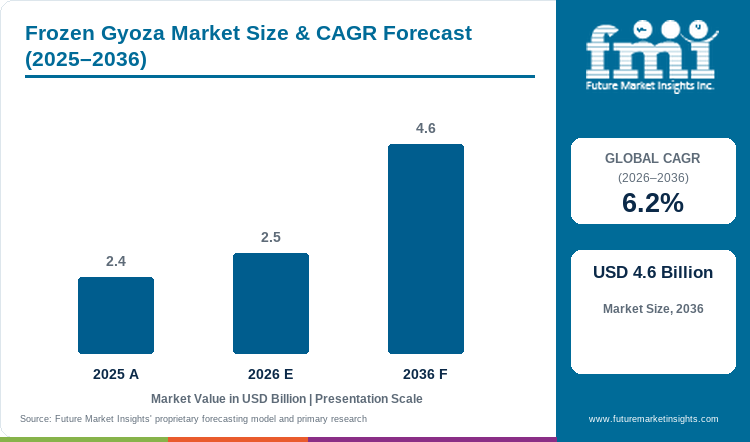
Sales of frozen gyoza are estimated at USD 2.5 Billion in 2026 and are forecast to reach USD 4.6 Billion by 2036 at a 6.2% CAGR. The market was valued at USD 2.4 Billion in 2025. Japan provides a strong operating benchmark: the Japan Frozen Food Association recorded 109.5 thousand tonnes of frozen gyoza production in 2025, up 13.0% year on year. The same association reported 1.6 million tonnes of total domestic frozen-food production and JPY 857.7 Billion in factory shipment value. Frozen gyoza therefore sits inside a deep frozen-food system, but its purchase logic is narrower because buyers judge wrapper performance, filling texture and pan-release reliability together.
The international growth path is different from Japan. In the USA, a 26.8 million Asian alone-or-in-combination population supports an established consumer base, while mainstream chains, warehouse clubs and foodservice operators widen trial beyond diaspora shoppers. Ajinomoto Foods North America sells across grocery, warehouse club and foodservice and explicitly identifies gyoza as an Asian foodservice opportunity. Day-Lee Foods maintains beef, pork, chicken, shrimp and vegetable gyoza lines. Wei-Chuan USA lists 19 gyoza products in its current gyoza and potsticker category. These channels connect frozen gyoza with the broader ethnic food market without making the category dependent on restaurant preparation.
Convenience engineering is becoming as important as filling flavor. Ajinomoto Frozen Foods renewed its core gyoza in February 2026 so consumers can cook it without oil, added water or a lid, and also expanded microwave formats. Eat&Foods sells skillet products designed for oil-free, water-free and lid-free preparation. The result is a product that competes for quick dinners, side dishes and snack occasions where the consumer wants restaurant-like browning with fewer failure points. That places frozen gyoza close to the ready-to-eat food market and convenience food market, while the freezer still gives retailers more inventory time than chilled dumplings.
Key Takeaways
- The market is estimated at USD 2.5 Billion in 2026 and is forecast to reach USD 4.6 Billion by 2036 at a 6.2% CAGR. The 2025 base is USD 2.4 Billion.
- Pork & Vegetable accounts for 34.0% of Filling Type demand in 2026 because the format balances familiar meat flavor with cabbage, chive, onion or leek inclusions used across major branded assortments.
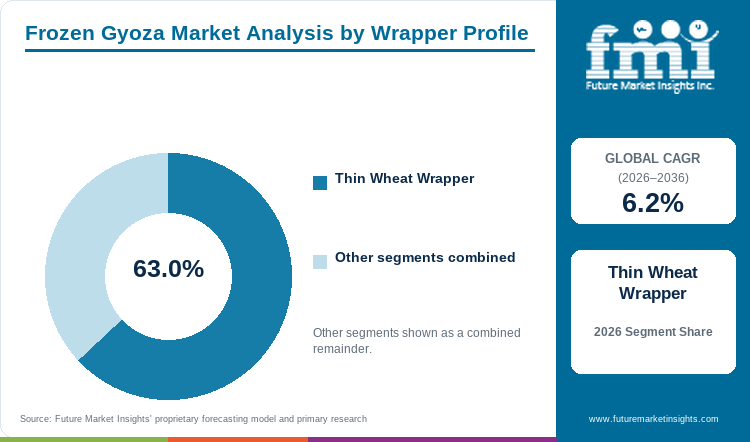
- Thin Wheat Wrapper holds 63.0% of Wrapper Profile demand in 2026. Buyers expect the skin to crisp during pan-frying while remaining resilient enough to contain steam and filling juices.
- Pan-Fry / Skillet represents 52.0% of Cooking Method demand in 2026 because the browned base and steamed upper wrapper define the eating experience for many retail gyoza products.
- Multi-serve Bags hold 57.0% of Pack Format demand and Supermarkets & Hypermarkets account for 43.0% of Sales Channel demand as households favor portion flexibility and freezer storage.
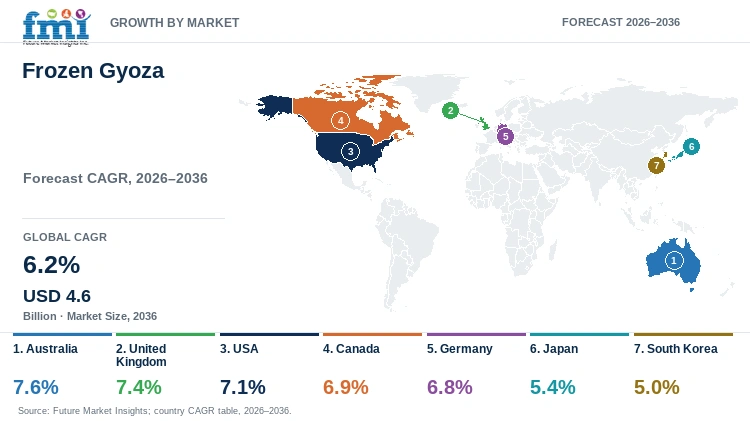
- Country CAGRs range from 7.6% in Australia to 5.0% in South Korea from 2026 to 2036, reflecting different levels of retail expansion, category maturity and local manufacturing investment.
Analyst Perspective
Gyoza has to brown underneath while the wrapper stays intact and the filling heats through. Failures are immediately visible in the pan: torn skins, sticking or excess water. Manufacturers are addressing those problems through wrapper formulation and simpler cooking methods. Pack sizes and directions also need to suit the cookware and meal portions used in each retail market.
- Nandini Roy Choudhury, Principal Consultant, Future Market Insights
How is the Frozen Gyoza Market segmented?
Filling Type, Wrapper Profile, Cooking Method, Pack Format, Sales Channel, and Region.
The Frozen Gyoza Market is segmented by Filling Type, Wrapper Profile, Cooking Method, Pack Format, Sales Channel, and Region. Filling Type covers Pork & Vegetable, Chicken & Vegetable, Vegetable, Seafood, Beef / Mixed Meat, and Plant-based / Specialty. Wrapper Profile covers Thin Wheat Wrapper, Standard / Thick Wheat Wrapper, and Specialty / Gluten-free / Wholegrain. Cooking Method includes Pan-Fry / Skillet, Steam, Boil, Air Fry / Oven, and Multi-method. Pack Format includes Multi-serve Bags, Trays, Single-serve / Microwave Packs, and Foodservice Bulk. Sales Channel includes Supermarkets & Hypermarkets, Asian / Specialty Grocery, Warehouse Clubs, Online Grocery / E-commerce, and Foodservice Distributors.
Why do Thin Wheat Wrappers lead demand within the Wrapper Profile category?
The wrapper has to perform two opposing jobs. It must stay elastic enough to resist splitting when steam pressure builds, yet become crisp where it contacts the pan. A thinner wheat skin shortens the thermal path to the filling and gives consumers the delicate bite associated with gyoza rather than a heavy dough layer. The trade-off is process control: sealing, freezer dehydration and reheating have to be managed tightly because a thin wrapper exposes quality defects quickly.
- Thin Wheat Wrapper is projected to account for 63.0% of Wrapper Profile demand in 2026 because it supports the crisp-base, tender-top texture expected from pan-fried gyoza.
- Ajinomoto’s 2026 renewal focused on getting a crisp skirt while keeping the wrapper soft after cooking, illustrating why wrapper engineering remains a product-development priority rather than a simple commodity input.
Why does Pork & Vegetable lead demand within the Filling Type category?
Pork and vegetables give manufacturers a wide formulation window. Pork fat carries flavor and keeps the filling moist, while cabbage, chive, leek, onion or similar vegetables add texture without making the dumpling too dense. The combination is common in Japanese frozen gyoza and also travels well into North American potsticker assortments. It supports both traditional seasoning and localized variants, which lowers the need to redesign the core production process for each market.
- Pork & Vegetable is projected to hold 34.0% of Filling Type demand in 2026 because it matches the established retail taste profile in Japan while remaining familiar in overseas gyoza and potsticker ranges.
- Day-Lee Foods lists pork, chicken, beef, shrimp and vegetable gyoza, while Wei-Chuan USA offers pork-and-vegetable plus chicken-and-vegetable gyoza, showing how pork-and-vegetable sits inside a broader but closely related filling portfolio.
Why does Pan-Fry / Skillet lead demand within the Cooking Method category?
Pan-frying creates the contrast that separates gyoza from many steamed dumplings: browning underneath, steam-softened dough above and hot filling inside. Manufacturers increasingly build water, starch and oil behavior into the product so the consumer does less work. Ajinomoto and Osaka Ohsho both market products designed to reduce or remove oil, water or lid requirements. Multi-method products remain useful, but skillet performance still defines the category for many retail shoppers.
- Pan-Fry / Skillet is projected to represent 52.0% of Cooking Method demand in 2026 because browning and controlled steaming are central to the expected finished texture.
- Ajinomoto’s 2026 core gyoza can be cooked without added oil, water or a lid, while Eat&Foods documents the same convenience logic for Osaka Ohsho winged gyoza.
Why do Multi-serve Bags lead demand within the Pack Format category?
A resealable or compact multi-piece bag fits the way frozen gyoza is consumed. Households can cook six or eight pieces as a side dish, then return the rest to the freezer. This makes pack economics work for families and smaller households without forcing the retailer into many single-serve SKUs. Ajinomoto’s 2026 30-piece pack also removes the tray to reduce freezer space, showing that packaging design is being used to improve storage density as well as portion flexibility.
- Multi-serve Bags are projected to hold 57.0% of Pack Format demand in 2026 because consumers can adjust serving size without thawing the full pack.
- Large household bags also give brands room to use different count structures, from standard multipacks to 30-piece formats, without changing the basic production line.
Why do Supermarkets & Hypermarkets lead demand within the Sales Channel category?
Mainstream supermarkets give frozen gyoza access to a broader household audience than specialty Asian stores alone. The freezer aisle can place the product next to frozen appetizers, Asian meals or broader global-cuisine sets, which reduces the need for consumers to make a separate specialty-store trip. Warehouse clubs are important for larger packs, while Asian grocery stores remain critical for assortment depth and early product trial. Online grocery improves discovery, but frozen last-mile economics still favor established store networks.
- Supermarkets & Hypermarkets are projected to account for 43.0% of Sales Channel demand in 2026 because they combine freezer infrastructure with frequent household grocery trips.
- In the USA, Ajinomoto Foods North America reaches chains and warehouse clubs, while Day-Lee Foods states that its gyoza appears in Asian stores and the authentic Asian sections of mainstream grocery chains.
What are the drivers, restraints and opportunities in the Frozen Gyoza Market?
Repeatable skillet cooking drives adoption; wrapper and cold-chain failures can suppress repeat purchase; localized microwave, air-fryer and foodservice formats create new revenue routes.
- Driver: Proven household demand in Japan and widening ethnic-food distribution overseas give manufacturers an existing consumption habit to build on rather than a completely new food format.
- Restraint: Thin wrappers can crack, dry out or stick during cooking, while frozen distribution raises logistics cost and allergen labeling varies by market.
- Opportunity: Brands can create additional occasions through microwave packs, air-fryer instructions, larger meal-style dumplings, plant-based fillings and foodservice bulk formats.
A useful demand signal comes from frequency, not novelty. Japan’s 2025 frozen gyoza production reached 109.5 thousand tonnes, 13.0% above the prior year, and Ajinomoto described its domestic frozen gyoza market at about JPY 64.0 Billion for the twelve months through March 2025. That means suppliers are competing inside a category with repeated household use. Simpler cooking methods can encourage more frequent use. Lid-free skillet cooking, microwave formats and packaging that saves freezer space each remove a small barrier between purchase and consumption. Overseas, the same logic works when retailers position gyoza as a freezer staple rather than an occasional restaurant substitute.
The risk is that convenience can magnify a quality failure. A frozen dumpling that tears during cooking, dries at the pleats or releases excess water can lose repeat purchase even if the filling tastes good. Cold-chain breaks create similar problems because thawing and refreezing can damage the wrapper. Suppliers also have to manage wheat, soy, sesame, shellfish and meat allergens with country-specific labeling. These constraints make process control and retailer handling part of the product proposition. A low-cost SKU that fails in the pan can create more commercial damage than a slightly higher-priced product with dependable cooking performance.
Additional cooking formats can make gyoza useful for more household meals. Microwave products target single-person and older households that do not want pan cleanup. Air-fryer guidance can capture consumers who have shifted small hot-snack preparation away from skillets. Foodservice packs let operators serve gyoza without in-house folding labor. CJ’s investment in a Japanese mandu plant and its European dumpling factory build-out show how local manufacturing can shorten supply routes as demand expands. In the USA, the category also benefits from the broader demand for ethnic food in USA, where global flavors already have established retail space.
Which country CAGRs are profiled in the Frozen Gyoza Market?
| Country | CAGR |
|---|---|
| Australia | 7.6% |
| United Kingdom | 7.4% |
| USA | 7.1% |
| Canada | 6.9% |
| Germany | 6.8% |
| Japan | 5.4% |
| South Korea | 5.0% |
How do country-level CAGRs compare in the Frozen Gyoza Market?
Growth across the profiled countries ranges from 7.6% CAGR in Australia to 5.0% in South Korea between 2026 and 2036. Australia and the United Kingdom benefit from relatively smaller frozen dumpling bases combined with expanding Asian-food retail exposure. The USA and Canada have large multicultural consumer groups and mature freezer infrastructure. Germany gains from European frozen-food distribution and new regional dumpling manufacturing. Japan and South Korea grow from more developed domestic categories, so additional revenue depends more on format renovation, household penetration and premium or convenience variants than on first-time category creation.
- Australia at 7.6% combines a multicultural consumer base with broader supermarket access. CJ Foods launched new dumpling lines in IGA stores nationwide in January 2025, strengthening mainstream frozen-aisle exposure.
- The United Kingdom at 7.4% has 5.5 million people identifying within the Asian, Asian British or Asian Welsh category in the 2021 Census, while CJ Foods has operated a UK subsidiary since 2022 as part of its European expansion.
- The USA at 7.1% has 26.8 million Asian alone-or-in-combination residents in 2024 and several specialist manufacturers already selling gyoza across grocery, warehouse club and foodservice channels.
- Canada at 6.9% combines established Asian communities with North American frozen-food supply routes; the 2021 Census counted 1.7 million Chinese, 218.1 thousand Korean and 98.9 thousand Japanese residents in racialized groups.
- Germany at 6.8% benefits from a European frozen-food manufacturing base and CJ Foods’ regional expansion, including its German frozen-food acquisition and a new Hungary factory intended to supply dumplings across Europe.
- Japan at 5.4% remains a mature reference market where volume expansion is supported by product renewal, microwave formats and continued household penetration rather than basic consumer education.
- South Korea at 5.0% starts from an established frozen-dumpling category. K-FOODTRADE estimated the domestic frozen dumpling market at KRW 470.3 Billion in 2022, with gyoza-style dumplings representing 45.5% of product composition.
Country-wise Analysis
- Australia: Demand for Frozen Gyoza is forecast to expand at 7.6% CAGR from 2026 to 2036. The Australian Bureau of Statistics recorded 136.9 thousand Korean and 78.0 thousand Japanese ancestry responses in 2021, alongside 1.4 million Chinese ancestry responses. CJ Foods moved six bibigo products into IGA stores nationwide in January 2025, including several frozen dumpling formats. Pan-fry and air-fry directions let shoppers prepare gyoza with familiar kitchen equipment.
- United Kingdom: Demand is forecast to increase at 7.4% CAGR. The 2021 Census recorded 5.5 million people in England and Wales within the Asian, Asian British or Asian Welsh category. This creates a broad base for Asian frozen foods while mainstream shoppers encounter Japanese and Korean formats through restaurants and retail. Suppliers still need clear front-of-pack cooking instructions because a product that depends on restaurant knowledge will convert more slowly in general grocery freezers.
- USA: Demand is projected to rise at 7.1% CAGR. The U.S. Census Bureau estimated 26.8 million Asian alone-or-in-combination residents in 2024, including 2.2 million Korean and 1.7 million Japanese people in detailed groups. Ajinomoto Foods North America identifies gyoza as a foodservice expansion opportunity, while Day-Lee and Wei-Chuan maintain broad retail assortments. The route to growth is therefore distribution depth plus repeatable home cooking, not simple category introduction.
- Canada: Demand is forecast to expand at 6.9% CAGR. Statistics Canada counted 1.7 million Chinese, 218.1 thousand Korean and 98.9 thousand Japanese residents in 2021 racialized groups. The market can absorb Japanese gyoza, Korean-style dumplings and potsticker variants through common frozen-distribution infrastructure. Pack sizes and bilingual labeling become practical commercialization issues as suppliers move from ethnic grocers into wider chains.
- Germany: Demand is projected to increase at 6.8% CAGR. CJ Foods entered Europe through the acquisition of German frozen-food company Mainfrost in 2018 and has since expanded into 27 European countries. Its new Hungary plant is intended to produce dumplings and chicken for the region. Germany therefore functions as both a consumption market and a distribution node where local or near-local production can reduce lead times compared with long-distance Asian imports.
- Japan: Demand is forecast to expand at 5.4% CAGR. Frozen gyoza production reached 109.5 thousand tonnes in 2025, up 13.0% year on year, placing the product among the top prepared frozen-food items by volume. Ajinomoto and Eat&Foods continue to simplify cooking through lid-free skillet methods and new pack structures. Growth is tied to purchase frequency, new eating occasions and household penetration rather than basic awareness.
- South Korea: Demand is forecast to increase at 5.0% CAGR. K-FOODTRADE estimated the domestic frozen dumpling market at KRW 470.3 Billion in 2022 and reported that gyoza dumplings accounted for 45.5% of product composition. The category is developed, so manufacturers compete through filling innovation, wrapper texture and multi-method preparation. Export scale also matters because Korean dumpling producers can use existing factories and brand awareness to reach Japan, Europe, North America and Australia.
Who are the notable companies in the Frozen Gyoza Market?
Ajinomoto Frozen Foods; Eat&Foods / Osaka Ohsho; CJ Foods / bibigo; Ajinomoto Foods North America; Day-Lee Foods; Wei-Chuan USA; Wismettac Asian Foods; Pulmuone Foods USA.
Competition is split between Japanese specialists, Korean dumpling platforms and North American Asian-food suppliers. Ajinomoto Frozen Foods and Eat&Foods compete in a mature Japanese retail market where cooking reliability and pack renovation matter. CJ Foods uses a broader mandu platform and local manufacturing to enter gyoza-adjacent occasions in Japan and Europe. Ajinomoto Foods North America, Day-Lee Foods and Wei-Chuan USA provide established freezer distribution in the USA. Wismettac combines branded frozen gyoza with Asian-food distribution, while Pulmuone Foods USA serves the potsticker side of the same skillet-cooked filled-dumpling occasion.
- Japan-focused product engineering: Ajinomoto Frozen Foods and Eat&Foods compete through wrapper performance, wing formation, filling choices and simplified skillet preparation.
- Cross-border manufacturing and distribution: CJ Foods, Ajinomoto Foods North America, Day-Lee Foods and Wismettac use local or regional infrastructure to reduce dependence on one domestic market.
- Assortment-led specialists: Wei-Chuan USA and Pulmuone Foods USA offer multiple filling and preparation options that help retailers build an Asian dumpling set around different household preferences.
Competitive Benchmarking: Frozen Gyoza Market
| Company | Gyoza / Potsticker Assortment | Prep Engineering | Retail & Foodservice Reach | Geographic Reach |
|---|---|---|---|---|
| Ajinomoto Frozen Foods | High | High | High | Japan with group-linked international reach |
| Eat&Foods / Osaka Ohsho | High | High | High | Japan with export-facing product activity |
| CJ Foods / bibigo | High | High | High | Asia, North America, Europe and Oceania |
| Ajinomoto Foods North America | High | High | High | USA and wider North American channels |
| Day-Lee Foods | High | Medium | Medium | USA, especially Asian and mainstream grocery |
| Wei-Chuan USA | High | Medium | Medium | USA with Asian grocery depth |
| Wismettac Asian Foods | Medium | Medium | High | North America with Asian-food distribution network |
| Pulmuone Foods USA | Medium | Medium | Medium | USA with Korean and Asian retail channels |
Scoring basis: Gyoza / Potsticker Assortment measures breadth of documented filled-dumpling SKUs relevant to the market boundary. Prep Engineering measures documented work on pan-fry, microwave, steam, air-fry or wrapper-performance convenience. Retail & Foodservice Reach measures channel coverage across grocery, club, specialty and operator supply. High indicates broad documented capability, Medium indicates narrower but active coverage, and Low would indicate a material documented limitation. Geographic Reach describes the company’s documented commercial presence.
Key Developments in the Frozen Gyoza Market
- In July 2026, Eat&Foods announced its 2026 autumn-winter frozen-food range for September rollout, including multiple new and renewed Osaka Ohsho gyoza products. The range expands filling, pack and flavor choice while keeping simplified skillet preparation at the center of the offer.
- In February 2026, Ajinomoto Frozen Foods began rolling out renewed core Gyoza products with improved even browning on induction cooktops and cooking that does not require oil, added water or a lid. The company also expanded microwave and larger-size gyoza formats, widening the convenience ladder around one brand family.
- In September 2025, CJ Foods opened its Chiba mandu plant in Japan after an investment of about KRW 100.0 Billion, or USD 73.0 Million. The 8,200-square-meter plant supplies nationwide distribution and gives the company local production capacity inside a Japanese frozen-dumpling market it valued at about USD 825.0 Million annually, with more than half in gyoza-style dumplings.
Key Players in the Frozen Gyoza Market
Japanese Retail Gyoza Platforms
- Ajinomoto Frozen Foods Co., Inc.
- Eat&Foods Co., Ltd. / Osaka Ohsho
Cross-Border Asian Dumpling Platforms
- CJ Foods / bibigo
- Ajinomoto Foods North America, Inc.
- Pulmuone Foods USA
North American Gyoza and Asian-Food Specialists
- Day-Lee Foods, Inc.
- Wei-Chuan U.S.A., Inc.
- Wismettac Asian Foods, Inc.
Frozen Gyoza Market - Report Scope
| Coverage field | Report scope |
|---|---|
| Market breakdown | Filling Type; Wrapper Profile; Cooking Method; Pack Format; Sales Channel; Region |
| Quantitative Units | USD Billion |
| Market Definition | Revenue from commercially sold frozen gyoza, Japanese-style frozen dumplings and potsticker-format products that fit the defined gyoza product form and are sold through retail or foodservice channels. |
| Regions Covered | North America; Latin America; Western Europe; Eastern Europe; East Asia; South Asia & Pacific; Middle East & Africa |
| Countries Covered | Australia; United Kingdom; USA; Canada; Germany; Japan; South Korea; plus additional countries in the full report |
| Key Companies Profiled | Ajinomoto Frozen Foods; Eat&Foods / Osaka Ohsho; CJ Foods / bibigo; Ajinomoto Foods North America; Day-Lee Foods; Wei-Chuan USA; Wismettac Asian Foods; Pulmuone Foods USA |
| Forecast Period | 2026 to 2036 |
| Approach | Triangulated market sizing using frozen gyoza and dumpling production, category-value anchors, active assortment, channel penetration, demographic demand signals and regional manufacturing capacity. |
Frozen Gyoza Market - Research Methodology
| Method | Approach |
|---|---|
| Primary Research | Market inputs are organized around buyer and supplier criteria such as filling preferences, pack economics, cooking failure points, channel requirements and foodservice specifications. |
| Desk Research | Government demographic statistics, frozen-food association data, public trade and category information, company product documentation, official company releases and distributor catalogues are used to establish category boundaries and demand signals. |
| Market Sizing and Forecasting | A triangulated model reconciles Japan and South Korea category anchors with overseas assortment, distribution access, demographic exposure and local manufacturing. Forecast assumptions reflect household penetration, channel expansion and format innovation. |
| Data Validation | Market values are cross-checked against production volume, known country category values, company manufacturing investment, product breadth and channel coverage. Fresh dumplings and adjacent filled foods are kept outside the revenue boundary. |
Frozen Gyoza Market by Segments
Frozen Gyoza Market segmented by Filling Type:
- Pork & Vegetable
- Chicken & Vegetable
- Vegetable
- Seafood
- Beef / Mixed Meat
- Plant-based / Specialty
Frozen Gyoza Market segmented by Wrapper Profile:
- Thin Wheat Wrapper
- Standard / Thick Wheat Wrapper
- Specialty / Gluten-free / Wholegrain
Frozen Gyoza Market segmented by Cooking Method:
- Pan-Fry / Skillet
- Steam
- Boil
- Air Fry / Oven
- Multi-method
Frozen Gyoza Market segmented by Pack Format:
- Multi-serve Bags
- Trays
- Single-serve / Microwave Packs
- Foodservice Bulk
Frozen Gyoza Market segmented by Sales Channel:
- Supermarkets & Hypermarkets
- Asian / Specialty Grocery
- Warehouse Clubs
- Online Grocery / E-commerce
- Foodservice Distributors
Frozen Gyoza Market by Region:
- North America
- United States
- Canada
- Latin America
- Brazil
- Mexico
- Argentina
- Chile
- Western Europe
- Germany
- United Kingdom
- France
- Italy
- Spain
- Benelux
- Nordics
- Eastern Europe
- Poland
- Czech Republic
- Romania
- Hungary
- East Asia
- China
- Japan
- South Korea
- South Asia & Pacific
- India
- ASEAN
- Australia and New Zealand
- Middle East & Africa
- GCC Countries
- South Africa
- Türkiye
- Israel
Research Sources and Bibliography
- Japan Frozen Food Association. (2026, June 15). 2025 Annual Frozen Food Production and Consumption Survey.
- Japan Frozen Food Association. (2026). 2025 Frozen Food Statistical Data Graphs.
- Ajinomoto Frozen Foods. (2026, January 6). Spring 2026 Gyoza New and Renewed Product Announcement.
- Eat&Foods. (2026, July 17). Osaka Ohsho Autumn-Winter 2026 Frozen Food New Product Announcement.
- CJ Foods. (2025, September 11). CJ Foods’ Chiba Plant Begins Operations.
- K-FOODTRADE. (2024, October 16). Frozen Food Market Size and Trends 2022.
- U.S. Census Bureau. (2026). Asian American and Pacific Islander Heritage Month: May 2026.
- Office for National Statistics. (2022). Ethnic Group, England and Wales: Census 2021.
- Statistics Canada. (2022). Racialized Groups - Canada at a Glance.
- Australian Bureau of Statistics. (2021). Census Country of Birth and Ancestry QuickStats.
- Ajinomoto Foods North America. (2025, September 18). Foodservice Growth and Leadership Announcement.
- Day-Lee Foods. Processed Foods Product Catalog, accessed 2026.
- Wei-Chuan USA. Gyoza & Potstickers Product Category, accessed 2026.
- Wismettac Asian Foods. Frozen Gyoza Product Information, accessed 2026.
- Pulmuone Foods USA. Dumplings and Potstickers Product Information, accessed 2026.
This Report Answers
- What is the Frozen Gyoza Market size in 2026 and what value is forecast for 2036?
- Why does Pork & Vegetable lead the Filling Type category in 2026?
- How does Thin Wheat Wrapper performance affect repeat purchase?
- Why does Pan-Fry / Skillet remain the main preparation method?
- How are microwave and air-fryer formats changing the frozen gyoza proposition?
- How do growth rates differ across Australia, the United Kingdom, USA, Canada, Germany, Japan and South Korea?
- Which companies currently participate in frozen gyoza and closely aligned potsticker formats?
- What should retail and foodservice buyers evaluate before qualifying a frozen gyoza supplier?
Frequently Asked Questions
How big is the Frozen Gyoza Market in 2026?
The Frozen Gyoza Market is estimated at USD 2.5 Billion in 2026 and is forecast to reach USD 4.6 Billion by 2036. The 2025 base is USD 2.4 Billion.
What is the CAGR of the Frozen Gyoza Market from 2026 to 2036?
The market is forecast to expand at a 6.2% CAGR from 2026 to 2036 as retail distribution broadens and manufacturers simplify cooking through skillet, microwave and multi-method formats.
Which Filling Type leads the Frozen Gyoza Market?
Pork & Vegetable is projected to hold 34.0% of Filling Type demand in 2026 because it matches established Japanese gyoza profiles and is also familiar in overseas potsticker assortments.
Which Sales Channel leads the Frozen Gyoza Market?
Supermarkets & Hypermarkets are projected to account for 43.0% of Sales Channel demand in 2026, supported by established freezer infrastructure and regular household shopping traffic.
How much value will the Frozen Gyoza Market add between 2026 and 2036?
The market is forecast to add USD 2.1 Billion between 2026 and 2036 as household penetration rises and local manufacturing improves access in markets outside Japan.
Which companies are active in the Frozen Gyoza Market?
Companies active in the market include Ajinomoto Frozen Foods, Eat&Foods / Osaka Ohsho, CJ Foods / bibigo, Ajinomoto Foods North America, Day-Lee Foods, Wei-Chuan USA, Wismettac Asian Foods and Pulmuone Foods USA.
Preview the report firsthand - request a free sample
Get SampleGet the brochure for pricing and purchase details.
Get PDFTable of Content
- Key Takeaways
- Market Size and CAGR
- Top Growth Driver
- Fastest Growing Segment
- Leading Region
- Key Companies
- Emerging Opportunities
- Executive Summary
- Global Market Outlook
- Demand-side Trends
- Supply-side Trends
- Technology Roadmap Analysis
- Analysis and Recommendations
- Analyst Perspective (What is happening? Why now? What should investors know?)
- Key Questions Answered
- How large is the market?
- What is the CAGR?
- What are key trends?
- Which region dominates?
- Who are the leaders?
- Market Overview
- Market Coverage / Taxonomy
- Market Definition / Scope / Limitations
- Research Methodology
- Chapter Orientation
- Analytical Lens and Working Hypotheses
- Market Structure, Signals, and Trend Drivers
- Benchmarking and Cross-market Comparability
- Market Sizing, Forecasting, and Opportunity Mapping
- Research Design and Evidence Framework
- Desk Research Programme (Secondary Evidence)
- Expert Input and Fieldwork (Primary Evidence)
- Tooling, Models, and Reference Databases
- Data Engineering and Model Build
- Quality Assurance and Audit Trail
- Market Background
- Market Dynamics (Drivers, Restraints, Opportunity, Trends)
- Scenario Forecast (Optimistic, Likely, Conservative)
- Impact Analysis
- AI Impact
- Sustainability Impact
- Regulatory Impact
- Technology Impact
- Consumer / Buyer Analysis
- Purchase Drivers
- Adoption Barriers
- Buyer Journey
- Opportunity Map Analysis
- Product Life Cycle Analysis
- Supply Chain Analysis
- Investment Feasibility Matrix
- Value Chain Analysis
- PESTLE and Porter's Analysis
- Regulatory Landscape
- Regional Parent Market Outlook
- Production and Consumption Statistics
- Import and Export Statistics
- Global Market Analysis and Forecast, 2021 to 2036
- Historical Market Size Value (USD Billion) Analysis, 2021 to 2025
- Current and Future Market Size Value (USD Billion) Projections, 2026 to 2036
- Y-o-Y Growth Trend Analysis
- Absolute $ Opportunity Analysis
- Global Market Pricing Analysis, 2021 to 2036
- Global Market Analysis and Forecast, By Filling Type, 2021 to 2036
- Introduction / Key Findings
- Historical Market Size Value (USD Billion) Analysis By Filling Type, 2021 to 2025
- Current and Future Market Size Value (USD Billion) Analysis and Forecast By Filling Type, 2026 to 2036
- Pork & Vegetable
- Chicken & Vegetable
- Vegetable
- Seafood
- Beef / Mixed Meat
- Plant-based / Specialty
- Y-o-Y Growth Trend Analysis By Filling Type, 2021 to 2025
- Absolute $ Opportunity Analysis By Filling Type, 2026 to 2036
- Global Market Analysis and Forecast, By Wrapper Profile, 2021 to 2036
- Introduction / Key Findings
- Historical Market Size Value (USD Billion) Analysis By Wrapper Profile, 2021 to 2025
- Current and Future Market Size Value (USD Billion) Analysis and Forecast By Wrapper Profile, 2026 to 2036
- Thin Wheat Wrapper
- Standard / Thick Wheat Wrapper
- Specialty / Gluten-free / Wholegrain
- Y-o-Y Growth Trend Analysis By Wrapper Profile, 2021 to 2025
- Absolute $ Opportunity Analysis By Wrapper Profile, 2026 to 2036
- Global Market Analysis and Forecast, By Cooking Method, 2021 to 2036
- Introduction / Key Findings
- Historical Market Size Value (USD Billion) Analysis By Cooking Method, 2021 to 2025
- Current and Future Market Size Value (USD Billion) Analysis and Forecast By Cooking Method, 2026 to 2036
- Pan-Fry / Skillet
- Steam
- Boil
- Air Fry / Oven
- Multi-method
- Y-o-Y Growth Trend Analysis By Cooking Method, 2021 to 2025
- Absolute $ Opportunity Analysis By Cooking Method, 2026 to 2036
- Global Market Analysis and Forecast, By Pack Format, 2021 to 2036
- Introduction / Key Findings
- Historical Market Size Value (USD Billion) Analysis By Pack Format, 2021 to 2025
- Current and Future Market Size Value (USD Billion) Analysis and Forecast By Pack Format, 2026 to 2036
- Multi-serve Bags
- Trays
- Single-serve / Microwave Packs
- Foodservice Bulk
- Y-o-Y Growth Trend Analysis By Pack Format, 2021 to 2025
- Absolute $ Opportunity Analysis By Pack Format, 2026 to 2036
- Global Market Analysis and Forecast, By Sales Channel, 2021 to 2036
- Introduction / Key Findings
- Historical Market Size Value (USD Billion) Analysis By Sales Channel, 2021 to 2025
- Current and Future Market Size Value (USD Billion) Analysis and Forecast By Sales Channel, 2026 to 2036
- Supermarkets & Hypermarkets
- Asian / Specialty Grocery
- Warehouse Clubs
- Online Grocery / E-commerce
- Foodservice Distributors
- Y-o-Y Growth Trend Analysis By Sales Channel, 2021 to 2025
- Absolute $ Opportunity Analysis By Sales Channel, 2026 to 2036
- Global Market Analysis and Forecast, By Region, 2021 to 2036
- Introduction
- Historical Market Size Value (USD Billion) Analysis By Region, 2021 to 2025
- Current Market Size Value (USD Billion) Analysis and Forecast By Region, 2026 to 2036
- North America
- Latin America
- Western Europe
- Eastern Europe
- East Asia
- South Asia & Pacific
- Middle East & Africa
- Market Attractiveness Analysis By Region
- North America Market Analysis and Forecast, By Country, 2021 to 2036
- Historical Market Size Value (USD Billion) Trend Analysis By Market Taxonomy, 2021 to 2025
- Market Size Value (USD Billion) Forecast By Market Taxonomy, 2026 to 2036
- By Country
- United States
- Canada
- By Filling Type
- By Wrapper Profile
- By Cooking Method
- By Pack Format
- By Sales Channel
- By Country
- Market Attractiveness Analysis
- By Country
- By Filling Type
- By Wrapper Profile
- By Cooking Method
- By Pack Format
- By Sales Channel
- Key Takeaways
- Latin America Market Analysis and Forecast, By Country
- Historical Market Size Value (USD Billion) Trend Analysis By Market Taxonomy, 2021 to 2025
- Market Size Value (USD Billion) Forecast By Market Taxonomy, 2026 to 2036
- By Country
- Brazil
- Mexico
- Argentina
- Chile
- By Filling Type
- By Wrapper Profile
- By Cooking Method
- By Pack Format
- By Sales Channel
- By Country
- Market Attractiveness Analysis
- By Country
- By Filling Type
- By Wrapper Profile
- By Cooking Method
- By Pack Format
- By Sales Channel
- Key Takeaways
- Western Europe Market Analysis and Forecast, By Country
- Historical Market Size Value (USD Billion) Trend Analysis By Market Taxonomy, 2021 to 2025
- Market Size Value (USD Billion) Forecast By Market Taxonomy, 2026 to 2036
- By Country
- Germany
- United Kingdom
- France
- Italy
- Spain
- Benelux
- Nordics
- By Filling Type
- By Wrapper Profile
- By Cooking Method
- By Pack Format
- By Sales Channel
- By Country
- Market Attractiveness Analysis
- By Country
- By Filling Type
- By Wrapper Profile
- By Cooking Method
- By Pack Format
- By Sales Channel
- Key Takeaways
- Eastern Europe Market Analysis and Forecast, By Country
- Historical Market Size Value (USD Billion) Trend Analysis By Market Taxonomy, 2021 to 2025
- Market Size Value (USD Billion) Forecast By Market Taxonomy, 2026 to 2036
- By Country
- Poland
- Czech Republic
- Romania
- Hungary
- By Filling Type
- By Wrapper Profile
- By Cooking Method
- By Pack Format
- By Sales Channel
- By Country
- Market Attractiveness Analysis
- By Country
- By Filling Type
- By Wrapper Profile
- By Cooking Method
- By Pack Format
- By Sales Channel
- Key Takeaways
- East Asia Market Analysis and Forecast, By Country
- Historical Market Size Value (USD Billion) Trend Analysis By Market Taxonomy, 2021 to 2025
- Market Size Value (USD Billion) Forecast By Market Taxonomy, 2026 to 2036
- By Country
- China
- Japan
- South Korea
- By Filling Type
- By Wrapper Profile
- By Cooking Method
- By Pack Format
- By Sales Channel
- By Country
- Market Attractiveness Analysis
- By Country
- By Filling Type
- By Wrapper Profile
- By Cooking Method
- By Pack Format
- By Sales Channel
- Key Takeaways
- South Asia & Pacific Market Analysis and Forecast, By Country
- Historical Market Size Value (USD Billion) Trend Analysis By Market Taxonomy, 2021 to 2025
- Market Size Value (USD Billion) Forecast By Market Taxonomy, 2026 to 2036
- By Country
- India
- ASEAN
- Australia and New Zealand
- By Filling Type
- By Wrapper Profile
- By Cooking Method
- By Pack Format
- By Sales Channel
- By Country
- Market Attractiveness Analysis
- By Country
- By Filling Type
- By Wrapper Profile
- By Cooking Method
- By Pack Format
- By Sales Channel
- Key Takeaways
- Middle East & Africa Market Analysis and Forecast, By Country
- Historical Market Size Value (USD Billion) Trend Analysis By Market Taxonomy, 2021 to 2025
- Market Size Value (USD Billion) Forecast By Market Taxonomy, 2026 to 2036
- By Country
- GCC Countries
- South Africa
- Türkiye
- Israel
- By Filling Type
- By Wrapper Profile
- By Cooking Method
- By Pack Format
- By Sales Channel
- By Country
- Market Attractiveness Analysis
- By Country
- By Filling Type
- By Wrapper Profile
- By Cooking Method
- By Pack Format
- By Sales Channel
- Key Takeaways
- Key Countries Market Analysis
- United States
- Pricing Analysis
- Market Share Analysis, 2025
- By Filling Type
- By Wrapper Profile
- By Cooking Method
- By Pack Format
- By Sales Channel
- Canada
- Pricing Analysis
- Market Share Analysis, 2025
- By Filling Type
- By Wrapper Profile
- By Cooking Method
- By Pack Format
- By Sales Channel
- Mexico
- Pricing Analysis
- Market Share Analysis, 2025
- By Filling Type
- By Wrapper Profile
- By Cooking Method
- By Pack Format
- By Sales Channel
- Brazil
- Pricing Analysis
- Market Share Analysis, 2025
- By Filling Type
- By Wrapper Profile
- By Cooking Method
- By Pack Format
- By Sales Channel
- Chile
- Pricing Analysis
- Market Share Analysis, 2025
- By Filling Type
- By Wrapper Profile
- By Cooking Method
- By Pack Format
- By Sales Channel
- Germany
- Pricing Analysis
- Market Share Analysis, 2025
- By Filling Type
- By Wrapper Profile
- By Cooking Method
- By Pack Format
- By Sales Channel
- United Kingdom
- Pricing Analysis
- Market Share Analysis, 2025
- By Filling Type
- By Wrapper Profile
- By Cooking Method
- By Pack Format
- By Sales Channel
- Italy
- Pricing Analysis
- Market Share Analysis, 2025
- By Filling Type
- By Wrapper Profile
- By Cooking Method
- By Pack Format
- By Sales Channel
- Spain
- Pricing Analysis
- Market Share Analysis, 2025
- By Filling Type
- By Wrapper Profile
- By Cooking Method
- By Pack Format
- By Sales Channel
- France
- Pricing Analysis
- Market Share Analysis, 2025
- By Filling Type
- By Wrapper Profile
- By Cooking Method
- By Pack Format
- By Sales Channel
- India
- Pricing Analysis
- Market Share Analysis, 2025
- By Filling Type
- By Wrapper Profile
- By Cooking Method
- By Pack Format
- By Sales Channel
- ASEAN
- Pricing Analysis
- Market Share Analysis, 2025
- By Filling Type
- By Wrapper Profile
- By Cooking Method
- By Pack Format
- By Sales Channel
- Australia and New Zealand
- Pricing Analysis
- Market Share Analysis, 2025
- By Filling Type
- By Wrapper Profile
- By Cooking Method
- By Pack Format
- By Sales Channel
- China
- Pricing Analysis
- Market Share Analysis, 2025
- By Filling Type
- By Wrapper Profile
- By Cooking Method
- By Pack Format
- By Sales Channel
- Japan
- Pricing Analysis
- Market Share Analysis, 2025
- By Filling Type
- By Wrapper Profile
- By Cooking Method
- By Pack Format
- By Sales Channel
- South Korea
- Pricing Analysis
- Market Share Analysis, 2025
- By Filling Type
- By Wrapper Profile
- By Cooking Method
- By Pack Format
- By Sales Channel
- Poland
- Pricing Analysis
- Market Share Analysis, 2025
- By Filling Type
- By Wrapper Profile
- By Cooking Method
- By Pack Format
- By Sales Channel
- Hungary
- Pricing Analysis
- Market Share Analysis, 2025
- By Filling Type
- By Wrapper Profile
- By Cooking Method
- By Pack Format
- By Sales Channel
- Türkiye
- Pricing Analysis
- Market Share Analysis, 2025
- By Filling Type
- By Wrapper Profile
- By Cooking Method
- By Pack Format
- By Sales Channel
- South Africa
- Pricing Analysis
- Market Share Analysis, 2025
- By Filling Type
- By Wrapper Profile
- By Cooking Method
- By Pack Format
- By Sales Channel
- Australia
- Pricing Analysis
- Market Share Analysis, 2025
- By Filling Type
- By Wrapper Profile
- By Cooking Method
- By Pack Format
- By Sales Channel
- United States
- Market Structure Analysis
- Competition Dashboard
- Competition Benchmarking
- Market Share Analysis of Top Players
- By Regional
- By Filling Type
- By Wrapper Profile
- By Cooking Method
- By Pack Format
- By Sales Channel
- Emerging Startups
- Innovation Benchmarking
- Competition Analysis
- Competition Deep Dive
- Ajinomoto Frozen Foods
- Overview
- Product Portfolio
- Profitability by Market Segments
- Sales Footprint
- Strategy Overview
- Marketing Strategy
- Product Strategy
- Channel Strategy
- Eat&Foods / Osaka Ohsho
- CJ Foods / bibigo
- Ajinomoto Foods North America
- Day-Lee Foods
- Wei-Chuan USA
- Wismettac Asian Foods
- Pulmuone Foods USA
- Ajinomoto Frozen Foods Co., Inc.
- Eat&Foods Co., Ltd. / Osaka Ohsho
- Ajinomoto Frozen Foods
- Case Studies
- Success Stories
- Recent Developments
- Competition Deep Dive
- Assumptions & Acronyms Used


