

- Market Size (2026)
- USD 111.2 Mn
- Forecast (2036)
- USD 227.1 Mn
- CAGR (2026 to 2036)
- 7.4%
How big is Frozen Onigiri Market in 2026?
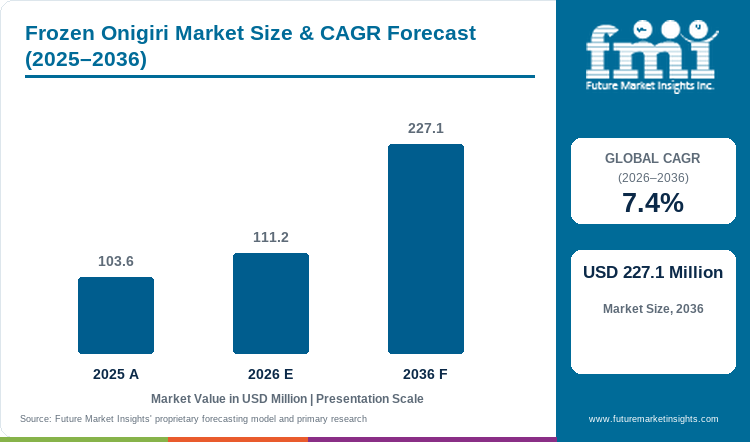
USD 111.2 Million in 2026 and USD 227.1 Million by 2036 at a 7.4% CAGR.
Sales of frozen onigiri are estimated at USD 111.2 Million in 2026 and are forecast to reach USD 227.1 Million by 2036 at a 7.4% CAGR. The market was valued at USD 103.6 Million in 2025. Japan remains the commercial center of the category. The Ministry of Agriculture, Forestry and Fisheries reported 203,969 tons of frozen rice production in 2025, up 2.0% from 2024, while the Japan Frozen Food Association said onigiri moved from 16th to 15th place in its 2025 frozen-food production ranking. That domestic base sits inside a much broader frozen food market, but frozen onigiri has its own economics because each unit is shaped, frozen and reheated as a finished handheld meal.
The next growth layer comes from two different routes. Japanese manufacturers are widening household packs and convenience-store frozen assortments, while exporters are taking Japanese rice balls into overseas specialty and mainstream retail. Lawson expanded frozen onigiri from a 21-store trial in 2023 to about 12,000 stores by November 2025 and later extended sales nationwide. JETRO documented a March 2025 onigiri test at Bristol Farms in California, while another JETRO case shows Noboru exporting frozen onigiri to the USA, Australia, France, Spain, the UK and South Africa. The product therefore overlaps the ready-to-eat food market and the convenience food market, but the frozen format changes shelf life, delivery frequency and food-waste economics.
Rice variety, hydration and freezing speed affect whether an onigiri regains a soft center after reheating. Moisture loss and starch firming can make the grains hard. MAFF's 2025 food feature describes rapid freezing as a way to recover freshly prepared texture. Within the rice-based products market, onigiri adds shaping, portioning and sometimes filling or grilling. It offers a handheld alternative to the bowls and trays common in the frozen cooked ready meals market.
Key Takeaways
- The market is estimated at USD 111.2 Million in 2026 and is forecast to reach USD 227.1 Million by 2036 at a 7.4% CAGR. The 2025 base is USD 103.6 Million, creating USD 115.9 Million of incremental opportunity through 2036.
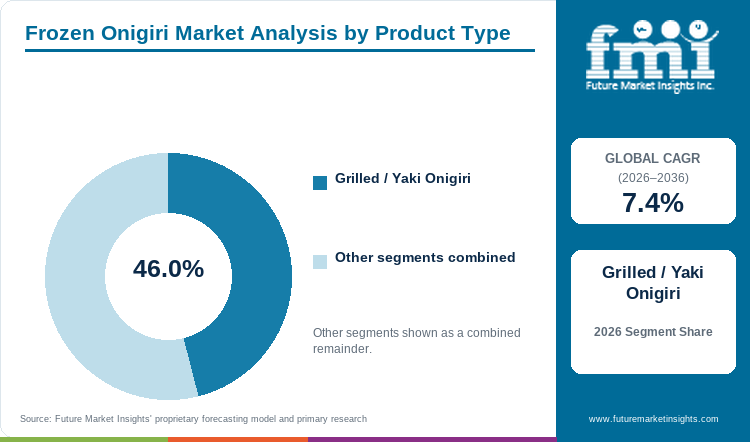
- Grilled / Yaki Onigiri accounts for 46.0% of Product Type demand in 2026 because soy-based glazes and surface grilling create a format that reheats well and does not depend on a chilled filling.
- Multi-piece Family Packs hold 54.0% of Pack Format demand in 2026 because households can heat one or several portions while keeping the remaining pieces frozen.
- Rapid / Blast Freezing represents 67.0% of Freezing Method demand in 2026 because shorter freezing time limits large ice-crystal formation and helps protect cooked-rice texture.
- Household Retail represents 82.0% of End Use demand, while Supermarkets & Hypermarkets account for 48.0% of Sales Channel demand as multipacks remain the core way frozen onigiri reaches consumers.
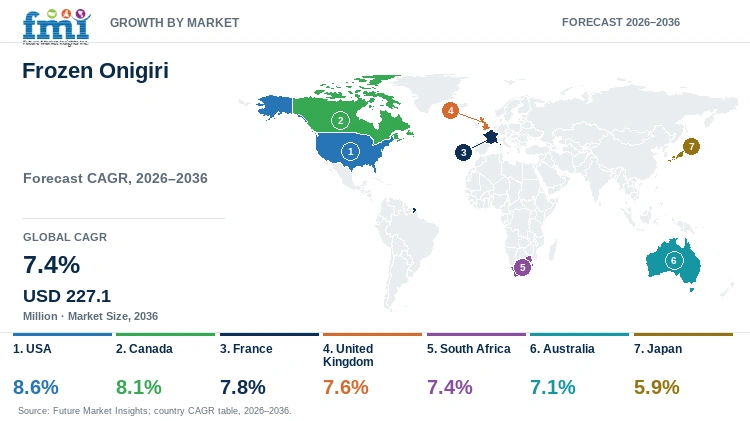
- Country CAGRs range from 8.6% in the USA to 5.9% in Japan from 2026 to 2036. Overseas retail expansion supports newer markets, while Japan grows from a more established frozen-rice base.
Analyst Perspective
Frozen onigiri gives retailers more time to sell a rice product normally associated with same-day consumption. Multipacks let households heat individual portions, while convenience stores can reduce delivery frequency. The benefit depends on the rice recovering its texture. Producers need to test the center as well as the surface after storage and across the heating methods shown on the pack.
- Nandini Roy Choudhury, Principal Consultant, Future Market Insights
How is the Frozen Onigiri Market segmented?
The Frozen Onigiri Market is segmented by Product Type, Pack Format, Freezing Method, End Use, Sales Channel, and Region.
Product Type covers Grilled / Yaki Onigiri, Filled Onigiri, Mixed-Rice / Seasoned Onigiri, and Specialty / Functional Onigiri. Pack Format includes Multi-piece Family Packs, Single-serve Packs, and Foodservice Bulk Packs. Freezing Method is divided into Rapid / Blast Freezing and Conventional Commercial Freezing. End Use covers Household Retail and Foodservice / Institutional demand. Sales Channel includes Supermarkets & Hypermarkets, Convenience Stores, Asian / Specialty Grocery, Online Retail, and Foodservice Distribution. Regional coverage follows North America, Latin America, Western Europe, Eastern Europe, East Asia, South Asia & Pacific, and Middle East & Africa.
Why does Grilled / Yaki Onigiri lead demand within Product Type?
Grilled onigiri turns the rice surface into part of the reheating system. A soy or miso glaze can add aroma after microwave heating, while the browned exterior helps the product feel distinct from plain frozen rice. The format also avoids some of the leakage and filling-distribution problems that come with stuffed rice balls. Nissui has developed its frozen grilled-onigiri line for decades, while Nichirei Foods added an eight-piece grilled onigiri pack in March 2026. Those products show why a familiar, sauce-led format remains the anchor for household frozen demand.
- Grilled / Yaki Onigiri holds 46.0% of Product Type demand in 2026 because surface seasoning survives frozen storage and microwave preparation better than many delicate fillings.
- Nissui continued limited regional-flavor launches in 2025 and 2026, showing how suppliers can refresh a mature grilled format without changing the preparation routine.
Why do Multi-piece Family Packs lead demand within Pack Format?
Frozen onigiri is often bought as a freezer staple rather than for immediate consumption. Multipacks fit that behavior because each rice ball acts as a portion and the consumer can heat only what is needed. The format also spreads outer-pack cost across several units. Nissui markets six-piece and eight-piece formats, while Nichirei offers eight-piece and ten-piece packs. Single-serve packs have more relevance in convenience stores and vending-style channels, but the household multipack remains better suited to planned freezer storage.
- Multi-piece Family Packs account for 54.0% of Pack Format demand in 2026 because portion flexibility is central to the freezer-stock use case.
- Pack counts of six, eight and ten pieces are visible across major Japanese frozen-onigiri lines, giving retailers several price and household-size points.
Why does Rapid / Blast Freezing lead demand within Freezing Method?
Cooked rice is sensitive to slow freezing because water migration and ice-crystal growth can damage texture. Rapid freezing reduces the time spent in the critical crystal-formation range and gives processors a better chance of restoring a soft grain structure after reheating. Noboru describes instant freezing as the basis for reproducing freshly cooked rice after thawing, while Lawson states that rapid freezing is used so its frozen onigiri tastes close to conventional onigiri after heating. The equipment choice therefore influences consumer acceptance directly rather than serving only as a production detail.
- Rapid / Blast Freezing represents 67.0% of Freezing Method demand in 2026 because texture recovery is a primary qualification requirement for commercial frozen rice balls.
- Noboru links quick freezing with longer shelf life and natural-thaw capability, which supports export distribution beyond microwave-only occasions.
Why does Household Retail lead demand within End Use?
The freezer gives households control over timing. Consumers can keep several rice balls at home for breakfast, snacks or light meals without relying on same-day purchase. Japan Frozen Food Association consumer research continues to track grilled onigiri as a commonly used frozen-food category, and its 2026 survey found 12.9% of male respondents saying their use frequency had increased from a year earlier. Foodservice demand exists in cafeterias and institutional settings, but retail packs create more repeat occasions because storage is transferred to the household freezer.
- Household Retail holds 82.0% of End Use demand in 2026 because storage life and portion control are strongest at-home purchase benefits.
- Foodservice / Institutional use remains relevant for standardized portions, but it competes with freshly prepared rice at many Japanese meal-service sites.
Why do Supermarkets & Hypermarkets lead demand within Sales Channel?
Supermarkets combine freezer capacity with enough weekly traffic to support multipack rotation. Consumers can compare onigiri against frozen noodles, fried rice and complete meals in one shopping trip. Convenience stores play a different role. Lawson has shown that frozen onigiri can sit beside fresh convenience food when price, shelf life and delivery efficiency create a separate reason to buy. Asian and specialty grocery remains important overseas because the format still needs explanation in many countries, while online retail supports access where store distribution is thin.
- Supermarkets & Hypermarkets account for 48.0% of Sales Channel demand in 2026 because they can carry multi-SKU frozen rice assortments with regular household replenishment.
- Convenience Stores hold the second structural route in Japan, where Lawson moved frozen onigiri from pilot scale to national coverage between 2023 and 2026.
What are the drivers, restraints and opportunities in the Frozen Onigiri Market?
Longer shelf life and efficient frozen distribution support demand; rice-texture recovery limits weaker products; export and convenience-store expansion create the clearest new revenue routes.
- Driver: Frozen onigiri can be produced in batches, stored for about a year in some retail programs, and delivered less frequently than fresh onigiri, improving availability and reducing write-offs.
- Restraint: Poor freezing or reheating can produce hard rice, uneven centers or wet nori, so a product can lose repeat demand even after successful trial.
- Opportunity: Export-oriented producers can combine Japanese rice positioning with quick freezing to reach specialty grocery, mainstream supermarkets and institutional channels outside Japan.
Shelf-life economics are becoming easier for retailers to see. Lawson said its frozen onigiri can be priced 10% to 20% below comparable fresh onigiri because production can be consolidated and inventory held longer. The chain also said frozen products need one daily delivery rather than two for conventional onigiri. That does not make every frozen rice ball cheaper, but it shows how cold-chain inventory can change store economics when waste and delivery frequency are part of the calculation.
Texture is the central adoption risk. Rice starch firms as it cools, and freezing can amplify the problem when process control is weak. Producers therefore manage rice variety, water absorption, oil or seasoning, freezing rate and microwave instructions as one system. The restraint becomes more visible in export markets because products may face longer storage and wider variation in household microwaves. A supplier that cannot reproduce a soft center after months of storage is unlikely to earn repeat purchase from a mainstream shopper.
The export opening is supported by Japanese rice policy. MAFF reported that commercial rice exports reached JPY 13.88 billion in 2025, up 15.4%, while rice plus packaged rice and processed-rice products reached JPY 15.9 billion, up 17.2%. The ministry specifically identifies frozen rice and onigiri demand development as part of its overseas expansion work. Frozen onigiri can use that infrastructure because the product converts Japanese rice into a longer-life, consumer-ready format rather than shipping only a commodity grain.
Which country CAGRs are profiled in the Frozen Onigiri Market?
| Country | CAGR |
|---|---|
| USA | 8.6% |
| Canada | 8.1% |
| France | 7.8% |
| United Kingdom | 7.6% |
| South Africa | 7.4% |
| Australia | 7.1% |
| Japan | 5.9% |
How do country-level CAGRs compare in the Frozen Onigiri Market?
USA has the highest profiled CAGR at 8.6% from 2026 to 2036, compared with 5.9% in Japan. Japanese demand builds on established grilled-onigiri multipacks and expanding convenience-store frozen ranges. Overseas exporters must first secure freezer distribution and explain preparation. Australia and South Africa add longer transport routes, making shipment size and distributor turnover especially relevant.
- USA at 8.6% benefits from direct retail education. JETRO tested Japanese-rice onigiri at a California premium supermarket in March 2025, while Noboru already lists the USA among its frozen-onigiri export destinations.
- Canada at 8.1% has a local frozen-onigiri proposition through Konscious Foods, whose plant-based onigiri is sold as a keep-frozen product with both Canadian and U.S. nutrition panels.
- France at 7.8% has an established fresh-onigiri audience that can support frozen trial. JETRO reported that Omusubi Gonbei's Paris sales had increased fivefold from its 2017 opening.
- Japan at 5.9% grows from a mature category where product renovation, convenience-store frozen space and household pack sizes matter more than basic awareness.
Country-wise Analysis
- USA: Demand for Frozen Onigiri is forecast to expand at 8.6% CAGR from 2026 to 2036. JETRO used a Bristol Farms store in California for an onigiri test in March 2025, with locally made rice balls using Japanese rice. That event matters because it tested the product in a premium American supermarket rather than only an Asian grocery. Frozen suppliers can use the same consumer familiarity while offering longer shelf life and easier inventory control. Noboru also identifies the USA as an export destination for its frozen onigiri.
- Canada: Demand is forecast to increase at 8.1% CAGR from 2026 to 2036. Konscious Foods sells frozen plant-based onigiri with microwave, hot-water and room-temperature preparation instructions, showing that the product can be localized beyond traditional Japanese fillings. Retailers with frozen Asian meals or plant-based ranges offer relevant shelf placement. Localized flavors can reduce the need to explain unfamiliar fillings while the triangular rice-ball format remains distinct.
- France: Demand is forecast to rise at 7.8% CAGR from 2026 to 2036. JETRO reported that Omusubi Gonbei in Paris had increased sales fivefold since opening in 2017, with 500 to 600 customers on weekdays and about 700 on weekends. Those are fresh onigiri sales, but they show consumer recognition of the meal format. Noboru already exports frozen onigiri to France, giving the frozen category a route that builds on existing familiarity instead of starting from zero.
- United Kingdom: Demand is forecast to expand at 7.6% CAGR from 2026 to 2036. JETRO's May 2025 list of Japanese Food and Ingredient Supporter Stores includes London businesses such as SOSAKU ONIGIRI as well as Japanese retail and e-commerce outlets. That specialist ecosystem gives frozen exporters places to establish repeat demand before moving into wider grocery distribution. Noboru also lists the UK among its current frozen-onigiri export destinations.
- South Africa: Demand is forecast to grow at 7.4% CAGR from 2026 to 2036. Noboru lists the country among its frozen-onigiri export destinations. Importers must manage a long frozen transport route and enough store turnover to avoid slow-moving inventory. Specialty Japanese-food outlets offer a starting point for introducing portion sizes, fillings and preparation methods suited to local shoppers.
- Australia: Demand is forecast to rise at 7.1% CAGR from 2026 to 2036. Noboru includes Australia among the overseas markets for its frozen onigiri. Australia combines established Japanese-food consumption with long domestic distribution distances, so frozen formats can solve a practical availability problem outside major urban fresh-food clusters. Importers still need pack sizes that fit supermarket freezer economics and labeling that makes heating instructions clear.
- Japan: Demand is forecast to increase at 5.9% CAGR from 2026 to 2036. MAFF reported 203,969 tons of frozen rice production in 2025, while the Japan Frozen Food Association said onigiri improved to 15th place in the national frozen-food production ranking. Lawson then expanded frozen onigiri nationally after moving from a 2023 test to thousands of stores in 2025. Japan therefore grows through channel expansion, multipack innovation and product renovation rather than first-time category discovery.
Who are the notable companies in the Frozen Onigiri Market?
Nissui; Nichirei Foods; Ajinomoto Frozen Foods; Mitsuhashi Rice; Noboru; Saga Reito Shokuhin; Konscious Foods; Kyoto Donguri
Competition splits into three groups. Japanese frozen-food companies such as Nissui, Nichirei Foods and Ajinomoto Frozen Foods bring large-scale rice processing and established domestic distribution. Rice specialists such as Mitsuhashi Rice and Noboru compete through rice quality, product variety and freezing know-how. Smaller specialists such as Saga Reito Shokuhin and Kyoto Donguri add regional recipes, while Konscious Foods shows how the format can be localized for North American plant-based retail. The market therefore does not depend on one supplier model.
- Large frozen-food manufacturers compete on production consistency, broad retail access and the ability to refresh a long-running grilled-onigiri line.
- Rice specialists compete more directly on grain quality, filling design and the ability to reproduce freshly cooked texture after thawing or microwave heating.
- Export-focused and regional brands can differentiate through plant-based recipes, local ingredients or natural-thaw formats, but cold-chain cost becomes more important as geographic reach widens.
Competitive Benchmarking: Frozen Onigiri Market
| Company | Rice / Texture Control | Product Breadth | Retail / Channel Reach | Geographic Reach |
|---|---|---|---|---|
| Nissui | High | High | High | Japan with established frozen-food distribution |
| Nichirei Foods | High | Medium | High | Japan with national retail coverage |
| Ajinomoto Frozen Foods | High | Medium | High | Japan retail and foodservice |
| Mitsuhashi Rice | High | High | Medium | Japan with export-facing product information |
| Noboru | High | High | Medium | Japan plus USA, Australia, France, Spain, UK and South Africa |
| Saga Reito Shokuhin | Medium | Medium | Medium | Japan with overseas frozen-meal expansion activity |
| Konscious Foods | Medium | Medium | High | USA and Canada |
| Kyoto Donguri | Medium | Medium | Medium | Japan with retail, events and e-commerce |
Scoring basis: Rice / Texture Control measures documented attention to rice preparation, rapid freezing or reheating quality. Product Breadth measures the range of grilled, filled, mixed-rice or specialty frozen onigiri formats. Retail / Channel Reach reflects documented supermarket, convenience, foodservice, e-commerce or specialty access. High indicates broad documented capability against the criterion. Medium indicates narrower but active coverage. Low indicates a documented limitation.
Key Developments in the Frozen Onigiri Market
- In July 2026, Nissui announced a new 100 g mackerel-and-ginger onigiri for its autumn-winter lineup, alongside a limited Hiroshima oyster-soy grilled onigiri. The launch extends frozen onigiri beyond plain grilled formats into breakfast-sized filled and seasoned rice products.
- In March 2026, Nichirei Foods launched an eight-piece 360 g grilled-onigiri pack focused on a smaller family-friendly portion and repeated soy-sauce glazing for aroma after heating. The product adds another pack-size option to a mature household category.
- In November 2025, Lawson expanded frozen onigiri to about 12,000 stores after earlier 2025 rollouts to roughly 9,800 locations. The chain linked the format with a shelf life of about one year, lower production cost and reduced delivery frequency versus fresh onigiri.
Key Players in the Frozen Onigiri Market
Scaled Japanese Frozen-Food Platforms
- Nissui
- Nichirei Foods
- Ajinomoto Frozen Foods
Rice and Export Specialists
- Mitsuhashi Rice
- Noboru
- Saga Reito Shokuhin
Regional and International Specialists
- Konscious Foods
- Kyoto Donguri
Frozen Onigiri Market - Report Scope
| Coverage field | Report scope |
|---|---|
| Market breakdown | Product Type; Pack Format; Freezing Method; End Use; Sales Channel; Region |
| Quantitative Units | USD Million |
| Market Definition | Revenue from commercially produced Japanese-style rice balls that are shaped before sale, frozen for storage and distribution, and sold for reheating or controlled thawing through retail or foodservice channels. |
| Regions Covered | North America; Latin America; Western Europe; Eastern Europe; East Asia; South Asia & Pacific; Middle East & Africa |
| Countries Covered | USA; Canada; France; United Kingdom; South Africa; Australia; Japan; and more than twenty-five additional countries in the full report |
| Key Companies Profiled | Nissui; Nichirei Foods; Ajinomoto Frozen Foods; Mitsuhashi Rice; Noboru; Saga Reito Shokuhin; Konscious Foods; Kyoto Donguri |
| Forecast Period | 2026 to 2036 |
| Approach | Hybrid bottom-up and top-down sizing that reconciles frozen-rice production, onigiri category evidence, retail rollout, observed pack structures, export activity and channel expansion within the defined revenue boundary. |
Frozen Onigiri Market - Research Methodology
| Method | Approach |
|---|---|
| Primary Research | The research framework is designed to test purchase criteria with frozen-food manufacturers, rice processors, distributors and retail buyers. Quantitative analysis draws on production statistics, company disclosures and retail-channel evidence. |
| Desk Research | Desk research uses MAFF production and export data, Japan Frozen Food Association statistics, JETRO market-development material, first-party product documentation and retailer releases. Evidence is screened for direct relevance to frozen onigiri rather than the wider frozen-rice category. |
| Market Sizing and Forecasting | Sizing triangulates Japan frozen-rice production with the onigiri share of prepared frozen foods, observed product pricing, retail distribution and export evidence. Forecast assumptions reflect domestic channel expansion, overseas adoption, pack-format development and freezing-process improvement. |
| Data Validation | Findings are cross-checked against active product lines, company participation and country routes. Fresh convenience-store onigiri, kimbap, sushi, arancini, plain frozen rice and unrelated frozen meals are kept outside the revenue boundary. |
Frozen Onigiri Market by Segments
Frozen Onigiri Market segmented by Product Type:
- Grilled / Yaki Onigiri
- Filled Onigiri
- Mixed-Rice / Seasoned Onigiri
- Specialty / Functional Onigiri
Frozen Onigiri Market segmented by Pack Format:
- Multi-piece Family Packs
- Single-serve Packs
- Foodservice Bulk Packs
Frozen Onigiri Market segmented by Freezing Method:
- Rapid / Blast Freezing
- Conventional Commercial Freezing
Frozen Onigiri Market segmented by End Use:
- Household Retail
- Foodservice / Institutional
Frozen Onigiri Market segmented by Sales Channel:
- Supermarkets & Hypermarkets
- Convenience Stores
- Asian / Specialty Grocery
- Online Retail
- Foodservice Distribution
Frozen Onigiri Market by Region:
- North America
- United States
- Canada
- Latin America
- Brazil
- Mexico
- Argentina
- Chile
- Western Europe
- Germany
- France
- United Kingdom
- Italy
- Spain
- Benelux
- Nordics
- Eastern Europe
- Poland
- Czech Republic
- Romania
- Hungary
- East Asia
- China
- Japan
- South Korea
- South Asia & Pacific
- India
- ASEAN
- Australia and New Zealand
- Middle East & Africa
- GCC Countries
- South Africa
- Türkiye
- Israel
Research Sources and Bibliography
- Ministry of Agriculture, Forestry and Fisheries, Japan. Main processed-rice production statistics, March 2026.
- Ministry of Agriculture, Forestry and Fisheries, Japan. Promotion of agricultural, forestry and fishery product exports, 2025 results.
- Ministry of Agriculture, Forestry and Fisheries, Japan. Evolution of frozen rice products, November 2025.
- Japan Frozen Food Association. 2025 domestic frozen-food production and consumption statistics, April 2026.
- Japan Frozen Food Association. 2026 Frozen Food Usage Survey, April 2026.
- JETRO. Test marketing of Japanese-rice onigiri at a California premium supermarket, March 2025.
- JETRO. Noboru case study: frozen onigiri export development, 2026.
- JETRO. Omusubi Gonbei, for the love of Japanese rice, accessed 2026.
- JETRO. List of Japanese Food and Ingredient Supporter Stores Overseas, May 2025.
- Lawson. Frozen onigiri expansion to about 9,800 stores, July 2025; expansion to about 12,000 stores, October 2025; nationwide rollout update, 2026.
- Nissui. Frozen grilled-onigiri product and new-product releases, January 2025 to July 2026.
- Nichirei Foods. 2026 spring new-product and renewal announcement, February 2026.
- Mitsuhashi Rice. Frozen rice ball product information, accessed 2026.
- Ajinomoto Frozen Foods. Professional-use grilled onigiri product information, accessed 2026.
- Konscious Foods. Frozen plant-based onigiri product information, accessed 2026.
- Saga Reito Shokuhin. Company profile and frozen-onigiri manufacturing information, accessed 2026.
This Report Answers
- What is the Frozen Onigiri Market size in 2026 and what value is forecast for 2036?
- Why does Grilled / Yaki Onigiri hold the leading Product Type share in 2026?
- How does freezing speed affect rice texture after microwave reheating?
- Why do Multi-piece Family Packs lead Pack Format demand?
- How are convenience stores changing frozen-onigiri distribution in Japan?
- How do growth rates differ across the USA, Canada, France, the United Kingdom, South Africa, Australia and Japan?
- Which companies currently participate in frozen-onigiri production and distribution?
- What should retail buyers evaluate before adding frozen onigiri to a mainstream freezer assortment?
Frequently Asked Questions
How big is the Frozen Onigiri Market in 2026?
The Frozen Onigiri Market is estimated at USD 111.2 Million in 2026 and is forecast to reach USD 227.1 Million by 2036. The market was valued at USD 103.6 Million in 2025.
What is the CAGR of the Frozen Onigiri Market from 2026 to 2036?
The market is forecast to expand at a 7.4% CAGR from 2026 to 2036. Growth reflects domestic Japanese channel expansion together with overseas specialty and mainstream retail development.
Which Product Type leads the Frozen Onigiri Market?
Grilled / Yaki Onigiri is projected to account for 46.0% of Product Type demand in 2026 because sauce-coated rice balls are well established and reheat without relying on a chilled filling.
Which Pack Format leads the Frozen Onigiri Market?
Multi-piece Family Packs are projected to hold 54.0% of Pack Format demand in 2026 because consumers can heat individual portions while keeping the remaining pieces frozen.
How much value will the Frozen Onigiri Market add between 2026 and 2036?
The market is forecast to add USD 115.9 Million between 2026 and 2036 as freezer distribution broadens and export-oriented suppliers reach more countries.
Which companies are active in the Frozen Onigiri Market?
Companies active in the market include Nissui, Nichirei Foods, Ajinomoto Frozen Foods, Mitsuhashi Rice, Noboru, Saga Reito Shokuhin, Konscious Foods and Kyoto Donguri.
Preview the report firsthand - request a free sample
Get SampleGet the brochure for pricing and purchase details.
Get PDFTable of Content
- Key Takeaways
- Market Size and CAGR
- Top Growth Driver
- Fastest Growing Segment
- Leading Region
- Key Companies
- Emerging Opportunities
- Executive Summary
- Global Market Outlook
- Demand-side Trends
- Supply-side Trends
- Technology Roadmap Analysis
- Analysis and Recommendations
- Analyst Perspective (What is happening? Why now? What should investors know?)
- Key Questions Answered
- How large is the market?
- What is the CAGR?
- What are key trends?
- Which region dominates?
- Who are the leaders?
- Market Overview
- Market Coverage / Taxonomy
- Market Definition / Scope / Limitations
- Research Methodology
- Chapter Orientation
- Analytical Lens and Working Hypotheses
- Market Structure, Signals, and Trend Drivers
- Benchmarking and Cross-market Comparability
- Market Sizing, Forecasting, and Opportunity Mapping
- Research Design and Evidence Framework
- Desk Research Programme (Secondary Evidence)
- Expert Input and Fieldwork (Primary Evidence)
- Tooling, Models, and Reference Databases
- Data Engineering and Model Build
- Quality Assurance and Audit Trail
- Market Background
- Market Dynamics (Drivers, Restraints, Opportunity, Trends)
- Scenario Forecast (Optimistic, Likely, Conservative)
- Impact Analysis
- AI Impact
- Sustainability Impact
- Regulatory Impact
- Technology Impact
- Consumer / Buyer Analysis
- Purchase Drivers
- Adoption Barriers
- Buyer Journey
- Opportunity Map Analysis
- Product Life Cycle Analysis
- Supply Chain Analysis
- Investment Feasibility Matrix
- Value Chain Analysis
- PESTLE and Porter's Analysis
- Regulatory Landscape
- Regional Parent Market Outlook
- Production and Consumption Statistics
- Import and Export Statistics
- Global Market Analysis and Forecast, 2021 to 2036
- Historical Market Size Value (USD Million) Analysis, 2021 to 2025
- Current and Future Market Size Value (USD Million) Projections, 2026 to 2036
- Y-o-Y Growth Trend Analysis
- Absolute $ Opportunity Analysis
- Global Market Pricing Analysis, 2021 to 2036
- Global Market Analysis and Forecast, By Product Type, 2021 to 2036
- Introduction / Key Findings
- Historical Market Size Value (USD Million) Analysis By Product Type, 2021 to 2025
- Current and Future Market Size Value (USD Million) Analysis and Forecast By Product Type, 2026 to 2036
- Grilled / Yaki Onigiri
- Filled Onigiri
- Mixed-Rice / Seasoned Onigiri
- Specialty / Functional Onigiri
- Y-o-Y Growth Trend Analysis By Product Type, 2021 to 2025
- Absolute $ Opportunity Analysis By Product Type, 2026 to 2036
- Global Market Analysis and Forecast, By Pack Format, 2021 to 2036
- Introduction / Key Findings
- Historical Market Size Value (USD Million) Analysis By Pack Format, 2021 to 2025
- Current and Future Market Size Value (USD Million) Analysis and Forecast By Pack Format, 2026 to 2036
- Multi-piece Family Packs
- Single-serve Packs
- Foodservice Bulk Packs
- Y-o-Y Growth Trend Analysis By Pack Format, 2021 to 2025
- Absolute $ Opportunity Analysis By Pack Format, 2026 to 2036
- Global Market Analysis and Forecast, By Freezing Method, 2021 to 2036
- Introduction / Key Findings
- Historical Market Size Value (USD Million) Analysis By Freezing Method, 2021 to 2025
- Current and Future Market Size Value (USD Million) Analysis and Forecast By Freezing Method, 2026 to 2036
- Rapid / Blast Freezing
- Conventional Commercial Freezing
- Y-o-Y Growth Trend Analysis By Freezing Method, 2021 to 2025
- Absolute $ Opportunity Analysis By Freezing Method, 2026 to 2036
- Global Market Analysis and Forecast, By End Use, 2021 to 2036
- Introduction / Key Findings
- Historical Market Size Value (USD Million) Analysis By End Use, 2021 to 2025
- Current and Future Market Size Value (USD Million) Analysis and Forecast By End Use, 2026 to 2036
- Household Retail
- Foodservice / Institutional
- Y-o-Y Growth Trend Analysis By End Use, 2021 to 2025
- Absolute $ Opportunity Analysis By End Use, 2026 to 2036
- Global Market Analysis and Forecast, By Sales Channel, 2021 to 2036
- Introduction / Key Findings
- Historical Market Size Value (USD Million) Analysis By Sales Channel, 2021 to 2025
- Current and Future Market Size Value (USD Million) Analysis and Forecast By Sales Channel, 2026 to 2036
- Supermarkets & Hypermarkets
- Convenience Stores
- Asian / Specialty Grocery
- Online Retail
- Foodservice Distribution
- Y-o-Y Growth Trend Analysis By Sales Channel, 2021 to 2025
- Absolute $ Opportunity Analysis By Sales Channel, 2026 to 2036
- Global Market Analysis and Forecast, By Region, 2021 to 2036
- Introduction
- Historical Market Size Value (USD Million) Analysis By Region, 2021 to 2025
- Current Market Size Value (USD Million) Analysis and Forecast By Region, 2026 to 2036
- North America
- Latin America
- Western Europe
- Eastern Europe
- East Asia
- South Asia & Pacific
- Middle East & Africa
- Market Attractiveness Analysis By Region
- North America Market Analysis and Forecast, By Country, 2021 to 2036
- Historical Market Size Value (USD Million) Trend Analysis By Market Taxonomy, 2021 to 2025
- Market Size Value (USD Million) Forecast By Market Taxonomy, 2026 to 2036
- By Country
- United States
- Canada
- By Product Type
- By Pack Format
- By Freezing Method
- By End Use
- By Sales Channel
- By Country
- Market Attractiveness Analysis
- By Country
- By Product Type
- By Pack Format
- By Freezing Method
- By End Use
- By Sales Channel
- Key Takeaways
- Latin America Market Analysis and Forecast, By Country
- Historical Market Size Value (USD Million) Trend Analysis By Market Taxonomy, 2021 to 2025
- Market Size Value (USD Million) Forecast By Market Taxonomy, 2026 to 2036
- By Country
- Brazil
- Mexico
- Argentina
- Chile
- By Product Type
- By Pack Format
- By Freezing Method
- By End Use
- By Sales Channel
- By Country
- Market Attractiveness Analysis
- By Country
- By Product Type
- By Pack Format
- By Freezing Method
- By End Use
- By Sales Channel
- Key Takeaways
- Western Europe Market Analysis and Forecast, By Country
- Historical Market Size Value (USD Million) Trend Analysis By Market Taxonomy, 2021 to 2025
- Market Size Value (USD Million) Forecast By Market Taxonomy, 2026 to 2036
- By Country
- Germany
- France
- United Kingdom
- Italy
- Spain
- Benelux
- Nordics
- By Product Type
- By Pack Format
- By Freezing Method
- By End Use
- By Sales Channel
- By Country
- Market Attractiveness Analysis
- By Country
- By Product Type
- By Pack Format
- By Freezing Method
- By End Use
- By Sales Channel
- Key Takeaways
- Eastern Europe Market Analysis and Forecast, By Country
- Historical Market Size Value (USD Million) Trend Analysis By Market Taxonomy, 2021 to 2025
- Market Size Value (USD Million) Forecast By Market Taxonomy, 2026 to 2036
- By Country
- Poland
- Czech Republic
- Romania
- Hungary
- By Product Type
- By Pack Format
- By Freezing Method
- By End Use
- By Sales Channel
- By Country
- Market Attractiveness Analysis
- By Country
- By Product Type
- By Pack Format
- By Freezing Method
- By End Use
- By Sales Channel
- Key Takeaways
- East Asia Market Analysis and Forecast, By Country
- Historical Market Size Value (USD Million) Trend Analysis By Market Taxonomy, 2021 to 2025
- Market Size Value (USD Million) Forecast By Market Taxonomy, 2026 to 2036
- By Country
- China
- Japan
- South Korea
- By Product Type
- By Pack Format
- By Freezing Method
- By End Use
- By Sales Channel
- By Country
- Market Attractiveness Analysis
- By Country
- By Product Type
- By Pack Format
- By Freezing Method
- By End Use
- By Sales Channel
- Key Takeaways
- South Asia & Pacific Market Analysis and Forecast, By Country
- Historical Market Size Value (USD Million) Trend Analysis By Market Taxonomy, 2021 to 2025
- Market Size Value (USD Million) Forecast By Market Taxonomy, 2026 to 2036
- By Country
- India
- ASEAN
- Australia and New Zealand
- By Product Type
- By Pack Format
- By Freezing Method
- By End Use
- By Sales Channel
- By Country
- Market Attractiveness Analysis
- By Country
- By Product Type
- By Pack Format
- By Freezing Method
- By End Use
- By Sales Channel
- Key Takeaways
- Middle East & Africa Market Analysis and Forecast, By Country
- Historical Market Size Value (USD Million) Trend Analysis By Market Taxonomy, 2021 to 2025
- Market Size Value (USD Million) Forecast By Market Taxonomy, 2026 to 2036
- By Country
- GCC Countries
- South Africa
- Türkiye
- Israel
- By Product Type
- By Pack Format
- By Freezing Method
- By End Use
- By Sales Channel
- By Country
- Market Attractiveness Analysis
- By Country
- By Product Type
- By Pack Format
- By Freezing Method
- By End Use
- By Sales Channel
- Key Takeaways
- Key Countries Market Analysis
- United States
- Pricing Analysis
- Market Share Analysis, 2025
- By Product Type
- By Pack Format
- By Freezing Method
- By End Use
- By Sales Channel
- Canada
- Pricing Analysis
- Market Share Analysis, 2025
- By Product Type
- By Pack Format
- By Freezing Method
- By End Use
- By Sales Channel
- Mexico
- Pricing Analysis
- Market Share Analysis, 2025
- By Product Type
- By Pack Format
- By Freezing Method
- By End Use
- By Sales Channel
- Brazil
- Pricing Analysis
- Market Share Analysis, 2025
- By Product Type
- By Pack Format
- By Freezing Method
- By End Use
- By Sales Channel
- Chile
- Pricing Analysis
- Market Share Analysis, 2025
- By Product Type
- By Pack Format
- By Freezing Method
- By End Use
- By Sales Channel
- Germany
- Pricing Analysis
- Market Share Analysis, 2025
- By Product Type
- By Pack Format
- By Freezing Method
- By End Use
- By Sales Channel
- United Kingdom
- Pricing Analysis
- Market Share Analysis, 2025
- By Product Type
- By Pack Format
- By Freezing Method
- By End Use
- By Sales Channel
- Italy
- Pricing Analysis
- Market Share Analysis, 2025
- By Product Type
- By Pack Format
- By Freezing Method
- By End Use
- By Sales Channel
- Spain
- Pricing Analysis
- Market Share Analysis, 2025
- By Product Type
- By Pack Format
- By Freezing Method
- By End Use
- By Sales Channel
- France
- Pricing Analysis
- Market Share Analysis, 2025
- By Product Type
- By Pack Format
- By Freezing Method
- By End Use
- By Sales Channel
- India
- Pricing Analysis
- Market Share Analysis, 2025
- By Product Type
- By Pack Format
- By Freezing Method
- By End Use
- By Sales Channel
- ASEAN
- Pricing Analysis
- Market Share Analysis, 2025
- By Product Type
- By Pack Format
- By Freezing Method
- By End Use
- By Sales Channel
- Australia and New Zealand
- Pricing Analysis
- Market Share Analysis, 2025
- By Product Type
- By Pack Format
- By Freezing Method
- By End Use
- By Sales Channel
- China
- Pricing Analysis
- Market Share Analysis, 2025
- By Product Type
- By Pack Format
- By Freezing Method
- By End Use
- By Sales Channel
- Japan
- Pricing Analysis
- Market Share Analysis, 2025
- By Product Type
- By Pack Format
- By Freezing Method
- By End Use
- By Sales Channel
- South Korea
- Pricing Analysis
- Market Share Analysis, 2025
- By Product Type
- By Pack Format
- By Freezing Method
- By End Use
- By Sales Channel
- Poland
- Pricing Analysis
- Market Share Analysis, 2025
- By Product Type
- By Pack Format
- By Freezing Method
- By End Use
- By Sales Channel
- Hungary
- Pricing Analysis
- Market Share Analysis, 2025
- By Product Type
- By Pack Format
- By Freezing Method
- By End Use
- By Sales Channel
- Türkiye
- Pricing Analysis
- Market Share Analysis, 2025
- By Product Type
- By Pack Format
- By Freezing Method
- By End Use
- By Sales Channel
- South Africa
- Pricing Analysis
- Market Share Analysis, 2025
- By Product Type
- By Pack Format
- By Freezing Method
- By End Use
- By Sales Channel
- Australia
- Pricing Analysis
- Market Share Analysis, 2025
- By Product Type
- By Pack Format
- By Freezing Method
- By End Use
- By Sales Channel
- United States
- Market Structure Analysis
- Competition Dashboard
- Competition Benchmarking
- Market Share Analysis of Top Players
- By Regional
- By Product Type
- By Pack Format
- By Freezing Method
- By End Use
- By Sales Channel
- Emerging Startups
- Innovation Benchmarking
- Competition Analysis
- Competition Deep Dive
- Nissui
- Overview
- Product Portfolio
- Profitability by Market Segments
- Sales Footprint
- Strategy Overview
- Marketing Strategy
- Product Strategy
- Channel Strategy
- Nichirei Foods
- Ajinomoto Frozen Foods
- Mitsuhashi Rice
- Noboru
- Saga Reito Shokuhin
- Konscious Foods
- Kyoto Donguri
- Nissui
- Case Studies
- Success Stories
- Recent Developments
- Competition Deep Dive
- Assumptions & Acronyms Used


