

- Market Size (2026)
- USD 314.6 Mn
- Forecast (2036)
- USD 724.5 Mn
- CAGR (2026 to 2036)
- 8.7%
How big is Frozen Bagels Market in 2026?
Demand for frozen bagels is projected to expand at 8.7% CAGR between 2026 and 2036. Industry value grows from USD 289.4 million in 2025 to USD 314.6 million in 2026 and is projected to reach USD 724.5 million by 2036.
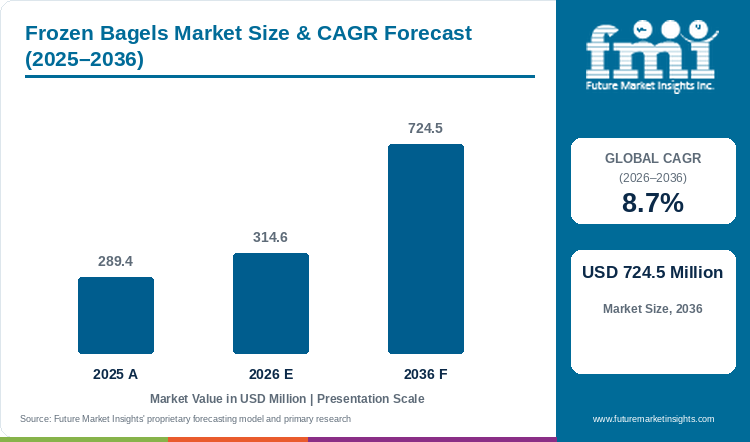
Frozen bagels are prepared bakery products which are stored at low temperature and used after thawing or toasting. As per FMI, global frozen bagels market was valued at USD 289.4 million in 2025 and is estimated at USD 314.6 million in 2026. Sales are projected to reach USD 724.5 million by 2036, expanding at 8.7% CAGR from 2026 to 2036. Plain bagels accounted for 25.0% of product type demand in 2026, as one bagel can be used with sweet toppings, savory fillings and sandwiches. U.S. baked-goods exports reached USD 4.48 billion and 1.51 million metric tons in 2025.[1] The large bakery trade is supporting wider distribution of packaged and frozen bakery products. Europastry listed fully baked frozen bagels with one to two minutes preparation in January 2026.[3] Short preparation is increasing its use among cafes, while Grupo Bimbo reported that 98% of its daily-consumption portfolio met Positive Nutrition criteria in May 2026.[5] Owing to these factors, quick preparation, familiar texture and defined nutrition claims are expected to support frozen bagels market growth.
Key Market Trends & Insights
- Product type: Plain led with 25.0% of demand in 2026, owing to flexible use with sweet toppings, savory fillings and sandwiches.
- Claim or nature: Conventional represented 61.0% in 2026, as familiar taste, wider availability and accessible pricing supports repeat household purchases.
- Format: Fresh held 38.0% in 2026, with immediate consumption and visible texture remaining important at bakery and cafe counters.
- Packaging format: Multipack accounted for 34.0% in 2026. Warburtons promoted four-count Protein Thin Bagels in January 2025, showing how portioned packs can combine household use with a nutrition claim.[6]
- Sales channel: Supermarkets and hypermarkets generated 42.0% in 2026, supported by freezer space, promotions and inventory serving both store and online orders.
Regional Highlights
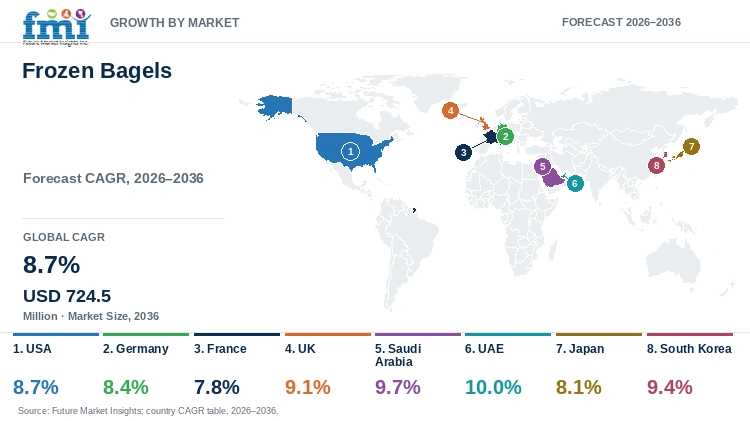
- Fastest-growing profiled country: UAE is projected at 10.0% CAGR from 2026 to 2036.
- By country: Saudi Arabia at 9.7% and South Korea at 9.4% follow, while France records the lowest profiled CAGR at 7.8%.
Market Size & Forecast
Table 1: Market Size and Forecast for the Frozen Bagels Market (USD million and percentage), 2025 to 2036
| Metric | Value |
|---|---|
| 2025 Market Size | USD 289.4 million |
| Estimated Market Size in 2026 | USD 314.6 million |
| Projected Market Size by 2036 | USD 724.5 million |
| CAGR, 2026 to 2036 | 8.7% |
| Added Revenue, 2026 to 2036 | USD 409.9 million |
| Market Expansion Multiple | 2.30x |
Availability through retail and foodservice channels is one of the primary factor deciding regular consumption of frozen bagels, according to FMI. UAE online grocery sales increased by 13% to USD 1.1 billion in 2024, due to which imported frozen bakery packs are becoming available beyond physical freezer displays.[2] Saudi Arabia food retail reached about USD 57 billion in 2025, while foodservice sales reached USD 30 billion and are expected to grow by about 8% annually over the next few years.[18] Smaller multipacks are suitable for digital grocery orders, whereas hotels, restaurants and institutional kitchens requires larger foodservice cases. Germany private label represented 36.2% of grocery sales in 2024, indicating that accessible price remains important in mature grocery markets.[4] Proper thaw performance, clear preparation instruction and dependable frozen delivery is likely to support repeat orders; however, weak cold-chain handling may hamper wider product availability.
Retail and Foodservice Demand Indicators
Frozen bagels are repeatedly purchased when retailers maintain frozen availability and foodservice buyers can prepare products without decline in texture. The indicators below connect bakery trade, online grocery, preparation time and pack development with frozen bagels demand. These figures are not separate market-size estimates; however, they show the operating conditions that are expected to support wider use.
Table 2: Retail and Foodservice Demand Indicators for the Frozen Bagels Market (USD billion, USD million, percentages, metric tons, and preparation time), mixed reporting years from 2024 to 2026
| Indicator | Data Point | Why It Matters | Source |
|---|---|---|---|
| U.S. baked-goods exports | USD 4.48 billion and 1.51 million metric tons in 2025 | Shows a large bakery trade and distribution base for packaged and frozen products | [1] |
| UAE online grocery | USD 1.1 billion in 2024; increased 13% | Digital grocery can widen household access to imported frozen bakery packs | [2] |
| Frozen bagel preparation | One to two minutes in January 2026 catalog | Short preparation supports cafes preparing bagels according to order | [3] |
| Germany private label | 36.2% of grocery sales in 2024 | Indicates price comparison and retailer brands remain important in mature grocery | [4] |
| Positive Nutrition portfolio | 98% of daily-consumption portfolio in May 2026 | Shows nutrition changes are moving into everyday branded bakery products | [5] |
| Saudi food retail and foodservice | USD 57 billion retail and USD 30 billion foodservice in 2025 | Supports separate retail multipacks and larger hospitality cases | [18] |
Basis: Added revenue equals USD 724.5 million less USD 314.6 million. Expansion multiple equals USD 724.5 million divided by USD 314.6 million. Supporting indicators use the reporting year stated by each source and are not components of the market valuation.
Analyst Perspective
“Household buyers will prefer portioned packs that reduce waste and allow use across several breakfast occasions. Foodservice buyers will select short thawing, consistent slicing and texture that remains acceptable after frozen handling.”
- Nandini Roy Choudhury, Principal Consultant, Future Market Insights.
How is the frozen bagels market segmented?
Frozen bagels market is segmented by five primary segments and region: product type, claim or nature, format, packaging format, sales channel, and region. In 2026, plain is projected at 25.0%, conventional at 61.0%, fresh at 38.0%, multipack at 34.0%, and supermarkets and hypermarkets at 42.0%.
By product type: plain, everything, seeded and multigrain, sweet, mini and bagel thins.
By claim or nature: conventional, clean label, organic, gluten-free, high-protein or fortified.
By format: fresh, frozen, ambient packaged, chilled, par-baked or thaw-and-serve.
By packaging format: multipack, single-serve, family pack, bulk foodservice.
By sales channel: supermarkets and hypermarkets, artisan and specialty bakeries, convenience and forecourt, online and direct-to-consumer, foodservice distributors.
By region: North America, Latin America, Western Europe, Eastern Europe, East Asia, South Asia and Pacific, Middle East and Africa.
Why does plain retain a notable product type share?
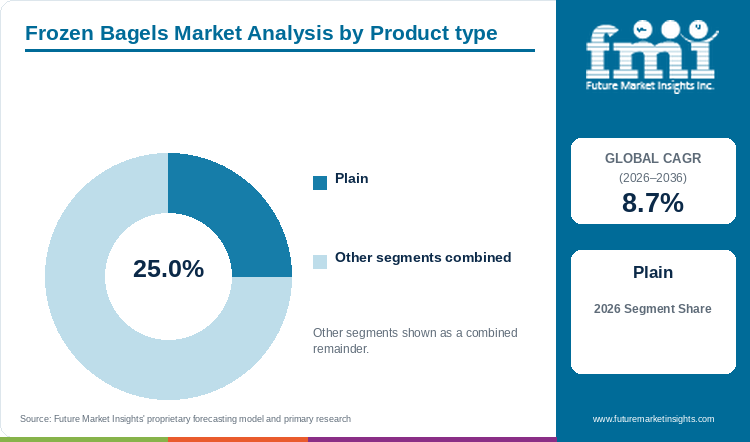
Based on product type, plain is projected to account for 25.0% in 2026, driven by flexible topping and sandwich use.
Table 3: Product Type Share for the Frozen Bagels Market (percentage share), 2026
| Product Type | Share (2026) |
|---|---|
| Plain | 25.0% |
| Other Segments Combined | 75.0%* |
| Total | 100.0% |
*Calculated as the balance remaining after deducting the leading segment's reported share from 100.0%.
Table 4: Product Type Leadership and Market Growth for the Frozen Bagels Market (segment and CAGR percentage), 2026 to 2036
| Metric | Value |
|---|---|
| Global CAGR (2026 to 2036) | 8.7% |
| Leading Segment | Plain |
Plain bagels are commonly used with cream cheese, sweet spreads, eggs, meat fillings and vegetables. Owing to this, one plain bagel product can be used across breakfast, snacks and sandwich preparation. Europastry listed fully baked frozen bagels in its January 2026 catalog with thaw-and-serve preparation of one to two minutes.[3] Short preparation allows cafes to prepare bagels according to order and can reduce unused prepared products. Plain bagels are projected to hold 25.0% of product type demand in 2026, as wider application and easy preparation supports household and foodservice use.
- Plain holds 25.0% of product type demand because one base product covers household breakfast and foodservice sandwich use.
- The 2026 catalog shows supplier support for frozen bagels designed for rapid thawing and low preparation waste.[3]
What supports conventional products within claim or nature?
By claim or nature, conventional is estimated to hold 61.0% in 2026, owing to familiar taste and accessible pricing.
Conventional frozen bagels are prepared with familiar ingredients and are widely available through supermarkets, bakery brands and private-label ranges. These products are generally priced lower as compared to organic, gluten-free and high-protein bagels, due to which conventional products are purchased by a larger consumer group. Private-label products represented 36.2% of grocery sales in Germany during 2024, showing acceptance of price competitive grocery products.[4] Conventional products to hold 61.0% of claim or nature demand in 2026. Availability at accessible price is expected to support repeat household consumption.
- Conventional products are estimated to hold 61.0% of claim or nature demand in 2026. Familiar taste and accessible pricing support purchasing across mainstream retail channels.
- Germany’s private-label share shows why added claims must justify a visible price or use benefit.[4]
How does fresh format meet immediate eating needs?
In 2026, fresh is expected to lead format with 38.0% share, supported by texture cues at purchase and preparation.
Fresh bagels are prepared for immediate consumption and allows consumers to check appearance, softness and surface finish at the time of purchase. Fresh format does not require thawing, due to which it is highly used across bakeries, cafes and in-store bakery counters. In May 2026, Grupo Bimbo reported that 98% of its daily-consumption portfolio, including savory bagels, met Positive Nutrition criteria.[5] Fresh format will hold 38.0% share in 2026, as immediate eating quality and bakery availability supports its demand.
- Fresh is expected to represent 38.0% of format demand because immediate texture remains visible during purchase and preparation.
- Grupo Bimbo reported in May 2026 that 98% of its daily-consumption portfolio, including savory bagels, met Positive Nutrition criteria.[5]
Why are buyers selecting multipacks for household use?
Multipack is likely to capture 34.0% share in 2026, aided by repeat breakfast occasions and manageable household portioning.
Multipack frozen bagels contains several bagels in one pack and allows households to consume required units while storing remaining products for later use. Such packs are suitable for repeated breakfast and snack occasions and reduces the need for purchasing separate bagels. In January 2025, Warburtons promoted four-count Protein Thin Bagels, combining household pack size with a protein claim.[6] Multipack is likely to capture 34.0% of packaging demand in 2026, as portioned packs support planned household consumption without requiring bulk storage.
- Multipack holds 34.0% of packaging demand because households can divide use over several days.
- Four-count packs show how suppliers connect portion control with repeat home consumption.[6]
Which conditions support supermarkets and hypermarkets?
Supermarkets and hypermarkets are projected to hold 42.0% share in 2026, enabled by wider product availability and physical and online retail availability.
Supermarkets and hypermarkets offers fresh, frozen, ambient and chilled bagels under one retail channel. These stores have freezer space, wider brand assortment and promotional pricing, due to which consumers can compare pack size, claims and price before purchasing. UAE online grocery sales reached USD 1.1 billion in 2024 after increasing by 13%.[2] Large retailers can use the same inventory for stores and online orders, which expands frozen bagel availability beyond store visits. Supermarkets and hypermarkets are projected to hold 42.0% sales channel share in 2026 owing to freezer facilities and online fulfillment.
- Supermarkets and hypermarkets hold 42.0% because freezer space, promotions, and online fulfillment sit in one system.
- Digital grocery growth raises the value of retailers that can replenish physical and online orders from shared inventory.[2]
What are the drivers, restraints, and opportunities in the frozen bagels market?
In the frozen bagels market, the key driver is meal convenience, the key restraint is cold-chain cost, and the key opportunity is claim-led format design.
- Driver: Bagels cover breakfast, snack, and light-meal occasions with limited preparation.
- Restraint: Freezer space, transport, and thaw-quality risk can favor fresh or ambient substitutes.
- Opportunity: Nutrition, clean-label, and portion-controlled products can open new retail and foodservice uses.
Convenience Supports More Eating Occasions
Foods that can be prepared in short time are gaining demand across breakfast, snack and light-meal occasions. Frozen bagels can be used with sweet as well as savory fillings and allows consumers to prepare one portion at a time. South Korea retail industry linked the growth of small households with minimum-quantity shopping and increasing purchase through convenience stores and online channels in 2025.[8] Remaining products can be stored for another eating occasion, due to which frozen bagels can lower household waste. An FMI analyst notes that easy preparation and portion use is anticipated to support the frozen bagels market growth.
Cold Handling Raises Delivered Cost
The high cost associated with frozen storage and transportation is one of the primary factor restraining frozen bagels market. Frozen bagels requires stable temperature from production to retail in order to avoid moisture loss, freezer damage and decline in eating quality. Japan recorded USD 193 billion in food retail sales during 2024 and consumers showed increasing demand for easy-to-prepare frozen foods.[9] However, limited freezer space and higher electricity and delivery requirement increases costs as compared to fresh and ambient bakery products. Higher delivered cost and improper thawing performance may hamper the growth of frozen bagels market.
Claims Create Defined Product Roles
Clean label, high-protein and portion-controlled bagels are gaining demand among consumers looking for defined nutrition and ingredient claims. In June 2026, Grupo Bimbo reported that its daily-consumption portfolio, including bagels, had remained free from artificial colors since 2024 and 99% of products contained no artificial flavors.[10] Manufacturers are developing bagels with simpler ingredients, protein fortification and smaller portion size in order to cater the growing demand. However, claim-based frozen bagels also requires acceptable taste, price and texture after thawing. Products combining nutrition claims with familiar eating quality are expected to create growth opportunities for frozen bagel manufacturers.
Which country CAGRs are profiled in the frozen bagels market?
Table 5: Country CAGR Comparison for the Frozen Bagels Market (CAGR percentage), 2026 to 2036
| Country | CAGR |
|---|---|
| USA | 8.7% |
| Germany | 8.4% |
| France | 7.8% |
| UK | 9.1% |
| Saudi Arabia | 9.7% |
| UAE | 10.0% |
| Japan | 8.1% |
| South Korea | 9.4% |
How do country-level CAGRs compare in the frozen bagels market?
Frozen bagels demand differs across countries owing to variations in grocery distribution, imported food availability, household size and foodservice use. In the FMI report, mature retail countries have wider bakery distribution, whereas Gulf countries are witnessing increasing demand through imported foods, hospitality and online grocery.
- USA demand benefits from broad grocery distribution, foodservice use, and a large baked-goods trade base.
- Germany combines a large grocery system with private-label purchasing and close price comparison.
- France links bakery demand with distributor brands, packaging rules, and established hypermarket channels.
- UK demand is supported by online grocery, branded thins, and nutrition-led product development.
- Saudi Arabia combines imported-food reliance with expanding retail and hospitality demand.
- UAE demand moves through hypermarkets, digital grocery, and a diverse imported-food assortment.
- Japan requires compact packs and dependable frozen handling within dense convenience networks.
- South Korea favors small packs, mobile commerce, and convenience-store replenishment.
Full report country CAGRs cover: North America; Latin America; Western Europe; Eastern Europe; East Asia; South Asia and Pacific; Middle East and Africa.
Country-wise Analysis
- By 2036, USA is projected to grow at 8.7% CAGR, supported by its large packaged bakery and foodservice network. USDA reported USD 4.48 billion in baked-goods exports during 2025, of which Canada accounted for USD 2.8 billion.[1] FMI research indicates that availability of national retail routes and foodservice distributors is supporting frozen bagel listings. Products retaining texture after frozen storage and toasting are expected to support the USA frozen bagels market growth.
- Germany frozen bagels market is anticipated to advance at 8.4% CAGR over the assessment period. Grocery sales reached about USD 293 billion and private label represented 36.2% during 2024.[4] High private-label purchasing gives frozen bagels wider retail access, but manufacturers requires competitive pricing for premium claims. Availability of retailer-ready multipacks is likely to fuel the market growth in Germany.
- Frozen bagel demand in France is forecast to rise at 7.8% CAGR over the forecast period. Around 70% of French food retail sales moved through hypermarkets, supermarkets and discount stores during 2024.[11] Presence of large grocery channels supports national distribution of frozen bakery products. Recyclable packaging with proper moisture protection is expected to remain important for suppliers entering the France frozen bagels market.[11]
- Adoption of frozen bagels in UK is estimated to expand at 9.1% CAGR through 2036. Warburtons promoted four-count Protein Thin Bagels in January 2025, developing a portioned retail product with a protein claim.[6] In early 2026, private label reached 52.2% of UK grocery spending, showing strong demand for accessible bakery lines.[7] Branded thin bagels can be used for breakfast and sandwich occasions and are suitable for online grocery packs. Expansion of nutrition-led products is anticipated to support the UK frozen bagels market growth.
- Saudi Arabia frozen bagels market is projected to record 9.7% CAGR during the assessment period. Food retail exceeded USD 50 billion in 2024 and imported products supplied around 70% of food demand.[12] Imported frozen bagels are increasingly supplied through large retailers, hotels and foodservice distributors. Expansion of hospitality and reliable cold-chain distribution is likely to propel the frozen bagels market growth in Saudi Arabia.[12]
- In UAE, frozen bagel demand is predicted to advance at 10.0% CAGR through 2036. Online grocery sales reached USD 1.1 billion in 2024 after increasing by 13%.[2] Digital ordering is widening the availability of imported bakery products beyond physical freezer displays. Increasing use of small retail packs and separate foodservice cases is expected to drive frozen bagel sales in UAE.
- Japan is estimated to post 8.1% CAGR over the forecast period. Food retail sales were valued at USD 193 billion during 2024 and consumers showed increasing demand for easy-to-prepare frozen foods.[9] Compact packs and clear thawing instructions are suitable for dense convenience and grocery networks. Dependable frozen handling and texture protection is anticipated to support the frozen bagels market in Japan.
- Frozen bagel sales in South Korea are forecast to expand at 9.4% CAGR by 2036. Convenience stores remained a major grocery route in 2025, while small households supported minimum-quantity purchasing.[8] Single-serve, mini and thin bagels can fit this consumption pattern and requires less household storage. FMI data suggests growing mobile commerce and compact packaging is expected to create growth opportunities in South Korea.
Who are the notable companies in the frozen bagels market?
Grupo Bimbo, Flowers Foods, ARYZTA, Lantmannen Unibake, Vandemoortele, Yamazaki Baking, Warburtons, Europastry, King’s Hawaiian, and St Pierre Groupe are notable companies profiled in this market.
Frozen bagels market is moderately fragmented with the presence of branded bakery manufacturers and frozen bakery specialists. Grupo Bimbo, Flowers Foods, Warburtons and Yamazaki Baking are offering products through established retail bakery channels. ARYZTA, Lantmannen Unibake, Vandemoortele and Europastry are engaged in frozen, bake-off and thaw-and-serve bakery products. Apart from that, King’s Hawaiian and St Pierre Groupe have presence in premium packaged bakery products. Some of the prominent players are focusing on product development, production capacity and foodservice distribution in order to increase market share and customer base.
- Retail bakery companies: Grupo Bimbo, Flowers Foods, Warburtons, and Yamazaki Baking connect branded products with established grocery distribution.
- Frozen bakery specialists: ARYZTA, Lantmannen Unibake, Vandemoortele, and Europastry supply frozen, bake-off, or thaw-and-serve formats.
- Premium bakery companies: King’s Hawaiian and St Pierre Groupe bring adjacent branded-bakery access where bagel-specific evidence is narrower.
Competitive Benchmarking: Frozen Bagels Market
Table 6: Competitive Benchmarking for the Frozen Bagels Market (qualitative capability ratings), 2026
| Company | Bagel depth | Frozen capability | Channel access | Reach |
|---|---|---|---|---|
| Grupo Bimbo | High | Medium | High | High |
| Flowers Foods | High | Medium | High | Medium |
| ARYZTA | Medium | High | High | High |
| Lantmannen Unibake | High | High | High | High |
| Vandemoortele | Medium | High | High | High |
| Yamazaki Baking | Medium | Medium | High | Medium |
| Warburtons | High | Low | High | Medium |
| Europastry | High | High | High | High |
| King’s Hawaiian | Low | Low | Medium | Medium |
| St Pierre Groupe | Low | Low | Medium | Medium |
High indicates broad current evidence, Medium indicates narrower evidence, and Low indicates limited available public information. Ratings describe public capability, not product quality or market share.
Key Developments in the Frozen Bagels Market
- In August 2026, ARYZTA opened a new Perth bakery to expand local convenience-bakery capacity and shorten supply routes.[13]
- In June 2026, Grupo Bimbo reported that its daily-consumption portfolio, including bagels, was free from artificial colors.[10]
- In June 2026, ARYZTA acquired a French distribution business, extending local customer access for bakery products.[13]
- In January 2026, Europastry published a United States catalog containing frozen fully baked bagels with thaw-and-serve preparation.[3]
Key Players in the Frozen Bagels Market
Retail bakery and bagel brand companies
- Grupo Bimbo
- Flowers Foods
- Warburtons
- Yamazaki Baking
Frozen and bake-off bakery specialists
- ARYZTA
- Lantmannen Unibake
- Vandemoortele
- Europastry
Premium bakery products companies
- King’s Hawaiian
- St Pierre Groupe
Frozen Bagels Market - Report Scope
Table 7: Report Scope for the Frozen Bagels Market (coverage fields and definitions), 2026 to 2036
| Coverage field | Report scope |
|---|---|
| Market breakdown | Product type; claim or nature; format; packaging format; sales channel. |
| Quantitative units | USD million. |
| Market definition | Supplier revenue from standalone bagels sold through the defined product, format, package, and channel universe. Prepared sandwiches, spreads, and adjacent bakery products are excluded. |
| Regions covered | North America; Latin America; Western Europe; Eastern Europe; East Asia; South Asia and Pacific; Middle East and Africa. |
| Countries covered | USA; Germany; France; UK; Saudi Arabia; UAE; Japan; South Korea; and additional countries in the full report. |
| Forecast period | 2026 to 2036. |
| Approach | The Future Market Insights report covers supplier activity, segment structure, distribution routes, and country adoption conditions within the stated boundary. |
Frozen Bagels Market - Research Methodology
Table 8: Research Methodology for the Frozen Bagels Market (research methods and approach), 2026 edition
| Method | Approach |
|---|---|
| Primary Research | The research study includes primary interviews with manufacturers, distributors, foodservice buyers, retailers, end users and industry experts. Interviews covers purchasing decision, product evaluation, pricing, adoption barriers, approval requirement and support expected before regular purchasing. |
| Desk Research | Desk research covers government statistics, regulatory publications, trade information, industry associations, company reports, product catalogs and official company announcements. Sources are reviewed for publication date, geographic relevance and direct connection with frozen bagels market. |
| Market Sizing and Forecasting | Market sizing combines base value, historical performance, segment structure, prices, volume indicators, company participation and country demand. Forecasting considers retail expansion, foodservice use, frozen distribution, product development and barriers affecting wider adoption. |
| Data Validation | Market estimates are checked with government data, company activity, trade patterns and primary interviews. Products and company revenue are included only when they fall within the defined frozen bagels market. Adjacent bakery products and unsupported claims are excluded. |
Segment shares and forecast estimates are proprietary analytical estimates. They are not government statistics or direct measurements of global market share.
Frozen Bagels Market by Segments
Product type
- Plain
- Everything
- Seeded and multigrain
- Sweet
- Mini and bagel thins
Claim or nature
- Conventional
- Clean label
- Organic
- Gluten-free
- High-protein or fortified
Format
- Fresh
- Frozen
- Ambient packaged
- Chilled
- Par-baked or thaw-and-serve
Packaging format
- Multipack
- Single-serve
- Family pack
- Bulk foodservice
Sales channel
- Supermarkets and hypermarkets
- Artisan and specialty bakeries
- Convenience and forecourt
- Online and direct-to-consumer
- Foodservice distributors
Frozen Bagels Market by Region
- North America
- United States
- Canada
- Latin America
- Brazil
- Mexico
- Argentina
- Chile
- Western Europe
- Germany
- France
- United Kingdom
- Italy
- Spain
- Benelux
- Nordics
- Eastern Europe
- Poland
- Czech Republic
- Romania
- Hungary
- East Asia
- Japan
- South Korea
- South Asia and Pacific
- ASEAN
- Australia and New Zealand
- Middle East and Africa
- GCC Countries
- South Africa
- Türkiye
- Israel
Research Sources and Bibliography
- [1] U.S. Department of Agriculture, Foreign Agricultural Service. (2026, May 13). Baked goods.
- [2] U.S. Department of Agriculture, Foreign Agricultural Service. (2025, December 30). United Arab Emirates: Retail foods annual.
- [3] Europastry. (2026, January). Product catalog.
- [4] U.S. Department of Agriculture, Foreign Agricultural Service. (2025, September 24). Germany: Retail foods annual.
- [5] Grupo Bimbo. (2026, May 12). We achieved Positive Nutrition across 98% of our daily consumption portfolio.
- [6] Warburtons. (2025, January 29). Get Snack-tive: Warburtons combines fitness and flavour with its debut athleisure range.
- [7] U.S. Department of Agriculture, Foreign Agricultural Service. (2026, October 1). United Kingdom: Retail foods annual.
- [8] U.S. Department of Agriculture, Foreign Agricultural Service. (2025, November 19). South Korea: Retail foods annual.
- [9] U.S. Department of Agriculture, Foreign Agricultural Service. (2025, November 19). Japan: Retail foods annual.
- [10] Grupo Bimbo. (2026, June 10). Portfolio free from artificial colors.
- [11] U.S. Department of Agriculture, Foreign Agricultural Service. (2025, November 19). France: Retail foods annual.
- [12] U.S. Department of Agriculture, Foreign Agricultural Service. (2025, September 24). Saudi Arabia: Retail foods annual.
- [13] ARYZTA AG. (2026). News and reporting archive.
- [14] Flowers Foods. (2025, February 21). Flowers Foods, Inc. completes acquisition of Simple Mills.
- [15] Grupo Bimbo. (2025, July 29). We are committed to removing artificial colorants from all our products by the end of 2026.
- [16] ARYZTA AG. (2026, January 22). Full year 2025 targets achieved; revenue growth and improved performance expected in 2026; new bakery in Portugal.
- [17] Vandemoortele NV. (2026, March 30). Vandemoortele makes transformative acquisitions and delivers solid performance in 2025.
- [18] U.S. Department of Agriculture, Foreign Agricultural Service. (2026, August 31). Saudi Arabia: Retail foods annual.
This bibliography is provided for reader reference. The full report contains the complete reference list and detailed citations.
This Report Answers
- What is Frozen Bagels Market worth during 2026?
- What value is Frozen Bagels Market projected by 2036?
- Which product type holds notable Frozen Bagels Market share?
- Which claim or nature holds notable Frozen Bagels Market share?
- Which countries show notable Frozen Bagels Market growth?
- Which companies are notable in Frozen Bagels Market today?
Frequently Asked Questions
How big is the Frozen Bagels Market in 2026?
The frozen bagels market is valued at USD 314.6 million in 2026 and is projected to reach USD 724.5 million by 2036.
What CAGR is projected for the Frozen Bagels Market through 2036?
As per FMI, the frozen bagels market is projected to expand at 8.7% CAGR from 2026 to 2036.
Which product type holds a notable share in 2026?
Plain bagels are projected to hold 25.0% of product type demand in 2026 because they support sweet and savory uses.
Which claim or nature leads demand in 2026?
FMI finds that conventional products will hold 61.0% of claim or nature demand in 2026 due to familiar taste and price accessibility.
Which country has a notable frozen bagels expansion outlook?
UAE frozen bagel demand is predicted to expand at 10.0% CAGR from 2026 to 2036, supported by imported-food demand and digital grocery expansion.
Which companies are active in the Frozen Bagels Market?
Notable companies include Grupo Bimbo, Flowers Foods, ARYZTA, Lantmannen Unibake, Vandemoortele, Yamazaki Baking, Warburtons, and Europastry.
Preview the report firsthand - request a free sample
Get SampleGet the brochure for pricing and purchase details.
Get PDFTable of Content
- Key Takeaways
- Market Size and CAGR
- Top Growth Driver
- Fastest Growing Segment
- Leading Region
- Key Companies
- Emerging Opportunities
- Executive Summary
- Global Market Outlook
- Demand-side Trends
- Supply-side Trends
- Technology Roadmap Analysis
- Analysis and Recommendations
- Analyst Perspective (What is happening? Why now? What should investors know?)
- Key Questions Answered
- How large is the market?
- What is the CAGR?
- What are key trends?
- Which region dominates?
- Who are the leaders?
- Market Overview
- Market Coverage / Taxonomy
- Market Definition / Scope / Limitations
- Research Methodology
- Chapter Orientation
- Analytical Lens and Working Hypotheses
- Market Structure, Signals, and Trend Drivers
- Benchmarking and Cross-market Comparability
- Market Sizing, Forecasting, and Opportunity Mapping
- Research Design and Evidence Framework
- Desk Research Programme (Secondary Evidence)
- Expert Input and Fieldwork (Primary Evidence)
- Tooling, Models, and Reference Databases
- Data Engineering and Model Build
- Quality Assurance and Audit Trail
- Market Background
- Market Dynamics (Drivers, Restraints, Opportunity, Trends)
- Scenario Forecast (Optimistic, Likely, Conservative)
- Impact Analysis
- AI Impact
- Sustainability Impact
- Regulatory Impact
- Technology Impact
- Consumer / Buyer Analysis
- Purchase Drivers
- Adoption Barriers
- Buyer Journey
- Opportunity Map Analysis
- Product Life Cycle Analysis
- Supply Chain Analysis
- Investment Feasibility Matrix
- Value Chain Analysis
- PESTLE and Porter's Analysis
- Regulatory Landscape
- Regional Parent Market Outlook
- Production and Consumption Statistics
- Import and Export Statistics
- Global Market Analysis and Forecast, 2021 to 2036
- Historical Market Size Value (USD Million) Analysis, 2021 to 2025
- Current and Future Market Size Value (USD Million) Projections, 2026 to 2036
- Y-o-Y Growth Trend Analysis
- Absolute $ Opportunity Analysis
- Global Market Pricing Analysis, 2021 to 2036
- Global Market Analysis and Forecast, By Product type, 2021 to 2036
- Introduction / Key Findings
- Historical Market Size Value (USD Million) Analysis By Product type, 2021 to 2025
- Current and Future Market Size Value (USD Million) Analysis and Forecast By Product type, 2026 to 2036
- Plain
- Everything
- Seeded and multigrain
- Sweet
- Mini and bagel thins
- Y-o-Y Growth Trend Analysis By Product type, 2021 to 2025
- Absolute $ Opportunity Analysis By Product type, 2026 to 2036
- Global Market Analysis and Forecast, By Claim or nature, 2021 to 2036
- Introduction / Key Findings
- Historical Market Size Value (USD Million) Analysis By Claim or nature, 2021 to 2025
- Current and Future Market Size Value (USD Million) Analysis and Forecast By Claim or nature, 2026 to 2036
- Conventional
- Clean label
- Organic
- Gluten-free
- High-protein or fortified
- Y-o-Y Growth Trend Analysis By Claim or nature, 2021 to 2025
- Absolute $ Opportunity Analysis By Claim or nature, 2026 to 2036
- Global Market Analysis and Forecast, By Format, 2021 to 2036
- Introduction / Key Findings
- Historical Market Size Value (USD Million) Analysis By Format, 2021 to 2025
- Current and Future Market Size Value (USD Million) Analysis and Forecast By Format, 2026 to 2036
- Fresh
- Frozen
- Ambient packaged
- Chilled
- Par-baked or thaw-and-serve
- Y-o-Y Growth Trend Analysis By Format, 2021 to 2025
- Absolute $ Opportunity Analysis By Format, 2026 to 2036
- Global Market Analysis and Forecast, By Packaging format, 2021 to 2036
- Introduction / Key Findings
- Historical Market Size Value (USD Million) Analysis By Packaging format, 2021 to 2025
- Current and Future Market Size Value (USD Million) Analysis and Forecast By Packaging format, 2026 to 2036
- Multipack
- Single-serve
- Family pack
- Bulk foodservice
- Y-o-Y Growth Trend Analysis By Packaging format, 2021 to 2025
- Absolute $ Opportunity Analysis By Packaging format, 2026 to 2036
- Global Market Analysis and Forecast, By Sales channel, 2021 to 2036
- Introduction / Key Findings
- Historical Market Size Value (USD Million) Analysis By Sales channel, 2021 to 2025
- Current and Future Market Size Value (USD Million) Analysis and Forecast By Sales channel, 2026 to 2036
- Supermarkets and hypermarkets
- Artisan and specialty bakeries
- Convenience and forecourt
- Online and direct-to-consumer
- Foodservice distributors
- Y-o-Y Growth Trend Analysis By Sales channel, 2021 to 2025
- Absolute $ Opportunity Analysis By Sales channel, 2026 to 2036
- Global Market Analysis and Forecast, By Region, 2021 to 2036
- Introduction
- Historical Market Size Value (USD Million) Analysis By Region, 2021 to 2025
- Current Market Size Value (USD Million) Analysis and Forecast By Region, 2026 to 2036
- North America
- Latin America
- Western Europe
- Eastern Europe
- East Asia
- South Asia and Pacific
- Middle East and Africa
- Market Attractiveness Analysis By Region
- North America Market Analysis and Forecast, By Country, 2021 to 2036
- Historical Market Size Value (USD Million) Trend Analysis By Market Taxonomy, 2021 to 2025
- Market Size Value (USD Million) Forecast By Market Taxonomy, 2026 to 2036
- By Country
- United States
- Canada
- By Product type
- By Claim or nature
- By Format
- By Packaging format
- By Sales channel
- By Country
- Market Attractiveness Analysis
- By Country
- By Product type
- By Claim or nature
- By Format
- By Packaging format
- By Sales channel
- Key Takeaways
- Latin America Market Analysis and Forecast, By Country
- Historical Market Size Value (USD Million) Trend Analysis By Market Taxonomy, 2021 to 2025
- Market Size Value (USD Million) Forecast By Market Taxonomy, 2026 to 2036
- By Country
- Brazil
- Mexico
- Argentina
- Chile
- By Product type
- By Claim or nature
- By Format
- By Packaging format
- By Sales channel
- By Country
- Market Attractiveness Analysis
- By Country
- By Product type
- By Claim or nature
- By Format
- By Packaging format
- By Sales channel
- Key Takeaways
- Western Europe Market Analysis and Forecast, By Country
- Historical Market Size Value (USD Million) Trend Analysis By Market Taxonomy, 2021 to 2025
- Market Size Value (USD Million) Forecast By Market Taxonomy, 2026 to 2036
- By Country
- Germany
- France
- United Kingdom
- Italy
- Spain
- Benelux
- Nordics
- By Product type
- By Claim or nature
- By Format
- By Packaging format
- By Sales channel
- By Country
- Market Attractiveness Analysis
- By Country
- By Product type
- By Claim or nature
- By Format
- By Packaging format
- By Sales channel
- Key Takeaways
- Eastern Europe Market Analysis and Forecast, By Country
- Historical Market Size Value (USD Million) Trend Analysis By Market Taxonomy, 2021 to 2025
- Market Size Value (USD Million) Forecast By Market Taxonomy, 2026 to 2036
- By Country
- Poland
- Czech Republic
- Romania
- Hungary
- By Product type
- By Claim or nature
- By Format
- By Packaging format
- By Sales channel
- By Country
- Market Attractiveness Analysis
- By Country
- By Product type
- By Claim or nature
- By Format
- By Packaging format
- By Sales channel
- Key Takeaways
- East Asia Market Analysis and Forecast, By Country
- Historical Market Size Value (USD Million) Trend Analysis By Market Taxonomy, 2021 to 2025
- Market Size Value (USD Million) Forecast By Market Taxonomy, 2026 to 2036
- By Country
- Japan
- South Korea
- By Product type
- By Claim or nature
- By Format
- By Packaging format
- By Sales channel
- By Country
- Market Attractiveness Analysis
- By Country
- By Product type
- By Claim or nature
- By Format
- By Packaging format
- By Sales channel
- Key Takeaways
- South Asia and Pacific Market Analysis and Forecast, By Country
- Historical Market Size Value (USD Million) Trend Analysis By Market Taxonomy, 2021 to 2025
- Market Size Value (USD Million) Forecast By Market Taxonomy, 2026 to 2036
- By Country
- ASEAN
- Australia and New Zealand
- By Product type
- By Claim or nature
- By Format
- By Packaging format
- By Sales channel
- By Country
- Market Attractiveness Analysis
- By Country
- By Product type
- By Claim or nature
- By Format
- By Packaging format
- By Sales channel
- Key Takeaways
- Middle East and Africa Market Analysis and Forecast, By Country
- Historical Market Size Value (USD Million) Trend Analysis By Market Taxonomy, 2021 to 2025
- Market Size Value (USD Million) Forecast By Market Taxonomy, 2026 to 2036
- By Country
- GCC Countries
- South Africa
- Türkiye
- Israel
- By Product type
- By Claim or nature
- By Format
- By Packaging format
- By Sales channel
- By Country
- Market Attractiveness Analysis
- By Country
- By Product type
- By Claim or nature
- By Format
- By Packaging format
- By Sales channel
- Key Takeaways
- Key Countries Market Analysis
- United States
- Pricing Analysis
- Market Share Analysis, 2025
- By Product type
- By Claim or nature
- By Format
- By Packaging format
- By Sales channel
- Canada
- Pricing Analysis
- Market Share Analysis, 2025
- By Product type
- By Claim or nature
- By Format
- By Packaging format
- By Sales channel
- Mexico
- Pricing Analysis
- Market Share Analysis, 2025
- By Product type
- By Claim or nature
- By Format
- By Packaging format
- By Sales channel
- Brazil
- Pricing Analysis
- Market Share Analysis, 2025
- By Product type
- By Claim or nature
- By Format
- By Packaging format
- By Sales channel
- Chile
- Pricing Analysis
- Market Share Analysis, 2025
- By Product type
- By Claim or nature
- By Format
- By Packaging format
- By Sales channel
- Germany
- Pricing Analysis
- Market Share Analysis, 2025
- By Product type
- By Claim or nature
- By Format
- By Packaging format
- By Sales channel
- United Kingdom
- Pricing Analysis
- Market Share Analysis, 2025
- By Product type
- By Claim or nature
- By Format
- By Packaging format
- By Sales channel
- Italy
- Pricing Analysis
- Market Share Analysis, 2025
- By Product type
- By Claim or nature
- By Format
- By Packaging format
- By Sales channel
- Spain
- Pricing Analysis
- Market Share Analysis, 2025
- By Product type
- By Claim or nature
- By Format
- By Packaging format
- By Sales channel
- France
- Pricing Analysis
- Market Share Analysis, 2025
- By Product type
- By Claim or nature
- By Format
- By Packaging format
- By Sales channel
- ASEAN
- Pricing Analysis
- Market Share Analysis, 2025
- By Product type
- By Claim or nature
- By Format
- By Packaging format
- By Sales channel
- Australia and New Zealand
- Pricing Analysis
- Market Share Analysis, 2025
- By Product type
- By Claim or nature
- By Format
- By Packaging format
- By Sales channel
- Japan
- Pricing Analysis
- Market Share Analysis, 2025
- By Product type
- By Claim or nature
- By Format
- By Packaging format
- By Sales channel
- South Korea
- Pricing Analysis
- Market Share Analysis, 2025
- By Product type
- By Claim or nature
- By Format
- By Packaging format
- By Sales channel
- Poland
- Pricing Analysis
- Market Share Analysis, 2025
- By Product type
- By Claim or nature
- By Format
- By Packaging format
- By Sales channel
- Hungary
- Pricing Analysis
- Market Share Analysis, 2025
- By Product type
- By Claim or nature
- By Format
- By Packaging format
- By Sales channel
- Türkiye
- Pricing Analysis
- Market Share Analysis, 2025
- By Product type
- By Claim or nature
- By Format
- By Packaging format
- By Sales channel
- South Africa
- Pricing Analysis
- Market Share Analysis, 2025
- By Product type
- By Claim or nature
- By Format
- By Packaging format
- By Sales channel
- Saudi Arabia
- Pricing Analysis
- Market Share Analysis, 2025
- By Product type
- By Claim or nature
- By Format
- By Packaging format
- By Sales channel
- UAE
- Pricing Analysis
- Market Share Analysis, 2025
- By Product type
- By Claim or nature
- By Format
- By Packaging format
- By Sales channel
- United States
- Market Structure Analysis
- Competition Dashboard
- Competition Benchmarking
- Market Share Analysis of Top Players
- By Regional
- By Product type
- By Claim or nature
- By Format
- By Packaging format
- By Sales channel
- Emerging Startups
- Innovation Benchmarking
- Competition Analysis
- Competition Deep Dive
- Grupo Bimbo
- Overview
- Product Portfolio
- Profitability by Market Segments
- Sales Footprint
- Strategy Overview
- Marketing Strategy
- Product Strategy
- Channel Strategy
- Flowers Foods
- ARYZTA
- Lantmannen Unibake
- Vandemoortele
- Yamazaki Baking
- Warburtons
- Europastry
- King’s Hawaiian
- St Pierre Groupe
- Grupo Bimbo
- Case Studies
- Success Stories
- Recent Developments
- Competition Deep Dive
- Assumptions & Acronyms Used


