

- Industry Size (2026)
- USD 26.9 Bn
- Forecast (2036)
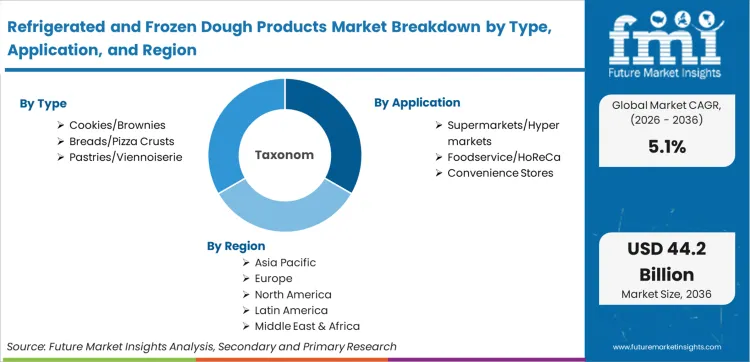
- USD 44.2 Bn
- CAGR (2026 to 2036)
- 5.1%
Refrigerated and Frozen Dough Products Market Size, Market Forecast and Outlook By FMI
In 2025, the refrigerated and frozen dough products market surpassed USD 25.6 billion, reflecting steady global adoption of ready‑to‑bake formats. According to Future Market Insights, demand is projected to reach USD 26.9 billion in 2026 and accelerate to USD 44.2 billion by 2036, supported by a long‑term CAGR of 5.1% over the forecast. This translates into an absolute dollar expansion of USD 17.3 billion, underscoring how incremental upgrades in cold‑chain infrastructure and persistent labor shortages across industrial baking are reshaping product demand patterns.
Sector’s momentum also reflects broader dynamics within global grain markets. Industrial bakeries continue to navigate fluctuations in wheat utilization, which was projected at 794 million tonnes for 2024/25 [5]. To mitigate variability, plant operators increasingly rely on advanced dough processing systems that help standardize outputs, reduce dependency on skilled labor, and enhance consistency across high‑speed production lines. At the same time, capacity constraints within cold‑storage facilities are tightening, pushing processors toward third‑party logistics providers to maintain required inventory buffers and support uninterrupted distribution.
Summary of Refrigerated and Frozen Dough Products Market
- Refrigerated and Frozen Dough Products Market Definition:
- Sector represents temperature-controlled unbaked bases utilized within commercial baking processes to standardize finished product quality and replace scratch preparation.
- Demand Drivers in the Market:
- Flour quality volatility forces dependence on standardizing pre-mixed bases.
- Labor shortages across foodservice compel ready-to-bake format adoption.
- Supermarket supply chains mandate extended anti-staling shelf stability.
- Key Segments Analyzed in the FMI Report:
- Type: Cookies/Brownies formats capture 25.8% volume share.
- Application: Supermarkets/Hypermarkets processing generates 48.2% consumption demand.
- Geography: Asia Pacific expansion outpaces mature North American operations.
- Analyst Opinion at FMI:
- Nandini Roy Choudhury, Principal Consultant for Food and Beverages, opines, “With ingredient cost volatility becoming a structural norm, bakeries can no longer rely on traditional process adjustments to protect margins. Pre‑portioned, ready‑to‑use dough formats have become non‑negotiable, offering built‑in yield stability that shields operations from wheat protein fluctuations and ensures consistent profitability.”
- Strategic Implications/Executive Takeaways:
- Anchor product positioning around direct margin savings and waste reduction metrics.
- Prioritize synergistic ingredient blends targeting multi-functional structural improvement.
- Realign commercial strategies toward rapid-growth Asian industrialized baking hubs.
- Methodology:
- Validated through first-hand corporate production and capacity data.
- Zero reliance on speculative third-party market research reports.
- Based on verifiable industrial benchmarks and verified sources.
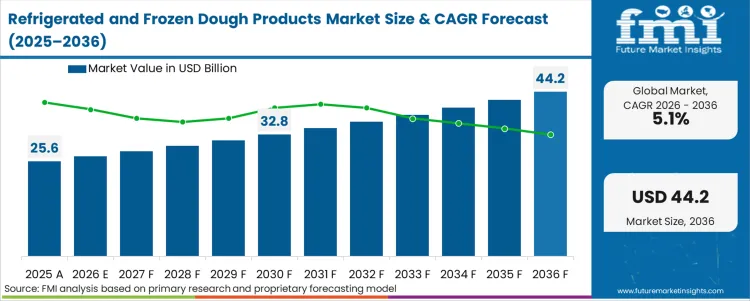
Demand-side trends are equally influential. Consumer preferences are shifting toward indulgent, bakery‑style formats, with larger, premium cookies gaining traction in retail channels. As Michelle Odland, Business Unit Director at General Mills, noted, “Larger, bakery‑style cookies are trending right now, so we knew it was time to bring those big flavors home. [7]” This signal how evolving taste profiles continue to influence product innovation and expansion strategies within the category.
Geographic expansion reveals diverse maturity profiles. China leads adoption velocity with a 6.9% CAGR, followed closely by commercialization efforts fueling India uptake at a 6.4% CAGR. Germany expands processing scale, recording a 5.9% CAGR, outpacing France at 5.4%. United Kingdom processors optimize recipes for a 4.8% CAGR. United States maturity yields a 4.3% CAGR, and Brazil scales import-dependent manufacturing at a 3.8% CAGR.
Refrigerated and Frozen Dough Products Market Key Takeaways
| Metric | Value |
|---|---|
| Industry Size (2026) | USD 26.9 Billion |
| Industry Value (2036) | USD 44.2 Billion |
| CAGR (2026 to 2036) | 5.1% |
Refrigerated and Frozen Dough Products Market Definition
Sector tracking involves pre-mixed, unbaked, and temperature-controlled bases deployed to accelerate final baking steps within commercial or residential ovens. Formulations modify complex starches and structural matrices prior to freezing stages. Manufacturers deploy specific catalytic agents to enhance crumb structure and standardize machinability across automated production lines.
Refrigerated and Frozen Dough Products Market Inclusions
Coverage spans pure and blended formulations engineered for commercial baking environments. Analysis incorporates cookie dough formats sold directly to industrial bakers or integrated into premixes. Assessment measures commercial volume moving through business-to-business distribution channels alongside retail freezer aisle placements.
Refrigerated and Frozen Dough Products Market Exclusions
Data boundaries exclude generic industrial flour intended for brewing, dairy processing, or animal feed applications. End-consumer retail yeast packets containing trace proteins fall outside measured scope. Fully baked ambient pastries lacking a final temperature-controlled baking step remain excluded from valuation models.
Refrigerated and Frozen Dough Products Market Research Methodology
- Primary Research: Formulation scientists, procurement heads, and distributors verified commercial utilization rates across regional hubs.
- Desk Research: Agricultural output datasets, corporate sustainability filings, and regional cold-chain capacity forecasts benchmarked addressable processing volumes.
- Market-Sizing and Forecasting: Bottom-up compilation mapped installed industrial oven capacity against dough based premixes inclusion percentages per metric ton of flour.
- Data Validation and Update Cycle: Quarterly triangulation cross-referenced supplier earnings reports against bulk flour consumption metrics.
Segmental Analysis
Refrigerated and Frozen Dough Products Market Analysis by Type
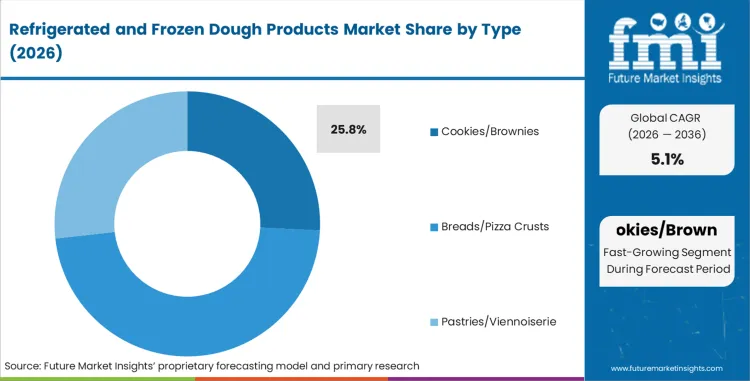
Cookies/Brownies formulations dominate usage, securing 25.8% baseline share in 2026. Processors leverage specific variants to bypass complex mixing stages, liberating skilled labor for final decoration and merchandising. Continuous industrial lines require precise gas retention properties, elevating demand for standardized pizza crust mix systems to prevent crumb firming. According to FMI's estimates, suppliers formulate specialized blends neutralizing natural variations within harvested grain to ensure uniform baking spreads. Catalytic degradation of specific starch fractions dictates extended softness, directly influencing retailer purchasing decisions.
- Yield stabilization: Commodity variability threatens high-speed production efficiency, forcing processors to deploy specialized formats to standardize water absorption across varying flour batches. Normalizing viscosity prevents line stoppages and protects margins across extended shifts.
- Freshness extension: Staling causes millions in preventable retail shrink annually, pushing formulators to utilize specific anti-staling bio-catalysts to modify amylopectin retrogradation rates. Delayed crumb firming extends marketable product life by days, satisfying stringent supermarket requirements.
- Label simplification: Consumers reject unfamiliar chemical additives on packaging, prompting brands to replace traditional mono-diglycerides with functional protein systems. Clean-label transitions directly open access to premium supermarket shelf placement prior to 2030.
Refrigerated and Frozen Dough Products Market Analysis by Application
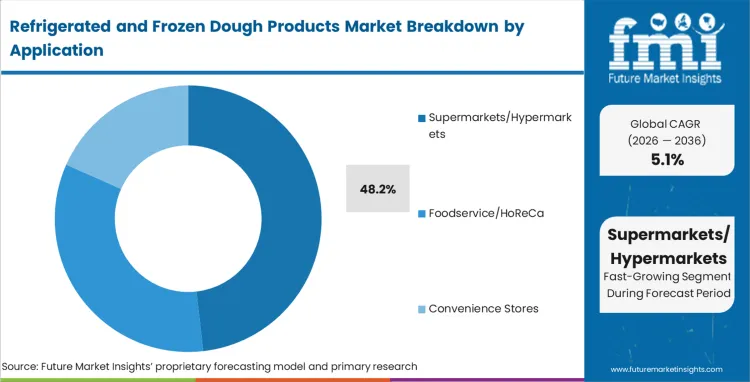
Supermarkets/Hypermarkets create primary volume consumption, generating 48.2% total category demand in 2026. High-speed continuous mixing environments expose structural matrices to severe mechanical stress. Bakers deploy functional proteins to reinforce gluten networks, ensuring consistent loaf volume and cell structure across automated panning systems. As per FMI's projection, formulation dependency increases as processors seek to offset fluctuating protein levels in bulk flour shipments. Companies utilize specialized par baked bread ingredients to modify endogenous wheat lipids, enhancing gas-holding capacity without supplementary chemical strengtheners. Production scale economics dictate stringent waste reduction, positioning freezer-to-oven formats as vital profitability safeguards for in-store bakery departments.
- Protein fortification: Weak flour profiles cause structural collapse during proofing stages, prompting technologists to incorporate oxidative agents to cross-link gluten strands. Reinforced matrices maintain target dimensions and prevent unsaleable deformations across continuous production runs.
- Labor substitution: Volatile wage pricing destroys margin predictability for sweet goods manufacturers, leading procurement teams to adopt specialized pre-mixed bases simulating scratch functionalities. Formulations using ready-to-bake formats reduce reliance on expensive skilled bakers, immediately improving gross margins.
- Process acceleration: Lengthy bulk fermentation creates costly manufacturing bottlenecks, requiring engineers to apply targeted catalytic cocktails hastening maturation. Faster processing cycles increase daily output capacity without requiring physical facility expansion prior to peak seasons.
Refrigerated and Frozen Dough Products Market Drivers, Restraints, and Opportunities
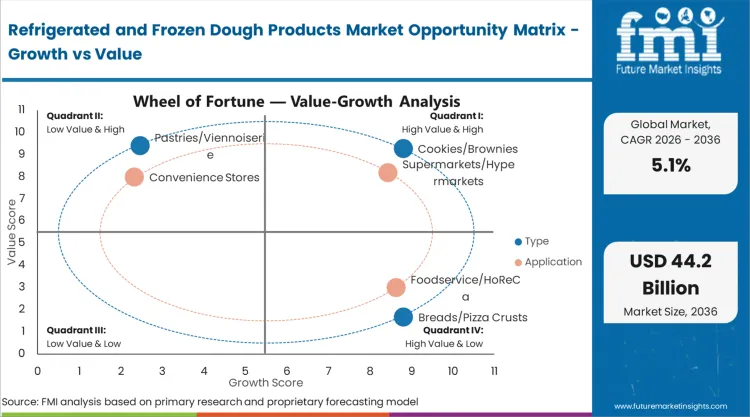
Raw material unpredictability forces industrial processors to systematize handling protocols. Climate-induced variations in grain harvests alter endogenous protein metrics, jeopardizing high-speed baking operations. Procurement directors pivot toward standardized biocatalysts to normalize behavior and prevent costly line interruptions. Plant managers utilize specific amylase combinations to optimize water hydration and manage stickiness. FMI analysts opine that stabilizing mechanical handling directly improves sliceability and reduces crumb tearing during packaging. Biocatalytic integration fundamentally shifts manufacturing reliance away from harvest conditions toward engineered predictability, relying heavily on existing cold-chain infrastructure.
Costly integration trials and stringent cold-storage requirements restrain immediate adoption among mid-tier regional bakeries. Replacing established ambient dough conditioners demands extensive temperature monitoring and formulation adjustments. Facility operators hesitate to risk entire production runs on unfamiliar freezing protocols. Suppliers combat adoption friction by deploying dedicated technical service teams to conduct on-site line optimization. Demonstrating immediate payback periods hastens conversion, overcoming initial validation hurdles across fragmented local processing sectors. Overcoming implementation barriers requires prolonged technical engagement and customized freezer calibration.
- Alternative protein synergy: Plant-based baking formulations face severe textural challenges, driving formulators to utilize specific transglutaminase networks to cross-link vegan proteins. Enhanced structural integrity captures expanding demand within premium diet-specific categories, validating higher raw material investments.
- Supply chain consolidation: Mergers reshape competitive capabilities and technical resource allocation, pushing combined entities to scale delivery networks.
- Zero-waste mandates: Retailer penalties for expired unsold goods compress baking margins, forcing application specialists to deploy advanced maltogenic amylases delaying starch retrogradation. Adding extra days to shelf life dramatically lowers return rates and improves sustainability metrics across regional distribution routes.
Regional Analysis
Based on the regional analysis, the Refrigerated and Frozen Dough Products market is segmented into North America, Latin America, Europe, East Asia, South Asia, Oceania and Middle East & Africa across 40+ countries. The full report also offers market attractiveness analysis based on regional trends.
.webp "Top Country Growth Comparison Refrigerated And Frozen Dough Products Market Cagr (2026 2036)")
| Country | CAGR (2026 to 2036) |
|---|---|
| China | 6.9% |
| India | 6.4% |
| Germany | 5.9% |
| France | 5.4% |
| UK | 4.8% |
| USA | 4.3% |
| Brazil | 3.8% |
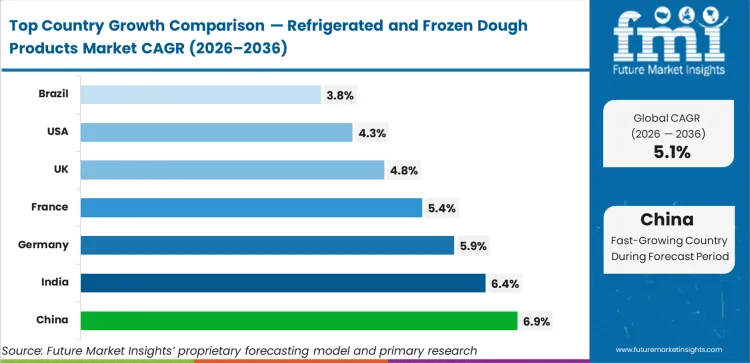
Source: Future Market Insights (FMI) analysis, based on proprietary forecasting model and primary research
North America Refrigerated and Frozen Dough Products Analysis
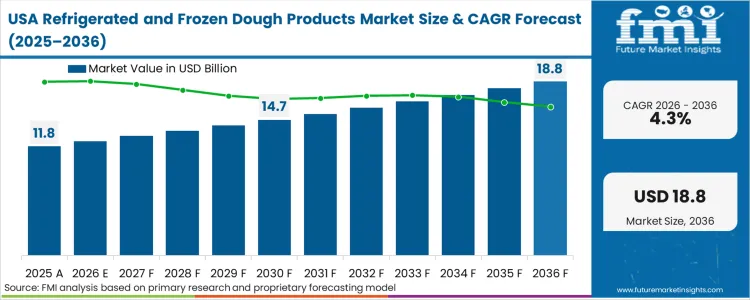
North American processors prioritize extreme shelf-life extension to navigate vast distribution networks. Consolidated wholesale bakeries demand strong anti-staling technologies ensuring softness across multi-day transit routes. Clean-label reformulations expand as major retailers restrict synthetic preservatives in private-label brands. Plant operators eliminate chemical emulsifiers to comply with evolving clean-label purchasing criteria set by major grocery chains. According to FMI's estimates, frozen food retail dollar growth expanding to 2.9% supports regional integration demands. [3]
- USA: Demand for frozen formats in USA is set to grow at 4.3% CAGR through 2036, supported by wholesale bakeries prioritizing waste reduction across extended supply chains. United States refrigerated warehouse gross capacity projections of 3.70 billion cubic feet ensure immense domestic processing volumes. [1] Integrating advanced frozen baked goods mitigates staling returns, directly protecting supplier profitability.
FMI’s report includes a detailed growth analysis covering Canada and Mexico. Canadian millers leverage specific modification tools adapting hard red spring wheat for diverse baking applications. Mexican industrial bakeries expand operations, representing targets for shelf-life optimization tools.
Latin America Refrigerated and Frozen Dough Products Analysis
Latin American production centers navigate intense raw material cost pressures. Reliance on imported wheat exposes domestic millers to currency fluctuations and global pricing volatility. Plant operators deploy functional proteins extracting maximum yield from varied flour qualities. Chemical formulations face replacement by advanced refrigerated snacks systems offering effective strengthening at lower cost-in-use metrics. As per FMI's projection, cost-effective strengthening secures margin viability for regional bread producers.
- Brazil: The Brazil sector is poised to expand at 3.8% CAGR during 2026 to 2036 because reliance on imported flour dictates enzymatic correction to achieve uniform characteristics. Europastry reported a 12% sales increase to €1.506 billion, signaling expanded focus on regional yield optimization capabilities. [10] Cost-effective strengthening secures margin viability for regional bread producers.
FMI’s report includes an assessment covering Argentina and Chile. Argentine millers focus on export-grade flour standardization utilizing targeted alpha-amylase treatments. Chilean processors adopt specialized catalysts improving frozen stability.
Europe Refrigerated and Frozen Dough Products Analysis
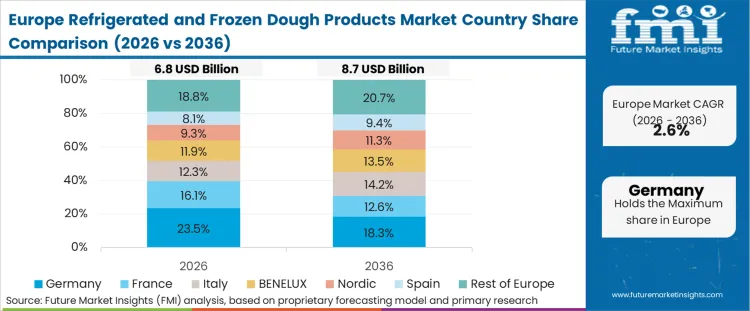
European manufacturers operate within stringent regulatory frameworks limiting chemical additive usage. High consumer demand for artisanal-style bread fuels industrial adoption of advanced biocatalysts replicating traditional fermentation profiles. Formulators focus on clean-label transitions, utilizing proteins meeting strict EU purity standards. Plant operators deploy specialized bakery mixes maintaining authentic crust textures under automated conditions.
- Germany: Over 2026 to 2036, processing in Germany is projected to grow at 5.9% CAGR, reflecting aggressive clean-label transitions prioritizing natural processing aids.
- France: At 5.4% CAGR, French outlook is shaped by intense regulatory scrutiny over natural health product claims, mandating rigorous safety dossiers. Clean-label requirements force suppliers to remove artificial colorants from chewable formats, ensuring steady demand for compliance-focused mineral products via physician recommendation pathways.
- UK: UK is expected to record 4.8% CAGR in catalyst demand over 2026 to 2036 as intense supermarket pressure targets food waste reduction. One Equity Partners acquired CraftMark Bakery, targeting processors seeking consistent ingredient performance across broad geographies. [8]
FMI’s report includes detailed analysis covering Italy and Spain. Italian operators utilize specialized xylanases maintaining authentic baguette crust textures under automated conditions. Spanish manufacturers optimize panettone shelf-life using complex enzymatic cocktails, elevating demand for specific frozen pastries formulations.
East Asia Refrigerated and Frozen Dough Products Analysis
East Asian baking sectors undergo rapid industrialization and capacity expansion. Urbanization fuels consumer preference toward packaged baked goods, necessitating reliable manufacturing infrastructure. Factory automation requires extreme tolerance, pushing regional adoption of sophisticated conditioning blends. Europastry acquired 60% of Art of Baking, enhancing regional service capabilities supporting vast Asian industrial scale-up. [9]
- China: China is likely to see processing revenues increase at 6.9% CAGR during 2026 to 2036, given rapid factory automation and retail network expansion. Chinese baking ingredients market scaling past USD 18 billion necessitates extreme high-volume production consistency. [4] Standardizing rheology secures product uniformity across vast franchise operations.
FMI’s report includes a strategic review covering Japan and South Korea. Japanese processors lead global innovation regarding ultra-soft bread textures utilizing maltogenic amylases. South Korean manufacturers integrate ready to finish bakery products improving frozen distribution networks.
South Asia Refrigerated and Frozen Dough Products Analysis
South Asian markets transition from unorganized local baking toward centralized industrial production. Rising disposable incomes fuel consumption of packaged biscuits, cakes, and sliced bread. Operations managers implement enzymatic conditioners replacing traditional chemical oxidants.
- India: In India, the sector is forecast to advance at 6.4% CAGR through 2036, with growth anchored in commercial baking shifts toward organized industrial formats. India operational cold-chain preservation capacity created reached 25.52 lakh MT/year, supplying regional processors with standardized temperature-controlled infrastructure. [2]
FMI’s report includes specific insights regarding Bangladesh and Sri Lanka. Bangladeshi biscuit manufacturers adopt specialized preservatives improving wafer sheet spreadability. Sri Lankan bread producers utilize amylases extending freshness within tropical climate conditions.
Competitive Aligners for Market Players
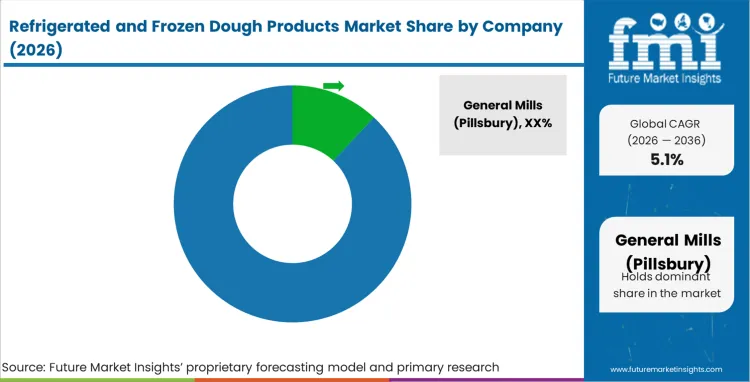
Strategic consolidation alters technical support capabilities across global supply chains. Scale advantages allow dominant players to co-develop customized protein complexes directly with multi-national baking conglomerates, raising entry barriers for smaller regional formulators. Volatility surrounding key baking ingredients forces suppliers to reorient product development pipelines. Aligning research outputs with immediate macroeconomic shocks positions suppliers as strategic risk-mitigation partners rather than mere commodity vendors. Rapid response formulation secures long-term contract lock-in.
Stringent regulatory environments reward suppliers maintaining rigorous purity and sustainability certifications. Companies achieving organic compliance leverage verified credentials to win procurement contracts from major European food brands. Documented supply chain transparency becomes a mandatory qualifying criterion for supplying global retail chains seeking frozen dough accountability. Formulators lacking comprehensive regulatory documentation face exclusion from premium clean-label project pipelines.
Recent Developments:
The report includes full coverage of key trends from competitive benchmarking. Some of the recent developments covered in the reports:
- In March 2024, CVC funds acquired Monbake Group from Ardian and co-investors to support global expansion and innovation growth strategy. [6]
- In May 2025, General Mills introduced Pillsbury BIG COOKIES targeting butter-containing bakery applications. [7]
Key Players in Refrigerated and Frozen Dough Products
- General Mills (Pillsbury)
- Grupo Monbake
- CraftMark Bakery
- Europastry
- Art of Baking
- Aryzta
- Rich Products Corporation
- Dawn Food Products
- CSM Bakery Solutions
- Vandemoortele
Scope of the Report
| Metric | Value |
|---|---|
| Quantitative Units | USD 26.9 billion (2026) to USD 44.2 billion (2036), at a CAGR of 5.1% |
| Market Definition | Sector represents temperature-controlled unbaked bases utilized within commercial baking processes to standardize finished product quality and replace scratch preparation. |
| Type Segmentation | Cookies/Brownies, Breads/Pizza Crusts, Pastries/Viennoiserie |
| Application Segmentation | Supermarkets/Hypermarkets, Foodservice/HoReCa, Convenience Stores |
| Application Coverage | Dough Conditioning, Shelf-life Extension, Yield Improvement |
| Regions Covered | North America, Latin America, Europe, East Asia, South Asia, Oceania, Middle East & Africa |
| Countries Covered | United States, Canada, Mexico, Brazil, Argentina, Germany, France, United Kingdom, Italy, Spain, China, India, Japan, South Korea, Indonesia, Australia and 40 plus countries |
| Key Companies Profiled | General Mills, Grupo Monbake, CraftMark Bakery, Europastry, Art of Baking |
| Forecast Period | 2026 to 2036 |
| Approach | Bottom-up compilation mapped installed industrial oven capacity against inclusion percentages per metric ton of flour. |
Refrigerated and Frozen Dough Products Market Analysis by Segments
Type:
- Cookies/Brownies
- Breads/Pizza Crusts
- Pastries/Viennoiserie
Application:
- Supermarkets/Hypermarkets
- Foodservice/HoReCa
- Convenience Stores
Region:
- Asia Pacific
- India
- China
- Japan
- South Korea
- Indonesia
- Australia & New Zealand
- ASEAN
- Rest of Asia Pacific
- Europe
- Germany
- Italy
- France
- United Kingdom
- Spain
- Benelux
- Nordics
- Central & Eastern Europe
- Rest of Europe
- North America
- United States
- Canada
- Mexico
- Latin America
- Brazil
- Argentina
- Chile
- Rest of Latin America
- Middle East & Africa
- Kingdom of Saudi Arabia
- United Arab Emirates
- South Africa
- Turkey
- Rest of Middle East & Africa
Bibliography
- [1] Esmis. (2024). USA refrigerated warehouse gross capacity.
- [2] Press Information Bureau. (2025). India operational cold-chain preservation capacity created.
- [3] AFFI. (2024). Frozen food retail dollar growth (US) Q4’23 to Q1’24.
- [4] USDA/FAS. (2026). China baking ingredients market size.
- [5] FAO. (2025). Global wheat utilization.
- [6] CVC. (2024). CVC funds acquired Monbake.
- [7] General Mills. (2025). Pillsbury BIG COOKIES launch.
- [8] One Equity Partners. (2025, March 26). One Equity Partners to acquire Craftmark Bakery [Press release].
- [9] Just Food. (2025). Europastry acquired 60% of Art of Baking.
- [10] Cinco Días. (2025). Europastry reported +12% sales to €1.506B.
This bibliography is provided for reader reference and is not exhaustive. The full report contains the complete reference list and detailed citations.
This Report Addresses
- Market intelligence to guide structured strategic decision making across mature and emerging industrial baking economies.
- Market size estimation and 10 year revenue forecasts from 2026 to 2036, supported by validated flour processing benchmarks.
- Growth opportunity mapping across formats with emphasis on clean-label grade transitions.
- Segment and regional revenue forecasts covering bread, biscuits, and pastry applications.
- Competition strategy assessment including integration models, cost survivability positioning, and formulation capability benchmarking.
- Product reformulation tracking including mono- and diglycerides replacement initiatives.
- Regulatory impact analysis covering synthetic additive limits and waste reduction mandates.
- Strategic report delivery via secure platforms.
Frequently Asked Questions
How large is the demand for Refrigerated and Frozen Dough Products in the global market in 2026?
Demand globally is estimated at USD 26.9 billion in 2026.
What will be the market size of Refrigerated and Frozen Dough Products in the global market by 2036?
Total category valuation is projected to reach USD 44.2 billion by 2036.
What is the expected demand growth for Refrigerated and Frozen Dough Products in the global market between 2026 and 2036?
Global consumption is expected to grow at a CAGR of 5.1% between 2026 and 2036.
Which Type is poised to lead global sales by 2026?
Cookies/Brownies formats capture 25.8% global share in 2026 due to extensive anti-staling utility.
How significant is the role of Supermarkets/Hypermarkets Application in driving Refrigerated and Frozen Dough Products adoption in 2026?
Supermarkets/Hypermarkets processing represents 48.2% consumption demand as continuous mixing requires effective strengthening.
What is driving demand in China?
Rapid factory automation and expanding retail franchise networks dictate extreme high-volume production consistency.
What compliance standards or regulations are referenced for China?
Clean-label transitions replace synthetic emulsifiers with natural biological alternatives.
What is the China growth outlook in this report?
China adoption expands at a 6.9% CAGR during 2026 to 2036.
Why is North America described as a priority region in this report?
Domestic wheat processing scale forces heavy reliance on shelf-life extension across extended supply networks.
What type of demand dominates in North America?
Replacement demand targeting synthetic preservatives dominates regional consumption profiles.
What is USA growth outlook in this report?
USA processing scales at a 4.3% CAGR during 2026 to 2036.
Does the report cover India in its regional analysis?
India is included within South Asia regional scope.
What are the sources referred to for analyzing India?
Official agricultural production forecasts published by USDA FAS benchmark available commercial processing volumes.
What is the main demand theme linked to India in its region coverage?
Organized commercial baking transitions require advanced machinability tools.
Does the report cover Germany in its regional analysis?
Germany is included within Europe regional coverage framework.
What is the main Germany related demand theme in its region coverage?
Clean-label premiumization utilizing advanced biological catalysts replaces synthetic additives.
Which product formats or configurations are strategically important for Europe supply chains?
Complex blends standardizing authentic artisanal textures represent formulation strategies.
What is Refrigerated and Frozen Dough Products and what is it mainly used for?
Biological catalysts accelerate chemical reactions modifying starches and proteins to improve handling and loaf freshness.
What does Refrigerated and Frozen Dough Products mean in this report?
Category tracks bio-enzymatic formulations sold directly to industrial bakeries or integrated into specialized premixes.
What is included in the scope of this Refrigerated and Frozen Dough Products report?
Scope covers pure and blended products utilized in commercial baking environments.
What is excluded from the scope of this report?
Generic industrial proteins intended for brewing, dairy processing, or non-catalytic chemical emulsifiers remain excluded.
What does market forecast mean on this page?
Projection represents model-based processing volume mapped against installed industrial oven capacity.
How does FMI build and validate the Refrigerated and Frozen Dough Products forecast?
Bottom-up compilation maps flour consumption metrics validated through formulation scientist interviews.
What does zero reliance on speculative third party market research mean here?
Primary interviews and verifiable agricultural datasets dictate baseline sizing instead of unverified syndicated estimates.
Preview the report firsthand - request a free sample
Get SampleGet the brochure for pricing and purchase details.
Get PDFTable of Content
- Executive Summary
- Global Market Outlook
- Demand-side Trends
- Supply-side Trends
- Technology Roadmap Analysis
- Analysis and Recommendations
- Market Overview
- Market Coverage / Taxonomy
- Market Definition / Scope / Limitations
- Research Methodology
- Chapter Orientation
- Analytical Lens and Working Hypotheses
- Market Structure, Signals, and Trend Drivers
- Benchmarking and Cross-market Comparability
- Market Sizing, Forecasting, and Opportunity Mapping
- Research Design and Evidence Framework
- Desk Research Programme (Secondary Evidence)
- Company Annual and Sustainability Reports
- Peer-reviewed Journals and Academic Literature
- Corporate Websites, Product Literature, and Technical Notes
- Earnings Decks and Investor Briefings
- Statutory Filings and Regulatory Disclosures
- Technical White Papers and Standards Notes
- Trade Journals, Industry Magazines, and Analyst Briefs
- Conference Proceedings, Webinars, and Seminar Materials
- Government Statistics Portals and Public Data Releases
- Press Releases and Reputable Media Coverage
- Specialist Newsletters and Curated Briefings
- Sector Databases and Reference Repositories
- FMI Internal Proprietary Databases and Historical Market Datasets
- Subscription Datasets and Paid Sources
- Social Channels, Communities, and Digital Listening Inputs
- Additional Desk Sources
- Expert Input and Fieldwork (Primary Evidence)
- Primary Modes
- Qualitative Interviews and Expert Elicitation
- Quantitative Surveys and Structured Data Capture
- Blended Approach
- Why Primary Evidence is Used
- Field Techniques
- Interviews
- Surveys
- Focus Groups
- Observational and In-context Research
- Social and Community Interactions
- Stakeholder Universe Engaged
- C-suite Leaders
- Board Members
- Presidents and Vice Presidents
- R&D and Innovation Heads
- Technical Specialists
- Domain Subject-matter Experts
- Scientists
- Physicians and Other Healthcare Professionals
- Governance, Ethics, and Data Stewardship
- Research Ethics
- Data Integrity and Handling
- Primary Modes
- Tooling, Models, and Reference Databases
- Desk Research Programme (Secondary Evidence)
- Data Engineering and Model Build
- Data Acquisition and Ingestion
- Cleaning, Normalisation, and Verification
- Synthesis, Triangulation, and Analysis
- Quality Assurance and Audit Trail
- Market Background
- Market Dynamics
- Drivers
- Restraints
- Opportunity
- Trends
- Scenario Forecast
- Demand in Optimistic Scenario
- Demand in Likely Scenario
- Demand in Conservative Scenario
- Opportunity Map Analysis
- Product Life Cycle Analysis
- Supply Chain Analysis
- Investment Feasibility Matrix
- Value Chain Analysis
- PESTLE and Porter’s Analysis
- Regulatory Landscape
- Regional Parent Market Outlook
- Production and Consumption Statistics
- Import and Export Statistics
- Market Dynamics
- Global Market Analysis 2021 to 2025 and Forecast, 2026 to 2036
- Historical Market Size Value (USD Million) Analysis, 2021 to 2025
- Current and Future Market Size Value (USD Million) Projections, 2026 to 2036
- Y-o-Y Growth Trend Analysis
- Absolute $ Opportunity Analysis
- Global Market Pricing Analysis 2021 to 2025 and Forecast 2026 to 2036
- Global Market Analysis 2021 to 2025 and Forecast 2026 to 2036, By Type
- Introduction / Key Findings
- Historical Market Size Value (USD Million) Analysis By Type , 2021 to 2025
- Current and Future Market Size Value (USD Million) Analysis and Forecast By Type , 2026 to 2036
- Cookies/Brownies
- Breads/Pizza Crusts
- Pastries/Viennoiserie
- Cookies/Brownies
- Y-o-Y Growth Trend Analysis By Type , 2021 to 2025
- Absolute $ Opportunity Analysis By Type , 2026 to 2036
- Global Market Analysis 2021 to 2025 and Forecast 2026 to 2036, By Application
- Introduction / Key Findings
- Historical Market Size Value (USD Million) Analysis By Application, 2021 to 2025
- Current and Future Market Size Value (USD Million) Analysis and Forecast By Application, 2026 to 2036
- Supermarkets/Hypermarkets
- Foodservice/HoReCa
- Convenience Stores
- Supermarkets/Hypermarkets
- Y-o-Y Growth Trend Analysis By Application, 2021 to 2025
- Absolute $ Opportunity Analysis By Application, 2026 to 2036
- Global Market Analysis 2021 to 2025 and Forecast 2026 to 2036, By Region
- Introduction
- Historical Market Size Value (USD Million) Analysis By Region, 2021 to 2025
- Current Market Size Value (USD Million) Analysis and Forecast By Region, 2026 to 2036
- North America
- Latin America
- Western Europe
- Eastern Europe
- East Asia
- South Asia and Pacific
- Middle East & Africa
- Market Attractiveness Analysis By Region
- North America Market Analysis 2021 to 2025 and Forecast 2026 to 2036, By Country
- Historical Market Size Value (USD Million) Trend Analysis By Market Taxonomy, 2021 to 2025
- Market Size Value (USD Million) Forecast By Market Taxonomy, 2026 to 2036
- By Country
- USA
- Canada
- Mexico
- By Type
- By Application
- By Country
- Market Attractiveness Analysis
- By Country
- By Type
- By Application
- Key Takeaways
- Latin America Market Analysis 2021 to 2025 and Forecast 2026 to 2036, By Country
- Historical Market Size Value (USD Million) Trend Analysis By Market Taxonomy, 2021 to 2025
- Market Size Value (USD Million) Forecast By Market Taxonomy, 2026 to 2036
- By Country
- Brazil
- Chile
- Rest of Latin America
- By Type
- By Application
- By Country
- Market Attractiveness Analysis
- By Country
- By Type
- By Application
- Key Takeaways
- Western Europe Market Analysis 2021 to 2025 and Forecast 2026 to 2036, By Country
- Historical Market Size Value (USD Million) Trend Analysis By Market Taxonomy, 2021 to 2025
- Market Size Value (USD Million) Forecast By Market Taxonomy, 2026 to 2036
- By Country
- Germany
- UK
- Italy
- Spain
- France
- Nordic
- BENELUX
- Rest of Western Europe
- By Type
- By Application
- By Country
- Market Attractiveness Analysis
- By Country
- By Type
- By Application
- Key Takeaways
- Eastern Europe Market Analysis 2021 to 2025 and Forecast 2026 to 2036, By Country
- Historical Market Size Value (USD Million) Trend Analysis By Market Taxonomy, 2021 to 2025
- Market Size Value (USD Million) Forecast By Market Taxonomy, 2026 to 2036
- By Country
- Russia
- Poland
- Hungary
- Balkan & Baltic
- Rest of Eastern Europe
- By Type
- By Application
- By Country
- Market Attractiveness Analysis
- By Country
- By Type
- By Application
- Key Takeaways
- East Asia Market Analysis 2021 to 2025 and Forecast 2026 to 2036, By Country
- Historical Market Size Value (USD Million) Trend Analysis By Market Taxonomy, 2021 to 2025
- Market Size Value (USD Million) Forecast By Market Taxonomy, 2026 to 2036
- By Country
- China
- Japan
- South Korea
- By Type
- By Application
- By Country
- Market Attractiveness Analysis
- By Country
- By Type
- By Application
- Key Takeaways
- South Asia and Pacific Market Analysis 2021 to 2025 and Forecast 2026 to 2036, By Country
- Historical Market Size Value (USD Million) Trend Analysis By Market Taxonomy, 2021 to 2025
- Market Size Value (USD Million) Forecast By Market Taxonomy, 2026 to 2036
- By Country
- India
- ASEAN
- Australia & New Zealand
- Rest of South Asia and Pacific
- By Type
- By Application
- By Country
- Market Attractiveness Analysis
- By Country
- By Type
- By Application
- Key Takeaways
- Middle East & Africa Market Analysis 2021 to 2025 and Forecast 2026 to 2036, By Country
- Historical Market Size Value (USD Million) Trend Analysis By Market Taxonomy, 2021 to 2025
- Market Size Value (USD Million) Forecast By Market Taxonomy, 2026 to 2036
- By Country
- Kingdom of Saudi Arabia
- Other GCC Countries
- Turkiye
- South Africa
- Other African Union
- Rest of Middle East & Africa
- By Type
- By Application
- By Country
- Market Attractiveness Analysis
- By Country
- By Type
- By Application
- Key Takeaways
- Key Countries Market Analysis
- USA
- Pricing Analysis
- Market Share Analysis, 2025
- By Type
- By Application
- Canada
- Pricing Analysis
- Market Share Analysis, 2025
- By Type
- By Application
- Mexico
- Pricing Analysis
- Market Share Analysis, 2025
- By Type
- By Application
- Brazil
- Pricing Analysis
- Market Share Analysis, 2025
- By Type
- By Application
- Chile
- Pricing Analysis
- Market Share Analysis, 2025
- By Type
- By Application
- Germany
- Pricing Analysis
- Market Share Analysis, 2025
- By Type
- By Application
- UK
- Pricing Analysis
- Market Share Analysis, 2025
- By Type
- By Application
- Italy
- Pricing Analysis
- Market Share Analysis, 2025
- By Type
- By Application
- Spain
- Pricing Analysis
- Market Share Analysis, 2025
- By Type
- By Application
- France
- Pricing Analysis
- Market Share Analysis, 2025
- By Type
- By Application
- India
- Pricing Analysis
- Market Share Analysis, 2025
- By Type
- By Application
- ASEAN
- Pricing Analysis
- Market Share Analysis, 2025
- By Type
- By Application
- Australia & New Zealand
- Pricing Analysis
- Market Share Analysis, 2025
- By Type
- By Application
- China
- Pricing Analysis
- Market Share Analysis, 2025
- By Type
- By Application
- Japan
- Pricing Analysis
- Market Share Analysis, 2025
- By Type
- By Application
- South Korea
- Pricing Analysis
- Market Share Analysis, 2025
- By Type
- By Application
- Russia
- Pricing Analysis
- Market Share Analysis, 2025
- By Type
- By Application
- Poland
- Pricing Analysis
- Market Share Analysis, 2025
- By Type
- By Application
- Hungary
- Pricing Analysis
- Market Share Analysis, 2025
- By Type
- By Application
- Kingdom of Saudi Arabia
- Pricing Analysis
- Market Share Analysis, 2025
- By Type
- By Application
- Turkiye
- Pricing Analysis
- Market Share Analysis, 2025
- By Type
- By Application
- South Africa
- Pricing Analysis
- Market Share Analysis, 2025
- By Type
- By Application
- USA
- Market Structure Analysis
- Competition Dashboard
- Competition Benchmarking
- Market Share Analysis of Top Players
- By Regional
- By Type
- By Application
- Competition Analysis
- Competition Deep Dive
- General Mills (Pillsbury)
- Overview
- Product Portfolio
- Profitability by Market Segments (Product/Age /Sales Channel/Region)
- Sales Footprint
- Strategy Overview
- Marketing Strategy
- Product Strategy
- Channel Strategy
- Grupo Monbake
- CraftMark Bakery
- Europastry
- Art of Baking
- Aryzta
- Rich Products Corporation
- Dawn Food Products
- CSM Bakery Solutions
- General Mills (Pillsbury)
- Competition Deep Dive
- Assumptions & Acronyms Used


