

- Market Size (2026)
- USD 340.0 Mn
- Forecast (2036)
- USD 797.5 Mn
- CAGR (2026 to 2036)
- 8.9%
How big is Frozen Kimbap Market in 2026?
USD 340.0 Million in 2026 and USD 797.5 Million by 2036 at an 8.9% CAGR.
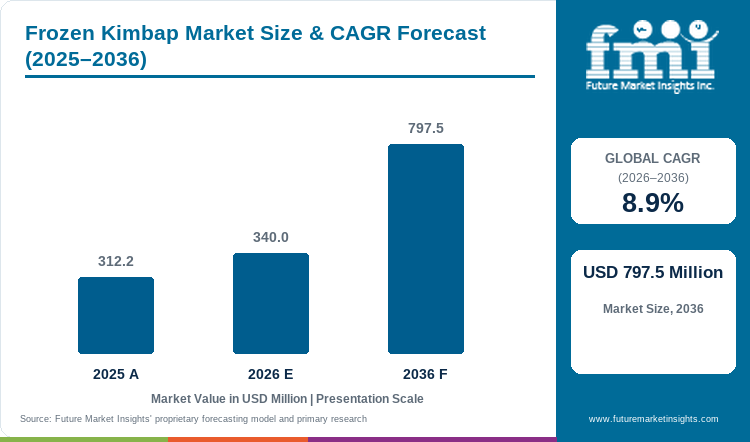
Sales of frozen kimbap are estimated at USD 340.0 Million in 2026 and are forecast to reach USD 797.5 Million by 2036 at an 8.9% CAGR. The market was valued at USD 312.2 Million in 2025. The product converts a meal that is usually eaten soon after preparation into a frozen format that can move through international retail. South Korea's Ministry of Agriculture, Food and Rural Affairs reported that processed rice-product exports reached about USD 250 Million through October 2024, up 41.9% from a year earlier, with precooked frozen kimbap named as one of the products supporting that rise. In April 2026, CJ Foods said cumulative global sales of bibigo frozen gimbap had passed 8 million units across 25 countries. Those signals place frozen kimbap inside the broader frozen food market while giving it a distinct technical problem: rice, seaweed and fillings must all recover acceptable texture after freezing and microwave reheating.
A frozen kimbap roll must heat evenly while retaining soft rice, distinct fillings and an acceptable seaweed texture. ALLGOT uses rapid freezing to limit moisture loss; DOT combines a segmented microwave tray with freezing at about -40°C. These designs address different stages of the same meal. Within the ready-to-eat food market, the product competes on how closely reheating reproduces a freshly prepared roll.
Key Takeaways
- The market is estimated at USD 340.0 Million in 2026 and is forecast to reach USD 797.5 Million by 2036 at an 8.9% CAGR. The 2025 base is USD 312.2 Million, creating USD 457.5 Million of incremental opportunity through 2036.
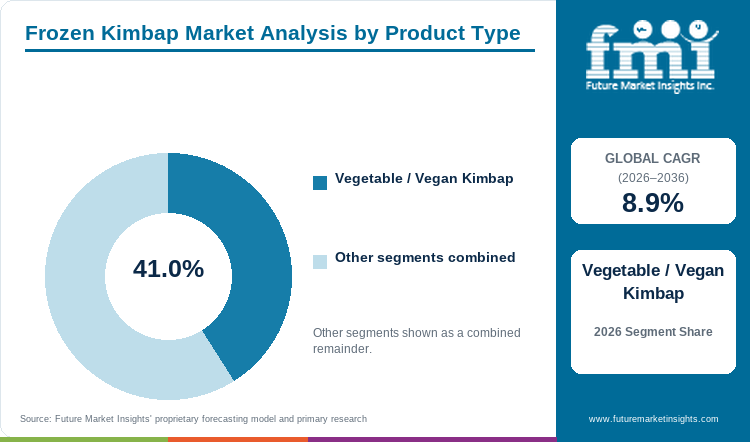
- Vegetable / Vegan Kimbap accounts for 41.0% of Product Type demand in 2026 because plant-based fillings can move through more export channels without the animal-protein restrictions that complicate some meat varieties.
- Single-roll microwave trays hold 57.0% of Packaging Format demand in 2026 because the pack can go from freezer to microwave while keeping sliced pieces separated for more even heating.
- Rapid / Spiral Quick Freezing represents 68.0% of Freezing Technology demand because rice texture and seaweed condition deteriorate when freezing is too slow and moisture migrates across the product.
- Household Retail represents 74.0% of End Use demand, while Supermarkets & Hypermarkets account for 52.0% of Sales Channel demand as frozen kimbap moves from Asian grocery discovery into mainstream freezer aisles.
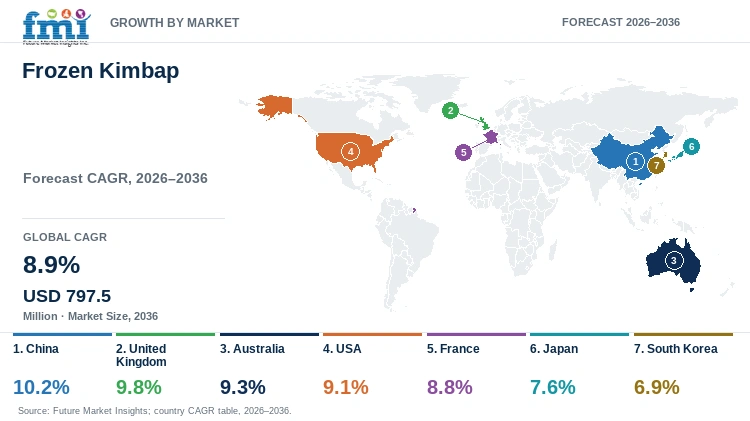
- Country CAGRs range from 10.2% in China to 6.9% in South Korea from 2026 to 2036. Retail expansion and local production raise growth in newer markets, while South Korea has a mature fresh-kimbap alternative that limits the need to freeze every eating occasion.
Analyst Perspective
Rice, seaweed and fillings respond differently to frozen storage and microwave heating. A successful kimbap pack controls moisture movement between them and heats the slices evenly. Automation can improve piece consistency, but each filling still needs a suitable process. Wider retail distribution will depend on reproducing that eating quality as production volumes increase.
- Nandini Roy Choudhury, Principal Consultant, Future Market Insights
How is the Frozen Kimbap Market segmented?
Product Type, Packaging Format, Freezing Technology, End Use, Sales Channel, and Region
The Frozen Kimbap Market is segmented by Product Type, Packaging Format, Freezing Technology, End Use, Sales Channel, and Region. Product Type covers Vegetable / Vegan Kimbap, Beef / Bulgogi Kimbap, Tuna / Seafood Kimbap, Kimchi / Cheese Kimbap and Other Varieties. Packaging Format includes Single-roll Microwave Trays, Multi-roll Family Packs, Pouches and Foodservice Bulk Packs. Freezing Technology includes Rapid / Spiral Quick Freezing, Blast Freezing and Other Commercial Freezing Systems. End Use is divided into Household Retail and Foodservice. Sales Channel covers Supermarkets & Hypermarkets, Asian / Specialty Grocery, Online Retail, Convenience Stores and Foodservice Distribution.
Why does Vegetable / Vegan Kimbap lead demand within the Product Type category?
Vegetable and vegan fillings retain the familiar kimbap format while avoiding some import restrictions on meat. Korea.net reported that ALLGOT supplied a braised-tofu and vegetable version to the U.S. when meat-export restrictions made other fillings harder to ship. The same logic helps retailers that want one SKU for vegetarian shoppers and mainstream consumers. Plant-based positioning also overlaps with the plant-based snacks market when kimbap is merchandised as a portable eating occasion rather than a full dinner.
- Vegetable / Vegan Kimbap is projected to hold 41.0% of Product Type demand in 2026 because the format combines broad dietary reach with simpler cross-border compliance than many meat-based recipes.
- ALLGOT markets tofu, vegetable and japchae-based frozen kimbap, while CJ Foods includes Vegetable and Bibimbap varieties in a six-product global lineup, showing that plant-forward recipes can support both specialist and scaled portfolios.
Why do Single-roll Microwave Trays lead demand within the Packaging Format category?
Frozen kimbap has to solve a reheating problem that fresh kimbap does not face. A sliced roll packed too tightly can heat unevenly, while condensation can soften seaweed. Single-roll trays create spacing between portions and give the consumer a controlled microwave route. DOT states that its divided tray is designed to improve heat transfer during defrosting. ALLGOT also uses a tray designed around microwave heating and condensation control. The format adds packaging cost, but it protects the eating experience at the point where first-time trial becomes repeat purchase.
- Single-roll microwave trays are projected to account for 57.0% of Packaging Format demand in 2026 because most retail purchases are designed around one quick meal or snack occasion.
- Multi-roll family packs gain relevance where a brand has repeat users, while bulk foodservice formats trade consumer convenience for lower unit packaging cost.
Why does Rapid / Spiral Quick Freezing lead demand within the Freezing Technology category?
The product contains rice with a high moisture load beside vegetables and seaweed with very different water behavior. Slow freezing gives more time for large ice crystals and moisture migration to damage texture. ALLGOT describes rapid freezing that lowers internal temperature quickly. DOT describes a -40°C quick-freeze step after tray placement. CJ Foods said in April 2026 that it had developed a gimbap-specific quick-freezing process as part of its automated production line. This makes freezing technology a product-quality decision rather than a back-end logistics choice.
- Rapid / Spiral Quick Freezing is projected to represent 68.0% of Freezing Technology demand in 2026 because commercial suppliers need shorter freezing windows to protect rice texture and reduce water movement across fillings.
- Blast and other freezer systems remain relevant for smaller plants, but line speed becomes more important as output rises and pack consistency has to match mainstream retail replenishment.
Why does Household Retail lead demand within the End Use category?
The frozen format removes the short consumption window that defines fresh kimbap. Household buyers can store a roll for weeks and use it as a lunch or small meal without visiting a Korean deli. That makes the product closer to the convenience food market than to restaurant-made kimbap even though the recipe remains recognizably Korean. Foodservice demand exists where operators want portion consistency, but retail has done more to create awareness because the product is designed around home microwave preparation.
- Household Retail is projected to hold 74.0% of End Use demand in 2026 because the value proposition is strongest when frozen storage replaces a same-day purchase or a labor-intensive home preparation.
- Foodservice demand is more selective because restaurants can prepare fresh rolls, but cafeterias and non-Korean operators may value a reheatable standardized format when labor is limited.
Why do Supermarkets & Hypermarkets lead demand within the Sales Channel category?
Frozen kimbap scales when shoppers encounter it beside other frozen meals rather than only in Korean specialty stores. CJ Foods said its products in Oceania had moved into the main frozen aisle, and the company planned broader mainstream U.S. grocery distribution in 2026. Large supermarkets can provide the freezer doors and replenishment cadence needed for repeat sales, while Asian grocery remains important for early adoption and broader flavor variety. The product also benefits from the wider ethnic food market because shoppers increasingly recognize Korean formats before they reach the shelf.
- Supermarkets & Hypermarkets are projected to account for 52.0% of Sales Channel demand in 2026 because they combine frozen infrastructure with enough traffic to move kimbap beyond a diaspora-only purchase.
- Asian / Specialty Grocery remains important for discovery and flavor depth, while online retail supports multipacks and areas where mainstream freezer placement is still limited.
What are the drivers, restraints and opportunities in the Frozen Kimbap Market?
Mainstream K-food distribution supports demand, texture and cold-chain execution constrain repeat purchase, and automated production creates a route to wider retail scale.
- Driver: K-food export programs and mainstream frozen aisles are giving frozen kimbap more retail touchpoints outside South Korea.
- Restraint: Rice texture, seaweed moisture and filling migration can weaken repeat purchase if freezing or microwave reheating is poorly controlled.
- Opportunity: Automated rolling, cutting and tray placement can raise output while improving piece consistency for large retail programs.
Demand has moved beyond one viral retail event. MAFRA reported that processed rice-based products reached about USD 250 Million in exports through October 2024, up 41.9% from a year earlier. In February 2026, the ministry said K-Food exports had reached USD 12.34 Billion through November 2025 and set a national target of USD 21 Billion by 2030. Frozen kimbap is a small part of that total, but it benefits from the same export promotion and retailer-buyer network. MAFRA's 2025 BKF+ trade event brought buyers from 42 countries and specifically showcased precooked frozen kimbap as one of the products aligned with global convenience demand.
Poor reheating can prevent repeat purchase of frozen kimbap. Fresh kimbap is valued for soft rice and a clear contrast between seaweed and fillings. Frozen storage works against those qualities unless the process is tightly controlled. A supplier can get the first listing because K-food is popular, then lose velocity if texture disappoints. Cold-chain interruptions create another risk because thaw-refreeze cycles can damage the rice and increase condensation. The product therefore needs a stable freezer journey from plant to warehouse and from retailer to household.
Automation changes the scale threshold. CJ Foods completed a fully automated frozen gimbap line in March 2026 that covers filling, rolling, cutting and tray placement. The company linked the line to better production consistency and planned export expansion. Smaller producers can specialize in recipes or formats outside the largest production runs. They can compete through private label, flavor specialization or regional distribution, but they still need repeatable freezing and tray performance. Scale alone does not create demand. It lowers the cost of serving demand once the product has earned a recurring freezer slot.
Which country CAGRs are profiled in the Frozen Kimbap Market?
| Country | CAGR |
|---|---|
| China | 10.2% |
| United Kingdom | 9.8% |
| Australia | 9.3% |
| USA | 9.1% |
| France | 8.8% |
| Japan | 7.6% |
| South Korea | 6.9% |
How do country-level CAGRs compare in the Frozen Kimbap Market?
The profiled country range runs from 10.2% in China to 6.9% in South Korea between 2026 and 2036. China benefits from a newer mainstream retail route and local production economics, while the United Kingdom and Australia are moving from specialty K-food demand into broader frozen assortments. The USA already proved that frozen kimbap can generate trial at mainstream grocery, so the next step is stable distribution after an unusually volatile early adoption cycle. Japan has earlier product familiarity and a more developed convenience-food culture. South Korea has the deepest cultural familiarity with kimbap, but fresh shops and convenience stores remain strong substitutes for frozen consumption.
- China at 10.2% reflects retail expansion plus local manufacturing. Pulmuone reported in November 2025 that its Chinese frozen category, including kimbap and hot dogs, grew 87.7% year on year through the third quarter.
- The United Kingdom at 9.8% and Australia at 9.3% are export-led markets where Korean brands can use existing frozen-food infrastructure without first building a fresh-kimbap consumption habit.
- The USA at 9.1% has strong awareness but also showed how quickly a viral spike can normalize. Growth through 2036 depends on broader grocery placement rather than one retailer-led surge.
- Japan at 7.6% and South Korea at 6.9% have stronger baseline familiarity, so frozen products must win against convenient fresh alternatives on storage and preparation rather than basic cuisine awareness.
Country-wise Analysis
- China: Demand for frozen kimbap is forecast to rise at 10.2% CAGR from 2026 to 2036. Pulmuone entered China's Sam's Club with frozen tuna kimbap in 2024 and reported in November 2025 that its frozen category had grown 87.7% year on year through the third quarter. The company also shifted kimbap toward local production, reducing the price relative to imported product. That combination matters because China can move from an import-only trial market to a local frozen-main-meal category with better replenishment economics.
- United Kingdom: Demand is forecast to expand at 9.8% CAGR from 2026 to 2036. CJ Foods said in April 2026 that bibigo frozen gimbap was available in 25 countries including the UK, and earlier Korean exporters had already sent frozen kimbap to the market. Retail sales need to extend from first-time trial to regular lunches and freezer meals. Mainstream placement matters more than adding many niche variants before the core product earns velocity.
- Australia: Demand is forecast to increase at 9.3% CAGR from 2026 to 2036. CJ Foods said in September 2025 that its Oceania lineup had expanded beyond mandu to include Frozen Gimbap and that bibigo products were being sold in the main frozen aisle. That placement reduces the distance between kimbap and familiar frozen meals. Suppliers still need compact packs because Australian freezer space is competitive and the product must justify a slot against dumplings, ready meals and snacks.
- USA: Demand is forecast to grow at 9.1% CAGR from 2026 to 2036. Korea.net documented how frozen gimbap sold out after entering a U.S. grocery chain in 2023. The initial viral cycle later cooled, which is commercially useful because it shows that long-term growth cannot rely on scarcity. CJ Foods said in 2026 that it planned wider mainstream U.S. grocery distribution. The market opportunity now depends on stable shelf presence and enough repeat volume to support multiple brands.
- France: Demand is forecast to rise at 8.8% CAGR from 2026 to 2036. Korea.net reported that Korean producer Bokmansa had begun exporting frozen kimbap to France before the category became widely known outside Korean grocery. France therefore represents a market where early specialty distribution can be followed by broader freezer placement if product labels and preparation guidance are clear. Vegetable products have a practical entry route because they avoid some animal-protein import complexity.
- Japan: Demand is forecast to expand at 7.6% CAGR from 2026 to 2036. CJ Foods launched bibigo frozen gimbap in Japan in 2023 and reported 200,000 units of sales in the first month across the initial rollout. Japan already has strong rice-meal and convenience-store habits, so the frozen proposition has to offer storage flexibility without losing texture. Local flavor variants such as tuna mayo can matter more here than simply explaining what kimbap is.
- South Korea: Demand is forecast to increase at 6.9% CAGR from 2026 to 2036. The country is the production base for many exporters, but fresh kimbap is widely available. Domestic frozen demand therefore comes from freezer convenience, online grocery and multipack purchasing rather than lack of access to fresh product. Capacity additions by CJ Foods and DOT also support export-oriented manufacturing, which can increase domestic output even when a large share of incremental volume is shipped abroad.
Who are the notable companies in the Frozen Kimbap Market?
CJ Foods / bibigo; ALLGOT Co., Ltd.; Pulmuone; Sajo Daerim; DOT / KwangcheonDasol Kim; Ocean's Halo; DASOMI
Competition combines scaled Korean food companies with specialist frozen-kimbap manufacturers and newer North American brands. CJ Foods competes through a six-variety lineup and distribution in 25 countries. ALLGOT built its business around rapid-freezing technology and private-label style export programs. Pulmuone uses local operating subsidiaries and mainstream warehouse retail in China. Sajo Daerim entered frozen kimbap exports through U.S. retail before widening overseas routes. DOT combines seaweed capability with a dedicated frozen-kimbap plant. Ocean's Halo positions organic frozen kimbap through U.S. and Canadian retail. DASOMI added frozen gimbap to a broader Korean-food distribution portfolio in 2024.
- Scaled K-food platforms can use existing distributor relationships and cross-category brand awareness to win frozen-space access.
- Specialist manufacturers compete more directly on freezing speed, tray design and private-label flexibility.
- Regional brands can differentiate through organic positioning or localized fillings, but they still need reliable cold-chain coverage to keep texture consistent.
Competitive Benchmarking: Frozen Kimbap Market
| Company | Freezing / Texture Engineering | Filling Breadth | Mainstream Retail Reach | Geographic Reach |
|---|---|---|---|---|
| CJ Foods / bibigo | High | High | High | 25 countries including USA, UK, Australia and Japan |
| ALLGOT Co., Ltd. | High | High | High | USA plus multiple Asian and international export markets |
| Pulmuone | High | Medium | High | South Korea and China with wider group distribution |
| Sajo Daerim | Medium | High | Medium | USA with export activity into Europe and Southeast Asia |
| DOT / KwangcheonDasol Kim | High | High | Medium | USA, Japan and China among documented export markets |
| Ocean's Halo | Medium | Medium | High | USA and Canada retail |
| DASOMI | Medium | Medium | Medium | Korean food export and global distribution platform |
Scoring basis: Freezing / Texture Engineering measures documented process control around quick freezing, reheating or rice-texture retention. Filling Breadth measures the number of clearly documented kimbap variants. Mainstream Retail Reach reflects documented access beyond specialist Korean grocery. High indicates broad documented capability against the criterion. Medium indicates narrower but active coverage. Low indicates a documented limitation.
Key Developments in the Frozen Kimbap Market
- In April 2026, CJ Foods announced completion of a fully automated frozen gimbap production line at CJ Blossom Campus. The line automates filling, rolling, cutting and tray placement, while the company said frozen gimbap cumulative global sales had passed 8 million units across 25 countries.
- In November 2025, Pulmuone reported that its China frozen category, including kimbap and hot dogs, had grown 87.7% year on year through the third quarter. Frozen kimbap had passed about 3 million cumulative units, and the company shifted the product toward local production to improve price competitiveness.
- In February 2025, Ocean's Halo expanded its frozen kimbap line with a fried-rice version and announced a Hot & Spicy variant for Expo West. The company said its earlier Veggie and Noodle frozen kimbap had entered retailers including Kroger, Target, Walmart and Whole Foods Market.
Key Players in the Frozen Kimbap Market
Scaled Korean Food Platforms
- CJ Foods / bibigo
- Pulmuone
- Sajo Daerim
Frozen Kimbap Specialists
- ALLGOT Co., Ltd.
- DOT / KwangcheonDasol Kim
- DASOMI
North American Asian-Food Brand
- Ocean's Halo
Frozen Kimbap Market - Report Scope
| Coverage field | Report scope |
|---|---|
| Market breakdown | Product Type; Packaging Format; Freezing Technology; End Use; Sales Channel; Region |
| Quantitative Units | USD Million |
| Market Definition | Revenue from commercially produced kimbap that is assembled before sale, frozen for storage and distribution, and sold as a ready-to-heat or thaw-and-eat packaged product. |
| Regions Covered | North America; Latin America; Western Europe; Eastern Europe; East Asia; South Asia & Pacific; Middle East & Africa |
| Countries Covered | China; United Kingdom; Australia; USA; France; Japan; South Korea; and more than twenty-five additional countries in the full report |
| Key Companies Profiled | CJ Foods / bibigo; ALLGOT Co., Ltd.; Pulmuone; Sajo Daerim; DOT / KwangcheonDasol Kim; Ocean's Halo; DASOMI |
| Forecast Period | 2026 to 2036 |
| Approach | Hybrid bottom-up and top-down sizing that reconciles frozen-kimbap unit evidence, exporter capacity, observed retail pricing, processed-rice trade signals and channel expansion within the defined revenue boundary. |
Frozen Kimbap Market - Research Methodology
| Method | Approach |
|---|---|
| Primary Research | The research framework is designed to test purchase criteria with manufacturers, distributors and retail buyers. Quantitative analysis draws on trade statistics, company disclosures and retail-channel evidence. |
| Desk Research | Desk research uses South Korean government export releases, customs guidance, first-party company announcements, product documentation and public retail evidence. Evidence is screened for direct relevance to frozen kimbap rather than the wider Korean-food category. |
| Market Sizing and Forecasting | Sizing triangulates known frozen-kimbap unit sales and supplier capacity with processed-rice export growth, observed price points and retail expansion. Forecast assumptions reflect mainstream freezer penetration, automation, local production and repeat-purchase conversion. |
| Data Validation | Findings are cross-checked against company distribution, product variants and freezing methods. Fresh deli kimbap, restaurant-made kimbap, sushi rolls, rice bowls and unrelated frozen Korean meals are kept outside the revenue boundary. |
Frozen Kimbap Market by Segments
Frozen Kimbap Market segmented by Product Type:
- Vegetable / Vegan Kimbap
- Beef / Bulgogi Kimbap
- Tuna / Seafood Kimbap
- Kimchi / Cheese Kimbap
- Other Varieties
Frozen Kimbap Market segmented by Packaging Format:
- Single-roll Microwave Trays
- Multi-roll Family Packs
- Pouches
- Foodservice Bulk Packs
Frozen Kimbap Market segmented by Freezing Technology:
- Rapid / Spiral Quick Freezing
- Blast Freezing
- Other Commercial Freezing Systems
Frozen Kimbap Market segmented by End Use:
- Household Retail
- Foodservice
Frozen Kimbap Market segmented by Sales Channel:
- Supermarkets & Hypermarkets
- Asian / Specialty Grocery
- Online Retail
- Convenience Stores
- Foodservice Distribution
Frozen Kimbap Market by Region:
- North America
- United States
- Canada
- Latin America
- Brazil
- Mexico
- Argentina
- Chile
- Western Europe
- Germany
- France
- United Kingdom
- Italy
- Spain
- Benelux
- Nordics
- Eastern Europe
- Poland
- Czech Republic
- Romania
- Hungary
- East Asia
- China
- Japan
- South Korea
- South Asia & Pacific
- India
- ASEAN
- Australia and New Zealand
- Middle East & Africa
- GCC Countries
- South Africa
- Türkiye
- Israel
Research Sources and Bibliography
- Ministry of Agriculture, Food and Rural Affairs, Republic of Korea. Processed rice-based products export updates, 2024.
- Ministry of Agriculture, Food and Rural Affairs, Republic of Korea. The Strategic Plan for Global Expansion of K-Food Exports, February 2026.
- Ministry of Agriculture, Food and Rural Affairs, Republic of Korea. Buy Korean Food+ buyer-exporter trade event release, November 2025.
- Korea.net. What explains the US craze for frozen Korean seaweed rice rolls?, November 2023.
- Korea.net. Processed rice products post record exports from January to July, August 2024.
- Korea Customs Service. Food exporter consultation and frozen kimbap tariff example for the United States, August 2025.
- CJ Foods. CJ Foods Automates Frozen Gimbap Production, April 2026.
- CJ CheilJedang. Why Is CJ CheilJedang Making bibigo Mandu in Australia?, September 2025.
- Pulmuone. China business growth and frozen-category update, November 2025.
- DOT / KwangcheonDasol Kim. Frozen kimbap production process, facilities and product information, accessed 2026.
- Ocean's Halo. Ocean's Halo Introduces Fried Rice!, February 2025.
- DASOMI. Company and frozen gimbap product information, accessed 2026.
This Report Answers
- What is the Frozen Kimbap Market size in 2026 and what value is forecast for 2036?
- Why does Vegetable / Vegan Kimbap hold the leading Product Type share in 2026?
- How do rapid-freezing systems affect rice texture and microwave recovery?
- Why do single-roll microwave trays hold the leading Packaging Format share?
- How are mainstream supermarkets changing frozen kimbap distribution outside South Korea?
- How do growth rates differ across China, the United Kingdom, Australia, the USA, France, Japan and South Korea?
- Which companies currently participate in frozen kimbap production and distribution?
- What should retail buyers evaluate before adding frozen kimbap to a mainstream freezer assortment?
Frequently Asked Questions
How big is the Frozen Kimbap Market in 2026?
The Frozen Kimbap Market is estimated at USD 340.0 Million in 2026 and is forecast to reach USD 797.5 Million by 2036. Growth is supported by wider frozen-aisle distribution and investment in automated production.
What is the CAGR of the Frozen Kimbap Market from 2026 to 2036?
The market is forecast to expand at an 8.9% CAGR from 2026 to 2036. Growth depends on conversion from first-time K-food trial to repeat freezer purchase across mainstream grocery channels.
Which Product Type leads the Frozen Kimbap Market?
Vegetable / Vegan Kimbap is projected to account for 41.0% of Product Type demand in 2026. The format has broad consumer reach and usually faces fewer animal-protein trade restrictions than meat-filled alternatives.
Which Packaging Format leads the Frozen Kimbap Market?
Single-roll microwave trays are projected to hold 57.0% of Packaging Format demand in 2026. The tray helps separate slices and supports more controlled reheating for a product whose quality depends on moisture management.
How much value will the Frozen Kimbap Market add between 2026 and 2036?
The market is forecast to add USD 457.5 Million between 2026 and 2036. Incremental revenue is expected to come from wider country coverage, local production in selected markets and greater mainstream frozen-retail penetration.
Which companies are active in the Frozen Kimbap Market?
Companies active in the market include CJ Foods / bibigo, ALLGOT, Pulmuone, Sajo Daerim, DOT / KwangcheonDasol Kim, Ocean's Halo and DASOMI. They compete through different combinations of freezing technology, retail access and filling variety.
Preview the report firsthand - request a free sample
Get SampleGet the brochure for pricing and purchase details.
Get PDFTable of Content
- Key Takeaways
- Market Size and CAGR
- Top Growth Driver
- Fastest Growing Segment
- Leading Region
- Key Companies
- Emerging Opportunities
- Executive Summary
- Global Market Outlook
- Demand-side Trends
- Supply-side Trends
- Technology Roadmap Analysis
- Analysis and Recommendations
- Analyst Perspective (What is happening? Why now? What should investors know?)
- Key Questions Answered
- How large is the market?
- What is the CAGR?
- What are key trends?
- Which region dominates?
- Who are the leaders?
- Market Overview
- Market Coverage / Taxonomy
- Market Definition / Scope / Limitations
- Research Methodology
- Chapter Orientation
- Analytical Lens and Working Hypotheses
- Market Structure, Signals, and Trend Drivers
- Benchmarking and Cross-market Comparability
- Market Sizing, Forecasting, and Opportunity Mapping
- Research Design and Evidence Framework
- Desk Research Programme (Secondary Evidence)
- Expert Input and Fieldwork (Primary Evidence)
- Tooling, Models, and Reference Databases
- Data Engineering and Model Build
- Quality Assurance and Audit Trail
- Market Background
- Market Dynamics (Drivers, Restraints, Opportunity, Trends)
- Scenario Forecast (Optimistic, Likely, Conservative)
- Impact Analysis
- AI Impact
- Sustainability Impact
- Regulatory Impact
- Technology Impact
- Consumer / Buyer Analysis
- Purchase Drivers
- Adoption Barriers
- Buyer Journey
- Opportunity Map Analysis
- Product Life Cycle Analysis
- Supply Chain Analysis
- Investment Feasibility Matrix
- Value Chain Analysis
- PESTLE and Porter's Analysis
- Regulatory Landscape
- Regional Parent Market Outlook
- Production and Consumption Statistics
- Import and Export Statistics
- Global Market Analysis and Forecast, 2021 to 2036
- Historical Market Size Value (USD Million) Analysis, 2021 to 2025
- Current and Future Market Size Value (USD Million) Projections, 2026 to 2036
- Y-o-Y Growth Trend Analysis
- Absolute $ Opportunity Analysis
- Global Market Pricing Analysis, 2021 to 2036
- Global Market Analysis and Forecast, By Product Type, 2021 to 2036
- Introduction / Key Findings
- Historical Market Size Value (USD Million) Analysis By Product Type, 2021 to 2025
- Current and Future Market Size Value (USD Million) Analysis and Forecast By Product Type, 2026 to 2036
- Vegetable / Vegan Kimbap
- Beef / Bulgogi Kimbap
- Tuna / Seafood Kimbap
- Kimchi / Cheese Kimbap
- Other Varieties
- Y-o-Y Growth Trend Analysis By Product Type, 2021 to 2025
- Absolute $ Opportunity Analysis By Product Type, 2026 to 2036
- Global Market Analysis and Forecast, By Packaging Format, 2021 to 2036
- Introduction / Key Findings
- Historical Market Size Value (USD Million) Analysis By Packaging Format, 2021 to 2025
- Current and Future Market Size Value (USD Million) Analysis and Forecast By Packaging Format, 2026 to 2036
- Single-roll Microwave Trays
- Multi-roll Family Packs
- Pouches
- Foodservice Bulk Packs
- Y-o-Y Growth Trend Analysis By Packaging Format, 2021 to 2025
- Absolute $ Opportunity Analysis By Packaging Format, 2026 to 2036
- Global Market Analysis and Forecast, By Freezing Technology, 2021 to 2036
- Introduction / Key Findings
- Historical Market Size Value (USD Million) Analysis By Freezing Technology, 2021 to 2025
- Current and Future Market Size Value (USD Million) Analysis and Forecast By Freezing Technology, 2026 to 2036
- Rapid / Spiral Quick Freezing
- Blast Freezing
- Other Commercial Freezing Systems
- Y-o-Y Growth Trend Analysis By Freezing Technology, 2021 to 2025
- Absolute $ Opportunity Analysis By Freezing Technology, 2026 to 2036
- Global Market Analysis and Forecast, By End Use, 2021 to 2036
- Introduction / Key Findings
- Historical Market Size Value (USD Million) Analysis By End Use, 2021 to 2025
- Current and Future Market Size Value (USD Million) Analysis and Forecast By End Use, 2026 to 2036
- Household Retail
- Foodservice
- Y-o-Y Growth Trend Analysis By End Use, 2021 to 2025
- Absolute $ Opportunity Analysis By End Use, 2026 to 2036
- Global Market Analysis and Forecast, By Sales Channel, 2021 to 2036
- Introduction / Key Findings
- Historical Market Size Value (USD Million) Analysis By Sales Channel, 2021 to 2025
- Current and Future Market Size Value (USD Million) Analysis and Forecast By Sales Channel, 2026 to 2036
- Supermarkets & Hypermarkets
- Asian / Specialty Grocery
- Online Retail
- Convenience Stores
- Foodservice Distribution
- Y-o-Y Growth Trend Analysis By Sales Channel, 2021 to 2025
- Absolute $ Opportunity Analysis By Sales Channel, 2026 to 2036
- Global Market Analysis and Forecast, By Region, 2021 to 2036
- Introduction
- Historical Market Size Value (USD Million) Analysis By Region, 2021 to 2025
- Current Market Size Value (USD Million) Analysis and Forecast By Region, 2026 to 2036
- North America
- Latin America
- Western Europe
- Eastern Europe
- East Asia
- South Asia & Pacific
- Middle East & Africa
- Market Attractiveness Analysis By Region
- North America Market Analysis and Forecast, By Country, 2021 to 2036
- Historical Market Size Value (USD Million) Trend Analysis By Market Taxonomy, 2021 to 2025
- Market Size Value (USD Million) Forecast By Market Taxonomy, 2026 to 2036
- By Country
- United States
- Canada
- By Product Type
- By Packaging Format
- By Freezing Technology
- By End Use
- By Sales Channel
- By Country
- Market Attractiveness Analysis
- By Country
- By Product Type
- By Packaging Format
- By Freezing Technology
- By End Use
- By Sales Channel
- Key Takeaways
- Latin America Market Analysis and Forecast, By Country
- Historical Market Size Value (USD Million) Trend Analysis By Market Taxonomy, 2021 to 2025
- Market Size Value (USD Million) Forecast By Market Taxonomy, 2026 to 2036
- By Country
- Brazil
- Mexico
- Argentina
- Chile
- By Product Type
- By Packaging Format
- By Freezing Technology
- By End Use
- By Sales Channel
- By Country
- Market Attractiveness Analysis
- By Country
- By Product Type
- By Packaging Format
- By Freezing Technology
- By End Use
- By Sales Channel
- Key Takeaways
- Western Europe Market Analysis and Forecast, By Country
- Historical Market Size Value (USD Million) Trend Analysis By Market Taxonomy, 2021 to 2025
- Market Size Value (USD Million) Forecast By Market Taxonomy, 2026 to 2036
- By Country
- Germany
- France
- United Kingdom
- Italy
- Spain
- Benelux
- Nordics
- By Product Type
- By Packaging Format
- By Freezing Technology
- By End Use
- By Sales Channel
- By Country
- Market Attractiveness Analysis
- By Country
- By Product Type
- By Packaging Format
- By Freezing Technology
- By End Use
- By Sales Channel
- Key Takeaways
- Eastern Europe Market Analysis and Forecast, By Country
- Historical Market Size Value (USD Million) Trend Analysis By Market Taxonomy, 2021 to 2025
- Market Size Value (USD Million) Forecast By Market Taxonomy, 2026 to 2036
- By Country
- Poland
- Czech Republic
- Romania
- Hungary
- By Product Type
- By Packaging Format
- By Freezing Technology
- By End Use
- By Sales Channel
- By Country
- Market Attractiveness Analysis
- By Country
- By Product Type
- By Packaging Format
- By Freezing Technology
- By End Use
- By Sales Channel
- Key Takeaways
- East Asia Market Analysis and Forecast, By Country
- Historical Market Size Value (USD Million) Trend Analysis By Market Taxonomy, 2021 to 2025
- Market Size Value (USD Million) Forecast By Market Taxonomy, 2026 to 2036
- By Country
- China
- Japan
- South Korea
- By Product Type
- By Packaging Format
- By Freezing Technology
- By End Use
- By Sales Channel
- By Country
- Market Attractiveness Analysis
- By Country
- By Product Type
- By Packaging Format
- By Freezing Technology
- By End Use
- By Sales Channel
- Key Takeaways
- South Asia & Pacific Market Analysis and Forecast, By Country
- Historical Market Size Value (USD Million) Trend Analysis By Market Taxonomy, 2021 to 2025
- Market Size Value (USD Million) Forecast By Market Taxonomy, 2026 to 2036
- By Country
- India
- ASEAN
- Australia and New Zealand
- By Product Type
- By Packaging Format
- By Freezing Technology
- By End Use
- By Sales Channel
- By Country
- Market Attractiveness Analysis
- By Country
- By Product Type
- By Packaging Format
- By Freezing Technology
- By End Use
- By Sales Channel
- Key Takeaways
- Middle East & Africa Market Analysis and Forecast, By Country
- Historical Market Size Value (USD Million) Trend Analysis By Market Taxonomy, 2021 to 2025
- Market Size Value (USD Million) Forecast By Market Taxonomy, 2026 to 2036
- By Country
- GCC Countries
- South Africa
- Türkiye
- Israel
- By Product Type
- By Packaging Format
- By Freezing Technology
- By End Use
- By Sales Channel
- By Country
- Market Attractiveness Analysis
- By Country
- By Product Type
- By Packaging Format
- By Freezing Technology
- By End Use
- By Sales Channel
- Key Takeaways
- Key Countries Market Analysis
- United States
- Pricing Analysis
- Market Share Analysis, 2025
- By Product Type
- By Packaging Format
- By Freezing Technology
- By End Use
- By Sales Channel
- Canada
- Pricing Analysis
- Market Share Analysis, 2025
- By Product Type
- By Packaging Format
- By Freezing Technology
- By End Use
- By Sales Channel
- Mexico
- Pricing Analysis
- Market Share Analysis, 2025
- By Product Type
- By Packaging Format
- By Freezing Technology
- By End Use
- By Sales Channel
- Brazil
- Pricing Analysis
- Market Share Analysis, 2025
- By Product Type
- By Packaging Format
- By Freezing Technology
- By End Use
- By Sales Channel
- Chile
- Pricing Analysis
- Market Share Analysis, 2025
- By Product Type
- By Packaging Format
- By Freezing Technology
- By End Use
- By Sales Channel
- Germany
- Pricing Analysis
- Market Share Analysis, 2025
- By Product Type
- By Packaging Format
- By Freezing Technology
- By End Use
- By Sales Channel
- United Kingdom
- Pricing Analysis
- Market Share Analysis, 2025
- By Product Type
- By Packaging Format
- By Freezing Technology
- By End Use
- By Sales Channel
- Italy
- Pricing Analysis
- Market Share Analysis, 2025
- By Product Type
- By Packaging Format
- By Freezing Technology
- By End Use
- By Sales Channel
- Spain
- Pricing Analysis
- Market Share Analysis, 2025
- By Product Type
- By Packaging Format
- By Freezing Technology
- By End Use
- By Sales Channel
- France
- Pricing Analysis
- Market Share Analysis, 2025
- By Product Type
- By Packaging Format
- By Freezing Technology
- By End Use
- By Sales Channel
- India
- Pricing Analysis
- Market Share Analysis, 2025
- By Product Type
- By Packaging Format
- By Freezing Technology
- By End Use
- By Sales Channel
- ASEAN
- Pricing Analysis
- Market Share Analysis, 2025
- By Product Type
- By Packaging Format
- By Freezing Technology
- By End Use
- By Sales Channel
- Australia and New Zealand
- Pricing Analysis
- Market Share Analysis, 2025
- By Product Type
- By Packaging Format
- By Freezing Technology
- By End Use
- By Sales Channel
- China
- Pricing Analysis
- Market Share Analysis, 2025
- By Product Type
- By Packaging Format
- By Freezing Technology
- By End Use
- By Sales Channel
- Japan
- Pricing Analysis
- Market Share Analysis, 2025
- By Product Type
- By Packaging Format
- By Freezing Technology
- By End Use
- By Sales Channel
- South Korea
- Pricing Analysis
- Market Share Analysis, 2025
- By Product Type
- By Packaging Format
- By Freezing Technology
- By End Use
- By Sales Channel
- Poland
- Pricing Analysis
- Market Share Analysis, 2025
- By Product Type
- By Packaging Format
- By Freezing Technology
- By End Use
- By Sales Channel
- Hungary
- Pricing Analysis
- Market Share Analysis, 2025
- By Product Type
- By Packaging Format
- By Freezing Technology
- By End Use
- By Sales Channel
- Türkiye
- Pricing Analysis
- Market Share Analysis, 2025
- By Product Type
- By Packaging Format
- By Freezing Technology
- By End Use
- By Sales Channel
- South Africa
- Pricing Analysis
- Market Share Analysis, 2025
- By Product Type
- By Packaging Format
- By Freezing Technology
- By End Use
- By Sales Channel
- Australia
- Pricing Analysis
- Market Share Analysis, 2025
- By Product Type
- By Packaging Format
- By Freezing Technology
- By End Use
- By Sales Channel
- United States
- Market Structure Analysis
- Competition Dashboard
- Competition Benchmarking
- Market Share Analysis of Top Players
- By Regional
- By Product Type
- By Packaging Format
- By Freezing Technology
- By End Use
- By Sales Channel
- Emerging Startups
- Innovation Benchmarking
- Competition Analysis
- Competition Deep Dive
- CJ Foods / bibigo
- Overview
- Product Portfolio
- Profitability by Market Segments
- Sales Footprint
- Strategy Overview
- Marketing Strategy
- Product Strategy
- Channel Strategy
- ALLGOT Co., Ltd.
- Pulmuone
- Sajo Daerim
- DOT / KwangcheonDasol Kim
- Ocean's Halo
- DASOMI
- CJ Foods / bibigo
- Case Studies
- Success Stories
- Recent Developments
- Competition Deep Dive
- Assumptions & Acronyms Used


