

- Market Size (2026)
- USD 672.8 Mn
- Forecast (2036)
- USD 1777.1 Mn
- CAGR (2026 to 2036)
- 10.2%
How big is Resealable Bread Packaging Market in 2026?
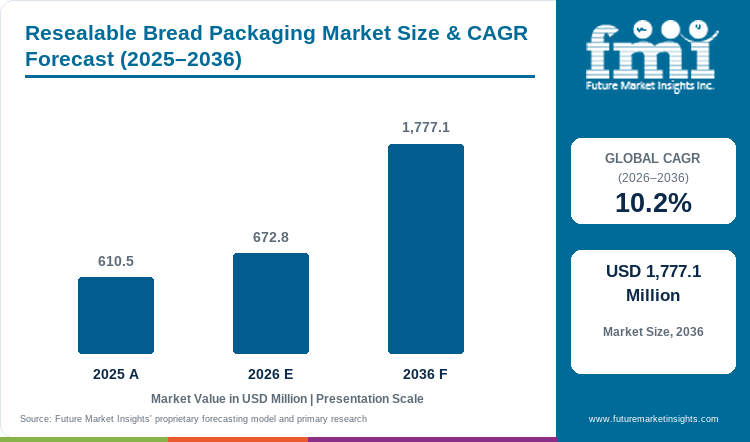
USD 672.8 million in 2026 and USD 1,777.1 million by 2036 at a 10.2% CAGR.
Demand for resealable bread packaging is projected to expand at 10.2% CAGR between 2026 and 2036, growing from USD 610.5 million in 2025 to USD 672.8 million in 2026, and escalating to USD 1,777.1 million by 2036. Bakery brands need reclose features that preserve freshness without disrupting high-speed bread packing operations during production. Amcor documented Woolworths bread bags containing 30% recycled plastic on six sliced-bread products in June 2025. The rollout shows that material redesign can reach bread shelves within familiar flexible formats. Reclosure suppliers still need the closure and film structure to work with printing and machine settings at commercial throughput.
Country growth differs because national packaging rules change the evidence required before bakery suppliers switch materials. UAE is forecast at 11.5% CAGR compared with Japan at 9.2% over the same assessment period. The UAE Ministry of Climate Change and Environment published a national single-use products guide in January 2025 for producers and importers as well as distributors and retailers. The guide also lists thin bags used for food packaging among the stated national exemptions. That framework gives bread suppliers a defined route but requires accurate package classification during material redesign. Japan has established separate-collection systems that place greater weight on material identification before one bread-pack architecture can move between national markets.
Key Takeaways
- Repeated opening makes post-purchase freshness a measurable requirement for industrial bakeries selling multi-use bread loaves.
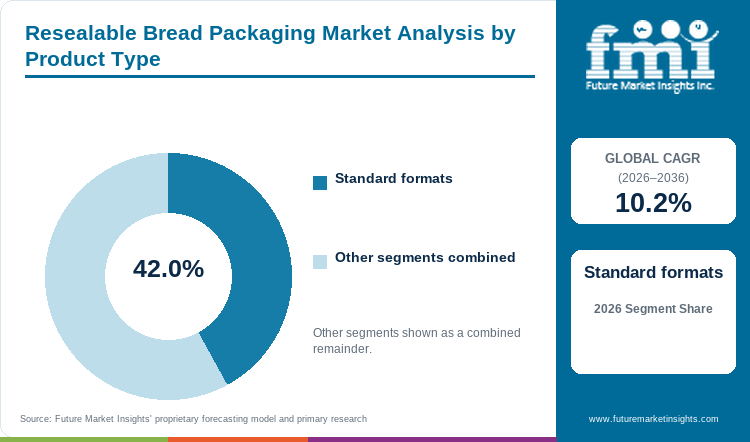
- Based on product type, standard formats are projected to account for 42.0% in 2026, supported by familiar dimensions that reduce line-change risk on installed bread-packaging equipment.
- The material category is forecast to be led by paper & board at 40.0% share in 2026, supported by printability and established fiber-recovery routes for bakery packaging.
- Bread & rolls are set to lead the bakery application category with 37.0% share in 2026, attributable to repeated access that exposes closure performance during household use.
- Mixed-material closures raise recycling and documentation burdens if convenience improvements weaken line speed or disposal clarity.
- Some of the key players in this market include Amcor, Mondi Group, Sealed Air, Smurfit Westrock, Novolex, Kwik Lok, ProAmpac, Sabert, Detmold Group, and Vegware.
Analyst Perspective
“Bakery buyers fund reclosure only after the package protects loaf quality without introducing an unstable machine step. Commercially durable formats document freshness and material recovery while maintaining repeatable line output in one qualification program.”
- Nandini Roy Choudhury, Principal Consultant, Future Market Insights
How is the resealable bread packaging market segmented?
The market is segmented by product type, material, bakery application, function, end use, and region.
The resealable bread packaging market is segmented by product type, material, bakery application, function, end use, and region for analysis. Product type covers standard, printed - branded, resealable - functional, and sustainable formats while material separates paper & board, plastic films, compostable - bio-based, and aluminium & specialty structures. Bakery application covers bread & rolls, cakes & pastry, cookies & biscuits, and frozen bakery while function distinguishes primary, secondary, transit & returnable, and active - shelf-life extension packaging. End use separates industrial bakeries, in-store bakery & retail, and artisan & foodservice operations within the global regional taxonomy.
What supports standard formats within the product type category?
Industrial bakeries keep standard bags in qualification programs because installed baggers define workable dimensions and closure stations preserve familiar changeover routines. Adjacent packaging films still need to match those machine settings before a bakery accepts a material or closure change. Kwik Lok introduced the 872 Plus bag-closing machine at IBIE in September 2025 with fewer parts and simplified operation for bakeries. The redesign reflects a practical buying condition: a package format must preserve predictable feed and closing behavior before engineering teams extend a trial into routine production. Bakery engineers still compare print registration and discharge performance before replacing a familiar bread-bag format on a high-volume line.
- By product type, standard formats are estimated to hold 42.0% in 2026, owing to low conversion risk on familiar bread-packaging equipment.
- Bakery teams compare seal repeatability and coding accuracy against discharge performance before extending a trial into routine production volumes.
How does paper & board influence selection within the material category?
Paper structures give bread brands a visible fiber route, yet coatings and windows must protect moisture-sensitive products without confusing recovery. Mondi launched FunctionalBarrier Paper Ultimate in August 2025 for food applications requiring strong moisture and oxygen protection. The company stated that the paper runs on existing horizontal and vertical form-fill-seal equipment. Those operating features matter to bakery converters because a fiber bread format must retain barrier performance without forcing an unrelated machine investment. Bread-specific moisture trials still determine whether the package protects loaf softness after repeated household opening. The commercial advantage appears when a paper bag protects the loaf and fits the converter's established paper packaging process without adding a separate production step.
- Paper & board is projected to hold 40.0% share in 2026, supported by printability and fiber-recovery routes that remain familiar to bakery converters.
- Converters still need bread-specific moisture trials because a recyclable paper claim does not establish softness retention after several consumer openings.
Why do bread & rolls draw resealable packaging attention within bakery application?
Loaves are commonly reopened several times, so the package experiences repeated handling after the bakery has lost direct control of storage conditions. Repeated access makes packaged bread a direct test of closure usability instead of a one-time sealing problem. Amcor's March 2026 bakery portfolio covers bags and flow-wrap structures for breads, buns and rolls alongside other bakery formats. The portfolio confirms that bread converters compare protection and line performance within formats already used on commercial bakery equipment. A resealable bread package therefore earns repeat orders only when the closure remains easy to use after opening and the bag still protects texture throughout the normal household consumption cycle.
- In 2026, bread & rolls are expected to lead bakery application with 37.0% share, driven by repeated access that makes post-opening protection easier to evaluate.
- Bread brands therefore test tear resistance and closure force beside moisture control over the expected consumption cycle before approving the package for routine use.
What role does primary packaging play within the function category?
Primary packs carry the closure and food-contact surface together with the label and moisture barrier that consumers use after purchase. In barrier packaging the technical question is inseparable from recyclability because every coating or attached component changes the recovery route. Regulation (EU) 2025/40 requires packaging placed on the EU market to meet recyclability requirements under phased design-for-recycling and recycled-at-scale criteria. That rule moves scrutiny toward the complete bread bag and closure combination because a compliant material can still fail if attached components lower the package's recyclability grade during assessment.
- By function, primary packaging is forecast to represent 48.0% in 2026, attributable to the consumer-facing layer controlling repeated access and freshness protection.
- Bakery qualification therefore examines the complete contact package before secondary cases or transit formats can influence the final commercial decision.
How do industrial bakeries evaluate the end use category?
Industrial bakeries can measure packaging economics over long runs, which makes small changes in closure reliability or downtime visible in unit costs. High-volume bakery products also give engineering teams enough throughput to justify structured package trials before a format change reaches regular production. Sabert's June 2025 IDDBA program presented food-packaging solutions for supermarket, deli and bakery operators with manufacturing and material-science investment behind the offer. Bakery operations still approve a resealable format on line behavior rather than portfolio breadth alone. Jam rates and changeover time must remain acceptable beside coding accuracy and seal consistency before a new package can move into repeat commercial runs.
- Industrial bakeries are likely to capture 42.0% share in 2026, supported by repeat production runs that make packaging performance measurable over commercial volumes.
- Operations teams approve a resealable format only after jam rates and changeover time remain acceptable alongside coding accuracy and seal consistency during production trials.
What are the drivers, restraints and opportunities in the Resealable Bread Packaging Market?
Freshness supports reclosure demand while material rules raise qualification costs and integrated recyclable formats offer a workable conversion route.
- Driver: Bakery brands test closures that protect bread after repeated opening without changing normal consumer handling routines.
- Restraint: Plastic-content and recyclability rules can delay convenient closures if material records or separation routes remain weak.
- Opportunity: Suppliers can pair practical reclosure with fiber or mono-material structures that keep existing bakery equipment productive.
Repeated Opening Makes Freshness a Closure Requirement
Repeated consumer access turns freshness retention into a package-performance issue for bread brands selling multi-use loaves. Bakeries need a closure that protects the remaining loaf without changing normal consumer handling or adding an unstable production step. Kwik Lok described the Enviro-Lok PE closure in August 2025 as a polyethylene option designed for bakery bags and existing closing equipment. The same update explains that the closure can be removed and reapplied to protect product freshness during consumption. This direct reclose function strengthens demand for food packaging systems that preserve convenience after first opening. Bakery teams still compare that benefit with closure cost and production speed before committing a format to routine volume.
Material Rules Extend Bread-Pack Qualification
Material rules can delay a bread-format change even after the closure performs reliably during commercial line trials. HM Revenue & Customs requires manufacturers or importers reaching 10 tonnes of finished plastic packaging to consider Plastic Packaging Tax registration. Components containing less than 30% recycled plastic can be chargeable under the rules and therefore add documentation to a recyclable packaging project. Bakery converters must account for the bag and attached closure as one material decision because the selected resin can affect tax treatment and recovery claims. A resealable format loses its cost advantage when extra recordkeeping or a slower line change outweighs the freshness benefit achieved after opening.
Integrated Barrier and Closure Design Opens a Conversion Route
A practical opportunity comes from designing reclosure and substrate inside one bakery qualification project from the start. ProAmpac expanded its RP-2000 recyclable high-barrier fiber series in February 2026 for moisture- and oxygen-sensitive dry-food applications. The development gives converters another fiber structure to evaluate where barrier performance must be proven before a closure is added. Suppliers working with mono-material packaging can apply the same integration principle by matching closure resin or attachment method to the main package structure. Bakery customers can then test seal force and moisture control with printing and recovery performance in one program. Successful line trials give converters a clearer route from material selection to repeat production.
Which country CAGRs are profiled in the Resealable Bread Packaging Market?
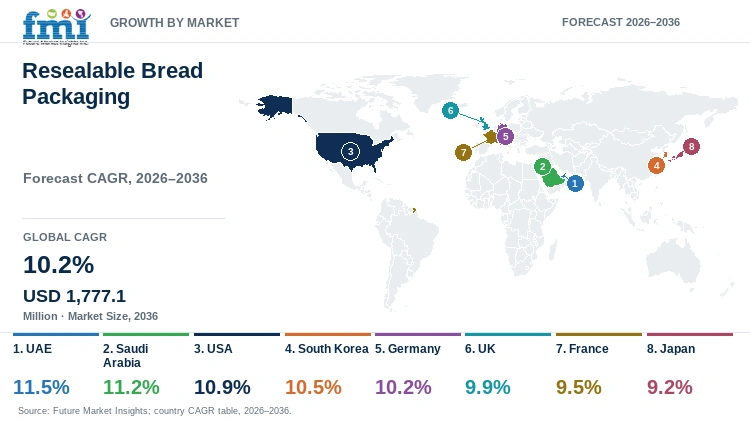
| Country | CAGR |
|---|---|
| UAE | 11.5% |
| Saudi Arabia | 11.2% |
| USA | 10.9% |
| South Korea | 10.5% |
| Germany | 10.2% |
| UK | 9.9% |
| France | 9.5% |
| Japan | 9.2% |
How do country-level CAGRs compare in the Resealable Bread Packaging Market?
The eight forecasts span 2.3 percentage points between UAE and Japan without ranking present revenue or bakery capacity. Gulf markets form the upper band and France with Japan form the lower-rate pair under different recovery and retail conditions.
- UAE packaging rules preserve a narrow fresh-bread exemption but make accurate format classification commercially important.
- Saudi Arabia pairs a large licensed food base with conformity requirements that raise documentation expectations for imported closures.
- USA bakery scale makes line stability and state-ready documentation important before converters standardize one closure format.
- South Korea ties package approval to detailed material specifications and current local technical documentation for food-contact formats.
- Germany combines mature recovery infrastructure with strict attention to how windows and closures enter sorting streams.
- UK plastic-content rules make recycled-content records a direct cost and qualification issue for flexible bread packs.
- France expands professional-packaging responsibility from 2027 and adds administrative work to bread-format changes for converters and brands.
- Japan combines extensive municipal collection planning with retail routines that favor compact and clearly identified package materials.
Comparable CAGRs still produce different entry conditions because compliance work and recovery systems change conversion timing. The full report provides country-level CAGR analysis across North America, Latin America, Western Europe, Eastern Europe, East Asia, South Asia and Pacific, and the Middle East and Africa.
Country-wise Analysis
- UAE retailers operate under a nationwide single-use policy that preserves a narrow exemption for very thin fresh-bread bags. By 2036, UAE is projected to grow at 11.5% CAGR, supported by a national exemption structure that preserves fresh-bread formats while other single-use rules tighten. Emirates News Agency confirmed in December 2025 that the second ban phase would start in January 2026 with fresh-bread wraps among stated exemptions. The exemption preserves some current formats but makes accurate package classification material during redesign work. Bakery suppliers still need lower-material alternatives that survive repeated opening and warm distribution conditions without weakening closure performance. Reclose systems can gain volume by preserving convenience without depending on an exemption that may not fit every bread format.
- Saudi industrial bakeries supply modern retail networks where warm logistics make seal reliability and food-contact records equally important. Saudi Arabia's resealable bread packaging outlook is anticipated to advance at 11.2% CAGR over the assessment period, supported by a regulated food-manufacturing and storage base serving bakery accounts nationwide. The Saudi Food and Drug Authority recorded 624 licensed food factories and 5,344 licensed food warehouses during 2025. Those national totals establish a substantial regulated food-manufacturing and storage base that packaging suppliers must serve. Imported closures still need clear conformity records and heat-tolerant performance before a bakery can standardize them.
- USA bread producers operate large commercial lines where downtime and format consistency are visible in packaging economics. Resealable bread packaging demand in USA is forecast to rise at 10.9% CAGR over the forecast period, supported by bakery operations where line stability affects packaging economics. Bureau of Labor Statistics data for May 2026 show about 272.7 thousand jobs in bread and bakery product manufacturing. That national employment base confirms substantial bakery production activity where line disruptions affect many operating shifts. Suppliers serving flexible plastic packaging need scalable specifications and state-ready documentation before one closure system can support broad bakery programs.
- South Korean food-packaging qualification depends on detailed material specifications and formal controls for containers and packages. Adoption of resealable bread packaging in South Korea is estimated to expand at 10.5% CAGR through 2036, shaped by food-contact rules that require exact material specifications for package approval. The Ministry of Food and Drug Safety amended its standards in March 2026 to clarify PVC restrictions involving DEHP and DEHA and expand criteria for physically recycled polypropylene used in food-contact applications. The rule gives converters a defined route for certain recycled materials but raises the value of exact resin documentation. International suppliers must keep Korean technical files aligned with the legal standard so simpler bag and closure combinations reduce approval delays.
- Germany places design-for-recycling decisions inside a mature collection system that already handles large packaging volumes. The German resealable bread packaging sector is projected to record 10.2% CAGR during the assessment period, influenced by design-for-recycling requirements within established national collection routes. The German Environment Agency and Central Agency Packaging Register reported in January 2026 that about 5.5 million tonnes of dual-system packaging were recycled during 2024. With that material moving through established recovery routes, attached windows and closures become practical sorting decisions rather than secondary design details. German bakery customers need component-level recovery evidence before paper bags with reclose features can replace familiar film without slowing approval or adding sorting risk.
- UK bakery and grocery teams work inside a packaging system where recovery performance differs between plastic and paper formats. In the UK, resealable bread packaging demand is predicted to advance at 9.9% CAGR through 2036, influenced by recovery differences between plastic and paper formats during package qualification. Defra’s July 2025 UK statistics on waste reported 51.0% recycling for plastic packaging and 74.3% for paper and cardboard under its 2024 methodology. Reclosure suppliers must show that closures and barrier layers fit the selected recovery route while preserving food-contact performance. Bakery customers can approve a format faster when material declarations and line trials explain both recovery behavior and closing performance before repeat orders begin.
- French bakery buyers evaluate format changes against national producer-responsibility administration during routine packaging redesign. France is estimated to post 9.5% CAGR over the forecast period, owing to producer-responsibility changes that move packaging classification into customer review. ADEME states that the professional-packaging EPR scheme will apply from January 1 2027 and producers must join an approved eco-organization or operate an approved individual system. The change makes material declarations and packaging classification part of the commercial file before a converter changes a bread bag. Fiber structures can gain attention where they simplify recovery communication but attached windows and closure components still need a defensible route. Concise compliance records can shorten customer review and reduce administrative friction during a bread-bag material change.
- Japanese bakery channels operate within national collection systems that make material identification a routine package-design consideration. Resealable bread packaging sales in Japan are forecast to expand at 9.2% CAGR by 2036, supported by separate-collection routes that raise the value of material identification. The Ministry of the Environment reported in March 2026 that 1,434 municipalities planned separate collection of plastic containers and packaging for fiscal 2026 and 904 planned paper packaging collection. Those routes give converters established recovery contexts but limit tolerance for confusing mixed structures. New formats must preserve performance on familiar high-speed wrapping routines before bakery operators approve production use.
Who are the notable companies in the Resealable Bread Packaging Market?
Amcor, Mondi Group, Sealed Air, Smurfit Westrock, Novolex, Kwik Lok, ProAmpac, Sabert, Detmold Group, and Vegware serve the defined competitive field.
Competition spans integrated converters and closure specialists plus fiber-focused food-packaging businesses serving distinct bakery qualification routes. Entry depends on proving bakery-line performance with repeated opening and a workable recovery route. Vegware remains a distinct operating brand under Novolex ownership which places both names within one corporate group despite separate market-facing offers.
- Amcor and Mondi Group join ProAmpac and Novolex as broad converting platforms for multi-format bakery trials.
- Kwik Lok concentrates on bakery closures while Sealed Air contributes food-protection and automated packaging experience to qualification.
- Smurfit Westrock and Sabert join Detmold Group and Novolex-owned Vegware in fiber or compostable food-packaging routes.
Competitive Benchmarking: Resealable Bread Packaging Market
| Company | Bakery Fit | Reclosure Integration | Circular Material Evidence | Geographic Reach |
|---|---|---|---|---|
| Amcor | High | Medium | High | Global |
| Mondi Group | High | Low | High | Global |
| Sealed Air | High | High | Medium | Global |
| Smurfit Westrock | High | Low | High | Global |
| Novolex | High | Medium | High | North America and Europe |
| Kwik Lok | High | High | High | Global |
| ProAmpac | High | High | High | Global |
| Sabert | High | Low | High | North America and selected international markets |
| Detmold Group | Medium | Low | High | Asia-Pacific, North America and international markets |
| Vegware | High | Low | High | UK, Europe and international distribution |
Scoring basis: High bakery fit requires current official bread or bakery evidence tied to commercial packaging use. Medium bakery fit requires current food-packaging evidence serving the same buyer route without a bread-specific action. Low bakery fit records broader packaging relevance only after a documented immediate-family admission test confirms the shared buyer route. High reclosure integration requires a documented resealable package or bakery closing-system capability tied to the supplier's current offer. Medium reclosure integration requires current package-system evidence that supports closure integration without a dedicated bread reclose action. Low reclosure integration records a documented scope that does not include a supplier-owned reclosure system. High circular-material evidence requires current recyclable or recycled-content action plus fiber or compostable evidence from official sources. Medium circular-material evidence requires one current circular route and Low records only broader material support without a qualifying circular action.
Key Developments in the Resealable Bread Packaging Market
- In May 2026, Sabert announced new multi-substrate packaging launches for bakery and related food operators ahead of IDDBA 2026.
- In February 2026, Vegware introduced laminated kraft bloomer bags with NatureFlex windows for fresh rolls and pastries.
- In May 2025, ProAmpac announced bakery-focused packaging solutions for IDDBA 2025 including fiber formats for retail food operations.
Key Players in the Resealable Bread Packaging Market
Integrated Flexible and Fiber Packaging Platforms
- Amcor
- Mondi Group
- ProAmpac
- Novolex
Closure and Food-Protection Specialists
- Kwik Lok
- Sealed Air
Fiber and Compostable Food-Packaging Businesses
- Smurfit Westrock
- Sabert
- Detmold Group
- Vegware
Resealable Bread Packaging Market - Report Scope
| Coverage field | Report scope |
|---|---|
| Market breakdown | By product type, material, bakery application, function, end use, and region. |
| Quantitative Units | USD million. |
| Market Definition | Revenue from converted resealable packages and closure components sold for bakery products within the stated segmentation boundary; downstream bakery-product revenue, standalone machinery, raw materials sold without conversion, generic non-resealable packs, and adjacent food-packaging categories are excluded. |
| Regions Covered | North America, Latin America, Western Europe, Eastern Europe, East Asia, South Asia and Pacific, and Middle East and Africa. |
| Countries Covered | USA, Germany, France, UK, Saudi Arabia, UAE, Japan, South Korea, and 20+ countries included in the full report. |
| Key Companies Profiled | Amcor, Mondi Group, Sealed Air, Smurfit Westrock, Novolex, Kwik Lok, ProAmpac, Sabert, Detmold Group, Vegware. |
| Forecast Period | 2026 to 2036. |
| Approach | Primary and secondary research with market triangulation. |
Resealable Bread Packaging Market - Research Methodology
| Method | Approach |
|---|---|
| Primary Research | FMI analysts gathered input from manufacturers, service providers, technology developers, distributors, end users, procurement teams, and subject-matter experts. Interviews examined purchasing decisions, product or service evaluation, adoption barriers, approval requirements, pricing considerations, and expectations for technical or commercial support. Respondents were also asked what evidence is required before a trial, pilot, or initial order develops into regular purchasing. |
| Desk Research | Desk research covered government statistics, regulatory publications, trade data, industry associations, technical literature, standards, company filings, product information, and official corporate announcements. Sources were reviewed for relevance, publication date, geographic coverage, and consistency with the defined market scope. Claims relating to performance, applications, approvals, capacity, investment, and commercial activity were retained only when supported by credible public evidence. |
| Market Sizing and Forecasting | The market model combined the baseline value with historical performance, segment structure, pricing and volume indicators, adoption levels, company participation, and country-level demand conditions. Forecast assumptions considered economic activity, investment trends, regulatory developments, technology adoption, purchasing cycles, supply availability, and barriers to wider market use. Segment and regional estimates were reconciled before the final market total was calculated. |
| Data Validation | Estimates were checked against multiple independent indicators, including public data, company activity, trade patterns, industry developments, and findings from primary interviews. Validation also tested whether products, services, applications, and company revenues fell within the defined market boundaries. Adjacent categories, unsupported claims, overlapping revenues, and activities without direct market relevance were excluded to reduce double counting and maintain consistency across segments and countries. |
Resealable Bread Packaging Market by Segments
Resealable Bread Packaging Market segmented by Product Type:
- Standard formats
- Printed - branded formats
- Resealable - functional formats
- Sustainable formats
Resealable Bread Packaging Market segmented by Material:
- Paper & board
- Plastic films
- Compostable - bio-based
- Aluminium & specialty
Resealable Bread Packaging Market segmented by Bakery Application:
- Bread & rolls
- Cakes & pastry
- Cookies & biscuits
- Frozen bakery
Resealable Bread Packaging Market segmented by Function:
- Primary packaging
- Secondary packaging
- Transit & returnable
- Active - shelf-life extension
Resealable Bread Packaging Market segmented by End Use:
- Industrial bakeries
- In-store bakery & retail
- Artisan & foodservice
Resealable Bread Packaging Market by Region:
- North America
- United States
- Canada
- Latin America
- Brazil
- Mexico
- Argentina
- Chile
- Western Europe
- Germany
- France
- United Kingdom
- Italy
- Spain
- Benelux
- Nordics
- Eastern Europe
- Poland
- Czech Republic
- Romania
- Hungary
- East Asia
- China
- Japan
- South Korea
- South Asia and Pacific
- India
- ASEAN
- Australia and New Zealand
- Middle East and Africa
- GCC Countries
- South Africa
- Türkiye
- Israel
Research Sources and Bibliography
- Amcor. (2025, September 30). Circularity in motion: Woolworths rolls out more sustainable bread bags with 30% recycled plastic.
- Ministry of Climate Change and Environment, United Arab Emirates. (2025, January 2). Ministry of Climate Change and Environment reveals details of comprehensive guide outlining regulations for single-use plastic products.
- Kwik Lok. (2025, September 2). Kwik Lok Debuts New 872 Plus at IBIE 2025.
- Mondi. (2025, August 14). Mondi ramps up FunctionalBarrier Paper Ultimate to meet growing demand for sustainable high-barrier paper-based packaging.
- Amcor. (2026, March 18). Amcor showcases innovative packaging solutions for bakery applications.
- European Parliament and Council of the European Union. (2025, January 22). Regulation (EU) 2025/40 on packaging and packaging waste.
- Sabert Corporation. (2025, June 2). Sabert Invests in the Future of Food Packaging with Innovative, Domestically Produced Solutions Featured at the 2025 IDDBA Show.
- Kwik Lok. (2025, August 22). Skate where the hockey puck is going.
- HM Revenue & Customs. (2026, February 12). Plastic Packaging Tax: steps to take.
- ProAmpac. (2026, February 17). ProAmpac Pushes the Limits of Fiber Packaging with New High Barrier Packaging Innovation Platform.
- Emirates News Agency. (2025, December 16). Second phase of nationwide ban on import, trade of single-use consumer plastic products, bags begins.
- Saudi Food and Drug Authority. (2026, January 26). SFDA Reports 18% Growth in Licensed Factories and Warehouses During 2025.
- USA Bureau of Labor Statistics. (2026, May). Table B-1a. Employees on nonfarm payrolls by industry sector and selected industry detail, seasonally adjusted.
- Ministry of Food and Drug Safety, Republic of Korea. (2026, March 27). Partial amendment to Standards and Specifications for Utensils, Containers and Packages (Notice No. 2026-24).
- German Environment Agency & Central Agency Packaging Register. (2026, January 27). Facts against myths: Packaging waste recycling in Germany is working.
- Department for Environment, Food & Rural Affairs. (2025, July 23). UK statistics on waste.
- ADEME. (2026, February 20). La filière des emballages professionnels agrandit son périmètre.
- Ministry of the Environment, Government of Japan. (2026, March 31). Summary results of projected separate collection volumes from FY2026 under the Containers and Packaging Recycling Law.
- Sabert Corporation. (2026, May 19). Sabert to Showcase New Packaging Innovations at IDDBA 2026.
- Vegware. (2026, February 10). Check out our lovely new bloomer bags.
- ProAmpac. (2025, May 29). ProAmpac Unboxes Fresh Thinking at IDDBA 2025.
- Smurfit Westrock. (2025, September 24). 150 projects and counting: Smurfit Westrock’s Design2Market sets the standard for packaging innovation.
- Mondi. (2025, November 25). Mondi customers experience high-performance kraft paper firsthand at new paper machine in Štětí mill.
- Mondi. (2025, April 2). Inside Mondi FlexStudios - and its innovation for circular packaging.
- Sealed Air. (2025, September 9). CRYOVAC Brand Food Packaging Installs 4,000th Rotary Vacuum Packaging System.
- Vegware. (2025, January 20). New Vegware and Food4Soil composting partnership.
- Sealed Air. (n.d.). Multi-Seal FlexLOK resealable lidding film. Retrieved September 16, 2026.
- ProAmpac. (n.d.). Quality Certifications. Retrieved September 16, 2026.
- Amcor. (2025, February 12). Amcor partners with Tip Top to introduce bread bags with 30% recycled plastic.
- Mondi. (2025, November 18). Mondi launches extended corrugated and solid board portfolio for the food packaging industry.
- Sealed Air. (2026, April 9). Sealed Air Announces Completion of Acquisition by CD&R.
- Smurfit Westrock. (2026, June 1). Smurfit Westrock announces €600 million investment ahead of Choose France summit.
- Novolex. (2025, April 1). Novolex and Pactiv Evergreen Inc. Complete Combination, Creating a Leading Manufacturer in Food, Beverage and Specialty Packaging.
- Kwik Lok. (2026, April 29). Kwik Lok Acquires Full Ownership of Kwik Lok Australia.
- ProAmpac. (2025, August 14). ProAmpac Commercializes High-Performance, Recyclable Ready Packaging for Chunk Cheese.
- Sabert Corporation. (2026, August 18). Sabert Opens Fifth USA Distribution Facility in Georgia to Meet Growing Customer Demand.
- Detmold Group. (2026, July 20). Global packaging supplier Detpak opens new manufacturing facility in Spartanburg, South Carolina.
- Vegware. (2026, February 2). Introducing Eco-Products: now available in the UK.
This bibliography is provided for reader reference and is not exhaustive. The full report contains the complete reference list and detailed citations.
This Report Answers
- How large is resealable bread packaging demand in 2026 and 2036?
- Which operating condition makes repeated bread opening commercially relevant for packaging suppliers?
- Which product type holds 42.0% of 2026 product type demand?
- Why do bread & rolls account for 37.0% of bakery application demand?
- How do national packaging rules change supplier entry conditions in selected countries?
- Which companies provide converting and closure capabilities for resealable bread packaging?
- What qualification problems can delay otherwise attractive resealable bread package conversions?
- Which recent company actions are changing bakery packaging capacity and customer access?
Frequently Asked Questions
How big is the resealable bread packaging market in 2026?
The resealable bread packaging market is valued at USD 672.8 million in 2026 and is projected to reach USD 1,777.1 million by 2036. Repeated opening supports reclosure demand where bakery lines preserve normal throughput during commercial packing and distribution operations.
What is the CAGR of the resealable bread packaging market from 2026 to 2036?
The resealable bread packaging market is projected to grow at 10.2% CAGR between 2026 and 2036. Bakery adoption depends on reclose functions meeting material and food-contact requirements without reducing line speed.
Which product type accounts for 42.0% of resealable bread packaging demand?
Standard formats are projected to hold 42.0% share in 2026, supported by familiar dimensions that fit existing bagging and closing equipment. That equipment fit reduces trial work for high-volume bakeries that already run familiar bag dimensions and closure stations.
Which countries record the highest projected growth in resealable bread packaging?
UAE is projected at 11.5% CAGR through 2036 and Saudi Arabia follows at 11.2%. USA is forecast at 10.9% as packaging rules and bakery-line requirements shape a different national conversion path.
Which companies are active in the resealable bread packaging market?
Key companies active in resealable bread packaging include Amcor, Mondi Group, Sealed Air, Smurfit Westrock, Novolex, Kwik Lok, ProAmpac, Sabert, Detmold Group, and Vegware. Kwik Lok specializes in reclosable bakery closures while Vegware operates as a Novolex-owned compostable packaging brand.
Preview the report firsthand - request a free sample
Get SampleGet the brochure for pricing and purchase details.
Get PDFTable of Content
- Key Takeaways
- Market Size and CAGR
- Top Growth Driver
- Fastest Growing Segment
- Leading Region
- Key Companies
- Emerging Opportunities
- Executive Summary
- Global Market Outlook
- Demand-side Trends
- Supply-side Trends
- Technology Roadmap Analysis
- Analysis and Recommendations
- Analyst Perspective (What is happening? Why now? What should investors know?)
- Key Questions Answered
- How large is the market?
- What is the CAGR?
- What are key trends?
- Which region dominates?
- Who are the leaders?
- Market Overview
- Market Coverage / Taxonomy
- Market Definition / Scope / Limitations
- Research Methodology
- Chapter Orientation
- Analytical Lens and Working Hypotheses
- Market Structure, Signals, and Trend Drivers
- Benchmarking and Cross-market Comparability
- Market Sizing, Forecasting, and Opportunity Mapping
- Research Design and Evidence Framework
- Desk Research Programme (Secondary Evidence)
- Expert Input and Fieldwork (Primary Evidence)
- Tooling, Models, and Reference Databases
- Data Engineering and Model Build
- Quality Assurance and Audit Trail
- Market Background
- Market Dynamics (Drivers, Restraints, Opportunity, Trends)
- Scenario Forecast (Optimistic, Likely, Conservative)
- Impact Analysis
- AI Impact
- Sustainability Impact
- Regulatory Impact
- Technology Impact
- Consumer / Buyer Analysis
- Purchase Drivers
- Adoption Barriers
- Buyer Journey
- Opportunity Map Analysis
- Product Life Cycle Analysis
- Supply Chain Analysis
- Investment Feasibility Matrix
- Value Chain Analysis
- PESTLE and Porter's Analysis
- Regulatory Landscape
- Regional Parent Market Outlook
- Production and Consumption Statistics
- Import and Export Statistics
- Global Market Analysis and Forecast, 2021 to 2036
- Historical Market Size Value (USD Million) Analysis, 2021 to 2025
- Current and Future Market Size Value (USD Million) Projections, 2026 to 2036
- Y-o-Y Growth Trend Analysis
- Absolute $ Opportunity Analysis
- Global Market Pricing Analysis, 2021 to 2036
- Global Market Analysis and Forecast, By Product Type, 2021 to 2036
- Introduction / Key Findings
- Historical Market Size Value (USD Million) Analysis By Product Type, 2021 to 2025
- Current and Future Market Size Value (USD Million) Analysis and Forecast By Product Type, 2026 to 2036
- Standard formats
- Printed - branded formats
- Resealable - functional formats
- Sustainable formats
- Y-o-Y Growth Trend Analysis By Product Type, 2021 to 2025
- Absolute $ Opportunity Analysis By Product Type, 2026 to 2036
- Global Market Analysis and Forecast, By Material, 2021 to 2036
- Introduction / Key Findings
- Historical Market Size Value (USD Million) Analysis By Material, 2021 to 2025
- Current and Future Market Size Value (USD Million) Analysis and Forecast By Material, 2026 to 2036
- Paper & board
- Plastic films
- Compostable - bio-based
- Aluminium & specialty
- Y-o-Y Growth Trend Analysis By Material, 2021 to 2025
- Absolute $ Opportunity Analysis By Material, 2026 to 2036
- Global Market Analysis and Forecast, By Bakery Application, 2021 to 2036
- Introduction / Key Findings
- Historical Market Size Value (USD Million) Analysis By Bakery Application, 2021 to 2025
- Current and Future Market Size Value (USD Million) Analysis and Forecast By Bakery Application, 2026 to 2036
- Bread & rolls
- Cakes & pastry
- Cookies & biscuits
- Frozen bakery
- Y-o-Y Growth Trend Analysis By Bakery Application, 2021 to 2025
- Absolute $ Opportunity Analysis By Bakery Application, 2026 to 2036
- Global Market Analysis and Forecast, By Function, 2021 to 2036
- Introduction / Key Findings
- Historical Market Size Value (USD Million) Analysis By Function, 2021 to 2025
- Current and Future Market Size Value (USD Million) Analysis and Forecast By Function, 2026 to 2036
- Primary packaging
- Secondary packaging
- Transit & returnable
- Active - shelf-life extension
- Y-o-Y Growth Trend Analysis By Function, 2021 to 2025
- Absolute $ Opportunity Analysis By Function, 2026 to 2036
- Global Market Analysis and Forecast, By End Use, 2021 to 2036
- Introduction / Key Findings
- Historical Market Size Value (USD Million) Analysis By End Use, 2021 to 2025
- Current and Future Market Size Value (USD Million) Analysis and Forecast By End Use, 2026 to 2036
- Industrial bakeries
- In-store bakery & retail
- Artisan & foodservice
- Y-o-Y Growth Trend Analysis By End Use, 2021 to 2025
- Absolute $ Opportunity Analysis By End Use, 2026 to 2036
- Global Market Analysis and Forecast, By Region, 2021 to 2036
- Introduction
- Historical Market Size Value (USD Million) Analysis By Region, 2021 to 2025
- Current Market Size Value (USD Million) Analysis and Forecast By Region, 2026 to 2036
- North America
- Latin America
- Western Europe
- Eastern Europe
- East Asia
- South Asia and Pacific
- Middle East and Africa
- Market Attractiveness Analysis By Region
- North America Market Analysis and Forecast, By Country, 2021 to 2036
- Historical Market Size Value (USD Million) Trend Analysis By Market Taxonomy, 2021 to 2025
- Market Size Value (USD Million) Forecast By Market Taxonomy, 2026 to 2036
- By Country
- United States
- Canada
- By Product Type
- By Material
- By Bakery Application
- By Function
- By End Use
- By Country
- Market Attractiveness Analysis
- By Country
- By Product Type
- By Material
- By Bakery Application
- By Function
- By End Use
- Key Takeaways
- Latin America Market Analysis and Forecast, By Country
- Historical Market Size Value (USD Million) Trend Analysis By Market Taxonomy, 2021 to 2025
- Market Size Value (USD Million) Forecast By Market Taxonomy, 2026 to 2036
- By Country
- Brazil
- Mexico
- Argentina
- Chile
- By Product Type
- By Material
- By Bakery Application
- By Function
- By End Use
- By Country
- Market Attractiveness Analysis
- By Country
- By Product Type
- By Material
- By Bakery Application
- By Function
- By End Use
- Key Takeaways
- Western Europe Market Analysis and Forecast, By Country
- Historical Market Size Value (USD Million) Trend Analysis By Market Taxonomy, 2021 to 2025
- Market Size Value (USD Million) Forecast By Market Taxonomy, 2026 to 2036
- By Country
- Germany
- France
- United Kingdom
- Italy
- Spain
- Benelux
- Nordics
- By Product Type
- By Material
- By Bakery Application
- By Function
- By End Use
- By Country
- Market Attractiveness Analysis
- By Country
- By Product Type
- By Material
- By Bakery Application
- By Function
- By End Use
- Key Takeaways
- Eastern Europe Market Analysis and Forecast, By Country
- Historical Market Size Value (USD Million) Trend Analysis By Market Taxonomy, 2021 to 2025
- Market Size Value (USD Million) Forecast By Market Taxonomy, 2026 to 2036
- By Country
- Poland
- Czech Republic
- Romania
- Hungary
- By Product Type
- By Material
- By Bakery Application
- By Function
- By End Use
- By Country
- Market Attractiveness Analysis
- By Country
- By Product Type
- By Material
- By Bakery Application
- By Function
- By End Use
- Key Takeaways
- East Asia Market Analysis and Forecast, By Country
- Historical Market Size Value (USD Million) Trend Analysis By Market Taxonomy, 2021 to 2025
- Market Size Value (USD Million) Forecast By Market Taxonomy, 2026 to 2036
- By Country
- China
- Japan
- South Korea
- By Product Type
- By Material
- By Bakery Application
- By Function
- By End Use
- By Country
- Market Attractiveness Analysis
- By Country
- By Product Type
- By Material
- By Bakery Application
- By Function
- By End Use
- Key Takeaways
- South Asia and Pacific Market Analysis and Forecast, By Country
- Historical Market Size Value (USD Million) Trend Analysis By Market Taxonomy, 2021 to 2025
- Market Size Value (USD Million) Forecast By Market Taxonomy, 2026 to 2036
- By Country
- India
- ASEAN
- Australia and New Zealand
- By Product Type
- By Material
- By Bakery Application
- By Function
- By End Use
- By Country
- Market Attractiveness Analysis
- By Country
- By Product Type
- By Material
- By Bakery Application
- By Function
- By End Use
- Key Takeaways
- Middle East and Africa Market Analysis and Forecast, By Country
- Historical Market Size Value (USD Million) Trend Analysis By Market Taxonomy, 2021 to 2025
- Market Size Value (USD Million) Forecast By Market Taxonomy, 2026 to 2036
- By Country
- GCC Countries
- South Africa
- Türkiye
- Israel
- By Product Type
- By Material
- By Bakery Application
- By Function
- By End Use
- By Country
- Market Attractiveness Analysis
- By Country
- By Product Type
- By Material
- By Bakery Application
- By Function
- By End Use
- Key Takeaways
- Key Countries Market Analysis
- United States
- Pricing Analysis
- Market Share Analysis, 2025
- By Product Type
- By Material
- By Bakery Application
- By Function
- By End Use
- Canada
- Pricing Analysis
- Market Share Analysis, 2025
- By Product Type
- By Material
- By Bakery Application
- By Function
- By End Use
- Mexico
- Pricing Analysis
- Market Share Analysis, 2025
- By Product Type
- By Material
- By Bakery Application
- By Function
- By End Use
- Brazil
- Pricing Analysis
- Market Share Analysis, 2025
- By Product Type
- By Material
- By Bakery Application
- By Function
- By End Use
- Chile
- Pricing Analysis
- Market Share Analysis, 2025
- By Product Type
- By Material
- By Bakery Application
- By Function
- By End Use
- Germany
- Pricing Analysis
- Market Share Analysis, 2025
- By Product Type
- By Material
- By Bakery Application
- By Function
- By End Use
- United Kingdom
- Pricing Analysis
- Market Share Analysis, 2025
- By Product Type
- By Material
- By Bakery Application
- By Function
- By End Use
- Italy
- Pricing Analysis
- Market Share Analysis, 2025
- By Product Type
- By Material
- By Bakery Application
- By Function
- By End Use
- Spain
- Pricing Analysis
- Market Share Analysis, 2025
- By Product Type
- By Material
- By Bakery Application
- By Function
- By End Use
- France
- Pricing Analysis
- Market Share Analysis, 2025
- By Product Type
- By Material
- By Bakery Application
- By Function
- By End Use
- India
- Pricing Analysis
- Market Share Analysis, 2025
- By Product Type
- By Material
- By Bakery Application
- By Function
- By End Use
- ASEAN
- Pricing Analysis
- Market Share Analysis, 2025
- By Product Type
- By Material
- By Bakery Application
- By Function
- By End Use
- Australia and New Zealand
- Pricing Analysis
- Market Share Analysis, 2025
- By Product Type
- By Material
- By Bakery Application
- By Function
- By End Use
- China
- Pricing Analysis
- Market Share Analysis, 2025
- By Product Type
- By Material
- By Bakery Application
- By Function
- By End Use
- Japan
- Pricing Analysis
- Market Share Analysis, 2025
- By Product Type
- By Material
- By Bakery Application
- By Function
- By End Use
- South Korea
- Pricing Analysis
- Market Share Analysis, 2025
- By Product Type
- By Material
- By Bakery Application
- By Function
- By End Use
- Poland
- Pricing Analysis
- Market Share Analysis, 2025
- By Product Type
- By Material
- By Bakery Application
- By Function
- By End Use
- Hungary
- Pricing Analysis
- Market Share Analysis, 2025
- By Product Type
- By Material
- By Bakery Application
- By Function
- By End Use
- Türkiye
- Pricing Analysis
- Market Share Analysis, 2025
- By Product Type
- By Material
- By Bakery Application
- By Function
- By End Use
- South Africa
- Pricing Analysis
- Market Share Analysis, 2025
- By Product Type
- By Material
- By Bakery Application
- By Function
- By End Use
- UAE
- Pricing Analysis
- Market Share Analysis, 2025
- By Product Type
- By Material
- By Bakery Application
- By Function
- By End Use
- Saudi Arabia
- Pricing Analysis
- Market Share Analysis, 2025
- By Product Type
- By Material
- By Bakery Application
- By Function
- By End Use
- United States
- Market Structure Analysis
- Competition Dashboard
- Competition Benchmarking
- Market Share Analysis of Top Players
- By Regional
- By Product Type
- By Material
- By Bakery Application
- By Function
- By End Use
- Emerging Startups
- Innovation Benchmarking
- Competition Analysis
- Competition Deep Dive
- Amcor
- Overview
- Product Portfolio
- Profitability by Market Segments
- Sales Footprint
- Strategy Overview
- Marketing Strategy
- Product Strategy
- Channel Strategy
- Mondi Group
- Sealed Air
- Smurfit Westrock
- Novolex
- Kwik Lok
- ProAmpac
- Sabert
- Detmold Group
- Vegware
- Amcor
- Case Studies
- Success Stories
- Recent Developments
- Competition Deep Dive
- Assumptions & Acronyms Used


