

- Market Size (2026)
- USD 893.3 Mn
- Forecast (2036)
- USD 3490.1 Mn
- CAGR (2026 to 2036)
- 14.6%
How big is Bagels Market in 2026?
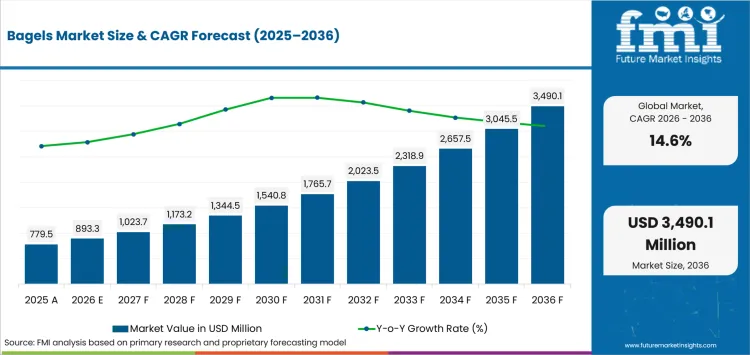
USD 893.3 million in 2026 and USD 3,490.1 million by 2036 at a 14.6% CAGR.
Sales in the bagels market are projected to grow at 14.6% CAGR through 2036, driving valuation to USD 3,490.1 million by 2036 from USD 893.3 million in 2026 as breakfast use extends into sandwiches and smaller meal occasions. USDA Economic Research Service data published in June 2026 show food-away-from-home accounted for 56.3% of USA food expenditures in 2025. Foodservice spending at that scale gives bakery products a larger route because bagels need limited kitchen preparation beyond toasting and filling.
Country economics shape format choice: packaged retail prioritizes shelf life and pack value, whereas foodservice and convenience channels prioritize handling speed. USDA Foreign Agricultural Service documented in November 2025 that 40.3% of Japanese consumers prioritized convenience in a February 2025 survey. A 4.8-point increase from 2024 makes quick meal formats more relevant in convenience foods such as bagels. Import cost and local pricing then determine whether a listing generates repeat orders.
Key Takeaways
- Demand expands as bagels move between breakfast, sandwich, snack, and foodservice occasions without requiring unfamiliar preparation.
- In 2026, plain is expected to lead product type with 25.0% share because its neutral flavor covers sweet and savory uses.
- By claim / nature, conventional is estimated to hold 54.0% in 2026 owing to broad taste, price, and formulation acceptance.
- Fresh is set to lead the format category with 29.0% share in 2026 due to bakery cues and immediate-use texture.
- Price sensitivity, short-life waste, listing economics, and import handling can reduce the commercial headroom available to higher-cost formats and claims.
- Some of the key players in this market include Grupo Bimbo, Flowers Foods, ARYZTA, Lantmännen Unibake, Vandemoortele, Yamazaki Baking, Warburtons, and Europastry.
Analyst Perspective
"Bagel programs earn repeat shelf space by covering breakfast, sandwich, and snack use with one core range instead of excessive SKU duplication. Stronger offers pair familiar base flavors with portion, shelf-life, or frozen-handling choices that improve rate of sale for each channel."
- Nandini Roy Choudhury, Principal Consultant, Future Market Insights
How is the bagels market segmented?
The bagels market is segmented by product type, claim / nature, format, packaging format, sales channel, and region.
Product type covers plain, everything, seeded & multigrain, sweet, and mini & bagel thins. Claim / nature includes conventional, clean-label ingredients, organic, gluten-free, and high-protein / fortified products. Format covers fresh, frozen, ambient packaged, chilled, and par-baked / thaw-and-serve bagel formats. Packaging format includes multipack, single-serve, family / loaf pack, and bulk foodservice options. Sales channel covers supermarkets & hypermarkets, artisan & specialty bakeries, convenience & forecourt, online & DTC, and foodservice distributors.
Why does plain lead the product type category?
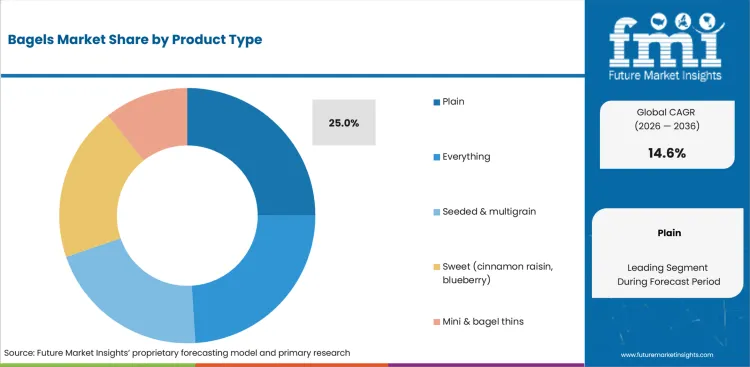
Plain gives retailers a core bagel for sweet spreads or savory sandwich fillings without committing the shelf to a narrow flavor. Brands can change portion size or nutrition claims and keep the base taste familiar.
- Based on product type, plain is projected to account for 25.0% in 2026 due to broad topping compatibility and a familiar baseline taste.
- In September 2025, USDA Food and Nutrition Service proposed treating bread forms such as bagels under one bread variety for SNAP retailer stocking. The proposal keeps bagels inside mainstream bread assortment rules instead of a separate bread-form classification.
Why does conventional lead the claim / nature category?
Conventional bagels cover the broadest price and taste range without the premiums or narrower ingredient rules attached to organic foods and specialty claims. Retailers can use them as the volume base and reserve premium space for a specific shopper mission.
- The conventional segment is likely to capture 54.0% share in 2026 attributable to broad taste, price, and formulation acceptance in national retail and foodservice ranges.
- USDA Economic Research Service documented in February 2025 that organic products continue to carry price premiums over conventional alternatives. The premium gap raises the rate-of-sale threshold for certified bagels in price-sensitive assortments.
How does fresh lead the format category?
Fresh bagels make texture and immediate consumption visible at the point of sale. Specialist bakeries can use that cue for daily replenishment during morning peaks, though unsold product loses value faster than frozen inventory.
- Fresh is set to lead the format category with 29.0% share in 2026 due to immediate-use texture and bakery-led merchandising at specialist counters.
- USDA Food and Nutrition Service retained bakery/bread specialty stores as a distinct retail type in its January 2025 store definitions. The classification gives fresh bagels a channel where bread is the main assortment instead of a secondary grocery line.
Why do supermarkets & hypermarkets lead the sales channel category?
Supermarkets let households compare bagel packs and shelf life beside other breakfast breads. Bakery ingredients for home use widen breakfast choices there. National reach supports scale, but category managers cut launches that miss rate-of-sale targets.
- In 2026, supermarkets & hypermarkets are expected to lead sales channel with 40.0% share because they provide broad reach, assortment visibility, and repeat grocery purchasing.
- USDA Economic Research Service data updated in August 2026 show grocery stores generated USD 617 billion in inflation-adjusted food sales during 2025. That scale keeps supermarkets central to national bakery distribution despite strict rate-of-sale tests.
What are the drivers, restraints and opportunities in the Bagels Market?
Multiple meal occasions support demand, with shelf economics constraining premium launches and channel-specific formats providing additional revenue routes.
- Driver: Portion, nutrition, and portable meal use give a familiar bread format more reasons to enter household and foodservice orders.
- Restraint: Private-label pressure, fresh-product waste, and retailer price tests can prevent higher-cost claims from converting into sustained distribution.
- Opportunity: Channel-specific packs, frozen handling, and nutrition-led variants can expand usage if the operating benefit is clear to a retail or foodservice account.
Nutrition claims carry more shelf weight when shoppers use label information during packaged-food choices. In May 2025, USDA Economic Research Service found that 79% of USA adults regularly used the Nutrition Facts label during the 2017-March 2020 survey period. Bagels using protein ingredients therefore need a visible nutrition difference that shoppers can compare against familiar breakfast breads.
Private-label scale raises the hurdle for higher-priced bagel claims because retailers already have a visible value benchmark. USDA Foreign Agricultural Service reported in September 2025 that private label held 36.2% of Germany's grocery market in 2024. Premium ingredients and short shelf life must recover their extra cost from a higher rate of sale.
Channel-specific formats earn distribution by removing a measurable handling or inventory cost for the account. USDA Foreign Agricultural Service documented in November 2025 that France's four largest retail formats represented 75% of its food retail market in 2024. Frozen baked goods can lower holding risk in that concentrated channel, and online-ready packs simplify replenishment for repeat orders.
Which country CAGRs are profiled in the Bagels Market?
| Country | CAGR |
|---|---|
| UAE | 15.7% |
| Saudi Arabia | 15.4% |
| South Korea | 15.0% |
| USA | 14.7% |
| UK | 14.4% |
| Germany | 14.1% |
| France | 13.8% |
| Japan | 13.4% |
How do country-level CAGRs compare in the Bagels Market?
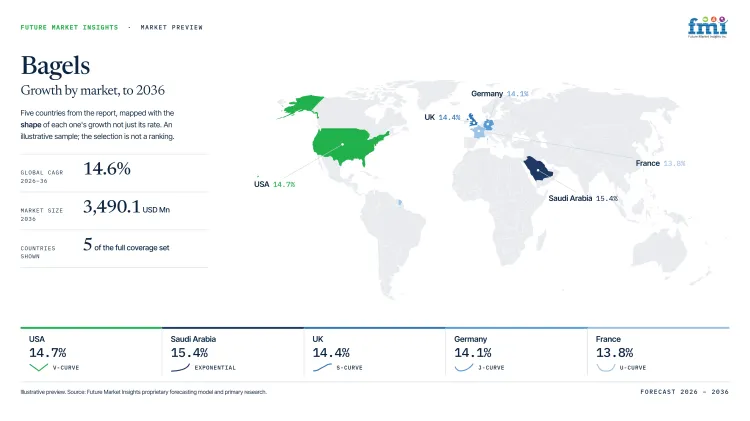
The profiled CAGRs span 2.3 percentage points, from 15.7% in the UAE to 13.4% in Japan for 2026 to 2036. UAE, Saudi Arabia, and South Korea form the upper band at 15.0% or above. USA and UK sit in an upper-middle range between 14.4% and 14.7%. Germany and France remain close behind at 14.1% and 13.8%.
- UAE re-export hubs let importers stage bagel inventory for nearby Gulf markets.
- Saudi foodservice growth gives frozen bagels another commercial route beside supermarket distribution.
- South Korean convenience breakfast sets favor portioned offers that fit small urban baskets.
- USA direct-store-delivery networks can widen bagel SKUs once shelf velocity is proven.
- UK private-label bakery ranges give supermarkets a price benchmark before branded listings.
- Germany retailers compete aggressively on value, but convenience and health cues can still create room for differentiated bakery products.
- France buyers operate through a diverse network that spans large-format grocery and discounters.
- Japan retailers emphasize convenience, predictable quality, and products that fit small households or quick meal routines.
CAGR indicates forecast pace and does not measure country size or profitability. The full report provides country-level CAGR analysis across North America, Latin America, Europe, East Asia, South Asia, Oceania and the Middle East and Africa.
Country-wise Analysis
- Saudi grocery expansion is concentrated in national hypermarket and supermarket chains, where importers must manage Arabic labeling, remaining shelf life, listing economics, and temperature control before bakery products enter routine replenishment. USDA Foreign Agricultural Service reported in September 2025 that imports meet about 70% of national food demand, giving packaged bagels an established import route even as freight cost and retailer returns narrow distributor margins. Saudi Arabia is projected to grow at 15.4% CAGR through 2036, tied to modern retail expansion and packaged bakery demand, which lets experienced distributors test household and foodservice packs without building a local route from zero.
- UAE retailers move imported packaged food via hypermarkets, supermarkets, discount chains, and fast-delivery platforms, giving bagel brands several listing paths but exposing premium packs to direct price comparisons and variable import lead times. Bagel demand in the UAE is forecast to rise at 15.7% CAGR over the forecast period, aided by digital grocery adoption and distributors accustomed to imported foods under local food labeling rules. In December 2025, USDA Foreign Agricultural Service documented 13% online grocery growth during 2024, a channel shift that favors shelf-stable or controlled frozen supply but leaves freight cost and expiry planning as important local constraints.
- South Korean convenience stores and mobile grocery platforms serve small households with frequent compact purchases, making smaller multipacks easier to trial than large household packs for breakfast and single-meal use in dense urban areas and commuter routines. In South Korea, bagel demand is predicted to advance at 15.0% CAGR through 2036 because rapid replenishment and convenience-led purchasing suit portable bakery products. USDA Foreign Agricultural Service's November 2025 report recorded 5% growth in convenience-store grocery food sales during 2024, confirming a strong small-format route even as importer layers and food-safety documentation raise costs before foreign products reach routine urban retail replenishment.
- USA grocery category managers handle bagels inside a mature branded bread set, where a new SKU must displace existing facings or increase category productivity to justify wider distribution. Bagel sales in the USA are forecast to expand at 14.7% CAGR by 2036, reflecting more breakfast and snack occasions despite continued sensitivity to price, markdown risk, and portfolio duplication. April 2026 USDA Economic Research Service data show cereal and bakery product prices rose 1.0% during 2025, keeping price comparisons visible and requiring launches to defend portion, nutrition, or usage value at shelf before major national buyers widen distribution in more stores.
- Retailers compete aggressively on value, but convenience and health cues can still create room for differentiated bakery products. Demand for Bagels in Germany is forecast to expand at 14.1% CAGR from 2026 to 2036. USDA Foreign Agricultural Service reported in September 2025 that Germany’s grocery market was highly competitive and price-sensitive, with e-commerce and convenience food demand also rising. Private-label strength makes premium pricing difficult without a clear consumer benefit. Suppliers need disciplined price packs, localized labeling, and enough product rotation to justify space in consolidated retail accounts.
- Buyers operate through a diverse network that spans large-format grocery and discounters. Convenience outlets, online retail, and traditional bakeries broaden the route to market. Demand for bagels in France is forecast to expand at 13.8% CAGR from 2026 to 2036. USDA Foreign Agricultural Service reported in November 2025 that price pressure was pushing consumers toward less expensive distributor brands while sustainability rules were also changing packaging expectations. That combination tightens the case for imported or premium offers. Suppliers need to localize flavor and pack size, protect value perception, and plan for French and EU compliance before seeking wider distribution.
- Retailers emphasize convenience, predictable quality, and products that fit small households or quick meal routines. Demand for bagels in Japan is forecast to expand at 13.4% CAGR from 2026 to 2036. USDA Foreign Agricultural Service reported in September 2024 that retailers were targeting younger consumers who seek easy-to-prepare, frozen, and ready-to-eat foods. Market entry still depends heavily on strong manufacturer and importer relationships plus product localization. Suppliers need to test portion size and texture carefully. Sweetness and preparation format also need localization rather than a direct transfer of a USA assortment.
- UK supermarket groups control much of branded bakery scaling and pair physical stores with mature online grocery operations, giving bagel ranges fast access to repeat household orders but strong private-label comparison. Office for National Statistics data released in August 2026 show internet sales represented 9.4% of predominantly food-store retail during 2025, providing a meaningful digital replenishment route without removing the need for profitable store turns. The UK bagels sector is projected to record 14.4% CAGR during the assessment period, given omnichannel grocery access, though pack economics and retailer terms decide which variants retain profitable national distribution after launch at scale.
Who are the notable companies in the Bagels Market?
Grupo Bimbo, Flowers Foods, ARYZTA, Lantmännen Unibake, Vandemoortele, Yamazaki Baking, Warburtons, and Europastry are key companies active in the market.
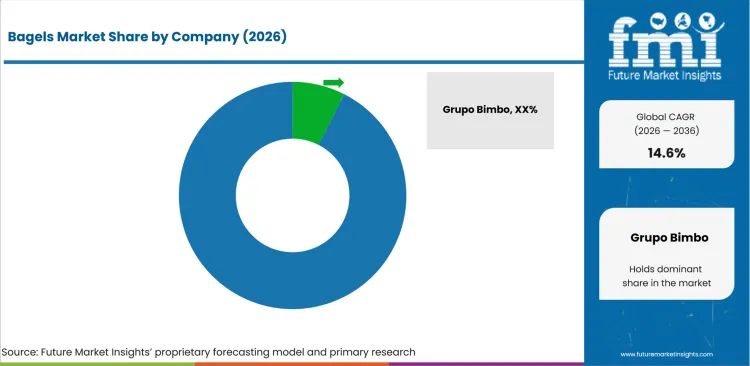
Bagel competition separates branded grocery platforms from industrial bakery groups and frozen or bake-off specialists. Grupo Bimbo and Flowers Foods use direct USA branded routes, and Warburtons maintains a dedicated UK bagel range with national grocery exposure. Yamazaki Baking supplies USA bagels via Bakewise Brands, providing direct category evidence from its American bakery operations. ARYZTA, Lantmännen Unibake, Vandemoortele, and Europastry provide larger frozen bakery and foodservice networks. Entry depends more on channel fit and handling performance than corporate scale alone.
- Branded retail platforms: Grupo Bimbo, Flowers Foods, and Warburtons use grocery reach and recognizable brands to defend repeat household turns.
- Industrial bakery platforms: ARYZTA, Lantmännen Unibake, Vandemoortele, and Europastry sell into bake-off or foodservice accounts where handling and production depth shape qualification.
- Yamazaki Baking supplies USA bagels via Bakewise Brands, providing direct category evidence from its American bakery operations. Demand for gluten-free food and other specialist claims widens the competitive set beyond conventional branded bread.
Competitive Benchmarking: Bagels Market
| Company | Bagel Portfolio Evidence | Format / Production Breadth | Retail / Foodservice Access | Geographic Reach |
|---|---|---|---|---|
| Grupo Bimbo | High | High | High | Global |
| Flowers Foods | High | Medium | High | United States |
| ARYZTA | Low | High | High | Europe, Asia, Australia and New Zealand |
| Lantmännen Unibake | Low | High | High | 60+ markets |
| Vandemoortele | Low | High | High | Europe, United States and export markets |
| Yamazaki Baking | Medium | High | High | Japan, United States and selected Asian markets |
| Warburtons | High | Medium | High | United Kingdom |
| Europastry | Medium | High | High | Europe, Americas and 80+ countries |
Scoring basis: High bagel portfolio evidence requires several varieties or a range launch. Medium requires a narrower portfolio, and Low identifies one limited bagel route within a broader bakery offer. High format / production breadth requires several bakery routes, Medium two and Low one. High retail / foodservice access requires both channels at scale, Medium one major route and Low a narrow route. Geographic reach records the disclosed operating footprint and does not form a scored capability column.
Key Developments in the Bagels Market
- In May 2026, Flowers Foods told investors that its recent Dave's Killer Bread mini bagels launch was contributing to breakfast momentum. The launch gave the organic brand a new portion-led breakfast use case.
- In September 2025, Lantmännen Unibake acquired Boboli Benelux and gained a Dutch bakery using bake-off and chilled technologies for retail and foodservice accounts.
- In February 2025, Vandemoortele acquired Lizzi and gained four Northern Italian frozen-bakery plants serving HoReCa and large-scale retail.
Key Players in the Bagels Market
Branded Retail Bagel Platforms
- Grupo Bimbo
- Flowers Foods
Frozen and Foodservice Bakery Platforms
- ARYZTA
- Lantmännen Unibake
- Vandemoortele
Regional and Multi-market Bakery Platforms
- Yamazaki Baking
- Warburtons
- Europastry
Bagels Market - Report Scope
| Coverage field | Report scope |
|---|---|
| Market breakdown | By product type, claim / nature, format, packaging format, sales channel, and region. |
| Quantitative Units | USD million. |
| Market Definition | Revenue from bagel products sold at the product-sale level in retail and foodservice. Prepared bagel sandwiches or meals after filling and service markup are excluded, as are adjacent bakery substitutes such as rolls, buns, English muffins, croissants, doughnuts, and sliced bread. |
| Regions Covered | North America, Latin America, Western Europe, Eastern Europe, East Asia, South Asia and Pacific, and Middle East and Africa. |
| Countries Covered | UAE, Saudi Arabia, South Korea, USA, UK, and 20+ additional countries in the full report. |
| Key Companies Profiled | Grupo Bimbo, Flowers Foods, ARYZTA, Lantmännen Unibake, Vandemoortele, Yamazaki Baking, Warburtons, Europastry. |
| Forecast Period | 2026 to 2036. |
| Approach | Primary and secondary research with market triangulation. |
Bagels Market - Research Methodology
| Method | Approach |
|---|---|
| Primary Research | FMI analysts gathered input from manufacturers, service providers, technology developers, distributors, end users, procurement teams, and subject-matter experts. Interviews examined purchasing decisions, product or service evaluation, adoption barriers, approval requirements, pricing considerations, and expectations for technical or commercial support. Respondents were also asked what evidence is required before a trial, pilot, or initial order develops into regular purchasing. |
| Desk Research | Desk research covered government statistics, regulatory publications, trade data, industry associations, technical literature, standards, company filings, product information, and official corporate announcements. Sources were reviewed for relevance, publication date, geographic coverage, and consistency with the defined market scope. Claims relating to performance, applications, approvals, capacity, investment, and commercial activity were retained only when supported by credible public evidence. |
| Market Sizing and Forecasting | The market model combined the baseline value with historical performance, segment structure, pricing and volume indicators, adoption levels, company participation, and country-level demand conditions. Forecast assumptions considered economic activity, investment trends, regulatory developments, technology adoption, purchasing cycles, supply availability, and barriers to wider market use. Segment and regional estimates were reconciled before the final market total was calculated. |
| Data Validation | Estimates were checked against multiple independent indicators, including public data, company activity, trade patterns, industry developments, and findings from primary interviews. Validation also tested whether products, services, applications, and company revenues fell within the defined market boundaries. Adjacent categories, unsupported claims, overlapping revenues, and activities without direct market relevance were excluded to reduce double counting and maintain consistency across segments and countries. |
Bagels Market by Segments
Bagels Market segmented by Product Type:
- Plain
- Everything
- Seeded & multigrain
- Sweet (cinnamon raisin, blueberry)
- Mini & bagel thins
Bagels Market segmented by Claim / Nature:
- Conventional
- Clean label
- Organic
- Gluten-free
- High-protein / fortified
Bagels Market segmented by Format:
- Fresh
- Frozen
- Ambient packaged
- Chilled
- Par-baked / thaw-and-serve
Bagels Market segmented by Packaging Format:
- Multipack
- Single-serve
- Family / loaf pack
- Bulk foodservice
Bagels Market segmented by Sales Channel:
- Supermarkets & hypermarkets
- Artisan & specialty bakeries
- Convenience & forecourt
- Online & DTC
- Foodservice distributors
Bagels Market by Region:
- North America
- United States
- Canada
- Latin America
- Brazil
- Mexico
- Chile
- Rest of Latin America
- Western Europe
- Germany
- United Kingdom
- Italy
- Spain
- France
- Nordics
- Benelux
- Rest of Western Europe
- Eastern Europe
- Russia
- Poland
- Hungary
- Balkan and Baltic States
- Rest of Eastern Europe
- East Asia
- China
- Japan
- South Korea
- South Asia and Pacific
- India
- ASEAN
- Australia and New Zealand
- Rest of South Asia and Pacific
- Middle East and Africa
- Kingdom of Saudi Arabia
- Other GCC Countries
- Türkiye
- South Africa
- Other African Union Countries
- Rest of Middle East and Africa
Research Sources and Bibliography
- Zeballos, E., & Sinclair, W. (2026, June 11). Total USA food spending reached $2.51 trillion in 2025.
- USA Department of Agriculture, Foreign Agricultural Service. (2025, November 19). Retail Foods Annual: Japan (JA2025-0048).
- USA Department of Agriculture, Food and Nutrition Service. (2025, September 25). Proposed Rule - Updated Staple Food Stocking Standards for Retailers in SNAP.
- Raszap Skorbiansky, S. (2025, February 5). Organic Situation Report, 2025 Edition.
- USA Department of Agriculture, Food and Nutrition Service. (2025, January 24). SNAP Store Type Definitions.
- USA Department of Agriculture, Economic Research Service. (2026, August 17). Retailing & Wholesaling - Retail Trends.
- Restrepo, B. J. (2025, May 21). Who Regularly Uses the Nutrition Facts Label? Exploring Demographic, Socioeconomic, and Geographic Differences.
- USA Department of Agriculture, Foreign Agricultural Service. (2025, September 24). Retail Foods Annual: Germany (GM2025-0016).
- USA Department of Agriculture, Foreign Agricultural Service. (2025, November 19). Retail Foods Annual: France (FR2025-0010).
- USA Department of Agriculture, Foreign Agricultural Service. (2025, December 30). Retail Foods Annual: United Arab Emirates (TC2025-0010).
- USA Department of Agriculture, Foreign Agricultural Service. (2025, September 24). Retail Foods Annual: Saudi Arabia (SA2025-0015).
- USA Department of Agriculture, Foreign Agricultural Service. (2025, November 19). Retail Foods Annual: Korea - Republic of (KS2025-0038).
- Sinclair, W., & Stewart, H. (2026, April 30). USA food-at-home prices increased 2.3 percent in 2025, compared with 2024.
- Office for National Statistics. (2026, August 21). RSI: Internet: Predominantly Food stores: All Bus: SA: proportion of retail.
- Flowers Foods. (2026, May 21). First Quarter 2026 Earnings - Prepared Remarks.
- Lantmännen. (2025, September 1). Lantmännen Unibake expands in savoury with acquisition of Boboli Benelux B.V..
- Vandemoortele. (2025, February 14). Vandemoortele acquires Lizzi in Italy, a specialty player in frozen Bakery.
- Grupo Bimbo. (2025). Annual Report 2025.
- ARYZTA. (2026, March 2). ARYZTA AG 2025 annual results.
- ARYZTA. (2026, June 23). ARYZTA acquires French distribution business.
- Vandemoortele. (2025, March 28). Vandemoortele and Délifrance intend to form a new leading player in frozen bakery.
- Yamazaki Baking Co., Ltd. (n.d.). Overseas Operations.
- Warburtons. (2026). New Packaging Redesign Unveiled for our 150th Anniversary.
- Europastry. (2026, June 23). Europastry to acquire Highland Baking Company to strengthen its presence in North America.
- Flowers Foods. (2025, January 8). Flowers Foods, Inc. to Acquire Simple Mills.
- ARYZTA. (2026, January 22). Full year 2025 targets achieved; Revenue growth & improved performance expected in 2026; New bun bakery in Portugal.
- ARYZTA. (2026, August 26). New Perth bakery officially opened.
- Lantmännen. (2025, December 23). Lantmännen Unibake signs agreement to expand in Italy.
- Lantmännen. (2025, May 28). Lantmännen makes strategic and long-term investment in new production facility for bread.
- Grupo Bimbo. (2025, September 17). Grupo Bimbo Receives Regulatory Approval to Acquire Wickbold in Brazil.
- Flowers Foods. (2025, October 27). FLOWERS FOODS TAPS INTO HIGHER-PROTEIN AND SOURDOUGH TRENDS WITH NEW PRODUCTS.
- Grupo Bimbo. (2025, July 29). We are committed to removing artificial colorants from all our products by the end of 2026.
- Vandemoortele. (2026, August 3). Vandemoortele USA completes final phase of acquisition of New Jersey-based Banneton Bakery.
- Yamazaki Baking Co., Ltd. (2026, April 28). 製品価格一部改定のお知らせ.
This bibliography is provided for reader reference and is not exhaustive. The full report contains the complete reference list and detailed citations.
This Report Answers
- How large is the bagels market in 2026 and what value is forecast for 2036?
- Which purchase occasions and channel conditions support bagel demand?
- Why does plain lead the product type category in 2026?
- Why does conventional hold the leading position within claim / nature?
- How do fresh and frozen formats differ in retail and foodservice economics?
- How do country growth rates compare in UAE, Saudi Arabia, South Korea, USA, and UK?
- Which companies compete in branded retail, bake-off, frozen bakery, and multi-market production?
- What limits premium bagel launches at shelf and in imported channels?
- What should grocery and foodservice accounts evaluate before widening bagel distribution?
Frequently Asked Questions
How big is the bagels market in 2026?
The bagels market is valued at USD 893.3 million in 2026 and is projected to reach USD 3,490.1 million by 2036. Growth is supported by breakfast, snack, sandwich, and foodservice occasions that require little kitchen preparation.
What is the CAGR of the bagels market from 2026 to 2036?
The bagels market is projected to grow at a CAGR of 14.6% between 2026 and 2036. Expansion is supported by portable meal occasions, portion innovation, nutrition claims, and wider retail availability.
Which product type leads the bagels market?
The plain segment is expected to hold 25.0% of the bagels market in 2026, supported by broad topping compatibility and a familiar base flavor. Its neutral profile lets retailers cover sweet breakfast and savory sandwich use with one core SKU.
How much value will the bagels market add between 2026 and 2036?
The bagels market is expected to add USD 2,596.8 million in value between 2026 and 2036. The increase comes from more breakfast, snack, sandwich, and foodservice occasions for packaged, fresh, and frozen formats.
Which companies are active in the bagels market?
Key companies operating in the market include Grupo Bimbo, Flowers Foods, ARYZTA, Lantmännen Unibake, Vandemoortele, Yamazaki Baking, Warburtons, and Europastry. Their positions differ by branded grocery reach, frozen bakery capacity, foodservice access, and bagel-specific product breadth.
Preview the report firsthand - request a free sample
Get SampleGet the brochure for pricing and purchase details.
Get PDFTable of Content
- Key Takeaways
- Market Size and CAGR
- Top Growth Driver
- Fastest Growing Segment
- Leading Region
- Key Companies
- Emerging Opportunities
- Executive Summary
- Global Market Outlook
- Demand-side Trends
- Supply-side Trends
- Technology Roadmap Analysis
- Analysis and Recommendations
- Analyst Perspective (What is happening? Why now? What should investors know?)
- Key Questions Answered
- How large is the market?
- What is the CAGR?
- What are key trends?
- Which region dominates?
- Who are the leaders?
- Market Overview
- Market Coverage / Taxonomy
- Market Definition / Scope / Limitations
- Research Methodology
- Chapter Orientation
- Analytical Lens and Working Hypotheses
- Market Structure, Signals, and Trend Drivers
- Benchmarking and Cross-market Comparability
- Market Sizing, Forecasting, and Opportunity Mapping
- Research Design and Evidence Framework
- Desk Research Programme (Secondary Evidence)
- Expert Input and Fieldwork (Primary Evidence)
- Tooling, Models, and Reference Databases
- Data Engineering and Model Build
- Quality Assurance and Audit Trail
- Market Background
- Market Dynamics (Drivers, Restraints, Opportunity, Trends)
- Scenario Forecast (Optimistic, Likely, Conservative)
- Impact Analysis
- AI Impact
- Sustainability Impact
- Regulatory Impact
- Technology Impact
- Consumer / Buyer Analysis
- Purchase Drivers
- Adoption Barriers
- Buyer Journey
- Opportunity Map Analysis
- Product Life Cycle Analysis
- Supply Chain Analysis
- Investment Feasibility Matrix
- Value Chain Analysis
- PESTLE and Porter's Analysis
- Regulatory Landscape
- Regional Parent Market Outlook
- Production and Consumption Statistics
- Import and Export Statistics
- Global Market Analysis and Forecast, 2021 to 2036
- Historical Market Size Value (USD Million) Analysis, 2021 to 2025
- Current and Future Market Size Value (USD Million) Projections, 2026 to 2036
- Y-o-Y Growth Trend Analysis
- Absolute $ Opportunity Analysis
- Global Market Pricing Analysis, 2021 to 2036
- Global Market Analysis and Forecast, By Product Type, 2021 to 2036
- Introduction / Key Findings
- Historical Market Size Value (USD Million) Analysis By Product Type, 2021 to 2025
- Current and Future Market Size Value (USD Million) Analysis and Forecast By Product Type, 2026 to 2036
- Plain
- Everything
- Seeded & multigrain
- Sweet (cinnamon raisin, blueberry)
- Mini & bagel thins
- Plain
- Y-o-Y Growth Trend Analysis By Product Type, 2021 to 2025
- Absolute $ Opportunity Analysis By Product Type, 2026 to 2036
- Global Market Analysis and Forecast, By Claim / Nature, 2021 to 2036
- Introduction / Key Findings
- Historical Market Size Value (USD Million) Analysis By Claim / Nature, 2021 to 2025
- Current and Future Market Size Value (USD Million) Analysis and Forecast By Claim / Nature, 2026 to 2036
- Conventional
- Clean label
- Organic
- Gluten-free
- High-protein / fortified
- Conventional
- Y-o-Y Growth Trend Analysis By Claim / Nature, 2021 to 2025
- Absolute $ Opportunity Analysis By Claim / Nature, 2026 to 2036
- Global Market Analysis and Forecast, By Format, 2021 to 2036
- Introduction / Key Findings
- Historical Market Size Value (USD Million) Analysis By Format, 2021 to 2025
- Current and Future Market Size Value (USD Million) Analysis and Forecast By Format, 2026 to 2036
- Fresh
- Frozen
- Ambient packaged
- Chilled
- Par-baked / thaw-and-serve
- Fresh
- Y-o-Y Growth Trend Analysis By Format, 2021 to 2025
- Absolute $ Opportunity Analysis By Format, 2026 to 2036
- Global Market Analysis and Forecast, By Packaging Format, 2021 to 2036
- Introduction / Key Findings
- Historical Market Size Value (USD Million) Analysis By Packaging Format, 2021 to 2025
- Current and Future Market Size Value (USD Million) Analysis and Forecast By Packaging Format, 2026 to 2036
- Multipack
- Single-serve
- Family / loaf pack
- Bulk foodservice
- Multipack
- Y-o-Y Growth Trend Analysis By Packaging Format, 2021 to 2025
- Absolute $ Opportunity Analysis By Packaging Format, 2026 to 2036
- Global Market Analysis and Forecast, By Sales Channel, 2021 to 2036
- Introduction / Key Findings
- Historical Market Size Value (USD Million) Analysis By Sales Channel, 2021 to 2025
- Current and Future Market Size Value (USD Million) Analysis and Forecast By Sales Channel, 2026 to 2036
- Supermarkets & hypermarkets
- Artisan & specialty bakeries
- Convenience & forecourt
- Online & DTC
- Foodservice distributors
- Supermarkets & hypermarkets
- Y-o-Y Growth Trend Analysis By Sales Channel, 2021 to 2025
- Absolute $ Opportunity Analysis By Sales Channel, 2026 to 2036
- Global Market Analysis and Forecast, By Region, 2021 to 2036
- Introduction
- Historical Market Size Value (USD Million) Analysis By Region, 2021 to 2025
- Current Market Size Value (USD Million) Analysis and Forecast By Region, 2026 to 2036
- North America
- Latin America
- Western Europe
- Eastern Europe
- East Asia
- South Asia and Pacific
- Middle East & Africa
- Market Attractiveness Analysis By Region
- North America Market Analysis and Forecast, By Country, 2021 to 2036
- Historical Market Size Value (USD Million) Trend Analysis By Market Taxonomy, 2021 to 2025
- Market Size Value (USD Million) Forecast By Market Taxonomy, 2026 to 2036
- By Country
- USA
- Canada
- By Product Type
- By Claim / Nature
- By Format
- By Packaging Format
- By Sales Channel
- By Country
- Market Attractiveness Analysis
- By Country
- By Product Type
- By Claim / Nature
- By Format
- By Packaging Format
- By Sales Channel
- Key Takeaways
- Latin America Market Analysis and Forecast, By Country
- Historical Market Size Value (USD Million) Trend Analysis By Market Taxonomy, 2021 to 2025
- Market Size Value (USD Million) Forecast By Market Taxonomy, 2026 to 2036
- By Country
- Brazil
- Mexico
- Chile
- Rest of Latin America
- By Product Type
- By Claim / Nature
- By Format
- By Packaging Format
- By Sales Channel
- By Country
- Market Attractiveness Analysis
- By Country
- By Product Type
- By Claim / Nature
- By Format
- By Packaging Format
- By Sales Channel
- Key Takeaways
- Western Europe Market Analysis and Forecast, By Country
- Historical Market Size Value (USD Million) Trend Analysis By Market Taxonomy, 2021 to 2025
- Market Size Value (USD Million) Forecast By Market Taxonomy, 2026 to 2036
- By Country
- Germany
- UK
- Italy
- Spain
- France
- Nordic
- BENELUX
- Rest of Western Europe
- By Product Type
- By Claim / Nature
- By Format
- By Packaging Format
- By Sales Channel
- By Country
- Market Attractiveness Analysis
- By Country
- By Product Type
- By Claim / Nature
- By Format
- By Packaging Format
- By Sales Channel
- Key Takeaways
- Eastern Europe Market Analysis and Forecast, By Country
- Historical Market Size Value (USD Million) Trend Analysis By Market Taxonomy, 2021 to 2025
- Market Size Value (USD Million) Forecast By Market Taxonomy, 2026 to 2036
- By Country
- Russia
- Poland
- Hungary
- Balkan & Baltic
- Rest of Eastern Europe
- By Product Type
- By Claim / Nature
- By Format
- By Packaging Format
- By Sales Channel
- By Country
- Market Attractiveness Analysis
- By Country
- By Product Type
- By Claim / Nature
- By Format
- By Packaging Format
- By Sales Channel
- Key Takeaways
- East Asia Market Analysis and Forecast, By Country
- Historical Market Size Value (USD Million) Trend Analysis By Market Taxonomy, 2021 to 2025
- Market Size Value (USD Million) Forecast By Market Taxonomy, 2026 to 2036
- By Country
- China
- Japan
- South Korea
- By Product Type
- By Claim / Nature
- By Format
- By Packaging Format
- By Sales Channel
- By Country
- Market Attractiveness Analysis
- By Country
- By Product Type
- By Claim / Nature
- By Format
- By Packaging Format
- By Sales Channel
- Key Takeaways
- South Asia and Pacific Market Analysis and Forecast, By Country
- Historical Market Size Value (USD Million) Trend Analysis By Market Taxonomy, 2021 to 2025
- Market Size Value (USD Million) Forecast By Market Taxonomy, 2026 to 2036
- By Country
- India
- ASEAN
- Australia & New Zealand
- Rest of South Asia and Pacific
- By Product Type
- By Claim / Nature
- By Format
- By Packaging Format
- By Sales Channel
- By Country
- Market Attractiveness Analysis
- By Country
- By Product Type
- By Claim / Nature
- By Format
- By Packaging Format
- By Sales Channel
- Key Takeaways
- Middle East & Africa Market Analysis and Forecast, By Country
- Historical Market Size Value (USD Million) Trend Analysis By Market Taxonomy, 2021 to 2025
- Market Size Value (USD Million) Forecast By Market Taxonomy, 2026 to 2036
- By Country
- Kingdom of Saudi Arabia
- Other GCC Countries
- Türkiye
- South Africa
- Other African Union
- Rest of Middle East & Africa
- By Product Type
- By Claim / Nature
- By Format
- By Packaging Format
- By Sales Channel
- By Country
- Market Attractiveness Analysis
- By Country
- By Product Type
- By Claim / Nature
- By Format
- By Packaging Format
- By Sales Channel
- Key Takeaways
- Key Countries Market Analysis
- USA
- Pricing Analysis
- Market Share Analysis, 2025
- By Product Type
- By Claim / Nature
- By Format
- By Packaging Format
- By Sales Channel
- Canada
- Pricing Analysis
- Market Share Analysis, 2025
- By Product Type
- By Claim / Nature
- By Format
- By Packaging Format
- By Sales Channel
- Mexico
- Pricing Analysis
- Market Share Analysis, 2025
- By Product Type
- By Claim / Nature
- By Format
- By Packaging Format
- By Sales Channel
- Brazil
- Pricing Analysis
- Market Share Analysis, 2025
- By Product Type
- By Claim / Nature
- By Format
- By Packaging Format
- By Sales Channel
- Chile
- Pricing Analysis
- Market Share Analysis, 2025
- By Product Type
- By Claim / Nature
- By Format
- By Packaging Format
- By Sales Channel
- Germany
- Pricing Analysis
- Market Share Analysis, 2025
- By Product Type
- By Claim / Nature
- By Format
- By Packaging Format
- By Sales Channel
- UK
- Pricing Analysis
- Market Share Analysis, 2025
- By Product Type
- By Claim / Nature
- By Format
- By Packaging Format
- By Sales Channel
- Italy
- Pricing Analysis
- Market Share Analysis, 2025
- By Product Type
- By Claim / Nature
- By Format
- By Packaging Format
- By Sales Channel
- Spain
- Pricing Analysis
- Market Share Analysis, 2025
- By Product Type
- By Claim / Nature
- By Format
- By Packaging Format
- By Sales Channel
- France
- Pricing Analysis
- Market Share Analysis, 2025
- By Product Type
- By Claim / Nature
- By Format
- By Packaging Format
- By Sales Channel
- India
- Pricing Analysis
- Market Share Analysis, 2025
- By Product Type
- By Claim / Nature
- By Format
- By Packaging Format
- By Sales Channel
- ASEAN
- Pricing Analysis
- Market Share Analysis, 2025
- By Product Type
- By Claim / Nature
- By Format
- By Packaging Format
- By Sales Channel
- Australia & New Zealand
- Pricing Analysis
- Market Share Analysis, 2025
- By Product Type
- By Claim / Nature
- By Format
- By Packaging Format
- By Sales Channel
- China
- Pricing Analysis
- Market Share Analysis, 2025
- By Product Type
- By Claim / Nature
- By Format
- By Packaging Format
- By Sales Channel
- Japan
- Pricing Analysis
- Market Share Analysis, 2025
- By Product Type
- By Claim / Nature
- By Format
- By Packaging Format
- By Sales Channel
- South Korea
- Pricing Analysis
- Market Share Analysis, 2025
- By Product Type
- By Claim / Nature
- By Format
- By Packaging Format
- By Sales Channel
- Russia
- Pricing Analysis
- Market Share Analysis, 2025
- By Product Type
- By Claim / Nature
- By Format
- By Packaging Format
- By Sales Channel
- Poland
- Pricing Analysis
- Market Share Analysis, 2025
- By Product Type
- By Claim / Nature
- By Format
- By Packaging Format
- By Sales Channel
- Hungary
- Pricing Analysis
- Market Share Analysis, 2025
- By Product Type
- By Claim / Nature
- By Format
- By Packaging Format
- By Sales Channel
- Kingdom of Saudi Arabia
- Pricing Analysis
- Market Share Analysis, 2025
- By Product Type
- By Claim / Nature
- By Format
- By Packaging Format
- By Sales Channel
- Türkiye
- Pricing Analysis
- Market Share Analysis, 2025
- By Product Type
- By Claim / Nature
- By Format
- By Packaging Format
- By Sales Channel
- South Africa
- Pricing Analysis
- Market Share Analysis, 2025
- By Product Type
- By Claim / Nature
- By Format
- By Packaging Format
- By Sales Channel
- USA
- Market Structure Analysis
- Competition Dashboard
- Competition Benchmarking
- Market Share Analysis of Top Players
- By Regional
- By Product Type
- By Claim / Nature
- By Format
- By Packaging Format
- By Sales Channel
- Emerging Startups
- Innovation Benchmarking
- Competition Analysis
- Competition Deep Dive
- Grupo Bimbo
- Overview
- Product Portfolio
- Profitability by Market Segments
- Sales Footprint
- Strategy Overview
- Marketing Strategy
- Product Strategy
- Channel Strategy
- Flowers Foods
- Aryzta
- Lantmannen Unibake
- Vandemoortele
- Yamazaki Baking
- Warburtons
- King's Hawaiian
- Europastry
- St Pierre Groupe
- Grupo Bimbo
- Case Studies
- Success Stories
- Recent Developments
- Competition Deep Dive
- Assumptions & Acronyms Used


