

- Market Size (2026)
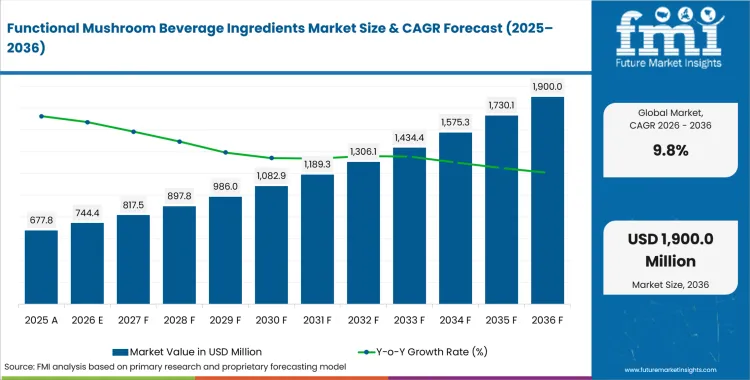
- USD 744.4 Mn
- Forecast (2036)
- USD 1900.0 Mn
- CAGR (2026 to 2036)
- 9.8%
How big is Functional Mushroom Beverage Ingredients Market size?
USD 744.4 million in 2026 and USD 1,900.0 million by 2036 at a 9.8% CAGR.
Demand for functional mushroom beverage ingredients is projected to expand at 9.8% CAGR between 2026 and 2036, increasing valuation from USD 744.4 million in 2026 to USD 1,900.0 million by 2036. Beverage makers actively incorporate mushroom powders and extracts to create innovative coffee alternatives and functional beverages. In August 2025, Nammex tested 16 organic mushroom extracts spanning 7 different species to map out their unique taste profiles. This direct sensory comparison helps product formulation teams pinpoint bitterness and aroma differences early in the design phase. Resulting with companies saving valuable laboratory time and money before even beginning experimenting with complex flavor-masking systems.
Global food and beverage brands apply distinct regional strategies on sourcing such specialty botanicals. Sourcing managers in the United States and Germany strictly demand specification consistency and well-documented quality controls. Recipe formulators in China and India prefer versatile ingredient formats and rely on responsive regional partners for agile support. Clinical research also plays a major role in shaping new product launches. In April 2024, Applied Food Sciences studied how Lion’s Mane and guayusa ingredients affected 40 healthy adults. Such human-study evidence gives product developers clear guidance on proper dosages and empowers teams to justify cognitive-health claims during internal product reviews.
Key Takeaways for Functional Mushroom Beverage Ingredients Market
- Demand is influenced by beverage developers seeking documented ingredient identity and manageable flavor performance across commercial recipes.
- Plant is expected to lead source with 25.0% share in 2026, driven by established botanical positioning and familiar sourcing records.
- Food manufacturers are estimated to hold 21.0% share of end user in 2026, led by repeated formulation requirements across branded product lines.
- Variable extraction quality and incomplete sensory records limit dependable performance during ingredient qualification.
- Competition focusses on Nammex, Aloha Medicinals, Bio-Botanica, Nektium, Applied Food Sciences, Sempera Organics, MycoTechnology, and Mushroom Design, with providers differentiating based on technical evidence, formulation assistance, and delivery reliability.
Analyst Perspective
“Functional mushroom ingredients earn lasting commercial value only when scientific evidence survives real formulation conditions. Leading suppliers translate species extraction quality and sensory control into repeatable manufacturing outcomes. Market leadership comes from reducing technical uncertainty during brand scale-up decisions.”
- Nandini Roy Choudhury, Principal Analyst for Food and Beverage at Future Market Insights
How is Functional Mushroom Beverage Ingredients Market segmented?
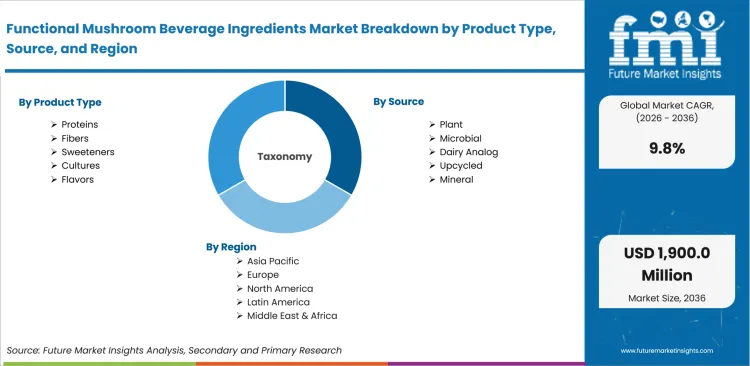
The functional mushroom beverage ingredients market is segmented by product type, source, application, end user, and region.
The functional mushroom beverage ingredients industry is segmented by product type, source, application, end user, and region. Product Type coverage includes Proteins and Fibers with Sweeteners and Cultures. Flavors complete defined Product Type coverage across nutrition and sensory requirements. Source coverage includes Plant and Microbial with Dairy Analog and Upcycled inputs. Mineral completes Source coverage across controlled fortification requirements. Application coverage includes Bakery and Beverages with Snacks and Infant Nutrition. Ready Meals complete defined Application coverage across convenient fortified products. End User coverage includes Food Manufacturers and Beverage Manufacturers with Foodservice Operators and Contract Manufacturers. Retail Brands complete End User coverage across private-label product development. Regional coverage spans North America and Latin America with Europe and East Asia. South Asia and Pacific joins Middle East and Africa across complete geographic assessment.
Why does proteins lead product type demand?
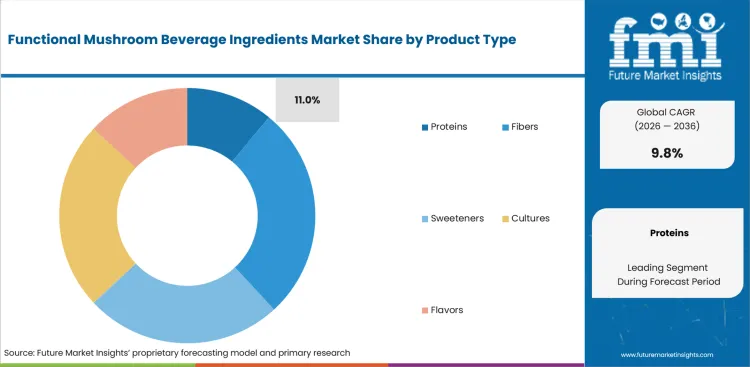
Protein-oriented mushroom ingredients support beverage recipes seeking measurable nutritional improvement and function-led positioning. Bains and colleagues reported that a smoothie containing 1.0% oyster mushroom powder reached 2.87% protein during November 2025. Recorded protein improvement links limited mushroom inclusion with measurable nutritional value inside a finished beverage matrix. Formulators gain a practical reference point for balancing protein contribution against texture and flavor requirements.
- By product type, proteins are estimated to represent 11.0% share in 2026 since it reflects use across nutrition-led beverage formulations. Documented protein contribution supports internal comparison against adjacent functional ingredients during recipe screening.
- Fibers and sweeteners support mouthfeel and palatability across powders requiring controlled dispersion. Cultures and flavors assist fermentation management and taste correction across recipes containing concentrated mushroom extracts.
Why does plant remain central to source demand?
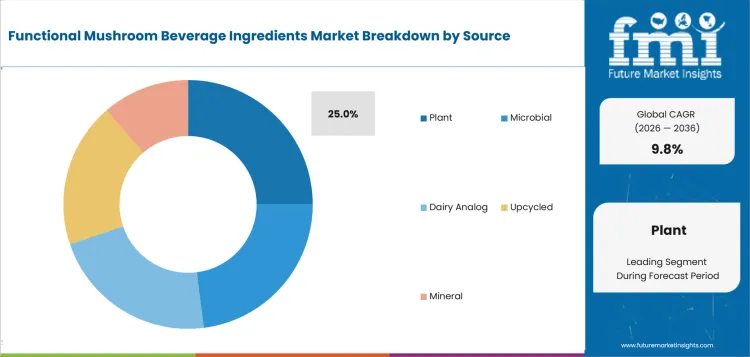
Plant-positioned inputs align with familiar botanical sourcing practices and established natural-product review processes. M2 Ingredients introduced Regenerative Organic Certified inputs covering 5 mushroom species during June 2025. Multi-species certification strengthens cultivation traceability and gives formulators additional sourcing choices within one documented production system. Supplier assessment therefore extends beyond species selection into cultivation records and processing consistency.
- Plant is projected to account for 25.0% share of source in 2026, backed by familiar botanical positioning across beverage concepts. Cultivation records and extraction documentation help technical teams compare batch consistency during qualification.
- Microbial and dairy analog sources support specialized fermentation and nutrition requirements across selected formulations. Upcycled and mineral sources address resource-use targets and controlled fortification needs across finished products.
Why does bakery lead application demand?
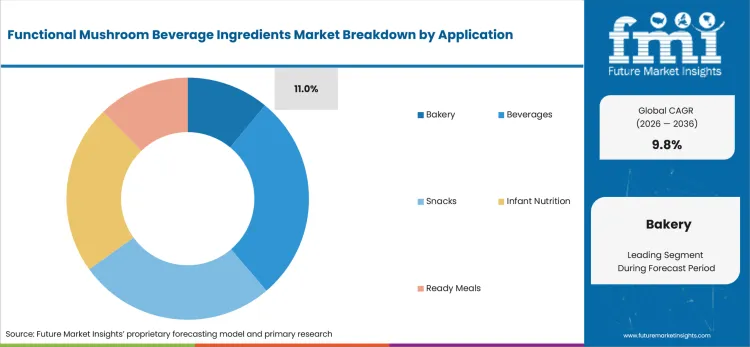
Bakery systems offer measurable checkpoints for flavor and texture before mushroom ingredients enter less forgiving beverage matrices. Srivastava and colleagues found that mushroom powder inclusion up to 5.0% did not reduce consumer acceptability during September 2024. Recorded tolerance establishes a practical dosage boundary and demonstrates how mushroom enrichment can add nutritional value without unacceptable sensory loss. Bakery trials therefore provide transferable evidence for developers evaluating dosage discipline across other finished products.
- In 2026, bakery is anticipated to account for 11.0% share owing to controlled recipe testing and measurable finished-product performance. Repeatable processing conditions help developers examine nutritional gains beside texture and flavor changes.
- Beverages and snacks require separate dosage strategies since processing and sensory conditions differ across finished formats. Infant nutrition and ready meals need stricter composition review supported by stable identity and manufacturing records.
Which buyer need keeps food manufacturers central to end user demand?
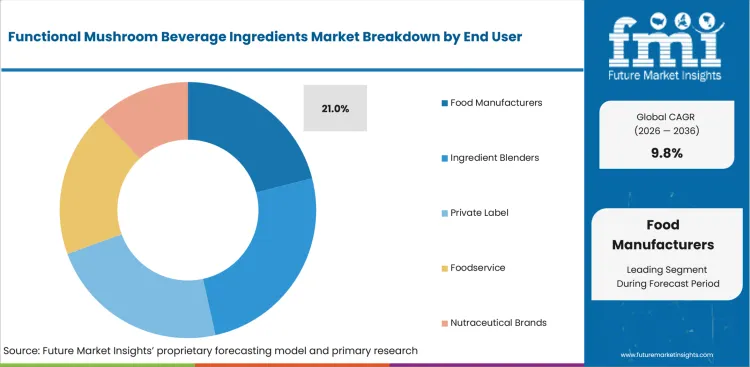
Food Manufacturers manage repeated development work across separate brands and need technical support suited to multiple product formats. M2 Ingredients opened an application laboratory covering 6 named formats during February 2026, including ready-to-drink beverages and bars. Coverage across six formats shows why manufacturers need matrix-specific formulation work instead of one generic ingredient recommendation. Dedicated laboratory support reduces repeated troubleshooting around solubility and processing behavior.
- Based on end user, food manufacturers are forecast to account for 21.0% share in 2026 since being led by repeated formulation requirements across branded product portfolios. Validation records and commercial production assistance support continuing supplier engagement following initial ingredient approval.
- Beverage manufacturers and foodservice operators compare suppliers using recipe response and delivery continuity across operating locations. Contract manufacturers and retail brands emphasize finished-product consistency across recurring production schedules and private-label programs.
What are drivers, restraints, and opportunities in Functional Mushroom Beverage Ingredients Market?
Verified ingredient performance supports repeat formulation across commercial beverage programs. Fragmented evidence requirements slow approval across separate countries.
- Driver: Beverage developers need functional ingredients supported by dependable identity testing and manageable sensory performance. Brand teams favor mushroom ingredients carrying verified species identity and predictable flavor performance.
- Restraint: Variable specifications and incomplete safety records weaken confidence during technical approval. Inconsistent extract quality delays approval by preventing technical teams from confirming repeatable performance.
- Opportunity: Supplier laboratories connecting ingredient science with finished-product trials improve conversion across commercial formats. Application laboratories shorten product development by resolving solubility and taste issues during scale-up planning.
Repeated purchasing depends on quality evidence surviving technical review and commercial production. Nammex linked its Certified Authentic participation to a 45-year quality commitment during March 2025. Routine testing for identity and consistency gives buyers stronger evidence for approving mushroom extracts across recurring beverage programs.
Regulatory preparation restricts suppliers lacking organized composition and safety records. European Food Safety Authority issued 2 updated guidance documents during September 2024. Detailed requirements increase preparation work for novel-food applications and place greater pressure on suppliers to maintain consistent production evidence.
Scientific substantiation creates expansion potential across cognition and wellness formulations. M2 Ingredients reported toxicology work covering 2 proprietary mushroom strains during November 2025. Strain-specific safety evidence helps beverage manufacturers prepare stronger technical files and reduces uncertainty during internal risk assessment.
How are country CAGRs aligned in Functional Mushroom Beverage Ingredients Market?
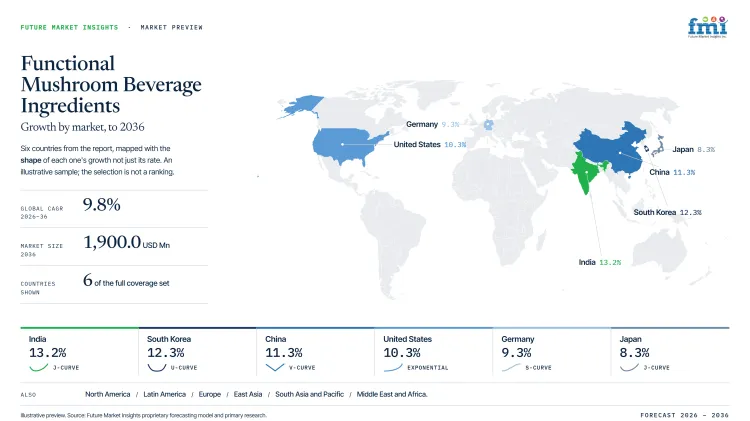
| Country or Market | CAGR |
|---|---|
| India | 13.2% |
| South Korea | 12.3% |
| China | 11.3% |
| United States | 10.3% |
| Germany | 9.3% |
| Japan | 8.3% |
Source: Future Market Insights analysis, 2026.
How do country-level CAGRs compare in Functional Mushroom Beverage Ingredients Market?
Country comparison forms a gradual reduction across the six profiled markets. India occupies the upper forecast position with South Korea following under active processed-food development. China forms the next expansion band supported by cultivation depth and ingredient-processing capacity. United States and Germany represent established buyer environments requiring stronger technical evidence. Japan completes the comparison under structured product review and disciplined format development. The 4.9 percentage-point spread reflects markets sharing a considerable growth outlook, even with their relative positions indicating different levels of market momentum.
- India establishes South Asia and Pacific at the upper end of the disclosed comparison.
- South Korea follows India under active rural-food innovation and specialized product development.
- China maintains the next position supported by cultivation capacity and domestic processing depth.
- United States and Germany record measured expansion under formal quality and compliance review.
- Japan completes the disclosed range under established beverage channels and structured ingredient assessment.
Markets carrying comparable CAGRs present different supplier-entry conditions. Local technical support influences qualification speed as flavor expectations and evidence requirements vary across countries. Full report coverage extends across North America, Latin America, Europe and East Asia, South Asia and Pacific, Middle East and Africa.
Country-wise Analysis
- Sales in India are projected to record 13.2% CAGR between 2026 and 2036, led by expanding cultivation knowledge and regional processing interest. Indian Council of Agricultural Research recorded participation from 24 mushroom growers during National Mushroom Day in December 2025. Grower engagement strengthens contact between cultivation and processing communities serving ingredient-development programs. Local suppliers need standardized drying and identity records before beverage manufacturers approve recurring commercial orders.
- Sales in South Korea are estimated to scale at 12.3% CAGR during the forecast period, driven by rising product-development activity. Ministry of Agriculture, Food and Rural Affairs selected 5 rural-convergence businesses during April 2025, including a producer developing mushroom-based brown rice and vegan protein powder. Government-backed food development improves local experience with mushroom processing and supports ingredient use across adjacent beverage formats. Suppliers benefit from application support adapted to compact serving formats and local taste expectations.
- Industry in China is forecast to grow at 11.3% CAGR from 2026 to 2036, backed by extensive cultivation and ingredient-processing capacity. Chinese official reporting placed annual edible mushroom output above 40 million tonnes during September 2025. Large feedstock availability supports powder and extract production across domestic and export-oriented programs. Beverage-grade suppliers need traceability and stable sensory specifications across scaled commercial batches.
- United States Department of Agriculture recorded 116.766 million pounds of certified organic mushroom production for the 2024-2025 season. Domestic organic production supports local sourcing and gives ingredient suppliers a measurable cultivation base for qualification discussions. Industry in the United States is projected to increase at 10.3% CAGR during the assessment period, helped by established beverage-development capacity and formal ingredient-quality review. Buyer review places emphasis on species identity and repeatable composition across finished beverage specifications.
- The market in Germany is anticipated to rise at 9.3% CAGR during the assessment period, reflecting structured food-safety review and established manufacturing controls. German Federal Statistical Office recorded mushroom production of 78,415 tonnes during 2025. Domestic cultivation supports supplier familiarity and provides an established raw-material setting for ingredient evaluation. German-language documentation and consistent batch records strengthen formal technical review.
- Demand in Japan is set to increase at 8.3% CAGR during the study period, guided by established beverage channels and structured functional-food review. Rohto Pharmaceutical announced 3 additional Eu Yan Sang products during April 2026, including a Lingzhi product scheduled for domestic release. Product-line expansion demonstrates active commercialization of mushroom-linked wellness ingredients across established consumer channels. Suppliers need concise evidence files and careful taste management for compact beverage and supplement formats.
Who are notable companies in Functional Mushroom Beverage Ingredients Market?
Nammex and Aloha Medicinals join Bio-Botanica and Nektium among notable companies. Applied Food Sciences and Sempera Organics complement MycoTechnology and Mushroom Design across specialized ingredient-development programs.
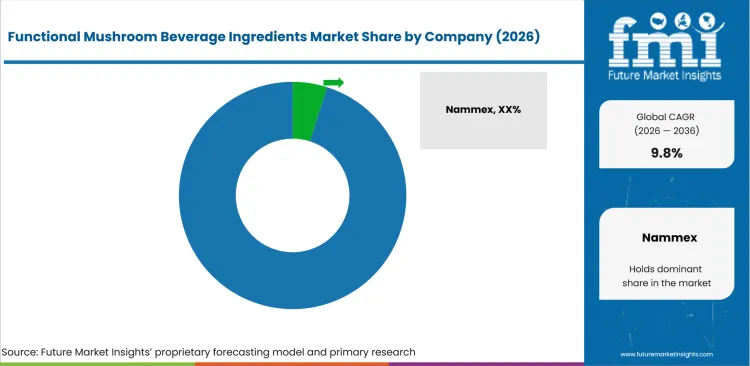
Competition centers on evidence quality and delivery reliability across commercial accounts. Mushroom specialists emphasize species identity and extraction consistency during supplier review. Established botanical suppliers support liquid and powder formats using application knowledge and maintained manufacturing records. Ingredient developers differentiate using solubility and sensory response during finished-product trials. Buyer assessment covers documentation quality and production continuity with technical assistance informing renewal decisions.
- Nammex and Aloha Medicinals compete using mushroom specialization and product-identity knowledge. Sourcing teams assess testing depth and extract consistency during early supplier qualification.
- Bio-Botanica and Nektium contribute botanical-extract experience and established commercial relationships. Food manufacturers examine format compatibility and technical response during recipe-development programs.
- Applied Food Sciences and Sempera Organics emphasize characterized ingredients and formulation support across wellness products. Scientific evidence strengthens buyer confidence during claim and dosage review.
- MycoTechnology and Mushroom Design support selected programs using mushroom-processing knowledge and specialized product development. Commercial appeal depends on direct ingredient fit and dependable scale-up assistance.
Competitive Benchmarking: Functional Mushroom Beverage Ingredients Market
| Company | Technical Depth and Evidence | Delivery and Integration Support | Account and Channel Reach | Geographic Reach |
|---|---|---|---|---|
| Nammex | High | Medium | High | Global |
| Aloha Medicinals | Low | Low | Low | North America |
| Bio-Botanica | Low | Medium | Medium | North America and Europe |
| Nektium | High | High | Low | North America |
| Applied Food Sciences | Medium | High | Medium | Regional |
| Sempera Organics | High | High | Low | Global |
| MycoTechnology | Medium | Medium | High | Regional |
| Mushroom Design | Medium | Medium | Low | Global |
Source: Company disclosures and Future Market Insights competitive analysis, 2026.
Key Developments in Functional Mushroom Beverage Ingredients Market
- In May 2025, M2 Ingredients launched a domestically grown and extracted functional mushroom ingredient line. Solvent-free production and improved sensory neutrality expanded sourcing options for beverage manufacturers seeking traceable United States supply.
- In June 2025, Bio-Botanica detailed a water-miscible mushroom extract portfolio using a 1:1 full-spectrum glycerite format. Liquid compatibility improved formulation options across shots and ready-to-drink beverages.
- In February 2026, M2 Ingredients introduced M2Brew for drip and pod coffee formats. Company testing reported delivery of up to 100 times more beneficial mushroom compounds into the finished cup compared with other brewed mushroom coffee formats. Improved filter transfer expands commercial use across brewed coffee equipment.
Key Players in Functional Mushroom Beverage Ingredients Market
Mushroom Ingredient Specialists
- Nammex
- Aloha Medicinals
- Sempera Organics
Botanical and Functional Ingredient Suppliers
- Bio-Botanica
- Nektium
- Applied Food Sciences
Specialized Mushroom Technology Companies
- MycoTechnology
- Mushroom Design
Functional Mushroom Beverage Ingredients Market Report Scope
| Coverage field | Report scope |
|---|---|
| Market breakdown | Functional mushroom beverage ingredients breakdown includes Product Type, Source, Application, End User, and Region. |
| Quantitative Units | Revenue in USD Million, CAGR in %. |
| Market Definition | Commercially tracked demand covers functional mushroom powders, extracts, and formulation-ready ingredients used across food and beverage development. Finished consumer products and psychedelic mushroom ingredients are excluded. |
| Regions Covered | North America, Latin America, Europe, East Asia, South Asia and Pacific, Middle East and Africa. |
| Countries Covered | United States, Germany, China, Japan, South Korea, India, and more than 30 additional countries. |
| Key Companies Profiled | Nammex, Aloha Medicinals, Bio-Botanica, Nektium, Applied Food Sciences, Sempera Organics, MycoTechnology, and Mushroom Design. |
| Forecast Period | 2026 to 2036 |
| Approach | Hybrid bottom-up and top-down sizing uses segment shares and country CAGRs. Company activity and buyer adoption support final reconciliation. |
Source: Future Market Insights analysis, 2026.
Functional Mushroom Beverage Ingredients Market - Research Methodology
| Method | Approach |
|---|---|
| Primary Research | FMI analysts gathered input from manufacturers, service providers, technology developers, distributors, end users, technical evaluation teams, and subject-matter experts. Interviews examined purchasing decisions, product or service evaluation, adoption barriers, approval requirements, pricing considerations, and expectations for technical or commercial support. Respondents were also asked what evidence is required before a trial, pilot, or initial order develops into regular purchasing. |
| Desk Research | Desk research covered government statistics, regulatory publications, trade data, industry associations, technical literature, standards, company filings, product information, and official corporate announcements. Sources were reviewed for relevance, publication date, geographic coverage, and consistency with the defined market scope. Claims relating to performance, applications, approvals, capacity, investment, and commercial activity were retained only when supported by credible public evidence. |
| Market Sizing and Forecasting | The market model combined the baseline value with historical performance, segment structure, pricing and volume indicators, adoption levels, company participation, and country-level demand conditions. Forecast assumptions considered economic activity, investment trends, regulatory developments, technology adoption, purchasing cycles, supply availability, and barriers to wider market use. Segment and regional estimates were reconciled before the final market total was calculated. |
| Data Validation | Estimates were checked against multiple independent indicators, including public data, company activity, trade patterns, industry developments, and findings from primary interviews. Validation also tested whether products, services, applications, and company revenues fell within the defined market boundaries. Adjacent categories, unsupported claims, overlapping revenues, and activities without direct market relevance were excluded to reduce double counting and maintain consistency across segments and countries. |
Source: Future Market Insights analysis, 2026.
Functional Mushroom Beverage Ingredients Market by Segments
Functional Mushroom Beverage Ingredients Market segmented by Product Type:
- Proteins
- Fibers
- Sweeteners
- Cultures
- Flavors
Functional Mushroom Beverage Ingredients Market segmented by Source:
- Plant
- Microbial
- Dairy Analog
- Upcycled
- Mineral
Functional Mushroom Beverage Ingredients Market segmented by Application:
- Bakery
- Beverages
- Snacks
- Infant Nutrition
- Ready Meals
Functional Mushroom Beverage Ingredients Market segmented by End User:
- Food Manufacturers
- Beverage Manufacturers
- Foodservice Operators
- Contract Manufacturers
- Retail Brands
Functional Mushroom Beverage Ingredients Market segmented by Region:
- North America
- United States
- Canada
- Latin America
- Brazil
- Mexico
- Argentina
- Chile
- Western Europe
- Germany
- France
- United Kingdom
- Italy
- Spain
- Benelux
- Nordics
- Eastern Europe
- Poland
- Czech Republic
- Romania
- Hungary
- East Asia
- China
- Japan
- South Korea
- South Asia and Pacific
- India
- ASEAN
- Australia and New Zealand
- Middle East and Africa
- GCC Countries
- South Africa
- Türkiye
- Israel
Research Sources and Bibliography
- Applied Food Sciences, Inc. (2024, April 1). Enhancing nootropics: New study shows acute cognitive benefits from guayusa and Lion’s Mane.
- Bains, A., Blay, Z. P., Neha, N., Bairagi, S., Sarkar, N., AlMousa, S. S. A., Muzaffar, N., Chawla, P., & Ali, N. (2025, November 29). Oyster mushroom powder enrichment improves nutritional quality, antioxidant potential, and cellular mineral uptake of carrot-tomato smoothie in Caco-2 cell model. Food Chemistry: X, 32, 103332.
- Bio-Botanica, Inc. (2025, June 24). Exploring mushroom extracts: Key varieties and their applications.
- Embassy of the People’s Republic of China in the Lao People’s Democratic Republic. (2025, September 30). China becomes world’s largest producer, consumer of edible mushrooms.
- European Food Safety Authority. (2024, September 30). Navigating novel foods: What EFSA’s updated guidance means for safety assessments.
- German Federal Statistical Office. (2026, March 13). Mushroom cultivation.
- Indian Council of Agricultural Research. (2025, December 23). National Mushroom Day 2025 celebrated.
- M2 Ingredients. (2025, May 12). M2 Ingredients launches US-made mushroom extracts to meet growing demand.
- M2 Ingredients. (2025, June 4). From organic to regenerative: A mushroom milestone.
- M2 Ingredients. (2025, November 14). Raising the bar on safety: New toxicology data for Lion’s Mane and Turkey Tail.
- M2 Ingredients. (2026, February 3). Grand opening: M2 Center of Innovation.
- M2 Ingredients. (2026, February 25). M2Brew: A breakthrough for brewed functional coffee.
- Ministry of Agriculture, Food and Rural Affairs. (2025, April 9). S. Korea nurtures unicorns in the rural convergence industry to revitalize local economies.
- Nammex. (2025, March 1). Nammex partners with Purity-IQ to become Certified Authentic.
- Nammex. (2025, August 22). What does your mushroom extract really taste like? New sensory data could change your formulation strategy.
- Rohto Pharmaceutical Co., Ltd. (2026, April 20). Three new products from Eu Yan Sang will be released sequentially.
- Srivastava, A., Attri, B. L., Kamal, S., Pathera, A. K., Kashyap, R., Verma, S., & Sharma, V. P. (2024, September 10). Nutritional enhancement, microstructural modifications, and sensory evaluation of mushroom-enriched multigrain bread. International Journal of Food Science & Technology, 59(12), 9523-9531.
- United States Department of Agriculture, National Agricultural Statistics Service. (2025, August 21). Mushrooms.
This bibliography is provided for reader reference and is not exhaustive. The full report contains the complete reference list and detailed citations.
This Report Answers
- How large is functional mushroom beverage ingredients demand during the forecast period?
- What Product Type options influence formulation and technical approval?
- How does Source selection affect identity evidence and manufacturing consistency?
- What Application conditions support Bakery adoption across defined formats?
- How do End User groups compare formulation assistance and supply reliability?
- Why do country CAGRs differ across profiled markets?
- What company capabilities influence competitive benchmarking?
- How do testing records affect buyer confidence?
- What risks restrict repeat ingredient use?
- How does methodology validate segment shares and country forecasts?
Frequently Asked Questions
What supports demand in functional mushroom beverage ingredients market?
Demand is likely to receive support from beverage developers seeking verified mushroom identity and manageable flavor performance. Supplier application assistance reduces formulation work across product programs requiring consistent taste.
Who are key companies in functional mushroom beverage ingredients market?
Key companies are anticipated to include Nammex and Aloha Medicinals among others. Competition is likely to reflect ingredient verification capabilities and formulation support across established and developing beverage programs.
What restraint affects functional mushroom beverage ingredients market?
Variable identity records and inconsistent extraction quality restrain ingredient approval across technical teams. Unstable flavor performance adds reformulation work across beverage systems requiring repeatable sensory profiles.
Why do executives track functional mushroom beverage ingredients market?
Executives track formulation activity since ingredient quality influences launch schedules and technical workloads. Supplier evidence affects risk review across quality and regulatory functions supporting brand decisions.
What formulation problem do functional mushroom beverage ingredients solve?
Formulation-ready mushroom ingredients connect wellness positioning with defined composition and manageable sensory behavior. Technical assistance helps developers compare dosage options across beverage formats and processing conditions.
What do beverage developers evaluate prior to supplier selection?
Beverage developers examine species identity and extraction records during supplier review. Solubility and flavor response inform batch-consistency assessment across commercial beverage programs.
What limits return on investment for purchasing teams?
Return weakens whenever teams spend extensive effort correcting flavor or rebuilding incomplete evidence files. Ingredient novelty creates limited commercial value without repeatable manufacturing performance across approved formulations.
How do companies build long-term customer confidence?
Companies build confidence using repeatable specifications and dependable delivery supported by responsive formulation assistance. Maintained testing records and finished-product trials support recurring use across approved programs.
Preview the report firsthand - request a free sample
Get SampleGet the brochure for pricing and purchase details.
Get PDFTable of Content
- Key Takeaways
- Market Size and CAGR
- Top Growth Driver
- Fastest Growing Segment
- Leading Region
- Key Companies
- Emerging Opportunities
- Executive Summary
- Global Market Outlook
- Demand-side Trends
- Supply-side Trends
- Technology Roadmap Analysis
- Analysis and Recommendations
- Analyst Perspective (What is happening? Why now? What should investors know?)
- Key Questions Answered
- How large is the market?
- What is the CAGR?
- What are key trends?
- Which region dominates?
- Who are the leaders?
- Market Overview
- Market Coverage / Taxonomy
- Market Definition / Scope / Limitations
- Research Methodology
- Chapter Orientation
- Analytical Lens and Working Hypotheses
- Market Structure, Signals, and Trend Drivers
- Benchmarking and Cross-market Comparability
- Market Sizing, Forecasting, and Opportunity Mapping
- Research Design and Evidence Framework
- Desk Research Programme (Secondary Evidence)
- Expert Input and Fieldwork (Primary Evidence)
- Tooling, Models, and Reference Databases
- Data Engineering and Model Build
- Quality Assurance and Audit Trail
- Market Background
- Market Dynamics (Drivers, Restraints, Opportunity, Trends)
- Scenario Forecast (Optimistic, Likely, Conservative)
- Impact Analysis
- AI Impact
- Sustainability Impact
- Regulatory Impact
- Technology Impact
- Consumer / Buyer Analysis
- Purchase Drivers
- Adoption Barriers
- Buyer Journey
- Opportunity Map Analysis
- Product Life Cycle Analysis
- Supply Chain Analysis
- Investment Feasibility Matrix
- Value Chain Analysis
- PESTLE and Porter's Analysis
- Regulatory Landscape
- Regional Parent Market Outlook
- Production and Consumption Statistics
- Import and Export Statistics
- Global Market Analysis and Forecast, 2021 to 2036
- Historical Market Size Value (USD Million) Analysis, 2021 to 2025
- Current and Future Market Size Value (USD Million) Projections, 2026 to 2036
- Y-o-Y Growth Trend Analysis
- Absolute $ Opportunity Analysis
- Global Market Pricing Analysis, 2021 to 2036
- Global Market Analysis and Forecast, By Product Type, 2021 to 2036
- Introduction / Key Findings
- Historical Market Size Value (USD Million) Analysis By Product Type, 2021 to 2025
- Current and Future Market Size Value (USD Million) Analysis and Forecast By Product Type, 2026 to 2036
- Proteins
- Fibers
- Sweeteners
- Cultures
- Flavors
- Proteins
- Y-o-Y Growth Trend Analysis By Product Type, 2021 to 2025
- Absolute $ Opportunity Analysis By Product Type, 2026 to 2036
- Global Market Analysis and Forecast, By Source, 2021 to 2036
- Introduction / Key Findings
- Historical Market Size Value (USD Million) Analysis By Source, 2021 to 2025
- Current and Future Market Size Value (USD Million) Analysis and Forecast By Source, 2026 to 2036
- Plant
- Microbial
- Dairy Analog
- Upcycled
- Mineral
- Plant
- Y-o-Y Growth Trend Analysis By Source, 2021 to 2025
- Absolute $ Opportunity Analysis By Source, 2026 to 2036
- Global Market Analysis and Forecast, By Application, 2021 to 2036
- Introduction / Key Findings
- Historical Market Size Value (USD Million) Analysis By Application, 2021 to 2025
- Current and Future Market Size Value (USD Million) Analysis and Forecast By Application, 2026 to 2036
- Bakery
- Beverages
- Snacks
- Infant Nutrition
- Ready Meals
- Bakery
- Y-o-Y Growth Trend Analysis By Application, 2021 to 2025
- Absolute $ Opportunity Analysis By Application, 2026 to 2036
- Global Market Analysis and Forecast, By End User, 2021 to 2036
- Introduction / Key Findings
- Historical Market Size Value (USD Million) Analysis By End User, 2021 to 2025
- Current and Future Market Size Value (USD Million) Analysis and Forecast By End User, 2026 to 2036
- Food Manufacturers
- Ingredient Blenders
- Private Label
- Foodservice
- Nutraceutical Brands
- Food Manufacturers
- Y-o-Y Growth Trend Analysis By End User, 2021 to 2025
- Absolute $ Opportunity Analysis By End User, 2026 to 2036
- Global Market Analysis and Forecast, By Region, 2021 to 2036
- Introduction
- Historical Market Size Value (USD Million) Analysis By Region, 2021 to 2025
- Current Market Size Value (USD Million) Analysis and Forecast By Region, 2026 to 2036
- North America
- Latin America
- Western Europe
- Eastern Europe
- East Asia
- South Asia and Pacific
- Middle East & Africa
- Market Attractiveness Analysis By Region
- North America Market Analysis and Forecast, By Country, 2021 to 2036
- Historical Market Size Value (USD Million) Trend Analysis By Market Taxonomy, 2021 to 2025
- Market Size Value (USD Million) Forecast By Market Taxonomy, 2026 to 2036
- By Country
- USA
- Canada
- By Product Type
- By Source
- By Application
- By End User
- By Country
- Market Attractiveness Analysis
- By Country
- By Product Type
- By Source
- By Application
- By End User
- Key Takeaways
- Latin America Market Analysis and Forecast, By Country
- Historical Market Size Value (USD Million) Trend Analysis By Market Taxonomy, 2021 to 2025
- Market Size Value (USD Million) Forecast By Market Taxonomy, 2026 to 2036
- By Country
- Brazil
- Mexico
- Chile
- Rest of Latin America
- By Product Type
- By Source
- By Application
- By End User
- By Country
- Market Attractiveness Analysis
- By Country
- By Product Type
- By Source
- By Application
- By End User
- Key Takeaways
- Western Europe Market Analysis and Forecast, By Country
- Historical Market Size Value (USD Million) Trend Analysis By Market Taxonomy, 2021 to 2025
- Market Size Value (USD Million) Forecast By Market Taxonomy, 2026 to 2036
- By Country
- Germany
- UK
- Italy
- Spain
- France
- Nordic
- BENELUX
- Rest of Western Europe
- By Product Type
- By Source
- By Application
- By End User
- By Country
- Market Attractiveness Analysis
- By Country
- By Product Type
- By Source
- By Application
- By End User
- Key Takeaways
- Eastern Europe Market Analysis and Forecast, By Country
- Historical Market Size Value (USD Million) Trend Analysis By Market Taxonomy, 2021 to 2025
- Market Size Value (USD Million) Forecast By Market Taxonomy, 2026 to 2036
- By Country
- Russia
- Poland
- Hungary
- Balkan & Baltic
- Rest of Eastern Europe
- By Product Type
- By Source
- By Application
- By End User
- By Country
- Market Attractiveness Analysis
- By Country
- By Product Type
- By Source
- By Application
- By End User
- Key Takeaways
- East Asia Market Analysis and Forecast, By Country
- Historical Market Size Value (USD Million) Trend Analysis By Market Taxonomy, 2021 to 2025
- Market Size Value (USD Million) Forecast By Market Taxonomy, 2026 to 2036
- By Country
- China
- Japan
- South Korea
- By Product Type
- By Source
- By Application
- By End User
- By Country
- Market Attractiveness Analysis
- By Country
- By Product Type
- By Source
- By Application
- By End User
- Key Takeaways
- South Asia and Pacific Market Analysis and Forecast, By Country
- Historical Market Size Value (USD Million) Trend Analysis By Market Taxonomy, 2021 to 2025
- Market Size Value (USD Million) Forecast By Market Taxonomy, 2026 to 2036
- By Country
- India
- ASEAN
- Australia & New Zealand
- Rest of South Asia and Pacific
- By Product Type
- By Source
- By Application
- By End User
- By Country
- Market Attractiveness Analysis
- By Country
- By Product Type
- By Source
- By Application
- By End User
- Key Takeaways
- Middle East & Africa Market Analysis and Forecast, By Country
- Historical Market Size Value (USD Million) Trend Analysis By Market Taxonomy, 2021 to 2025
- Market Size Value (USD Million) Forecast By Market Taxonomy, 2026 to 2036
- By Country
- Kingdom of Saudi Arabia
- Other GCC Countries
- Türkiye
- South Africa
- Other African Union
- Rest of Middle East & Africa
- By Product Type
- By Source
- By Application
- By End User
- By Country
- Market Attractiveness Analysis
- By Country
- By Product Type
- By Source
- By Application
- By End User
- Key Takeaways
- Key Countries Market Analysis
- USA
- Pricing Analysis
- Market Share Analysis, 2025
- By Product Type
- By Source
- By Application
- By End User
- Canada
- Pricing Analysis
- Market Share Analysis, 2025
- By Product Type
- By Source
- By Application
- By End User
- Mexico
- Pricing Analysis
- Market Share Analysis, 2025
- By Product Type
- By Source
- By Application
- By End User
- Brazil
- Pricing Analysis
- Market Share Analysis, 2025
- By Product Type
- By Source
- By Application
- By End User
- Chile
- Pricing Analysis
- Market Share Analysis, 2025
- By Product Type
- By Source
- By Application
- By End User
- Germany
- Pricing Analysis
- Market Share Analysis, 2025
- By Product Type
- By Source
- By Application
- By End User
- UK
- Pricing Analysis
- Market Share Analysis, 2025
- By Product Type
- By Source
- By Application
- By End User
- Italy
- Pricing Analysis
- Market Share Analysis, 2025
- By Product Type
- By Source
- By Application
- By End User
- Spain
- Pricing Analysis
- Market Share Analysis, 2025
- By Product Type
- By Source
- By Application
- By End User
- France
- Pricing Analysis
- Market Share Analysis, 2025
- By Product Type
- By Source
- By Application
- By End User
- India
- Pricing Analysis
- Market Share Analysis, 2025
- By Product Type
- By Source
- By Application
- By End User
- ASEAN
- Pricing Analysis
- Market Share Analysis, 2025
- By Product Type
- By Source
- By Application
- By End User
- Australia & New Zealand
- Pricing Analysis
- Market Share Analysis, 2025
- By Product Type
- By Source
- By Application
- By End User
- China
- Pricing Analysis
- Market Share Analysis, 2025
- By Product Type
- By Source
- By Application
- By End User
- Japan
- Pricing Analysis
- Market Share Analysis, 2025
- By Product Type
- By Source
- By Application
- By End User
- South Korea
- Pricing Analysis
- Market Share Analysis, 2025
- By Product Type
- By Source
- By Application
- By End User
- Russia
- Pricing Analysis
- Market Share Analysis, 2025
- By Product Type
- By Source
- By Application
- By End User
- Poland
- Pricing Analysis
- Market Share Analysis, 2025
- By Product Type
- By Source
- By Application
- By End User
- Hungary
- Pricing Analysis
- Market Share Analysis, 2025
- By Product Type
- By Source
- By Application
- By End User
- Kingdom of Saudi Arabia
- Pricing Analysis
- Market Share Analysis, 2025
- By Product Type
- By Source
- By Application
- By End User
- Türkiye
- Pricing Analysis
- Market Share Analysis, 2025
- By Product Type
- By Source
- By Application
- By End User
- South Africa
- Pricing Analysis
- Market Share Analysis, 2025
- By Product Type
- By Source
- By Application
- By End User
- USA
- Market Structure Analysis
- Competition Dashboard
- Competition Benchmarking
- Market Share Analysis of Top Players
- By Regional
- By Product Type
- By Source
- By Application
- By End User
- Emerging Startups
- Innovation Benchmarking
- Competition Analysis
- Competition Deep Dive
- Nammex
- Overview
- Product Portfolio
- Profitability by Market Segments
- Sales Footprint
- Strategy Overview
- Marketing Strategy
- Product Strategy
- Channel Strategy
- Aloha Medicinals
- Bio-Botanica
- Nektium
- Applied Food Sciences
- Sempera Organics
- MycoTechnology
- Mushroom Design
- Nammex
- Case Studies
- Success Stories
- Recent Developments
- Competition Deep Dive
- Assumptions & Acronyms Used


