

- Market Size (2026)
- USD 63.5 Bn
- Forecast (2036)
- USD 123.8 Bn
- CAGR (2026 to 2036)
- 6.9%
How big is APAC Dairy & Functional Beverage Ingredients Market in 2026?
USD 63.5 billion in 2026 and USD 123.8 billion by 2036 at a 6.9% CAGR.
Demand for dairy and functional beverage ingredients is expected to lift valuation from USD 63.5 billion in 2026 to USD 123.8 billion by 2036 at a 6.9% CAGR during the forecast period. Growth trajectory is underpinned by expanding dairy production and increasing availability of milk-based raw materials across key markets. OECD and FAO reported in June 2026 that worldwide milk production grew 2.1% to 1,005 million tonnes during 2025. The expanded supply base broadens processing options within the dairy ingredients industry across domestic and imported production routes. Manufacturers require consistent protein functionality and stable beverage performance before higher milk availability creates repeatable ingredient purchasing.
APAC commercialization differs between domestic milk systems and imported specialty ingredient routes across major APAC countries. OECD and FAO reported in July 2025 that India and Pakistan would lead fresh dairy consumption growth through 2034. The regional supply base supports local formulation yet ingredients must withstand different heat treatments and storage conditions. Import-dependent processors need documentation that follows national registration and food-claim rules without delaying factory trials. National differences make milk protein commercial access depend on documentation ownership and local application support. Regional distributors need technical teams that can resolve production failures near customers rather than relying on remote sales coverage.
-market-value-analysis.webp "Dairy & Functional Beverage Ingredients (apac Focus) Market Value Analysis")
Key Takeaways of APAC Dairy & Functional Beverage Ingredients Market
- Demand for APAC dairy and functional beverage ingredients is driven by manufacturers investing in proteins and cultures that preserve texture during heat treatment and normal distribution conditions, with functional claims gaining value only after meeting national evidence and labeling requirements.
- By ingredient, dairy proteins hold the leading share at 53.1% in 2026, attributable to broad roles in nutrition and beverage structure.
- Dairy is the dominant product segment, holding 65.7% share in 2026, underpinned by familiar formats and installed processing capacity.
- Hypermarkets/supermarkets account for 31.4% distribution channel share in 2026, supported by chilled distribution and product comparison.
- Probiotics and functional actives are gaining adoption through targeted benefits, though stability and claim compliance remain separate qualification tests from base formulation performance.
- India, Indonesia, and China record CAGRs of 7.3%, 6.9%, and 6.5% respectively through 2036, while Australia and Japan offer defined claim frameworks alongside demanding evidence requirements that affect commercialization speed.
- Competition centers on Fonterra, Arla, FrieslandCampina Ingredients, Glanbia, Danone, Nestlé, Yili, and Mengniu, with vendors differentiating through manufacturing scale, formulation assistance, functional dairy branding, and cultured beverage portfolios.
Analyst Perspective
Commercial confidence in APAC dairy and functional beverage ingredients depends on performance remaining reproducible under normal manufacturing and distribution conditions across customer sites, not on formulation results from a single trial batch. Application teams should test protein solubility and culture viability separately, since each mechanism carries a distinct production risk profile. Supply contracts should assign responsibility for claim evidence and regulatory files before the first commercial batch ships, and expansion should follow measured product stability and repeatable sensory results across the intended retail channels and climates.
-Nandini Roy Choudhury, Principal Analyst at Future Market Insights
Source: FMI's proprietary forecasting model and primary research
How is the APAC Dairy & Functional Beverage Ingredients Market segmented?
The APAC dairy & functional beverage ngredients market is segmented by ingredient, product, sales channel, and region.
Ingredient analysis separates dairy proteins from probiotics and functional actives according to their role inside the formulation. Product analysis distinguishes conventional dairy formats from functional drinks that use different consumption occasions and processing requirements. Sales Channel analysis compares organized retail with convenience and specialist outlets together with online and foodservice routes. Regional analysis tracks regulatory conditions and supply structures across countries with different dairy systems and customer service models. The probiotic ingredients industry provides a related view of cultures used across several functional food applications.
How do processors evaluate dairy proteins within the ingredient category?
-market-analysis-by-ingredient.webp "Dairy & Functional Beverage Ingredients (apac Focus) Market Analysis By Ingredient")
Specialty dairy proteins determine texture and nutritional density across high-protein milk drinks and shelf-stable formulations. Arla Foods Ingredients unveiled a protein soda concept in May 2025 using beta-lactoglobulin that supports hot and cold processing. The development shows why beverage manufacturers test whey protein ingredients through solubility and heat tolerance rather than headline protein content alone. A technically strong ingredient loses commercial value if storage creates sediment or changes the expected mouthfeel.
- Dairy proteins are set to lead the ingredient category with 53.1% share in 2026 due to their combined structural and nutritional roles across several beverage formats. Protein concentrates influence viscosity and stability across several finished beverage formats during routine production systems. Their broad formulation reach supports larger qualification programs than functional actives designed for one narrow claim route.
- Ready-to-drink manufacturers purchase dairy proteins that dissolve consistently across common temperature and processing conditions during scale-up. Application teams compare hydration time with flavor masking and sediment control during pilot production runs. Ingredient specialists earn repeat orders by resolving these linked constraints without requiring a complete line redesign. Local technical support reduces troubleshooting time and improves consistency across customer launch schedules and timelines.
How does dairy shape demand within the product category?
-market-analysis-by-product.webp "Dairy & Functional Beverage Ingredients (apac Focus) Market Analysis By Product")
Finished dairy beverages remain central because familiar formats already carry nutrition through daily routines and accommodate fermented dairy ingredients. Fonterra reported in July 2025 that Uni-President upgraded its Assam milk tea with whole milk powder and milk protein concentrate. The launch shows how established dairy formats can absorb lower-sugar positioning without requiring consumers to adopt an unfamiliar beverage category. Manufacturers must control sweetness and protein stability across the intended shelf life and distribution temperature.
- By product, dairy is estimated to hold 65.7% share in 2026 owing to established processing assets and familiar consumption occasions across major dairy categories. Existing filling lines can support fortified milk and cultured drinks with limited format changes across facilities. Processing knowledge lowers implementation risk but does not guarantee consumer acceptance for every functional formulation or claim.
- Dairy processors combine proteins with probiotics or micronutrients inside a single familiar daily beverage format. Adoption improves through formulations that preserve taste and prevent sediment during normal retail storage conditions. Lactose-free dairy products widen access for consumers seeking reduced lactose without abandoning familiar milk-based formats. Commercial performance depends on matching sensory quality with repeatable stability during production and distribution cycles.
How do hypermarkets/supermarkets support the sales channel category?
-market-analysis-by-sales-channel.webp "Dairy & Functional Beverage Ingredients (apac Focus) Market Analysis By Sales Channel")
Organized stores combine chilled cabinets with recurring household traffic and direct product comparison across major urban retail systems. China’s National Bureau of Statistics reported in January 2026 that supermarket sales increased 4.3% across 2025. The increase confirms stronger sales through participating supermarket enterprises during the complete annual reporting period. Functional beverage launches require reliable refrigeration and repeat purchasing across stores throughout each regional distribution network. Related functional beverages use similar organized retail routes without treating the channel statistic as category-specific demand evidence.
- Hypermarkets/supermarkets are likely to capture 31.4% share in 2026 attributable to coordinated chilled distribution and broad product comparison within organized retail networks. The channel can place conventional milk beside protein drinks and probiotic beverages within one shopping area. Product adjacency supports discovery without requiring a separate specialist purchasing journey for consumers in organized retail.
- Large dairy brands use organized retail for national launches that require coordinated packaging and promotion across many stores. Retailers track repeat purchasing and spoilage through consistent store-level performance data across regional launch periods. The model loses efficiency in remote areas with irregular service and weak refrigeration across distribution networks. Regional distributors remain necessary for stores beyond major urban cold-chain networks and secondary commercial districts.
What are the drivers, restraints, and opportunities in the APAC Dairy & Functional Beverage Ingredients Market?
Growing milk availability supports value-added beverage development through proteins and functional systems that improve nutritional performance. Volatile dairy input prices remain a restraint because proteins and milkfat can follow different cost patterns during the same contracting period. Diet-specific formulations create an opportunity for manufacturers that can preserve taste and stability while addressing lactose or protein requirements.
- Driver: Expanding milk availability gives processors more feedstock for dairy beverages with measurable nutritional and formulation performance.
- Restraint: Divergent dairy input prices complicate formulation budgets and make qualified ingredient alternatives necessary across long production contracts.
- Opportunity: Diet-specific formulations can use established processing assets while serving consumers with defined lactose or protein requirements.
Expanding milk production gives processors more feedstock for value-added beverages with defined nutritional performance programs. FAO reported in May 2025 that global milk production expanded during 2024 with significant growth across Asia and Oceania. The supply trend supports functional food ingredients used for protein enrichment and cultured beverage programs. Ingredient demand strengthens once those systems improve texture or nutrition without adding unstable manufacturing steps across high-volume beverage lines during routine commercial production.
Dairy commodity prices can separate sharply across proteins and milkfat during the same purchasing period. Beverage manufacturers therefore cannot build every dairy input into one blended cost assumption across longer contracts. FAO reported in July 2026 that its Dairy Price Index was 24.5% below the June 2025 level. Product-level conditions continued to diverge across major powder and milkfat categories despite the lower aggregate index. The divergence complicates formulation budgets and requires separate price formulas with qualified alternatives that preserve sensory and nutritional performance.
Diet-specific formulations create a commercial opening for dairy formats that address defined nutritional needs through established retail channels. The protein ingredient opportunity requires sensory quality that survives heat treatment and retail storage across the stated shelf life. Established powdered and ready-to-drink formats reduce consumer education for convenient protein consumption across regional retail channels. Nestlé launched Milo Pro in Indonesia during July 2025 and planned wider Southeast Asian distribution during 2026. The launch documents commercial demand while manufacturers must preserve flavor and stability to justify differentiated pricing across regional channels.
Which country CAGRs are profiled in the APAC Dairy & Functional Beverage Ingredients Market?
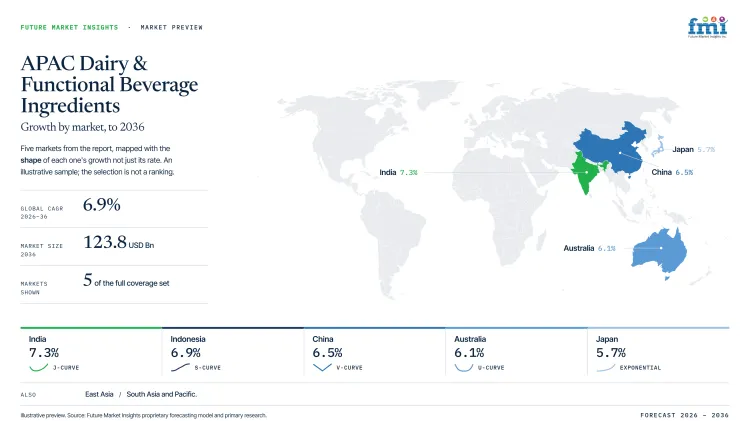
| Country | CAGR |
|---|---|
| China | 6.5% |
| India | 7.3% |
| Japan | 5.7% |
| Indonesia | 6.9% |
| Australia | 6.1% |
How do country-level CAGRs compare in the APAC Dairy & Functional Beverage Ingredients Market?
The country forecasts form a narrow range across dairy systems with different manufacturing and regulatory conditions. India stands 0.4 percentage points above Indonesia and 0.8 points above China across the forecast period. Australia remains 0.4 points below China and Japan follows Australia by another 0.4 points during the same interval. The complete range spans 1.6 percentage points across all five forecasts for national jurisdictions. The measured CAGR gaps describe commercialization speed rather than current revenue or installed processing capacity alone.
- India occupies the upper end of the displayed range with a modest advantage over Indonesia and China across the forecast interval.
- Indonesia follows India by 0.4 percentage points while local halal documentation creates a separate commercialization sequence for imported ingredients.
- China sits midway between Indonesia and Australia as registration requirements shape imported ingredient timing alongside substantial domestic dairy output.
- Australia remains close to China despite a smaller milk base because claim compliance and export-oriented processing create a different commercial model.
- Japan trails Australia by 0.4 percentage points while formal functional-claim routes require carefully matched evidence and product labeling.
Comparable CAGRs create different entry conditions because regulatory files and processing systems shape repeat purchasing. Milk mineral concentrate comparisons show why narrow ingredients depend on local claims and nearby application support. The full report provides country-level CAGR analysis across East Asia and the South Asia and Pacific region.
Country-wise Analysis
- China requires overseas dairy ingredient producers to complete applicable GACC registration before registered imports can enter normal commercial channels. Dairy and functional beverage ingredient demand in China is projected to advance at 6.5% CAGR from 2026 to 2036. The National Bureau of Statistics reported in January 2026 that national milk output reached 40.91 million tonnes during 2025. Domestic production supports beverage manufacturing but imported specialty proteins require separate establishment registration and product compliance documentation. Large processors create an adoption enabler through established plants and national retail reach across several provinces. Registration maintenance and provincial service distance remain material frictions for smaller ingredient exporters entering secondary cities. Commercial entry improves through a registered importer with nearby application support and clear responsibility for factory troubleshooting.
- India combines a large milk base with fragmented procurement across cooperatives and privately managed processing plants. Industry in India is forecast to rise at 7.3% CAGR over the forecast period supported by value-added processing. FSSAI places fortified milk inside a defined national framework that includes standards and the notified +F identification logo. The Press Information Bureau reported in November 2025 that national milk production reached 247.87 million tonnes during 2024-25. The production base gives local processors substantial feedstock for protein enrichment and cultured beverage programs. Smaller plants can face limited application support and uneven cold-chain performance beyond major dairy clusters. Regional distributors with laboratory access and flexible pack sizes can reduce the cost of qualifying specialized ingredients.
- Japan requires functional dairy products to follow the selected FOSHU or Foods with Function Claims route with evidence and compliant labeling. The Consumer Affairs Agency revised its Foods with Function Claims notification guidance on October 1, 2025. The revision reinforces disciplined dossier management for beverage companies using probiotics or other functional ingredients. Dairy and functional beverage ingredient industry in Japan is estimated to expand at 5.7% CAGR through 2036. Established quality systems enable precise formulation and compact production runs across advanced dairy processors with modern filling systems. Extensive documentation and demanding sensory expectations increase qualification costs for unfamiliar overseas ingredients entering the country. Local technical partners can shorten reformulation work and support traceable claim evidence through commercial launch.
- Indonesia requires halal assurance planning across ingredient sourcing and finished beverage manufacturing ahead of the October 2026 implementation milestone. Dairy and functional beverage ingredient sales in Indonesia is expected to record 6.9% CAGR between 2026 and 2036 reflecting established UHT distribution and stricter halal documentation. Overseas ingredient manufacturers must coordinate halal documentation locally with national food registration and distributor responsibilities. BPJPH confirmed in June 2026 that food and beverage products enter mandatory halal certification requirements from October 18, 2026. Large dairy processors enable adoption through established UHT capacity and broad urban distribution across major islands. Service distance across the archipelago creates material friction for factory troubleshooting and maintenance access outside major industrial clusters. Commercial plans should use an authorized local partner that can manage certification files and support production trials near customer plants.
- Food Standards Australia New Zealand requires nutrition and health claims to meet the applicable Food Standards Code requirements. Dairy and functional beverage ingredient demand in Australia is projected to grow at 6.1% CAGR through 2036. The Australian Bureau of Statistics reported in April 2026 that 2.1 million dairy cattle were on holding at 30 June 2025. The milk base supports established processing and export-oriented ingredient production across major dairy regions and export plants. Current FSANZ guidance gives manufacturers a defined route for substantiating nutrition and health claims on finished beverages. Experienced processors and regional ingredient distributors provide an adoption enabler through established quality systems in major regions. Long transport distances and concentrated production regions raise service costs for smaller beverage manufacturers outside established dairy corridors.
Who are the notable companies in the APAC Dairy & Functional Beverage Ingredients Market?
Danone, Nestlé, FrieslandCampina, Fonterra, Yili, Mengniu, Arla, and Glanbia are the notable companies profiled in this industry.
-market-analysis-by-company.webp "Dairy & Functional Beverage Ingredients (apac Focus) Market Analysis By Company")
The competitive outlook combines consumer dairy groups with ingredient manufacturers and application partners serving beverage companies. Fonterra and Arla connect dairy protein production with formulation support while FrieslandCampina Ingredients and Glanbia provide nutrition systems. Yili reported in May 2026 that it operated 77 production bases and sold products across more than 80 countries and regions. Danone and Nestlé demonstrate functional dairy use cases through global brands and specialized nutrition platforms across regulated consumer categories.
Mengniu adds large Chinese production capacity and a broad liquid dairy portfolio across several beverage categories. Company selection depends on protein functionality and application service rather than corporate scale alone during qualification. A protein ingredient comparison clarifies specialized ingredient depth against finished-product commercial reach for beverage manufacturers.
- Fonterra and Arla provide dairy proteins through documented manufacturing capacity and dedicated beverage application support across international customer programs. Their commercial position depends on consistent functionality across processing conditions and responsive technical service during scale-up. Each company must connect laboratory results with line conditions across customer plants and storage programs.
- FrieslandCampina Ingredients and Glanbia combine specialized proteins with prebiotic systems and broader nutrition capabilities for beverage developers. Their application teams support formulation transfer across plants that use different processing equipment and product formats. Regional technical teams reduce reformulation cycles during commercial transfer and product launch preparation across customer plants.
- Danone and Nestlé operate global functional dairy portfolios through consumer brands and specialized nutrition platforms across established wellness categories. Yili and Mengniu add Chinese manufacturing capacity and organized distribution routes that support finished-product scale across major domestic channels. Their different business models separate ingredient capability from consumer reach during partner selection across APAC countries.
Competitive Benchmarking: APAC Dairy & Functional Beverage Ingredients Market
| Company | Dairy Ingredient Portfolio | Functional Beverage Portfolio | Application Support | Geographic Reach |
|---|---|---|---|---|
| Danone | Low | High | Low | Global |
| Nestlé | Low | High | Low | Global |
| FrieslandCampina | High | High | High | Global |
| Fonterra | High | High | High | Global |
| Yili | Medium | High | Medium | China and selected international jurisdictions |
| Mengniu | Low | High | Low | China and selected international jurisdictions |
| Arla | High | High | High | Global |
| Glanbia | High | High | High | Global |
Key Developments in the APAC Dairy & Functional Beverage Ingredients Market
- In May 2025, Arla Foods Ingredients expanded its Brenntag partnership to extend distribution across the food and nutrition sectors of Vietnam and Thailand. The agreement also covers Indonesia through the same extensive protein ingredient portfolio and regional service arrangement. The new route improves local ordering and technical access for beverage manufacturers that need regional distribution support.
- In February 2025, Fonterra progressed construction at the Studholme advanced protein hub through new powder storage and specialized processing equipment. The facility will support high-value dairy protein production for international ingredient customers from its planned 2026 startup. The project adds another supply route for beverage manufacturers qualifying advanced proteins across shelf-stable and chilled formulations.
- In July 2026, Yili presented precision-nutrition advances and functional dairy products at the Global Dairy Congress. The showcased applications addressed blood sugar management and bone health together with gastrointestinal nutrition and sports immunity. The development demonstrates how a major APAC dairy manufacturer is adapting dairy formats to defined health needs across multiple consumer groups. Ingredient manufacturers gain a clearer formulation brief but must substantiate each benefit under the applicable APAC claim route.
- In June 2025, Nestlé expanded its Sinergity rollout across Latin America and the Middle East with additional Asian launches planned for the same year. The formulation combines one probiotic strain with six human milk oligosaccharides inside a finished dairy nutrition platform. The rollout documents ingredient deployment across jurisdictions with different labeling and registration requirements for early-life products.
Key Players in the APAC Dairy & Functional Beverage Ingredients Market
Dairy Protein and Ingredient Specialists
- FrieslandCampina
- Fonterra
- Arla
- Glanbia
Global Functional Dairy and Nutrition Groups
- Danone
- Nestlé
Scaled APAC Dairy Manufacturers
- Yili
- Mengniu
APAC Dairy & Functional Beverage Ingredients Market - Report Scope
-market-breakdown-by-ingredient,-product,-and-region.webp "Dairy & Functional Beverage Ingredients (apac Focus) Market Breakdown By Ingredient, Product, And Region")
| Coverage field | Report scope |
|---|---|
| Industry breakdown | Ingredient, product, sales channel, and region. |
| Quantitative Units | USD billion, CAGR in %. |
| Industry Definition | Revenue from dairy proteins, probiotics, functional actives, finished dairy and functional drink formats, and commercial sales channels directly serving the defined industry. Adjacent ingredients without a direct beverage application are excluded. |
| Regions Covered | East Asia; South Asia and Pacific. |
| Countries Covered | China, India, Japan, Indonesia, Australia, South Korea, ASEAN member countries, and additional APAC countries within the regional model. |
| Key Companies Profiled | Danone, Nestlé, FrieslandCampina, Fonterra, Yili, Mengniu, Arla, and Glanbia |
| Forecast Period | 2026 to 2036. |
| Approach | Hybrid bottom-up and top-down sizing supports the defined industry scope. Company records and trade evidence are considered alongside regulatory and technical sources. |
APAC Dairy & Functional Beverage Ingredients Market - Research Methodology
| Method | Approach |
|---|---|
| Primary Research | FMI analysts gathered input from manufacturers, service providers, technology developers, distributors, end users, sourcing teams, and subject-matter experts. Interviews examined purchasing decisions, product or service evaluation, adoption barriers, approval requirements, pricing considerations, and expectations for technical or commercial support. Respondents were also asked what evidence is required before a trial, pilot, or initial order develops into regular purchasing. |
| Desk Research | Desk research covered government statistics, regulatory publications, trade data, industry associations, technical literature, standards, company filings, product information, and official corporate announcements. Sources were reviewed for relevance, publication date, geographic coverage, and consistency with the defined market scope. Claims relating to performance, applications, approvals, capacity, investment, and commercial activity were retained only when supported by credible public evidence. |
| Market Sizing and Forecasting | The market model combined the baseline value with historical performance, segment structure, pricing and volume indicators, adoption levels, company participation, and country-level demand conditions. Forecast assumptions considered economic activity, investment trends, regulatory developments, technology adoption, purchasing cycles, supply availability, and barriers to wider market use. Segment and regional estimates were reconciled before the final market total was calculated. |
| Data Validation | Estimates were checked against multiple independent indicators, including public data, company activity, trade patterns, industry developments, and findings from primary interviews. Validation also tested whether products, services, applications, and company revenues fell within the defined market boundaries. Adjacent categories, unsupported claims, overlapping revenues, and activities without direct market relevance were excluded to reduce double counting and maintain consistency across segments and countries. |
APAC Dairy & Functional Beverage Ingredients Market by Segments
APAC Dairy & Functional Beverage Ingredients Market segmented by Ingredient:
- Dairy Proteins
- Probiotics
- Functional Actives
APAC Dairy & Functional Beverage Ingredients Market segmented by Product:
- Dairy
- Functional Drinks
APAC Dairy & Functional Beverage Ingredients Market segmented by Sales Channel:
- Hypermarkets/Supermarkets
- Convenience Stores
- Specialty Stores
- Online Retail
- Foodservice/HoReCa
APAC Dairy & Functional Beverage Ingredients Market by Region:
- East Asia
- China
- Japan
- South Korea
- South Asia and Pacific
- India
- ASEAN
- Australia and New Zealand
Research Sources and Bibliography
- Organisation for Economic Co-operation and Development and Food and Agriculture Organization of the United Nations. (2026, June 29). Dairy and dairy products: OECD-FAO Agricultural Outlook 2026-2035.
- Organisation for Economic Co-operation and Development and Food and Agriculture Organization of the United Nations. (2025, July 15). Dairy and dairy products: OECD-FAO Agricultural Outlook 2025-2034.
- Food and Agriculture Organization of the United Nations. (2025, May 22). Dairy Market Review. Overview of global market developments in 2024.
- Food and Agriculture Organization of the United Nations. (2026, July 3). FAO Food Price Index.
- Arla Foods Ingredients. (2025, May 6). Arla Foods Ingredients showcases protein soda concept at Vitafoods Europe.
- Fonterra Co-operative Group. (2025, July 1). Demand for functional foods in Greater China.
- National Bureau of Statistics of China. (2026, January 20). Total retail sales of consumer goods in December 2025.
- General Administration of Customs of the People’s Republic of China. (n.d.). 进口食品境外生产企业注册 [Registration of overseas producers of imported food]. Retrieved July 22, 2026.
- National Bureau of Statistics of China. (2026, January 19). National economy pushed forward with innovation-led and high-quality development and expected targets achieved successfully in 2025.
- Press Information Bureau, Government of India. (2025, November 26). Release of Basic Animal Husbandry Statistics 2025 on the Occasion of National Milk Day 2025.
- Food Safety and Standards Authority of India. (n.d.). Fortified food. Retrieved July 22, 2026.
- Consumer Affairs Agency, Government of Japan. (2025, October 1). 〖食品関連事業者向け〗機能性表示食品の届出について [For food-related businesses: Notification of foods with function claims].
- Halal Product Assurance Organizing Agency. (2026, June 5). Tak Hanya Makanan-Minuman, Ini Jenis Produk yang Wajib Bersertifikat Halal Mulai 18 Oktober 2026.
- Food Standards Australia New Zealand. (2025, February 25). Nutrition, health and related claims.
- Australian Bureau of Statistics. (2026, April 28). Australian Agriculture: Livestock, 2024-25 financial year.
- Arla Foods Ingredients. (2025, May 20). Arla Foods Ingredients and Brenntag expand collaboration into Southeast Asia.
- Fonterra Co-operative Group. (2025, February 17). Fonterra’s Studholme site on track for first advanced proteins to come off the line in 2026.
- FrieslandCampina Ingredients. (2026, May 15). FrieslandCampina Ingredients opens new North America Application Center to support the development of protein and prebiotic solutions.
- Nestlé. (2025, June 2). Nestlé’s groundbreaking Sinergity is going global.
- Nestlé. (2025, July 22). Nestlé launches high-protein Milo Pro to energize active teens and young adults.
- Nestlé. (2026, February 19). Full-year results 2025 and strategic update: Strong momentum, accelerating strategic change.
- Yili Group. (2026, July 1). Yili Group showcases dairy innovation and functional product development at the 19th Global Dairy Congress.
- Yili Group. (2026, May 14). Yili Group reports FY2025 dual growth in revenue and profit, marking 500-fold revenue surge in 30 years since its listing.
- Glanbia. (2026, March 11). Annual report 2025.
- Fonterra Co-operative Group. (2025, November 7). Fonterra’s dairy innovation on display at giant China expo.
This bibliography is provided for reader reference and is not exhaustive. The full report contains the complete reference list and detailed citations.
This Report Answers
- How large is the APAC Dairy & Functional Beverage Ingredients Market in 2026 and 2036?
- Which supply and formulation conditions support investment in dairy and functional beverage ingredients?
- Why do Dairy Proteins hold the leading Ingredient share during 2026?
- How does Dairy retain the leading position within the Product category?
- Why do Hypermarkets/Supermarkets account for the leading Sales Channel share?
- How do growth rates differ across China, India, Japan, Indonesia, and Australia?
- Which companies combine ingredient portfolios with functional beverage and application capabilities?
- What regulatory conditions limit imported ingredients and functional product claims across APAC?
- Which commercial tests support confidence before a formulation enters broad retail distribution?
Frequently Asked Questions
How big is the APAC Dairy & Functional Beverage Ingredients Market in 2026?
The APAC dairy and functional beverage ingredients market is valued at USD 63.5 billion in 2026 and is forecast to reach USD 123.8 billion by 2036. Growth reflects expanding dairy production and increasing availability of milk-based raw materials across processing routes in key APAC markets.
Who are the key players in the APAC Dairy & Functional Beverage Ingredients Market?
Fonterra and Arla provide specialized proteins with application support from FrieslandCampina and Glanbia across customer beverage programs. Danone and Nestlé contribute global functional dairy portfolios as Yili and Mengniu provide scaled APAC manufacturing and distribution.
What is the CAGR of the APAC Dairy & Functional Beverage Ingredients Market from 2026 to 2036?
The APAC dairy and functional beverage ingredients market grows at a CAGR of 6.9% between 2026 and 2036, supported by expanding milk availability that gives processors more feedstock for value-added beverages with measurable nutritional and formulation performance improvements.
Which ingredient leads the APAC Dairy & Functional Beverage Ingredients Market?
Dairy proteins account for 53.1% of the APAC dairy and functional beverage ingredients market by ingredient in 2026, driven by their combined structural and nutritional roles that influence viscosity and stability across several finished beverage formats during routine production systems.
How much will the APAC Dairy & Functional Beverage Ingredients Market add between 2026 and 2036?
The APAC dairy and functional beverage ingredients market is set to add USD 60.3 billion between 2026 and 2036, growing from USD 63.5 billion to USD 123.8 billion as dairy protein and functional beverage demand extends across a widening base of processing routes.
Who are the leading companies in the APAC Dairy & Functional Beverage Ingredients Market?
Five companies lead the APAC dairy and functional beverage ingredients market, including Danone, Nestlé, FrieslandCampina, Fonterra, and Yili, competing through dairy proteins, functional beverage portfolios, application support capabilities, and broad manufacturing scale across major APAC distribution regions.
Preview the report firsthand - request a free sample
Get SampleGet the brochure for pricing and purchase details.
Get PDFTable of Content
- Key Takeaways
- Market Size and CAGR
- Top Growth Driver
- Fastest Growing Segment
- Leading Region
- Key Companies
- Emerging Opportunities
- Executive Summary
- APAC Market Outlook
- Demand-side Trends
- Supply-side Trends
- Technology Roadmap Analysis
- Analysis and Recommendations
- Analyst Perspective (What is happening? Why now? What should investors know?)
- Key Questions Answered
- How large is the market?
- What is the CAGR?
- What are key trends?
- Which region dominates?
- Who are the leaders?
- Market Overview
- Market Coverage / Taxonomy
- Market Definition / Scope / Limitations
- Research Methodology
- Chapter Orientation
- Analytical Lens and Working Hypotheses
- Market Structure, Signals, and Trend Drivers
- Benchmarking and Cross-market Comparability
- Market Sizing, Forecasting, and Opportunity Mapping
- Research Design and Evidence Framework
- Desk Research Programme (Secondary Evidence)
- Expert Input and Fieldwork (Primary Evidence)
- Tooling, Models, and Reference Databases
- Data Engineering and Model Build
- Quality Assurance and Audit Trail
- Market Background
- Market Dynamics (Drivers, Restraints, Opportunity, Trends)
- Scenario Forecast (Optimistic, Likely, Conservative)
- Impact Analysis
- AI Impact
- Sustainability Impact
- Regulatory Impact
- Technology Impact
- Consumer / Buyer Analysis
- Purchase Drivers
- Adoption Barriers
- Buyer Journey
- Opportunity Map Analysis
- Product Life Cycle Analysis
- Supply Chain Analysis
- Investment Feasibility Matrix
- Value Chain Analysis
- PESTLE and Porter's Analysis
- Regulatory Landscape
- Regional Parent Market Outlook
- Production and Consumption Statistics
- Import and Export Statistics
- APAC Market Analysis and Forecast, 2021 to 2036
- Historical Market Size Value (USD Billion) Analysis, 2021 to 2025
- Current and Future Market Size Value (USD Billion) Projections, 2026 to 2036
- Y-o-Y Growth Trend Analysis
- Absolute $ Opportunity Analysis
- APAC Market Pricing Analysis, 2021 to 2036
- APAC Market Analysis and Forecast, By Ingredient, 2021 to 2036
- Introduction / Key Findings
- Historical Market Size Value (USD Billion) Analysis By Ingredient, 2021 to 2025
- Current and Future Market Size Value (USD Billion) Analysis and Forecast By Ingredient, 2026 to 2036
- Dairy Proteins
- Probiotics
- Functional Actives
- Dairy Proteins
- Y-o-Y Growth Trend Analysis By Ingredient, 2021 to 2025
- Absolute $ Opportunity Analysis By Ingredient, 2026 to 2036
- APAC Market Analysis and Forecast, By Product, 2021 to 2036
- Introduction / Key Findings
- Historical Market Size Value (USD Billion) Analysis By Product, 2021 to 2025
- Current and Future Market Size Value (USD Billion) Analysis and Forecast By Product, 2026 to 2036
- Dairy
- Functional Drinks
- Dairy
- Y-o-Y Growth Trend Analysis By Product, 2021 to 2025
- Absolute $ Opportunity Analysis By Product, 2026 to 2036
- APAC Market Analysis and Forecast, By Sales Channel, 2021 to 2036
- Introduction / Key Findings
- Historical Market Size Value (USD Billion) Analysis By Sales Channel, 2021 to 2025
- Current and Future Market Size Value (USD Billion) Analysis and Forecast By Sales Channel, 2026 to 2036
- Hypermarkets/Supermarkets
- Convenience Stores
- Specialty Stores
- Online Retail
- Foodservice/HoReCa
- Hypermarkets/Supermarkets
- Y-o-Y Growth Trend Analysis By Sales Channel, 2021 to 2025
- Absolute $ Opportunity Analysis By Sales Channel, 2026 to 2036
- APAC Market Analysis and Forecast, By Region, 2021 to 2036
- Introduction
- Historical Market Size Value (USD Billion) Analysis By Region, 2021 to 2025
- Current Market Size Value (USD Billion) Analysis and Forecast By Region, 2026 to 2036
- East Asia
- South Asia and Pacific
- Market Attractiveness Analysis By Region
- East Asia Market Analysis and Forecast, By Country
- Historical Market Size Value (USD Billion) Trend Analysis By Market Taxonomy, 2021 to 2025
- Market Size Value (USD Billion) Forecast By Market Taxonomy, 2026 to 2036
- By Country
- China
- Japan
- South Korea
- By Ingredient
- By Product
- By Sales Channel
- By Country
- Market Attractiveness Analysis
- By Country
- By Ingredient
- By Product
- By Sales Channel
- Key Takeaways
- South Asia and Pacific Market Analysis and Forecast, By Country
- Historical Market Size Value (USD Billion) Trend Analysis By Market Taxonomy, 2021 to 2025
- Market Size Value (USD Billion) Forecast By Market Taxonomy, 2026 to 2036
- By Country
- India
- ASEAN
- Australia & New Zealand
- Rest of South Asia and Pacific
- By Ingredient
- By Product
- By Sales Channel
- By Country
- Market Attractiveness Analysis
- By Country
- By Ingredient
- By Product
- By Sales Channel
- Key Takeaways
- Key Countries Market Analysis
- India
- Pricing Analysis
- Market Share Analysis, 2025
- By Ingredient
- By Product
- By Sales Channel
- ASEAN
- Pricing Analysis
- Market Share Analysis, 2025
- By Ingredient
- By Product
- By Sales Channel
- Australia & New Zealand
- Pricing Analysis
- Market Share Analysis, 2025
- By Ingredient
- By Product
- By Sales Channel
- China
- Pricing Analysis
- Market Share Analysis, 2025
- By Ingredient
- By Product
- By Sales Channel
- Japan
- Pricing Analysis
- Market Share Analysis, 2025
- By Ingredient
- By Product
- By Sales Channel
- South Korea
- Pricing Analysis
- Market Share Analysis, 2025
- By Ingredient
- By Product
- By Sales Channel
- India
- Market Structure Analysis
- Competition Dashboard
- Competition Benchmarking
- Market Share Analysis of Top Players
- By Regional
- By Ingredient
- By Product
- By Sales Channel
- Emerging Startups
- Innovation Benchmarking
- Competition Analysis
- Competition Deep Dive
- Danone
- Overview
- Product Portfolio
- Profitability by Market Segments
- Sales Footprint
- Strategy Overview
- Marketing Strategy
- Product Strategy
- Channel Strategy
- Nestlé
- FrieslandCampina
- Fonterra
- Yili
- Mengniu
- Arla
- Glanbia
- Danone
- Case Studies
- Success Stories
- Recent Developments
- Competition Deep Dive
- Assumptions & Acronyms Used


