

- Market Size (2026)
- USD 2.3 Bn
- Forecast (2036)
- USD 4.9 Bn
- CAGR (2026 to 2036)
- 7.8%
How big is Functional Seasoning Blends Market in 2026?
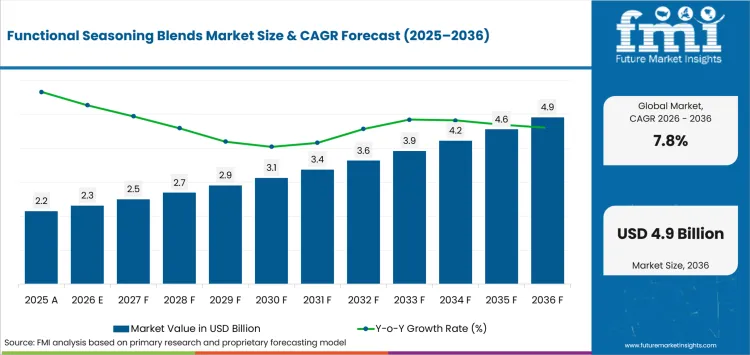
USD 2.3 billion in 2026 and USD 4.9 billion by 2036 at a 7.8% CAGR.
The functional seasoning blends market is projected to grow at a 7.8% CAGR from USD 2.3 billion in 2026 to USD 4.9 billion by 2036. The market was valued at USD 2.1 billion in 2025 and is expected to add USD 2.6 billion in value over the forecast period.
The market expands as food manufacturers move nutrition goals upstream into seasonings that already determine much of a product's taste profile. In August 2024, the FDA said that more than 70% of USA sodium intake comes from sodium added during manufacturing or commercial preparation. Its Phase II draft targets span 163 food categories. This pressure puts seasoning systems close to the reformulation decision because suppliers can adjust salt perception before a finished recipe is locked. They can also add botanicals or nutritional components at the same development stage. Buyers still resist solutions that introduce bitterness or weaken aroma. Purchasing therefore shifts toward blends that pair a defined function with documented sensory performance and repeatable dosing.
Country conditions change the path from reformulation interest to an order. USA manufacturers face category-level sodium targets and tend to evaluate systems against high-volume formulations. UK buyers work within a long-running salt reduction program that places reformulation expectations on processed foods. Germany adds science-based national reduction targets for sugar, fats and salt in processed foods. Japan places greater emphasis on responsibility for functional benefit communication, and its 2024 rule changes increased scrutiny of certain functional food formats. Across these markets, a supplier may offer the same health objective but cannot assume one claim or one taste architecture travels unchanged. Conversion depends on regulatory fit and sensory acceptance. It also depends on confidence that the blend will behave consistently at production scale.
Key Takeaways of Functional Seasoning Blends Market
- By function, Immunity Support is estimated to account for 26.7% in 2026 due to its ability to embed a broad wellness benefit into routine savory eating occasions; by end user, Food Manufacturers are estimated to account for 32.8% in 2026 driven by centralized formulation decisions across high-volume recipes.
- Among the key countries, South Korea leads at a 7.5% CAGR, followed by USA (7.2%), UK (6.9%), Germany (6.4%), and Japan (5.5%) from 2026 to 2036.
- By format, Dry Blends are estimated to account for 44.6% in 2026 because the format supports concentrated dosing, broad savory compatibility and efficient industrial handling across seasoning operations.
- Functional claim substantiation and formulation stability constrain adoption because jurisdiction-specific ingredient requirements and application validation lengthen the qualification process before a benefit-led product can reach commercial scale.
- Kerry, Givaudan, Symrise, IFF, and Ajinomoto provide integrated taste, nutrition and reformulation platforms for food manufacturers globally. McCormick, Fuchs Gruppe, and Solina deliver seasoning depth and custom culinary systems for industrial co-development. Sensient and ofi (Olam) contribute natural ingredient and savory extract platforms for clean-label and better-for-you seasoning development.
Analyst Perspective
"Functional seasoning blends win formulation briefs when the intended benefit can sit in a familiar flavour profile without complicating dosage, stability or label positioning. Suppliers with application evidence across food formats will have the clearest route to repeat orders."
- Nandini Roy Choudhury, Principal Consultant, Future Market Insights
How is the Functional Seasoning Blends Market segmented?
The functional seasoning blends market is segmented by function, format, ingredient base, end user, sales channel, and region.
Function separates the health or nutritional job that the blend is intended to support. Format reflects how the system is dosed, stored and incorporated into a recipe. Ingredient Base identifies the material platform used to carry taste and functional value. End User distinguishes industrial formulators from household, foodservice and branded nutrition buyers. Sales Channel captures the route through which finished blends or business-to-business systems reach those purchasers. Together, these axes show that functional seasoning is not bought only for flavor. Buyers also compare claim suitability, process compatibility, convenience and route-to-market economics before approving a formula.
What supports Food Manufacturers in the End User category?
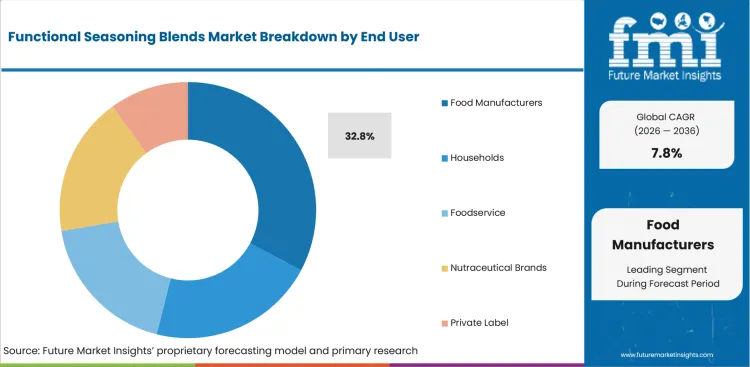
Food Manufacturers lead because functional seasoning is most valuable when it is specified early in product development. Industrial buyers can use one system to adjust flavor intensity, sodium delivery and functional ingredients before packaging or downstream processing. That reduces the number of separate ingredients a developer must manage and makes supplier co-development commercially important. The buying process remains demanding because quality teams need specifications and production teams need repeatable behavior at scale. A blend that performs in a bench sample can still fail after heat, shear or long storage. Suppliers therefore win manufacturing programs by pairing culinary design with application testing, regulatory support and dependable supply rather than by offering flavor novelty alone.
- Food Manufacturers hold a 32.8% share in 2026 because they can integrate functional seasoning directly into high-volume recipes and control the resulting product specification.
- In January 2025, Solina acquired Advanced Food Systems, adding customized dry seasoning solutions and functional ingredient systems designed for food manufacturers in the United States.
What makes Immunity Support central to the Function category?
Immunity Support leads because it translates a broad wellness objective into an understandable everyday food proposition. Seasoning is used repeatedly across meals, so the benefit can be embedded in a familiar culinary habit rather than requiring a separate consumption occasion. Herbs and permitted micronutrients give formulators several routes to build an immunity-oriented concept while preserving recognizable flavor cues. The commercial hurdle is substantiation. Givaudan's 2024 Integrated Report describes nutrition solutions that combine taste with vitamins, minerals and natural botanical ingredients. It also describes programs for reducing salt without compromising flavor. Successful blends therefore need a credible functional rationale alongside claim discipline and formulation records.
- Immunity Support holds a 26.7% share in 2026 because the benefit is easy to communicate and can be integrated into routine savory eating occasions.
- Givaudan published its 2024 Integrated Report on January 31, 2025. The report describes natural botanical ingredients and nutrition solutions that pair health-oriented formulation with taste technology.
Why do Dry Blends lead the Format category?
Dry Blends lead because they fit established seasoning operations and let manufacturers meter a concentrated system without adding unnecessary water. They combine readily with spices and minerals. Taste modulators can also be incorporated into the same dose for snacks or prepared foods. The format gives suppliers a practical base for localized variants because a core dry system can be adjusted before final packing. Powder performance still depends on flow, dispersion and ingredient stability. Buyers therefore favor suppliers that can validate the blend in the target process rather than sell an undifferentiated premix. Local powder capacity can also shorten supply chains when volumes justify regional manufacturing.
- Dry Blends hold a 44.6% share in 2026 because the format supports concentrated dosing, broad savory compatibility and efficient industrial handling.
- In September 2024, Symrise and Shan Foods inaugurated a powder-blending facility in Pakistan. It serves general seasonings plus bouillons, snacks and instant noodles.
How do Herbs & Botanicals anchor the Ingredient Base category?
Herbs & Botanicals anchor the Ingredient Base category because they perform two jobs at once. They build the sensory identity of a seasoning and provide a familiar ingredient story for health-oriented positioning. That dual role helps formulators avoid the disconnect that can occur when a functional additive changes taste or feels foreign to the recipe. It also supports household adoption because consumers already understand many culinary herbs as food ingredients. The constraint is consistency. Botanical materials vary by origin and processing, so suppliers need control over flavor strength and specifications. They also need restraint when translating a botanical association into a health claim because regulatory treatment varies by market.
- Herbs & Botanicals hold a 31.2% share in 2026 because they combine culinary familiarity with a natural route to functional product design.
- In May 2024, McCormick reported that its USA Everyday Core Herbs and Spices portfolio produces more than 100 million containers annually, illustrating the scale of established retail herb and spice use.
What drives Supermarkets & Hypermarkets in the Sales Channel category?
Supermarkets & Hypermarkets lead because functional seasoning benefits from physical shelf comparison and repeat household replenishment. Shoppers can assess ingredient cues, benefit statements and familiar culinary formats beside conventional seasonings. That comparison gives brands an opportunity to justify a premium through a clear function without changing the basic cooking ritual. Retail scale also favors standardized dry jars, sachets and other shelf-ready formats that can be replenished through existing grocery distribution. The channel is less forgiving of confusing claims or weak taste. A benefit must be understandable within seconds and the first use must deliver enough flavor value to support repeat purchase. Private-label programs add a further route for retailers to translate health themes into category-specific ranges.
- Supermarkets & Hypermarkets hold a 33.9% share in 2026 because shelf visibility and existing grocery habits support discovery, comparison and repeat purchase.
- Ajinomoto Group's Sustainability Report 2024 shows that its Smart Salt initiative, which supports delicious salt reduction using umami-based technologies, reached 350 million people annually with products promoting reduced salt intake and protein intake optimization, illustrating how health-oriented seasoning propositions can scale through branded consumer channels.
What are the drivers, restraints and opportunities in the Functional Seasoning Blends Market?
Reformulation pressure increases demand for taste-preserving functional systems, while claim and performance validation slow conversion and co-developed easy-to-dose blends open the clearest route to scale.
- Driver: Food manufacturers are reformulating nutrition profiles while trying to preserve the taste signatures that protect repeat purchase.
- Restraint: Functional claims and ingredient performance require jurisdiction-specific substantiation plus application validation before a formula can scale.
- Opportunity: Suppliers can combine taste modulation with botanicals or fortification in systems that make healthier formulation easier for manufacturers and households.
Functional Food Demand Supports Blend Development
The strongest driver is the need to improve nutrition without losing sensory acceptance. FDA targets in the United States focus on commercially processed and prepared foods because that is where most dietary sodium is added. This puts seasoning systems close to the point where manufacturers can act. Kerry showed the practical mechanism in April 2024 by comparing BBQ chips at 500 mg sodium per 100 g with a 700 mg control. The company reported comparable upfront salt impact using Tastesense Salt. The commercial demand is therefore for reformulation tools that protect taste while moving a finished recipe toward a nutritional objective.
Claims and Formulation Stability Constrain Adoption
The main restraint appears during qualification rather than initial interest. Functional benefits must fit the local claims framework, and ingredients must remain stable through the target process. Japan provided a clear signal in August 2024 when the Consumer Affairs Agency revised standards affecting certain Foods with Function Claims. The changes included manufacturing or processing requirements for specified formats that use natural extracts. These requirements do not remove demand. They lengthen documentation and formulation work before a manufacturer can place a benefit-led product on shelf. Smaller brands may therefore favor functions that can be supported with established ingredients and conservative wording.
Application-Specific Blends Expand Commercial Reach
The opportunity is to turn functional formulation into a service rather than a bag of ingredients. Buyers increasingly need a supplier to balance taste, nutritional intent and process constraints in one development cycle. Symrise's September 2024 partnership with Shan Foods linked powder blending with local application capability for seasonings and other savory categories. Solina's February 2025 acquisitions added both customized dry seasoning systems and liquid savory capability in North America. Those moves point to a commercial opening for suppliers that can deliver format flexibility and faster localization. The best-positioned companies will be those that provide validated application recipes and regulatory documentation alongside the seasoning system.
Which country CAGRs are profiled in the Functional Seasoning Blends Market?
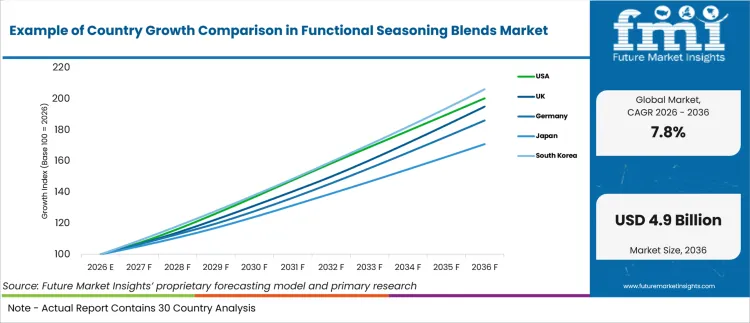
| Country | CAGR |
|---|---|
| USA | 7.2% |
| UK | 6.9% |
| Germany | 6.4% |
| Japan | 5.5% |
| South Korea | 7.5% |
How do country-level CAGRs compare in the Functional Seasoning Blends Market?
South Korea and the USA form the highest-growth band at 7.5% and 7.2% CAGR from 2026 to 2036. The UK follows at 6.9%, while Germany sits at 6.4%. Japan is the slowest of the five at 5.5%. The spread between the highest and lowest rates is 2.0 percentage points. These differences indicate variation in reformulation pace and channel development rather than market size. Faster growth can reflect a smaller installed base or a sharper policy response. Supplier planning therefore needs to pair CAGR with evidence on regulation, local taste, buyer structure and the speed of product qualification.
- South Korea exceeds the USA by 0.3 percentage points. Both support early investment, but South Korea requires especially strong localization around familiar savory profiles and sodium reduction.
- The USA exceeds the UK by 0.3 percentage points. The USA opportunity is closely tied to manufacturer reformulation, while UK conversion also reflects retail and advertising rules for less healthy foods.
- The UK exceeds Germany by 0.5 percentage points. German buyers face similar nutrition pressure, but claim discipline and conservative recipe qualification can lengthen the path to a scaled launch.
- Germany exceeds Japan by 0.9 percentage points. The larger adjacent gap makes localized taste architecture and functional-claim documentation particularly important for suppliers targeting Japan.
CAGR is only one screen for country attractiveness. A supplier also needs to understand how much of the addressable demand is industrial or household, which functions can be communicated legally and which formats fit local cooking habits. The broader report framework therefore combines country growth rates with buyer behavior, reformulation policy and route-to-market conditions. This avoids treating the fastest percentage growth as automatic proof of the largest revenue pool.
Country-wise Analysis
- USA: USA food manufacturers and foodservice operators buy functional seasoning mainly as a reformulation tool that must work inside existing high-volume recipes. Demand for Functional Seasoning Blends in USA is forecast to expand at 7.2% CAGR from 2026 to 2036. In August 2024, the FDA issued Phase II draft sodium targets for 163 commercially processed or prepared food categories and noted that more than 70% of USA sodium intake comes from manufacturing or commercial preparation. The friction is sensory and technical: salt contributes more than salinity in many foods. Suppliers need application-specific taste modulation, manufacturing validation and careful claim support to win repeat programs.
- UK: UK manufacturers and retailers operate within a long-established reformulation environment, so seasoning suppliers are evaluated on their ability to deliver measurable nutrient change without weakening familiar flavor. Demand for Functional Seasoning Blends in UK is forecast to expand at 6.9% CAGR from 2026 to 2036. Public Health England published 2024 salt reduction targets in September 2020 for food and drink categories. The framework made reformulation a continuing product-development task rather than a one-time labeling exercise. The friction is that nutrient reduction must still protect consumer acceptance in familiar foods. Suppliers need low-sodium systems and clear ingredient documentation. They also need retail-ready benefit communication.
- Germany: German food manufacturers tend to combine nutritional reformulation with strict product-quality expectations and conservative benefit communication. Demand for Functional Seasoning Blends in Germany is forecast to expand at 6.4% CAGR from 2026 to 2036. The German Federal Government's 2025 Sustainable Development Strategy says its National Reduction and Innovation Strategy sets science-based targets for sugar, fats and salt in processed foods. It also states that reformulation progress to date remains insufficient. The friction is translating a nutrition objective into an established recipe without weakening taste or process performance. Suppliers need careful claim design and strong sensory testing. They also need seasoning systems that fit existing processed-food operations.
- Japan: Japanese buyers place high value on localized savory balance and on documentation that supports any explicit functional positioning. Demand for Functional Seasoning Blends in Japan is forecast to expand at 5.5% CAGR from 2026 to 2036. In August 2024, the Consumer Affairs Agency revised standards affecting certain Foods with Function Claims and established manufacturing or processing requirements for specified formats using natural extracts. The friction is that functional benefit communication can add regulatory work beyond ordinary seasoning approval. Suppliers should use familiar umami and botanical profiles, avoid overextended claims and provide supporting documentation that helps brand owners manage notification or labeling obligations.
- South Korea: South Korean food and foodservice buyers favor bold seasoning profiles, which makes sodium reduction commercially useful only when flavor intensity is preserved. Demand for Functional Seasoning Blends in South Korea is forecast to expand at 7.5% CAGR from 2026 to 2036. In March 2025, the Ministry of Food and Drug Safety designated March 31 as an annual Samsamhan Day and launched a nationwide campaign to reduce excessive sodium intake. The friction is balancing lower sodium with familiar sauces, soups and seasoned foods while keeping benefit statements within local rules. Suppliers need localized savory systems, strong sensory validation and channel partners that can translate health positioning into everyday meals.
Who are the notable companies in the Functional Seasoning Blends Market?
Kerry, McCormick, Givaudan, Symrise, IFF, Ajinomoto, Fuchs Gruppe, Solina, Sensient, and ofi (Olam) are the notable companies profiled in this market.
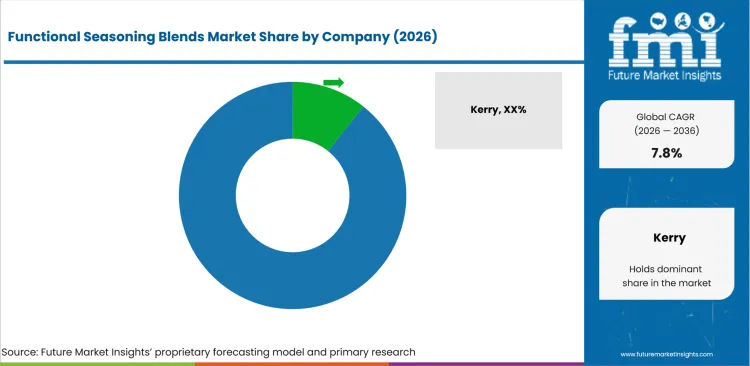
The competitive field separates into three practical roles. Integrated taste and nutrition houses combine savory flavor creation with sodium reduction, nutritional design and application support. Seasoning specialists compete through recipe depth, custom dry systems and close customer co-development. Natural ingredient platforms contribute spices, extracts and flavor building blocks that can be converted into finished seasoning systems directly or through partners. Company boundaries are not absolute. A supplier may participate in more than one role, but the primary route to value differs. Buyers therefore compare how much formulation work a supplier can absorb, how well the solution fits regional taste and whether the company can support regulatory review plus consistent supply after a product moves from pilot to full production.
- Integrated Taste, Nutrition and Reformulation Platforms: Kerry, Givaudan and Symrise work alongside IFF and Ajinomoto. This group combines taste science with nutrition-oriented reformulation or functional ingredient capabilities.
- Seasoning Specialists and Custom Culinary Systems: McCormick, Fuchs Gruppe and Solina emphasize seasoning depth, custom formulation and food-manufacturer application support.
- Natural Ingredient and Savory Extract Platforms: Sensient and ofi (Olam) contribute savory flavor building, spice systems and ingredient combinations that support clean-label or better-for-you development.
Competitive Benchmarking: Functional Seasoning Blends Market
| Company | Savory & Seasoning System Depth | Nutrition / Function Integration | Reformulation & Co-development | Geographic Reach |
|---|---|---|---|---|
| Kerry | High | High | High | North America, Europe, Asia-Pacific and other global markets |
| McCormick | High | Medium | High | Americas, Europe, Middle East, Africa and Asia-Pacific |
| Givaudan | High | High | High | North America, Europe, Latin America, Asia-Pacific and Middle East/Africa |
| Symrise | High | High | High | Europe, North America, Latin America, Asia-Pacific and Middle East/Africa |
| IFF | High | High | High | North America, Europe, Asia-Pacific and Latin America |
| Ajinomoto | Medium | High | High | Asia, North America, Latin America and Europe |
| Fuchs Gruppe | High | Medium | High | Europe, North America and additional international operations |
| Solina | High | Medium | High | Europe and North America with a multi-country manufacturing network |
| Sensient | Medium | Medium | High | North America, Europe and Asia-Pacific |
| ofi (Olam) | Medium | Medium | High | North America, Europe, Asia and major spice-origin markets |
Scoring basis: Savory & Seasoning System Depth measures documented breadth in complete seasoning or savory systems across food applications. Nutrition / Function Integration measures documented sodium reduction, nutritional formulation, botanical or functional-ingredient capability within taste solutions. Reformulation & Co-development measures documented customer collaboration, application testing and the ability to move a concept toward commercial formulation. High indicates broad documented capability and Medium indicates credible but narrower coverage. Low would indicate a documented limitation; unavailable public information is left unscored rather than treated as Low.
Key Developments in the Functional Seasoning Blends Market
- In April 2024, Kerry published sensory validation of Tastesense Salt in BBQ-seasoned chips. The work compared a reduced-salt recipe at 500 mg sodium per 100 g with a 700 mg control and reported a closely matched upfront salt impact. For functional seasoning formulators, the result demonstrates how taste-modulation systems can support sodium-reduction targets without relying on salt removal alone.
- In September 2024, Symrise and Shan Foods inaugurated a powder-blending manufacturing facility in Pakistan. The partnership targets general seasonings, bouillons, processed meat, snacks and instant noodles while also addressing better-for-you products and ingredients with functional benefits. Local blending and application capability can shorten development cycles for dry-format systems and reduce dependence on imported finished blends.
- In November 2024, ofi (Olam) announced a collaboration with Lisco Barbecue Supply Chain using ofi's Shanghai Customer Solutions Center. The partners aim to develop new spice blends and ingredient combinations targeting the barbecue culinary segment in China and Asia Pacific. The model combines spice sourcing with local co-creation, giving suppliers a route to translate provenance, flavor consistency and convenient formats into tailored seasoning systems.
- In February 2025, Solina acquired Advanced Food Systems and Sokol Custom Food Ingredients in the United States. Advanced Food Systems adds customized dry seasoning solutions and functional ingredient systems, while Sokol adds sweet and savory sauce capability. The transactions broaden Solina's dry and liquid solution range and place additional formulation capacity closer to North American food manufacturers.
Key Players in the Functional Seasoning Blends Market
Integrated Taste, Nutrition, and Reformulation Platforms
- Kerry
- Givaudan
- Symrise
- IFF
- Ajinomoto
Seasoning Specialists and Custom Culinary Systems
- McCormick
- Fuchs Gruppe
- Solina
Natural Ingredient and Savory Extract Platforms
- Sensient
- ofi (Olam)
Functional Seasoning Blends Market - Report Scope
| Coverage field | Report scope |
|---|---|
| Market breakdown | By Function, Format, Ingredient Base, End User, Sales Channel, and Region. |
| Quantitative Units | USD billion. |
| Market Definition | Revenue includes functional seasoning blends sold within the defined segmentation universe. It includes systems designed to deliver flavor plus a stated nutritional or functional purpose. Revenue from downstream finished foods, standalone adjacent ingredients and substitute products is excluded. |
| Regions Covered | North America; Latin America; Western Europe; Eastern Europe; East Asia; South Asia and Pacific; Middle East and Africa |
| Countries Covered | USA, UK, Germany, Japan, South Korea, plus more than twenty-five additional countries in the full report |
| Key Companies Profiled | Kerry, McCormick, Givaudan, Symrise, IFF, Ajinomoto, Fuchs Gruppe, Solina, Sensient, ofi (Olam) |
| Forecast Period | 2026 to 2036 |
| Approach | FMI applies a hybrid bottom-up and top-down sizing approach that reconciles supplier activity, channel structure, end-use demand and market-specific operating factors. |
Functional Seasoning Blends Market - Research Methodology
| Method | Approach |
|---|---|
| Primary Research | Structured discussions with seasoning and ingredient manufacturers, distributors, food manufacturers, foodservice buyers and subject-matter experts focus on market scope, purchasing criteria, pricing behavior, product qualification and adoption barriers. |
| Desk Research | FMI reviews regulators, national statistics, dietary guidance, company filings, product documentation, standards, trade material and public policy sources that directly support the market definition and commercial mechanisms. |
| Market Sizing and Forecasting | FMI triangulates supplier activity, channel structure, end-user demand, segmentation patterns and policy or nutrition factors. Forecasts assess adoption pace, product qualification and route-to-market conditions without treating adjacent finished-product revenue as market revenue. |
| Data Validation | Findings are cross-checked for scope consistency and numerical reconciliation. Double counting is removed, downstream finished-product revenue is excluded and adjacent or substitute categories are not counted unless they fall within the defined functional seasoning blend boundary. |
Functional Seasoning Blends Market by Segments
Functional Seasoning Blends Market segmented by Function:
- Immunity Support
- Digestive Health
- Metabolic Support
- Energy & Cognition
- Sodium Reduction
Functional Seasoning Blends Market segmented by Format:
- Dry Blends
- Pastes
- Liquid Concentrates
- Encapsulated Blends
- Cubes & Tablets
Functional Seasoning Blends Market segmented by Ingredient Base:
- Herbs & Botanicals
- Fortified Minerals & Vitamins
- Adaptogens
- Fermented / Probiotic
- Protein-Enriched
Functional Seasoning Blends Market segmented by End User:
- Food Manufacturers
- Households
- Foodservice
- Nutraceutical Brands
- Private Label
Functional Seasoning Blends Market segmented by Sales Channel:
- Supermarkets & Hypermarkets
- Online Retail
- B2B Ingredient Supply
- Specialty Stores
- Convenience Stores
Functional Seasoning Blends Market by Region:
- North America
- United States
- Canada
- Latin America
- Brazil
- Mexico
- Argentina
- Chile
- Western Europe
- Germany
- France
- United Kingdom
- Italy
- Spain
- Benelux
- Nordics
- Eastern Europe
- Poland
- Czech Republic
- Romania
- Hungary
- East Asia
- China
- Japan
- South Korea
- South Asia and Pacific
- India
- ASEAN
- Australia and New Zealand
- Middle East and Africa
- GCC Countries
- South Africa
- Türkiye
- Israel
Research Sources and Bibliography
- USA Food and Drug Administration (2024, November 1). FDA Starts Next Phase of Sodium Reduction Efforts.
- Public Health England (2020, September 7). Salt reduction: targets for 2024.
- German Federal Government (2025, May 13). Shaping transformation fairly together: German Sustainable Development Strategy Update 2025.
- Consumer Affairs Agency, Government of Japan (2024, August 30). Revision of standards for certain Foods with Function Claims using natural extracts.
- Ministry of Food and Drug Safety, Republic of Korea (2025, March 31). MFDS Holds a Healthy Eating Campaign on 'Samsamhan Day'.
- Kerry (2024, April 8). Rethink & Reinvent: Navigating Sodium Reduction in Salty Snacks.
- McCormick & Company (2024, May 15). Reimagining our USA Everyday Core Herbs and Spices Portfolio.
- Givaudan (2025, January 31). 2024 Integrated Report.
- Symrise (2024, September 20). Symrise and Shan Foods inaugurate a state-of-the-art international standard production facility for its strategic partnership in Pakistan.
- IFF (2024, November 6). The Fifth Taste: Salt and Fat Take a Dive with Umami.
- Ajinomoto Group (2024, September 27). Help Extend the Healthy Life Expectancy of 1 Billion People.
- Fuchs Gruppe (2024, September 10). Doubling of production capacity in Romania.
- Solina (2025, February 6). Expanding our North America presence with two strategic acquisitions.
- Sensient Technologies Corporation (2025, February 19). 2024 Annual Report.
- ofi (2024, November 6). ofi and Lisco Barbecue Supply Chain collaborate to spice up the barbecue culinary industry.
This bibliography is provided for reader reference and is not exhaustive. The full report contains the complete reference list and detailed citations.
This Report Answers
- What are the Functional Seasoning Blends Market sizes in 2026 and 2036?
- Which nutrition and reformulation pressures support demand for functional seasoning blends?
- Why does Immunity Support hold the leading position within the Function category?
- How does Dry Blends leadership influence manufacturing and downstream formulation?
- Why do Herbs & Botanicals hold the leading position within the Ingredient Base category?
- How do growth rates differ across USA, UK, Germany, Japan and South Korea from 2026 to 2036?
- Which companies provide integrated taste systems, custom seasonings or natural ingredient platforms?
- How do claim substantiation and application validation limit adoption?
- What should food product development and procurement teams evaluate before purchasing functional seasoning blends?
Frequently Asked Questions
How big is the Functional Seasoning Blends Market in 2026?
The functional seasoning blends market is valued at USD 2.3 billion in 2026.
What is the CAGR of the Functional Seasoning Blends Market from 2026 to 2036?
The functional seasoning blends market is projected to grow at a CAGR of 7.8% between 2026 and 2036.
Which function segment leads the Functional Seasoning Blends Market?
Immunity Support is projected to account for 26.7% of the function category in 2026.
How much value will the Functional Seasoning Blends Market add between 2026 and 2036?
The market is expected to add USD 2.6 billion in value between 2026 and 2036.
Which companies are active in the Functional Seasoning Blends Market?
Key companies operating in the market include Kerry, McCormick, Givaudan, Symrise, IFF, Ajinomoto, Fuchs Gruppe, Solina, Sensient, and ofi (Olam).
Preview the report firsthand - request a free sample
Get SampleGet the brochure for pricing and purchase details.
Get PDFTable of Content
- Key Takeaways
- Market Size and CAGR
- Top Growth Driver
- Fastest Growing Segment
- Leading Region
- Key Companies
- Emerging Opportunities
- Executive Summary
- Global Market Outlook
- Demand-side Trends
- Supply-side Trends
- Technology Roadmap Analysis
- Analysis and Recommendations
- Analyst Perspective (What is happening? Why now? What should investors know?)
- Key Questions Answered
- How large is the market?
- What is the CAGR?
- What are key trends?
- Which region dominates?
- Who are the leaders?
- Market Overview
- Market Coverage / Taxonomy
- Market Definition / Scope / Limitations
- Research Methodology
- Chapter Orientation
- Analytical Lens and Working Hypotheses
- Market Structure, Signals, and Trend Drivers
- Benchmarking and Cross-market Comparability
- Market Sizing, Forecasting, and Opportunity Mapping
- Research Design and Evidence Framework
- Desk Research Programme (Secondary Evidence)
- Expert Input and Fieldwork (Primary Evidence)
- Tooling, Models, and Reference Databases
- Data Engineering and Model Build
- Quality Assurance and Audit Trail
- Market Background
- Market Dynamics (Drivers, Restraints, Opportunity, Trends)
- Scenario Forecast (Optimistic, Likely, Conservative)
- Impact Analysis
- AI Impact
- Sustainability Impact
- Regulatory Impact
- Technology Impact
- Consumer / Buyer Analysis
- Purchase Drivers
- Adoption Barriers
- Buyer Journey
- Opportunity Map Analysis
- Product Life Cycle Analysis
- Supply Chain Analysis
- Investment Feasibility Matrix
- Value Chain Analysis
- PESTLE and Porter's Analysis
- Regulatory Landscape
- Regional Parent Market Outlook
- Production and Consumption Statistics
- Import and Export Statistics
- Global Market Analysis and Forecast, 2021 to 2036
- Historical Market Size Value (USD Billion) Analysis, 2021 to 2025
- Current and Future Market Size Value (USD Billion) Projections, 2026 to 2036
- Y-o-Y Growth Trend Analysis
- Absolute $ Opportunity Analysis
- Global Market Pricing Analysis, 2021 to 2036
- Global Market Analysis and Forecast, By Function, 2021 to 2036
- Introduction / Key Findings
- Historical Market Size Value (USD Billion) Analysis By Function, 2021 to 2025
- Current and Future Market Size Value (USD Billion) Analysis and Forecast By Function, 2026 to 2036
- Immunity Support
- Digestive Health
- Metabolic Support
- Energy & Cognition
- Sodium Reduction
- Immunity Support
- Y-o-Y Growth Trend Analysis By Function, 2021 to 2025
- Absolute $ Opportunity Analysis By Function, 2026 to 2036
- Global Market Analysis and Forecast, By Format, 2021 to 2036
- Introduction / Key Findings
- Historical Market Size Value (USD Billion) Analysis By Format, 2021 to 2025
- Current and Future Market Size Value (USD Billion) Analysis and Forecast By Format, 2026 to 2036
- Dry Blends
- Pastes
- Liquid Concentrates
- Encapsulated Blends
- Cubes & Tablets
- Dry Blends
- Y-o-Y Growth Trend Analysis By Format, 2021 to 2025
- Absolute $ Opportunity Analysis By Format, 2026 to 2036
- Global Market Analysis and Forecast, By Ingredient Base, 2021 to 2036
- Introduction / Key Findings
- Historical Market Size Value (USD Billion) Analysis By Ingredient Base, 2021 to 2025
- Current and Future Market Size Value (USD Billion) Analysis and Forecast By Ingredient Base, 2026 to 2036
- Herbs & Botanicals
- Fortified Minerals & Vitamins
- Adaptogens
- Fermented / Probiotic
- Protein-Enriched
- Herbs & Botanicals
- Y-o-Y Growth Trend Analysis By Ingredient Base, 2021 to 2025
- Absolute $ Opportunity Analysis By Ingredient Base, 2026 to 2036
- Global Market Analysis and Forecast, By End User, 2021 to 2036
- Introduction / Key Findings
- Historical Market Size Value (USD Billion) Analysis By End User, 2021 to 2025
- Current and Future Market Size Value (USD Billion) Analysis and Forecast By End User, 2026 to 2036
- Food Manufacturers
- Households
- Foodservice
- Nutraceutical Brands
- Private Label
- Food Manufacturers
- Y-o-Y Growth Trend Analysis By End User, 2021 to 2025
- Absolute $ Opportunity Analysis By End User, 2026 to 2036
- Global Market Analysis and Forecast, By Sales Channel, 2021 to 2036
- Introduction / Key Findings
- Historical Market Size Value (USD Billion) Analysis By Sales Channel, 2021 to 2025
- Current and Future Market Size Value (USD Billion) Analysis and Forecast By Sales Channel, 2026 to 2036
- Supermarkets & Hypermarkets
- Online Retail
- B2B Ingredient Supply
- Specialty Stores
- Convenience Stores
- Supermarkets & Hypermarkets
- Y-o-Y Growth Trend Analysis By Sales Channel, 2021 to 2025
- Absolute $ Opportunity Analysis By Sales Channel, 2026 to 2036
- Global Market Analysis and Forecast, By Region, 2021 to 2036
- Introduction
- Historical Market Size Value (USD Billion) Analysis By Region, 2021 to 2025
- Current Market Size Value (USD Billion) Analysis and Forecast By Region, 2026 to 2036
- North America
- Latin America
- Western Europe
- Eastern Europe
- East Asia
- South Asia and Pacific
- Middle East & Africa
- Market Attractiveness Analysis By Region
- North America Market Analysis and Forecast, By Country, 2021 to 2036
- Historical Market Size Value (USD Billion) Trend Analysis By Market Taxonomy, 2021 to 2025
- Market Size Value (USD Billion) Forecast By Market Taxonomy, 2026 to 2036
- By Country
- USA
- Canada
- By Function
- By Format
- By Ingredient Base
- By End User
- By Sales Channel
- By Country
- Market Attractiveness Analysis
- By Country
- By Function
- By Format
- By Ingredient Base
- By End User
- By Sales Channel
- Key Takeaways
- Latin America Market Analysis and Forecast, By Country
- Historical Market Size Value (USD Billion) Trend Analysis By Market Taxonomy, 2021 to 2025
- Market Size Value (USD Billion) Forecast By Market Taxonomy, 2026 to 2036
- By Country
- Brazil
- Mexico
- Chile
- Rest of Latin America
- By Function
- By Format
- By Ingredient Base
- By End User
- By Sales Channel
- By Country
- Market Attractiveness Analysis
- By Country
- By Function
- By Format
- By Ingredient Base
- By End User
- By Sales Channel
- Key Takeaways
- Western Europe Market Analysis and Forecast, By Country
- Historical Market Size Value (USD Billion) Trend Analysis By Market Taxonomy, 2021 to 2025
- Market Size Value (USD Billion) Forecast By Market Taxonomy, 2026 to 2036
- By Country
- Germany
- UK
- Italy
- Spain
- France
- Nordic
- BENELUX
- Rest of Western Europe
- By Function
- By Format
- By Ingredient Base
- By End User
- By Sales Channel
- By Country
- Market Attractiveness Analysis
- By Country
- By Function
- By Format
- By Ingredient Base
- By End User
- By Sales Channel
- Key Takeaways
- Eastern Europe Market Analysis and Forecast, By Country
- Historical Market Size Value (USD Billion) Trend Analysis By Market Taxonomy, 2021 to 2025
- Market Size Value (USD Billion) Forecast By Market Taxonomy, 2026 to 2036
- By Country
- Russia
- Poland
- Hungary
- Balkan & Baltic
- Rest of Eastern Europe
- By Function
- By Format
- By Ingredient Base
- By End User
- By Sales Channel
- By Country
- Market Attractiveness Analysis
- By Country
- By Function
- By Format
- By Ingredient Base
- By End User
- By Sales Channel
- Key Takeaways
- East Asia Market Analysis and Forecast, By Country
- Historical Market Size Value (USD Billion) Trend Analysis By Market Taxonomy, 2021 to 2025
- Market Size Value (USD Billion) Forecast By Market Taxonomy, 2026 to 2036
- By Country
- China
- Japan
- South Korea
- By Function
- By Format
- By Ingredient Base
- By End User
- By Sales Channel
- By Country
- Market Attractiveness Analysis
- By Country
- By Function
- By Format
- By Ingredient Base
- By End User
- By Sales Channel
- Key Takeaways
- South Asia and Pacific Market Analysis and Forecast, By Country
- Historical Market Size Value (USD Billion) Trend Analysis By Market Taxonomy, 2021 to 2025
- Market Size Value (USD Billion) Forecast By Market Taxonomy, 2026 to 2036
- By Country
- India
- ASEAN
- Australia & New Zealand
- Rest of South Asia and Pacific
- By Function
- By Format
- By Ingredient Base
- By End User
- By Sales Channel
- By Country
- Market Attractiveness Analysis
- By Country
- By Function
- By Format
- By Ingredient Base
- By End User
- By Sales Channel
- Key Takeaways
- Middle East & Africa Market Analysis and Forecast, By Country
- Historical Market Size Value (USD Billion) Trend Analysis By Market Taxonomy, 2021 to 2025
- Market Size Value (USD Billion) Forecast By Market Taxonomy, 2026 to 2036
- By Country
- Kingdom of Saudi Arabia
- Other GCC Countries
- Türkiye
- South Africa
- Other African Union
- Rest of Middle East & Africa
- By Function
- By Format
- By Ingredient Base
- By End User
- By Sales Channel
- By Country
- Market Attractiveness Analysis
- By Country
- By Function
- By Format
- By Ingredient Base
- By End User
- By Sales Channel
- Key Takeaways
- Key Countries Market Analysis
- USA
- Pricing Analysis
- Market Share Analysis, 2025
- By Function
- By Format
- By Ingredient Base
- By End User
- By Sales Channel
- Canada
- Pricing Analysis
- Market Share Analysis, 2025
- By Function
- By Format
- By Ingredient Base
- By End User
- By Sales Channel
- Mexico
- Pricing Analysis
- Market Share Analysis, 2025
- By Function
- By Format
- By Ingredient Base
- By End User
- By Sales Channel
- Brazil
- Pricing Analysis
- Market Share Analysis, 2025
- By Function
- By Format
- By Ingredient Base
- By End User
- By Sales Channel
- Chile
- Pricing Analysis
- Market Share Analysis, 2025
- By Function
- By Format
- By Ingredient Base
- By End User
- By Sales Channel
- Germany
- Pricing Analysis
- Market Share Analysis, 2025
- By Function
- By Format
- By Ingredient Base
- By End User
- By Sales Channel
- UK
- Pricing Analysis
- Market Share Analysis, 2025
- By Function
- By Format
- By Ingredient Base
- By End User
- By Sales Channel
- Italy
- Pricing Analysis
- Market Share Analysis, 2025
- By Function
- By Format
- By Ingredient Base
- By End User
- By Sales Channel
- Spain
- Pricing Analysis
- Market Share Analysis, 2025
- By Function
- By Format
- By Ingredient Base
- By End User
- By Sales Channel
- France
- Pricing Analysis
- Market Share Analysis, 2025
- By Function
- By Format
- By Ingredient Base
- By End User
- By Sales Channel
- India
- Pricing Analysis
- Market Share Analysis, 2025
- By Function
- By Format
- By Ingredient Base
- By End User
- By Sales Channel
- ASEAN
- Pricing Analysis
- Market Share Analysis, 2025
- By Function
- By Format
- By Ingredient Base
- By End User
- By Sales Channel
- Australia & New Zealand
- Pricing Analysis
- Market Share Analysis, 2025
- By Function
- By Format
- By Ingredient Base
- By End User
- By Sales Channel
- China
- Pricing Analysis
- Market Share Analysis, 2025
- By Function
- By Format
- By Ingredient Base
- By End User
- By Sales Channel
- Japan
- Pricing Analysis
- Market Share Analysis, 2025
- By Function
- By Format
- By Ingredient Base
- By End User
- By Sales Channel
- South Korea
- Pricing Analysis
- Market Share Analysis, 2025
- By Function
- By Format
- By Ingredient Base
- By End User
- By Sales Channel
- Russia
- Pricing Analysis
- Market Share Analysis, 2025
- By Function
- By Format
- By Ingredient Base
- By End User
- By Sales Channel
- Poland
- Pricing Analysis
- Market Share Analysis, 2025
- By Function
- By Format
- By Ingredient Base
- By End User
- By Sales Channel
- Hungary
- Pricing Analysis
- Market Share Analysis, 2025
- By Function
- By Format
- By Ingredient Base
- By End User
- By Sales Channel
- Kingdom of Saudi Arabia
- Pricing Analysis
- Market Share Analysis, 2025
- By Function
- By Format
- By Ingredient Base
- By End User
- By Sales Channel
- Türkiye
- Pricing Analysis
- Market Share Analysis, 2025
- By Function
- By Format
- By Ingredient Base
- By End User
- By Sales Channel
- South Africa
- Pricing Analysis
- Market Share Analysis, 2025
- By Function
- By Format
- By Ingredient Base
- By End User
- By Sales Channel
- USA
- Market Structure Analysis
- Competition Dashboard
- Competition Benchmarking
- Market Share Analysis of Top Players
- By Regional
- By Function
- By Format
- By Ingredient Base
- By End User
- By Sales Channel
- Emerging Startups
- Innovation Benchmarking
- Competition Analysis
- Competition Deep Dive
- Kerry
- Overview
- Product Portfolio
- Profitability by Market Segments
- Sales Footprint
- Strategy Overview
- Marketing Strategy
- Product Strategy
- Channel Strategy
- McCormick
- Givaudan
- Symrise
- IFF
- Ajinomoto
- Fuchs Gruppe
- Solina
- Sensient
- ofi (Olam)
- Kerry
- Case Studies
- Success Stories
- Recent Developments
- Competition Deep Dive
- Assumptions & Acronyms Used


