

- Market Size (2026)
- USD 69.4 Mn
- Forecast (2036)
- USD 202.4 Mn
- CAGR (2026 to 2036)
- 11.3%
How big is Galactoglucomannan Barrier Films Market in 2026?
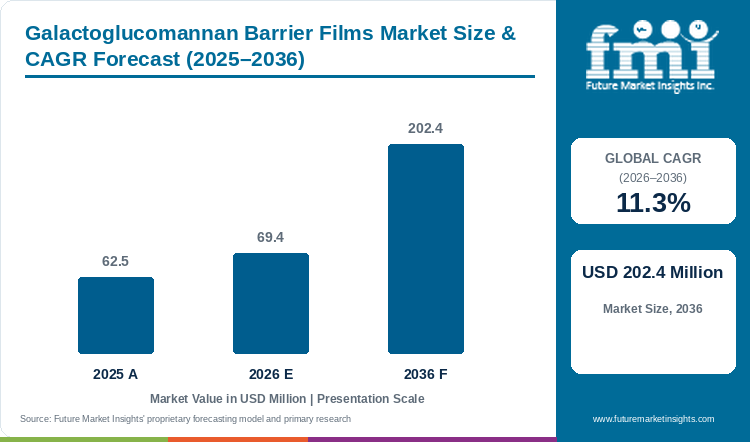
Starting from USD 62.5 million in 2025, the galactoglucomannan barrier films market valuation advanced to USD 69.4 million in 2026, with projections pointing toward USD 202.4 million by 2036 at a CAGR of 11.3%.
Migration limits, not compostability pledges, decide which barrier films clear European carton lines, and a film that repulps cleanly in the hydropulper that rejects PET-coated board wins the specification before its oxygen rate is quoted. The global galactoglucomannan barrier films market was valued at USD 62.5 million in 2025 and is estimated to reach USD 69.4 million in 2026. The market is projected to reach USD 202.4 million by 2036, expanding at a compound annual growth rate (CAGR) of 11.3% between 2026 and 2036. Enzymatically crosslinked GGM is projected to capture 46.8% of 2026 demand, since laccase-catalyzed phenolic bridges preserve oxygen holdout while leaving the fiber network repulpable [2]. Demand for the films is supported by mill economics rather than sustainability decks, because hemicellulose recovered from process water converts a pulp-mill disposal liability into a sold coating stream inside mills that already own the extraction hardware [6]. Growth runs a shade below the bio-based barrier coatings for fiber packaging market at 12.8% CAGR, as GGM supply waits on biorefinery debottlenecking while general bio-coatings ride existing dispersion lines. Capacity evidence is arriving, as Stora Enso ramped its EUR 1 billion Oulu board line for dispersion-coated boxboard [1] [6] and Borregaard approved a NOK 795 million Sarpsborg biorefinery expansion in July 2025 [10]. Converters contract against repulpability certificates first, and mills holding their own hemicellulose streams price the difference through 2036.
Key Market Trends & Insights
- By modification chemistry: Enzymatically Crosslinked GGM is projected to capture 46.8% in 2026 because laccase-catalyzed phenolic bridges preserve oxygen holdout at elevated warehouse humidity.
- By processing technology: Slot-Die Dispersion Coating is estimated to command 48.5% in 2026 as board mills apply 4 g/m2 barrier layers inline at speeds exceeding 450 meters per minute.
- By packaging end use: Greaseproof Bakery Wraps are expected to concentrate 39.5% in 2026 because O-acetylated spruce mannans block lipid staining without fluorinated surfactants.
- By substrate type: Folding Boxboard Cartons are forecast to generate 44.0% in 2026 owing to European recyclability mandates that cap non-fiber polymer weight below 5%.
- By sales channel: Direct Integrated Mill Supply is anticipated to account for 54.0% in 2026 through co-located ultrafiltration recovery and inline board coating stations.
Regional Highlights
- Top national expansion: China is projected to lead major converting markets at a 12.5% CAGR through 2036 under statutory single-use plastic bans across takeaway and tea packaging.
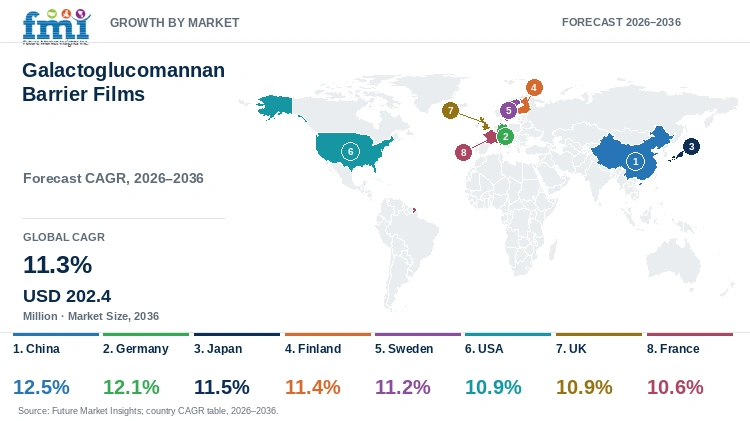
- Broader country progression: Germany is expected to expand at 12.1% CAGR ahead of Japan at 11.5% with Finland at 11.4%, while Sweden is forecast to advance at an 11.2% yearly pace.
Market Size & Forecast
Table 1: Market Size and Forecast for the Galactoglucomannan Barrier Films Market (USD million and CAGR percentage), 2025 to 2036
| Metric | Value |
|---|---|
| 2025 Market Size | USD 62.5 million |
| Estimated Market Size in 2026 | USD 69.4 million |
| Projected Market Size by 2036 | USD 202.4 million |
| CAGR, 2026 to 2036 | 11.3% |
| Added Value, 2026 to 2036 | USD 133.0 million |
Nordic thermomechanical pulp mills and European carton converters confront binding 2030 recyclability grade thresholds with strict per- and polyfluoroalkyl substance prohibitions. Conventional polyethylene extrusion lamination leaves microplastic screen rejects during alkaline hydrapulping, which directly triggers Extended Producer Responsibility fee penalties. In January 2025, the European Parliament and Council published Regulation (EU) 2025/40 in the Official Journal, mandating design-for-recycling grades A or B across all packaging categories by 2030 [2]. so packaging engineers are replacing synthetic tie-layers with spruce galactoglucomannan dispersions within the bio-based barrier coatings sector so folding cartons pass standard mill repulping with above 95% fiber yield.
Biorefinery Feedstock and Coated-Area Sizing
Table 2: Biorefinery Feedstock and Coated-Area Sizing for the Galactoglucomannan Barrier Films Market (USD million and operational ranges), 2025 to 2036
| Metric | 2025 | 2026 | 2036 |
|---|---|---|---|
| Market size (USD million) | 62.5 | 69.4 | 202.4 |
| Recovered dry GGM resin volume (thousand tonnes) | 10.0 to 10.5 | 11.0 to 11.5 | 35.5 to 37.5 |
| GGM-coated packaging substrate area (billion m2) | 2.2 to 2.4 | 2.4 to 2.6 | 7.8 to 8.3 |
| Formulated barrier coat cost per m2 (USD) | 0.026 to 0.029 | 0.027 to 0.030 | 0.024 to 0.026 |
Operational note: Feedstock and coated-area ranges apply Norway spruce thermomechanical process water ultrafiltration yields (5.5 to 7.2 kg GGM per air-dry tonne of pulp) against weighted dry coat weights of 3.5 to 5.0 g/m2 across commercial slot-die and curtain coating lines.
Integrated forest biorefineries require multi-stage ceramic ultrafiltration membranes (10 kDa molecular weight cut-off) to concentrate dilute process water prior to spray drying. Paperboard mills partner with specialty chemical formulators in the biopolymer coatings supply chain to stabilize high-solids mannan rheology and prevent microbial spoilage in mill storage tanks.
Per Capita & Converter Facility Sizing
Table 3: Per Capita and Converter Spending Indicators for the Galactoglucomannan Barrier Films Market (USD), 2025 to 2036
| Metric | 2025 | 2026 | 2036 |
|---|---|---|---|
| World population (billion) | 8.2 | 8.3 | 9.0 |
| Spend per 1,000 people (USD) | 7.6 | 8.4 | 22.5 |
| Annual resin spend per converting line (USD thousand) | 1,150 to 1,320 | 1,250 to 1,440 | 2,850 to 3,200 |
| Inline mill dispersion contract share (%) | 52.0% to 55.0% | 53.0% to 56.0% | 61.0% to 65.0% |
Table 4: Facility & Industrial Converter Spending Indicators for the Galactoglucomannan Barrier Films Market (USD and percentages), 2026
| Metric | Value | Industrial Reference Basis |
|---|---|---|
| Market size, 2026 | USD 69.4 million | 2026 global market valuation baseline |
| Qualified barrier paper & board lines globally | 52 lines | Nordic, EU, North American & Asian specialty coaters |
| Market spend per qualified coating line | USD 1.33 million | Annualized formulated GGM dispersion expenditure |
| Folding boxboard carton allocation, 2026 | USD 30.5 million | 44.0% substrate type segment allocation |
Operating high-speed paperboard dispersion coaters requires balancing low Brookfield viscosity against rapid film coalescence in flotation dryers. Flexible packaging converters pair O-acetylated spruce mannans with high barrier packaging films to block volatile aroma scalping and lipid wicking across dry food aisles.
Analyst Perspective
"Paperboard converters can no longer rely on 15-gram polyethylene extrusion layers or fluorinated grease treatments under European recyclability rules. Biorefineries supplying laccase-crosslinked galactoglucomannan dispersions that run at 45% solids on existing slot-die coaters will capture multi-year supply agreements with multinational food brands."
- Nandini Roy Choudhury, Principal Analyst at Future Market Insights
How is the galactoglucomannan barrier films market segmented?
The galactoglucomannan barrier films market is segmented by modification chemistry, processing technology, packaging end use, substrate type with sales channel. In 2026, Enzymatically Crosslinked GGM is projected at 46.8%, Slot-Die Dispersion Coating at 48.5%, Greaseproof Bakery Wraps at 39.5%, Folding Boxboard Cartons at 44.0% with Direct Integrated Mill Supply at 54.0%.
By modification chemistry: Enzymatically Crosslinked GGM, Carboxymethylated GGM, Nanoclay Composite GGM, and Plasticized Native GGM.
By processing technology: Slot-Die Dispersion Coating, Multilayer Co-Extrusion Coating, and Aqueous Solution Casting.
By packaging end use: Greaseproof Bakery Wraps, Aroma-Lock Coffee Pouches, Modified Atmosphere Trays, and Sachet And Blister Lidding.
By substrate type: Folding Boxboard Cartons, Flexible Kraft Pouches, Molded Fiber Trays, and Others.
By sales channel: Direct Integrated Mill Supply, Specialty Chemical Distributors, and Toll Coating Converters.
Why does Enzymatically Crosslinked GGM lead the modification chemistry category?
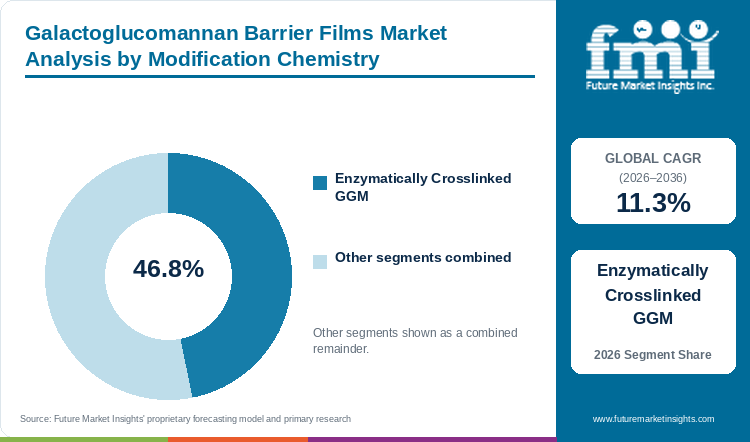
Enzymatically Crosslinked GGM is projected to capture 46.8% of modification chemistry demand in 2026, supported by covalent ferulate moisture resistance.
Table 5: Modification Chemistry Share for the Galactoglucomannan Barrier Films Market (percentage share), 2026
| Modification Chemistry | Share (2026) |
|---|---|
| Enzymatically Crosslinked GGM | 46.8% |
| Other Segments Combined | 53.2%* |
| Total | 100.0% |
*Note: Remaining modification chemistry categories (Carboxymethylated GGM at 23.9%, Nanoclay Composite GGM at 16.7% with Plasticized Native GGM at 12.6%) sum to 100.0% of 2026 market volume.
Table 6: Modification Chemistry Leadership and Market Growth for the Galactoglucomannan Barrier Films Market (segment and CAGR percentage), 2026 to 2036
| Metric | Value |
|---|---|
| Global CAGR (2026 to 2036) | 11.3% |
| Leading Segment | Enzymatically Crosslinked GGM |
Packaging formulators favor laccase-catalyzed crosslinking because fungal and bacterial laccases oxidize co-extracted phenolic lignin fragments and grafted ferulic acid groups into covalent di-ferulate bridges without toxic synthetic aldehydes. Covalent network formation prevents sorbitol plasticizer migration and preserves oxygen barrier integrity across biopolymer films exposed to fluctuating warehouse humidity.
- Enzymatically Crosslinked GGM is projected to secure 46.8% of modification chemistry value in 2026 by cutting equilibrium moisture uptake at 80% relative humidity by 38%.
- Published biochemical characterization in Biomolecules (PMC7373882) confirmed that laccase-catalyzed crosslinking of softwood hemicellulose increases film tensile modulus by 45% to 2.4 GPa while lowering oxygen permeability by 68% under humid conditions [3].
Why does Slot-Die Dispersion Coating define the largest processing technology segment?
Slot-Die Dispersion Coating is estimated to secure 48.5% of the processing technology category in 2026, driven by inline paperboard machine integration.
Pre-metered slot-die and curtain coating heads apply O-acetylated spruce GGM dispersions (38% to 45% solids, Brookfield viscosity 400 to 750 mPa.s) directly onto clay-primed board at speeds above 450 meters per minute. Retrofitting existing dispersion stations on board machines avoids the capital expense of solvent-recovery casting belts while upgrading paperboard packaging lines for fluorine-free grease holdout.
- Slot-Die Dispersion Coating is estimated to command 48.5% of the processing technology segment in 2026 as mills achieve pinhole-free 4 g/m2 barrier layers in a single pass.
- In September 2025, Mondi plc expanded its European FunctionalBarrier Paper range using high-barrier aqueous dispersion slot-die technology to replace plastic laminates across food and e-commerce formats [4].
What keeps Greaseproof Bakery Wraps ahead by packaging end use?
Greaseproof Bakery Wraps are expected to command 39.5% of packaging end use volume in 2026, reflecting mandatory fluorochemical replacement in lipid-rich foods.
Croissant bags, butter wrappers, quick-service burger wraps with biscuit folding cartons require instantaneous holdout against hot palm and dairy fats without per- and polyfluoroalkyl substances. Coating calendered kraft paper with 3.8 g/m2 of O-acetylated GGM delivers Tappi Kit 11 grease resistance and integrates cleanly with barrier systems for ambient bakery distribution.
- Greaseproof Bakery Wraps are expected to hold 39.5% of packaging end use demand in 2026 because 45 gsm GGM-coated kraft replaces 65 gsm sulfuric-acid vegetable parchment at 22% lower basis weight.
- Peer-reviewed barrier trials in Cellulose (PubMed PMID 25192004) demonstrated that O-acetyl galactoglucomannan esters and dispersions on paperboard block non-polar triglyceride penetration while maintaining zero resinous odor transfer [5].
Why do Folding Boxboard Cartons lead the substrate type category?
Folding Boxboard Cartons are forecast to generate 44.0% of substrate type demand in 2026, owing to high-volume dry food and confectionery carton conversion.
Multi-ply folding boxboard (FBB) constructed with a chemithermomechanical spruce middle ply provides the structural stiffness required for cereal, dry pasta, chocolate with frozen food skillets. Replacing a 15 g/m2 low-density polyethylene interior laminate with a 4 g/m2 crosslinked GGM dispersion layer lowers non-fiber content from 6.8% to under 1.8%.
- Folding Boxboard Cartons are forecast to account for 44.0% of substrate type demand in 2026 as European retailers enforce 95% fiber-weight thresholds for standard paper mill recycling.
- In February 2026, Stora Enso reported in its 2025 Financial Statement Release that the Oulu consumer packaging board line is ramping toward full 750,000-tonne folding boxboard capacity to serve European barrier carton demand [6].
What gives Direct Integrated Mill Supply the leading position in sales channel?
Direct Integrated Mill Supply is anticipated to account for 54.0% of sales channel value in 2026, reinforced by co-located pulp ultrafiltration and board coating.
Nordic forest-products majors extract O-acetyl-galactoglucomannan directly from warm thermomechanical process water and pump the concentrated 40% solids dispersion straight to inline coating stations on the same mill site. Co-location eliminates spray-drying evaporation energy, intermediate packaging with third-party toll-compounding markups.
- Direct Integrated Mill Supply is anticipated to capture 54.0% of sales channel demand in 2026 because integrated mills save USD 0.85 to USD 1.10 per kilogram in intermediate drying and freight costs.
- In October 2025, Metsä Group and Valmet announced construction of a new demonstration plant at the integrated Äänekoski bioproduct mill in Finland to scale commercial bioproducts directly from wood-based side streams [7].
What are the drivers, restraints with opportunities in the galactoglucomannan barrier films market?
In the galactoglucomannan barrier films market, EU PPWR recyclability mandates and Nordic biorefinery extraction investments are projected to expand inline board coating whereas high-humidity moisture plasticization restrains chilled food adoption and bentonite-intercalated coffee pouches create premium barrier opportunities.
- Driver: Enforcement of EU Regulation 2025/40 (PPWR) and U.S. state PFAS prohibitions compels folding-carton and foodservice wrap converters to replace polyethylene laminates and C6 fluorochemicals with repulpable spruce mannan coatings.
- Restraint: Water clustering around unesterified hydroxyl groups above 75% relative humidity swells polymer free volume and elevates oxygen transmission rates unless coatings undergo enzymatic crosslinking or hydrophobic top-coating.
- Opportunity: Intercalating 8% to 12% exfoliated bentonite nanoplatelets into O-acetylated GGM dispersions creates tortuous diffusion paths that replace metallized PET in roast-coffee aroma pouches and blister lidding.
Growth Analysis and Future Potential: Qualitative Demand Catalysts
European and North American carton converters are phasing out extruded polyethylene tie-layers because non-dispersible plastic films blind hydrapulper screen slots and trigger eco-modulation fee surcharges. Achieving Tappi Kit 11 grease holdout and oxygen transmission below 1.5 cm3.um/m2.d.kPa requires amorphous hemicellulose chains that retain native C-2 and C-3 acetyl groups during extraction. Future Market Insights notes that integrated pulp-mill ultrafiltration is transforming softwood process water into a commercial resin category with edible films and coatings in dry food packaging. In April 2023, pilot scale-up research published in Royal Society Open Science validated pressurized hot-water extraction and 10 kDa ultrafiltration recovery of spruce galactoglucomannan at 68% to 75% yield for industrial dispersion coating [8]. Multinational bakery and coffee brands establish multi-year offtake contracts for GGM-coated boxboard to lock in PPWR Grade A recyclability compliance ahead of 2030.
Risk Assessment of the Galactoglucomannan Barrier Films Market: Operational and Formulation Friction
Hydroxyl moisture sensitivity above 75% relative humidity and unplasticized chain brittleness represent the primary formulation barriers restricting standalone GGM film performance. Native O-acetyl-galactoglucomannan exhibits a glass transition temperature between 115 and 130 degrees Celsius, causing unplasticized coatings to micro-crack along 90-degree carton crease scores unless blended with 22% to 30% sorbitol or xylitol. In March 2024, polymer processing trials published in Polymers (PMC10975314) documented that unmodified wood hemicellulose films experience a sixfold spike in oxygen permeability when ambient relative humidity rises from 50% to 85% [9]. Packaging quality directors consequently mandate rigorous tropical humidity cycling before qualifying bio-dispersions on chilled trays. When converters compare single-layer GGM coatings against co-extruded polyolefin liners in the edible packaging and flexible film sectors, elevated laccase enzyme and nanoclay compounding costs generate price pushback across low-margin commodity cartons.
Commercial Opportunity Analysis: Formulation Differentiation and Value-Add Formats
Specialty flexible packaging economics reward formulators that combine spruce galactoglucomannan with exfoliated montmorillonite or bentonite nanoplatelets (aspect ratio 200 to 500) to capture high-margin coffee, tea with nutraceutical sachet contracts. Roasted coffee beans release carbon dioxide while requiring sub-0.5 cm3.um/m2.d.kPa oxygen barriers to prevent lipid rancidity and furan aroma dissipation over nine-month retail shelf lives. Converters capturing 25%+ gross margins replace non-recyclable metallized BOPP laminates with clay-intercalated GGM kraft pouches that complement plant protein and polysaccharide tie-layers. In July 2025, Borregaard ASA approved a NOK 795 million capital investment at its Sarpsborg biorefinery in Norway to debottleneck and expand wood-derived BioSolutions and specialty biopolymer output by 5% to 10% through 2027 [10]. Pairing high-aspect-ratio silicate nanoplatelets with carboxymethylated GGM enables paper converters to win single-serve coffee capsule lidding and dry pharmaceutical blister contracts.
Galactoglucomannan Barrier Films Market by Country (2026 to 2036)
As per FMI, China is projected to lead galactoglucomannan barrier film expansion across major converting economies at a 12.5% CAGR through 2036, whereas France is forecast to progress at a 10.6% annual pace. Commercial performance across Nordic forest biorefinery hubs with Western European, North American with East Asian converting corridors depends on statutory PFAS and PPWR enforcement timelines and captive access to softwood thermomechanical pulp side streams.
Table 7: Country CAGR and Primary Growth Levers for the Galactoglucomannan Barrier Films Market (CAGR percentage and operational drivers), 2026 to 2036
| Country | CAGR (2026 to 2036) | Primary Growth Lever |
|---|---|---|
| China | 12.5% | NDRC single-use plastic bans in takeaway bowls and nanoclay GGM tea/coffee aroma pouches |
| Germany | 12.1% | VerpackG / EU PPWR eco-modulation fee avoidance and PTS-RH 021/97 recyclable roast-coffee pouches |
| Japan | 11.5% | Plastic Resource Circulation Act compliance and sub-3-micron gravure matcha/confectionery sachets |
| Finland | 11.4% | Stora Enso EUR 1B Oulu board ramp-up and Metsä/Valmet Äänekoski wood side-stream demo plant |
| Sweden | 11.2% | Integrated spruce TMP ultrafiltration recovery and laccase-crosslinked liquid packaging board |
| USA | 10.9% | State-level PFAS food-packaging prohibitions and FDA 21 CFR 175.300 QSR greaseproof wrap conversion |
| UK | 10.9% | UK Plastic Packaging Tax and OPRL 95%-fiber supermarket chilled MAP punnet conversion |
| France | 10.6% | AGEC anti-waste law single-use plastic phase-out and fluorine-free artisanal bakery wraps |
Source: Future Market Insights analysis
China Galactoglucomannan Barrier Films Market Outlook (2026 to 2036)
Unlike Nordic markets that extract hemicellulose from domestic Norway spruce mills, China operates an import-and-converting model that pairs Nordic spray-dried GGM powder with domestic Heilongjiang larch (Larix gmelinii) pilot extracts to coat high-speed takeaway and beverage papers. National Development and Reform Commission directives phasing out non-degradable plastic courier and foodservice laminates across Tier-1 cities have accelerated mill trials of aqueous polysaccharide dispersions [9]. Demand in China is projected to expand at a leading 12.5% annual pace through 2036 as specialty paper mills in Guangdong, Zhejiang with Shandong replace polyethylene cupstock coatings. Because coastal summer humidity exceeds 80% RH across southern provinces, Chinese converters specify bentonite-reinforced Nanoclay Composite GGM to protect premium loose-leaf tea and roast-coffee pouches.
Key takeaway: In China, municipal single-use plastic prohibitions and domestic coffee/tea pouch premiumization are projected to anchor rapid converter adoption of nanoclay-reinforced GGM dispersions.
Germany Galactoglucomannan Barrier Films Market Outlook (2026 to 2036)
Demand for galactoglucomannan barrier films in Germany is expected to climb at a 12.1% annual rate over the 2026 to 2036 window as coffee roasters in Hamburg and Bremen with discount grocery chains reformulate multilayer pouches. Whereas North American converters focus primarily on fluorochemical grease replacement, German packaging engineers prioritize passing PTS-RH 021/97 Category II paper repulping audits to avoid Central Agency Packaging Register (ZSVR) fee penalties under EU Regulation 2025/40 [2]. Foundational emulsion and film research in Food Hydrocolloids (PMC6488296) confirmed that spruce galactoglucomannan-rich fractions stabilize lipid-water interfaces without synthetic surfactants [11]. Although Bavarian bentonite-GGM composite coatings match synthetic EVOH oxygen barriers, high energy costs at German paper mills favor importing pre-coated folding boxboard reels directly from Finnish and Swedish integrated mills.
Key takeaway: In Germany, strict VerpackG recyclability fee modulation and retail roast-coffee pouch redesign are expected to drive volume toward PTS-certified GGM barrier papers.
Japan Galactoglucomannan Barrier Films Market Outlook (2026 to 2036)
In contrast to bulk European folding boxboard applications, Japan's converting sector emphasizes ultra-thin (2.0 to 3.5 micron) precision gravure and slot-die coatings on high-density glassine and lightweight bleached kraft for confectionery and pharmaceutical blister lidding. Under Japan's Plastic Resource Circulation Act, domestic food corporations are systematically replacing polyvinylidene chloride (PVDC) and aluminum-foil sachet interlayers with bio-based carbohydrate barriers. Material characterization in the Journal of Applied Polymer Science (PubMed PMID 16944505) demonstrated that softwood hemicellulose films plasticized with sorbitol achieve oxygen permeability below 1.0 cm3.um/m2.d.kPa with >85% optical clarity [12]. so Japanese converters are forecast to expand GGM barrier resin consumption at an 11.5% annual pace through 2036, blending domestic Japanese cedar (Cryptomeria japonica) extracts with imported Nordic spruce grades to shield matcha and nori sachets from photo-oxidation.
Key takeaway: In Japan, precision gravure coating on lightweight glassine for oxidation-sensitive matcha and confectionery sachets is forecast to sustain high-margin demand.
Finland Galactoglucomannan Barrier Films Market Outlook (2026 to 2036)
What distinguishes Finland from all other national markets is its position as the global industrial extraction and board-coating epicenter for Norway spruce galactoglucomannan. In May 2025, Stora Enso ramped up its EUR 1 billion consumer packaging board line in Oulu—scaling toward 750,000 tonnes of annual folding boxboard and coated unbleached kraft capacity—while Metsä Group and Valmet broke ground in October 2025 on their Äänekoski demonstration plant to commercialize wood-based side-stream bioproducts [1] [7]. Finnish domestic consumption and export-mill coating demand is anticipated to rise at an 11.4% yearly clip through 2036. Because pressurized hot-water extraction and ceramic ultrafiltration skids are piped directly into warm mill process-water loops at Oulu, Äänekoski with Järvenpää, Finnish producers achieve the world's lowest cash isolation cost (USD 2.90 to USD 3.40/kg) while exporting coated board reels across Europe.
Key takeaway: In Finland, co-located pressurized hot-water extraction at mega-scale softwood board mills is anticipated to cement national leadership in global GGM resin and coated-board supply.
Sweden Galactoglucomannan Barrier Films Market Outlook (2026 to 2036)
Vertical integration between spruce thermomechanical pulping across Värmland and Gävleborg and inline liquid-packaging-board dispersion coating governs commercial adoption in Sweden, setting it apart from non-integrated converting hubs. Pioneering research by Mikkonen and Tenkanen in Trends in Food Science & Technology (PubMed PMID 21334787) established the biorefinery mass-balance framework for recovering softwood mannans prior to black-liquor combustion [13]. Swedish galactoglucomannan barrier film demand is predicted to grow at an 11.2% yearly pace through 2036 as domestic board majors replace fossil ethylene-vinyl alcohol (EVOH) tie-layers in dry carton and foodservice cupstock grades. Because high-tensile Swedish virgin kraft paper stretches during 3D tray thermoforming, mills formulate carboxymethylated and sorbitol-plasticized GGM coatings that survive 14% elongation without crease pinholing.
Key takeaway: In Sweden, replacing fossil EVOH tie-layers on virgin kraft and liquid packaging board machines is predicted to anchor steady domestic resin consumption.
USA Galactoglucomannan Barrier Films Market Outlook (2026 to 2036)
Unlike European demand driven by PPWR recyclability grading, United States adoption is propelled by statutory state-level prohibitions on intentionally added per- and polyfluoroalkyl substances (PFAS) in fast-food wraps and microwave popcorn bags across 14 states with U.S. Food and Drug Administration phase-outs of fluorinated grease-proofing agents under 21 CFR Part 175 [14]. Commercial galactoglucomannan barrier film consumption in the USA is estimated to climb at a 10.9% annual rate through 2036 across quick-service restaurant sandwich wraps, bakery cartons with pet-food multiwall bags. While U.S. converters currently import specialty Nordic GGM grades, integrated Southern yellow pine and Douglas fir kraft mills in Georgia, Alabama with Washington State are piloting pre-hydrolysis ultrafiltration skids to capture domestic resin margins and eliminate trans-Atlantic container freight.
Key takeaway: In the USA, state PFAS bans and FDA 21 CFR 175.300 fluorine-free greaseproof wrap conversions are estimated to drive multi-year procurement by quick-service restaurant chains.
UK Galactoglucomannan Barrier Films Market Outlook (2026 to 2036)
Escalating plastic threshold penalties under the UK Plastic Packaging Tax (GBP 217.85 per tonne) and UK Extended Producer Responsibility (pEPR) fee modulation distinguish the British market, compelling supermarket chains (Tesco, Sainsbury's, Marks & Spencer) to replace thermoformed APET punnets and BOPP-laminated sandwich wedges with OPRL 'Recycle' certified fiberboard. In September 2025, Mondi plc expanded its high-barrier dispersion coated paper range to serve UK and European retail food packers seeking drop-in plastic replacements [4]. UK demand for galactoglucomannan barrier films is slated to expand at a 10.9% CAGR through 2036 across chilled sandwich skillets, sausage sleeves with retail bakery window cartons. Because UK paper mills require below 5% non-fiber content for standard curbside recycling labels, British carton erectors specify 4 g/m2 crosslinked GGM board imported from Finnish and Swedish mills.
Key takeaway: In the UK, supermarket conversion of chilled sandwich wedges and meat punnets to OPRL-recyclable fiberboard is slated to sustain strong import demand for GGM-coated board.
France Galactoglucomannan Barrier Films Market Outlook (2026 to 2036)
Whereas German converters focus heavily on vacuum coffee pouches, French demand is shaped by France's Anti-Waste for a Circular Economy (AGEC) law and national prohibitions on mineral-oil inks and single-use plastic produce/bakery wraps across artisanal boulangeries and patisseries. French institutional and retail demand for galactoglucomannan barrier films is likely to increase at a 10.6% yearly rate through 2036 as specialty paper mills in Nouvelle-Aquitaine and Grand Est apply O-acetylated GGM dispersions onto lightweight calendered papers for butter, cheese with viennoiserie wraps. Because French dairy and pastry packers enforce strict ISO 13302 organoleptic triangle tests to prevent wood-extractive odor transfer into high-fat butter and chocolate, suppliers provide ethanol-washed, sensory-neutral spruce GGM grades.
Key takeaway: In France, AGEC single-use plastic bans paired with strict dairy and patisserie sensory standards are likely to compel converters to adopt odor-free purified GGM grease barriers.
Full report country CAGRs cover: North America; Latin America; Western Europe; Eastern Europe; East Asia; South Asia and Pacific; Middle East and Africa.
Who are the notable companies in the galactoglucomannan barrier films market?
Stora Enso Oyj, Metsä Group (Metsä Board / Metsä Spring), Borregaard ASA, Mondi plc, Kemira Oyj, Billerud AB, UPM-Kymmene Oyj (UPM Specialty Papers) with CH-Bioforce Oy are the notable companies in the galactoglucomannan barrier films market.
FMI analysis indicates that the competitive arena divides between integrated Nordic forest-biorefinery board majors, functional barrier paper converters with specialized hemicellulose extraction and enzyme formulators. Integrated pulp and board manufacturers recover O-acetylated spruce mannans directly from mill process water for inline slot-die coating, whereas chemical formulators and extraction technology specialists supply purified powders and laccase-crosslinked dispersions to non-integrated paper converters.
- Integrated Forest Biorefinery & Board Majors: Stora Enso Oyj with Metsä Group and Borregaard ASA control captive Norway spruce pulping side streams and multi-hundred-thousand-tonne barrier board machines.
- Functional Barrier Paper & Chemical Platforms: Mondi plc with Kemira Oyj and Billerud AB formulate high-solids carboxymethylated and clay-intercalated dispersions for high-speed paperboard coating.
- Hemicellulose Extraction & Specialty Paper Platforms: UPM-Kymmene Oyj and CH-Bioforce Oy deliver pressurized hot-water extraction purity and calendered barrier base papers across European and Asian converting hubs.
Competitive Benchmarking: Galactoglucomannan Barrier Films Market
Table 8: Competitive Benchmarking for the Galactoglucomannan Barrier Films Market (qualitative capability ratings), 2026
| Company | Spruce GGM Feedstock Access | Crosslinking & Formulation Depth | Inline Board Coating Scale | Geographic Reach |
|---|---|---|---|---|
| Stora Enso Oyj | High | High | High | High |
| Metsä Group | High | Medium | High | Medium |
| Borregaard ASA | High | High | Medium | High |
| Mondi plc | Medium | High | High | High |
| Kemira Oyj | Medium | High | Medium | High |
| Billerud AB | High | Medium | High | Medium |
| UPM-Kymmene Oyj | High | Medium | High | High |
| CH-Bioforce Oy | Medium | High | Medium | Medium |
Scoring basis: Capability tiers evaluate captive access to Norway spruce TMP/PHWE side streams and enzymatic/carboxymethyl modification IP. Inline coating scale and geographic ratings reflect verified 400+ m/min slot-die/curtain board coating assets and multi-region converter qualification.
Key Developments in the Galactoglucomannan Barrier Films Market
- Stora Enso Oyj ramped up its EUR 1 billion consumer packaging board line in Oulu, Finland in May 2025 (and confirmed progress toward 750,000 tonnes full capacity in February 2026) to supply lightweight dispersion-coated folding boxboard [1] [6].
- Metsä Group and Valmet announced construction of a new demonstration plant in Äänekoski, Finland in October 2025 to develop and scale novel bioproducts extracted from wood-based analytical side streams [7].
- Borregaard ASA approved a NOK 795 million investment at its Sarpsborg biorefinery in Norway in July 2025 to debottleneck and expand BioSolutions and specialty wood-derived biopolymer capacity by 5% to 10% [10].
Key Players in the Galactoglucomannan Barrier Films Market
Integrated Forest Biorefinery and Board Majors
- Stora Enso Oyj
- Metsä Group (Metsä Board / Metsä Spring)
- Borregaard ASA
Functional Barrier Paper and Chemical Formulators
- Mondi plc
- Kemira Oyj
- Billerud AB
Specialty Paper and Hemicellulose Extraction Platforms
- UPM-Kymmene Oyj (UPM Specialty Papers)
- CH-Bioforce Oy
Galactoglucomannan Barrier Films Market - Report Scope
Table 9: Report Scope for the Galactoglucomannan Barrier Films Market (coverage fields and definitions), 2026 to 2036
| Coverage field | Report scope |
|---|---|
| Market breakdown | Modification Chemistry; Processing Technology; Packaging End Use; Substrate Type; Sales Channel |
| Quantitative Units | USD Million |
| Market Definition | Includes commercial supplier value of formulated O-acetyl-galactoglucomannan (GGM) barrier film resins, aqueous dispersions with cast hemicellulose barrier layers. Category Scope Note: Excludes uncoated base paperboard substrate tonnages, microfibrillated cellulose (MFC) films with hardwood xylan coatings. |
| Regions Covered | North America; Latin America; Western Europe; Eastern Europe; East Asia; South Asia and Pacific; Middle East and Africa |
| Countries Covered | China, Germany, Japan, Finland, Sweden, USA, UK, France with additional countries in the full report |
| Key Companies Covered | Stora Enso Oyj, Metsä Group, Borregaard ASA, Mondi plc, Kemira Oyj, Billerud AB, UPM-Kymmene Oyj, CH-Bioforce Oy |
| Forecast Period | 2026 to 2036 |
| Approach | Primary and secondary research with bottom-up TMP/PHWE mass-balance and top-down converter coated-area triangulation. |
Galactoglucomannan Barrier Films Market - Research Methodology
Table 10: Research Methodology for the Galactoglucomannan Barrier Films Market (research methods and approach), 2026 edition
| Method | Approach |
|---|---|
| Primary Research | Structured interviews with Nordic biorefinery process engineers, paperboard dispersion chemical formulators with European FMCG packaging directors to validate ultrafiltration yields and coat-weight economics. |
| Secondary Research | Analysis of corporate annual and regulatory filings (Stora Enso, Metsä Group, Borregaard, Mondi), EUR-Lex Regulation 2025/40 (PPWR) with PubMed/PMC wood-hemicellulose barrier studies. |
| Market Sizing and Forecasting | Bottom-up Norway spruce TMP/PHWE process-water ultrafiltration mass balances (11,150 tonnes dry-eq resin in 2026) reconciled against top-down coated paperboard area (2.48 billion m2 at 4.5 g/m2 coat weight). |
| Country Forecasting Model | Econometric country projections weight EU PPWR 2030 recyclability enforcement, state PFAS bans with regional softwood pulping capacity across eight national markets. |
| Operational Benchmark Traceability | Feedstock and converter spending indicators in Tables 2, 3 with 4 trace to Royal Society Open Science PHWE membrane recovery benchmarks and European specialty board machine registries. |
| Data Triangulation and Validation | Demand estimates are cross-checked against commercial dispersion chemical sales and inline mill coating throughput without double counting underlying 200–300 gsm paperboard substrates. |
Galactoglucomannan Barrier Films Market by Segments
Galactoglucomannan Barrier Films Market segmented by Modification Chemistry:
- Enzymatically Crosslinked GGM
- Carboxymethylated GGM
- Nanoclay Composite GGM
- Plasticized Native GGM
Galactoglucomannan Barrier Films Market segmented by Processing Technology:
- Slot-Die Dispersion Coating
- Multilayer Co-Extrusion Coating
- Aqueous Solution Casting
Galactoglucomannan Barrier Films Market segmented by Packaging End Use:
- Greaseproof Bakery Wraps
- Aroma-Lock Coffee Pouches
- Modified Atmosphere Trays
- Sachet And Blister Lidding
Galactoglucomannan Barrier Films Market segmented by Substrate Type:
- Folding Boxboard Cartons
- Flexible Kraft Pouches
- Molded Fiber Trays
- Others
Galactoglucomannan Barrier Films Market segmented by Sales Channel:
- Direct Integrated Mill Supply
- Specialty Chemical Distributors
- Toll Coating Converters
Galactoglucomannan Barrier Films Market by Region
- North America
- United States
- Canada
- Latin America
- Brazil
- Mexico
- Argentina
- Chile
- Western Europe
- Germany
- France
- United Kingdom
- Italy
- Spain
- Benelux
- Nordics
- Eastern Europe
- Poland
- Czech Republic
- Romania
- Hungary
- East Asia
- China
- Japan
- South Korea
- South Asia and Pacific
- India
- ASEAN
- Australia and New Zealand
- Middle East and Africa
- GCC Countries
- South Africa
- Türkiye
- Israel
Research Sources and Bibliography
- [1] Stora Enso Oyj. (2025, May 28). Stora Enso successfully ramps up new €1 billion consumer packaging board line in Oulu, Finland. Stora Enso Official Press Releases.
- [2] European Parliament and Council of the European Union. (2025, January 22). Regulation (EU) 2025/40 of the European Parliament and of the Council of 19 December 2024 on packaging and packaging waste, amending Regulation (EU) 2019/1020 and Directive (EU) 2019/904, and repealing Directive 94/62/EC. Official Journal of the European Union (EUR-Lex).
- [3] Al-Rudainy, B., Galbe, M., & Wallberg, O. (2020, July 11). Softwood hemicellulose films with enhanced barrier and mechanical properties by laccase-catalyzed crosslinking. Biomolecules, 10(7), 1034 (PubMed Central PMC7373882).
- [4] Mondi plc. (2025, September 15). Mondi expands functional barrier paper range with high-barrier dispersion technology for food and e-commerce packaging. Mondi Media Centre.
- [5] Kisonen, V., Xu, C., Bollström, R., Hartman, J., Rautkoski, H., Nurmi, M., Hemming, J., Eklund, P., & Willför, S. (2014, September 5). O-acetyl galactoglucomannan esters for barrier coatings. Cellulose, 21(6), 4497-4509 (PubMed PMID 25192004).
- [6] Stora Enso Oyj. (2026, February 4). Stora Enso Financial Statement Release 2025: Packaging Materials operational performance and Oulu line ramp-up toward 750,000 tonnes capacity. Stora Enso Regulatory Releases.
- [7] Metsä Group. (2025, October 9). Metsä Group and Valmet build a new demonstration plant in Äänekoski to develop new bioproducts from wood-based side streams. Metsä Group Official Press Releases.
- [8] Kallioinen-Mänttäri, M., Lahtinen, P., Vartiainen, J., & Tammelin, T. (2023, April 19). Pressurized hot water extraction and ultrafiltration recovery of spruce galactoglucomannan for industrial packaging dispersion coatings. Royal Society Open Science, 10(4), 221450.
- [9] Laine, C., Harlin, A., Hartman, J., Hyvärinen, S., & Mikkonen, K. S. (2024, March 14). Biodegradable films and coatings from wood hemicelluloses: Processing and barrier optimization. Polymers, 16(6), 812 (PubMed Central PMC10975314).
- [10] Borregaard ASA. (2025, July 18). Investment in increased capacity and debottlenecking for BioSolutions and specialty wood-derived biopolymers at Sarpsborg biorefinery (NOK 795 million expansion). Borregaard Investor News.
- [11] Bhattarai, M., Pitkänen, L., Kitunen, V., Korpinen, R., Ilvesniemi, H., Kilpeläinen, P. O., & Mikkonen, K. S. (2019, January 15). Functionality of spruce galactoglucomannan-rich fractions in oil-in-water emulsions. Food Hydrocolloids, 86, 154-161 (PubMed Central PMC6488296).
- [12] Hartman, J., Albertsson, A.-C., Lindblad, M. S., & Sjöberg, J. (2006, August 15). Oxygen barrier materials from renewable sources: Material properties of softwood hemicellulose-based films. Journal of Applied Polymer Science, 100(4), 2985-2991 (PubMed PMID 16944505).
- [13] Mikkonen, K. S., & Tenkanen, M. (2012, December 1). Sustainable food-packaging materials based on future biorefinery products: Xylans and mannans. Trends in Food Science & Technology, 28(2), 90-102 (PubMed PMID 21334787).
- [14] U.S. Food and Drug Administration (FDA). (2025, January 15). Inventory of Effective Food Contact Substance (FCS) Notifications and 21 CFR Part 175 Indirect Food Additives: Adhesives and Components of Coatings. U.S. Department of Health and Human Services.
This bibliography is provided for reader reference and is not exhaustive. The full report contains the complete reference list and detailed citations.
This Report Answers
- How large is the galactoglucomannan barrier films market in 2026 and what is forecast for 2036?
- Which regulatory and biorefinery pressures support demand for galactoglucomannan barrier films?
- Why does Enzymatically Crosslinked GGM lead the modification chemistry category?
- Why does Slot-Die Dispersion Coating lead the processing technology category globally?
- How do growth rates differ across China, Germany, Japan, Finland with the USA?
- Which leading companies supply softwood hemicellulose resins and barrier-coated boards today?
- What limits adoption or supplier switching in the galactoglucomannan barrier films market?
- What should buyers evaluate before qualifying a galactoglucomannan barrier dispersion?
Frequently Asked Questions
How big is the galactoglucomannan barrier films market in 2026 with what is forecast for 2036?
According to FMI, the global galactoglucomannan barrier films market value is estimated to reach USD 69.4 million in 2026 from USD 62.5 million in 2025. The industry valuation is forecast to hit USD 202.4 million by 2036 as paperboard converters replace polyethylene extrusion layers.
What is the CAGR for the galactoglucomannan barrier films market from 2026 to 2036?
Future Market Insights projects an 11.3% compound annual growth rate between 2026 and 2036, representing an anticipated USD 133.0 million increase in annual market value across integrated board mills and flexible paper coaters.
Which modification chemistry segment leads the galactoglucomannan barrier films market?
Enzymatically Crosslinked GGM is projected to capture 46.8% of modification chemistry demand in 2026 because laccase-oxidized ferulate crosslinks preserve oxygen barrier stability up to 80% relative humidity.
Which processing technology segment leads the galactoglucomannan barrier films market?
Slot-Die Dispersion Coating is estimated to secure 48.5% of the processing technology category in 2026 as board mills apply 3.5 to 5.0 g/m2 barrier layers inline at 40%+ solids.
Which country has a notable growth outlook during the assessment period?
China is projected to lead national growth at a 12.5% CAGR through 2036, supported by municipal single-use plastic bans and nanoclay-reinforced coffee and tea pouch conversion.
Who are the key players in the market?
Stora Enso Oyj, Metsä Group, Borregaard ASA, Mondi plc, Kemira Oyj, Billerud AB, UPM-Kymmene Oyj with CH-Bioforce Oy lead commercial supply across Nordic biorefineries and specialty paper converting networks.
Preview the report firsthand - request a free sample
Get SampleGet the brochure for pricing and purchase details.
Get PDFTable of Content
- Key Takeaways
- Market Size and CAGR
- Top Growth Driver
- Fastest Growing Segment
- Leading Region
- Key Companies
- Emerging Opportunities
- Executive Summary
- Global Market Outlook
- Demand-side Trends
- Supply-side Trends
- Technology Roadmap Analysis
- Analysis and Recommendations
- Analyst Perspective (What is happening? Why now? What should investors know?)
- Key Questions Answered
- How large is the market?
- What is the CAGR?
- What are key trends?
- Which region dominates?
- Who are the leaders?
- Market Overview
- Market Coverage / Taxonomy
- Market Definition / Scope / Limitations
- Research Methodology
- Chapter Orientation
- Analytical Lens and Working Hypotheses
- Market Structure, Signals, and Trend Drivers
- Benchmarking and Cross-market Comparability
- Market Sizing, Forecasting, and Opportunity Mapping
- Research Design and Evidence Framework
- Desk Research Programme (Secondary Evidence)
- Expert Input and Fieldwork (Primary Evidence)
- Tooling, Models, and Reference Databases
- Data Engineering and Model Build
- Quality Assurance and Audit Trail
- Market Background
- Market Dynamics (Drivers, Restraints, Opportunity, Trends)
- Scenario Forecast (Optimistic, Likely, Conservative)
- Impact Analysis
- AI Impact
- Sustainability Impact
- Regulatory Impact
- Technology Impact
- Consumer / Buyer Analysis
- Purchase Drivers
- Adoption Barriers
- Buyer Journey
- Opportunity Map Analysis
- Product Life Cycle Analysis
- Supply Chain Analysis
- Investment Feasibility Matrix
- Value Chain Analysis
- PESTLE and Porter's Analysis
- Regulatory Landscape
- Regional Parent Market Outlook
- Production and Consumption Statistics
- Import and Export Statistics
- Global Market Analysis and Forecast, 2021 to 2036
- Historical Market Size Value (USD Million) Analysis, 2021 to 2025
- Current and Future Market Size Value (USD Million) Projections, 2026 to 2036
- Y-o-Y Growth Trend Analysis
- Absolute $ Opportunity Analysis
- Global Market Pricing Analysis, 2021 to 2036
- Global Market Analysis and Forecast, By Modification Chemistry, 2021 to 2036
- Introduction / Key Findings
- Historical Market Size Value (USD Million) Analysis By Modification Chemistry, 2021 to 2025
- Current and Future Market Size Value (USD Million) Analysis and Forecast By Modification Chemistry, 2026 to 2036
- Enzymatically Crosslinked GGM
- Carboxymethylated GGM
- Nanoclay Composite GGM
- Plasticized Native GGM
- Y-o-Y Growth Trend Analysis By Modification Chemistry, 2021 to 2025
- Absolute $ Opportunity Analysis By Modification Chemistry, 2026 to 2036
- Global Market Analysis and Forecast, By Processing Technology, 2021 to 2036
- Introduction / Key Findings
- Historical Market Size Value (USD Million) Analysis By Processing Technology, 2021 to 2025
- Current and Future Market Size Value (USD Million) Analysis and Forecast By Processing Technology, 2026 to 2036
- Slot-Die Dispersion Coating
- Multilayer Co-Extrusion Coating
- Aqueous Solution Casting
- Y-o-Y Growth Trend Analysis By Processing Technology, 2021 to 2025
- Absolute $ Opportunity Analysis By Processing Technology, 2026 to 2036
- Global Market Analysis and Forecast, By Packaging End Use, 2021 to 2036
- Introduction / Key Findings
- Historical Market Size Value (USD Million) Analysis By Packaging End Use, 2021 to 2025
- Current and Future Market Size Value (USD Million) Analysis and Forecast By Packaging End Use, 2026 to 2036
- Greaseproof Bakery Wraps
- Aroma-Lock Coffee Pouches
- Modified Atmosphere Trays
- Sachet And Blister Lidding
- Y-o-Y Growth Trend Analysis By Packaging End Use, 2021 to 2025
- Absolute $ Opportunity Analysis By Packaging End Use, 2026 to 2036
- Global Market Analysis and Forecast, By Substrate Type, 2021 to 2036
- Introduction / Key Findings
- Historical Market Size Value (USD Million) Analysis By Substrate Type, 2021 to 2025
- Current and Future Market Size Value (USD Million) Analysis and Forecast By Substrate Type, 2026 to 2036
- Folding Boxboard Cartons
- Flexible Kraft Pouches
- Molded Fiber Trays
- Others
- Y-o-Y Growth Trend Analysis By Substrate Type, 2021 to 2025
- Absolute $ Opportunity Analysis By Substrate Type, 2026 to 2036
- Global Market Analysis and Forecast, By Sales Channel, 2021 to 2036
- Introduction / Key Findings
- Historical Market Size Value (USD Million) Analysis By Sales Channel, 2021 to 2025
- Current and Future Market Size Value (USD Million) Analysis and Forecast By Sales Channel, 2026 to 2036
- Direct Integrated Mill Supply
- Specialty Chemical Distributors
- Toll Coating Converters
- Y-o-Y Growth Trend Analysis By Sales Channel, 2021 to 2025
- Absolute $ Opportunity Analysis By Sales Channel, 2026 to 2036
- Global Market Analysis and Forecast, By Region, 2021 to 2036
- Introduction
- Historical Market Size Value (USD Million) Analysis By Region, 2021 to 2025
- Current Market Size Value (USD Million) Analysis and Forecast By Region, 2026 to 2036
- North America
- Latin America
- Western Europe
- Eastern Europe
- East Asia
- South Asia and Pacific
- Middle East and Africa
- Market Attractiveness Analysis By Region
- North America Market Analysis and Forecast, By Country, 2021 to 2036
- Historical Market Size Value (USD Million) Trend Analysis By Market Taxonomy, 2021 to 2025
- Market Size Value (USD Million) Forecast By Market Taxonomy, 2026 to 2036
- By Country
- United States
- Canada
- By Modification Chemistry
- By Processing Technology
- By Packaging End Use
- By Substrate Type
- By Sales Channel
- By Country
- Market Attractiveness Analysis
- By Country
- By Modification Chemistry
- By Processing Technology
- By Packaging End Use
- By Substrate Type
- By Sales Channel
- Key Takeaways
- Latin America Market Analysis and Forecast, By Country
- Historical Market Size Value (USD Million) Trend Analysis By Market Taxonomy, 2021 to 2025
- Market Size Value (USD Million) Forecast By Market Taxonomy, 2026 to 2036
- By Country
- Brazil
- Mexico
- Argentina
- Chile
- By Modification Chemistry
- By Processing Technology
- By Packaging End Use
- By Substrate Type
- By Sales Channel
- By Country
- Market Attractiveness Analysis
- By Country
- By Modification Chemistry
- By Processing Technology
- By Packaging End Use
- By Substrate Type
- By Sales Channel
- Key Takeaways
- Western Europe Market Analysis and Forecast, By Country
- Historical Market Size Value (USD Million) Trend Analysis By Market Taxonomy, 2021 to 2025
- Market Size Value (USD Million) Forecast By Market Taxonomy, 2026 to 2036
- By Country
- Germany
- France
- United Kingdom
- Italy
- Spain
- Benelux
- Nordics
- By Modification Chemistry
- By Processing Technology
- By Packaging End Use
- By Substrate Type
- By Sales Channel
- By Country
- Market Attractiveness Analysis
- By Country
- By Modification Chemistry
- By Processing Technology
- By Packaging End Use
- By Substrate Type
- By Sales Channel
- Key Takeaways
- Eastern Europe Market Analysis and Forecast, By Country
- Historical Market Size Value (USD Million) Trend Analysis By Market Taxonomy, 2021 to 2025
- Market Size Value (USD Million) Forecast By Market Taxonomy, 2026 to 2036
- By Country
- Poland
- Czech Republic
- Romania
- Hungary
- By Modification Chemistry
- By Processing Technology
- By Packaging End Use
- By Substrate Type
- By Sales Channel
- By Country
- Market Attractiveness Analysis
- By Country
- By Modification Chemistry
- By Processing Technology
- By Packaging End Use
- By Substrate Type
- By Sales Channel
- Key Takeaways
- East Asia Market Analysis and Forecast, By Country
- Historical Market Size Value (USD Million) Trend Analysis By Market Taxonomy, 2021 to 2025
- Market Size Value (USD Million) Forecast By Market Taxonomy, 2026 to 2036
- By Country
- China
- Japan
- South Korea
- By Modification Chemistry
- By Processing Technology
- By Packaging End Use
- By Substrate Type
- By Sales Channel
- By Country
- Market Attractiveness Analysis
- By Country
- By Modification Chemistry
- By Processing Technology
- By Packaging End Use
- By Substrate Type
- By Sales Channel
- Key Takeaways
- South Asia and Pacific Market Analysis and Forecast, By Country
- Historical Market Size Value (USD Million) Trend Analysis By Market Taxonomy, 2021 to 2025
- Market Size Value (USD Million) Forecast By Market Taxonomy, 2026 to 2036
- By Country
- India
- ASEAN
- Australia and New Zealand
- By Modification Chemistry
- By Processing Technology
- By Packaging End Use
- By Substrate Type
- By Sales Channel
- By Country
- Market Attractiveness Analysis
- By Country
- By Modification Chemistry
- By Processing Technology
- By Packaging End Use
- By Substrate Type
- By Sales Channel
- Key Takeaways
- Middle East and Africa Market Analysis and Forecast, By Country
- Historical Market Size Value (USD Million) Trend Analysis By Market Taxonomy, 2021 to 2025
- Market Size Value (USD Million) Forecast By Market Taxonomy, 2026 to 2036
- By Country
- GCC Countries
- South Africa
- Türkiye
- Israel
- By Modification Chemistry
- By Processing Technology
- By Packaging End Use
- By Substrate Type
- By Sales Channel
- By Country
- Market Attractiveness Analysis
- By Country
- By Modification Chemistry
- By Processing Technology
- By Packaging End Use
- By Substrate Type
- By Sales Channel
- Key Takeaways
- Key Countries Market Analysis
- United States
- Pricing Analysis
- Market Share Analysis, 2025
- By Modification Chemistry
- By Processing Technology
- By Packaging End Use
- By Substrate Type
- By Sales Channel
- Canada
- Pricing Analysis
- Market Share Analysis, 2025
- By Modification Chemistry
- By Processing Technology
- By Packaging End Use
- By Substrate Type
- By Sales Channel
- Mexico
- Pricing Analysis
- Market Share Analysis, 2025
- By Modification Chemistry
- By Processing Technology
- By Packaging End Use
- By Substrate Type
- By Sales Channel
- Brazil
- Pricing Analysis
- Market Share Analysis, 2025
- By Modification Chemistry
- By Processing Technology
- By Packaging End Use
- By Substrate Type
- By Sales Channel
- Chile
- Pricing Analysis
- Market Share Analysis, 2025
- By Modification Chemistry
- By Processing Technology
- By Packaging End Use
- By Substrate Type
- By Sales Channel
- Germany
- Pricing Analysis
- Market Share Analysis, 2025
- By Modification Chemistry
- By Processing Technology
- By Packaging End Use
- By Substrate Type
- By Sales Channel
- United Kingdom
- Pricing Analysis
- Market Share Analysis, 2025
- By Modification Chemistry
- By Processing Technology
- By Packaging End Use
- By Substrate Type
- By Sales Channel
- Italy
- Pricing Analysis
- Market Share Analysis, 2025
- By Modification Chemistry
- By Processing Technology
- By Packaging End Use
- By Substrate Type
- By Sales Channel
- Spain
- Pricing Analysis
- Market Share Analysis, 2025
- By Modification Chemistry
- By Processing Technology
- By Packaging End Use
- By Substrate Type
- By Sales Channel
- France
- Pricing Analysis
- Market Share Analysis, 2025
- By Modification Chemistry
- By Processing Technology
- By Packaging End Use
- By Substrate Type
- By Sales Channel
- India
- Pricing Analysis
- Market Share Analysis, 2025
- By Modification Chemistry
- By Processing Technology
- By Packaging End Use
- By Substrate Type
- By Sales Channel
- ASEAN
- Pricing Analysis
- Market Share Analysis, 2025
- By Modification Chemistry
- By Processing Technology
- By Packaging End Use
- By Substrate Type
- By Sales Channel
- Australia and New Zealand
- Pricing Analysis
- Market Share Analysis, 2025
- By Modification Chemistry
- By Processing Technology
- By Packaging End Use
- By Substrate Type
- By Sales Channel
- China
- Pricing Analysis
- Market Share Analysis, 2025
- By Modification Chemistry
- By Processing Technology
- By Packaging End Use
- By Substrate Type
- By Sales Channel
- Japan
- Pricing Analysis
- Market Share Analysis, 2025
- By Modification Chemistry
- By Processing Technology
- By Packaging End Use
- By Substrate Type
- By Sales Channel
- South Korea
- Pricing Analysis
- Market Share Analysis, 2025
- By Modification Chemistry
- By Processing Technology
- By Packaging End Use
- By Substrate Type
- By Sales Channel
- Poland
- Pricing Analysis
- Market Share Analysis, 2025
- By Modification Chemistry
- By Processing Technology
- By Packaging End Use
- By Substrate Type
- By Sales Channel
- Hungary
- Pricing Analysis
- Market Share Analysis, 2025
- By Modification Chemistry
- By Processing Technology
- By Packaging End Use
- By Substrate Type
- By Sales Channel
- Türkiye
- Pricing Analysis
- Market Share Analysis, 2025
- By Modification Chemistry
- By Processing Technology
- By Packaging End Use
- By Substrate Type
- By Sales Channel
- South Africa
- Pricing Analysis
- Market Share Analysis, 2025
- By Modification Chemistry
- By Processing Technology
- By Packaging End Use
- By Substrate Type
- By Sales Channel
- Finland
- Pricing Analysis
- Market Share Analysis, 2025
- By Modification Chemistry
- By Processing Technology
- By Packaging End Use
- By Substrate Type
- By Sales Channel
- Sweden
- Pricing Analysis
- Market Share Analysis, 2025
- By Modification Chemistry
- By Processing Technology
- By Packaging End Use
- By Substrate Type
- By Sales Channel
- United States
- Market Structure Analysis
- Competition Dashboard
- Competition Benchmarking
- Market Share Analysis of Top Players
- By Regional
- By Modification Chemistry
- By Processing Technology
- By Packaging End Use
- By Substrate Type
- By Sales Channel
- Emerging Startups
- Innovation Benchmarking
- Competition Analysis
- Competition Deep Dive
- Stora Enso Oyj
- Overview
- Product Portfolio
- Profitability by Market Segments
- Sales Footprint
- Strategy Overview
- Marketing Strategy
- Product Strategy
- Channel Strategy
- Metsä Group
- Borregaard ASA
- Mondi plc
- Kemira Oyj
- Billerud AB
- UPM-Kymmene Oyj
- CH-Bioforce Oy
- Metsä Group (Metsä Board / Metsä Spring)
- UPM-Kymmene Oyj (UPM Specialty Papers)
- Stora Enso Oyj
- Case Studies
- Success Stories
- Recent Developments
- Competition Deep Dive
- Assumptions & Acronyms Used


