

- Market Size (2026)
- USD 299.4 Mn
- Forecast (2036)
- USD 556.2 Mn
- CAGR (2026 to 2036)
- 6.4%
How big is PLA Barrier Coated Beverage Board Market in 2026?
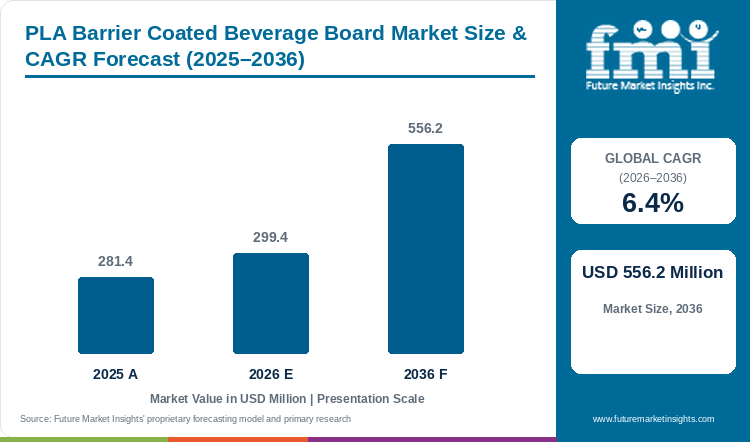
Demand for PLA barrier coated beverage board is projected to expand at 6.4% CAGR between 2026 and 2036. Industry value grows from USD 281.4 million in 2025 to USD 299.4 million in 2026 and is projected to reach USD 556.2 million by 2036.
PLA barrier coated beverage board is used in cups and beverage packs for preventing liquid penetration into paperboard. The global market was valued at USD 281.4 million in 2025 and is expected to increase from USD 299.4 million in 2026 to USD 556.2 million by 2036, at 6.4% CAGR during the forecast period. As per FMI, virgin PLA accounts for 56.8% of coating base demand in 2026, owing to controlled resin quality and repeatable coating performance. In July 2025, Huhtamaki introduced ice-cream cups with bio-based coating and less than 10% plastic content.[2] Stora Enso provides thin coating options for paper cups with less than 5% plastic in selected designs.[3] Metsä Board also reported 2.1 million tonnes of annual paperboard capacity in 2026.[6] Availability of lightweight board and lower-polymer cup structures is expected to support the market growth.
Key Market Trends & Insights
- By coating base, virgin PLA led the market with 56.8% share in 2026, supported by controlled resin quality and repeatable extrusion coating.
- By packaging format, paper cups accounted for 61.6% of demand in 2026, as established forming lines can process coated cupstock at commercial speed.
- By end-use channel, quick-service restaurants represented 39.5% of demand in 2026, owing to repeated use of standardized cups for takeaway beverages.
Regional Highlights
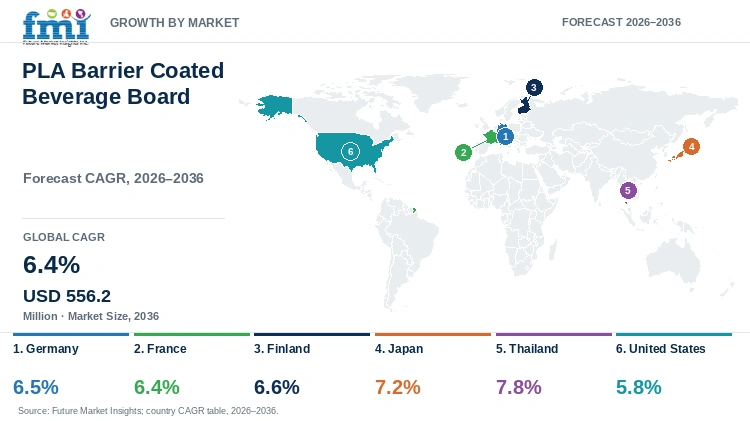
- Fastest-growing profiled country: Thailand (7.8% CAGR, 2026 to 2036).
- By country: Japan (7.2%) and Finland (6.6%) follow, while the United States records the lowest profiled CAGR at 5.8%.
Market Size & Forecast
Table 1: Market Size and Forecast for the PLA Barrier Coated Beverage Board Market (USD million and percentage), 2025 to 2036
| Metric | Value |
|---|---|
| 2025 Market Size | USD 281.4 million |
| Estimated Market Size in 2026 | USD 299.4 million |
| Projected Market Size by 2036 | USD 556.2 million |
| CAGR, 2026 to 2036 | 6.4% |
| Added Revenue, 2026 to 2036 | USD 256.8 million |
| Market Expansion Multiple | 1.9x |
Selection of PLA coated beverage board is also affected by the treatment route available after consumption. Regulation (EU) 2025/40 entered into force in February 2025 and will apply from August 2026.[1] The regulation requires 65% recycling of packaging waste by 2025 and 70% by 2030. Beverage distributors are also required to meet 10% reusable packaging target by 2030. Furthermore, restaurants and cafes must accept consumer containers by 2027 and provide reusable takeaway formats by 2028. These requirements are pushing cup manufacturers towards lighter coating and clear disposal instruction. Germany reported that composite packaging moved another 7.9 percentage points below its recycling target in 2023. Thus, liquid packaging board with PLA coating is expected to gain demand where liquid resistance is combined with suitable collection and recovery facilities.
Barrier Reduction and Recovery Readiness
PLA barrier coated beverage board requires sufficient coating for liquid resistance, but higher coating also reduces the fiber share of the package. Lower coating weight can improve material efficiency, whereas very thin coating can affect cup sealing and strength. Apart from that, the finished cup needs to enter a recycling or composting route accepted in the respective country. The following indicators explains how coating reduction, board capacity and recovery requirement can influence the adoption of PLA coated beverage board.
Table 2: Barrier Reduction and Recovery Readiness Indicators for the PLA Barrier Coated Beverage Board Market (percentages, million tonnes, and policy dates), mixed reporting years from 2023 to 2030
| Indicator | Data Point | Why It Matters | Source |
|---|---|---|---|
| Huhtamaki bio-based coated cup | Less than 10% plastic; launched July 2025 | Shows a commercial paperboard cup using a bio-based barrier with reduced plastic content. | [2] |
| Stora Enso UltraThinPE Tec | Less than 5% plastic in selected paper-cup designs | Shows how thinner coating can retain paper-cup converting and liquid-barrier performance. | [3] |
| Metsä Board paperboard supply | 2.1 million tonnes annual capacity reported in 2026 | Provides an established fiber-board platform for foodservice and other consumer packaging. | [6] |
| EU packaging recycling requirement | 65% by 2025; 70% by 2030 | Raises the requirement for coated board to fit collection, sorting and recycling systems. | [1] |
| EU reusable beverage packaging target | 10% by 2030 | Creates a design comparison between single-use coated board and reusable beverage formats. | [1] |
| German household packaging recovery | More than 5.5 million tonnes processed in 2023 | Shows the scale of an established national collection and sorting system. | [4] |
| German beverage carton performance | 8.7 percentage points below quota in 2023 | Shows the recovery challenge for liquid-packaging structures containing several materials. | [4] |
Analyst Perspective
“I expect lighter PLA coating to receive higher preference where cup makers can retain sealing and reduce polymer use. Demand will remain selective until collection and treatment facilities supports the disposal claim used on the package.”
- Nandini Roy Choudhury, Principal Consultant, Future Market Insights.
How is the PLA barrier coated beverage board market segmented?
PLA barrier coated beverage board market is segmented by three primary commercial axes and region: coating base, packaging format, end-use channel, and region. Virgin PLA, paper cups, and quick-service restaurants are projected to hold 56.8%, 61.6%, and 39.5% in 2026.
By coating base: virgin PLA, recycled PLA, and blended PLA.
By packaging format: paper cups, liquid cartons, paper bottles, sleeved aluminum cans, and bag-in-box liners.
By end-use channel: quick-service restaurants, coffee shops and cafes, on-the-go retail, institutional catering, and ready-to-drink beverage brands.
By region: North America, Latin America, Western Europe, Eastern Europe, East Asia, South Asia and Pacific, and Middle East and Africa.
Why does virgin PLA retain a notable coating base share?
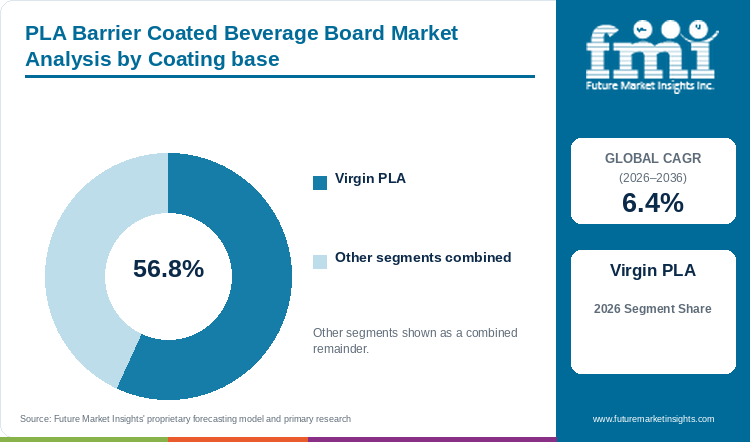
Based on coating base, virgin PLA is projected to account for 56.8% in 2026, supported by stable food-contact conversion.
Table 3: Coating Base Share for the PLA Barrier Coated Beverage Board Market (percentage share), 2026
| Coating Base | Share (2026) |
|---|---|
| Virgin PLA | 56.8% |
| Other Segments Combined | 43.2%* |
| Total | 100.0% |
*Calculated as the balance remaining after deducting the leading segment's reported share from 100.0%.
Table 4: Coating Base Leadership and Market Growth for the PLA Barrier Coated Beverage Board Market (segment and CAGR percentage), 2026 to 2036
| Metric | Value |
|---|---|
| Global CAGR (2026 to 2036) | 6.4% |
| Leading Segment | Virgin PLA |
Virgin PLA is produced from controlled resin grades and offers consistent melt flow during extrusion coating. In the FMI report, virgin PLA accounts for 56.8% of coating base demand in 2026, as food-contact packages and plant-based food packaging require stable coating thickness and sealing performance. Regulation (EU) 2025/40 requires manufacturers to retain technical documentation for five years and ten years for reusable packaging. Availability of controlled resin along with required food-contact documents is expected to propel the virgin PLA segment growth.
- Virgin PLA is projected to account for 56.8% of coating base revenue in 2026, owing to repeatable extrusion coating performance.
- Defined resin grades help converters to maintain coating consistency during repeated food-contact production.
What supports paper cups as the preferred packaging format?
In 2026, paper cups are expected to lead packaging format with 61.6% share, owing to established forming lines.
Paper cups are used for hot drinks, cold drinks, ice cream and other takeaway beverages. According to FMI, paper cups account for 61.6% of packaging format demand in 2026, owing to standardized cup sizes and established forming lines. These cups require a liquid barrier for maintaining shape and preventing leakage during consumption. European rules will require takeaway businesses to accept customer containers by 2027 and offer reusable packaging by 2028. In response to this, cup manufacturers are reducing coating weight across paperboard packaging without changing the existing cup-forming process. Development of lighter cup structures is anticipated to support the paper cups segment growth.
- Paper cups are expected to represent 61.6% of packaging format demand in 2026, owing to standardized sizes and established forming equipment.
- Stable rim sealing and liquid resistance supports use of the same cup format for different hot and cold beverages.
How do quick-service restaurants shape end-use channel demand?
Quick-service restaurants are set to lead end-use channel with 39.5% share in 2026, driven by takeaway beverage throughput.
Quick-service restaurants use paper cups in repeated volume for coffee, soft drinks and takeaway beverages. FMI research indicates that this channel accounts for 39.5% of demand in 2026, as restaurant chains purchase standard cup sizes for different outlets. PLA coated board protects the cup against heat, condensation and leakage during the consumption period. European rules will require reusable takeaway packaging from 2028 without additional charge. This is encouraging restaurant suppliers to use lighter single-use cups alongside certified compostable foodservice packaging with better disposal instruction. Expansion of takeaway beverage sales is expected to drive demand from quick-service restaurants.
- Quick-service restaurants are projected to hold 39.5% of end-use channel demand in 2026, driven by repeated takeaway cup consumption.
- Purchase of standardized cup sizes in repeated volume is expected to support demand for qualified barrier board.
What are the drivers, restraints, and opportunities in the PLA barrier coated beverage board market?
In the PLA barrier coated beverage board market, renewable barrier demand drives adoption, disposal-route mismatch limits use, and lighter coatings create opportunity.
- Driver: Beverage sellers seek renewable-content barrier structures that retain liquid resistance and food-contact performance.
- Restraint: PLA behaves as plastic under EU single-use rules and may not fit conventional paper recycling or local composting routes.
- Opportunity: Thin coatings and fiber-dominant structures can reduce polymer content while preserving cup-forming performance.
Renewable Barriers Support Material Switching
Beverage brands are shifting towards renewable packaging materials for reducing the use of fossil-based plastic, strengthening demand for sustainable packaging. PLA coating provides a bio-based barrier while retaining printability and cup-forming performance of paperboard. Regulation (EU) 2025/40 requires packaging to become recyclable and introduces recyclability grades from 2030. Due to this, packaging manufacturers are reducing coating weight and maintaining documents connected with material composition. Wider use of fiber-dominant beverage cups is expected to drive the PLA barrier coated beverage board market growth.
Disposal Routes Restrict Wider Use
A key factor restraining the market is limited availability of suitable collection and treatment facilities. According to the Food & Beverage Carton Alliance in November 2025, beverage cartons face collection and sorting limitations across multi-material recycling streams.[10] Composite packaging also moved further below the target due to sorting and recovery limitations. Paper mills and composting plants may not accept the same coated structure in every country. Differences in recovery facilities and disposal rules for bioplastic packaging may hamper the growth of PLA barrier coated beverage board market.
Thin Coatings Open Design Options
Thin barrier coating reduces polymer use and retains higher paperboard content in the finished cup. Regulation (EU) 2025/40 requires packaging weight and volume to be minimized without affecting its function. This provides an opportunity for suppliers of barrier coatings for packaging to lower polymer content while maintaining heat sealing and liquid resistance. Development of lightweight PLA coating suitable for existing cup lines is expected to create new growth opportunities during the forecast period.
Which country CAGRs are profiled in the PLA barrier coated beverage board market?
Table 5: Country CAGR Comparison for the PLA Barrier Coated Beverage Board Market (CAGR percentage), 2026 to 2036
| Country | CAGR |
|---|---|
| Germany | 6.5% |
| France | 6.4% |
| Finland | 6.6% |
| Japan | 7.2% |
| Thailand | 7.8% |
| United States | 5.8% |
How do country-level CAGRs compare in the PLA barrier coated beverage board market?
Commercial conditions differ across the profiled countries owing to beverage service, paperboard production and availability of recycling or composting facilities. FMI data suggests that European countries will witness steady growth due to common packaging rules and redesign of foodservice cups. Japan and Thailand are expected to expand with rising takeaway beverage sales and regional converting activity.
Thailand is estimated to expand at 7.8% CAGR owing to takeaway beverages and regional packaging production. Japan is forecast to grow at 7.2% CAGR as vending and ready-to-drink beverages requires consistent packaging quality.
- Germany links coated board purchases to sorting performance and PPWR compliance.
- France combines anti-waste policy with beverage-service packaging redesign.
- Finland connects board production expertise with lighter renewable-material structures.
- Japan uses strict labeling and established beverage packaging quality controls.
- Thailand gains from takeaway beverage channels and regional converting activity.
- United States demand depends on state-level composting access and foodservice specifications.
Full report country CAGRs cover: North America; Latin America; Western Europe; Eastern Europe; East Asia; South Asia and Pacific; Middle East and Africa.
Country-wise Analysis
- Germany PLA barrier coated beverage board market is projected to expand at 6.5% CAGR through 2036, supported by packaging redesign and stricter recycling requirement. In January 2025, German authorities reported more than 5.5 million tonnes of household packaging waste collected, sorted and recycled during 2023.[4] However, beverage cartons remained 8.7 percentage points below the required recycling quota. Lower recycling performance of composite packaging is increasing focus on coating weight and material separation. Demand for PLA coated board is anticipated to grow where converters provide lower polymer content with clear disposal instruction.
- France PLA barrier coated beverage board market is anticipated to grow at 6.4% CAGR over the assessment period, owing to foodservice packaging redesign and waste-reduction measures. The European Environment Agency published the municipal and packaging waste profile for France in April 2025.[5] Regulation (EU) 2025/40 will also apply packaging minimization and recyclability requirement from August 2026. Cups and beverage cartons using PLA coating requires disposal instruction according to the collection route available in France. Redesign of beverage packaging is expected to support the France market revenue growth.
- Finland PLA barrier coated beverage board market is estimated to expand at 6.6% CAGR through 2036, supported by domestic paperboard knowledge and converting capability. In March 2025, Statistics Finland reported that national paperboard production reached 3.8 million tonnes in 2024.[11] The output provides an established fiber platform for regional beverage carton and cupstock converters. Finland also has extensive converting expertise in lightweight paperboard used for beverage packages. Increasing use of certified fiber and lower coating weight is likely to propel the Finland market growth.
- PLA barrier coated beverage board demand in Japan is forecast to increase at 7.2% CAGR over the forecast period, owing to vending and ready-to-drink beverage consumption. Japan Ministry of the Environment continued plastic resource circulation and separate collection policies during 2025.[7] Beverage packs used in convenience retail requires stable printing, sealing and liquid resistance. PLA coating can gain use in selected paper cups where the disposal route is clearly communicated. Demand for controlled quality beverage packaging is expected to support the Japan market growth.
- Thailand is estimated to rise at 7.8% CAGR over the forecast period. Increasing tourism, convenience retail and takeaway beverages is supporting demand for paper cups used for hot and cold drinks. Thailand Environment Institute continued circular economy and packaging waste programs during 2025, which supports wider discussion on material use and disposal.[8] Local converters also supplies beverage packaging to domestic and export customers with different labeling requirement. Expansion of beverage service and packaging conversion is expected to create growth opportunities for PLA barrier coated beverage board in Thailand.
- United States PLA barrier coated beverage board market is forecast to grow at 5.8% CAGR through 2036, influenced by foodservice demand and uneven composting access. The U.S. Environmental Protection Agency updated its Sustainable Materials Management resources in September 2026.[9] Acceptance of compostable packaging still differs by state and municipality, due to which one disposal claim cannot be used in every location. Large restaurant and coffee chains can create demand through centralized cup specification and controlled collection sites. However, uneven composting and paper recovery facilities may limit wider adoption in the United States.
Who are the notable companies in the PLA barrier coated beverage board market?
Huhtamaki, Stora Enso, Graphic Packaging International, International Paper, Smurfit WestRock, NatureWorks, TotalEnergies Corbion, and Metsä Board are notable companies profiled in this market.
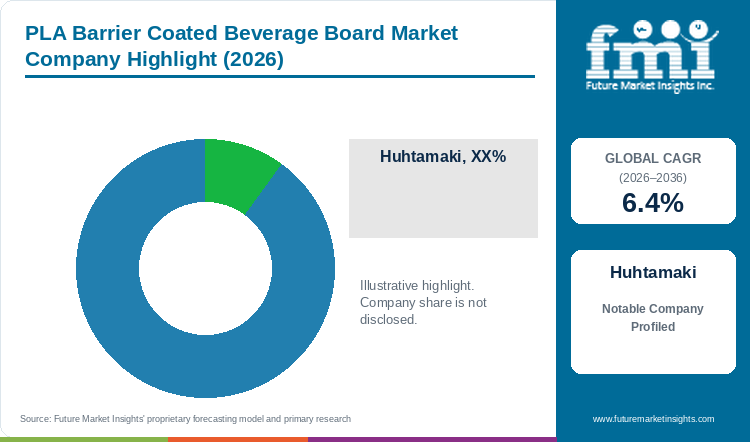
PLA barrier coated beverage board market is moderately fragmented with presence of paperboard producers, foodservice converters and PLA material suppliers. An FMI analyst notes that Huhtamaki and Stora Enso compete through cupstock and foodservice board formats. Graphic Packaging International, International Paper, Smurfit WestRock and Metsä Board participates through board production and converting reach. NatureWorks and TotalEnergies Corbion supplies PLA material for bio-based and compostable packages. Some prominent players are reducing coating weight and expanding foodservice packaging portfolio for catering to growing demand. Product development and regional supply reach is expected to increase competition in the market.
- Integrated paperboard and converting participants: Huhtamaki, Stora Enso, Graphic Packaging International, International Paper, Smurfit WestRock, and Metsä Board.
- PLA material suppliers: NatureWorks and TotalEnergies Corbion support coating-grade resin and application development.
- Foodservice route: companies compete through cupstock, forming performance, print quality, and chain-level supply capability.
Competitive Benchmarking: PLA Barrier Coated Beverage Board Market
Table 6: Competitive Benchmarking for the PLA Barrier Coated Beverage Board Market (qualitative capability ratings), 2026
| Company | Barrier / Material | Board / Supply | Current Activity | Reach |
|---|---|---|---|---|
| Huhtamaki | High | High | High | High |
| Stora Enso | High | High | High | High |
| Graphic Packaging International | Medium | High | High | High |
| International Paper | Medium | High | Medium | High |
| Smurfit WestRock | Medium | High | High | High |
| NatureWorks | High | Medium | High | High |
| TotalEnergies Corbion | High | Medium | Medium | High |
| Metsä Board | Medium | High | High | High |
High indicates wider product, supply, activity and regional evidence. Medium indicates narrower evidence, whereas Low indicates limited direct evidence. These ratings do not indicate product quality, market share or company rank.
Key Developments in the PLA Barrier Coated Beverage Board Market
- In 2025, Huhtamaki continued development of fiber-based foodservice packaging with lower plastic content.
- In 2025, Stora Enso continued offering foodservice paperboard and barrier coating options for cups and other food packages.
- In 2026, Metsä Board published its Sustainability Review 2025 covering paperboard production, certified fiber and energy performance.
- In February 2025, Regulation (EU) 2025/40 entered into force, changing design and documentation expectations for packaging suppliers.
Key Players in the PLA Barrier Coated Beverage Board Market
Paperboard and packaging platforms
- Huhtamaki
- Stora Enso
- Graphic Packaging International
- International Paper
- Smurfit WestRock
- Metsä Board
PLA resin and coating material platforms
- NatureWorks
- TotalEnergies Corbion
PLA Barrier Coated Beverage Board Market - Report Scope
Table 7: Report Scope for the PLA Barrier Coated Beverage Board Market (coverage fields and definitions), 2026 to 2036
| Coverage field | Report scope |
|---|---|
| Market breakdown | Coating base; packaging format; end-use channel; region |
| Quantitative units | USD million |
| Market definition | First-sale revenue from paperboard coated with PLA-based barriers and sold for beverage packaging. Standalone cups made from other barriers, equipment, collection services, and downstream beverage value are excluded. |
| Regions covered | North America; Latin America; Western Europe; Eastern Europe; East Asia; South Asia and Pacific; Middle East and Africa |
| Countries covered | Germany; France; Finland; Japan; Thailand; United States |
| Key companies profiled | Huhtamaki, Stora Enso, Graphic Packaging International, International Paper, Smurfit WestRock, NatureWorks, TotalEnergies Corbion, Metsä Board |
| Forecast period | 2026 to 2036 |
| Approach | Hybrid bottom-up and top-down sizing that reconciles board volumes, coating value, packaging formats, end-use demand, and country adoption conditions. |
PLA Barrier Coated Beverage Board Market - Research Methodology
Table 8: Research Methodology for the PLA Barrier Coated Beverage Board Market (research methods and approach), 2026 edition
| Method | Approach |
|---|---|
| Primary Research | the report analysts gathered input from manufacturers, service providers, technology developers, distributors, end users, procurement teams, and subject-matter experts. Interviews examined purchasing decisions, product evaluation, adoption barriers, approval requirements, pricing considerations, and expectations for technical or commercial support. |
| Desk Research | Desk research covered government statistics, regulatory publications, trade data, industry associations, technical literature, standards, company filings, product information, and official corporate announcements. |
| Market Sizing and Forecasting | The market model combined the baseline value with historical performance, segment structure, pricing and volume indicators, adoption levels, company participation, and country-level demand conditions. |
| Data Validation | Estimates were checked against public data, company activity, trade patterns, industry developments, and primary interviews. Adjacent categories, overlapping revenues, and activities without direct market relevance were excluded. |
PLA Barrier Coated Beverage Board Market by Segments
Coating base
- Virgin PLA
- Recycled PLA
- Blended PLA
Packaging format
- Paper cups
- Liquid cartons
- Paper bottles
- Sleeved aluminum cans
- Bag-in-box liners
End-use channel
- Quick-service restaurants
- Coffee shops and cafes
- On-the-go retail
- Institutional catering
- Ready-to-drink beverage brands
PLA Barrier Coated Beverage Board Market by Region
- North America
- United States
- Canada
- Latin America
- Brazil
- Mexico
- Argentina
- Chile
- Western Europe
- Germany
- France
- United Kingdom
- Italy
- Spain
- Benelux
- Nordics
- Eastern Europe
- Poland
- Czech Republic
- Romania
- Hungary
- East Asia
- Japan
- South Korea
- South Asia and Pacific
- ASEAN
- Australia and New Zealand
- Middle East and Africa
- GCC Countries
- South Africa
- Türkiye
- Israel
Research Sources and Bibliography
- [1] European Union. (2025). Regulation (EU) 2025/40 on packaging and packaging waste.
- [2] Huhtamäki Oyj. (2025, July 16). Huhtamaki launches new compostable ice cream cups.
- [3] Stora Enso. (n.d.). Foodservice packaging: Paperboard materials. Retrieved October 9, 2026.
- [4] German Environment Agency & Central Agency Packaging Register. (2025, January 21). Recycling starts with sorting.
- [5] European Environment Agency. (2025, April 23). Country profiles on municipal and packaging waste management.
- [6] Metsä Board. (2026). ESG presentation, January-March 2026.
- [7] Ministry of the Environment, Government of Japan. (2025). Policies for resource circulation and plastic waste.
- [8] Thailand Environment Institute. (2025). Circular economy and packaging waste resources.
- [9] U.S. Environmental Protection Agency. (2025). Sustainable management of food and packaging materials.
- [10] Food & Beverage Carton Alliance. (2025, November 4). Food and beverage carton recycling facts and figures.
- [11] Statistics Finland. (2025, February 21). Forest industry production and wood consumption 2024.
This bibliography is provided for reader reference. The full report contains the complete reference list and detailed citations.
This Report Answers
- How large is the PLA barrier coated beverage board market in 2026?
- What market value is projected for PLA barrier coated beverage board by 2036?
- Which coating base holds a notable share of demand in 2026?
- Which packaging format holds a notable share of demand in 2026?
- Which countries have a notable expansion outlook through the forecast period?
- Which companies are notable in PLA barrier coated beverage board?
Frequently Asked Questions
How large is the PLA barrier coated beverage board market in 2026?
Future Market Insights estimates that the PLA barrier coated beverage board market will be valued at USD 299.4 million in 2026. The market is projected to reach USD 556.2 million by 2036 as beverage packaging shifts towards renewable barrier materials.
What CAGR is projected for the market through 2036?
As per FMI, the PLA barrier coated beverage board market is projected to grow at 6.4% CAGR from 2026 to 2036. Growth is supported by demand for liquid-resistant paperboard with lower fossil-based plastic content.
Which coating base holds a notable share in 2026?
Virgin PLA is projected to hold 56.8% of coating base revenue in 2026. Consistent melt flow and repeatable extrusion coating is supporting the segment demand.
Which packaging format holds a notable share in 2026?
Paper cups are expected to account for 61.6% of packaging format demand in 2026. Established forming lines and takeaway beverage use is supporting the paper cups segment.
Which country has a notable expansion outlook through 2036?
Thailand is projected to register 7.8% CAGR from 2026 to 2036. Tourism, convenience retail and regional converting activity is expected to support the country growth.
Who are the notable companies in this market?
Huhtamaki, Stora Enso, Graphic Packaging International, International Paper, Smurfit WestRock, NatureWorks, TotalEnergies Corbion and Metsä Board are notable participants. These companies participates through paperboard supply, foodservice conversion and PLA material development.
Preview the report firsthand - request a free sample
Get SampleGet the brochure for pricing and purchase details.
Get PDFTable of Content
- Key Takeaways
- Market Size and CAGR
- Top Growth Driver
- Fastest Growing Segment
- Leading Region
- Key Companies
- Emerging Opportunities
- Executive Summary
- Global Market Outlook
- Demand-side Trends
- Supply-side Trends
- Technology Roadmap Analysis
- Analysis and Recommendations
- Analyst Perspective (What is happening? Why now? What should investors know?)
- Key Questions Answered
- How large is the market?
- What is the CAGR?
- What are key trends?
- Which region dominates?
- Who are the leaders?
- Market Overview
- Market Coverage / Taxonomy
- Market Definition / Scope / Limitations
- Research Methodology
- Chapter Orientation
- Analytical Lens and Working Hypotheses
- Market Structure, Signals, and Trend Drivers
- Benchmarking and Cross-market Comparability
- Market Sizing, Forecasting, and Opportunity Mapping
- Research Design and Evidence Framework
- Desk Research Programme (Secondary Evidence)
- Expert Input and Fieldwork (Primary Evidence)
- Tooling, Models, and Reference Databases
- Data Engineering and Model Build
- Quality Assurance and Audit Trail
- Market Background
- Market Dynamics (Drivers, Restraints, Opportunity, Trends)
- Scenario Forecast (Optimistic, Likely, Conservative)
- Impact Analysis
- AI Impact
- Sustainability Impact
- Regulatory Impact
- Technology Impact
- Consumer / Buyer Analysis
- Purchase Drivers
- Adoption Barriers
- Buyer Journey
- Opportunity Map Analysis
- Product Life Cycle Analysis
- Supply Chain Analysis
- Investment Feasibility Matrix
- Value Chain Analysis
- PESTLE and Porter's Analysis
- Regulatory Landscape
- Regional Parent Market Outlook
- Production and Consumption Statistics
- Import and Export Statistics
- Global Market Analysis and Forecast, 2021 to 2036
- Historical Market Size Value (USD Million) Analysis, 2021 to 2025
- Current and Future Market Size Value (USD Million) Projections, 2026 to 2036
- Y-o-Y Growth Trend Analysis
- Absolute $ Opportunity Analysis
- Global Market Pricing Analysis, 2021 to 2036
- Global Market Analysis and Forecast, By Coating base, 2021 to 2036
- Introduction / Key Findings
- Historical Market Size Value (USD Million) Analysis By Coating base, 2021 to 2025
- Current and Future Market Size Value (USD Million) Analysis and Forecast By Coating base, 2026 to 2036
- Virgin PLA
- Recycled PLA
- Blended PLA
- Y-o-Y Growth Trend Analysis By Coating base, 2021 to 2025
- Absolute $ Opportunity Analysis By Coating base, 2026 to 2036
- Global Market Analysis and Forecast, By Packaging format, 2021 to 2036
- Introduction / Key Findings
- Historical Market Size Value (USD Million) Analysis By Packaging format, 2021 to 2025
- Current and Future Market Size Value (USD Million) Analysis and Forecast By Packaging format, 2026 to 2036
- Paper cups
- Liquid cartons
- Paper bottles
- Sleeved aluminum cans
- Bag-in-box liners
- Y-o-Y Growth Trend Analysis By Packaging format, 2021 to 2025
- Absolute $ Opportunity Analysis By Packaging format, 2026 to 2036
- Global Market Analysis and Forecast, By End-use channel, 2021 to 2036
- Introduction / Key Findings
- Historical Market Size Value (USD Million) Analysis By End-use channel, 2021 to 2025
- Current and Future Market Size Value (USD Million) Analysis and Forecast By End-use channel, 2026 to 2036
- Quick-service restaurants
- Coffee shops and cafes
- On-the-go retail
- Institutional catering
- Ready-to-drink beverage brands
- Y-o-Y Growth Trend Analysis By End-use channel, 2021 to 2025
- Absolute $ Opportunity Analysis By End-use channel, 2026 to 2036
- Global Market Analysis and Forecast, By Region, 2021 to 2036
- Introduction
- Historical Market Size Value (USD Million) Analysis By Region, 2021 to 2025
- Current Market Size Value (USD Million) Analysis and Forecast By Region, 2026 to 2036
- North America
- Latin America
- Western Europe
- Eastern Europe
- East Asia
- South Asia and Pacific
- Middle East and Africa
- Market Attractiveness Analysis By Region
- North America Market Analysis and Forecast, By Country, 2021 to 2036
- Historical Market Size Value (USD Million) Trend Analysis By Market Taxonomy, 2021 to 2025
- Market Size Value (USD Million) Forecast By Market Taxonomy, 2026 to 2036
- By Country
- United States
- Canada
- By Coating base
- By Packaging format
- By End-use channel
- By Country
- Market Attractiveness Analysis
- By Country
- By Coating base
- By Packaging format
- By End-use channel
- Key Takeaways
- Latin America Market Analysis and Forecast, By Country
- Historical Market Size Value (USD Million) Trend Analysis By Market Taxonomy, 2021 to 2025
- Market Size Value (USD Million) Forecast By Market Taxonomy, 2026 to 2036
- By Country
- Brazil
- Mexico
- Argentina
- Chile
- By Coating base
- By Packaging format
- By End-use channel
- By Country
- Market Attractiveness Analysis
- By Country
- By Coating base
- By Packaging format
- By End-use channel
- Key Takeaways
- Western Europe Market Analysis and Forecast, By Country
- Historical Market Size Value (USD Million) Trend Analysis By Market Taxonomy, 2021 to 2025
- Market Size Value (USD Million) Forecast By Market Taxonomy, 2026 to 2036
- By Country
- Germany
- France
- United Kingdom
- Italy
- Spain
- Benelux
- Nordics
- By Coating base
- By Packaging format
- By End-use channel
- By Country
- Market Attractiveness Analysis
- By Country
- By Coating base
- By Packaging format
- By End-use channel
- Key Takeaways
- Eastern Europe Market Analysis and Forecast, By Country
- Historical Market Size Value (USD Million) Trend Analysis By Market Taxonomy, 2021 to 2025
- Market Size Value (USD Million) Forecast By Market Taxonomy, 2026 to 2036
- By Country
- Poland
- Czech Republic
- Romania
- Hungary
- By Coating base
- By Packaging format
- By End-use channel
- By Country
- Market Attractiveness Analysis
- By Country
- By Coating base
- By Packaging format
- By End-use channel
- Key Takeaways
- East Asia Market Analysis and Forecast, By Country
- Historical Market Size Value (USD Million) Trend Analysis By Market Taxonomy, 2021 to 2025
- Market Size Value (USD Million) Forecast By Market Taxonomy, 2026 to 2036
- By Country
- Japan
- South Korea
- By Coating base
- By Packaging format
- By End-use channel
- By Country
- Market Attractiveness Analysis
- By Country
- By Coating base
- By Packaging format
- By End-use channel
- Key Takeaways
- South Asia and Pacific Market Analysis and Forecast, By Country
- Historical Market Size Value (USD Million) Trend Analysis By Market Taxonomy, 2021 to 2025
- Market Size Value (USD Million) Forecast By Market Taxonomy, 2026 to 2036
- By Country
- ASEAN
- Australia and New Zealand
- By Coating base
- By Packaging format
- By End-use channel
- By Country
- Market Attractiveness Analysis
- By Country
- By Coating base
- By Packaging format
- By End-use channel
- Key Takeaways
- Middle East and Africa Market Analysis and Forecast, By Country
- Historical Market Size Value (USD Million) Trend Analysis By Market Taxonomy, 2021 to 2025
- Market Size Value (USD Million) Forecast By Market Taxonomy, 2026 to 2036
- By Country
- GCC Countries
- South Africa
- Türkiye
- Israel
- By Coating base
- By Packaging format
- By End-use channel
- By Country
- Market Attractiveness Analysis
- By Country
- By Coating base
- By Packaging format
- By End-use channel
- Key Takeaways
- Key Countries Market Analysis
- United States
- Pricing Analysis
- Market Share Analysis, 2025
- By Coating base
- By Packaging format
- By End-use channel
- Canada
- Pricing Analysis
- Market Share Analysis, 2025
- By Coating base
- By Packaging format
- By End-use channel
- Mexico
- Pricing Analysis
- Market Share Analysis, 2025
- By Coating base
- By Packaging format
- By End-use channel
- Brazil
- Pricing Analysis
- Market Share Analysis, 2025
- By Coating base
- By Packaging format
- By End-use channel
- Chile
- Pricing Analysis
- Market Share Analysis, 2025
- By Coating base
- By Packaging format
- By End-use channel
- Germany
- Pricing Analysis
- Market Share Analysis, 2025
- By Coating base
- By Packaging format
- By End-use channel
- United Kingdom
- Pricing Analysis
- Market Share Analysis, 2025
- By Coating base
- By Packaging format
- By End-use channel
- Italy
- Pricing Analysis
- Market Share Analysis, 2025
- By Coating base
- By Packaging format
- By End-use channel
- Spain
- Pricing Analysis
- Market Share Analysis, 2025
- By Coating base
- By Packaging format
- By End-use channel
- France
- Pricing Analysis
- Market Share Analysis, 2025
- By Coating base
- By Packaging format
- By End-use channel
- ASEAN
- Pricing Analysis
- Market Share Analysis, 2025
- By Coating base
- By Packaging format
- By End-use channel
- Australia and New Zealand
- Pricing Analysis
- Market Share Analysis, 2025
- By Coating base
- By Packaging format
- By End-use channel
- Japan
- Pricing Analysis
- Market Share Analysis, 2025
- By Coating base
- By Packaging format
- By End-use channel
- South Korea
- Pricing Analysis
- Market Share Analysis, 2025
- By Coating base
- By Packaging format
- By End-use channel
- Poland
- Pricing Analysis
- Market Share Analysis, 2025
- By Coating base
- By Packaging format
- By End-use channel
- Hungary
- Pricing Analysis
- Market Share Analysis, 2025
- By Coating base
- By Packaging format
- By End-use channel
- Türkiye
- Pricing Analysis
- Market Share Analysis, 2025
- By Coating base
- By Packaging format
- By End-use channel
- South Africa
- Pricing Analysis
- Market Share Analysis, 2025
- By Coating base
- By Packaging format
- By End-use channel
- Finland
- Pricing Analysis
- Market Share Analysis, 2025
- By Coating base
- By Packaging format
- By End-use channel
- Thailand
- Pricing Analysis
- Market Share Analysis, 2025
- By Coating base
- By Packaging format
- By End-use channel
- United States
- Market Structure Analysis
- Competition Dashboard
- Competition Benchmarking
- Market Share Analysis of Top Players
- By Regional
- By Coating base
- By Packaging format
- By End-use channel
- Emerging Startups
- Innovation Benchmarking
- Competition Analysis
- Competition Deep Dive
- Huhtamaki
- Overview
- Product Portfolio
- Profitability by Market Segments
- Sales Footprint
- Strategy Overview
- Marketing Strategy
- Product Strategy
- Channel Strategy
- Stora Enso
- Graphic Packaging International
- International Paper
- Smurfit WestRock
- NatureWorks
- TotalEnergies Corbion
- Metsä Board
- Huhtamaki
- Case Studies
- Success Stories
- Recent Developments
- Competition Deep Dive
- Assumptions & Acronyms Used


