

- Market Size (2026)
- USD 158.5 Mn
- Forecast (2036)
- USD 314.7 Mn
- CAGR (2026 to 2036)
- 7.1%
How Big is the Garlic Butter & Spreads Market in 2026?
The garlic butter & spreads market is estimated at USD 158.5 million in 2026.
The global garlic butter and spreads market was valued at USD 148.0 million in 2025 and is estimated to reach USD 158.5 million in 2026. The market is projected to reach USD 314.7 million by 2036, expanding at a compound annual growth rate (CAGR) of 7.1% between 2026 and 2036. Sheet / plaque format accounted for the largest share of the Type classification, contributing 35.0% of total revenue in 2026. Demand is supported by garlic bread and savoury bakery products that use a prepared seasoned spread for consistent application. Butter costs have fallen sharply. According to CMB News, EU butter reference prices stood at around EUR 4,145.0 per tonne in October 2026, almost 30.0% below year-earlier levels[6]. Supply is also growing. The United States Department of Agriculture (USDA) forecasts global butter production at 12.62 million tonnes in 2026, up 2.4%, led by India and the United States[7]. Garlic supply is ample, as China's garlic production was expected to rise by 15.0% to 20.0% in 2026, with combined inventories expected to exceed 5 million tons[5].
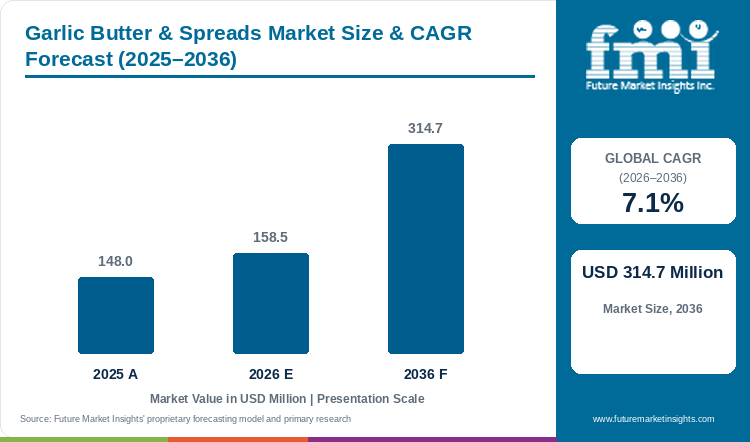
Table 1: Garlic Butter & Spreads Market Size and Forecast (USD million), 2025 to 2036
| Market size and forecast | Value |
|---|---|
| 2025 market size | USD 148.0 million |
| Estimated market size in 2026 | USD 158.5 million |
| Projected market size by 2036 | USD 314.7 million |
| CAGR (2026-2036) | 7.1% |
| Added revenue, 2026 to 2036 | USD 156.2 million |
Key Market Trends & Insights
- By Type: The Sheet / plaque format segment accounted for the largest share of the Type classification in 2026, representing 35.0% of total market revenue.
- By Form: Powder / dry products held the leading market position with a share of 47.0% in 2026.
- By Application: Bread & rolls remained the largest application segment, accounting for 34.0% of the market in 2026.
Regional Highlights
- Fastest-growing country: Saudi Arabia is expected to record the highest growth rate among the eight profiled countries, with a projected CAGR of 8.4% between 2026 and 2036.
- Growth across other countries: The UAE is projected to expand at a CAGR of 8.1%, followed by South Korea at 7.8% and the USA at 7.4%. Japan is expected to register comparatively slower growth, with a CAGR of 6.1% during the forecast period.
The cost of butter remains the most important factor influencing garlic spread prices. Expana reported that the EU unsalted butter price fell to EUR 3,900.0 per tonne on March 31, 2026, down EUR 500.0 in a month, as ample spot supply and elevated stocks weighed on the market[7]. US butter production reached a five-year high of 231.4 million pounds in January 2026, up 6.1% year on year[7]. Lower butter prices reduce the cost of butter-based garlic spreads and narrow the price gap with vegetable-fat alternatives. Product design also matters. Land O'Lakes positions its garlic and herb foodservice spread for garlic bread and hot or cold sandwiches[3], uses that require the savory flavor system to stay evenly distributed as the fat softens.
Garlic supply is also plentiful. According to FreshPlaza, China's garlic planting area increased by approximately 18.0% in 2026, and national production was expected to rise by 15.0% to 20.0%[5]. Mould damage tightened supplies of high-quality garlic, however, and prices for good-quality bulbs were expected to remain firm[5]. For spread manufacturers, ample supply of standard garlic supports stable seasoning costs. Kerrygold's garlic and herb butter shows a butter-based offer within a category that also contains other spread formulations[4]. Carrier composition influences flavour, spreading resistance and behaviour during heating, so the comparison belongs in the intended bread recipe at a defined application weight.
Bread formulation is changing in some markets. France's agriculture ministry published its assessment of the collective bread salt-reduction agreement in June 2026[2], which affects the seasoning contributed by the complete bread-and-spread combination. Changes to the bread can alter the dosage that produces the intended flavour balance. Ingredient information must also follow the full composition. The US Food and Drug Administration's (FDA) January 2025 allergen guidance provides context, and Land O'Lakes identifies milk and soy in its spread[1][3]. Joint approval of dosage, carrier and declaration reduces the risk that a recipe change disrupts an established savoury bread programme.
Table 2: Supporting Industry Indicators for the Garlic Butter & Spreads Market, 2025 to 2026
| Indicator | Data point | Why it matters | Source |
|---|---|---|---|
| EU butter price | EU butter reference prices stood at around EUR 4,145.0 per tonne in October 2026, almost 30.0% below a year earlier. | Butter is the main carrier in garlic butter. | [6] |
| Earlier price fall | The EU unsalted butter price fell to EUR 3,900.0 per tonne on March 31, 2026, down EUR 500.0 in a month. | The decline reflects ample supply and high stocks. | [7] |
| US butter supply | US butter production reached a five-year high of 231.4 million pounds in January 2026, up 6.1%. | Higher US output supports domestic butter availability. | [7] |
| Global butter outlook | USDA forecasts global butter production at 12.62 million tonnes in 2026, up 2.4%. | Growing supply supports lower butter costs. | [7] |
| Garlic production | China's garlic production was expected to rise by 15.0% to 20.0% in 2026, with planting area up about 18.0%. | China is the main source of garlic for seasoning. | [5] |
| Garlic inventories | Combined Chinese garlic inventories were expected to exceed 5 million tons in 2026. | Large stocks support stable garlic costs. | [5] |
| Dairy prices | The FAO Dairy Price Index stood 19.1% below its year-earlier level in September 2026. | Lower dairy costs reduce butter-based spread prices. | [8] |
| Bread reformulation | France reported on its collective bread salt-reduction agreement in June 2026. | Bread and spread contribute jointly to seasoning. | [2] |
| Prepared spread uses | Land O'Lakes specifies garlic bread and hot or cold sandwiches for its garlic and herb spread. | Applications link carrier selection with working temperature. | [3] |
| Allergen guidance | FDA published Edition 5 of its food allergen labelling guidance in January 2025. | Carrier composition affects finished-product information. | [1] |
Demand Intensity Analysis
A comparison of FMI's market estimate with global butter production provides a measure of the scale of garlic butter within dairy use. USDA forecasts global butter production at 12.62 million tonnes in 2026[7]. FMI estimated the garlic butter and spreads market at USD 148.0 million in 2025, which is equivalent to approximately USD 11.7 for every tonne of butter produced worldwide. The figure shows that bakery garlic spreads are a small and specialised outlet for butter and other fats.
Input costs provide another reference point. EU butter reference prices were almost 30.0% below year-earlier levels in October 2026[6], and the FAO Dairy Price Index was 19.1% lower[8], while Chinese garlic production was expected to rise by 15.0% to 20.0%[5]. With both main inputs cheaper or more plentiful, manufacturers have room to improve margins or offer more competitive prices to bakery customers.
A similar comparison can be made between projected market growth and supply. FMI expects the market to grow at a CAGR of 7.1% between 2026 and 2036, while global butter production is forecast to grow by 2.4% in 2026[7]. The difference implies that growth will rely on wider use of prepared garlic spreads in bakery and foodservice, rather than on growth in butter supply, and lower input costs may help this adoption.
Segment values show where demand is concentrated. Bread & rolls represented USD 53.9 million of the 2026 market, while Direct to industrial bakeries accounted for USD 88.8 million. The Type dimension assigns USD 55.5 million to Sheet / plaque format, and the separate Form dimension places Powder / dry at USD 74.5 million. The projected addition of USD 156.2 million between 2026 and 2036 takes the market to 2.0 times its 2026 value.
Table 3: Demand Intensity Metrics for the Garlic Butter & Spreads Market, 2026 Dairy and Garlic Data Against Market Values
| Demand intensity metric | Value | Basis |
|---|---|---|
| FMI market value, 2025 | USD 148.0 million | FMI estimate of garlic butter and spread revenue. |
| Global butter production, 2026 | 12.62 million tonnes | USDA forecast. |
| FMI value per tonne of butter produced | Approximately USD 11.7 | The calculation divides USD 148.0 million by 12.62 million tonnes. |
| EU butter price change, year on year | Almost -30.0% | EU reference price, October 2026. |
| FAO Dairy Price Index, year-on-year change | -19.1% | September 2026. |
| China garlic production change, 2026 | +15.0% to 20.0% | Industry estimate. |
| Global butter production growth, 2026 | 2.4% | USDA forecast. |
| FMI value CAGR, 2026 to 2036 | 7.1% | FMI market forecast. |
| Bread & rolls revenue, 2026 | USD 53.9 million | 34.0% of the market. |
| Direct industrial bakery revenue, 2026 | USD 88.8 million | 56.0% of the market. |
| Market expansion multiple | 2.0 times | Projected 2036 market value relative to 2026. |
Analyst Perspective
"Butter is almost a third cheaper than a year ago and garlic is plentiful, which gives spread makers a rare chance to win new bakery accounts on price without cutting quality."
- Nandini Roy Choudhury, Principal Analyst at Future Market Insights
How is the garlic butter & spreads market segmented?
The garlic butter and spreads market is segmented by type, form, application, claim and sales channel. Type distinguishes Sheet / plaque format, Block, Concentrated butter and Cultured & flavored products. Form describes the preparation delivered to the customer, Application places it within a bread or other bakery recipe, and Claim requirements affect the ingredients and information accompanying them. Sales Channel determines how the customer obtains the chosen specification.
How is Sheet / plaque format positioned within Type?
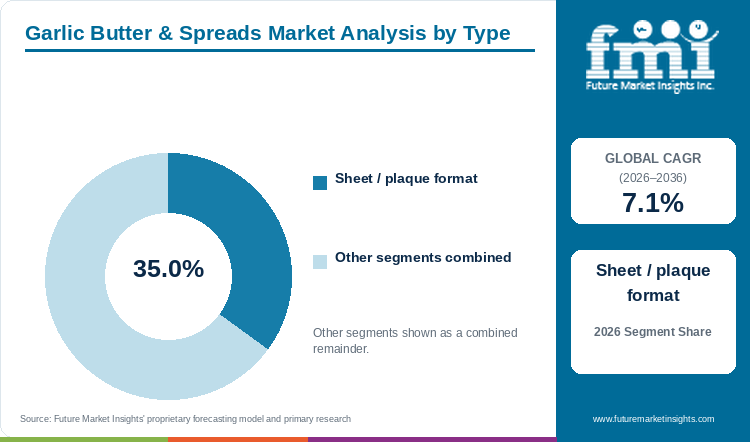
Sheet / plaque format accounts for 35.0% of Type in 2026.
Pre-portioned sheet and plaque formats allow bakeries to apply a fixed quantity of seasoned fat, and the format generated approximately USD 55.5 million in 2026. The physical assessment concerns the preparation as it is applied and heated on bread. Working temperature influences spreading resistance, while the carrier determines how fat and seasoning move into the crumb. With EU butter prices almost 30.0% lower than a year earlier[6], butter-based sheets have become more cost-competitive. Retaining the finish in repeated production depends on consistent composition and handling information.
- Sheet / plaque format accounts for 35.0% of Type in 2026.
- Working temperature and application weight determine how the garlic-seasoned preparation performs on bread.
What supports the Powder / dry Form position?
Powder / dry holds 47.0% of Form in 2026.
Dry garlic-butter systems accounted for approximately USD 74.5 million in 2026 and must be prepared with the intended carrier before application. Controlled weighing and mixing set the concentration and consistency of the spread, and the result depends on how thoroughly the material disperses. Clumps or uneven garlic particles can produce noticeable differences between portions. Instructions should make the relationship between dry dosage and prepared spread clear, so the bakery can check the mixture at its normal batch size.
- Powder / dry holds 47.0% of Form in 2026.
- Mixing instructions should specify how the dry addition relates to the quantity of spread ready for use.
Why do Bread & rolls anchor Application demand?
Bread & rolls represent 34.0% of Application in 2026.
Garlic bread and rolls are the core application, accounting for approximately USD 53.9 million in 2026. Coverage and crumb absorption determine performance, and brushing, injecting and manual spreading each need different consistency. A firm preparation can damage soft crumb, while a fluid one may travel beyond the intended area, and heating changes the result again. A fair comparison uses the same bread and application weight, followed by the planned reheating and holding sequence.
- Bread & rolls represent 34.0% of Application in 2026.
- The intended bread, application weight and holding period should be used when comparing formulations.
How does Conventional retain the largest Claim category?
Conventional leads Claim with 52.0% in 2026.
Conventional formulations led the Claim category with 52.0% in 2026, as suppliers can adjust butter, vegetable fats and seasoning to meet the required cost and handling brief. The composition also determines what must be declared, and Land O'Lakes lists milk and soy in the allergen information for its foodservice spread[3]. FDA guidance provides the relevant context for checking ingredient information[1]. Lower butter prices[6] may encourage some manufacturers to increase the butter share of blended spreads.
- Conventional leads Claim with 52.0% in 2026.
- Allergen information should be checked against the full composition, including the carrier and seasoning additions.
Why does Direct to industrial bakeries dominate Sales Channel?
Direct to industrial bakeries holds 56.0% of Sales Channel in 2026.
Industrial bakeries that pump spreads need different physical properties from those that apply them by hand, even with the same garlic flavour, and direct supply accounted for approximately USD 88.8 million in 2026. Direct contact with the manufacturer helps agree those properties before regular deliveries begin. Garlic particle distribution and carrier composition can affect the depositor as well as the taste. Once agreed, changes need to be communicated before they reach production.
- Direct to industrial bakeries holds 56.0% of Sales Channel in 2026.
- The bakery should be notified before a composition change that could affect pumping, dosing or flavour distribution.
What are the drivers, restraints and opportunities in the garlic butter & spreads market?
Prepared spreads and lower input costs support adoption, but the carrier and the bread must be considered together, allowing purpose-built preparations to serve distinct bakery routines.
Prepared spreads and lower input costs support adoption
Preparing garlic butter from separate ingredients introduces variation in mixing and application, and prepared spreads provide a defined starting recipe. Land O'Lakes describes its garlic and herb spread for garlic bread and hot or cold sandwiches[3]. The convenience depends on the application method, and matching the preparation to food processing conditions makes the benefit tangible. Lower input costs strengthen the case, as EU butter prices fell by almost 30.0% year on year[6] and Chinese garlic supply expanded[5], which allows suppliers to offer prepared spreads at prices closer to the cost of in-house mixing.
The carrier and the bread must be considered together
Changing a garlic spread can alter more than the seasoning, as the fat determines spreading resistance and how much material enters the crumb, while salt contributes to the flavour of the whole bread. France's agriculture ministry reported on its bread salt-reduction agreement in June 2026[2]. If the base bread changes, the previous dosage may no longer give the same balance, and chilling or freezing before reheating adds another set of conditions. Butter prices can also reverse, as they did after the 2025 highs[6], so cost-driven reformulation carries risk.
Purpose-built preparations can serve distinct bakery routines
Application timing separates immediate-service preparations from formulations used in longer bakery production sequences, as a factory preparation must retain its properties through storage and reheating. Kerrygold's garlic and herb butter provides a butter-based option with herbs and spices[4]. Work on savory bakery ingredients can bring the carrier and the bread recipe together early in development. Growing US butter output, which reached a five-year high in January 2026[7], supports the development of butter-based spreads for American bakery and foodservice customers.
Which country CAGRs are profiled in the garlic butter & spreads market?
Table 4: Country growth outlook for the garlic butter & spreads market
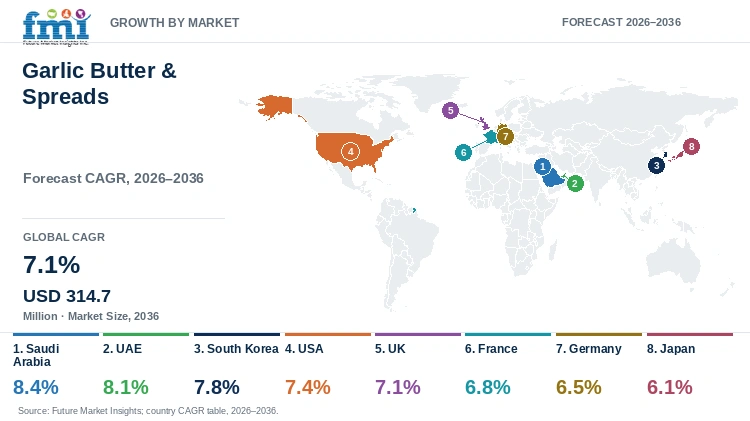
| Country | CAGR |
|---|---|
| Saudi Arabia | 8.4% |
| UAE | 8.1% |
| South Korea | 7.8% |
| USA | 7.4% |
| UK | 7.1% |
| France | 6.8% |
| Germany | 6.5% |
| Japan | 6.1% |
Saudi Arabia
- Saudi Arabia is the fastest-growing market among the profiled countries, with a forecast CAGR of 8.4% from 2026 to 2036. Central preparation and distribution to several locations make finishing consistency important for Saudi garlic bread supply, as the spread must cope with preparation, transport and final heating. Application weight affects cost as well as texture, so it should be agreed before roll-out. Packs and instructions can then be matched to central preparation or outlet use.
UAE
- In the UAE, immediate service and ready-to-heat packaged bread create different application conditions, so the two may need different spread consistencies even with the same flavour brief. The UAE is forecast to grow at a CAGR of 8.1% from 2026 to 2036. Softening speed, seasoning settlement and the period before consumption can be assessed in a practical trial, and pack size should suit the customer's consumption rate.
South Korea
- With a forecast CAGR of 7.8% from 2026 to 2036, South Korea ranks third among the profiled countries. Individual savoury bread portions make garlic distribution and coverage important to presentation, and concentrated seasoning or excess fat at the base indicates a mismatch between application quantity and carrier behaviour. A filled bread and a sliced one may need different quantities even with the same flavour target.
USA
- US bakery and foodservice buyers distinguish butter-based preparations from garlic spreads using other fat systems. US butter production reached a five-year high of 231.4 million pounds in January 2026[7], which supports domestic supply. The USA is forecast to grow at a CAGR of 7.4% from 2026 to 2036. Land O'Lakes documents bread and sandwich applications for its foodservice spread and identifies milk and soy allergens[3], and these details can be checked against the full recipe before a trial establishes spread weight and working temperature.
UK
- UK chilled and frozen garlic bread production extends spread qualification through storage and reheating, which can change aroma, fat separation and distribution in the crumb. The UK is forecast to grow at a CAGR of 7.1% from 2026 to 2036. A preparation that works for immediate service may need a different quantity or consistency in this sequence, and trials across the intended bread shapes establish whether one formulation suits them all.
France
- In France, reformulation of the base bread changes the seasoning required from a garlic spread. The agriculture ministry reviewed the collective agreement on bread salt reduction in June 2026[2]. France is forecast to grow at a CAGR of 6.8% from 2026 to 2036. The bread and spread should be tasted together at the intended serving weight after heating, so that one reformulation is not offset by uncontrolled changes to the other.
Germany
- Germany is projected to grow at a CAGR of 6.5% from 2026 to 2036. German industrial bakeries need a spread that performs through established application, packing and reheating sequences, with a carrier suited to the equipment. Using one preparation across several sizes requires application settings that preserve flavour balance in each portion. Lower EU butter prices[6] may also help German buyers move from blended fats to butter-based spreads without a large cost increase.
Japan
- Japan is expected to register the slowest growth among the profiled countries, with a forecast CAGR of 6.1% from 2026 to 2036. Compact savoury bread formats in Japan place particular emphasis on controlled seasoning and placement, as movement during heating and appearance after wrapping determine whether the spread suits the portion size. For smaller batches, manageable packs and clear preparation instructions help keep quantities consistent.
Who are the notable companies in the garlic butter & spreads market?
Land O'Lakes; Ornua / Kerrygold; Arla / Lurpak; Chef Shamy; Danish Creamery
The profiled participants offer different compositions within the garlic-seasoned category. Land O'Lakes has a garlic and herb foodservice spread, while Kerrygold, Lurpak, Chef Shamy and Danish Creamery offer garlic-seasoned butter products[3][4]. Butter-based suppliers benefit directly from lower butter costs, with EU reference prices almost 30.0% below a year earlier in October 2026[6]. These distinctions matter when a bakery compares flavour, handling and intended use.
The comparison also involves bread formulation. A carrier that spreads easily on one bread may absorb differently into another, so product descriptions are most useful when they explain the conditions under which the preparation works.
Competitive Benchmarking: Garlic Butter & Spreads Market
Table 5: Company capabilities in the garlic butter & spreads market
| Company | Product capability | Application emphasis |
|---|---|---|
| Land O'Lakes | Signature garlic and herb spread | Foodservice bread and sandwich preparation |
| Ornua / Kerrygold | Garlic and herb butter | Butter-based savory finishing |
| Arla / Lurpak | Garlic butter | Bread and culinary preparation |
| Chef Shamy | Garlic herb butter | Savory cooking and bread preparation |
| Danish Creamery | European Style Garlic Salt Butter | Savory butter applications |
Key Developments in the Garlic Butter & Spreads Market
- In January 2025, FDA issued Edition 5 of its food allergen labelling guidance, which applies when a garlic butter formulation or its carrier changes[1].
- In March 2026, the EU unsalted butter price fell to EUR 3,900.0 per tonne, down EUR 500.0 in a month[7].
- In June 2026, France's agriculture ministry published results from its collective agreement to reduce salt in bread[2].
- In August 2026, FreshPlaza reported that China's garlic production was expected to rise by 15.0% to 20.0%[5].
- In October 2026, EU butter reference prices stood at around EUR 4,145.0 per tonne, almost 30.0% below a year earlier[6].
Key Players in the Garlic Butter & Spreads Market
- Land O'Lakes
- Ornua / Kerrygold
- Arla / Lurpak
- Chef Shamy
- Danish Creamery
Garlic Butter & Spreads Market - Report Scope
Table 6: Report scope for the garlic butter & spreads market
| Coverage field | Report scope |
|---|---|
| Market breakdown | Type, Form, Application, Claim, Sales Channel and Region |
| Quantitative Units | USD Million |
| Market Definition | Supplier revenue from qualifying garlic-seasoned butter, butter-like spreads and dry or liquid garlic-butter ingredient systems sold for the specified bakery and foodservice application universe. Excludes finished baked goods, unseasoned fats, stand-alone garlic spices, unrelated fillings, confectionery flavor pastes, release agents and other substitute ingredient sales; bundles count only to the extent qualifying ingredient revenue can be isolated. |
| Regions Covered | North America, Latin America, Western Europe, Eastern Europe, East Asia, South Asia and Pacific, Middle East and Africa |
| Countries Covered | Saudi Arabia; UAE; South Korea; USA; UK; France; Germany; Japan |
| Key Companies Profiled | Land O'Lakes; Ornua / Kerrygold; Arla / Lurpak; Chef Shamy; Danish Creamery |
| Forecast Period | 2026 to 2036 |
| Approach | Market assessment supported by official technical and regulatory publications, company product information and country operating conditions. |
Garlic Butter & Spreads Market - Research Methodology
Table 7: Research approach for the garlic butter & spreads market
| Method | Approach |
|---|---|
| Market definition | The assessment covers garlic-seasoned butter, butter-style spreads and qualifying ingredient systems supplied for the specified bakery and foodservice applications. |
| Desk research | Government and regulatory publications, technical literature and official product information establish the application and supply context. |
| Commercial assessment | Purchasing analysis considers fat composition, spreading and melting behavior, seasoning distribution, portion control and performance after storage or reheating. |
| Comparability | Market values, segment allocations and country growth rates use consistent units and the stated 2026 to 2036 forecast period. Company comparisons describe product roles and purchasing relevance. |
Garlic Butter & Spreads Market by Segments
Type
- Sheet / plaque format
- Block
- Concentrated butter
- Cultured & flavored
Form
- Powder / dry
- Liquid
- Paste / semi-solid
- Granules / pieces
Application
- Bread & rolls
- Cakes & muffins
- Biscuits & cookies
- Viennoiserie & pastry
- Other bakery & snacks
Claim
- Conventional
- Clean label
- Organic
- Non-GMO / identity preserved
Sales Channel
- Direct to industrial bakeries
- Ingredient distributors
- Foodservice & artisan supply
- Online B2B
Garlic Butter & Spreads Market by Region
- North America
- United States
- Canada
- Latin America
- Brazil
- Mexico
- Argentina
- Chile
- Western Europe
- Germany
- France
- United Kingdom
- Italy
- Spain
- Benelux
- Nordics
- Eastern Europe
- Poland
- Czech Republic
- Romania
- Hungary
- East Asia
- China
- Japan
- South Korea
- South Asia and Pacific
- India
- ASEAN
- Australia and New Zealand
- Middle East and Africa
- GCC Countries
- South Africa
- Türkiye
- Israel
Research Sources and Bibliography
- [1] U.S. Food and Drug Administration. (2025, January). Guidance for industry: Questions and answers regarding food allergen labeling (Edition 5).
- [2] French Ministry of Agriculture. (2026, June 1). Accord collectif sur la réduction du sel dans le pain : un bilan positif pour la santé publique.
- [3] Land O'Lakes Foodservice. (n.d.). Land O Lakes Signature Spread Garlic & Herb.
- [4] Kerrygold. (n.d.). Garlic & herb butter.
- [5] FreshPlaza. (2026, August 12). China's new garlic harvest is set to rise 15%-20%, while tight high-quality supplies support prices.
- [6] CMB News. (2026, October 19). EU butter market: Tight milk, rising costs and a cautious price rebound.
- [7] Expana. (2026). Butter: Q2 2026 global commodities price trends report.
- [8] Food and Agriculture Organization of the United Nations. (2026, October 2). FAO Food Price Index.
Future Market Insights. (2026). Garlic Butter & Spreads Market: Global Industry Analysis and Opportunity Assessment 2036.
This Report Answers
- What are the forecast market values for garlic butter & spreads in 2026 and 2036?
- Which industrial-bakery and foodservice pressures support demand for prepared garlic spreads?
- Why does Sheet / plaque format lead the Type segmentation?
- Why does Powder / dry lead the Form segmentation?
- How do the eight profiled country growth rates compare over 2026 to 2036?
- Which companies offer garlic-seasoned butter and spread products?
Frequently Asked Questions
How big is the Garlic Butter & Spreads Market in 2026 and what is forecast for 2036?
The market is valued at USD 158.5 million in 2026 and is forecast to reach USD 314.7 million by 2036.
What CAGR is forecast for the garlic butter & spreads market from 2026 to 2036?
The market is forecast to grow at a CAGR of 7.1% from 2026 to 2036.
Which Type segment holds the largest share in 2026?
Sheet / plaque format leads Type with 35.0% in 2026.
Which Form segment leads the market in 2026?
Powder / dry is the leading Form category with 47.0% in 2026.
Which profiled countries are expected to grow fastest?
Saudi Arabia leads at 8.4%, followed by the UAE at 8.1% and South Korea at 7.8% from 2026 to 2036.
Which companies participate in the garlic butter & spreads market?
The report profiles Land O'Lakes, Ornua / Kerrygold, Arla / Lurpak, Chef Shamy and Danish Creamery, whose formulations and application roles differ.
Preview the report firsthand - request a free sample
Get SampleGet the brochure for pricing and purchase details.
Get PDFTable of Content
- Key Takeaways
- Market Size and CAGR
- Top Growth Driver
- Fastest Growing Segment
- Leading Region
- Key Companies
- Emerging Opportunities
- Executive Summary
- Global Market Outlook
- Demand-side Trends
- Supply-side Trends
- Technology Roadmap Analysis
- Analysis and Recommendations
- Analyst Perspective (What is happening? Why now? What should investors know?)
- Key Questions Answered
- How large is the market?
- What is the CAGR?
- What are key trends?
- Which region dominates?
- Who are the leaders?
- Market Overview
- Market Coverage / Taxonomy
- Market Definition / Scope / Limitations
- Research Methodology
- Chapter Orientation
- Analytical Lens and Working Hypotheses
- Market Structure, Signals, and Trend Drivers
- Benchmarking and Cross-market Comparability
- Market Sizing, Forecasting, and Opportunity Mapping
- Research Design and Evidence Framework
- Desk Research Programme (Secondary Evidence)
- Expert Input and Fieldwork (Primary Evidence)
- Tooling, Models, and Reference Databases
- Data Engineering and Model Build
- Quality Assurance and Audit Trail
- Market Background
- Market Dynamics (Drivers, Restraints, Opportunity, Trends)
- Scenario Forecast (Optimistic, Likely, Conservative)
- Impact Analysis
- AI Impact
- Sustainability Impact
- Regulatory Impact
- Technology Impact
- Consumer / Buyer Analysis
- Purchase Drivers
- Adoption Barriers
- Buyer Journey
- Opportunity Map Analysis
- Product Life Cycle Analysis
- Supply Chain Analysis
- Investment Feasibility Matrix
- Value Chain Analysis
- PESTLE and Porter's Analysis
- Regulatory Landscape
- Regional Parent Market Outlook
- Production and Consumption Statistics
- Import and Export Statistics
- Global Market Analysis and Forecast, 2021 to 2036
- Historical Market Size Value (USD Million) Analysis, 2021 to 2025
- Current and Future Market Size Value (USD Million) Projections, 2026 to 2036
- Y-o-Y Growth Trend Analysis
- Absolute $ Opportunity Analysis
- Global Market Pricing Analysis, 2021 to 2036
- Global Market Analysis and Forecast, By Type, 2021 to 2036
- Introduction / Key Findings
- Historical Market Size Value (USD Million) Analysis By Type, 2021 to 2025
- Current and Future Market Size Value (USD Million) Analysis and Forecast By Type, 2026 to 2036
- Sheet / plaque format
- Block
- Concentrated butter
- Cultured & flavored
- Y-o-Y Growth Trend Analysis By Type, 2021 to 2025
- Absolute $ Opportunity Analysis By Type, 2026 to 2036
- Global Market Analysis and Forecast, By Form, 2021 to 2036
- Introduction / Key Findings
- Historical Market Size Value (USD Million) Analysis By Form, 2021 to 2025
- Current and Future Market Size Value (USD Million) Analysis and Forecast By Form, 2026 to 2036
- Powder / dry
- Liquid
- Paste / semi-solid
- Granules / pieces
- Y-o-Y Growth Trend Analysis By Form, 2021 to 2025
- Absolute $ Opportunity Analysis By Form, 2026 to 2036
- Global Market Analysis and Forecast, By Application, 2021 to 2036
- Introduction / Key Findings
- Historical Market Size Value (USD Million) Analysis By Application, 2021 to 2025
- Current and Future Market Size Value (USD Million) Analysis and Forecast By Application, 2026 to 2036
- Bread & rolls
- Cakes & muffins
- Biscuits & cookies
- Viennoiserie & pastry
- Other bakery & snacks
- Y-o-Y Growth Trend Analysis By Application, 2021 to 2025
- Absolute $ Opportunity Analysis By Application, 2026 to 2036
- Global Market Analysis and Forecast, By Claim, 2021 to 2036
- Introduction / Key Findings
- Historical Market Size Value (USD Million) Analysis By Claim, 2021 to 2025
- Current and Future Market Size Value (USD Million) Analysis and Forecast By Claim, 2026 to 2036
- Conventional
- Clean label
- Organic
- Non-GMO / identity preserved
- Y-o-Y Growth Trend Analysis By Claim, 2021 to 2025
- Absolute $ Opportunity Analysis By Claim, 2026 to 2036
- Global Market Analysis and Forecast, By Sales Channel, 2021 to 2036
- Introduction / Key Findings
- Historical Market Size Value (USD Million) Analysis By Sales Channel, 2021 to 2025
- Current and Future Market Size Value (USD Million) Analysis and Forecast By Sales Channel, 2026 to 2036
- Direct to industrial bakeries
- Ingredient distributors
- Foodservice & artisan supply
- Online B2B
- Y-o-Y Growth Trend Analysis By Sales Channel, 2021 to 2025
- Absolute $ Opportunity Analysis By Sales Channel, 2026 to 2036
- Global Market Analysis and Forecast, By Region, 2021 to 2036
- Introduction
- Historical Market Size Value (USD Million) Analysis By Region, 2021 to 2025
- Current Market Size Value (USD Million) Analysis and Forecast By Region, 2026 to 2036
- North America
- Latin America
- Western Europe
- Eastern Europe
- East Asia
- South Asia and Pacific
- Middle East and Africa
- Market Attractiveness Analysis By Region
- North America Market Analysis and Forecast, By Country, 2021 to 2036
- Historical Market Size Value (USD Million) Trend Analysis By Market Taxonomy, 2021 to 2025
- Market Size Value (USD Million) Forecast By Market Taxonomy, 2026 to 2036
- By Country
- United States
- Canada
- By Type
- By Form
- By Application
- By Claim
- By Sales Channel
- By Country
- Market Attractiveness Analysis
- By Country
- By Type
- By Form
- By Application
- By Claim
- By Sales Channel
- Key Takeaways
- Latin America Market Analysis and Forecast, By Country
- Historical Market Size Value (USD Million) Trend Analysis By Market Taxonomy, 2021 to 2025
- Market Size Value (USD Million) Forecast By Market Taxonomy, 2026 to 2036
- By Country
- Brazil
- Mexico
- Argentina
- Chile
- By Type
- By Form
- By Application
- By Claim
- By Sales Channel
- By Country
- Market Attractiveness Analysis
- By Country
- By Type
- By Form
- By Application
- By Claim
- By Sales Channel
- Key Takeaways
- Western Europe Market Analysis and Forecast, By Country
- Historical Market Size Value (USD Million) Trend Analysis By Market Taxonomy, 2021 to 2025
- Market Size Value (USD Million) Forecast By Market Taxonomy, 2026 to 2036
- By Country
- Germany
- France
- United Kingdom
- Italy
- Spain
- Benelux
- Nordics
- By Type
- By Form
- By Application
- By Claim
- By Sales Channel
- By Country
- Market Attractiveness Analysis
- By Country
- By Type
- By Form
- By Application
- By Claim
- By Sales Channel
- Key Takeaways
- Eastern Europe Market Analysis and Forecast, By Country
- Historical Market Size Value (USD Million) Trend Analysis By Market Taxonomy, 2021 to 2025
- Market Size Value (USD Million) Forecast By Market Taxonomy, 2026 to 2036
- By Country
- Poland
- Czech Republic
- Romania
- Hungary
- By Type
- By Form
- By Application
- By Claim
- By Sales Channel
- By Country
- Market Attractiveness Analysis
- By Country
- By Type
- By Form
- By Application
- By Claim
- By Sales Channel
- Key Takeaways
- East Asia Market Analysis and Forecast, By Country
- Historical Market Size Value (USD Million) Trend Analysis By Market Taxonomy, 2021 to 2025
- Market Size Value (USD Million) Forecast By Market Taxonomy, 2026 to 2036
- By Country
- China
- Japan
- South Korea
- By Type
- By Form
- By Application
- By Claim
- By Sales Channel
- By Country
- Market Attractiveness Analysis
- By Country
- By Type
- By Form
- By Application
- By Claim
- By Sales Channel
- Key Takeaways
- South Asia and Pacific Market Analysis and Forecast, By Country
- Historical Market Size Value (USD Million) Trend Analysis By Market Taxonomy, 2021 to 2025
- Market Size Value (USD Million) Forecast By Market Taxonomy, 2026 to 2036
- By Country
- India
- ASEAN
- Australia and New Zealand
- By Type
- By Form
- By Application
- By Claim
- By Sales Channel
- By Country
- Market Attractiveness Analysis
- By Country
- By Type
- By Form
- By Application
- By Claim
- By Sales Channel
- Key Takeaways
- Middle East and Africa Market Analysis and Forecast, By Country
- Historical Market Size Value (USD Million) Trend Analysis By Market Taxonomy, 2021 to 2025
- Market Size Value (USD Million) Forecast By Market Taxonomy, 2026 to 2036
- By Country
- GCC Countries
- South Africa
- Türkiye
- Israel
- By Type
- By Form
- By Application
- By Claim
- By Sales Channel
- By Country
- Market Attractiveness Analysis
- By Country
- By Type
- By Form
- By Application
- By Claim
- By Sales Channel
- Key Takeaways
- Key Countries Market Analysis
- United States
- Pricing Analysis
- Market Share Analysis, 2025
- By Type
- By Form
- By Application
- By Claim
- By Sales Channel
- Canada
- Pricing Analysis
- Market Share Analysis, 2025
- By Type
- By Form
- By Application
- By Claim
- By Sales Channel
- Mexico
- Pricing Analysis
- Market Share Analysis, 2025
- By Type
- By Form
- By Application
- By Claim
- By Sales Channel
- Brazil
- Pricing Analysis
- Market Share Analysis, 2025
- By Type
- By Form
- By Application
- By Claim
- By Sales Channel
- Chile
- Pricing Analysis
- Market Share Analysis, 2025
- By Type
- By Form
- By Application
- By Claim
- By Sales Channel
- Germany
- Pricing Analysis
- Market Share Analysis, 2025
- By Type
- By Form
- By Application
- By Claim
- By Sales Channel
- United Kingdom
- Pricing Analysis
- Market Share Analysis, 2025
- By Type
- By Form
- By Application
- By Claim
- By Sales Channel
- Italy
- Pricing Analysis
- Market Share Analysis, 2025
- By Type
- By Form
- By Application
- By Claim
- By Sales Channel
- Spain
- Pricing Analysis
- Market Share Analysis, 2025
- By Type
- By Form
- By Application
- By Claim
- By Sales Channel
- France
- Pricing Analysis
- Market Share Analysis, 2025
- By Type
- By Form
- By Application
- By Claim
- By Sales Channel
- India
- Pricing Analysis
- Market Share Analysis, 2025
- By Type
- By Form
- By Application
- By Claim
- By Sales Channel
- ASEAN
- Pricing Analysis
- Market Share Analysis, 2025
- By Type
- By Form
- By Application
- By Claim
- By Sales Channel
- Australia and New Zealand
- Pricing Analysis
- Market Share Analysis, 2025
- By Type
- By Form
- By Application
- By Claim
- By Sales Channel
- China
- Pricing Analysis
- Market Share Analysis, 2025
- By Type
- By Form
- By Application
- By Claim
- By Sales Channel
- Japan
- Pricing Analysis
- Market Share Analysis, 2025
- By Type
- By Form
- By Application
- By Claim
- By Sales Channel
- South Korea
- Pricing Analysis
- Market Share Analysis, 2025
- By Type
- By Form
- By Application
- By Claim
- By Sales Channel
- Poland
- Pricing Analysis
- Market Share Analysis, 2025
- By Type
- By Form
- By Application
- By Claim
- By Sales Channel
- Hungary
- Pricing Analysis
- Market Share Analysis, 2025
- By Type
- By Form
- By Application
- By Claim
- By Sales Channel
- Türkiye
- Pricing Analysis
- Market Share Analysis, 2025
- By Type
- By Form
- By Application
- By Claim
- By Sales Channel
- South Africa
- Pricing Analysis
- Market Share Analysis, 2025
- By Type
- By Form
- By Application
- By Claim
- By Sales Channel
- Saudi Arabia
- Pricing Analysis
- Market Share Analysis, 2025
- By Type
- By Form
- By Application
- By Claim
- By Sales Channel
- UAE
- Pricing Analysis
- Market Share Analysis, 2025
- By Type
- By Form
- By Application
- By Claim
- By Sales Channel
- United States
- Market Structure Analysis
- Competition Dashboard
- Competition Benchmarking
- Market Share Analysis of Top Players
- By Regional
- By Type
- By Form
- By Application
- By Claim
- By Sales Channel
- Emerging Startups
- Innovation Benchmarking
- Competition Analysis
- Competition Deep Dive
- Land O'Lakes
- Overview
- Product Portfolio
- Profitability by Market Segments
- Sales Footprint
- Strategy Overview
- Marketing Strategy
- Product Strategy
- Channel Strategy
- Ornua / Kerrygold
- Arla / Lurpak
- Chef Shamy
- Danish Creamery
- Land O'Lakes
- Case Studies
- Success Stories
- Recent Developments
- Competition Deep Dive
- Assumptions & Acronyms Used


