

- Market Size (2026)
- USD 374.4 Mn
- Forecast (2036)
- USD 604.1 Mn
- CAGR (2026 to 2036)
- 4.9%
How big is Butter Wraps Market in 2026?
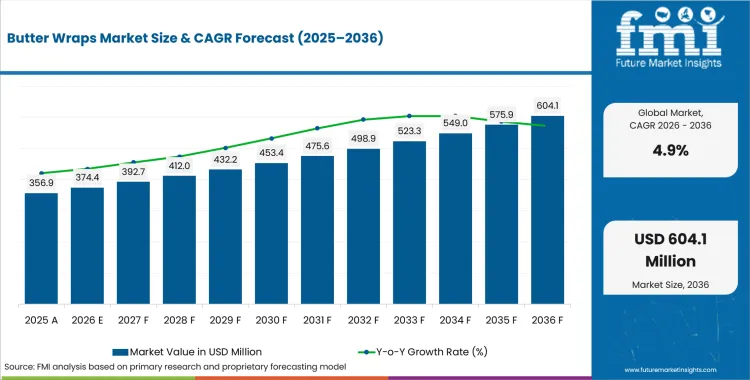
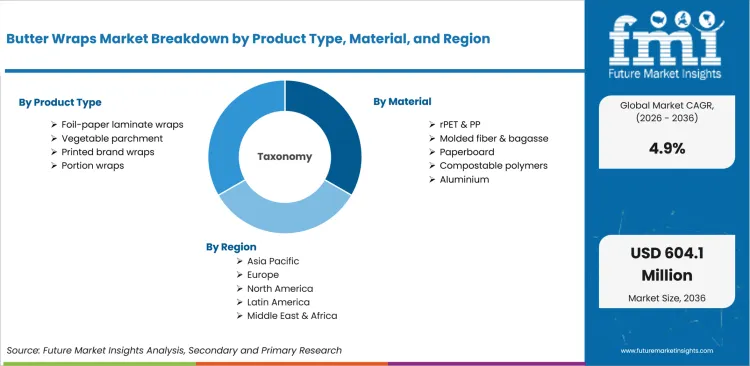
USD 374.4 million in 2026 and USD 604.1 million by 2036 at a 4.9% CAGR.
Demand for butter wraps is projected to expand at 4.9% CAGR between 2026 and 2036, increasing valuation from USD 374.4 million in 2026 to USD 604.1 million by 2036. Off-premises foodservice supplies the volume mechanism through clean portion handling after butter leaves the restaurant counter. The National Restaurant Association reported in April 2025 that nearly 75% of restaurant traffic occurs off-premises. Off-premises traffic at that scale raises repeat demand for grease-resistant portions that open consistently during takeout and delivery service.
Country demand follows different service economics under varying hospitality density and jurisdiction-specific packaging rules. Saudi Arabia provides the clearest growth-side contrast with mature regulated markets such as Germany and the United States. GASTAT stated in January 2026 that licensed tourism hospitality facilities reached 5,622 during Q3 2025 and rose 40.6% from one year earlier. Hospitality expansion widens the foodservice base, but local food-contact and packaging rules govern material qualification.
Key Takeaways of Butter Wraps Market
- Off-premises meal service keeps butter portions in frequent circulation through repeated clean handling beyond the counter and during delivery.
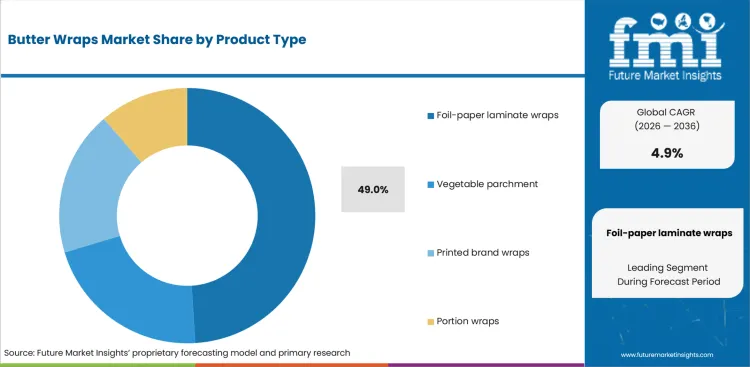
- By product type, foil-paper laminate wraps are estimated to hold 49.0% in 2026 owing to layered barrier performance suited to grease-sensitive portions.
- In 2026, rPET & PP is expected to lead material with 26.0% share because standardized portion formats need reliable sealing and shape retention.
- Standard meal is projected to hold 37.0% share in 2026 owing to routine restaurant service and simplified distributor inventory.
- Food-contact reformulation and recyclability classification lengthen approval cycles by requiring replacement wraps to preserve grease control and operating consistency.
- Some of the key players in this market include ProAmpac, Novolex, Huhtamaki, Dart Container, Graphic Packaging, Detmold Group, Sabert, and Duni.
Analyst Perspective
"Butter-wrap economics improve once a dairy packer proves grease control and runnability on the actual wrapping line during material-change approval. Commercial value comes from verified food-contact evidence and steady distributor supply since a cheaper wrap loses value if it disrupts portion handling."
- Nandini Roy Choudhury, Principal Consultant, Future Market Insights
How is the Butter Wraps Market segmented?
The butter wraps market is segmented by product type, material, format size, end use, sales channel and region.
Product type covers foil-paper laminate wraps, vegetable parchment, printed brand wraps and portion wraps. Material includes rPET & PP, molded fiber & bagasse, paperboard, compostable polymers and aluminium. Format size covers standard meal, single-serve and family & catering. End use includes QSR chains, delivery platforms, coffee & beverage, institutional catering and retail deli. Sales channels include broadline foodservice distributors, direct chain contracts, packaging distributors and online. Related dairy packaging and food packaging reports cover adjacent categories without changing the taxonomy.
What makes Foil-paper laminate wraps central to the Product type category?
Butter portions need a grease barrier that folds cleanly and tolerates chilled handling during high-frequency foodservice use. Foil-paper laminates separate barrier duty from the printable outer surface and remain familiar to converters working with greaseproof paper sheets.
- Based on product type, foil-paper laminate wraps are projected to account for 49.0% in 2026 because the layered structure balances dead-fold behavior with grease resistance.
- ProAmpac launched dedicated butter wraps in April 2025 with grease resistance and dead-fold performance aimed at commercial dairy packaging. The launch keeps material development tied to the handling demands that determine qualification on butter wrapping lines.
Why does rPET & PP lead the Material category?
Polymer portion formats compete on seal consistency and shape retention during chilled service as rigid or semi-rigid packs replace flexible wraps. Dart Container stated in May 2025 that selected clear polypropylene formats received APR Design for Recyclability Recognition.
- By material, rPET & PP is estimated to hold 26.0% in 2026 given reliable processing and familiar sealing behavior in standardized portion formats.
- Foodservice accounts need food-contact records for recycled content plus additives for a polymer change to reach commercial volume. APR recognition narrows one part of that review and keeps molded fiber packaging comparisons focused on documented recovery performance.
How does Standard meal set the Format size benchmark?
Standard meal wraps fit breakfast programs and bread service without requiring separate pack sizes for each routine meal occasion. A common serving unit also fits foodservice disposables purchasing by letting distributors replenish familiar portions beside other meal-service packaging.
- In 2026, standard meal is expected to lead format size with 37.0% share since one portion specification reduces inventory fragmentation for routine restaurant service.
- The National Restaurant Association noted in May 2025 that nearly six in ten Gen Z and millennial consumers order takeout or drive-through meals weekly. Repeated off-premises use keeps meal components commercially relevant for restaurants serving portion sizes at high frequency.
Why do Broadline foodservice distributors lead the Sales channel category?
Butter wraps carry low unit values and national restaurant accounts replenish them frequently through scheduled regional foodservice channels. Sysco operated 337 distribution facilities in North America and Europe as of June 28 2025 in its annual filing.
- By sales channel, broadline foodservice distributors are forecast to represent 45.0% in 2026 driven by local inventory and scheduled deliveries that reduce ordering friction.
- Broadline networks can place disposable food containers beside butter portions under one delivery schedule and account structure. That route reduces stand-alone freight for small packaging items and gives restaurants reliable nearby inventory between scheduled deliveries.
What are the drivers, restraints and opportunities in the Butter Wraps Market?
Off-premises service increases portion demand, qualification rules slow material changes and converter support turns compliant redesigns into recurring programs.
- Driver: Higher off-premises meal frequency increases the number of individually handled butter portions that require dependable grease resistance beyond the dining room.
- Restraint: Food-contact and recyclability rules extend qualification by requiring documented barrier chemistry and material recovery without reducing run performance.
- Opportunity: Packaging companies can win specification changes by pairing lower-complexity materials with testing support that reduces operating-line changeover work.
Off-premises demand raises packaging performance from a minor purchase criterion to a condition for menu portability. The National Restaurant Association reported in May 2025 that 90% of off-premises customers would order more variety if upgraded packaging preserved on-premises food quality. Poor containment directly limits which foods restaurants can send off-site and strengthens repeat demand for grease-control components plus related greaseproof sheets.
Requalification slows substitution by delaying cost savings at the operating line until packaging changes satisfy technical rules. PackUK published RAM v1.1 in April 2025 and tied red-amber-green recyclability outcomes to future fee modulation for obligated household packaging. The RAM assessment raises the value of documented material composition and comparable compostable greaseproof papers by requiring evidence to support a new barrier structure.
Material changes convert faster into orders if the packaging company can reduce qualification work on the operating line. Duni Group acquired an 80% stake in LinePack Oy in June 2025 and extended its offer into automated food-packaging equipment plus installation and maintenance. Duni can pair packaging changes with installation support that reduces changeover work for foodservice and food-processing accounts that otherwise delay new substrate specifications.
Which country CAGRs are profiled in the Butter Wraps Market?
| Country | CAGR |
|---|---|
| Saudi Arabia | 6.5% |
| UAE | 6.2% |
| USA | 5.9% |
| South Korea | 5.6% |
| Germany | 5.3% |
How do country-level CAGRs compare in the Butter Wraps Market?
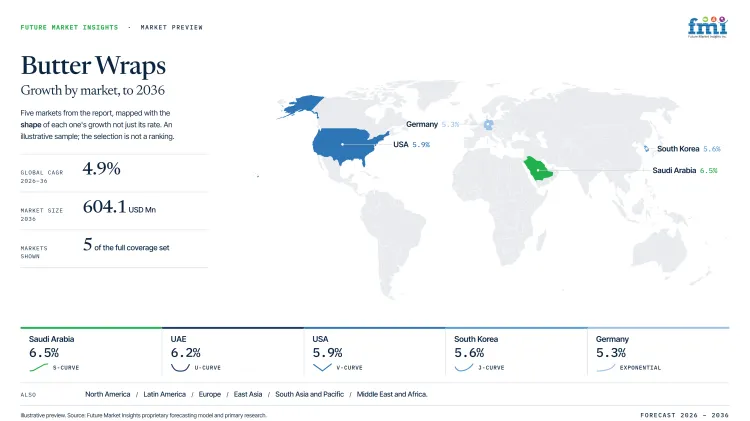
The profiled markets span 1.2 percentage points between Saudi Arabia at 6.5% and Germany at 5.3%. Hospitality-heavy foodservice places Saudi Arabia and UAE in the upper band as USA and South Korea form the middle tier. Germany follows closely with mature purchasing that slows specification turnover without removing underlying portion demand.
- Hotel breakfast service concentrates Saudi butter portions into daily distributor replenishment cycles.
- UAE hospitality clusters favor compact portions supplied locally through centralized hotel accounts.
- National chain purchasing makes USA broadline distribution effective for standardized butter portions.
- South Korean delivery channels reward compact portions suited to rapid meal turnover.
- German bakery channels retain paper wraps commercially for chilled service and presentation.
Similar CAGRs conceal different service economics and qualification routes in commercial practice. The full report provides country-level CAGR analysis across North America, Latin America, Europe, East Asia, South Asia, Oceania and the Middle East and Africa.
Country-wise Analysis
- Saudi hotels and serviced apartments replenish butter portions through scheduled foodservice deliveries during peak tourism periods, and GASTAT reported hotel room occupancy near 63% during Q1 2025 with a 2.1-point annual increase. Local distributors reduce missed service by holding standard portion packaging near major hospitality clusters, and the Saudi Arabia butter wraps sector is projected to record 6.5% CAGR during the assessment period because hospitality growth enlarges the service base. Imported wraps need food-contact records and Saudi inventory for national groups to approve wider use, leaving well-stocked distributors better placed to turn successful qualification into repeat hospitality orders across national accounts.
- Dubai restaurants increasingly sort disposable packaging by material category during larger inventory commitments for hotel and takeaway service through local foodservice distributors that can swap compliant formats quickly. Dubai Municipality confirmed in December 2025 that the final restriction phase would start on January 1 2026 for plastic cutlery plus cups and selected tableware, requiring each affected service format to be classified during substitution. Butter-wrap sales in UAE are forecast to expand at 6.2% CAGR by 2036 given strong hospitality demand with seasonal inventory swings and category-specific restrictions keeping accurate product mapping and local stock discipline central to wider chain adoption.
- National restaurant chains qualify butter wraps through centralized specifications that govern portion handling and distributor replenishment for thousands of outlets served by broadline distribution networks nationwide. USA is estimated to post 5.9% CAGR over the forecast period since off-premises service sustains frequent portion demand and centralized purchasing concentrates specification decisions. The FDA determined in January 2025 that 35 PFAS food-contact notifications for grease-proofing paper and paperboard were no longer effective, requiring alternative barriers to carry validated food-contact evidence for national conversion and favoring manufacturers that can reliably coordinate coating trials without creating regional wrap specifications at full national commercial scale.
- South Korean foodservice accounts place formal material records beside grease resistance during qualification of imported and locally converted butter packaging for dense urban service networks. The Ministry of Food and Drug Safety posted updated English standards for utensils plus containers and packages in June 2025, giving importers a current reference for coatings and resins used in direct food contact. Adoption of butter wraps in South Korea is estimated to expand at 5.6% CAGR through 2036 tied to dense urban foodservice demand even as documentation changes delay distributor onboarding and favor companies with controlled formulations plus responsive local technical support teams.
- German restaurant and catering accounts assess composite food-contact packaging during the PPWR transition as they approve broader butter-wrap specification changes for national catering contracts and bakery service. Butter-wrap demand in Germany is forecast to rise at 5.3% CAGR over the forecast period attributable to steady foodservice demand and active packaging redesign supported by established paper-converting capacity. European Commission guidance published in June 2026 confirms Regulation (EU) 2025/40 applies from August 12 2026, keeping recovery evidence central following grease-barrier changes and favoring simpler structures that preserve chilled-service performance plus clear material declarations during national customer specification reviews and contract renewals.
Who are the notable companies in the Butter Wraps Market?
ProAmpac, Novolex, Huhtamaki, Dart Container, Graphic Packaging, Detmold Group, Sabert and Duni are the notable companies serving this market.
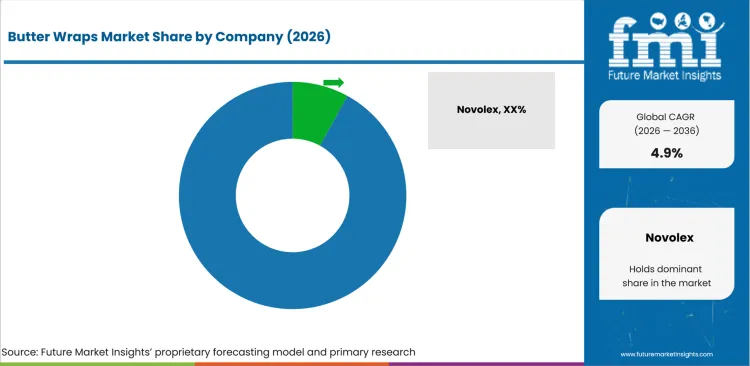
Competition separates direct wrap converters from broader groups, and ProAmpac holds the clearest exact-market position through dedicated butter wraps. Novolex and Huhtamaki cover dairy packaging, and Dart Container plus Sabert span multiple substrates. Graphic Packaging, Detmold Group and Duni add paper-converting or channel depth for milk packaging. These roles still require verified grease control and chain-scale delivery during butter-wrap qualification.
- ProAmpac, Novolex and Detmold Group provide documented wrap or paper-converting routes for grease-sensitive foodservice applications.
- Huhtamaki, Dart Container and Sabert supply multi-substrate foodservice formats suited to centralized restaurant and distributor programs.
- Graphic Packaging and Duni contribute paperboard conversion or foodservice channel depth for broader account support.
Competitive Benchmarking: Butter Wraps Market
| Company | Grease-Barrier Converting | Material Versatility | Chain Foodservice Support | Geographic Reach |
|---|---|---|---|---|
| ProAmpac | High | High | High | North America and Europe |
| Novolex | High | High | High | North America and international markets |
| Huhtamaki | High | High | High | Global |
| Dart Container | Medium | High | High | North America and international operations |
| Graphic Packaging | Medium | Medium | High | Americas, Europe and Asia-Pacific |
| Detmold Group | High | Medium | High | Australia, Asia and North America |
| Sabert | Medium | High | High | North America, Europe and Asia |
| Duni | Low | High | High | Europe and international markets |
Scoring basis: High converting depth requires several documented grease-barrier routes whereas Medium requires two and Low identifies one. High material versatility requires at least three documented material families whereas Medium requires two and Low identifies one. High chain support requires multi-market distribution whereas Medium marks regional support and Low identifies one verified route.
Key Developments in the Butter Wraps Market
- In April 2025, Novolex completed its Pactiv Evergreen combination and consolidated foodservice packaging assets under one operating platform. The transaction broadens sourcing options for national accounts managing butter-wrap specifications during qualification.
- In February 2025, Huhtamaki launched ProDairy paper cups for chilled dairy products using less than 10% plastic content. The launch documents barrier work for dairy accounts testing lower-polymer food-contact formats during qualification.
- In August 2026, Sabert opened a 300,000-square-foot Georgia distribution center for its foodservice packaging network. The expansion increases regional inventory capacity for Southeast restaurant accounts evaluating multi-substrate packaging formats.
Key Players in the Butter Wraps Market
Direct Wrap and Integrated Converting Platforms
- ProAmpac
- Novolex
Multi-Substrate Foodservice Packaging Platforms
- Huhtamaki
- Dart Container
Paperboard, Fiber and Channel Platforms
- Graphic Packaging
- Detmold Group
- Sabert
- Duni
Butter Wraps Market - Report Scope
| Coverage field | Report scope |
|---|---|
| Market breakdown | By product type, material, format size, end use, sales channel and region. |
| Quantitative Units | USD Million. |
| Market Definition | Commercial wraps sold to contain or serve butter within the stated taxonomy. Finished-food revenue and adjacent packaging are excluded. |
| Regions Covered | North America, Latin America, Europe, East Asia, South Asia and Pacific, Middle East and Africa. |
| Countries Covered | Saudi Arabia, UAE, USA, South Korea, Germany and 20+ additional countries. |
| Key Companies Profiled | ProAmpac, Novolex, Huhtamaki, Dart Container, Graphic Packaging, Detmold Group, Sabert, Duni. |
| Forecast Period | 2026 to 2036. |
| Approach | Primary research, desk research and market triangulation. |
Butter Wraps Market - Research Methodology
| Method | Approach |
|---|---|
| Primary Research | FMI analysts gathered input from manufacturers, service providers, technology developers, distributors, end users, procurement teams, and subject-matter experts. Interviews examined purchasing decisions, product or service evaluation, adoption barriers, approval requirements, pricing considerations, and expectations for technical or commercial support. Respondents were also asked what evidence is required before a trial, pilot, or initial order develops into regular purchasing. |
| Desk Research | Desk research covered government statistics, regulatory publications, trade data, industry associations, technical literature, standards, company filings, product information, and official corporate announcements. Sources were reviewed for relevance, publication date, geographic coverage, and consistency with the defined market scope. Claims relating to performance, applications, approvals, capacity, investment, and commercial activity were retained only when supported by credible public evidence. |
| Market Sizing and Forecasting | The market model combined the baseline value with historical performance, segment structure, pricing and volume indicators, adoption levels, company participation, and country-level demand conditions. Forecast assumptions considered economic activity, investment trends, regulatory developments, technology adoption, purchasing cycles, supply availability, and barriers to wider market use. Segment and regional estimates were reconciled before the final market total was calculated. |
| Data Validation | Estimates were checked against multiple independent indicators, including public data, company activity, trade patterns, industry developments, and findings from primary interviews. Validation also tested whether products, services, applications, and company revenues fell within the defined market boundaries. Adjacent categories, unsupported claims, overlapping revenues, and activities without direct market relevance were excluded to reduce double counting and maintain consistency across segments and countries. |
Butter Wraps Market by Segments
Butter Wraps Market segmented by Product Type:
- Foil-paper laminate wraps
- Vegetable parchment
- Printed brand wraps
- Portion wraps
Butter Wraps Market segmented by Material:
- rPET & PP
- Molded fiber & bagasse
- Paperboard
- Compostable polymers
- Aluminium
Butter Wraps Market segmented by Format Size:
- Standard meal
- Single-serve
- Family & catering
Butter Wraps Market segmented by End Use:
- QSR chains
- Delivery platforms
- Coffee & beverage
- Institutional catering
- Retail deli
Butter Wraps Market segmented by Sales Channel:
- Broadline foodservice distributors
- Direct chain contracts
- Packaging distributors
- Online
Butter Wraps Market by Region:
- North America
- United States
- Canada
- Latin America
- Brazil
- Mexico
- Chile
- Rest of Latin America
- Western Europe
- Germany
- United Kingdom
- Italy
- Spain
- France
- Nordics
- Benelux
- Rest of Western Europe
- Eastern Europe
- Russia
- Poland
- Hungary
- Balkan and Baltic States
- Rest of Eastern Europe
- East Asia
- China
- Japan
- South Korea
- South Asia and Pacific
- India
- ASEAN
- Australia and New Zealand
- Rest of South Asia and Pacific
- Middle East and Africa
- Kingdom of Saudi Arabia
- Other GCC Countries
- Türkiye
- South Africa
- Other African Union Countries
- Rest of Middle East and Africa
Research Sources and Bibliography
- National Restaurant Association. (2025, April 16). From Trend to Transformation: Off-Premises Dining Now Essential for Restaurant Consumers, Operators.
- General Authority for Statistics. (2026, January 8). GASTAT: Publishes Tourism Establishments Statistics for Q3 of 2025.
- ProAmpac. (2025, April 7). ProAmpac enhances dairy packaging lineup with high-performance butter wraps.
- Dart Container. (2025, May 12). Dart products earn sustainability recognition.
- National Restaurant Association. (2025, May 8). Value is a big piece of off-premises dining’s popularity play.
- Sysco Corporation. (2025, August 22). Form 10-K for the fiscal year ended June 28, 2025.
- National Restaurant Association. (2025, May 21). Increased sales come in the right packages.
- PackUK. (2025, April 29). Recyclability Assessment Methodology (RAM) v1.1.
- Duni Group. (2025, June 3). Duni Group Acquires Majority Stake in LinePack Oy.
- General Authority for Statistics. (2025, July 3). GASTAT publishes Tourism Establishments Statistics for Q1 2025.
- Dubai Municipality. (2025, December 24). Dubai to enforce final phase of single-use plastic ban from 2026.
- USA Food and Drug Administration. (2025, January 3). FDA Determines Authorization for 35 Food Contact Notifications Related to PFAS Are No Longer Effective.
- Ministry of Food and Drug Safety, Republic of Korea. (2025, June 27). Standards and Specifications for Utensils, Containers and Packages (No. 2024-29).
- European Commission. (2026, June 10). Guidance document for Regulation (EU) 2025/40 on packaging and packaging waste.
- Novolex. (2025, April 1). Novolex and Pactiv Evergreen Inc. Complete Combination, Creating a Leading Manufacturer in Food, Beverage and Specialty Packaging.
- Huhtamaki. (2025, February 28). Huhtamaki launches recyclable single coated paper cups for yogurt and dairy.
- Sabert Corporation. (2025, September 10). Nuvida Achieves APR PCR Certification for Entire Resin Portfolio, Advancing Circular Economy Goals.
- ProAmpac. (2025, September 10). Home-Compostable ButterFresh Parchment Marks New Step in ProAmpac’s Sustainability Journey.
- Novolex. (2025, May 1). Eco-Products and DNO Produce Help Bring Environmental Sustainability to K-12 School Cafeterias.
- Huhtamaki. (2025, July 16). Huhtamaki launches new compostable ice cream cups.
- Dart Container. (2025, August 21). Mexico sites earn elite certification for preventing plastic pellet loss.
- Graphic Packaging Holding Company. (2025, November 4). Graphic Packaging Holding Company Reports Third Quarter 2025 Financial Results.
- Detmold Group. (2026, July 20). Global packaging supplier Detpak opens new manufacturing facility in Spartanburg, South Carolina.
- Sabert Corporation. (2026, August 18). Sabert Opens Fifth USA Distribution Facility in Georgia to Meet Growing Customer Demand.
- Duni Group. (2025, May 15). Duni Group Becomes Official Event Partner and Supplier of Sustainable Packaging Solutions for Gothia Cup and Partille World Cup.
This Report Answers
- What is the butter wraps market size through 2036?
- What sustains demand for grease-resistant butter portions?
- Why do foil-paper laminate wraps lead product type?
- Why does rPET & PP lead material?
- Why does standard meal lead format size?
- How do profiled country CAGRs compare?
- Which companies compete in the butter wraps market?
- What slows butter-wrap material changes?
Frequently Asked Questions
How big is the butter wraps market in 2026?
The butter wraps market is valued at USD 374.4 million in 2026 and is projected to reach USD 604.1 million by 2036. Growth is tied to repeated portion use in off-premises foodservice and institutional meal programs that require clean handling beyond the counter.
What is the CAGR of the butter wraps market from 2026 to 2036?
The butter wraps market is projected to grow at a CAGR of 4.9% between 2026 and 2036. Expansion is supported by portion-control demand and ongoing qualification of grease-resistant food-contact formats used by restaurants and institutional accounts.
Which product type leads the butter wraps market?
The foil-paper laminate wraps segment is expected to hold 49.0% of the butter wraps market in 2026, driven by grease resistance and dead-fold handling. The construction suits branded butter portions without requiring restaurant operators to change familiar service procedures.
Which countries are projected to record the highest growth in the butter wraps market?
Saudi Arabia is projected to grow at 6.5% CAGR through 2036 with UAE at 6.2% and USA at 5.9%. Country growth differs through the interaction of hospitality density and foodservice purchasing with separate packaging qualification rules.
Which companies are active in the butter wraps market?
Key companies operating in the butter wraps market include ProAmpac, Novolex, Huhtamaki, Dart Container, Graphic Packaging, Detmold Group, Sabert, and Duni. Their positions differ through barrier converting, material breadth, foodservice distribution, qualification support and paperboard expertise for chain specifications.
Preview the report firsthand - request a free sample
Get SampleGet the brochure for pricing and purchase details.
Get PDFTable of Content
- Key Takeaways
- Market Size and CAGR
- Top Growth Driver
- Fastest Growing Segment
- Leading Region
- Key Companies
- Emerging Opportunities
- Executive Summary
- Global Market Outlook
- Demand-side Trends
- Supply-side Trends
- Technology Roadmap Analysis
- Analysis and Recommendations
- Analyst Perspective (What is happening? Why now? What should investors know?)
- Key Questions Answered
- How large is the market?
- What is the CAGR?
- What are key trends?
- Which region dominates?
- Who are the leaders?
- Market Overview
- Market Coverage / Taxonomy
- Market Definition / Scope / Limitations
- Research Methodology
- Chapter Orientation
- Analytical Lens and Working Hypotheses
- Market Structure, Signals, and Trend Drivers
- Benchmarking and Cross-market Comparability
- Market Sizing, Forecasting, and Opportunity Mapping
- Research Design and Evidence Framework
- Desk Research Programme (Secondary Evidence)
- Expert Input and Fieldwork (Primary Evidence)
- Tooling, Models, and Reference Databases
- Data Engineering and Model Build
- Quality Assurance and Audit Trail
- Market Background
- Market Dynamics (Drivers, Restraints, Opportunity, Trends)
- Scenario Forecast (Optimistic, Likely, Conservative)
- Impact Analysis
- AI Impact
- Sustainability Impact
- Regulatory Impact
- Technology Impact
- Consumer / Buyer Analysis
- Purchase Drivers
- Adoption Barriers
- Buyer Journey
- Opportunity Map Analysis
- Product Life Cycle Analysis
- Supply Chain Analysis
- Investment Feasibility Matrix
- Value Chain Analysis
- PESTLE and Porter's Analysis
- Regulatory Landscape
- Regional Parent Market Outlook
- Production and Consumption Statistics
- Import and Export Statistics
- Global Market Analysis and Forecast, 2021 to 2036
- Historical Market Size Value (USD Million) Analysis, 2021 to 2025
- Current and Future Market Size Value (USD Million) Projections, 2026 to 2036
- Y-o-Y Growth Trend Analysis
- Absolute $ Opportunity Analysis
- Global Market Pricing Analysis, 2021 to 2036
- Global Market Analysis and Forecast, By Product Type, 2021 to 2036
- Introduction / Key Findings
- Historical Market Size Value (USD Million) Analysis By Product Type, 2021 to 2025
- Current and Future Market Size Value (USD Million) Analysis and Forecast By Product Type, 2026 to 2036
- Foil-paper laminate wraps
- Vegetable parchment
- Printed brand wraps
- Portion wraps
- Foil-paper laminate wraps
- Y-o-Y Growth Trend Analysis By Product Type, 2021 to 2025
- Absolute $ Opportunity Analysis By Product Type, 2026 to 2036
- Global Market Analysis and Forecast, By Material, 2021 to 2036
- Introduction / Key Findings
- Historical Market Size Value (USD Million) Analysis By Material, 2021 to 2025
- Current and Future Market Size Value (USD Million) Analysis and Forecast By Material, 2026 to 2036
- rPET & PP
- Molded fiber & bagasse
- Paperboard
- Compostable polymers
- Aluminium
- rPET & PP
- Y-o-Y Growth Trend Analysis By Material, 2021 to 2025
- Absolute $ Opportunity Analysis By Material, 2026 to 2036
- Global Market Analysis and Forecast, By Format Size, 2021 to 2036
- Introduction / Key Findings
- Historical Market Size Value (USD Million) Analysis By Format Size, 2021 to 2025
- Current and Future Market Size Value (USD Million) Analysis and Forecast By Format Size, 2026 to 2036
- Standard meal
- Single-serve
- Family & catering
- Standard meal
- Y-o-Y Growth Trend Analysis By Format Size, 2021 to 2025
- Absolute $ Opportunity Analysis By Format Size, 2026 to 2036
- Global Market Analysis and Forecast, By End Use, 2021 to 2036
- Introduction / Key Findings
- Historical Market Size Value (USD Million) Analysis By End Use, 2021 to 2025
- Current and Future Market Size Value (USD Million) Analysis and Forecast By End Use, 2026 to 2036
- QSR chains
- Delivery platforms
- Coffee & beverage
- Institutional catering
- Retail deli
- QSR chains
- Y-o-Y Growth Trend Analysis By End Use, 2021 to 2025
- Absolute $ Opportunity Analysis By End Use, 2026 to 2036
- Global Market Analysis and Forecast, By Sales Channel, 2021 to 2036
- Introduction / Key Findings
- Historical Market Size Value (USD Million) Analysis By Sales Channel, 2021 to 2025
- Current and Future Market Size Value (USD Million) Analysis and Forecast By Sales Channel, 2026 to 2036
- Broadline foodservice distributors
- Direct chain contracts
- Packaging distributors
- Online
- Broadline foodservice distributors
- Y-o-Y Growth Trend Analysis By Sales Channel, 2021 to 2025
- Absolute $ Opportunity Analysis By Sales Channel, 2026 to 2036
- Global Market Analysis and Forecast, By Region, 2021 to 2036
- Introduction
- Historical Market Size Value (USD Million) Analysis By Region, 2021 to 2025
- Current Market Size Value (USD Million) Analysis and Forecast By Region, 2026 to 2036
- North America
- Latin America
- Western Europe
- Eastern Europe
- East Asia
- South Asia and Pacific
- Middle East & Africa
- Market Attractiveness Analysis By Region
- North America Market Analysis and Forecast, By Country, 2021 to 2036
- Historical Market Size Value (USD Million) Trend Analysis By Market Taxonomy, 2021 to 2025
- Market Size Value (USD Million) Forecast By Market Taxonomy, 2026 to 2036
- By Country
- USA
- Canada
- By Product Type
- By Material
- By Format Size
- By End Use
- By Sales Channel
- By Country
- Market Attractiveness Analysis
- By Country
- By Product Type
- By Material
- By Format Size
- By End Use
- By Sales Channel
- Key Takeaways
- Latin America Market Analysis and Forecast, By Country
- Historical Market Size Value (USD Million) Trend Analysis By Market Taxonomy, 2021 to 2025
- Market Size Value (USD Million) Forecast By Market Taxonomy, 2026 to 2036
- By Country
- Brazil
- Mexico
- Chile
- Rest of Latin America
- By Product Type
- By Material
- By Format Size
- By End Use
- By Sales Channel
- By Country
- Market Attractiveness Analysis
- By Country
- By Product Type
- By Material
- By Format Size
- By End Use
- By Sales Channel
- Key Takeaways
- Western Europe Market Analysis and Forecast, By Country
- Historical Market Size Value (USD Million) Trend Analysis By Market Taxonomy, 2021 to 2025
- Market Size Value (USD Million) Forecast By Market Taxonomy, 2026 to 2036
- By Country
- Germany
- UK
- Italy
- Spain
- France
- Nordic
- BENELUX
- Rest of Western Europe
- By Product Type
- By Material
- By Format Size
- By End Use
- By Sales Channel
- By Country
- Market Attractiveness Analysis
- By Country
- By Product Type
- By Material
- By Format Size
- By End Use
- By Sales Channel
- Key Takeaways
- Eastern Europe Market Analysis and Forecast, By Country
- Historical Market Size Value (USD Million) Trend Analysis By Market Taxonomy, 2021 to 2025
- Market Size Value (USD Million) Forecast By Market Taxonomy, 2026 to 2036
- By Country
- Russia
- Poland
- Hungary
- Balkan & Baltic
- Rest of Eastern Europe
- By Product Type
- By Material
- By Format Size
- By End Use
- By Sales Channel
- By Country
- Market Attractiveness Analysis
- By Country
- By Product Type
- By Material
- By Format Size
- By End Use
- By Sales Channel
- Key Takeaways
- East Asia Market Analysis and Forecast, By Country
- Historical Market Size Value (USD Million) Trend Analysis By Market Taxonomy, 2021 to 2025
- Market Size Value (USD Million) Forecast By Market Taxonomy, 2026 to 2036
- By Country
- China
- Japan
- South Korea
- By Product Type
- By Material
- By Format Size
- By End Use
- By Sales Channel
- By Country
- Market Attractiveness Analysis
- By Country
- By Product Type
- By Material
- By Format Size
- By End Use
- By Sales Channel
- Key Takeaways
- South Asia and Pacific Market Analysis and Forecast, By Country
- Historical Market Size Value (USD Million) Trend Analysis By Market Taxonomy, 2021 to 2025
- Market Size Value (USD Million) Forecast By Market Taxonomy, 2026 to 2036
- By Country
- India
- ASEAN
- Australia & New Zealand
- Rest of South Asia and Pacific
- By Product Type
- By Material
- By Format Size
- By End Use
- By Sales Channel
- By Country
- Market Attractiveness Analysis
- By Country
- By Product Type
- By Material
- By Format Size
- By End Use
- By Sales Channel
- Key Takeaways
- Middle East & Africa Market Analysis and Forecast, By Country
- Historical Market Size Value (USD Million) Trend Analysis By Market Taxonomy, 2021 to 2025
- Market Size Value (USD Million) Forecast By Market Taxonomy, 2026 to 2036
- By Country
- Kingdom of Saudi Arabia
- Other GCC Countries
- Türkiye
- South Africa
- Other African Union
- Rest of Middle East & Africa
- By Product Type
- By Material
- By Format Size
- By End Use
- By Sales Channel
- By Country
- Market Attractiveness Analysis
- By Country
- By Product Type
- By Material
- By Format Size
- By End Use
- By Sales Channel
- Key Takeaways
- Key Countries Market Analysis
- USA
- Pricing Analysis
- Market Share Analysis, 2025
- By Product Type
- By Material
- By Format Size
- By End Use
- By Sales Channel
- Canada
- Pricing Analysis
- Market Share Analysis, 2025
- By Product Type
- By Material
- By Format Size
- By End Use
- By Sales Channel
- Mexico
- Pricing Analysis
- Market Share Analysis, 2025
- By Product Type
- By Material
- By Format Size
- By End Use
- By Sales Channel
- Brazil
- Pricing Analysis
- Market Share Analysis, 2025
- By Product Type
- By Material
- By Format Size
- By End Use
- By Sales Channel
- Chile
- Pricing Analysis
- Market Share Analysis, 2025
- By Product Type
- By Material
- By Format Size
- By End Use
- By Sales Channel
- Germany
- Pricing Analysis
- Market Share Analysis, 2025
- By Product Type
- By Material
- By Format Size
- By End Use
- By Sales Channel
- UK
- Pricing Analysis
- Market Share Analysis, 2025
- By Product Type
- By Material
- By Format Size
- By End Use
- By Sales Channel
- Italy
- Pricing Analysis
- Market Share Analysis, 2025
- By Product Type
- By Material
- By Format Size
- By End Use
- By Sales Channel
- Spain
- Pricing Analysis
- Market Share Analysis, 2025
- By Product Type
- By Material
- By Format Size
- By End Use
- By Sales Channel
- France
- Pricing Analysis
- Market Share Analysis, 2025
- By Product Type
- By Material
- By Format Size
- By End Use
- By Sales Channel
- India
- Pricing Analysis
- Market Share Analysis, 2025
- By Product Type
- By Material
- By Format Size
- By End Use
- By Sales Channel
- ASEAN
- Pricing Analysis
- Market Share Analysis, 2025
- By Product Type
- By Material
- By Format Size
- By End Use
- By Sales Channel
- Australia & New Zealand
- Pricing Analysis
- Market Share Analysis, 2025
- By Product Type
- By Material
- By Format Size
- By End Use
- By Sales Channel
- China
- Pricing Analysis
- Market Share Analysis, 2025
- By Product Type
- By Material
- By Format Size
- By End Use
- By Sales Channel
- Japan
- Pricing Analysis
- Market Share Analysis, 2025
- By Product Type
- By Material
- By Format Size
- By End Use
- By Sales Channel
- South Korea
- Pricing Analysis
- Market Share Analysis, 2025
- By Product Type
- By Material
- By Format Size
- By End Use
- By Sales Channel
- Russia
- Pricing Analysis
- Market Share Analysis, 2025
- By Product Type
- By Material
- By Format Size
- By End Use
- By Sales Channel
- Poland
- Pricing Analysis
- Market Share Analysis, 2025
- By Product Type
- By Material
- By Format Size
- By End Use
- By Sales Channel
- Hungary
- Pricing Analysis
- Market Share Analysis, 2025
- By Product Type
- By Material
- By Format Size
- By End Use
- By Sales Channel
- Kingdom of Saudi Arabia
- Pricing Analysis
- Market Share Analysis, 2025
- By Product Type
- By Material
- By Format Size
- By End Use
- By Sales Channel
- Türkiye
- Pricing Analysis
- Market Share Analysis, 2025
- By Product Type
- By Material
- By Format Size
- By End Use
- By Sales Channel
- South Africa
- Pricing Analysis
- Market Share Analysis, 2025
- By Product Type
- By Material
- By Format Size
- By End Use
- By Sales Channel
- USA
- Market Structure Analysis
- Competition Dashboard
- Competition Benchmarking
- Market Share Analysis of Top Players
- By Regional
- By Product Type
- By Material
- By Format Size
- By End Use
- By Sales Channel
- Emerging Startups
- Innovation Benchmarking
- Competition Analysis
- Competition Deep Dive
- Novolex
- Overview
- Product Portfolio
- Profitability by Market Segments
- Sales Footprint
- Strategy Overview
- Marketing Strategy
- Product Strategy
- Channel Strategy
- Dart Container
- Huhtamaki
- Pactiv Evergreen
- Duni
- Berry Global
- Graphic Packaging
- Detmold Group
- Sabert
- Genpak
- Novolex
- Case Studies
- Success Stories
- Recent Developments
- Competition Deep Dive
- Assumptions & Acronyms Used


