

- Market Size (2026)
- USD 387.3 Mn
- Forecast (2036)
- USD 925.3 Mn
- CAGR (2026 to 2036)
- 9.1%
How big is Compostable Greaseproof Papers Market in 2026?
USD 387.3 million in 2026 and USD 925.3 million by 2036 at a 9.1% CAGR.
Demand for compostable greaseproof papers is projected to expand at a 9.1% CAGR between 2026 and 2036, increasing valuation from USD 387.3 million in 2026 to USD 925.3 million by 2036. Food-packaging suppliers are increasingly evaluating alternatives to fluorinated grease-resistant materials as regulatory scrutiny of PFAS intensifies. In January 2025, the FDA made 35 PFAS-related food-contact notifications ineffective for grease-proofing substances previously authorized for paper packaging. The change has increased interest in replacement papers that can maintain oil resistance and packaging-line performance throughout food-contact qualification programs.
Growth differences between markets are becoming more closely tied to packaging recovery systems and qualification requirements. The United Kingdom is projected to expand at a 9.2% CAGR compared with 8.4% for the United States. Defra's April 2026 Extended Producer Responsibility (EPR) reporting recorded approximately 1.88 million tonnes of obligated paper and card packaging from 2024 producer submissions. The scale of the paper-packaging stream supports established fiber-recovery pathways and creates a clearer route for paper-based packaging adoption. In the United States, packaging specifications often need to satisfy both performance requirements and local organics-acceptance conditions, making commercialization more dependent on regional disposal infrastructure and compostability verification.
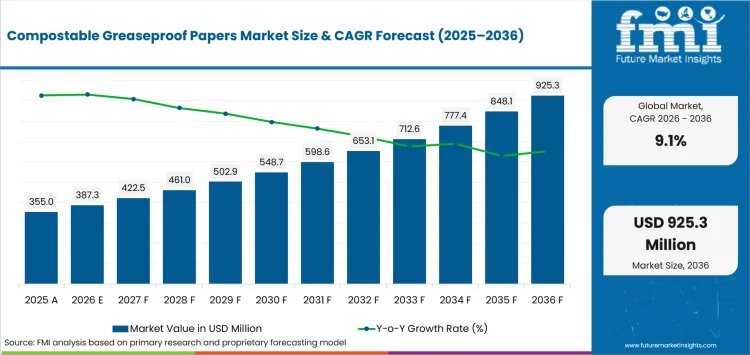
Key Takeaways of Compostable Greaseproof Papers Market
- PFAS restrictions increase grease-barrier requalification as food-packaging manufacturers replace fluorinated treatments without losing line speed or documented food-contact performance.
- By product type, unbleached natural greaseproof is estimated to hold 36.0% in 2026 owing to familiar food-contact conversion and stable oil resistance.
- In 2026, unbleached virgin fiber is expected to lead material with 40.0% share due to controlled strength and cleaner food-contact inputs.
- Industrial compostable is projected to hold 48.0% of certification demand in 2026, supported by defined commercial-compost testing and clearer claim boundaries.
- Uneven compost collection and material classification delay approval despite documented grease-resistance and compostability performance in the finished paper.
- Nordic Paper Holding AB (publ), Ahlstrom Oyj, Metsä Tissue Corporation, delfortgroup AG, Sappi Limited, ProAmpac, UPM-Kymmene Corporation and Koehler Paper SE operate across natural greaseproof, functional barrier and converted food-packaging routes.
Analyst Perspective
“Commercial qualification starts with oil holdout on the intended line and ends with a disposal claim that the local waste route accepts. Paper mills earn repeat business by reducing reformulation work while preserving food-contact documentation and steady converting performance.”
- Nandini Roy Choudhury, Principal Consultant, Future Market Insights
How is the Compostable Greaseproof Papers Market segmented?
Segmentation covers product type, material, certification, application, end use, sales channel and region.
Segmentation comprises product type (unbleached natural greaseproof, certified compostable coated papers, home-compostable grades, PFAS-free barrier papers and others), material (unbleached virgin fiber, bleached virgin fiber, bagasse - agri-fiber, recycled fiber and others), certification (industrial compostable, home compostable and uncertified), application (bakery & confectionery, QSR wraps & liners, snack packaging, household baking and others), end use (foodservice, food processing, retail & household and others), and sales channel (direct - converter supply, packaging distributors, online - e-commerce and others).
What supports bakery & confectionery within the application category?
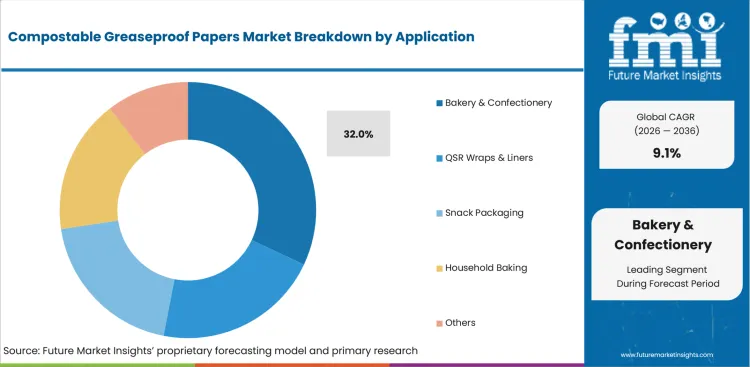
Bakery and confectionery lines consume greaseproof sheets repeatedly as dough fats and sugar-rich fillings require reliable release during production, cooling and transport. Standard pan and tray formats let bakery manufacturers qualify new food packaging paper on established lines without redesigning ovens, cutters or routine downstream handling equipment.
- Bakery & confectionery is likely to capture 32.0% share in 2026 attributable to high-frequency commercial sheet consumption and established heat-resistant formats.
- Metsä Tissue Corporation licensed its SAGA consumer business to Fredman Group in June 2025, preserving Mänttä base-paper supply for fiber-based kitchen products including baking papers.
What makes unbleached natural greaseproof central to the product type category?
Unbleached natural greaseproof paper relies on dense fiber structure to resist oil without a heavy polymer layer, which suits parchment paper used for direct food contact. Ahlstrom Oyj inaugurated a parchmentizer in France during May 2025 to increase vegetable parchment output for grease-resistant food packaging applications.
- By product type, unbleached natural greaseproof is estimated to hold 36.0% in 2026 owing to familiar conversion routes and a paper-forward appearance.
- Food producers value baking and cooking paper that releases cleanly under heat, but recurring orders depend on stable porosity and wet strength during repeated line trials.
Why does unbleached virgin fiber lead the material category?
Unbleached virgin fiber gives specialty paper mills a predictable substrate for strength, porosity and food-contact cleanliness during greaseproof conversion at commercial scale. Paper engineers use that consistency to control formation and coating response across long runs, especially for applications that need an even barrier surface.
- In 2026, unbleached virgin fiber is expected to lead material with 40.0% share due to controlled fiber quality and repeatable converting performance.
- Ahlstrom launched LamiBak Flex in March 2025 using 100% responsibly sourced wood pulp with a natural grease barrier for flexible paper packaging, linking virgin fiber control to high-barrier conversion.
How does industrial compostable shape demand within the certification category?
Industrial compostable grades give compostable foodservice packaging programs a defined end-of-life test route, but certification does not guarantee acceptance by every local organics program. Ahlstrom received Australian and New Zealand home-compost certification for Sulpack in April 2025, adding another verified route beside existing regional certifications.
- The certification category is forecast to be led by industrial compostable at 48.0% share in 2026 due to standardized commercial-compost conditions and clearer testing boundaries across commercial programs.
- Foodservice brands need sustainable packaging claims that identify the applicable disposal setting and preserve food-contact performance under normal commercial grease exposure.
What are the drivers, restraints and opportunities in the Compostable Greaseproof Papers Market?
PFAS controls increase barrier requalification, disposal-system limits slow claim conversion and higher-performance papers expand addressable food formats.
- Driver: PFAS limits are forcing food-packaging manufacturers to requalify grease barriers that preserve food-contact safety and normal production speed.
- Restraint: Industrial compostability does not convert into purchasing value unless the served account has a collection route that accepts the finished paper.
- Opportunity: Higher grease and moisture resistance extends compostable paper into oilier food formats if the finished structure retains valid end-of-life claims.
PFAS Rules Force Barrier Requalification
Regulation (EU) 2025/40 sets a 25 ppb limit for each targeted PFAS in food-contact packaging from August 2026. European food-packaging manufacturers need PFAS-free coatings and fiber barriers that pass chemical compliance during normal line trials. Repeat orders depend on replacement papers holding oil without adding coating steps or reducing production speed.
Compost Acceptance Limits Disposal Claims
USA foodservice purchasing guidance adds a practical limit to compostability claims for single-use food packaging. EPA guidance stated in October 2025 that procurement of certified commercially compostable food-service ware should follow confirmed local acceptance and available hauling. Greaseproof paper certification supports recurring foodservice specifications once disposal instructions match the served collection system.
Higher-Barrier Papers Expand Addressable Formats
Koehler Paper SE introduced a PFAS-free grease-resistant fast-food paper in April 2026 for restaurant-chain formats. Restaurant chains favor mill-applied barrier coated papers that reduce extra coating work during qualification on existing equipment. Compostable grades suit the same applications if grease performance and end-of-life claims remain valid in the finished package.
Which country CAGRs are profiled in the Compostable Greaseproof Papers Market?
| Country | CAGR |
|---|---|
| Brazil | 9.6% |
| United Kingdom | 9.2% |
| Germany | 8.9% |
| United States | 8.4% |
| Japan | 7.6% |
How do country-level CAGRs compare in the Compostable Greaseproof Papers Market?
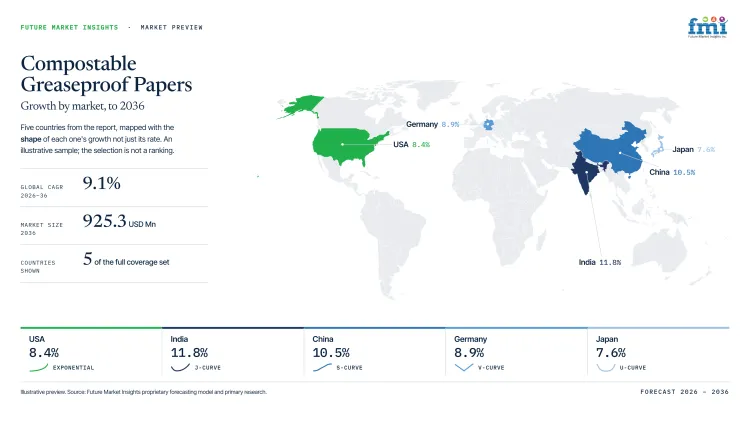
The five forecasts form an upper pair and lower pair around Germany as a current transition market. Brazil and the United Kingdom exceed 9.0% as channel access and packaging rules shape qualification pace. The United States and Japan remain lower as longer qualification cycles and local disposal routes temper adoption.
- Brazil’s distributor networks reduce replenishment distance for recurring bakery and foodservice paper orders.
- United Kingdom EPR fees make material classification a direct cost in food-packaging specifications.
- German paper-recovery targets increase scrutiny of fiber classification for coated food-contact formats.
- United States PFAS reformulation meets uneven commercial compost access across local service areas.
- Japanese food producers use longer technical qualification cycles for paper release and barrier consistency.
Comparable growth rates can produce different qualification costs across commercial accounts. The full report provides country-level CAGR analysis across North America, Latin America, Europe, East Asia, South Asia, Oceania and the Middle East and Africa.
Country-wise Analysis
- Brazilian food-packaging programs must match compostable-paper disposal instructions to municipal waste systems that vary across service territories, making one national end-of-life claim difficult to apply consistently across recurring commercial foodservice accounts nationwide. In August 2025 Brazil’s environment ministry reported roughly 2,500 municipalities continued using open dumps, a disposal gap that raises documentation needs for compostable paper outside established recovery routes serving bakery and takeaway accounts. Adoption of compostable greaseproof papers in Brazil is estimated to expand at 9.6% CAGR through 2036, supported by repeat commercial foodservice use but constrained by documented waste-system differences that complicate consistent nationwide end-of-life claims.
- United Kingdom packaging manufacturers qualify greaseproof coatings against an established paper-recovery route that Defra measured at a 74.3% recycling rate for paper and cardboard packaging during 2024 in its July 2025 national release. That recovery base shapes material classification during trials across national retail and commercial foodservice packaging programs, and compostable greaseproof paper sales in the United Kingdom are forecast to expand at 9.2% CAGR by 2036. Greaseproof and parchment formats require separate disposal routes under some assessment methods, so manufacturers need coating choices and end-of-life instructions that protect the intended classification during customer qualification and recurring commercial supply contracts.
- German food-packaging converters qualify greaseproof papers within a mature national recovery system that rewards clear fiber classification and makes end-of-life instructions part of specification work for coated bakery and foodservice formats sold commercially. Germany’s compostable greaseproof papers outlook is anticipated to advance at 8.9% CAGR over the assessment period, supported by established collection infrastructure but constrained by strict national classification of finished food-contact structures during commercial approval. The federal environment ministry reported in March 2025 that commercial paper and board packaging recovery was targeted to rise from 90% to 95% by 2030, increasing pressure to document recoverable structures during approval.
- United States foodservice converters face a direct grease-barrier replacement cycle and qualify paper formats against federal food-contact requirements plus local organics collection conditions across restaurant, bakery and prepared-food accounts in major service areas. ProAmpac reported in September 2025 that ButterFresh Parchment earned OK compost HOME certification with a wax-free construction and no intentionally added PFAS, giving food packers a verified home-compostability route for existing commercial packing equipment. The United States compostable greaseproof papers sector is projected to record 8.4% CAGR during the assessment period, aided by active reformulation but constrained by uneven commercial compost access across local municipal customer service areas.
- Japanese converters plan paper specifications around stable release behavior and qualification cycles, and the environment ministry reported in March 2026 that 904 municipalities planned separate collection of paper containers and packaging for fiscal 2026. Compostable greaseproof paper demand in Japan is predicted to advance at 7.6% CAGR through 2036, supported by detailed municipal collection planning and established food-production lines that reward consistent fiber quality across long runs. Variable disposal routes across municipalities remain a local friction that requires technical documentation separating food-contact performance from end-of-life instructions during approval by bakery manufacturers, packaged-food producers and regional retail and foodservice customer programs.
Who are the notable companies in the Compostable Greaseproof Papers Market?
Nordic Paper Holding AB (publ), Ahlstrom Oyj, Metsä Tissue Corporation, delfortgroup AG, Sappi Limited, ProAmpac, UPM-Kymmene Corporation and Koehler Paper SE are the notable companies serving this market.
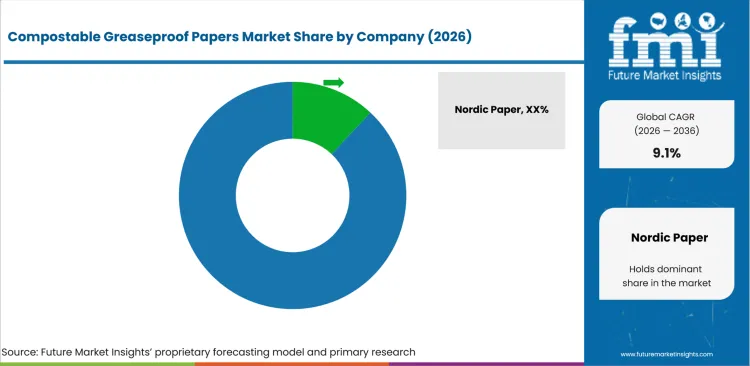
Competition separates specialty paper mills from converted packaging groups that qualify grease barriers on commercial equipment. Entry barriers center on documented food-contact status, grease-barrier performance and technical support during commercial line trials.
- Nordic Paper Holding AB (publ), Ahlstrom Oyj, Metsä Tissue Corporation and delfortgroup AG control specialty greaseproof or parchment production routes.
- Sappi Limited, UPM-Kymmene Corporation and Koehler Paper SE develop barrier papers while ProAmpac converts parchment for food packaging.
Competitive Benchmarking: Compostable Greaseproof Papers Market
| Company | Grease-Barrier Paper Depth | Commercialization Evidence | Application Qualification Support | Geographic Reach |
|---|---|---|---|---|
| Nordic Paper Holding AB (publ) | Medium | Medium | Medium | Scandinavia, Canada and international markets |
| Ahlstrom Oyj | High | High | High | Europe, North America and Asia-Pacific |
| Metsä Tissue Corporation | High | High | High | Europe and global food-preparation markets |
| delfortgroup AG | Medium | High | Medium | Europe and international food-packaging markets |
| Sappi Limited | Medium | High | Medium | Europe, North America and global customer markets |
| ProAmpac | Medium | High | Medium | North America and Europe |
| UPM-Kymmene Corporation | Medium | High | Medium | Europe, Asia and global specialty-material markets |
| Koehler Paper SE | Medium | High | Medium | Europe and international packaging markets |
Key Developments in the Compostable Greaseproof Papers Market
- In June 2026, Ahlstrom Oyj renewed CMA-W industrial compostability certification for its Genuine Vegetable Parchment food-grade portfolio under North American commercial-compost conditions.
- In April 2026, Sappi Limited’s North American business launched LusterFSB OGR for quick-service and bakery formats with grease resistance and design features intended for compostability.
- In March 2026, UPM-Kymmene Corporation and Paramelt introduced a grease-resistant paper packaging concept for bakery and fast-food uses with components individually validated as home compostable.
Key Players in the Compostable Greaseproof Papers Market
Natural Greaseproof and Parchment Paper Mills
- Nordic Paper Holding AB (publ)
- Ahlstrom Oyj
- Metsä Tissue Corporation
Functional Barrier Paper Platforms
- delfortgroup AG
- Sappi Limited
- UPM-Kymmene Corporation
- Koehler Paper SE
Converted Compostable Paper Specialists
- ProAmpac
Compostable Greaseproof Papers Market - Report Scope
| Coverage field | Report scope |
|---|---|
| Market breakdown | By product type, material, certification, application, end use, sales channel and region. |
| Quantitative Units | Revenue in USD million and CAGR in %. |
| Market Definition | Commercial compostable greaseproof paper sold as reels, sheets or retail rolls for food-contact and related packaging formats within the listed taxonomy. |
| Regions Covered | North America, Latin America, Europe, East Asia, South Asia and Pacific, and Middle East and Africa. |
| Countries Covered | Brazil, United Kingdom, Germany, United States, Japan, and 20+ countries included in the full report. |
| Key Companies Profiled | Nordic Paper Holding AB (publ), Ahlstrom Oyj, Metsä Tissue Corporation, delfortgroup AG, Sappi Limited, ProAmpac, UPM-Kymmene Corporation, and Koehler Paper SE. |
| Forecast Period | 2026 to 2036. |
| Approach | Primary and secondary research with market triangulation. |
Compostable Greaseproof Papers Market - Research Methodology
| Method | Approach |
|---|---|
| Primary Research | FMI analysts gathered input from manufacturers, service providers, technology developers, distributors, end users, procurement teams, and subject-matter experts. Interviews examined purchasing decisions, product or service evaluation, adoption barriers, approval requirements, pricing considerations, and expectations for technical or commercial support. Respondents were also asked what evidence is required before a trial, pilot, or initial order develops into regular purchasing. |
| Desk Research | Desk research covered government statistics, regulatory publications, trade data, industry associations, technical literature, standards, company filings, product information, and official corporate announcements. Sources were reviewed for relevance, publication date, geographic coverage, and consistency with the defined market scope. Claims relating to performance, applications, approvals, capacity, investment, and commercial activity were retained only when supported by credible public evidence. |
| Market Sizing and Forecasting | The market model combined the baseline value with historical performance, segment structure, pricing and volume indicators, adoption levels, company participation, and country-level demand conditions. Forecast assumptions considered economic activity, investment trends, regulatory developments, technology adoption, purchasing cycles, supply availability, and barriers to wider market use. Segment and regional estimates were reconciled before the final market total was calculated. |
| Data Validation | Estimates were checked against multiple independent indicators, including public data, company activity, trade patterns, industry developments, and findings from primary interviews. Validation also tested whether products, services, applications, and company revenues fell within the defined market boundaries. Adjacent categories, unsupported claims, overlapping revenues, and activities without direct market relevance were excluded to reduce double counting and maintain consistency across segments and countries. |
Compostable Greaseproof Papers Market by Segments
Compostable Greaseproof Papers Market segmented by Product Type:
- Unbleached Natural Greaseproof
- Certified Compostable Coated Papers
- Home-Compostable Grades
- PFAS-Free Barrier Papers
- Others
Compostable Greaseproof Papers Market segmented by Material:
- Unbleached Virgin Fiber
- Bleached Virgin Fiber
- Bagasse - Agri-Fiber
- Recycled Fiber
- Others
Compostable Greaseproof Papers Market segmented by Certification:
- Industrial Compostable
- Home Compostable
- Uncertified
Compostable Greaseproof Papers Market segmented by Application:
- Bakery & Confectionery
- QSR Wraps & Liners
- Snack Packaging
- Household Baking
- Others
Compostable Greaseproof Papers Market segmented by End Use:
- Foodservice
- Food Processing
- Retail & Household
- Others
Compostable Greaseproof Papers Market segmented by Sales Channel:
- Direct - Converter Supply
- Packaging Distributors
- Online - E-commerce
- Others
Compostable Greaseproof Papers Market by Region:
- North America
- United States
- Canada
- Latin America
- Brazil
- Mexico
- Chile
- Rest of Latin America
- Western Europe
- Germany
- United Kingdom
- Italy
- Spain
- France
- Nordics
- Benelux
- Rest of Western Europe
- Eastern Europe
- Russia
- Poland
- Hungary
- Balkan and Baltic States
- Rest of Eastern Europe
- East Asia
- China
- Japan
- South Korea
- South Asia and Pacific
- India
- ASEAN
- Australia and New Zealand
- Rest of South Asia and Pacific
- Middle East and Africa
- Kingdom of Saudi Arabia
- Other GCC Countries
- Türkiye
- South Africa
- Other African Union Countries
- Rest of Middle East and Africa
Research Sources and Bibliography
- USA Food and Drug Administration. (2025, January 3). FDA Determines Authorization for 35 Food Contact Notifications Related to PFAS Are No Longer Effective
- Department for Environment, Food & Rural Affairs. (2026, April 20). Local authority payments and material base fees: breakdown of costs and tonnages
- Ahlstrom Oyj. (2025, May 21). Ahlstrom inaugurates new parchmentizer at the Saint-Séverin plant, strengthening customer partnerships and local commitment
- Ahlstrom Oyj. (2025, March 17). Ahlstrom expands LamiBak™ portfolio with a new base paper for flexible food packaging
- Ahlstrom Oyj. (2025, April 7). Ahlstrom receives home compostable certification in Australia and New Zealand for Sulpack® Flexible packaging
- Metsä Tissue. (2025, June 18). Metsä Tissue’s greaseproof paper business licenses SAGA consumer business to Fredman Group
- European Parliament and Council of the European Union. (2025, January 22). Regulation (EU) 2025/40 of the European Parliament and of the Council of 19 December 2024 on packaging and packaging waste, amending Regulation (EU) 2019/1020 and Directive (EU) 2019/904, and repealing Directive 94/62/EC
- USA Environmental Protection Agency. (2025, October 22). Identifying Sustainable Food Service and Food Service Ware
- Koehler Paper SE. (2026, April 10). PFAS-Free and Recyclable Fast Food Packaging Paper
- Ministry of the Environment and Climate Change, Brazil. (2025, August 12). Plano Clima Mitigação debate sete planos setoriais e avança para consolidação
- Department for Environment, Food & Rural Affairs. (2025, July 23). UK statistics on waste
- Federal Ministry for the Environment, Nature Conservation, Nuclear Safety and Consumer Protection. (2025, March 25). Deutsche Verpackungsindustrie setzt Zeichen für hohe Recyclingquote bei Papier, Pappe und Karton in der EU
- ProAmpac. (2025, September 10). Home-Compostable ButterFresh™ Parchment Marks New Step in ProAmpac’s Sustainability Journey
- Ministry of the Environment, Japan. (2026, March 31).
- Nordic Paper Holding AB (publ). (2025, July 16). Nordic Paper Interim report January-June 2025
- delfortgroup AG. (2025, June 17). new barrier paper for varying temperatures: thinbarrier 303 protects food from frozen to tropical
- Ahlstrom Oyj. (2026, June 17). Ahlstrom renews CMA-W compostability certification for GVP food-grade portfolio
- Sappi North America. (2026, April 13). Sappi North America Introduces LusterFSB OGR, a Grease Resistant Food Service Board Designed for Compostability
- UPM. (2026, March 24). UPM and Paramelt introduce bio-based food packaging concept
This bibliography is provided for reader reference and is not exhaustive. The full report contains the complete reference list and detailed citations
This Report Answers
- How do PFAS rules affect converter qualification?
- Why does unbleached natural greaseproof lead product type?
- How does virgin fiber affect food-contact conversion?
- Why does industrial compostability require local acceptance?
- What explains the profiled country CAGR spread?
- How do waste rules change qualification routes?
- Which capabilities separate greaseproof paper suppliers?
- How are recent company actions changing competition?
Frequently Asked Questions
How big is the Compostable Greaseproof Papers Market in 2026?
The compostable greaseproof papers market is valued at USD 387.3 million in 2026 and is projected to reach USD 925.3 million by 2036. Growth is driven by increasing demand for sustainable food-packaging materials that maintain grease resistance and food-contact performance.
What is the CAGR of the Compostable Greaseproof Papers Market from 2026 to 2036?
The compostable greaseproof papers market is projected to grow at a CAGR of 9.1% between 2026 and 2036. Expansion is supported by the transition away from restricted grease-resistant treatments and rising adoption of compostable packaging solutions.
Which certification segment is projected to account for 48.0% of the Compostable Greaseproof Papers Market?
Industrial compostable certification is projected to account for 48.0% of the market in 2026. Its leading share is supported by established certification standards and broader acceptance across commercial composting systems.
Which application segment is projected to account for 32.0% of the Compostable Greaseproof Papers Market?
Bakery & confectionery is projected to account for 32.0% of the market in 2026. Its leading position is driven by frequent use of greaseproof papers in baking, wrapping, and food handling applications.
Which companies are active in the Compostable Greaseproof Papers Market?
Key companies operating in the market include Nordic Paper Holding AB (publ), Ahlstrom Oyj, Metsä Tissue Corporation, delfortgroup AG, Sappi Limited, ProAmpac, UPM-Kymmene Corporation, and Koehler Paper SE. These companies compete through barrier technology innovation, compostability certifications, and food-packaging expertise.
Preview the report firsthand - request a free sample
Get SampleGet the brochure for pricing and purchase details.
Get PDFTable of Content
- Key Takeaways
- Market Size and CAGR
- Top Growth Driver
- Fastest Growing Segment
- Leading Region
- Key Companies
- Emerging Opportunities
- Executive Summary
- Global Market Outlook
- Demand-side Trends
- Supply-side Trends
- Technology Roadmap Analysis
- Analysis and Recommendations
- Analyst Perspective (What is happening? Why now? What should investors know?)
- Key Questions Answered
- How large is the market?
- What is the CAGR?
- What are key trends?
- Which region dominates?
- Who are the leaders?
- Market Overview
- Market Coverage / Taxonomy
- Market Definition / Scope / Limitations
- Research Methodology
- Chapter Orientation
- Analytical Lens and Working Hypotheses
- Market Structure, Signals, and Trend Drivers
- Benchmarking and Cross-market Comparability
- Market Sizing, Forecasting, and Opportunity Mapping
- Research Design and Evidence Framework
- Desk Research Programme (Secondary Evidence)
- Expert Input and Fieldwork (Primary Evidence)
- Tooling, Models, and Reference Databases
- Data Engineering and Model Build
- Quality Assurance and Audit Trail
- Market Background
- Market Dynamics (Drivers, Restraints, Opportunity, Trends)
- Scenario Forecast (Optimistic, Likely, Conservative)
- Impact Analysis
- AI Impact
- Sustainability Impact
- Regulatory Impact
- Technology Impact
- Consumer / Buyer Analysis
- Purchase Drivers
- Adoption Barriers
- Buyer Journey
- Opportunity Map Analysis
- Product Life Cycle Analysis
- Supply Chain Analysis
- Investment Feasibility Matrix
- Value Chain Analysis
- PESTLE and Porter's Analysis
- Regulatory Landscape
- Regional Parent Market Outlook
- Production and Consumption Statistics
- Import and Export Statistics
- Global Market Analysis and Forecast, 2021 to 2036
- Historical Market Size Value (USD Million) Analysis, 2021 to 2025
- Current and Future Market Size Value (USD Million) Projections, 2026 to 2036
- Y-o-Y Growth Trend Analysis
- Absolute $ Opportunity Analysis
- Global Market Pricing Analysis, 2021 to 2036
- Global Market Analysis and Forecast, By Product Type, 2021 to 2036
- Introduction / Key Findings
- Historical Market Size Value (USD Million) Analysis By Product Type, 2021 to 2025
- Current and Future Market Size Value (USD Million) Analysis and Forecast By Product Type, 2026 to 2036
- Unbleached Natural Greaseproof
- Certified Compostable Coated Papers
- Home-Compostable Grades
- PFAS-Free Barrier Papers
- Others
- Unbleached Natural Greaseproof
- Y-o-Y Growth Trend Analysis By Product Type, 2021 to 2025
- Absolute $ Opportunity Analysis By Product Type, 2026 to 2036
- Global Market Analysis and Forecast, By Material, 2021 to 2036
- Introduction / Key Findings
- Historical Market Size Value (USD Million) Analysis By Material, 2021 to 2025
- Current and Future Market Size Value (USD Million) Analysis and Forecast By Material, 2026 to 2036
- Unbleached Virgin Fiber
- Bleached Virgin Fiber
- Bagasse - Agri-Fiber
- Recycled Fiber
- Others
- Unbleached Virgin Fiber
- Y-o-Y Growth Trend Analysis By Material, 2021 to 2025
- Absolute $ Opportunity Analysis By Material, 2026 to 2036
- Global Market Analysis and Forecast, By Certification, 2021 to 2036
- Introduction / Key Findings
- Historical Market Size Value (USD Million) Analysis By Certification, 2021 to 2025
- Current and Future Market Size Value (USD Million) Analysis and Forecast By Certification, 2026 to 2036
- Industrial Compostable
- Home Compostable
- Uncertified
- Industrial Compostable
- Y-o-Y Growth Trend Analysis By Certification, 2021 to 2025
- Absolute $ Opportunity Analysis By Certification, 2026 to 2036
- Global Market Analysis and Forecast, By Application, 2021 to 2036
- Introduction / Key Findings
- Historical Market Size Value (USD Million) Analysis By Application, 2021 to 2025
- Current and Future Market Size Value (USD Million) Analysis and Forecast By Application, 2026 to 2036
- Bakery & Confectionery
- QSR Wraps & Liners
- Snack Packaging
- Household Baking
- Others
- Bakery & Confectionery
- Y-o-Y Growth Trend Analysis By Application, 2021 to 2025
- Absolute $ Opportunity Analysis By Application, 2026 to 2036
- Global Market Analysis and Forecast, By End Use, 2021 to 2036
- Introduction / Key Findings
- Historical Market Size Value (USD Million) Analysis By End Use, 2021 to 2025
- Current and Future Market Size Value (USD Million) Analysis and Forecast By End Use, 2026 to 2036
- Foodservice
- Food Processing
- Retail & Household
- Others
- Foodservice
- Y-o-Y Growth Trend Analysis By End Use, 2021 to 2025
- Absolute $ Opportunity Analysis By End Use, 2026 to 2036
- Global Market Analysis and Forecast, By Sales Channel
- Introduction / Key Findings
- Historical Market Size Value (USD Million) Analysis By Sales Channel, 2021 to 2025
- Current and Future Market Size Value (USD Million) Analysis and Forecast By Sales Channel, 2026 to 2036
- Direct - Converter Supply
- Packaging Distributors
- Online - E-commerce
- Others
- Direct - Converter Supply
- Y-o-Y Growth Trend Analysis By Sales Channel, 2021 to 2025
- Absolute $ Opportunity Analysis By Sales Channel, 2026 to 2036
- Global Market Analysis and Forecast, By Region, 2021 to 2036
- Introduction
- Historical Market Size Value (USD Million) Analysis By Region, 2021 to 2025
- Current Market Size Value (USD Million) Analysis and Forecast By Region, 2026 to 2036
- North America
- Latin America
- Western Europe
- Eastern Europe
- East Asia
- South Asia and Pacific
- Middle East & Africa
- Market Attractiveness Analysis By Region
- North America Market Analysis and Forecast, By Country, 2021 to 2036
- Historical Market Size Value (USD Million) Trend Analysis By Market Taxonomy, 2021 to 2025
- Market Size Value (USD Million) Forecast By Market Taxonomy, 2026 to 2036
- By Country
- USA
- Canada
- By Product Type
- By Material
- By Certification
- By Application
- By End Use
- By Sales Channel
- By Country
- Market Attractiveness Analysis
- By Country
- By Product Type
- By Material
- By Certification
- By Application
- By End Use
- By Sales Channel
- Key Takeaways
- Latin America Market Analysis and Forecast, By Country
- Historical Market Size Value (USD Million) Trend Analysis By Market Taxonomy, 2021 to 2025
- Market Size Value (USD Million) Forecast By Market Taxonomy, 2026 to 2036
- By Country
- Brazil
- Mexico
- Chile
- Rest of Latin America
- By Product Type
- By Material
- By Certification
- By Application
- By End Use
- By Sales Channel
- By Country
- Market Attractiveness Analysis
- By Country
- By Product Type
- By Material
- By Certification
- By Application
- By End Use
- By Sales Channel
- Key Takeaways
- Western Europe Market Analysis and Forecast, By Country
- Historical Market Size Value (USD Million) Trend Analysis By Market Taxonomy, 2021 to 2025
- Market Size Value (USD Million) Forecast By Market Taxonomy, 2026 to 2036
- By Country
- Germany
- UK
- Italy
- Spain
- France
- Nordic
- BENELUX
- Rest of Western Europe
- By Product Type
- By Material
- By Certification
- By Application
- By End Use
- By Sales Channel
- By Country
- Market Attractiveness Analysis
- By Country
- By Product Type
- By Material
- By Certification
- By Application
- By End Use
- By Sales Channel
- Key Takeaways
- Eastern Europe Market Analysis and Forecast, By Country
- Historical Market Size Value (USD Million) Trend Analysis By Market Taxonomy, 2021 to 2025
- Market Size Value (USD Million) Forecast By Market Taxonomy, 2026 to 2036
- By Country
- Russia
- Poland
- Hungary
- Balkan & Baltic
- Rest of Eastern Europe
- By Product Type
- By Material
- By Certification
- By Application
- By End Use
- By Sales Channel
- By Country
- Market Attractiveness Analysis
- By Country
- By Product Type
- By Material
- By Certification
- By Application
- By End Use
- By Sales Channel
- Key Takeaways
- East Asia Market Analysis and Forecast, By Country
- Historical Market Size Value (USD Million) Trend Analysis By Market Taxonomy, 2021 to 2025
- Market Size Value (USD Million) Forecast By Market Taxonomy, 2026 to 2036
- By Country
- China
- Japan
- South Korea
- By Product Type
- By Material
- By Certification
- By Application
- By End Use
- By Sales Channel
- By Country
- Market Attractiveness Analysis
- By Country
- By Product Type
- By Material
- By Certification
- By Application
- By End Use
- By Sales Channel
- Key Takeaways
- South Asia and Pacific Market Analysis and Forecast, By Country
- Historical Market Size Value (USD Million) Trend Analysis By Market Taxonomy, 2021 to 2025
- Market Size Value (USD Million) Forecast By Market Taxonomy, 2026 to 2036
- By Country
- India
- ASEAN
- Australia & New Zealand
- Rest of South Asia and Pacific
- By Product Type
- By Material
- By Certification
- By Application
- By End Use
- By Sales Channel
- By Country
- Market Attractiveness Analysis
- By Country
- By Product Type
- By Material
- By Certification
- By Application
- By End Use
- By Sales Channel
- Key Takeaways
- Middle East & Africa Market Analysis and Forecast, By Country
- Historical Market Size Value (USD Million) Trend Analysis By Market Taxonomy, 2021 to 2025
- Market Size Value (USD Million) Forecast By Market Taxonomy, 2026 to 2036
- By Country
- Kingdom of Saudi Arabia
- Other GCC Countries
- Türkiye
- South Africa
- Other African Union
- Rest of Middle East & Africa
- By Product Type
- By Material
- By Certification
- By Application
- By End Use
- By Sales Channel
- By Country
- Market Attractiveness Analysis
- By Country
- By Product Type
- By Material
- By Certification
- By Application
- By End Use
- By Sales Channel
- Key Takeaways
- Key Countries Market Analysis
- USA
- Pricing Analysis
- Market Share Analysis, 2025
- By Product Type
- By Material
- By Certification
- By Application
- By End Use
- By Sales Channel
- Canada
- Pricing Analysis
- Market Share Analysis, 2025
- By Product Type
- By Material
- By Certification
- By Application
- By End Use
- By Sales Channel
- Mexico
- Pricing Analysis
- Market Share Analysis, 2025
- By Product Type
- By Material
- By Certification
- By Application
- By End Use
- By Sales Channel
- Brazil
- Pricing Analysis
- Market Share Analysis, 2025
- By Product Type
- By Material
- By Certification
- By Application
- By End Use
- By Sales Channel
- Chile
- Pricing Analysis
- Market Share Analysis, 2025
- By Product Type
- By Material
- By Certification
- By Application
- By End Use
- By Sales Channel
- Germany
- Pricing Analysis
- Market Share Analysis, 2025
- By Product Type
- By Material
- By Certification
- By Application
- By End Use
- By Sales Channel
- UK
- Pricing Analysis
- Market Share Analysis, 2025
- By Product Type
- By Material
- By Certification
- By Application
- By End Use
- By Sales Channel
- Italy
- Pricing Analysis
- Market Share Analysis, 2025
- By Product Type
- By Material
- By Certification
- By Application
- By End Use
- By Sales Channel
- Spain
- Pricing Analysis
- Market Share Analysis, 2025
- By Product Type
- By Material
- By Certification
- By Application
- By End Use
- By Sales Channel
- France
- Pricing Analysis
- Market Share Analysis, 2025
- By Product Type
- By Material
- By Certification
- By Application
- By End Use
- By Sales Channel
- India
- Pricing Analysis
- Market Share Analysis, 2025
- By Product Type
- By Material
- By Certification
- By Application
- By End Use
- By Sales Channel
- ASEAN
- Pricing Analysis
- Market Share Analysis, 2025
- By Product Type
- By Material
- By Certification
- By Application
- By End Use
- By Sales Channel
- Australia & New Zealand
- Pricing Analysis
- Market Share Analysis, 2025
- By Product Type
- By Material
- By Certification
- By Application
- By End Use
- By Sales Channel
- China
- Pricing Analysis
- Market Share Analysis, 2025
- By Product Type
- By Material
- By Certification
- By Application
- By End Use
- By Sales Channel
- Japan
- Pricing Analysis
- Market Share Analysis, 2025
- By Product Type
- By Material
- By Certification
- By Application
- By End Use
- By Sales Channel
- South Korea
- Pricing Analysis
- Market Share Analysis, 2025
- By Product Type
- By Material
- By Certification
- By Application
- By End Use
- By Sales Channel
- Russia
- Pricing Analysis
- Market Share Analysis, 2025
- By Product Type
- By Material
- By Certification
- By Application
- By End Use
- By Sales Channel
- Poland
- Pricing Analysis
- Market Share Analysis, 2025
- By Product Type
- By Material
- By Certification
- By Application
- By End Use
- By Sales Channel
- Hungary
- Pricing Analysis
- Market Share Analysis, 2025
- By Product Type
- By Material
- By Certification
- By Application
- By End Use
- By Sales Channel
- Kingdom of Saudi Arabia
- Pricing Analysis
- Market Share Analysis, 2025
- By Product Type
- By Material
- By Certification
- By Application
- By End Use
- By Sales Channel
- Türkiye
- Pricing Analysis
- Market Share Analysis, 2025
- By Product Type
- By Material
- By Certification
- By Application
- By End Use
- By Sales Channel
- South Africa
- Pricing Analysis
- Market Share Analysis, 2025
- By Product Type
- By Material
- By Certification
- By Application
- By End Use
- By Sales Channel
- USA
- Market Structure Analysis
- Competition Dashboard
- Competition Benchmarking
- Market Share Analysis of Top Players
- By Regional
- By Product Type
- By Material
- By Certification
- By Application
- By End Use
- By Sales Channel
- Emerging Startups
- Innovation Benchmarking
- Competition Analysis
- Competition Deep Dive
- Nordic Paper
- Overview
- Product Portfolio
- Profitability by Market Segments
- Sales Footprint
- Strategy Overview
- Marketing Strategy
- Product Strategy
- Channel Strategy
- Ahlstrom
- Metsa Group
- Delfort
- If You Care
- Vegware (Novolex)
- Koehler Paper
- Seaman Paper
- Pudumjee Paper Products
- Sappi
- Nordic Paper
- Case Studies
- Success Stories
- Recent Developments
- Competition Deep Dive
- Assumptions & Acronyms Used


