
- Market Size (2026)
- USD 167.2 Bn
- Forecast (2036)
- USD 242.8 Bn
- CAGR (2026 to 2036)
- 3.8%
How big is Flat Panel Display Market in 2026?
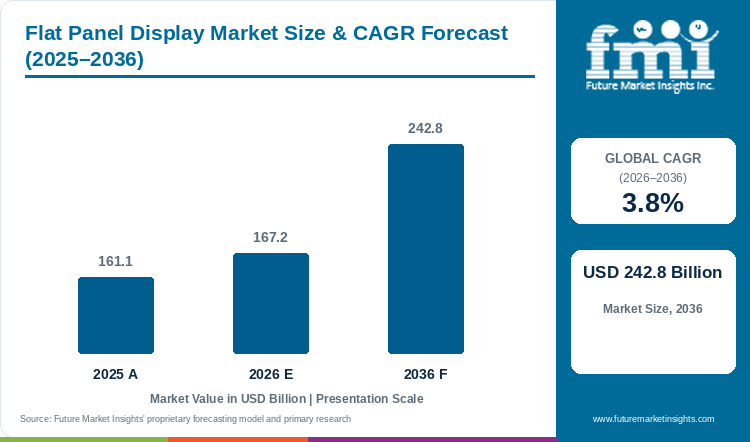
Demand is projected to expand at 3.8% CAGR from 2026 to 2036. Market value rises from USD 161.07 billion in 2025 to USD 167.2 billion in 2026 and USD 242.75 billion by 2036.
Buyers choose panels around the viewing experience, power budget and physical design of the device they intend to build, making the balance between established LCD production and newer OLED formats commercially important. Samsung Display's CES 2026 presentation spans computer, television and vehicle applications, while LG Display offers automotive LCD configurations built around brightness and larger screen areas. [3][4] These different product routes give equipment makers several ways to improve a screen without using the same panel construction. Module requirements also depend on where the display will operate, with vehicle interiors imposing a different integration task from a meeting-room installation. Demand associated with conference room solutions therefore reaches panel suppliers through the specifications of the completed equipment. India's proposed customs distinctions between complete interactive displays and open cells further illustrate the commercial importance of local assembly. [1] Through 2036, growth will depend on reliable panel supply and the value that customers attach to improved visual performance.
Key Market Trends & Insights
- Device programs connect image quality and power requirements with the panel configuration selected for production.
- Automotive displays create application-specific work around module integration and the vehicle interior.
- Open-cell sourcing and local assembly influence the commercial relationship between panel inputs and finished displays. [1]
Regional Highlights
- Local assembly economics shape India's flat-panel opportunity because a complete interactive display and its open-cell inputs enter different stages of manufacturing (FMI outlook: 7.2% CAGR, 2026 to 2036).
- Commercial installations and consumer-device programs connect US demand to different parts of the panel supply chain (FMI outlook: 6.9% CAGR, 2026 to 2036).
- Industrial equipment and automotive applications give Japanese display buyers a reason to examine reliability and supply continuity alongside visual specifications (FMI outlook: 6.5% CAGR, 2026 to 2036).
Market Size & Forecast
Table 1: Market Size and Forecast for Flat Panel Display Market (USD billion and percentage), 2025 to 2036
| Metric | Value |
|---|---|
| 2025 market value | USD 161.07 billion |
| 2026 market value | USD 167.2 billion |
| 2036 market value | USD 242.75 billion |
| CAGR 2026 to 2036 | 3.8% |
| Revenue increase 2026 to 2036 | USD 75.55 billion |
| Market expansion 2026 to 2036 | 1.45 times |
The market covers LCD, OLED and other flat-panel modules and panels, including display-specific manufacturing. Finished-device sales and unrelated panel-level semiconductor packaging are excluded.
Meeting-room installations create panel specifications around screen size, viewing distance and operating time, so demand for conference room solutions reaches display suppliers through the equipment selected for each room.
Display engineering across consumer and automotive applications
Panel development follows the equipment customer's requirements for image quality, power use and physical integration. Public research and manufacturer presentations show continuing work on automotive displays and newer OLED formats, while assembly policy influences how customers source open cells and completed modules. [1][2][3][4]
Table 2: Industry evidence relevant to the flat panel display market
| Indicator | Data point or observation | Market relevance | Source |
|---|---|---|---|
| Automotive LCD | LG Display describes LTPS and oxide LCD options | Brightness and larger screen areas influence module selection | [4] |
| OLED development | Samsung Display presented computing, television and vehicle formats at CES 2026 | Several device programs create distinct panel specifications | [3] |
| Local assembly | India's 2025 Budget proposed different duties for complete interactive displays and component inputs | Component sourcing affects assembly economics | [1] |
Analyst Perspective
"Display purchasing connects the image required by the application with the power and integration available in the finished product. Panel makers need to support that complete fit, including the operating environment and production requirements, as customers compare display technologies for different devices and vehicle installations."
- Sudip Saha, Co-founder, Future Market Insights
How is the Flat Panel Display Market segmented?
The market is segmented by Technology, Application, End Use, Deployment, and Region.
Technology coverage comprises Liquid Crystal Displays (LCD), Plasma Displays, and Organic Light-Emitting Diode (OLED) Displays. Application analysis separates Consumer Electronics, including Television, Mobile Phones and Personal Computers, from Automotive. End Use covers the Consumer Electronics Industry, Automotive Industry, Retail Industry, Healthcare Industry and Industrial Sector, while Deployment distinguishes Indoor Displays and Outdoor Displays. These axes connect the panel design to its intended user and operating environment.
Why do liquid crystal displays retain a substantial position in panel technology?
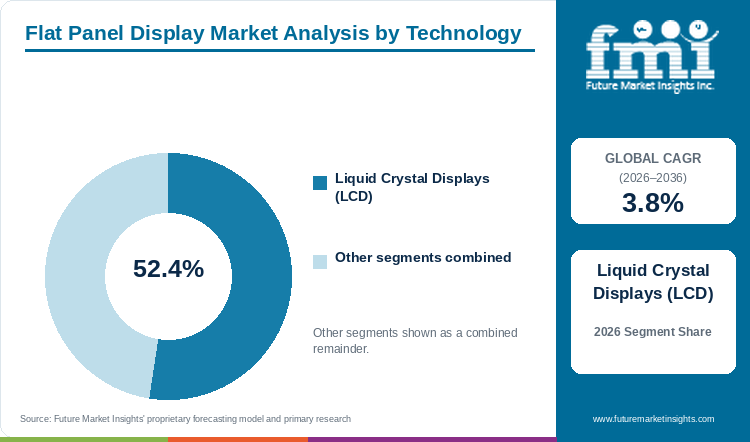
Table 3: Technology Share for Flat Panel Display Market (percentage share), 2026
| Technology | Estimated share (2026) |
|---|---|
| Liquid Crystal Displays (LCD) | 52.4% |
| Other technologies | 47.6% |
| Total | 100.0% |
Table 4: Segment Position and Market Growth for Flat Panel Display Market, 2026 to 2036
| Metric | Value |
|---|---|
| Global CAGR (2026 to 2036) | 3.8% |
| Profiled technology segment | Liquid Crystal Displays (LCD) |
LCD demand benefits from a broad production base and the ability to match panel configurations to different price points, screen sizes and operating environments. A manufacturer designing a high-volume product can assess an established supply route alongside the brightness, resolution and power requirements of the screen. Automotive use illustrates the continuing development of this technology, with LG Display describing LTPS and oxide LCD options for larger and brighter vehicle displays. [4] The estimated 52.4% technology share in 2026 reflects that breadth of practical use, even as premium product programs create room for OLED. Selection consequently depends on the complete display specification and the equipment maker's production schedule, giving consistent output and integration support continuing commercial importance.
The Liquid Crystal Displays (LCD) segment is projected to account for 52.4% of technology demand in 2026.
- Liquid Crystal Displays (LCD): 52.4% of technology demand (2026 estimate), supported by their broad application base and established supply economics.
- Automotive LCD development continues to address brightness, larger screen areas and the integration of display surfaces within vehicle interiors. [4]
What sustains consumer electronics demand for flat-panel displays?
Table 5: Application Share for Flat Panel Display Market (percentage share), 2026
| Application | Estimated share (2026) |
|---|---|
| Consumer Electronics | 46.0% |
| Other applications | 54.0% |
| Total | 100.0% |
Personal devices make the screen a visible part of the customer's purchase decision, bringing display quality and product design into repeated replacement cycles. Televisions, phones and computers also place different demands on size, portability and power consumption, allowing several panel technologies to coexist within consumer electronics. Samsung Display's CES 2026 program presented OLED and QD-OLED applications across tablets, laptops, monitors and televisions, demonstrating the breadth of product design work around this category. [3] The Consumer Electronics segment is estimated to account for 46.0% of application demand in 2026 as manufacturers balance those improvements against the price of the finished device. The purchasing relationship extends beyond an individual panel order because brands need repeatable quality and dependable deliveries throughout each product program.
The Consumer Electronics segment is projected to account for 46.0% of application demand in 2026.
- Consumer Electronics: 46.0% of application demand (2026 estimate), with personal-device programs supporting recurring panel procurement.
- Screen size, portability, image quality and power requirements create distinct purchasing specifications across televisions, mobile devices and computers. [3]
- A vehicle's central computing design influences the information presented in the cabin, connecting automotive SoC selection with the display interfaces and visual functions that equipment makers need to support.
What are the drivers, restraints, and opportunities in the Flat Panel Display Market?
A display order connects the viewing experience with manufacturing economics, since the equipment maker needs a screen that fits its design, power budget and product price. Suppliers can create value through application-specific configurations and dependable output, with qualification support helping customers carry a promising panel into sustained production. Automotive and local-assembly programs provide distinct routes to those relationships. [1][2][4]
Driver
Screen quality and physical design influence the value of a finished device, giving manufacturers a reason to consider new panel configurations when they update a product. Samsung Display's CES 2026 presentation spans computer, television and automotive uses, while LG Display's automotive LCD range addresses larger screen areas and brightness. [3][4] These programs create work for suppliers able to translate a device specification into reliable panel output, with qualification and production support helping turn design interest into repeat orders.
Restraint
Panel manufacturers commit capital and engineering resources before a customer's product reaches sustained production, making utilization and qualification commercially important. A display with suitable image characteristics still needs to fit the equipment maker's cost target and assembly process. Buyers consequently assess the complete module specification and the support required during integration, with a change in product mix capable of shifting demand between established LCD output and premium OLED formats.
Opportunity
Vehicle interiors and commercial installations create opportunities for application-specific modules with different sizes, layouts and operating conditions. Taiwan's public display research priorities include automotive applications and related materials, while India's proposed customs structure draws attention to open-cell sourcing and local assembly. [2][1] Suppliers can develop these opportunities through practical engineering support, helping customers choose a suitable panel and integrate it consistently within the finished product.
Display qualification can include temperature and humidity work in environmental test chambers, helping the equipment maker assess the chosen panel within the conditions expected during use.
Which country CAGRs are profiled in the Flat Panel Display Market?
Table 6: Country CAGR Comparison for Flat Panel Display Market (CAGR percentage), 2026 to 2036
| Country | CAGR |
|---|---|
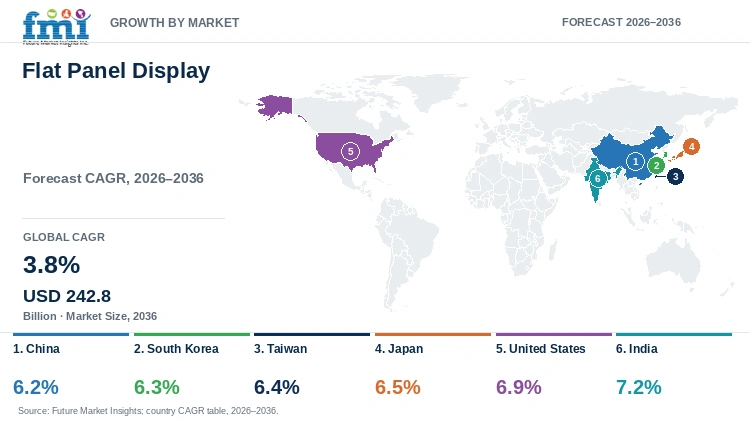
| China | 6.2% |
| South Korea | 6.3% |
| Taiwan | 6.4% |
| Japan | 6.5% |
| United States | 6.9% |
| India | 7.2% |
Country-wise Analysis
China Flat Panel Display Market Outlook (2026 to 2036)
Large-volume electronics manufacturing places panel availability, production consistency and cost at the center of China's display purchasing. A panel ordered for a mass-market screen has to fit an assembly schedule, while a more specialized product requires closer coordination around size, brightness and interface requirements. Competition consequently depends on the ability to deliver the required panel repeatedly across a production run. Automotive and commercial screens add opportunities for suppliers able to support application qualification, while consumer programs continue to reward dependable output and a workable component price.
South Korea Flat Panel Display Market Outlook (2026 to 2036)
OLED product development gives South Korea a distinct position in flat-panel supply, connecting display engineering with premium device and vehicle programs. Samsung Display's CES 2026 presentation included computer screens, television panels and automotive configurations, illustrating several routes through which the same broad technology family reaches different customers. [3] A successful development still needs an equipment maker with a suitable product program, making customer qualification and production support central to commercialization. Suppliers therefore compete on the fit between panel capabilities and the design priorities of each purchasing team.
Taiwan Flat Panel Display Market Outlook (2026 to 2036)
Taiwan's display ecosystem combines panel manufacturing with materials and application development, giving suppliers opportunities to work closely with customers on specialized modules. The Ministry of Economic Affairs presented publicly supported work in automotive display applications and display-related materials in April 2025, providing a concrete view of those development priorities. [2] Automotive customers place particular emphasis on the module's operating environment and integration within the vehicle, while industrial equipment buyers value continuity across longer product lives. This combination supports suppliers that can carry a design from development into a stable manufacturing and delivery relationship.
Japan Flat Panel Display Market Outlook (2026 to 2036)
Industrial equipment and automotive applications give Japanese display buyers a reason to examine reliability and supply continuity alongside visual specifications. A screen integrated into a machine interface or vehicle dashboard becomes part of a wider product with its own development schedule, service requirements and replacement expectations. The commercial task involves matching the display to the equipment's physical layout and operating conditions, with documentation and consistent production helping suppliers remain part of an established program. Consumer applications add a different purchasing rhythm, creating a market in which longer qualification cycles coexist with more frequent device updates.
United States Flat Panel Display Market Outlook (2026 to 2036)
Commercial installations and consumer-device programs connect US demand to different parts of the panel supply chain. A business ordering an interactive meeting-room display purchases an assembled product, while the equipment manufacturer selects the panel around image performance, size and expected operating time. Computer and television designs also provide a route for newer OLED offerings, as illustrated by Samsung Display's CES 2026 product presentation. [3] Suppliers benefit when they can explain how a panel fits the completed device and support the manufacturer's delivery schedule, especially where a commercial rollout requires consistent specifications across several locations.
India Flat Panel Display Market Outlook (2026 to 2036)
Local assembly economics shape India's flat-panel opportunity because a complete interactive display and its open-cell inputs enter different stages of manufacturing. The 2025 Budget proposed higher basic customs duty on complete interactive flat-panel displays and lower duty on open cells and specified components, directing attention to the components assembled within the country. [1] Equipment makers need suitable component sources, assembly capability and quality control to serve those orders consistently. Suppliers can therefore compete through practical integration support and repeatable deliveries, with the economics of the finished device influencing the panel specification a buyer can sustain.
Who are the notable companies in the Flat Panel Display Market?
Samsung Display; LG Display; BOE; AUO; Innolux
Panel suppliers compete for design decisions made before a finished device reaches production, when the equipment maker balances image requirements with module cost and integration work. Samsung Display's computing, television and vehicle presentation illustrates the breadth of OLED applications, while LG Display's automotive LCD offering gives vehicle programs another technology route. [3][4] Established panel makers also participate through production and module supply, making the fit between a particular panel and the customer's continuing product program central to commercial selection.
Competitive Benchmarking: Flat Panel Display Market
Table 7: Competitive positioning for the flat panel display market
| Company | Positioning | Commercial distinction |
|---|---|---|
| Samsung Display | Display panels and modules | Technology and application scope |
| LG Display | Display panels | Qualified product and customer application |
| BOE | Panel manufacturing | Operating production and module boundary |
| AUO | Display panels and application solutions | Application qualification and supply scope |
| Innolux | Panel and module supply | Component stage and delivery capability |
Key Developments in the Flat Panel Display Market
- Samsung Display's January 2026 CES presentation included OLED and QD-OLED applications across computing, television and automotive product designs. [3]
- Taiwan's Ministry of Economic Affairs presented display-related research in automotive applications and materials in April 2025. [2]
- India's 2025 Budget proposed a customs structure distinguishing complete interactive displays from open cells and specified component inputs. [1]
Key Players in the Flat Panel Display Market
Display panels and modules
- Samsung Display
Display panels
- LG Display
Panel manufacturing
- BOE
Display panels and application solutions
- AUO
Panel and module supply
- Innolux
Flat Panel Display Market Report Scope
Table 8: Report Scope for Flat Panel Display Market, 2026 to 2036
| Coverage field | Report scope |
|---|---|
| Market definition | The market covers LCD, OLED and other flat-panel modules and panels, including display-specific manufacturing. Finished-device sales and unrelated panel-level semiconductor packaging are excluded. |
| Quantitative units | USD billion |
| Historical reference year | 2025 |
| Forecast period | 2026 to 2036 |
| Market breakdown | Technology; Application; End Use; Deployment; Region |
| Countries profiled | China; South Korea; Taiwan; Japan; United States; India |
| Regions covered | North America; Latin America; Western Europe; Eastern Europe; East Asia; South Asia and Pacific; Middle East and Africa |
| Key companies profiled | Samsung Display; LG Display; BOE; AUO; Innolux |
Flat Panel Display Market Research Methodology
Table 9: Research Methodology for Flat Panel Display Market, 2026 edition
| Method | Approach |
|---|---|
| Market definition | The market covers LCD, OLED and other flat-panel modules and panels, including display-specific manufacturing. Finished-device sales and unrelated panel-level semiconductor packaging are excluded. |
| Secondary research | Public institutional reports, regulator publications, technical literature and supplier documentation provide the operating context for the market. |
| Quantitative coverage | Market values are expressed in USD billion, with a 2025 base value, a 2026 estimate and a projection for 2036. |
| Segment and country assessment | Segment categories retain distinct demand measures, while each country profile is linked with its estimated CAGR for 2026 to 2036. |
| Company comparison | Representative participants are compared by the product or service offered, the customer application and the implementation requirements relevant to procurement. |
Flat Panel Display Market by Segments
Flat Panel Display Market segmented by Technology:
- Liquid Crystal Displays (LCD)
- Plasma Displays
- Organic Light-Emitting Diode (OLED) Displays
Flat Panel Display Market segmented by Application:
- Consumer Electronics
- Television
- Mobile Phones
- Personal Computers
- Automotive
- Television
Flat Panel Display Market segmented by End Use:
- Consumer Electronics Industry
- Automotive Industry
- Retail Industry
- Healthcare Industry
- Industrial Sector
Flat Panel Display Market segmented by Deployment:
- Indoor Displays
- Outdoor Displays
Flat Panel Display Market by Region
- North America
- United States
- Canada
- Latin America
- Brazil
- Mexico
- Argentina
- Chile
- Western Europe
- Germany
- France
- United Kingdom
- Italy
- Spain
- Benelux
- Nordics
- Eastern Europe
- Poland
- Czech Republic
- Romania
- Hungary
- East Asia
- China
- Japan
- South Korea
- Taiwan
- South Asia and Pacific
- India
- ASEAN
- Australia and New Zealand
- Middle East and Africa
- GCC Countries
- South Africa
- Türkiye
- Israel
Research Sources and Bibliography
- [1] Ministry of Finance / Press Information Bureau. 1 February 2025. Union Budget 2025-26: electronic-goods customs structure
- [2] Ministry of Economic Affairs, Taiwan. 16 April 2025. MOEA displays 27 display R&D outcomes
- [3] Samsung Display. 4 January 2026. Samsung Display Showcases OLED Innovations for the AI Era at CES 2026
- [4] LG Display. Accessed 16 October 2026. Automotive LCD
This Report Answers
- How large is the Flat Panel Display Market in 2026?
- What is the growth outlook for the Flat Panel Display Market through 2036?
- What is the 2026 share of Liquid Crystal Displays (LCD)?
- What is the 2026 share of Consumer Electronics?
- Which profiled market has the highest projected growth?
- Who are the notable participants in the Flat Panel Display Market?
Table of Content
Table of Content
- Key Takeaways
- Market Size and CAGR
- Top Growth Driver
- Fastest Growing Segment
- Leading Region
- Key Companies
- Emerging Opportunities
- Executive Summary
- Global Market Outlook
- Demand-side Trends
- Supply-side Trends
- Technology Roadmap Analysis
- Analysis and Recommendations
- Analyst Perspective (What is happening? Why now? What should investors know?)
- Key Questions Answered
- How large is the market?
- What is the CAGR?
- What are key trends?
- Which region dominates?
- Who are the leaders?
Read More...
- Market Overview
- Market Coverage / Taxonomy
- Market Definition / Scope / Limitations
- Research Methodology
- Chapter Orientation
- Analytical Lens and Working Hypotheses
- Market Structure, Signals, and Trend Drivers
- Benchmarking and Cross-market Comparability
- Market Sizing, Forecasting, and Opportunity Mapping
- Research Design and Evidence Framework
- Desk Research Programme (Secondary Evidence)
- Expert Input and Fieldwork (Primary Evidence)
- Tooling, Models, and Reference Databases
- Data Engineering and Model Build
- Quality Assurance and Audit Trail
- Market Background
- Market Dynamics (Drivers, Restraints, Opportunity, Trends)
- Scenario Forecast (Optimistic, Likely, Conservative)
- Impact Analysis
- AI Impact
- Sustainability Impact
- Regulatory Impact
- Technology Impact
- Consumer / Buyer Analysis
- Purchase Drivers
- Adoption Barriers
- Buyer Journey
- Opportunity Map Analysis
- Product Life Cycle Analysis
- Supply Chain Analysis
- Investment Feasibility Matrix
- Value Chain Analysis
- PESTLE and Porter's Analysis
- Regulatory Landscape
- Regional Parent Market Outlook
- Production and Consumption Statistics
- Import and Export Statistics
- Global Market Analysis and Forecast, 2021 to 2036
- Historical Market Size Value (USD Billion) Analysis, 2021 to 2025
- Current and Future Market Size Value (USD Billion) Projections, 2026 to 2036
- Y-o-Y Growth Trend Analysis
- Absolute $ Opportunity Analysis
- Global Market Pricing Analysis, 2021 to 2036
- Global Market Analysis and Forecast, By Technology, 2021 to 2036
- Introduction / Key Findings
- Historical Market Size Value (USD Billion) Analysis By Technology, 2021 to 2025
- Current and Future Market Size Value (USD Billion) Analysis and Forecast By Technology, 2026 to 2036
- Liquid Crystal Displays (LCD)
- Plasma Displays
- Organic Light-Emitting Diode (OLED) Displays
- Y-o-Y Growth Trend Analysis By Technology, 2021 to 2025
- Absolute $ Opportunity Analysis By Technology, 2026 to 2036
- Global Market Analysis and Forecast, By Application, 2021 to 2036
- Introduction / Key Findings
- Historical Market Size Value (USD Billion) Analysis By Application, 2021 to 2025
- Current and Future Market Size Value (USD Billion) Analysis and Forecast By Application, 2026 to 2036
- Consumer Electronics
- Television
- Mobile Phones
- Personal Computers
- Automotive
- Y-o-Y Growth Trend Analysis By Application, 2021 to 2025
- Absolute $ Opportunity Analysis By Application, 2026 to 2036
- Global Market Analysis and Forecast, By End Use, 2021 to 2036
- Introduction / Key Findings
- Historical Market Size Value (USD Billion) Analysis By End Use, 2021 to 2025
- Current and Future Market Size Value (USD Billion) Analysis and Forecast By End Use, 2026 to 2036
- Consumer Electronics Industry
- Automotive Industry
- Retail Industry
- Healthcare Industry
- Industrial Sector
- Y-o-Y Growth Trend Analysis By End Use, 2021 to 2025
- Absolute $ Opportunity Analysis By End Use, 2026 to 2036
- Global Market Analysis and Forecast, By Deployment, 2021 to 2036
- Introduction / Key Findings
- Historical Market Size Value (USD Billion) Analysis By Deployment, 2021 to 2025
- Current and Future Market Size Value (USD Billion) Analysis and Forecast By Deployment, 2026 to 2036
- Indoor Displays
- Outdoor Displays
- Y-o-Y Growth Trend Analysis By Deployment, 2021 to 2025
- Absolute $ Opportunity Analysis By Deployment, 2026 to 2036
- Global Market Analysis and Forecast, By Region, 2021 to 2036
- Introduction
- Historical Market Size Value (USD Billion) Analysis By Region, 2021 to 2025
- Current Market Size Value (USD Billion) Analysis and Forecast By Region, 2026 to 2036
- North America
- Latin America
- Western Europe
- Eastern Europe
- East Asia
- South Asia and Pacific
- Middle East and Africa
- Market Attractiveness Analysis By Region
- North America Market Analysis and Forecast, By Country, 2021 to 2036
- Historical Market Size Value (USD Billion) Trend Analysis By Market Taxonomy, 2021 to 2025
- Market Size Value (USD Billion) Forecast By Market Taxonomy, 2026 to 2036
- By Country
- United States
- Canada
- By Technology
- By Application
- By End Use
- By Deployment
- By Country
- Market Attractiveness Analysis
- By Country
- By Technology
- By Application
- By End Use
- By Deployment
- Key Takeaways
- Latin America Market Analysis and Forecast, By Country
- Historical Market Size Value (USD Billion) Trend Analysis By Market Taxonomy, 2021 to 2025
- Market Size Value (USD Billion) Forecast By Market Taxonomy, 2026 to 2036
- By Country
- Brazil
- Mexico
- Argentina
- Chile
- By Technology
- By Application
- By End Use
- By Deployment
- By Country
- Market Attractiveness Analysis
- By Country
- By Technology
- By Application
- By End Use
- By Deployment
- Key Takeaways
- Western Europe Market Analysis and Forecast, By Country
- Historical Market Size Value (USD Billion) Trend Analysis By Market Taxonomy, 2021 to 2025
- Market Size Value (USD Billion) Forecast By Market Taxonomy, 2026 to 2036
- By Country
- Germany
- France
- United Kingdom
- Italy
- Spain
- Benelux
- Nordics
- By Technology
- By Application
- By End Use
- By Deployment
- By Country
- Market Attractiveness Analysis
- By Country
- By Technology
- By Application
- By End Use
- By Deployment
- Key Takeaways
- Eastern Europe Market Analysis and Forecast, By Country
- Historical Market Size Value (USD Billion) Trend Analysis By Market Taxonomy, 2021 to 2025
- Market Size Value (USD Billion) Forecast By Market Taxonomy, 2026 to 2036
- By Country
- Poland
- Czech Republic
- Romania
- Hungary
- By Technology
- By Application
- By End Use
- By Deployment
- By Country
- Market Attractiveness Analysis
- By Country
- By Technology
- By Application
- By End Use
- By Deployment
- Key Takeaways
- East Asia Market Analysis and Forecast, By Country
- Historical Market Size Value (USD Billion) Trend Analysis By Market Taxonomy, 2021 to 2025
- Market Size Value (USD Billion) Forecast By Market Taxonomy, 2026 to 2036
- By Country
- China
- Japan
- South Korea
- Taiwan
- By Technology
- By Application
- By End Use
- By Deployment
- By Country
- Market Attractiveness Analysis
- By Country
- By Technology
- By Application
- By End Use
- By Deployment
- Key Takeaways
- South Asia and Pacific Market Analysis and Forecast, By Country
- Historical Market Size Value (USD Billion) Trend Analysis By Market Taxonomy, 2021 to 2025
- Market Size Value (USD Billion) Forecast By Market Taxonomy, 2026 to 2036
- By Country
- India
- ASEAN
- Australia and New Zealand
- By Technology
- By Application
- By End Use
- By Deployment
- By Country
- Market Attractiveness Analysis
- By Country
- By Technology
- By Application
- By End Use
- By Deployment
- Key Takeaways
- Middle East and Africa Market Analysis and Forecast, By Country
- Historical Market Size Value (USD Billion) Trend Analysis By Market Taxonomy, 2021 to 2025
- Market Size Value (USD Billion) Forecast By Market Taxonomy, 2026 to 2036
- By Country
- GCC Countries
- South Africa
- Türkiye
- Israel
- By Technology
- By Application
- By End Use
- By Deployment
- By Country
- Market Attractiveness Analysis
- By Country
- By Technology
- By Application
- By End Use
- By Deployment
- Key Takeaways
- Key Countries Market Analysis
- United States
- Pricing Analysis
- Market Share Analysis, 2025
- By Technology
- By Application
- By End Use
- By Deployment
- Canada
- Pricing Analysis
- Market Share Analysis, 2025
- By Technology
- By Application
- By End Use
- By Deployment
- Mexico
- Pricing Analysis
- Market Share Analysis, 2025
- By Technology
- By Application
- By End Use
- By Deployment
- Brazil
- Pricing Analysis
- Market Share Analysis, 2025
- By Technology
- By Application
- By End Use
- By Deployment
- Chile
- Pricing Analysis
- Market Share Analysis, 2025
- By Technology
- By Application
- By End Use
- By Deployment
- Germany
- Pricing Analysis
- Market Share Analysis, 2025
- By Technology
- By Application
- By End Use
- By Deployment
- United Kingdom
- Pricing Analysis
- Market Share Analysis, 2025
- By Technology
- By Application
- By End Use
- By Deployment
- Italy
- Pricing Analysis
- Market Share Analysis, 2025
- By Technology
- By Application
- By End Use
- By Deployment
- Spain
- Pricing Analysis
- Market Share Analysis, 2025
- By Technology
- By Application
- By End Use
- By Deployment
- France
- Pricing Analysis
- Market Share Analysis, 2025
- By Technology
- By Application
- By End Use
- By Deployment
- India
- Pricing Analysis
- Market Share Analysis, 2025
- By Technology
- By Application
- By End Use
- By Deployment
- ASEAN
- Pricing Analysis
- Market Share Analysis, 2025
- By Technology
- By Application
- By End Use
- By Deployment
- Australia and New Zealand
- Pricing Analysis
- Market Share Analysis, 2025
- By Technology
- By Application
- By End Use
- By Deployment
- China
- Pricing Analysis
- Market Share Analysis, 2025
- By Technology
- By Application
- By End Use
- By Deployment
- Japan
- Pricing Analysis
- Market Share Analysis, 2025
- By Technology
- By Application
- By End Use
- By Deployment
- South Korea
- Pricing Analysis
- Market Share Analysis, 2025
- By Technology
- By Application
- By End Use
- By Deployment
- Poland
- Pricing Analysis
- Market Share Analysis, 2025
- By Technology
- By Application
- By End Use
- By Deployment
- Hungary
- Pricing Analysis
- Market Share Analysis, 2025
- By Technology
- By Application
- By End Use
- By Deployment
- Türkiye
- Pricing Analysis
- Market Share Analysis, 2025
- By Technology
- By Application
- By End Use
- By Deployment
- South Africa
- Pricing Analysis
- Market Share Analysis, 2025
- By Technology
- By Application
- By End Use
- By Deployment
- Taiwan
- Pricing Analysis
- Market Share Analysis, 2025
- By Technology
- By Application
- By End Use
- By Deployment
- United States
- Market Structure Analysis
- Competition Dashboard
- Competition Benchmarking
- Market Share Analysis of Top Players
- By Regional
- By Technology
- By Application
- By End Use
- By Deployment
- Emerging Startups
- Innovation Benchmarking
- Competition Analysis
- Competition Deep Dive
- Samsung Display
- Overview
- Product Portfolio
- Profitability by Market Segments
- Sales Footprint
- Strategy Overview
- Marketing Strategy
- Product Strategy
- Channel Strategy
- LG Display
- BOE
- AUO
- Innolux
- Samsung Display
- Case Studies
- Success Stories
- Recent Developments
- Competition Deep Dive
- Assumptions & Acronyms Used
List of Tables
- Table 1: Global Market Value (USD Billion) Forecast by Region, 2021 to 2036
- Table 2: Global Market Value (USD Billion) Forecast by Technology, 2021 to 2036
- Table 3: Global Market Value (USD Billion) Forecast by Application, 2021 to 2036
- Table 4: Global Market Value (USD Billion) Forecast by End Use, 2021 to 2036
- Table 5: Global Market Value (USD Billion) Forecast by Deployment, 2021 to 2036
- Table 6: North America Market Value (USD Billion) Forecast by Country, 2021 to 2036
- Table 7: North America Market Value (USD Billion) Forecast by Technology, 2021 to 2036
- Table 8: North America Market Value (USD Billion) Forecast by Application, 2021 to 2036
- Table 9: North America Market Value (USD Billion) Forecast by End Use, 2021 to 2036
- Table 10: North America Market Value (USD Billion) Forecast by Deployment, 2021 to 2036
- Table 11: Latin America Market Value (USD Billion) Forecast by Country, 2021 to 2036
- Table 12: Latin America Market Value (USD Billion) Forecast by Technology, 2021 to 2036
- Table 13: Latin America Market Value (USD Billion) Forecast by Application, 2021 to 2036
- Table 14: Latin America Market Value (USD Billion) Forecast by End Use, 2021 to 2036
- Table 15: Latin America Market Value (USD Billion) Forecast by Deployment, 2021 to 2036
- Table 16: Western Europe Market Value (USD Billion) Forecast by Country, 2021 to 2036
- Table 17: Western Europe Market Value (USD Billion) Forecast by Technology, 2021 to 2036
- Table 18: Western Europe Market Value (USD Billion) Forecast by Application, 2021 to 2036
- Table 19: Western Europe Market Value (USD Billion) Forecast by End Use, 2021 to 2036
- Table 20: Western Europe Market Value (USD Billion) Forecast by Deployment, 2021 to 2036
- Table 21: Eastern Europe Market Value (USD Billion) Forecast by Country, 2021 to 2036
- Table 22: Eastern Europe Market Value (USD Billion) Forecast by Technology, 2021 to 2036
- Table 23: Eastern Europe Market Value (USD Billion) Forecast by Application, 2021 to 2036
- Table 24: Eastern Europe Market Value (USD Billion) Forecast by End Use, 2021 to 2036
- Table 25: Eastern Europe Market Value (USD Billion) Forecast by Deployment, 2021 to 2036
- Table 26: East Asia Market Value (USD Billion) Forecast by Country, 2021 to 2036
- Table 27: East Asia Market Value (USD Billion) Forecast by Technology, 2021 to 2036
- Table 28: East Asia Market Value (USD Billion) Forecast by Application, 2021 to 2036
- Table 29: East Asia Market Value (USD Billion) Forecast by End Use, 2021 to 2036
- Table 30: East Asia Market Value (USD Billion) Forecast by Deployment, 2021 to 2036
- Table 31: South Asia and Pacific Market Value (USD Billion) Forecast by Country, 2021 to 2036
- Table 32: South Asia and Pacific Market Value (USD Billion) Forecast by Technology, 2021 to 2036
- Table 33: South Asia and Pacific Market Value (USD Billion) Forecast by Application, 2021 to 2036
- Table 34: South Asia and Pacific Market Value (USD Billion) Forecast by End Use, 2021 to 2036
- Table 35: South Asia and Pacific Market Value (USD Billion) Forecast by Deployment, 2021 to 2036
- Table 36: Middle East and Africa Market Value (USD Billion) Forecast by Country, 2021 to 2036
- Table 37: Middle East and Africa Market Value (USD Billion) Forecast by Technology, 2021 to 2036
- Table 38: Middle East and Africa Market Value (USD Billion) Forecast by Application, 2021 to 2036
- Table 39: Middle East and Africa Market Value (USD Billion) Forecast by End Use, 2021 to 2036
- Table 40: Middle East and Africa Market Value (USD Billion) Forecast by Deployment, 2021 to 2036
List of Figures
- Figure 1: Global Market Pricing Analysis
- Figure 2: Global Market Value (USD Billion) Forecast 2021-2036
- Figure 3: Global Market Value Share and BPS Analysis by Technology, 2026 and 2036
- Figure 4: Global Market Y-o-Y Growth Comparison by Technology, 2026-2036
- Figure 5: Global Market Attractiveness Analysis by Technology
- Figure 6: Global Market Value Share and BPS Analysis by Application, 2026 and 2036
- Figure 7: Global Market Y-o-Y Growth Comparison by Application, 2026-2036
- Figure 8: Global Market Attractiveness Analysis by Application
- Figure 9: Global Market Value Share and BPS Analysis by End Use, 2026 and 2036
- Figure 10: Global Market Y-o-Y Growth Comparison by End Use, 2026-2036
- Figure 11: Global Market Attractiveness Analysis by End Use
- Figure 12: Global Market Value Share and BPS Analysis by Deployment, 2026 and 2036
- Figure 13: Global Market Y-o-Y Growth Comparison by Deployment, 2026-2036
- Figure 14: Global Market Attractiveness Analysis by Deployment
- Figure 15: Global Market Value (USD Billion) Share and BPS Analysis by Region, 2026 and 2036
- Figure 16: Global Market Y-o-Y Growth Comparison by Region, 2026-2036
- Figure 17: Global Market Attractiveness Analysis by Region
- Figure 18: North America Market Incremental Dollar Opportunity, 2026-2036
- Figure 19: Latin America Market Incremental Dollar Opportunity, 2026-2036
- Figure 20: Western Europe Market Incremental Dollar Opportunity, 2026-2036
- Figure 21: Eastern Europe Market Incremental Dollar Opportunity, 2026-2036
- Figure 22: East Asia Market Incremental Dollar Opportunity, 2026-2036
- Figure 23: South Asia and Pacific Market Incremental Dollar Opportunity, 2026-2036
- Figure 24: Middle East and Africa Market Incremental Dollar Opportunity, 2026-2036
- Figure 25: North America Market Value Share and BPS Analysis by Country, 2026 and 2036
- Figure 26: North America Market Value Share and BPS Analysis by Technology, 2026 and 2036
- Figure 27: North America Market Y-o-Y Growth Comparison by Technology, 2026-2036
- Figure 28: North America Market Attractiveness Analysis by Technology
- Figure 29: North America Market Value Share and BPS Analysis by Application, 2026 and 2036
- Figure 30: North America Market Y-o-Y Growth Comparison by Application, 2026-2036
- Figure 31: North America Market Attractiveness Analysis by Application
- Figure 32: North America Market Value Share and BPS Analysis by End Use, 2026 and 2036
- Figure 33: North America Market Y-o-Y Growth Comparison by End Use, 2026-2036
- Figure 34: North America Market Attractiveness Analysis by End Use
- Figure 35: North America Market Value Share and BPS Analysis by Deployment, 2026 and 2036
- Figure 36: North America Market Y-o-Y Growth Comparison by Deployment, 2026-2036
- Figure 37: North America Market Attractiveness Analysis by Deployment
- Figure 38: Latin America Market Value Share and BPS Analysis by Country, 2026 and 2036
- Figure 39: Latin America Market Value Share and BPS Analysis by Technology, 2026 and 2036
- Figure 40: Latin America Market Y-o-Y Growth Comparison by Technology, 2026-2036
- Figure 41: Latin America Market Attractiveness Analysis by Technology
- Figure 42: Latin America Market Value Share and BPS Analysis by Application, 2026 and 2036
- Figure 43: Latin America Market Y-o-Y Growth Comparison by Application, 2026-2036
- Figure 44: Latin America Market Attractiveness Analysis by Application
- Figure 45: Latin America Market Value Share and BPS Analysis by End Use, 2026 and 2036
- Figure 46: Latin America Market Y-o-Y Growth Comparison by End Use, 2026-2036
- Figure 47: Latin America Market Attractiveness Analysis by End Use
- Figure 48: Latin America Market Value Share and BPS Analysis by Deployment, 2026 and 2036
- Figure 49: Latin America Market Y-o-Y Growth Comparison by Deployment, 2026-2036
- Figure 50: Latin America Market Attractiveness Analysis by Deployment
- Figure 51: Western Europe Market Value Share and BPS Analysis by Country, 2026 and 2036
- Figure 52: Western Europe Market Value Share and BPS Analysis by Technology, 2026 and 2036
- Figure 53: Western Europe Market Y-o-Y Growth Comparison by Technology, 2026-2036
- Figure 54: Western Europe Market Attractiveness Analysis by Technology
- Figure 55: Western Europe Market Value Share and BPS Analysis by Application, 2026 and 2036
- Figure 56: Western Europe Market Y-o-Y Growth Comparison by Application, 2026-2036
- Figure 57: Western Europe Market Attractiveness Analysis by Application
- Figure 58: Western Europe Market Value Share and BPS Analysis by End Use, 2026 and 2036
- Figure 59: Western Europe Market Y-o-Y Growth Comparison by End Use, 2026-2036
- Figure 60: Western Europe Market Attractiveness Analysis by End Use
- Figure 61: Western Europe Market Value Share and BPS Analysis by Deployment, 2026 and 2036
- Figure 62: Western Europe Market Y-o-Y Growth Comparison by Deployment, 2026-2036
- Figure 63: Western Europe Market Attractiveness Analysis by Deployment
- Figure 64: Eastern Europe Market Value Share and BPS Analysis by Country, 2026 and 2036
- Figure 65: Eastern Europe Market Value Share and BPS Analysis by Technology, 2026 and 2036
- Figure 66: Eastern Europe Market Y-o-Y Growth Comparison by Technology, 2026-2036
- Figure 67: Eastern Europe Market Attractiveness Analysis by Technology
- Figure 68: Eastern Europe Market Value Share and BPS Analysis by Application, 2026 and 2036
- Figure 69: Eastern Europe Market Y-o-Y Growth Comparison by Application, 2026-2036
- Figure 70: Eastern Europe Market Attractiveness Analysis by Application
- Figure 71: Eastern Europe Market Value Share and BPS Analysis by End Use, 2026 and 2036
- Figure 72: Eastern Europe Market Y-o-Y Growth Comparison by End Use, 2026-2036
- Figure 73: Eastern Europe Market Attractiveness Analysis by End Use
- Figure 74: Eastern Europe Market Value Share and BPS Analysis by Deployment, 2026 and 2036
- Figure 75: Eastern Europe Market Y-o-Y Growth Comparison by Deployment, 2026-2036
- Figure 76: Eastern Europe Market Attractiveness Analysis by Deployment
- Figure 77: East Asia Market Value Share and BPS Analysis by Country, 2026 and 2036
- Figure 78: East Asia Market Value Share and BPS Analysis by Technology, 2026 and 2036
- Figure 79: East Asia Market Y-o-Y Growth Comparison by Technology, 2026-2036
- Figure 80: East Asia Market Attractiveness Analysis by Technology
- Figure 81: East Asia Market Value Share and BPS Analysis by Application, 2026 and 2036
- Figure 82: East Asia Market Y-o-Y Growth Comparison by Application, 2026-2036
- Figure 83: East Asia Market Attractiveness Analysis by Application
- Figure 84: East Asia Market Value Share and BPS Analysis by End Use, 2026 and 2036
- Figure 85: East Asia Market Y-o-Y Growth Comparison by End Use, 2026-2036
- Figure 86: East Asia Market Attractiveness Analysis by End Use
- Figure 87: East Asia Market Value Share and BPS Analysis by Deployment, 2026 and 2036
- Figure 88: East Asia Market Y-o-Y Growth Comparison by Deployment, 2026-2036
- Figure 89: East Asia Market Attractiveness Analysis by Deployment
- Figure 90: South Asia and Pacific Market Value Share and BPS Analysis by Country, 2026 and 2036
- Figure 91: South Asia and Pacific Market Value Share and BPS Analysis by Technology, 2026 and 2036
- Figure 92: South Asia and Pacific Market Y-o-Y Growth Comparison by Technology, 2026-2036
- Figure 93: South Asia and Pacific Market Attractiveness Analysis by Technology
- Figure 94: South Asia and Pacific Market Value Share and BPS Analysis by Application, 2026 and 2036
- Figure 95: South Asia and Pacific Market Y-o-Y Growth Comparison by Application, 2026-2036
- Figure 96: South Asia and Pacific Market Attractiveness Analysis by Application
- Figure 97: South Asia and Pacific Market Value Share and BPS Analysis by End Use, 2026 and 2036
- Figure 98: South Asia and Pacific Market Y-o-Y Growth Comparison by End Use, 2026-2036
- Figure 99: South Asia and Pacific Market Attractiveness Analysis by End Use
- Figure 100: South Asia and Pacific Market Value Share and BPS Analysis by Deployment, 2026 and 2036
- Figure 101: South Asia and Pacific Market Y-o-Y Growth Comparison by Deployment, 2026-2036
- Figure 102: South Asia and Pacific Market Attractiveness Analysis by Deployment
- Figure 103: Middle East and Africa Market Value Share and BPS Analysis by Country, 2026 and 2036
- Figure 104: Middle East and Africa Market Value Share and BPS Analysis by Technology, 2026 and 2036
- Figure 105: Middle East and Africa Market Y-o-Y Growth Comparison by Technology, 2026-2036
- Figure 106: Middle East and Africa Market Attractiveness Analysis by Technology
- Figure 107: Middle East and Africa Market Value Share and BPS Analysis by Application, 2026 and 2036
- Figure 108: Middle East and Africa Market Y-o-Y Growth Comparison by Application, 2026-2036
- Figure 109: Middle East and Africa Market Attractiveness Analysis by Application
- Figure 110: Middle East and Africa Market Value Share and BPS Analysis by End Use, 2026 and 2036
- Figure 111: Middle East and Africa Market Y-o-Y Growth Comparison by End Use, 2026-2036
- Figure 112: Middle East and Africa Market Attractiveness Analysis by End Use
- Figure 113: Middle East and Africa Market Value Share and BPS Analysis by Deployment, 2026 and 2036
- Figure 114: Middle East and Africa Market Y-o-Y Growth Comparison by Deployment, 2026-2036
- Figure 115: Middle East and Africa Market Attractiveness Analysis by Deployment
- Figure 116: Global Market - Tier Structure Analysis
- Figure 117: Global Market - Company Share Analysis
Frequently Asked Questions
How large is the Flat Panel Display Market in 2026?
The market is estimated at USD 167.2 billion in 2026, compared with USD 161.07 billion in 2025.
What is the growth outlook for the Flat Panel Display Market through 2036?
The market is projected to reach USD 242.75 billion by 2036, representing a CAGR of 3.8% from 2026 to 2036.
What is the 2026 share of Liquid Crystal Displays (LCD)?
The Liquid Crystal Displays (LCD) segment is estimated to account for 52.4% of technology demand in 2026. Automotive LCD development continues to address brightness, larger screen areas and the integration of display surfaces within vehicle interiors. [4]
What is the 2026 share of Consumer Electronics?
The Consumer Electronics segment is estimated to account for 46% of application demand in 2026. Screen size, portability, image quality and power requirements create distinct purchasing specifications across televisions, mobile devices and computers. [3]
Which profiled market has the highest projected growth?
India has the highest projected rate among the markets profiled, at 7.2% CAGR from 2026 to 2036.
Who are the notable participants in the Flat Panel Display Market?
Representative participants include Samsung Display, LG Display, BOE, AUO, Innolux.
Preview the report firsthand - request a free sample
Get SampleGet the brochure for pricing and purchase details.
Get PDF
