

- Market Size (2026)
- USD 920 Mn
- Forecast (2036)
- USD 3150.7 Mn
- CAGR (2026 to 2036)
- 13.1%
How big is Graphene Enhanced Plastics Market in 2026?
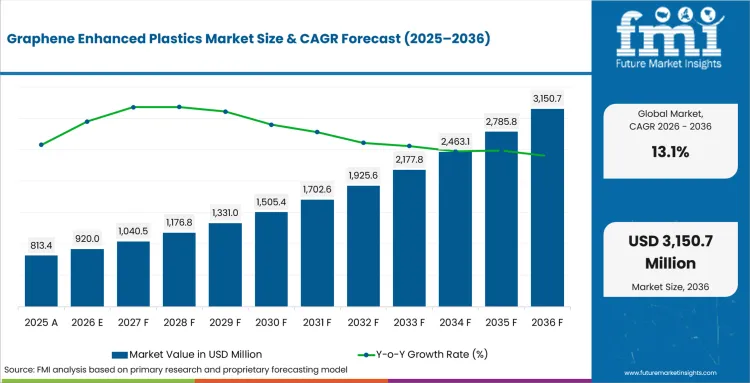
USD 920 million in 2026 and USD 3150.7 million by 2036 at a 13.1% CAGR.
Demand for graphene enhanced plastics is projected to expand at 13.1% CAGR between 2026 and 2036 with valuation rising from USD 920 million to USD 3150.7 million by 2036. Commercial demand develops through compounds that deliver several functions without forcing manufacturers to replace established extrusion or molding assets. Market access also depends on regulatory clearance for the graphene material before a processor begins customer-specific formulation work. HydroGraph reported in February 2026 that it received US EPA and UK REACH plus EU REACH clearances for commercial-scale graphene sales. Those approvals give graphene materials programs a defined route into regional trials while resin-specific validation continues to determine recurring orders.
Application engineers separate graphene offers by resin compatibility and processing stability rather than additive concentration alone. A commercial compounder must translate laboratory loading into repeatable production across full-sized equipment and customer resin grades. In July 2026, it was reported that Midland Compounding earned partner certification for advanced polymer applications following technical and commercial qualification. Midland operates pilot and production lines that connect formulation work with scale-up across engineering resins and recycled compounds. The added route strengthens access to conductive plastics programs that require measured electrical performance across normal processing conditions. Related automotive composites programs remain sensitive to tooling expense and part approval timelines across large customer platforms.
Key Takeaways of Graphene Enhanced Plastics Market
- Demand develops through polymer parts that combine lower weight with mechanical strength or controlled electrical performance. Commercial conversion depends on stable dispersion across repeat production lots and full-sized component testing under customer conditions.
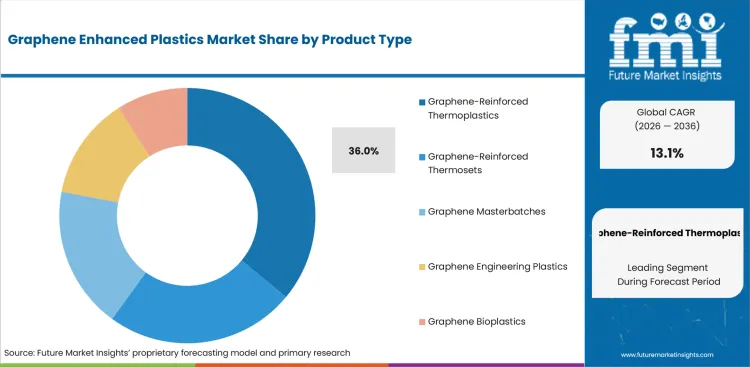
- Graphene-reinforced thermoplastics is forecast to represent 36.0% share within product type in 2026, supported by established extrusion and molding routes across several resin families.
- Automotive components is estimated to hold 31.0% share in 2026, reflecting vehicle programs that reward multifunctional materials but require lengthy part validation.
- Automotive manufacturers is projected to account for 35.0% share by end user in 2026, shaped by recurring component volumes and formal material approval systems.
- Unstable dispersion can alter melt flow and component performance across commercial equipment during repeated production runs. Lengthy qualification cycles raise development costs and delay recurring contracts that could justify wider production capacity.
- NanoXplore Inc., First Graphene Limited, Black Swan Graphene Inc., HydroGraph Clean Power Inc., Gerdau Graphene, Graphmatech AB, Levidian Nanosystems Ltd., and Thomas Swan & Co. Ltd. compete through distinct production and application routes. Customer selection depends on repeatable compound performance and practical technical support throughout formulation and qualification.
Analyst Perspective
"Graphene-enhanced plastics can justify their added cost when one compound replaces several material functions without disrupting established processing. The strongest programs connect consistent graphene quality with practical compounding support and full-sized part evidence. Companies that control these handoffs can shorten qualification, while weak dispersion or unclear responsibility can turn promising laboratory results into expensive customer delays."
- Nikhil Kaitwade, Principal Analyst, Future Market Insights
How is the Graphene Enhanced Plastics Market segmented?
The graphene enhanced plastics industry is segmented by product type, application, end user, distribution channel, polymer type, and region.
The market separates the form purchased, the component function, the approving organization, the sales route, and the base resin. Product type covers graphene-reinforced thermoplastics, thermosets, masterbatches, engineering plastics, and bioplastics used through established polymer processing systems. Application categories identify the performance problem inside automotive, electrical, industrial, aerospace, and consumer component manufacturing. End user analysis records which manufacturing organization controls qualification and recurring orders, while distribution channel distinguishes direct technical selling from distributors, compounders, online platforms, and value-added resellers. Polymer type compares polypropylene, polyamide, polycarbonate, polyethylene, and high-performance resins whose processing windows determine whether graphene remains evenly dispersed during commercial production.
How do graphene-reinforced thermoplastics shape demand in the product type category?
Thermoplastics offer the broadest processing route because manufacturers can use familiar extrusion and injection-molding equipment. Commercial programs depend on masterbatch quality that holds graphene evenly through repeated resin feeding and melt processing. HydroGraph reported in June 2026 that Modern Dispersions earned partner certification after technical and commercial qualification for scaled graphene masterbatch production. The qualified route gives masterbatch formulations access to eighteen extrusion lines and established carbon-compounding controls across North American production.
- By product type, graphene-reinforced thermoplastics is forecast to represent 36.0% in 2026 driven by established extrusion and molding routes. The segment reaches automotive and packaging programs through familiar resin systems that reduce equipment changes during qualification. Its share position reflects processing reach rather than proof that every graphene grade performs consistently.
- Compounders adopt thermoplastic grades through pelletized concentrates that simplify dosing and reduce direct contact with dry graphene powders. Production teams can adjust loading through standard feeder controls and compare melt behavior across repeated commercial runs. Wider adoption depends on stable surface quality and mechanical performance across customer resin grades and part geometries.
What keeps automotive components ahead within the application category?
Automotive components face strict weight targets and long qualification programs across molded interior and structural parts. Production evidence must connect impact performance with cycle time and dimensional control across full-sized components. Black Swan Graphene reported in September 2025 that polypropylene and polyamide trials improved impact resistance and lightweighting at customer facilities. The program supports decisions that compare graphene compounds with established carbon fiber composites across tooling cost and repeatable part performance.
- By application, automotive components is estimated to hold 31.0% in 2026 owing to vehicle programs that reward lighter multifunctional parts. The category benefits from recurring component volumes across several vehicle platforms and production model years. Its position remains tied to successful validation across impact testing and production tooling rather than one laboratory coupon.
- Vehicle engineering teams adopt graphene compounds through component suppliers that understand molding tools and automotive quality systems. Early trials focus on impact behavior and surface quality across full-sized parts under normal production cycle times. Wider use requires documented correction routes for formulation drift so one failed batch does not disrupt a vehicle launch or recurring delivery schedule.
Which buying mechanism supports automotive manufacturers in the end user category?
Automotive manufacturers control material specifications that continue across vehicle platforms and recurring multi-year component contracts. Production programs require dependable technical support during tooling changes and corrective work across launch schedules. NanoXplore reported in February 2026 that Club Car production had started at Statesville and contributed to quarterly revenue. The same program planned a later conversion from virgin resin to graphene-enhanced recycled plastic during 2026. That staged route supports advanced polymer composites adoption without placing every material change inside the first production launch.
- The automotive manufacturers segment is likely to capture 35.0% share in 2026 attributable to control over component specifications and approval systems. Recurring vehicle programs can support larger compound volumes after one material enters an approved design. The segment coordinates corrective work across resin producers and component molders throughout production launch programs.
- Vehicle manufacturers use qualified component partners to connect material data with tooling knowledge and production records. Their adoption decisions compare verified part performance with the cost of changing established material specifications. Commercial progress improves when technical responsibility remains clear across formulation adjustments and repeated component deliveries throughout each model program and service campaign.
What supports the position of direct sales within the distribution channel category?
Early graphene compound projects require confidential loading decisions and direct access to application engineers during customer trials. Black Swan Graphene reported in August 2025 that Thomas Swan became a global non-exclusive distributor for graphene nanoplatelets and enhanced masterbatches. The agreement added warehouse coverage while preserving direct technical support throughout formulation and customer qualification programs. Direct sales remains valuable for conductive polymers programs until processing guidance becomes repeatable enough for wider regional distribution.
- In 2026, direct sales is expected to lead distribution channel with 39.0% share because early projects require confidential formulation support. The route gives material developers immediate feedback on processing limits and component performance across commercial trials. Direct contracts also assign responsibility for corrective work during customer qualification and initial production transfer.
- Large manufacturers use direct contracts to define loading targets and technical support responsibilities across qualification programs. Regional distributors become more useful for standardized grades with documented processing guidance and predictable repeat orders. The channel mix therefore shifts as formulations progress from confidential development toward routine supply across several plants and customer locations.
Why does polypropylene lead the polymer type category?
Polypropylene combines low resin cost with a large installed base across automotive parts and commercial packaging. Processors can test graphene functions without moving immediately toward premium engineering polymers or unfamiliar equipment. Black Swan Graphene reported in May 2025 that Modern Dispersions would manufacture enhanced masterbatches across polypropylene and other scalable polymer systems. The partnership supports polypropylene compounds through established feeding and extrusion controls that reduce dry-powder handling during commercial compounding.
- Polypropylene is projected to hold 29.0% share in 2026 owing to its broad processing base and manageable resin cost. The material supports high-volume trials across automotive and packaging applications through existing commercial molding equipment. Its position also reflects operator familiarity with established polyolefin controls during formulation changes and production transfer.
- Processors adopt polypropylene masterbatches through pelletized dosing that fits common material feeders and commercial compounding lines. The route supports gradual loading adjustments during trials without rebuilding the complete production and control system. Commercial use remains exposed to lower-cost carbon black or mineral fillers whenever a program needs one narrow property improvement rather than combined functions.
What are the drivers, restraints, and opportunities in the Graphene Enhanced Plastics Market?
Multifunctional polymer performance supports demand, unstable dispersion and lengthy qualification slow conversion, application-specific compounds can replace several additive functions through one production route.
- Driver: Multifunctional compounds can reduce part weight and combine mechanical plus electrical performance through one qualified polymer system.
- Restraint: Unstable graphene dispersion can alter melt flow and component performance across commercial equipment while lengthy validation raises development cost.
- Opportunity: Application-specific compounds can replace separate additives or enable thinner parts through verified processing guidance and full-sized component evidence.
Multifunctional performance supports demand across components that need lower weight and controlled conductivity within one polymer system. A commercial formulation must deliver those gains at practical loading without narrowing normal processing windows. Black Swan Graphene reported in July 2025 that partner masterbatches improved polypropylene impact performance and PET barrier behavior at low loading levels. Measured results from separate polymer systems strengthen conductive polymer coatings and molded-part programs that combine several functions through one qualified additive route.
Dispersion inconsistency remains a material restraint because agglomeration can change strength and conductivity across nominally identical parts. Customer review lengthens further if material data sheets use inconsistent descriptions or unmatched measurement methods. ISO published its graphene-related material classification framework in July 2025 with characteristics and applicable measurement methods for commercial materials. Consistent classification improves comparison between graphene grades but resin-specific production trials remain necessary for every customer application.
Additive manufacturing offers a focused opportunity for static-dissipative tools and housings used around sensitive electronics. Production teams need conductive filament that also maintains stable flow and mechanical integrity across commercial print speeds. Graphmatech introduced its graphene-enhanced C-PETG filament in March 2025 for electronics manufacturing and high-speed printing. The launch gives graphene nanocomposites a defined route into jigs and protective components with measurable production requirements.
Which country CAGRs are profiled in the Graphene Enhanced Plastics Market?
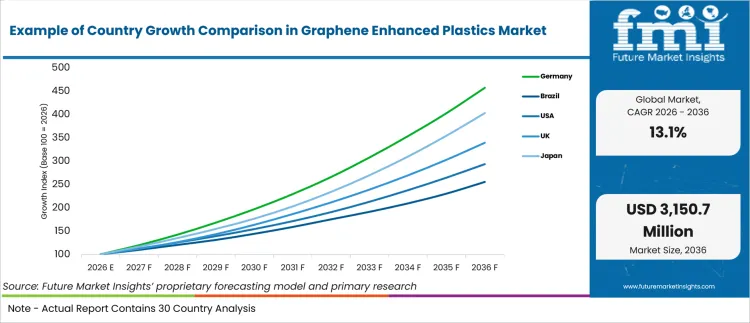
| Country | CAGR |
|---|---|
| Germany | 16.4% |
| Japan | 14.9% |
| UK | 13.0% |
| Australia | 12.6% |
| Canada | 12.2% |
| USA | 11.3% |
| Brazil | 9.8% |
How do country-level CAGRs compare in the Graphene Enhanced Plastics Market?
The country forecasts show a differentiated growth pattern across the graphene enhanced plastics market, with a noticeable gap between the upper and lower ends of the comparison. Germany and Japan form a closely aligned upper group, supported by strong advanced materials research and growing incorporation of graphene into high-performance polymer applications. The UK, Australia and Canada create a middle band where the forecasts remain relatively compressed, indicating similar momentum in commercial adoption. The USA follows within the same broader range, while Brazil remains separated from the main group by a more visible gap. This pattern reflects differences in advanced manufacturing capabilities, composites innovation and the pace at which graphene-enabled materials are moving from research environments into commercial production. Demand is increasingly linked to efforts to improve strength-to-weight ratios, conductivity, thermal performance and durability across industrial and consumer applications.
- Germany benefits from its strong engineering and specialty materials ecosystem, where graphene-enhanced polymers are being evaluated for automotive, industrial and high-performance manufacturing applications.
- Japan remains closely aligned with Germany through continued investment in advanced materials science and the development of lightweight plastics with enhanced thermal and mechanical properties.
- The UK supports market expansion through active research programs, commercialization initiatives and increasing collaboration between graphene developers and polymer manufacturers.
- Australia's outlook is influenced by a growing graphene innovation ecosystem and efforts to translate material science advances into scalable industrial applications.
- Canada continues to generate demand through investments in advanced composites and specialty plastics designed for performance-driven end-use sectors.
- The USA reflects broad interest in graphene-enhanced materials across automotive, aerospace, electronics and industrial manufacturing, although adoption remains dependent on cost-effective scale-up and integration.
- Brazil maintains steady momentum as manufacturers explore advanced plastic formulations that can improve product performance while supporting modernization of industrial production processes.
Similar CAGRs do not necessarily create identical commercial opportunities. Differences in graphene production capacity, polymer processing expertise, regulatory requirements and end-use industry demand can significantly influence adoption timelines and product development strategies. As a result, companies may encounter distinct commercialization pathways even where growth prospects appear broadly comparable. The full report provides country-level CAGR analysis across North America, Latin America, Europe, East Asia, South Asia, Oceania and the Middle East and Africa.
Country-wise Analysis
- German automotive plants use formal component approval systems and dense regional engineering networks for advanced polymer trials. The German Association of the Automotive Industry reported in February 2026 that domestic factories produced 1.67 million electric passenger cars during 2025. Graphene enhanced plastics demand in Germany is forecast to rise at 16.4% CAGR over the forecast period, supported by lightweight and electrically functional components. Several vehicle platforms give compound developers a direct enabler for targeted tooling trials and repeated production testing. Local application engineers can address processing corrections without long service travel across major manufacturing clusters. Lengthy approval cycles remain the main friction and every formulation must prove durable performance across full-sized parts and recurring production lots.
- Japanese manufacturers emphasize repeatable quality and controlled material changes across established automotive and electronics production lines. By 2036 Japan's graphene enhanced plastics market is projected to grow at 14.9% CAGR, influenced by specialized automotive and electronics programs. Local distributors provide technical documentation and responsive production support during formulation trials across concentrated manufacturing regions. The Ministry of Economy, Trade and Industry reported in February 2026 that motor vehicles and plastic products supported January's production increase. The operating mix gives developers several settings for targeted material validation without relying on one end-use sector. Detailed customer reviews remain a material friction and small formulation changes can require extended testing across normal production equipment.
- The United Kingdom combines specialist graphene developers with established polymer compounders and regional chemical distribution. HydroGraph reported in March 2026 that Broadway Colours earned partner certification for commercial masterbatch activity across Britain and Europe. The qualified route gives manufacturers regional formulation support and shorter service distances during development and repeat supply. Graphene enhanced plastics demand in the UK is predicted to advance at 13.0% CAGR through 2036, aided by accessible application engineering. Customer qualification expense remains the main friction and repeated compound batches must meet identical processing and component requirements. Successful market entry therefore depends on one defined resin program with documented correction support across customer production.
- Australian graphene programs benefit from domestic production capability but serve industrial customers across long service distances. Local formulation teams give manufacturers a direct enabler for early trials without complete dependence on imported technical support. The Australian graphene enhanced plastics sector is projected to record 12.6% CAGR during the assessment period, reinforced by domestic composite development. Smaller production runs and travel costs remain material frictions for projects outside concentrated manufacturing areas. First Graphene reported in its June 2026 corporate presentation that annual capacity reached 100 tonnes and active commercial clients exceeded 35. The operating base supports export-oriented trials but project economics must absorb technical travel and smaller customer batches.
- Canadian customers span automotive and industrial corridors across several provinces with long distances between production sites. NanoXplore reported in May 2026 that its Canadian facility expansion for graphene-enhanced parts was completed during May 2025. Graphene enhanced plastics sales in Canada are forecast to expand at 12.2% CAGR by 2036, shaped by domestic graphene and composite capacity. The completed expansion gives manufacturers a local route from graphene production toward molded components and customer qualification. Established domestic composite engineering supports production-scale component evaluation across major Canadian manufacturing corridors and customer facilities. Underused capacity and dispersed service requirements remain commercial frictions until recurring programs reach sufficient operating scale.
- United States demand develops through large automotive accounts and regional compounding capacity across several manufacturing corridors. The USA's graphene enhanced plastics outlook is anticipated to advance at 11.3% CAGR over the assessment period, supported by vehicle and industrial component programs. Large customer platforms provide a direct enabler for scaled trials and recurring production contracts across multiple plants. Techmer PM announced in June 2026 that it commercially launched a NanoXplore graphene masterbatch for high-performance plastic films. The launch gives American processors a defined film formulation with commercial production guidance and established polymer engineering support. Tooling expense and uneven qualification requirements remain material frictions across component programs that need customer-specific approval.
- Brazil offers an established plastics processing base and domestic graphene masterbatch development through Gerdau Graphene. Gerdau Graphene reported in March 2025 that it launched new Poly-G masterbatch versions with improved polymer compatibility and dispersion. The commercial range gives local processors a familiar route through films and extruded components using existing equipment. Adoption of graphene enhanced plastics in Brazil is estimated to expand at 9.8% CAGR through 2036, linked to packaging and industrial components. Domestic supply reduces import complexity and supports faster formulation trials with regional technical engineering teams. Price sensitivity remains the primary friction and conventional fillers provide lower-cost alternatives for applications that need one narrow property improvement.
Who are the notable companies in the Graphene Enhanced Plastics Market?
NanoXplore Inc., First Graphene Limited, Black Swan Graphene Inc., HydroGraph Clean Power Inc., Gerdau Graphene, Graphmatech AB, Levidian Nanosystems Ltd., and Thomas Swan & Co. Ltd. are the notable companies shaping this market.
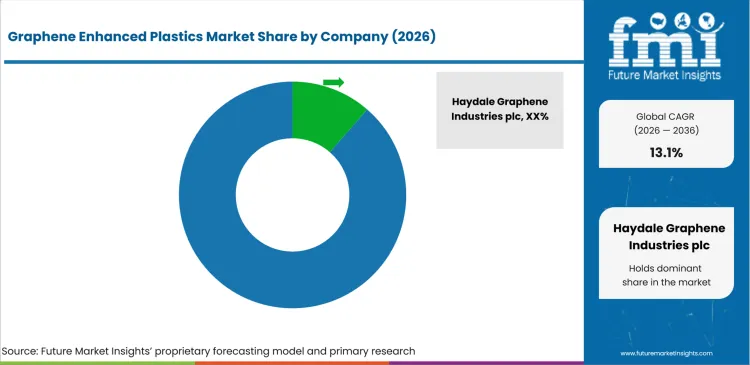
Competition is moderately concentrated around companies that combine graphene production with polymer integration or downstream validation. NanoXplore and Black Swan link material supply with compound or molded-part routes across commercial programs. First Graphene and HydroGraph extend market access through production capacity and qualified regional technical networks. Gerdau Graphene and Graphmatech focus on defined polymer systems with clearer application and processing boundaries. Levidian contributes production technology and joint development while Thomas Swan adds global distribution and chemical formulation experience. Entry remains possible through one verified resin application but broad performance claims provide little protection during customer qualification. Competitive selection depends on repeatable compound quality and practical correction support across full customer production programs.
- NanoXplore Inc. and Black Swan Graphene Inc. combine graphene production with downstream compounding or molded-part routes. Their commercial position depends on converting material consistency into approved components across recurring customer production programs. Both companies support application development beyond powder supply through defined formulation and customer validation activities. Integrated technical routes can reduce handoffs during qualification and production transfer across large customer programs.
- First Graphene Limited and HydroGraph Clean Power Inc. expand market access through commercial capacity and partner networks. Regional compounders improve their entry scope by providing resin formulation and production support near customer facilities. The model suits manufacturers that need local technical guidance without building internal graphene handling or dispersion capability.
- Gerdau Graphene and Graphmatech AB focus on defined masterbatch or conductive polymer systems across targeted applications. Levidian Nanosystems Ltd. supports joint application development through verified graphene production and partner engineering programs. Thomas Swan & Co. Ltd. adds global chemical distribution plus warehouse coverage for repeat material supply across regional customer programs.
Competitive Benchmarking: Graphene Enhanced Plastics Market
| Company | Graphene Polymer Integration | Application Validation | Scale and Customer Support | Geographic Reach |
|---|---|---|---|---|
| NanoXplore Inc. | High | High | High | North America and Europe |
| First Graphene Limited | High | Medium | Medium | Australia, Europe, and North America |
| Black Swan Graphene Inc. | Medium | High | High | North America and Europe |
| HydroGraph Clean Power Inc. | Medium | Medium | Medium | North America and Europe |
| Gerdau Graphene | Medium | Medium | Medium | Brazil and selected international markets |
| Graphmatech AB | High | Medium | Medium | Europe and the Middle East |
| Levidian Nanosystems Ltd. | Low | Medium | Medium | United Kingdom, Europe, and the Middle East |
| Thomas Swan & Co. Ltd. | Medium | Medium | High | Global |
Key Developments in the Graphene Enhanced Plastics Market
- In June 2026, First Graphene completed its acquisition of MITO Material Solutions through an ASX-recorded transaction. The deal transferred functionalized graphene additives plus manufacturing equipment and intellectual property into First Graphene's commercial portfolio. A direct North American application base now connects commercial graphene production with additive design and technical integration across thermoset and thermoplastic customer programs and regional customer support.
- In March 2026, Black Swan Graphene completed a UK production expansion that lifted annual capacity to approximately 140 tonnes. The operating unit uses established infrastructure at Thomas Swan's site and supports scaled graphene output for enhanced masterbatch programs. Greater availability gives distribution partners more dependable inventory for commercial trials and customer-specific polymer development across several regional markets and recurring supply programs.
- In July 2026, HydroGraph signed definitive agreements for a planned Texas manufacturing facility with initial capacity targeted at up to 360 tons annually. The project secured a long-term acetylene supply and land lease beside established industrial infrastructure while construction remains subject to permitting. The planned facility would provide domestic graphene supply near qualified compounders and polymer application partners across the United States.
- In March 2025, Levidian formed a strategic collaboration with Graphmatech to co-develop graphene polymer solutions for hydrogen infrastructure and other industries. The program combines Levidian's graphene production with Graphmatech's dispersion technology across thermoplastic pipelines and pressure vessels. Joint development connects material supply with application validation and extends technical activity across Britain and Sweden with potential Middle Eastern customer programs across regional commercial networks.
Graphene Enhanced Plastics Market - Report Scope
| Coverage field | Report scope |
|---|---|
| Market breakdown | Product type, application, end user, distribution channel, polymer type, and region. |
| Market Definition | Polymer compounds, masterbatches, additives, and molded parts whose mechanical, electrical, thermal, barrier, or tribological performance is modified through graphene materials. |
| Regions Covered | North America, Latin America, Europe, East Asia, South Asia, Oceania, and Middle East and Africa. |
| Countries Covered | Germany, Japan, UK, Australia, Canada, USA, and Brazil. |
| Key Companies Profiled | NanoXplore Inc., First Graphene Limited, Black Swan Graphene Inc., HydroGraph Clean Power Inc., Gerdau Graphene, Graphmatech AB, Levidian Nanosystems Ltd., and Thomas Swan & Co. Ltd. |
| Forecast Period | 2026 to 2036. |
| Approach | Hybrid bottom-up and top-down market sizing supported by primary interviews and official desk research. |
Graphene Enhanced Plastics Market - Research Methodology
| Method | Approach |
|---|---|
| Primary Research | FMI analysts gathered input from manufacturers, service providers, technology developers, distributors, end users, procurement teams, and subject-matter experts. Interviews examined purchasing decisions, product or service evaluation, adoption barriers, approval requirements, pricing considerations, and expectations for technical or commercial support. Respondents were also asked what evidence is required before a trial, pilot, or initial order develops into regular purchasing. |
| Desk Research | Desk research covered government statistics, regulatory publications, trade data, industry associations, technical literature, standards, company filings, product information, and official corporate announcements. Sources were reviewed for relevance, publication date, geographic coverage, and consistency with the defined market scope. Claims relating to performance, applications, approvals, capacity, investment, and commercial activity were retained only when supported by credible public evidence. |
| Market Sizing and Forecasting | The market model combined the baseline value with historical performance, segment structure, pricing and volume indicators, adoption levels, company participation, and country-level demand conditions. Forecast assumptions considered economic activity, investment trends, regulatory developments, technology adoption, purchasing cycles, supply availability, and barriers to wider market use. Segment and regional estimates were reconciled before the final market total was calculated. |
| Data Validation | Estimates were checked against multiple independent indicators, including public data, company activity, trade patterns, industry developments, and findings from primary interviews. Validation also tested whether products, services, applications, and company revenues fell within the defined market boundaries. Adjacent categories, unsupported claims, overlapping revenues, and activities without direct market relevance were excluded to reduce double counting and maintain consistency across segments and countries. |
Graphene Enhanced Plastics Market by Segments
Graphene Enhanced Plastics Market Segmented by Product Type
- Graphene-Reinforced Thermoplastics
- Polypropylene (PP) Composites
- Polyamide (PA) Composites
- Graphene-Reinforced Thermosets
- Epoxy Resin Composites
- Polyurethane Composites
- Graphene Masterbatches
- Conductive Masterbatches
- High-Strength Masterbatches
- Graphene Engineering Plastics
- PEEK Composites
- Polycarbonate Composites
- Graphene Bioplastics
- PLA Composites
- Bio-PE Composites
Graphene Enhanced Plastics Market Segmented by Application
- Automotive Components
- Interior Components
- Under-the-Hood Parts
- Electrical & Electronics
- EMI Shielding Components
- Electronic Housings
- Industrial Equipment
- Machinery Components
- Chemical Processing Equipment
- Aerospace & Defense
- Aircraft Interior Components
- Lightweight Structural Parts
- Consumer Goods
- Sporting Goods
- Household Products
Graphene Enhanced Plastics Market Segmented by End User
- Automotive Manufacturers
- Passenger Vehicle OEMs
- Commercial Vehicle OEMs
- Electronics Manufacturers
- Consumer Electronics OEMs
- Industrial Electronics OEMs
- Industrial Manufacturers
- Heavy Equipment Manufacturers
- Industrial Machinery OEMs
- Aerospace & Defense Companies
- Aircraft Manufacturers
- Defense Equipment Manufacturers
- Consumer Goods Manufacturers
- Sporting Goods Manufacturers
- Home Appliance Manufacturers
Graphene Enhanced Plastics Market Segmented by Distribution Channel
- Direct Sales
- OEM Supply Agreements
- Project-Based Contracts
- Industrial Distributors
- Authorized Material Distributors
- Specialty Polymer Suppliers
- Compounders & Material Suppliers
- Custom Compounders
- Resin Suppliers
- Online B2B Platforms
- Manufacturer Portals
- Industrial E-Commerce Platforms
- Value-Added Resellers
- Technical Solution Providers
- Regional Resellers
Graphene Enhanced Plastics Market Segmented by Polymer Type
- Polypropylene
- Homopolymer PP
- Copolymer PP
- Polyamide
- PA6
- PA66
- Polycarbonate
- Standard PC
- PC Blends
- Polyethylene
- HDPE
- LDPE
- High-Performance Polymers
- PEEK
- PPS
Graphene Enhanced Plastics Market by Region
- North America
- USA
- Canada
- Latin America
- Brazil
- Mexico
- Western Europe
- Germany
- France
- United Kingdom
- Italy
- Spain
- Benelux
- Nordics
- Eastern Europe
- Poland
- Czech Republic
- Romania
- Hungary
- East Asia
- China
- Japan
- South Korea
- South Asia and Pacific
- India
- ASEAN
- Australia and New Zealand
- Middle East and Africa
- GCC Countries
- South Africa
- Türkiye
- Israel
Research Sources and Bibliography
- HydroGraph Clean Power Inc. (2026, February 24).
- HydroGraph Clean Power Inc. (2026, July 7).
- HydroGraph Clean Power Inc. (2026, June 16).
- Black Swan Graphene Inc. (2025, September 9).
- NanoXplore Inc. (2026, February).
- Black Swan Graphene Inc. (2025, August 19)
- Black Swan Graphene Inc. (2025, May 14).
- Black Swan Graphene Inc. (2025, July 22)
- International Organization for Standardization. (2025, July).
- Graphmatech AB. (2025, March 3)
- German Association of the Automotive Industry. (2026, February 3).
- Ministry of Economy, Trade and Industry. (2026, February 27).
- HydroGraph Clean Power Inc. (2026, March 17).
- First Graphene Limited. (2026, June 4).
- NanoXplore Inc. (2026, May 13).
- Techmer PM. (2026, June 15)
- Gerdau Graphene. (2025, March 24).
- First Graphene Limited. (2026, June 18).
- Black Swan Graphene Inc. (2026, March 18).
- HydroGraph Clean Power Inc. (2026, July 14).
- Levidian Nanosystems Ltd. (2025, March 18).
This bibliography is provided for reader reference and is not exhaustive. The full report contains the complete reference list and detailed citations
This Report Answers
- How large is the graphene enhanced plastics market in 2026 and 2036?
- Which operating requirements support investment in graphene-enhanced polymer compounds?
- Why do graphene-reinforced thermoplastics hold a substantial product type share during 2026?
- How do automotive components influence application demand and qualification activity?
- Why do automotive manufacturers account for a substantial end-user share during 2026?
- How do country growth rates differ across Germany, Japan, the UK, Australia, Canada, the USA, and Brazil?
- Which companies provide graphene materials, polymer integration, or application engineering?
- What limits commercial conversion across graphene-enhanced polymer programs?
- How does direct sales support formulation work and customer qualification?
- Which commercial developments are shaping competition?
Frequently Asked Questions
How big is the Graphene Enhanced Plastics Market in 2026?
The graphene enhanced plastics market is valued at USD 920 million in 2026 and is forecast to reach USD 3150.7 million by 2036. Growth is supported by multifunctional compound programs that combine lower part weight with mechanical strength or controlled electrical performance, sustaining recurring demand for graphene-reinforced thermoplastics and masterbatches across automotive, electronics, and industrial component manufacturing programs.
What is the CAGR of the Graphene Enhanced Plastics Market from 2026 to 2036?
The graphene enhanced plastics market grows at a CAGR of 13.1% between 2026 and 2036, supported by polymer processors adopting graphene compound systems once stable dispersion, repeatable melt behavior, and full-sized component performance are validated within direct supply arrangements linking formulation engineering with traceable qualification records across recurring automotive and industrial production programs.
Which product type leads the Graphene Enhanced Plastics Market?
Graphene-reinforced thermoplastics account for 36.0% of the graphene enhanced plastics market by product type in 2026, driven by established extrusion and injection-molding routes that allow compounders to reach automotive and packaging programs through familiar resin systems without requiring manufacturers to replace existing processing equipment or rebuild established production and quality control procedures.
How much will the Graphene Enhanced Plastics Market add between 2026 and 2036?
The graphene enhanced plastics market is set to add USD 2230.7 million between 2026 and 2036, growing from USD 920 million to USD 3150.7 million as graphene-reinforced thermoplastics, masterbatches, and application-specific compounds enter qualified production programs across a widening base of automotive manufacturers, electronics producers, and industrial component suppliers globally.
Who are the leading companies in the Graphene Enhanced Plastics Market?
Notable companies competing in the graphene enhanced plastics market include NanoXplore Inc., First Graphene Limited, Black Swan Graphene Inc., HydroGraph Clean Power Inc., Gerdau Graphene, Graphmatech AB, Levidian Nanosystems Ltd., and Thomas Swan & Co. Ltd., differentiating through graphene polymer integration depth, application validation capability, production scale and customer support reach, and the geographic coverage of their compounding partner and technical engineering networks.
Preview the report firsthand - request a free sample
Get SampleGet the brochure for pricing and purchase details.
Get PDFTable of Content
- Key Takeaways
- Market Size and CAGR
- Top Growth Driver
- Fastest Growing Segment
- Leading Region
- Key Companies
- Emerging Opportunities
- Executive Summary
- Global Market Outlook
- Demand-side Trends
- Supply-side Trends
- Technology Roadmap Analysis
- Analysis and Recommendations
- Analyst Perspective (What is happening? Why now? What should investors know?)
- Key Questions Answered
- How large is the market?
- What is the CAGR?
- What are key trends?
- Which region dominates?
- Who are the leaders?
- Market Overview
- Market Coverage / Taxonomy
- Market Definition / Scope / Limitations
- Research Methodology
- Chapter Orientation
- Analytical Lens and Working Hypotheses
- Market Structure, Signals, and Trend Drivers
- Benchmarking and Cross-market Comparability
- Market Sizing, Forecasting, and Opportunity Mapping
- Research Design and Evidence Framework
- Desk Research Programme (Secondary Evidence)
- Expert Input and Fieldwork (Primary Evidence)
- Tooling, Models, and Reference Databases
- Data Engineering and Model Build
- Quality Assurance and Audit Trail
- Market Background
- Market Dynamics (Drivers, Restraints, Opportunity, Trends)
- Scenario Forecast (Optimistic, Likely, Conservative)
- Impact Analysis
- AI Impact
- Sustainability Impact
- Regulatory Impact
- Technology Impact
- Consumer / Buyer Analysis
- Purchase Drivers
- Adoption Barriers
- Buyer Journey
- Opportunity Map Analysis
- Product Life Cycle Analysis
- Supply Chain Analysis
- Investment Feasibility Matrix
- Value Chain Analysis
- PESTLE and Porter's Analysis
- Regulatory Landscape
- Regional Parent Market Outlook
- Production and Consumption Statistics
- Import and Export Statistics
- Global Market Analysis and Forecast, 2021 to 2036
- Historical Market Size Value (USD Million) Analysis, 2021 to 2025
- Current and Future Market Size Value (USD Million) Projections, 2026 to 2036
- Y-o-Y Growth Trend Analysis
- Absolute $ Opportunity Analysis
- Global Market Pricing Analysis, 2021 to 2036
- Global Market Analysis and Forecast, By Product Type, 2021 to 2036
- Introduction / Key Findings
- Historical Market Size Value (USD Million) Analysis By Product Type, 2021 to 2025
- Current and Future Market Size Value (USD Million) Analysis and Forecast By Product Type, 2026 to 2036
- Graphene-Reinforced Thermoplastics
- Polypropylene (PP) Composites
- Polyamide (PA) Composites
- Graphene-Reinforced Thermosets
- Epoxy Resin Composites
- Polyurethane Composites
- Graphene Masterbatches
- Conductive Masterbatches
- High-Strength Masterbatches
- Graphene Engineering Plastics
- PEEK Composites
- Polycarbonate Composites
- Graphene Bioplastics
- PLA Composites
- Bio-PE Composites
- Graphene-Reinforced Thermoplastics
- Y-o-Y Growth Trend Analysis By Product Type, 2021 to 2025
- Absolute $ Opportunity Analysis By Product Type, 2026 to 2036
- Global Market Analysis and Forecast, By Application, 2021 to 2036
- Introduction / Key Findings
- Historical Market Size Value (USD Million) Analysis By Application, 2021 to 2025
- Current and Future Market Size Value (USD Million) Analysis and Forecast By Application, 2026 to 2036
- Automotive Components
- Interior Components
- Under-the-Hood Parts
- Electrical & Electronics
- EMI Shielding Components
- Electronic Housings
- Industrial Equipment
- Machinery Components
- Chemical Processing Equipment
- Aerospace & Defense
- Aircraft Interior Components
- Lightweight Structural Parts
- Consumer Goods
- Sporting Goods
- Household Products
- Automotive Components
- Y-o-Y Growth Trend Analysis By Application, 2021 to 2025
- Absolute $ Opportunity Analysis By Application, 2026 to 2036
- Global Market Analysis and Forecast, By End User, 2021 to 2036
- Introduction / Key Findings
- Historical Market Size Value (USD Million) Analysis By End User, 2021 to 2025
- Current and Future Market Size Value (USD Million) Analysis and Forecast By End User, 2026 to 2036
- Automotive Manufacturers
- Passenger Vehicle OEMs
- Commercial Vehicle OEMs
- Electronics Manufacturers
- Consumer Electronics OEMs
- Industrial Electronics OEMs
- Industrial Manufacturers
- Heavy Equipment Manufacturers
- Industrial Machinery OEMs
- Aerospace & Defense Companies
- Aircraft Manufacturers
- Defense Equipment Manufacturers
- Consumer Goods Manufacturers
- Sporting Goods Manufacturers
- Home Appliance Manufacturers
- Automotive Manufacturers
- Y-o-Y Growth Trend Analysis By End User, 2021 to 2025
- Absolute $ Opportunity Analysis By End User, 2026 to 2036
- Global Market Analysis and Forecast, By Distribution Channel, 2021 to 2036
- Introduction / Key Findings
- Historical Market Size Value (USD Million) Analysis By Distribution Channel, 2021 to 2025
- Current and Future Market Size Value (USD Million) Analysis and Forecast By Distribution Channel, 2026 to 2036
- Direct Sales
- OEM Supply Agreements
- Project-Based Contracts
- Industrial Distributors
- Authorized Material Distributors
- Specialty Polymer Suppliers
- Compounders & Material Suppliers
- Custom Compounders
- Resin Suppliers
- Online B2B Platforms
- Manufacturer Portals
- Industrial E-Commerce Platforms
- Value-Added Resellers
- Technical Solution Providers
- Regional Resellers
- Direct Sales
- Y-o-Y Growth Trend Analysis By Distribution Channel, 2021 to 2025
- Absolute $ Opportunity Analysis By Distribution Channel, 2026 to 2036
- Global Market Analysis and Forecast, By Polymer Type, 2021 to 2036
- Introduction / Key Findings
- Historical Market Size Value (USD Million) Analysis By Polymer Type, 2021 to 2025
- Current and Future Market Size Value (USD Million) Analysis and Forecast By Polymer Type, 2026 to 2036
- Polypropylene (PP)
- Homopolymer PP
- Copolymer PP
- Polyamide (PA)
- PA6
- PA66
- Polycarbonate (PC)
- Standard PC
- PC Blends
- Polyethylene (PE)
- HDPE
- LDPE
- High-Performance Polymers
- PEEK
- PPS
- Polypropylene (PP)
- Y-o-Y Growth Trend Analysis By Polymer Type, 2021 to 2025
- Absolute $ Opportunity Analysis By Polymer Type, 2026 to 2036
- Global Market Analysis and Forecast, By Region, 2021 to 2036
- Introduction
- Historical Market Size Value (USD Million) Analysis By Region, 2021 to 2025
- Current Market Size Value (USD Million) Analysis and Forecast By Region, 2026 to 2036
- North America
- Latin America
- Western Europe
- Eastern Europe
- East Asia
- South Asia and Pacific
- Middle East & Africa
- Market Attractiveness Analysis By Region
- North America Market Analysis and Forecast, By Country, 2021 to 2036
- Historical Market Size Value (USD Million) Trend Analysis By Market Taxonomy, 2021 to 2025
- Market Size Value (USD Million) Forecast By Market Taxonomy, 2026 to 2036
- By Country
- USA
- Canada
- By Product Type
- By Application
- By End User
- By Distribution Channel
- By Polymer Type
- By Country
- Market Attractiveness Analysis
- By Country
- By Product Type
- By Application
- By End User
- By Distribution Channel
- By Polymer Type
- Key Takeaways
- Latin America Market Analysis and Forecast, By Country
- Historical Market Size Value (USD Million) Trend Analysis By Market Taxonomy, 2021 to 2025
- Market Size Value (USD Million) Forecast By Market Taxonomy, 2026 to 2036
- By Country
- Brazil
- Mexico
- Chile
- Rest of Latin America
- By Product Type
- By Application
- By End User
- By Distribution Channel
- By Polymer Type
- By Country
- Market Attractiveness Analysis
- By Country
- By Product Type
- By Application
- By End User
- By Distribution Channel
- By Polymer Type
- Key Takeaways
- Western Europe Market Analysis and Forecast, By Country
- Historical Market Size Value (USD Million) Trend Analysis By Market Taxonomy, 2021 to 2025
- Market Size Value (USD Million) Forecast By Market Taxonomy, 2026 to 2036
- By Country
- Germany
- UK
- Italy
- Spain
- France
- Nordic
- BENELUX
- Rest of Western Europe
- By Product Type
- By Application
- By End User
- By Distribution Channel
- By Polymer Type
- By Country
- Market Attractiveness Analysis
- By Country
- By Product Type
- By Application
- By End User
- By Distribution Channel
- By Polymer Type
- Key Takeaways
- Eastern Europe Market Analysis and Forecast, By Country
- Historical Market Size Value (USD Million) Trend Analysis By Market Taxonomy, 2021 to 2025
- Market Size Value (USD Million) Forecast By Market Taxonomy, 2026 to 2036
- By Country
- Russia
- Poland
- Hungary
- Balkan & Baltic
- Rest of Eastern Europe
- By Product Type
- By Application
- By End User
- By Distribution Channel
- By Polymer Type
- By Country
- Market Attractiveness Analysis
- By Country
- By Product Type
- By Application
- By End User
- By Distribution Channel
- By Polymer Type
- Key Takeaways
- East Asia Market Analysis and Forecast, By Country
- Historical Market Size Value (USD Million) Trend Analysis By Market Taxonomy, 2021 to 2025
- Market Size Value (USD Million) Forecast By Market Taxonomy, 2026 to 2036
- By Country
- China
- Japan
- South Korea
- By Product Type
- By Application
- By End User
- By Distribution Channel
- By Polymer Type
- By Country
- Market Attractiveness Analysis
- By Country
- By Product Type
- By Application
- By End User
- By Distribution Channel
- By Polymer Type
- Key Takeaways
- South Asia and Pacific Market Analysis and Forecast, By Country
- Historical Market Size Value (USD Million) Trend Analysis By Market Taxonomy, 2021 to 2025
- Market Size Value (USD Million) Forecast By Market Taxonomy, 2026 to 2036
- By Country
- India
- ASEAN
- Australia & New Zealand
- Rest of South Asia and Pacific
- By Product Type
- By Application
- By End User
- By Distribution Channel
- By Polymer Type
- By Country
- Market Attractiveness Analysis
- By Country
- By Product Type
- By Application
- By End User
- By Distribution Channel
- By Polymer Type
- Key Takeaways
- Middle East & Africa Market Analysis and Forecast, By Country
- Historical Market Size Value (USD Million) Trend Analysis By Market Taxonomy, 2021 to 2025
- Market Size Value (USD Million) Forecast By Market Taxonomy, 2026 to 2036
- By Country
- Kingdom of Saudi Arabia
- Other GCC Countries
- Türkiye
- South Africa
- Other African Union
- Rest of Middle East & Africa
- By Product Type
- By Application
- By End User
- By Distribution Channel
- By Polymer Type
- By Country
- Market Attractiveness Analysis
- By Country
- By Product Type
- By Application
- By End User
- By Distribution Channel
- By Polymer Type
- Key Takeaways
- Key Countries Market Analysis
- USA
- Pricing Analysis
- Market Share Analysis, 2025
- By Product Type
- By Application
- By End User
- By Distribution Channel
- By Polymer Type
- Canada
- Pricing Analysis
- Market Share Analysis, 2025
- By Product Type
- By Application
- By End User
- By Distribution Channel
- By Polymer Type
- Mexico
- Pricing Analysis
- Market Share Analysis, 2025
- By Product Type
- By Application
- By End User
- By Distribution Channel
- By Polymer Type
- Brazil
- Pricing Analysis
- Market Share Analysis, 2025
- By Product Type
- By Application
- By End User
- By Distribution Channel
- By Polymer Type
- Chile
- Pricing Analysis
- Market Share Analysis, 2025
- By Product Type
- By Application
- By End User
- By Distribution Channel
- By Polymer Type
- Germany
- Pricing Analysis
- Market Share Analysis, 2025
- By Product Type
- By Application
- By End User
- By Distribution Channel
- By Polymer Type
- UK
- Pricing Analysis
- Market Share Analysis, 2025
- By Product Type
- By Application
- By End User
- By Distribution Channel
- By Polymer Type
- Italy
- Pricing Analysis
- Market Share Analysis, 2025
- By Product Type
- By Application
- By End User
- By Distribution Channel
- By Polymer Type
- Spain
- Pricing Analysis
- Market Share Analysis, 2025
- By Product Type
- By Application
- By End User
- By Distribution Channel
- By Polymer Type
- France
- Pricing Analysis
- Market Share Analysis, 2025
- By Product Type
- By Application
- By End User
- By Distribution Channel
- By Polymer Type
- India
- Pricing Analysis
- Market Share Analysis, 2025
- By Product Type
- By Application
- By End User
- By Distribution Channel
- By Polymer Type
- ASEAN
- Pricing Analysis
- Market Share Analysis, 2025
- By Product Type
- By Application
- By End User
- By Distribution Channel
- By Polymer Type
- Australia & New Zealand
- Pricing Analysis
- Market Share Analysis, 2025
- By Product Type
- By Application
- By End User
- By Distribution Channel
- By Polymer Type
- China
- Pricing Analysis
- Market Share Analysis, 2025
- By Product Type
- By Application
- By End User
- By Distribution Channel
- By Polymer Type
- Japan
- Pricing Analysis
- Market Share Analysis, 2025
- By Product Type
- By Application
- By End User
- By Distribution Channel
- By Polymer Type
- South Korea
- Pricing Analysis
- Market Share Analysis, 2025
- By Product Type
- By Application
- By End User
- By Distribution Channel
- By Polymer Type
- Russia
- Pricing Analysis
- Market Share Analysis, 2025
- By Product Type
- By Application
- By End User
- By Distribution Channel
- By Polymer Type
- Poland
- Pricing Analysis
- Market Share Analysis, 2025
- By Product Type
- By Application
- By End User
- By Distribution Channel
- By Polymer Type
- Hungary
- Pricing Analysis
- Market Share Analysis, 2025
- By Product Type
- By Application
- By End User
- By Distribution Channel
- By Polymer Type
- Kingdom of Saudi Arabia
- Pricing Analysis
- Market Share Analysis, 2025
- By Product Type
- By Application
- By End User
- By Distribution Channel
- By Polymer Type
- Türkiye
- Pricing Analysis
- Market Share Analysis, 2025
- By Product Type
- By Application
- By End User
- By Distribution Channel
- By Polymer Type
- South Africa
- Pricing Analysis
- Market Share Analysis, 2025
- By Product Type
- By Application
- By End User
- By Distribution Channel
- By Polymer Type
- USA
- Market Structure Analysis
- Competition Dashboard
- Competition Benchmarking
- Market Share Analysis of Top Players
- By Regional
- By Product Type
- By Application
- By End User
- By Distribution Channel
- By Polymer Type
- Emerging Startups
- Innovation Benchmarking
- Competition Analysis
- Competition Deep Dive
- Haydale Graphene Industries plc
- Overview
- Product Portfolio
- Profitability by Market Segments
- Sales Footprint
- Strategy Overview
- Marketing Strategy
- Product Strategy
- Channel Strategy
- Directa Plus S.p.A.
- NanoXplore Inc.
- First Graphene Ltd.
- XG Sciences
- Graphenea
- Applied Graphene Materials plc
- Thomas Swan & Co. Ltd.
- Black Swan Graphene Inc.
- Avient Corporation
- Haydale Graphene Industries plc
- Case Studies
- Success Stories
- Recent Developments
- Competition Deep Dive
- Assumptions & Acronyms Used


