

- Market Size (2026)
- USD 135.0 Mn
- Forecast (2036)
- USD 438.0 Mn
- CAGR (2026 to 2036)
- 12.5%
How big is Hair-Restoration & Dermatology Robotics Market in 2026?
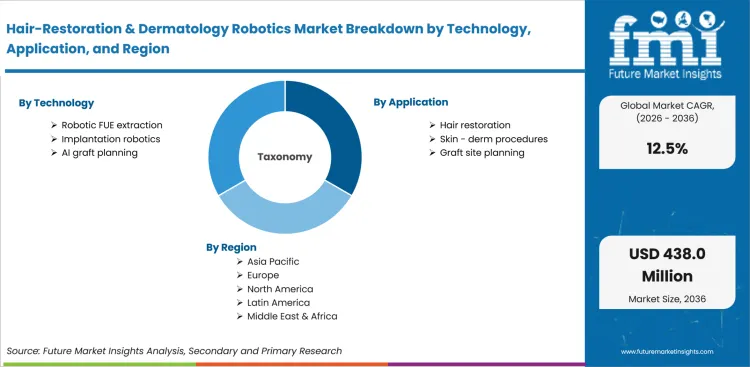
USD 135.0 million in 2026 and USD 438.0 million by 2036 at a 12.5% CAGR
Demand for hair-restoration and dermatology robotics is expected to increase valuation from USD 135.0 million in 2026 and is projected to reach USD 438.0 million by 2036 at a 12.5% CAGR, driven by clinics seeking repeatable follicle extraction during long surgical sessions. The wider hair restoration procedure base supports system investment across specialist surgical clinics. The International Society of Hair Restoration Surgery reported in May 2025 that 95% of first-time surgical patients treated during 2024 began treatment between ages 20 and 35. The younger patient mix gives specialist clinics a reason to plan consistent procedure capacity across several treatment rooms.
Commercial adoption differs between countries with an established ARTAS base and markets developing regional equipment. United States clinics work within a mature regulatory setting, but capital equipment purchases remain sensitive to lending conditions. China has moved toward a locally registered HAIRO platform that reflects regional hair characteristics and hospital partnerships. Venus Concept reported in June 2025 that capital used in operations for its hair businesses totaled about USD 6.7 million during fiscal 2024. The broader medical robots field shows why service coverage and staff training matter after installation. Training and service costs can determine whether a clinic gains enough procedures to support the initial system price.
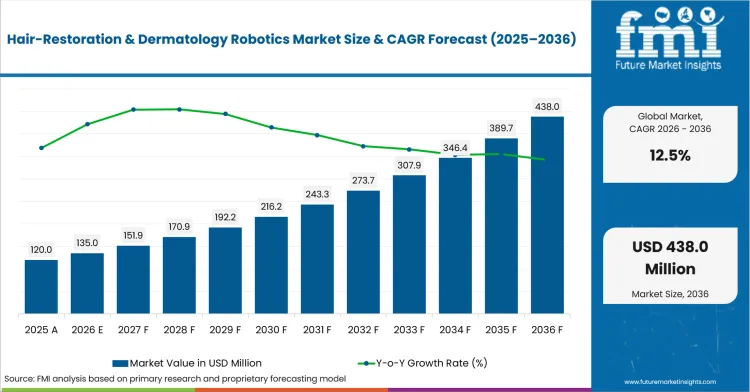
Key Takeaways of Hair-Restoration & Dermatology Robotics Market
- Demand for hair-restoration and dermatology robotics is driven by the need for repeated follicle targeting during long procedures, with clinic groups using repeatable extraction settings to reduce variation across trained teams and treatment rooms.
- By technology, robotic FUE extraction is expected to lead with 58.0% share in 2026, supported by its established harvesting role.
- Hair restoration is the dominant application segment, projected to hold 62.0% share in 2026, attributable to the limited commercial use of robotics in broader dermatology procedures.
- Systems are estimated to lead the component category with 56.0% share in 2026, owing to integrated imaging hardware and the capital cost of each installed platform.
- Training and maintenance support remain critical to commercial value, as equipment availability during scheduled treatment days depends on avoiding repeated cancellations or downtime.
- China, Japan, the United States, and India are expected to grow at 15.5%, 14.5%, 13.0%, and 9.5% CAGR respectively through 2036, shaped by domestic platform registration, premium aesthetic care demand, and clinic network familiarity.
Analyst Perspective
"The hair restoration robotics market remains an adjunct to clinical practice rather than a replacement for surgeon expertise. Adoption is concentrated in high-volume clinics where procedural consistency and workflow efficiency justify capital investment, while utilization rates continue to influence purchasing economics. Future market expansion will depend less on robotic capability alone and more on reimbursement conditions, physician training, regulatory acceptance, and the ability to integrate automation into established FUE protocols without disrupting clinical decision-making."
-Anurag Sharma, Principal Analyst at Future Market Insights
How is the Hair-Restoration & Dermatology Robotics Market segmented?
The hair-restoration and dermatology robotics market is segmented by technology, application, component, end user, business model, and region.
The market structure separates the robotic function from the clinical setting and the way a clinic pays for the platform. The technology category covers robotic FUE extraction, implantation robotics, and AI-assisted graft planning software used during procedure preparation. The application category distinguishes hair restoration from skin procedures and separate graft-site planning workflows used by specialist clinics. Component analysis divides capital systems from recurring consumables and technical services needed after installation throughout clinical operation. The end-user category includes specialist hair clinics, dermatology practices, and hospitals that conduct surgical restoration. Business models cover capital purchase and per-procedure pricing, with leasing and refurbished equipment providing other access routes. These categories connect with wider dermatology devices because clinical value depends on how imaging hardware and treatment workflow operate together.
How does robotic FUE extraction shape demand within the technology category?
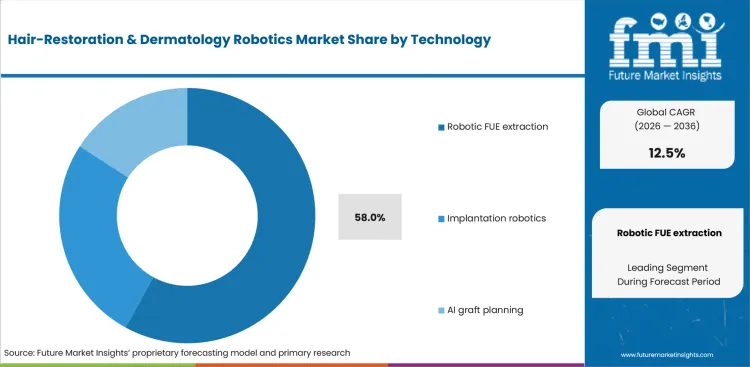
Robotic FUE extraction has an established commercial record because early ARTAS clearances focused on follicle harvesting. The International Society of Hair Restoration Surgery reported in May 2025 that 10.5% of surveyed members selected artificial intelligence as the next major technology step. The result supports continued investment in AI-based surgical robots that assist repeated clinical tasks while leaving treatment planning with the physician.
- In 2026, robotic FUE extraction is expected to lead the technology category with 58.0% share, supported by its established role in donor harvesting. Clinics can evaluate extraction accuracy and workflow impact against a familiar procedure step with established clinical documentation. The share therefore reflects a clearer purchase case than implantation-only modules or planning software sold without a complete extraction platform.
- Specialist hair clinics increasingly evaluate robotic FUE extraction for long sessions that involve repeated follicle identification and punch control. The technology gives trained teams a consistent mechanical process that can support repeated extraction across selected patients. Commercial value still depends on physician supervision, service response, and a procedure schedule that keeps the system in regular use.
What supports demand for hair restoration within the application category?
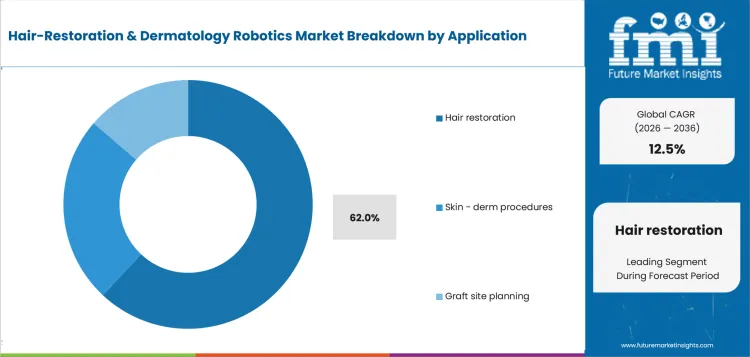
Hair restoration remains the core application as current platforms were developed around follicular unit extraction and implantation. The International Society of Hair Restoration Surgery reported in May 2025 that 91.7% of FUE donor harvest sites recorded for 2024 were on the scalp. The donor-site concentration gives robotics a direct clinical pathway and keeps broader dermatology automation adjacent to AI dermatology imaging rather than within the present revenue base.
- By application, hair restoration is forecast to represent 62.0% share in 2026, attributable to the regulatory history and installed workflow of robotic follicle extraction. Clinics can connect the system directly to paid surgical procedures and the recurring consumables used during treatment. Broader skin procedures need separate devices and clinical validation, which limits their contribution to the defined market.
- Hair restoration practices favor robotic platforms after the equipment supports graft planning and extraction within one managed workflow. The purchase decision depends on patient eligibility and surgeon oversight rather than automation claims or equipment specifications alone. A clinic must confirm that the robotic step improves usable capacity without weakening the design work that determines the final cosmetic result.
How are systems positioned within the component category?
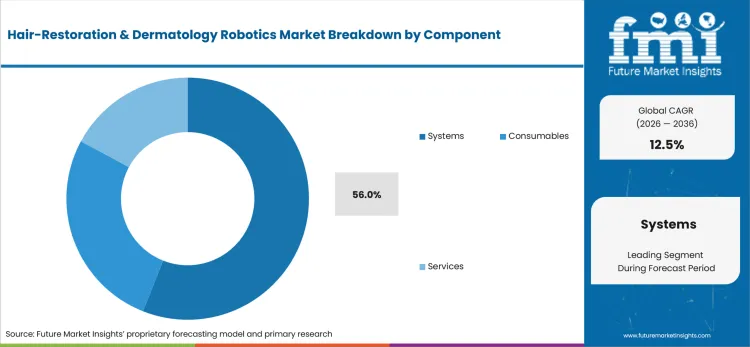
Systems carry much of the component value because imaging and computing are purchased with robotic motion hardware and the treatment chair as one capital platform. The International Society of Hair Restoration Surgery reported in May 2025 that first hair restoration procedures averaged 2,347 grafts during 2024. The procedure scale shows why installed hardware must support repeated imaging and motion control, while recurring kits and service shape lifetime economics across AI-enabled medical devices.
- The component category is forecast to be led by systems at 56.0% share in 2026, owing to the capital value of integrated imaging and robotic hardware. Each installation requires treatment-room planning and staff training before the equipment can enter regular clinical use. Consumables and services gain importance later, but their revenue depends on an installed system completing enough procedures.
- Multi-site clinic groups pay close attention to systems that can support repeatable operating protocols and clear maintenance schedules. Equipment downtime can cancel planned procedures and delay revenue across a clinic schedule that depends on reserved treatment days. A platform gains preference after the manufacturer or service partner can provide training, replacement parts, and technical support that match the clinic network.
What makes hair clinics central to the end-user category?
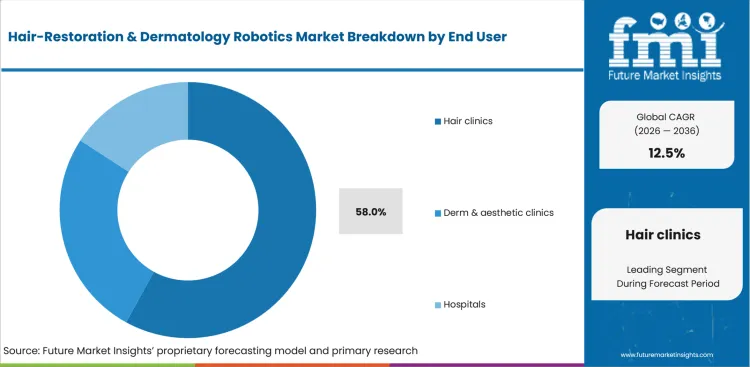
Hair clinics concentrate the specialist staff and procedure flow needed to keep a robotic platform active. The International Society of Hair Restoration Surgery reported in its 2025 census that surveyed physicians devoted an average 76% of their practice to surgical and medical hair restoration. The practice concentration gives dedicated clinics a stronger operating case for robotics than hospitals with occasional procedures and links adoption to surgical robot procedures.
- Hair clinics are projected to hold 58.0% share in 2026, led by concentrated procedure volume and specialist staffing. Their schedules can support system training and recurring kit use more consistently than a general hospital service. The share reflects the need for repeat use because a capital platform produces weak returns during long periods between suitable patients.
- Dedicated practices evaluate robotics through physician workflow and treatment-room capacity rather than the machine specification alone. Clinic leaders need clear patient screening rules and dependable support for staff training and certification requirements. The system earns a larger role after the practice can integrate extraction into existing consultations, surgery days, and postoperative follow-up without disrupting other procedures.
How does capital purchase influence purchasing within the business model category?
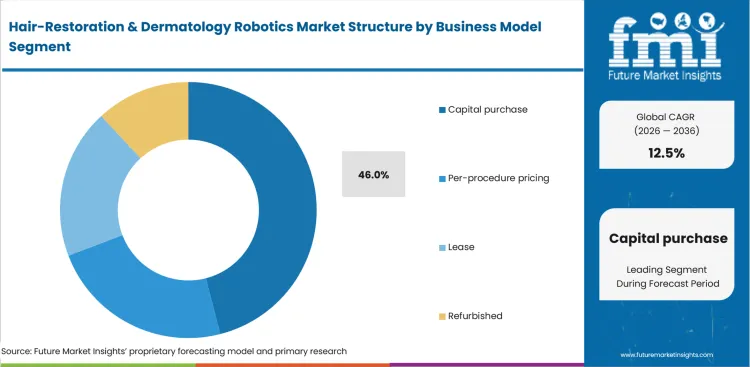
Capital purchase is expected to remain the dominant business model, as robotic hair restoration systems have traditionally been adopted as clinic-owned equipment supported by consumable kits and ongoing technical support. QHT Clinic reported that robotic hair transplants use AI-powered vision and robotic accuracy with surgeon expertise and vigilance in India. Financing access can change purchase timing even when the wider medical imaging software workflow remains intact.
- Based on business model, capital purchase is projected to account for 46.0% share in 2026, underpinned by established equipment acquisition practices in specialist clinics. Equipment ownership gives a clinic direct control over scheduling and the procedure economics attached to each robotic case.
- Clinic groups compare capital purchase with leasing and per-procedure access after they estimate annual robotic case volume. A lease can reduce initial cash pressure but may raise total payments across the equipment use period.
What are the drivers, restraints, and opportunities in the Hair-Restoration & Dermatology Robotics Market?
The market is projected to expand at a 12.5% CAGR from 2026 to 2036, driven by repeatable extraction; restricted patient indications are expected to limit routine use through 2036, shaped by current labeling; regional platform entry is forecast to widen commercial options by 2036, supported by locally developed systems.
- Driver: Repeatable follicle identification and extraction support procedure capacity during long sessions that demand sustained technical precision.
- Restraint: Current regulatory indications and patient characteristics limit the cases that a robotic platform can address without separate clinical judgment.
- Opportunity: Regional systems and service models can lower entry barriers for clinics that cannot support a premium imported platform.
Venus Hair scheduled an official webinar for April 2, 2025 on maximizing ARTAS clinical workflow efficiency and offered a two-day in-person training package as part of the event. The event shows that equipment use depends on workflow training rather than hardware delivery alone. Commercial value still requires enough scheduled cases to keep the system active across planned treatment days.
Demand is supported by the challenge of preserving extraction precision when clinicians must make thousands of graft-selection decisions in a single FUE procedure.
Commercial adoption remains bounded by the limited patient indications reflected in current ARTAS regulatory labeling. The USA Food and Drug Administration clearance identifies men with androgenetic alopecia who have black or brown straight hair. The restriction does not prevent physician-led treatment decisions, but it narrows the platform claim that clinics can make. Practices must review hair characteristics and donor quality before they schedule a robotic case or estimate system use.
An emerging opportunity comes from the small current base of robotic extraction within FUE practice. The International Society of Hair Restoration Surgery reported in May 2025 that robotic-assisted FUE accounted for 1.3% of methods used in FUE cases during 2024. The low share leaves room for regional platforms and more flexible access models to widen adoption. Expansion still depends on clinical evidence and service networks that can support physician training and equipment maintenance.
Which country CAGRs are profiled in the Hair-Restoration & Dermatology Robotics Market?
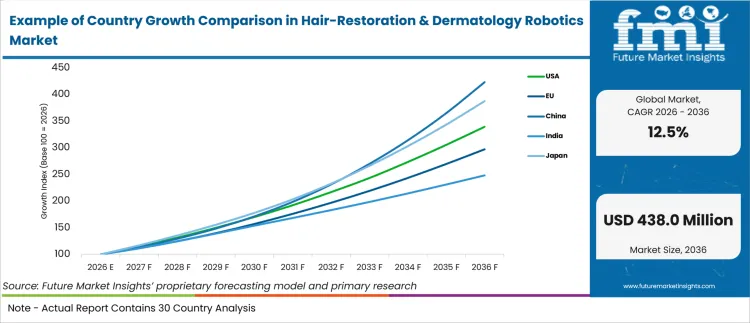
| Country | CAGR |
|---|---|
| China | 15.5% |
| Japan | 14.5% |
| United States | 13.0% |
| European Union | 11.5% |
| India | 9.5% |
Source: FMI's proprietary forecasting model and primary research
How do country-level CAGRs compare in the Hair-Restoration & Dermatology Robotics Market?
The country comparison spans six percentage points and shows a close upper pair followed by wider gaps across the remaining markets. China and Japan remain closely aligned which indicates comparable expansion across robotic hair restoration and technology-supported dermatology procedures. The United States occupies a middle position while the European Union and India show more measured development across the forecast period. The European Union figure represents a regional average and is expected to conceal differences across individual member-country markets.
- China shows notable momentum as expanding clinic networks are expected to support wider adoption of robotic follicular extraction systems.
- Japan remains close to China and is anticipated to emphasize precision-led procedures within specialist dermatology and restoration clinics.
- The United States holds an intermediate position supported by established private clinics and continued spending on technology-assisted cosmetic procedures.
- European Union growth is expected to develop through varied clinical practices and medical-device requirements across separate national markets.
- India remains outside the central cluster while urban clinics are anticipated to expand adoption through cost-sensitive treatment models.
Markets with comparable CAGRs are expected to follow different development paths as physician acceptance and clinic economics vary. These differences influence equipment investment and practitioner training as well as the pace of procedure standardization. The full report provides country-level CAGR analysis across North America; Latin America; Europe; East Asia; South Asia; Oceania; and the Middle East and Africa.
Country-wise Analysis
- China has developed a domestic robotic platform around Asian hair characteristics and hospital-led clinical use. Adoption of hair-restoration robotics in China is estimated to expand at 15.5% CAGR through 2036, led by HAIRO registration and local equipment development. The Shanghai Songjiang District Government reported in March 2025 that HAIRO could extract 1,800 follicles per hour. The figure gives clinics a measurable operating benchmark and raises the importance of training and service coverage. Local hospital use can support clinical learning, but international growth requires separate approvals and partner networks. Local service depth therefore becomes a supplier-selection factor for clinics considering regional expansion and long-term maintenance commitments.
- Japanese clinics evaluate robotic FUE against premium manual treatment and strict expectations for natural design. Robotic hair restoration sales in Japan are forecast to expand at 14.5% CAGR by 2036, aided by interest in image-guided extraction. An official Venus Concept Japan notice stated that Japanese-language customer support would continue until May 30, 2025 after local operations ceased. The change shows that product availability does not guarantee local service continuity across the installed base. Physicians still control hairline design and final graft placement during every robotic procedure in Japanese specialist clinics. Clinics need support that fits domestic follow-up practices and patient access outside major cities, making reliable regional service coverage an operational requirement for future installations.
- United States clinics have established commercial exposure to ARTAS and a clear regulatory history for robotic FUE. Hair-restoration robotics demand in the United States is forecast to rise at 13.0% CAGR between 2026 and 2036, supported by established specialist networks. The International Society of Hair Restoration Surgery reported in May 2025 that members in the United States and Canada completed an average 200 surgical procedures during 2024. The regional procedure activity can support equipment use, although financing and patient eligibility remain important considerations for each clinic. Platform providers therefore need dependable service agreements that protect scheduled procedure days and treatment-room capacity.
- European Union demand is spread across national clinic systems that differ in financing and patient access. The European Union market is projected to record 11.5% CAGR during the forecast period, reinforced by specialist practice activity. The International Society of Hair Restoration Surgery reported in its May 2025 census that European members completed an average 179 surgical procedures during 2024. The reported workload can support selected systems, but each clinic must evaluate service reach and local device requirements before equipment approval. Manufacturers need regional training partners rather than one sales approach for every member state reliably within the European Union.
- India combines a high-volume hair restoration service base with manual procedure prices that remain below robotic treatment costs. India is estimated to post 9.5% CAGR over the forecast period, shaped by the cost gap between robotic and conventional methods. The International Society of Hair Restoration Surgery reported in May 2025 that members across Asia and Australia completed an average 190 surgical procedures during 2024. The regional workload shows that procedure volume exists, while QHT Clinic confirmed ARTAS service availability in India during October 2025. Indian clinic groups can reduce risk through shared access or staged financing, but qualified surgeons and dependable maintenance remain necessary before wider expansion.
Who are the notable companies in the Hair-Restoration & Dermatology Robotics Market?
Notable companies and service organizations in the market include Venus Concept, Puncture Robotic, and QHT Clinic.
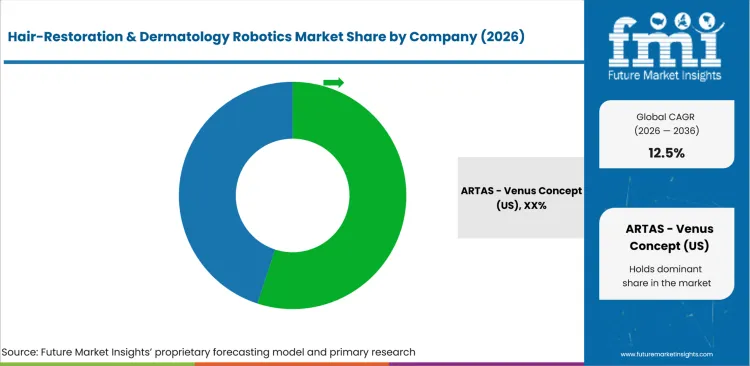
The competitive field remains narrow because a robotic hair platform needs image-guided extraction capability and clinical support. Venus Concept represents the established ARTAS line through international system distribution and recurring procedure-kit infrastructure. Puncture Robotic provides a Chinese platform built around three-dimensional imaging, automated extraction, and domestic regulatory registration. QHT Clinic represents clinical delivery and patient-facing robotic procedure services in India rather than equipment manufacturing. The competitive comparison must therefore distinguish platform development from the clinical service required to convert equipment into procedures. Each organization occupies a different part of the skin care devices value chain and must be evaluated on the role it actually performs.
- Venus Concept competes through ARTAS system capability and a recurring relationship tied to procedure kits and technical support. Clinics gain value from established regulatory documentation and platform familiarity that can shorten equipment evaluation and staff training. The commercial risk comes from capital equipment financing and the need to keep system use high enough to support ongoing service costs.
- Puncture Robotic competes through HAIRO and a design focus that addresses Asian hair characteristics and domestic hospital workflows. Its domestic registration and hospital deployments give the company a base for further clinical evidence. International growth requires separate regulatory approvals and local service partners that can train physicians and maintain equipment after installation.
- QHT Clinic participates as a clinical service provider that explains robotic treatment economics to Indian patients. The clinic's role shows how procedure pricing and physician expertise shape equipment demand within a cost-sensitive service market. A clinic operator cannot substitute for a platform developer, but clinical adoption determines whether robotic systems produce recurring procedure revenue.
Competitive Benchmarking: Hair-Restoration & Dermatology Robotics Market
| Company | Robotic Extraction Platform | Imaging and Planning | Clinical Service Delivery | Geographic Reach |
|---|---|---|---|---|
| Venus Concept | High | High | Medium | North America and international distributor markets |
| Puncture Robotic | High | High | Medium | China with reported overseas institution negotiations |
| QHT Clinic | Low | Medium | High | India-based clinical services |
Scoring basis: High indicates a documented core capability; Medium indicates a supporting or partner-led capability; Low indicates limited direct evidence within the defined market.
Source: Future Market Insights
Key Developments in the Hair-Restoration & Dermatology Robotics Market
- In March 2025, Puncture Robotic: Shanghai Songjiang District Government reported the March 1 launch of the first-generation HAIRO follicle extraction device. The announcement stated that Puncture Robotic had received China's first domestic Class III registration certificate for a hair-transplant robot from the National Medical Products Administration (NMPA). The launch moved HAIRO from product development into regulated domestic commercialization across hospitals and specialist clinics.
- In November 2025, Venus Concept reported that the pending hair-business sale had not closed and that it had sought assistance from the Delaware Court of Chancery. The third-quarter release stated that lower Venus Hair revenue reflected the transaction delay, customer uncertainty about the economic environment, and tighter third-party lending practices, all of which negatively affected capital equipment sales.
- In March 2026, Venus Concept completed a common stock sale and short-form merger that consolidated ownership under funds managed by Madryn Asset Management. The official announcement took the company private and removed public trading obligations from future corporate operations.
Key Players in the Hair-Restoration & Dermatology Robotics Market
Robotic platform developers
- Venus Concept
- Puncture Robotic
Clinical service providers
- QHT Clinic
Hair-Restoration & Dermatology Robotics Market - Report Scope
| Coverage field | Report scope |
|---|---|
| Market breakdown | Technology, application, component, end user, business model, and region. |
| Quantitative Units | Revenue in USD Million, CAGR in %. |
| Market Definition | Robotic systems and related software, consumables, and services used to assist follicular unit extraction, graft planning, or implantation within hair restoration and closely defined dermatology procedures. |
| Regions Covered | North America, Latin America, Europe, East Asia, South Asia, Oceania, and Middle East and Africa. |
| Countries Covered | United States, China, Japan, European Union member states, India, and 20+ countries within the regional model. |
| Key Companies Profiled | Venus Concept, Puncture Robotic, and QHT Clinic. |
| Forecast Period | 2026 to 2036. |
| Approach | Hybrid bottom-up and top-down market sizing supported by primary interviews and official desk research. |
Source: FMI's proprietary forecasting model and primary research
Hair-Restoration & Dermatology Robotics Market - Research Methodology
| Method | Approach |
|---|---|
| Primary Research | FMI analysts gathered input from manufacturers, service providers, technology developers, distributors, end users, sourcing teams, and subject-matter experts. Interviews examined purchasing decisions, product or service evaluation, adoption barriers, approval requirements, pricing considerations, and expectations for technical or commercial support. Respondents were also asked what evidence is required before a trial, pilot, or initial order develops into regular purchasing. |
| Desk Research | Desk research covered government statistics, regulatory publications, trade data, industry associations, technical literature, standards, company filings, product information, and official corporate announcements. Sources were reviewed for relevance, publication date, geographic coverage, and consistency with the defined market scope. Claims relating to performance, applications, approvals, capacity, investment, and commercial activity were retained only when supported by credible public evidence. |
| Market Sizing and Forecasting | The market model combined the baseline value with historical performance, segment structure, pricing and volume indicators, adoption levels, company participation, and country-level demand conditions. Forecast assumptions considered economic activity, investment trends, regulatory developments, technology adoption, purchasing cycles, supply availability, and barriers to wider market use. Segment and regional estimates were reconciled before the final market total was calculated. |
| Data Validation | Estimates were checked against multiple independent indicators, including public data, company activity, trade patterns, industry developments, and findings from primary interviews. Validation also tested whether products, services, applications, and company revenues fell within the defined market boundaries. Adjacent categories, unsupported claims, overlapping revenues, and activities without direct market relevance were excluded to reduce double counting and maintain consistency across segments and countries. |
Hair-Restoration & Dermatology Robotics Market by Segments
Hair-Restoration & Dermatology Robotics Market segmented by Technology:
- Robotic FUE extraction
- Implantation robotics
- AI-assisted graft planning
Hair-Restoration & Dermatology Robotics Market segmented by Application:
- Hair restoration
- Skin and dermatology procedures
- Graft site planning
Hair-Restoration & Dermatology Robotics Market segmented by Component:
- Systems
- Consumables
- Services
Hair-Restoration & Dermatology Robotics Market segmented by End User:
- Hair clinics
- Dermatology and aesthetic clinics
- Hospitals
Hair-Restoration & Dermatology Robotics Market segmented by Business Model:
- Capital purchase
- Per-procedure pricing
- Lease
- Refurbished equipment
Hair-Restoration & Dermatology Robotics Market by Region:
- North America
- United States
- Canada
- Latin America
- Brazil
- Mexico
- Western Europe
- Germany
- United Kingdom
- France
- Italy
- Spain
- Eastern Europe
- Poland
- Romania
- East Asia
- China
- Japan
- South Korea
- South Asia
- India
- Thailand
- Malaysia
- Indonesia
- Oceania
- Australia
- New Zealand
- Middle East and Africa
- GCC Countries
- Türkiye
- South Africa
Research Sources and Bibliography
- International Society of Hair Restoration Surgery. (2025, May 13). New survey finds younger adults and more women seeking treatment for hair loss. International Society of Hair Restoration Surgery.
- International Society of Hair Restoration Surgery. (2025, May). 2025 ISHRS practice census results. International Society of Hair Restoration Surgery.
- USA Food and Drug Administration. (2018, March 16). 510(k) premarket notification K173358: ARTAS System. USA Food and Drug Administration.
- Venus Concept Inc. (2025, June 6). Venus Concept announces definitive agreement to sell Venus Hair Business for USD 20 million. Venus Concept Investor Relations.
- Venus Concept Inc. (2025, November 13). Venus Concept announces third quarter 2025 financial results. Venus Concept Investor Relations.
- Venus Concept Inc. (2026, April 1). Venus Concept announces completion of common stock sale and short-form merger. Venus Concept Investor Relations.
- Shanghai Songjiang District Government. (2025, March). First-generation HAIRO robot revolutionizes hair transplants. Shanghai Songjiang District Government.
- Puncture Robotic. (n.d.). HAIRO hair transplant robot. Retrieved July 17, 2026, from Puncture Robotic.
- QHT Clinic. (2025, October 17). Robotic hair transplants: The future of precision in India. QHT Clinic.
- Venus Concept. (2025, April 2). Venus Hair webinar streaming event on April 2nd. Venus Concept.
- Venus Concept Japan. (2025, May 30). Changes to Venus Concept Japan operations. Venus Concept.
This bibliography is provided for reader reference and is not exhaustive. The full report contains the complete reference list and detailed citations.
This Report Answers
- What market values define the 2026 starting point and the 2036 forecast endpoint?
- Which technology, application, and component segments carry the stated 2026 shares?
- How do system cost and procedure volume shape capital purchase decisions?
- Which clinical factors support or limit robotic FUE adoption?
- How do the five profiled country CAGRs compare through 2036?
- Which companies develop robotic platforms and which organization represents clinical service delivery?
- What evidence should clinics review before selecting a robotic system?
- How do regulatory indications affect patient eligibility and system utilization?
- What operating requirements can improve return on a robotic platform?
Frequently Asked Questions
What is driving growth in the Hair-Restoration & Dermatology Robotics Market?
Growth reflects demand for repeatable follicle extraction during long FUE sessions across specialist hair clinics. Physician control remains necessary because patient selection and treatment design still determine whether robotic support fits each procedure.
Who are the key players in the Hair-Restoration & Dermatology Robotics Market?
Venus Concept supplies the ARTAS platform while Puncture Robotic develops HAIRO for Chinese clinical settings. QHT Clinic represents India's procedure-service channel and shows how robotic equipment reaches patients through specialist clinical operations.
What is a notable restraint in the Hair-Restoration & Dermatology Robotics Market?
Current ARTAS indications cover a limited patient profile and reduce the eligible case pool for labeled robotic use. Clinics still need physician screening for hair color and texture alongside donor quality before treatment begins.
Why should executives track the Hair-Restoration & Dermatology Robotics Market?
Executives should track regional platform entry and ownership changes alongside the financing conditions that affect equipment purchases. Service-network development can reshape installation timing and clinic adoption expectations across markets with limited local technical coverage.
What business problem does the Hair-Restoration & Dermatology Robotics Market address?
The market addresses repeated follicle identification and extraction during lengthy transplant procedures that demand sustained technical attention. Robotic assistance can reduce workflow variation while physicians retain responsibility for patient selection and cosmetic treatment design.
What should hair-restoration clinic leaders evaluate in the Hair-Restoration & Dermatology Robotics Market?
Clinic leaders should compare patient eligibility and annual procedure volume before selecting a robotic hair-restoration platform. Staff training and service response must fit existing surgical workflows and the available treatment-room capacity.
What limits return on investment in the Hair-Restoration & Dermatology Robotics Market?
Low utilization spreads fixed equipment and service costs across too few procedures to support the ownership model. Financing charges and unplanned downtime can weaken returns even when patient interest remains steady across consultation cycles.
What supports long-term commercial confidence in the Hair-Restoration & Dermatology Robotics Market?
Long-term confidence depends on verified clinical performance and clear regulatory status across each market where systems operate. Dependable support with transparent training and consumable pricing gives clinic groups a practical basis for measured expansion.
Preview the report firsthand - request a free sample
Get SampleGet the brochure for pricing and purchase details.
Get PDFTable of Content
- Key Takeaways
- Market Size and CAGR
- Top Growth Driver
- Fastest Growing Segment
- Leading Region
- Key Companies
- Emerging Opportunities
- Executive Summary
- Global Market Outlook
- Demand-side Trends
- Supply-side Trends
- Technology Roadmap Analysis
- Analysis and Recommendations
- Analyst Perspective (What is happening? Why now? What should investors know?)
- Key Questions Answered
- How large is the market?
- What is the CAGR?
- What are key trends?
- Which region dominates?
- Who are the leaders?
- Market Overview
- Market Coverage / Taxonomy
- Market Definition / Scope / Limitations
- Research Methodology
- Chapter Orientation
- Analytical Lens and Working Hypotheses
- Market Structure, Signals, and Trend Drivers
- Benchmarking and Cross-market Comparability
- Market Sizing, Forecasting, and Opportunity Mapping
- Research Design and Evidence Framework
- Desk Research Programme (Secondary Evidence)
- Expert Input and Fieldwork (Primary Evidence)
- Tooling, Models, and Reference Databases
- Data Engineering and Model Build
- Quality Assurance and Audit Trail
- Market Background
- Market Dynamics (Drivers, Restraints, Opportunity, Trends)
- Scenario Forecast (Optimistic, Likely, Conservative)
- Impact Analysis
- AI Impact
- Sustainability Impact
- Regulatory Impact
- Technology Impact
- Consumer / Buyer Analysis
- Purchase Drivers
- Adoption Barriers
- Buyer Journey
- Opportunity Map Analysis
- Product Life Cycle Analysis
- Supply Chain Analysis
- Investment Feasibility Matrix
- Value Chain Analysis
- PESTLE and Porter's Analysis
- Regulatory Landscape
- Regional Parent Market Outlook
- Production and Consumption Statistics
- Import and Export Statistics
- Global Market Analysis and Forecast, 2021 to 2036
- Historical Market Size Value (USD Mn) Analysis, 2021 to 2025
- Current and Future Market Size Value (USD Mn) Projections, 2026 to 2036
- Y-o-Y Growth Trend Analysis
- Absolute $ Opportunity Analysis
- Global Market Pricing Analysis, 2021 to 2036
- Global Market Analysis and Forecast, By Technology, 2021 to 2036
- Introduction / Key Findings
- Historical Market Size Value (USD Mn) Analysis By Technology, 2021 to 2025
- Current and Future Market Size Value (USD Mn) Analysis and Forecast By Technology, 2026 to 2036
- Robotic FUE extraction
- Implantation robotics
- AI graft planning
- Robotic FUE extraction
- Y-o-Y Growth Trend Analysis By Technology, 2021 to 2025
- Absolute $ Opportunity Analysis By Technology, 2026 to 2036
- Global Market Analysis and Forecast, By Application, 2021 to 2036
- Introduction / Key Findings
- Historical Market Size Value (USD Mn) Analysis By Application, 2021 to 2025
- Current and Future Market Size Value (USD Mn) Analysis and Forecast By Application, 2026 to 2036
- Hair restoration
- Skin - derm procedures
- Graft site planning
- Hair restoration
- Y-o-Y Growth Trend Analysis By Application, 2021 to 2025
- Absolute $ Opportunity Analysis By Application, 2026 to 2036
- Global Market Analysis and Forecast, By Component, 2021 to 2036
- Introduction / Key Findings
- Historical Market Size Value (USD Mn) Analysis By Component, 2021 to 2025
- Current and Future Market Size Value (USD Mn) Analysis and Forecast By Component, 2026 to 2036
- Systems
- Consumables
- Services
- Systems
- Y-o-Y Growth Trend Analysis By Component, 2021 to 2025
- Absolute $ Opportunity Analysis By Component, 2026 to 2036
- Global Market Analysis and Forecast, By End User, 2021 to 2036
- Introduction / Key Findings
- Historical Market Size Value (USD Mn) Analysis By End User, 2021 to 2025
- Current and Future Market Size Value (USD Mn) Analysis and Forecast By End User, 2026 to 2036
- Hair clinics
- Derm & aesthetic clinics
- Hospitals
- Hair clinics
- Y-o-Y Growth Trend Analysis By End User, 2021 to 2025
- Absolute $ Opportunity Analysis By End User, 2026 to 2036
- Global Market Analysis and Forecast, By Business Model, 2021 to 2036
- Introduction / Key Findings
- Historical Market Size Value (USD Mn) Analysis By Business Model, 2021 to 2025
- Current and Future Market Size Value (USD Mn) Analysis and Forecast By Business Model, 2026 to 2036
- Capital purchase
- Per-procedure pricing
- Lease
- Refurbished
- Capital purchase
- Y-o-Y Growth Trend Analysis By Business Model, 2021 to 2025
- Absolute $ Opportunity Analysis By Business Model, 2026 to 2036
- Global Market Analysis and Forecast, By Region, 2021 to 2036
- Introduction
- Historical Market Size Value (USD Mn) Analysis By Region, 2021 to 2025
- Current Market Size Value (USD Mn) Analysis and Forecast By Region, 2026 to 2036
- North America
- Latin America
- Western Europe
- Eastern Europe
- East Asia
- South Asia and Pacific
- Middle East & Africa
- Market Attractiveness Analysis By Region
- North America Market Analysis and Forecast, By Country, 2021 to 2036
- Historical Market Size Value (USD Mn) Trend Analysis By Market Taxonomy, 2021 to 2025
- Market Size Value (USD Mn) Forecast By Market Taxonomy, 2026 to 2036
- By Country
- USA
- Canada
- By Technology
- By Application
- By Component
- By End User
- By Business Model
- By Country
- Market Attractiveness Analysis
- By Country
- By Technology
- By Application
- By Component
- By End User
- By Business Model
- Key Takeaways
- Latin America Market Analysis and Forecast, By Country
- Historical Market Size Value (USD Mn) Trend Analysis By Market Taxonomy, 2021 to 2025
- Market Size Value (USD Mn) Forecast By Market Taxonomy, 2026 to 2036
- By Country
- Brazil
- Mexico
- Chile
- Rest of Latin America
- By Technology
- By Application
- By Component
- By End User
- By Business Model
- By Country
- Market Attractiveness Analysis
- By Country
- By Technology
- By Application
- By Component
- By End User
- By Business Model
- Key Takeaways
- Western Europe Market Analysis and Forecast, By Country
- Historical Market Size Value (USD Mn) Trend Analysis By Market Taxonomy, 2021 to 2025
- Market Size Value (USD Mn) Forecast By Market Taxonomy, 2026 to 2036
- By Country
- Germany
- UK
- Italy
- Spain
- France
- Nordic
- BENELUX
- Rest of Western Europe
- By Technology
- By Application
- By Component
- By End User
- By Business Model
- By Country
- Market Attractiveness Analysis
- By Country
- By Technology
- By Application
- By Component
- By End User
- By Business Model
- Key Takeaways
- Eastern Europe Market Analysis and Forecast, By Country
- Historical Market Size Value (USD Mn) Trend Analysis By Market Taxonomy, 2021 to 2025
- Market Size Value (USD Mn) Forecast By Market Taxonomy, 2026 to 2036
- By Country
- Russia
- Poland
- Hungary
- Balkan & Baltic
- Rest of Eastern Europe
- By Technology
- By Application
- By Component
- By End User
- By Business Model
- By Country
- Market Attractiveness Analysis
- By Country
- By Technology
- By Application
- By Component
- By End User
- By Business Model
- Key Takeaways
- East Asia Market Analysis and Forecast, By Country
- Historical Market Size Value (USD Mn) Trend Analysis By Market Taxonomy, 2021 to 2025
- Market Size Value (USD Mn) Forecast By Market Taxonomy, 2026 to 2036
- By Country
- China
- Japan
- South Korea
- By Technology
- By Application
- By Component
- By End User
- By Business Model
- By Country
- Market Attractiveness Analysis
- By Country
- By Technology
- By Application
- By Component
- By End User
- By Business Model
- Key Takeaways
- South Asia and Pacific Market Analysis and Forecast, By Country
- Historical Market Size Value (USD Mn) Trend Analysis By Market Taxonomy, 2021 to 2025
- Market Size Value (USD Mn) Forecast By Market Taxonomy, 2026 to 2036
- By Country
- India
- ASEAN
- Australia & New Zealand
- Rest of South Asia and Pacific
- By Technology
- By Application
- By Component
- By End User
- By Business Model
- By Country
- Market Attractiveness Analysis
- By Country
- By Technology
- By Application
- By Component
- By End User
- By Business Model
- Key Takeaways
- Middle East & Africa Market Analysis and Forecast, By Country
- Historical Market Size Value (USD Mn) Trend Analysis By Market Taxonomy, 2021 to 2025
- Market Size Value (USD Mn) Forecast By Market Taxonomy, 2026 to 2036
- By Country
- Kingdom of Saudi Arabia
- Other GCC Countries
- Türkiye
- South Africa
- Other African Union
- Rest of Middle East & Africa
- By Technology
- By Application
- By Component
- By End User
- By Business Model
- By Country
- Market Attractiveness Analysis
- By Country
- By Technology
- By Application
- By Component
- By End User
- By Business Model
- Key Takeaways
- Key Countries Market Analysis
- USA
- Pricing Analysis
- Market Share Analysis, 2025
- By Technology
- By Application
- By Component
- By End User
- By Business Model
- Canada
- Pricing Analysis
- Market Share Analysis, 2025
- By Technology
- By Application
- By Component
- By End User
- By Business Model
- Mexico
- Pricing Analysis
- Market Share Analysis, 2025
- By Technology
- By Application
- By Component
- By End User
- By Business Model
- Brazil
- Pricing Analysis
- Market Share Analysis, 2025
- By Technology
- By Application
- By Component
- By End User
- By Business Model
- Chile
- Pricing Analysis
- Market Share Analysis, 2025
- By Technology
- By Application
- By Component
- By End User
- By Business Model
- Germany
- Pricing Analysis
- Market Share Analysis, 2025
- By Technology
- By Application
- By Component
- By End User
- By Business Model
- UK
- Pricing Analysis
- Market Share Analysis, 2025
- By Technology
- By Application
- By Component
- By End User
- By Business Model
- Italy
- Pricing Analysis
- Market Share Analysis, 2025
- By Technology
- By Application
- By Component
- By End User
- By Business Model
- Spain
- Pricing Analysis
- Market Share Analysis, 2025
- By Technology
- By Application
- By Component
- By End User
- By Business Model
- France
- Pricing Analysis
- Market Share Analysis, 2025
- By Technology
- By Application
- By Component
- By End User
- By Business Model
- India
- Pricing Analysis
- Market Share Analysis, 2025
- By Technology
- By Application
- By Component
- By End User
- By Business Model
- ASEAN
- Pricing Analysis
- Market Share Analysis, 2025
- By Technology
- By Application
- By Component
- By End User
- By Business Model
- Australia & New Zealand
- Pricing Analysis
- Market Share Analysis, 2025
- By Technology
- By Application
- By Component
- By End User
- By Business Model
- China
- Pricing Analysis
- Market Share Analysis, 2025
- By Technology
- By Application
- By Component
- By End User
- By Business Model
- Japan
- Pricing Analysis
- Market Share Analysis, 2025
- By Technology
- By Application
- By Component
- By End User
- By Business Model
- South Korea
- Pricing Analysis
- Market Share Analysis, 2025
- By Technology
- By Application
- By Component
- By End User
- By Business Model
- Russia
- Pricing Analysis
- Market Share Analysis, 2025
- By Technology
- By Application
- By Component
- By End User
- By Business Model
- Poland
- Pricing Analysis
- Market Share Analysis, 2025
- By Technology
- By Application
- By Component
- By End User
- By Business Model
- Hungary
- Pricing Analysis
- Market Share Analysis, 2025
- By Technology
- By Application
- By Component
- By End User
- By Business Model
- Kingdom of Saudi Arabia
- Pricing Analysis
- Market Share Analysis, 2025
- By Technology
- By Application
- By Component
- By End User
- By Business Model
- Türkiye
- Pricing Analysis
- Market Share Analysis, 2025
- By Technology
- By Application
- By Component
- By End User
- By Business Model
- South Africa
- Pricing Analysis
- Market Share Analysis, 2025
- By Technology
- By Application
- By Component
- By End User
- By Business Model
- USA
- Market Structure Analysis
- Competition Dashboard
- Competition Benchmarking
- Market Share Analysis of Top Players
- By Regional
- By Technology
- By Application
- By Component
- By End User
- By Business Model
- Emerging Startups
- Innovation Benchmarking
- Competition Analysis
- Competition Deep Dive
- ARTAS - Venus Concept (US)
- Overview
- Product Portfolio
- Profitability by Market Segments
- Sales Footprint
- Strategy Overview
- Marketing Strategy
- Product Strategy
- Channel Strategy
- Devroye Instruments (BE)
- ARTAS - Venus Concept (US)
- Case Studies
- Success Stories
- Recent Developments
- Competition Deep Dive
- Assumptions & Acronyms Used


