

- Market Size (2026)
- USD 748.1 Mn
- Forecast (2036)
- USD 1391.2 Mn
- CAGR (2026 to 2036)
- 6.4%
How Big is the Hair Skin & Nails Supplements Market in 2026?
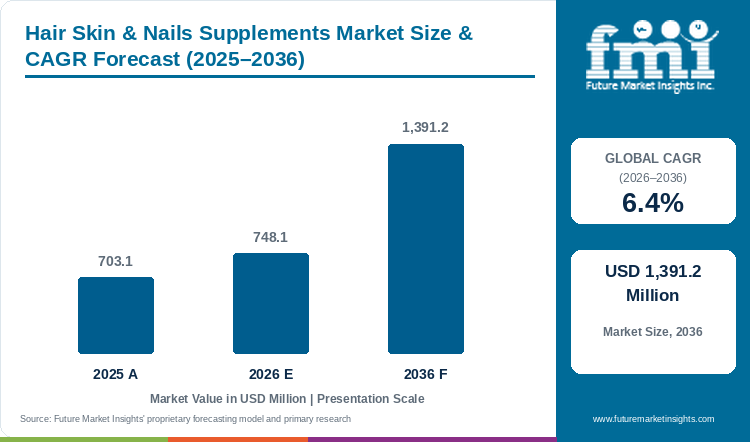
Sales of hair skin & nails supplements will grow at a 6.4% CAGR from 2026 to 2036. Market value is estimated at USD 748.1 Million in 2026 and will reach USD 1,391.2 Million by 2036.
Hair skin & nails supplements market size is estimated at USD 748.1 Million in 2026 and will reach USD 1,391.2 Million by 2036 at a 6.4% CAGR, as per FMI. Brands selling beauty supplements can approach consumers already familiar with regular supplementation. In May 2026, NCHS reported that 60.2% of USA adults aged 20 and older had used a dietary supplement in the previous 30 days during August 2021 to August 2023. Use among women reached 66.1% [1]. This wider supplement audience gives brands a starting point for introducing hair, skin and nail products in familiar gummy, capsule and drink-mix formats. Applying the forecast CAGR to the prior year gives an estimated 2025 market value of USD 703.1 Million.
The first purchase tests a product's appeal; subsequent orders depend on what the consumer receives for a recurring price. Preparation, taste and convenience can influence use, while benefit claims need evidence for the product. FTC guidance requires scientific support for objective health claims [3]. Biotin also calls for accurate dose communication because high intake can interfere with laboratory tests, as Germany's BfR notes [4]. Brands must resolve these evidence and safety questions alongside the format and price decisions that affect replenishment.
Key Takeaways
- Established supplement habits will support trial of hair, skin and nail products, with convenient daily formats helping brands secure repeat purchases.
- Everyday essentials will lead Product Type demand with a 38.0% share in 2026 because familiar formats fit regular use and replenishment.
- Conventional will account for 52.0% of demand by Nature in 2026, supported by mainstream formulas sold through retail and digital channels.
- Daily routine will hold 43.0% of Use Occasion demand in 2026. Regular intake shapes product design and subscription offers.
- Product evidence, ingredient safety and labeling requirements will influence qualification. Broad beauty claims can raise review costs and weaken consumer trust.
- Companies profiled include Church & Dwight, Therabody, HigherDOSE, Plunge, The Body Shop, Renpho, Vital Proteins, Lush, Hyperice and Vitruvi. Vital Proteins has documented current supplement products; other companies have historical or adjacent wellness roles.
Analyst Perspective
Demand converts to durable revenue when brands make daily use easy and keep benefit claims aligned with credible evidence. Novelty can trigger trial, but substantiation and repeat-purchase economics determine whether that trial becomes a routine.
- Rahul Pandita, Principal Analyst at Future Market Insights
How is the Hair Skin & Nails Supplements Market Segmented?
According to FMI, the market is segmented by Product Type, Nature, Use Occasion, Price Tier, Sales Channel and Region.
Based on Product Type, the market covers Everyday essentials, Targeted therapy formats, Premium & smart formats and Gift & travel sets. By Nature, it includes Conventional, Natural & organic, Vegan and Clinically positioned. Use Occasion comprises Daily routine, Recovery & post-workout, Sleep & wind-down and Gifting. The study covers Mid-range, Mass and Premium by Price Tier, and E-commerce & DTC, Specialty wellness retail, Pharmacies, Supermarkets and Spas & studios by Sales Channel. Regional coverage spans North America, Latin America, Western Europe, Eastern Europe, East Asia, South Asia and Pacific, and Middle East and Africa.
Why Do Everyday Essentials Lead Product Type Demand?
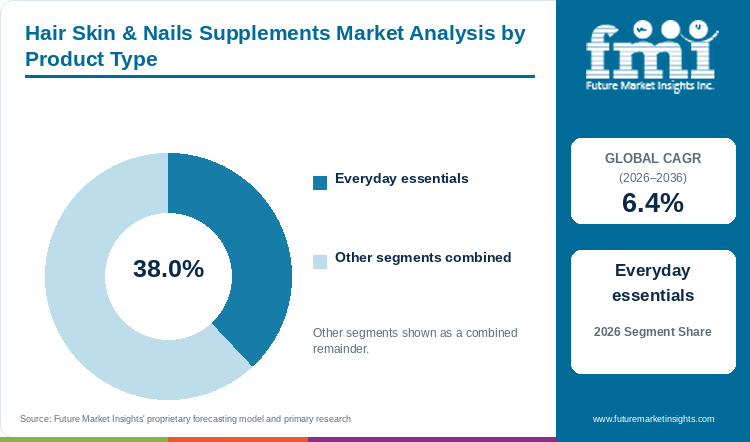
FMI finds that Everyday essentials will hold 38.0% of Product Type demand in 2026.
A capsule taken alongside regular vitamin supplements asks little change of an existing user. Powders mixed into beverages offer another route into an established habit. Familiar formats reduce the explanation required at purchase and make it easier to plan the next order. Their advantage can disappear if taste, preparation or ongoing cost puts the user off. FMI expects Everyday essentials to remain the leading Product Type because they offer a practical fit with regular supplementation.
- Everyday essentials will hold 38.0% of Product Type demand in 2026. Familiar formats and manageable preparation support regular use.
- In March 2024, Vital Proteins described collagen use in coffee and smoothies [13]. The approach connects supplementation with an established beverage routine.
Why Does Conventional Lead Demand by Nature?
Conventional will account for 52.0% of demand by Nature in 2026.
Conventional collagen supplements and vitamin-mineral formulas give brands flexibility across pharmacy, supermarket and online assortments. They can vary ingredients and formats without meeting the narrower requirements of a vegan or certified-natural brief. This makes it easier to extend a range, but consumers can also compare similar products by dose and price. Brands need a clear reason for choosing their formula and evidence suited to its claims. Familiar ingredients and broad channel access will support Conventional's leading share.
- Conventional will account for 52.0% of demand by Nature in 2026. Broad assortment flexibility supports its reach across retail and digital channels.
- In May 2025, Church & Dwight described VITAFUSION multivitamin renovation and the addition of Power Plus [19]. This historical, broader vitamin activity illustrates formula development in conventional formats before the company sold the business.
Why Does Daily Routine Lead by Use Occasion?
Daily routine will hold 43.0% of Use Occasion demand in 2026.
A supplement kept beside coffee or tea is easier to include in a morning routine than one requiring a separate preparation step. Capsules provide another low-preparation option. Vital Proteins introduced Hair Complex and Skin Complex as beverage-mix powders in December 2024 [14], linking targeted positioning to familiar drinks. Regular intake creates a predictable replenishment occasion for brands. Daily routine will lead demand, while recovery, wind-down and gifting serve more specific or less frequent occasions.
- Daily routine will hold 43.0% of Use Occasion demand in 2026. Ease of regular use supports replenishment and subscription purchasing.
- In December 2024, Vital Proteins introduced Hair Complex and Skin Complex as powders for familiar beverages [14]. Benefit-specific positioning was combined with a format suited to regular use.
Why Do Mid-range Supplements Lead by Price Tier?
Mid-range will account for 40.0% of demand by Price Tier in 2026.
Consumers buying a daily supplement face a monthly cost, making affordability central to retention. Mid-range products allow branded ingredients and convenient formats at a price accessible to mainstream users. Mass offers compete on entry cost; premium products need evidence or a format advantage to justify the additional spending. Pack size affects this comparison as much as shelf price. FMI expects Mid-range supplements to lead where consumers can keep purchasing the features that persuaded them to try the product.
- Mid-range will account for 40.0% of demand by Price Tier in 2026. Routine affordability and scope for ingredient differentiation support its position.
- In May 2025, Church & Dwight described its companywide mix of value and premium products [19]. This historical portfolio approach provides context for pricing choices, rather than evidence for the market's segment share.
Why Do E-commerce & DTC Lead the Sales Channel?
E-commerce & DTC will hold 35.0% of Sales Channel demand in 2026.
An online product page gives a brand space to explain ingredients, recommended use and the evidence behind its claims. Subscriptions and reminders can then help customers reorder as a pack runs out. This supports a category designed around regular intake. Pharmacies offer a familiar purchasing setting and supermarkets convenient availability, while direct sales let the brand manage education and replenishment together. E-commerce & DTC will retain the largest share, with repeat-order price and clear product information influencing customer retention.
- E-commerce & DTC will hold 35.0% of Sales Channel demand in 2026. Product education and replenishment support its leading position.
- In May 2025, Church & Dwight reported global online sales equal to 22.9% of total consumer sales [19]. The companywide measure illustrates digital infrastructure across its portfolio and does not measure hair, skin and nail supplement sales.
What are the Drivers Restraints and Opportunities in the Hair Skin & Nails Supplements Market?
As per FMI, established supplement habits will support demand, evidence and safety requirements will limit claims, and targeted formulas and convenient formats will create opportunities through 2036.
- Driver: Familiarity with dietary supplements gives brands an audience for products that fit daily routines.
- Restraint: Claims substantiation and ingredient safety requirements can increase development costs and limit positioning.
- Opportunity: Targeted formulas and convenient formats can support differentiation where product evidence meets local claims requirements.
Consumers already taking a daily supplement have fewer practical changes to make when trying a beauty-focused product. NCHS recorded use among 60.2% of USA adults and 66.1% of adult women in its August 2021 to August 2023 survey, based on intake in the previous 30 days [1]. Those figures describe the wider supplement category. Brands can approach these users with familiar formats, acceptable taste and little preparation. Continued sales will depend on whether the customer considers the product worth buying again.
Stronger beauty claims require stronger evidence, and the collagen literature presents limits that brands must account for. A May 2025 meta-analysis of 23 randomized trials found favorable pooled results but no significant benefit in the non-industry-funded or higher-quality subgroups [11]. FTC guidance requires scientific substantiation for objective health claims [3]. High biotin intake raises a separate safety issue through possible laboratory-test interference [4]. Product development and promotion therefore need to reflect the particular formula's evidence and intended dose.
A defined benefit gives a targeted formula a clearer development brief. In an August 2024 randomized trial in an East Asian population, collagen peptide use improved selected skin and nail measures [12]. Industry funding and affiliations limit how broadly brands can apply that result. Suppliers can use it to guide further testing for their own formulas. Japan and South Korea provide functional-claim frameworks [9] [10], making the match between ingredients, evidence and proposed benefit central to commercialization.
Country-wise Analysis
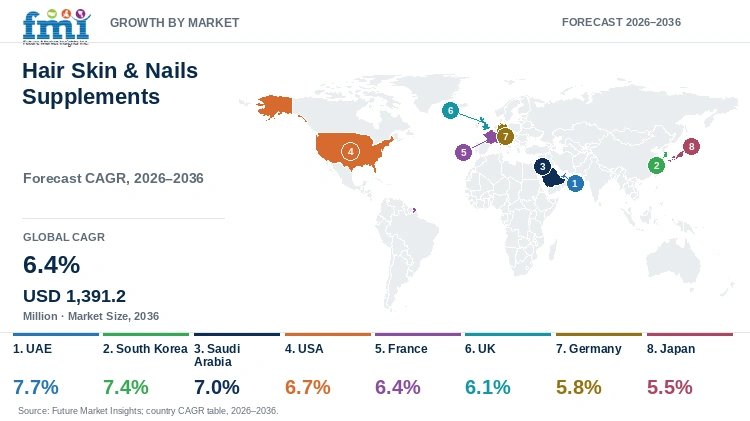
Country growth rates for the hair skin & nails supplements market are shown below for 2026 to 2036.
| Country | CAGR |
|---|---|
| UAE | 7.7% |
| South Korea | 7.4% |
| Saudi Arabia | 7.0% |
| USA | 6.7% |
| France | 6.4% |
| UK | 6.1% |
| Germany | 5.8% |
| Japan | 5.5% |
How Do Growth Rates Compare across Key Countries?
The UAE will lead the profiled countries at 7.7%, followed by South Korea at 7.4% and Saudi Arabia at 7.0%. The USA, France and UK will grow at 6.7%, 6.4% and 6.1%, respectively. Germany and Japan will remain below 6.0%, at 5.8% and 5.5%, leaving a UAE-Japan gap of 2.2 percentage points. Brands deciding where to expand will also have to account for local product requirements and the cost of substantiating their claims.
- UAE: Dubai's supplement-monitoring framework makes product compliance and traceability relevant to local market access [8].
- South Korea: Functional-ingredient recognition and specifications influence product development and claims [10].
- Saudi Arabia: SFDA's registration workflow makes complete product documentation important before launch [7].
- USA: Established supplement use supports trial, while FDA and FTC requirements guide product communication [1] [2] [3].
- France: Gummies provide a familiar format, but composition and health claims remain subject to enforcement [5].
- UK: Guidance recognizes several dose forms and keeps supplements within a nutritional or physiological role [6].
- Germany: Biotin guidance encourages accurate dosing and communication about possible laboratory-test interference [4].
- Japan: Businesses remain responsible for scientific support under the Foods with Function Claims notification system [9].
Country Outlook
What Will Support Supplement Sales in the UAE?
Suppliers approaching Dubai's distributors need traceable product information and labels ready for local review. Dubai Municipality's November 2022 clarification describes health-supplement monitoring from import checks through market circulation and periodic inspection, and directs consumers to Montaji for inquiries [8]. This emirate-level framework is relevant to brands planning local access. FMI forecasts a 7.7% CAGR for the UAE from 2026 to 2036. Distributors can help manage assortment and product requirements, while online channels extend discovery after products meet the conditions for sale.
How Will Functional-ingredient Rules Shape Demand in South Korea?
South Korean launches depend on ingredients and benefit language meeting the applicable recognition requirements. MFDS posted Regulation No. 2026-33 on functional-ingredient recognition and health-functional-food standards in August 2026 [10]. Suppliers need consistent specifications and technical records that brands can use within this framework. Products may fit local beauty routines, but their claims still require suitable scientific support. FMI forecasts a 7.4% CAGR through 2036, with launch preparation influencing which formulas reach regular distribution.
What Will Determine Launch Readiness in Saudi Arabia?
A Saudi Arabian launch requires a complete product file before the registration process can proceed. SFDA's supplement and energy-drink service describes electronic application, fee payment and approval; its September 2026 update lists an implementation period of ten working days [7]. Brands can plan assortment and distribution around that workflow while preparing compliant labels. FMI forecasts a 7.0% CAGR from 2026 to 2036. Pharmacy, retail and online channels provide routes to customers once the product is ready for sale.
Why Does Established Supplement Use Matter in the USA?
USA brands have a substantial wider supplement audience to approach. NCHS recorded use among 60.2% of adults and 66.1% of adult women during August 2021 to August 2023, based on intake in the previous 30 days [1]. These figures provide context for trial rather than a count of beauty-supplement buyers. FMI projects a 6.7% CAGR through 2036. FDA does not approve dietary supplements for safety and effectiveness before sale [2], leaving brands responsible for suitable products and claims as they seek repeat purchases.
How Will Claims Scrutiny Affect the French Market?
Gummies can make a supplement approachable, but French brands must review composition and claims before promoting them. DGCCRF's November 2025 report noted their popularity among younger consumers alongside prohibited therapeutic claims, unsupported claims and composition problems found in its 2023 controls [5]. This scrutiny makes label review part of launching a convenient format. France will grow at a 6.4% CAGR through 2036, as per FMI. Pharmacy and online access can support sales when the product's quality and communication meet the requirements for continued distribution.
What Will Guide Supplement Format Development in the UK?
UK suppliers can choose tablets, capsules, gummies, powders or liquids under the Food Standards Agency's June 2026 guidance [6]. The same guidance places supplements alongside a balanced diet and rules out medical-treatment claims. Brands therefore have room to improve convenience while keeping communication within a nutritional or physiological role. FMI forecasts a 6.1% CAGR from 2026 to 2036. Format and recurring cost will influence consumer choice, with accurate labeling helping retailers assess a product for their shelves and websites.
Why Will Evidence and Dosing Matter in Germany?
Adding more biotin does not automatically give a supplement a stronger purchasing case. Germany's BfR notes that diet generally provides adequate biotin and that high supplemental intake can interfere with certain laboratory tests [4]. Brands need clear ingredient amounts and proportionate benefit language when retailers review their products. This also avoids suggesting that broad consumer groups are deficient. FMI expects a 5.8% CAGR through 2036, with convenience and price influencing purchases alongside evidence and dosing.
How Will Functional Claims Influence Purchases in Japan?
Japan's Foods with Function Claims system requires businesses to notify safety and efficacy information before using functional statements. Each product is not individually evaluated by government as it is under FOSHU, leaving the operator responsible for scientific support [9]. A convenient daily format must therefore be accompanied by precise labels and evidence relevant to its formulation. FMI forecasts a 5.5% CAGR from 2026 to 2036, the lowest among the profiled countries. Product novelty will have limited commercial value if weak substantiation prevents a launch.
Who are the Notable Companies in the Hair Skin & Nails Supplements Market?
Church & Dwight, Therabody, HigherDOSE, Plunge, The Body Shop, Renpho, Vital Proteins, Lush, Hyperice, and Vitruvi are the notable companies profiled in this market.
Vital Proteins documents current collagen and targeted hair and skin supplements [14] [17]. Church & Dwight's vitamin-business participation is historical: it sold VITAFUSION and L'IL CRITTERS at the end of 2025 [20] [21]. The other profiled companies address related consumer purchases through wellness devices, equipment, topical beauty or home scent [22] [23] [24] [25] [26] [27] [28] [29]. Therabody, HigherDOSE, Plunge, Renpho and Hyperice sell devices or equipment; The Body Shop and Lush offer topical products, and Vitruvi supplies diffusers and home scent. Their revenues are outside the supplement market definition.
- Current and historical supplement suppliers: Vital Proteins has documented current products; Church & Dwight is assessed for its vitamin business before the December 2025 sale.
- Adjacent wellness devices and equipment: Therabody, HigherDOSE, Plunge, Renpho and Hyperice.
- Adjacent topical beauty and home wellness: The Body Shop, Lush and Vitruvi.
Competitive Benchmarking
| Company | In-scope ingestibles | HSN-specific positioning | Routine-format breadth | Geographic Reach |
|---|---|---|---|---|
| Church & Dwight | Low | Unscored | Low | Former U.S. VMS operations; in-scope ownership ended Dec. 2025 |
| Therabody | Unscored | Unscored | Unscored | In-scope supplement reach not verified |
| HigherDOSE | Unscored | Unscored | Unscored | In-scope supplement reach not verified |
| Plunge | Unscored | Unscored | Unscored | In-scope supplement reach not verified |
| The Body Shop | Unscored | Unscored | Unscored | In-scope supplement reach not verified |
| Renpho | Unscored | Unscored | Unscored | In-scope supplement reach not verified |
| Vital Proteins | High | High | High | U.S. DTC and retail activity documented |
| Lush | Unscored | Unscored | Unscored | In-scope supplement reach not verified |
| Hyperice | Unscored | Unscored | Unscored | In-scope supplement reach not verified |
| Vitruvi | Unscored | Unscored | Unscored | In-scope supplement reach not verified |
Scoring basis: In-scope ingestibles assesses ownership or sale of supplements within the revenue definition. HSN-specific positioning assesses direct hair, skin or nail benefit positioning. Routine-format breadth covers documented repeat-use formats. High indicates broad capability, Medium narrower capability, and Low a documented current limitation. Missing public evidence remains Unscored; adjacent device or topical sales do not establish supplement capability.
Key Developments in the Hair Skin & Nails Supplements Market
- Vital Proteins introduced Hair Complex and Skin Complex in December 2024. The powders combine collagen peptides with benefit-specific ingredients and can be mixed into familiar beverages [14]. This links hair and skin positioning to a format a consumer can add to an existing daily habit.
- Church & Dwight agreed to sell VITAFUSION and L'IL CRITTERS to Piping Rock in December 2025 and later confirmed completion on December 31, 2025 [20] [21]. The company is retained in the profile for its historical vitamin-business role, with the former portfolio excluded from current ownership.
- In April 2026, Vital Proteins introduced Advanced Collagen Peptides + Creatine with hair, skin and nail support positioning alongside exercise performance and recovery [17]. The powder gives the brand a post-workout occasion within a format also suited to daily intake.
Key Players in the Hair Skin & Nails Supplements Market
Current and historical supplement suppliers
- Vital Proteins
- Church & Dwight
Adjacent wellness devices and equipment
- Therabody
- HigherDOSE
- Plunge
- Renpho
- Hyperice
Adjacent beauty and home-wellness brands
- The Body Shop
- Lush
- Vitruvi
Report Scope and Methodology
| Coverage field | Report scope |
|---|---|
| Market breakdown | Product Type; Nature; Use Occasion; Price Tier; Sales Channel |
| Quantitative Units | USD Million |
| Market Definition | Revenue from ingestible supplements marketed for hair, skin and/or nail support within the stated segmentation. Excludes topical cosmetics, beauty devices, wellness equipment, services, general foods and adjacent supplements without hair, skin or nail positioning. For bundles, only attributable in-scope supplement revenue is included; device-only bundles and aftermarket activity are excluded. |
| Regions Covered | North America; Latin America; Western Europe; Eastern Europe; East Asia; South Asia and Pacific; Middle East and Africa |
| Countries Covered | USA; Germany; France; UK; Saudi Arabia; UAE; Japan; South Korea |
| Key Companies Profiled | Church & Dwight; Therabody; HigherDOSE; Plunge; The Body Shop; Renpho; Vital Proteins; Lush; Hyperice; Vitruvi |
| Forecast Period | 2026 to 2036 |
| Approach | Primary and secondary research with market triangulation. |
Research Methodology
| Method | Approach |
|---|---|
| Primary Research | FMI analysts gathered input from manufacturers, distributors, retailers, procurement teams and subject-matter experts. Discussions covered product selection, claims evidence, pricing, launch requirements and the conditions supporting repeat purchases. |
| Desk Research | Supplement-use statistics, regulatory guidance, clinical literature, company product information and dated announcements informed the assessment. Sources were checked for relevance to ingestible hair, skin and nail products and the defined market scope. |
| Market Sizing and Forecasting | The model considered the baseline value, segment mix, pricing and volume indicators, adoption and country demand conditions. Routine use, replenishment, channel access and qualification requirements informed the forecast. Segment and regional estimates were reconciled with the market total. |
| Data Validation | Estimates were checked against public evidence, company activity and research inputs. Current supplement participation was distinguished from divested portfolios and adjacent wellness activity. Topical products, devices, unrelated foods and services were excluded, with only attributable in-scope bundle revenue counted. |
Market Segmentation
By Product Type
- Everyday essentials
- Targeted therapy formats
- Premium & smart formats
- Gift & travel sets
By Nature
- Conventional
- Natural & organic
- Vegan
- Clinically positioned
By Use Occasion
- Daily routine
- Recovery & post-workout
- Sleep & wind-down
- Gifting
By Price Tier
- Mid-range
- Mass
- Premium
By Sales Channel
- E-commerce & DTC
- Specialty wellness retail
- Pharmacies
- Supermarkets
- Spas & studios
By Region
- North America
- United States
- Canada
- Latin America
- Brazil
- Mexico
- Argentina
- Chile
- Western Europe
- Germany
- France
- United Kingdom
- Italy
- Spain
- Benelux
- Nordics
- Eastern Europe
- Poland
- Czech Republic
- Romania
- Hungary
- East Asia
- China
- Japan
- South Korea
- South Asia and Pacific
- India
- ASEAN
- Australia and New Zealand
- Middle East and Africa
- GCC Countries
- South Africa
- Türkiye
- Israel
Research Sources and Bibliography
- [1] National Center for Health Statistics (2026, May 21). Dietary Supplement Use: United States, August 2021-August 2023.
- [2] U.S. Food and Drug Administration (n.d.). FDA 101: Dietary Supplements.
- [3] Federal Trade Commission (2022, December 20). Health Products Compliance Guidance.
- [4] German Federal Institute for Risk Assessment (BfR) (2026, May 21). Biotin: Supplemente können Laboruntersuchungen verfälschen.
- [5] DGCCRF (2025, November 3). Compléments alimentaires : des anomalies encore trop nombreuses.
- [6] Food Standards Agency (2026, June 25). Food supplements guidance.
- [7] Saudi Food and Drug Authority (2026, September 9). Registration of dietary supplement and energy drink products.
- [8] Dubai Municipality (2022, November 10). Health Supplement Rumour.
- [9] Consumer Affairs Agency, Japan (n.d.). Foods with Function Claims.
- [10] Ministry of Food and Drug Safety, Republic of Korea (2026, August 13). Regulation on Recognition of Functional Ingredient and of Standard·Specification for Health Functional Foods (No. 2026-33).
- [11] Myung, S.-K., & Park, Y. (2025, May 3). Effects of Collagen Supplements on Skin Aging: A Systematic Review and Meta-Analysis of Randomized Controlled Trials.
- [12] Vleminckx, S., et al. (2024, August 15). Influence of collagen peptide supplementation on visible signs of skin and nail health and -aging in an East Asian population: A double blind, randomized, placebo-controlled trial.
- [13] Vital Proteins (2024, March 12). Exploring the Benefits of Collagen.
- [14] Vital Proteins (2024, December 11). Vital Proteins's Newest Beauty Duo.
- [15] Vital Proteins (2025, April 28). Introducing Limited Edition Ice Pop Collagen Peptides.
- [16] Vital Proteins (2025, August 7). Introducing Vital Proteins® Collagen & Protein Shake.
- [17] Vital Proteins (2026, April 20). Introducing Vital Proteins® Advanced Collagen Peptides + Creatine.
- [18] Vital Proteins (2026, August 11). Get Your Skin in the Game at the US Open.
- [19] Church & Dwight (2025, May 1). Church & Dwight Reports First Quarter 2025 Results.
- [20] Church & Dwight (2025, December 9). Church & Dwight to Sell VitaFusion and L’il Critters Brands.
- [21] Church & Dwight (2026, January 30). Church & Dwight Reports Q4 2025 and 2025 Results and Provides 2026 Outlook.
- [22] Therabody (n.d.). Shop All | Recovery, Pain Relief, Wellness & Beauty Devices.
- [23] HigherDOSE (n.d.). Red Light Face Mask.
- [24] Plunge (n.d.). Plunge | Cold Plunge & Sauna for Home and Business.
- [25] The Body Shop (n.d.). Collections.
- [26] RENPHO (n.d.). Shop All.
- [27] Lush (n.d.). Products.
- [28] Hyperice (n.d.). Collections.
- [29] Vitruvi (n.d.). Shop All Diffusers.
This bibliography is provided for reader reference and is not exhaustive. The full report contains the complete reference list and detailed citations.
This Report Answers
- How large is the Hair Skin & Nails Supplements Market in 2026 and what value is forecast for 2036?
- Which industry pressures are supporting demand for hair, skin and nail supplementation?
- Why do Everyday essentials hold the leading Product Type position?
- Why does Conventional hold the leading Nature position?
- How do the profiled country growth rates differ from 2026 to 2036?
- Which profiled companies supply or participate around relevant supplement, beauty and wellness categories?
- What limits adoption, repeat purchase or supplier switching in hair, skin and nail supplements?
- What should buyers evaluate before purchasing a hair, skin and nails supplement?
Frequently Asked Questions
How big is the Hair Skin & Nails Supplements Market in 2026, and what is forecast for 2036?
The market is estimated at USD 748.1 Million in 2026 and will reach USD 1,391.2 Million by 2036, as per FMI. Daily-use formats and replenishment will support sales.
What is the CAGR for the Hair Skin & Nails Supplements Market from 2026 to 2036?
FMI forecasts a 6.4% CAGR from 2026 to 2036. Established supplement habits, product development and channel access underpin the forecast.
Which Product Type segment leads the Hair Skin & Nails Supplements Market?
Everyday essentials will lead Product Type demand with a 38.0% share in 2026. Familiar formats support routine use and replenishment.
Which Nature segment leads the Hair Skin & Nails Supplements Market?
Conventional will account for 52.0% of demand by Nature in 2026. Assortment flexibility supports broad retail and digital access.
Which profiled countries have the highest growth rates in the Hair Skin & Nails Supplements Market?
The UAE will grow at 7.7%, followed by South Korea at 7.4% and Saudi Arabia at 7.0% from 2026 to 2036. These rates compare growth rather than country market values.
Which companies are active around the Hair Skin & Nails Supplements Market?
Vital Proteins has documented current supplement products. Church & Dwight sold its vitamin business at the end of 2025. Therabody, HigherDOSE, Plunge, The Body Shop, Renpho, Lush, Hyperice and Vitruvi are profiled for adjacent wellness, device or topical roles.
Preview the report firsthand - request a free sample
Get SampleGet the brochure for pricing and purchase details.
Get PDFTable of Content
- Key Takeaways
- Market Size and CAGR
- Top Growth Driver
- Fastest Growing Segment
- Leading Region
- Key Companies
- Emerging Opportunities
- Executive Summary
- Global Market Outlook
- Demand-side Trends
- Supply-side Trends
- Technology Roadmap Analysis
- Analysis and Recommendations
- Analyst Perspective (What is happening? Why now? What should investors know?)
- Key Questions Answered
- How large is the market?
- What is the CAGR?
- What are key trends?
- Which region dominates?
- Who are the leaders?
- Market Overview
- Market Coverage / Taxonomy
- Market Definition / Scope / Limitations
- Research Methodology
- Chapter Orientation
- Analytical Lens and Working Hypotheses
- Market Structure, Signals, and Trend Drivers
- Benchmarking and Cross-market Comparability
- Market Sizing, Forecasting, and Opportunity Mapping
- Research Design and Evidence Framework
- Desk Research Programme (Secondary Evidence)
- Expert Input and Fieldwork (Primary Evidence)
- Tooling, Models, and Reference Databases
- Data Engineering and Model Build
- Quality Assurance and Audit Trail
- Market Background
- Market Dynamics (Drivers, Restraints, Opportunity, Trends)
- Scenario Forecast (Optimistic, Likely, Conservative)
- Impact Analysis
- AI Impact
- Sustainability Impact
- Regulatory Impact
- Technology Impact
- Consumer / Buyer Analysis
- Purchase Drivers
- Adoption Barriers
- Buyer Journey
- Opportunity Map Analysis
- Product Life Cycle Analysis
- Supply Chain Analysis
- Investment Feasibility Matrix
- Value Chain Analysis
- PESTLE and Porter's Analysis
- Regulatory Landscape
- Regional Parent Market Outlook
- Production and Consumption Statistics
- Import and Export Statistics
- Global Market Analysis and Forecast, 2021 to 2036
- Historical Market Size Value (USD Million) Analysis, 2021 to 2025
- Current and Future Market Size Value (USD Million) Projections, 2026 to 2036
- Y-o-Y Growth Trend Analysis
- Absolute $ Opportunity Analysis
- Global Market Pricing Analysis, 2021 to 2036
- Global Market Analysis and Forecast, By Product Type, 2021 to 2036
- Introduction / Key Findings
- Historical Market Size Value (USD Million) Analysis By Product Type, 2021 to 2025
- Current and Future Market Size Value (USD Million) Analysis and Forecast By Product Type, 2026 to 2036
- Everyday essentials
- Targeted therapy formats
- Premium & smart formats
- Gift & travel sets
- Y-o-Y Growth Trend Analysis By Product Type, 2021 to 2025
- Absolute $ Opportunity Analysis By Product Type, 2026 to 2036
- Global Market Analysis and Forecast, By Nature, 2021 to 2036
- Introduction / Key Findings
- Historical Market Size Value (USD Million) Analysis By Nature, 2021 to 2025
- Current and Future Market Size Value (USD Million) Analysis and Forecast By Nature, 2026 to 2036
- Conventional
- Natural & organic
- Vegan
- Clinically positioned
- Y-o-Y Growth Trend Analysis By Nature, 2021 to 2025
- Absolute $ Opportunity Analysis By Nature, 2026 to 2036
- Global Market Analysis and Forecast, By Use Occasion, 2021 to 2036
- Introduction / Key Findings
- Historical Market Size Value (USD Million) Analysis By Use Occasion, 2021 to 2025
- Current and Future Market Size Value (USD Million) Analysis and Forecast By Use Occasion, 2026 to 2036
- Daily routine
- Recovery & post-workout
- Sleep & wind-down
- Gifting
- Y-o-Y Growth Trend Analysis By Use Occasion, 2021 to 2025
- Absolute $ Opportunity Analysis By Use Occasion, 2026 to 2036
- Global Market Analysis and Forecast, By Price Tier, 2021 to 2036
- Introduction / Key Findings
- Historical Market Size Value (USD Million) Analysis By Price Tier, 2021 to 2025
- Current and Future Market Size Value (USD Million) Analysis and Forecast By Price Tier, 2026 to 2036
- Mid-range
- Mass
- Premium
- Y-o-Y Growth Trend Analysis By Price Tier, 2021 to 2025
- Absolute $ Opportunity Analysis By Price Tier, 2026 to 2036
- Global Market Analysis and Forecast, By Sales Channel, 2021 to 2036
- Introduction / Key Findings
- Historical Market Size Value (USD Million) Analysis By Sales Channel, 2021 to 2025
- Current and Future Market Size Value (USD Million) Analysis and Forecast By Sales Channel, 2026 to 2036
- E-commerce & DTC
- Specialty wellness retail
- Pharmacies
- Supermarkets
- Spas & studios
- Y-o-Y Growth Trend Analysis By Sales Channel, 2021 to 2025
- Absolute $ Opportunity Analysis By Sales Channel, 2026 to 2036
- Global Market Analysis and Forecast, By Region, 2021 to 2036
- Introduction
- Historical Market Size Value (USD Million) Analysis By Region, 2021 to 2025
- Current Market Size Value (USD Million) Analysis and Forecast By Region, 2026 to 2036
- North America
- Latin America
- Western Europe
- Eastern Europe
- East Asia
- South Asia and Pacific
- Middle East and Africa
- Market Attractiveness Analysis By Region
- North America Market Analysis and Forecast, By Country, 2021 to 2036
- Historical Market Size Value (USD Million) Trend Analysis By Market Taxonomy, 2021 to 2025
- Market Size Value (USD Million) Forecast By Market Taxonomy, 2026 to 2036
- By Country
- United States
- Canada
- By Product Type
- By Nature
- By Use Occasion
- By Price Tier
- By Sales Channel
- By Country
- Market Attractiveness Analysis
- By Country
- By Product Type
- By Nature
- By Use Occasion
- By Price Tier
- By Sales Channel
- Key Takeaways
- Latin America Market Analysis and Forecast, By Country
- Historical Market Size Value (USD Million) Trend Analysis By Market Taxonomy, 2021 to 2025
- Market Size Value (USD Million) Forecast By Market Taxonomy, 2026 to 2036
- By Country
- Brazil
- Mexico
- Argentina
- Chile
- By Product Type
- By Nature
- By Use Occasion
- By Price Tier
- By Sales Channel
- By Country
- Market Attractiveness Analysis
- By Country
- By Product Type
- By Nature
- By Use Occasion
- By Price Tier
- By Sales Channel
- Key Takeaways
- Western Europe Market Analysis and Forecast, By Country
- Historical Market Size Value (USD Million) Trend Analysis By Market Taxonomy, 2021 to 2025
- Market Size Value (USD Million) Forecast By Market Taxonomy, 2026 to 2036
- By Country
- Germany
- France
- United Kingdom
- Italy
- Spain
- Benelux
- Nordics
- By Product Type
- By Nature
- By Use Occasion
- By Price Tier
- By Sales Channel
- By Country
- Market Attractiveness Analysis
- By Country
- By Product Type
- By Nature
- By Use Occasion
- By Price Tier
- By Sales Channel
- Key Takeaways
- Eastern Europe Market Analysis and Forecast, By Country
- Historical Market Size Value (USD Million) Trend Analysis By Market Taxonomy, 2021 to 2025
- Market Size Value (USD Million) Forecast By Market Taxonomy, 2026 to 2036
- By Country
- Poland
- Czech Republic
- Romania
- Hungary
- By Product Type
- By Nature
- By Use Occasion
- By Price Tier
- By Sales Channel
- By Country
- Market Attractiveness Analysis
- By Country
- By Product Type
- By Nature
- By Use Occasion
- By Price Tier
- By Sales Channel
- Key Takeaways
- East Asia Market Analysis and Forecast, By Country
- Historical Market Size Value (USD Million) Trend Analysis By Market Taxonomy, 2021 to 2025
- Market Size Value (USD Million) Forecast By Market Taxonomy, 2026 to 2036
- By Country
- China
- Japan
- South Korea
- By Product Type
- By Nature
- By Use Occasion
- By Price Tier
- By Sales Channel
- By Country
- Market Attractiveness Analysis
- By Country
- By Product Type
- By Nature
- By Use Occasion
- By Price Tier
- By Sales Channel
- Key Takeaways
- South Asia and Pacific Market Analysis and Forecast, By Country
- Historical Market Size Value (USD Million) Trend Analysis By Market Taxonomy, 2021 to 2025
- Market Size Value (USD Million) Forecast By Market Taxonomy, 2026 to 2036
- By Country
- India
- ASEAN
- Australia and New Zealand
- By Product Type
- By Nature
- By Use Occasion
- By Price Tier
- By Sales Channel
- By Country
- Market Attractiveness Analysis
- By Country
- By Product Type
- By Nature
- By Use Occasion
- By Price Tier
- By Sales Channel
- Key Takeaways
- Middle East and Africa Market Analysis and Forecast, By Country
- Historical Market Size Value (USD Million) Trend Analysis By Market Taxonomy, 2021 to 2025
- Market Size Value (USD Million) Forecast By Market Taxonomy, 2026 to 2036
- By Country
- GCC Countries
- South Africa
- Türkiye
- Israel
- By Product Type
- By Nature
- By Use Occasion
- By Price Tier
- By Sales Channel
- By Country
- Market Attractiveness Analysis
- By Country
- By Product Type
- By Nature
- By Use Occasion
- By Price Tier
- By Sales Channel
- Key Takeaways
- Key Countries Market Analysis
- United States
- Pricing Analysis
- Market Share Analysis, 2025
- By Product Type
- By Nature
- By Use Occasion
- By Price Tier
- By Sales Channel
- Canada
- Pricing Analysis
- Market Share Analysis, 2025
- By Product Type
- By Nature
- By Use Occasion
- By Price Tier
- By Sales Channel
- Mexico
- Pricing Analysis
- Market Share Analysis, 2025
- By Product Type
- By Nature
- By Use Occasion
- By Price Tier
- By Sales Channel
- Brazil
- Pricing Analysis
- Market Share Analysis, 2025
- By Product Type
- By Nature
- By Use Occasion
- By Price Tier
- By Sales Channel
- Chile
- Pricing Analysis
- Market Share Analysis, 2025
- By Product Type
- By Nature
- By Use Occasion
- By Price Tier
- By Sales Channel
- Germany
- Pricing Analysis
- Market Share Analysis, 2025
- By Product Type
- By Nature
- By Use Occasion
- By Price Tier
- By Sales Channel
- United Kingdom
- Pricing Analysis
- Market Share Analysis, 2025
- By Product Type
- By Nature
- By Use Occasion
- By Price Tier
- By Sales Channel
- Italy
- Pricing Analysis
- Market Share Analysis, 2025
- By Product Type
- By Nature
- By Use Occasion
- By Price Tier
- By Sales Channel
- Spain
- Pricing Analysis
- Market Share Analysis, 2025
- By Product Type
- By Nature
- By Use Occasion
- By Price Tier
- By Sales Channel
- France
- Pricing Analysis
- Market Share Analysis, 2025
- By Product Type
- By Nature
- By Use Occasion
- By Price Tier
- By Sales Channel
- India
- Pricing Analysis
- Market Share Analysis, 2025
- By Product Type
- By Nature
- By Use Occasion
- By Price Tier
- By Sales Channel
- ASEAN
- Pricing Analysis
- Market Share Analysis, 2025
- By Product Type
- By Nature
- By Use Occasion
- By Price Tier
- By Sales Channel
- Australia and New Zealand
- Pricing Analysis
- Market Share Analysis, 2025
- By Product Type
- By Nature
- By Use Occasion
- By Price Tier
- By Sales Channel
- China
- Pricing Analysis
- Market Share Analysis, 2025
- By Product Type
- By Nature
- By Use Occasion
- By Price Tier
- By Sales Channel
- Japan
- Pricing Analysis
- Market Share Analysis, 2025
- By Product Type
- By Nature
- By Use Occasion
- By Price Tier
- By Sales Channel
- South Korea
- Pricing Analysis
- Market Share Analysis, 2025
- By Product Type
- By Nature
- By Use Occasion
- By Price Tier
- By Sales Channel
- Poland
- Pricing Analysis
- Market Share Analysis, 2025
- By Product Type
- By Nature
- By Use Occasion
- By Price Tier
- By Sales Channel
- Hungary
- Pricing Analysis
- Market Share Analysis, 2025
- By Product Type
- By Nature
- By Use Occasion
- By Price Tier
- By Sales Channel
- Türkiye
- Pricing Analysis
- Market Share Analysis, 2025
- By Product Type
- By Nature
- By Use Occasion
- By Price Tier
- By Sales Channel
- South Africa
- Pricing Analysis
- Market Share Analysis, 2025
- By Product Type
- By Nature
- By Use Occasion
- By Price Tier
- By Sales Channel
- UAE
- Pricing Analysis
- Market Share Analysis, 2025
- By Product Type
- By Nature
- By Use Occasion
- By Price Tier
- By Sales Channel
- Saudi Arabia
- Pricing Analysis
- Market Share Analysis, 2025
- By Product Type
- By Nature
- By Use Occasion
- By Price Tier
- By Sales Channel
- United States
- Market Structure Analysis
- Competition Dashboard
- Competition Benchmarking
- Market Share Analysis of Top Players
- By Regional
- By Product Type
- By Nature
- By Use Occasion
- By Price Tier
- By Sales Channel
- Emerging Startups
- Innovation Benchmarking
- Competition Analysis
- Competition Deep Dive
- Church & Dwight
- Overview
- Product Portfolio
- Profitability by Market Segments
- Sales Footprint
- Strategy Overview
- Marketing Strategy
- Product Strategy
- Channel Strategy
- Therabody
- HigherDOSE
- Plunge
- The Body Shop
- Renpho
- Vital Proteins
- Lush
- Hyperice
- Vitruvi
- Church & Dwight
- Case Studies
- Success Stories
- Recent Developments
- Competition Deep Dive
- Assumptions & Acronyms Used


