

- Market Size (2026)
- USD 8.2 Bn
- Forecast (2036)
- USD 18.7 Bn
- CAGR (2026 to 2036)
- 8.6%
How big is Hair, Skin & Nails Nutricosmetics Market in 2026?
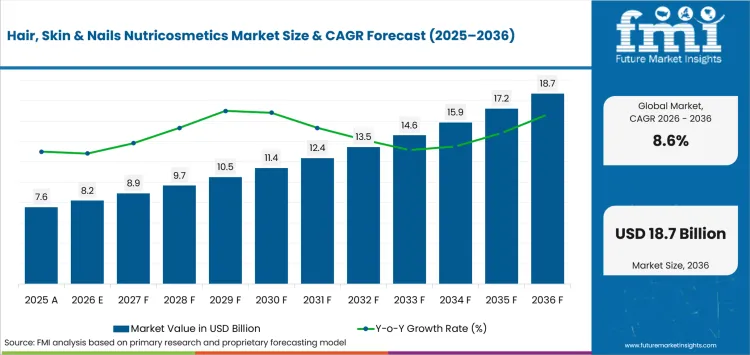
USD 8.2 billion in 2026 and USD 18.7 billion by 2036 at an 8.6% CAGR.
Demand for hair, skin and nails nutricosmetics is projected to expand at 8.6% CAGR between 2026 and 2036. Industry valuation is estimated at USD 8.2 billion in 2026 and is forecast to reach USD 18.7 billion by 2036 owing to sustained purchasing across peptide and collagen formulas. FDA clarified dietary supplement disclaimer placement in December 2025 and retained the core link between each structure-function claim and its required disclaimer. The agency limited enforcement discretion to repeated panel placement; it did not relax the underlying claim boundary. The retained claim boundary makes substantiation central across dietary supplements instead of treating appearance outcomes as drug effects. Brands need defined endpoints and clear dosage instructions to protect repeat purchasing across daily oral routines.
United States brands use federal structure-function notifications and retailer evidence reviews for each finished oral appearance formula. Japanese companies carry direct responsibility for scientific support under the Foods with Function Claims route. The Consumer Affairs Agency renewed its notification database in April 2025 to improve access to submitted functional-food records. Its functional-claim framework makes safety and manufacturing quality records available alongside evidence for the notified function. China and South Korea use separate health-food systems that add documentation work for imported ingredients and finished products. Commercial planning across USA nutricosmetics therefore requires country-ready claim files and stable ingredient specifications across each target country. Local distributors must assign responsibility for compliant labels and consumer guidance through launch and repeat sales. Strong clinical evidence cannot offset delayed review or unclear control over the final claims file.
Key Takeaways of Hair, Skin & Nails Nutricosmetics Market
- Evidence-led appearance outcomes and wider beauty-wellness distribution support recurring demand across oral hair, skin and nail formulas.
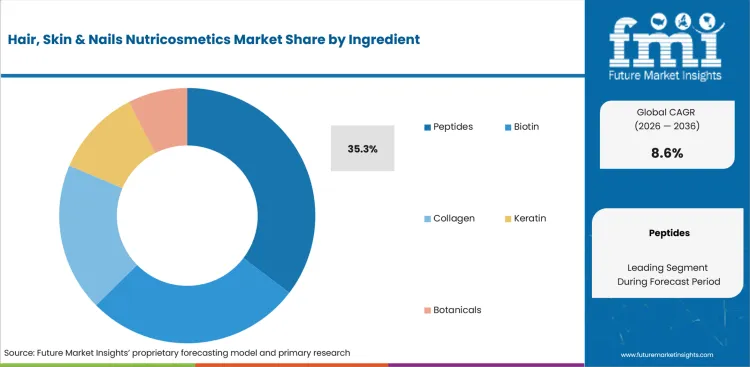
- By ingredient, peptides are expected to account for 35.3% share in 2026 owing to standardized bioactive profiles and product-specific evidence.
- Capsule is projected to hold 46.9% share in 2026, supported by precise dosing and compatibility with concentrated nutrient blends.
- Hair growth is estimated to capture 47.5% share in 2026, reflecting visible needs and sustained use across several hair cycles.
- Biotin interference and uneven product evidence increase professional review burdens across concentrated oral formulas and imported market entries.
- Finished-product competition includes Nutrafol and Vital Proteins with Viviscal and Nutrilite alongside Swisse across oral appearance formulas. GELITA and Lonza serve upstream formulation roles while Shiseido extends inner-beauty distribution through established Japanese channels.
Analyst Perspective
“Hair, skin and nail supplements succeed through a narrow balance between evidence and daily usability. Peptide formulas need endpoint data that directly matches the claimed concern and intended consumer population. Capsules must carry an effective dose without creating an excessive daily serving burden for users. Biotin safety guidance and country-ready claim files shape professional recommendation; portfolios that solve these issues are better placed to retain repeat users.”
- Nandini Roy Choudhury, Principal Analyst, Future Market Insights
How is the Hair, Skin & Nails Nutricosmetics Market segmented?
The market is segmented by ingredient, form, concern, and region.
Ingredient separates peptides, biotin, collagen, keratin and botanicals according to their nutritional role and evidence requirements. Form distinguishes capsules, gummies and liquids through dose capacity, routine convenience, sensory demands and distribution stability. Concern separates hair growth, skin and nails by the appearance outcome addressed through each oral formula. Region captures supplement rules, claim review, retail access and consumer delivery preferences across local markets. Together, these dimensions let companies compare formula economics without combining topical cosmetics or pharmaceutical hair-loss treatments with nutricosmetic ingredients revenue.
How do peptides shape demand within the ingredient category?
Peptide selection determines whether a formula presents a defined bioactive profile or an undifferentiated protein proposition. GELITA reported in April 2025 that a randomized double-blind trial linked VERISOL collagen peptides with improved hydration, elasticity and wrinkle measures. The findings apply to the tested peptide and dosage rather than every collagen ingredient across finished formulas. Formulators must match source, dose and endpoint language for each finished product before using the evidence in commercial claims.
- The ingredient category is forecast to be led by peptides at 35.3% share in 2026 due to their defined bioactive profiles and product-specific substantiation. Controlled hydrolysis and documented peptide identity distinguish these inputs from undifferentiated protein in premium oral beauty formulas. Batch consistency and claim-ready files support premium positioning across finished products that target specific skin or hair outcomes.
- Product developers use peptides across powders and capsules because the same bioactive dose can serve different consumer routines. Neutral sensory performance supports peptide supplements designed for consistent daily use without hiding the required serving level. Marine sourcing costs and animal-origin preferences create separate limits across selected retail channels and consumer groups. Formula teams need alternate sources that preserve endpoint evidence and sensory quality through commercial scale-up.
What drives capsule within the form category?
Capsules concentrate several nutrients without the sugar load or flavor work required by many gummies and liquids. Amway completed a USD 75 million Nutrilite manufacturing investment in May 2026 and commissioned a high-speed two-capsule filling machine. The site supports 136 formulas across sixty markets and shows how capsule production combines fill control with multi-market scale. Brands developing collagen supplements must balance shell capacity and serving count against the effective daily dose for each formula.
- Based on form, capsule is projected to account for 46.9% in 2026 due to precise dosing and compatibility with concentrated nutrient blends. Manufacturers can adjust shell composition and fill blends without rebuilding the complete product concept during each formula revision. The format protects sensitive ingredients through normal distribution and uses familiar equipment across contract manufacturing networks.
- Contract manufacturers favor capsules for smaller runs that require quick formula changes and established filling equipment. Serving burden rises as concentrated collagen or mineral blends require several units each day within normal routines. Commercial performance depends on nutrient density and swallowing comfort across long-term routines and repeat purchasing. Brands that ignore the complete serving requirement risk weak adherence despite convenient packaging and familiar retail presentation.
What makes hair growth central to the concern category?
Hair-focused formulas connect visible shedding concerns with daily nutritional routines and professional recommendation across sustained use periods. Nutrafol reported in February 2025 that a six-month randomized double-blind trial found significant improvements in hair growth and quality for its men’s nutraceutical. The evidence applies to the tested formula and population rather than every biotin supplement sold across consumer channels. Brands must separate cosmetic support from treatment claims and explain realistic usage periods for hair-cycle outcomes.
- Hair growth is projected to hold 47.5% share in 2026 owing to persistent appearance concerns and recurring use across the hair cycle. Visible outcomes often require several months of consistent intake and support repeat purchasing across the segment. Product-level evidence gives branded formulas a clearer point of difference from crowded vitamin and botanical offers.
- Adults select hair formulas for life-stage needs that include hormonal changes, stress-related shedding and age-associated density concerns. Clinical credibility strengthens professional recommendation across these groups, but high monthly cost can weaken continuation outside premium channels. Brands improve retention through clear dosage guidance and realistic appearance outcomes across direct and specialist retail channels without promising medical treatment.
What are the drivers, restraints, and opportunities in the Hair, Skin & Nails Nutricosmetics Market?
Product-level evidence and informed retail guidance support repeat purchasing; biotin safety and dosage burden restrict recommendation; targeted peptide systems create concern-specific formulation openings.
- Driver: Product-level trials and specialist retail guidance improve informed selection across hair, skin and nail formulas.
- Restraint: Biotin interference and high serving requirements increase safety communication burdens across concentrated oral appearance products.
- Opportunity: Defined peptide platforms and flexible dosage formats support formulas for narrower concerns and life-stage needs.
Product-level evidence gives oral beauty brands a clearer route to repeat purchasing across specialist retail channels. Nutrafol announced in July 2025 that its hair supplements would enter 500 Ulta Beauty locations and the retailer’s online channel. The expansion placed ingestible hair care beside established beauty categories and widened guided product discovery. Companies across the collagen value chain gain more from distribution staff who explain dosage and evidence boundaries. Retail reach produces durable revenue through informed selection and realistic usage expectations across repeated purchase cycles.
Biotin safety communication creates a material restraint across formulas marketed for hair and nail support. The German Federal Institute for Risk Assessment reported in May 2026 that high-dose biotin can interfere with laboratory tests and complicate clinical interpretation. The agency also stated that normal diets generally provide sufficient biotin across Germany’s population groups. Brands need clear interruption guidance and must avoid presenting extra intake as correction for an unverified deficiency. Weak instructions can reduce professional recommendation despite compliant manufacturing and acceptable product quality in professional channels.
Targeted peptide systems give ingredient developers a route to address narrower appearance concerns through defined biological endpoints. GELITA highlighted CURADERM at Vitafoods Europe in May 2026 as an inside-out peptide platform for skin and outer-body barrier support. The advancement extends development beyond broad collagen positioning and gives formulation teams a more specific product concept. Commercial teams can pair the active with oral formats that preserve an effective daily level. Finished-product trials remain necessary to confirm the intended population and claimed consumer benefit under realistic consumption conditions.
Which country CAGRs are profiled in the Hair, Skin & Nails Nutricosmetics Market?
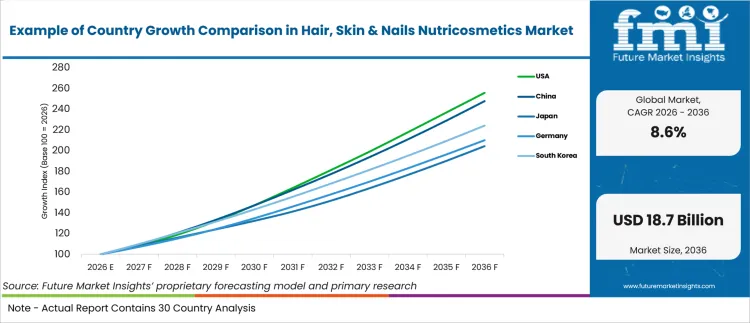
| Country | CAGR |
|---|---|
| USA | 8.0% |
| China | 9.5% |
| Japan | 7.4% |
| Germany | 7.7% |
| South Korea | 8.4% |
How do country-level CAGRs compare in the Hair, Skin & Nails Nutricosmetics Market?
The country rates span 2.1 percentage points across five distinct regulatory systems in the forecast model. China and South Korea form a close growth band through formal health-food routes and active personalized service models. The USA sits near the middle with broad retail access and detailed federal claim requirements. Germany and Japan show more measured modeled expansion under demanding evidence review and established supplement habits. The rates describe forecast revenue momentum rather than current market size or automatic approval for any finished formula.
- China sits 1.1 percentage points above South Korea; registration work and digital beauty channels create a distinct commercialization route for imported formulas.
- South Korea remains 0.4 percentage points above the USA through personalized health-functional-food services and dense mobile retail networks.
- The USA remains 0.3 percentage points above Germany through wider direct access and substantial specialist retail participation across oral beauty products.
- Germany remains 0.3 percentage points above Japan; pharmacy credibility and formal claim review shape product selection differently across both markets.
- Japan defines the lower endpoint through mature ingestible beauty habits and demanding documentation for notified functional claims across established retail channels.
Comparable CAGRs can produce different entry economics through registration work, dosage preferences and retailer education requirements across these markets. Companies should test each formula against local claim rules and channel costs rather than applying one global strategy. The full report provides country-level CAGR analysis across North America, Latin America, Europe, East Asia, South Asia, Oceania and the Middle East and Africa.
Country-wise Analysis
- United States manufacturers must substantiate structure-function claims and file applicable notifications through defined federal routes. The USA oral nutricosmetics sector is projected to record 8.0% CAGR during the assessment period, underpinned by broad retail access and established professional recommendation networks. FDA released new dietary ingredient materials in June 2025 to improve submission completeness and reduce avoidable review delays. The guidance gives ingredient developers a clearer safety-file route for novel actives entering oral beauty formulas. Retail reach supports launch access across specialist and mass channels, yet separate legal review for ingredient status and claim language remains a material friction. Brands need support teams that explain dosage duration without implying disease treatment or guaranteed regrowth.
- China requires health-food registration or filing based on ingredient status and exact finished-product composition used by domestic and imported brands. Major digital channels provide a direct route for imported formulas supported by complete registration and label documentation. Oral nutricosmetics demand in China is forecast to rise at 9.5% CAGR over the forecast period, underpinned by digital beauty retail and interest in documented wellness products. SAMR initiated a health-food registration certificate data standard in April 2025 with a twenty-four-month development cycle. The project is intended to standardize certificate information across domestic and imported health-food registrations during the planned drafting cycle. Local registration responsibility remains a material friction, so companies must align Chinese labels and health functions with approved certificates instead of translating overseas claims directly.
- Japan uses the Foods with Function Claims system for products supported by company-held safety and functional evidence. Japan’s oral nutricosmetics outlook is anticipated to advance at 7.4% CAGR over the assessment period, influenced by mature collagen use and familiar convenience formats. Consumer familiarity with beauty drinks and tablets provides a direct adoption enabler across established pharmacy and convenience-store channels. The Consumer Affairs Agency reported in February 2025 that eighty-eight related notifications had requested withdrawal following evidence concerns. The action demonstrates active scrutiny under a notification route without government preapproval of individual claims. Documentation quality remains a material commercial friction across national advertising and retail channels that use notified claims. Entrants need Japanese evidence summaries and disciplined controls for every functional statement used across product labels and advertising.
- German operators apply European health-claim rules alongside national review of products near the food and medicine boundary. Pharmacy channels give premium formulas a trusted route to consumers who expect detailed quality information. Adoption of oral nutricosmetics in Germany is estimated to expand at 7.7% CAGR through 2036, supported by established distribution and formal evidence review. The Federal Office of Consumer Protection and Food Safety renewed its joint expert commission in March 2025 for classifying borderline substances and products. The commission provides a defined route for formulas whose dose or claim language may create a medicinal presentation. Pharmacy credibility creates the local enabler, but strict claim review requires German-language files and experienced distribution partners.
- South Korea operates a health-functional-food system with defined ingredient conditions and expanding personalized dispensing models. Registered products can use tailored combinations and service-led consumer engagement across dense urban retail networks. Imported formulas face material friction through local claim wording and ingredient-use conditions across personalized services. In South Korea, oral nutricosmetics demand is predicted to advance at 8.4% CAGR through 2036. Mobile commerce and frequent beauty-wellness purchasing reinforce the modeled outlook across dense urban consumer channels. MFDS announced an operating-status survey of personalized health functional foods in August 2025 to examine current service practices. Personalized services provide a direct local enabler by connecting registered products with tailored consumer support. Companies need channel partners that manage education and adverse-event responsibilities across each regulated service route.
Who are the notable companies in the Hair, Skin & Nails Nutricosmetics Market?
Nestlé Health Science (Vital Proteins), Nutrafol (Unilever), Church & Dwight (Viviscal), Amway (Nutrilite), GELITA, Lonza Capsules & Health Ingredients, Shiseido, and H&H Group (Swisse) are the notable companies shaping this market.
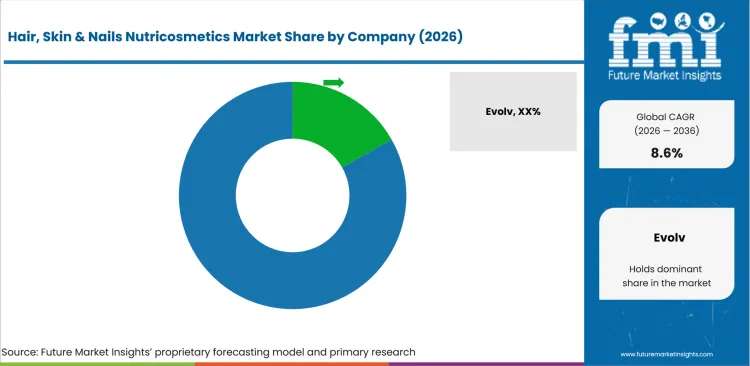
Competition separates finished-product brands from ingredient platforms and oral dosage specialists across the global nutricosmetics value chain. Unilever’s 2025 annual report identifies Nutrafol as a hair growth supplement brand acquired in 2022. Nutrafol and Church & Dwight’s Viviscal compete through hair-focused formulas with different evidence and channel models. Nestlé Health Science and Amway extend collagen or inner-beauty portfolios through broad consumer networks shared by Shiseido and H&H Group. GELITA supports peptide differentiation while Lonza Capsules & Health Ingredients provides scalable oral delivery systems for international formula developers. Selection depends on evidence depth and country-ready biotin ingredients documentation across intended markets and channels.
- Nutrafol and Church & Dwight’s Viviscal focus on hair concerns through branded oral formulas and consumer education. Unilever documents Nutrafol as a current hair growth supplement brand while Church & Dwight lists Viviscal capsules within its hair-care portfolio. Their commercial test is product-level evidence and realistic usage guidance across professional and direct retail channels.
- Nestlé Health Science and Amway combine broad distribution with several oral formats across portfolios also operated by Shiseido and H&H Group. Vital Proteins adds collagen-led powders and ready-to-drink products while Swisse Professional expands beauty recommendation through specialist channels. Portfolio comparison should examine effective dose and local claim support across each intended route and consumer setting.
- GELITA and Lonza Capsules & Health Ingredients operate upstream through bioactive peptides and oral dosage systems. Lonza reported in January 2026 that the capsule business recorded 3.9% constant-currency growth during 2025 and continued to see healthy demand. Their value depends on reproducible specifications and scalable production support for formulas entering several geographic markets.
Competitive Benchmarking: Hair, Skin & Nails Nutricosmetics Market
| Company | Concern-Specific Formula Support | Oral Format Breadth | Validation and Scale Support | Geographic Reach |
|---|---|---|---|---|
| Nestlé Health Science (Vital Proteins) | High | High | Medium | International |
| Nutrafol (Unilever) | High | Medium | High | United States |
| Church & Dwight (Viviscal) | High | Medium | Medium | United States |
| Amway (Nutrilite) | Medium | Medium | High | Global |
| GELITA | High | High | High | Global |
| Lonza Capsules & Health Ingredients | Low | High | Medium | Global |
| Shiseido | High | High | Medium | Japan |
| H&H Group (Swisse) | Medium | Medium | Medium | Asia-Pacific and Europe |
Key Developments in the Hair, Skin & Nails Nutricosmetics Market
- In February 2026, Nutrafol introduced Men 50+ Hair Growth Nutraceutical for age-specific biological changes affecting older men. The launch extended its life-stage portfolio through a targeted oral formula and healthcare-provider distribution across professional channels. The development raises evidence expectations for concern-specific formulas; broad adult positioning does not address the same age-related hair needs across professional and direct retail channels with comparable precision.
- In January 2025, Shiseido announced The Collagen Powder for a February nationwide launch through drugstores and general merchandise stores. The company also opened its online channel for the mixable formula containing 5,000 mg of low-molecular-weight fish collagen and six additional beauty ingredients. The launch expanded powder nutricosmetics through familiar food and beverage routines across Japanese retail channels and daily consumption occasions.
- In March 2025, H&H Group launched the Swisse Professional range in Italy through the professional beauty channel. The expansion gave beauty professionals another route to recommend nutritional products during structured specialist consultations. Trained advisers broaden access for inner-beauty formulas across Italian channels; local claim rules and product-level evidence remain necessary during national rollout for responsible hair, skin and nail positioning.
- In March 2026, Lonza signed a definitive agreement to divest Capsules & Health Ingredients to Lone Star Funds. The company stated that closing was expected during the second half of 2026 and retained a future stake under the announced terms. Lonza’s July 2026 results continued to describe the transaction as an agreement, so customers should monitor legal ownership and service continuity during long-term capsule qualification.
Key Players in the Hair, Skin & Nails Nutricosmetics Market
Branded Hair Nutricosmetics Companies
- Nutrafol (Unilever)
- Church & Dwight (Viviscal)
Diversified Consumer Health and Inner Beauty Companies
- Nestlé Health Science (Vital Proteins)
- Amway (Nutrilite)
- Shiseido
- H&H Group (Swisse)
Ingredient and Dosage-System Specialists
- GELITA
- Lonza Capsules & Health Ingredients
Hair, Skin & Nails Nutricosmetics Market - Report Scope
| Coverage field | Report scope |
|---|---|
| Market breakdown | Ingredient, form, concern, and region. |
| Quantitative Units | Revenue in USD Million, CAGR in %. |
| Market Definition | Oral supplements formulated to support hair, skin, or nail appearance through peptides, collagen, biotin, keratin, botanicals, and related nutrients. Topical cosmetics and pharmaceutical hair-loss treatments are excluded. |
| Regions Covered | North America, Latin America, Western Europe, Eastern Europe, East Asia, South Asia and Pacific, and Middle East and Africa. |
| Countries Covered | USA, China, Japan, Germany, and South Korea, with more than twenty-five additional countries included in the full report. |
| Key Companies Profiled | Nestlé Health Science (Vital Proteins), Nutrafol (Unilever), Church & Dwight (Viviscal), Amway (Nutrilite), GELITA, Lonza Capsules & Health Ingredients, Shiseido, and H&H Group (Swisse) |
| Forecast Period | 2026 to 2036. |
| Approach | Hybrid bottom-up and top-down market sizing supported by primary interviews and official desk research. |
Hair, Skin & Nails Nutricosmetics Market - Research Methodology
| Method | Approach |
|---|---|
| Primary Research | FMI analysts gathered input from manufacturers, service providers, technology developers, distributors, end users, procurement teams, and subject-matter experts. Interviews examined purchasing decisions, product or service evaluation, adoption barriers, approval requirements, pricing considerations, and expectations for technical or commercial support. Respondents were also asked what evidence is required before a trial, pilot, or initial order develops into regular purchasing. |
| Desk Research | Desk research covered government statistics, regulatory publications, trade data, industry associations, technical literature, standards, company filings, product information, and official corporate announcements. Sources were reviewed for relevance, publication date, geographic coverage, and consistency with the defined market scope. Claims relating to performance, applications, approvals, capacity, investment, and commercial activity were retained only when supported by credible public evidence. |
| Market Sizing and Forecasting | The market model combined the baseline value with historical performance, segment structure, pricing and volume indicators, adoption levels, company participation, and country-level demand conditions. Forecast assumptions considered economic activity, investment trends, regulatory developments, technology adoption, purchasing cycles, supply availability, and barriers to wider market use. Segment and regional estimates were reconciled before the final market total was calculated. |
| Data Validation | Estimates were checked against multiple independent indicators, including public data, company activity, trade patterns, industry developments, and findings from primary interviews. Validation also tested whether products, services, applications, and company revenues fell within the defined market boundaries. Adjacent categories, unsupported claims, overlapping revenues, and activities without direct market relevance were excluded to reduce double counting and maintain consistency across segments and countries. |
Hair, Skin & Nails Nutricosmetics Market by Segments
Hair, Skin & Nails Nutricosmetics Market segmented by Ingredient:
- Peptides
- Biotin
- Collagen
- Keratin
- Botanicals
Hair, Skin & Nails Nutricosmetics Market segmented by Form:
- Capsule
- Gummy
- Liquid
Hair, Skin & Nails Nutricosmetics Market segmented by Concern:
- Hair Growth
- Skin
- Nails
Hair, Skin & Nails Nutricosmetics Market by Region:
- North America
- United States
- Canada
- Latin America
- Brazil
- Mexico
- Argentina
- Chile
- Western Europe
- Germany
- France
- United Kingdom
- Italy
- Spain
- Benelux
- Nordics
- Eastern Europe
- Poland
- Czech Republic
- Romania
- Hungary
- East Asia
- China
- Japan
- South Korea
- South Asia and Pacific
- India
- ASEAN
- Australia and New Zealand
- Middle East and Africa
- GCC Countries
- South Africa
- Türkiye
- Israel
Research Sources and Bibliography
- USA Food and Drug Administration. (2025, December 11). Letter to the Dietary Supplement Industry on the DSHEA Disclaimer.
- USA Food and Drug Administration. (2025, June 11). FDA Releases Educational Materials on the New Dietary Ingredient Notification Process for Dietary Supplements.
- Consumer Affairs Agency. (2025, April 1). 機能性表示食品制度届出データベースを更改しました [Foods with Function Claims database renewed].
- Consumer Affairs Agency. (2025, February 28). 機能性表示食品について [Foods with Function Claims].
- Ministry of Food and Drug Safety. (2025, August 4). 식약처, 맞춤형 건강기능식품 제도 운영 현황 실태조사 [Survey of the personalized health functional food system].
- State Administration for Market Regulation. (2025, April 9). 保健食品注册证书数据规范 [Data standard for health food registration certificate].
- German Federal Institute for Risk Assessment. (2026, May 21). Biotin: Supplements can interfere with laboratory tests.
- Federal Office of Consumer Protection and Food Safety. (2025, March 11). Im Grenzbereich zwischen Arznei- und Lebensmitteln [At the boundary between medicinal products and foods].
- Nutrafol. (2025, February 11). Nutrafol Men is Clinically Proven to Improve Hair Growth.
- Nutrafol. (2025, July 16). Nutrafol Launches at Ulta Beauty, Expanding National Retail Footprint.
- Nutrafol. (2026, February 3). Nutrafol Introduces Men 50+, the First and Only Hair Growth Product Specifically Formulated for Men 50+.
- GELITA. (2025, April 22). VERISOL®: Confirmed to Elevate Skin Hydration and Elasticity, While Reducing Wrinkles.
- GELITA. (2026, May 28). Spotlight on CURADERM®: Video Interview from Vitafoods Europe 2026.
- Amway. (2026, May 7). Amway strengthens manufacturing capabilities with its reimagined Nutrilite Spaulding Plant.
- Lonza. (2026, January 28). Lonza Delivers Strong Profitable Growth in Full-Year 2025 and Successfully Completes Vacaville Site Integration.
- Lonza. (2026, March 6). Lonza Completes its Transformation to a Pure-Play CDMO with Agreement to Divest Capsules & Health Ingredients.
- Lonza. (2026, July 22). Lonza Delivered Strong H1 2026 Performance Across All Business Platforms and Raised Full-Year Margin Outlook.
- Shiseido Company, Limited. (2025, January 20). あなたの今日に、ハリあれ 毎日の食習慣に手軽に取り入れることが出来る ザ・コラーゲン <パウダー> [The Collagen Powder for convenient daily dietary use].
- Health and Happiness (H&H) International Holdings Limited. (2025, April 10). H&H announces Q1 2025 Results.
- Nestlé Health Science. (2022, February 21). Nestlé Health Science Completes Acquisition of Vital Proteins.
- Vital Proteins. (2026, May 27). Vital Proteins® Collagen Sparkling Water.
- Unilever PLC. (2026). Annual Report and Accounts 2025.
- Church & Dwight Co., Inc. (2026, February 12). Form 10-K.
- Church & Dwight Co., Inc. (2026). Ingredient Disclosure.
- Amway. (2020, February 5). You asked, our scientists answered: Nutrilite Q&A.
This bibliography is provided for reader reference and is not exhaustive. The full report contains the complete reference list and detailed citations
This Report Answers
- How large is the hair, skin & nails nutricosmetics market in 2026 and 2036?
- Which evidence requirements support recurring demand for oral appearance formulas?
- Why do peptides hold a notable ingredient share in 2026?
- How does capsule format influence dose capacity and consumer adherence?
- Why does hair growth account for a substantial concern share in 2026?
- How do country growth rates differ across the five profiled markets?
- Which companies provide finished formulas, bioactive ingredients or oral dosage systems?
- What limits professional recommendation across biotin and multi-ingredient formulas?
- Which company developments are changing product availability and commercial execution?
Frequently Asked Questions
How big is the Hair, Skin & Nails Nutricosmetics Market in 2026?
The hair, skin & nails nutricosmetics market is valued at USD 8.2 billion in 2026 and is forecast to reach USD 18.7 billion by 2036, supported by sustained purchasing across peptide and collagen formulas and expanding specialist retail distribution connecting oral appearance products with informed consumer guidance.
What is the CAGR of the Hair, Skin & Nails Nutricosmetics Market from 2026 to 2036?
The hair, skin & nails nutricosmetics market is projected to grow at a CAGR of 8.6% between 2026 and 2036, supported by product-level clinical evidence strengthening repeat purchasing across hair, skin, and nail formulas and growing specialist retail participation widening guided consumer access to oral beauty supplements.
Which ingredient leads the Hair, Skin & Nails Nutricosmetics Market?
Peptides account for 35.3% of the hair, skin & nails nutricosmetics market by ingredient in 2026, driven by defined bioactive profiles and product-specific substantiation that distinguish controlled-hydrolysis inputs from undifferentiated protein across premium oral beauty formulas targeting specific skin and hair outcomes.
How much will the Hair, Skin & Nails Nutricosmetics Market add between 2026 and 2036?
The hair, skin & nails nutricosmetics market is set to add USD 10.5 billion between 2026 and 2036, growing from USD 8.2 billion to USD 18.7 billion as targeted peptide platforms, expanding specialist retail channels, and country-ready claim documentation accelerate recurring demand across oral hair, skin, and nail formulas globally.
Who are the leading companies in the Hair, Skin & Nails Nutricosmetics Market?
Leading companies in the hair, skin & nails nutricosmetics market include Nutrafol (Unilever), Church & Dwight (Viviscal), Nestlé Health Science (Vital Proteins), Amway (Nutrilite), Shiseido, H&H Group (Swisse), GELITA, and Lonza Capsules & Health Ingredients, competing across branded hair nutricosmetic formulas, diversified inner beauty portfolios, and upstream bioactive peptide and oral dosage system supply.
Preview the report firsthand - request a free sample
Get SampleGet the brochure for pricing and purchase details.
Get PDFTable of Content
- Key Takeaways
- Market Size and CAGR
- Top Growth Driver
- Fastest Growing Segment
- Leading Region
- Key Companies
- Emerging Opportunities
- Executive Summary
- Global Market Outlook
- Demand-side Trends
- Supply-side Trends
- Technology Roadmap Analysis
- Analysis and Recommendations
- Analyst Perspective (What is happening? Why now? What should investors know?)
- Key Questions Answered
- How large is the market?
- What is the CAGR?
- What are key trends?
- Which region dominates?
- Who are the leaders?
- Market Overview
- Market Coverage / Taxonomy
- Market Definition / Scope / Limitations
- Research Methodology
- Chapter Orientation
- Analytical Lens and Working Hypotheses
- Market Structure, Signals, and Trend Drivers
- Benchmarking and Cross-market Comparability
- Market Sizing, Forecasting, and Opportunity Mapping
- Research Design and Evidence Framework
- Desk Research Programme (Secondary Evidence)
- Expert Input and Fieldwork (Primary Evidence)
- Tooling, Models, and Reference Databases
- Data Engineering and Model Build
- Quality Assurance and Audit Trail
- Market Background
- Market Dynamics (Drivers, Restraints, Opportunity, Trends)
- Scenario Forecast (Optimistic, Likely, Conservative)
- Impact Analysis
- AI Impact
- Sustainability Impact
- Regulatory Impact
- Technology Impact
- Consumer / Buyer Analysis
- Purchase Drivers
- Adoption Barriers
- Buyer Journey
- Opportunity Map Analysis
- Product Life Cycle Analysis
- Supply Chain Analysis
- Investment Feasibility Matrix
- Value Chain Analysis
- PESTLE and Porter's Analysis
- Regulatory Landscape
- Regional Parent Market Outlook
- Production and Consumption Statistics
- Import and Export Statistics
- Global Market Analysis and Forecast, 2021 to 2036
- Historical Market Size Value (USD Billion) Analysis, 2021 to 2025
- Current and Future Market Size Value (USD Billion) Projections, 2026 to 2036
- Y-o-Y Growth Trend Analysis
- Absolute $ Opportunity Analysis
- Global Market Pricing Analysis, 2021 to 2036
- Global Market Analysis and Forecast, By Ingredient, 2021 to 2036
- Introduction / Key Findings
- Historical Market Size Value (USD Billion) Analysis By Ingredient, 2021 to 2025
- Current and Future Market Size Value (USD Billion) Analysis and Forecast By Ingredient, 2026 to 2036
- Peptides
- Biotin
- Collagen
- Keratin
- Botanicals
- Peptides
- Y-o-Y Growth Trend Analysis By Ingredient, 2021 to 2025
- Absolute $ Opportunity Analysis By Ingredient, 2026 to 2036
- Global Market Analysis and Forecast, By Form, 2021 to 2036
- Introduction / Key Findings
- Historical Market Size Value (USD Billion) Analysis By Form, 2021 to 2025
- Current and Future Market Size Value (USD Billion) Analysis and Forecast By Form, 2026 to 2036
- Capsule
- Gummy
- Liquid
- Capsule
- Y-o-Y Growth Trend Analysis By Form, 2021 to 2025
- Absolute $ Opportunity Analysis By Form, 2026 to 2036
- Global Market Analysis and Forecast, By Concern, 2021 to 2036
- Introduction / Key Findings
- Historical Market Size Value (USD Billion) Analysis By Concern, 2021 to 2025
- Current and Future Market Size Value (USD Billion) Analysis and Forecast By Concern, 2026 to 2036
- Hair Growth
- Skin
- Nails
- Hair Growth
- Y-o-Y Growth Trend Analysis By Concern, 2021 to 2025
- Absolute $ Opportunity Analysis By Concern, 2026 to 2036
- Global Market Analysis and Forecast, By Region, 2021 to 2036
- Introduction
- Historical Market Size Value (USD Billion) Analysis By Region, 2021 to 2025
- Current Market Size Value (USD Billion) Analysis and Forecast By Region, 2026 to 2036
- North America
- Latin America
- Western Europe
- Eastern Europe
- East Asia
- South Asia and Pacific
- Middle East & Africa
- Market Attractiveness Analysis By Region
- North America Market Analysis and Forecast, By Country, 2021 to 2036
- Historical Market Size Value (USD Billion) Trend Analysis By Market Taxonomy, 2021 to 2025
- Market Size Value (USD Billion) Forecast By Market Taxonomy, 2026 to 2036
- By Country
- USA
- Canada
- By Ingredient
- By Form
- By Concern
- By Country
- Market Attractiveness Analysis
- By Country
- By Ingredient
- By Form
- By Concern
- Key Takeaways
- Latin America Market Analysis and Forecast, By Country
- Historical Market Size Value (USD Billion) Trend Analysis By Market Taxonomy, 2021 to 2025
- Market Size Value (USD Billion) Forecast By Market Taxonomy, 2026 to 2036
- By Country
- Brazil
- Mexico
- Chile
- Rest of Latin America
- By Ingredient
- By Form
- By Concern
- By Country
- Market Attractiveness Analysis
- By Country
- By Ingredient
- By Form
- By Concern
- Key Takeaways
- Western Europe Market Analysis and Forecast, By Country
- Historical Market Size Value (USD Billion) Trend Analysis By Market Taxonomy, 2021 to 2025
- Market Size Value (USD Billion) Forecast By Market Taxonomy, 2026 to 2036
- By Country
- Germany
- UK
- Italy
- Spain
- France
- Nordic
- BENELUX
- Rest of Western Europe
- By Ingredient
- By Form
- By Concern
- By Country
- Market Attractiveness Analysis
- By Country
- By Ingredient
- By Form
- By Concern
- Key Takeaways
- Eastern Europe Market Analysis and Forecast, By Country
- Historical Market Size Value (USD Billion) Trend Analysis By Market Taxonomy, 2021 to 2025
- Market Size Value (USD Billion) Forecast By Market Taxonomy, 2026 to 2036
- By Country
- Russia
- Poland
- Hungary
- Balkan & Baltic
- Rest of Eastern Europe
- By Ingredient
- By Form
- By Concern
- By Country
- Market Attractiveness Analysis
- By Country
- By Ingredient
- By Form
- By Concern
- Key Takeaways
- East Asia Market Analysis and Forecast, By Country
- Historical Market Size Value (USD Billion) Trend Analysis By Market Taxonomy, 2021 to 2025
- Market Size Value (USD Billion) Forecast By Market Taxonomy, 2026 to 2036
- By Country
- China
- Japan
- South Korea
- By Ingredient
- By Form
- By Concern
- By Country
- Market Attractiveness Analysis
- By Country
- By Ingredient
- By Form
- By Concern
- Key Takeaways
- South Asia and Pacific Market Analysis and Forecast, By Country
- Historical Market Size Value (USD Billion) Trend Analysis By Market Taxonomy, 2021 to 2025
- Market Size Value (USD Billion) Forecast By Market Taxonomy, 2026 to 2036
- By Country
- India
- ASEAN
- Australia & New Zealand
- Rest of South Asia and Pacific
- By Ingredient
- By Form
- By Concern
- By Country
- Market Attractiveness Analysis
- By Country
- By Ingredient
- By Form
- By Concern
- Key Takeaways
- Middle East & Africa Market Analysis and Forecast, By Country
- Historical Market Size Value (USD Billion) Trend Analysis By Market Taxonomy, 2021 to 2025
- Market Size Value (USD Billion) Forecast By Market Taxonomy, 2026 to 2036
- By Country
- Kingdom of Saudi Arabia
- Other GCC Countries
- Türkiye
- South Africa
- Other African Union
- Rest of Middle East & Africa
- By Ingredient
- By Form
- By Concern
- By Country
- Market Attractiveness Analysis
- By Country
- By Ingredient
- By Form
- By Concern
- Key Takeaways
- Key Countries Market Analysis
- USA
- Pricing Analysis
- Market Share Analysis, 2025
- By Ingredient
- By Form
- By Concern
- Canada
- Pricing Analysis
- Market Share Analysis, 2025
- By Ingredient
- By Form
- By Concern
- Mexico
- Pricing Analysis
- Market Share Analysis, 2025
- By Ingredient
- By Form
- By Concern
- Brazil
- Pricing Analysis
- Market Share Analysis, 2025
- By Ingredient
- By Form
- By Concern
- Chile
- Pricing Analysis
- Market Share Analysis, 2025
- By Ingredient
- By Form
- By Concern
- Germany
- Pricing Analysis
- Market Share Analysis, 2025
- By Ingredient
- By Form
- By Concern
- UK
- Pricing Analysis
- Market Share Analysis, 2025
- By Ingredient
- By Form
- By Concern
- Italy
- Pricing Analysis
- Market Share Analysis, 2025
- By Ingredient
- By Form
- By Concern
- Spain
- Pricing Analysis
- Market Share Analysis, 2025
- By Ingredient
- By Form
- By Concern
- France
- Pricing Analysis
- Market Share Analysis, 2025
- By Ingredient
- By Form
- By Concern
- India
- Pricing Analysis
- Market Share Analysis, 2025
- By Ingredient
- By Form
- By Concern
- ASEAN
- Pricing Analysis
- Market Share Analysis, 2025
- By Ingredient
- By Form
- By Concern
- Australia & New Zealand
- Pricing Analysis
- Market Share Analysis, 2025
- By Ingredient
- By Form
- By Concern
- China
- Pricing Analysis
- Market Share Analysis, 2025
- By Ingredient
- By Form
- By Concern
- Japan
- Pricing Analysis
- Market Share Analysis, 2025
- By Ingredient
- By Form
- By Concern
- South Korea
- Pricing Analysis
- Market Share Analysis, 2025
- By Ingredient
- By Form
- By Concern
- Russia
- Pricing Analysis
- Market Share Analysis, 2025
- By Ingredient
- By Form
- By Concern
- Poland
- Pricing Analysis
- Market Share Analysis, 2025
- By Ingredient
- By Form
- By Concern
- Hungary
- Pricing Analysis
- Market Share Analysis, 2025
- By Ingredient
- By Form
- By Concern
- Kingdom of Saudi Arabia
- Pricing Analysis
- Market Share Analysis, 2025
- By Ingredient
- By Form
- By Concern
- Türkiye
- Pricing Analysis
- Market Share Analysis, 2025
- By Ingredient
- By Form
- By Concern
- South Africa
- Pricing Analysis
- Market Share Analysis, 2025
- By Ingredient
- By Form
- By Concern
- USA
- Market Structure Analysis
- Competition Dashboard
- Competition Benchmarking
- Market Share Analysis of Top Players
- By Regional
- By Ingredient
- By Form
- By Concern
- Emerging Startups
- Innovation Benchmarking
- Competition Analysis
- Competition Deep Dive
- Evolv
- Overview
- Product Portfolio
- Profitability by Market Segments
- Sales Footprint
- Strategy Overview
- Marketing Strategy
- Product Strategy
- Channel Strategy
- Nestlé Health Science
- Nutrafol (Unilever)
- Viviscal
- BASF
- Lonza
- Gnosis
- Evolv
- Case Studies
- Success Stories
- Recent Developments
- Competition Deep Dive
- Assumptions & Acronyms Used


