

- Industry Size (2026)
- USD 54.2 Bn
- Forecast (2036)
- USD 28.6 Bn
- CAGR (2026 to 2036)
- 6.6%
Nourishing Hair And Skin Care Market Forecast and Outlook 2026 to 2036
The global nourishing hair and skin care sector is on track to achieve a valuation of USD 54.2 billion by 2036, accelerating from USD 28.6 billion in 2026 at a CAGR of 6.6%. As per Future Market Insights, expansion is structurally underpinned by consumer demand for multifunctional products that address both hair damage repair and skin barrier restoration through unified ingredient platforms. L'Oreal Group noted in its 2023 Annual Report that the company is advancing naturality and sustainability across its product portfolio, stating that consumers are seeking formulations with transparent ingredient sourcing and proven efficacy, though specific nourishing care revenue was not disclosed separately.
This consumer preference for natural nourishment compels manufacturers to secure certified organic supply chains for botanical oils and plant extracts while maintaining price competitiveness against synthetic alternatives. Simultaneously the regulatory landscape is shifting from individual ingredient safety assessments to holistic environmental impact evaluations which forces brands to document full lifecycle sustainability from farm to finished product.
The shift toward natural nourishment and lifecycle-conscious formulation is strengthening demand for multifunctional hair and skin care products within routine personal care use. These products align with simplified routines, ingredient transparency expectations, and sustainability-driven purchasing behavior. This positioning reflects growing consumer awareness of product origin and environmental impact.
As Abena Antwi, Research Director, Product Designer and Chemist at Burt’s Bees, said, “We want people to think critically about what they’re buying, where it’s coming from and how it affects the broader ecosystem.” Future Market Insights observes that manufacturers are increasingly investing in certified organic supply chains and plant-based conditioning systems to meet demand for natural nourishment without premium pricing escalation. Regulatory scrutiny around environmental impact and preservative use is shaping formulation strategies, accelerating innovation in natural preservation technologies and plant-derived conditioning alternatives.
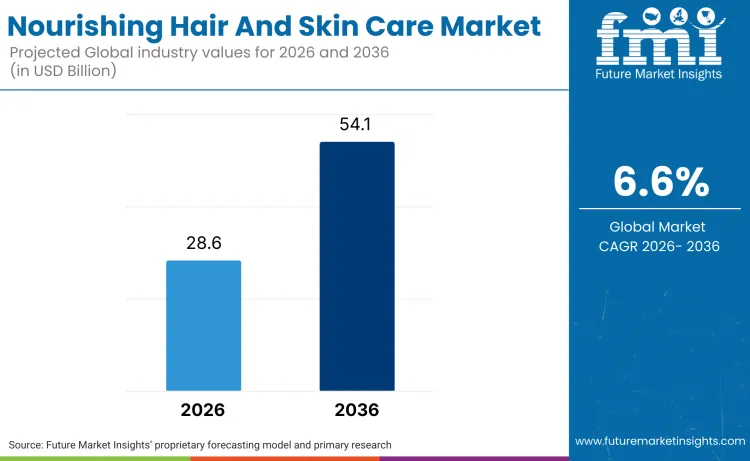
Summary of Nourishing Hair And Skin Care Market
What Is Growth Outlook for Nourishing Hair And Skin Care Market as per Future Market Insights Projection?
Future Market Insights projects the nourishing hair and skin care market to expand at a CAGR of 6.6% from 2026 to 2036, increasing from USD 28.6 Billion in 2026 to USD 54.2 Billion by 2036.
FMI Research Approach: FMI proprietary forecasting model based on natural personal care category growth trajectories, botanical ingredient supply chain analysis, and cross-category nourishing product adoption rates.
How Do FMI Analysts Perceive Nourishing Hair And Skin Care Market to Evolve?
FMI analysts perceive the market evolving toward unified hair-skin care systems where brands formulate multifunctional products using shared botanical ingredient platforms that address both scalp health and facial skin barrier repair through coordinated treatment protocols.
FMI Research Approach: Cross-category innovation patent analysis and holistic wellness trend tracking in personal care product development.
Which Country Holds Largest Share in Global Nourishing Hair And Skin Care Market?
The United States holds a significant share of the global nourishing hair and skin care market by value which is supported by clean beauty movement adoption and premium natural personal care retail infrastructure across specialty stores and e-commerce channels.
FMI Research Approach: FMI country-level revenue modeling by natural personal care penetration rates and botanical ingredient preference data.
How Large Will Nourishing Hair And Skin Care Market Be by 2036?
The global nourishing hair and skin care market is projected to reach USD 54.2 Billion by 2036.
FMI Research Approach: FMI long-term revenue forecast derived from natural ingredient cost curves, clean beauty adoption projections, and cross-category nourishing product line extensions.
What Is Definition of Nourishing Hair And Skin Care Market?
The nourishing hair and skin care market comprises personal care products formulated with botanical oils, plant extracts, vitamins, and proteins designed to restore moisture, repair damage, and strengthen hair and skin barriers through nutrient delivery systems.
FMI Research Approach: FMI market taxonomy and inclusion-exclusion framework aligned with natural personal care industry classification standards.
What Are Globally Unique Trends Shaping Nourishing Hair And Skin Care Market?
Globally unique trends include the integration of Ayurvedic and Traditional Chinese Medicine botanical systems into mainstream formulations, the rise of waterless concentrated nourishment formats that eliminate preservatives, and transparency platforms where brands disclose full ingredient sourcing provenance including farm locations and processing methods.
FMI Research Approach: Traditional medicine integration tracking in commercial personal care formulations and ingredient transparency technology adoption analysis.
Nourishing Hair And Skin Care Market Key Takeaways
| Metric | Details |
| Industry Size (2026) | USD 28.6 Billion |
| Industry Value (2036) | USD 54.1 Billion |
| CAGR (2026-2036) | 6.6% |
Source: Future Market Insights (FMI) analysis, based on proprietary forecasting model and primary research
What Is Driving Wider Adoption of Nourishing Hair and Skin Care Products?
Expectations around everyday nourishment are evolving as hair and skin care products move beyond occasional repair use into regular, preventive routines. According to Future Market Insights, consumers are placing increasing emphasis on ingredient transparency, microbiome-friendly formulations, and barrier-support benefits that avoid harsh surfactants. Earlier natural nourishment formats were often perceived as lifestyle-driven or wellness add-ons, which limited their role in daily personal care. That perception is shifting as botanical oils and plant-based conditioners gain stronger placement within mainstream hair and skin care assortments.
Brand portfolio strategies highlight this transition. Major personal care companies are extending core ranges to include nourishing oils, conditioners, and barrier-repair lotions alongside conventional repair and styling products rather than isolating them within niche natural lines. These products are designed for routine use, compatibility with established hair and skin care steps, and visible comfort outcomes across different skin and scalp types. FMI notes that brands integrating nourishment-led products into core portfolios, supported by evidence-led positioning around barrier health and scalp comfort, are better placed to encourage repeat usage as natural nourishment becomes embedded within everyday personal care routines.
How is the Nourishing Hair And Skin Care Market Segmented?
The nourishing hair and skin care market is structured around product category and distribution channel, reflecting routine personal care usage patterns. By product category, the market is centered on hair nourishment formats such as oils, conditioners, and repair treatments, where visible damage repair and conditioning benefits drive frequent use and stronger consumer value perception. Mass-market hair oils and conditioners contribute a larger share of unit volumes due to wide availability and regular replenishment cycles, while premium natural formulations account for a higher share of value as they achieve stronger price realization through specialty beauty retail. The category is undergoing a crossover shift, with haircare brands extending botanical ingredient platforms into skin nourishment lines, creating unified natural care portfolios. This trend is most apparent within hair oil formats, where shared ingredient systems are being adapted for facial oil serums, supporting operational efficiencies and wider addressable market expansion.
Why does Nourishing Hair Oil hold a Dominant Share?
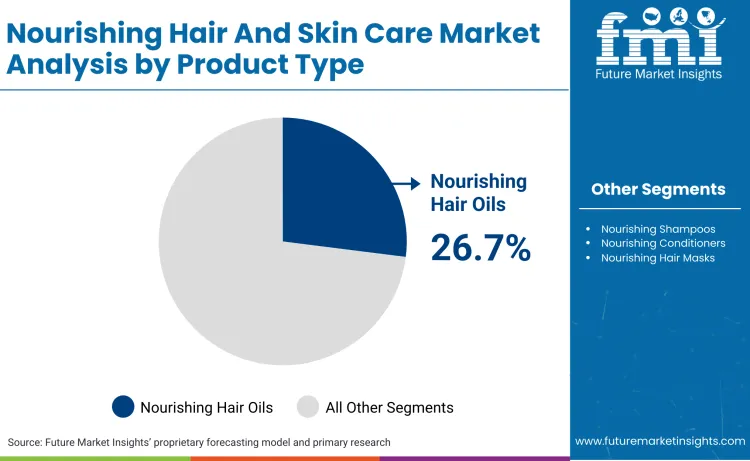
The dominance of nourishing hair oils, capturing 26.7% of the total market, is fueled by universal application across diverse hair types and textures for moisture restoration and damage repair. The International Journal of Trichology published research demonstrating that coconut oil penetrates hair shafts more effectively than mineral oils, providing scientific validation for traditional hair oiling practices. Procter & Gamble's Pantene brand has incorporated natural oils into mainstream formulations, legitimizing botanical hair nourishment for consumers who previously associated oils with specialty natural brands. This broad applicability positions hair oils as entry products that introduce consumers to natural nourishment benefits before they explore targeted treatments like masks and serums.
Why are Natural And Botanical Ingredients the preferred Ingredient Type?
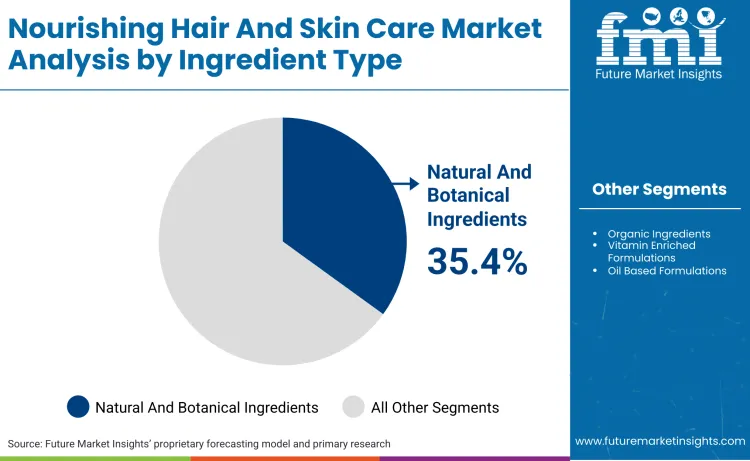
Natural and botanical ingredients maintain 35.4% ingredient share due to consumer perception that plant-derived actives are inherently safer and more sustainable than synthetic alternatives. The term natural lacks regulatory definition in most jurisdictions, allowing brands flexibility in formulation while meeting consumer preference for recognizable plant names on ingredient lists. Unilever's Dove brand reformulation toward plant-based moisturizers demonstrates mainstream adoption of botanical positioning, moving natural ingredients from niche health stores into mass-market distribution channels where volume sales justify botanical ingredient sourcing investments.
Why do Supermarkets And Hypermarkets dominate the Distribution Mix?
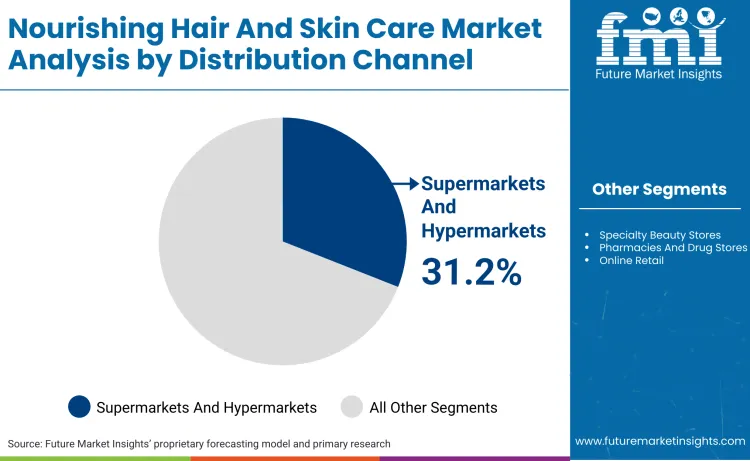
Supermarkets and hypermarkets hold 31.2% distribution share as personal care purchasing remains integrated into routine grocery shopping where consumers restock nourishing products alongside food items. Mass-market retail provides price transparency and promotional frequency that specialty beauty stores cannot match, making natural nourishment accessible to price-sensitive consumers. The integration of natural personal care sections within mainstream supermarkets validates botanical products as everyday essentials rather than luxury indulgences, accelerating category normalization.
What Consumer Behavior Shifts Are Reshaping Nourishing Hair and Skin Care Demand?
The psychology of the consumer has shifted toward seeking multifunctional products that simplify routines, as time-constrained lifestyles prioritize efficacy over ritualistic multi-step regimens. This behavioral shift is driving brands to formulate nourishing products that combine treatment benefits with daily maintenance, eliminating distinctions between damage repair masks and regular conditioners. The trend toward minimalism, where consumers reduce product counts while maintaining care quality, particularly favors concentrated nourishing oils that serve hair, face, and body applications interchangeably.
How are Ingredient Sourcing and Vertical Integration Strategies Influencing Industry Evolution?
Manufacturers are racing to secure direct farm partnerships for botanical ingredients, bypassing commodity traders to document sustainable sourcing and fair-trade compliance. Shiseido's investment in Japanese camellia oil production demonstrates vertical integration strategies that control ingredient quality while supporting rural agricultural communities. The physical package is increasingly serving as an educational medium where brands communicate botanical sourcing stories, processing methods, and traditional cultural heritage through on-pack narratives that differentiate natural products from generic synthetic alternatives.
Why Is Preservative-Free Formulation Becoming a Core Innovation Focus?
The formulation frontier is focused on preservative-free systems where anhydrous oil bases and fermentation-derived natural preservatives eliminate synthetic antimicrobial agents. Johnson & Johnson's research into natural preservation technologies reflects industry commitment to addressing consumer concerns about parabens and formaldehyde-releasing preservatives while maintaining product safety. Brands achieving multi-year shelf stability without synthetic preservatives are capturing premium positioning as next-generation natural formulations that resolve historical trade-offs between natural claims and product performance.
How Will Nourishing Hair And Skin Care Market Expansion Unfold Across Key Global Regions?
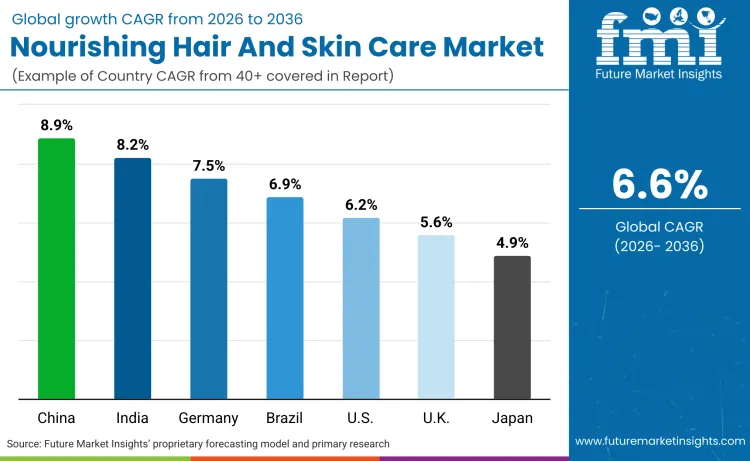
The nourishing hair and skin care market is poised for significant expansion across key global regions, with varying growth rates projected from 2026 to 2036. China leads the way with a CAGR of 8.91%, driven by traditional herbal medicine integration into modern formulations and expanding middle-class demand for premium natural products. India follows at 8.25%, benefiting from Ayurvedic heritage commercialization and domestic botanical ingredient advantages.
Germany records 7.59% growth, reflecting European clean beauty leadership and organic certification infrastructure. Brazil is anticipated to grow at 6.93%, driven by Amazonian botanical biodiversity and regional natural ingredient pride. The United States, with a CAGR of 6.27%, maintains market leadership through clean beauty movement and natural product retail maturity. The United Kingdom at 5.61% and Japan at 4.95% also present steady growth opportunities, fueled by prestige natural beauty segments and traditional botanical usage respectively.
| Country | CAGR (2026 to 2036) |
|---|---|
| China | 8.9% |
| India | 8.2% |
| Germany | 7.5% |
| Brazil | 6.9% |
| United States | 6.2% |
| UK | 5.6% |
| Japan | 4.9% |
Source: Future Market Insights (FMI) analysis, based on proprietary forecasting model and primary research
How is Traditional Medicine Modernization Fueling China's Growth?
China’s 8.91% CAGR positions it as the fastest-growing market for nourishing hair and skin care, supported by strong consumer acceptance of botanical formulations within daily wellness routines. Demand is being shaped by rising interest in traditional ingredient systems adapted for modern personal care, particularly in urban markets where consumers seek visible nourishment benefits with cultural relevance. Nourishing hair oils and skin treatments are commonly used for targeted repair and maintenance, rather than broad routine replacement of conventional products.
Strong e-commerce penetration continues to support category growth, as natural formulations are easy to discover, compare, and reorder through digital platforms. Adoption is being driven more by higher usage frequency of botanical nourishment products and selective upgrading from synthetic formulations for specific hair and skin concerns than by overall population expansion. As consumers prioritize authenticity, efficacy, and heritage-backed ingredients, nourishing care products are becoming a routine component of everyday personal care practices.
Why is Ayurvedic Heritage Commercialization Driving India's Expansion?
India’s 8.25% CAGR reflects growing commercialization of Ayurvedic botanical knowledge into modern nourishing hair and skin care products that combine traditional ingredients with contemporary formulation science. Government support for traditional medicine systems is strengthening credibility for herbal personal care beyond niche wellness segments. Cultural hair oiling practices create strong baseline acceptance for nourishing treatments, reducing adoption barriers for oil-based products. Brands such as Dabur and Patanjali are extending coconut and amla oil ranges into premium variants incorporating botanicals like bhringraj and hibiscus, attracting middle-income consumers trading up from basic oils.
Local sourcing of botanical ingredients supports cost efficiency while reinforcing authenticity claims. Rapid growth of online beauty platforms is improving access to natural hair care beyond major cities, with rising digital discovery supporting trial and repeat purchase. As consumers prioritize heritage-backed efficacy and natural nourishment, botanical hair and skin care products are becoming embedded within routine personal care.
How is Organic Certification Infrastructure Supporting Germany's Growth?
Germany’s 7.59% CAGR is supported by a mature organic cosmetics certification ecosystem, where standards such as BDIH COSMOS Organic and NATRUE provide trusted third-party verification of natural claims. This certification framework strengthens consumer confidence in botanical nourishing products and reduces skepticism around greenwashing. Sales growth in organic personal care reflects rising acceptance of certified natural formulations over conventional alternatives.
Established domestic brands such as Weleda and Dr. Hauschka have built long-standing credibility in natural hair and skin nourishment, creating strong baseline demand and formulation expertise within the local market. Pharmacy-led distribution plays an important role in guiding consumer choice, as professional consultation supports selection of appropriate nourishing products for specific hair and skin concerns. German consumers also show a willingness to pay price premiums for certified organic products, supporting favorable economics for botanical formulations despite higher raw material and sourcing costs.
What Drives Brazil's Amazonian Biodiversity Positioning?
Brazil’s 6.93% CAGR reflects strong positioning around Amazonian botanical biodiversity, which provides domestic brands with distinctive differentiation anchored in regional ingredient heritage. Demand for natural personal care products is supporting premiumization, with formulations featuring Amazonian botanicals achieving higher price realization than conventional alternatives. Brands that secure sustainable sourcing from forest-based supply chains benefit from favorable consumer perception linked to conservation and community partnership narratives.
Natura &CO has strengthened transparency by sourcing ingredients such as cupuaçu butter, babassu oil, and Brazil nut oil through cooperative networks, reinforcing sustainability positioning. Regulatory frameworks protecting traditional knowledge while enabling commercial use of biodiversity reduce legal uncertainty for botanical product development. Expansion of prestige beauty retail across major urban centers is improving access to premium natural nourishing products, exposing broader consumer segments to botanical-based hair and skin care formats previously limited to niche specialty channels.
How Does the USA's Clean Beauty Movement Support 6.27% Growth?
The U.S. market is expanding at a 6.27% CAGR, supported by strong momentum in clean beauty, where major retail partners apply restricted ingredient standards that favor botanical nourishing formulations. Programs such as Sephora’s Clean at Sephora are shaping shelf eligibility, encouraging brands to avoid controversial synthetics and strengthen natural positioning. Demand for natural personal care continues to rise, with hair oils and leave-in treatments showing strong growth within nourishing care routines.
This consumer awareness supports higher price realization for brands that clearly communicate ingredient function and sourcing transparency across mass and prestige channels. Direct-to-consumer brands are strengthening adoption by using digital education to explain botanical benefits and usage methods, building loyalty through content-led engagement. Ongoing industry efforts to standardize natural ingredient definitions are expected to improve clarity around clean beauty claims, supporting broader mainstream adoption of botanical hair and skin care formats.
What Strategic Moves Are Defining Competitive Landscape?
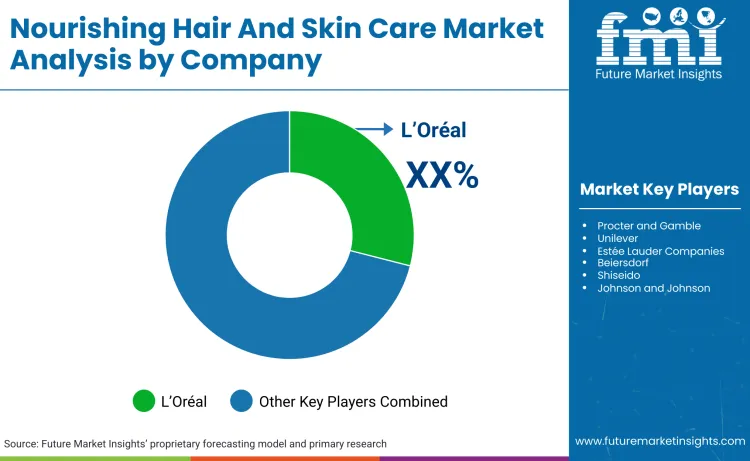
The competitive landscape is experiencing vertical integration as major beauty conglomerates acquire botanical ingredient suppliers to secure transparent supply chains and control sourcing narratives that increasingly influence consumer purchasing decisions. Manufacturers are investing in direct farm partnerships that bypass commodity ingredient markets, enabling brands to document specific harvest locations and farming practices that validate natural positioning claims through verifiable provenance. The operational reality is defined by the need to educate consumers on botanical ingredient benefits and application techniques unfamiliar from conventional synthetic personal care usage.
Supply chain strategies are shifting toward regional sourcing where brands partner with local farmers to secure indigenous botanicals while supporting economic development narratives that resonate with conscious consumers. Margin dynamics favor concentrated nourishing formats where oil-rich formulations command premium per-ounce pricing while eliminating water-related preservation costs, creating profitability advantages over conventional diluted products despite higher botanical ingredient expenses.
Recent Developments:
- In March 2023, L'Oreal Group launched a botanical sourcing transparency platform providing consumers with ingredient origin documentation including farm locations and harvest methods for key natural actives.
- In July 2023, Procter & Gamble announced expansion of its Herbal Essences bio:renew line to incorporate Ayurvedic botanicals including amla and shikakai in partnership with Indian agricultural cooperatives.
- In November 2023, Unilever completed acquisition of a Brazilian botanical ingredient supplier specializing in Amazonian oils to vertically integrate supply chains for its Dove and TRESemmé natural ranges.
Key Players in Nourishing Hair And Skin Care Market
-
L'Oreal S.A.
- Procter and Gamble Co.
- Unilever PLC
- Estee Lauder Companies Inc.
- Beiersdorf AG
- Shiseido Company Ltd.
- Johnson and Johnson Consumer Inc.
- Kao Corporation
- Henkel AG & Co. KGaA
- Coty Inc.
Market Definition
The nourishing hair and skin care market represents revenue generated from personal care products formulated with botanical oils, plant extracts, vitamins, proteins, and natural moisturizers designed to restore hair moisture and shine, repair damage, strengthen barriers, and improve skin hydration through nutrient delivery. The market measures the value of hair oils, shampoos, conditioners, masks, skin creams, body lotions, and serums sold through mass-market, specialty, pharmacy, and online channels to consumers seeking natural nourishment solutions.
Inclusions cover nourishing hair oils for moisture restoration, natural shampoos and conditioners with botanical cleansing and conditioning agents, intensive hair masks and treatments, nourishing skin creams and body lotions, and facial serums delivering concentrated plant-derived actives. It encompasses formulations using natural and botanical ingredients including plant oils (coconut, argan, jojoba), organic certified botanicals, vitamin enriched formulations (B5, E, C), oil-based delivery systems, and protein and peptide based formulations from plant and biotechnology sources. Distribution through supermarkets, hypermarkets, specialty beauty stores, pharmacies, online retail, and direct-to-consumer channels is included when products target nourishing and restoration benefits.
Exclusions include conventional synthetic hair care and skincare products marketed primarily on cleansing or styling benefits rather than nourishment and restoration. Professional salon services and treatments are outside scope. Medical dermatology prescription products for disease treatment are excluded. Hair coloring and chemical treatment products are not included even when formulated with some botanical ingredients. Generic moisturizers without specific nourishing or damage repair positioning fall outside market definition.
Scope of Report
| Items | Values |
|---|---|
| Quantitative Units (2026) | USD 28.6 Billion |
| Product Type | Nourishing Hair Oils; Nourishing Shampoos; Nourishing Conditioners; Nourishing Hair Masks; Nourishing Skin Creams; Nourishing Body Lotions; Nourishing Serums |
| Ingredient Type | Natural and Botanical Ingredients; Organic Ingredients; Vitamin-Enriched Formulations; Oil-Based Formulations; Protein and Peptide-Based Formulations |
| Distribution Channel | Supermarkets and Hypermarkets; Specialty Beauty Stores; Pharmacies and Drug Stores; Online Retail; Direct-to-Consumer |
| End User | Women; Men; Unisex |
| Regions Covered | North America, Europe, Asia Pacific, Latin America, Middle East & Africa |
| Countries Covered | United States, Germany, United Kingdom, India, China, Brazil, and 40+ countries |
| Key Companies Profiled | L’Oréal; Procter & Gamble; Unilever; Estée Lauder Companies; Beiersdorf; Shiseido; Johnson & Johnson; Kao Corporation; Others |
| Additional Attributes | Dollar sales by product type, ingredient type, distribution channel, and end user; country-wise growth analysis; adoption trends for botanical and multifunctional nourishing formats; application patterns across hair oils, conditioners, masks, and skin care; competitive positioning across mass, premium, and dermatology-aligned personal care channels |
Key Segments
By Product Type:
- Nourishing Hair Oils
- Nourishing Shampoos
- Nourishing Conditioners
- Nourishing Hair Masks
- Nourishing Skin Creams
- Nourishing Body Lotions
- Nourishing Serums
By Ingredient Type:
- Natural And Botanical Ingredients
- Organic Ingredients
- Vitamin Enriched Formulations
- Oil Based Formulations
- Protein And Peptide Based Formulations
By Distribution Channel:
- Supermarkets And Hypermarkets
- Specialty Beauty Stores
- Pharmacies And Drug Stores
- Online Retail
- Direct To Consumer
By End User:
- Women
- Men
- Unisex
By Region:
- North America (United States, Canada, Mexico)
- Europe (Germany, France, United Kingdom, Italy, Spain, BENELUX, Nordics)
- East Asia (China, Japan, South Korea)
- South Asia (India, Australia & New Zealand, Southeast Asia)
- Latin America (Brazil, Chile, Colombia, Argentina)
- Middle East & Africa
Bibliography
- China Association of Traditional Chinese Medicine. (2023). Herbal Cosmetics Market Report 2023. CATCM.
- India Brand Equity Foundation. (2024). Natural and Organic Personal Care Market Report. Government of India, Ministry of Commerce and Industry.
- German Federal Ministry of Food and Agriculture. (2023). Organic Personal Care Sales Statistics 2023. BMEL.
- Brazilian Association of Personal Hygiene, Perfumes and Cosmetics. (2023). ABIHPEC Natural Personal Care Report 2023. ABIHPEC.
- SPINS LLC. (2023). U.S. Natural Personal Care Market Report 2023. SPINS.
- Japan Cosmetic Industry Association. (2023). Japanese Hair Care Market Statistics 2023. JCIA.
Frequently Asked Questions
What is the current global market size for nourishing hair and skin care?
The global market is valued at USD 28.6 Billion in 2026, driven by consumer demand for natural botanical formulations and multifunctional products addressing both hair and skin nourishment.
What is the projected Compound Annual Growth Rate (CAGR) for the market over the next 10 years?
The market is projected to grow at 6.6% CAGR from 2026 to 2036, reaching USD 54.2 Billion by 2036.
Which regions are experiencing the fastest expansion?
China leads with 8.91% growth, followed closely by India at 8.25% and Germany at 7.59%, driven by traditional medicine integration, Ayurvedic heritage, and organic certification infrastructure respectively.
What are the primary market drivers?
Legislative pressure on synthetic ingredient disclosure and consumer awareness of hair and skin microbiome health are fueling adoption of botanical nourishment products across mass-market and premium tiers.
Who are the leading suppliers in the industry?
L'Oreal S.A., Procter and Gamble, Unilever, Estee Lauder Companies, and Beiersdorf are key players, differentiating through botanical ingredient sourcing transparency, natural formulation innovation, and cross-category product platforms.
Preview the report firsthand - request a free sample
Get SampleGet the brochure for pricing and purchase details.
Get PDFTable of Content
- Executive Summary
- Global Market Overview
- Key Demand Drivers
- Ingredient and Supply Chain Shifts
- Strategic Implications
- Market Introduction
- Market Definition
- Market Scope and Coverage
- Market Taxonomy
- Research Methodology
- Report Structure and Chapter Orientation
- FMI Research Framework
- Market Sizing Methodology
- Forecasting Assumptions
- Primary and Secondary Research Inputs
- Data Validation and Triangulation
- Market Background
- Industry Dynamics
- Drivers
- Restraints
- Opportunities
- Trends
- Value Chain Analysis
- Supply Chain and Sourcing Assessment
- Regulatory and Sustainability Landscape
- Pricing and Cost Structure Analysis
- Industry Dynamics
- Global Nourishing Hair and Skin Care Market Analysis 2021 to 2025 and Forecast 2026 to 2036
- Market Size Value Analysis (USD Billion)
- Y-o-Y Growth Analysis
- Absolute Dollar Opportunity Analysis
- Global Nourishing Hair and Skin Care Market Analysis by Product Type
- Nourishing Hair Oils
- Nourishing Shampoos
- Nourishing Conditioners
- Nourishing Hair Masks
- Nourishing Skin Creams
- Nourishing Body Lotions
- Nourishing Serums
- Global Nourishing Hair and Skin Care Market Analysis by Ingredient Type
- Natural and Botanical Ingredients
- Organic Ingredients
- Vitamin-Enriched Formulations
- Oil-Based Formulations
- Protein and Peptide-Based Formulations
- Global Nourishing Hair and Skin Care Market Analysis by Distribution Channel
- Supermarkets and Hypermarkets
- Specialty Beauty Stores
- Pharmacies and Drug Stores
- Online Retail
- Direct-to-Consumer
- Global Nourishing Hair and Skin Care Market Analysis by End User
- Women
- Men
- Unisex
- Global Nourishing Hair and Skin Care Market Analysis by Region
- North America
- Europe
- Asia Pacific
- Latin America
- Middle East & Africa
- North America Nourishing Hair and Skin Care Market Analysis
- United States
- Canada
- Mexico
- Europe Nourishing Hair and Skin Care Market Analysis
- Germany
- United Kingdom
- France
- Italy
- Spain
- BENELUX
- Nordics
- Rest of Europe
- Asia Pacific Nourishing Hair and Skin Care Market Analysis
- China
- India
- Japan
- South Korea
- Southeast Asia
- Australia and New Zealand
- Latin America Nourishing Hair and Skin Care Market Analysis
- Brazil
- Chile
- Colombia
- Argentina
- Rest of Latin America
- Middle East & Africa Nourishing Hair and Skin Care Market Analysis
- Competitive Landscape
- Market Share Analysis
- Competitive Dashboard
- Strategic Initiatives and Developments
- Company Profiles
- L’Oréal S.A.
- Procter & Gamble Co.
- Unilever PLC
- Estée Lauder Companies Inc.
- Beiersdorf AG
- Shiseido Company Ltd.
- Johnson & Johnson Consumer Inc.
- Kao Corporation
- Henkel AG & Co. KGaA
- Coty Inc.
- Others
- Assumptions and Acronyms


