

- Market Size (2026)
- USD 372.4 Mn
- Forecast (2036)
- USD 705.6 Mn
- CAGR (2026 to 2036)
- 6.6%
How big is the heat protectant sprays market in 2026?
The heat protectant sprays market at USD 372.4 million in 2026, up from an estimated USD 349.3 million in 2025. Sales are forecast to reach USD 705.6 million by 2036, growing at a 6.6% CAGR.
FMI values the heat protectant sprays market at USD 372.4 million in 2026, up from an estimated USD 349.3 million in 2025. Sales are forecast to reach USD 705.6 million by 2036, growing at a 6.6% CAGR. Frequent blow-drying, straightening, and curling create a recurring reason to use thermal protection. Laboratory research published in the Journal of Cosmetic Science found substantial keratin damage from flat ironing above 200°C and showed that selected polymer pretreatments reduced thermal degradation and breakage. [1] Products that combine protection with a useful finish can turn this prevention need into repeat purchases.
Heat protection sits alongside the wider hair styling products market, where consumers choose formulas for hold, smoothness, volume, and shine. The UAE, Saudi Arabia, and South Korea are likely to grow at brisk pace owing to climatic conditions. In the US and Europe, established online shopping and beauty retail give suppliers several routes to reach buyers. Across these markets, texture and ease of application influence whether a product stays in the routine.
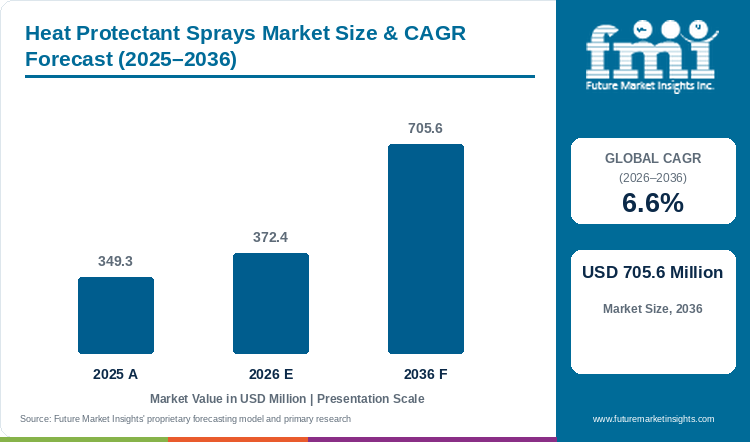
Heat Protectant Sprays Market Size & CAGR Forecast (2025-2036)
| Year | Basis | Market value (USD million) |
|---|---|---|
| 2025 | Estimate | 349.3 |
| 2026 | Estimate | 372.4 |
| 2036 | Forecast | 705.6 |
| CAGR, 2026 to 2036 | 6.6% | |
Source: Future Market Insights proprietary forecasting model and primary research.
Key Takeaways
- Core / classic lines lead product type with a 34.0% share in 2026. A direct thermal-protection claim makes their purpose clear before blow-drying or hot-tool styling.
- Conventional products account for 54.0% of nature demand, supported by familiar formulations and availability across price tiers.
- Cream & balm formats hold a 36.0% share, combining conditioning with controlled application to lengths and ends.
- Mass products represent 35.0% of price-positioning demand, while e-commerce & DTC leads individual sales channels at 25.0%.
- The UAE leads country growth at 7.8% CAGR, followed by Saudi Arabia at 7.5% and South Korea at 7.2%.
Analyst Perspective
A temperature claim gives buyers a reason to try a protectant. The finish gives them a reason to buy it again. Suppliers need to make coverage and dosage clear, especially when adding repair, hydration, or volume benefits that can change how a formula feels on the hair.
- Rahul Pandita, Principal Consultant, Future Market Insights.
How is the heat protectant sprays market segmented?
The market covers product type, nature, format, price positioning, and sales channel.
The Heat Protectant Sprays Market is segmented by Product Type into Core / Classic Lines, Targeted Treatment Lines, Sensitive & Gentle Lines, Premium & Clinical Lines and Kits & Sets; by Nature into Conventional, Vegan & Cruelty-Free, Natural & Organic, Dermocosmetic / Clinical and Fragrance-Free & Sensitive; by Format into Cream & Balm, Liquid & Serum, Stick & Solid, Spray & Mist, Sheet & Patch and Powder; by Price Positioning into Mass, Masstige, Premium and Professional; and by Sales Channel into E-commerce & DTC, Specialty Beauty Retail, Pharmacies & Drugstores, Supermarkets & Hypermarkets and Salons & Spas.
Why do Core / Classic Lines lead demand within the Product Type category?
Core / Classic Lines account for 34.0% of Product Type demand in 2026.
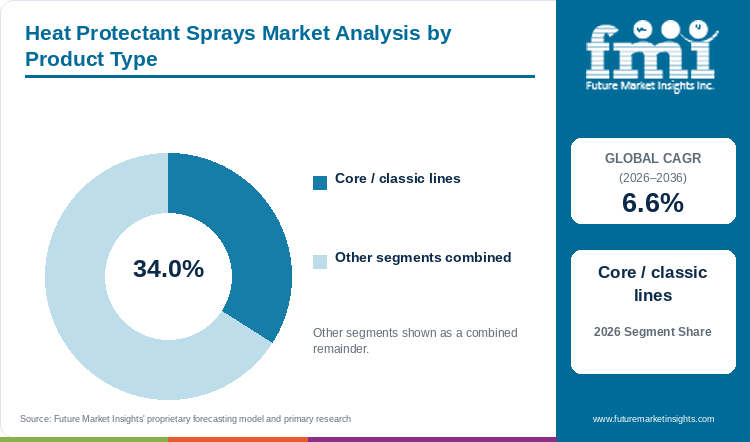
| Product type | Share (2026) |
|---|---|
| Core / Classic Lines | 34.0% |
| Other segments combined | 66.0%* |
| Total | 100.0% |
| Metric | Value |
|---|---|
| Global CAGR (2026 to 2036) | 6.6% |
| Leading segment | Core / Classic Lines |
The category is also adding more care benefits. Henkel introduced Schwarzkopf taft Aloe Boost Hydra Protect in February 2026 with heat protection up to 230°C plus aloe vera and a glycerin complex. [19] Hydration adds another reason to use the product without changing the familiar pre-styling routine.
- Core / Classic Lines account for 34.0% of Product Type demand in 2026.
Why do Conventional Products lead demand within the Nature category?
Conventional Products account for 54.0% of Nature demand in 2026.
Their lead comes from the flexibility formulators have when building protection, conditioning and styling performance into the same product. Film-forming polymers can help reduce heat damage while conditioning agents improve slip and softness. This gives brands more room to adjust the formula for fine, dry or chemically treated hair without changing the basic purpose of the product.
- Performance remains important because a heat protectant has to work repeatedly within an existing styling routine.
- Laboratory research has shown that selected polymer pretreatments can reduce thermal degradation during flat ironing. Consumers may also look for vegan, natural or fragrance-free positioning. These preferences matter most when the product still spreads evenly and leaves the hair with an acceptable finish.
What are the drivers, restraints, and opportunities in the heat protectant sprays market?
Repeated heat styling drives demand for protection, poor application feel can limit repeat use and multifunctional formulas create room for growth through added benefits such as conditioning, frizz control and volume.
- Driver: repeated use of dryers and hot tools creates a recurring need for protection before styling.
- Restraint: residue, uneven application, and an unsuitable finish can discourage regular use.
- Opportunity: formulas that combine protection with conditioning, frizz control, or volume can address several styling needs in one application.
Thermal exposure gives the category a functional basis. A hair-dryer study published in Annals of Dermatology found that surface damage increased as drying temperature rose. [2] For suppliers, the commercial opportunity depends on making a preventive step easy to repeat each time a consumer styles with heat.
Application conditions also matter. Research on water and heat-styling damage found that water-based and ethanol-based protectant sprays reduced a marker of thermal damage, while moisture affected structural outcomes under the study conditions. [3] Instructions therefore need to explain whether a product is intended for damp or dry hair and how it should be distributed. Fragrance, tack, drying time, and heaviness can all influence acceptance after the first use.
Multifunctional formulas offer room for differentiation. Henkel’s taft x GLISS Blow-dry Volume Mist combines a stated protection limit of 230°C with volume positioning, while Olaplex’s Volumizing Blow Dry Mist pairs volume with thermal protection up to 450°F/232°C. [20] [21] These propositions address an outcome the buyer already wants from styling. The added benefit needs to remain compatible with the desired texture and finish.
Which country CAGRs are profiled in the Heat Protectant Sprays Market Report?
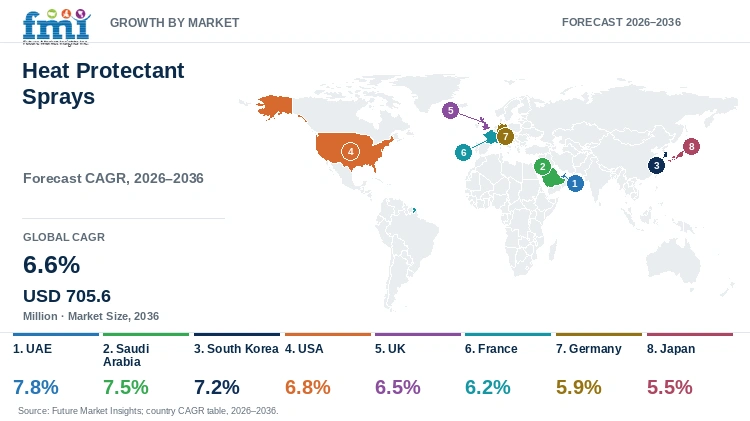
| Country | CAGR, 2026-2036 |
|---|---|
| UAE | 7.8% |
| Saudi Arabia | 7.5% |
| South Korea | 7.2% |
| USA | 6.8% |
| UK | 6.5% |
| France | 6.2% |
| Germany | 5.9% |
| Japan | 5.5% |
Country-wise Analysis
- UAE: Digital retail is giving heat protectant brands more ways to reach buyers in the UAE. Federal Decree-Law No. 14 of 2023 covers trade conducted through websites, apps, social platforms and digital marketplaces. That matters for a category where demonstrations can show how a spray is applied and what finish it leaves on the hair. The UAE is expected to grow at 7.8% CAGR from 2026 to 2036, with clear product instructions and reliable fulfillment supporting repeat purchases.
- Saudi Arabia: Electronic payments already account for most retail transactions in Saudi Arabia. The Saudi Central Bank reported an 85% share in 2025, making both online and store-based purchasing easier. Cosmetic products also need to move through the SFDA notification process. Against that backdrop, the market carries a 7.5% CAGR through 2036. Products with an easy-to-understand benefit such as smoothness or volume are easier for buyers to compare with their existing hair-care routine.
- South Korea: Online cosmetics sales are already growing strongly in South Korea. The Ministry of Trade, Industry and Energy reported double-digit growth among major retailers in April 2025. This gives brands room to explain texture, finish and hair-type suitability through product pages and styling content. The country has a 7.2% CAGR forecast from 2026 to 2036, and products aimed at damaged lengths or fine hair can stand out when the application and expected result are clear.
- USA: Heat protectants have access to a wide mix of mass retail, specialty beauty stores, salons and brand websites in the USA. E-commerce represented 16.4% of total retail sales in 2025, according to the U.S. Census Bureau. L’Oréal Paris Dream Lengths Heat Slayer and Aussie Total Miracle Heat Protecting Spray show the breadth of dedicated consumer options already on the market. The USA carries a 6.8% CAGR through 2036, with repeat sales depending on a recognizable styling benefit and simple instructions.
- UK: Online purchasing is deeply established in the UK. ONS found that online transactions accounted for 50.5% of consumer card spending in September 2025. This supports discovery and replenishment through digital channels while drugstores and beauty retailers remain important. Products sold in Great Britain also need a Responsible Person and must meet cosmetic safety and notification requirements. The UK is forecast to grow at 6.5% CAGR from 2026 to 2036, so brands need both clear product information and a practical styling benefit at the point of purchase.
Who are the notable companies in the heat protectant sprays market?
Kao Corporation, L’Oréal, Unilever, Henkel, Procter & Gamble, Wella Company, and Olaplex
These companies supply dedicated thermal-protection products. Their offers range from mass sprays to treatment-oriented leave-ins. Amorepacific’s serum customization and Church & Dwight’s broader hair-care participation form part of the wider competitive context.
Shiseido Professional belongs within Henkel’s professional hair portfolio following the acquisition of the business. [27] Its WONDER SHIELD routine uses blow-drying heat to activate a shielding film, adding a different treatment mechanism to the professional hair-care offer. [26]
Competitive Benchmarking: Heat Protectant Sprays Market
| Company | Representative offering | Product positioning |
|---|---|---|
| Kao Corporation | John Frieda Frizz Ease Heat Defeat Protecting Spray | Heat protection up to 230°C, with smoothing and frizz-control positioning. [14] |
| L’Oréal | Elvive Dream Lengths Heat Slayer | Dedicated pre-iron leave-in spray for heat styling. [16] |
| Unilever | TRESemmé Keratin Smooth Weightless Heat Protect Spray | Thermal protection with a lightweight smoothing proposition. [17] |
| Henkel | Schwarzkopf taft Aloe Boost Hydra Protect | Heat protection up to 230°C combined with hydration. [19] |
| Olaplex | Volumizing Blow Dry Mist | Volume and reparative blow-dry positioning with heat protection up to 450°F/232°C. [21] |
| Procter & Gamble | Aussie Total Miracle Heat Protecting Spray | Dedicated consumer heat-protection spray with softness and shine benefits. [22] |
| Wella Company | Ultimate Repair Protective Leave-In | Cream-serum with heat protection up to 230°C, frizz control, and breakage benefits. [24] |
Key Developments in the Heat Protectant Sprays Market
- Henkel introduced taft Aloe Boost Hydra Protect in Germany in February 2026. The 150 ml spray offers heat protection up to 230°C and combines aloe vera with a glycerin complex in a vegan formula.
- Kao Corporation refreshed the John Frieda brand globally in January 2026. The relaunch included reformulated products and a clearer focus on individual hair concerns and styling routines.
- Henkel added taft x GLISS Blow-dry Volume Mist to its range in August 2024. The product combines heat protection up to 230°C with volume and care benefits.
- Wella Professionals introduced Ultimate Repair in April 2023 as a repair-focused hair-care range. Its Protective Leave-In uses a cream-serum format and combines thermal protection with smoothing benefits.
Key Players in the Heat Protectant Sprays Market
Consumer and professional thermal-protection suppliers
- Kao Corporation
- L’Oréal
- Unilever
- Henkel
- Procter & Gamble
- Wella Company
- Olaplex
Wider hair-care and treatment participants
- Amorepacific
- Church & Dwight
Heat Protectant Sprays Market - Report Scope
| Coverage field | Report scope |
|---|---|
| Market breakdown | Product type; nature; format; price positioning; sales channel; country |
| Quantitative units | USD million |
| Market definition | Revenue from leave-in hair products explicitly positioned for thermal protection, including sprays and other formats within the segmentation. Heat-styling appliances, salon service fees, general styling or conditioning products without thermal-protection positioning, and repair-only products are excluded. |
| Countries analyzed | USA; Germany; France; UK; Saudi Arabia; UAE; Japan; South Korea |
| Companies covered | Kao Corporation; L’Oréal; Church & Dwight; Unilever; Henkel, including Shiseido Professional; Amorepacific; Olaplex; Procter & Gamble; Wella Company |
| Forecast period | 2026-2036 |
| Research approach | Primary and secondary research with market triangulation |
Heat Protectant Sprays Market - Research Methodology
| Method | Approach |
|---|---|
| Primary research | Manufacturer, distributor, end-user, procurement, and specialist input on product selection, pricing, adoption barriers, and repeat purchasing. |
| Desk research | Government statistics, regulatory publications, technical literature, company filings, product information, and official announcements. |
| Market sizing and forecasting | Analysis of market value, segment structure, pricing and volume indicators, adoption, and country demand conditions, with estimates reconciled across the market. |
| Data validation | Comparison of demand indicators, company activity, and research findings within the defined product scope, with overlapping revenues removed. |
Heat Protectant Sprays Market by Segments
Product Type
- Core / classic lines
- Targeted treatment lines
- Sensitive & gentle lines
- Premium & clinical lines
- Kits & sets
Nature
- Conventional
- Vegan & cruelty-free
- Natural & organic
- Dermocosmetic / clinical
- Fragrance-free & sensitive
Format
- Cream & balm
- Liquid & serum
- Stick & solid
- Spray & mist
- Sheet & patch
- Powder
Price Positioning
- Mass
- Masstige
- Premium
- Professional
Sales Channel
- E-commerce & DTC
- Specialty beauty retail
- Pharmacies & drugstores
- Supermarkets & hypermarkets
- Salons & spas
Heat Protectant Sprays Market by Region
- North America
- United States
- Canada
- Latin America
- Brazil
- Mexico
- Argentina
- Chile
- Western Europe
- Germany
- France
- United Kingdom
- Italy
- Spain
- Benelux
- Nordics
- Eastern Europe
- Poland
- Czech Republic
- Romania
- Hungary
- East Asia
- China
- Japan
- South Korea
- South Asia and Pacific
- India
- ASEAN
- Australia and New Zealand
- Middle East and Africa
- GCC Countries
- South Africa
- Türkiye
- Israel
Research Sources and Bibliography
- [1] Journal of Cosmetic Science (2011). The effect of various cosmetic pretreatments on protecting hair from thermal damage by hot flat ironing.
- [2] Annals of Dermatology (2011). Hair shaft damage from heat and drying time of hair dryer.
- [3] Journal of Cosmetic Science (2011). The effects of water on heat-styling damage.
- [4] European Union (2023, July 26). Commission Regulation (EU) 2023/1545 on the labelling of fragrance allergens in cosmetic products.
- [5] European Commission (n.d.). Fragrance allergens labelling.
- [6] U.S. Census Bureau (2026, March 10). Quarterly Retail E-Commerce Sales, 4th Quarter 2025.
- [7] INSEE (2025, October 14). Achats de produits et de services en ligne.
- [8] Office for National Statistics (2026, February 6). Consumer card spending, e-commerce and digital trade insights in the UK: 2019 to 2025.
- [9] Saudi Central Bank (2026, April 12). SAMA: E-Payments Account for 85% of Total Retail Payments in 2025.
- [10] Saudi Food and Drug Authority (n.d.). Guidance of Regulations and Requirements for Cosmetic Products Notification.
- [11] UAE Government (2023). Federal Decree by Law No. 14 of 2023 Concerning the Modern Technology-Based Trade.
- [12] Ministry of Trade, Industry and Energy, Republic of Korea (2025, May 28). Korea’s retail industry grows 7.0% in April.
- [13] Ministry of Economy, Trade and Industry, Japan (2025, August 26). Results of FY2024 E-Commerce Market Survey Compiled.
- [14] Kao Corporation (n.d.). Heat Defeat Protecting Spray.
- [15] Kao Corporation (2026, January 7). John Frieda Reimagined with Striking Global Brand Relaunch.
- [16] L’Oréal (n.d.). Elvive Dream Lengths Heat Slayer Leave In.
- [17] TRESemmé (n.d.). Keratin Smooth Weightless Heat Protect Spray.
- [18] Unilever (2025, October 23). Q3 2025 results: video transcript.
- [19] Henkel (2026, February 1). Styling trifft auf Pflege: Schwarzkopf präsentiert zwei neue Hybridinnovationen.
- [20] Henkel (2024, August 9). Doppelte Power: die neuen Styling- und Pflegeprodukte von taft x Gliss.
- [21] Olaplex (n.d.). Volumizing Blow Dry Mist.
- [22] Aussie, Procter & Gamble (n.d.). Total Miracle Heat Protecting Spray.
- [23] Wella Professionals (2023, April 18). Say Goodbye to Bad Hair Days With Ultimate Repair.
- [24] Wella Professionals (n.d.). Ultimate Repair Protective Leave-In.
- [25] Amorepacific (2026, June 1). Mise-en-Scène Perfect Serum Bespoke.
- [26] Shiseido Professional (n.d.). WONDER SHIELD.
- [27] Henkel (2023, October 11). Henkel celebrates 40 years of pioneering in Singapore.
- [28] UK Government (n.d.). Making cosmetic products available to consumers in Great Britain.
This Report Answers
- How large is the market in 2026, and what value is forecast for 2036?
- Which styling habits and purchasing channels support demand?
- Why do core / classic lines and conventional products lead their categories?
- What supports the leading share of cream & balm formats?
- How do country growth rates compare?
- How do supplier products differ in protection, finish, and format?
- What limits repeat purchasing?
- Where do multifunctional products offer room for growth?
Frequently Asked Questions
How big is the heat protectant sprays market in 2026, and what is forecast for 2036?
The market is valued at USD 372.4 million in 2026 and is forecast to reach USD 705.6 million by 2036.
What is the market CAGR from 2026 to 2036?
The forecast CAGR is 6.6%.
Which product type leads the market?
Core / classic lines lead with a 34.0% share in 2026.
Which nature segment leads the market?
Conventional products account for 54.0% of nature demand in 2026.
Which countries have the highest forecast growth rates?
The UAE leads at 7.8%, followed by Saudi Arabia at 7.5% and South Korea at 7.2% CAGR from 2026 to 2036.
Which companies supply thermal-protection products?
Suppliers include Kao Corporation, L’Oréal, Unilever, Henkel, Procter & Gamble, Wella Company, and Olaplex.
Preview the report firsthand - request a free sample
Get SampleGet the brochure for pricing and purchase details.
Get PDFTable of Content
- Key Takeaways
- Market Size and CAGR
- Top Growth Driver
- Fastest Growing Segment
- Leading Region
- Key Companies
- Emerging Opportunities
- Executive Summary
- Global Market Outlook
- Demand-side Trends
- Supply-side Trends
- Technology Roadmap Analysis
- Analysis and Recommendations
- Analyst Perspective (What is happening? Why now? What should investors know?)
- Key Questions Answered
- How large is the market?
- What is the CAGR?
- What are key trends?
- Which region dominates?
- Who are the leaders?
- Market Overview
- Market Coverage / Taxonomy
- Market Definition / Scope / Limitations
- Research Methodology
- Chapter Orientation
- Analytical Lens and Working Hypotheses
- Market Structure, Signals, and Trend Drivers
- Benchmarking and Cross-market Comparability
- Market Sizing, Forecasting, and Opportunity Mapping
- Research Design and Evidence Framework
- Desk Research Programme (Secondary Evidence)
- Expert Input and Fieldwork (Primary Evidence)
- Tooling, Models, and Reference Databases
- Data Engineering and Model Build
- Quality Assurance and Audit Trail
- Market Background
- Market Dynamics (Drivers, Restraints, Opportunity, Trends)
- Scenario Forecast (Optimistic, Likely, Conservative)
- Impact Analysis
- AI Impact
- Sustainability Impact
- Regulatory Impact
- Technology Impact
- Consumer / Buyer Analysis
- Purchase Drivers
- Adoption Barriers
- Buyer Journey
- Opportunity Map Analysis
- Product Life Cycle Analysis
- Supply Chain Analysis
- Investment Feasibility Matrix
- Value Chain Analysis
- PESTLE and Porter's Analysis
- Regulatory Landscape
- Regional Parent Market Outlook
- Production and Consumption Statistics
- Import and Export Statistics
- Global Market Analysis and Forecast, 2021 to 2036
- Historical Market Size Value (USD Million) Analysis, 2021 to 2025
- Current and Future Market Size Value (USD Million) Projections, 2026 to 2036
- Y-o-Y Growth Trend Analysis
- Absolute $ Opportunity Analysis
- Global Market Pricing Analysis, 2021 to 2036
- Global Market Analysis and Forecast, By Product Type, 2021 to 2036
- Introduction / Key Findings
- Historical Market Size Value (USD Million) Analysis By Product Type, 2021 to 2025
- Current and Future Market Size Value (USD Million) Analysis and Forecast By Product Type, 2026 to 2036
- Core / classic lines
- Targeted treatment lines
- Sensitive & gentle lines
- Premium & clinical lines
- Kits & sets
- Y-o-Y Growth Trend Analysis By Product Type, 2021 to 2025
- Absolute $ Opportunity Analysis By Product Type, 2026 to 2036
- Global Market Analysis and Forecast, By Nature, 2021 to 2036
- Introduction / Key Findings
- Historical Market Size Value (USD Million) Analysis By Nature, 2021 to 2025
- Current and Future Market Size Value (USD Million) Analysis and Forecast By Nature, 2026 to 2036
- Conventional
- Vegan & cruelty-free
- Natural & organic
- Dermocosmetic / clinical
- Fragrance-free & sensitive
- Y-o-Y Growth Trend Analysis By Nature, 2021 to 2025
- Absolute $ Opportunity Analysis By Nature, 2026 to 2036
- Global Market Analysis and Forecast, By Format, 2021 to 2036
- Introduction / Key Findings
- Historical Market Size Value (USD Million) Analysis By Format, 2021 to 2025
- Current and Future Market Size Value (USD Million) Analysis and Forecast By Format, 2026 to 2036
- Cream & balm
- Liquid & serum
- Stick & solid
- Spray & mist
- Sheet & patch
- Powder
- Y-o-Y Growth Trend Analysis By Format, 2021 to 2025
- Absolute $ Opportunity Analysis By Format, 2026 to 2036
- Global Market Analysis and Forecast, By Price Positioning, 2021 to 2036
- Introduction / Key Findings
- Historical Market Size Value (USD Million) Analysis By Price Positioning, 2021 to 2025
- Current and Future Market Size Value (USD Million) Analysis and Forecast By Price Positioning, 2026 to 2036
- Mass
- Masstige
- Premium
- Professional
- Y-o-Y Growth Trend Analysis By Price Positioning, 2021 to 2025
- Absolute $ Opportunity Analysis By Price Positioning, 2026 to 2036
- Global Market Analysis and Forecast, By Sales Channel, 2021 to 2036
- Introduction / Key Findings
- Historical Market Size Value (USD Million) Analysis By Sales Channel, 2021 to 2025
- Current and Future Market Size Value (USD Million) Analysis and Forecast By Sales Channel, 2026 to 2036
- E-commerce & DTC
- Specialty beauty retail
- Pharmacies & drugstores
- Supermarkets & hypermarkets
- Salons & spas
- Y-o-Y Growth Trend Analysis By Sales Channel, 2021 to 2025
- Absolute $ Opportunity Analysis By Sales Channel, 2026 to 2036
- Global Market Analysis and Forecast, By Region, 2021 to 2036
- Introduction
- Historical Market Size Value (USD Million) Analysis By Region, 2021 to 2025
- Current Market Size Value (USD Million) Analysis and Forecast By Region, 2026 to 2036
- North America
- Latin America
- Western Europe
- Eastern Europe
- East Asia
- South Asia and Pacific
- Middle East and Africa
- Market Attractiveness Analysis By Region
- North America Market Analysis and Forecast, By Country, 2021 to 2036
- Historical Market Size Value (USD Million) Trend Analysis By Market Taxonomy, 2021 to 2025
- Market Size Value (USD Million) Forecast By Market Taxonomy, 2026 to 2036
- By Country
- United States
- Canada
- By Product Type
- By Nature
- By Format
- By Price Positioning
- By Sales Channel
- By Country
- Market Attractiveness Analysis
- By Country
- By Product Type
- By Nature
- By Format
- By Price Positioning
- By Sales Channel
- Key Takeaways
- Latin America Market Analysis and Forecast, By Country
- Historical Market Size Value (USD Million) Trend Analysis By Market Taxonomy, 2021 to 2025
- Market Size Value (USD Million) Forecast By Market Taxonomy, 2026 to 2036
- By Country
- Brazil
- Mexico
- Argentina
- Chile
- By Product Type
- By Nature
- By Format
- By Price Positioning
- By Sales Channel
- By Country
- Market Attractiveness Analysis
- By Country
- By Product Type
- By Nature
- By Format
- By Price Positioning
- By Sales Channel
- Key Takeaways
- Western Europe Market Analysis and Forecast, By Country
- Historical Market Size Value (USD Million) Trend Analysis By Market Taxonomy, 2021 to 2025
- Market Size Value (USD Million) Forecast By Market Taxonomy, 2026 to 2036
- By Country
- Germany
- France
- United Kingdom
- Italy
- Spain
- Benelux
- Nordics
- By Product Type
- By Nature
- By Format
- By Price Positioning
- By Sales Channel
- By Country
- Market Attractiveness Analysis
- By Country
- By Product Type
- By Nature
- By Format
- By Price Positioning
- By Sales Channel
- Key Takeaways
- Eastern Europe Market Analysis and Forecast, By Country
- Historical Market Size Value (USD Million) Trend Analysis By Market Taxonomy, 2021 to 2025
- Market Size Value (USD Million) Forecast By Market Taxonomy, 2026 to 2036
- By Country
- Poland
- Czech Republic
- Romania
- Hungary
- By Product Type
- By Nature
- By Format
- By Price Positioning
- By Sales Channel
- By Country
- Market Attractiveness Analysis
- By Country
- By Product Type
- By Nature
- By Format
- By Price Positioning
- By Sales Channel
- Key Takeaways
- East Asia Market Analysis and Forecast, By Country
- Historical Market Size Value (USD Million) Trend Analysis By Market Taxonomy, 2021 to 2025
- Market Size Value (USD Million) Forecast By Market Taxonomy, 2026 to 2036
- By Country
- China
- Japan
- South Korea
- By Product Type
- By Nature
- By Format
- By Price Positioning
- By Sales Channel
- By Country
- Market Attractiveness Analysis
- By Country
- By Product Type
- By Nature
- By Format
- By Price Positioning
- By Sales Channel
- Key Takeaways
- South Asia and Pacific Market Analysis and Forecast, By Country
- Historical Market Size Value (USD Million) Trend Analysis By Market Taxonomy, 2021 to 2025
- Market Size Value (USD Million) Forecast By Market Taxonomy, 2026 to 2036
- By Country
- India
- ASEAN
- Australia and New Zealand
- By Product Type
- By Nature
- By Format
- By Price Positioning
- By Sales Channel
- By Country
- Market Attractiveness Analysis
- By Country
- By Product Type
- By Nature
- By Format
- By Price Positioning
- By Sales Channel
- Key Takeaways
- Middle East and Africa Market Analysis and Forecast, By Country
- Historical Market Size Value (USD Million) Trend Analysis By Market Taxonomy, 2021 to 2025
- Market Size Value (USD Million) Forecast By Market Taxonomy, 2026 to 2036
- By Country
- GCC Countries
- South Africa
- Türkiye
- Israel
- By Product Type
- By Nature
- By Format
- By Price Positioning
- By Sales Channel
- By Country
- Market Attractiveness Analysis
- By Country
- By Product Type
- By Nature
- By Format
- By Price Positioning
- By Sales Channel
- Key Takeaways
- Key Countries Market Analysis
- United States
- Pricing Analysis
- Market Share Analysis, 2025
- By Product Type
- By Nature
- By Format
- By Price Positioning
- By Sales Channel
- Canada
- Pricing Analysis
- Market Share Analysis, 2025
- By Product Type
- By Nature
- By Format
- By Price Positioning
- By Sales Channel
- Mexico
- Pricing Analysis
- Market Share Analysis, 2025
- By Product Type
- By Nature
- By Format
- By Price Positioning
- By Sales Channel
- Brazil
- Pricing Analysis
- Market Share Analysis, 2025
- By Product Type
- By Nature
- By Format
- By Price Positioning
- By Sales Channel
- Chile
- Pricing Analysis
- Market Share Analysis, 2025
- By Product Type
- By Nature
- By Format
- By Price Positioning
- By Sales Channel
- Germany
- Pricing Analysis
- Market Share Analysis, 2025
- By Product Type
- By Nature
- By Format
- By Price Positioning
- By Sales Channel
- United Kingdom
- Pricing Analysis
- Market Share Analysis, 2025
- By Product Type
- By Nature
- By Format
- By Price Positioning
- By Sales Channel
- Italy
- Pricing Analysis
- Market Share Analysis, 2025
- By Product Type
- By Nature
- By Format
- By Price Positioning
- By Sales Channel
- Spain
- Pricing Analysis
- Market Share Analysis, 2025
- By Product Type
- By Nature
- By Format
- By Price Positioning
- By Sales Channel
- France
- Pricing Analysis
- Market Share Analysis, 2025
- By Product Type
- By Nature
- By Format
- By Price Positioning
- By Sales Channel
- India
- Pricing Analysis
- Market Share Analysis, 2025
- By Product Type
- By Nature
- By Format
- By Price Positioning
- By Sales Channel
- ASEAN
- Pricing Analysis
- Market Share Analysis, 2025
- By Product Type
- By Nature
- By Format
- By Price Positioning
- By Sales Channel
- Australia and New Zealand
- Pricing Analysis
- Market Share Analysis, 2025
- By Product Type
- By Nature
- By Format
- By Price Positioning
- By Sales Channel
- China
- Pricing Analysis
- Market Share Analysis, 2025
- By Product Type
- By Nature
- By Format
- By Price Positioning
- By Sales Channel
- Japan
- Pricing Analysis
- Market Share Analysis, 2025
- By Product Type
- By Nature
- By Format
- By Price Positioning
- By Sales Channel
- South Korea
- Pricing Analysis
- Market Share Analysis, 2025
- By Product Type
- By Nature
- By Format
- By Price Positioning
- By Sales Channel
- Poland
- Pricing Analysis
- Market Share Analysis, 2025
- By Product Type
- By Nature
- By Format
- By Price Positioning
- By Sales Channel
- Hungary
- Pricing Analysis
- Market Share Analysis, 2025
- By Product Type
- By Nature
- By Format
- By Price Positioning
- By Sales Channel
- Türkiye
- Pricing Analysis
- Market Share Analysis, 2025
- By Product Type
- By Nature
- By Format
- By Price Positioning
- By Sales Channel
- South Africa
- Pricing Analysis
- Market Share Analysis, 2025
- By Product Type
- By Nature
- By Format
- By Price Positioning
- By Sales Channel
- UAE
- Pricing Analysis
- Market Share Analysis, 2025
- By Product Type
- By Nature
- By Format
- By Price Positioning
- By Sales Channel
- Saudi Arabia
- Pricing Analysis
- Market Share Analysis, 2025
- By Product Type
- By Nature
- By Format
- By Price Positioning
- By Sales Channel
- United States
- Market Structure Analysis
- Competition Dashboard
- Competition Benchmarking
- Market Share Analysis of Top Players
- By Regional
- By Product Type
- By Nature
- By Format
- By Price Positioning
- By Sales Channel
- Emerging Startups
- Innovation Benchmarking
- Competition Analysis
- Competition Deep Dive
- Kao Corporation
- Overview
- Product Portfolio
- Profitability by Market Segments
- Sales Footprint
- Strategy Overview
- Marketing Strategy
- Product Strategy
- Channel Strategy
- L’Oréal
- Unilever
- Henkel
- Olaplex
- Procter & Gamble
- Wella Company
- Amorepacific
- Church & Dwight
- Kao Corporation
- Case Studies
- Success Stories
- Recent Developments
- Competition Deep Dive
- Assumptions & Acronyms Used


