
- Market Size (2026)
- USD 1.9 Bn
- Forecast (2036)
- USD 3.7 Bn
- CAGR (2026 to 2036)
- 7.1%
How big is the Herbicide Safeners Market in 2026?
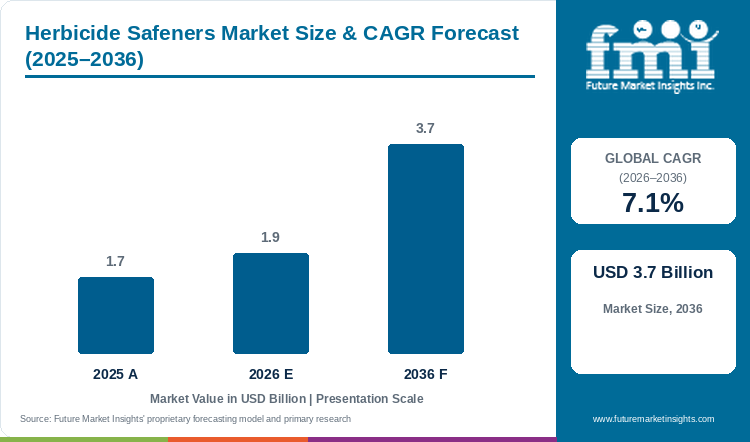
The market is projected to reach USD 3.7 billion by 2036, growing at a 7.1% CAGR from 2026 to 2036. The market is estimated at USD 1.9 billion in 2026. The market was valued at USD 1.7 billion in 2025. Demand follows the maize, sorghum, rice and small-grain cereal area that receives safener-based programmes [1]. USDA's Acreage report of 30 June 2026 put US corn plantings at 95.3 million acres, 3% below 2025, and all wheat at 42.7 million acres, 6% below 2025 [18]. On 19 October 2026 BASF announced EPA registration of Ridivex, a post-emergence corn herbicide with a built-in crop safener, planned for availability in 2027 [10].
The wider herbicides market is under price and weather pressure. Benoxacor is set at 0.01 ppm from 15 July 2022 [2], furilazole at 0.01 ppm on sweet corn commodities from 3 October 2019 [3], and dichlormid at 0.05 ppm from 23 March 2011 [4]. Corteva's herbicide sales were USD 932.0 million in the second quarter of 2026, against USD 995.0 million a year earlier [14]. Bayer said on 3 November 2026 that herbicide and fungicide sales excluding glyphosate fell 8.6% in the third quarter [16].
Key Market Trends & Insights
- On 19 October 2026 BASF announced that Ridivex had received EPA registration. Ridivex is a premix of diflufenzopyr, dicamba and pyroxasulfone with a built-in crop safener for post-emergence use in corn [10]. BASF said it is planned for availability in 2027 and is not yet for sale or taking orders [10]. On 3 June 2026 it had described the product as pending registration [11].
- On 27 April 2026 ADAMA launched Marathon in Australia, its first pyrasulfotole-based herbicide, for wheat and barley in the 2026 season, with mefenpyr diethyl as an in-built safener [12].
- Regulators keep extending safener clearances one crop at a time. EPA amended benoxacor tolerances for field corn, popcorn and sweet corn commodities effective 15 July 2022. It said there was not sufficient data to extend them beyond corn [2]. EPA also set furilazole tolerances on sweet corn commodities effective 3 October 2019 [3].
Regional Highlights
- North America: US corn plantings were 95.3 million acres in 2026, down 3% on 2025 [18]. Soybeans rose 5% to 85.4 million acres [18], and safeners have not been shown to help that crop [1].
- Continental Europe: EU grain maize covered 8.5 million hectares in 2025 and produced 60.1 million tonnes [20]. USDA's October 2026 outlook puts EU corn production for 2026/27 at 48.0 million tonnes [19]. That is 16% below last year, on the lowest harvested area on record [19].
- United Kingdom: provisional estimates for England show wheat production of 10.8 million tonnes in 2026, up 0.8%. Barley production fell 11% to 3.7 million tonnes, the smallest barley harvest since 2012 [21].
Herbicide Safeners Market Size and Forecast
Table 1: Herbicide Safeners Market Size and Forecast
| Market size and forecast | Value |
|---|---|
| Market size in 2025 | USD 1.7 billion |
| Estimated market size in 2026 | USD 1.9 billion |
| Projected market size by 2036 | USD 3.7 billion |
| CAGR from 2026 to 2036 | 7.1% |
Source: Future Market Insights analysis of the herbicide safeners market, 2026.
Analyst Perspective
“A safener is sold as part of a herbicide decision, not on its own. The commercial question is which herbicide franchises carry a protected-crop claim, and in which crops. Benoxacor has a head start because it already sits in established corn programmes. The growth case leans on newer premixes that add a safener to post-emergence chemistry. Buyers should read supply through the herbicide partner, the crop and the registration status of each product, and not through the safener name alone.”
- Nikhil Kaitwade, Principal Consultant, FMI
How is the Herbicide Safeners Market segmented?
- By product type: Benoxacor, Furilazole, Dichlormid, Isoxadifen and Other Safeners
- By application: Post-emergence and Pre-emergence
- By region: Worldwide, with North America and Europe as profiled regions
Why does Benoxacor lead by Product Type in the Herbicide Safeners Market in 2026?
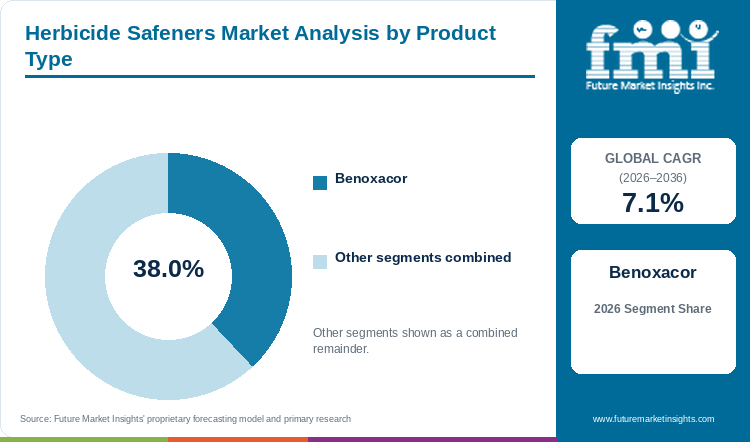
Benoxacor is estimated to account for 38.0% of the Herbicide Safeners Market by product type in 2026. Its lead rests on its place in established herbicide products. Syngenta's SDS for Dual II Magnum, revised on 30 May 2024 under EPA registration 100-818, lists S-metolachlor at 82.4% by weight and benoxacor at 1% to under 5% [6]. Safeners were first developed for thiocarbamate and chloroacetamide herbicides in maize, grain sorghum and wet-sown rice, and benoxacor's EPA tolerances are written for named commodities [2]. Benoxacor also has more than one commercial source and a long regulatory record. Health Canada's Pest Management Regulatory Agency identifies benoxacor as the safener in Dual II Magnum (registration 25729), while Dual Magnum (25728) contains S-metolachlor only [8]. In Canada, UPL AgroSolutions' Komodo was reported on 28 November 2019 as the first alternative S-metolachlor product marketed there that includes benoxacor [9]. In the United States, EPA amended the benoxacor tolerances effective 15 July 2022 for eight field corn, popcorn and sweet corn commodities, each at 0.01 ppm [2]. Other product types have narrower clearances. Furilazole tolerances cover sweet corn commodities [3]. Dichlormid tolerances cover field, pop and sweet corn commodities at 0.05 ppm [4]. Isoxadifen-ethyl tolerances, set on 14 November 2007 after a Bayer CropScience petition, cover specified corn and rice commodities [5]. Benoxacor's combination of two sources, two national regulators and a current corn tolerance explains why it keeps the largest share.
Table 2: Product Type, 2026 Share
| Leading Share | 2026 market share |
|---|---|
| Benoxacor | 38.0% |
| All Other Segments Combined Share | 62.0% |
Source: Future Market Insights analysis of the herbicide safeners market, 2026.
Why does Post-emergence lead by Application in the Herbicide Safeners Market in 2026?
Post-emergence is estimated to account for 63.0% of the Herbicide Safeners Market by application in 2026. A post-emergence herbicide reaches a crop that is already growing. The crop's own metabolism must therefore carry the tolerance. Safeners do this by raising the activity of herbicide-metabolising enzymes, such as glutathione S-transferases and cytochrome P450 monooxygenases, and by lifting glutathione levels [1]. That mechanism lets a crop tolerate a herbicide that would otherwise injure it after emergence, while weeds without the same response stay controlled [1]. The newest products point the same way. BASF positions Ridivex as post-emerge weed control in corn. It calls the product the first corn post-emergence herbicide innovation from BASF in over a decade, with a built-in crop safener [10]. Nufarm's Epic, which pairs pinoxaden at 100 g/L with cloquintocet-mexyl at 25 g/L, is described as a systemic post-emergence herbicide for wild oats, green foxtail, yellow foxtail, Persian darnel and volunteer oats [13]. Pre-emergence still holds 37.0% of the market, where the safener protects the crop from a herbicide applied before it emerges.
Table 3: Application, 2026 Share
| Leading Share | 2026 market share |
|---|---|
| Post-emergence | 63.0% |
| All Other Segments Combined Share | 37.0% |
Source: Future Market Insights analysis of the herbicide safeners market, 2026.
What are the key drivers, restraints and opportunities?
Driver
Crop protection that does not blunt weed control. A safener lets a grower use a herbicide that would otherwise injure the crop, without lowering control of target weeds. The technology has been used in maize, grain sorghum, rice and small-grain cereals. Its mechanism, higher expression of detoxifying enzymes and transporters, is documented [1]. New launches add it: BASF's Ridivex carries a built-in crop safener for post-emergence use in corn [10], and ADAMA's Marathon uses mefenpyr diethyl as an in-built safener in wheat and barley [12]. Each launch gives formulators a reason to source a safener alongside the herbicide active.
Regulatory groundwork in corn. EPA has cleared the main safeners one at a time as inert ingredients. Dichlormid moved from time-limited to permanent tolerances on 23 March 2011, after the earlier tolerances expired on 31 December 2010 [4]. Isoxadifen-ethyl tolerances were set in 2007 [5]. Furilazole tolerances followed in 2019 on a petition from Monsanto [3]. Benoxacor tolerances were amended in 2022 [2]. These clearances let formulators bring corn products to registration without building a residue case for the safener first.
Restraint
Narrow crop fit. Safeners protect grass crops. They have not been shown to improve herbicide tolerance in dicot crops such as soybean [1]. EPA's benoxacor tolerances are corn-specific. In its 2022 benoxacor rule, EPA said there was not sufficient data to extend them beyond corn commodities [2]. Area shifts therefore matter. USDA put 2026 US corn plantings 3% below 2025 and soybeans 5% above [18]. Its October 2026 outlook for EU corn is 16% below last year [19].
Weather and herbicide pricing. Bayer said on 3 November 2026 that its Crop Science herbicide and fungicide sales, excluding glyphosate, fell 8.6% in the third quarter on an adjusted basis [16]. Adverse weather and regulatory impacts in EMEA and Asia-Pacific held back Crop Science sales that quarter [16]. Syngenta reported on 30 October 2026 that persistent drought in Europe and pricing pressure on off-patent products weighed on crop protection in the first nine months [17]. When the herbicide partner sells less or at lower prices, the safener inside the product follows.
Opportunity
Built-in safeners in new premixes. BASF's Ridivex shows the model: three herbicide actives and a crop safener in one corn product, registered by EPA and planned for 2027 [10]. ADAMA's high-load Marathon formulation does the same for broadleaf weed control in cereals [12]. Suppliers whose safener actives win a place in such premixes gain volume tied to a long product life, not to a single season. Buyers specifying tank mixes can also compare the compatibility additives used alongside such products.
Second sources and wider registrations. UPL's Komodo gave Canadian S-metolachlor buyers a benoxacor-containing alternative to Dual II Magnum [9]. PMRA has accepted new uses on carrots and other commodities for Dual II Magnum [7][8]. Each added crop widens the base for the safener. Cereal herbicides offer another route. Nufarm's Epic carries cloquintocet-mexyl at 25 g/L [13]. For a second herbicide input, compare mecoprop.
Herbicide Safeners Market by Country (2026 to 2036)
Table 4: Herbicide Safeners Market Country Growth Forecast
| Country | CAGR, 2026 to 2036 |
|---|---|
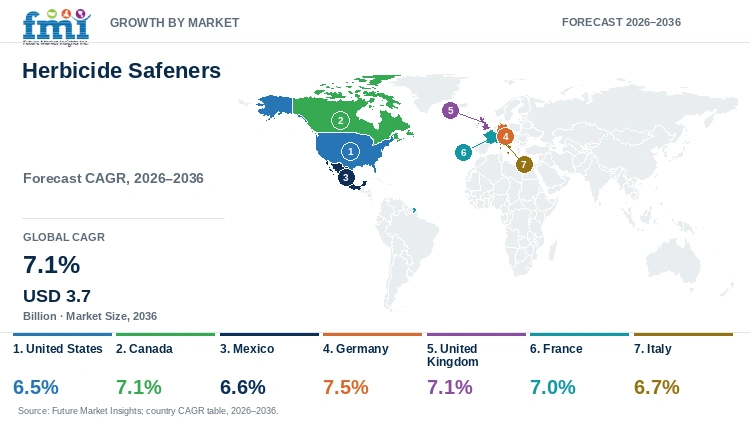
| United States | 6.5% |
| Canada | 7.1% |
| Mexico | 6.6% |
| Germany | 7.5% |
| United Kingdom | 7.1% |
| France | 7.0% |
| Italy | 6.7% |
Source: Future Market Insights analysis of the herbicide safeners market, 2026.
United States
USDA's Acreage report of 30 June 2026 put corn planted for all purposes at 95.3 million acres, down 3% from 2025 [18]. Soybeans were at 85.4 million acres, up 5%, and all wheat at 42.7 million acres, down 6% [18]. The shift toward soybeans therefore takes area away from safener crops.
EPA's benoxacor record is specific to corn. Isoxadifen-ethyl tolerances were set on 14 November 2007 after a Bayer CropScience petition [5]. Dichlormid tolerances became permanent on 23 March 2011 on a Dow AgroSciences petition, replacing time-limited tolerances that expired on 31 December 2010 [4]. Furilazole tolerances on sweet corn commodities took effect on 3 October 2019 after a Monsanto petition [3]. The benoxacor amendment took effect on 15 July 2022 [2]. It set eight corn commodities at 0.01 ppm and followed a petition filed for Landis International [2]. A September 2007 EPA-stamped label for Surpass EC describes acetochlor combined with the safener dichlormid [23]. The label covers field, seed, silage, sweet and popcorn uses [23].
Syngenta's Dual II Magnum is a general use herbicide registered as EPA 100-818 that contains benoxacor [6]. BASF's Ridivex is registered but not for sale until 2027 [10]. Corteva reported herbicide sales of USD 2.0 billion for the first six months of 2026, against USD 1.9 billion a year earlier [14]. It will report third-quarter results on 11 November 2026 after the market closes [15]. The United States is the largest base. Its forecast rate of 6.5% is below the global rate, which fits a corn area that is already large and shrinking in 2026.
Canada
Health Canada's Pest Management Regulatory Agency identifies benoxacor as the safener in Dual II Magnum herbicide, registration 25729, while Dual Magnum, registration 25728, contains S-metolachlor only [8]. In a proposed maximum residue limit consultation dated 25 September 2015, it found new carrot uses on the Dual II Magnum label acceptable [7]. A consultation dated 8 August 2016 found new uses on various commodities acceptable for the S-metolachlor product labels [8].
On 28 November 2019 Top Crop Manager reported that PMRA had approved UPL AgroSolutions' Komodo, a Group 15 herbicide for corn, soybeans, dry beans and horticulture crops [9]. UPL described it as the first alternative S-metolachlor product marketed in Canada that includes benoxacor safener [9]. Canadian buyers of benoxacor-containing S-metolachlor products therefore have two named suppliers.
Cereals add a second line. The University of Hertfordshire's formulations catalogue lists Nufarm's Epic as an emulsifiable concentrate. It contains pinoxaden at 100 g/L and cloquintocet-mexyl at 25 g/L [13]. The product carries Canadian registration code PCP 33603 for post-emergence control of wild oats and other grass weeds [13]. Canada's forecast rate of 7.1% matches the global rate, which fits a mixed base of maize-linked and cereal-linked products.
Mexico
The first safeners were developed for maize, grain sorghum and wet-sown rice [1]. Mexico's sorghum sector is under pressure this season. USDA's October 2026 outlook puts Mexico's 2026/27 sorghum production at 3.6 million tonnes [19]. That is 13% below its September estimate and 18% below the five-year average [19]. Harvested area of 1.1 million hectares stays near a 30-year low [19].
The drivers are economic and climatic. USDA reports that farmers face low crop prices, high debt, limited access to credit and government support, and erratic rainfall [19]. Mexico's agri-food statistics service, SIAP, put the spring and summer planted area at 310,000 hectares, 28% below the previous season [19]. Planting in Guanajuato, the largest spring and summer producer, fell 14% [19]. In Tamaulipas, which grows 77% of fall and winter sorghum, planting intentions are low [19]. September 2026 was the driest in 45 years in the north of the state [19].
For safener sellers, Mexican sorghum is a credit-constrained outlet in the 2026/27 season. The forecast of 6.6% therefore depends on a recovery in sorghum area or on demand from other crops, not on farm-level expansion now. Suppliers should plan Mexican volumes on current planting data, not on past seasons.
Germany
Eurostat data show Germany grew 489.9 thousand hectares of grain maize in 2025, down 1.7% from 2024 [20]. Production was 4,944.8 thousand tonnes, at a yield of 10.09 tonnes per hectare [20]. Wheat and spelt covered 2,958.4 thousand hectares, about six times the maize area [20]. That ratio points the safener market toward cereal herbicide programmes more than maize ones.
Weather cut the 2026 maize crop. USDA's October 2026 outlook lowered Germany's corn production by 0.4 million tonnes to 4.1 million tonnes after official statistics were released [19]. It noted a prolonged drought in southern Germany through the summer [19]. Company results cite similar pressures. Bayer cited adverse weather and regulatory impacts in EMEA and Asia-Pacific for its third-quarter 2026 Crop Science sales [16]. Syngenta said persistent drought in Europe weighed on demand in the first nine months [17].
Germany has the highest forecast rate of the seven profiled countries, at 7.5%. The cereal base gives growth room despite the weak 2026 maize season. Cereal herbicides with built-in safeners show the product class at work. Examples include ADAMA's wheat and barley product in Australia and Nufarm's Epic in Canada [12][13]. For application technology, compare spray retention additives.
United Kingdom
Defra's provisional 2026 estimates, updated on 8 October 2026, cover England. Wheat area fell 1.8% [21]. Yield rose 2.7% to 7.2 tonnes per hectare, and production came to 10.8 million tonnes, up 0.8% on 2025 [21]. Wheat is the stable base for cereal herbicide use.
Barley was weaker. Total barley area fell 9.2%, and production was 3.7 million tonnes, down 11%. Spring barley production fell 23% [21]. Defra described it as the smallest barley harvest since 2012 [21]. It said hot weather and limited rainfall hampered the 2026 harvest [21]. A smaller spring barley area reduces herbicide use in the crop for the 2026 season.
Cereal safeners reach UK growers inside herbicide products, not as stand-alone items. Nufarm's Epic pairs pinoxaden with cloquintocet-mexyl at 25 g/L [13]. ADAMA's Marathon carries mefenpyr diethyl [12]. Both products are sold in other markets, Canada and Australia. UK buyers should therefore confirm local registration and label crops with each supplier. With wheat steady and barley down, the UK forecast of 7.1% rests on holding wheat programmes while barley recovers.
France
France evaluates safener-containing products under Regulation (EC) No 1107/2009. ANSES issued its evaluation conclusions on 5 October 2017 for Bayer SAS's Capreno application [22]. Capreno is a suspension concentrate with 345 g/L tembotrione, 68 g/L thiencarbazone-methyl and 134 g/L isoxadifen-ethyl [22]. ANSES describes isoxadifen-ethyl as the safener (phytoprotecteur) [22]. The file was examined by the Bulgarian authorities. ANSES states that the document is not a decision [22].
France is the largest maize and wheat grower in the profiled European set. Eurostat shows 1,614.47 thousand hectares of grain maize in 2025, up 1.2% [20]. Production was 13,742.01 thousand tonnes, down 6.4% on 2024 [20]. Wheat and spelt covered 4,716.21 thousand hectares [20]. USDA's October 2026 outlook is harsher. It puts French corn production at 7.0 million tonnes, the lowest in 50 years [19]. The harvested area of 1.2 million hectares is the smallest in 58 years, after extreme summer heat and dryness [19].
A smaller 2026 maize crop reduces the amount of maize herbicide applied this season. The forecast of 7.0% sits close to the global rate. Wheat area is nearly three times the maize area in 2025, which gives the market a steadier base than maize alone [20]. Buyers of isoxadifen-ethyl products such as Capreno should track the 2027 maize area recovery.
Italy
Italy moved against the European trend in 2025. Eurostat shows grain maize area rising 9.2% to 540.95 thousand hectares [20]. Production rose 11.9% to 5,529.06 thousand tonnes, and yield improved to 10.22 tonnes per hectare from 9.97 [20]. Wheat and spelt covered 1,645.47 thousand hectares [20].
The contrast with the 2026/27 outlook is sharp. USDA's October 2026 estimate for EU corn is 48.0 million tonnes, 16% below last year and the smallest crop since 1994/95 [19]. France and Hungary were the hardest hit by heat and dryness [19]. USDA's outlook does not single out Italy for 2026, so 2025 is the latest official year for Italy [20].
Italy's maize area is about a third of France's and similar to Germany's [20]. That limits absolute demand for maize safeners, even though recent growth is strong. The forecast of 6.7% fits a market expanding from a small base. Buyers supplying Italian growers should tie plans to national planting data as it is published, given the weather swings seen across Europe in 2026.
Who are the notable companies in the Herbicide Safeners Market?
Notable companies in the Herbicide Safeners Market include Syngenta, Bayer, BASF, ADAMA, UPL and Nufarm.
The partner herbicide decides who sells a safener, because the safener reaches the farmer inside a formulated product. Benoxacor sits in Syngenta's Dual II Magnum [6]. The SDS lists it at 1% to under 5% by weight, beside S-metolachlor at 82.4% [6]. It is also in UPL's Komodo in Canada [9]. Isoxadifen-ethyl is the safener in Bayer's Capreno, at 134 g/L beside tembotrione and thiencarbazone-methyl [22]. BASF's Ridivex carries an unnamed built-in safener alongside diflufenzopyr, dicamba and pyroxasulfone [10]. Competition is therefore between herbicide franchises, with the safener as a feature of each.
Crop and application stage split the field next. Maize programmes use benoxacor, isoxadifen-ethyl, furilazole and dichlormid, with EPA tolerances written for named commodities [2][3][4][5]. Cereal programmes use different actives. ADAMA's Marathon uses mefenpyr diethyl in wheat and barley [12]. Nufarm's Epic uses cloquintocet-mexyl at 25 g/L beside pinoxaden [13]. A maize safener supplier cannot simply serve a cereal customer, so the market stays divided by crop.
Timing and financial context also differ. Bayer's Crop Science sales were EUR 3.9 billion in the third quarter of 2026, down 2.4% on an adjusted basis [16]. EBITDA before special items was EUR 101.0 million, down 41.3% [16]. Syngenta's crop protection sales were USD 9.8 billion for the first nine months of 2026, flat on the year [17]. Syngenta also reported more than 1,400 approvals secured [17]. BASF's Ridivex will not be sold until 2027 [10]. Its effect on safener demand therefore lies ahead, not in 2026.
Key Developments in the Herbicide Safeners Market
- On 19 October 2026, BASF announced that Ridivex herbicide had received EPA registration, calling it the first corn post-emergence herbicide innovation from BASF in over a decade. The product is planned for availability in 2027 and is not currently for sale [10].
- On 27 April 2026, ADAMA announced the launch of Marathon, its first pyrasulfotole-based herbicide, for Australian wheat and barley growers in the 2026 season, with mefenpyr diethyl as an in-built safener [12].
- On 3 November 2026, Bayer reported that Crop Science third-quarter sales were EUR 3.9 billion, down 2.4% on an adjusted basis [16]. Fungicides and herbicides excluding glyphosate fell 8.6% [16].
- On 30 October 2026, Syngenta Group reported first-nine-month 2026 crop protection sales of USD 9.8 billion, flat on the year, with North America down 1% and Latin America down 14% [17].
Key Players in the Herbicide Safeners Market
- Syngenta
- Bayer
- BASF
- ADAMA
- UPL
- Nufarm
Herbicide Safeners Market Report Scope
Table 5: Herbicide Safeners Market Report Scope
| Coverage field | Report scope |
|---|---|
| Market definition | Chemical agents that protect crops from herbicide injury without reducing control of target weeds, measured by value of sales |
| Product Type | Benoxacor, Furilazole, Dichlormid, Isoxadifen and Other Safeners |
| Application | Post-emergence and Pre-emergence |
| Regions and profiled countries | Worldwide market value. Profiled regions: North America and Europe (United States, Canada, Mexico, Germany, United Kingdom, France, Italy) |
| Companies covered | Syngenta, Bayer, BASF, ADAMA, UPL and Nufarm |
| Forecast period | 2026 to 2036, with 2025 as the historical base year |
| Quantitative Units | USD billion |
Source: Future Market Insights analysis of the herbicide safeners market, 2026.
Herbicide Safeners Market by Segments
Herbicide Safeners Market segmented by Product Type:
- Benoxacor
- Furilazole
- Dichlormid
- Isoxadifen
- Other Safeners
Herbicide Safeners Market segmented by Application:
- Post-emergence
- Pre-emergence
Herbicide Safeners Market by Region
- North America
- Europe
- United States
- Canada
- Mexico
- Germany
- United Kingdom
- France
- Italy
Research Sources and Bibliography
- [1] Riechers, D. E., Kreuz, K., & Zhang, Q. (2010, March 17). Detoxification without Intoxication: Herbicide Safeners Activate Plant Defense Gene Expression. Plant Physiology, 153(1), 3-13. https://pmc.ncbi.nlm.nih.gov/articles/PMC2862420
- [2] U.S. Environmental Protection Agency. (2022, July 15). Benoxacor; Pesticide Tolerances (Federal Register, Vol. 87, No. 135). https://www.govinfo.gov/content/pkg/FR-2022-07-15/html/2022-15018.htm
- [3] U.S. Environmental Protection Agency. (2019, October 3). Furilazole; Pesticide Tolerances (Federal Register, Vol. 84, No. 192). https://www.govinfo.gov/content/pkg/FR-2019-10-03/html/2019-20874.htm
- [4] U.S. Environmental Protection Agency. (2011, March 23). Dichlormid; Pesticide Tolerances (Federal Register, Vol. 76, No. 56). https://www.govinfo.gov/content/pkg/FR-2011-03-23/html/2011-6440.htm
- [5] U.S. Environmental Protection Agency. (2007, November 14). Isoxadifen-ethyl; Pesticide Tolerances (Federal Register, Vol. 72, No. 219). https://www.govinfo.gov/content/pkg/FR-2007-11-14/html/E7-22223.htm
- [6] Syngenta Crop Protection, LLC. (2024, May 30). Safety Data Sheet: DUAL II MAGNUM (Version 4.0). https://www.syngenta-us.com/sds-label/dual_ii_magnum
- [7] Health Canada, Pest Management Regulatory Agency. (2015, September 25). Benoxacor, Proposed Maximum Residue Limit PMRL2015-35. https://publications.gc.ca/site/eng/9.803793/publication.html
- [8] Health Canada, Pest Management Regulatory Agency. (2016, August 8). S-metolachlor, Proposed Maximum Residue Limit PMRL2016-42. https://publications.gc.ca/site/eng/9.822299/publication.html
- [9] Top Crop Manager. (2019, November 28). New Komodo herbicide released for corn, soybeans, dry beans. https://www.topcropmanager.com/new-komodo-herbicide-released-for-corn-soybeans-dry-beans/
- [10] BASF. (2026, October 19). BASF announces EPA approval of Ridivex herbicide, a new all-in-one standard for post-emerge weed control in corn. https://www.basf.com/us/en/media/news-releases/2026/10/P-US-26-36
- [11] Farms.com. (2026, June 3). BASF launches Ridivex herbicide to combat resistant weeds in corn fields. https://www.farms.com/ag-industry-news/basf-launches-ridivex-herbicide-to-combat-resistant-weeds-in-corn-fields-707.aspx
- [12] Global Agriculture. (2026, April 27). ADAMA launches Marathon in Australia, its first pyrasulfotole-based herbicide for cereal growers. https://www.global-agriculture.com/crop-protection/adama-launches-marathon-in-australia-its-first-pyrasulfotole-based-herbicide-for-cereal-growers/
- [13] University of Hertfordshire, Agriculture and Environment Research Unit. (n.d.). Pesticide Formulations Catalogue: Epic (Nufarm Ltd). https://sitem.herts.ac.uk/aeru/pfc/Reports/671.htm
- [14] Corteva, Inc. (2026, June 30). Form 10-Q for the quarterly period ended June 30, 2026. https://www.sec.gov/Archives/edgar/data/0001755672/000175567226000025/ctva-20260630.htm
- [15] Corteva, Inc. (2026, October 6). Corteva Announces Dates for Third Quarter 2026 Earnings Release and Webcast. https://www.placera.se/pressmeddelanden/corteva-corteva-announces-dates-for-third-quarter-2026-earnings-release-and-webcast-20261006
- [16] Global Agriculture. (2026, November 3). Bayer Crop Science sales fall 2.4% in Q3 as seeds offset crop protection weakness. https://www.global-agriculture.com/crop-protection/bayer-crop-science-sales-fall-2-4-in-q3-as-seeds-offset-crop-protection-weakness/
- [17] Agribusiness Global. (2026, October 30). Syngenta Group reports 9M 2026 results with higher profitability. https://www.agribusinessglobal.com/agrochemicals/syngenta-group-reports-9m-2026-results-with-higher-profitability/
- [18] U.S. Department of Agriculture, National Agricultural Statistics Service. (2026, June 30). Acreage. https://www.nass.usda.gov/Newsroom/2026/06-30-2026.php
- [19] U.S. Department of Agriculture, Foreign Agricultural Service. (2026, October). World Agricultural Production, WAP 10-26. https://apps.fas.usda.gov/psdonline/circulars/production.pdf
- [20] Eurostat. (2026, October 27). Crop production in EU standard humidity (apro_cpsh1), grain maize and corn-cob-mix, wheat and spelt. https://ec.europa.eu/eurostat/api/dissemination/statistics/1.0/data/apro_cpsh1?format=JSON&lang=EN&crops=C1500&geo=DE&geo=FR&geo=IT&geo=EU27_2020&time=2024&time=2025
- [21] Department for Environment, Food and Rural Affairs. (2026, October 8). Provisional cereal and oilseed production estimates for England 2026. https://www.gov.uk/government/statistics/cereal-and-oilseed-rape-production/provisional-cereal-and-oilseed-production-estimates-for-england-2026
- [22] ANSES. (2017, October 5). Conclusions de l'evaluation relatives a une demande d'autorisation de mise sur le marche pour la preparation CAPRENO (dossier 2016-2040). https://www.anses.fr/system/files/phyto/evaluations/CAPRENO_PMTS_2016-2040_Ans.pdf
- [23] U.S. Environmental Protection Agency. (2007, September 19). Surpass EC Herbicide, EPA-stamped label (EPA Reg. No. 62719-367). https://www3.epa.gov/pesticides/chem_search/ppls/062719-00367-20070919.pdf
Table of Content
Table of Content
- Key Takeaways
- Market Size and CAGR
- Top Growth Driver
- Fastest Growing Segment
- Leading Region
- Key Companies
- Emerging Opportunities
- Executive Summary
- Global Market Outlook
- Demand-side Trends
- Supply-side Trends
- Technology Roadmap Analysis
- Analysis and Recommendations
- Analyst Perspective (What is happening? Why now? What should investors know?)
- Key Questions Answered
- How large is the market?
- What is the CAGR?
- What are key trends?
- Which region dominates?
- Who are the leaders?
Read More...
- Market Overview
- Market Coverage / Taxonomy
- Market Definition / Scope / Limitations
- Research Methodology
- Chapter Orientation
- Analytical Lens and Working Hypotheses
- Market Structure, Signals, and Trend Drivers
- Benchmarking and Cross-market Comparability
- Market Sizing, Forecasting, and Opportunity Mapping
- Research Design and Evidence Framework
- Desk Research Programme (Secondary Evidence)
- Expert Input and Fieldwork (Primary Evidence)
- Tooling, Models, and Reference Databases
- Data Engineering and Model Build
- Quality Assurance and Audit Trail
- Market Background
- Market Dynamics (Drivers, Restraints, Opportunity, Trends)
- Scenario Forecast (Optimistic, Likely, Conservative)
- Impact Analysis
- AI Impact
- Sustainability Impact
- Regulatory Impact
- Technology Impact
- Consumer / Buyer Analysis
- Purchase Drivers
- Adoption Barriers
- Buyer Journey
- Opportunity Map Analysis
- Product Life Cycle Analysis
- Supply Chain Analysis
- Investment Feasibility Matrix
- Value Chain Analysis
- PESTLE and Porter's Analysis
- Regulatory Landscape
- Regional Parent Market Outlook
- Production and Consumption Statistics
- Import and Export Statistics
- Global Market Analysis and Forecast, 2021 to 2036
- Historical Market Size Value (USD Billion) Analysis, 2021 to 2025
- Current and Future Market Size Value (USD Billion) Projections, 2026 to 2036
- Y-o-Y Growth Trend Analysis
- Absolute $ Opportunity Analysis
- Global Market Pricing Analysis, 2021 to 2036
- Global Market Analysis and Forecast, By Product Type, 2021 to 2036
- Introduction / Key Findings
- Historical Market Size Value (USD Billion) Analysis By Product Type, 2021 to 2025
- Current and Future Market Size Value (USD Billion) Analysis and Forecast By Product Type, 2026 to 2036
- Benoxacor
- Furilazole
- Dichlormid
- Isoxadifen
- Other Safeners
- Y-o-Y Growth Trend Analysis By Product Type, 2021 to 2025
- Absolute $ Opportunity Analysis By Product Type, 2026 to 2036
- Global Market Analysis and Forecast, By Application, 2021 to 2036
- Introduction / Key Findings
- Historical Market Size Value (USD Billion) Analysis By Application, 2021 to 2025
- Current and Future Market Size Value (USD Billion) Analysis and Forecast By Application, 2026 to 2036
- Post-emergence
- Pre-emergence
- Y-o-Y Growth Trend Analysis By Application, 2021 to 2025
- Absolute $ Opportunity Analysis By Application, 2026 to 2036
- Global Market Analysis and Forecast, By Region, 2021 to 2036
- Introduction
- Historical Market Size Value (USD Billion) Analysis By Region, 2021 to 2025
- Current Market Size Value (USD Billion) Analysis and Forecast By Region, 2026 to 2036
- North America
- Europe
- Market Attractiveness Analysis By Region
- North America Market Analysis and Forecast, By Country, 2021 to 2036
- Historical Market Size Value (USD Billion) Trend Analysis By Market Taxonomy, 2021 to 2025
- Market Size Value (USD Billion) Forecast By Market Taxonomy, 2026 to 2036
- By Country
- By Product Type
- By Application
- Market Attractiveness Analysis
- By Country
- By Product Type
- By Application
- Key Takeaways
- Europe Market Analysis and Forecast, By Country
- Historical Market Size Value (USD Billion) Trend Analysis By Market Taxonomy, 2021 to 2025
- Market Size Value (USD Billion) Forecast By Market Taxonomy, 2026 to 2036
- By Country
- United States
- Canada
- Mexico
- Germany
- United Kingdom
- France
- Italy
- By Product Type
- By Application
- By Country
- Market Attractiveness Analysis
- By Country
- By Product Type
- By Application
- Key Takeaways
- Key Countries Market Analysis
- United States
- Pricing Analysis
- Market Share Analysis, 2025
- By Product Type
- By Application
- Canada
- Pricing Analysis
- Market Share Analysis, 2025
- By Product Type
- By Application
- Mexico
- Pricing Analysis
- Market Share Analysis, 2025
- By Product Type
- By Application
- Germany
- Pricing Analysis
- Market Share Analysis, 2025
- By Product Type
- By Application
- United Kingdom
- Pricing Analysis
- Market Share Analysis, 2025
- By Product Type
- By Application
- Italy
- Pricing Analysis
- Market Share Analysis, 2025
- By Product Type
- By Application
- France
- Pricing Analysis
- Market Share Analysis, 2025
- By Product Type
- By Application
- United States
- Market Structure Analysis
- Competition Dashboard
- Competition Benchmarking
- Market Share Analysis of Top Players
- By Regional
- By Product Type
- By Application
- Emerging Startups
- Innovation Benchmarking
- Competition Analysis
- Competition Deep Dive
- Syngenta
- Overview
- Product Portfolio
- Profitability by Market Segments
- Sales Footprint
- Strategy Overview
- Marketing Strategy
- Product Strategy
- Channel Strategy
- Bayer
- BASF
- ADAMA
- UPL
- Nufarm
- Syngenta
- Case Studies
- Success Stories
- Recent Developments
- Competition Deep Dive
- Assumptions & Acronyms Used
List of Tables
- Table 1: Global Market Value (USD Billion) Forecast by Region, 2021 to 2036
- Table 2: Global Market Value (USD Billion) Forecast by Product Type, 2021 to 2036
- Table 3: Global Market Value (USD Billion) Forecast by Application, 2021 to 2036
- Table 4: North America Market Value (USD Billion) Forecast by Country, 2021 to 2036
- Table 5: North America Market Value (USD Billion) Forecast by Product Type, 2021 to 2036
- Table 6: North America Market Value (USD Billion) Forecast by Application, 2021 to 2036
- Table 7: Europe Market Value (USD Billion) Forecast by Country, 2021 to 2036
- Table 8: Europe Market Value (USD Billion) Forecast by Product Type, 2021 to 2036
- Table 9: Europe Market Value (USD Billion) Forecast by Application, 2021 to 2036
List of Figures
- Figure 1: Global Market Pricing Analysis
- Figure 2: Global Market Value (USD Billion) Forecast 2021-2036
- Figure 3: Global Market Value Share and BPS Analysis by Product Type, 2026 and 2036
- Figure 4: Global Market Y-o-Y Growth Comparison by Product Type, 2026-2036
- Figure 5: Global Market Attractiveness Analysis by Product Type
- Figure 6: Global Market Value Share and BPS Analysis by Application, 2026 and 2036
- Figure 7: Global Market Y-o-Y Growth Comparison by Application, 2026-2036
- Figure 8: Global Market Attractiveness Analysis by Application
- Figure 9: Global Market Value (USD Billion) Share and BPS Analysis by Region, 2026 and 2036
- Figure 10: Global Market Y-o-Y Growth Comparison by Region, 2026-2036
- Figure 11: Global Market Attractiveness Analysis by Region
- Figure 12: North America Market Incremental Dollar Opportunity, 2026-2036
- Figure 13: Europe Market Incremental Dollar Opportunity, 2026-2036
- Figure 14: North America Market Value Share and BPS Analysis by Country, 2026 and 2036
- Figure 15: North America Market Value Share and BPS Analysis by Product Type, 2026 and 2036
- Figure 16: North America Market Y-o-Y Growth Comparison by Product Type, 2026-2036
- Figure 17: North America Market Attractiveness Analysis by Product Type
- Figure 18: North America Market Value Share and BPS Analysis by Application, 2026 and 2036
- Figure 19: North America Market Y-o-Y Growth Comparison by Application, 2026-2036
- Figure 20: North America Market Attractiveness Analysis by Application
- Figure 21: Europe Market Value Share and BPS Analysis by Country, 2026 and 2036
- Figure 22: Europe Market Value Share and BPS Analysis by Product Type, 2026 and 2036
- Figure 23: Europe Market Y-o-Y Growth Comparison by Product Type, 2026-2036
- Figure 24: Europe Market Attractiveness Analysis by Product Type
- Figure 25: Europe Market Value Share and BPS Analysis by Application, 2026 and 2036
- Figure 26: Europe Market Y-o-Y Growth Comparison by Application, 2026-2036
- Figure 27: Europe Market Attractiveness Analysis by Application
- Figure 28: Global Market - Tier Structure Analysis
- Figure 29: Global Market - Company Share Analysis
Frequently Asked Questions
How big is the herbicide safeners market in 2026?
The Herbicide Safeners Market is estimated at USD 1.9 billion in 2026, up from USD 1.7 billion in 2025. It is projected to reach USD 3.7 billion by 2036, a 7.1% CAGR from 2026 to 2036.
Which product type leads the herbicide safeners market?
Benoxacor leads with 38.0% of the market in 2026. It is the safener in Syngenta's Dual II Magnum, present at 1% to under 5% by weight beside S-metolachlor [6]. UPL's Komodo was reported in Canada on 28 November 2019 as the first alternative S-metolachlor product with benoxacor [9]. EPA amended its tolerances effective 15 July 2022 [2].
Which other product types and applications matter?
Furilazole holds 22.0%, Dichlormid 16.0%, Isoxadifen 13.0% and Other Safeners 11.0%. By application, Post-emergence holds 63.0% and Pre-emergence 37.0%. EPA tolerances exist for furilazole on sweet corn commodities [3]. Dichlormid tolerances cover field, pop and sweet corn commodities [4]. Isoxadifen-ethyl tolerances cover specified corn and rice commodities [5]. Bayer's Capreno carries isoxadifen-ethyl at 134 g/L [22].
Which profiled country is forecast to grow fastest?
Germany has the highest forecast CAGR of the seven profiled countries, at 7.5% from 2026 to 2036. Canada and the United Kingdom follow at 7.1% each, and France at 7.0%. Eurostat shows German wheat and spelt at 2,958.4 thousand hectares in 2025, against 489.9 thousand hectares of grain maize [20].
What regulation and demand signals affect supply?
In the United States, EPA sets safener tolerances as inert ingredients, commodity by commodity. In 2022 it said there was not sufficient data to extend benoxacor tolerances beyond corn commodities [2]. On the demand side, USDA put 2026 US corn plantings at 95.3 million acres, down 3% from 2025 [18]. BASF's Ridivex was registered on 19 October 2026 and is planned for availability in 2027 [10].
What should a buyer check when sourcing a safener-containing product?
Check the partner herbicide, the crop and the stage of application first. The safener is sold inside the formulation. Then confirm the registration status in the target country. Ridivex is registered in the United States but not yet for sale [10]. ANSES's 2017 Capreno document is an evaluation, not a decision [22]. Finally, confirm the active safener named on the label or SDS, as in Dual II Magnum [6].
Preview the report firsthand - request a free sample
Get SampleGet the brochure for pricing and purchase details.
Get PDF
