

- Industry Size (2026)
- USD 398.14 Bn
- Forecast (2036)
- USD 875.61 Bn
- CAGR (2026 to 2036)
- 8.20%
Heritage Railway Train Market Size, Market Forecast and Outlook By FMI
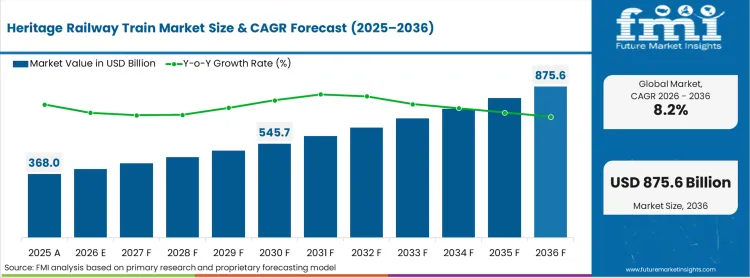
In 2025, the heritage railway train market was valued at USD 367.97 billion. Based on Future Market Insights' analysis, demand is estimated to grow to USD 398.14 billion in 2026 and USD 875.61 billion by 2036. FMI projects a CAGR of 8.20% during the forecast period.
Summary of Heritage Railway Train Market
- Heritage Railway Train Market Definition
- The heritage railway train market encompasses tourism and leisure operations utilizing preserved, restored, or replica historic railway rolling stock including luxury trains, narrow-gauge toy trains, steam locomotives, and heritage tram systems, sold through online, phone, and in-person booking channels for domestic and international tourist experiences.
- Demand Drivers in the Market
- Experiential tourism spending growth, with travelers prioritizing unique cultural and heritage experiences over conventional sightseeing, is directing tourism expenditure toward heritage railway operations that offer immersive historical transport experiences unavailable through modern transit.
- Government heritage preservation funding in India (Ministry of Railways heritage circuit investment), UK (Heritage Lottery Fund), and Canada (federal historic railway designation programs) provides capital for rolling stock restoration and track infrastructure maintenance.
- Online travel platform integration (Booking.com, Viator, MakeMyTrip) is enabling heritage railway operators to access international tourism markets directly, reducing dependency on traditional travel agency distribution and improving booking yield management.
- Key Segments Analyzed in the FMI Report
- Luxury Train train type: 38.6% share in 2026, reflecting its structural position as the primary category across established procurement channels.
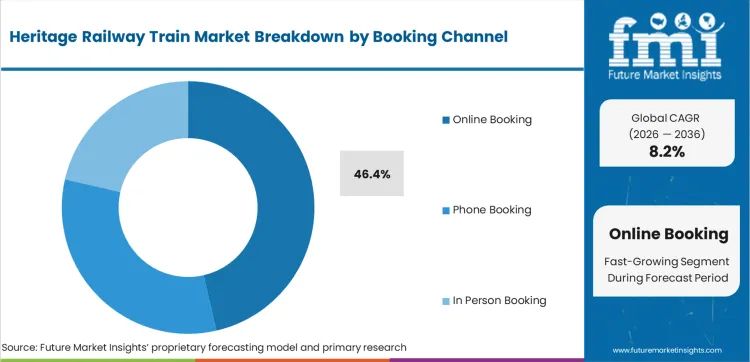
- Online Booking booking channel: 46.4% share in 2026, reflecting its structural position as the primary category across established procurement channels.
- India: 13.30% compound growth through 2036, indicating concentrated demand acceleration.
- Analyst Opinion at FMI
- Ronak Shah, Principal Consultant for Travel and Tourism observe that, The heritage railway train market is a niche tourism category where experiential value and heritage preservation funding create a demand floor independent of broader transport sector economics. FMI analysts observe that luxury trains command 38.6% type share because premium heritage experiences (Palace on Wheels, Rocky Mountaineer, Orient Express heritage services) generate the highest revenue per passenger-journey in the heritage railway category. Online booking at 46.4% channel share reflects the tourism industry digital shift, where heritage operators adopting yield management and dynamic pricing through online platforms are capturing direct booking revenue previously lost to intermediary commissions. India leads at 13.3% CAGR because the convergence of UNESCO heritage railway designations, government tourism circuit investment, and growing domestic middle-class travel spending creates the fastest demand expansion trajectory.
- Strategic Implications / Executive Takeaways
- Heritage railway operators should invest in online booking platforms with dynamic pricing capability to optimize revenue yield across peak and off-peak travel periods, reducing reliance on fixed-price travel agency distribution.
- Tourism authorities in India should expand heritage railway circuit connectivity between UNESCO-listed mountain railways and luxury train operations to create multi-day experiential packages that increase per-tourist spending.
- Heritage preservation organizations should establish rolling stock restoration training programs to address the aging workforce challenge in steam locomotive and heritage carriage maintenance, which is the primary operational constraint limiting service expansion.
Heritage Railway Train Market Key Takeaways
| Metric | Details |
|---|---|
| Industry Size (2026) | USD 398.14 Billion |
| Industry Value (2036) | USD 875.61 Billion |
| CAGR (2026 to 2036) | 8.20% |
Source: Future Market Insights, 2026
The market is set to add approximately USD 477.47 billion in absolute terms between 2026 and 2036. Experiential tourism growth and government heritage preservation investment are sustaining heritage railway market expansion. India leads with UNESCO-listed mountain railways (Darjeeling Himalayan, Nilgiri Mountain, Kalka-Shimla) and luxury palace-on-wheels operations generating high-yield international tourism revenue. Online booking platform adoption is reducing distribution friction for heritage operators previously dependent on travel agency intermediation.
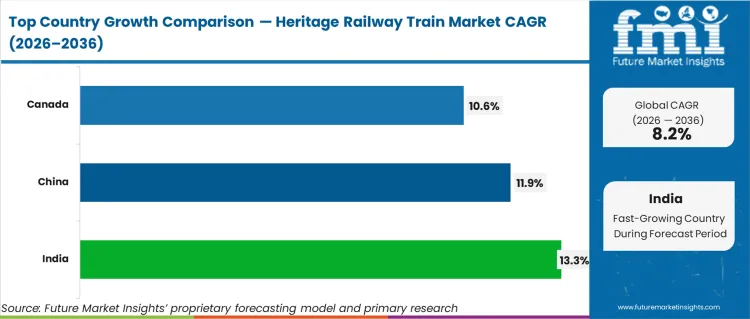
As per FMI, country-level growth rates through 2036 are projected as follows: India at 13.30%, China at 11.90%, Canada at 10.60%. India records the fastest expansion driven by concentrated institutional investment and infrastructure development.
Heritage Railway Train Market Definition
The heritage railway train market represents the tourism and leisure segment operating preserved, restored, and replica historic railway systems for passenger experiences. The market spans luxury overnight train journeys, narrow-gauge mountain and toy train excursions, preserved steam railway day trips, and heritage tramway operations. Based on FMI's analysis, the market is driven by experiential tourism demand and government heritage preservation investment, with digital booking platform adoption enabling heritage operators to access international tourism markets directly and implement yield management pricing strategies.
Heritage Railway Train Market Inclusions
Market scope covers heritage railway tourism revenue from luxury train journeys, narrow-gauge toy train operations, preserved steam railway excursions, and heritage tram experiences, encompassing ticket sales across online, phone, and in-person booking channels for domestic and international tourists.
Heritage Railway Train Market Exclusions
Modern commercial passenger rail services, freight railway operations, railway museum admission fees without operational train rides, and model railway equipment sales are excluded.
Heritage Railway Train Market Research Methodology
- Primary Research: Analysts conducted structured interviews with procurement managers, product engineers, and distribution channel operators to map purchase decision triggers and specification requirements across key verticals.
- Desk Research: Data collection aggregated regulatory filings, industry standards documentation, patent registries, trade body publications, and company annual reports across all target geographies.
- Market-Sizing and Forecasting: Baseline values derive from a bottom-up aggregation of product shipment volumes and average selling prices, validated against publicly disclosed revenue figures from leading suppliers.
- Data Validation and Update Cycle: Projections are cross-referenced against quarterly earnings data, import-export trade statistics, and industry association production reports to maintain forecast integrity.
Key Industry Highlights
Increasing Government Grand and Funding Nurtures the Heritage Railway Train Market Growth
Government grants and other funding for heritage and cultural projects have become more accessible and are the main sources of funding for heritage railways. They are valuable for funding expenses linked with the expensive procedures of restoration of vintage trains, station maintenance, and tourism development.
The future of heritage railways’ sustainability is guaranteed through government support for cultural and economic significance. Private foundations and trusts may also provide grant funding that supports the preservation of historical items and education. This gives the heritage tourism market a strong financial foundation to carry out large projects and enhancements, hence growth and sustainability.
Technological Innovations in Restoration and Operation Bolster Growth Prospects for the Industry
With the development of technology, the restoration and continued use of old trains have become much easier and more achievable. For example, restoration of old vehicles can be achieved using techniques like 3D printing to produce hard-to-find or out-of-production spare parts, modeling helps in planning and execution of restoration projects.
In fact, today there are security systems that can easily be incorporated inconspicuously into historic railways and thus provide security for the visitors. These innovations improve the viability and efficiency of running and maintaining heritage railways, thus increasing their salience and practicality, which is important in attracting the public.
Booming Eco-tourism and Sustainability Trends Provide Additional Prospects for Development
The increased focus on heritage railways as sustainable travel alternatives has been fueled by the rise in eco-tourism. Known to run slower through picturesque, less developed zones, these railways adhere to the norms of responsible and conscious tourism. There are increased efforts by railway heritage to go green, for instance, through the use of biofuels, energy efficiency, and conservation practices.
Heritage railways have the potential to target an audience that is environmentally conscious and willing to support rails that promote ecotourism, contributing to the industry’s growth.
2020 to 2025 Global Heritage Railway Train Sales Outlook Compared to Demand Forecast for 2026 to 2036
Heritage railways contribute significantly to railway preservation, innovation, and historical and social experience and the local society. They are supported mainly by governments, heritage organizations, and enthusiasts of railways. Thus, facilitating the growth and funding models for heritage railways infrastructure.
Heritage railways have gone a step further than merely offering train rides for their services. They now offer experiences such as themed parties, festive exhibitions, and interest-based trips for different age groups.
These can range from holiday leisure trains to wine-tasting stations, and more family-orientated events. This diversification has helped expand the targeted audience base, which in turn has helped generate more revenue and visitors.
The future of the industry seems promising at an 8.2% CAGR predicted till 2035. It is believed that the implementation of augmented reality, virtual reality, and digital stories will improve the visitor’s experience of the heritage railway trains.
These advancements will introduce the interactive and learning aspects appealing to today’s travelers, especially the Millennial and Gen Z generations. Digital media will also enable online bookings, marketing platforms, and virtual tourism, thus augmenting the public perception of heritage railways worldwide.
Market Competition
Tier 1 companies include the top leaders in the heritage railway train industry, capturing around 60% of global industry shares. The Rocky Mountaineer, The Durango & Silverton Narrow Gauge Railroad, The Napa Valley Wine Train, The Jacobite Steam Train, and The Rhaetian Railway fall under this category.
These businesses expand by acquiring or restoring additional routes, particularly those with unique historical or scenic value. They invest in upgrading stations, tracks, and facilities to enhance visitor comfort and operational efficiency.
Tier 2 companies include the mid-level participants, capturing around 25% of the global industry shares. The Emily Dickinson Museum, The Louisa May Alcott Orchard House, The Brontë Parsonage Museum, The Robert Burns Birthplace Museum, and The Hemingway Home and Museum fall under this category.
These businesses thrive by engaging with local communities through volunteer programs, educational initiatives, and community events to foster support and enhance local tourism.
The Tier 3 companies include the emerging and the lower tier companies, acquiring around 15% of the global industry shares. The Charles Dickens Museum, The John Steinbeck House, The Edgar Allan Poe Museum, The James Joyce Centre, and The Beatrix Potter Attraction are listed in this category.
These businesses focus on increasing membership and volunteer base to support operational needs and expand community involvement.
Heritage Railway Train Market Regional Trends and Competition
This section gives insights into the heritage railway train market forecast in top countries and the regional growth patterns. Information on regions like North America, Europe, Asia Pacific, and others has been granulated, focusing on the top countries.
India is expected to be at the forefront, expanding at a 13.3% CAGR until 2036. China follows next, expanding at an 11.9% CAGR until 2036. Lastly, the United States is also on the list, expanding at a 10.6% CAGR until 2036. This data indicates that the Asia Pacific is likely to make remarkable progress in the coming years.
.webp "Top Country Growth Comparison Heritage Railway Train Market Cagr (2026 2036)")
| Countries | Value CAGR (2026 to 2036) |
|---|---|
| India | 13.3% |
| China | 11.9% |
| Canada | 10.6% |
Diverse Tourism Offerings and Regional Appeal Boost Growth in India
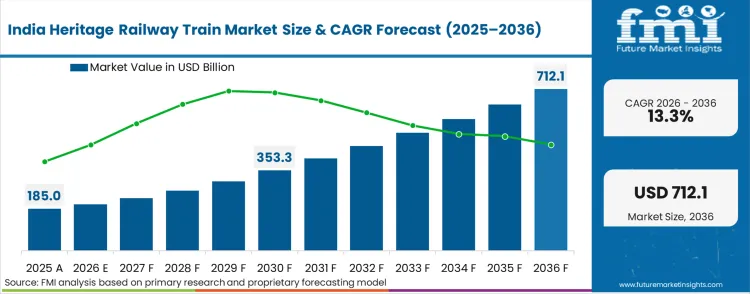
The heritage railway train market growth in India is estimated at a 13.3% CAGR till 2036. The various regions and diverse cultures in India provide numerous tourism facilities in the exploration of heritage railways in India.
Starting from the UNESCO heritage sites such as the mountain railways of Darjeeling, Nilgiri, and Kalka-Shimla, down to the desert locations of Rajasthan, each location brings a different experience depending on the target segment.
In addition to conventional sightseeing activities, receptive services such as specialized steam trains, cultural festivals onboard, and culinary journeys expand the appeal and reach for a greater demographic. This adds to greater revenues in India. Also, the government of India keeps on adding more heritage train tours, catapulting revenues in the near future.
Luxury Tourism and International Appeal Surges Revenue in China
The heritage railway train market growth in China is projected at an 11.9% CAGR until 2036. Some of the heritage trains that are popular in China include the Palace on Wheels and the Eastern & Oriental Express.
They are luxury brands targeting high-end tourists. These trains provide a historic rail experience with twenty-first-century comforts of theme-based travel, fine dining services, and traveling facilities.
Marketing strategies for heritage railways in China focus on affluent demographics. Diplomatic relations, luxurious brands, and exclusive travel packages appeal to high-end tourism stakeholders and establish China’s heritage railways as world-class tourism attractions.
Tourism Development Stimulates Growth in Canada
The heritage railway train market growth in Canada is predicted at a 10.6% CAGR until 2036. Heritage railways play a vital role in the development of tourism as they bring people to less-known places and sustain the businesses operating in these areas. They involve direct spending for tourism, creating employment in tourism-related industries, and sourcing various inputs locally.
Working hand in hand with regional tourism boards, government agencies, and community organizations, heritage railway ridership statistics are complemented. Thereby, the heritage railways’ visibility as a tourism asset is established to boost patronage and revenues.
Category-wise Insights
This section takes a closer look at the heritage railway train market segmentation by train type and booking channels. Based on train type, the luxury train segment is leading with 38.6% of the global industry shares captured in 2026. By booking channel, the online booking segment dominates with 46.4% of the global industry shares garnered in 2026.
Luxury Train Type Dominates the Industry
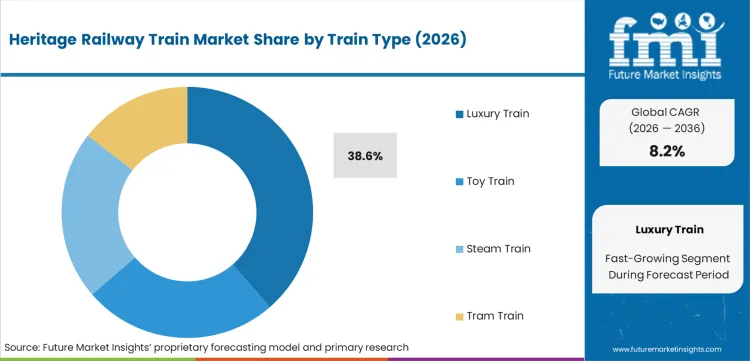
| Segment | Luxury Train (Train Type) |
|---|---|
| Value Share (2026) | 38.6% |
The increase in international disposable income levels, the increase in high net-worth individuals (HNWI) wealth, and the trend towards experiential luxury have all propelled the demand for luxury train travel.
Sustainability in heritage railways is attracting rich and affluent travelers. Super-rich tourists define luxury as a way to have wellness, adventure, culture, and personalized products and services on the go.
Such demographics are served by luxury trains since they maintain high service standards, provide luxury accommodations, and organize impressive experiences that match their clientele’s lifestyle.
Online Booking Channel is Highly Preferred in the Industry
| Segment | Online Booking (Booking Channel) |
|---|---|
| Value Share (2026) | 46.4% |
Owing to the fact that most booking sites are owned by different companies, they provide better rates, promotions, and packaged deals than traditional booking methods. The main drivers of these incentives are travelers who are price-conscious and those, who book their tickets in advance.
Seasonal sales, giveaways, and combination with other services like hotels, tours, etc., strengthen the proposition of making more online bookings, which is why the segment dominates in the industry.
Competition Outlook
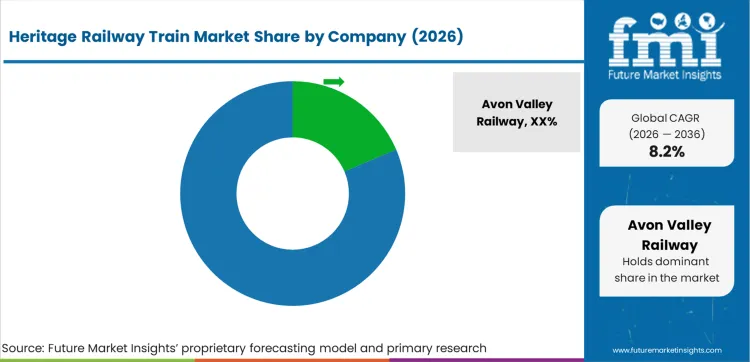
The heritage railway train market is fragmented with the presence of both incumbent and new players. The key players in the industry are the Rocky Mountaineer and Venice Simplon-Orient-Express due to their brand power and luxury services. Regional operators like the Puffing Billy Railway provide local experiences utilizing community backing and regional tourism collaborations.
Industry Update
- In October 2023, the Prime Minister of India launched an exclusive heritage train in Rajasthan. The Heritage Special-Marwar Express as it’s duly named, will journey through the dramatic landscapes of the Marwar region.
Scope of the Report
| Metric | Value |
|---|---|
| Quantitative Units | USD 398.14 Bn to USD 875.61 Bn, at a CAGR of 8.20% |
| Market Definition | The heritage railway train market encompasses tourism and leisure operations utilizing preserved, restored, or replica historic railway rolling stock including luxury trains, narrow-gauge toy trains, steam locomotives, and heritage tram systems, sold through online, phone, and in-person booking channels for domestic and international tourist experiences. |
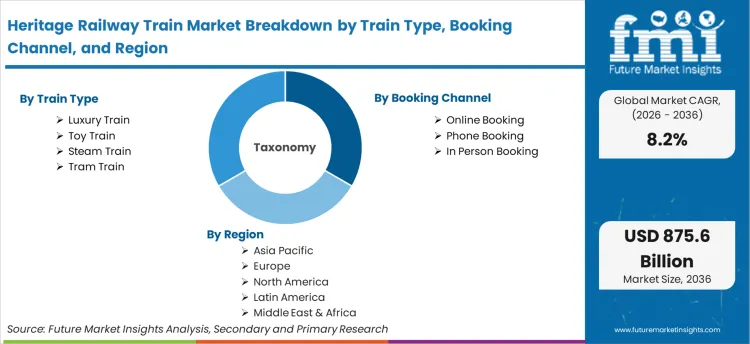
| Train Type Segmentation | Luxury Train, Toy Train, Steam Train, Tram Train |
| Booking Channel Segmentation | Online Booking, Phone Booking, In Person Booking |
| Regions Covered | North America, Latin America, Europe, East Asia, South Asia, Oceania, Middle East & Africa |
| Countries Covered | India, China, Canada, and 40 plus countries |
| Key Companies Profiled | Avon Valley Railway, Bideford Railway Heritage Centre, Helston Railway, Calcutta Tramways Company, Palace on Wheels |
| Forecast Period | 2026 to 2036 |
| Approach | Hybrid bottom-up and top-down modeling validated against primary research inputs and publicly available industry data. |
Key Segments of Market Report
By Train Type:
Based on train type, the industry is classified into toy train, steam train, luxury train, and tram train.
By Booking Channel:
Depending on booking channel, the sector is segmented into phone booking, online booking, and in person booking.
By Tourist Type:
When it comes to tourist type, the industry bifurcates into domestic and international.
By Tour Type:
In terms of tourist type, the industry trifurcates into independent traveler, package traveler, and tour group.
By Consumer Orientation:
Based on consumer orientation, the sector bifurcates into men and women.
By Age Group:
Depending on age group, the industry is fragmented into 15 to 25 Years, 26 to 35 Years, 36 to 45 Years, 46 to 55 Years, and 65 to 75 Years.
By Region:
Analysis of the industry has been conducted in the countries of North America, Latin America, Europe, East Asia, South Asia & Pacific, and the Middle East & Africa (MEA).
Bibliography
- [1] UNESCO. (2024). World Heritage List: Mountain Railways of India. UNESCO.
- [2] Ministry of Railways, India. (2024). Heritage Railway Circuit Investment Programme Report. Indian Railways.
- [3] Heritage Railway Association, UK. (2024). Annual Statistical Report: UK Heritage Railway Operations. HRA.
- [4] World Tourism Organization. (2024). UNWTO Tourism Barometer: Experiential Tourism Spending Trends. UNWTO.
- [5] Parks Canada. (2024). National Historic Sites: Heritage Railway Designation Programme. Parks Canada.
This bibliography is provided for reader reference. The full FMI report contains the complete reference list with primary research documentation.
Frequently Asked Questions
How large is the demand for Heritage Railway Train in the global market in 2026?
Demand for Heritage Railway Train in the global market is estimated to be valued at USD 398.14 billion in 2026.
What will be the market size of Heritage Railway Train by 2036?
Market size for Heritage Railway Train is projected to reach USD 875.61 billion by 2036.
What is the expected demand growth between 2026 and 2036?
Demand is expected to grow at a CAGR of 8.20% between 2026 and 2036.
Which Train Type is poised to lead by 2026?
Luxury Train accounts for 38.6% in 2026, reflecting its established position across primary channels.
How significant is Online Booking in driving adoption?
Online Booking represents 46.4% of segment share in 2026.
What country records the fastest growth?
India is projected to grow at a CAGR of 13.30% during 2026 to 2036.
What is the projected growth for China?
China is projected to expand at a CAGR of 11.90% during 2026 to 2036.
What is included in the scope of this report?
Market scope covers heritage railway tourism revenue from luxury train journeys, narrow-gauge toy train operations, preserved steam railway excursions, and heritage tram experiences, encompassing ticket sales across online, phone, and in-person booking channels for domestic and international tourists.
Preview the report firsthand - request a free sample
Get SampleGet the brochure for pricing and purchase details.
Get PDFTable of Content
- Executive Summary
- Global Market Outlook
- Demand-side Trends
- Supply-side Trends
- Technology Roadmap Analysis
- Analysis and Recommendations
- Market Overview
- Market Coverage / Taxonomy
- Market Definition / Scope / Limitations
- Research Methodology
- Chapter Orientation
- Analytical Lens and Working Hypotheses
- Market Structure, Signals, and Trend Drivers
- Benchmarking and Cross-market Comparability
- Market Sizing, Forecasting, and Opportunity Mapping
- Research Design and Evidence Framework
- Desk Research Programme (Secondary Evidence)
- Company Annual and Sustainability Reports
- Peer-reviewed Journals and Academic Literature
- Corporate Websites, Product Literature, and Technical Notes
- Earnings Decks and Investor Briefings
- Statutory Filings and Regulatory Disclosures
- Technical White Papers and Standards Notes
- Trade Journals, Industry Magazines, and Analyst Briefs
- Conference Proceedings, Webinars, and Seminar Materials
- Government Statistics Portals and Public Data Releases
- Press Releases and Reputable Media Coverage
- Specialist Newsletters and Curated Briefings
- Sector Databases and Reference Repositories
- FMI Internal Proprietary Databases and Historical Market Datasets
- Subscription Datasets and Paid Sources
- Social Channels, Communities, and Digital Listening Inputs
- Additional Desk Sources
- Expert Input and Fieldwork (Primary Evidence)
- Primary Modes
- Qualitative Interviews and Expert Elicitation
- Quantitative Surveys and Structured Data Capture
- Blended Approach
- Why Primary Evidence is Used
- Field Techniques
- Interviews
- Surveys
- Focus Groups
- Observational and In-context Research
- Social and Community Interactions
- Stakeholder Universe Engaged
- C-suite Leaders
- Board Members
- Presidents and Vice Presidents
- R&D and Innovation Heads
- Technical Specialists
- Domain Subject-matter Experts
- Scientists
- Physicians and Other Healthcare Professionals
- Governance, Ethics, and Data Stewardship
- Research Ethics
- Data Integrity and Handling
- Primary Modes
- Tooling, Models, and Reference Databases
- Desk Research Programme (Secondary Evidence)
- Data Engineering and Model Build
- Data Acquisition and Ingestion
- Cleaning, Normalisation, and Verification
- Synthesis, Triangulation, and Analysis
- Quality Assurance and Audit Trail
- Market Background
- Market Dynamics
- Drivers
- Restraints
- Opportunity
- Trends
- Scenario Forecast
- Demand in Optimistic Scenario
- Demand in Likely Scenario
- Demand in Conservative Scenario
- Opportunity Map Analysis
- Product Life Cycle Analysis
- Supply Chain Analysis
- Investment Feasibility Matrix
- Value Chain Analysis
- PESTLE and Porter’s Analysis
- Regulatory Landscape
- Regional Parent Market Outlook
- Production and Consumption Statistics
- Import and Export Statistics
- Market Dynamics
- Global Market Analysis 2021 to 2025 and Forecast, 2026 to 2036
- Historical Market Size Value (USD Million) Analysis, 2021 to 2025
- Current and Future Market Size Value (USD Million) Projections, 2026 to 2036
- Y-o-Y Growth Trend Analysis
- Absolute $ Opportunity Analysis
- Global Market Pricing Analysis 2021 to 2025 and Forecast 2026 to 2036
- Global Market Analysis 2021 to 2025 and Forecast 2026 to 2036, By Train Type
- Introduction / Key Findings
- Historical Market Size Value (USD Million) Analysis By Train Type , 2021 to 2025
- Current and Future Market Size Value (USD Million) Analysis and Forecast By Train Type , 2026 to 2036
- Luxury Train
- Toy Train
- Steam Train
- Tram Train
- Luxury Train
- Y-o-Y Growth Trend Analysis By Train Type , 2021 to 2025
- Absolute $ Opportunity Analysis By Train Type , 2026 to 2036
- Global Market Analysis 2021 to 2025 and Forecast 2026 to 2036, By Booking Channel
- Introduction / Key Findings
- Historical Market Size Value (USD Million) Analysis By Booking Channel, 2021 to 2025
- Current and Future Market Size Value (USD Million) Analysis and Forecast By Booking Channel, 2026 to 2036
- Online Booking
- Phone Booking
- In Person Booking
- Online Booking
- Y-o-Y Growth Trend Analysis By Booking Channel, 2021 to 2025
- Absolute $ Opportunity Analysis By Booking Channel, 2026 to 2036
- Global Market Analysis 2021 to 2025 and Forecast 2026 to 2036, By Tourist Type
- Introduction / Key Findings
- Historical Market Size Value (USD Million) Analysis By Tourist Type, 2021 to 2025
- Current and Future Market Size Value (USD Million) Analysis and Forecast By Tourist Type, 2026 to 2036
- Domestic
- International
- Domestic
- Y-o-Y Growth Trend Analysis By Tourist Type, 2021 to 2025
- Absolute $ Opportunity Analysis By Tourist Type, 2026 to 2036
- Global Market Analysis 2021 to 2025 and Forecast 2026 to 2036, By Tour Type
- Introduction / Key Findings
- Historical Market Size Value (USD Million) Analysis By Tour Type, 2021 to 2025
- Current and Future Market Size Value (USD Million) Analysis and Forecast By Tour Type, 2026 to 2036
- Independent Traveler
- Package Traveler
- Tour Group
- Independent Traveler
- Y-o-Y Growth Trend Analysis By Tour Type, 2021 to 2025
- Absolute $ Opportunity Analysis By Tour Type, 2026 to 2036
- Global Market Analysis 2021 to 2025 and Forecast 2026 to 2036, By Consumer Orientation
- Introduction / Key Findings
- Historical Market Size Value (USD Million) Analysis By Consumer Orientation, 2021 to 2025
- Current and Future Market Size Value (USD Million) Analysis and Forecast By Consumer Orientation, 2026 to 2036
- Men
- Women
- Men
- Y-o-Y Growth Trend Analysis By Consumer Orientation, 2021 to 2025
- Absolute $ Opportunity Analysis By Consumer Orientation, 2026 to 2036
- Global Market Analysis 2021 to 2025 and Forecast 2026 to 2036, By Age Group
- Introduction / Key Findings
- Historical Market Size Value (USD Million) Analysis By Age Group, 2021 to 2025
- Current and Future Market Size Value (USD Million) Analysis and Forecast By Age Group, 2026 to 2036
- 15-25 Years
- 26-35 Years
- 36-45 Years
- 11.4. 46-55 Years
- 56-65 Years
- 66-75 Years
- 15-25 Years
- Y-o-Y Growth Trend Analysis By Age Group, 2021 to 2025
- Absolute $ Opportunity Analysis By Age Group, 2026 to 2036
- Global Market Analysis 2021 to 2025 and Forecast 2026 to 2036, By Region
- Introduction
- Historical Market Size Value (USD Million) Analysis By Region, 2021 to 2025
- Current Market Size Value (USD Million) Analysis and Forecast By Region, 2026 to 2036
- North America
- Latin America
- Western Europe
- Eastern Europe
- East Asia
- South Asia and Pacific
- Middle East & Africa
- Market Attractiveness Analysis By Region
- North America Market Analysis 2021 to 2025 and Forecast 2026 to 2036, By Country
- Historical Market Size Value (USD Million) Trend Analysis By Market Taxonomy, 2021 to 2025
- Market Size Value (USD Million) Forecast By Market Taxonomy, 2026 to 2036
- By Country
- USA
- Canada
- Mexico
- By Train Type
- By Booking Channel
- By Tourist Type
- By Tour Type
- By Consumer Orientation
- By Age Group
- By Country
- Market Attractiveness Analysis
- By Country
- By Train Type
- By Booking Channel
- By Tourist Type
- By Tour Type
- By Consumer Orientation
- By Age Group
- Key Takeaways
- Latin America Market Analysis 2021 to 2025 and Forecast 2026 to 2036, By Country
- Historical Market Size Value (USD Million) Trend Analysis By Market Taxonomy, 2021 to 2025
- Market Size Value (USD Million) Forecast By Market Taxonomy, 2026 to 2036
- By Country
- Brazil
- Chile
- Rest of Latin America
- By Train Type
- By Booking Channel
- By Tourist Type
- By Tour Type
- By Consumer Orientation
- By Age Group
- By Country
- Market Attractiveness Analysis
- By Country
- By Train Type
- By Booking Channel
- By Tourist Type
- By Tour Type
- By Consumer Orientation
- By Age Group
- Key Takeaways
- Western Europe Market Analysis 2021 to 2025 and Forecast 2026 to 2036, By Country
- Historical Market Size Value (USD Million) Trend Analysis By Market Taxonomy, 2021 to 2025
- Market Size Value (USD Million) Forecast By Market Taxonomy, 2026 to 2036
- By Country
- Germany
- UK
- Italy
- Spain
- France
- Nordic
- BENELUX
- Rest of Western Europe
- By Train Type
- By Booking Channel
- By Tourist Type
- By Tour Type
- By Consumer Orientation
- By Age Group
- By Country
- Market Attractiveness Analysis
- By Country
- By Train Type
- By Booking Channel
- By Tourist Type
- By Tour Type
- By Consumer Orientation
- By Age Group
- Key Takeaways
- Eastern Europe Market Analysis 2021 to 2025 and Forecast 2026 to 2036, By Country
- Historical Market Size Value (USD Million) Trend Analysis By Market Taxonomy, 2021 to 2025
- Market Size Value (USD Million) Forecast By Market Taxonomy, 2026 to 2036
- By Country
- Russia
- Poland
- Hungary
- Balkan & Baltic
- Rest of Eastern Europe
- By Train Type
- By Booking Channel
- By Tourist Type
- By Tour Type
- By Consumer Orientation
- By Age Group
- By Country
- Market Attractiveness Analysis
- By Country
- By Train Type
- By Booking Channel
- By Tourist Type
- By Tour Type
- By Consumer Orientation
- By Age Group
- Key Takeaways
- East Asia Market Analysis 2021 to 2025 and Forecast 2026 to 2036, By Country
- Historical Market Size Value (USD Million) Trend Analysis By Market Taxonomy, 2021 to 2025
- Market Size Value (USD Million) Forecast By Market Taxonomy, 2026 to 2036
- By Country
- China
- Japan
- South Korea
- By Train Type
- By Booking Channel
- By Tourist Type
- By Tour Type
- By Consumer Orientation
- By Age Group
- By Country
- Market Attractiveness Analysis
- By Country
- By Train Type
- By Booking Channel
- By Tourist Type
- By Tour Type
- By Consumer Orientation
- By Age Group
- Key Takeaways
- South Asia and Pacific Market Analysis 2021 to 2025 and Forecast 2026 to 2036, By Country
- Historical Market Size Value (USD Million) Trend Analysis By Market Taxonomy, 2021 to 2025
- Market Size Value (USD Million) Forecast By Market Taxonomy, 2026 to 2036
- By Country
- India
- ASEAN
- Australia & New Zealand
- Rest of South Asia and Pacific
- By Train Type
- By Booking Channel
- By Tourist Type
- By Tour Type
- By Consumer Orientation
- By Age Group
- By Country
- Market Attractiveness Analysis
- By Country
- By Train Type
- By Booking Channel
- By Tourist Type
- By Tour Type
- By Consumer Orientation
- By Age Group
- Key Takeaways
- Middle East & Africa Market Analysis 2021 to 2025 and Forecast 2026 to 2036, By Country
- Historical Market Size Value (USD Million) Trend Analysis By Market Taxonomy, 2021 to 2025
- Market Size Value (USD Million) Forecast By Market Taxonomy, 2026 to 2036
- By Country
- Kingdom of Saudi Arabia
- Other GCC Countries
- Turkiye
- South Africa
- Other African Union
- Rest of Middle East & Africa
- By Train Type
- By Booking Channel
- By Tourist Type
- By Tour Type
- By Consumer Orientation
- By Age Group
- By Country
- Market Attractiveness Analysis
- By Country
- By Train Type
- By Booking Channel
- By Tourist Type
- By Tour Type
- By Consumer Orientation
- By Age Group
- Key Takeaways
- Key Countries Market Analysis
- USA
- Pricing Analysis
- Market Share Analysis, 2025
- By Train Type
- By Booking Channel
- By Tourist Type
- By Tour Type
- By Consumer Orientation
- By Age Group
- Canada
- Pricing Analysis
- Market Share Analysis, 2025
- By Train Type
- By Booking Channel
- By Tourist Type
- By Tour Type
- By Consumer Orientation
- By Age Group
- Mexico
- Pricing Analysis
- Market Share Analysis, 2025
- By Train Type
- By Booking Channel
- By Tourist Type
- By Tour Type
- By Consumer Orientation
- By Age Group
- Brazil
- Pricing Analysis
- Market Share Analysis, 2025
- By Train Type
- By Booking Channel
- By Tourist Type
- By Tour Type
- By Consumer Orientation
- By Age Group
- Chile
- Pricing Analysis
- Market Share Analysis, 2025
- By Train Type
- By Booking Channel
- By Tourist Type
- By Tour Type
- By Consumer Orientation
- By Age Group
- Germany
- Pricing Analysis
- Market Share Analysis, 2025
- By Train Type
- By Booking Channel
- By Tourist Type
- By Tour Type
- By Consumer Orientation
- By Age Group
- UK
- Pricing Analysis
- Market Share Analysis, 2025
- By Train Type
- By Booking Channel
- By Tourist Type
- By Tour Type
- By Consumer Orientation
- By Age Group
- Italy
- Pricing Analysis
- Market Share Analysis, 2025
- By Train Type
- By Booking Channel
- By Tourist Type
- By Tour Type
- By Consumer Orientation
- By Age Group
- Spain
- Pricing Analysis
- Market Share Analysis, 2025
- By Train Type
- By Booking Channel
- By Tourist Type
- By Tour Type
- By Consumer Orientation
- By Age Group
- France
- Pricing Analysis
- Market Share Analysis, 2025
- By Train Type
- By Booking Channel
- By Tourist Type
- By Tour Type
- By Consumer Orientation
- By Age Group
- India
- Pricing Analysis
- Market Share Analysis, 2025
- By Train Type
- By Booking Channel
- By Tourist Type
- By Tour Type
- By Consumer Orientation
- By Age Group
- ASEAN
- Pricing Analysis
- Market Share Analysis, 2025
- By Train Type
- By Booking Channel
- By Tourist Type
- By Tour Type
- By Consumer Orientation
- By Age Group
- Australia & New Zealand
- Pricing Analysis
- Market Share Analysis, 2025
- By Train Type
- By Booking Channel
- By Tourist Type
- By Tour Type
- By Consumer Orientation
- By Age Group
- China
- Pricing Analysis
- Market Share Analysis, 2025
- By Train Type
- By Booking Channel
- By Tourist Type
- By Tour Type
- By Consumer Orientation
- By Age Group
- Japan
- Pricing Analysis
- Market Share Analysis, 2025
- By Train Type
- By Booking Channel
- By Tourist Type
- By Tour Type
- By Consumer Orientation
- By Age Group
- South Korea
- Pricing Analysis
- Market Share Analysis, 2025
- By Train Type
- By Booking Channel
- By Tourist Type
- By Tour Type
- By Consumer Orientation
- By Age Group
- Russia
- Pricing Analysis
- Market Share Analysis, 2025
- By Train Type
- By Booking Channel
- By Tourist Type
- By Tour Type
- By Consumer Orientation
- By Age Group
- Poland
- Pricing Analysis
- Market Share Analysis, 2025
- By Train Type
- By Booking Channel
- By Tourist Type
- By Tour Type
- By Consumer Orientation
- By Age Group
- Hungary
- Pricing Analysis
- Market Share Analysis, 2025
- By Train Type
- By Booking Channel
- By Tourist Type
- By Tour Type
- By Consumer Orientation
- By Age Group
- Kingdom of Saudi Arabia
- Pricing Analysis
- Market Share Analysis, 2025
- By Train Type
- By Booking Channel
- By Tourist Type
- By Tour Type
- By Consumer Orientation
- By Age Group
- Turkiye
- Pricing Analysis
- Market Share Analysis, 2025
- By Train Type
- By Booking Channel
- By Tourist Type
- By Tour Type
- By Consumer Orientation
- By Age Group
- South Africa
- Pricing Analysis
- Market Share Analysis, 2025
- By Train Type
- By Booking Channel
- By Tourist Type
- By Tour Type
- By Consumer Orientation
- By Age Group
- USA
- Market Structure Analysis
- Competition Dashboard
- Competition Benchmarking
- Market Share Analysis of Top Players
- By Regional
- By Train Type
- By Booking Channel
- By Tourist Type
- By Tour Type
- By Consumer Orientation
- By Age Group
- Competition Analysis
- Competition Deep Dive
- Avon Valley Railway
- Overview
- Product Portfolio
- Profitability by Market Segments (Product/Age /Sales Channel/Region)
- Sales Footprint
- Strategy Overview
- Marketing Strategy
- Product Strategy
- Channel Strategy
- Bideford Railway Heritage Centre
- Helston Railway
- Calcutta Tramways Company
- Palace on Wheels
- Avon Valley Railway
- Competition Deep Dive
- Assumptions & Acronyms Used


