

- Market Size (2026)
- USD 2.4 Bn
- Forecast (2036)
- USD 9.6 Bn
- CAGR (2026 to 2036)
- 15.0%
How big is High-Performance Bioplastics for Automotive and Aerospace Market in 2026?
USD 2.4 billion in 2026 and USD 9.6 billion by 2036 at a 15.0% CAGR.
FMI estimates that demand in the High-Performance Bioplastics for Automotive and Aerospace Market will rise from USD 2.4 billion in 2026 to USD 9.6 billion by 2036. The implied expansion rate rounds to 15.0% per year over the forecast period. The model covers high-performance bio-based, bio-attributed, bio-recycled and biodegradable-blend and bio-composite polymer systems used in durable automotive and aerospace components. Commodity packaging bioplastics and conventional fossil polymers without an attributed lower-carbon feedstock are outside the defined market.
The commercial base expands when a material can enter a qualified bill of materials without forcing a full component redesign. Drop-in mass-balance polyamides can shorten that route where the properties match an existing grade. New bio-based polymer chemistries can capture more value, but they require a longer sequence of compounding, tooling trials and ageing tests and production validation. Aerospace applications add flame, smoke, toxicity and traceability and change-control requirements that make approval slower but raise the value of stable supply.
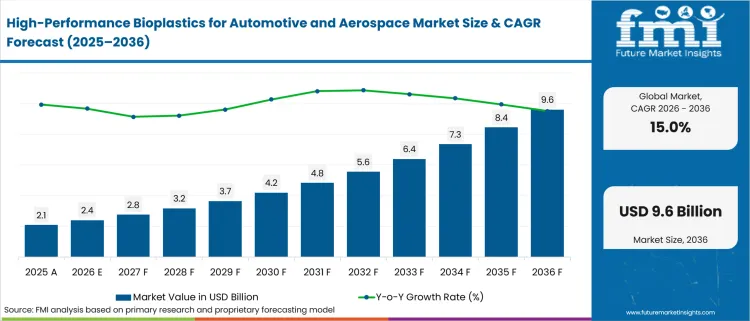
Key Takeaways of High-Performance Bioplastics for Automotive and Aerospace Market
- Demand is tied to qualified replacement of fossil-derived engineering polymers in parts that must retain performance through heat, chemicals, vibration and long service life.
- Bio-PA leads Product Type with a 37.0% share in 2026 because long-chain and specialty polyamides can combine renewable feedstocks with established compounding and molding routes.
- Interior Components lead Application at 45.0%, while Automotive holds 72.0% of End Use due to larger platform volumes and a wider set of eligible parts.
- Direct Sales accounts for 48.0% of Distribution Channel because OEM contracts require technical service, traceable specifications, production trials and formal change approval.
- Bio-Based Feedstocks hold 54.0% of Material Source demand, supported by plant-derived monomers and polymer routes that provide a clear renewable-carbon claim.
- Qualification cost, property retention after ageing, lot consistency and chain-of-custody documentation can delay adoption even when the material has a lower reported carbon footprint.
- South Korea records the highest CAGR among the profiled countries at 16.12%, followed by the USA at 15.42% and the UK at 15.17%.
- BASF SE, Arkema S.A., Asahi Kasei Corporation and Solvay SA and Toray Industries, Inc. and Braskem S.A. and NatureWorks LLC and DuPont de Nemours, Inc. and Covestro AG and Mitsubishi Chemical Group Corporation form the named competitive set.
Analyst Perspective
"High-performance bioplastics will be purchased as qualified engineering materials, not as sustainability badges. A supplier has to preserve dimensional stability, heat ageing, fatigue and process repeatability while documenting the renewable or recycled input. Automotive programs reward grades that can pass PPAP without tooling disruption. Aerospace programs place more weight on flammability, traceability, and change control. The commercial advantage goes to suppliers that pair credible feedstock accounting with application data and stable regional supply."
- Nikhil Kaitwade, Principal Consultant, Future Market Insights
How is the High-Performance Bioplastics for Automotive and Aerospace Market segmented?
Product Type: Bio-PA (Polyamide 6.10 and Polyamide 4.10), Bio-PET (Polyethylene Terephthalate Resins and Recycled Bio-PET), Bio-PP (Bio-Based Polypropylene and Reinforced Bio-PP) and Others (Bio-Based PEEK and Bio-Based Epoxy & Specialty Polymers).
Application: Interior Components (Dashboards & Door Panels and Seat Components & Interior Trim), Exterior Components (Bumper Fascia & Exterior Trim and Wheel Arch Liners & Body Components), Structural Components (Battery Housings and Secondary Structural Components) and Other Applications (Electrical Components and Insulation & Specialty Parts).
End Use: Automotive (Passenger Vehicles and Electric Vehicles) and Aerospace (Commercial Aircraft and UAVs & Specialty Aircraft). Distribution Channel: Direct Sales (OEM Direct Contracts and Long-Term Supply Agreements), Specialty Polymer Distributors (Regional Distributors and Industrial Material Distributors), Compounders & Material Processors (Custom Compounding and Engineered Polymer Processing) and Online & Other Channels (B2B E-Commerce and Specialty Material Platforms).
Material Source: Bio-Based Feedstocks (Plant-Based Feedstocks and Bio-Derived Monomers), Bio-Based Recycled Feedstocks (Chemically Recycled Feedstocks and Mass-Balance Materials), Biodegradable & Compostable Materials (PHA-Based Materials and Biodegradable Polymer Blends) and Hybrid & Other Sources (Bio-Fiber Reinforced Polymers and Bio-Based Composite Materials).
Why does Bio-PA lead the product type category?
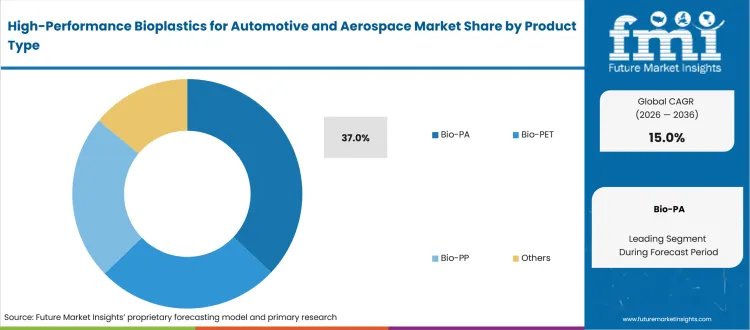
Bio-PA holds a 37.0% share in 2026.
- Polyamide 6.10 and Polyamide 4.10 give formulators a route to renewable carbon while retaining the reinforcement response, chemical resistance, and processing familiarity associated with engineering polyamides. Their value is strongest where a compound must survive under-hood fluids, repeated thermal cycles, or dimensional loads that exceed the capability of commodity bioplastics. Long-chain bio-polyamides can also offer lower moisture uptake than shorter-chain grades, which helps with tolerance control in tubing, connectors and clips and technical housings.
What supports interior components as the leading application?
- Dashboards & Door Panels provide large surface areas where weight, appearance, scratch resistance and odor and color stability can be designed together. Seat Components & Interior Trim add brackets, covers, adjustment parts and decorative elements that do not always face the thermal or impact burden of exterior and primary structural parts. This wider application window allows bio-based compounds to enter through visible trim, hidden carriers, and functional attachments before moving into higher-risk systems.
Why does automotive lead the end use category?
Automotive represents a 72.0% share in 2026.
- Passenger Vehicles create high platform volumes and repeated demand for interior carriers, clips, fascia and connectors and ducts and covers and under-hood parts. A successful material approval can therefore convert into multiyear production across several plants. Electric Vehicles add battery mass and raise the value of lightweight parts, while their electrical architecture creates demand for dielectric housings, cable-management components and cooling lines and flame-managed enclosures. The broad part count allows suppliers to begin with a lower-risk component and build evidence for later platform nominations.
Why does direct sales lead the distribution channel category?
Direct Sales hold a 48.0% share in 2026
- OEM Direct Contracts allow material suppliers to work with design engineering, procurement, quality and molding partners during grade selection. Long-Term Supply Agreements protect continuity after approval, define change notification, and support resin availability across plants. These arrangements also give the supplier access to molding data and failure analysis, which is critical when a lower-carbon grade must match the process window of an incumbent material.
Why do bio-based feedstocks lead the material source category?
Bio-Based Feedstocks account for a 54.0% share in 2026.
- Plant-Based Feedstocks provide a direct renewable-carbon route through castor oil, sugar-derived intermediates, cellulose and other agricultural or forestry inputs. Bio-Derived Monomers allow suppliers to preserve familiar polymer architectures while replacing part of the fossil feedstock. Buyers can therefore connect a material claim to a specific carbon source while assessing whether the resulting grade meets the existing component specification.
What are the drivers, restraints, and opportunities in the High-Performance Bioplastics for Automotive and Aerospace Market?
Driver: OEM lifecycle-carbon and lightweighting targets are moving into material specifications. Restraint: Qualification cost, property retention, and traceability slow substitution. Opportunity: Drop-in bio-attributed grades and application-specific compounds can enter interiors, EV electrical systems, secondary structures and UAVs.
- Driver: OEM lifecycle-carbon and lightweighting targets are moving into material specifications.
- Restraint: Qualification cost, property retention, and traceability slow substitution.
- Opportunity: Drop-in bio-attributed grades and application-specific compounds can enter interiors, EV electrical systems, secondary structures and UAVs.
The driver starts with the vehicle or aircraft program rather than the resin plant. USA Department of Energy guidance links lower vehicle mass to lower energy demand, with particular relevance to electric vehicles carrying heavy batteries. European vehicle policy is moving toward circular design, better material documentation, and recycled plastic content in new vehicles. These signals encourage OEMs to add carbon-footprint and circularity criteria to engineering specifications, but material substitution is accepted only after the part retains its safety and durability function.
The restraint appears during qualification. Automotive PPAP is built around evidence that a production process can repeatedly meet the engineering record and specification at production rates. Aerospace suppliers work within quality systems that emphasize control across the supply chain, while cabin materials must comply with application-specific flammability requirements under FAA and EASA rules. A bioplastic that changes moisture uptake, shrinkage, weld-line strength and flame behavior or color after ageing can trigger new tooling trials and test programs.
The opportunity is therefore strongest for suppliers that reduce the qualification burden. Drop-in mass-balance grades, stable bio-polyamides, custom compounds and well-documented recycled feedstocks can enter through non-primary parts before expanding to more demanding functions.
Which country CAGRs are profiled in the High-Performance Bioplastics for Automotive and Aerospace Market?
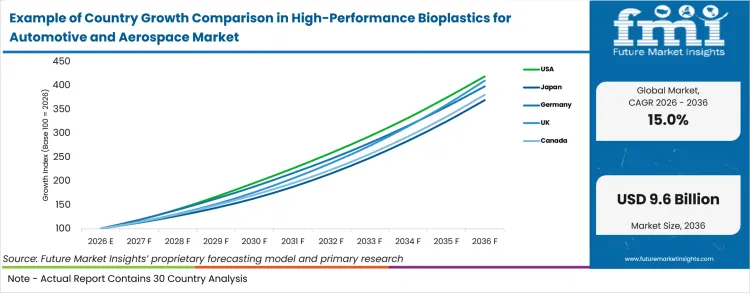
| Country | CAGR, 2026 to 2036 |
|---|---|
| USA | 15.42% |
| Japan | 13.96% |
| Germany | 14.83% |
| UK | 15.17% |
| Canada | 14.31% |
| Australia | 14.68% |
| South Korea | 16.12% |
How do country-level CAGRs compare in the High-Performance Bioplastics for Automotive and Aerospace Market?
The profiled forecasts form a narrow but commercially meaningful band. South Korea leads at 16.12% as EV platforms and domestic aerospace material certification reinforce demand. The USA and UK exceed 15% due to the depth of automotive, aerospace, and advanced-material programs. Germany and Australia sit close to the global rate, while Canada and Japan expand through more selective qualification pathways.
- South Korea leads the profiled set at 16.12%, supported by EV programs and domestic aerospace material certification.
- The USA at 15.42% and the UK at 15.17% exceed the 15.0% global forecast rate.
- Germany at 14.83% and Australia at 14.68% remain close to the global rate.
- Canada at 14.31% and Japan at 13.96% expand through more selective qualification pathways.
How does the High-Performance Bioplastics for Automotive and Aerospace Market vary by country?
- USA (15.42%): The USA combines large automotive platforms with a broad aerospace and defence supply base. Automotive buyers favor suppliers that can support production trials, PPAP evidence, regional compounding and rapid root-cause analysis. Aerospace demand is more selective because cabin materials, insulation systems, and other interior parts must meet FAA flammability requirements. The market therefore rewards companies that can serve high-volume vehicle programs while maintaining separate documentation and lot controls for aviation customers.
- Japan (13.96%): Japanese programs place strong weight on surface quality, tight tolerances, low odor and controlled engineering changes. Material suppliers need consistent resin behavior across long product cycles and must coordinate closely with molders when a renewable or recycled feedstock is introduced. Automotive interiors and technical housings provide an accessible route, while aerospace use advances through long validation sequences. Domestic chemical groups also create a pathway from bio-derived monomers to locally supported engineering plastics.
- Germany (14.83%): Germany combines a dense OEM and Tier-1 engineering network with EU policy on vehicle circularity. The purchasing mechanism is documentation-led: teams assess product carbon footprint, chain of custody, recyclability compatibility and performance after ageing before nominating a grade. Suppliers that can offer lower-carbon polyamide or polycarbonate variants without changing the established process window are better positioned than materials that require a new tool or unproven joining method.
- UK (15.17%): The UK has linked advanced materials, aerospace, automotive and batteries and space within its Advanced Manufacturing Sector Plan. This supports pilot-scale material work and creates a route from university or technology-center validation into industrial trials. Performance vehicle and aerospace programs purchase lower volumes than mass-market automotive platforms, but they can accept higher material value when the supplier provides design data, prototype support and a credible path to certification.
- Canada (14.31%): Canada combines an established aerospace industry with automotive production concentrated in Ontario. Aerospace suppliers need material traceability and process control that can survive long program lives. Automotive applications add regional demand for interior and electrical compounds. Cold-weather performance is commercially important, so low-temperature impact, moisture conditioning and dimensional stability can determine whether a grade moves from laboratory approval to a supply agreement.
- Australia (14.68%): Australia has a smaller automotive manufacturing base, so demand is more project-based and centered on aerospace, defence and space and advanced manufacturing and specialist mobility. Government policy identifies advanced manufacturing and materials as critical technologies. Buyers often require local technical support, small development lots, and clear import continuity. UAVs, specialty aircraft, and low-volume components create openings for additive manufacturing and bio-composites but field exposure and certification evidence remain decisive.
- South Korea (16.12%): South Korea records the highest profiled CAGR at 16.12%. Large automotive and EV manufacturers can move a qualified compound into substantial platform volumes, while electronics capability supports electrical housings and connector applications. The national aerospace carbon-composites roadmap also places certification and buyer-supplier coordination at the center of material adoption. Suppliers must combine fast development cycles with documented quality and a credible local supply plan.
Who are the notable companies in the High-Performance Bioplastics for Automotive and Aerospace Market?
BASF SE, Arkema S.A., Asahi Kasei Corporation and Solvay SA and Toray Industries, Inc. and Braskem S.A. and NatureWorks LLC and DuPont de Nemours, Inc. and Covestro AG and Mitsubishi Chemical Group Corporation.
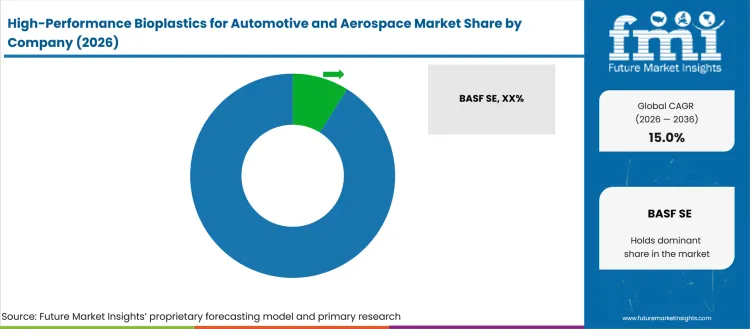
- Competition is shaped by control of polymer chemistry, access to renewable or circular feedstocks, compounding capability and application data and the ability to hold a qualified specification across regions. BASF SE and Arkema S.A. have documented lower-carbon or bio-based polyamide platforms. Asahi Kasei Corporation, Toray Industries, Inc., and Mitsubishi Chemical Group Corporation connect polymer development with automotive or aerospace application engineering. Braskem S.A. brings a scalable route for bio-attributed and bio-circular polypropylene, while NatureWorks LLC focuses on bio-based polymer platforms and performance grade development.
- Solvay SA, DuPont de Nemours, Inc., and Covestro AG participate through specialty engineering polymers and material science and component support. The main commercial divide is between suppliers offering drop-in carbon-footprint reduction within a familiar polymer family and suppliers introducing a new bio-based chemistry with a distinct performance profile. The first route can lower change risk. The second can create stronger differentiation, but it demands more testing and process support.
How do companies compare in the High-Performance Bioplastics for Automotive and Aerospace Market?
| Company | Documented market signal | Commercial position |
|---|---|---|
| BASF SE | Ultramid LowPCF and ZeroPCF variants in the PA6 value chain use renewable energy and mass-balance feedstocks. | Drop-in engineering-polyamide route for customers seeking lower product carbon footprint with established processing. |
| Arkema S.A. | Rilsan PA11 is a fully bio-based long-chain polyamide; Arkema reported a lower global production footprint beginning in 2025. | Specialty bio-polyamide platform suited to tubing, connectors, coatings and e-mobility applications. |
| Asahi Kasei Corporation | Development work with Aquafil combines regenerated PA6 with cellulose nanofiber for additive-manufacturing compounds. | Links circular feedstock, reinforcement, and prototyping for automotive and aeronautical parts. |
| Braskem S.A. | Certified bio-attributed and bio-circular propylene and polypropylene were introduced to the USA market with Shell Chemicals. | Scalable polyolefin pathway for interior, trim, and other high-volume automotive components. |
| Toray Industries, Inc. | Official sustainability materials cover biomass and recycled nylon/PET alongside composite capabilities. | Integrated polymer, fiber, and composite position across transport applications. |
| NatureWorks LLC | Ingeo high-performance grades extend PLA-based materials into heat-resistant and engineered applications. | Bio-based polymer platform for blends, molded parts, additive manufacturing and selected durable components. |
| Covestro AG | Makrolon polycarbonate is positioned for lightweight, durable, transparent and electrical applications. Circular feedstock options across the portfolio. | Application engineering for interior, lighting, electronic and specialty mobility parts. |
| Mitsubishi Chemical Group Corporation | DURABIO plant-derived engineering plastic has documented vehicle interior and exterior adoptions. | Commercial automotive evidence in high-appearance components and functional trim. |
Benchmarking reflects documented official product or company evidence. It does not represent a market-share ranking. Supplier fit varies by polymer family, application qualification, geographic support and the buyer's accepted chain-of-custody method.
What are the key developments in the High-Performance Bioplastics for Automotive and Aerospace Market?
- In June 2026, Mitsubishi Chemical Corporation announced that Audi selected DURABIO plant-derived engineering plastic for door switch inserts in the new Q3.
- In October 2024, BASF launched Ultramid LowPCF and ZeroPCF options in its European polyamide 6 value chain, using renewable electricity and low-emission steam and certified mass-balance feedstocks.
- In October 2024, Arkema announced that the global production footprint of its bio-based polyamide 11 chain would reach 1.3 kg CO2e per kg from January 2025.
- In October 2024, Asahi Kasei and Aquafil agreed to develop compounds that combine ECONYL regenerated polyamide 6 with cellulose nanofiber for 3D-printing applications suited to automotive and aeronautical parts.
- In March 2024, Braskem and Shell Chemicals announced certified bio-attributed and bio-circular propylene and polypropylene for the USA market, including automotive applications.
What is included in the High-Performance Bioplastics for Automotive and Aerospace Market report scope?
| Coverage field | Report scope |
|---|---|
| Market breakdown | Product Type, Application, End Use and Distribution Channel and Material Source and Region |
| Quantitative Units | Revenue in USD Billion and CAGR in %. |
| Market Definition | Revenue includes first-sale manufacturer revenue from high-performance bio-based, bio-attributed, bio-recycled and biodegradable-blend and bio-composite polymer systems supplied for durable automotive and aerospace components within the defined segmentation universe. Commodity packaging bioplastics and conventional fossil polymers without an attributed lower-carbon feedstock are excluded. |
| Regions Covered | North America; Latin America; Western Europe; Eastern Europe; East Asia; South Asia and Pacific; Middle East and Africa |
| Countries Covered | USA, Japan, Germany and UK and Canada and Australia and South Korea and more than thirty additional countries in the full report |
| Key Companies Profiled | BASF SE; Arkema S.A.; Asahi Kasei Corporation; Solvay SA; Toray Industries, Inc.; Braskem S.A.; NatureWorks LLC; DuPont de Nemours, Inc.; Covestro AG; Mitsubishi Chemical Group Corporation |
| Forecast Period | 2026 to 2036 |
| Approach | Hybrid bottom-up and top-down sizing using polymer supplier revenue, qualified application volumes, average selling prices and product mix and channel structure and country indicators and buyer-side validation. |
How was the High-Performance Bioplastics for Automotive and Aerospace Market research conducted?
| Method | Approach |
|---|---|
| Primary Research | FMI engages resin producers, bio-feedstock suppliers, compounders and molders and specialty distributors and automotive OEM and Tier-1 material engineers and aerospace suppliers and quality professionals and procurement teams and subject-matter experts. |
| Desk Research | The review covers official vehicle and aviation regulation, recognized quality and approval standards, government manufacturing and industry releases and company filings and first-party product documentation and official press releases and technical guidance. |
| Market Sizing and Forecasting | The model reconciles supplier revenue, qualified application penetration, polymer and compound pricing and product type and material-source mix and distribution structure and vehicle and aircraft program indicators and country demand. |
| Data Validation | Supplier-side findings are cross-checked with buyer qualification practices, channel evidence, application requirements and country mechanisms and mathematical consistency across the forecast period. |
How is the High-Performance Bioplastics for Automotive and Aerospace Market segmented by category?
High-Performance Bioplastics for Automotive and Aerospace Market segmented by Product Type:
- Bio-PA
- Polyamide 6.10
- Polyamide 4.10
- Bio-PET
- Polyethylene Terephthalate Resins
- Recycled Bio-PET
- Bio-PP
- Bio-Based Polypropylene
- Reinforced Bio-PP
- Others
- Bio-Based PEEK
- Bio-Based Epoxy & Specialty Polymers
High-Performance Bioplastics for Automotive and Aerospace Market segmented by Application:
- Interior Components
- Dashboards & Door Panels
- Seat Components & Interior Trim
- Exterior Components
- Bumper Fascia & Exterior Trim
- Wheel Arch Liners & Body Components
- Structural Components
- Battery Housings
- Secondary Structural Components
- Other Applications
- Electrical Components
- Insulation & Specialty Parts
High-Performance Bioplastics for Automotive and Aerospace Market segmented by End Use:
- Automotive
- Passenger Vehicles
- Electric Vehicles
- Aerospace
- Commercial Aircraft
- UAVs & Specialty Aircraft
High-Performance Bioplastics for Automotive and Aerospace Market segmented by Distribution Channel:
- Direct Sales
- OEM Direct Contracts
- Long-Term Supply Agreements
- Specialty Polymer Distributors
- Regional Distributors
- Industrial Material Distributors
- Compounders & Material Processors
- Custom Compounding
- Engineered Polymer Processing
- Online & Other Channels
- B2B E-Commerce
- Specialty Material Platforms
High-Performance Bioplastics for Automotive and Aerospace Market segmented by Material Source:
- Bio-Based Feedstocks
- Plant-Based Feedstocks
- Bio-Derived Monomers
- Bio-Based Recycled Feedstocks
- Chemically Recycled Feedstocks
- Mass-Balance Materials
- Biodegradable & Compostable Materials
- PHA-Based Materials
- Biodegradable Polymer Blends
- Hybrid & Other Sources
- Bio-Fiber Reinforced Polymers
- Bio-Based Composite Materials
Which regions are covered in the High-Performance Bioplastics for Automotive and Aerospace Market?
- North America
- United States
- Canada
- Mexico
- Latin America
- Brazil
- Chile
- Rest of Latin America
- Western Europe
- Germany
- United Kingdom
- Italy
- Spain
- France
- Nordics
- Benelux
- Rest of Western Europe
- Eastern Europe
- Russia
- Poland
- Hungary
- Balkan and Baltic States
- Rest of Eastern Europe
- East Asia
- China
- Japan
- South Korea
- South Asia and Pacific
- India
- ASEAN
- Australia and New Zealand
- Rest of South Asia and Pacific
- Middle East and Africa
- Kingdom of Saudi Arabia
- Other GCC Countries
- Türkiye
- South Africa
- Other African Union Countries
- Rest of Middle East and Africa
Which sources support the High-Performance Bioplastics for Automotive and Aerospace Market analysis?
- European Commission. End-of-life vehicles Regulation, official policy page. Accessed July 31, 2026.
- USA Department of Energy. Lightweight Materials for Cars and Trucks. Accessed July 31, 2026.
- Electronic Code of Federal Regulations. 14 CFR 25.853, Compartment interiors. Current as accessed July 31, 2026.
- European Union Aviation Safety Agency. CS-25 Large Aeroplanes and associated flammability requirements. Accessed July 31, 2026.
- Automotive Industry Action Group. Production Part Approval Process, PPAP-4. Accessed July 31, 2026.
- International Aerospace Quality Group. 9100 Quality Management Systems Requirements for Aviation, Space and Defense Organizations. Accessed July 31, 2026.
- UK Department for Business and Trade. Advanced Manufacturing Sector Plan. June 23, 2025; updated August 5, 2025.
- Innovation, Science and Economic Development Canada. State of Canada's Aerospace Industry. March 31, 2026.
- Australian Department of Industry, Science and Resources. Advanced manufacturing and materials technologies. Accessed July 31, 2026.
- Korea Ministry of Trade, Industry and Energy. Aerospace Carbon Composites Technology Development and Certification Roadmap. May 22, 2024.
- BASF. Ultramid LowPCF and ZeroPCF polyamide portfolio announcement. October 10, 2024.
- Arkema. Carbon footprint update for the global bio-based polyamide 11 chain. October 10, 2024.
- Asahi Kasei. Collaboration with Aquafil on regenerated polyamide 6 and cellulose nanofiber compounds. October 8, 2024.
- Braskem. Certified bio-attributed and bio-circular propylene and polypropylene for the U.S. market. March 14, 2024.
- Mitsubishi Chemical Corporation. Audi selects DURABIO for new Q3 door switch inserts. June 16, 2026.
- Toray Industries. Initiatives to promote a circular economy through biomass and recycled materials. Accessed July 31, 2026.
- NatureWorks. Ingeo high-performance grades. Accessed July 31, 2026.
- Covestro. Makrolon polycarbonate material platform. Accessed July 31, 2026.
This bibliography is provided for reader reference and is not exhaustive. The full report contains the complete reference list and detailed citations.
What questions does this report answer?
- What is the High-Performance Bioplastics for Automotive and Aerospace Market size in 2026 and what value is forecast for 2036?
- Why does Bio-PA hold the leading Product Type position?
- Which interior, exterior, structural and electrical and insulation applications provide the most practical entry points?
- How do automotive PPAP and aerospace flammability or quality requirements affect adoption?
- Why do Direct Sales and long-term supply agreements hold a central role in qualified programs?
- How do plant-based, recycled, mass-balance and biodegradable and hybrid material sources differ commercially?
- How do country growth rates compare across the USA, Japan, Germany and UK and Canada and Australia and South Korea?
- Which named companies provide bio-based, lower-carbon, circular or specialty engineering polymer capabilities?
- What should OEM material teams evaluate before replacing an incumbent engineering polymer?
Frequently Asked Questions
How big is the High-Performance Bioplastics for Automotive and Aerospace Market in 2026?
The high-performance bioplastics for automotive and aerospace market is valued at USD 2.4 billion in 2026 and is forecast to reach USD 9.6 billion by 2036. Growth is supported by OEM lifecycle-carbon and lightweighting targets moving into material specifications across passenger vehicle, electric vehicle, and commercial aircraft component qualification programs worldwide.
What is the CAGR of the High-Performance Bioplastics for Automotive and Aerospace Market from 2026 to 2036?
The high-performance bioplastics for automotive and aerospace market grows at a CAGR of 15.0% between 2026 and 2036, supported by automotive and aerospace programs adopting bio-based and bio-attributed engineering polymers once drop-in grades preserve dimensional stability, heat ageing, and process repeatability across formal qualification and production approval workflows.
Which product type leads the High-Performance Bioplastics for Automotive and Aerospace Market?
Bio-PA accounts for 37.0% of the high-performance bioplastics for automotive and aerospace market by product type in 2026, driven by long-chain and specialty polyamides that combine renewable feedstocks with established compounding, reinforcement response, and chemical resistance across under-hood, connector, and technical housing applications.
How much will the High-Performance Bioplastics for Automotive and Aerospace Market add between 2026 and 2036?
The high-performance bioplastics for automotive and aerospace market is set to add USD 7.2 billion between 2026 and 2036, growing from USD 2.4 billion to USD 9.6 billion as qualified bio-based and bio-attributed engineering polymers expand across interior components, EV electrical systems, secondary structures, and UAV applications globally.
Who are the leading companies in the High-Performance Bioplastics for Automotive and Aerospace Market?
Ten companies shape competition in the high-performance bioplastics for automotive and aerospace market, including BASF SE, Arkema, Asahi Kasei, Solvay, Toray Industries, Braskem, NatureWorks, DuPont de Nemours, Covestro, and Mitsubishi Chemical Group, competing through bio-polyamide platforms, mass-balance polyolefins, circular feedstock programs, and application engineering support across automotive and aerospace qualification pathways worldwide.
Preview the report firsthand - request a free sample
Get SampleGet the brochure for pricing and purchase details.
Get PDFTable of Content
- Key Takeaways
- Market Size and CAGR
- Top Growth Driver
- Fastest Growing Segment
- Leading Region
- Key Companies
- Emerging Opportunities
- Executive Summary
- Global Market Outlook
- Demand-side Trends
- Supply-side Trends
- Technology Roadmap Analysis
- Analysis and Recommendations
- Analyst Perspective (What is happening? Why now? What should investors know?)
- Key Questions Answered
- How large is the market?
- What is the CAGR?
- What are key trends?
- Which region dominates?
- Who are the leaders?
- Market Overview
- Market Coverage / Taxonomy
- Market Definition / Scope / Limitations
- Research Methodology
- Chapter Orientation
- Analytical Lens and Working Hypotheses
- Market Structure, Signals, and Trend Drivers
- Benchmarking and Cross-market Comparability
- Market Sizing, Forecasting, and Opportunity Mapping
- Research Design and Evidence Framework
- Desk Research Programme (Secondary Evidence)
- Expert Input and Fieldwork (Primary Evidence)
- Tooling, Models, and Reference Databases
- Data Engineering and Model Build
- Quality Assurance and Audit Trail
- Market Background
- Market Dynamics (Drivers, Restraints, Opportunity, Trends)
- Scenario Forecast (Optimistic, Likely, Conservative)
- Impact Analysis
- AI Impact
- Sustainability Impact
- Regulatory Impact
- Technology Impact
- Consumer / Buyer Analysis
- Purchase Drivers
- Adoption Barriers
- Buyer Journey
- Opportunity Map Analysis
- Product Life Cycle Analysis
- Supply Chain Analysis
- Investment Feasibility Matrix
- Value Chain Analysis
- PESTLE and Porter's Analysis
- Regulatory Landscape
- Regional Parent Market Outlook
- Production and Consumption Statistics
- Import and Export Statistics
- Global Market Analysis and Forecast, 2021 to 2036
- Historical Market Size Value (USD Billion) Analysis, 2021 to 2025
- Current and Future Market Size Value (USD Billion) Projections, 2026 to 2036
- Y-o-Y Growth Trend Analysis
- Absolute $ Opportunity Analysis
- Global Market Pricing Analysis, 2021 to 2036
- Global Market Analysis and Forecast, By Product Type, 2021 to 2036
- Introduction / Key Findings
- Historical Market Size Value (USD Billion) Analysis By Product Type, 2021 to 2025
- Current and Future Market Size Value (USD Billion) Analysis and Forecast By Product Type, 2026 to 2036
- Bio-PA
- Polyamide 6.10
- Polyamide 4.10
- Bio-PET
- Polyethylene Terephthalate Resins
- Recycled Bio-PET
- Bio-PP
- Bio-Based Polypropylene
- Reinforced Bio-PP
- Others
- Bio-Based PEEK
- Bio-Based Epoxy & Specialty Polymers
- Bio-PA
- Y-o-Y Growth Trend Analysis By Product Type, 2021 to 2025
- Absolute $ Opportunity Analysis By Product Type, 2026 to 2036
- Global Market Analysis and Forecast, By Application, 2021 to 2036
- Introduction / Key Findings
- Historical Market Size Value (USD Billion) Analysis By Application, 2021 to 2025
- Current and Future Market Size Value (USD Billion) Analysis and Forecast By Application, 2026 to 2036
- Interior Components
- Dashboards & Door Panels
- Seat Components & Interior Trim
- Exterior Components
- Bumper Fascia & Exterior Trim
- Wheel Arch Liners & Body Components
- Structural Components
- Battery Housings
- Secondary Structural Components
- Other Applications
- Electrical Components
- Insulation & Specialty Parts
- Interior Components
- Y-o-Y Growth Trend Analysis By Application, 2021 to 2025
- Absolute $ Opportunity Analysis By Application, 2026 to 2036
- Global Market Analysis and Forecast, By End Use, 2021 to 2036
- Introduction / Key Findings
- Historical Market Size Value (USD Billion) Analysis By End Use, 2021 to 2025
- Current and Future Market Size Value (USD Billion) Analysis and Forecast By End Use, 2026 to 2036
- Automotive
- Passenger Vehicles
- Electric Vehicles
- Aerospace
- Commercial Aircraft
- UAVs & Specialty Aircraft
- Automotive
- Y-o-Y Growth Trend Analysis By End Use, 2021 to 2025
- Absolute $ Opportunity Analysis By End Use, 2026 to 2036
- Global Market Analysis and Forecast, By Distribution Channel, 2021 to 2036
- Introduction / Key Findings
- Historical Market Size Value (USD Billion) Analysis By Distribution Channel, 2021 to 2025
- Current and Future Market Size Value (USD Billion) Analysis and Forecast By Distribution Channel, 2026 to 2036
- Direct Sales
- OEM Direct Contracts
- Long-Term Supply Agreements
- Specialty Polymer Distributors
- Regional Distributors
- Industrial Material Distributors
- Compounders & Material Processors
- Custom Compounding
- Engineered Polymer Processing
- Online & Other Channels
- B2B E-Commerce
- Specialty Material Platforms
- Direct Sales
- Y-o-Y Growth Trend Analysis By Distribution Channel, 2021 to 2025
- Absolute $ Opportunity Analysis By Distribution Channel, 2026 to 2036
- Global Market Analysis and Forecast, By Material Source, 2021 to 2036
- Introduction / Key Findings
- Historical Market Size Value (USD Billion) Analysis By Material Source, 2021 to 2025
- Current and Future Market Size Value (USD Billion) Analysis and Forecast By Material Source, 2026 to 2036
- Bio-Based Feedstocks
- Plant-Based Feedstocks
- Bio-Derived Monomers
- Bio-Based Recycled Feedstocks
- Chemically Recycled Feedstocks
- Mass-Balance Materials
- Biodegradable & Compostable Materials
- PHA-Based Materials
- Biodegradable Polymer Blends
- Hybrid & Other Sources
- Bio-Fiber Reinforced Polymers
- Bio-Based Composite Materials
- Bio-Based Feedstocks
- Y-o-Y Growth Trend Analysis By Material Source, 2021 to 2025
- Absolute $ Opportunity Analysis By Material Source, 2026 to 2036
- Global Market Analysis and Forecast, By Region, 2021 to 2036
- Introduction
- Historical Market Size Value (USD Billion) Analysis By Region, 2021 to 2025
- Current Market Size Value (USD Billion) Analysis and Forecast By Region, 2026 to 2036
- North America
- Latin America
- Western Europe
- Eastern Europe
- East Asia
- South Asia and Pacific
- Middle East & Africa
- Market Attractiveness Analysis By Region
- North America Market Analysis and Forecast, By Country, 2021 to 2036
- Historical Market Size Value (USD Billion) Trend Analysis By Market Taxonomy, 2021 to 2025
- Market Size Value (USD Billion) Forecast By Market Taxonomy, 2026 to 2036
- By Country
- USA
- Canada
- By Product Type
- By Application
- By End Use
- By Distribution Channel
- By Material Source
- By Country
- Market Attractiveness Analysis
- By Country
- By Product Type
- By Application
- By End Use
- By Distribution Channel
- By Material Source
- Key Takeaways
- Latin America Market Analysis and Forecast, By Country
- Historical Market Size Value (USD Billion) Trend Analysis By Market Taxonomy, 2021 to 2025
- Market Size Value (USD Billion) Forecast By Market Taxonomy, 2026 to 2036
- By Country
- Brazil
- Mexico
- Chile
- Rest of Latin America
- By Product Type
- By Application
- By End Use
- By Distribution Channel
- By Material Source
- By Country
- Market Attractiveness Analysis
- By Country
- By Product Type
- By Application
- By End Use
- By Distribution Channel
- By Material Source
- Key Takeaways
- Western Europe Market Analysis and Forecast, By Country
- Historical Market Size Value (USD Billion) Trend Analysis By Market Taxonomy, 2021 to 2025
- Market Size Value (USD Billion) Forecast By Market Taxonomy, 2026 to 2036
- By Country
- Germany
- UK
- Italy
- Spain
- France
- Nordic
- BENELUX
- Rest of Western Europe
- By Product Type
- By Application
- By End Use
- By Distribution Channel
- By Material Source
- By Country
- Market Attractiveness Analysis
- By Country
- By Product Type
- By Application
- By End Use
- By Distribution Channel
- By Material Source
- Key Takeaways
- Eastern Europe Market Analysis and Forecast, By Country
- Historical Market Size Value (USD Billion) Trend Analysis By Market Taxonomy, 2021 to 2025
- Market Size Value (USD Billion) Forecast By Market Taxonomy, 2026 to 2036
- By Country
- Russia
- Poland
- Hungary
- Balkan & Baltic
- Rest of Eastern Europe
- By Product Type
- By Application
- By End Use
- By Distribution Channel
- By Material Source
- By Country
- Market Attractiveness Analysis
- By Country
- By Product Type
- By Application
- By End Use
- By Distribution Channel
- By Material Source
- Key Takeaways
- East Asia Market Analysis and Forecast, By Country
- Historical Market Size Value (USD Billion) Trend Analysis By Market Taxonomy, 2021 to 2025
- Market Size Value (USD Billion) Forecast By Market Taxonomy, 2026 to 2036
- By Country
- China
- Japan
- South Korea
- By Product Type
- By Application
- By End Use
- By Distribution Channel
- By Material Source
- By Country
- Market Attractiveness Analysis
- By Country
- By Product Type
- By Application
- By End Use
- By Distribution Channel
- By Material Source
- Key Takeaways
- South Asia and Pacific Market Analysis and Forecast, By Country
- Historical Market Size Value (USD Billion) Trend Analysis By Market Taxonomy, 2021 to 2025
- Market Size Value (USD Billion) Forecast By Market Taxonomy, 2026 to 2036
- By Country
- India
- ASEAN
- Australia & New Zealand
- Rest of South Asia and Pacific
- By Product Type
- By Application
- By End Use
- By Distribution Channel
- By Material Source
- By Country
- Market Attractiveness Analysis
- By Country
- By Product Type
- By Application
- By End Use
- By Distribution Channel
- By Material Source
- Key Takeaways
- Middle East & Africa Market Analysis and Forecast, By Country
- Historical Market Size Value (USD Billion) Trend Analysis By Market Taxonomy, 2021 to 2025
- Market Size Value (USD Billion) Forecast By Market Taxonomy, 2026 to 2036
- By Country
- Kingdom of Saudi Arabia
- Other GCC Countries
- Türkiye
- South Africa
- Other African Union
- Rest of Middle East & Africa
- By Product Type
- By Application
- By End Use
- By Distribution Channel
- By Material Source
- By Country
- Market Attractiveness Analysis
- By Country
- By Product Type
- By Application
- By End Use
- By Distribution Channel
- By Material Source
- Key Takeaways
- Key Countries Market Analysis
- USA
- Pricing Analysis
- Market Share Analysis, 2025
- By Product Type
- By Application
- By End Use
- By Distribution Channel
- By Material Source
- Canada
- Pricing Analysis
- Market Share Analysis, 2025
- By Product Type
- By Application
- By End Use
- By Distribution Channel
- By Material Source
- Mexico
- Pricing Analysis
- Market Share Analysis, 2025
- By Product Type
- By Application
- By End Use
- By Distribution Channel
- By Material Source
- Brazil
- Pricing Analysis
- Market Share Analysis, 2025
- By Product Type
- By Application
- By End Use
- By Distribution Channel
- By Material Source
- Chile
- Pricing Analysis
- Market Share Analysis, 2025
- By Product Type
- By Application
- By End Use
- By Distribution Channel
- By Material Source
- Germany
- Pricing Analysis
- Market Share Analysis, 2025
- By Product Type
- By Application
- By End Use
- By Distribution Channel
- By Material Source
- UK
- Pricing Analysis
- Market Share Analysis, 2025
- By Product Type
- By Application
- By End Use
- By Distribution Channel
- By Material Source
- Italy
- Pricing Analysis
- Market Share Analysis, 2025
- By Product Type
- By Application
- By End Use
- By Distribution Channel
- By Material Source
- Spain
- Pricing Analysis
- Market Share Analysis, 2025
- By Product Type
- By Application
- By End Use
- By Distribution Channel
- By Material Source
- France
- Pricing Analysis
- Market Share Analysis, 2025
- By Product Type
- By Application
- By End Use
- By Distribution Channel
- By Material Source
- India
- Pricing Analysis
- Market Share Analysis, 2025
- By Product Type
- By Application
- By End Use
- By Distribution Channel
- By Material Source
- ASEAN
- Pricing Analysis
- Market Share Analysis, 2025
- By Product Type
- By Application
- By End Use
- By Distribution Channel
- By Material Source
- Australia & New Zealand
- Pricing Analysis
- Market Share Analysis, 2025
- By Product Type
- By Application
- By End Use
- By Distribution Channel
- By Material Source
- China
- Pricing Analysis
- Market Share Analysis, 2025
- By Product Type
- By Application
- By End Use
- By Distribution Channel
- By Material Source
- Japan
- Pricing Analysis
- Market Share Analysis, 2025
- By Product Type
- By Application
- By End Use
- By Distribution Channel
- By Material Source
- South Korea
- Pricing Analysis
- Market Share Analysis, 2025
- By Product Type
- By Application
- By End Use
- By Distribution Channel
- By Material Source
- Russia
- Pricing Analysis
- Market Share Analysis, 2025
- By Product Type
- By Application
- By End Use
- By Distribution Channel
- By Material Source
- Poland
- Pricing Analysis
- Market Share Analysis, 2025
- By Product Type
- By Application
- By End Use
- By Distribution Channel
- By Material Source
- Hungary
- Pricing Analysis
- Market Share Analysis, 2025
- By Product Type
- By Application
- By End Use
- By Distribution Channel
- By Material Source
- Kingdom of Saudi Arabia
- Pricing Analysis
- Market Share Analysis, 2025
- By Product Type
- By Application
- By End Use
- By Distribution Channel
- By Material Source
- Türkiye
- Pricing Analysis
- Market Share Analysis, 2025
- By Product Type
- By Application
- By End Use
- By Distribution Channel
- By Material Source
- South Africa
- Pricing Analysis
- Market Share Analysis, 2025
- By Product Type
- By Application
- By End Use
- By Distribution Channel
- By Material Source
- USA
- Market Structure Analysis
- Competition Dashboard
- Competition Benchmarking
- Market Share Analysis of Top Players
- By Regional
- By Product Type
- By Application
- By End Use
- By Distribution Channel
- By Material Source
- Emerging Startups
- Innovation Benchmarking
- Competition Analysis
- Competition Deep Dive
- BASF SE
- Overview
- Product Portfolio
- Profitability by Market Segments
- Sales Footprint
- Strategy Overview
- Marketing Strategy
- Product Strategy
- Channel Strategy
- Arkema S.A.
- Asahi Kasei Corporation
- Solvay SA
- Toray Industries, Inc.
- Braskem S.A.
- NatureWorks LLC
- DuPont de Nemours, Inc.
- Covestro AG
- Mitsubishi Chemical Group Corporation
- Others
- BASF SE
- Case Studies
- Success Stories
- Recent Developments
- Competition Deep Dive
- Assumptions & Acronyms Used


