

- Industry Size (2026)
- USD 1.72 Bn
- Forecast (2036)
- USD 10.94 Bn
- CAGR (2026 to 2036)
- 20.3%
Bioplastics Outlook in the UK 2026 to 2036
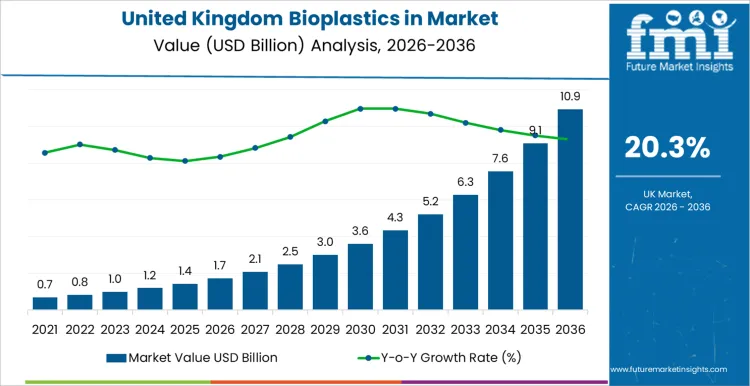
Demand for bioplastics in the UK is projected to reach USD 1.72 billion in 2026. Demand is expected to rise to USD 10.94 billion by 2036, expanding at a 20.3% CAGR. This acceleration is shaped by a practical shift in how manufacturers, converters, and retail brands make packaging and product-material decisions.
Quick Stats for Bioplastics Demand in the UK
- Bioplastics Valuation in the UK (2026): USD 1.72 billion
- Bioplastics Forecast Valuation in the UK (2036): USD 10.94 billion
- Bioplastics Forecast CAGR (2026 to 2036): 20.3%
- Leading Regional Growth: England (22.3)
- Leading Material Type: Bio-PET (41% share)
- High-Value Application Areas: Bottle; Packaging; Food-Services; Agriculture/Horticulture; Consumer Products
- Key Companies Profiled: NatureWorks LLC; BASF SE; Total Energies Corbion; Novamont S.p.A; Mitsubishi Chemical Corporation
Procurement teams are moving from broad sustainability statements to measurable improvements such as lower fossil dependency, credible end-of-life pathways, and compliance-aligned claims.
For CEOs and commercial leaders, the largest advantage lies in protecting brand reputation while meeting packaging expectations from retailers and regulators. For polymer suppliers and technology partners, growth depends on reliable performance in mainstream converting lines, stable feedstock access, and predictable quality at scale.
Bioplastics adoption in the UK is being defined by two parallel requirements. The first is performance compatibility, where materials must run on existing filling, sealing, and forming equipment with limited downtime. The second is governance readiness, where businesses must show evidence for recyclability, compostability, and responsible labeling to avoid claim disputes.
Why is the UK a High-Intent Adoption Hub for Bioplastics?
The UK has become a high-intent environment for bioplastics adoption because packaging strategy is now tied closely to cost exposure, compliance, and customer trust. Businesses that rely heavily on plastic packaging face direct fiscal pressure when recycled content thresholds are unmet.
The UK’s Plastic Packaging Tax applies to plastic packaging components manufactured in or imported into the UK that contain less than 30% recycled plastic, pushing companies to reassess material portfolios and blending strategies.
Restrictions on specific single-use items also shape packaging redesign priorities, particularly in England where bans and restrictions apply to defined categories with exemptions. This policy environment increases demand for material solutions that support credible sustainability outcomes while remaining functional in real distribution conditions.
Supply dynamics support further adoption. Global bioplastics production capacity is expected to increase from around 2.47 million tonnes in 2024 to approximately 5.73 million tonnes by 2029, signalling broader scale-up across the industry. UK buyers benefit from this momentum as availability improves and polymer selection becomes more diversified.
Decision makers also align UK material roadmaps with broader category shifts captured in the bioplastics demand outlook, especially when planning long-term supply partnerships and application expansion across packaging and consumer goods.
How is Bioplastics Demand Segmented by Material Type and Applications?
The demand for bioplastics in the UK is guided by material performance, processing readiness, and end-use requirements that vary across packaging, food-service formats, and consumer products.
Why does Bio-PET lead material-type adoption with an Elevated Share in the UK?
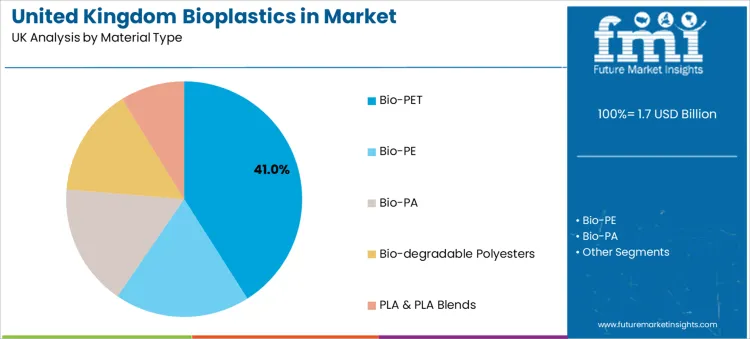
Bio-PET holds a 41% share, reflecting its advantage as a drop-in style solution in many packaging use cases where performance familiarity matters. For brand owners, Bio-PET supports clearer adoption because it can fit existing bottle and packaging requirements where strength, clarity, and barrier expectations are non-negotiable.
This makes it attractive for businesses that want sustainability progress without compromising shelf impact or operational reliability in high-speed filling lines. Bio-PET is also well-positioned for large-scale packaging uses where corporate stakeholders want measurable change at a portfolio level. It supports better internal alignment between packaging engineering teams, procurement, and ESG reporting, since material transitions can be tracked through consistent SKU conversions.
Why do bottles lead application uptake with a 41.0% share across UK demand?
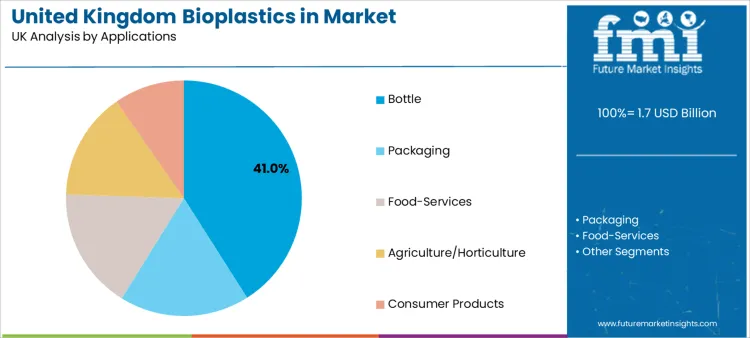
Bottles account for a 41.0% share, making them the most significant application pathway for bioplastic adoption in the UK. This is driven by strong volume throughput in beverage, personal care, and household packaging, where brands aim to improve material narratives while maintaining durability and shelf life requirements.
Bottles also offer a clear route for large-scale conversion because packaging teams can validate performance through repeatable testing and rollout discipline across standard bottle formats. Clarity, strength, and filling-line compatibility remain non-negotiable priorities in bottle-led material roadmaps within the plastic bottles industry.
What are the Dynamics, Restraints, Opportunities, and Threats Shaping this Sector?
How are regulation, brand commitments, and packaging economics driving rapid demand?
Demand is rising because sustainability is now linked to measurable commercial exposure. Taxes, restrictions, and retailer expectations turn packaging decisions into executive-level topics. The Plastic Packaging Tax requirement tied to recycled content thresholds changes cost structures and pushes brands to rethink packaging materials and sourcing strategies.
At the same time, many UK businesses are tightening packaging governance, requiring evidence for claims and clear performance outcomes that protect consumer trust. Packaging conversion programmes also depend on operational fit. Buyers want resins and blends that run consistently on existing equipment. This keeps pressure on suppliers to provide stable specifications, quality assurance, and technical support through trial phases.
Do end-of-life clarity and infrastructure gaps limit adoption in certain uses?
Some adoption barriers are structural. End-of-life outcomes depend on sorting, collection, and the availability of compatible recycling or composting routes. When packaging claims outpace real infrastructure, brand risk increases.
This is why many procurement teams require certification alignment, controlled labeling, and clear consumer guidance. For compostable packaging applications, EN 13432-related requirements and performance expectations become essential decision filters for material selection.
Where are the strongest growth opportunities emerging across UK applications?
Packaging remains the largest opportunity area, especially bottles and broader packaging formats where brands can scale changes across large SKU volumes. Food-service is another growth pocket, driven by demand for more responsible single-use formats and improved waste-reduction narratives in cafés, QSR, and institutional catering.
Innovators are also building new options through renewable building blocks and advanced inputs. This creates upstream opportunity for producers focused on next-generation feedstocks and specialty polymer inputs, including bioplastic building blocks for consumer goods and durable applications.
There is also active interest in renewable bioplastic building blocks for packaging and personal care where polymer supply is shaped by performance expectations and scaling practicality. Medical and regulated packaging formats are becoming another frontier, since sustainability pressure is increasing even in safety-critical packaging categories. This supports targeted innovation such as compostable medical pouch bioplastics for specific packaging segments where validated performance and responsible materials are both required.
What threats can disrupt adoption momentum despite high demand?
Two risks stand out. The first is cost volatility, including feedstock price swings and capacity constraints that can affect contract pricing. The second is reputational risk when claims are not aligned with certification and realistic end-of-life outcomes. Any mismatch can trigger de-listing, consumer backlash, or regulatory scrutiny. Businesses respond by strengthening qualification processes, investing in third-party verification, and prioritising applications where materials have clear functional fit.
How is Bioplastics Demand Evolving across Key Regions in the UK?
Regional demand varies by packaging production footprint, industrial activity, and concentration of consumer goods manufacturing and distribution. Forecast growth trends from 2026 to 2036 show strong expansion across all regions.
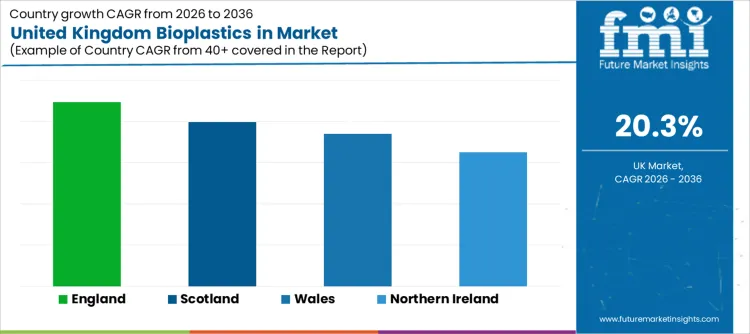
| Region | CAGR (2026-2036) |
|---|---|
| England | 22.3 |
| Scotland | 19.9 |
| Wales | 18.5 |
| Northern Ireland | 16.3 |
Why is England accelerating adoption through packaging scale and brand-led conversions?
The bioplastics industry in England is likely to advance at a 22.3% CAGR, supported by the concentration of major consumer goods operations, packaging converters, and retail distribution networks.
Large portfolio owners are more likely to run multi-SKU packaging conversion programmes, which drives consistent procurement demand. England is also where many pilots scale into procurement frameworks once performance is validated.
Companies in this region increasingly pair packaging redesign with broader sustainability targets in areas like biodegradable packaging solutions used across food, retail, and e-commerce delivery formats.
How is Scotland building steady expansion through specialty production and application-led adoption?
Scotland grows at a 19.9% CAGR, supported by focused conversion priorities and strong attention to claims integrity and product safety. Adoption expands where material transitions are aligned to clear application needs such as packaging, food-service items, and selected consumer products. Stakeholders often prefer solutions with defined performance profiles and controlled labeling strategies that reduce ambiguity for end users and regulators.
What is shaping Wales as it scales packaging and agriculture-focused adoption pathways?
The bioplastics industry in Wales is slated to expand at a CAGR of 18.5%, with opportunity tied to packaging uses and agriculture or horticulture formats where biodegradable solutions can support specific operational needs.
Growth is supported by practical adoption models where material selection is linked to durability, cost predictability, and responsible end-of-life options. Procurement teams focus on supplier consistency and resin performance that avoids disruption across converting operations.
Why is Northern Ireland progressing through targeted applications and supply readiness?
Northern Ireland rises at a CAGR of 16.3%, reflecting steady adoption led by targeted application rollouts. Companies in the region often scale bioplastics where supply reliability is clear and where customer-facing benefits are communicated simply. This staged approach supports controlled change management and allows buyers to refine specifications, labeling, and conversion logistics before expanding to larger product portfolios
What Defines the Competitive Landscape for Bioplastics in the UK?
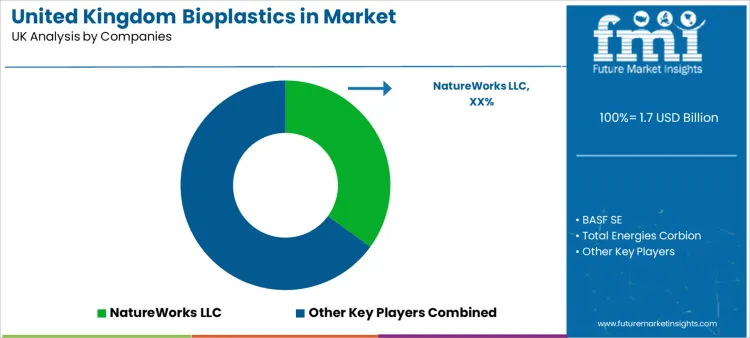
Competition is shaped by material performance, supply reliability, technical support, and the ability to validate claims credibly. Stakeholders compare suppliers on product range depth across Bio-PET, Bio-PE, Bio-PA, biodegradable polyesters, and PLA blends. They also look at how well companies support converters with processing guidance, formulation stability, and trial-to-scale execution.
NatureWorks LLC is strongly associated with PLA innovation and supply capability. BASF SE is positioned across advanced polymer solutions and application support. Total Energies Corbion brings experience in PLA material development and scaling. Novamont S.p.A holds positioning in biodegradable polymer solutions aligned with application needs. Mitsubishi Chemical Corporation supports broader material portfolios and industrial conversion readiness.
For UK buyers, supplier selection depends on two outcomes that are easy to measure: consistent manufacturing quality and smooth performance in real processing environments. Partners that deliver predictable resin supply, clear documentation, and stable technical support are best placed to win long-term contracts.
Key Industry Participants
- NatureWorks LLC
- BASF SE
- Total Energies Corbion
- Novamont S.p.A
- Mitsubishi Chemical Corporation
Scope of Report
| Items | Values |
|---|---|
| Quantitative Units | USD Billion |
| Material Type | Bio-PET; Bio-PE; Bio-PA; Bio-degradable Polyesters; PLA & PLA Blends |
| Applications | Bottle; Packaging; Food-Services; Agriculture/Horticulture; Consumer Products |
| Regions Covered | England; Scotland; Wales; Northern Ireland |
| Key Companies Profiled | NatureWorks LLC; BASF SE; Total Energies Corbion; Novamont S.p.A; Mitsubishi Chemical Corporation |
Bioplastics Demand in the UK by Segment
By Material Type
- Bio-PET
- Bio-PE
- Bio-PA
- Biodegradable Polyesters
- PLA & PLA Blends
By Applications
- Bottle
- Packaging
- Food-Services
- Agriculture/Horticulture
- Consumer Products
By Region
- England
- Scotland
- Wales
- Northern Ireland
Bibliography
- Department for Environment, Food & Rural Affairs. (2024). Single-use plastics bans and restrictions.
- European Bioplastics. (2024). Bioplastics market development update 2024.
- European Bioplastics. (2023). EN 13432 certified bioplastics performance in industrial composting.
- HM Revenue & Customs. (2025). Plastic Packaging Tax: mass balance approach and removal of pre-consumer plastic.
- HM Revenue & Customs. (2022). Plastic Packaging Tax: steps to take.
Frequently Asked Questions
How big is the demand for bioplastics in uk in 2026?
The demand for bioplastics in uk is estimated to be valued at USD 1.7 billion in 2026.
What will be the size of bioplastics in uk in 2036?
The market size for the bioplastics in uk is projected to reach USD 10.9 billion by 2036.
How much will be the demand for bioplastics in uk growth between 2026 and 2036?
The demand for bioplastics in uk is expected to grow at a 20.3% CAGR between 2026 and 2036.
What are the key product types in the bioplastics in uk?
The key product types in bioplastics in uk are bio-pet, bio-pe, bio-pa, bio-degradable polyesters and pla & pla blends.
Which applications segment is expected to contribute significant share in the bioplastics in uk in 2026?
In terms of applications, bottle segment is expected to command 41.0% share in the bioplastics in uk in 2026.
Preview the report firsthand - request a free sample
Get SampleGet the brochure for pricing and purchase details.
Get PDFTable of Content
- Executive Summary
- UK Market Outlook
- Demand-side Trends
- Supply-side Trends
- Technology Roadmap Analysis
- Analysis and Recommendations
- Market Overview
- Market Coverage / Taxonomy
- Market Definition / Scope / Limitations
- Market Background
- Market Dynamics
- Drivers
- Restraints
- Opportunity
- Trends
- Scenario Forecast
- Demand in Optimistic Scenario
- Demand in Likely Scenario
- Demand in Conservative Scenario
- Opportunity Map Analysis
- Product Life Cycle Analysis
- Supply Chain Analysis
- Investment Feasibility Matrix
- Value Chain Analysis
- PESTLE and Porter’s Analysis
- Regulatory Landscape
- Regional Parent Market Outlook
- Production and Consumption Statistics
- Import and Export Statistics
- Market Dynamics
- UK Market Analysis 2021 to 2025 and Forecast, 2026 to 2036
- Historical Market Size Value (USD Million) Analysis, 2021 to 2025
- Current and Future Market Size Value (USD Million) Projections, 2026 to 2036
- Y-o-Y Growth Trend Analysis
- Absolute $ Opportunity Analysis
- UK Market Pricing Analysis 2021 to 2025 and Forecast 2026 to 2036
- UK Market Analysis 2021 to 2025 and Forecast 2026 to 2036, By Material Type
- Introduction / Key Findings
- Historical Market Size Value (USD Million) Analysis By Material Type , 2021 to 2025
- Current and Future Market Size Value (USD Million) Analysis and Forecast By Material Type , 2026 to 2036
- Bio-PET
- Bio-PE
- Bio-PA
- Bio-degradable Polyesters
- PLA & PLA Blends
- Bio-PET
- Y-o-Y Growth Trend Analysis By Material Type , 2021 to 2025
- Absolute $ Opportunity Analysis By Material Type , 2026 to 2036
- UK Market Analysis 2021 to 2025 and Forecast 2026 to 2036, By Applications
- Introduction / Key Findings
- Historical Market Size Value (USD Million) Analysis By Applications, 2021 to 2025
- Current and Future Market Size Value (USD Million) Analysis and Forecast By Applications, 2026 to 2036
- Bottle
- Packaging
- Food-Services
- Agriculture/Horticulture
- Consumer Products
- Bottle
- Y-o-Y Growth Trend Analysis By Applications, 2021 to 2025
- Absolute $ Opportunity Analysis By Applications, 2026 to 2036
- Market Structure Analysis
- Competition Dashboard
- Competition Benchmarking
- Market Share Analysis of Top Players
- By Regional
- By Material Type
- By Applications
- Competition Analysis
- Competition Deep Dive
- NatureWorks LLC
- Overview
- Product Portfolio
- Profitability by Market Segments (Product/Age /Sales Channel/Region)
- Sales Footprint
- Strategy Overview
- Marketing Strategy
- Product Strategy
- Channel Strategy
- BASF SE
- Total Energies Corbion
- Novamont S.p.A
- Mitsubishi Chemical Corporation
- NatureWorks LLC
- Competition Deep Dive
- Assumptions & Acronyms Used
- Research Methodology


