

- Market Size (2026)
- USD 3.8 Bn
- Forecast (2036)
- USD 9.2 Bn
- CAGR (2026 to 2036)
- 9.2%
How big is High-Protein Noodles Market in 2026?
USD 3.8 billion in 2026 and USD 9.2 billion by 2036 at a 9.2% CAGR.
The high-protein noodles market is projected to grow at a 9.2% CAGR from USD 3.8 billion in 2026 to USD 9.2 billion by 2036. The market was valued at USD 3.5 billion in 2025 and is expected to add USD 5.4 billion in value over the forecast period.
High-protein noodles shift protein demand into a familiar meal rather than requiring consumers to add a separate shake, bar, or supplement. The International Food Information Council reported in July 2025 that 71% of Americans were trying to consume protein. It also found that a high-protein diet remained the most followed eating pattern for a third consecutive year. That demand is increasingly visible in noodles that preserve familiar preparation while altering the nutrition profile. Vite Ramen offers very high protein per meal, while Nissin Foods pairs added protein with lower carbohydrate and sodium positioning in Japan. Banza and Barilla use wheat-legume systems to stay closer to conventional pasta texture. Retail buyers therefore evaluate more than grams of protein. Shelf velocity depends on taste and price per meal. Preparation time also matters, as does whether the nutrition claim remains credible after consumers read the rest of the label.
Adoption conditions differ by country because high-protein positioning sits inside distinct noodle cultures and retail rules. The USA has strong protein-seeking behavior and a wide mix of DTC, mass retail, and specialty channels. The UK adds a tighter marketing environment for products that fall within less-healthy food rules, which raises the value of balanced formulations and retailer communication. Germany combines conventional pasta demand with dietary guidance that places greater emphasis on plant foods such as legumes. Japan has a mature instant-noodle culture where nutrition upgrades must protect the recognizable eating experience. South Korea adds a fast-moving ramyeon ecosystem with strong product competition and export capability. Across these markets, interest becomes repeat purchase only when protein density avoids an unacceptable sensory or value penalty. Texture and flavor must work alongside sodium, convenience, and price.
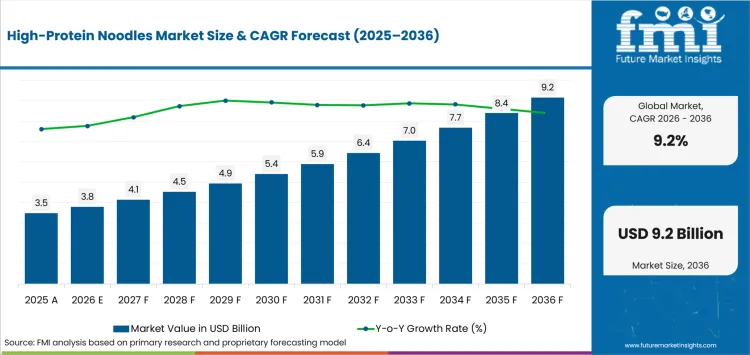
Key Takeaways of High-Protein Noodles Market
- By protein source, Wheat Gluten is estimated to account for 29.7% in 2026 because its structural network supports elasticity, bite, and cooking tolerance that consumers already associate with conventional noodles; by product type, Instant Ramen is estimated to account for 33.6% in 2026 driven by its single-meal convenience format that integrates added protein into a high-frequency eating occasion.
- Among the key countries, South Korea leads at a 9.4% CAGR, followed by USA (8.8%), UK (8.1%), Germany (7.6%), and Japan (6.9%) from 2026 to 2036.
- By protein content, the 10–15 g/serving tier is estimated to account for 41.9% in 2026 because it delivers a visible nutrition upgrade while limiting the ingredient substitution that can alter texture, cooking behavior, and flavor.
- Formulation and sensory trade-offs constrain repeat purchase because raising protein can increase cooking loss, weaken firmness, and alter flavor in ways that undermine consumer acceptance even when the nutrition claim is strong.
- Nissin Foods, Vite Ramen, immi, and Borealis Foods (Chef Woo) provide convenient high-protein ramen platforms targeting complete-meal occasions globally. Banza, Barilla, and ZENB deliver mainstream and legume-based pasta platforms built around familiar shapes and blended protein systems. Liviva, Kaizen Food Company, and The Only Bean address specialty bean and low-carbohydrate pasta needs for nutrition-focused consumers.
Analyst Perspective
"High-protein noodles need to clear two purchasing tests at once: a credible protein contribution and the texture, cook time and flavour consumers expect from noodles. Products that hold those attributes across instant and dried formats can earn repeat shelf and online listings."
- Nandini Roy Choudhury, Principal Consultant, Future Market Insights
How is the High-Protein Noodles Market segmented?
The high-protein noodles market is segmented by protein source, product type, protein content, nature, sales channel, and region.
Protein Source distinguishes the structural and nutritional system used to raise protein while maintaining noodle performance. Product Type separates instant ramen, dried pasta-style formats, cups and bowls, fresh noodles, and air-dried products by preparation and eating occasion. Protein Content captures how aggressively a product is reformulated for nutrient density. Nature separates conventional offers from gluten-free and organic propositions with different ingredient and certification requirements. Sales Channel reflects where shoppers discover, compare, and replenish products, ranging from supermarkets and convenience stores to online, specialist nutrition outlets, and foodservice.
What supports Conventional leadership in the Nature category?
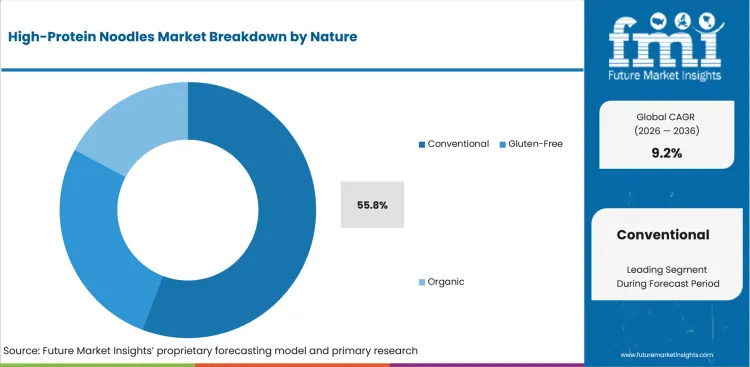
Conventional high-protein noodles can use wheat and gluten as well as egg or dairy. That gives formulators a broad set of familiar tools. That flexibility helps manufacturers optimize texture and cost without the added ingredient constraints associated with gluten-free or organic positioning. It also lets brands approach mainstream shoppers through familiar pasta and ramen cues rather than making a dietary restriction the first reason to buy. Gluten-free and organic products remain important for defined consumer needs, yet they can require more specialized raw materials or certification. Barilla's Protein+ strategy reflects the mainstream path by using familiar wheat pasta architecture with plant proteins, keeping the product close to the sensory expectations of conventional pasta users.
- Conventional holds a 55.8% share of the Nature category in 2026 because its broader ingredient toolkit supports familiar texture, scalable manufacturing, and mainstream pricing.
- Barilla reported in June 2025 that Protein+ made its official Italian debut at TuttoFood in May, extending a familiar wheat-based pasta proposition around added protein.
What makes Wheat Gluten central to the Protein Source category?
Wheat gluten gives formulators a structural advantage because its protein network supports elasticity, bite, and cooking tolerance that shoppers already associate with conventional noodles. That matters when protein is increased because alternative proteins can alter firmness, color, and cooking loss. Wheat-based systems can also be combined with chickpea, pea, or lentil ingredients to raise protein without abandoning familiar pasta behavior. Banza's 2026 move into wheat protein pasta illustrates this design logic: the company combined semolina wheat with chickpeas to increase protein while explicitly targeting consumers who would not compromise on traditional taste and texture. The commercial value is a lower sensory hurdle for mainstream repeat purchase.
- Wheat Gluten accounts for 29.7% of the Protein Source category in 2026 because it pairs protein contribution with a familiar structural network.
- Banza announced in April 2026 that its Wheat Protein Pasta combines semolina wheat and chickpeas and delivers 22g of protein per serving across Rotini, Penne, and Elbow shapes.
Why does Instant Ramen lead the Product Type category?
Instant ramen places protein inside a high-frequency convenience format with an established preparation ritual. The bowl or packet can serve as the meal itself, so higher protein changes the nutritional value of an existing occasion instead of asking the consumer to build a separate dish. This format also supports flavor variety and portion control. That can encourage trial among fitness users, office workers, and quick-meal buyers. Specialist brands can push protein substantially higher than conventional ramen because the consumer is buying a defined nutrition proposition. The trade-off is that texture and broth quality remain visible in every serving. Sodium and price also shape whether trial becomes repeat demand.
- Instant Ramen holds a 33.6% share of the Product Type category in 2026 because convenience and single-meal positioning make added protein easy to integrate into routine consumption.
- Vite Ramen stated in February 2024 that its Pro+ ramen would launch on March 4 with 42g of protein and 460 calories, showing how the format can serve highly protein-focused users.
How does 10-15 g/serving anchor the Protein Content category?
The 10-15 g/serving range gives brands a practical middle point between nutrition enhancement and product familiarity. It can create a meaningful protein cue without forcing the level of ingredient substitution used in more extreme formulations. That reduces the risk of large shifts in chew, cooking behavior, or flavor while keeping the product relevant to consumers who want better everyday nutrition rather than a performance-food profile. It also fits mainstream portions where shoppers compare protein alongside calories, sodium, and carbohydrates. This tier can therefore reach a broader base than products designed primarily for very high protein intake, while still differentiating from conventional noodles.
- 10-15 g/serving represents 41.9% of the Protein Content category in 2026 because it balances a visible protein upgrade with a manageable formulation change.
- Nissin Foods announced in January 2025 that the renewed Cup Noodles PRO line would continue to provide 15g of protein while also reducing carbohydrates and salt relative to its reference products.
What drives Supermarkets & Hypermarkets in the Sales Channel category?
Supermarkets and hypermarkets give high-protein noodles the strongest setting for side-by-side comparison with conventional pasta, instant noodles, and other better-for-you options. Shoppers can evaluate protein per serving against price and sodium. They can then compare carbohydrates, ingredients, and pack size before making a substitution decision. The channel also supports repeat replenishment after trial, which is more important than one-time discovery for category scale. Online and DTC remain useful for education and specialist products, while sports-nutrition stores can reach highly engaged users. Large-format retail becomes especially valuable when a product has moved beyond niche education and needs dependable household penetration and shelf productivity.
- Supermarkets & Hypermarkets account for 31.4% of the Sales Channel category in 2026 because they combine broad reach, comparison shopping, and repeat replenishment.
- Borealis Foods announced in October 2024 that it was expanding to more than 1,300 Walmart stores nationwide while launching two high-protein Ramen Noodles by Chef Ramsay flavors.
What are the drivers, restraints and opportunities in the High-Protein Noodles Market?
Protein-seeking consumers are pulling the nutrient into familiar meals, while formulation and value trade-offs can slow repeat purchase, and hybrid protein systems create room for better taste-to-nutrition performance.
- Driver: Protein has become an everyday purchase criterion, making familiar noodles a convenient vehicle for higher protein intake.
- Restraint: Raising protein can change cooking performance and firmness. It can also alter flavor or cost, creating a repeat-purchase hurdle even when the nutrition claim is strong.
- Opportunity: Wheat-legume and other blended formulations can target higher protein while preserving familiar texture and scaling through mainstream retail.
Protein-Focused Food Demand Supports Noodle Innovation
Protein demand is broad enough to influence ordinary grocery decisions rather than only sports-nutrition purchases. IFIC reported in July 2025 that 71% of Americans were trying to consume protein, up from 67% in 2023 and 59% in 2022. High-protein noodles benefit when consumers want to raise protein without changing the meal format they already understand. The commercial mechanism is straightforward: a shopper can substitute a protein-forward ramen or pasta for a conventional version within the same occasion. That lowers behavioral friction. Brands still need to show why the product deserves a price premium or shelf switch, so protein grams must work with taste and total nutrition.
Texture and Cooking Performance Can Limit Repeat Purchase
Formulation is the most immediate restraint because protein enrichment can disturb the properties that make noodles enjoyable and easy to cook. Liang and co-authors reported in June 2023 that increasing soy protein isolate in wheat noodles raised protein content, but cooking loss increased while hardness and tensile strength declined. In the same study, noodles with 5% soy protein isolate were closer to the control on flavor and taste. Overall acceptability was also closer than with more aggressive formulations. The study does not represent every commercial recipe, but it identifies the technical trade-off buyers experience. A product can win the nutrition comparison and still lose repeat purchase if texture or cooking tolerance feels unfamiliar.
Format Innovation Broadens Protein-Noodle Adoption
The clearest opportunity is to improve the taste-to-protein equation rather than simply maximize grams per serving. Banza's April 2026 wheat protein launch combined semolina with chickpeas and explicitly targeted consumers who wanted added nutrition without giving up traditional pasta texture. Barilla uses a similar bridge through wheat plus lentil, chickpea, and pea proteins. Other brands push further with yellow pea and lupini bean alongside soy or mixed plant proteins. These systems can address gluten-free and low-carbohydrate needs. Suppliers can tune protein level and texture to a specific eating occasion. They can also manage sodium and ingredient simplicity, which supports both mainstream grocery and specialist nutrition channels without forcing one formulation to serve every user.
Which country CAGRs are profiled in the High-Protein Noodles Market?
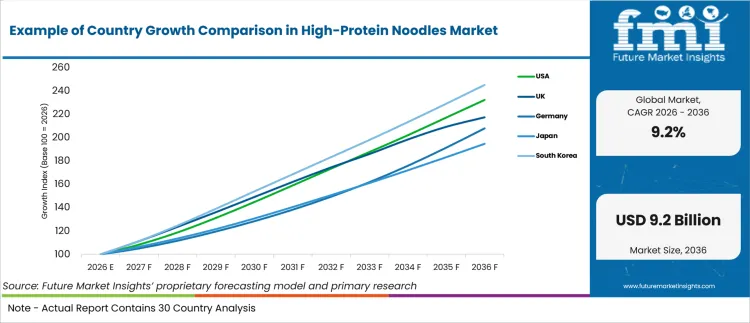
| Country | CAGR |
|---|---|
| USA | 8.8% |
| UK | 8.1% |
| Germany | 7.6% |
| Japan | 6.9% |
| South Korea | 9.4% |
How do country-level CAGRs compare in the High-Protein Noodles Market?
The five profiled countries span a 2.5 percentage-point range from South Korea at 9.4% CAGR to Japan at 6.9% from 2026 to 2036. South Korea and the USA form the faster-growth group at 9.4% and 8.8%. The UK and Germany sit in a middle band at 8.1% and 7.6%. Japan grows more steadily at 6.9% within a highly developed noodle market. These rates describe pace rather than absolute market size. Supplier priorities should therefore reflect how quickly consumers are switching, how strongly retail channels can scale a new proposition, and how much reformulation or education is needed before trial becomes repeat demand.
- South Korea versus USA: the 0.6 percentage-point gap favors faster category experimentation in South Korea, while the USA offers a broad protein-seeking consumer base and deep retail channel options.
- USA versus UK: the 0.7 percentage-point gap makes US retail rollout relatively more expansion-led, while UK commercialization requires closer attention to nutrient profile and advertising rules for products that fall within regulated categories.
- UK versus Germany: the 0.5 percentage-point gap is modest, so product-market fit matters more than rate alone. UK media rules and Germany's plant-forward dietary context create different routes to consumer acceptance.
- Germany versus Japan: the 0.7 percentage-point gap suggests a more incremental Japanese growth path. Suppliers there must compete inside an established instant-noodle culture where taste and convenience standards are already high.
CAGR should not be treated as a proxy for current revenue, shelf depth, or competitive intensity. A faster market can still have a smaller starting base, while a slower market can support substantial revenue through an established noodle culture. The broader report therefore considers local eating behavior and regulatory conditions alongside route to market. It also assesses how protein claims fit established product expectations in addition to the growth rate itself.
Country-wise Analysis
- USA: US shoppers encounter high-protein noodles through mass retail and specialist nutrition outlets, alongside DTC brands. That makes label comparison a central part of the purchase. Demand for High-Protein Noodles in the USA is forecast to rise at 8.8% CAGR from 2026 to 2036. IFIC reported in July 2025 that 71% of Americans were trying to consume protein, yet the same research highlighted uncertainty about how much protein people actually need. The friction is therefore not awareness alone; value, taste, and clear nutrition communication determine repeat purchase. Suppliers need familiar formats, transparent serving-level protein, and pricing that can survive comparison with conventional pasta and ramen.
- UK: UK purchases are concentrated in supermarket and online environments where nutrition profile and promotional rules increasingly shape how packaged foods are marketed. Sales of High-Protein Noodles in the UK are forecast to expand at 8.1% CAGR from 2026 to 2036. UK government guidance updated on June 4, 2025 confirmed that restrictions on advertising less-healthy food and drink would take effect on January 5, 2026 for products that meet the relevant category and nutrient-profile tests. Not every high-protein noodle is affected, but high-sodium or otherwise qualifying formulations face a marketing constraint. Suppliers can respond by improving overall nutrition and building retailer-led education around protein, taste, and portion value.
- Germany: German buyers can approach high-protein noodles through both conventional pasta behavior and interest in plant-forward foods, which supports blended wheat-legume and pulse-based formulations. Demand for High-Protein Noodles in Germany is forecast to rise at 7.6% CAGR from 2026 to 2036. The German Nutrition Society published updated food-based dietary guidelines in 2024 that emphasize a greater role for plant foods including legumes and whole grains. That creates a favorable ingredient narrative, but it does not remove sensory barriers. Shoppers still expect reliable cooking and recognizable taste. Suppliers need formulations that translate pulse proteins such as pea, lentil, or chickpea into mainstream pasta performance. The nutrition message also needs to remain simple.
- Japan: Japanese consumers buy within a mature instant-noodle system where flavor fidelity, preparation speed, and portion expectations are already well established. Demand for High-Protein Noodles in Japan is forecast to expand at 6.9% CAGR from 2026 to 2036. Nissin Foods announced in January 2025 that it would renew Cup Noodles PRO with 15g of protein, 50% lower carbohydrates, and 25% lower salt versus reference products while using proprietary salt-reduction technology. That action shows the local challenge: protein alone is not enough. Suppliers must preserve the familiar cup-noodle experience while managing sodium and carbohydrates. Texture and price also need to hold up so nutrition improvements do not create a sensory penalty.
- South Korea: South Korea combines a highly competitive ramyeon culture with strong manufacturing and export infrastructure, giving protein-forward variants a fast-moving category context. Adoption of High-Protein Noodles in South Korea is forecast to expand at 9.4% CAGR from 2026 to 2036. MAFRA reported on April 7, 2025 that broader Korean ramyeon exports reached USD 344 million in the first quarter of 2025, up 27.3% year over year. That trade figure is not a measure of high-protein noodles, but it shows the scale of the surrounding category ecosystem. The friction is differentiation. Suppliers need a clear protein benefit without sacrificing the flavor, convenience, and price discipline expected in mainstream ramyeon.
Who are the notable companies in the High-Protein Noodles Market?
Nissin Foods, Vite Ramen, Banza, Barilla, immi, Borealis Foods (Chef Woo), ZENB, Liviva, Kaizen Food Company, and The Only Bean are the notable companies profiled in this market.
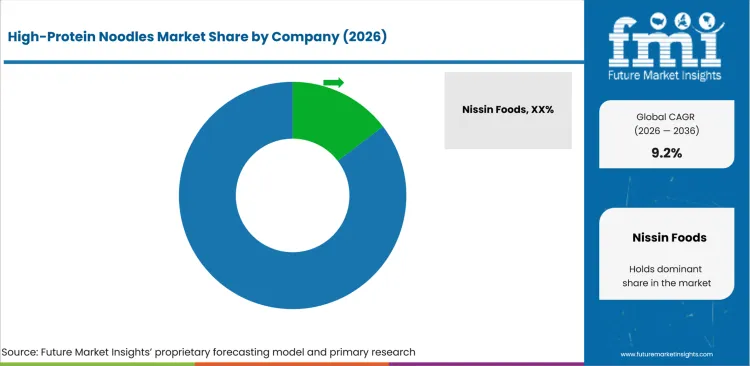
Competition is organized around how much nutrition change a brand asks consumers to accept. Nissin Foods and Vite Ramen use the instant-ramen occasion as a delivery system. immi and Borealis Foods (Chef Woo) also compete in ramen with propositions that range from mainstream enhancement to performance-oriented meals. Banza and Barilla focus on familiar pasta shapes while blending wheat with pulse proteins or using pulse-led formulations. ZENB moves further toward a whole-yellow-pea architecture and maintains a broader noodle platform in Japan even as its US site confirmed that the previous domestic product lineup was discontinued in May 2025. Liviva and Kaizen Food Company target specialty needs through bean or lupini formulations. The Only Bean uses bean-based pasta to address protein-focused and gluten-free demand.
- Convenient high-protein ramen platforms: Nissin Foods, Vite Ramen, immi, and Borealis Foods (Chef Woo) compete around complete-meal convenience, flavor, and higher protein per serving.
- Mainstream and legume-based pasta platforms: Banza, Barilla, and ZENB use familiar shapes or pulse-based architecture to broaden protein-forward pasta beyond specialist sports nutrition.
- Specialty bean and low-carbohydrate pasta platforms: Liviva, Kaizen Food Company, and The Only Bean emphasize bean, lupini, or alternative-carbohydrate formulations for nutrition-focused consumers.
Competitive Benchmarking: High-Protein Noodles Market
| Company | Protein-Forward Formulation Depth | Noodle / Pasta Format Breadth | Retail & DTC Channel Access | Geographic Reach |
|---|---|---|---|---|
| Nissin Foods | Medium | High | High | Japan; broader global group network |
| Vite Ramen | High | Medium | Medium | United States; DTC-led |
| Banza | High | High | High | United States; selected Canada e-commerce |
| Barilla | Medium | High | High | North America and Europe |
| immi | High | Medium | High | United States |
| Borealis Foods (Chef Woo) | High | Medium | High | United States |
| ZENB | Medium | High | Low | Japan; US brand sales discontinued |
| Liviva | High | High | Medium | North America; online-led |
| Kaizen Food Company | High | High | Medium | United States; international DTC shipping |
| The Only Bean | Medium | Low | Medium | United States |
Scoring basis: Protein-Forward Formulation Depth measures documented ability to deliver meaningful protein through purpose-built noodle or pasta formulations; High reflects multiple or more intensive protein propositions, Medium reflects a credible but narrower platform, and Low would require a documented limitation. Noodle / Pasta Format Breadth measures the range of relevant noodle or pasta forms rather than adjacent food categories. Retail & DTC Channel Access measures documented availability across mass retail, specialty outlets, and direct channels. Geographic Reach reflects evidenced commercial availability for high-protein noodles. A Low rating indicates a documented limitation, while unavailable public information would be left unscored rather than treated as Low.
Key Developments in the High-Protein Noodles Market
- In October 2024, Borealis Foods expanded US Walmart distribution to more than 1,300 stores and launched two high-protein Ramen Noodles by Chef Ramsay flavors. The products paired animal-free protein with Black Garlic Beef and Shiitake Mushroom Chicken flavor profiles. The action materially widened mass-retail access for a protein-forward ramen proposition and gave Borealis a larger setting to test repeat purchase beyond specialist or online channels.
- In January 2025, Nissin Foods announced the renewal of three Cup Noodles PRO products in Japan, with the reformulated line going on sale from February 24.. The reformulated line retained 15g of protein and 50% lower carbohydrates while adding a 25% salt reduction through a proprietary salt-enhancement approach. The development shows that established noodle manufacturers are competing on a multi-nutrient proposition rather than treating protein as a standalone claim.
- In May 2025, Barilla Protein+ made its official debut in Italy at TuttoFood, according to a Barilla Group story published in June. The line brings a familiar wheat-pasta experience together with added plant protein and extends the Protein+ proposition into another major pasta market. The move broadens the addressable audience for higher-protein pasta by linking nutrition enhancement to an established mainstream brand and eating format.
- In April 2026, Banza launched Wheat Protein Pasta and Wheat Protein Mac & Cheese, marking its first move beyond gluten-free products. The pasta combines semolina wheat with chickpeas and delivers 22g of protein per serving. The rollout reached Kroger, Publix, Sprouts, Target, Walmart, and Whole Foods Market as part of the same nationwide April retail wave, following an exclusive TikTok Shop debut on April 1. The launch directly targets consumers who want higher protein while retaining conventional wheat-pasta taste and texture.
Key Players in the High-Protein Noodles Market
Convenient High-Protein Ramen Platforms
- Nissin Foods
- Vite Ramen
- immi
- Borealis Foods (Chef Woo)
Mainstream and Legume-Based Pasta Platforms
- Banza
- Barilla
- ZENB
Specialty Bean and Low-Carbohydrate Pasta Platforms
- Liviva
- Kaizen Food Company
- The Only Bean
High-Protein Noodles Market - Report Scope
| Coverage field | Report scope |
|---|---|
| Market breakdown | By Protein Source, Product Type, Protein Content, Nature, Sales Channel, and Region. |
| Quantitative Units | USD billion. |
| Market Definition | Revenue includes sales of high-protein noodle products represented within the defined segmentation universe, including instant ramen, dried pasta-style noodles, cups and bowls, fresh noodles, and air-dried products. It excludes protein ingredients sold separately, conventional noodles not positioned within the high-protein category, and downstream meal revenue where the noodle product is not the distinct item sold. |
| Regions Covered | North America; Latin America; Western Europe; Eastern Europe; East Asia; South Asia and Pacific; Middle East and Africa |
| Countries Covered | USA, UK, Germany, Japan, South Korea, and more than twenty-five additional countries in the full report |
| Key Companies Profiled | Nissin Foods; Vite Ramen; Banza; Barilla; immi; Borealis Foods (Chef Woo); ZENB; Liviva; Kaizen Food Company; The Only Bean |
| Forecast Period | 2026 to 2036 |
| Approach | FMI applies a hybrid bottom-up and top-down sizing approach that reconciles supplier participation, product and channel economics, country adoption conditions, and category-level demand indicators while excluding adjacent categories and double counting. |
High-Protein Noodles Market - Research Methodology
| Method | Approach |
|---|---|
| Primary Research | Primary research is structured around discussions with noodle and pasta manufacturers, ingredient and formulation specialists, distributors, retailers, foodservice buyers, and category experts. The work tests purchase triggers, acceptable protein thresholds, formulation trade-offs, channel economics, price sensitivity, and the conditions that support repeat purchase. |
| Desk Research | Desk research reviews government nutrition and advertising guidance, food-labeling requirements, company releases and product documentation, retail availability signals, scientific literature on protein-enriched noodle performance, and relevant trade statistics. Sources are screened for direct relevance to high-protein noodles or clearly identified contextual category evidence. |
| Market Sizing and Forecasting | Market sizing and forecasting combine product-level participation, observed channel presence, pricing and format mix, country adoption conditions, competitive expansion signals, and the defined revenue boundary. Forecast assumptions consider nutrition demand, product reformulation, retail scale-up, category maturity, and the friction created by sensory or value trade-offs. |
| Data Validation | Validation reconciles bottom-up supplier and product evidence with top-down category indicators, checks consistency across countries and segments, and removes adjacent product revenue or duplicate channel counting. Unsupported claims and facts that cannot be traced to an appropriate source are excluded from the final analysis. |
High-Protein Noodles Market by Segments
High-Protein Noodles Market segmented by Protein Source:
- Wheat Gluten
- Legume (Chickpea / Lentil)
- Pea Protein
- Soy
- Egg & Dairy
High-Protein Noodles Market segmented by Product Type:
- Instant Ramen
- Dried Pasta-Style Noodles
- Cups & Bowls
- Fresh Noodles
- Air-Dried
High-Protein Noodles Market segmented by Protein Content:
- 10-15 g/serving
- 15-20 g/serving
- More than 20 g/serving
High-Protein Noodles Market segmented by Nature:
- Conventional
- Gluten-Free
- Organic
High-Protein Noodles Market segmented by Sales Channel:
- Supermarkets & Hypermarkets
- Online / DTC
- Convenience Stores
- Specialty & Sports Nutrition
- Foodservice
High-Protein Noodles Market by Region:
- North America
- United States
- Canada
- Latin America
- Brazil
- Mexico
- Argentina
- Chile
- Western Europe
- Germany
- France
- United Kingdom
- Italy
- Spain
- Benelux
- Nordics
- Eastern Europe
- Poland
- Czech Republic
- Romania
- Hungary
- East Asia
- China
- Japan
- South Korea
- South Asia and Pacific
- India
- ASEAN
- Australia and New Zealand
- Middle East and Africa
- GCC Countries
- South Africa
- Türkiye
- Israel
Research Sources and Bibliography
- International Food Information Council (2025, July 8). Protein-Dazed, And Still Confused: New IFIC Research Reveals America’s High-Protein Hype Doesn’t Match Knowledge.
- UK Department of Health and Social Care (2025, June 4). Restricting advertising of less healthy food or drink on TV and online: products in scope.
- German Nutrition Society (DGE) (2024). Food-Based Dietary Guidelines for Germany.
- Ministry of Agriculture, Food and Rural Affairs, Republic of Korea (2025, April 7). Exports of K-Food Plus in Q1 of 2025: USD 3.18 billion, up by 7.9% from the Previous Year.
- Liang, J.-N., Nargotra, P., Li, X.-Y., Sharma, V., Hsieh, S.-L., Tsai, Y.-H., Liu, Y.-C., Huang, C.-Y., & Kuo, C.-H. (2023, June 30). Evaluation of Wheat Noodles Supplemented with Soy Protein Isolate for Nutritional, Textural, Cooking Attributes and Glycemic Index.
- Nissin Foods Holdings Co., Ltd. (2025, January 10). Cup Noodles PRO High-Protein & Low-Carb, Now with Reduced Salt [Japanese-language release].
- Vite Ramen (2024, February 28). Why I Drink Worcestershire sauce.
- Banza (2026, April 1). Banza Launches the First No Compromises Wheat Protein Pasta, Powered by Chickpeas.
- Barilla Group (2025, June 17). Barilla Protein+: the pasta you’ve always loved, with a push of protein.
- immi (n.d.; accessed 2026, August 13). Instant Ramen Reinvented.
- Borealis Foods Inc. (2024, October 31). Borealis Foods Expands USA Walmart Distribution with the Launch of Ramen Noodles by Chef Ramsay Crafted by Master Chef Gordon Ramsay.
- ZENB (n.d.; accessed 2026, August 13). ZENB: Plant Based Pasta for Gluten Free Meals.
- Liviva (n.d.; accessed 2026, August 13). LIVIVA: Low Carb High Protein Pasta & Rice.
- Kaizen Food Company (n.d.; accessed 2026, August 13). Low Carb Cavatappi.
- The Only Bean (n.d.; accessed 2026, August 13). Organic Edamame Spaghetti Pasta.
This bibliography is provided for reader reference and is not exhaustive. The full report contains the complete reference list and detailed citations.
This Report Answers
- What is the High-Protein Noodles Market size in 2026 and what value is forecast for 2036?
- Which consumer and industry pressures support demand for high-protein noodles?
- Why does Wheat Gluten hold the leading position within the Protein Source category?
- How does Instant Ramen influence the way protein-forward noodles are purchased and consumed?
- Why does the 10-15 g/serving tier hold the leading position within Protein Content?
- How do growth rates differ across the USA, UK, Germany, Japan, and South Korea from 2026 to 2036?
- Which product and channel roles are occupied by Nissin Foods, Vite Ramen, Banza, Barilla, immi, Borealis Foods (Chef Woo), ZENB, Liviva, Kaizen Food Company, and The Only Bean?
- What formulation, sensory, value, and marketing constraints can limit adoption of high-protein noodles?
- What should retail category managers and product teams evaluate before purchasing, listing, or developing high-protein noodle products?
Frequently Asked Questions
How big is the High-Protein Noodles Market in 2026?
The high-protein noodles market is valued at USD 3.8 billion in 2026.
What is the CAGR of the High-Protein Noodles Market from 2026 to 2036?
The high-protein noodles market is projected to grow at a CAGR of 9.2% between 2026 and 2036.
Which protein source segment leads the High-Protein Noodles Market?
Wheat Gluten is projected to account for 29.7% of the protein source category in 2026.
How much value will the High-Protein Noodles Market add between 2026 and 2036?
The market is expected to add USD 5.4 billion in value between 2026 and 2036.
Which companies are active in the High-Protein Noodles Market?
Key companies operating in the market include Nissin Foods, Vite Ramen, Banza, Barilla, immi, Borealis Foods (Chef Woo), ZENB, Liviva, Kaizen Food Company, and The Only Bean.
Preview the report firsthand - request a free sample
Get SampleGet the brochure for pricing and purchase details.
Get PDFTable of Content
- Key Takeaways
- Market Size and CAGR
- Top Growth Driver
- Fastest Growing Segment
- Leading Region
- Key Companies
- Emerging Opportunities
- Executive Summary
- Global Market Outlook
- Demand-side Trends
- Supply-side Trends
- Technology Roadmap Analysis
- Analysis and Recommendations
- Analyst Perspective (What is happening? Why now? What should investors know?)
- Key Questions Answered
- How large is the market?
- What is the CAGR?
- What are key trends?
- Which region dominates?
- Who are the leaders?
- Market Overview
- Market Coverage / Taxonomy
- Market Definition / Scope / Limitations
- Research Methodology
- Chapter Orientation
- Analytical Lens and Working Hypotheses
- Market Structure, Signals, and Trend Drivers
- Benchmarking and Cross-market Comparability
- Market Sizing, Forecasting, and Opportunity Mapping
- Research Design and Evidence Framework
- Desk Research Programme (Secondary Evidence)
- Expert Input and Fieldwork (Primary Evidence)
- Tooling, Models, and Reference Databases
- Data Engineering and Model Build
- Quality Assurance and Audit Trail
- Market Background
- Market Dynamics (Drivers, Restraints, Opportunity, Trends)
- Scenario Forecast (Optimistic, Likely, Conservative)
- Impact Analysis
- AI Impact
- Sustainability Impact
- Regulatory Impact
- Technology Impact
- Consumer / Buyer Analysis
- Purchase Drivers
- Adoption Barriers
- Buyer Journey
- Opportunity Map Analysis
- Product Life Cycle Analysis
- Supply Chain Analysis
- Investment Feasibility Matrix
- Value Chain Analysis
- PESTLE and Porter's Analysis
- Regulatory Landscape
- Regional Parent Market Outlook
- Production and Consumption Statistics
- Import and Export Statistics
- Global Market Analysis and Forecast, 2021 to 2036
- Historical Market Size Value (USD Billion) Analysis, 2021 to 2025
- Current and Future Market Size Value (USD Billion) Projections, 2026 to 2036
- Y-o-Y Growth Trend Analysis
- Absolute $ Opportunity Analysis
- Global Market Pricing Analysis, 2021 to 2036
- Global Market Analysis and Forecast, By Protein Source, 2021 to 2036
- Introduction / Key Findings
- Historical Market Size Value (USD Billion) Analysis By Protein Source, 2021 to 2025
- Current and Future Market Size Value (USD Billion) Analysis and Forecast By Protein Source, 2026 to 2036
- Wheat Gluten
- Legume (Chickpea / Lentil)
- Pea Protein
- Soy
- Egg & Dairy
- Wheat Gluten
- Y-o-Y Growth Trend Analysis By Protein Source, 2021 to 2025
- Absolute $ Opportunity Analysis By Protein Source, 2026 to 2036
- Global Market Analysis and Forecast, By Product Type, 2021 to 2036
- Introduction / Key Findings
- Historical Market Size Value (USD Billion) Analysis By Product Type, 2021 to 2025
- Current and Future Market Size Value (USD Billion) Analysis and Forecast By Product Type, 2026 to 2036
- Instant Ramen
- Dried Pasta-Style Noodles
- Cups & Bowls
- Fresh Noodles
- Air-Dried
- Instant Ramen
- Y-o-Y Growth Trend Analysis By Product Type, 2021 to 2025
- Absolute $ Opportunity Analysis By Product Type, 2026 to 2036
- Global Market Analysis and Forecast, By Protein Content, 2021 to 2036
- Introduction / Key Findings
- Historical Market Size Value (USD Billion) Analysis By Protein Content, 2021 to 2025
- Current and Future Market Size Value (USD Billion) Analysis and Forecast By Protein Content, 2026 to 2036
- 10-15 g/serving
- 15-20 g/serving
- More than 20 g/serving
- 10-15 g/serving
- Y-o-Y Growth Trend Analysis By Protein Content, 2021 to 2025
- Absolute $ Opportunity Analysis By Protein Content, 2026 to 2036
- Global Market Analysis and Forecast, By Nature, 2021 to 2036
- Introduction / Key Findings
- Historical Market Size Value (USD Billion) Analysis By Nature, 2021 to 2025
- Current and Future Market Size Value (USD Billion) Analysis and Forecast By Nature, 2026 to 2036
- Conventional
- Gluten-Free
- Organic
- Conventional
- Y-o-Y Growth Trend Analysis By Nature, 2021 to 2025
- Absolute $ Opportunity Analysis By Nature, 2026 to 2036
- Global Market Analysis and Forecast, By Sales Channel, 2021 to 2036
- Introduction / Key Findings
- Historical Market Size Value (USD Billion) Analysis By Sales Channel, 2021 to 2025
- Current and Future Market Size Value (USD Billion) Analysis and Forecast By Sales Channel, 2026 to 2036
- Supermarkets & Hypermarkets
- Online / DTC
- Convenience Stores
- Specialty & Sports Nutrition
- Foodservice
- Supermarkets & Hypermarkets
- Y-o-Y Growth Trend Analysis By Sales Channel, 2021 to 2025
- Absolute $ Opportunity Analysis By Sales Channel, 2026 to 2036
- Global Market Analysis and Forecast, By Region, 2021 to 2036
- Introduction
- Historical Market Size Value (USD Billion) Analysis By Region, 2021 to 2025
- Current Market Size Value (USD Billion) Analysis and Forecast By Region, 2026 to 2036
- North America
- Latin America
- Western Europe
- Eastern Europe
- East Asia
- South Asia and Pacific
- Middle East & Africa
- Market Attractiveness Analysis By Region
- North America Market Analysis and Forecast, By Country, 2021 to 2036
- Historical Market Size Value (USD Billion) Trend Analysis By Market Taxonomy, 2021 to 2025
- Market Size Value (USD Billion) Forecast By Market Taxonomy, 2026 to 2036
- By Country
- USA
- Canada
- By Protein Source
- By Product Type
- By Protein Content
- By Nature
- By Sales Channel
- By Country
- Market Attractiveness Analysis
- By Country
- By Protein Source
- By Product Type
- By Protein Content
- By Nature
- By Sales Channel
- Key Takeaways
- Latin America Market Analysis and Forecast, By Country
- Historical Market Size Value (USD Billion) Trend Analysis By Market Taxonomy, 2021 to 2025
- Market Size Value (USD Billion) Forecast By Market Taxonomy, 2026 to 2036
- By Country
- Brazil
- Mexico
- Chile
- Rest of Latin America
- By Protein Source
- By Product Type
- By Protein Content
- By Nature
- By Sales Channel
- By Country
- Market Attractiveness Analysis
- By Country
- By Protein Source
- By Product Type
- By Protein Content
- By Nature
- By Sales Channel
- Key Takeaways
- Western Europe Market Analysis and Forecast, By Country
- Historical Market Size Value (USD Billion) Trend Analysis By Market Taxonomy, 2021 to 2025
- Market Size Value (USD Billion) Forecast By Market Taxonomy, 2026 to 2036
- By Country
- Germany
- UK
- Italy
- Spain
- France
- Nordic
- BENELUX
- Rest of Western Europe
- By Protein Source
- By Product Type
- By Protein Content
- By Nature
- By Sales Channel
- By Country
- Market Attractiveness Analysis
- By Country
- By Protein Source
- By Product Type
- By Protein Content
- By Nature
- By Sales Channel
- Key Takeaways
- Eastern Europe Market Analysis and Forecast, By Country
- Historical Market Size Value (USD Billion) Trend Analysis By Market Taxonomy, 2021 to 2025
- Market Size Value (USD Billion) Forecast By Market Taxonomy, 2026 to 2036
- By Country
- Russia
- Poland
- Hungary
- Balkan & Baltic
- Rest of Eastern Europe
- By Protein Source
- By Product Type
- By Protein Content
- By Nature
- By Sales Channel
- By Country
- Market Attractiveness Analysis
- By Country
- By Protein Source
- By Product Type
- By Protein Content
- By Nature
- By Sales Channel
- Key Takeaways
- East Asia Market Analysis and Forecast, By Country
- Historical Market Size Value (USD Billion) Trend Analysis By Market Taxonomy, 2021 to 2025
- Market Size Value (USD Billion) Forecast By Market Taxonomy, 2026 to 2036
- By Country
- China
- Japan
- South Korea
- By Protein Source
- By Product Type
- By Protein Content
- By Nature
- By Sales Channel
- By Country
- Market Attractiveness Analysis
- By Country
- By Protein Source
- By Product Type
- By Protein Content
- By Nature
- By Sales Channel
- Key Takeaways
- South Asia and Pacific Market Analysis and Forecast, By Country
- Historical Market Size Value (USD Billion) Trend Analysis By Market Taxonomy, 2021 to 2025
- Market Size Value (USD Billion) Forecast By Market Taxonomy, 2026 to 2036
- By Country
- India
- ASEAN
- Australia & New Zealand
- Rest of South Asia and Pacific
- By Protein Source
- By Product Type
- By Protein Content
- By Nature
- By Sales Channel
- By Country
- Market Attractiveness Analysis
- By Country
- By Protein Source
- By Product Type
- By Protein Content
- By Nature
- By Sales Channel
- Key Takeaways
- Middle East & Africa Market Analysis and Forecast, By Country
- Historical Market Size Value (USD Billion) Trend Analysis By Market Taxonomy, 2021 to 2025
- Market Size Value (USD Billion) Forecast By Market Taxonomy, 2026 to 2036
- By Country
- Kingdom of Saudi Arabia
- Other GCC Countries
- Türkiye
- South Africa
- Other African Union
- Rest of Middle East & Africa
- By Protein Source
- By Product Type
- By Protein Content
- By Nature
- By Sales Channel
- By Country
- Market Attractiveness Analysis
- By Country
- By Protein Source
- By Product Type
- By Protein Content
- By Nature
- By Sales Channel
- Key Takeaways
- Key Countries Market Analysis
- USA
- Pricing Analysis
- Market Share Analysis, 2025
- By Protein Source
- By Product Type
- By Protein Content
- By Nature
- By Sales Channel
- Canada
- Pricing Analysis
- Market Share Analysis, 2025
- By Protein Source
- By Product Type
- By Protein Content
- By Nature
- By Sales Channel
- Mexico
- Pricing Analysis
- Market Share Analysis, 2025
- By Protein Source
- By Product Type
- By Protein Content
- By Nature
- By Sales Channel
- Brazil
- Pricing Analysis
- Market Share Analysis, 2025
- By Protein Source
- By Product Type
- By Protein Content
- By Nature
- By Sales Channel
- Chile
- Pricing Analysis
- Market Share Analysis, 2025
- By Protein Source
- By Product Type
- By Protein Content
- By Nature
- By Sales Channel
- Germany
- Pricing Analysis
- Market Share Analysis, 2025
- By Protein Source
- By Product Type
- By Protein Content
- By Nature
- By Sales Channel
- UK
- Pricing Analysis
- Market Share Analysis, 2025
- By Protein Source
- By Product Type
- By Protein Content
- By Nature
- By Sales Channel
- Italy
- Pricing Analysis
- Market Share Analysis, 2025
- By Protein Source
- By Product Type
- By Protein Content
- By Nature
- By Sales Channel
- Spain
- Pricing Analysis
- Market Share Analysis, 2025
- By Protein Source
- By Product Type
- By Protein Content
- By Nature
- By Sales Channel
- France
- Pricing Analysis
- Market Share Analysis, 2025
- By Protein Source
- By Product Type
- By Protein Content
- By Nature
- By Sales Channel
- India
- Pricing Analysis
- Market Share Analysis, 2025
- By Protein Source
- By Product Type
- By Protein Content
- By Nature
- By Sales Channel
- ASEAN
- Pricing Analysis
- Market Share Analysis, 2025
- By Protein Source
- By Product Type
- By Protein Content
- By Nature
- By Sales Channel
- Australia & New Zealand
- Pricing Analysis
- Market Share Analysis, 2025
- By Protein Source
- By Product Type
- By Protein Content
- By Nature
- By Sales Channel
- China
- Pricing Analysis
- Market Share Analysis, 2025
- By Protein Source
- By Product Type
- By Protein Content
- By Nature
- By Sales Channel
- Japan
- Pricing Analysis
- Market Share Analysis, 2025
- By Protein Source
- By Product Type
- By Protein Content
- By Nature
- By Sales Channel
- South Korea
- Pricing Analysis
- Market Share Analysis, 2025
- By Protein Source
- By Product Type
- By Protein Content
- By Nature
- By Sales Channel
- Russia
- Pricing Analysis
- Market Share Analysis, 2025
- By Protein Source
- By Product Type
- By Protein Content
- By Nature
- By Sales Channel
- Poland
- Pricing Analysis
- Market Share Analysis, 2025
- By Protein Source
- By Product Type
- By Protein Content
- By Nature
- By Sales Channel
- Hungary
- Pricing Analysis
- Market Share Analysis, 2025
- By Protein Source
- By Product Type
- By Protein Content
- By Nature
- By Sales Channel
- Kingdom of Saudi Arabia
- Pricing Analysis
- Market Share Analysis, 2025
- By Protein Source
- By Product Type
- By Protein Content
- By Nature
- By Sales Channel
- Türkiye
- Pricing Analysis
- Market Share Analysis, 2025
- By Protein Source
- By Product Type
- By Protein Content
- By Nature
- By Sales Channel
- South Africa
- Pricing Analysis
- Market Share Analysis, 2025
- By Protein Source
- By Product Type
- By Protein Content
- By Nature
- By Sales Channel
- USA
- Market Structure Analysis
- Competition Dashboard
- Competition Benchmarking
- Market Share Analysis of Top Players
- By Regional
- By Protein Source
- By Product Type
- By Protein Content
- By Nature
- By Sales Channel
- Emerging Startups
- Innovation Benchmarking
- Competition Analysis
- Competition Deep Dive
- Nissin Foods
- Overview
- Product Portfolio
- Profitability by Market Segments
- Sales Footprint
- Strategy Overview
- Marketing Strategy
- Product Strategy
- Channel Strategy
- Vite Ramen
- Banza
- Barilla
- immi
- Borealis Foods (Chef Woo)
- ZENB
- Liviva
- Kaizen Food Company
- The Only Bean
- Nissin Foods
- Case Studies
- Success Stories
- Recent Developments
- Competition Deep Dive
- Assumptions & Acronyms Used


