

- Industry Size (2026)
- USD 51.80 Bn
- Forecast (2036)
- USD 122.63 Bn
- CAGR (2026 to 2036)
- 9.00%
Histiocytosis Treatment Market Size, Market Forecast and Outlook By FMI
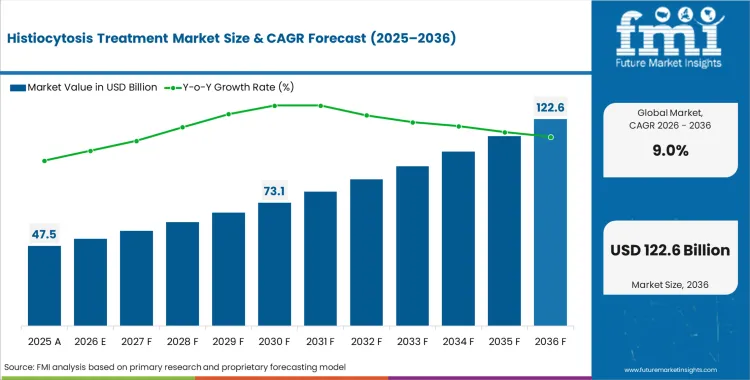
The histiocytosis treatment market was valued at USD 47.52 billion in 2025, projected to reach USD 51.80 billion in 2026, and is forecast to expand to USD 122.63 billion by 2036 at a 9.00% CAGR. As per FMI, the incremental opportunity across the forecast period amounts to USD 70.83 billion, reflecting a steady expansion trajectory shaped by evolving end-use requirements and shifting procurement patterns across global supply chains.
Expanding diagnostic precision for histiocytic disorders, accelerating clinical trial pipelines for targeted therapies, and growing institutional awareness of rare hematologic malignancies are driving procurement growth for histiocytosis treatment regimens across hospital, specialty clinic, and homecare settings. The approval and adoption of emapalumab for refractory hemophagocytic lymphohistiocytosis (HLH) has established a treatment paradigm that is stimulating further investment in targeted biologic and immunomodulatory therapies. FMI analysts observe that Langerhans cell histiocytosis (LCH) remains the most prevalent clinical subtype, commanding the largest share of treatment expenditure due to its higher incidence rate and expanding treatment protocol standardization across pediatric and adult oncology centers.
Summary of Histiocytosis Treatment Market
- The market is estimated at USD 47.52 billion in 2025.
- The market is projected to reach USD 122.63 billion by 2036.
- The market is expected to grow at a CAGR of 9.00% from 2026 to 2036.
- The forecast period represents an incremental opportunity of USD 70.83 billion.
- Langerhans cell histiocytosis leads by type with a 46.3% share in 2026.
- Emapalumab dominates by drug class with a 38.7% share in 2026.
- Hospital settings lead as the primary end-user segment due to complex treatment requirements.
- The market is driven by advancements in diagnostic precision and targeted biologic therapies.
- China (11.6%), India (10.7%), and Germany (9.9%) are among the fastest-growing markets.
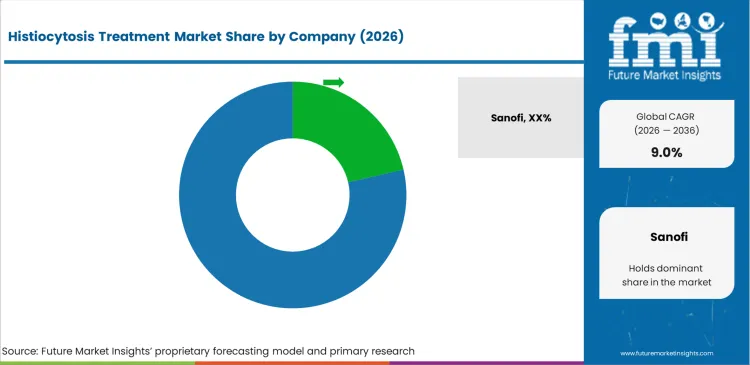
- Key companies in the market include Sanofi, SOBI, AB2 Bio Ltd., Alpine Immune Sciences, Bellicum Pharmaceuticals, Pfizer Inc., Johnson & Johnson Services, and Incyte Corporation.
Histiocytosis Treatment Market Key Takeaways
| Metric | Details |
|---|---|
| Industry Size (2026) | USD 51.80 Billion |
| Industry Value (2036) | USD 122.63 Billion |
| CAGR (2026-2036) | 9.00% |
Source: Future Market Insights, 2026
Based on FMI's report, the histiocytosis treatment market is expected to create an incremental opportunity of USD 70.83 billion between 2026 and 2036. FMI analysts project that end-use procurement patterns and regional supply chain dynamics will shape the distribution of this opportunity across segments and geographies.
Regional demand for histiocytosis treatments reflects the geographic distribution of rare disease diagnostic infrastructure, specialty oncology center concentration, and biologic therapy reimbursement frameworks. China at 11.6% CAGR, India at 10.7% CAGR, Germany at 9.9% CAGR, Brazil at 9.0% CAGR, USA at 8.1% CAGR, UK at 7.3% CAGR, Japan at 6.4% CAGR. China leads growth through expanding rare disease drug access programs and specialty hospital network development. India follows on the strength of growing oncology center capacity and improving rare disease diagnostic capabilities.
Germany sustains growth through established rare disease registry programs and comprehensive reimbursement coverage for orphan-designated therapies. France and the United Kingdom maintain growth through centralized rare disease treatment networks and clinical trial participation. The United States advances through orphan drug designation incentives and specialty pharmacy distribution infrastructure. Brazil registers steady growth tied to expanding public health coverage for rare hematologic conditions.
Histiocytosis Treatment Market Definition
Histiocytosis treatment encompasses pharmaceutical therapies used to manage histiocytic disorders, a group of rare diseases characterized by abnormal accumulation and proliferation of histiocytes (tissue macrophages and dendritic cells). The three primary clinical subtypes are Langerhans cell histiocytosis (LCH), hemophagocytic lymphohistiocytosis (HLH), and malignant histiocytic disorders. Treatment regimens include targeted biologic agents (emapalumab), monoclonal antibodies (alemtuzumab), immunomodulators (infliximab), chemotherapy combinations, and supportive care protocols administered across hospital, specialty clinic, homecare, and outpatient settings.
Future Market Insights analysis captures the complete addressable consumption base across all major producing and consuming regions, covering the forecast period from 2026 to 2036.
Histiocytosis Treatment Market Inclusions
Market scope includes pharmaceutical treatments for Langerhans cell histiocytosis, hemophagocytic lymphohistiocytosis, and malignant histiocytic disorders across drug categories and end-user settings. The assessment covers global and regional market sizes, forecast period 2026 to 2036, and segment breakdowns by disease type, drug, end user, and region.
Histiocytosis Treatment Market Exclusions
The scope excludes diagnostic testing reagents and equipment, surgical interventions, radiation therapy, and stem cell transplantation procedures. Over-the-counter supportive care products and nutritional supplements are not included.
Histiocytosis Treatment Market Research Methodology
- Primary Research: Analysts engaged with procurement managers, clinical specialists, and distribution channel executives to map the decision gates and compliance thresholds shaping product adoption.
- Desk Research: Data collection aggregated regulatory filings, clinical guidelines, trade body publications, and company financial disclosures across all major producing and consuming regions.
- Market-Sizing and Forecasting: Baseline values derive from a bottom-up aggregation of product shipment volumes and utilization data, applying region-specific adoption growth curves to project demand velocity through 2036.
- Data Validation and Update Cycle: Projections are tested against publicly reported industry statistics, clinical data, and company guidance. The model is updated quarterly to reflect market structure changes.
Unlocking the Potential for Better Histiocytosis Outcomes: Exploring the Emerging Opportunities in the Treatment Market
The increasing use of telemedicine in the treatment of histiocytosis is also an opportunity for growth in the market. Telemedicine refers to the use of technology, such as video conferencing and remote monitoring, to deliver medical services remotely. The increasing use of telemedicine is providing new opportunities for the delivery of histiocytosis treatments and therapies, and is helping to improve access to care for patients in remote or underserved areas. Telemedicine is helping to reduce the risk of exposure to infectious diseases, such as COVID-19, in the healthcare setting, providing a safer and more convenient option for patients and healthcare providers.
The increasing use of big data and artificial intelligence is a trend in the histiocytosis treatment market. The use of big data and artificial intelligence is helping to improve the accuracy of diagnoses, the selection of the most effective treatments, and the management of patients with histiocytosis. For example, artificial intelligence algorithms can analyze large amounts of patient data and identify patterns and trends that may not be visible to the human eye. This information can be used to inform the selection of treatments, predict outcomes, and monitor response to therapy. Big data and artificial intelligence can help to identify potential new treatments and therapies for histiocytosis, by analyzing data from large clinical trials and identifying molecular targets that may be responsible for the disease.
Breaking New Ground in Histiocytosis Care: The Rise of the Treatment Market in North America
Among the noteworthy drivers in the histiocytosis treatment market in North America is the increasing use of personalized medicine. The increasing use of personalized medicine in North America is providing new opportunities for the development of effective treatments for histiocytosis. The histiocytosis treatment market in North America is also driven by the availability of new and innovative treatments.
In recent years, several new treatments and therapies have been developed and approved for the treatment of histiocytosis, including targeted therapies, immunotherapy, and combination therapy. These new treatments and therapies are providing new options for patients with histiocytosis and are helping to improve the management of the disease. The availability of new treatments is driving growth in the histiocytosis treatment market in North America.
Histiocytosis is a group of rare disorders in which too many histiocytes build up in certain tissues and organs. This can cause damage to tissues or lead formation of tumors in one or more parts of the body.
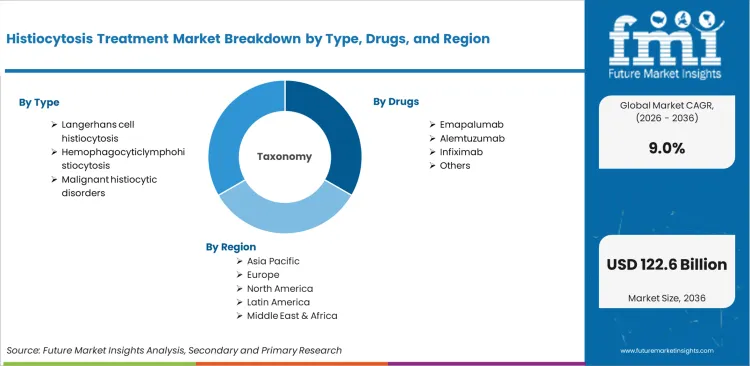
The histiocytosis are of three different types, namely, Langerhans cell histiocytosis (LCH), hemophagocyticlymphohistiocytosis (HLH), and malignant histiocytic disorders.
According to the type of drugs with histiocytosis market includes Emapalumab, alemtuzumab and infliximab. The increasing prevalence of oncology and immunology disorders is one of the major driving force of the histiocytosis treatment market.
The Emapalumab was the first drug that was established to treat histiocytosis. Alemtuzumab is a cancer drug and also used in the treatment of leukemia. Global histiocytosis treatment market is expected to grow substantially in the forecast period due to high unmet need of the histiocytosis is fueling the market growth.
The outbreak of Covid-19 has a strong impact which has started to be felt and is affecting the histiocytosis treatment markets. The lockdowns across the globe may have resulted in temporary slowing down in the growth of the histiocytosis treatment market.
Histiocytosis Treatment Market: Drivers and Restraints
The increasing prevalence of oncology and immunology disorders worldwide has led to enhancing the market growth for the histiocytosis treatment market. As these disorders can increase the risk of developing hemophagocyticlymphohistiocytosis. In addition, the huge financial support to the researchers for developing novel intervention is leading to considerable growth of the histiocytosis treatment market.
Moreover, increase in strategic alliances between the companies to expedite the development faster is propelling the growth of the market.
However, low heathacare budget in developing countries may lead to hamper the growth of the histiocytosis market. Another factor that may act as a restraint for the market growth is the stringent and hefty regulations. It is also observed that histiocitosis is challenging to diagnose as the initial symptoms are similar to common infections acting as a challenging factor for the growth of the histiocytosis market.
Histiocytosis Treatment Market: Overview
On the basis of drugs, the histiocytosis market is classified into Emapalumab, Alemtuzumab, Infiximab and others. Emapalumab is expected to continue to dominate the drug type in the treatment of histiocytosis market as it can be administered to all patients of histiocytosis including new borns and older children.
However, Alemtuzumab may be expected to generate higher levels of revenue in the upcoming years due to the rising prevalence of tumors resulting in cancers.
Histiocytosis Treatment Market: Regional-Wise Outlook
.webp "Top Country Growth Comparison Histiocytosis Treatment Market Cagr (2026 2036)")
Geographically, the histiocytosis treatment market is segmented into seven regions viz.South Asia, East Asia, Europe,Latin America, North America, Oceania and Middle East and Africa. North America may have the highest shares in the histiocytosis market due to high demand of disease specific treatment and presense of refined healthcare expenditure.
Europe is considered to be the second largest contributor in the histiocytosis treatment market as a result of growing cases of cancer. East Asia may also have a significant growth rate in the histiocytosis treatment market due to availability of funds for research and development.
South Asia is also expected to have significant growth in the histiocytosis market due to rise in histiocytosis patients. Latin America is expected to have a gradual growth in the market. Middle east and Africa is expected to have least market growth due to poor economy in African region and limited development in the healthcare region.
Histiocytosis Treatment Market: Key players
Some of the players identified in the histiocytosis treatment market include:
- SOBI
- AB2 Bio Ltd.
- Alpine Immune Sciencs
- Bellicum Pharmaceuticals
- Sanofi
- Pfizer Inc.
- Johnson & Johnson Services
- Incyte corporation
The report is a compilation of first-hand information, qualitative and quantitative assessment by industry analysts, inputs from industry experts and industry participants across the value chain.
The report provides in-depth analysis of parent market trends, macro-economic indicators and governing factors along with market attractiveness as per segments. The report also maps the qualitative impact of various market factors on market segments and geographies.
- Market Segments
- Market Dynamics
- Market Size
- Supply & Demand
- Current Trends/Issues/Challenges
- Competition & Companies involved
- Technology Matrix
- Value Chain
Scope of the Report
| Metric | Value |
|---|---|
| Quantitative Units | USD 51.80 Billion to USD 122.63 Billion, at a CAGR of 9.00% |
| Market Definition | Histiocytosis treatment encompasses pharmaceutical therapies used to manage histiocytic disorders, a group of rare diseases characterized by abnormal accumulation and proliferation of histiocytes (tissue macrophages and dendritic cells). The three primary clinical subtypes are Langerhans cell histiocytosis (LCH), hemophagocytic lymphohistiocytosis (HLH), and malignant histiocytic disorders. |
| Segmentation | Type: Langerhans cell histiocytosis, Hemophagocyticlymphohistiocytosis, Malignant histiocytic disorders; Drugs: Emapalumab, Alemtuzumab, Infiximab, Others; End users: Hospitals, Homecare, Specialty clinics, Oncologist, Immunologist |
| Regions Covered | North America, Latin America, Europe, East Asia, South Asia, Oceania, Middle East & Africa |
| Countries Covered | China, India, Germany, Brazil, USA, UK, Japan, and 40 plus countries |
| Key Companies Profiled | Sanofi, SOBI, AB2 Bio Ltd., Alpine Immune Sciencs, Bellicum Pharmaceuticals, Pfizer Inc., Johnson & Johnson Services, Incyte corporation |
| Forecast Period | 2026 to 2036 |
| Approach | Forecasting models apply a bottom-up methodology starting with regional utilization metrics and projecting adoption rates against demand drivers and regulatory frameworks. |
Histiocytosis Treatment Market: Segmentation
Tentatively, the global histiocytosis treatment market has been segmented on the basis of type, drugs and end users
By Type:
- Langerhans cell histiocytosis
- Hemophagocyticlymphohistiocytosis
- Malignant histiocytic disorders
By Drugs:
- Emapalumab
- Alemtuzumab
- Infiximab
- Others
By End users:
- Hospitals
- Homecare
- Specialty clinics
- Oncologist
- Immunologist
Bibliography
- World Health Organization. (2025). WHO Classification of Haematolymphoid Tumours, 5th Edition: Histiocytic and Dendritic Cell Neoplasms. WHO.
- USA Food and Drug Administration. (2025). Orphan Drug Designations Database. FDA.
- European Medicines Agency. (2025). EU Register of Orphan Medicinal Products. EMA.
- National Institutes of Health. (2025). Genetic and Rare Diseases Information Center: Histiocytosis. NIH.
- Sobi (Swedish Orphan Biovitrum). (2025). Annual Report 2025. Sobi.
This bibliography is provided for reader reference. The full Future Market Insights report contains the complete reference list with primary research documentation.
Frequently Asked Questions
How large is the demand for Histiocytosis Treatment in the global market in 2026?
Demand for Histiocytosis Treatment in the global market is estimated to be valued at USD 51.80 billion in 2026.
What will be the market size of Histiocytosis Treatment in the global market by 2036?
Market size for Histiocytosis Treatment is projected to reach USD 122.63 billion by 2036.
What is the expected demand growth for Histiocytosis Treatment between 2026 and 2036?
Demand for Histiocytosis Treatment is expected to grow at a CAGR of 9.00% between 2026 and 2036.
Which Type is poised to lead global sales by 2026?
Langerhans cell histiocytosis accounts for 46.3% share in 2026 based on structural demand factors and procurement concentration patterns.
What is driving demand in China?
China leads growth at 11.6% CAGR through 2036, driven by expanding capacity and end-use procurement volumes.
What is India's growth outlook in this report?
India is projected to grow at a CAGR of 10.7% during 2026 to 2036.
What is Histiocytosis Treatment and what is it mainly used for?
Histiocytosis treatment encompasses pharmaceutical therapies used to manage histiocytic disorders, a group of rare diseases characterized by abnormal accumulation and proliferation of histiocytes (tissue macrophages and dendritic cells). The three primary clinical subtypes are Langerhans cell histiocytosis (LCH), hemophagocytic lymphohistiocytosis (HLH), and malignant histiocytic disorders.
How does FMI build and validate the forecast?
Forecasting models apply a bottom-up methodology starting with regional utilization metrics and cross-validate projections against industry statistics and company guidance.
Preview the report firsthand - request a free sample
Get SampleGet the brochure for pricing and purchase details.
Get PDFTable of Content
- Executive Summary
- Global Market Outlook
- Demand-side Trends
- Supply-side Trends
- Technology Roadmap Analysis
- Analysis and Recommendations
- Market Overview
- Market Coverage / Taxonomy
- Market Definition / Scope / Limitations
- Research Methodology
- Chapter Orientation
- Analytical Lens and Working Hypotheses
- Market Structure, Signals, and Trend Drivers
- Benchmarking and Cross-market Comparability
- Market Sizing, Forecasting, and Opportunity Mapping
- Research Design and Evidence Framework
- Desk Research Programme (Secondary Evidence)
- Company Annual and Sustainability Reports
- Peer-reviewed Journals and Academic Literature
- Corporate Websites, Product Literature, and Technical Notes
- Earnings Decks and Investor Briefings
- Statutory Filings and Regulatory Disclosures
- Technical White Papers and Standards Notes
- Trade Journals, Industry Magazines, and Analyst Briefs
- Conference Proceedings, Webinars, and Seminar Materials
- Government Statistics Portals and Public Data Releases
- Press Releases and Reputable Media Coverage
- Specialist Newsletters and Curated Briefings
- Sector Databases and Reference Repositories
- FMI Internal Proprietary Databases and Historical Market Datasets
- Subscription Datasets and Paid Sources
- Social Channels, Communities, and Digital Listening Inputs
- Additional Desk Sources
- Expert Input and Fieldwork (Primary Evidence)
- Primary Modes
- Qualitative Interviews and Expert Elicitation
- Quantitative Surveys and Structured Data Capture
- Blended Approach
- Why Primary Evidence is Used
- Field Techniques
- Interviews
- Surveys
- Focus Groups
- Observational and In-context Research
- Social and Community Interactions
- Stakeholder Universe Engaged
- C-suite Leaders
- Board Members
- Presidents and Vice Presidents
- R&D and Innovation Heads
- Technical Specialists
- Domain Subject-matter Experts
- Scientists
- Physicians and Other Healthcare Professionals
- Governance, Ethics, and Data Stewardship
- Research Ethics
- Data Integrity and Handling
- Primary Modes
- Tooling, Models, and Reference Databases
- Desk Research Programme (Secondary Evidence)
- Data Engineering and Model Build
- Data Acquisition and Ingestion
- Cleaning, Normalisation, and Verification
- Synthesis, Triangulation, and Analysis
- Quality Assurance and Audit Trail
- Market Background
- Market Dynamics
- Drivers
- Restraints
- Opportunity
- Trends
- Scenario Forecast
- Demand in Optimistic Scenario
- Demand in Likely Scenario
- Demand in Conservative Scenario
- Opportunity Map Analysis
- Product Life Cycle Analysis
- Supply Chain Analysis
- Investment Feasibility Matrix
- Value Chain Analysis
- PESTLE and Porter’s Analysis
- Regulatory Landscape
- Regional Parent Market Outlook
- Production and Consumption Statistics
- Import and Export Statistics
- Market Dynamics
- Global Market Analysis 2021 to 2025 and Forecast, 2026 to 2036
- Historical Market Size Value (USD Million) Analysis, 2021 to 2025
- Current and Future Market Size Value (USD Million) Projections, 2026 to 2036
- Y-o-Y Growth Trend Analysis
- Absolute $ Opportunity Analysis
- Global Market Pricing Analysis 2021 to 2025 and Forecast 2026 to 2036
- Global Market Analysis 2021 to 2025 and Forecast 2026 to 2036, By Type
- Introduction / Key Findings
- Historical Market Size Value (USD Million) Analysis By Type , 2021 to 2025
- Current and Future Market Size Value (USD Million) Analysis and Forecast By Type , 2026 to 2036
- Langerhans cell histiocytosis
- Hemophagocyticlymphohistiocytosis
- Malignant histiocytic disorders
- Langerhans cell histiocytosis
- Y-o-Y Growth Trend Analysis By Type , 2021 to 2025
- Absolute $ Opportunity Analysis By Type , 2026 to 2036
- Global Market Analysis 2021 to 2025 and Forecast 2026 to 2036, By Drugs
- Introduction / Key Findings
- Historical Market Size Value (USD Million) Analysis By Drugs, 2021 to 2025
- Current and Future Market Size Value (USD Million) Analysis and Forecast By Drugs, 2026 to 2036
- Emapalumab
- Alemtuzumab
- Infiximab
- Others
- Emapalumab
- Y-o-Y Growth Trend Analysis By Drugs, 2021 to 2025
- Absolute $ Opportunity Analysis By Drugs, 2026 to 2036
- Global Market Analysis 2021 to 2025 and Forecast 2026 to 2036, By End users
- Introduction / Key Findings
- Historical Market Size Value (USD Million) Analysis By End users, 2021 to 2025
- Current and Future Market Size Value (USD Million) Analysis and Forecast By End users, 2026 to 2036
- Hospitals
- Homecare
- Specialty clinics
- Oncologist
- Immunologist
- Hospitals
- Y-o-Y Growth Trend Analysis By End users, 2021 to 2025
- Absolute $ Opportunity Analysis By End users, 2026 to 2036
- Global Market Analysis 2021 to 2025 and Forecast 2026 to 2036, By Region
- Introduction
- Historical Market Size Value (USD Million) Analysis By Region, 2021 to 2025
- Current Market Size Value (USD Million) Analysis and Forecast By Region, 2026 to 2036
- North America
- Latin America
- Western Europe
- Eastern Europe
- East Asia
- South Asia and Pacific
- Middle East & Africa
- Market Attractiveness Analysis By Region
- North America Market Analysis 2021 to 2025 and Forecast 2026 to 2036, By Country
- Historical Market Size Value (USD Million) Trend Analysis By Market Taxonomy, 2021 to 2025
- Market Size Value (USD Million) Forecast By Market Taxonomy, 2026 to 2036
- By Country
- USA
- Canada
- Mexico
- By Type
- By Drugs
- By End users
- By Country
- Market Attractiveness Analysis
- By Country
- By Type
- By Drugs
- By End users
- Key Takeaways
- Latin America Market Analysis 2021 to 2025 and Forecast 2026 to 2036, By Country
- Historical Market Size Value (USD Million) Trend Analysis By Market Taxonomy, 2021 to 2025
- Market Size Value (USD Million) Forecast By Market Taxonomy, 2026 to 2036
- By Country
- Brazil
- Chile
- Rest of Latin America
- By Type
- By Drugs
- By End users
- By Country
- Market Attractiveness Analysis
- By Country
- By Type
- By Drugs
- By End users
- Key Takeaways
- Western Europe Market Analysis 2021 to 2025 and Forecast 2026 to 2036, By Country
- Historical Market Size Value (USD Million) Trend Analysis By Market Taxonomy, 2021 to 2025
- Market Size Value (USD Million) Forecast By Market Taxonomy, 2026 to 2036
- By Country
- Germany
- UK
- Italy
- Spain
- France
- Nordic
- BENELUX
- Rest of Western Europe
- By Type
- By Drugs
- By End users
- By Country
- Market Attractiveness Analysis
- By Country
- By Type
- By Drugs
- By End users
- Key Takeaways
- Eastern Europe Market Analysis 2021 to 2025 and Forecast 2026 to 2036, By Country
- Historical Market Size Value (USD Million) Trend Analysis By Market Taxonomy, 2021 to 2025
- Market Size Value (USD Million) Forecast By Market Taxonomy, 2026 to 2036
- By Country
- Russia
- Poland
- Hungary
- Balkan & Baltic
- Rest of Eastern Europe
- By Type
- By Drugs
- By End users
- By Country
- Market Attractiveness Analysis
- By Country
- By Type
- By Drugs
- By End users
- Key Takeaways
- East Asia Market Analysis 2021 to 2025 and Forecast 2026 to 2036, By Country
- Historical Market Size Value (USD Million) Trend Analysis By Market Taxonomy, 2021 to 2025
- Market Size Value (USD Million) Forecast By Market Taxonomy, 2026 to 2036
- By Country
- China
- Japan
- South Korea
- By Type
- By Drugs
- By End users
- By Country
- Market Attractiveness Analysis
- By Country
- By Type
- By Drugs
- By End users
- Key Takeaways
- South Asia and Pacific Market Analysis 2021 to 2025 and Forecast 2026 to 2036, By Country
- Historical Market Size Value (USD Million) Trend Analysis By Market Taxonomy, 2021 to 2025
- Market Size Value (USD Million) Forecast By Market Taxonomy, 2026 to 2036
- By Country
- India
- ASEAN
- Australia & New Zealand
- Rest of South Asia and Pacific
- By Type
- By Drugs
- By End users
- By Country
- Market Attractiveness Analysis
- By Country
- By Type
- By Drugs
- By End users
- Key Takeaways
- Middle East & Africa Market Analysis 2021 to 2025 and Forecast 2026 to 2036, By Country
- Historical Market Size Value (USD Million) Trend Analysis By Market Taxonomy, 2021 to 2025
- Market Size Value (USD Million) Forecast By Market Taxonomy, 2026 to 2036
- By Country
- Kingdom of Saudi Arabia
- Other GCC Countries
- Turkiye
- South Africa
- Other African Union
- Rest of Middle East & Africa
- By Type
- By Drugs
- By End users
- By Country
- Market Attractiveness Analysis
- By Country
- By Type
- By Drugs
- By End users
- Key Takeaways
- Key Countries Market Analysis
- USA
- Pricing Analysis
- Market Share Analysis, 2025
- By Type
- By Drugs
- By End users
- Canada
- Pricing Analysis
- Market Share Analysis, 2025
- By Type
- By Drugs
- By End users
- Mexico
- Pricing Analysis
- Market Share Analysis, 2025
- By Type
- By Drugs
- By End users
- Brazil
- Pricing Analysis
- Market Share Analysis, 2025
- By Type
- By Drugs
- By End users
- Chile
- Pricing Analysis
- Market Share Analysis, 2025
- By Type
- By Drugs
- By End users
- Germany
- Pricing Analysis
- Market Share Analysis, 2025
- By Type
- By Drugs
- By End users
- UK
- Pricing Analysis
- Market Share Analysis, 2025
- By Type
- By Drugs
- By End users
- Italy
- Pricing Analysis
- Market Share Analysis, 2025
- By Type
- By Drugs
- By End users
- Spain
- Pricing Analysis
- Market Share Analysis, 2025
- By Type
- By Drugs
- By End users
- France
- Pricing Analysis
- Market Share Analysis, 2025
- By Type
- By Drugs
- By End users
- India
- Pricing Analysis
- Market Share Analysis, 2025
- By Type
- By Drugs
- By End users
- ASEAN
- Pricing Analysis
- Market Share Analysis, 2025
- By Type
- By Drugs
- By End users
- Australia & New Zealand
- Pricing Analysis
- Market Share Analysis, 2025
- By Type
- By Drugs
- By End users
- China
- Pricing Analysis
- Market Share Analysis, 2025
- By Type
- By Drugs
- By End users
- Japan
- Pricing Analysis
- Market Share Analysis, 2025
- By Type
- By Drugs
- By End users
- South Korea
- Pricing Analysis
- Market Share Analysis, 2025
- By Type
- By Drugs
- By End users
- Russia
- Pricing Analysis
- Market Share Analysis, 2025
- By Type
- By Drugs
- By End users
- Poland
- Pricing Analysis
- Market Share Analysis, 2025
- By Type
- By Drugs
- By End users
- Hungary
- Pricing Analysis
- Market Share Analysis, 2025
- By Type
- By Drugs
- By End users
- Kingdom of Saudi Arabia
- Pricing Analysis
- Market Share Analysis, 2025
- By Type
- By Drugs
- By End users
- Turkiye
- Pricing Analysis
- Market Share Analysis, 2025
- By Type
- By Drugs
- By End users
- South Africa
- Pricing Analysis
- Market Share Analysis, 2025
- By Type
- By Drugs
- By End users
- USA
- Market Structure Analysis
- Competition Dashboard
- Competition Benchmarking
- Market Share Analysis of Top Players
- By Regional
- By Type
- By Drugs
- By End users
- Competition Analysis
- Competition Deep Dive
- Sanofi
- Overview
- Product Portfolio
- Profitability by Market Segments (Product/Age /Sales Channel/Region)
- Sales Footprint
- Strategy Overview
- Marketing Strategy
- Product Strategy
- Channel Strategy
- SOBI
- AB2 Bio Ltd.
- Alpine Immune Sciencs
- Bellicum Pharmaceuticals
- Pfizer Inc.
- Johnson & Johnson Services
- Incyte corporation
- Sanofi
- Competition Deep Dive
- Assumptions & Acronyms Used


