

- Industry Size (2026)
- USD 3.52 Bn
- Forecast (2036)
- USD 4.96 Bn
- CAGR (2026 to 2036)
- 3.50%
HiToxic Gas Detector Market Size, Market Forecast and Outlook By FMI
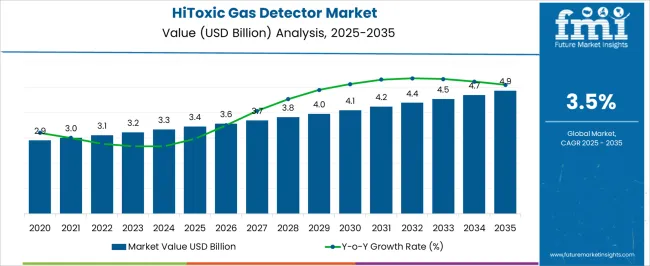
The hitoxic gas detector market was valued at USD 3.40 billion in 2025, projected to reach USD 3.52 billion in 2026, and is forecast to expand to USD 4.96 billion by 2036 at a 3.50% CAGR. As per FMI, the incremental opportunity across the forecast period amounts to USD 1.44 billion, reflecting a steady expansion trajectory shaped by evolving end-use requirements and shifting procurement patterns across global supply chains.
Summary of HiToxic Gas Detector Market
- Market Snapshot
- The hitoxic gas detector market is valued at USD 3.40 billion in 2025 and is projected to reach USD 4.96 billion by 2036.
- The industry is expected to grow at a 3.50% CAGR from 2026 to 2036, creating an incremental opportunity of USD 1.44 billion.
- The market is a regulatory-compliance-driven industrial safety instrumentation category, where sensor technology accuracy, wireless connectivity, and field-replaceable cartridge economics define procurement specifications.
- Demand and Growth Drivers
- Demand is driven by tightening occupational exposure limits and workplace safety enforcement mandates across petrochemical, chemical, utility, and semiconductor manufacturing operations.
- Sensor miniaturization and wireless IoT connectivity advances are enabling networked gas detection arrays that provide continuous real-time monitoring across distributed industrial facilities.
- Semiconductor manufacturing cleanroom expansion is creating new procurement channels for toxic gas detectors rated for specialty gas species used in wafer fabrication processes.
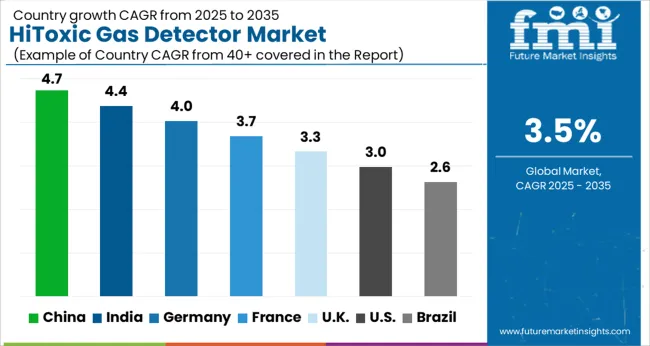
- Among key countries, China at 4.7%, India at 4.4%, Germany at 4.0%, France at 3.7%, UK at 3.3%, USA at 3.0%, Brazil at 2.6%.
- Product and Segment View
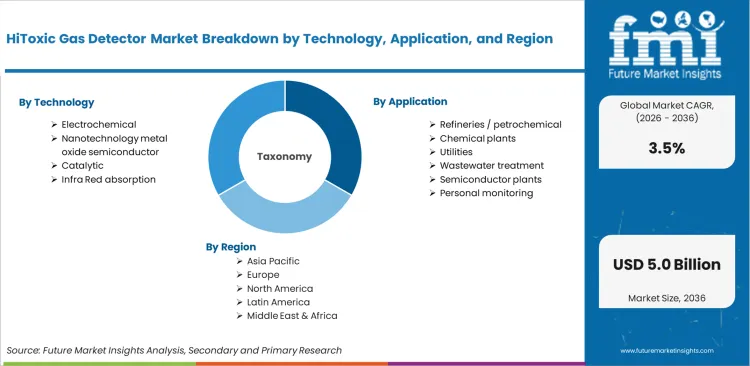
- The market includes toxic gas detectors across sensor technologies (electrochemical, nanotechnology metal oxide semiconductor, catalytic, infrared absorption) for refineries, chemical plants, utilities, wastewater treatment, semiconductor plants, and personal monitoring applications.
- Electrochemical sensor technology commands the leading share due to gas specificity, detection sensitivity, and field-replaceable cartridge economics across the broadest toxic gas species range.
- The scope includes fixed and portable toxic gas detection instruments, while excluding combustible gas detectors, oxygen monitors, and ambient air quality monitoring stations.
- Electrochemical leads by Technology with 40.1% share in 2026.
- Refineries / petrochemical leads by Application with 30.4% share in 2026.
- Geography and Competitive Outlook
- China and India are the fastest-growing markets driven by industrial expansion and safety regulation enforcement, while North America and Europe sustain value through stringent occupational exposure limit compliance and refinery safety procurement cycles.
- Competition is shaped by product specification depth, regulatory certification, and supply chain reliability, with key players including Honeywell, Drager, MSA, Riken Keiki, Industrial Scientific, Emerson, Shenzhen ExSAF, RKI Instruments, ACTION ELECTRONICS, Hanwei Electronics.
- Analyst Opinion at FMI
- Nikhil Kaitwade, Principal Consultant, opines: 'In my analysis, I have observed that the toxic gas detector market is transitioning from standalone instrument procurement toward networked detection platform subscriptions where sensor replacement, calibration services, and cloud-based exposure analytics are bundled into recurring service contracts. Industrial safety managers who continue purchasing standalone detectors without service coverage face growing compliance risk from missed calibration schedules and sensor degradation.'
- Strategic Implications / Executive Takeaways
- Detector manufacturers must develop wireless IoT-enabled platforms with cloud-based exposure analytics to capture recurring service revenue from networked industrial safety monitoring contracts.
- Petrochemical and chemical plant safety managers should transition from standalone detector purchases to platform subscription models that bundle sensor replacement, calibration, and compliance reporting.
- Semiconductor fab safety teams must specify toxic gas detector sensor cartridge compatibility with the expanding range of specialty process gases used in advanced node wafer fabrication.
HiToxic Gas Detector Market Key Takeaways
| Metric | Details |
|---|---|
| Industry Size (2026) | USD 3.52 Billion |
| Industry Value (2036) | USD 4.96 Billion |
| CAGR (2026-2036) | 3.50% |
Source: Future Market Insights, 2026
Based on FMI's report, the hitoxic gas detector market is expected to create an incremental opportunity of USD 1.44 billion between 2026 and 2036. FMI analysts project that end-use procurement patterns and regional supply chain dynamics will shape the distribution of this opportunity across segments and geographies.
Tightening workplace safety regulations across petrochemical, chemical processing, utility, and semiconductor manufacturing operations are sustaining procurement volumes for toxic gas detection systems. Advancing sensor miniaturization and wireless connectivity are enabling deployment of networked gas detection arrays that provide real-time exposure monitoring across distributed industrial sites. As per FMI, electrochemical sensor technology commands the leading share due to its combination of gas specificity, detection sensitivity, and field-replaceable sensor cartridge economics across the broadest range of toxic gas species monitored in industrial safety compliance programs.
Regional demand for toxic gas detectors reflects the geographic distribution of petrochemical refining, chemical manufacturing, utility infrastructure, and semiconductor fabrication activity. China at 4.7% CAGR, India at 4.4% CAGR, Germany at 4.0% CAGR, France at 3.7% CAGR, UK at 3.3% CAGR, USA at 3.0% CAGR, Brazil at 2.6% CAGR. China leads growth through expanding petrochemical refining capacity and tightening workplace safety enforcement. India follows on the strength of chemical manufacturing expansion and industrial safety regulation modernization. Germany sustains growth through stringent occupational safety standards and precision instrumentation manufacturing. France and the United Kingdom maintain growth through refinery and utility safety compliance requirements. The United States advances through OSHA permissible exposure limit enforcement and petroleum refinery turnaround cycle detector procurement. Brazil registers steady growth tied to petrochemical and mining sector safety investment.
HiToxic Gas Detector Market Definition
Toxic gas detectors are industrial safety instruments designed to detect and measure the concentration of hazardous gases in workplace environments to protect personnel from acute and chronic exposure. They operate using electrochemical, nanotechnology metal oxide semiconductor, catalytic, and infrared absorption sensor technologies. Primary applications include petrochemical refinery safety monitoring, chemical plant process area surveillance, utility infrastructure gas leak detection, wastewater treatment facility monitoring, semiconductor fab toxic gas detection, and personal wearable exposure monitoring.
Future Market Insights analysis captures the complete addressable consumption base across all major producing and consuming regions, covering the forecast period from 2026 to 2036.
HiToxic Gas Detector Market Inclusions
Market scope includes fixed and portable toxic gas detectors across sensor technologies and industrial applications. The assessment covers global and regional market sizes, forecast period 2026 to 2036, and segment breakdowns by technology, application, and region.
HiToxic Gas Detector Market Exclusions
The scope excludes combustible gas (LEL) detectors, oxygen deficiency monitors, ambient outdoor air quality monitoring stations, and residential carbon monoxide detectors. Replacement sensor cartridges sold as aftermarket consumables are not included in the instrument market valuation.
HiToxic Gas Detector Market Research Methodology
- Primary Research: Analysts engaged with procurement managers, clinical specialists, and distribution channel executives to map the decision gates and compliance thresholds shaping product adoption.
- Desk Research: Data collection aggregated regulatory filings, clinical guidelines, trade body publications, and company financial disclosures across all major producing and consuming regions.
- Market-Sizing and Forecasting: Baseline values derive from a bottom-up aggregation of product shipment volumes and utilization data, applying region-specific adoption growth curves to project demand velocity through 2036.
- Data Validation and Update Cycle: Projections are tested against publicly reported industry statistics, clinical data, and company guidance. The model is updated quarterly to reflect market structure changes.
Why is the HiToxic Gas Detector Market Growing?
The HiToxic gas detector market is witnessing significant growth, supported by increasing safety regulations and the growing emphasis on workplace hazard monitoring across industries. Rising concerns regarding worker health and the prevention of industrial accidents are creating strong demand for advanced gas detection solutions. Regulatory bodies worldwide are mandating the use of reliable detection systems to ensure compliance with safety standards, further stimulating adoption.
Continuous innovation in sensor technologies, particularly in miniaturization and connectivity, is improving accuracy and real-time monitoring capabilities. Integration of detectors with wireless communication and centralized monitoring platforms is enhancing operational efficiency in high-risk industries such as oil and gas, chemicals, and manufacturing. The market outlook remains positive as industrial expansion in emerging economies increases the need for reliable safety equipment.
Growing demand for detectors that can withstand extreme operating conditions while providing precise measurements is expected to drive further adoption As industries prioritize preventive safety measures, the HiToxic gas detector market is set to expand steadily, with strong opportunities in both developed and developing regions.
Segmental Analysis
The hitoxic gas detector market is segmented by technology, application, and geographic regions. By technology, hitoxic gas detector market is divided into Electrochemical, Nanotechnology metal oxide semiconductor (NTMOS), Catalytic, and Infra Red absorption. In terms of application, hitoxic gas detector market is classified into Refineries / petrochemical, Chemical plants, Utilities, Wastewater treatment, Semiconductor plants, and Personal monitoring. Regionally, the hitoxic gas detector industry is classified into North America, Latin America, Western Europe, Eastern Europe, Balkan & Baltic Countries, Russia & Belarus, Central Asia, East Asia, South Asia & Pacific, and the Middle East & Africa.
Insights into the Electrochemical Technology Segment
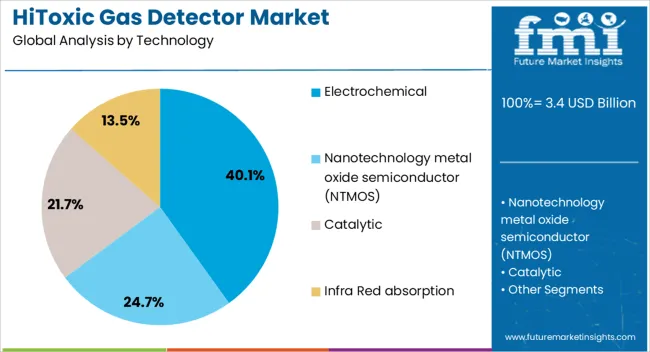
The electrochemical technology segment is projected to hold 40.1% of the HiToxic gas detector market revenue share in 2026, making it the dominant technology. This leadership is being reinforced by the high sensitivity and selectivity of electrochemical sensors, which enable accurate detection of a wide range of toxic gases even at very low concentrations. The low power consumption and compact size of electrochemical detectors make them well suited for both portable and fixed applications.
Growing adoption is being supported by the ability of this technology to deliver consistent performance with minimal interference from other gases, ensuring reliability in critical industrial environments. Advances in sensor design and calibration are improving operational lifespan and reducing maintenance requirements, strengthening cost-effectiveness.
The segment is also benefiting from compliance with stringent occupational safety regulations that demand precision monitoring in hazardous environments As industries continue to emphasize worker safety and environmental protection, the electrochemical technology segment is expected to maintain its leadership in the global market.
Insights into the Refineries and Petrochemical Application Segment
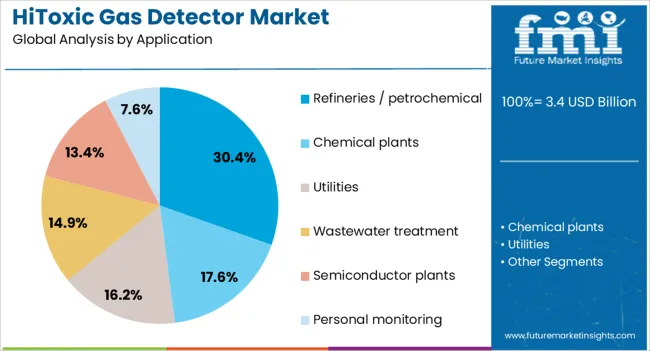
The refineries and petrochemical application segment is expected to account for 30.4% of the HiToxic gas detector market revenue share in 2026, establishing itself as the leading application area. This dominance is being driven by the inherently high-risk environment of refineries and petrochemical plants, where exposure to toxic gases poses serious threats to worker safety and operational continuity.
The segment is benefiting from strict regulatory frameworks that mandate continuous monitoring of hazardous gases to prevent accidents and ensure compliance with safety standards. The use of HiToxic gas detectors in this segment is also being reinforced by the need to safeguard high-value assets and minimize downtime caused by gas leaks or hazardous exposure.
Integration of detection systems with advanced automation and control networks is further enhancing monitoring efficiency and response times As global demand for petrochemical products rises and capacity expansion projects increase, the reliance on advanced toxic gas detection solutions in this sector is expected to strengthen, maintaining its position as the leading application.
Market Overview
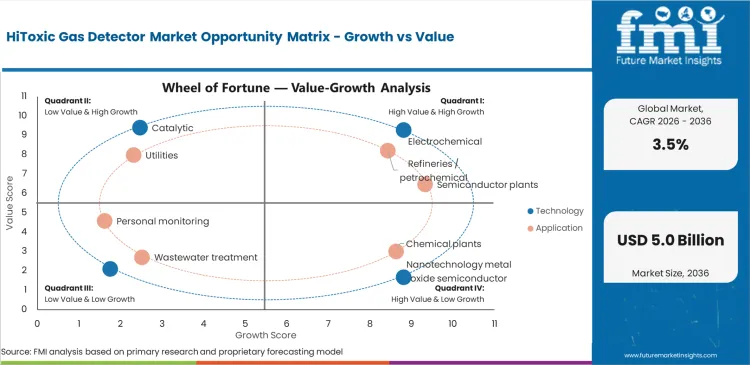
HiToxic Gas Detector Market: Drivers & Restraints
Increasing concerns about occupational health and safety, increase in demand from oil & gas industry and regulations in developed economies like North America and Europe are some of the key factors driving the growth of the HiToxic gas detector market.
Routine maintenance, associated costs, insensitivity and exclusivity of gas detectors for a particular gas, high initial purchase are few probable factors responsible for negatively impacting the growth of the HiToxic gas detector market.
HiToxic Gas Detector Market: Overview
Though the economic recovery has slowed down in recent years, protection of human lives and assets is critical to all organizations. With stringent regulations and increasing safety concerns, the acceptance of HiToxic gas detector is gaining popularity. The global HiToxic gas detector market is expected to expand at a promising CAGR during the forecast period (2025-2026).
HiToxic Gas Detector Market: Region-wise Outlook
The global HiToxic gas detector Market is expected to register a double-digit CAGR for the forecast period. Depending on geographic regions, global HiToxic gas detector market is segmented into seven key regions: North America, South America, Eastern Europe, Western Europe, Asia Pacific, Japan, and Middle East & Africa.
As of 2025, North America dominated the global HiToxic gas detector market in terms of market revenue followed by Europe. Asia Pacific & Japan are projected to expand at a substantial growth and will contribute to the global HiToxic gas detector market value exhibiting a robust CAGR during the forecast period, 2025?2025.
HiToxic Gas Detector Market: Key Players
Some of the key market participants in global HiToxic gas detector market are RKI Instruments Inc, Honeywell International, Det-Tronics, Sierra Monitor Corporation, Simtronics, Emerson Electric Co, General Monitors.
The research report presents a comprehensive assessment of the market and contains thoughtful insights, facts, historical data, and statistically supported and industry-validated market data. It also contains projections using a suitable set of assumptions and methodologies. The research report provides analysis and information according to categories such as market segments, geographies, types and applications.
The report covers exhaustive analysis on
- Market Segments
- Market Dynamics
- Market Size
- Supply & Demand
- Current Trends/Issues/Challenges
- Competition & Companies involved
- Technology
- Value Chain
Regional analysis includes
- North America (USA, Canada)
- Latin America (Mexico. Brazil)
- Western Europe (Germany, Italy, France, UK, Spain, Nordic countries, Belgium, Netherlands, Luxembourg)
- Eastern Europe (Poland, Russia)
- Asia Pacific (China, India, ASEAN, Australia & New Zealand)
- Japan
- Middle East and Africa (GCC, S. Africa, N. Africa)
The report is a compilation of first-hand information, qualitative and quantitative assessment by industry analysts, inputs from industry experts and industry participants across the value chain. The report provides in-depth analysis of parent market trends, macro-economic indicators and governing factors along with market attractiveness as per segments. The report also maps the qualitative impact of various market factors on market segments and geographies.
Analysis of HiToxic Gas Detector Market By Key Countries
.webp "Top Country Growth Comparison Hitoxic Gas Detector Market Cagr (2026 2036)")
| Country | CAGR |
|---|---|
| China | 4.7% |
| India | 4.4% |
| Germany | 4.0% |
| France | 3.7% |
| UK | 3.3% |
| USA | 3.0% |
| Brazil | 2.6% |
Country-wise Analysis
The HiToxic Gas Detector Market is expected to register a CAGR of 3.5% during the forecast period, exhibiting varied country level momentum. China leads with the highest CAGR of 4.7%, followed by India at 4.4%. Developed markets such as Germany, France, and the UK continue to expand steadily, while the USA is likely to grow at consistent rates. Brazil posts the lowest CAGR at 2.6%, yet still underscores a broadly positive trajectory for the global HiToxic Gas Detector Market. In 2026, Germany held a dominant revenue in the Western Europe market and is expected to grow with a CAGR of 4.0%. The USA HiToxic Gas Detector Market is estimated to be valued at USD 1.3 billion in 2026 and is anticipated to reach a valuation of USD 1.7 billion by 2036. Sales are projected to rise at a CAGR of 3.0% over the forecast period between 2026 and 2036. While Japan and South Korea markets are estimated to be valued at USD 181.5 million and USD 88.3 million respectively in 2026.
Key Players in the HiToxic Gas Detector Market
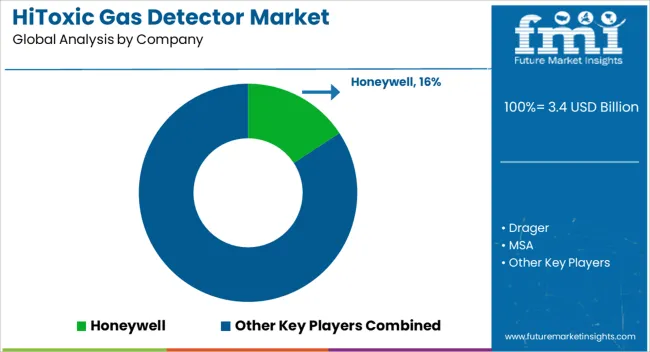
- Honeywell
- Drager
- MSA
- Riken Keiki
- Industrial Scientific
- Emerson
- Shenzhen ExSAF
- RKI Instruments
- ACTION ELECTRONICS
- Hanwei Electronics
Scope of the Report
| Metric | Value |
|---|---|
| Quantitative Units | USD 3.52 Billion to USD 4.96 Billion, at a CAGR of 3.50% |
| Market Definition | Toxic gas detectors are industrial safety instruments designed to detect and measure the concentration of hazardous gases in workplace environments to protect personnel from acute and chronic exposure. They operate using electrochemical, nanotechnology metal oxide semiconductor, catalytic, and infrared absorption sensor technologies. |
| Segmentation | Technology: Electrochemical, Nanotechnology metal oxide semiconductor, Catalytic, Infra Red absorption; Application: Refineries / petrochemical, Chemical plants, Utilities, Wastewater treatment, Semiconductor plants, Personal monitoring |
| Regions Covered | North America, Latin America, Europe, East Asia, South Asia, Oceania, Middle East & Africa |
| Countries Covered | China, India, Germany, France, UK, USA, Brazil, and 40 plus countries |
| Key Companies Profiled | Honeywell, Drager, MSA, Riken Keiki, Industrial Scientific, Emerson, Shenzhen ExSAF, RKI Instruments, ACTION ELECTRONICS, Hanwei Electronics |
| Forecast Period | 2026 to 2036 |
| Approach | Forecasting models apply a bottom-up methodology starting with regional utilization metrics and projecting adoption rates against demand drivers and regulatory frameworks. |
HiToxic Gas Detector Market by Segments
Technology:
- Electrochemical
- Nanotechnology metal oxide semiconductor (NTMOS)
- Catalytic
- Infra Red absorption
Application:
- Refineries / petrochemical
- Chemical plants
- Utilities
- Wastewater treatment
- Semiconductor plants
- Personal monitoring
Region:
- North America
- USA
- Canada
- Mexico
- Latin America
- Brazil
- Chile
- Rest of Latin America
- Western Europe
- Germany
- UK
- Italy
- Spain
- France
- Nordic
- BENELUX
- Rest of Western Europe
- Eastern Europe
- Russia
- Poland
- Hungary
- Balkan & Baltic
- Rest of Eastern Europe
- East Asia
- China
- Japan
- South Korea
- South Asia and Pacific
- India
- ASEAN
- Australia & New Zealand
- Rest of South Asia and Pacific
- Middle East & Africa
- Kingdom of Saudi Arabia
- Other GCC Countries
- Turkiye
- South Africa
- Other African Union
- Rest of Middle East & Africa
Bibliography
- USA Occupational Safety and Health Administration. (2025). Permissible Exposure Limits for Toxic Substances. OSHA.
- International Electrotechnical Commission. (2025). IEC 60079-29-1: Gas Detectors, Performance Requirements. IEC.
- European Commission. (2025). Directive 2014/34/EU: ATEX Equipment Directive. European Commission.
- Organisation for Economic Co-operation and Development. (2025). Chemical Safety Programme: Workplace Exposure Guidelines. OECD.
- MSA Safety Inc. (2025). Annual Report 2025: Detection Division. MSA.
This bibliography is provided for reader reference. The full Future Market Insights report contains the complete reference list with primary research documentation.
Frequently Asked Questions
How large is the demand for HiToxic Gas Detector in the global market in 2026?
Demand for HiToxic Gas Detector in the global market is estimated to be valued at USD 3.52 billion in 2026.
What will be the market size of HiToxic Gas Detector in the global market by 2036?
Market size for HiToxic Gas Detector is projected to reach USD 4.96 billion by 2036.
What is the expected demand growth for HiToxic Gas Detector between 2026 and 2036?
Demand for HiToxic Gas Detector is expected to grow at a CAGR of 3.50% between 2026 and 2036.
Which Technology is poised to lead global sales by 2026?
Electrochemical accounts for 40.1% share in 2026 based on structural demand factors and procurement concentration patterns.
What is driving demand in China?
China leads growth at 4.7% CAGR through 2036, driven by expanding capacity and end-use procurement volumes.
What is India's growth outlook in this report?
India is projected to grow at a CAGR of 4.4% during 2026 to 2036.
What is HiToxic Gas Detector and what is it mainly used for?
Toxic gas detectors are industrial safety instruments designed to detect and measure the concentration of hazardous gases in workplace environments to protect personnel from acute and chronic exposure. They operate using electrochemical, nanotechnology metal oxide semiconductor, catalytic, and infrared absorption sensor technologies.
How does FMI build and validate the forecast?
Forecasting models apply a bottom-up methodology starting with regional utilization metrics and cross-validate projections against industry statistics and company guidance.
Preview the report firsthand - request a free sample
Get SampleGet the brochure for pricing and purchase details.
Get PDFTable of Content
- Executive Summary
- Global Market Outlook
- Demand-side Trends
- Supply-side Trends
- Technology Roadmap Analysis
- Analysis and Recommendations
- Market Overview
- Market Coverage / Taxonomy
- Market Definition / Scope / Limitations
- Research Methodology
- Chapter Orientation
- Analytical Lens and Working Hypotheses
- Market Structure, Signals, and Trend Drivers
- Company Annual and Sustainability Reports
- Peer-reviewed Journals and Academic Literature
- Corporate Websites, Product Literature, and Technical Notes
- Earnings Decks and Investor Briefings
- Statutory Filings and Regulatory Disclosures
- Technical White Papers and Standards Notes
- Trade Journals, Industry Magazines, and Analyst Briefs
- Conference Proceedings, Webinars, and Seminar Materials
- Government Statistics Portals and Public Data Releases
- Press Releases and Reputable Media Coverage
- Specialist Newsletters and Curated Briefings
- Sector Databases and Reference Repositories
- FMI Internal Proprietary Databases and Historical Market Datasets
- Subscription Datasets and Paid Sources
- Social Channels, Communities, and Digital Listening Inputs
- Additional Desk Sources
- Expert Input and Fieldwork (Primary Evidence)
- Primary Modes
- Qualitative Interviews and Expert Elicitation
- Quantitative Surveys and Structured Data Capture
- Blended Approach
- Why Primary Evidence is Used
- Field Techniques
- Interviews
- Surveys
- Focus Groups
- Observational and In-context Research
- Social and Community Interactions
- Stakeholder Universe Engaged
- C-suite Leaders
- Board Members
- Presidents and Vice Presidents
- R&D and Innovation Heads
- Technical Specialists
- Domain Subject-matter Experts
- Scientists
- Physicians and Other Healthcare Professionals
- Governance, Ethics, and Data Stewardship
- Research Ethics
- Data Integrity and Handling
- Primary Modes
- Tooling, Models, and Reference Databases
- Data Engineering and Model Build
- Data Acquisition and Ingestion
- Cleaning, Normalisation, and Verification
- Synthesis, Triangulation, and Analysis
- Quality Assurance and Audit Trail
- Market Background
- Market Dynamics
- Drivers
- Restraints
- Opportunity
- Trends
- Scenario Forecast
- Demand in Optimistic Scenario
- Demand in Likely Scenario
- Demand in Conservative Scenario
- Opportunity Map Analysis
- Product Life Cycle Analysis
- Supply Chain Analysis
- Investment Feasibility Matrix
- Value Chain Analysis
- PESTLE and Porter’s Analysis
- Regulatory Landscape
- Regional Parent Market Outlook
- Production and Consumption Statistics
- Import and Export Statistics
- Market Dynamics
- Global Market Analysis 2021 to 2025 and Forecast, 2026 to 2036
- Historical Market Size Value (USD Million) Analysis, 2021 to 2025
- Current and Future Market Size Value (USD Million) Projections, 2026 to 2036
- Y-o-Y Growth Trend Analysis
- Absolute $ Opportunity Analysis
- Global Market Pricing Analysis 2021 to 2025 and Forecast 2026 to 2036
- Global Market Analysis 2021 to 2025 and Forecast 2026 to 2036, By Technology
- Introduction / Key Findings
- Historical Market Size Value (USD Million) Analysis By Technology , 2021 to 2025
- Current and Future Market Size Value (USD Million) Analysis and Forecast By Technology , 2026 to 2036
- Electrochemical
- Nanotechnology metal oxide semiconductor
- Catalytic
- Infra Red absorption
- Electrochemical
- Y-o-Y Growth Trend Analysis By Technology , 2021 to 2025
- Absolute $ Opportunity Analysis By Technology , 2026 to 2036
- Global Market Analysis 2021 to 2025 and Forecast 2026 to 2036, By Application
- Introduction / Key Findings
- Historical Market Size Value (USD Million) Analysis By Application, 2021 to 2025
- Current and Future Market Size Value (USD Million) Analysis and Forecast By Application, 2026 to 2036
- Refineries / petrochemical
- Chemical plants
- Utilities
- Wastewater treatment
- Semiconductor plants
- Personal monitoring
- Refineries / petrochemical
- Y-o-Y Growth Trend Analysis By Application, 2021 to 2025
- Absolute $ Opportunity Analysis By Application, 2026 to 2036
- Global Market Analysis 2021 to 2025 and Forecast 2026 to 2036, By Region
- Introduction
- Historical Market Size Value (USD Million) Analysis By Region, 2021 to 2025
- Current Market Size Value (USD Million) Analysis and Forecast By Region, 2026 to 2036
- North America
- Latin America
- Western Europe
- Eastern Europe
- East Asia
- South Asia and Pacific
- Middle East & Africa
- Market Attractiveness Analysis By Region
- North America Market Analysis 2021 to 2025 and Forecast 2026 to 2036, By Country
- Historical Market Size Value (USD Million) Trend Analysis By Market Taxonomy, 2021 to 2025
- Market Size Value (USD Million) Forecast By Market Taxonomy, 2026 to 2036
- By Country
- USA
- Canada
- Mexico
- By Technology
- By Application
- By Country
- Market Attractiveness Analysis
- By Country
- By Technology
- By Application
- Key Takeaways
- Latin America Market Analysis 2021 to 2025 and Forecast 2026 to 2036, By Country
- Historical Market Size Value (USD Million) Trend Analysis By Market Taxonomy, 2021 to 2025
- Market Size Value (USD Million) Forecast By Market Taxonomy, 2026 to 2036
- By Country
- Brazil
- Chile
- Rest of Latin America
- By Technology
- By Application
- By Country
- Market Attractiveness Analysis
- By Country
- By Technology
- By Application
- Key Takeaways
- Western Europe Market Analysis 2021 to 2025 and Forecast 2026 to 2036, By Country
- Historical Market Size Value (USD Million) Trend Analysis By Market Taxonomy, 2021 to 2025
- Market Size Value (USD Million) Forecast By Market Taxonomy, 2026 to 2036
- By Country
- Germany
- UK
- Italy
- Spain
- France
- Nordic
- BENELUX
- Rest of Western Europe
- By Technology
- By Application
- By Country
- Market Attractiveness Analysis
- By Country
- By Technology
- By Application
- Key Takeaways
- Eastern Europe Market Analysis 2021 to 2025 and Forecast 2026 to 2036, By Country
- Historical Market Size Value (USD Million) Trend Analysis By Market Taxonomy, 2021 to 2025
- Market Size Value (USD Million) Forecast By Market Taxonomy, 2026 to 2036
- By Country
- Russia
- Poland
- Hungary
- Balkan & Baltic
- Rest of Eastern Europe
- By Technology
- By Application
- By Country
- Market Attractiveness Analysis
- By Country
- By Technology
- By Application
- Key Takeaways
- East Asia Market Analysis 2021 to 2025 and Forecast 2026 to 2036, By Country
- Historical Market Size Value (USD Million) Trend Analysis By Market Taxonomy, 2021 to 2025
- Market Size Value (USD Million) Forecast By Market Taxonomy, 2026 to 2036
- By Country
- China
- Japan
- South Korea
- By Technology
- By Application
- By Country
- Market Attractiveness Analysis
- By Country
- By Technology
- By Application
- Key Takeaways
- South Asia and Pacific Market Analysis 2021 to 2025 and Forecast 2026 to 2036, By Country
- Historical Market Size Value (USD Million) Trend Analysis By Market Taxonomy, 2021 to 2025
- Market Size Value (USD Million) Forecast By Market Taxonomy, 2026 to 2036
- By Country
- India
- ASEAN
- Australia & New Zealand
- Rest of South Asia and Pacific
- By Technology
- By Application
- By Country
- Market Attractiveness Analysis
- By Country
- By Technology
- By Application
- Key Takeaways
- Middle East & Africa Market Analysis 2021 to 2025 and Forecast 2026 to 2036, By Country
- Historical Market Size Value (USD Million) Trend Analysis By Market Taxonomy, 2021 to 2025
- Market Size Value (USD Million) Forecast By Market Taxonomy, 2026 to 2036
- By Country
- Kingdom of Saudi Arabia
- Other GCC Countries
- Turkiye
- South Africa
- Other African Union
- Rest of Middle East & Africa
- By Technology
- By Application
- By Country
- Market Attractiveness Analysis
- By Country
- By Technology
- By Application
- Key Takeaways
- Key Countries Market Analysis
- USA
- Pricing Analysis
- Market Share Analysis, 2025
- By Technology
- By Application
- Canada
- Pricing Analysis
- Market Share Analysis, 2025
- By Technology
- By Application
- Mexico
- Pricing Analysis
- Market Share Analysis, 2025
- By Technology
- By Application
- Brazil
- Pricing Analysis
- Market Share Analysis, 2025
- By Technology
- By Application
- Chile
- Pricing Analysis
- Market Share Analysis, 2025
- By Technology
- By Application
- Germany
- Pricing Analysis
- Market Share Analysis, 2025
- By Technology
- By Application
- UK
- Pricing Analysis
- Market Share Analysis, 2025
- By Technology
- By Application
- Italy
- Pricing Analysis
- Market Share Analysis, 2025
- By Technology
- By Application
- Spain
- Pricing Analysis
- Market Share Analysis, 2025
- By Technology
- By Application
- France
- Pricing Analysis
- Market Share Analysis, 2025
- By Technology
- By Application
- India
- Pricing Analysis
- Market Share Analysis, 2025
- By Technology
- By Application
- ASEAN
- Pricing Analysis
- Market Share Analysis, 2025
- By Technology
- By Application
- Australia & New Zealand
- Pricing Analysis
- Market Share Analysis, 2025
- By Technology
- By Application
- China
- Pricing Analysis
- Market Share Analysis, 2025
- By Technology
- By Application
- Japan
- Pricing Analysis
- Market Share Analysis, 2025
- By Technology
- By Application
- South Korea
- Pricing Analysis
- Market Share Analysis, 2025
- By Technology
- By Application
- Russia
- Pricing Analysis
- Market Share Analysis, 2025
- By Technology
- By Application
- Poland
- Pricing Analysis
- Market Share Analysis, 2025
- By Technology
- By Application
- Hungary
- Pricing Analysis
- Market Share Analysis, 2025
- By Technology
- By Application
- Kingdom of Saudi Arabia
- Pricing Analysis
- Market Share Analysis, 2025
- By Technology
- By Application
- Turkiye
- Pricing Analysis
- Market Share Analysis, 2025
- By Technology
- By Application
- South Africa
- Pricing Analysis
- Market Share Analysis, 2025
- By Technology
- By Application
- USA
- Market Structure Analysis
- Competition Dashboard
- Competition Benchmarking
- Market Share Analysis of Top Players
- By Regional
- By Technology
- By Application
- Competition Analysis
- Competition Deep Dive
- Honeywell
- Overview
- Product Portfolio
- Profitability by Market Segments (Product/Age /Sales Channel/Region)
- Sales Footprint
- Strategy Overview
- Marketing Strategy
- Product Strategy
- Channel Strategy
- Drager
- MSA
- Riken Keiki
- Industrial Scientific
- Emerson
- Shenzhen ExSAF
- RKI Instruments
- ACTION ELECTRONICS
- Hanwei Electronics
- Honeywell
- Competition Deep Dive
- Assumptions & Acronyms Used


