

- Market Size (2026)
- USD 0.5 Bn
- Forecast (2036)
- USD 3.9 Bn
- CAGR (2026 to 2036)
- 22.8%
How big is the Homomorphic Encryption Market in 2026?
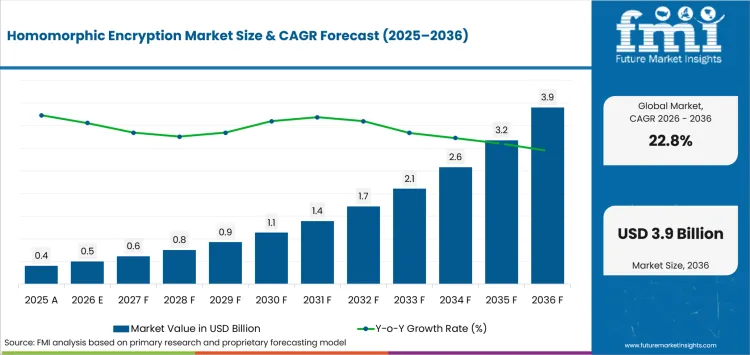
USD 0.5 billion in 2026 and USD 3.9 billion by 2036 at a 22.8% CAGR.
Demand for homomorphic encryption is projected to expand at 22.8% CAGR between 2026 and 2036, increasing valuation from USD 0.5 billion to USD 3.9 billion. Organizations are evaluating privacy-preserving AI and shared analytics where external infrastructure must process sensitive information without receiving plaintext. NIST updated its privacy-enhancing cryptography overview in July 2026 and defines FHE as arbitrary computation over encrypted data without access to the secret key. Commercial conversion depends on software and services that preserve this security boundary within measured latency and accuracy requirements.
Japan has a clearer financial deployment route than Germany as national trials connect cryptography research with operating financial institutions. NICT reported that a five-bank trial improved average fraud-detection recall by about 18 percentage points. The trial used privacy-preserving federated learning with homomorphic encryption instead of transferring raw bank data between participants. The trial used privacy-preserving federated learning with homomorphic encryption instead of transferring raw bank data between participants. Measured performance gives Japanese institutions a firmer basis for continued evaluation, while German activity remains more concentrated in applied research and institutional qualification.
Key Takeaways of Homomorphic Encryption Market
- Demand rises as organizations seek shared analytics that preserve plaintext confidentiality across external compute environments and institutional boundaries.
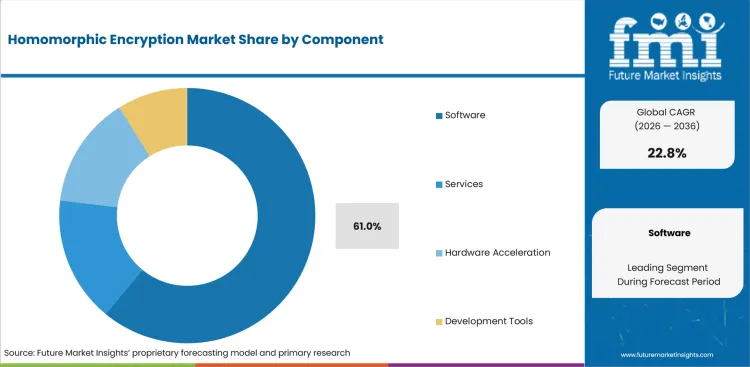
- Software is projected to hold 61.0% share in 2026 because maintained libraries provide the primary integration layer for encrypted workloads.
- Fully homomorphic encryption is estimated at 42.0% in 2026 owing to its support for arbitrary operations across eligible ciphertext workloads.
- Cloud data security is forecast to represent 34.0% in 2026 as outsourced analytics increase requirements for data-in-use protection.
- Ciphertext expansion and intensive arithmetic lengthen qualification cycles until production latency and recurring infrastructure cost meet workload targets.
- IBM Corporation, Microsoft Corporation, Google LLC, Zama, Duality Technologies Inc., Enveil, Inc., Intel Corporation and Cornami, Inc. are some notable players in the market.
Analyst Perspective
"Homomorphic encryption becomes commercially useful when a defined workload preserves confidentiality without missing its required production service level. Technical teams should compare circuit depth and precision loss against key custody, integration effort and recurring compute cost before selecting software or acceleration."
- Sudip Saha, Principal Consultant, Future Market Insights
How is the Homomorphic Encryption Market segmented?
The homomorphic encryption market is segmented by component, encryption type, application, end user, deployment and region.
Market taxonomy covers component, encryption type, application, end user, deployment and region across the ten-year assessment period. Components include software, services, hardware acceleration and development tools alongside fully homomorphic, partially homomorphic and somewhat homomorphic encryption methods. Applications cover cloud data security, financial services, healthcare data protection and government or defense while end users include large enterprises, public agencies and research institutions across cloud, on-premise and edge deployment environments.
Why does software lead demand within the component category?
Software translates homomorphic schemes into libraries and interfaces that application engineers can connect to established data platforms. Microsoft released SEAL 4.4.0 in July 2026 as a major security update for teams handling untrusted encrypted inputs.
- By component, software is estimated to hold 61.0% in 2026 owing to its role in parameter selection and application integration.
- Maintained libraries reduce custom cryptographic coding and give development teams a consistent implementation base for early commercial trials. Production approval still requires tests covering ciphertext growth and numerical accuracy alongside error handling, which sustains demand for specialist integration and validation services.
Why does fully homomorphic encryption lead demand within the encryption-type category?
Fully homomorphic encryption supports arbitrary ciphertext operations and covers a wider workload range than restricted schemes in practice. CNIL explained in March 2025 that partially homomorphic methods permit one operation class while somewhat homomorphic methods allow limited calculation depth.
- In 2026, fully homomorphic encryption is expected to lead the encryption-type category with 42.0% share because broader function support expands eligible regulated applications.
- Bootstrapping refreshes ciphertext for deeper circuits but also raises computation during repeated evaluation across complex workloads. Application teams compare unrestricted operation depth with added latency and parameter complexity before selecting a production scheme.
Why does cloud data security lead demand within the application category?
Cloud data security separates information ownership from external infrastructure that performs sensitive analytics across shared systems. CNIL identified cloud processing in March 2025 as a practical application because homomorphic encryption preserves ciphertext during storage and computation.
- The cloud data security segment is likely to capture 34.0% share in 2026 attributable to concern about plaintext exposure during cloud analytics.
- Financial institutions and health systems can share encrypted inputs without exposing raw records or proprietary queries. Routine use requires accurate results and auditable key ownership across every participant, which increases demand for integration support and controlled validation services.
Why does cloud deployment lead demand within the deployment category?
Cloud deployment supplies elastic private cloud services for benchmark runs across several circuits and parameter sets during early pilots. The UK PET adoption guide asks organizations to match privacy technologies with their operating context and governance duties.
- Cloud deployment is set to lead the deployment category with 58.0% share in 2026 due to external infrastructure executing protected workloads without decryption keys.
- Pilot teams compare processor use and latency across the intended workload before accepting recurring infrastructure costs. Elastic capacity widens testing options but does not guarantee workable economics for every circuit, which preserves on-premise control for sensitive workloads.
What are the drivers, restraints and opportunities in the Homomorphic Encryption Market?
Protected external analytics increase demand, while compute overhead delays production and reusable components lower workload qualification effort.
- Driver: Organizations need useful external analytics without giving cloud infrastructure or partner institutions access to plaintext inputs.
- Restraint: Ciphertext expansion and expensive arithmetic prevent some workloads from meeting approved latency and recurring cost targets.
- Opportunity: Reusable libraries and accelerators lower engineering effort for repeatable operations with defined security and performance requirements.
Data-in-Use Protection Expands Addressable Workloads
Conventional analytics often require plaintext during processing and therefore block collaboration between institutions that cannot exchange raw data. The ICO reported in November 2024 that PET uptake remained low amid uncertainty about maturity and cost-benefit evidence. Data-in-use protection gains commercial relevance where preserved data utility justifies additional engineering and clear governance across participating organizations.
Compute Overhead Restricts Production Conversion
Encrypted arithmetic expands ciphertext size and raises processor demand compared with equivalent plaintext workloads under the same analytical task. CNIL stated in January 2026 that homomorphic encryption adds computing cost and cannot support every AI model. Commercial approval depends on circuits that meet defined latency and infrastructure limits under the intended precision and security settings.
Reusable Components Reduce Engineering Friction
Reusable components reduce implementation work when their documented constraints match the intended encrypted circuit requirements. Fair Math and collaborators including IBM Research – Haifa and Duality Technologies published the FHERMA Cookbook in October 2025 with comparison and matrix operations for privacy-preserving applications. Encryption software providers can package validated functions for repeatable workloads and reserve specialist engineering for application-specific integration or performance tuning.
Which country CAGRs are profiled in the Homomorphic Encryption Market?
| Country | CAGR |
|---|---|
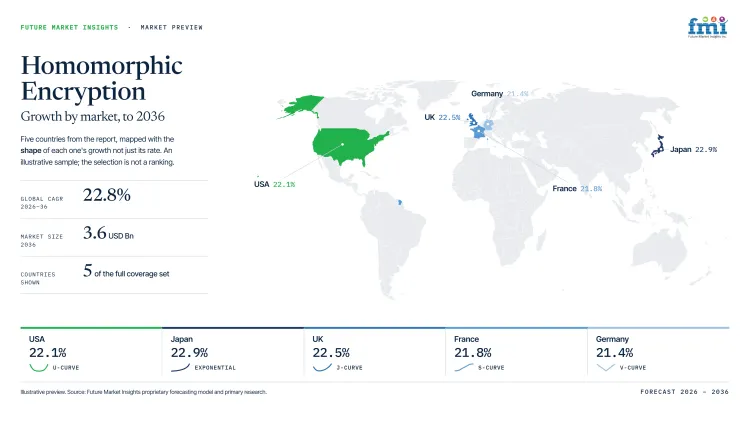
| Japan | 22.9% |
| United Kingdom | 22.5% |
| United States | 22.1% |
| France | 21.8% |
| Germany | 21.4% |
How do country-level CAGRs compare in the Homomorphic Encryption Market?
The profiled forecasts span 1.5 percentage points between Japan and Germany across the assessment period. The range measures forecast pace rather than current revenue or installed system scale across the profiled countries.
- Japan's pace reflects bank and medical programs that connect cryptography research with named institutions and operational use cases.
- The United Kingdom benefits from trusted research environment programs and guidance that give public institutions a defined evaluation route.
- The United States relies on public technical forums and a broad software base that support implementation review across enterprise and government workloads.
- France uses regulator-led experiments to define practical performance limits for encrypted cloud analytics and artificial intelligence applications.
- Germany develops implementation knowledge through applied medical research under demanding legal review and institutional integration requirements.
Comparable CAGRs do not imply identical market size or purchase timing across the five profiled countries. Each national route converts technical activity into contracts through different governance, validation and service requirements. The full report also assesses additional national markets across the standard geographic regions used by FMI.
Country-wise Analysis
- Japanese banks and hospitals are testing joint analytics that protect transaction and medical records while each institution retains control of its source data, operating policies and model-governance responsibilities across domestic research and operating programs. Adoption of homomorphic encryption in Japan is estimated to expand at 22.9% CAGR through 2036, supported by regulated financial and medical programs with named partners and national technical coordination across participating institutions nationwide. NICT reported in July 2025 that six organizations began a radiology AI program using advanced cryptography, yet hospitals require clinical validation and maintainable integration before recurring software subscriptions and support contracts become practical.
- United Kingdom research institutions are building trusted environments that permit cross-organization studies while each participant retains separate governance duties, access controls and audit responsibility for sensitive public data across health and government research programs. Homomorphic encryption demand in the United Kingdom is forecast to rise at 22.5% CAGR over the forecast period, aided by national guidance and prototype routes across health and government research infrastructure nationwide. UKRI included homomorphic encryption in its April 2025 call for new trusted research environment capabilities, although applicants must prove scalable isolation and predictable cloud performance before institutions commit recurring software and integration budgets nationwide.
- United States security teams use public cryptographic forums to compare specifications and implementation evidence for regulated analytics across shared infrastructure, enterprise cloud environments and government data programs with formal service and audit requirements. The United States homomorphic encryption sector is projected to record 22.1% CAGR during the assessment period, reinforced by extensive software engineering capacity and public review of implementation approaches across enterprise and government sectors. NIST reported in July 2026 that its January workshop included three threshold-FHE presentations and two submission previews, while long benchmark cycles and specialist key management continue to delay production commitments and recurring support contracts.
- CNIL gives French technology teams a regulator-led route for testing homomorphic schemes across cloud analytics, artificial intelligence systems and sensitive public or commercial data environments that require documented privacy and security controls during deployment. Homomorphic encryption sales in France are forecast to expand at 21.8% CAGR by 2036, supported by domestic cryptography expertise and formal data-protection review across financial and public-sector institutions with documented deployment controls. CNIL reported in March 2025 that FHE models ran 1,000 to 100,000 times slower than plaintext models, making workload selection and performance evidence central to subscriptions and integration decisions across regulated deployments.
- German hospitals and technology institutes test encrypted analytics through applied projects that combine security engineering with controlled medical data, specialist clinical partners and formal institutional review that requires documented privacy and operational controls throughout. Germany is estimated to post 21.4% CAGR over the forecast period, shaped by domestic research capacity and demanding data-protection requirements across healthcare and industrial applications with formal institutional controls and specialist integration. Fraunhofer AISEC reported that ANONY-MED covered three healthcare use cases through December 2025, while legal review and specialist integration continue to slow recurring software support and production expansion across domestic institutions and technology partners.
Who are the notable companies in the Homomorphic Encryption Market?
IBM Corporation, Microsoft Corporation, Google LLC, Zama, Duality Technologies Inc., Enveil, Inc., Intel Corporation and Cornami, Inc. are notable companies serving this market.
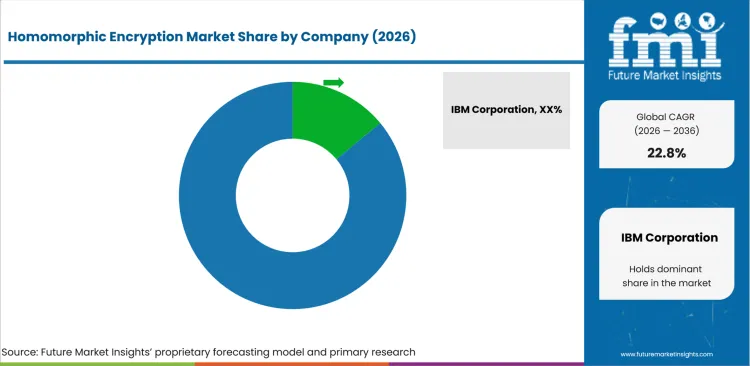
The competitive field remains fragmented across open-source toolchains, enterprise privacy platforms and processor specialists. Organizations compare vendors on workload coverage and integration depth because a production system must protect the complete path from encryption to result recovery. Entry therefore depends on verifiable cryptographic engineering and application support rather than broad company scale.
- IBM Corporation and Microsoft Corporation maintain widely used libraries, while Google LLC develops compiler tooling that helps engineers compare schemes and supported backends.
- Zama and Duality Technologies Inc. package encrypted computation for developers and multi-organization analytics across distributed environments. Enveil, Inc. focuses on protected search and data collaboration across controlled enterprise workflows in regulated sectors.
- Intel Corporation advances standards and processor support for accelerated execution across general computing platforms and data centers. Cornami, Inc. develops purpose-built architecture for encrypted AI and other FHE workloads with demanding throughput targets.
Competitive Benchmarking: Homomorphic Encryption Market
| Company | Cryptographic Software Depth | Enterprise Workflow Coverage | Acceleration Readiness | Geographic Reach |
|---|---|---|---|---|
| IBM Corporation | High | High | Medium | Global |
| Microsoft Corporation | High | Medium | Medium | Global |
| Google LLC | Medium | Medium | Medium | Global |
| Zama | High | High | High | Global developer ecosystem |
| Duality Technologies Inc. | High | High | Medium | North America and Europe |
| Enveil, Inc. | High | High | Medium | North America and Europe |
| Intel Corporation | Medium | Medium | High | Global |
| Cornami, Inc. | Medium | Medium | High | United States and partner markets |
Key Developments in the Homomorphic Encryption Market
- In June 2026, Duality Technologies released version 4.6 with data harmonization and custom federated workloads for distributed sensitive datasets. The release reduces schema-alignment work across organizations that maintain separate controls and broadens supported analytics.
- In January 2026, Zama completed a sealed-bid token auction on its mainnet using fully homomorphic encryption. The auction received 24,697 bids with USD 118.5 million committed and placed FHE inside a live blockchain workflow.
- In July 2025, Enveil released ZeroReveal Search 6.0 with cloud hardware configuration and server integrations for protected queries across separate organizations. The release expands deployment choices for encrypted search at regulated enterprises, but recurring revenue depends on data volume and integration effort inside existing analytical and compliance workflows plus ongoing support requirements across participating systems.
Key Players in the Homomorphic Encryption Market
Developer Libraries and Toolchains
- IBM Corporation
- Microsoft Corporation
- Google LLC
- Zama
Enterprise Privacy Platforms
- Duality Technologies Inc.
- Enveil, Inc.
Encrypted-Compute Acceleration
- Intel Corporation
- Cornami, Inc.
Homomorphic Encryption Market - Report Scope
| Coverage field | Report scope |
|---|---|
| Market breakdown | By component, encryption type, application, end user, deployment and region. |
| Quantitative Units | Revenue USD billion and CAGR in %. |
| Market Definition | Software, services, development tools and hardware acceleration used to compute or analyze encrypted data without exposing plaintext during processing. |
| Regions Covered | North America, Latin America, Europe, East Asia, South Asia and Pacific, and Middle East and Africa. |
| Countries Covered | Japan, United Kingdom, United States, France, Germany, and 20+ countries included in the full report. |
| Key Companies Profiled | IBM Corporation, Microsoft Corporation, Google LLC, Zama, Duality Technologies Inc., Enveil, Inc., Intel Corporation, Cornami, Inc. |
| Forecast Period | 2026 to 2036. |
| Approach | Primary and secondary research with market triangulation. |
Homomorphic Encryption Market - Research Methodology
| Method | Approach |
|---|---|
| Primary Research | FMI analysts gathered input from manufacturers, service providers, technology developers, distributors, end users, procurement teams, and subject-matter experts. Interviews examined purchasing decisions, product or service evaluation, adoption barriers, approval requirements, pricing considerations, and expectations for technical or commercial support. Respondents were also asked what evidence is required before a trial, pilot, or initial order develops into regular purchasing. |
| Desk Research | Desk research covered government statistics, regulatory publications, trade data, industry associations, technical literature, standards, company filings, product information, and official corporate announcements. Sources were reviewed for relevance, publication date, geographic coverage, and consistency with the defined market scope. Claims relating to performance, applications, approvals, capacity, investment, and commercial activity were retained only when supported by credible public evidence. |
| Market Sizing and Forecasting | The market model combined the baseline value with historical performance, segment structure, pricing and volume indicators, adoption levels, company participation, and country-level demand conditions. Forecast assumptions considered economic activity, investment trends, regulatory developments, technology adoption, purchasing cycles, supply availability, and barriers to wider market use. Segment and regional estimates were reconciled before the final market total was calculated. |
| Data Validation | Estimates were checked against multiple independent indicators, including public data, company activity, trade patterns, industry developments, and findings from primary interviews. Validation also tested whether products, services, applications, and company revenues fell within the defined market boundaries. Adjacent categories, unsupported claims, overlapping revenues, and activities without direct market relevance were excluded to reduce double counting and maintain consistency across segments and countries. |
Homomorphic Encryption Market by Segments
Homomorphic Encryption Market segmented by Component:
- Software
- Homomorphic Encryption Libraries
- Data Protection Platforms
- Privacy-preserving Analytics Software
- Services
- Consulting Services
- Implementation & Integration Services
- Managed Security Services
- Hardware Acceleration
- Cryptographic Accelerators
- Hardware Security Modules
- Trusted Execution Infrastructure
- Development Tools
- SDKs
- Application Programming Interfaces
- Testing & Validation Tools
Homomorphic Encryption Market segmented by Encryption Type:
- Fully Homomorphic Encryption
- Bootstrapped Fully Homomorphic Encryption
- Non-bootstrapped Fully Homomorphic Encryption
- Open-source Fully Homomorphic Encryption
- Partially Homomorphic Encryption
- Additive Homomorphic Encryption
- Multiplicative Homomorphic Encryption
- Application-specific Encryption
- Somewhat Homomorphic Encryption
- Limited-depth Computation
- Low-latency Encryption
- Research-grade Implementations
Homomorphic Encryption Market segmented by Application:
- Cloud Data Security
- Encrypted Cloud Computing
- Secure Cloud Storage
- Privacy-preserving Cloud Analytics
- Financial Services
- Secure Financial Transactions
- Fraud Detection
- Confidential Banking Analytics
- Healthcare Data Protection
- Privacy-preserving Medical Research
- Encrypted Electronic Health Records
- Secure Clinical Data Sharing
- Government & Defense
- Secure Intelligence Processing
- Classified Data Analytics
- Critical Infrastructure Security
Homomorphic Encryption Market segmented by End User:
- Large Enterprises
- BFSI Organizations
- Healthcare Enterprises
- Technology Companies
- Government & Defense Agencies
- Public Sector Organizations
- Defense Organizations
- Intelligence Agencies
- Research & Academic Institutions
- Universities
- Cryptography Research Centers
- National Laboratories
Homomorphic Encryption Market segmented by Deployment:
- Cloud
- Public Cloud
- Private Cloud
- Hybrid Cloud
- On-Premise
- Enterprise Data Centers
- Secure Internal Networks
- Government Facilities
- Edge Deployment
- Industrial Edge Systems
- Internet of Things Environments
- Confidential Local Analytics
Homomorphic Encryption Market by Region:
- North America
- United States
- Canada
- Latin America
- Brazil
- Mexico
- Chile
- Rest of Latin America
- Western Europe
- Germany
- United Kingdom
- Italy
- Spain
- France
- Nordics
- Benelux
- Rest of Western Europe
- Eastern Europe
- Russia
- Poland
- Hungary
- Balkan and Baltic States
- Rest of Eastern Europe
- East Asia
- China
- Japan
- South Korea
- South Asia and Pacific
- India
- ASEAN
- Australia and New Zealand
- Rest of South Asia and Pacific
- Middle East and Africa
- Kingdom of Saudi Arabia
- Other GCC Countries
- Türkiye
- South Africa
- Other African Union Countries
- Rest of Middle East and Africa
Research Sources and Bibliography
- National Institute of Standards and Technology. (2026, July 1). Privacy-Enhancing Cryptography.
- National Institute of Information and Communications Technology. (2025, July 22).
- Microsoft. (2026, July 25). Microsoft SEAL v4.4.0.
- CNIL LINC. (2025, March 25). [2/3] Advanced privacy-preserving cryptographic techniques.
- CNIL LINC. (2025, March 25). [3/3] Practical applications of advanced cryptography.
- Government Digital Service. (2025, January 30). Privacy Enhancing Technologies Adoption Guide.
- Information Commissioner’s Office. (2024, November 15). Using Privacy Enhancing Technologies (PETs) to unlock value from data responsibly.
- CNIL. (2026, January 5). Ensuring the security of an AI system’s development.
- IBM Research. (2025, October 13). FHERMA Cookbook: FHE Components for Privacy-Preserving Applications.
- National Institute of Information and Communications Technology. (2025, July 1).
- UK Research and Innovation. (2025, April 4). DARE UK next-generation trusted research environment capabilities.
- National Institute of Standards and Technology. (2026, July 1). Fully-Homomorphic Encryption (FHE).
- CNIL LINC. (2025, March 25). On a testé le chiffrement homomorphe !
- Fraunhofer AISEC. (2025, December). ANONY-MED.
- Duality Technologies Inc. (2026, June 15). Duality Technologies Launches Version 4.6, Making Multi-Organization Analytics and AI Easier to Deploy.
- Zama. (2026, January 26). $118M Committed for the First Encrypted ICO on Ethereum.
- Enveil, Inc. (2025, July 15). Next Gen Encrypted Search Capability Delivers Cross-Silo Collaboration.
- Ali, A., Choi, J., Gipson, B., Gorantala, S., Kun, J., Legiest, W., Lim, L., Viand, A., Demissie, M. Z., & Zheng, H. (2025, August 14). HEIR: A Universal Compiler for Homomorphic Encryption.
- Intel Corporation. (2024, February 5). Intel Continues to Lead Efforts to Establish FHE Standards for Encrypted Computing.
- Cornami, Inc. (2025, September 16). Cornami and DESILO Bring Encrypted AI to Scale with Deployable FHE-Based LLM.
This bibliography is provided for reader reference and is not exhaustive. The full report contains the complete reference list and detailed citations.
This Report Answers
- How do homomorphic encryption values change between the 2026 baseline and the 2036 forecast?
- Which operating conditions increase demand for computation over encrypted data across external infrastructure?
- Why does software account for 61.0% of component demand during the 2026 baseline year?
- How do unrestricted and limited-depth schemes differ during technical and commercial workload evaluation?
- Why does cloud data security represent 34.0% of application demand during the 2026 baseline year?
- How do national governance and validation routes alter forecast pace across the profiled countries?
- Which companies provide developer libraries, enterprise privacy platforms and encrypted-compute acceleration?
- Which performance and integration constraints prevent technically valid workloads from entering routine production?
Frequently Asked Questions
How big is the homomorphic encryption market in 2026?
The homomorphic encryption market is estimated at USD 0.5 billion in 2026 and is projected to reach USD 3.9 billion by 2036. Growth is driven by increasing demand for secure data processing across cloud computing, analytics, and AI applications.
What is the CAGR of the homomorphic encryption market from 2026 to 2036?
The homomorphic encryption market is forecast to grow at a CAGR of 22.8% between 2026 and 2036. Adoption is expected to rise as organizations seek privacy-preserving methods for processing sensitive data without decryption.
Which component leads the homomorphic encryption market?
Software is projected to hold a 61.0% share of the market in 2026. Its dominance is supported by growing demand for encryption libraries, development tools, and platforms that enable secure computation.
Which deployment segment leads the homomorphic encryption market?
Cloud deployment is estimated to account for 58.0% of the market in 2026. Organizations increasingly rely on cloud infrastructure to perform encrypted data processing while maintaining data privacy and security.
Which companies are active in the homomorphic encryption market?
Key companies operating in the market include IBM Corporation, Microsoft Corporation, Google LLC, Zama, Duality Technologies Inc., Enveil, Inc., Intel Corporation, and Cornami, Inc. These companies provide software, privacy-enhancing technologies, and hardware solutions for encrypted computing.
Preview the report firsthand - request a free sample
Get SampleGet the brochure for pricing and purchase details.
Get PDFTable of Content
- Key Takeaways
- Market Size and CAGR
- Top Growth Driver
- Fastest Growing Segment
- Leading Region
- Key Companies
- Emerging Opportunities
- Executive Summary
- Global Market Outlook
- Demand-side Trends
- Supply-side Trends
- Technology Roadmap Analysis
- Analysis and Recommendations
- Analyst Perspective (What is happening? Why now? What should investors know?)
- Key Questions Answered
- How large is the market?
- What is the CAGR?
- What are key trends?
- Which region dominates?
- Who are the leaders?
- Market Overview
- Market Coverage / Taxonomy
- Market Definition / Scope / Limitations
- Research Methodology
- Chapter Orientation
- Analytical Lens and Working Hypotheses
- Market Structure, Signals, and Trend Drivers
- Benchmarking and Cross-market Comparability
- Market Sizing, Forecasting, and Opportunity Mapping
- Research Design and Evidence Framework
- Desk Research Programme (Secondary Evidence)
- Expert Input and Fieldwork (Primary Evidence)
- Tooling, Models, and Reference Databases
- Data Engineering and Model Build
- Quality Assurance and Audit Trail
- Market Background
- Market Dynamics (Drivers, Restraints, Opportunity, Trends)
- Scenario Forecast (Optimistic, Likely, Conservative)
- Impact Analysis
- AI Impact
- Sustainability Impact
- Regulatory Impact
- Technology Impact
- Consumer / Buyer Analysis
- Purchase Drivers
- Adoption Barriers
- Buyer Journey
- Opportunity Map Analysis
- Product Life Cycle Analysis
- Supply Chain Analysis
- Investment Feasibility Matrix
- Value Chain Analysis
- PESTLE and Porter's Analysis
- Regulatory Landscape
- Regional Parent Market Outlook
- Production and Consumption Statistics
- Import and Export Statistics
- Global Market Analysis and Forecast, 2021 to 2036
- Historical Market Size Value (USD Billion) Analysis, 2021 to 2025
- Current and Future Market Size Value (USD Billion) Projections, 2026 to 2036
- Y-o-Y Growth Trend Analysis
- Absolute $ Opportunity Analysis
- Global Market Pricing Analysis, 2021 to 2036
- Global Market Analysis and Forecast, By Component, 2021 to 2036
- Introduction / Key Findings
- Historical Market Size Value (USD Billion) Analysis By Component, 2021 to 2025
- Current and Future Market Size Value (USD Billion) Analysis and Forecast By Component, 2026 to 2036
- Software
- Homomorphic Encryption Libraries
- Data Protection Platforms
- Privacy-preserving Analytics Software
- Services
- Consulting Services
- Implementation & Integration Services
- Managed Security Services
- Hardware Acceleration
- Cryptographic Accelerators
- Hardware Security Modules
- Trusted Execution Infrastructure
- Development Tools
- SDKs
- Application Programming Interfaces
- Testing & Validation Tools
- Software
- Y-o-Y Growth Trend Analysis By Component, 2021 to 2025
- Absolute $ Opportunity Analysis By Component, 2026 to 2036
- Global Market Analysis and Forecast, By Encryption Type, 2021 to 2036
- Introduction / Key Findings
- Historical Market Size Value (USD Billion) Analysis By Encryption Type, 2021 to 2025
- Current and Future Market Size Value (USD Billion) Analysis and Forecast By Encryption Type, 2026 to 2036
- Fully Homomorphic Encryption
- Bootstrapped Fully Homomorphic Encryption
- Non-bootstrapped Fully Homomorphic Encryption
- Open-source Fully Homomorphic Encryption
- Partially Homomorphic Encryption
- Additive Homomorphic Encryption
- Multiplicative Homomorphic Encryption
- Application-specific Encryption
- Somewhat Homomorphic Encryption
- Limited-depth Computation
- Low-latency Encryption
- Research-grade Implementations
- Fully Homomorphic Encryption
- Y-o-Y Growth Trend Analysis By Encryption Type, 2021 to 2025
- Absolute $ Opportunity Analysis By Encryption Type, 2026 to 2036
- Global Market Analysis and Forecast, By Application, 2021 to 2036
- Introduction / Key Findings
- Historical Market Size Value (USD Billion) Analysis By Application, 2021 to 2025
- Current and Future Market Size Value (USD Billion) Analysis and Forecast By Application, 2026 to 2036
- Cloud Data Security
- Encrypted Cloud Computing
- Secure Cloud Storage
- Privacy-preserving Cloud Analytics
- Financial Services
- Secure Financial Transactions
- Fraud Detection
- Confidential Banking Analytics
- Healthcare Data Protection
- Privacy-preserving Medical Research
- Encrypted Electronic Health Records
- Secure Clinical Data Sharing
- Government & Defense
- Secure Intelligence Processing
- Classified Data Analytics
- Critical Infrastructure Security
- Cloud Data Security
- Y-o-Y Growth Trend Analysis By Application, 2021 to 2025
- Absolute $ Opportunity Analysis By Application, 2026 to 2036
- Global Market Analysis and Forecast, By End User, 2021 to 2036
- Introduction / Key Findings
- Historical Market Size Value (USD Billion) Analysis By End User, 2021 to 2025
- Current and Future Market Size Value (USD Billion) Analysis and Forecast By End User, 2026 to 2036
- Large Enterprises
- BFSI Organizations
- Healthcare Enterprises
- Technology Companies
- Government & Defense Agencies
- Public Sector Organizations
- Defense Organizations
- Intelligence Agencies
- Research & Academic Institutions
- Universities
- Cryptography Research Centers
- National Laboratories
- Large Enterprises
- Y-o-Y Growth Trend Analysis By End User, 2021 to 2025
- Absolute $ Opportunity Analysis By End User, 2026 to 2036
- Global Market Analysis and Forecast, By Deployment, 2021 to 2036
- Introduction / Key Findings
- Historical Market Size Value (USD Billion) Analysis By Deployment, 2021 to 2025
- Current and Future Market Size Value (USD Billion) Analysis and Forecast By Deployment, 2026 to 2036
- Cloud
- Public Cloud
- Private Cloud
- Hybrid Cloud
- On-premise
- Enterprise Data Centers
- Private Computing Infrastructure
- Secure Internal Networks
- Edge Deployment
- Industrial Edge Computing
- Internet of Things Security
- Confidential Edge Analytics
- Cloud
- Y-o-Y Growth Trend Analysis By Deployment, 2021 to 2025
- Absolute $ Opportunity Analysis By Deployment, 2026 to 2036
- Global Market Analysis and Forecast, By Region, 2021 to 2036
- Introduction
- Historical Market Size Value (USD Billion) Analysis By Region, 2021 to 2025
- Current Market Size Value (USD Billion) Analysis and Forecast By Region, 2026 to 2036
- North America
- Latin America
- Western Europe
- Eastern Europe
- East Asia
- South Asia and Pacific
- Middle East & Africa
- Market Attractiveness Analysis By Region
- North America Market Analysis and Forecast, By Country, 2021 to 2036
- Historical Market Size Value (USD Billion) Trend Analysis By Market Taxonomy, 2021 to 2025
- Market Size Value (USD Billion) Forecast By Market Taxonomy, 2026 to 2036
- By Country
- USA
- Canada
- By Component
- By Encryption Type
- By Application
- By End User
- By Deployment
- By Country
- Market Attractiveness Analysis
- By Country
- By Component
- By Encryption Type
- By Application
- By End User
- By Deployment
- Key Takeaways
- Latin America Market Analysis and Forecast, By Country
- Historical Market Size Value (USD Billion) Trend Analysis By Market Taxonomy, 2021 to 2025
- Market Size Value (USD Billion) Forecast By Market Taxonomy, 2026 to 2036
- By Country
- Brazil
- Mexico
- Chile
- Rest of Latin America
- By Component
- By Encryption Type
- By Application
- By End User
- By Deployment
- By Country
- Market Attractiveness Analysis
- By Country
- By Component
- By Encryption Type
- By Application
- By End User
- By Deployment
- Key Takeaways
- Western Europe Market Analysis and Forecast, By Country
- Historical Market Size Value (USD Billion) Trend Analysis By Market Taxonomy, 2021 to 2025
- Market Size Value (USD Billion) Forecast By Market Taxonomy, 2026 to 2036
- By Country
- Germany
- UK
- Italy
- Spain
- France
- Nordic
- BENELUX
- Rest of Western Europe
- By Component
- By Encryption Type
- By Application
- By End User
- By Deployment
- By Country
- Market Attractiveness Analysis
- By Country
- By Component
- By Encryption Type
- By Application
- By End User
- By Deployment
- Key Takeaways
- Eastern Europe Market Analysis and Forecast, By Country
- Historical Market Size Value (USD Billion) Trend Analysis By Market Taxonomy, 2021 to 2025
- Market Size Value (USD Billion) Forecast By Market Taxonomy, 2026 to 2036
- By Country
- Russia
- Poland
- Hungary
- Balkan & Baltic
- Rest of Eastern Europe
- By Component
- By Encryption Type
- By Application
- By End User
- By Deployment
- By Country
- Market Attractiveness Analysis
- By Country
- By Component
- By Encryption Type
- By Application
- By End User
- By Deployment
- Key Takeaways
- East Asia Market Analysis and Forecast, By Country
- Historical Market Size Value (USD Billion) Trend Analysis By Market Taxonomy, 2021 to 2025
- Market Size Value (USD Billion) Forecast By Market Taxonomy, 2026 to 2036
- By Country
- China
- Japan
- South Korea
- By Component
- By Encryption Type
- By Application
- By End User
- By Deployment
- By Country
- Market Attractiveness Analysis
- By Country
- By Component
- By Encryption Type
- By Application
- By End User
- By Deployment
- Key Takeaways
- South Asia and Pacific Market Analysis and Forecast, By Country
- Historical Market Size Value (USD Billion) Trend Analysis By Market Taxonomy, 2021 to 2025
- Market Size Value (USD Billion) Forecast By Market Taxonomy, 2026 to 2036
- By Country
- India
- ASEAN
- Australia & New Zealand
- Rest of South Asia and Pacific
- By Component
- By Encryption Type
- By Application
- By End User
- By Deployment
- By Country
- Market Attractiveness Analysis
- By Country
- By Component
- By Encryption Type
- By Application
- By End User
- By Deployment
- Key Takeaways
- Middle East & Africa Market Analysis and Forecast, By Country
- Historical Market Size Value (USD Billion) Trend Analysis By Market Taxonomy, 2021 to 2025
- Market Size Value (USD Billion) Forecast By Market Taxonomy, 2026 to 2036
- By Country
- Kingdom of Saudi Arabia
- Other GCC Countries
- Türkiye
- South Africa
- Other African Union
- Rest of Middle East & Africa
- By Component
- By Encryption Type
- By Application
- By End User
- By Deployment
- By Country
- Market Attractiveness Analysis
- By Country
- By Component
- By Encryption Type
- By Application
- By End User
- By Deployment
- Key Takeaways
- Key Countries Market Analysis
- USA
- Pricing Analysis
- Market Share Analysis, 2025
- By Component
- By Encryption Type
- By Application
- By End User
- By Deployment
- Canada
- Pricing Analysis
- Market Share Analysis, 2025
- By Component
- By Encryption Type
- By Application
- By End User
- By Deployment
- Mexico
- Pricing Analysis
- Market Share Analysis, 2025
- By Component
- By Encryption Type
- By Application
- By End User
- By Deployment
- Brazil
- Pricing Analysis
- Market Share Analysis, 2025
- By Component
- By Encryption Type
- By Application
- By End User
- By Deployment
- Chile
- Pricing Analysis
- Market Share Analysis, 2025
- By Component
- By Encryption Type
- By Application
- By End User
- By Deployment
- Germany
- Pricing Analysis
- Market Share Analysis, 2025
- By Component
- By Encryption Type
- By Application
- By End User
- By Deployment
- UK
- Pricing Analysis
- Market Share Analysis, 2025
- By Component
- By Encryption Type
- By Application
- By End User
- By Deployment
- Italy
- Pricing Analysis
- Market Share Analysis, 2025
- By Component
- By Encryption Type
- By Application
- By End User
- By Deployment
- Spain
- Pricing Analysis
- Market Share Analysis, 2025
- By Component
- By Encryption Type
- By Application
- By End User
- By Deployment
- France
- Pricing Analysis
- Market Share Analysis, 2025
- By Component
- By Encryption Type
- By Application
- By End User
- By Deployment
- India
- Pricing Analysis
- Market Share Analysis, 2025
- By Component
- By Encryption Type
- By Application
- By End User
- By Deployment
- ASEAN
- Pricing Analysis
- Market Share Analysis, 2025
- By Component
- By Encryption Type
- By Application
- By End User
- By Deployment
- Australia & New Zealand
- Pricing Analysis
- Market Share Analysis, 2025
- By Component
- By Encryption Type
- By Application
- By End User
- By Deployment
- China
- Pricing Analysis
- Market Share Analysis, 2025
- By Component
- By Encryption Type
- By Application
- By End User
- By Deployment
- Japan
- Pricing Analysis
- Market Share Analysis, 2025
- By Component
- By Encryption Type
- By Application
- By End User
- By Deployment
- South Korea
- Pricing Analysis
- Market Share Analysis, 2025
- By Component
- By Encryption Type
- By Application
- By End User
- By Deployment
- Russia
- Pricing Analysis
- Market Share Analysis, 2025
- By Component
- By Encryption Type
- By Application
- By End User
- By Deployment
- Poland
- Pricing Analysis
- Market Share Analysis, 2025
- By Component
- By Encryption Type
- By Application
- By End User
- By Deployment
- Hungary
- Pricing Analysis
- Market Share Analysis, 2025
- By Component
- By Encryption Type
- By Application
- By End User
- By Deployment
- Kingdom of Saudi Arabia
- Pricing Analysis
- Market Share Analysis, 2025
- By Component
- By Encryption Type
- By Application
- By End User
- By Deployment
- Türkiye
- Pricing Analysis
- Market Share Analysis, 2025
- By Component
- By Encryption Type
- By Application
- By End User
- By Deployment
- South Africa
- Pricing Analysis
- Market Share Analysis, 2025
- By Component
- By Encryption Type
- By Application
- By End User
- By Deployment
- USA
- Market Structure Analysis
- Competition Dashboard
- Competition Benchmarking
- Market Share Analysis of Top Players
- By Regional
- By Component
- By Encryption Type
- By Application
- By End User
- By Deployment
- Emerging Startups
- Innovation Benchmarking
- Competition Analysis
- Competition Deep Dive
- IBM Corporation
- Overview
- Product Portfolio
- Profitability by Market Segments
- Sales Footprint
- Strategy Overview
- Marketing Strategy
- Product Strategy
- Channel Strategy
- Microsoft Corporation
- Duality Technologies Inc.
- Zama
- CryptoExperts
- Google LLC
- Intel Corporation
- Cornami, Inc.
- ShieldIO
- Enveil, Inc.
- IBM Corporation
- Case Studies
- Success Stories
- Recent Developments
- Competition Deep Dive
- Assumptions & Acronyms Used


