

- Market Size (2026)
- USD 919.0 Mn
- Forecast (2036)
- USD 6993.0 Mn
- CAGR (2026 to 2036)
- 22.5%
How big is Hospital Logistics & Delivery Robots Market in 2026?
The is valued at USD 919.0 million in 2026 and is projected to reach USD 6,993.0 million by 2036 at a 22.5% CAGR.
Sales in hospital logistics and delivery robots market is projected to expand at a 22.5% CAGR, pushing valuation from USD 919.0 million in 2026 to USD 6,993.0 million by 2036 as hospitals shift repeatable transport work away from clinical staff. The American Hospital Association reported in March 2026 that hospital labor costs reached USD 890 billion in 2024 and represented 56% of total expenses. This cost base makes medication runs and supply transfers practical automation targets for departments with fixed daily routes. The medical robotics outlook shows how non-surgical robots are becoming part of daily hospital support. Adoption should favor fleets that document each handoff while operating through existing corridors and access controls.
Adoption differs by country because hospital layouts and labor economics shape the return from each route. Large United States health systems can spread fleet software and integration costs across several campuses. Japanese hospitals have used controlled indoor transport for longer periods and place greater weight on compact equipment that fits established facilities. The American Hospital Association reported in April 2025 that United States hospitals spent USD 51.1 billion on contract staff during 2023. That expense strengthens the case for automating low-value walking while protecting clinical coverage during busy shifts. Workforce management tools help administrators compare robot schedules with staffing needs across each department. Procurement decisions should therefore examine route volume and integration effort before comparing unit prices.
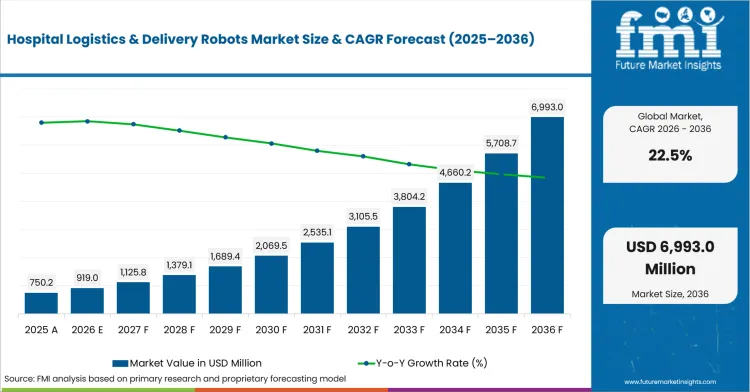
Key Takeaways of Hospital Logistics & Delivery Robots Market
- Labor pressure gives hospital logistics robots a measurable operating purpose, linking routine transport with staff capacity as clinical teams lose productive time when nurses handle medication and specimen routes during scheduled rounds.
- By robot type, autonomous tugs and carts are expected to lead with 44.0% share in 2026, suited to heavy cart trains and established service corridors connecting loading areas with nursing units across several floors.
- Medication delivery is the dominant application segment, projected to hold 30.0% share in 2026, reflecting the need for secure, trackable routes between pharmacy and patient-care areas.
- By component, hardware is expected to lead with 56.0% share in 2026, as sensors and batteries determine safe movement inside crowded facilities throughout long service hours.
- Fleet software gains commercial weight once several robots share elevators and route priorities during the same shift, while locked compartments and electronic delivery records reduce handoff uncertainty.
- The United States, China, South Korea, Japan, and Germany show distinct adoption patterns, shaped by multicampus fleet standardization, newly built hospital integration, mature digital systems, and constrained renovation windows in established buildings.
- Competition centers on ST Engineering Aethon, Diligent Robotics, Swisslog Healthcare, Relay Robotics, and Panasonic, with vendors differentiating through heavy transport combined with secure pharmacy delivery, mobile manipulation without fixed loading stations, and integrated automation contracts spanning transport and material handling.
Analyst Perspective
"The hospital logistics robots market is succeeding where automation is introduced around well-defined operational workflows rather than around technology demonstrations. Sustainable returns depend on selecting transport tasks with predictable demand, integrating robots into existing hospital infrastructure, and maintaining reliable performance across everyday clinical operations. As healthcare facilities expand autonomous material movement, providers that support workflow planning, infrastructure readiness, and long-term operational continuity will be better placed to secure repeat deployments across multi-building hospital campuses."
- Anurag Sharma, Principal Analyst at Future Market Insights
Source: FMI's proprietary forecasting model and primary research
How is the Hospital Logistics and Delivery Robots Market segmented?
The industry is assessed by robot design, hospital task, component spending, facility type, payment model, and region.
The report compares six dimensions that explain how hospitals select and pay for robot fleets. Robot Type separates autonomous tugs from compact couriers and mobile manipulation platforms through payload and handling needs. Application analysis covers medication delivery and lab specimen transport while examining linen handling and supply movement. Component analysis divides hardware spending from fleet software and service revenue across the contract period. End User distinguishes large hospitals from mid-size facilities and outpatient settings that have different support resources. Business Model compares direct purchase with leasing and subscription contracts under separate budget structures. Regional analysis reviews local infrastructure and digital readiness. This structure connects route needs with pharmacy automation trends throughout the forecast.
How do autonomous tugs and carts shape robot selection?
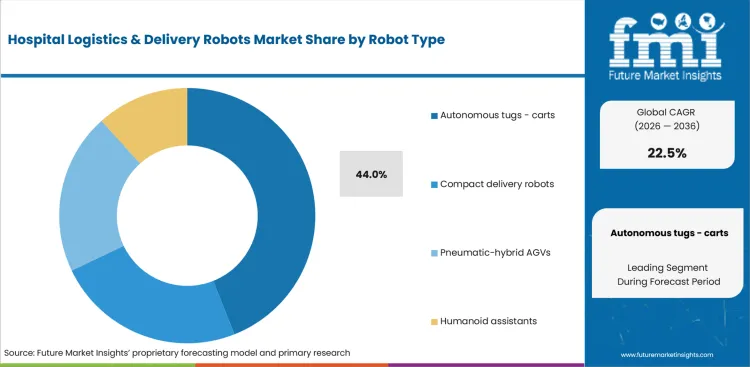
Hospitals use autonomous tugs for routes that move heavy carts between central stores and clinical floors. ST Engineering Aethon reported in April 2024 that ZenaRx provides more than 10,000 cubic inches of payload space and runs for up to ten hours. The product targets secure medication and specimen movement within a protected mobile platform. Its design shows that payload protection can be added to established navigation systems without rebuilding hospital corridors.
- By robot type, autonomous tugs and carts are projected to account for 44.0% of 2026 revenue because they can tow standard hospital carts across long internal routes. Their share reflects compatibility with existing material flows and the ability to move heavier loads without adding manual handling at every transfer point.
- Facilities with central kitchens and supply rooms are expected to favor tug platforms on scheduled rounds. A single vehicle can serve several cart types through a repeatable route plan. This operating model gives hospital engineering teams one navigation system to maintain while departments retain the carts already used for daily work.
What supports medication delivery within the application category?
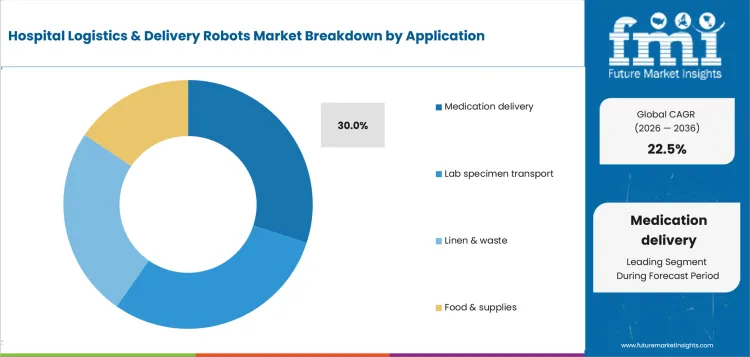
Medication routes create a clear use case because each trip has a known origin and a controlled destination. Diligent Robotics reported in July 2025 that Moxi robots had completed more than 300,000 pharmacy deliveries. Higher-volume sites recorded more than 900 pharmacy trips per month through recurring hospital workflows. These figures show that pharmacy work can produce steady robot utilization after clinical teams standardize pickup points and access rules. The pattern complements lab automation demand where repeatable handoffs carry similar value.
- In 2026, medication delivery is estimated to represent 30.0% of application revenue due to frequent transfers between pharmacies and nursing units. The category benefits from clear route ownership and the need to reduce delays for time-sensitive doses. Secure compartments further support use for items that require documented custody within controlled pharmacy workflows.
- Hospital pharmacies are expected to expand robot use on routes with repeated demand throughout the day. The commercial value increases when the robot returns empty bins or collects the next request during the same trip. This route density raises utilization without requiring more vehicles and improves the case for a recurring service contract.
How is hardware positioned within the component category?
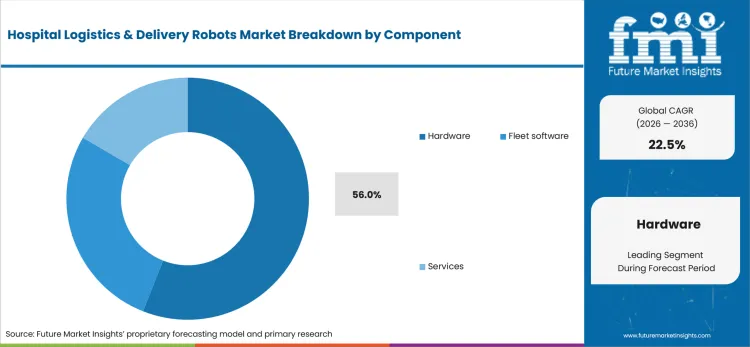
Hardware spending reflects the equipment needed for safe navigation and protected payload transport throughout each operating shift. Panasonic reported in December 2023 that HOSPI systems had operated at ten hospitals in Japan and two hospitals in Singapore. The installed base shows how durable vehicles can remain in service across different hospital layouts. Buyers still need to evaluate battery life and payload design alongside software functions and maintenance access. The same purchasing logic appears in healthcare asset tracking because physical devices and location data must work together.
- By component, hardware is forecast to represent 56.0% of 2026 revenue because each deployment requires mobile bases and navigation sensors. Protected cabinets and charging equipment add further cost throughout long daily operating schedules. This share should decline gradually as installed fleets create recurring demand for software updates and maintenance services.
- Hospital operations teams are expected to compare hardware through payload fit and route reliability rather than appearance. A vehicle that cannot use existing elevators creates extra infrastructure work and weakens the financial case. Procurement therefore depends on tested interfaces and service access as much as the robot purchase price over the contract term.
What are the drivers, restraints, and opportunities in the Hospital Logistics and Delivery Robots Market?
Labor pressure supports routine transport automation. Building integration slows commissioning. Flexible contracts widen access for smaller facilities.
- Driver: Hospitals are assigning scheduled delivery routes to robots so clinical staff can remain closer to patient care.
- Restraint: Elevator controls and secure doors can extend deployment schedules inside older hospital buildings that lack standard interfaces.
- Opportunity: Subscription contracts can connect robot access with maintenance and route support under one operating fee.
Routine transport consumes paid clinical time even though many delivery steps do not require clinical judgment. Relay Robotics reported in January 2025 that MedStar Georgetown University Hospital used robots to prepare and deliver chemotherapy medicine through a tracked workflow. The deployment shows how automation can support a sensitive route rather than a generic courier task. Hospitals can build stronger investment cases by measuring avoided walking and delivery delays across each shift. Related hospital capacity planning can connect these time savings with staffing pressure across each department.
Facility integration remains a practical restraint because a robot must cross doors and elevators without disrupting patient movement. Panasonic announced in November 2016 that HOSPI received Japanese JIS safety certification under the service robot standard. That milestone shows why safety evidence and operating controls matter before a hospital approves autonomous movement. Older buildings may need interface work and wireless upgrades that extend commissioning beyond the hardware installation. Vendors that test routes early can reduce schedule risk and prevent equipment from waiting for facility changes.
Flexible payment models create an opening among hospitals that lack capital for a full fleet purchase. A subscription can combine equipment and service support under one operating budget with defined performance terms. This structure gives a mid-size facility a predictable monthly cost while the vendor retains responsibility for maintenance and software updates. The robotics service models comparison helps decision-makers evaluate ownership against recurring service through a common cost basis. Adoption should improve where contracts define uptime and response duties clearly across every operating shift. Weak service terms can transfer technical risk back to hospital staff and reduce expected savings.
Which country CAGRs are profiled in the Hospital Logistics and Delivery Robots Market?
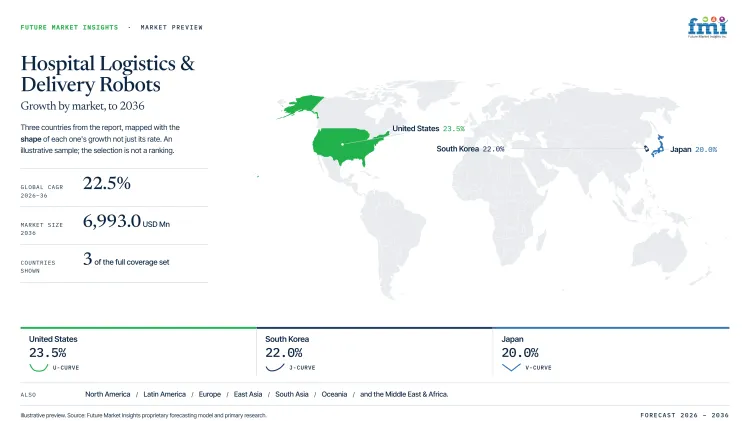
| Country | CAGR |
|---|---|
| United States | 23.5% |
| South Korea | 22.0% |
| Japan | 20.0% |
Source: FMI's proprietary forecasting model and primary research.
How do country-level CAGRs compare in the Hospital Logistics and Delivery Robots Market?
The comparison spans 3.5 percentage points and places the three markets within a relatively narrow growth range. The United States records the highest CAGR at 23.5%, followed by South Korea at 22.0% and Japan at 20.0%. The ranking reflects differences in hospital automation programs, workforce requirements and the integration of autonomous transport systems into clinical operations.
- The United States leads with a CAGR of 23.5%. Hospitals are increasing the use of autonomous delivery robots to transport medications, laboratory samples, meals and medical supplies between departments, helping streamline internal logistics and reduce routine manual transport tasks.
- South Korea follows at 22.0%, 1.5 percentage points below the United States. Healthcare providers are incorporating delivery robots into smart hospital initiatives, where automated transport systems improve movement of clinical materials while supporting more efficient hospital workflows.
- Japan records a CAGR of 20.0%, 2.0 percentage points below South Korea. Hospital operators continue evaluating logistics robots for repetitive transport activities, particularly in facilities seeking to improve operational efficiency and optimize staff allocation across pharmacy, laboratory and inpatient services.
Comparable CAGRs do not indicate identical market conditions. Differences in hospital infrastructure, healthcare automation strategies, labor availability and capital investment priorities influence purchasing decisions and deployment across healthcare facilities. The full report provides country-level CAGR analysis across North America, Latin America, Europe, East Asia, South Asia, Oceania and the Middle East and Africa.
Country-wise Analysis
Country performance reflects hospital construction patterns and technical service availability. Newer campuses can plan robot routes during design while established facilities must work around existing elevators and corridors. Health systems with shared operating standards can spread integration costs across several sites and reuse the same approval process. United States systems focus on labor savings from recurring tasks across multiple campuses. Japan emphasizes predictable operation within mature hospital networks. South Korea benefits from digital systems that can support route data and access controls. These differences align with broader robotics demand across each healthcare system.
- United States hospital systems often manage several campuses through shared pharmacy and supply operations. The country is projected to record 23.5% CAGR from 2026 to 2036 as health systems standardize internal delivery work across their networks. Diligent Robotics reported in September 2025 that Moxi operated in more than 25 hospitals. The company stated that its robots had saved nearly 600,000 staff hours through more than one million completed tasks. These operating records give administrators a basis for comparing route volume with service cost. Multicampus buyers may favor vendors that provide central fleet reporting and local field support. Contract selection should therefore test response times and integration ownership before a system commits to one platform.
- South Korean hospitals can build robot workflows on established digital systems that already connect clinical departments. The national outlook is estimated to advance at 22.0% CAGR between 2026 and 2036 as connected facilities add physical automation to existing information systems. Samsung Medical Center reported in March 2025 that it received a perfect 400 score in the HIMSS Digital Health Indicator. The hospital also held Level 7 status in four HIMSS assessment areas. This digital base can simplify identity controls and route reporting for hospital robots. Local technology providers still need to prove safe navigation in crowded public spaces. Hospitals are likely to select platforms that connect with established access systems without creating a separate data environment for each robot fleet.
- Japan combines long experience with service robots and a hospital system that values controlled movement in compact buildings. Sales are forecast to increase at 20.0% CAGR through 2036 as facilities replace manual routes without changing established clinical layouts. Japan's Ministry of Health, Labour and Welfare reported in April 2025 that 1,796 hospitals contributed 2023 data to national surveillance for hospital-acquired infection measures. That participation indicates broad use of standardized reporting across infection-sensitive facilities. Robot suppliers must therefore support cleaning routines and traceable transport for medications and specimens. Japanese buyers may favor compact vehicles with proven safety records. Commercial expansion depends on fitting existing corridors and reducing training demands for hospital support staff.
Who are the notable companies in the Hospital Logistics and Delivery Robots Market?
Notable companies include ST Engineering Aethon, Diligent Robotics, Swisslog Healthcare, Relay Robotics, Panasonic, and KEENON Robotics.
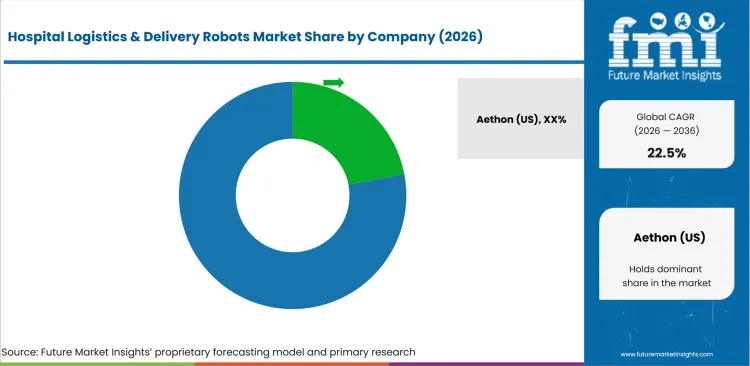
Competition spans heavy transport platforms and compact clinical couriers that address different hospital routes. ST Engineering Aethon serves cart movement and secure payload delivery through related mobile platforms. Diligent Robotics adds manipulation that can collect items without a fixed loading station. Swisslog Healthcare approaches transport as one part of pharmacy and material handling automation. Relay Robotics focuses on protected small-item delivery with elevator access. Panasonic brings an operating record for HOSPI systems in Japan and Singapore. KEENON Robotics offers hospital transport for medicines and sterile supplies. The hospital service robots comparison shows why buyers should evaluate route fit and integration support before selecting a vendor.
- ST Engineering Aethon and Swisslog Healthcare address hospital logistics through broader material movement systems. Aethon brings autonomous transport platforms while Swisslog links delivery work with pharmacy automation. Their shared advantage is the ability to discuss robot routes within a wider hospital logistics plan that includes storage and workflow control.
- Diligent Robotics differentiates Moxi through mobile manipulation that can collect and return items during a route. This capability fits workflows that lack fixed loading points across several clinical departments. Hospitals must assess whether the added function produces enough route volume to justify the higher system complexity and support needs.
- Relay Robotics and Panasonic focus on protected deliveries through compact vehicles that can use elevators. Relay emphasizes chain of custody and flexible service models for repeated small-item routes. Panasonic offers a long operating history through HOSPI deployments in Japan and Singapore. Both approaches suit lower-payload hospital work that requires controlled access.
- KEENON Robotics competes through a hospital portfolio that covers medicines and specimens across related delivery routes. The company can appeal to facilities seeking coordinated robots across several support tasks. Buyers should verify local service coverage and software integration before extending a pilot across multiple departments and buildings.
Competitive Benchmarking: Hospital Logistics & Delivery Robots Market
| Company | Heavy Cart Transport | Secure Item Delivery | Fleet Integration | Subscription Model | Geographic Reach |
|---|---|---|---|---|---|
| ST Engineering Aethon | High | High | High | Medium | North America and selected global sites |
| Diligent Robotics | Low | High | Medium | High | United States |
| Swisslog Healthcare | Medium | Medium | High | Medium | Europe, North America, and Asia |
| Relay Robotics | Low | High | Medium | High | North America |
| Panasonic | Medium | High | Medium | Low | Japan and Singapore |
| KEENON Robotics | Medium | Medium | Medium | Medium | Asia with wider international sales |
Scoring basis: High indicates a verified core capability. Medium indicates a supported capability with narrower evidence. Low indicates limited disclosed activity in the category.
Key Developments in the Hospital Logistics & Delivery Robots Market
- In September 2025, ST Engineering Aethon announced a collaboration with Oracle to connect autonomous mobile robots with Oracle Fusion Cloud Supply Chain and Manufacturing. The integration links physical transport with inventory information and task dispatch across hospital supply workflows. Hospitals can use this approach to reduce manual coordination between stock records and robot movements. Commercial value depends on reliable interfaces that keep inventory status and delivery execution aligned throughout each shift.
- In October 2025, Diligent Robotics introduced plans for Moxi 2.0 after more than 1.25 million deliveries in hospital environments. The updated platform is intended to extend how the robot supports clinical teams through mobile manipulation and transport work. Operating data from deployed fleets can guide product changes that address recurring hospital tasks. Hospitals should examine whether new functions improve route completion without raising maintenance or training demands.
- In September 2025, Swisslog Healthcare formed a strategic alliance with Diligent Robotics to bring last-mile delivery robots into United States hospitals. The agreement connects mobile delivery with Swisslog pharmacy and transport automation under a coordinated workflow. This structure can reduce the number of separate suppliers involved in one deployment. Pharmacy leaders may value a contract that covers storage and internal movement through clearly assigned service responsibility.
- In June 2026, Relay Robotics expanded its BayCare deployment with two robots at Winter Haven hospitals. The company reported that the earlier St. Anthony's pilot achieved a 99.8% delivery success rate across 50 trips per day. The expansion demonstrates how a hospital system can move from one-site testing to a wider fleet. Future orders should depend on verified uptime and documented clinical hours returned.
Key Players in the Hospital Logistics & Delivery Robots Market
Heavy-load logistics platforms
- ST Engineering Aethon
- Swisslog Healthcare
Mobile manipulation and clinical courier robots
- Diligent Robotics
- Relay Robotics
Hospital service robot suppliers
- Panasonic
- KEENON Robotics
Hospital Logistics & Delivery Robots Market - Report Scope
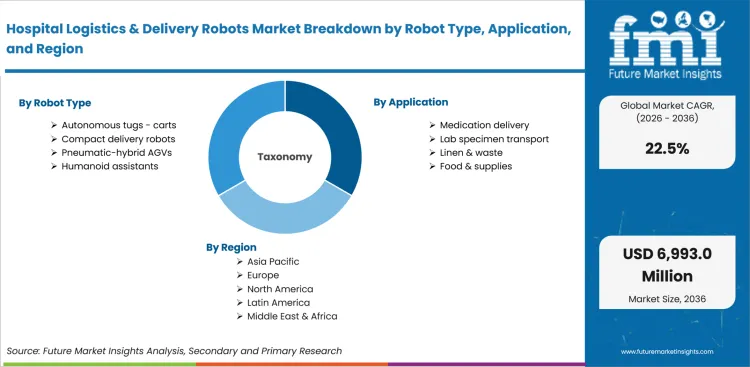
| Coverage field | Report scope |
|---|---|
| Market breakdown | Robot Type, Application, Component, End User, Business Model, and Region. |
| Quantitative units | Revenue in USD Million, CAGR in %. |
| Market definition | Autonomous robots used to transport medications, laboratory specimens, linen, waste, food, and hospital supplies within healthcare facilities. The market includes logistics and delivery robots deployed in hospitals, laboratories, pharmacies, clinics, and outpatient settings. Surgical robots, rehabilitation robots, and general-purpose industrial robots are excluded. |
| Regions covered | North America, Latin America, Europe, East Asia, South Asia, Oceania, and the Middle East & Africa. |
| Countries covered | United States, Canada, Brazil, Mexico, Argentina, Germany, United Kingdom, France, Italy, Spain, China, Japan, South Korea, India, ASEAN countries, Australia, New Zealand, Gulf Cooperation Council countries, South Africa, Israel, and additional countries included within the regional assessment. |
| Key companies profiled | ST Engineering Aethon, Diligent Robotics, Swisslog Healthcare, Relay Robotics, Panasonic, and KEENON Robotics. |
| Forecast period | 2026 to 2036. |
| Approach | Hybrid bottom-up and top-down market sizing supported by primary interviews with manufacturers, service providers, healthcare procurement teams, and end users, complemented by government statistics, industry publications, company disclosures, hospital deployment records, and proprietary forecasting models. |
Source: FMI's proprietary forecasting model and primary research
Hospital Logistics & Delivery Robots Market - Research Methodology
| Method | Approach |
|---|---|
| Primary Research | FMI analysts gathered input from manufacturers, service providers, technology developers, distributors, end users, procurement teams, and subject-matter experts. Interviews examined purchasing decisions, product or service evaluation, adoption barriers, approval requirements, pricing considerations, and expectations for technical or commercial support. Respondents were also asked what evidence is required before a trial, pilot, or initial order develops into regular purchasing. |
| Desk Research | Desk research covered government statistics, regulatory publications, trade data, industry associations, technical literature, standards, company filings, product information, and official corporate announcements. Sources were reviewed for relevance, publication date, geographic coverage, and consistency with the defined market scope. Claims relating to performance, applications, approvals, capacity, investment, and commercial activity were retained only when supported by credible public evidence. |
| Market Sizing and Forecasting | The market model combined the baseline value with historical performance, segment structure, pricing and volume indicators, adoption levels, company participation, and country-level demand conditions. Forecast assumptions considered economic activity, investment trends, regulatory developments, technology adoption, purchasing cycles, supply availability, and barriers to wider market use. Segment and regional estimates were reconciled before the final market total was calculated. |
| Data Validation | Estimates were checked against multiple independent indicators, including public data, company activity, trade patterns, industry developments, and findings from primary interviews. Validation also tested whether products, services, applications, and company revenues fell within the defined market boundaries. Adjacent categories, unsupported claims, overlapping revenues, and activities without direct market relevance were excluded to reduce double counting and maintain consistency across segments and countries. |
Source: FMI's proprietary forecasting model and primary research
Hospital Logistics & Delivery Robots Market by Segments
By Robot Type
- Autonomous tugs and carts
- Compact delivery robots
- Pneumatic-hybrid automated guided vehicles
- Mobile manipulation robots
By Application
- Medication delivery
- Lab specimen transport
- Linen and waste handling
- Food and supply delivery
By Component
- Hardware
- Fleet management software
- Deployment and maintenance services
By End User
- Large hospitals
- Mid-size hospitals
- Laboratories and pharmacies
- Clinics and outpatient centers
By Business Model
- Direct purchase
- Robotics-as-a-service subscriptions
- Equipment leasing
- Limited pilot programs
Hospital Logistics & Delivery Robots Market by Region:
- North America
- United States
- Canada
- Latin America
- Brazil
- Mexico
- Argentina
- Rest of Latin America
- Europe
- Germany
- United Kingdom
- France
- Italy
- Spain
- Rest of Europe
- East Asia
- China
- Japan
- South Korea
- South Asia
- India
- ASEAN countries
- Rest of South Asia
- Oceania
- Australia
- New Zealand
- Middle East and Africa
- Gulf Cooperation Council countries
- South Africa
- Israel
- Rest of Middle East and Africa
Research Sources and Bibliography
- American Hospital Association. (2026, March 9). 2025 Cost of Caring report.
- American Hospital Association. (2025, April 28). 2024 Costs of Caring.
- ST Engineering Aethon. (2024, April 29). ST Engineering Aethon launches ZenaRx for secure medication and specimen delivery.
- Diligent Robotics. (2025, July 16). Diligent Robotics leads United States adoption of hospital pharmacy robotics.
- Panasonic. (2023, December 12). HOSPI Trail hospital service robot.
- Relay Robotics. (2025, January 12). Robots prepare and deliver chemotherapy medicine at MedStar Georgetown.
- Panasonic. (2016, November 2). HOSPI autonomous delivery robot receives JIS safety certification.
- Diligent Robotics. (2025, September 23). Diligent Robotics selected for the inaugural Physical AI Fellowship.
- Federal Statistical Office of Germany. (2025, November 6). Inpatient hospital treatments increased in 2024.
- People's Daily Online. (2026, February 4). A glimpse of Beijing Anzhen Hospital's smart transformation.
- Samsung Medical Center. (2025, March 12). South Korea's medical information technology attracts global attention.
- Ministry of Health, Labour and Welfare of Japan. (2025, April 18). Nippon AMR One Health Report 2024.
- ST Engineering Aethon. (2025, September 10). ST Engineering Aethon and Oracle collaborate to automate hospital supply chain processes.
- Diligent Robotics. (2025, October 28). Moxi 2.0.
- Swisslog Healthcare. (2025, September 15). Swisslog Healthcare partners with Diligent Robotics.
- Relay Robotics. (2026, June 3). BayCare expands autonomous hospital delivery at Winter Haven hospitals.
- ST Engineering Aethon. (2026). Autonomous mobile robots for healthcare and hospital logistics.
- Diligent Robotics. (2026). Moxi hospital support robot.
- Swisslog Healthcare. (2026). Healthcare automation systems and transport solutions.
- Relay Robotics. (2026). Autonomous delivery robots for hospitals.
- Panasonic. (2017). HOSPI autonomous delivery robots at Changi General Hospital
- KEENON Robotics. (2026). Hospital WITMED autonomous logistics solution
This bibliography is provided for reader reference and uses primary government, standards-body, official trade body, and company sources.
This Report Answers
- How large is the hospital logistics and delivery robots market in 2026?
- Which hospital transport tasks create the clearest case for robot use?
- Why do autonomous tugs and carts account for a substantial share of revenue?
- How do medication delivery routes affect fleet utilization?
- Which building integration issues can delay a hospital robot deployment?
- How do country adoption patterns differ across the profiled economies?
- Which companies provide verified hospital logistics robot capabilities?
- How do direct purchase and subscription contracts change procurement risk?
- What evidence should hospitals request before expanding a robot pilot?
Frequently Asked Questions
What is driving growth in the hospital logistics and delivery robots market?
Hospital labor pressure is increasing interest in automated transport. Growth depends on routes that return staff time without adding complex facility work.
Who are the key players in the hospital logistics and delivery robots market?
Verified participants include ST Engineering Aethon and Diligent Robotics. Swisslog Healthcare, Relay Robotics, Panasonic, and KEENON Robotics serve related hospital workflows.
What is a notable restraint for hospital logistics robot deployment?
Older elevators and secure doors can slow commissioning. Hospitals need tested interfaces and dependable wireless coverage before a fleet can operate across departments.
Why should executives track the hospital logistics and delivery robots market?
The category links staffing costs with repeatable support work. Executives can use route data to decide whether automation improves care capacity and operating control.
What business problem does this market address?
Hospital robots reduce manual walking for routine deliveries. The equipment helps pharmacies and support teams move items without pulling clinical staff from patient areas.
What should procurement teams evaluate before selecting a robot supplier?
Procurement teams should compare payload fit and route reliability. Service response, access-system integration, and reporting quality determine whether a fleet remains useful.
What limits return on investment from hospital delivery robots?
Weak route volume can leave equipment underused. Unexpected elevator work and unclear service ownership can raise costs beyond the original deployment plan.
What supports long-term commercial confidence in this market?
Repeated hospital use and verified operating records support confidence. Clear uptime terms and documented staff-time savings give decision-makers a stronger basis for expansion.
Preview the report firsthand - request a free sample
Get SampleGet the brochure for pricing and purchase details.
Get PDFTable of Content
- Key Takeaways
- Market Size and CAGR
- Top Growth Driver
- Fastest Growing Segment
- Leading Region
- Key Companies
- Emerging Opportunities
- Executive Summary
- Global Market Outlook
- Demand-side Trends
- Supply-side Trends
- Technology Roadmap Analysis
- Analysis and Recommendations
- Analyst Perspective (What is happening? Why now? What should investors know?)
- Key Questions Answered
- How large is the market?
- What is the CAGR?
- What are key trends?
- Which region dominates?
- Who are the leaders?
- Market Overview
- Market Coverage / Taxonomy
- Market Definition / Scope / Limitations
- Research Methodology
- Chapter Orientation
- Analytical Lens and Working Hypotheses
- Market Structure, Signals, and Trend Drivers
- Benchmarking and Cross-market Comparability
- Market Sizing, Forecasting, and Opportunity Mapping
- Research Design and Evidence Framework
- Desk Research Programme (Secondary Evidence)
- Expert Input and Fieldwork (Primary Evidence)
- Tooling, Models, and Reference Databases
- Data Engineering and Model Build
- Quality Assurance and Audit Trail
- Market Background
- Market Dynamics (Drivers, Restraints, Opportunity, Trends)
- Scenario Forecast (Optimistic, Likely, Conservative)
- Impact Analysis
- AI Impact
- Sustainability Impact
- Regulatory Impact
- Technology Impact
- Consumer / Buyer Analysis
- Purchase Drivers
- Adoption Barriers
- Buyer Journey
- Opportunity Map Analysis
- Product Life Cycle Analysis
- Supply Chain Analysis
- Investment Feasibility Matrix
- Value Chain Analysis
- PESTLE and Porter's Analysis
- Regulatory Landscape
- Regional Parent Market Outlook
- Production and Consumption Statistics
- Import and Export Statistics
- Global Market Analysis and Forecast, 2021 to 2036
- Historical Market Size Value (USD Mn) Analysis, 2021 to 2025
- Current and Future Market Size Value (USD Mn) Projections, 2026 to 2036
- Y-o-Y Growth Trend Analysis
- Absolute $ Opportunity Analysis
- Global Market Pricing Analysis, 2021 to 2036
- Global Market Analysis and Forecast, By Robot Type, 2021 to 2036
- Introduction / Key Findings
- Historical Market Size Value (USD Mn) Analysis By Robot Type, 2021 to 2025
- Current and Future Market Size Value (USD Mn) Analysis and Forecast By Robot Type, 2026 to 2036
- Autonomous tugs - carts
- Compact delivery robots
- Pneumatic-hybrid AGVs
- Humanoid assistants
- Autonomous tugs - carts
- Y-o-Y Growth Trend Analysis By Robot Type, 2021 to 2025
- Absolute $ Opportunity Analysis By Robot Type, 2026 to 2036
- Global Market Analysis and Forecast, By Application, 2021 to 2036
- Introduction / Key Findings
- Historical Market Size Value (USD Mn) Analysis By Application, 2021 to 2025
- Current and Future Market Size Value (USD Mn) Analysis and Forecast By Application, 2026 to 2036
- Medication delivery
- Lab specimen transport
- Linen & waste
- Food & supplies
- Medication delivery
- Y-o-Y Growth Trend Analysis By Application, 2021 to 2025
- Absolute $ Opportunity Analysis By Application, 2026 to 2036
- Global Market Analysis and Forecast, By Component, 2021 to 2036
- Introduction / Key Findings
- Historical Market Size Value (USD Mn) Analysis By Component, 2021 to 2025
- Current and Future Market Size Value (USD Mn) Analysis and Forecast By Component, 2026 to 2036
- Hardware
- Fleet software
- Services
- Hardware
- Y-o-Y Growth Trend Analysis By Component, 2021 to 2025
- Absolute $ Opportunity Analysis By Component, 2026 to 2036
- Global Market Analysis and Forecast, By End User, 2021 to 2036
- Introduction / Key Findings
- Historical Market Size Value (USD Mn) Analysis By End User, 2021 to 2025
- Current and Future Market Size Value (USD Mn) Analysis and Forecast By End User, 2026 to 2036
- Large hospitals
- Mid-size hospitals
- Labs & pharmacies
- Clinics
- Large hospitals
- Y-o-Y Growth Trend Analysis By End User, 2021 to 2025
- Absolute $ Opportunity Analysis By End User, 2026 to 2036
- Global Market Analysis and Forecast, By Business Model, 2021 to 2036
- Introduction / Key Findings
- Historical Market Size Value (USD Mn) Analysis By Business Model, 2021 to 2025
- Current and Future Market Size Value (USD Mn) Analysis and Forecast By Business Model, 2026 to 2036
- Direct
- RaaS
- Lease
- Pilot programs
- Direct
- Y-o-Y Growth Trend Analysis By Business Model, 2021 to 2025
- Absolute $ Opportunity Analysis By Business Model, 2026 to 2036
- Global Market Analysis and Forecast, By Region, 2021 to 2036
- Introduction
- Historical Market Size Value (USD Mn) Analysis By Region, 2021 to 2025
- Current Market Size Value (USD Mn) Analysis and Forecast By Region, 2026 to 2036
- North America
- Latin America
- Western Europe
- Eastern Europe
- East Asia
- South Asia and Pacific
- Middle East & Africa
- Market Attractiveness Analysis By Region
- North America Market Analysis and Forecast, By Country, 2021 to 2036
- Historical Market Size Value (USD Mn) Trend Analysis By Market Taxonomy, 2021 to 2025
- Market Size Value (USD Mn) Forecast By Market Taxonomy, 2026 to 2036
- By Country
- USA
- Canada
- By Robot Type
- By Application
- By Component
- By End User
- By Business Model
- By Country
- Market Attractiveness Analysis
- By Country
- By Robot Type
- By Application
- By Component
- By End User
- By Business Model
- Key Takeaways
- Latin America Market Analysis and Forecast, By Country
- Historical Market Size Value (USD Mn) Trend Analysis By Market Taxonomy, 2021 to 2025
- Market Size Value (USD Mn) Forecast By Market Taxonomy, 2026 to 2036
- By Country
- Brazil
- Mexico
- Chile
- Rest of Latin America
- By Robot Type
- By Application
- By Component
- By End User
- By Business Model
- By Country
- Market Attractiveness Analysis
- By Country
- By Robot Type
- By Application
- By Component
- By End User
- By Business Model
- Key Takeaways
- Western Europe Market Analysis and Forecast, By Country
- Historical Market Size Value (USD Mn) Trend Analysis By Market Taxonomy, 2021 to 2025
- Market Size Value (USD Mn) Forecast By Market Taxonomy, 2026 to 2036
- By Country
- Germany
- UK
- Italy
- Spain
- France
- Nordic
- BENELUX
- Rest of Western Europe
- By Robot Type
- By Application
- By Component
- By End User
- By Business Model
- By Country
- Market Attractiveness Analysis
- By Country
- By Robot Type
- By Application
- By Component
- By End User
- By Business Model
- Key Takeaways
- Eastern Europe Market Analysis and Forecast, By Country
- Historical Market Size Value (USD Mn) Trend Analysis By Market Taxonomy, 2021 to 2025
- Market Size Value (USD Mn) Forecast By Market Taxonomy, 2026 to 2036
- By Country
- Russia
- Poland
- Hungary
- Balkan & Baltic
- Rest of Eastern Europe
- By Robot Type
- By Application
- By Component
- By End User
- By Business Model
- By Country
- Market Attractiveness Analysis
- By Country
- By Robot Type
- By Application
- By Component
- By End User
- By Business Model
- Key Takeaways
- East Asia Market Analysis and Forecast, By Country
- Historical Market Size Value (USD Mn) Trend Analysis By Market Taxonomy, 2021 to 2025
- Market Size Value (USD Mn) Forecast By Market Taxonomy, 2026 to 2036
- By Country
- China
- Japan
- South Korea
- By Robot Type
- By Application
- By Component
- By End User
- By Business Model
- By Country
- Market Attractiveness Analysis
- By Country
- By Robot Type
- By Application
- By Component
- By End User
- By Business Model
- Key Takeaways
- South Asia and Pacific Market Analysis and Forecast, By Country
- Historical Market Size Value (USD Mn) Trend Analysis By Market Taxonomy, 2021 to 2025
- Market Size Value (USD Mn) Forecast By Market Taxonomy, 2026 to 2036
- By Country
- India
- ASEAN
- Australia & New Zealand
- Rest of South Asia and Pacific
- By Robot Type
- By Application
- By Component
- By End User
- By Business Model
- By Country
- Market Attractiveness Analysis
- By Country
- By Robot Type
- By Application
- By Component
- By End User
- By Business Model
- Key Takeaways
- Middle East & Africa Market Analysis and Forecast, By Country
- Historical Market Size Value (USD Mn) Trend Analysis By Market Taxonomy, 2021 to 2025
- Market Size Value (USD Mn) Forecast By Market Taxonomy, 2026 to 2036
- By Country
- Kingdom of Saudi Arabia
- Other GCC Countries
- Türkiye
- South Africa
- Other African Union
- Rest of Middle East & Africa
- By Robot Type
- By Application
- By Component
- By End User
- By Business Model
- By Country
- Market Attractiveness Analysis
- By Country
- By Robot Type
- By Application
- By Component
- By End User
- By Business Model
- Key Takeaways
- Key Countries Market Analysis
- USA
- Pricing Analysis
- Market Share Analysis, 2025
- By Robot Type
- By Application
- By Component
- By End User
- By Business Model
- Canada
- Pricing Analysis
- Market Share Analysis, 2025
- By Robot Type
- By Application
- By Component
- By End User
- By Business Model
- Mexico
- Pricing Analysis
- Market Share Analysis, 2025
- By Robot Type
- By Application
- By Component
- By End User
- By Business Model
- Brazil
- Pricing Analysis
- Market Share Analysis, 2025
- By Robot Type
- By Application
- By Component
- By End User
- By Business Model
- Chile
- Pricing Analysis
- Market Share Analysis, 2025
- By Robot Type
- By Application
- By Component
- By End User
- By Business Model
- Germany
- Pricing Analysis
- Market Share Analysis, 2025
- By Robot Type
- By Application
- By Component
- By End User
- By Business Model
- UK
- Pricing Analysis
- Market Share Analysis, 2025
- By Robot Type
- By Application
- By Component
- By End User
- By Business Model
- Italy
- Pricing Analysis
- Market Share Analysis, 2025
- By Robot Type
- By Application
- By Component
- By End User
- By Business Model
- Spain
- Pricing Analysis
- Market Share Analysis, 2025
- By Robot Type
- By Application
- By Component
- By End User
- By Business Model
- France
- Pricing Analysis
- Market Share Analysis, 2025
- By Robot Type
- By Application
- By Component
- By End User
- By Business Model
- India
- Pricing Analysis
- Market Share Analysis, 2025
- By Robot Type
- By Application
- By Component
- By End User
- By Business Model
- ASEAN
- Pricing Analysis
- Market Share Analysis, 2025
- By Robot Type
- By Application
- By Component
- By End User
- By Business Model
- Australia & New Zealand
- Pricing Analysis
- Market Share Analysis, 2025
- By Robot Type
- By Application
- By Component
- By End User
- By Business Model
- China
- Pricing Analysis
- Market Share Analysis, 2025
- By Robot Type
- By Application
- By Component
- By End User
- By Business Model
- Japan
- Pricing Analysis
- Market Share Analysis, 2025
- By Robot Type
- By Application
- By Component
- By End User
- By Business Model
- South Korea
- Pricing Analysis
- Market Share Analysis, 2025
- By Robot Type
- By Application
- By Component
- By End User
- By Business Model
- Russia
- Pricing Analysis
- Market Share Analysis, 2025
- By Robot Type
- By Application
- By Component
- By End User
- By Business Model
- Poland
- Pricing Analysis
- Market Share Analysis, 2025
- By Robot Type
- By Application
- By Component
- By End User
- By Business Model
- Hungary
- Pricing Analysis
- Market Share Analysis, 2025
- By Robot Type
- By Application
- By Component
- By End User
- By Business Model
- Kingdom of Saudi Arabia
- Pricing Analysis
- Market Share Analysis, 2025
- By Robot Type
- By Application
- By Component
- By End User
- By Business Model
- Türkiye
- Pricing Analysis
- Market Share Analysis, 2025
- By Robot Type
- By Application
- By Component
- By End User
- By Business Model
- South Africa
- Pricing Analysis
- Market Share Analysis, 2025
- By Robot Type
- By Application
- By Component
- By End User
- By Business Model
- USA
- Market Structure Analysis
- Competition Dashboard
- Competition Benchmarking
- Market Share Analysis of Top Players
- By Regional
- By Robot Type
- By Application
- By Component
- By End User
- By Business Model
- Emerging Startups
- Innovation Benchmarking
- Competition Analysis
- Competition Deep Dive
- Aethon (US)
- Overview
- Product Portfolio
- Profitability by Market Segments
- Sales Footprint
- Strategy Overview
- Marketing Strategy
- Product Strategy
- Channel Strategy
- Swisslog Healthcare Relay (CH)
- Diligent Robotics Moxi (US)
- Panasonic Hospi (JP)
- Aethon (US)
- Case Studies
- Success Stories
- Recent Developments
- Competition Deep Dive
- Assumptions & Acronyms Used


