

- Market Size (2026)
- USD 1.0 Bn
- Forecast (2036)
- USD 20.1 Bn
- CAGR (2026 to 2036)
- 35.0%
How big is Sidewalk & Last-mile Delivery Robots Market in 2026?
USD 1.0 billion in 2026 and USD 20.1 billion by 2036 at 35.0% CAGR.
Demand for sidewalk & last-mile delivery robots are expected to expand at 35.0% CAGR from 2026 to 2036. The industry valuation is expected to rise from USD 1.0 billion in 2026 to USD 20.1 billion by 2036, as dense online ordering creates repeated short trips suited to low-speed robots. The USA Census Bureau reported in May 2026 that first-quarter retail e-commerce sales reached USD 326.7 billion and increased 9.8% from one year earlier. That order base supports last-mile logistics models that assign compact deliveries without changing the customer checkout process. Commercial returns depend on route density and dependable handoffs that support repeat use throughout each operating day.
Adoption patterns differ across countries as local services address different delivery needs and public-space conditions. United States programs often connect robots with ordering platforms across several metropolitan areas and merchant groups. Finland has developed deeper grocery use through winter operations and retailer partnerships across smaller service communities. Starship Technologies reported in October 2025 that it raised USD 50 million for urban expansion in the United States. In December 2025 the company reported one million grocery deliveries in Finland and a share of up to 20% of online grocery orders. These differences show why sidewalk delivery services need charging plans and customer support that reflect local operating conditions. Fleet economics improve as dispatch rules direct suitable orders toward each available robot and reduce empty travel.
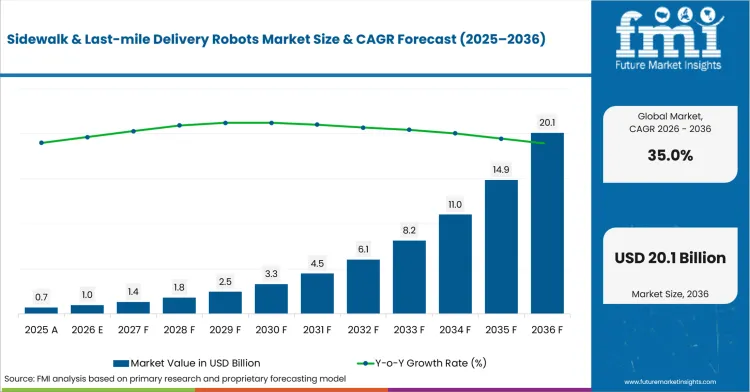
Key Takeaways of Sidewalk & Last-mile Delivery Robots Market
- Demand for sidewalk and last-mile delivery robots is driven by short urban deliveries in zones with dense online orders, with commercial value depending on each unit completing enough paid trips to cover charging and remote support.
- Sidewalk rovers are the leading robot design for low-speed neighborhood trips carrying meals and convenience goods across short distances.
- Food delivery provides the primary demand driver, offering regular order peaks that let platforms direct suitable trips toward compact autonomous fleets.
- Hardware remains a large cost element, as each unit needs batteries and weather-resistant sensing equipment, while software value grows as fleets expand and require map updates and remote assistance.
- Robot productivity improves when several nearby stores share one service zone, reducing empty travel between customer orders and strengthening the case for funded, performance-defined contracts.
- The United States, South Korea, and Russia are expected to follow distinct adoption paths, shaped by broad merchant networks with varying permit requirements, compact high-density residential districts, and established commercial operation through Yandex delivery robots.
- Competition centers on Starship Technologies, Serve Robotics, Coco Robotics, DoorDash, Avride, Yandex, Cartken, and Ottonomy, with vendors differentiating through operating history and partnerships, integration with restaurant/retail ordering systems, autonomous-driving software applied to delivery, and mixed indoor-outdoor route service.
Analyst Perspective
"Commercial deployment of autonomous last-mile delivery robots will be determined by operational discipline rather than autonomous mobility alone. Sustainable fleet expansion requires dependable loading, consistent customer handoffs, and route selection that reflects real delivery conditions instead of maximum coverage. As deployments scale, operators will place greater emphasis on service ownership, charging logistics, and incident response to maintain reliable delivery performance and control operating costs."
- Nikhil Kaitwade, Principal Analyst at Future Market Insights
Source: FMI's proprietary forecasting model and primary research
How is the Sidewalk & Last-mile Delivery Robots Market segmented?
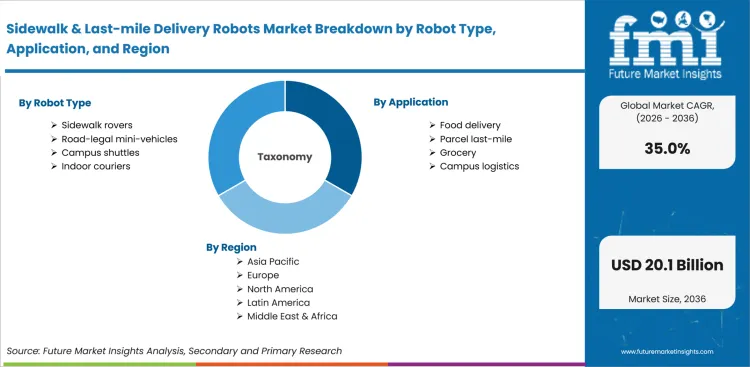
The sidewalk & last-mile delivery robots industry is segmented by robot type, application, component, end-use industry, business model, and region.
The report compares six dimensions that determine route fit and revenue ownership across commercial delivery programs. Robot Type separates sidewalk rovers from larger road-capable units through differences in speed and payload capacity. Application covers food and grocery deliveries alongside parcel movement and campus logistics within managed service areas. Component analysis separates hardware spending from autonomy software and operating services throughout the active fleet. End-use Industry compares restaurant and retail demand with parcel carriers and institutional sites in each service zone. Business Model distinguishes service contracts from equipment ownership under different risk arrangements for fleet customers. Regional analysis reflects infrastructure quality and local operating rules that shape deployment schedules in each country.
How does the sidewalk rover format shape demand within the robot type category?
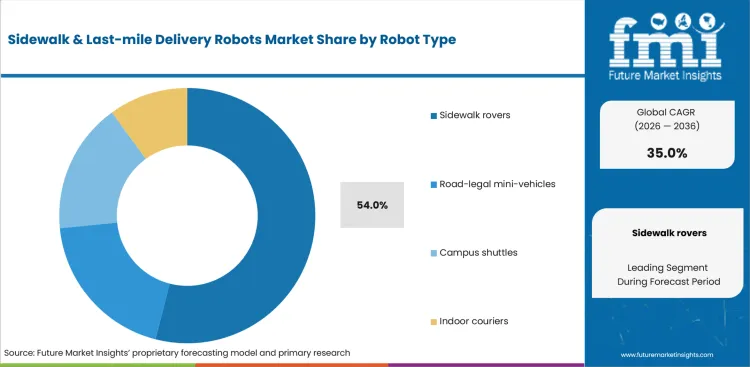
Sidewalk rovers fit common meal and convenience orders without requiring road speeds or vehicle-sized staging areas. Starship Technologies reported in April 2025 that its fleet had completed over eight million deliveries through more than 2,000 robots across at least 150 locations. The operating record shows that compact fleets can scale through consistent route data and repeatable merchant loading procedures.
- By robot type sidewalk rovers are forecast to represent 54.0% in 2026 owing to their fit with low-speed routes and small payloads. Compact dimensions support curb access and pedestrian movement without the operating demands of larger road vehicles. The share reflects a practical match between common order size and available public-space infrastructure during daily service.
- Restaurants and neighborhood retailers are expected to use sidewalk rovers for short orders that conventional vehicle dispatch handles poorly. The format complements electric delivery vehicles by covering smaller trips inside compact zones that do not need road-speed travel. A shared fleet gains value as each robot serves several merchants and returns to a nearby charging point with limited empty travel.
What supports food delivery within the application category?
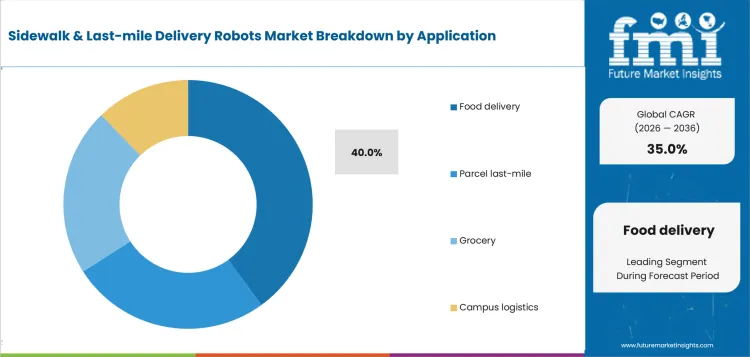
Food delivery provides frequent short trips through platforms that already coordinate customers and nearby restaurants. Korea's Ministry of Data and Statistics reported in October 2025 that online shopping reached 22.4802 trillion won during August. The same release showed that food-service transactions increased 9.0% from one year earlier during the reporting month. The figures indicate an order flow that robot services can join without creating a separate customer channel.
- In 2026, food delivery is expected to represent 40.0% of the application category due to frequent meal orders and short delivery windows. Restaurant preparation times give dispatch systems a clear pickup schedule that supports orderly robot collection during peak periods. The segment gains commercial value as several merchants share one zone and support repeated robot use through lunch and dinner periods.
- Delivery platforms are projected to assign selected meal orders to robots that meet defined distance and payload limits. This method lets online food delivery providers retain one customer interface even as the physical delivery mode changes. Reliable arrival estimates and secure compartment access reduce friction during the final handoff and support repeat use.
How is hardware positioned within the component category?
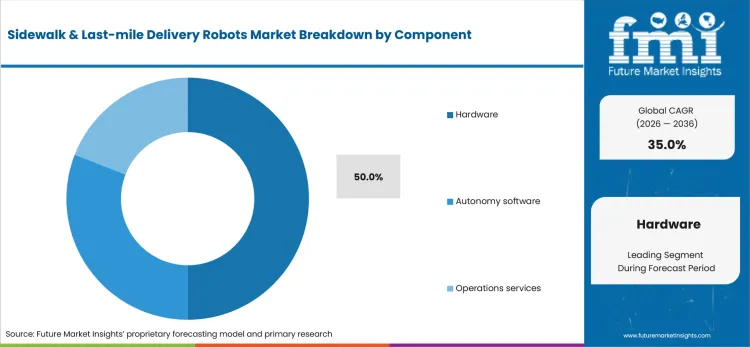
Every deployed robot needs a chassis and battery system that can operate outdoors and protect the order compartment. Serve Robotics reported in October 2025 that its 1,000th third-generation robot entered service following deployment of more than 380 units during September. That production pace shows why hardware availability can determine rollout speed even if software and merchant agreements are ready for wider service.
- By component, hardware is estimated to hold 50.0% share in 2026 as each deployed unit combines mobility systems with sensing equipment. Batteries and wheels must withstand repeated outdoor use across changing weather and uneven pedestrian routes. Cameras and lidar help the robot detect pedestrians and vehicles across each active delivery route. A weather-resistant enclosure protects food or parcels throughout the route and supports a dependable handoff.
- Fleet operators are projected to spend more on autonomy software as route coverage and service hours expand beyond early deployments. Recurring map updates and remote support connect the physical fleet with delivery software systems across every active route. Providers that shorten diagnostics and restart times can improve uptime without assigning extra robots to each zone during peak periods.
What are the drivers, restraints, and opportunities in the Sidewalk & Last-Mile Delivery Robots Market?
Dense short-distance orders support repeat trips; local permits can delay route expansion; multi-category service contracts can improve daily utilization.
- Driver: Online ordering platforms are expected to direct suitable local orders toward robots that can complete repeated trips within compact service zones.
- Restraint: Sidewalk access rules are anticipated to extend rollout schedules as operators meet local limits for speed and public-space safety.
- Opportunity: Multi-category contracts are projected to improve utilization by combining meal and grocery demand with parcels across different operating periods.
Order density is the main demand mechanism as each robot must complete enough paid trips to cover equipment and supervision costs. Starship Technologies announced in March 2025 that its foodora service could reach 50,000 Stockholm households within a three-kilometre range. The development shows how an established delivery platform can supply recurring demand without requiring merchants to build a separate dispatch system. Commercial expansion depends on maintaining that trip flow across normal operating weeks and several merchant locations.
Local approval creates friction as sidewalk robots share public space with pedestrians and mobility devices. The District of Columbia Personal Delivery Device Act took effect in July 2018 and caps operating speed at 10 miles per hour. The law requires robots to yield to pedestrians and establishes a process for mechanical failure and swift removal from public space. These conditions make incident response and device identification important during permit review by transport authorities. Capable autonomy cannot prevent delay if the operating plan fails the public-space duties defined by local authorities.
The commercial opening expands as one fleet carries several order types across different demand periods. Starship Technologies reported in April 2026 that autonomous delivery was USD 3 to USD 4 cheaper per order than traditional rider delivery. That cost gap becomes more useful as grocery trips fill operating hours outside the main meal-order peaks. Secure compartments and temperature-controlled delivery practices can extend the order mix without weakening product condition. The opportunity is concentrated in zones that maintain useful trip volume across several parts of the day.
Which country CAGRs are profiled in the Sidewalk & Last-Mile Delivery Robots Market?
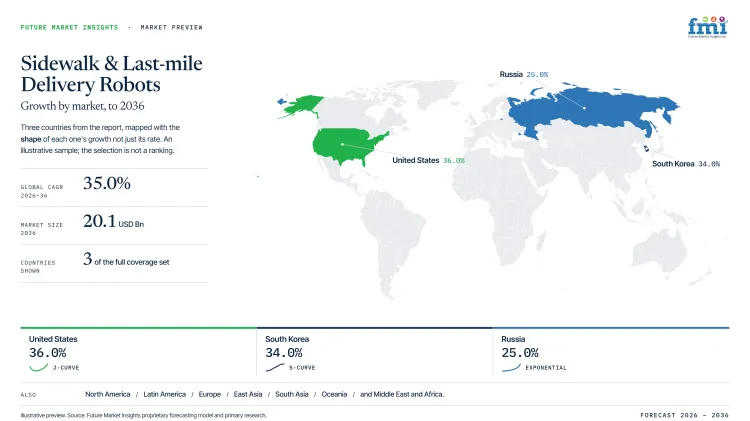
| Country | CAGR |
|---|---|
| United States | 36.0% |
| South Korea | 34.0% |
| Russia | 25.0% |
Source: FMI's proprietary forecasting model and primary research
How do country-level CAGRs compare in the Sidewalk & Last-Mile Delivery Robots Market?
Country growth depends on online order density and the rules that govern access to local streets or sidewalks. United States platforms combine broad merchant networks with city-level permits that shape fleet expansion across separate operating areas. South Korea offers compact service districts and high mobile shopping use for short trips between stores and apartment buildings. Russia retains autonomous engineering capacity through Yandex delivery robots that serve selected cities and connect with online service platforms. These differences shape charging plans and weather preparation across delivery networks as robots compete with drone delivery services. Each country therefore presents a different path from pilot activity to funded commercial service under local operating conditions.
- United States delivery platforms can direct large order volumes toward robots without rebuilding the customer checkout process. Demand in the United States is forecast to rise at 36.0% CAGR from 2026 to 2036 due to multi-city platform partnerships and wider fleet rollout. DoorDash reported in April 2025 that Coco robots had completed more than 100,000 deliveries during an initial pilot and were available from nearly 600 merchants in Los Angeles and Chicago. The result shows that platform integration can create useful trip density across several restaurant groups. City permit duties and public complaints make response planning a service-selection factor alongside route capacity and merchant coverage.
- South Korea combines dense urban development with mobile ordering habits that suit short merchant-to-customer routes. Adoption is estimated to expand at 34.0% CAGR through 2036 as compact service districts support domestic robotics programs. Korea's Ministry of Data and Statistics reported in March 2026 that January online shopping transactions reached 24.1004 trillion won. The same release recorded a 10.9% increase in food-service transactions from one year earlier. This order base gives robot fleets a broad pool of short trips across dense residential districts. Service agreements that include remote support and clear handoff instructions can reduce early friction in apartment deliveries.
- Russia retains autonomous-driving expertise through delivery robots that operate across selected urban locations and online service platforms. The Russian sector is projected to record 25.0% CAGR from 2026 to 2036 as commercial routes expand from a limited base. Yandex reported in April 2026 that its Autonomous Tech segment generated RUB 0.1 billion in first-quarter revenue with growth of 167% from one year earlier. The release stated that delivery robots operated commercially in several Russian cities during the quarter. The revenue figure covers a broader autonomy business and therefore indicates operating activity instead of delivery robot sales alone. Year-round contracts must account for winter performance and remote recovery during service disruptions across exposed urban routes.
Who are the notable companies in the Sidewalk & Last-mile Delivery Robots Market?
The company landscape includes Starship Technologies, Serve Robotics, Coco Robotics, Avride, DoorDash, Cartken, Ottonomy, and Yandex.
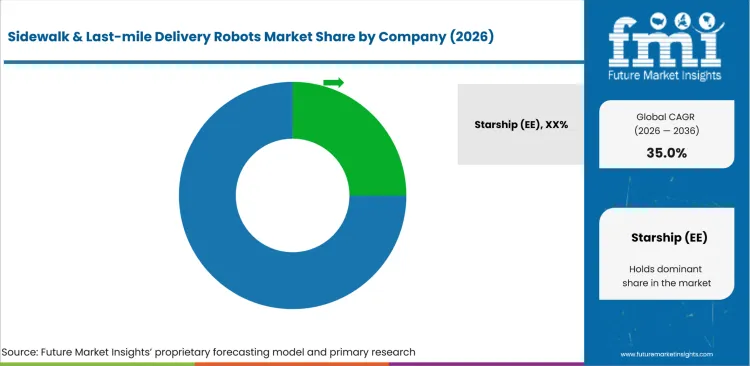
Competition depends on completed deliveries and dependable route coverage across active service zones instead of prototype claims. Starship Technologies and Serve Robotics use operating history to support platform partnerships across several delivery zones. Coco Robotics and DoorDash combine sidewalk fleets with established ordering systems in United States cities. Avride and Yandex apply autonomous-driving software from broader mobility programs to delivery robots that need perception and remote assistance across urban routes. Cartken and Ottonomy serve mixed indoor and outdoor routes across campuses or controlled sites with defined access conditions. These services overlap with autonomous warehouse robots at facilities that connect indoor movement with nearby outdoor routes. Fleet control and maintenance therefore influence uptime across warehouse automation programs and public-space delivery services.
- Starship Technologies and Serve Robotics compete through established fleets and integration with ordering platforms across several cities. Their commercial position depends on route uptime and the ability to add service zones without weakening remote assistance or merchant support during peak order periods.
- Coco Robotics and DoorDash compete through compact delivery vehicles linked to restaurant and retail platforms. Coco provides fleet operations in permitted service areas that support recurring neighborhood trips throughout daily service. DoorDash controls the ordering system and has introduced its Dot vehicle for selected road and sidewalk routes.
- Avride and Yandex apply autonomous-driving software across delivery robots and related mobility services that share perception or mapping capabilities. Cartken and Ottonomy compete through mixed-site programs that make indoor-outdoor movement and campus access central to commercial expansion decisions across managed sites.
Competitive Benchmarking: Sidewalk & Last-mile Delivery Robots Market
| Company | Route Capability | Platform Integration | Fleet Operations | Geographic Reach |
|---|---|---|---|---|
| Starship Technologies | High | High | High | Europe and North America |
| Serve Robotics | High | High | High | North America |
| Coco Robotics | High | High | Medium | North America and Europe |
| Avride | High | High | Medium | North America |
| DoorDash | Medium | High | High | North America |
| Cartken | High | High | Medium | North America, Europe, and Asia |
| Ottonomy | High | Medium | Medium | North America, Europe, and Middle East |
| Yandex | High | High | High | Russia |
Scoring basis: High indicates verified commercial use across several programs or locations within the exact delivery robot category. Medium indicates a relevant capability with narrower documented service coverage across the same operating dimension.
Source: Future Market Insights competitive analysis, 2026.
Key Developments in the Sidewalk & Last-mile Delivery Robots Market
- November 2025, Starship Technologies announced a global partnership with Uber Eats for sidewalk robot delivery across Europe and the United States. Service began in Leeds during December 2025 with European expansion planned across additional cities during 2026. Starship reported more than nine million completed deliveries and 2,700 robots at the announcement. The agreement lets Uber Eats add autonomous capacity through the customer ordering process already used across its platform.
- October 2025, Serve Robotics entered a multi-year partnership with DoorDash for autonomous deliveries in the United States. Service started in Los Angeles with expansion planned for additional United States cities under the multi-year agreement. The arrangement gives Serve another source of order volume and reduces reliance on one platform. DoorDash gains access to an established robot fleet without building every delivery vehicle through its internal engineering program.
- March 2026, Coco Robotics announced a Wolt partnership for robot deliveries across central Turku in Finland. Around ten robots were scheduled to begin service with restaurant and grocery orders during March. Customers could track each vehicle and unlock its compartment through the Wolt app during every completed delivery. The launch extends Coco into another European city and tests several order types within one compact operating area.
- September 2025, DoorDash introduced Dot as an in-house delivery vehicle for an early access program in Tempe and Mesa. The vehicle was designed at one-tenth the size of a car and could travel at speeds up to 20 miles per hour. The development gives DoorDash direct control over vehicle design as its platform coordinates human couriers and external robot providers.
Key Players in the Sidewalk & Last-mile Delivery Robots Market
Scaled sidewalk delivery operators
- Starship Technologies
- Serve Robotics
- Coco Robotics
Platform-integrated autonomous developers
- Avride
- Yandex
- DoorDash
Campus and mixed-site robotics providers
- Cartken
- Ottonomy
Sidewalk & Last-mile Delivery Robots Market - Report Scope
| Coverage field | Report scope |
|---|---|
| Market breakdown | Robot type, application, component, end-use industry, business model, and region. |
| Quantitative Units | Revenue in USD billion and CAGR in percentage terms. |
| Market Definition | Autonomous robots that transport food, groceries, parcels, or site materials across sidewalks and short last-mile routes with remote support. |
| Regions Covered | North America, Latin America, Europe, East Asia, South Asia, Oceania, and Middle East and Africa. |
| Countries Covered | United States, Canada, South Korea, Japan, China, Russia, selected European countries, and additional countries within regional forecasts. |
| Key Companies Profiled | Starship Technologies, Serve Robotics, Coco Robotics, Avride, DoorDash, Cartken, Ottonomy, and Yandex. |
| Forecast Period | 2026 to 2036. |
| Approach | Hybrid company-level and demand-side market sizing supported by primary interviews and official secondary research. |
Source: Future Market Insights analysis driven by proprietary forecasting models and primary research
Sidewalk & Last-mile Delivery Robots Market - Research Methodology
| Method | Approach |
|---|---|
| Primary Research | FMI analysts gathered input from manufacturers, service providers, technology developers, distributors, end users, procurement teams, and subject-matter experts. Interviews examined purchasing decisions, product or service evaluation, adoption barriers, approval requirements, pricing considerations, and expectations for technical or commercial support. Respondents were also asked what evidence is required before a trial, pilot, or initial order develops into regular purchasing. |
| Desk Research | Desk research covered government statistics, regulatory publications, trade data, industry associations, technical literature, standards, company filings, product information, and official corporate announcements. Sources were reviewed for relevance, publication date, geographic coverage, and consistency with the defined market scope. Claims relating to performance, applications, approvals, capacity, investment, and commercial activity were retained only when supported by credible public evidence. |
| Market Sizing and Forecasting | The market model combined the baseline value with historical performance, segment structure, pricing and volume indicators, adoption levels, company participation, and country-level demand conditions. Forecast assumptions considered economic activity, investment trends, regulatory developments, technology adoption, purchasing cycles, supply availability, and barriers to wider market use. Segment and regional estimates were reconciled before the final market total was calculated. |
| Data Validation | Estimates were checked against multiple independent indicators, including public data, company activity, trade patterns, industry developments, and findings from primary interviews. Validation also tested whether products, services, applications, and company revenues fell within the defined market boundaries. Adjacent categories, unsupported claims, overlapping revenues, and activities without direct market relevance were excluded to reduce double counting and maintain consistency across segments and countries. |
Source: Future Market Insights analysis based on proprietary forecasting models and primary research
Sidewalk & Last-mile Delivery Robots Market by Segments
Sidewalk & Last-mile Delivery Robots Market segmented by Robot Type:
- Sidewalk Rovers
- Road-capable Mini Vehicles
- Campus Delivery Robots
- Indoor-outdoor Delivery Robots
Sidewalk & Last-mile Delivery Robots Market segmented by Application:
- Food Delivery
- Grocery Delivery
- Parcel Delivery
- Campus and Site Logistics
Sidewalk & Last-mile Delivery Robots Market segmented by Component:
- Hardware
- Autonomy Software
- Fleet Operations Services
Sidewalk & Last-mile Delivery Robots Market segmented by End-use Industry:
- Restaurants and Delivery Platforms
- Retail and Grocery
- Parcel Carriers
- Universities and Campuses
Sidewalk & Last-mile Delivery Robots Market segmented by Business Model:
- Delivery-as-a-Service
- Direct Sales
- Subscription
- Pilot Programs
Sidewalk & Last-mile Delivery Robots Market by Region:
- North America
- United States
- Canada
- Latin America
- Brazil
- Mexico
- Argentina
- Europe
- United Kingdom
- Finland
- Estonia
- Germany
- France
- East Asia
- South Korea
- Japan
- China
- South Asia
- India
- Thailand
- Indonesia
- Oceania
- Australia
- New Zealand
- Middle East and Africa
- United Arab Emirates
- Saudi Arabia
- South Africa
Research Sources and Bibliography
- USA Census Bureau. (2026, May). Quarterly retail e-commerce sales, first quarter 2026. USA Department of Commerce.
- Republic of Korea Ministry of Data and Statistics. (2025, October). Online shopping in August 2025.
- Republic of Korea Ministry of Data and Statistics. (2026, March). Online shopping in January 2026.
- Council of the District of Columbia. (2018, July 17). Personal Delivery Device Act of 2018, D.C. Law 22-137.
- Starship Technologies. (2025, March). Starship Technologies and foodora announce partnership in Sweden.
- Starship Technologies. (2025, April). Starship Technologies surpasses 8 million deliveries.
- Starship Technologies. (2025, October). Starship Technologies raises $50M Series C to scale autonomous delivery across USA cities.
- Starship Technologies. (2025, November). Starship Technologies and Uber Eats launch autonomous delivery partnership.
- Starship Technologies. (2025, December). One million grocery deliveries completed in Finland with S Group.
- Starship Technologies. (2026, April). Autonomous delivery moves into the mainstream as Starship Technologies passes 10 million deliveries.
- Serve Robotics. (2025, October). Serve Robotics deploys 1,000th autonomous delivery robot.
- Serve Robotics. (2025, October). DoorDash and Serve Robotics partner to bring delivery robots to the DoorDash platform.
- DoorDash. (2025, April). DoorDash and Coco expand global partnership with USA sidewalk robot delivery launch.
- DoorDash. (2025, September). DoorDash unveils Dot and its autonomous delivery platform.
- Coco Robotics. (2026, March). Wolt and Coco launch robot deliveries in Turku, Finland.
- Avride. (n.d.). Delivery robot.
- Cartken. (n.d.). Cartken: Autonomous robots for outdoor and indoor use.
- Ottonomy. (n.d.). Autonomous delivery robots.
- Yandex. (2026, April). Yandex announces first quarter 2026 financial results.
This bibliography is provided for reader reference and uses primary government, standards-body, official trade body, and company sources.
This Report Answers
- What market value is estimated for 2026 and 2036?
- What CAGR is projected from 2026 to 2036?
- Why do sidewalk rovers account for 54.0% of robot type revenue?
- How does food delivery create a recurring commercial base for robot fleets?
- Which route and permit conditions shape daily service economics?
- How do growth conditions differ across the United States, South Korea, and Russia?
- Which companies use fleet scale or platform integration to compete?
- What operating evidence should service planners review before choosing a delivery robot provider?
- How are hardware and service revenue separated within the forecast?
Frequently Asked Questions
What is driving growth in the Sidewalk & Last-mile Delivery Robots Market?
Online ordering creates repeated short trips within compact service zones. Commercial growth improves as platforms maintain enough daily volume for active fleet use.
Who are the key players in the Sidewalk & Last-mile Delivery Robots Market?
Starship Technologies and Serve Robotics operate sidewalk fleets across multiple service zones. Coco Robotics and Avride compete through ordering-platform connections and wider service coverage.
What is a notable restraint in the Sidewalk & Last-mile Delivery Robots Market?
Local sidewalk rules can delay route launches and add reporting duties. Service plans must address safe yielding and rapid recovery from blocked devices.
Why should executives track the Sidewalk & Last-mile Delivery Robots Market?
Delivery robots can change the economics of short urban orders. Adoption may alter platform contracts and fleet investment priorities across local delivery networks.
What business problem does the Sidewalk & Last-mile Delivery Robots Market address?
The technology handles short trips that cars or human couriers may serve inefficiently. Smaller autonomous vehicles support repeated local deliveries within defined zones.
What should procurement teams evaluate?
Selection should compare route uptime and remote support with merchant integration. Contracts must assign responsibility for charging and unsuccessful deliveries.
What limits return on investment?
Low daily use leaves expensive robots idle between narrow order peaks. Poor route selection increases manual intervention and maintenance costs.
What supports long-term commercial confidence?
Documented delivery history provides evidence of service reliability. Clear local permits and accountable operating support reduce the risk of wider expansion.
Preview the report firsthand - request a free sample
Get SampleGet the brochure for pricing and purchase details.
Get PDFTable of Content
- Key Takeaways
- Market Size and CAGR
- Top Growth Driver
- Fastest Growing Segment
- Leading Region
- Key Companies
- Emerging Opportunities
- Executive Summary
- Global Market Outlook
- Demand-side Trends
- Supply-side Trends
- Technology Roadmap Analysis
- Analysis and Recommendations
- Analyst Perspective (What is happening? Why now? What should investors know?)
- Key Questions Answered
- How large is the market?
- What is the CAGR?
- What are key trends?
- Which region dominates?
- Who are the leaders?
- Market Overview
- Market Coverage / Taxonomy
- Market Definition / Scope / Limitations
- Research Methodology
- Chapter Orientation
- Analytical Lens and Working Hypotheses
- Market Structure, Signals, and Trend Drivers
- Benchmarking and Cross-market Comparability
- Market Sizing, Forecasting, and Opportunity Mapping
- Research Design and Evidence Framework
- Desk Research Programme (Secondary Evidence)
- Expert Input and Fieldwork (Primary Evidence)
- Tooling, Models, and Reference Databases
- Data Engineering and Model Build
- Quality Assurance and Audit Trail
- Market Background
- Market Dynamics (Drivers, Restraints, Opportunity, Trends)
- Scenario Forecast (Optimistic, Likely, Conservative)
- Impact Analysis
- AI Impact
- Sustainability Impact
- Regulatory Impact
- Technology Impact
- Consumer / Buyer Analysis
- Purchase Drivers
- Adoption Barriers
- Buyer Journey
- Opportunity Map Analysis
- Product Life Cycle Analysis
- Supply Chain Analysis
- Investment Feasibility Matrix
- Value Chain Analysis
- PESTLE and Porter's Analysis
- Regulatory Landscape
- Regional Parent Market Outlook
- Production and Consumption Statistics
- Import and Export Statistics
- Global Market Analysis and Forecast, 2021 to 2036
- Historical Market Size Value (USD Bn) Analysis, 2021 to 2025
- Current and Future Market Size Value (USD Bn) Projections, 2026 to 2036
- Y-o-Y Growth Trend Analysis
- Absolute $ Opportunity Analysis
- Global Market Pricing Analysis, 2021 to 2036
- Global Market Analysis and Forecast, By Robot Type, 2021 to 2036
- Introduction / Key Findings
- Historical Market Size Value (USD Bn) Analysis By Robot Type, 2021 to 2025
- Current and Future Market Size Value (USD Bn) Analysis and Forecast By Robot Type, 2026 to 2036
- Sidewalk rovers
- Road-legal mini-vehicles
- Campus shuttles
- Indoor couriers
- Sidewalk rovers
- Y-o-Y Growth Trend Analysis By Robot Type, 2021 to 2025
- Absolute $ Opportunity Analysis By Robot Type, 2026 to 2036
- Global Market Analysis and Forecast, By Application, 2021 to 2036
- Introduction / Key Findings
- Historical Market Size Value (USD Bn) Analysis By Application, 2021 to 2025
- Current and Future Market Size Value (USD Bn) Analysis and Forecast By Application, 2026 to 2036
- Food delivery
- Parcel last-mile
- Grocery
- Campus logistics
- Food delivery
- Y-o-Y Growth Trend Analysis By Application, 2021 to 2025
- Absolute $ Opportunity Analysis By Application, 2026 to 2036
- Global Market Analysis and Forecast, By Component, 2021 to 2036
- Introduction / Key Findings
- Historical Market Size Value (USD Bn) Analysis By Component, 2021 to 2025
- Current and Future Market Size Value (USD Bn) Analysis and Forecast By Component, 2026 to 2036
- Hardware
- Autonomy software
- Operations services
- Hardware
- Y-o-Y Growth Trend Analysis By Component, 2021 to 2025
- Absolute $ Opportunity Analysis By Component, 2026 to 2036
- Global Market Analysis and Forecast, By End-use Industry, 2021 to 2036
- Introduction / Key Findings
- Historical Market Size Value (USD Bn) Analysis By End-use Industry, 2021 to 2025
- Current and Future Market Size Value (USD Bn) Analysis and Forecast By End-use Industry, 2026 to 2036
- Restaurants & delivery platforms
- Retail & grocery
- Parcel carriers
- Universities & campuses
- Restaurants & delivery platforms
- Y-o-Y Growth Trend Analysis By End-use Industry, 2021 to 2025
- Absolute $ Opportunity Analysis By End-use Industry, 2026 to 2036
- Global Market Analysis and Forecast, By Business Model, 2021 to 2036
- Introduction / Key Findings
- Historical Market Size Value (USD Bn) Analysis By Business Model, 2021 to 2025
- Current and Future Market Size Value (USD Bn) Analysis and Forecast By Business Model, 2026 to 2036
- Delivery-as-a-service
- Direct sale
- Subscription
- Pilot programs
- Delivery-as-a-service
- Y-o-Y Growth Trend Analysis By Business Model, 2021 to 2025
- Absolute $ Opportunity Analysis By Business Model, 2026 to 2036
- Global Market Analysis and Forecast, By Region, 2021 to 2036
- Introduction
- Historical Market Size Value (USD Bn) Analysis By Region, 2021 to 2025
- Current Market Size Value (USD Bn) Analysis and Forecast By Region, 2026 to 2036
- North America
- Latin America
- Western Europe
- Eastern Europe
- East Asia
- South Asia and Pacific
- Middle East & Africa
- Market Attractiveness Analysis By Region
- North America Market Analysis and Forecast, By Country, 2021 to 2036
- Historical Market Size Value (USD Bn) Trend Analysis By Market Taxonomy, 2021 to 2025
- Market Size Value (USD Bn) Forecast By Market Taxonomy, 2026 to 2036
- By Country
- USA
- Canada
- By Robot Type
- By Application
- By Component
- By End-use Industry
- By Business Model
- By Country
- Market Attractiveness Analysis
- By Country
- By Robot Type
- By Application
- By Component
- By End-use Industry
- By Business Model
- Key Takeaways
- Latin America Market Analysis and Forecast, By Country
- Historical Market Size Value (USD Bn) Trend Analysis By Market Taxonomy, 2021 to 2025
- Market Size Value (USD Bn) Forecast By Market Taxonomy, 2026 to 2036
- By Country
- Brazil
- Mexico
- Chile
- Rest of Latin America
- By Robot Type
- By Application
- By Component
- By End-use Industry
- By Business Model
- By Country
- Market Attractiveness Analysis
- By Country
- By Robot Type
- By Application
- By Component
- By End-use Industry
- By Business Model
- Key Takeaways
- Western Europe Market Analysis and Forecast, By Country
- Historical Market Size Value (USD Bn) Trend Analysis By Market Taxonomy, 2021 to 2025
- Market Size Value (USD Bn) Forecast By Market Taxonomy, 2026 to 2036
- By Country
- Germany
- UK
- Italy
- Spain
- France
- Nordic
- BENELUX
- Rest of Western Europe
- By Robot Type
- By Application
- By Component
- By End-use Industry
- By Business Model
- By Country
- Market Attractiveness Analysis
- By Country
- By Robot Type
- By Application
- By Component
- By End-use Industry
- By Business Model
- Key Takeaways
- Eastern Europe Market Analysis and Forecast, By Country
- Historical Market Size Value (USD Bn) Trend Analysis By Market Taxonomy, 2021 to 2025
- Market Size Value (USD Bn) Forecast By Market Taxonomy, 2026 to 2036
- By Country
- Russia
- Poland
- Hungary
- Balkan & Baltic
- Rest of Eastern Europe
- By Robot Type
- By Application
- By Component
- By End-use Industry
- By Business Model
- By Country
- Market Attractiveness Analysis
- By Country
- By Robot Type
- By Application
- By Component
- By End-use Industry
- By Business Model
- Key Takeaways
- East Asia Market Analysis and Forecast, By Country
- Historical Market Size Value (USD Bn) Trend Analysis By Market Taxonomy, 2021 to 2025
- Market Size Value (USD Bn) Forecast By Market Taxonomy, 2026 to 2036
- By Country
- China
- Japan
- South Korea
- By Robot Type
- By Application
- By Component
- By End-use Industry
- By Business Model
- By Country
- Market Attractiveness Analysis
- By Country
- By Robot Type
- By Application
- By Component
- By End-use Industry
- By Business Model
- Key Takeaways
- South Asia and Pacific Market Analysis and Forecast, By Country
- Historical Market Size Value (USD Bn) Trend Analysis By Market Taxonomy, 2021 to 2025
- Market Size Value (USD Bn) Forecast By Market Taxonomy, 2026 to 2036
- By Country
- India
- ASEAN
- Australia & New Zealand
- Rest of South Asia and Pacific
- By Robot Type
- By Application
- By Component
- By End-use Industry
- By Business Model
- By Country
- Market Attractiveness Analysis
- By Country
- By Robot Type
- By Application
- By Component
- By End-use Industry
- By Business Model
- Key Takeaways
- Middle East & Africa Market Analysis and Forecast, By Country
- Historical Market Size Value (USD Bn) Trend Analysis By Market Taxonomy, 2021 to 2025
- Market Size Value (USD Bn) Forecast By Market Taxonomy, 2026 to 2036
- By Country
- Kingdom of Saudi Arabia
- Other GCC Countries
- Türkiye
- South Africa
- Other African Union
- Rest of Middle East & Africa
- By Robot Type
- By Application
- By Component
- By End-use Industry
- By Business Model
- By Country
- Market Attractiveness Analysis
- By Country
- By Robot Type
- By Application
- By Component
- By End-use Industry
- By Business Model
- Key Takeaways
- Key Countries Market Analysis
- USA
- Pricing Analysis
- Market Share Analysis, 2025
- By Robot Type
- By Application
- By Component
- By End-use Industry
- By Business Model
- Canada
- Pricing Analysis
- Market Share Analysis, 2025
- By Robot Type
- By Application
- By Component
- By End-use Industry
- By Business Model
- Mexico
- Pricing Analysis
- Market Share Analysis, 2025
- By Robot Type
- By Application
- By Component
- By End-use Industry
- By Business Model
- Brazil
- Pricing Analysis
- Market Share Analysis, 2025
- By Robot Type
- By Application
- By Component
- By End-use Industry
- By Business Model
- Chile
- Pricing Analysis
- Market Share Analysis, 2025
- By Robot Type
- By Application
- By Component
- By End-use Industry
- By Business Model
- Germany
- Pricing Analysis
- Market Share Analysis, 2025
- By Robot Type
- By Application
- By Component
- By End-use Industry
- By Business Model
- UK
- Pricing Analysis
- Market Share Analysis, 2025
- By Robot Type
- By Application
- By Component
- By End-use Industry
- By Business Model
- Italy
- Pricing Analysis
- Market Share Analysis, 2025
- By Robot Type
- By Application
- By Component
- By End-use Industry
- By Business Model
- Spain
- Pricing Analysis
- Market Share Analysis, 2025
- By Robot Type
- By Application
- By Component
- By End-use Industry
- By Business Model
- France
- Pricing Analysis
- Market Share Analysis, 2025
- By Robot Type
- By Application
- By Component
- By End-use Industry
- By Business Model
- India
- Pricing Analysis
- Market Share Analysis, 2025
- By Robot Type
- By Application
- By Component
- By End-use Industry
- By Business Model
- ASEAN
- Pricing Analysis
- Market Share Analysis, 2025
- By Robot Type
- By Application
- By Component
- By End-use Industry
- By Business Model
- Australia & New Zealand
- Pricing Analysis
- Market Share Analysis, 2025
- By Robot Type
- By Application
- By Component
- By End-use Industry
- By Business Model
- China
- Pricing Analysis
- Market Share Analysis, 2025
- By Robot Type
- By Application
- By Component
- By End-use Industry
- By Business Model
- Japan
- Pricing Analysis
- Market Share Analysis, 2025
- By Robot Type
- By Application
- By Component
- By End-use Industry
- By Business Model
- South Korea
- Pricing Analysis
- Market Share Analysis, 2025
- By Robot Type
- By Application
- By Component
- By End-use Industry
- By Business Model
- Russia
- Pricing Analysis
- Market Share Analysis, 2025
- By Robot Type
- By Application
- By Component
- By End-use Industry
- By Business Model
- Poland
- Pricing Analysis
- Market Share Analysis, 2025
- By Robot Type
- By Application
- By Component
- By End-use Industry
- By Business Model
- Hungary
- Pricing Analysis
- Market Share Analysis, 2025
- By Robot Type
- By Application
- By Component
- By End-use Industry
- By Business Model
- Kingdom of Saudi Arabia
- Pricing Analysis
- Market Share Analysis, 2025
- By Robot Type
- By Application
- By Component
- By End-use Industry
- By Business Model
- Türkiye
- Pricing Analysis
- Market Share Analysis, 2025
- By Robot Type
- By Application
- By Component
- By End-use Industry
- By Business Model
- South Africa
- Pricing Analysis
- Market Share Analysis, 2025
- By Robot Type
- By Application
- By Component
- By End-use Industry
- By Business Model
- USA
- Market Structure Analysis
- Competition Dashboard
- Competition Benchmarking
- Market Share Analysis of Top Players
- By Regional
- By Robot Type
- By Application
- By Component
- By End-use Industry
- By Business Model
- Emerging Startups
- Innovation Benchmarking
- Competition Analysis
- Competition Deep Dive
- Starship (EE)
- Overview
- Product Portfolio
- Profitability by Market Segments
- Sales Footprint
- Strategy Overview
- Marketing Strategy
- Product Strategy
- Channel Strategy
- Serve Robotics (US)
- Kiwibot (CO)
- Neubility (KR)
- Yandex rovers (RU)
- Starship (EE)
- Case Studies
- Success Stories
- Recent Developments
- Competition Deep Dive
- Assumptions & Acronyms Used


