

- Market Size (2026)
- USD 188.0 Mn
- Forecast (2036)
- USD 1751.0 Mn
- CAGR (2026 to 2036)
- 25.0%
How big is Hotel Room-Service Delivery Robots Market in 2026?
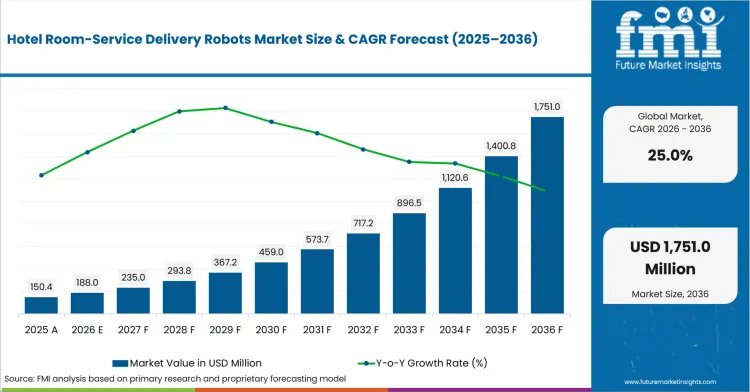
Demand for hotel room-Service delivery robots is projected to expand at 25.0% CAGR between 2026 and 2036, increasing valuation from USD 188.0 million in 2026 to USD 1,751.0 million by 2036.
Hotel teams manage frequent guest requests such as extra towels and forgotten personal items alongside daily service responsibilities. Higher workloads are encouraging investment in autonomous delivery robots that reduce repetitive staff activities. Corridor delivery robots are projected to represent 58.0% of product demand in 2026. Hotels favour wheeled robots designed for hallway navigation since they require less infrastructure than elevator-integrated systems. According to the American Hotel & Lodging Association, 65.0% of surveyed hotels reported staffing shortages in February 2025.
- Hospitality operators in the United States are placing greater emphasis on elevator compatibility and integration with food delivery platforms to improve property-wide automation. Hotel groups in South Korea are expanding partnerships with domestic robotics companies to strengthen housekeeping support and butler-style services. Hospitality businesses across Europe assess corridor robots according to individual property layouts and day-to-day operating requirements.
- Investment is increasingly directed toward fleet management platforms capable of coordinating multiple robots within a single property. Buyers evaluate navigation accuracy and delivery speed before selecting robotic delivery systems. Product differentiation now reflects dependable software performance and efficient fleet management alongside payload capacity.
Key Takeaways of Hotel Room-Service Delivery Robots Market
- Demand for hotel room-service delivery robots is driven by uneven guest requests across floors and shift patterns, with the market valued at USD 188.0 million in 2026 and projected to reach USD 1,751.0 million by 2036 at a 25.0% CAGR.
- Corridor delivery robots are expected to lead the product category with 58.0% share in 2026, favored for accessible installation across hotel properties.
- Room-service delivery is the dominant application segment, projected to hold 52.0% share in 2026, reflecting its role in offsetting uneven small-request workload.
- Hardware is estimated to lead component spend with 54.0% share in 2026, forming the largest cost category within deployed systems.
- Elevator-interoperability standards and fleet-software coordination remain critical purchasing considerations, alongside guest preference for contactless delivery and staffing shortages in housekeeping and front-desk roles.
- The United States, South Korea, European Union, and Japan show distinct adoption patterns, shaped by large-scale domestic piloting, robotics-hospitality co-development, fragmented ownership structures, and staffing pressure across accommodation facilities.
- Competition centers on elevator-communication hardware, fleet-software coordination, and guest-facing display design, with vendors differentiating through dependable uptime and subscription-based deployment models that ease adoption for smaller properties.
Analyst Perspective
"Hotel service robots are moving beyond novelty and becoming part of everyday guest operations, where consistent performance matters more than isolated demonstrations. Hotel operators are assessing whether robotic delivery systems can integrate smoothly with elevator controls, maintain dependable room-service workflows, and enhance the guest experience without increasing staff workload. Providers that deliver reliable fleet performance, flexible commercial models, and strong operational support will be well placed as hospitality groups expand automation across properties of different sizes and service formats."
- Ronak Shah, Principal Consultant at FMI
How is the Hotel Room-Service Delivery Robots Market segmented?
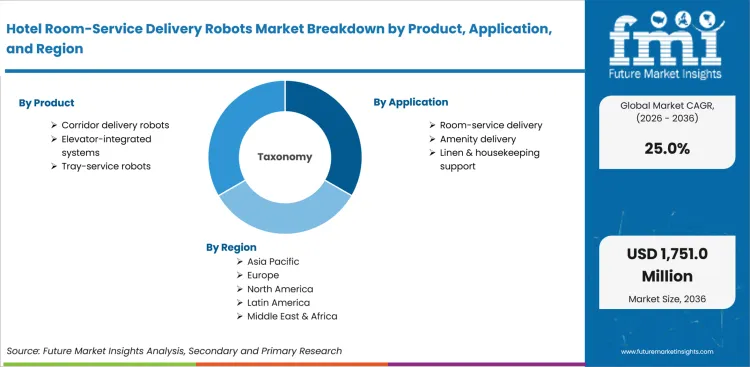
Hotel Room-Service Delivery Robots Market is segmented by product, application, component, end user, business model, and region.
Product segmentation includes corridor delivery robots, elevator-integrated systems, and tray-service robots. Application coverage comprises room-service delivery, amenity delivery, and linen and housekeeping support. Component analysis includes hardware, fleet software, and services. End users include full-service hotels, select-service hotels, and resorts and casinos. Business models consist of robots-as-a-service, direct purchase, and lease arrangements. Regional assessment covers North America, Latin America, Europe, East Asia, South Asia, Oceania, and Middle East and Africa.
Why do corridor delivery robots lead Product adoption?
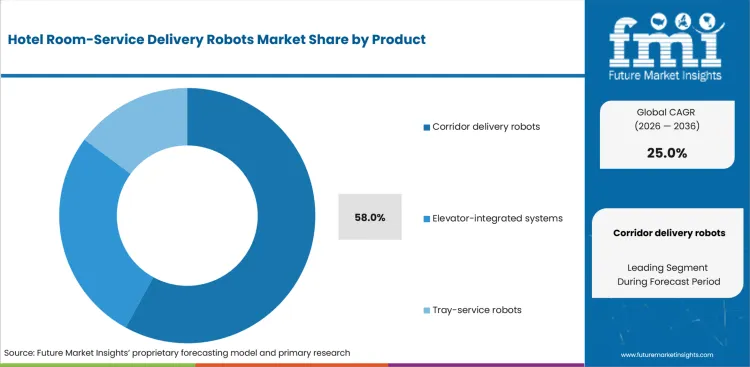
Hotel operators favor wheeled corridor units as an accessible starting point into delivery automation, avoiding costlier structural work tied to elevator-integrated alternatives. Recognizable hallway navigation reduces guest hesitation and supports repeated use across return visits. Fleet-software refinement adds routing intelligence that keeps every delivery run efficient across longer corridors.
- Corridor delivery robots are estimated to represent 58.0% of Product demand in 2026, per FMI's segment analysis. Hotel buyers continue favoring hallway-native formats over elevator-embedded systems given lower installation complexity and faster staff onboarding.
- Growing interest from full-service properties managing high room counts continues supporting commercial demand.
Why does room-service delivery lead Application demand?
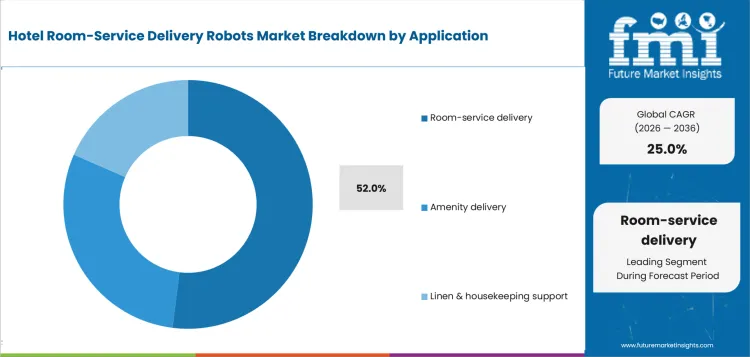
Most robot purchases target actual food and beverage delivery instead of ancillary housekeeping runs. Guests ordering through hotel apps or phone lines represent a clear per-trip return for operators working to keep front-desk staff available for other duties.
- Room-service delivery occupies the leading application position with a 52.0% share in 2026. High volumes of guest food and beverage requests are encouraging hotels to automate routine in-room deliveries.
- Amenity requests and housekeeping support round out remaining Application share, with software personalization continuing to improve dispatch accuracy across repeated guest interactions.
Why does hardware account for most Component spending?
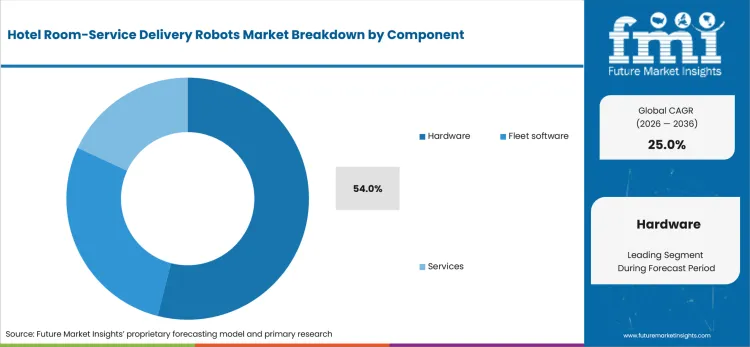
Every corridor delivery robot depends on physical components determining navigation accuracy, payload capacity, and operating uptime. Mechanical design continues representing a substantial portion of manufacturing cost ahead of software and support layered onto every deployment.
- Hardware secures a 54.0% share of component demand in 2026. Core equipment including motors, LiDAR sensors, cameras, battery systems, and structural assemblies contributes substantially to the overall product value.
- Fleet software and services continue extending product functionality following purchase, though hardware reliability remains a first factor hotel buyers evaluate before committing budget toward corridor delivery robots.
What are the drivers, restraints, and opportunities in the Hotel Room-Service Delivery Robots Market?
Growing staffing pressure across hotel floors continues encouraging interest in autonomous delivery platforms. High installation costs remain a barrier for smaller properties, whereas rising guest demand for contactless service opens new avenues for corridor robot suppliers.
- Driver: Persistent staffing shortages across front-desk and housekeeping roles continue encouraging hotel operators to deploy delivery robots for repetitive guest-request trips.
- Restraint: Matching robot format against actual application and building layout continues slowing purchase decisions among first-time buyers.
- Opportunity: Rising demand for contactless, round-the-clock guest service continues creating new openings across full-service hotels and resort properties.
More operators seek delivery coverage blending naturally into everyday hotel operations without added recruitment burden. Corridor delivery robots answer that need through continuous, round-the-clock availability across guest floors. In July 2025, Robotise announced that its JEEVES service robot received the Red Dot Award for Product Design, highlighting growing industry recognition for autonomous hotel delivery solutions.
Affordability shape purchasing behavior across many hotel groups. Corridor delivery robots combine navigation sensors, elevator-communication hardware, and continuous software support within a single product, keeping upfront costs elevated for smaller independent properties. A 2025 World Travel & Tourism Council study projects a shortfall exceeding 8.6 million hospitality workers globally by 2035, underscoring long-term pressure that continues pushing many operators toward automation despite near-term cost hesitation.
Hotel groups increasingly view corridor delivery robots as tools complementing front-desk staff instead of replacing guest-facing roles. Resort properties, extended-stay brands, and select-service chains continue exploring delivery automation to maintain service consistency during peak occupancy. Close to 80.0% of travelers indicated a preference for fully automated front-desk interactions, according to a May 2025 hospitality-technology review published by CiHMS, a proportion signaling wider guest readiness for continued robot deployment across additional touchpoints.
Which country CAGRs are profiled in the Hotel Room-Service Delivery Robots Market?
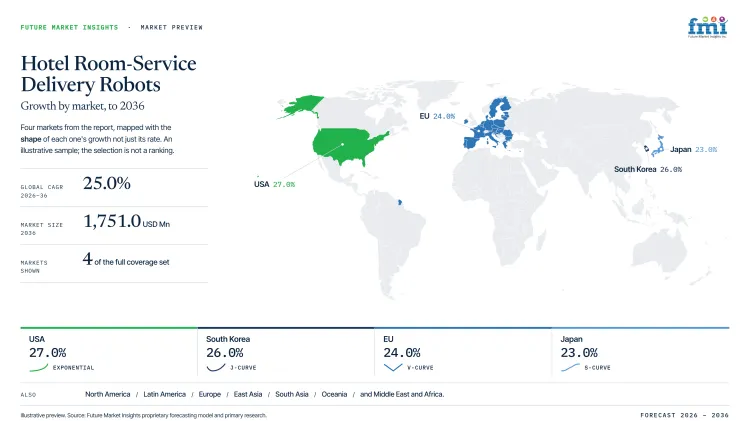
| Country | CAGR |
|---|---|
| USA | 27.0% |
| EU | 24.0% |
| South Korea | 26.0% |
| Japan | 23.0% |
Source: FMI's proprietary forecasting model and primary research.
How do country-level CAGRs compare in the Hotel Room-Service Delivery Robots Market?
The country comparison spans 4.0 percentage points across the hotel room-service delivery robots market. The United States records the highest CAGR at 27.0%, followed by South Korea at 26.0%. The European Union reaches 24.0%, while Japan posts 23.0%. The relatively narrow spread indicates that hospitality automation is progressing across all four markets, although investment priorities and hotel operating models differ.
- The United States leads with a CAGR of 27.0%. Hotels are expanding the use of autonomous delivery robots to transport food, beverages, amenities and guest requests, helping streamline room-service operations and support contactless service where appropriate.
- South Korea follows at 26.0%, just 1.0 percentage point behind the United States. Hotel operators continue integrating service robots into smart hospitality strategies, where automated deliveries improve operational efficiency and allow staff to focus on guest-facing responsibilities.
- The European Union records a CAGR of 24.0%, 2.0 percentage points below South Korea. Adoption is increasing in hotels seeking to automate routine in-building deliveries and improve service consistency. Deployment varies across member states because hotel investment cycles, labor availability and technology adoption differ across the region.
- Japan reaches a CAGR of 23.0%, 1.0 percentage point below the European Union. The market reflects continued interest in service robotics for accommodation facilities, particularly where operators are modernizing guest services and improving internal logistics through autonomous delivery systems.
Comparable CAGRs do not indicate identical market conditions. Differences in hotel infrastructure, automation strategies, labor costs and hospitality technology investment influence deployment decisions and long-term commercial opportunities. The full report provides country-level CAGR analysis across North America, Latin America, Europe, East Asia, South Asia, Oceania and the Middle East and Africa.
Country-wise Analysis
Robot adoption across hotels varies according to labour availability, investment priorities, and property ownership models. The United States and South Korea are adopting service robots at a quicker pace. European hotels are expanding automation gradually, while Japanese operators remain more selective because of investment planning across smaller properties.
- The United States is projected to register a CAGR of 27.0% through 2036 as major hotel brands expand corridor delivery robots to improve guest service and reduce routine staff workloads. According to the American Hotel & Lodging Association, 65.0% of surveyed hotels reported staffing shortages in February 2025, encouraging wider adoption of automated delivery systems during busy and overnight shifts.
- Supported by a strong domestic robotics ecosystem, South Korea is expected to grow at a CAGR of 26.0% between 2026 and 2036. The International Federation of Robotics reported 1,220 robots per 10,000 employees in its World Robotics 2025 report, reflecting broad acceptance of automation that supports hospitality robot deployment.
- Growth across the European Union is estimated at a CAGR of 24.0% through 2036 as hotel operators gradually invest in robotic delivery solutions suited to diverse property formats. HOTREC reported an average workforce shortage of nearly 10.0% in its January 2026 roadmap, encouraging hotels to automate repetitive delivery tasks while improving operational efficiency.
- Japan is anticipated to expand at a CAGR of 23.0% during the forecast period as hotels introduce automation through carefully planned investments that match operational requirements.
Who are the notable companies in the Hotel Room-Service Delivery Robots Market?
Companies active in this market include Relay Robotics (US), Robotise JEEVES (DE), LG CLOi (KR).
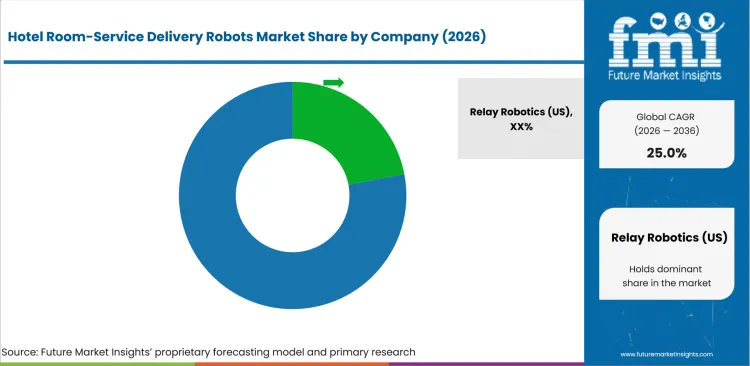
- Competition is assessed around product relevance, deployment fit, service capability, and ability to support procurement or integration requirements within this market.
- Relay Robotics (US), Robotise JEEVES (DE), LG CLOi (KR) represent the principal company group profiled in this report.Competitive Benchmarking: Hotel Room-Service Delivery Robots Market
| Company | Elevator Integration | Fleet Software | Product Innovation | Geographic Presence |
|---|---|---|---|---|
| Relay Robotics (US) | High | High | High | North America |
| Robotise JEEVES (DE) | Medium | High | High | Europe |
| LG CLOi (KR) | High | Medium | High | Asia and North America |
Scoring basis: High reflects established capability in elevator interoperability, fleet coordination, and commercial product availability. Medium represents demonstrated capability across selected hospitality deployments and regional markets.
Source: FMI proprietary competitive assessment based on company product portfolios, commercial activity, and primary research.
Key Players in the Hotel Room-Service Delivery Robots Market
- Relay Robotics (US)
- Robotise JEEVES (DE)
- LG CLOi (KR)
Hotel Room-Service Delivery Robots Market Report Scope
| Coverage field | Report scope |
|---|---|
| Market Segmentation | Product, application, component, end user, business model, country, and regional analysis. |
| Quantitative Units | Revenue in USD Million, CAGR in %. |
| Market Definition | Hotel room-service delivery robots are autonomous hardware and software systems designed to transport food, beverages, amenities, and housekeeping items between hotel service points and guest rooms through corridor navigation, elevator interoperability, and fleet-management software. |
| Regions Covered | North America, Latin America, Europe, East Asia, South Asia, Oceania, and Middle East and Africa. |
| Countries Covered | United States, South Korea, Germany, United Kingdom, France, Japan, China, Australia, and more than 30 additional countries. |
| Key companies active in the market include Relay Robotics (US), Robotise JEEVES (DE), LG CLOi (KR). | Relay Robotics, Inc., Robotise AG, and LG Electronics Inc. |
| Forecast Period | 2026 to 2036, with 2025 used as the historical market-size reference. |
| Approach | Hybrid bottom-up and top-down market sizing supported by vendor activity, hotel adoption trends, labor-market data, and country-level robotics acceptance patterns. |
Source: FMI proprietary research and market analysis.
Hotel Room-Service Delivery Robots Market Research Methodology
| Method | Approach |
|---|---|
| Primary Research | FMI analysts gathered input from manufacturers, service providers, technology developers, distributors, end users, procurement teams, and subject-matter experts. Interviews examined purchasing decisions, product or service evaluation, adoption barriers, approval requirements, pricing considerations, and expectations for technical or commercial support. Respondents were also asked what evidence is required before a trial, pilot, or initial order develops into regular purchasing. |
| Desk Research | Desk research covered government statistics, regulatory publications, trade data, industry associations, technical literature, standards, company filings, product information, and official corporate announcements. Sources were reviewed for relevance, publication date, geographic coverage, and consistency with the defined market scope. Claims relating to performance, applications, approvals, capacity, investment, and commercial activity were retained only when supported by credible public evidence. |
| Market Sizing and Forecasting | The market model combined the baseline value with historical performance, segment structure, pricing and volume indicators, adoption levels, company participation, and country-level demand conditions. Forecast assumptions considered economic activity, investment trends, regulatory developments, technology adoption, purchasing cycles, supply availability, and barriers to wider market use. Segment and regional estimates were reconciled before the final market total was calculated. |
| Data Validation | Estimates were checked against multiple independent indicators, including public data, company activity, trade patterns, industry developments, and findings from primary interviews. Validation also tested whether products, services, applications, and company revenues fell within the defined market boundaries. Adjacent categories, unsupported claims, overlapping revenues, and activities without direct market relevance were excluded to reduce double counting and maintain consistency across segments and countries. |
Source: Future Market Insights (FMI) analysis, based on proprietary forecasting model and primary research.
Hotel Room-Service Delivery Robots Market by Segments
By Product
- Corridor Delivery Robots
- Elevator-Integrated Systems
- Tray-Service Robots
By Application
- Room-Service Delivery
- Amenity Delivery
- Linen & Housekeeping Support
By Component
- Hardware
- Fleet Software
- Services
By End User
- Full-Service Hotels
- Select-Service Hotels
- Resorts & Casinos
By Business Model
- Robots-as-a-Service (RaaS)
- Direct Purchase
- Lease
By Region
- North America
- United States
- Canada
- Latin America
- Brazil
- Mexico
- Argentina
- Europe
- Germany
- United Kingdom
- France
- Italy
- Spain
- Rest of Europe
- East Asia
- Japan
- China
- South Korea
- South Asia and Pacific
- India
- ASEAN
- Australia & New Zealand
- Rest of South Asia and Pacific
- Middle East and Africa
- GCC Countries
- South Africa
- Rest of Middle East and Africa
Research Sources and Bibliography
- Future Market Insights analysis and primary research.
- Company public materials reviewed for market relevance: Relay Robotics (US), Robotise JEEVES (DE), LG CLOi (KR).
- Public robotics, automation, defence, hospitality, maritime, and industrial sources reviewed for market context where applicable.
- Key companies active in the market include Relay Robotics (US), Robotise JEEVES (DE), LG CLOi (KR).
- Key companies active in the market include Relay Robotics (US), Robotise JEEVES (DE), LG CLOi (KR).
This Report Answers
- What value is the hotel room-service delivery robots market forecast to reach in 2026 and by 2036?
- What CAGR is expected from 2026 to 2036?
- Which product, application, and component categories make up the disclosed 2026 share view?
- What operating problem is driving hotels toward delivery robot adoption?
- How do country CAGRs differ across the United States, South Korea, European Union, and Japan?
- Which companies are profiled across elevator integration, fleet software, and product innovation?
- How does Future Market Insights frame the market's forecast and segmentation?
- What should buyers evaluate before selecting a corridor delivery robot?
Frequently Asked Questions
What is the biggest challenge for the hotel room-service delivery robots market?
Hotels need to select robots that match their building layout, delivery requirements, and existing infrastructure. Compatibility with elevators and corridor navigation remains an important consideration before deployment.
Why is the hotel room-service delivery robots market growing?
The market is expected to increase from USD 188.0 million in 2026 to USD 1,751.0 million by 2036. Rising labour shortages and greater investment in hospitality automation continue supporting market expansion.
What problem do hotel room-service delivery robots solve?
Delivery robots handle routine requests such as meals, towels, toiletries, and guest amenities. Automation allows hotel staff to spend more time on personalised guest services.
What should buyers consider before purchasing hotel room-service delivery robots?
Buyers evaluate navigation performance, software reliability, elevator compatibility, battery life, maintenance support, and suitability for their hotel environment before selecting a robotic system.
How do companies strengthen customer confidence in hotel room-service delivery robots?
Manufacturers build customer confidence by delivering reliable navigation, stable software performance, responsive technical support, and successful deployment across different hotel environments.
Preview the report firsthand - request a free sample
Get SampleGet the brochure for pricing and purchase details.
Get PDFTable of Content
- Key Takeaways
- Market Size and CAGR
- Top Growth Driver
- Fastest Growing Segment
- Leading Region
- Key Companies
- Emerging Opportunities
- Executive Summary
- Global Market Outlook
- Demand-side Trends
- Supply-side Trends
- Technology Roadmap Analysis
- Analysis and Recommendations
- Analyst Perspective (What is happening? Why now? What should investors know?)
- Key Questions Answered
- How large is the market?
- What is the CAGR?
- What are key trends?
- Which region dominates?
- Who are the leaders?
- Market Overview
- Market Coverage / Taxonomy
- Market Definition / Scope / Limitations
- Research Methodology
- Chapter Orientation
- Analytical Lens and Working Hypotheses
- Market Structure, Signals, and Trend Drivers
- Benchmarking and Cross-market Comparability
- Market Sizing, Forecasting, and Opportunity Mapping
- Research Design and Evidence Framework
- Desk Research Programme (Secondary Evidence)
- Expert Input and Fieldwork (Primary Evidence)
- Tooling, Models, and Reference Databases
- Data Engineering and Model Build
- Quality Assurance and Audit Trail
- Market Background
- Market Dynamics (Drivers, Restraints, Opportunity, Trends)
- Scenario Forecast (Optimistic, Likely, Conservative)
- Impact Analysis
- AI Impact
- Sustainability Impact
- Regulatory Impact
- Technology Impact
- Consumer / Buyer Analysis
- Purchase Drivers
- Adoption Barriers
- Buyer Journey
- Opportunity Map Analysis
- Product Life Cycle Analysis
- Supply Chain Analysis
- Investment Feasibility Matrix
- Value Chain Analysis
- PESTLE and Porter's Analysis
- Regulatory Landscape
- Regional Parent Market Outlook
- Production and Consumption Statistics
- Import and Export Statistics
- Global Market Analysis and Forecast, 2021 to 2036
- Historical Market Size Value (USD Million) Analysis, 2021 to 2025
- Current and Future Market Size Value (USD Million) Projections, 2026 to 2036
- Y-o-Y Growth Trend Analysis
- Absolute $ Opportunity Analysis
- Global Market Pricing Analysis, 2021 to 2036
- Global Market Analysis and Forecast, By Product, 2021 to 2036
- Introduction / Key Findings
- Historical Market Size Value (USD Million) Analysis By Product, 2021 to 2025
- Current and Future Market Size Value (USD Million) Analysis and Forecast By Product, 2026 to 2036
- Corridor delivery robots
- Elevator-integrated systems
- Tray-service robots
- Corridor delivery robots
- Y-o-Y Growth Trend Analysis By Product, 2021 to 2025
- Absolute $ Opportunity Analysis By Product, 2026 to 2036
- Global Market Analysis and Forecast, By Application, 2021 to 2036
- Introduction / Key Findings
- Historical Market Size Value (USD Million) Analysis By Application, 2021 to 2025
- Current and Future Market Size Value (USD Million) Analysis and Forecast By Application, 2026 to 2036
- Room-service delivery
- Amenity delivery
- Linen & housekeeping support
- Room-service delivery
- Y-o-Y Growth Trend Analysis By Application, 2021 to 2025
- Absolute $ Opportunity Analysis By Application, 2026 to 2036
- Global Market Analysis and Forecast, By Component, 2021 to 2036
- Introduction / Key Findings
- Historical Market Size Value (USD Million) Analysis By Component, 2021 to 2025
- Current and Future Market Size Value (USD Million) Analysis and Forecast By Component, 2026 to 2036
- Hardware
- Fleet software
- Services
- Hardware
- Y-o-Y Growth Trend Analysis By Component, 2021 to 2025
- Absolute $ Opportunity Analysis By Component, 2026 to 2036
- Global Market Analysis and Forecast, By End User, 2021 to 2036
- Introduction / Key Findings
- Historical Market Size Value (USD Million) Analysis By End User, 2021 to 2025
- Current and Future Market Size Value (USD Million) Analysis and Forecast By End User, 2026 to 2036
- Full-service hotels
- Select-service hotels
- Resorts & casinos
- Full-service hotels
- Y-o-Y Growth Trend Analysis By End User, 2021 to 2025
- Absolute $ Opportunity Analysis By End User, 2026 to 2036
- Global Market Analysis and Forecast, By Business Model, 2021 to 2036
- Introduction / Key Findings
- Historical Market Size Value (USD Million) Analysis By Business Model, 2021 to 2025
- Current and Future Market Size Value (USD Million) Analysis and Forecast By Business Model, 2026 to 2036
- RaaS
- Direct
- Lease
- RaaS
- Y-o-Y Growth Trend Analysis By Business Model, 2021 to 2025
- Absolute $ Opportunity Analysis By Business Model, 2026 to 2036
- Global Market Analysis and Forecast, By Region, 2021 to 2036
- Introduction
- Historical Market Size Value (USD Million) Analysis By Region, 2021 to 2025
- Current Market Size Value (USD Million) Analysis and Forecast By Region, 2026 to 2036
- North America
- Latin America
- Western Europe
- Eastern Europe
- East Asia
- South Asia and Pacific
- Middle East & Africa
- Market Attractiveness Analysis By Region
- North America Market Analysis and Forecast, By Country, 2021 to 2036
- Historical Market Size Value (USD Million) Trend Analysis By Market Taxonomy, 2021 to 2025
- Market Size Value (USD Million) Forecast By Market Taxonomy, 2026 to 2036
- By Country
- USA
- Canada
- By Product
- By Application
- By Component
- By End User
- By Business Model
- By Country
- Market Attractiveness Analysis
- By Country
- By Product
- By Application
- By Component
- By End User
- By Business Model
- Key Takeaways
- Latin America Market Analysis and Forecast, By Country
- Historical Market Size Value (USD Million) Trend Analysis By Market Taxonomy, 2021 to 2025
- Market Size Value (USD Million) Forecast By Market Taxonomy, 2026 to 2036
- By Country
- Brazil
- Mexico
- Chile
- Rest of Latin America
- By Product
- By Application
- By Component
- By End User
- By Business Model
- By Country
- Market Attractiveness Analysis
- By Country
- By Product
- By Application
- By Component
- By End User
- By Business Model
- Key Takeaways
- Western Europe Market Analysis and Forecast, By Country
- Historical Market Size Value (USD Million) Trend Analysis By Market Taxonomy, 2021 to 2025
- Market Size Value (USD Million) Forecast By Market Taxonomy, 2026 to 2036
- By Country
- Germany
- UK
- Italy
- Spain
- France
- Nordic
- BENELUX
- Rest of Western Europe
- By Product
- By Application
- By Component
- By End User
- By Business Model
- By Country
- Market Attractiveness Analysis
- By Country
- By Product
- By Application
- By Component
- By End User
- By Business Model
- Key Takeaways
- Eastern Europe Market Analysis and Forecast, By Country
- Historical Market Size Value (USD Million) Trend Analysis By Market Taxonomy, 2021 to 2025
- Market Size Value (USD Million) Forecast By Market Taxonomy, 2026 to 2036
- By Country
- Russia
- Poland
- Hungary
- Balkan & Baltic
- Rest of Eastern Europe
- By Product
- By Application
- By Component
- By End User
- By Business Model
- By Country
- Market Attractiveness Analysis
- By Country
- By Product
- By Application
- By Component
- By End User
- By Business Model
- Key Takeaways
- East Asia Market Analysis and Forecast, By Country
- Historical Market Size Value (USD Million) Trend Analysis By Market Taxonomy, 2021 to 2025
- Market Size Value (USD Million) Forecast By Market Taxonomy, 2026 to 2036
- By Country
- China
- Japan
- South Korea
- By Product
- By Application
- By Component
- By End User
- By Business Model
- By Country
- Market Attractiveness Analysis
- By Country
- By Product
- By Application
- By Component
- By End User
- By Business Model
- Key Takeaways
- South Asia and Pacific Market Analysis and Forecast, By Country
- Historical Market Size Value (USD Million) Trend Analysis By Market Taxonomy, 2021 to 2025
- Market Size Value (USD Million) Forecast By Market Taxonomy, 2026 to 2036
- By Country
- India
- ASEAN
- Australia & New Zealand
- Rest of South Asia and Pacific
- By Product
- By Application
- By Component
- By End User
- By Business Model
- By Country
- Market Attractiveness Analysis
- By Country
- By Product
- By Application
- By Component
- By End User
- By Business Model
- Key Takeaways
- Middle East & Africa Market Analysis and Forecast, By Country
- Historical Market Size Value (USD Million) Trend Analysis By Market Taxonomy, 2021 to 2025
- Market Size Value (USD Million) Forecast By Market Taxonomy, 2026 to 2036
- By Country
- Kingdom of Saudi Arabia
- Other GCC Countries
- Türkiye
- South Africa
- Other African Union
- Rest of Middle East & Africa
- By Product
- By Application
- By Component
- By End User
- By Business Model
- By Country
- Market Attractiveness Analysis
- By Country
- By Product
- By Application
- By Component
- By End User
- By Business Model
- Key Takeaways
- Key Countries Market Analysis
- USA
- Pricing Analysis
- Market Share Analysis, 2025
- By Product
- By Application
- By Component
- By End User
- By Business Model
- Canada
- Pricing Analysis
- Market Share Analysis, 2025
- By Product
- By Application
- By Component
- By End User
- By Business Model
- Mexico
- Pricing Analysis
- Market Share Analysis, 2025
- By Product
- By Application
- By Component
- By End User
- By Business Model
- Brazil
- Pricing Analysis
- Market Share Analysis, 2025
- By Product
- By Application
- By Component
- By End User
- By Business Model
- Chile
- Pricing Analysis
- Market Share Analysis, 2025
- By Product
- By Application
- By Component
- By End User
- By Business Model
- Germany
- Pricing Analysis
- Market Share Analysis, 2025
- By Product
- By Application
- By Component
- By End User
- By Business Model
- UK
- Pricing Analysis
- Market Share Analysis, 2025
- By Product
- By Application
- By Component
- By End User
- By Business Model
- Italy
- Pricing Analysis
- Market Share Analysis, 2025
- By Product
- By Application
- By Component
- By End User
- By Business Model
- Spain
- Pricing Analysis
- Market Share Analysis, 2025
- By Product
- By Application
- By Component
- By End User
- By Business Model
- France
- Pricing Analysis
- Market Share Analysis, 2025
- By Product
- By Application
- By Component
- By End User
- By Business Model
- India
- Pricing Analysis
- Market Share Analysis, 2025
- By Product
- By Application
- By Component
- By End User
- By Business Model
- ASEAN
- Pricing Analysis
- Market Share Analysis, 2025
- By Product
- By Application
- By Component
- By End User
- By Business Model
- Australia & New Zealand
- Pricing Analysis
- Market Share Analysis, 2025
- By Product
- By Application
- By Component
- By End User
- By Business Model
- China
- Pricing Analysis
- Market Share Analysis, 2025
- By Product
- By Application
- By Component
- By End User
- By Business Model
- Japan
- Pricing Analysis
- Market Share Analysis, 2025
- By Product
- By Application
- By Component
- By End User
- By Business Model
- South Korea
- Pricing Analysis
- Market Share Analysis, 2025
- By Product
- By Application
- By Component
- By End User
- By Business Model
- Russia
- Pricing Analysis
- Market Share Analysis, 2025
- By Product
- By Application
- By Component
- By End User
- By Business Model
- Poland
- Pricing Analysis
- Market Share Analysis, 2025
- By Product
- By Application
- By Component
- By End User
- By Business Model
- Hungary
- Pricing Analysis
- Market Share Analysis, 2025
- By Product
- By Application
- By Component
- By End User
- By Business Model
- Kingdom of Saudi Arabia
- Pricing Analysis
- Market Share Analysis, 2025
- By Product
- By Application
- By Component
- By End User
- By Business Model
- Türkiye
- Pricing Analysis
- Market Share Analysis, 2025
- By Product
- By Application
- By Component
- By End User
- By Business Model
- South Africa
- Pricing Analysis
- Market Share Analysis, 2025
- By Product
- By Application
- By Component
- By End User
- By Business Model
- USA
- Market Structure Analysis
- Competition Dashboard
- Competition Benchmarking
- Market Share Analysis of Top Players
- By Regional
- By Product
- By Application
- By Component
- By End User
- By Business Model
- Emerging Startups
- Innovation Benchmarking
- Competition Analysis
- Competition Deep Dive
- Relay Robotics (US)
- Overview
- Product Portfolio
- Profitability by Market Segments
- Sales Footprint
- Strategy Overview
- Marketing Strategy
- Product Strategy
- Channel Strategy
- Robotise JEEVES (DE)
- LG CLOi (KR)
- Relay Robotics (US)
- Case Studies
- Success Stories
- Recent Developments
- Competition Deep Dive
- Assumptions & Acronyms Used


