

- Industry Size (2026)
- USD 3150.0 Mn
- Forecast (2036)
- USD 7900.0 Mn
- CAGR (2026 to 2036)
- 9.6%
Hotel Channel Management Market Size, Market Forecast and Outlook By FMI
The hotel channel management market projected to reach USD 3,150.0 million in 2026, and is forecast to expand to USD 7,900.0 million by 2036 at a 9.6% CAGR.
Summary of Hotel Channel Management Market
- By 2036, the market is projected to be worth USD 7,900.0 million.
- A 9.6% compound annual growth rate is anticipated between 2026 and 2036.
- Market size in 2025 was estimated at USD 868.67 million.
- China leads country-level growth at 12.2% CAGR, underpinned by strong domestic demand and favorable policy conditions.
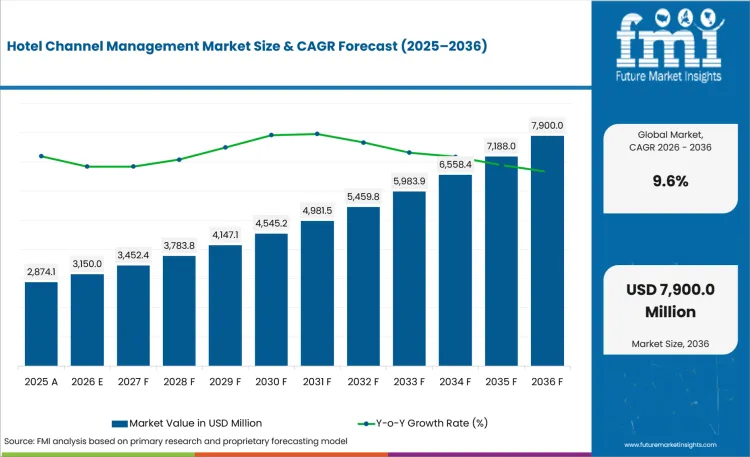
Hotel Channel Management Market Key Takeaways
| Metric | Details |
|---|---|
| Industry Size (2026) | USD 3,150.0 million |
| Industry Value (2036) | USD 7,900.0 million |
| CAGR (2026-2036) | 9.6% |
Source: Future Market Insights, 2026
Accelerating online travel agency (OTA) proliferation, combined with the operational complexity of managing real-time inventory across an expanding number of booking platforms, is driving sustained adoption of automated channel management solutions across premium, standard, and budget hotel segments. As per FMI, the premium segment holds a 37.1% share in 2026, reflecting higher per-property subscription values and the operational urgency of real-time rate parity management across multiple high-commission distribution channels.
Accommodation services anchor demand at 53.7% of service type share, as channel management platforms primarily serve room inventory synchronization, rate distribution, and availability calendar management functions. Solo travelers dominate the occupancy segment, reflecting the growth of business travel and independent leisure booking behavior where real-time availability accuracy directly influences conversion rates. FMI is of the opinion that the integration of revenue management algorithms within channel management platforms is transforming these tools from passive distribution utilities into active yield optimization engines, where dynamic pricing recommendations respond to demand signals aggregated across all connected booking channels.
India leads growth at 14.7% CAGR, driven by rapid hotel supply expansion, OTA market penetration, and government tourism promotion initiatives. China follows at 12.2%, supported by domestic travel platform proliferation and hotel chain digitization programs. Canada registers 10.3% growth as independent hotel operators adopt channel management tools to compete with chain-affiliated properties on OTA platforms. The United Kingdom tracks at 4.4% and the United States at 3.9%, where mature markets sustain upgrade-cycle demand as properties migrate from legacy systems to cloud-native channel management platforms. FMI analysts observe that the convergence of property management system (PMS) and channel management functionality into unified cloud platforms is reducing adoption barriers for smaller properties.
Hotel Channel Management Market Definition
Hotel channel management software enables hospitality properties to distribute room inventory, rates, and availability across multiple online and offline booking channels from a single platform. These systems synchronize real-time updates across OTAs, global distribution systems (GDS), metasearch engines, and direct booking websites to prevent overbooking and maintain rate parity.
Hotel Channel Management Market Inclusions
Market scope includes channel management platforms serving premium, budget, and standard hotel segments across accommodation, food and beverage, and other hospitality services. The report covers market sizes by hotel type, service type, occupant category, and region for the 2026 to 2036 forecast period.
Hotel Channel Management Market Exclusions
The scope excludes standalone property management systems (PMS) without integrated channel distribution functionality, online travel agency platforms themselves, and metasearch engine advertising tools. Revenue management systems sold as independent software products are not included.
Hotel Channel Management Market Research Methodology
- Primary Research : Analysts engaged with hotel technology directors, independent property owners, and hospitality technology consultants to map platform adoption triggers, integration requirements, and subscription pricing models across different property segments.
- Desk Research : Data collection included national tourism authority accommodation statistics, OTA market share reports, hospitality technology industry surveys, and published hotel technology adoption benchmarking studies.
- Market-Sizing and Forecasting : Baseline values derive from a bottom-up aggregation of channel management platform subscriptions by property segment, applying regional hotel supply counts and SaaS pricing tiers to project market revenue.
- Data Validation and Update Cycle : Projections are validated against publicly reported revenue from listed hospitality technology companies and cross-referenced with hotel industry supply data from national tourism authorities.
Key Industry Highlights
Hotel Channel Managers are Crucial for Managing Online Channels
The hospitality industry is becoming more digital, relying more on online channels for bookings. As global hotel chains expand, managing channels becomes essential to maintain consistent inventory and pricing across different markets and distribution methods.
Hotel channel managers help hotels manage these channels better, reaching more people online and increasing visibility. With digitalization, there are now many online platforms hotels must manage, like OTAs, metasearch engines, GDS, and social media.
Expedia, Booking.com, and Airbnb offer online platforms for hotels to showcase their rooms and reach a wider audience. Channel managers make it easier to update rates and availability across all these platforms in real time. This digital shift has made the distribution complex, requiring channel managers to streamline operations and optimize strategies. As hotels keep up with digital trends, the need for effective channel management solutions is likely to skyrocket.
Growing Preference for Cloud-based Channel Management in Hospitality
Hoteliers are leveraging innovative technologies like advanced analytics and business intelligence solutions integrated into channel management systems to gain insights into booking trends, guest preferences, and demand. These insights help hotels optimize pricing, distribution strategies, and advertising campaigns through data-driven decision-making.
Cloud-based channel management systems are becoming extremely popular because of their scalability, flexibility, and cost-effectiveness compared to traditional on-premises solutions. The hotel industry is increasingly adopting cloud technologies for channel management needs.
Cloud-based software as a service (SaaS) channel managers provide connectivity to top OTAs such as Booking.com and Expedia, as well as regional platforms like MakeMyTrip and Traveloka. They also connect with Google Hotel Ads, expanding hotels' reach to a wide range of potential guests across different platforms.
Challenges of Connecting Channel Management with Hotel Technologies
For smaller hotels or those with tighter budgets, setting up channel management systems can be costly. On top of software costs, training staff and integrating the system into existing operations require high expenditure.
Integrating channel management systems with revenue management systems, property management systems, and central reservation systems can be challenging and time-consuming. Compatibility issues and customization needs might lead to delays and extra expenses.
Resistance to change can hinder the widespread adoption of channel management solutions. This is especially prevalent for hoteliers who have had success with manual or outdated systems. Convincing stakeholders of the benefits of new technology may require overcoming reluctance to change.
2021 to 2025 Global Hotel Channel Management Sales Outlook Compared to Demand Forecasts from 2026 to 2036
In the past, travelers and hoteliers mainly relied on retail travel agents. But now, especially during the historical period, booking hotels through online websites and mobile applications witnessed a massive boom. Hence, there has been a big demand for hotel channel managers. Hotels need a unified system to keep track of all their distribution channels, especially with so many online platforms available.
Hotels are present on multiple booking platforms and use online channel managers to take advantage of this trend. This is where a channel manager becomes valuable. It helps hotels manage their channels seamlessly in a busy sector, preventing overbooking or double bookings and reducing human errors that could impact guest satisfaction.
Many of today's travelers prefer hotels that use channel management systems, and these travelers make up a significant portion of customers. The availability of app-based channel management systems could further boost the appeal of these systems for hotels.
Artificial intelligence and machine learning technologies in hotel channel management systems offer significant opportunities for hotels. They can help hotel channel managers to analyze large amounts of data to improve distribution strategies.
The detailed reports and data analysis tools in channel managers help hotels make smart decisions. Hotels can use this information to set prices and manage bookings better, making more money. Analyzing guest behavior and industry trends helps hotels make the most of their resources and increase profits.
Market Concentration
Tier 1 companies lead the hotel channel management market with big names like Amadeus IT Group, Sabre Corporation, Expedia Group, Booking Holdings, and Travelport Worldwide Limited controlling it. They control a large part of the industry, bringing in about USD 371.3 million, which is 50% of the global industry share.
These companies are famous for their strong presence and influence in the industry. These companies invest heavily in research and development to stay ahead of competitors and provide innovative solutions to their clients.
Tier 2 companies include SiteMinder, RateGain, Cloudbeds, Pegasus Solutions, and eRevMax. Together, they hold around 35% of the global industry value share, which is worth USD 259.9 million.
Although they are not as big as Tier 1 companies, Tier 2 companies are appreciated for their innovative solutions and customer-focused approach. They differentiate themselves from Tier 1 companies by focusing on niche markets and offering competitive pricing.
Tier 3 companies comprise Channel Manager, D-EDGE Hospitality Solutions, AxisRooms, STAAH, and Cubilis. While not as prominent as Tier 1 and Tier 2 companies, they still generate a significant revenue of about USD 111.4 million, making up 15% of the industry.
What sets them apart is their focus on specific markets, agility in adapting to industry changes, and offering cost-effective solutions to smaller hotels and accommodations.
Country-wise Insights
The following section discusses recent trends in the hotel channel management market in different countries in Europe, Asia Pacific, and North America.
In North America, the United States is the prominent industry and is on its way to surge at 3.9% CAGR through 2036. In Europe, the United Kingdom tops the chart and is set to make its progression at a 7.2% CAGR through 2036.
In Asia Pacific, India is evolving as a leading industry. It is on track to develop more promptly than China, with a yearly growth rate of 14.7% compared to China's 12.2% through 2036.
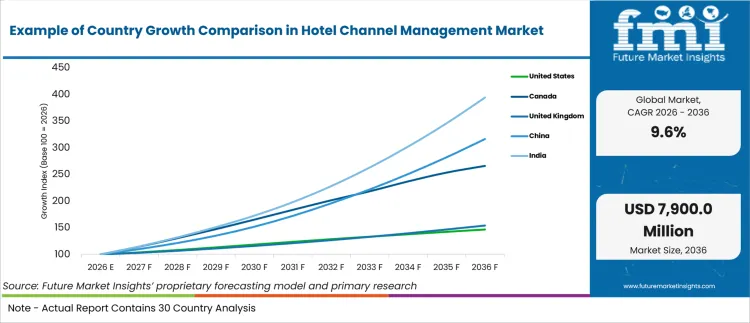
| Countries | CAGR 2026 to 2036 |
|---|---|
| United States | 3.9% |
| Canada | 10.3% |
| United Kingdom | 4.4% |
| China | 12.2% |
| India | 14.7% |
Hospitality Boom Drives Demand for Channel Management Systems in the United States
There are many hotels and a strong travel and tourism business in the United States. This creates a big need for hotel channel management systems. Business travel, leisure travel, events, and conventions drive demand for hotel rooms. Cities like New York, Las Vegas, Orlando, Los Angeles, Miami, and San Francisco have very active hotels. These systems are widely accepted by these hotels.
The 3.9% CAGR for the hotel channel management market in the United States shows it has come to maturation. Many big players in this industry are coexisting with each other. They offer a variety of services to hotels. For instance, SiteMinder is a top player in the United States that connects hotels to over 400 channels. These include online travel agencies, wholesalers, and global distribution systems.
In January 2026, SiteMinder was recognized at the 2026 HotelTechAwards. It won the title of ‘Best Hotel eCommerce Platform’ for the second year in a row. SiteMinder is known for combining revenue management and marketing software for hotels.
Tourist Inflow Drives Adoption of Channel Management Software in the United Kingdom
The hospitality industry in the United Kingdom is quite extensive as it is a popular destination, drawing millions each year with its various attractions. The influx of tourists boosts demand for accommodation, leading to higher occupancy and room rates. This sequentially increases the adoption of hotel channel management software like Preno's UK Channel Manager Software.
It helps hotels manage inventory distribution, pricing, and availability. It also lists properties on over 54 popular online travel agencies. Also, it provides training resources, support from experts, powerful analytics, and easy-to-use controls.
This industry has room for innovation. New technologies like AI and cloud computing can still bring changes. The competition among big players guarantees high-quality services. Smaller companies can also find niche opportunities. The industry's growth is expected to continue steadily. As a result, the future projection of the hotel channel management market in the United Kingdom indicates a moderate CAGR of 4.4%.
India Emerges as a Global Travel Hotspot, Driving Demand for Channel Managers
The India hotel channel management market outlook looks bright as it is forecasted to expand at a CAGR of 23.1%. The main reason is the fast growth in technology in this area. On top of that, urban areas are growing quickly, and with people having more money to spend, they are willing to invest in these types of hotels.
India's stability, good infrastructure, and hosting of international events have made it even more attractive as a travel destination. During India's G20 presidency in 2023, there were over 200 meetings held in different locations across the country, boosting demand for hotels in those cities. During this time, demand for hotel channel managers was at its peak.
Domestic tourism in India is also strong, with more people choosing staycations for convenience, safety, and the chance to discover hidden gems within the country. There are also more independent and boutique hotels in the region, adding to this demand. India has become a top destination for both leisure and business travelers globally. This contributes to the growth of tourism and, in turn, strengthens the hotel channel manager industry.
There are a lot of industry players present in this country. For instance, ChannelSyncro, India's top Hotel Channel Manager Software, helps hotels manage their online presence, distribution, revenue, and bookings across multiple channels easily.
Category-wise Insights
This section elaborates on dynamics observed in the hotel channel management market based on its top segments. In terms of type, the premium segment is estimated to dominate by holding a share of 37.1% in 2024. By service type, the accommodation category is projected to fortify its position as the champion by obtaining more than half of the industry share, which is around 53.7%, in 2024.
Rise of Premium Hotels Signals Growth in Demand for Hotel Channel Managers
Premium hotels are having a magnificent moment at present. These hotels are in great need of hotel channel management systems. These systems help them maintain a strong online presence and uphold their brand reputation.
With hotel channel management systems, these hotels can effectively manage their online partners and marketing channels. This ensures that their presence on various distribution channels is accurate, reliable, and up-to-date.
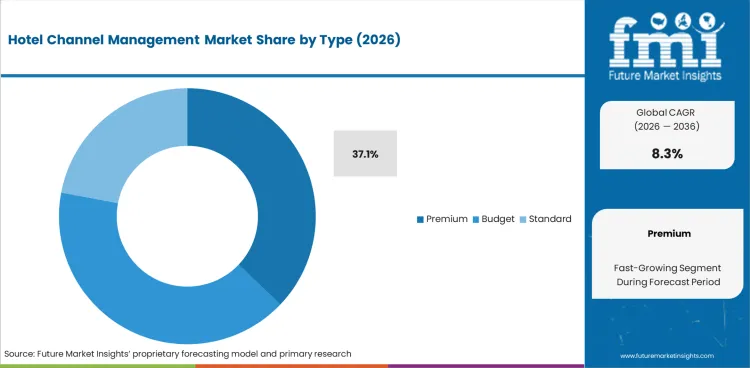
| Segment | Premium (Type) |
|---|---|
| Value Share (2026 | 37.1% |
The rise of online booking has made the segment grow faster. For example, on February 10th, 2026, Marriott International updated its mobile app, Marriott Bonvoy, with new features like easier booking, more personalized experiences, as well as options to earn and use points.
This increased need for better services is expected to boost the demand for hotel channel managers, who help hotels manage their online bookings and services effectively.
Hotel Channel Management Simplifies Accommodation Updates across Platforms
Hotel channel management is principally used for accommodation because it helps hotels manage their distribution channels effectively. These systems consent hotels to connect with various online travel agencies and other booking platforms.
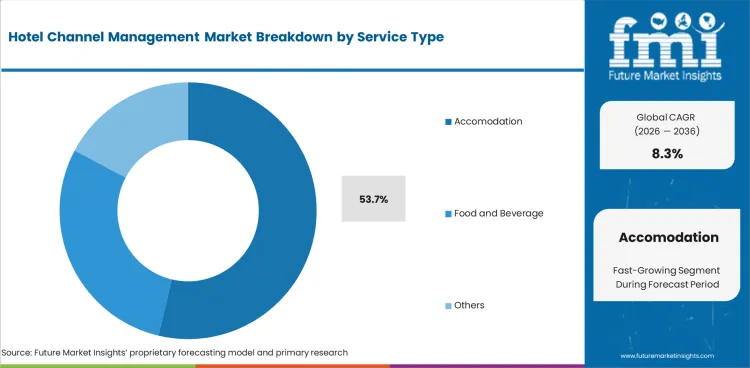
| Segment | Accommodation (Service Type) |
|---|---|
| Value Share (2026) | 53.7% |
With the utilization of channel management software, hotels can update their room availability, rates, and other information across all channels in real-time. This software lets hotels change room availability and update rates instantly across many channels at once. This clears confusion regarding the overbooking of rooms and helps in maximizing occupancy rates.
Competition Outlook
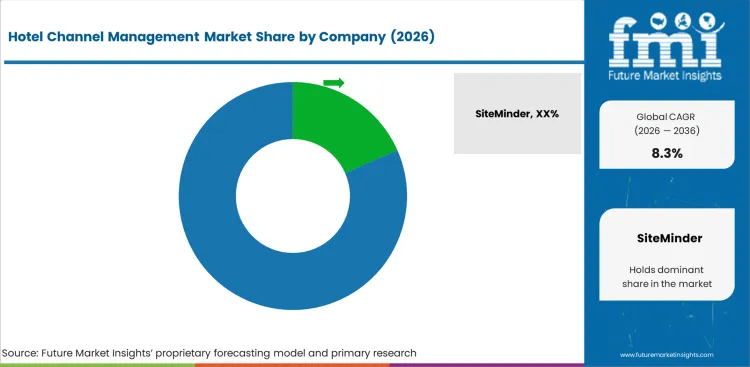
The hotel channel management market statistics report indicates that companies compete based on price, features, and customer service. They plan to attract hotels by offering efficient and customizable solutions.
The industry is growing fast, with unique hotel channel management digital marketing strategies speeding up growth. Companies focus on innovative tactics like SEO, social media marketing, as well as targeted advertising to attract and retain hotels in the competitive industry.
To stay ahead, key players in the hotel channel management industry focus on highlighting unique features. This includes advanced analytics, real-time inventory management, and seamless integration with online booking platforms.
In the competitive landscape of the hotel channel management industry, top companies focus on affordability. They offer cost-effective solutions with flexible pricing models, budget-friendly packages, and transparent fee structures. This strategy helps attract multiple hotels, from boutique to large chains.
Global hotel channel management market scenario dynamics show that top players are engaging in mergers and acquisitions. This strategy helps them magnify their industry presence, acquire new technologies, and enrich service offerings. It also strengthens their competitive position by consolidating resources and reaching a broader customer base.
Industry Updates
- In May 2024, SiteMinder launched its top-notch platform for mobile devices. This authorizes accommodation providers to manage revenue and handle real-time risks anywhere, not just at their desks. The mobile app marks the initial stage of SiteMinder's smart platform delivery, a significant step toward democratizing advanced revenue management for all hotels globally.
- In December 2023, Revivo introduced its leading channel management suite, Hotel X. It's India's inaugural all-inclusive Hospitality Management and Growth platform designed for progressive hotels nationwide. Developed by hoteliers, Hotel X is a comprehensive SaaS solution that adeptly automates and manages hotel operations, improving revenue globally.
- In March 2023, Guestcentric unveiled HyperCommerce, a channel management solution for hotel eCommerce and distribution needs. It enables hotels to provide personalized experiences, adopt attribute-based pricing, and create additional revenue streams. It meets the demand for omnichannel presence and integrates with emerging booking channels like social media and conversational interfaces.
Scope of the Report
| Metric | Value |
|---|---|
| Quantitative Units | USD 3,150.0 million to USD 7,900.0 million, at a CAGR of 9.6% |
| Market Definition | Hotel channel management software enables hospitality properties to distribute room inventory, rates, and availability across multiple online and offline booking channels from a single platform. These... |
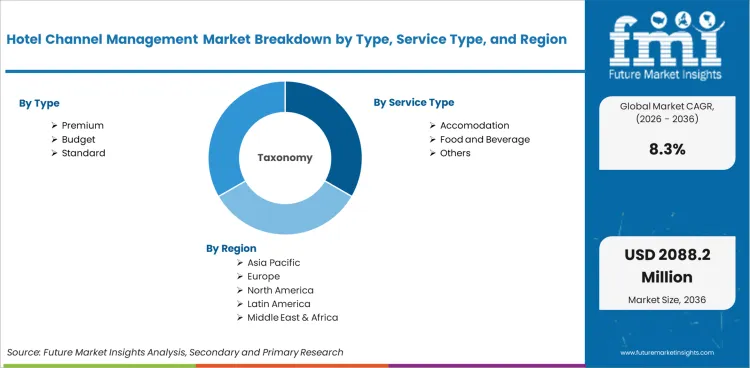
| Segmentation | Type: Premium, Budget, Standard; Service Type: Accomodation, Food and Beverage, Others; Occupants: Solo, Group |
| Regions Covered | North America, Latin America, Europe, East Asia, South Asia, Oceania, Middle East & Africa |
| Countries Covered | India, China, Canada, UK, USA, and 40 plus countries |
| Key Companies Profiled | SiteMinder, eRevMax, SkyTouch Technology, Hotelier, RateGain, SmartHOTEL, InnQuest, StayNToch, Vertical Booking, Profitroom, Little Hotelier, Intuitive |
| Forecast Period | 2026 to 2036 |
| Approach | Forecasting models apply a bottom-up methodology starting with installed base metrics and cross-validate projections against publicly reported industry data. |
Key Segments of Market Report
By Type:
In terms of type, the industry is trifurcated into budget, standard, and premium.
By Service Type:
Based on service type, the industry is divided into accommodation, food and beverage, and others.
By Occupants:
Depending on occupants, the industry is categorized into solo and group.
By Region:
A regional analysis of the hotel channel management market is conducted across North America, Latin America, Western Europe, Eastern Europe, South Asia and Pacific, and the Middle East and Africa
Bibliography
- 1. World Tourism Organization (UNWTO). (2025). World Tourism Barometer. UNWTO.
- 2. Ministry of Tourism, Government of India. (2024). India Tourism Statistics 2024. Ministry of Tourism.
- 3. Organisation for Economic Co-operation and Development. (2024). OECD Tourism Trends and Policies. OECD.
- 4. Phocuswright. (2024). Global Online Travel Overview (public summary). Phocuswright.
- 5. STR Global. (2025). Hotel Industry Performance Metrics: Global Summary. STR.
This bibliography is provided for reader reference. The full Future Market Insights report contains the complete reference list with primary research documentation.
Frequently Asked Questions
How large is the hotel channel management market in 2026?
The hotel channel management market is estimated to be valued at USD 3,150.0 million in 2026.
What will be the market size by 2036?
Market size is projected to reach USD 7,900.0 million by 2036.
What is the expected CAGR between 2026 and 2036?
The market is expected to grow at a CAGR of 9.6% between 2026 and 2036.
Which Type segment leads in 2026?
Premium holds 37.1% share in 2026 by Type.
Which country records the fastest growth?
India is projected to grow at 14.7% CAGR during 2026 to 2036.
What is included in the scope of this report?
Market scope includes channel management platforms serving premium, budget, and standard hotel segments across accommodation, food and beverage, and other hospitality services. The report covers market sizes by hotel type, service type, occupant category, and region for the 2026 to 2036 forecast period.
What is excluded from the scope of this report?
The scope excludes standalone property management systems (PMS) without integrated channel distribution functionality, online travel agency platforms themselves, and metasearch engine advertising tools. Revenue management systems sold as independent software products are not included.
How does FMI build and validate this forecast?
Forecasting models apply a bottom-up methodology starting with installed base metrics and cross-validate projections against publicly reported industry data and primary research documentation.
Preview the report firsthand - request a free sample
Get SampleGet the brochure for pricing and purchase details.
Get PDFTable of Content
- Global Market Outlook
- Demand-side Trends
- Supply-side Trends
- Technology Roadmap Analysis
- Analysis and Recommendations
- Market Overview
- Research Methodology
- Chapter Orientation
- Analytical Lens and Working Hypotheses
- Market Structure, Signals, and Trend Drivers
- Benchmarking and Cross-market Comparability
- Market Sizing, Forecasting, and Opportunity Mapping
- Research Design and Evidence Framework
- Desk Research Programme (Secondary Evidence)
- Company Annual and Sustainability Reports
- Peer-reviewed Journals and Academic Literature
- Corporate Websites, Product Literature, and Technical Notes
- Earnings Decks and Investor Briefings
- Statutory Filings and Regulatory Disclosures
- Technical White Papers and Standards Notes
- Trade Journals, Industry Magazines, and Analyst Briefs
- Conference Proceedings, Webinars, and Seminar Materials
- Government Statistics Portals and Public Data Releases
- Press Releases and Reputable Media Coverage
- Specialist Newsletters and Curated Briefings
- Quantitative Surveys and Structured Data Capture
- Blended Approach
- Why Primary Evidence is Used
- Field Techniques
- Interviews
- Surveys
- Focus Groups
- Observational and In-context Research
- Social and Community Interactions
- Stakeholder Universe Engaged
- C-suite Leaders
- Board Members
- Presidents and Vice Presidents
- R&D and Innovation Heads
- Technical Specialists
- Domain Subject-matter Experts
- Scientists
- Physicians and Other Healthcare Professionals
- Governance, Ethics, and Data Stewardship
- Research Ethics
- Data Integrity and Handling
- Desk Research Programme (Secondary Evidence)
- Tooling, Models, and Reference Databases
- Data Engineering and Model Build
- Data Acquisition and Ingestion
- Cleaning, Normalisation, and Verification
- Synthesis, Triangulation, and Analysis
- Quality Assurance and Audit Trail
- Research Methodology
- Market Background
- Market Dynamics
- Drivers
- Restraints
- Opportunity
- Trends
- Scenario Forecast
- Demand in Optimistic Scenario
- Demand in Likely Scenario
- Demand in Conservative Scenario
- Opportunity Map Analysis
- Product Life Cycle Analysis
- Supply Chain Analysis
- Investment Feasibility Matrix
- Value Chain Analysis
- PESTLE and Porter’s Analysis
- Regulatory Landscape
- Regional Parent Market Outlook
- Production and Consumption Statistics
- Import and Export Statistics
- Market Dynamics
- Global Market Analysis 2021 to 2025 and Forecast, 2026 to 2036
- Historical Market Size Value (USD Million) Analysis, 2021 to 2025
- Current and Future Market Size Value (USD Million) Projections, 2026 to 2036
- Y-o-Y Growth Trend Analysis
- Absolute $ Opportunity Analysis
- Global Market Pricing Analysis 2021 to 2025 and Forecast 2026 to 2036
- Global Market Analysis 2021 to 2025 and Forecast 2026 to 2036, By Type
- Introduction / Key Findings
- Historical Market Size Value (USD Million) Analysis By Type , 2021 to 2025
- Current and Future Market Size Value (USD Million) Analysis and Forecast By Type , 2026 to 2036
- Premium
- Budget
- Standard
- Premium
- Y-o-Y Growth Trend Analysis By Type , 2021 to 2025
- Absolute $ Opportunity Analysis By Type , 2026 to 2036
- Global Market Analysis 2021 to 2025 and Forecast 2026 to 2036, By Service Type
- Introduction / Key Findings
- Historical Market Size Value (USD Million) Analysis By Service Type, 2021 to 2025
- Current and Future Market Size Value (USD Million) Analysis and Forecast By Service Type, 2026 to 2036
- Accomodation
- Food and Beverage
- Others
- Accomodation
- Y-o-Y Growth Trend Analysis By Service Type, 2021 to 2025
- Absolute $ Opportunity Analysis By Service Type, 2026 to 2036
- Global Market Analysis 2021 to 2025 and Forecast 2026 to 2036, By Occupants
- Introduction / Key Findings
- Historical Market Size Value (USD Million) Analysis By Occupants, 2021 to 2025
- Current and Future Market Size Value (USD Million) Analysis and Forecast By Occupants, 2026 to 2036
- Solo
- Group
- Solo
- Y-o-Y Growth Trend Analysis By Occupants, 2021 to 2025
- Absolute $ Opportunity Analysis By Occupants, 2026 to 2036
- Global Market Analysis 2021 to 2025 and Forecast 2026 to 2036, By Region
- Introduction
- Historical Market Size Value (USD Million) Analysis By Region, 2021 to 2025
- Current Market Size Value (USD Million) Analysis and Forecast By Region, 2026 to 2036
- North America
- Latin America
- Western Europe
- Eastern Europe
- East Asia
- South Asia and Pacific
- Middle East & Africa
- Market Attractiveness Analysis By Region
- North America Market Analysis 2021 to 2025 and Forecast 2026 to 2036, By Country
- Historical Market Size Value (USD Million) Trend Analysis By Market Taxonomy, 2021 to 2025
- Market Size Value (USD Million) Forecast By Market Taxonomy, 2026 to 2036
- By Country
- USA
- Canada
- Mexico
- By Type
- By Service Type
- By Occupants
- By Country
- Market Attractiveness Analysis
- By Country
- By Type
- By Service Type
- By Occupants
- Key Takeaways
- Latin America Market Analysis 2021 to 2025 and Forecast 2026 to 2036, By Country
- Historical Market Size Value (USD Million) Trend Analysis By Market Taxonomy, 2021 to 2025
- Market Size Value (USD Million) Forecast By Market Taxonomy, 2026 to 2036
- By Country
- Brazil
- Chile
- Rest of Latin America
- By Type
- By Service Type
- By Occupants
- By Country
- Market Attractiveness Analysis
- By Country
- By Type
- By Service Type
- By Occupants
- Key Takeaways
- Western Europe Market Analysis 2021 to 2025 and Forecast 2026 to 2036, By Country
- Historical Market Size Value (USD Million) Trend Analysis By Market Taxonomy, 2021 to 2025
- Market Size Value (USD Million) Forecast By Market Taxonomy, 2026 to 2036
- By Country
- Germany
- UK
- Italy
- Spain
- France
- Nordic
- BENELUX
- Rest of Western Europe
- By Type
- By Service Type
- By Occupants
- By Country
- Market Attractiveness Analysis
- By Country
- By Type
- By Service Type
- By Occupants
- Key Takeaways
- Eastern Europe Market Analysis 2021 to 2025 and Forecast 2026 to 2036, By Country
- Historical Market Size Value (USD Million) Trend Analysis By Market Taxonomy, 2021 to 2025
- Market Size Value (USD Million) Forecast By Market Taxonomy, 2026 to 2036
- By Country
- Russia
- Poland
- Hungary
- Balkan & Baltic
- Rest of Eastern Europe
- By Type
- By Service Type
- By Occupants
- By Country
- Market Attractiveness Analysis
- By Country
- By Type
- By Service Type
- By Occupants
- Key Takeaways
- East Asia Market Analysis 2021 to 2025 and Forecast 2026 to 2036, By Country
- Historical Market Size Value (USD Million) Trend Analysis By Market Taxonomy, 2021 to 2025
- Market Size Value (USD Million) Forecast By Market Taxonomy, 2026 to 2036
- By Country
- China
- Japan
- South Korea
- By Type
- By Service Type
- By Occupants
- By Country
- Market Attractiveness Analysis
- By Country
- By Type
- By Service Type
- By Occupants
- Key Takeaways
- South Asia and Pacific Market Analysis 2021 to 2025 and Forecast 2026 to 2036, By Country
- Historical Market Size Value (USD Million) Trend Analysis By Market Taxonomy, 2021 to 2025
- Market Size Value (USD Million) Forecast By Market Taxonomy, 2026 to 2036
- By Country
- India
- ASEAN
- Australia & New Zealand
- Rest of South Asia and Pacific
- By Type
- By Service Type
- By Occupants
- By Country
- Market Attractiveness Analysis
- By Country
- By Type
- By Service Type
- By Occupants
- Key Takeaways
- Middle East & Africa Market Analysis 2021 to 2025 and Forecast 2026 to 2036, By Country
- Historical Market Size Value (USD Million) Trend Analysis By Market Taxonomy, 2021 to 2025
- Market Size Value (USD Million) Forecast By Market Taxonomy, 2026 to 2036
- By Country
- Kingdom of Saudi Arabia
- Other GCC Countries
- Turkiye
- South Africa
- Other African Union
- Rest of Middle East & Africa
- By Type
- By Service Type
- By Occupants
- By Country
- Market Attractiveness Analysis
- By Country
- By Type
- By Service Type
- By Occupants
- Key Takeaways
- Key Countries Market Analysis
- USA
- Pricing Analysis
- Market Share Analysis, 2025
- By Type
- By Service Type
- By Occupants
- Canada
- Pricing Analysis
- Market Share Analysis, 2025
- By Type
- By Service Type
- By Occupants
- Mexico
- Pricing Analysis
- Market Share Analysis, 2025
- By Type
- By Service Type
- By Occupants
- Brazil
- Pricing Analysis
- Market Share Analysis, 2025
- By Type
- By Service Type
- By Occupants
- Chile
- Pricing Analysis
- Market Share Analysis, 2025
- By Type
- By Service Type
- By Occupants
- Germany
- Pricing Analysis
- Market Share Analysis, 2025
- By Type
- By Service Type
- By Occupants
- UK
- Pricing Analysis
- Market Share Analysis, 2025
- By Type
- By Service Type
- By Occupants
- Italy
- Pricing Analysis
- Market Share Analysis, 2025
- By Type
- By Service Type
- By Occupants
- Spain
- Pricing Analysis
- Market Share Analysis, 2025
- By Type
- By Service Type
- By Occupants
- France
- Pricing Analysis
- Market Share Analysis, 2025
- By Type
- By Service Type
- By Occupants
- India
- Pricing Analysis
- Market Share Analysis, 2025
- By Type
- By Service Type
- By Occupants
- ASEAN
- Pricing Analysis
- Market Share Analysis, 2025
- By Type
- By Service Type
- By Occupants
- Australia & New Zealand
- Pricing Analysis
- Market Share Analysis, 2025
- By Type
- By Service Type
- By Occupants
- China
- Pricing Analysis
- Market Share Analysis, 2025
- By Type
- By Service Type
- By Occupants
- Japan
- Pricing Analysis
- Market Share Analysis, 2025
- By Type
- By Service Type
- By Occupants
- South Korea
- Pricing Analysis
- Market Share Analysis, 2025
- By Type
- By Service Type
- By Occupants
- Russia
- Pricing Analysis
- Market Share Analysis, 2025
- By Type
- By Service Type
- By Occupants
- Poland
- Pricing Analysis
- Market Share Analysis, 2025
- By Type
- By Service Type
- By Occupants
- Hungary
- Pricing Analysis
- Market Share Analysis, 2025
- By Type
- By Service Type
- By Occupants
- Kingdom of Saudi Arabia
- Pricing Analysis
- Market Share Analysis, 2025
- By Type
- By Service Type
- By Occupants
- Turkiye
- Pricing Analysis
- Market Share Analysis, 2025
- By Type
- By Service Type
- By Occupants
- South Africa
- Pricing Analysis
- Market Share Analysis, 2025
- By Type
- By Service Type
- By Occupants
- USA
- Market Structure Analysis
- Competition Dashboard
- Competition Benchmarking
- Market Share Analysis of Top Players
- By Regional
- By Type
- By Service Type
- By Occupants
- Competition Analysis
- Competition Deep Dive
- SiteMinder
- Overview
- Product Portfolio
- Profitability by Market Segments (Product/Age /Sales Channel/Region)
- Sales Footprint
- Strategy Overview
- Marketing Strategy
- Product Strategy
- Channel Strategy
- eRevMax
- SkyTouch Technology
- Hotelier
- RateGain
- SmartHOTEL
- InnQuest
- StayNToch
- Vertical Booking
- Profitroom
- Little Hotelier
- Intuitive
- SiteMinder
- Competition Deep Dive
- Assumptions & Acronyms Used


