

- Market Size (2026)
- USD 188.0 Mn
- Forecast (2036)
- USD 1751.0 Mn
- CAGR (2026 to 2036)
- 25.0%
How big is the Airport Passenger-Service Robots Market size?
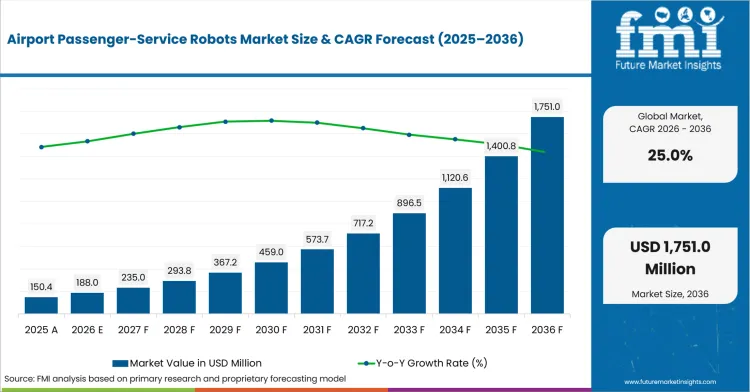
USD 188.0 million in 2026 and USD 1,751.0 million by 2036 at a 25.0% CAGR.
Sales of airport passenger-service robots are forecast to progress at 25.0% CAGR from 2026 to 2036, raising valuation from USD 188.0 million to USD 1,751.0 million. Managing unpredictable terminal crowds during sudden flight delays requires adaptable service solutions, leading airport management to deploy autonomous robots for wayfinding and baggage assistance. Increasingly growing travel volumes continuously stretch traditional terminal capacity. Airports Council International data released in July 2025 recorded global passenger traffic surpassing 9.4 billion travelers in 2024, an 8.4% increase from 2023. Such high numbers encourage airport authorities to integrate automated tools inside busy concourses.
Service priorities shift depending on regional operational goals. Operators across South Korea and the United States favor multilingual passenger guides and targeted terminal test programs. Airport authorities in Japan and the European Union judge autonomous cleaning and accessibility tools against rigid quality frameworks. Long security and check-in lines remain a primary frustration for modern flyers. A SITA report from September 2024 highlighted 64.0% of passengers favoring shorter airport waiting lines. Widespread traveler frustration motivates terminal teams to adopt interactive tools to ensure faster information access and smoother foot traffic.
Key Takeaways of Airport Passenger-Service Robots Market
- Demand for airport passenger-service robots is driven by terminal crowd pressure requiring automated assistance and service continuity, with account decisions reflecting passenger interaction quality and maintenance access.
- By location, terminals are expected to lead with 56.0% share in 2026, driven by passenger density and easier service placement.
- Airport operators are the dominant buyer segment, projected to hold 52.0% share in 2026, led by their direct control over terminal service quality.
- Hardware is estimated to lead the component category with 52.0% share in 2026, as physical robots guide early deployment spending.
- Uptime evidence and safe movement near travelers remain critical to supplier evaluation, as facility teams and ground handlers seek robots that document work completion in congested service zones.
- South Korea, the United States, and Japan are expected to form the higher-growth country tier, advancing at 27.0%, 26.0%, and 24.0% CAGR respectively through 2036, supported by advanced airport service models and high passenger volumes.
- Competition centers on LG Electronics, IntBot, Aurrigo International, Ottonomy, Cyberdyne, and WHILL, with vendors differentiating through multilingual passenger interaction, autonomous delivery workflows, and cleaning/accessibility support profiles.
Analyst Perspective
"Passenger-service robots are becoming part of airport modernization strategies as operators look for technologies that improve traveler assistance without disrupting terminal operations. The strongest commercial outcomes come from systems that navigate busy public spaces reliably, support multilingual interactions, and integrate smoothly with existing passenger service workflows. Vendors that deliver dependable fleet management, practical deployment expertise, and responsive maintenance capabilities are expected to build lasting partnerships as airports expand automation across customer-facing operations."
- Ronak Shah, Principal Consultant for Travel and Tourism at Future Market Insights
Source: Future Market Insights analysis, 2026.
How is Airport Passenger-Service Robots Market segmented?
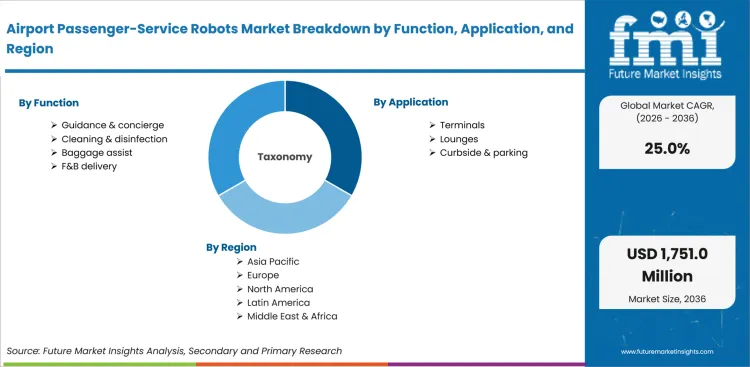
The airport passenger-service robots industry is segmented by function, application, component, end user, business model and region.
Function coverage includes guidance & concierge, cleaning & disinfection, baggage assist and food & beverage delivery robots. Application coverage includes terminals, lounges and curbside & parking areas. Component coverage includes hardware, software and services. End-user coverage includes airport operators, airlines and ground handlers. Business model coverage includes RaaS, direct purchase and service contracts. Regional coverage includes North America and Latin America. Coverage also includes Europe, East Asia, South Asia, Oceania and Middle East and Africa.
How do guidance & concierge robots shape function purchasing?
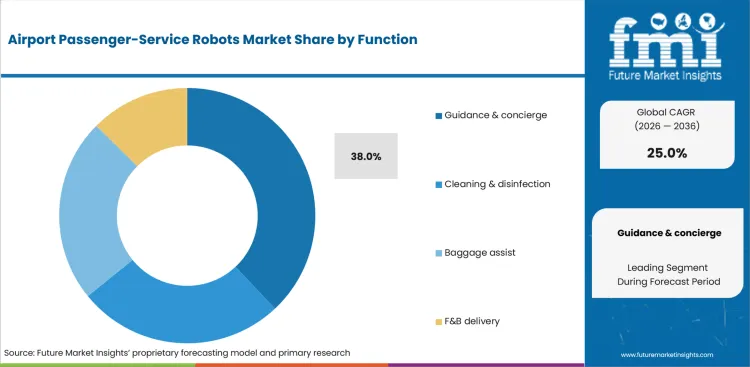
Guidance & concierge robots are estimated to lead function purchasing as airport teams need passenger-facing systems able to answer routine questions and reduce staff interruptions. Buyers value terminal mapping and service escalation before moving from pilots to larger placement. Sensors journal reported in 2026 stating the WINGO service robot operated with 3 primary functions involving congestion monitoring and operational support for airport staff.
- Based on function, guidance & concierge robots are anticipated to represent 38.0% share in 2026 due to wayfinding needs and traveler service pressure. Airport teams assess guidance robots led by location accuracy and service handoff evidence before approval.
- Cleaning & disinfection and food & beverage delivery robots support specialized terminal duties across facility care and passenger convenience. Guidance & concierge robots retain selection strength as travelers need immediate answers across check-in zones and transfer paths.
How do terminals influence application demand?
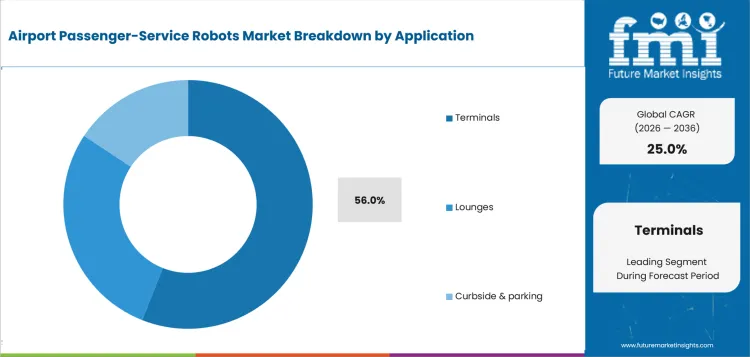
Airports Council International reported in July 2025 claiming the top 20 airports processed 1.54 billion passengers in 2024, supporting terminal-focused automation around dense traveler flows. Terminals are anticipated to guide application demand as passenger-service robots deliver the clearest value inside high-traffic halls and gate areas. Buyers review robot movement safety and passenger response quality before assigning larger floor coverage.
- By application, terminals are projected to capture 56.0% share in 2026 as passenger assistance concentrates around gates and security-adjacent zones. Airport operators compare terminal robots driven by navigation discipline and service continuity across peak operating periods.
- Lounges and curbside & parking areas create additional use cases for guided support and delivery services. Terminal demand keeps review priority as robots encounter more traveler questions and service tasks inside primary passenger buildings.
How does hardware support component demand?
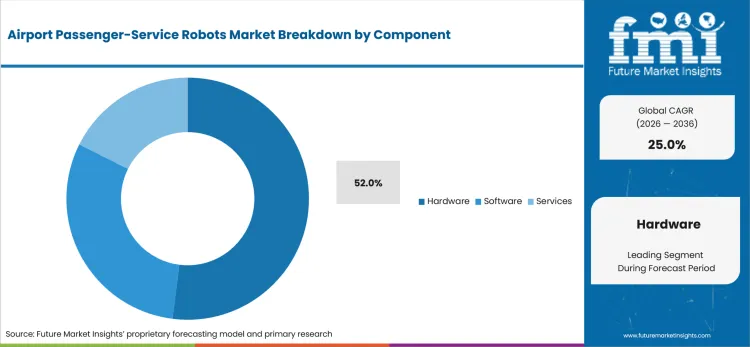
Hardware is projected to guide component purchasing as buyers first evaluate batteries and obstacle-avoidance systems before expanding software and services. Physical reliability stays central as robots operate near passengers and fixed terminal assets. Pudu Robotics announced in May 2025 for CC1 Pro covering 5,000 to 8,000 m² per operation, reinforcing coverage capability as a hardware review point for large indoor facilities.
- In 2026, hardware is set to account for 52.0% share since early spending concentrates on mobile robots and passenger-facing interfaces. Technical evaluators approve hardware orders led by endurance checks and maintenance access suited to airport halls.
- Software and services support later program depth as buyers connect robot fleets with scheduling tools and support contracts. Hardware demand gains account attention due to mobile units proving safe movement and stable uptime in passenger areas.
How do airport operators shape end-user demand?
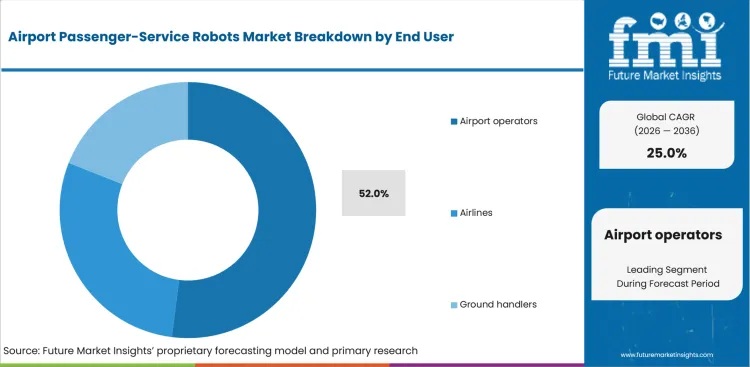
Invest KOREA reported in January 2026 stating for Incheon International Airport having recorded 425,760 flight operations in 2025, supporting operator interest in scalable assistance across large terminal systems. Airport operators are expected to lead end-user requirements since facility owners control terminal service quality and accessibility targets. Operators assess signage compatibility and handoff needs before shifting service tasks from staff desks to automated assistants.
- Airport operators are estimated to secure 52.0% share of end-user demand in 2026, backed by direct responsibility for terminal services and facility operations. Operator teams evaluate robots defined by passenger safety evidence and placement flexibility across concourses.
- Airlines and ground handlers generate sustained demand for baggage assistance and service-linked mobility. Airport operator demand stays central led by facility owners coordinate passenger flow and public-space service standards.
How does RaaS support business model demand?
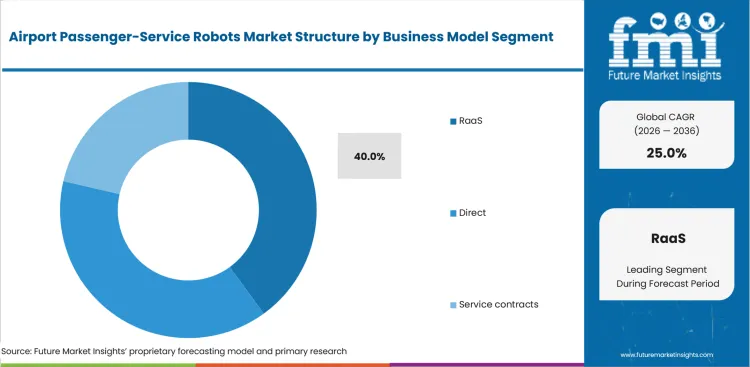
RaaS is anticipated to support business model demand as airport teams seek robot access without full fleet ownership or heavy maintenance burden. Subscription-led models help buyers test service routines, update software and adjust robot count across traffic seasons. International Federation of Robotics reported in October 2025 highlighting the professional service robot RaaS fleet grew 31.0% to more than 24,500 units in 2024, supporting managed robot access for buyers controlling upfront ownership exposure.
- RaaS is projected to capture 40.0% share in 2026, aided by airport buyers seeking controlled pilots and service-backed deployment. Commercial teams review RaaS contracts through uptime terms and ability to add robots during peak periods.
- Direct purchase and service contracts support buyers needing asset control or vendor maintenance attached to owned fleets. RaaS gains account attention due to lower initial commitment and easier scaling across lounges and curbside service zones.
What are drivers, restraints, and opportunities in Airport Passenger-Service Robots Market?
Passenger-flow pressure pushes airport teams toward robots for wayfinding and baggage support. Safety checks and service-readiness gaps slow movement from pilot trials to wider rollout.
- Driver: Airport operators are assigning routine cleaning and delivery tasks to robots as passenger volumes place pressure on terminal service teams.
- Restraint: Adoption slows as buyers test accessibility performance and service escalation before approving passenger-facing robots.
- Opportunity: Developers offering fleet monitoring and local maintenance support improve approval chances across airport accounts.
Airport service teams are expected to invest in passenger-service robots as crowd volumes return to record levels and staff time becomes harder to allocate across repetitive questions. Transportation Security Administration reported in June 2024 noting to have screened nearly 2.99 million people in June 2024, reinforcing demand for automated assistance during peak passenger periods.
Adoption is likely to face approval delays as airport buyers examine robot behavior around travelers, baggage and fixed terminal assets. Aurrigo International announced in January 2024 reporting Auto-DollyTug testing at Changi Airport assessing autonomous baggage movement during aircraft turnaround, illustrating how live airport trials shape approval confidence before deployment.
Opportunity is projected to improve for vendors combining service robots with fleet management and local support. SITA reported in 2025 claiming 79.0% of passengers were ready for mobile-based identity tools, indicating traveler openness toward automated airport interactions linked with clearer information and faster assistance.
What country CAGRs are profiled in Airport Passenger-Service Robots Market?
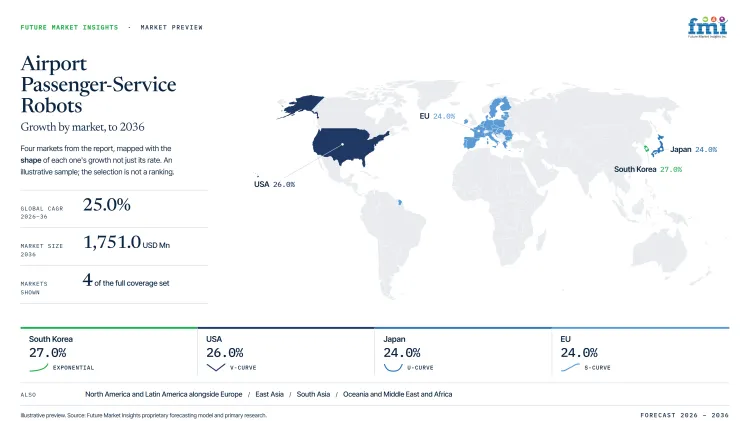
| Country | CAGR |
|---|---|
| South Korea | 27.0% |
| USA | 26.0% |
| Japan | 24.0% |
| EU | 24.0% |
Source: Future Market Insights analysis, 2026.
How do country-level CAGRs compare in Airport Passenger-Service Robots Market?
The country comparison spans 3.0 percentage points and highlights two closely connected growth tiers across the airport passenger-service robots market. South Korea and the United States lead the comparison with only a 1.0-point difference between them. Japan and the European Union share the second tier, each posting the same CAGR of 24.0%. The pattern reflects differences in airport automation strategies, passenger service digitalization and investment in intelligent terminal operations.
- South Korea leads the comparison with a CAGR of 27.0%. Airports are increasingly incorporating passenger-service robots for wayfinding, multilingual assistance, information delivery and terminal support as operators seek to improve traveler experience while handling higher passenger volumes efficiently.
- The United States follows at 26.0%, only 1.0 percentage point behind South Korea. Interest is centered on robotic assistants that help passengers navigate terminals, provide real-time flight information and complement airport customer service during peak operating periods.
- Japan records a CAGR of 24.0%, standing 2.0 percentage points below the United States. Demand reflects continued adoption of automation across airport operations, where service robots are being evaluated to improve passenger guidance, streamline information services and support multilingual communication.
- The European Union also posts a CAGR of 24.0%, matching Japan's growth rate. Airport operators across the region continue exploring robotic passenger assistance as part of broader terminal modernization programs. Adoption varies among member states because airport size, passenger traffic and investment priorities differ across the region.
- Comparable CAGRs do not necessarily produce identical commercial opportunities. Differences in airport infrastructure, passenger volumes, digital service strategies and automation investment priorities influence deployment approaches and long-term market potential. The full report provides country-level CAGR analysis across North America, Latin America, Europe, East Asia, South Asia, Oceania and the Middle East and Africa.
Country-wise Analysis
Industry adoption in the given key countries are determined by airport service priorities and automation-readiness across terminal operations. Demand in the South Korea and USA is projected to move faster as passenger-service pilots and advanced airport operating models support stronger buyer review. Sales in Japan and EU are expected to track steady terminal upgrades and service quality requirements.
- Sector in South Korea is expected to record 27.0% CAGR during the forecast period, guided by advanced airport service models and passenger-service technology familiarity. High passenger movement increases the need for robots easing traveler support across complex terminal zones. Incheon International Airport Corporation reported in 2026 announcing about 74,071,475 passengers having used the airport in 2025, reinforcing robot review across high-volume terminal environments.
- Bureau of Transportation Statistics reported in March 2026 claiming USA airlines having carried 81.2 million scheduled passengers in December 2025, keeping terminal service reliability central to airport planning. Significant passenger volumes make airport pilots more commercially meaningful for terminal support planning. Service robot purchasing in the United States is projected to increase at 26.0% CAGR by 2036, driven by airport pilots and high passenger throughput.
- Industry in Japan is anticipated to expand at 24.0% CAGR between 2026 and 2036, helped by airport service quality expectations and labor support needs across terminals. Extensive domestic flight activity keeps staff-support robots practical for cleaning and guided passenger movement. Japan Airport Terminal Group stated in May 2025 highlighting Haneda Airport passenger traffic for fiscal 2024 including domestic flights of 64.99 million, supporting cleaning and mobility-assist robot review across a large terminal base.
- Eurostat reported in December 2025 reflecting 1.1 billion passengers travelled by air in the EU during 2024, up 8.3% from 2023, strengthening terminal-service automation review. Recovered air traffic creates clearer justification for robots improving routine terminal service consistency. Passenger recovery across European airport networks supports EU demand, projected to rise at 24.0% CAGR during the study period.
Who are notable companies in Airport Passenger-Service Robots Market?
LG Electronics and IntBot are expected to shape market direction. Aurrigo International and Ottonomy add autonomous airport movement depth. Cyberdyne and WHILL support cleaning and accessibility-related service automation. SoftBank Robotics Group Corp. and SITA add passenger interaction and airport technology support. Avidbots and Bear Robotics strengthen cleaning and indoor service robot capabilities.
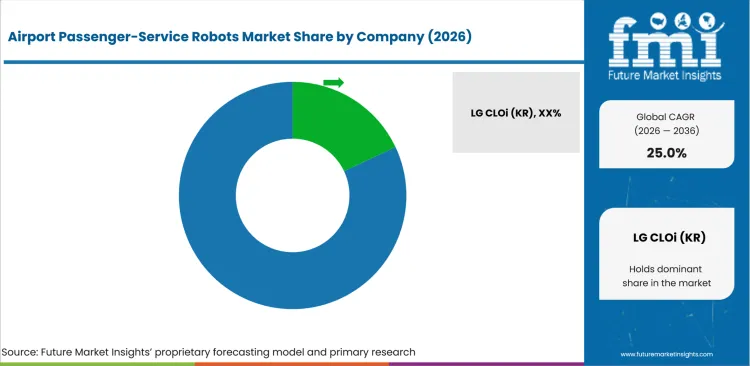
Competition in airport passenger-service robots is anticipated to center on safe navigation and passenger interaction. Service software and local maintenance response guide final vendor review. Account teams are likely to compare vendors based on terminal proof files and support for recurring airport operations after first approval.
- LG Electronics and IntBot are expected to gain account attention based on passenger-facing robotics and multilingual interaction. Conversational service capability is likely to promote programs needing traveler assistance and public-space reliability.
- Aurrigo International and Ottonomy are anticipated to compete through autonomous mobility and managed delivery service support. Airport buyers may assess both developers before committing to baggage assist or terminal delivery workflows.
- Cyberdyne and WHILL are forecast to support demand led by cleaning automation and mobility assistance. Facility and accessibility teams may compare these systems through safety records and indoor operating suitability.
- SoftBank Robotics Group Corp. and Bear Robotics are estimated to gain review strength due to airport systems knowledge and facility automation depth. Vendor attention is likely to improve as airports need robots matching passenger-service and cleaning routines.
Competitive Benchmarking: Airport Passenger-Service Robots Market
| Company | Portfolio Depth | Airport Match | Service Support | Service Reach |
|---|---|---|---|---|
| LG Electronics | High | High | High | South Korea and global |
| IntBot | Medium | High | Medium | United States |
| Aurrigo International plc | High | High | High | United Kingdom and global |
| Ottonomy Inc. | Medium | High | Medium | United States and global |
| Cyberdyne Inc. | Medium | Medium | Medium | Japan |
| WHILL Inc. | Medium | High | Medium | Japan and global |
| SoftBank Robotics Group Corp. | Medium | Medium | Medium | Japan and global |
| SITA | High | Medium | High | Global |
| Avidbots Corp. | Medium | Medium | Medium | North America and global |
| Bear Robotics, Inc. | High | Medium | High | United States, South Korea and Japan |
Source: Future Market Insights competitive analysis, 2026.
Key Developments in Airport Passenger-Service Robots Market
- In January 2025, LG Electronics secured management control of Bear Robotics after deciding to acquire an additional 30.0% stake. LG Electronics stated it would hold 51.0% of Bear Robotics shares and transfer its LG CLOi robot business to Bear Robotics, strengthening service robot software and fleet management capability for public-space use.
- In April 2025, Aurrigo International and Aviation Solutions announced a partnership to commercialize autonomous baggage handling at airports. Aurrigo stated Auto-DollyTug was under testing at 6 global airports, supporting airport buyer review of autonomous baggage assist robots across congested service areas.
- In March 2026, San José Mineta International Airport launched IntBot’s José humanoid robot inside Terminal B. Airport officials stated José could provide real-time information in more than 50 languages, improving passenger-service robot validation before broader airport placement.
Key Players in Airport Passenger-Service Robots Market
Passenger interaction and guidance developers
- LG Electronics
- IntBot
- SoftBank Robotics Group Corp.
- SITA
Autonomous delivery and baggage assist specialists
- Aurrigo International plc
- Ottonomy Inc.
- Bear Robotics, Inc.
Cleaning and mobility-assist robot developers
- Cyberdyne Inc.
- WHILL Inc.
- Avidbots Corp.
Airport Passenger-Service Robots Market - Report Scope
| Coverage field | Report scope |
|---|---|
| Market breakdown | Airport Passenger-Service Robots Market breakdown by function alongside application, component, end user, business model and region |
| Quantitative Units | USD million in 2026 to USD million by 2036 at a CAGR |
| Market Definition | Airport passenger-service robots include autonomous or semi-autonomous robots, AI interfaces, hardware platforms and service arrangements used for passenger assistance, cleaning, baggage support and food delivery across airport environments. |
| Regions Covered | North America and Latin America alongside Europe, East Asia, South Asia, Oceania and Middle East and Africa |
| Countries Covered | United States and South Korea alongside Japan, EU, Canada, Brazil, Mexico, Germany, United Kingdom, France, Italy, Spain, China, India, Australia, New Zealand, GCC countries, South Africa and Türkiye |
| Key Companies Profiled | LG Electronics and IntBot alongside Aurrigo International plc, Ottonomy Inc., Cyberdyne Inc., WHILL Inc., SoftBank Robotics Group Corp., SITA, Avidbots Corp. and Bear Robotics, Inc. |
| Forecast Period | 2026 to 2036 |
| Approach | Hybrid bottom-up and top-down methodology using segment share, country CAGR, airport passenger flow, terminal automation needs, robot capability, company portfolio depth and service exposure |
Source: Future Market Insights analysis, 2026.
Airport Passenger-Service Robots Market - Research Methodology
| Method | Approach |
|---|---|
| Primary Research | FMI analysts gathered input from manufacturers, service providers, technology developers, distributors, end users, procurement teams, and subject-matter experts. Interviews examined purchasing decisions, product or service evaluation, adoption barriers, approval requirements, pricing considerations, and expectations for technical or commercial support. Respondents were also asked what evidence is required before a trial, pilot, or initial order develops into regular purchasing. |
| Desk Research | Desk research covered government statistics, regulatory publications, trade data, industry associations, technical literature, standards, company filings, product information, and official corporate announcements. Sources were reviewed for relevance, publication date, geographic coverage, and consistency with the defined market scope. Claims relating to performance, applications, approvals, capacity, investment, and commercial activity were retained only when supported by credible public evidence. |
| Market Sizing and Forecasting | The market model combined the baseline value with historical performance, segment structure, pricing and volume indicators, adoption levels, company participation, and country-level demand conditions. Forecast assumptions considered economic activity, investment trends, regulatory developments, technology adoption, purchasing cycles, supply availability, and barriers to wider market use. Segment and regional estimates were reconciled before the final market total was calculated. |
| Data Validation | Estimates were checked against multiple independent indicators, including public data, company activity, trade patterns, industry developments, and findings from primary interviews. Validation also tested whether products, services, applications, and company revenues fell within the defined market boundaries. Adjacent categories, unsupported claims, overlapping revenues, and activities without direct market relevance were excluded to reduce double counting and maintain consistency across segments and countries. |
Source: Future Market Insights analysis, 2026.
Airport Passenger-Service Robots Market by Segments
Airport Passenger-Service Robots Market segmented by Function:
- Guidance & concierge
- Cleaning & disinfection
- Baggage assist
- Food & beverage delivery
Airport Passenger-Service Robots Market segmented by Application:
- Terminals
- Lounges
- Curbside & parking
Airport Passenger-Service Robots Market segmented by Component:
- Hardware
- Software
- Services
Airport Passenger-Service Robots Market segmented by End User:
- Airport operators
- Airlines
- Ground handlers
Airport Passenger-Service Robots Market segmented by Business Model:
- RaaS
- Direct purchase
- Service contracts
Airport Passenger-Service Robots Market by Region:
- North America
- United States
- Canada
- Latin America
- Brazil
- Mexico
- Argentina
- Europe
- Germany
- United Kingdom
- France
- Italy
- Spain
- East Asia
- China
- Japan
- South Korea
- South Asia
- India
- Thailand
- Indonesia
- Oceania
- Australia
- New Zealand
- Middle East and Africa
- GCC countries
- South Africa
- Türkiye
Research Sources and Bibliography
- Airports Council International. (2025, July 8). World’s busiest airports revealed in final global rankings.
- Aurrigo International plc. (2024, January 31). Changi Airport Group collaborates with Aurrigo to trial new autonomous baggage handling vehicle.
- Aurrigo International plc. (2025, April 8). Aurrigo and Aviation Solutions join forces to commercialise autonomous baggage handling at airports.
- Bureau of Transportation Statistics. (2026, March 13). December 2025 USA airline traffic data down 2.6% from the same month last year.
- Pudu Robotics. (2025, May 27). Pudu Robotics launches its latest AI-powered autonomous cleaning robot: PUDU CC1 Pro.
- Eurostat. (2025, December 8). Number of air passengers up 8% in 2024.
- Incheon International Airport Corporation. (2026). View Incheon Airport Statistics.
- International Federation of Robotics. (2025, October 7). World Robotics 2025 report: Service robots see global growth boom.
- Japan Airport Terminal Co., Ltd. (2025, May 9). Japan Airport Terminal Group Integrated Report 2025.
- LG Electronics. (2025, January 24). LG secures majority stake in Bear Robotics.
- San José Mineta International Airport. (2026, March 24). San José Mineta International Airport launches AI-powered IntBot humanoid robot.
- Sensors. (2026). AI-powered service robots for smart airport operations: Real-world implementation and performance analysis in passenger flow management.
- SITA. (2024, September 18). Technology is the key to unlocking the passenger experience of the future.
- SITA. (2025). Passenger IT Insights 2025.
- Transportation Security Administration. (2024, June 24). TSA breaks record for most individuals screened on a single day.
- Incheon International Airport Corporation. (2026, January). Incheon Airport records 74,071,475 passengers and 425,760 flight operations in 2025.
This bibliography is provided for reader reference and is not exhaustive. The full report contains the complete reference list and detailed citations.
This Report Answers
- What segments shape demand across function, application, component, end user and business model?
- How do airport buyers evaluate passenger-service robots before replacing routine terminal support tasks?
- How do country CAGRs differ across profiled markets?
- What companies compete through airport robot depth and service-response capability?
- How are forecasts validated using a hybrid bottom-up and top-down approach?
- What factors do account teams address before larger account expansion?
- How do terminal pilots and safety evidence affect vendor selection?
- What limits return on investment for teams adding passenger-service robots?
- How do multilingual interaction and navigation records influence account approval?
- What vendor capabilities improve long-term account confidence?
Frequently Asked Questions
What supports demand in airport passenger-service robots market?
Demand is likely to be supported by airport teams needing service robots reducing repetitive passenger assistance tasks during busy terminal periods. Accounts are expected to prefer vendors combining safe navigation and maintenance response.
Who are key players in airport passenger-service robots market?
Key companies are anticipated to include LG Electronics and Aurrigo International among others to support competition. Competition is likely to be based on passenger interaction quality and regional service support.
What restraint affects airport passenger-service robots market?
A major restraint is the proof burden created during safety review and accessibility testing across passenger-facing environments. Accounts slow adoption if robots lack navigation evidence or support capacity needed for terminal approval.
Why do executives track airport passenger-service robots market?
Executives are expected to track airport passenger-service robots as terminal service choices affect passenger experience and staff workload. Factors such as multilingual support and robot uptime shape buyer reviews.
What business problem does airport passenger-service robots market address?
Airport passenger-service robots market addresses the operational gap created by high passenger movement needing repeatable assistance and delivery support. Airport operators and airlines need robots supporting consistent service records and field-ready support.
What do account teams evaluate before selecting vendors?
Account teams are likely to evaluate navigation safety and passenger interaction quality before vendor approval. Software updates and service documentation are expected to guide final vendor review.
What limits return on investment for purchasing teams?
Return on investment weakens if robot performance or terminal acceptance is not proven before deployment. Pilot delays and support gaps reduce expected service efficiency gains.
How do vendors build long-term account confidence?
Vendors build account confidence by providing consistent robot quality and evidence specific to airport passenger-service use. Deployment records and responsive troubleshooting support are expected to influence repeat-order trust.
Preview the report firsthand - request a free sample
Get SampleGet the brochure for pricing and purchase details.
Get PDFTable of Content
- Key Takeaways
- Market Size and CAGR
- Top Growth Driver
- Fastest Growing Segment
- Leading Region
- Key Companies
- Emerging Opportunities
- Executive Summary
- Global Market Outlook
- Demand-side Trends
- Supply-side Trends
- Technology Roadmap Analysis
- Analysis and Recommendations
- Analyst Perspective (What is happening? Why now? What should investors know?)
- Key Questions Answered
- How large is the market?
- What is the CAGR?
- What are key trends?
- Which region dominates?
- Who are the leaders?
- Market Overview
- Market Coverage / Taxonomy
- Market Definition / Scope / Limitations
- Research Methodology
- Chapter Orientation
- Analytical Lens and Working Hypotheses
- Market Structure, Signals, and Trend Drivers
- Benchmarking and Cross-market Comparability
- Market Sizing, Forecasting, and Opportunity Mapping
- Research Design and Evidence Framework
- Desk Research Programme (Secondary Evidence)
- Expert Input and Fieldwork (Primary Evidence)
- Tooling, Models, and Reference Databases
- Data Engineering and Model Build
- Quality Assurance and Audit Trail
- Market Background
- Market Dynamics (Drivers, Restraints, Opportunity, Trends)
- Scenario Forecast (Optimistic, Likely, Conservative)
- Impact Analysis
- AI Impact
- Sustainability Impact
- Regulatory Impact
- Technology Impact
- Consumer / Buyer Analysis
- Purchase Drivers
- Adoption Barriers
- Buyer Journey
- Opportunity Map Analysis
- Product Life Cycle Analysis
- Supply Chain Analysis
- Investment Feasibility Matrix
- Value Chain Analysis
- PESTLE and Porter's Analysis
- Regulatory Landscape
- Regional Parent Market Outlook
- Production and Consumption Statistics
- Import and Export Statistics
- Global Market Analysis and Forecast, 2021 to 2036
- Historical Market Size Value (USD Million) Analysis, 2021 to 2025
- Current and Future Market Size Value (USD Million) Projections, 2026 to 2036
- Y-o-Y Growth Trend Analysis
- Absolute $ Opportunity Analysis
- Global Market Pricing Analysis, 2021 to 2036
- Global Market Analysis and Forecast, By Function, 2021 to 2036
- Introduction / Key Findings
- Historical Market Size Value (USD Million) Analysis By Function, 2021 to 2025
- Current and Future Market Size Value (USD Million) Analysis and Forecast By Function, 2026 to 2036
- Guidance & concierge
- Cleaning & disinfection
- Baggage assist
- F&B delivery
- Guidance & concierge
- Y-o-Y Growth Trend Analysis By Function, 2021 to 2025
- Absolute $ Opportunity Analysis By Function, 2026 to 2036
- Global Market Analysis and Forecast, By Application, 2021 to 2036
- Introduction / Key Findings
- Historical Market Size Value (USD Million) Analysis By Application, 2021 to 2025
- Current and Future Market Size Value (USD Million) Analysis and Forecast By Application, 2026 to 2036
- Terminals
- Lounges
- Curbside & parking
- Terminals
- Y-o-Y Growth Trend Analysis By Application, 2021 to 2025
- Absolute $ Opportunity Analysis By Application, 2026 to 2036
- Global Market Analysis and Forecast, By Component, 2021 to 2036
- Introduction / Key Findings
- Historical Market Size Value (USD Million) Analysis By Component, 2021 to 2025
- Current and Future Market Size Value (USD Million) Analysis and Forecast By Component, 2026 to 2036
- Hardware
- Software
- Services
- Hardware
- Y-o-Y Growth Trend Analysis By Component, 2021 to 2025
- Absolute $ Opportunity Analysis By Component, 2026 to 2036
- Global Market Analysis and Forecast, By End User, 2021 to 2036
- Introduction / Key Findings
- Historical Market Size Value (USD Million) Analysis By End User, 2021 to 2025
- Current and Future Market Size Value (USD Million) Analysis and Forecast By End User, 2026 to 2036
- Airport operators
- Airlines
- Ground handlers
- Airport operators
- Y-o-Y Growth Trend Analysis By End User, 2021 to 2025
- Absolute $ Opportunity Analysis By End User, 2026 to 2036
- Global Market Analysis and Forecast, By Business Model, 2021 to 2036
- Introduction / Key Findings
- Historical Market Size Value (USD Million) Analysis By Business Model, 2021 to 2025
- Current and Future Market Size Value (USD Million) Analysis and Forecast By Business Model, 2026 to 2036
- RaaS
- Direct
- Service contracts
- RaaS
- Y-o-Y Growth Trend Analysis By Business Model, 2021 to 2025
- Absolute $ Opportunity Analysis By Business Model, 2026 to 2036
- Global Market Analysis and Forecast, By Region, 2021 to 2036
- Introduction
- Historical Market Size Value (USD Million) Analysis By Region, 2021 to 2025
- Current Market Size Value (USD Million) Analysis and Forecast By Region, 2026 to 2036
- North America
- Latin America
- Western Europe
- Eastern Europe
- East Asia
- South Asia and Pacific
- Middle East & Africa
- Market Attractiveness Analysis By Region
- North America Market Analysis and Forecast, By Country, 2021 to 2036
- Historical Market Size Value (USD Million) Trend Analysis By Market Taxonomy, 2021 to 2025
- Market Size Value (USD Million) Forecast By Market Taxonomy, 2026 to 2036
- By Country
- USA
- Canada
- By Function
- By Application
- By Component
- By End User
- By Business Model
- By Country
- Market Attractiveness Analysis
- By Country
- By Function
- By Application
- By Component
- By End User
- By Business Model
- Key Takeaways
- Latin America Market Analysis and Forecast, By Country
- Historical Market Size Value (USD Million) Trend Analysis By Market Taxonomy, 2021 to 2025
- Market Size Value (USD Million) Forecast By Market Taxonomy, 2026 to 2036
- By Country
- Brazil
- Mexico
- Chile
- Rest of Latin America
- By Function
- By Application
- By Component
- By End User
- By Business Model
- By Country
- Market Attractiveness Analysis
- By Country
- By Function
- By Application
- By Component
- By End User
- By Business Model
- Key Takeaways
- Western Europe Market Analysis and Forecast, By Country
- Historical Market Size Value (USD Million) Trend Analysis By Market Taxonomy, 2021 to 2025
- Market Size Value (USD Million) Forecast By Market Taxonomy, 2026 to 2036
- By Country
- Germany
- UK
- Italy
- Spain
- France
- Nordic
- BENELUX
- Rest of Western Europe
- By Function
- By Application
- By Component
- By End User
- By Business Model
- By Country
- Market Attractiveness Analysis
- By Country
- By Function
- By Application
- By Component
- By End User
- By Business Model
- Key Takeaways
- Eastern Europe Market Analysis and Forecast, By Country
- Historical Market Size Value (USD Million) Trend Analysis By Market Taxonomy, 2021 to 2025
- Market Size Value (USD Million) Forecast By Market Taxonomy, 2026 to 2036
- By Country
- Russia
- Poland
- Hungary
- Balkan & Baltic
- Rest of Eastern Europe
- By Function
- By Application
- By Component
- By End User
- By Business Model
- By Country
- Market Attractiveness Analysis
- By Country
- By Function
- By Application
- By Component
- By End User
- By Business Model
- Key Takeaways
- East Asia Market Analysis and Forecast, By Country
- Historical Market Size Value (USD Million) Trend Analysis By Market Taxonomy, 2021 to 2025
- Market Size Value (USD Million) Forecast By Market Taxonomy, 2026 to 2036
- By Country
- China
- Japan
- South Korea
- By Function
- By Application
- By Component
- By End User
- By Business Model
- By Country
- Market Attractiveness Analysis
- By Country
- By Function
- By Application
- By Component
- By End User
- By Business Model
- Key Takeaways
- South Asia and Pacific Market Analysis and Forecast, By Country
- Historical Market Size Value (USD Million) Trend Analysis By Market Taxonomy, 2021 to 2025
- Market Size Value (USD Million) Forecast By Market Taxonomy, 2026 to 2036
- By Country
- India
- ASEAN
- Australia & New Zealand
- Rest of South Asia and Pacific
- By Function
- By Application
- By Component
- By End User
- By Business Model
- By Country
- Market Attractiveness Analysis
- By Country
- By Function
- By Application
- By Component
- By End User
- By Business Model
- Key Takeaways
- Middle East & Africa Market Analysis and Forecast, By Country
- Historical Market Size Value (USD Million) Trend Analysis By Market Taxonomy, 2021 to 2025
- Market Size Value (USD Million) Forecast By Market Taxonomy, 2026 to 2036
- By Country
- Kingdom of Saudi Arabia
- Other GCC Countries
- Türkiye
- South Africa
- Other African Union
- Rest of Middle East & Africa
- By Function
- By Application
- By Component
- By End User
- By Business Model
- By Country
- Market Attractiveness Analysis
- By Country
- By Function
- By Application
- By Component
- By End User
- By Business Model
- Key Takeaways
- Key Countries Market Analysis
- USA
- Pricing Analysis
- Market Share Analysis, 2025
- By Function
- By Application
- By Component
- By End User
- By Business Model
- Canada
- Pricing Analysis
- Market Share Analysis, 2025
- By Function
- By Application
- By Component
- By End User
- By Business Model
- Mexico
- Pricing Analysis
- Market Share Analysis, 2025
- By Function
- By Application
- By Component
- By End User
- By Business Model
- Brazil
- Pricing Analysis
- Market Share Analysis, 2025
- By Function
- By Application
- By Component
- By End User
- By Business Model
- Chile
- Pricing Analysis
- Market Share Analysis, 2025
- By Function
- By Application
- By Component
- By End User
- By Business Model
- Germany
- Pricing Analysis
- Market Share Analysis, 2025
- By Function
- By Application
- By Component
- By End User
- By Business Model
- UK
- Pricing Analysis
- Market Share Analysis, 2025
- By Function
- By Application
- By Component
- By End User
- By Business Model
- Italy
- Pricing Analysis
- Market Share Analysis, 2025
- By Function
- By Application
- By Component
- By End User
- By Business Model
- Spain
- Pricing Analysis
- Market Share Analysis, 2025
- By Function
- By Application
- By Component
- By End User
- By Business Model
- France
- Pricing Analysis
- Market Share Analysis, 2025
- By Function
- By Application
- By Component
- By End User
- By Business Model
- India
- Pricing Analysis
- Market Share Analysis, 2025
- By Function
- By Application
- By Component
- By End User
- By Business Model
- ASEAN
- Pricing Analysis
- Market Share Analysis, 2025
- By Function
- By Application
- By Component
- By End User
- By Business Model
- Australia & New Zealand
- Pricing Analysis
- Market Share Analysis, 2025
- By Function
- By Application
- By Component
- By End User
- By Business Model
- China
- Pricing Analysis
- Market Share Analysis, 2025
- By Function
- By Application
- By Component
- By End User
- By Business Model
- Japan
- Pricing Analysis
- Market Share Analysis, 2025
- By Function
- By Application
- By Component
- By End User
- By Business Model
- South Korea
- Pricing Analysis
- Market Share Analysis, 2025
- By Function
- By Application
- By Component
- By End User
- By Business Model
- Russia
- Pricing Analysis
- Market Share Analysis, 2025
- By Function
- By Application
- By Component
- By End User
- By Business Model
- Poland
- Pricing Analysis
- Market Share Analysis, 2025
- By Function
- By Application
- By Component
- By End User
- By Business Model
- Hungary
- Pricing Analysis
- Market Share Analysis, 2025
- By Function
- By Application
- By Component
- By End User
- By Business Model
- Kingdom of Saudi Arabia
- Pricing Analysis
- Market Share Analysis, 2025
- By Function
- By Application
- By Component
- By End User
- By Business Model
- Türkiye
- Pricing Analysis
- Market Share Analysis, 2025
- By Function
- By Application
- By Component
- By End User
- By Business Model
- South Africa
- Pricing Analysis
- Market Share Analysis, 2025
- By Function
- By Application
- By Component
- By End User
- By Business Model
- USA
- Market Structure Analysis
- Competition Dashboard
- Competition Benchmarking
- Market Share Analysis of Top Players
- By Regional
- By Function
- By Application
- By Component
- By End User
- By Business Model
- Emerging Startups
- Innovation Benchmarking
- Competition Analysis
- Competition Deep Dive
- LG CLOi (KR)
- Overview
- Product Portfolio
- Profitability by Market Segments
- Sales Footprint
- Strategy Overview
- Marketing Strategy
- Product Strategy
- Channel Strategy
- Cyberdyne (JP)
- Ottonomy (US)
- Aurrigo (UK)
- LG CLOi (KR)
- Case Studies
- Success Stories
- Recent Developments
- Competition Deep Dive
- Assumptions & Acronyms Used


