

- Industry Size (2026)
- USD 15.52 Bn
- Forecast (2036)
- USD 27.01 Bn
- CAGR (2026 to 2036)
- 5.7%
Hydrolyzed Starch Market Size, Market Forecast and Outlook By FMI
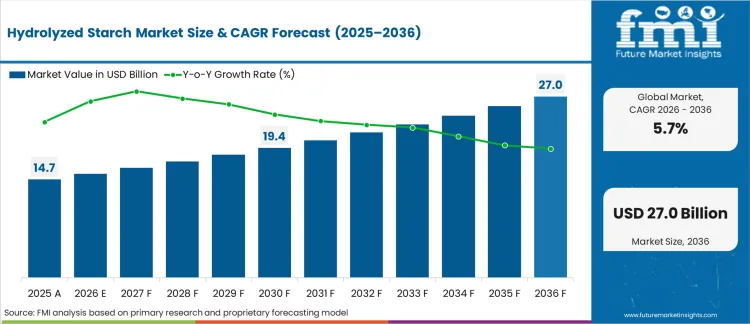
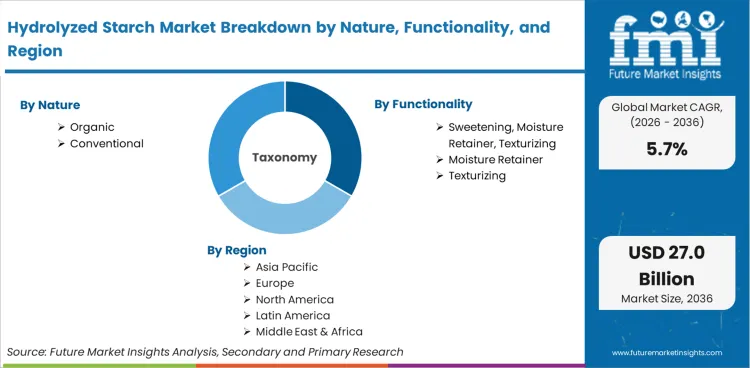
In 2025, the hydrolyzed starch market was valued at USD 14.70 billion. Based on Future Market Insights' analysis, demand for hydrolyzed starch is estimated to grow to USD 15.52 billion in 2026 and USD 27.01 billion by 2036. FMI projects a CAGR of 5.7% during the forecast period.
Absolute dollar growth of USD 11.49 billion over the decade reflects one of the largest absolute growth opportunities in the food ingredient sector, driven by hydrolyzed starch's role as a functional backbone ingredient across sweetening, moisture retention, and texturizing applications in food and beverage manufacturing. In November 2025, Tate and Lyle expanded its regenerative agriculture program into Europe, partnering with French corn farmers to implement AI-driven solutions that improve soil health and resilience for its corn-based starch and sweetener supply chains, a strategic investment that signals leading operators are building upstream agricultural technology advantages that commodity starch producers cannot replicate. [1]
Summary of Hydrolyzed Starch Market
- Hydrolyzed Starch Market Definition
- The market covers globally traded enzymatically and acid-hydrolyzed starch products including glucose syrups, maltodextrins, and dextrins used as sweeteners, humectants, and texture modifiers across food, beverage, pharmaceutical, and industrial applications.
- Demand Drivers in the Market
- Tate and Lyle's November 2025 European regenerative agriculture expansion using AI-driven soil health optimisation signals that leading operators are building upstream agricultural technology advantages that create supply chain differentiation and input cost resilience unavailable to commodity producers.
- Ingredion's 2026 strategic focus on texture solutions targeting Gen Z and Millennial immersive snack experience preferences confirms that hydrolyzed starch functionality is being repositioned from commodity food ingredient to premium consumer experience enabler.
- Cargill's March 2025 Gwalior corn starch milling plant inauguration in India signals that emerging market capacity investment is concentrating among large integrated processors, raising the capital intensity threshold for competitive market participation.
- Key Segments Analyzed in the FMI Report
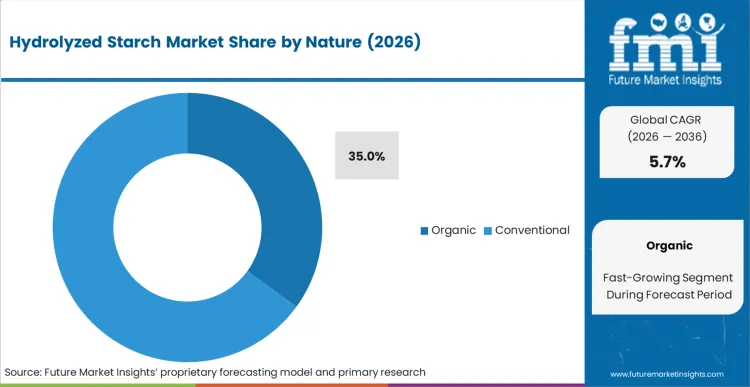
- Nature: Organic holds 35.0% of market volume, reflecting growing food and beverage manufacturer demand for certified-origin hydrolyzed starch ingredients in clean-label and organic product formulations.
- Functionality: The combined Sweetening, Moisture Retainer, and Texturizing functionality segment captures 40.0% of demand, representing the highest-margin multi-functional application tier in food and beverage manufacturing.
- Geography: Japan holds the largest individual country value at USD 11.13 billion in 2026, reflecting extensive hydrolyzed starch use across processed food, confectionery, and functional beverage categories.
- Analyst Opinion at FMI
- Nandini Roy Choudhury, Principal Consultant for Food & Beverage and Materials Industry at Future Market Insights, opines, "In the updated version of the Hydrolyzed Starch Market Report for 2026 to 2036, CXOs will find that the market's USD 11.49 billion absolute growth opportunity is structurally bifurcating between commodity glucose syrup production, where margin compression from new Asian capacity additions will accelerate, and high-functionality multi-role starch ingredients where AI-optimised supply chains and regenerative agriculture sourcing credentials are building defensible competitive positions. Operators without a clear pathway to one of these two structures face a strategic no-man's land by 2028 where neither scale nor premium positioning generates adequate returns."
- Strategic Implications / Executive Takeaways
- Invest in multi-functional starch product development combining sweetening, moisture retention, and texturizing capabilities to capture the 40.0% high-margin functionality segment and differentiate from commodity glucose syrup competition.
- Establish regenerative agriculture and certified organic sourcing programs to meet the growing clean-label and sustainability documentation requirements of premium food and beverage manufacturer customers.
- Develop India and Southeast Asia market positioning ahead of Cargill's new Gwalior capacity coming online, to secure distribution relationships before domestic supply expansion tightens import market access.
- Methodology
- Validated through primary interviews with corn wet milling operators, food ingredient procurement managers, and regenerative agriculture program coordinators.
- Zero reliance on speculative third-party market research reports.
- Based on Corn Refiners Association data, UN Comtrade statistics, USDA crop production records, and major processor annual report disclosures.
The United States leads with a 4.3% CAGR through 2036, generating USD 5.59 billion in 2026 demand as the world's largest corn wet milling base and primary hydrolyzed starch producing nation. Japan holds the largest individual country value at USD 11.13 billion in 2026, reflecting deep penetration across processed food, confectionery, and functional beverage manufacturing. South Korea contributes USD 0.42 billion through food processing and confectionery ingredient procurement. Organic nature holds 35.0% of market share, and the combined Sweetening, Moisture Retaining, and Texturizing functionality segment captures 40.0% of demand, representing the highest-margin application tier.
Hydrolyzed Starch Market Definition
The hydrolyzed starch market comprises the global production, processing, and trade of starch-derived products produced through enzymatic or acid hydrolysis of corn, wheat, potato, tapioca, and other starch sources to generate glucose syrups, maltodextrins, dextrins, and polyols with specific dextrose equivalent (DE) values and functional performance profiles. Hydrolyzed starches are used as sweeteners, humectants, texture modifiers, and functional carriers across food and beverage, pharmaceutical, and industrial applications. The market covers both organic and conventional production variants distributed to food manufacturers, pharmaceutical formulators, and specialty industrial buyers.
Hydrolyzed Starch Market Inclusions
The report includes global and regional market sizes by volume and value with a 10-year forecast from 2026 to 2036. Coverage spans segmental breakdowns by nature (Organic, Conventional) and functionality (Sweetening, Moisture Retainer, Texturizing and combined multi-functional applications). Country-level analysis covers all major starch producing and consuming markets globally.
Hydrolyzed Starch Market Exclusions
The scope excludes unhydrolyzed native and modified starches that have not undergone enzymatic or acid hydrolysis processing, finished food products where hydrolyzed starch is a processed component in a consumer retail SKU, and non-starch derived sweeteners including sucrose, fructose, and synthetic high-intensity sweeteners. Starch-based bioethanol feedstock and non-food industrial applications such as paper coating and adhesive production are excluded.
Hydrolyzed Starch Market Research Methodology
- Primary Research: Interviews were conducted with corn wet milling operators, hydrolyzed starch producers, food and beverage ingredient procurement managers, pharmaceutical excipient buyers, and regenerative agriculture program coordinators across the United States, Germany, France, China, Japan, and India.
- Desk Research: Production data from the Corn Refiners Association, national starch industry associations in Europe and Asia, UN Comtrade trade statistics for glucose syrups and maltodextrins, company annual reports from Cargill, Ingredion, Tate and Lyle, and Roquette, and USDA crop production data supported volume benchmarking.
- Market-Sizing and Forecasting: A hybrid top-down and bottom-up model was applied. Demand was reconstructed from food and beverage ingredient procurement volumes, pharmaceutical excipient import records, and industrial application data, then validated against wet milling plant production capacity and corn input supply data.
- Data Validation and Update Cycle: Outputs undergo anomaly screening, cross-validation against Corn Refiners Association production data and international trade statistics, and structured peer review prior to release.
Key Industry Highlights
The Versatility of Hydrolyzed Starch for Green Label Product formulation
Every day, customers around the globe are getting more conscious of the environment, and thus the need for cleaner label or green ingredients in food, beverages, and cosmetics. The target product which perfectly fits this trend, which is produced from renewable plant materials.
There has been growth in the emphasis on sustainable procurement of the raw materials and minimizing impacts on the natural environment by adopting environmentally sound production. Today, companies involved in the production of starch are considering farming methods that are environmentally friendly as well as production methods that can be disposed of naturally.
It is also in the limelight in clean-label products because of its highly processed ingredient from plant origin with emphasis on consumers wanting to see natural and clean labels on products. It has also extended starches from non-GMO crops and will help in the formation for an eco-friendly long-term in the rear view mirror of the sector.
Gluten Free Nature: Attracting the consumers in developed regions
In the last decade, the share of gluten-free food products is rapidly rising mainly in the USA and European countries due to growing awareness of celiac disease and gluten intolerance. In these products, starch is used since it is as a gluten-free thickener, emulsifier, as well as a stabilizer. Food industry prepared gluten-free products have been prepared with target product to enhance the texture, structure and mouthfeel.
This development makes it even possible for starch producers to think afresh as they establish themselves to capture promising market for gluten-free products for health conscious customers. It stands a better chance of growing in this market segment and expands in the future years as more businesses embrace it.
Infusion in Functional Foods Elevating the sales
The functional foods market that highlights added value products defined as having and written health appeal beyond basic foodstuff is growing rapidly. Hydrolyzed starch, which is an excellent source of easily digestible glucose is widely incorporated into functional foods mainly for use in weight control, energy enhancement and sports nutrition products. Product is being incorporated in energy bars, smoothies, and drinks because it offers a stable readily digestible carbohydrate source for manufacturers.
The flexibility of application across segments like probiotics, prebiotics, and fiber products is positively driving the functional foods market. The demand for such products are therefore expected to remain high especially owing to the fact that consumers target improving their general wellbeing.
Starch Hydrolysates for Use in Cosmetic and Personal Care Products
Hydrolyzed starch in particularly has become a common ingredient in personal care products over the recent past attributed to the increased preference for natural formulations on the skin. This has been widely observed especially in products that include shampoos, conditioners, face masks and moisturizers since it enhances the products texture and its abilities to retain moisture.
It is an ideal ingredient for any delicate skin as it does not cause any irritation, which is a golden rule of contemporary cosmetic products entering the market when people are opting for environmentally friendly and soft on skin healthy products. It is being used for formulating for related reasons such as improvement of the feel of the finished product, smoothness, and increased viscosity. This trend should also be expected to grow further amid heightened awareness for clean beauty brands and environment friendly packaging.
Prescribed More Frequently in the Pharmaceuticals
Hydrolyzed starch is becoming popular in the pharmaceutical industry because of versatility and its uses as binder, disintegrant and stabilizer in tablet preparation. They used mostly in the manufacture of oral dosage forms especially for the effect of improving the disintegration of tablets and the total availability of the drug in the body. Also its nontoxic effects along with the compatible solubility with other excipients make it suitable also for pharmaceutical applications.
Current requirements for even more individualized and better performing pharmaceutical goods are the primary movers of advancement in starch-based excipients. Since the novel, patient-friendly and functional pharmaceuticals are on the rise, it can soon expect to expand its use in formulations.
Advancements in Extraction technology: Enhancing the efficiency in Global Supply Chain
Continued developments in the engineering of starches to be used in the production of hydrolyzed starch are enabling producers of the commodity to increase on their production rates as well as quality of this product. Recent developments in enzyme technology, fermentation techniques, and biotechnological procedures have led to improvement in the control over the molecular weight and functionality of the hydrolysed starch products.
This has brought greatly new opportunities to manufacture new forms of starch with more specific characteristics such as more solubility, viscosity and stability. This is making it easy for hydrolyzed starch to grow and fulfil other diverse industries’ needs such as food and beverages, pharmaceuticals, and cosmetics among others.
2021to 2025 Global Hydrolyzed Starch Sales Analysis Compared to Demand Forecasts for 2026 to 2036
Global sales increased at a CAGR of 5.2% from 2021 to 2025. For the assessment period of 2026 to 2036, the projections showcase that value will expand at a CAGR of 5.7%.
In recent years, slow and steady sales of different varieties of starches can be attributed to the rising fitness and nutrition industry. With consumers' rising consciousness about health and wellness and the expanding nutrition industry, the demand for such components including starch has skyrocketed. The limited protein sources for vegetarians have also propelled sales.
With the evolving methods and the rise of advanced processing techniques, it has become easier for companies to produce high amounts of good quality starch in a shorter period, catering to diverse consumer demands. In addition, collaborating with wholesalers and retailers helps the brands to better position their products in the business landscape and make them available on shelves of convenience stores. This ensures the availability for not only retail purposes but also industrial applications.
Market Concentration
Tier 1 companies comprise industry leaders with revenue of above USD 10 million capturing a significant share of 50% to 60% in the global business landscape. High production capacity and a wide product portfolio characterize these leaders. These leaders are distinguished by their extensive expertise in manufacturing and reconditioning across multiple packaging formats and a broad geographical reach, underpinned by a robust consumer base.
They provide a wide range of series including reconditioning, recycling, and manufacturing utilizing the latest technology and meeting the regulatory standards providing the highest quality. Prominent companies within tier 1 include Cargill Inc., BASF, DowDuPont, Archer Daniels Midland, Roquette Freres S.A., Rettenmaier & Sohne GmbH & Co. KG and few others.
Tier 2 companies include mid-size players with revenue of USD 1 to 10 million having a presence in specific regions and highly influencing the local commerce. These are characterized by a strong presence overseas and strong business knowledge.
These players in the arena have good technology and ensure regulatory compliance but may not have advanced technology and wide global reach. Prominent companies in tier 2 include Lanxess Aktiengesellschaft, Mitsui Chemicals, Shell International, Covestro, Stepan Company, Sweetener Products Company, SPI Polyols, Inc., and others.
Tier 3 includes the majority of small-scale companies operating at the local presence and serving niche economies having revenue below USD 1 million. These companies are notably oriented towards fulfilling local demands and are consequently classified within the tier 3 share segment.
They are small-scale players and have limited geographical reach. Tier 3, within this context, is recognized as an unorganized ecosystem, denoting a sector characterized by a lack of extensive structure and formalization when compared to organized competitors.
Country wise Insights
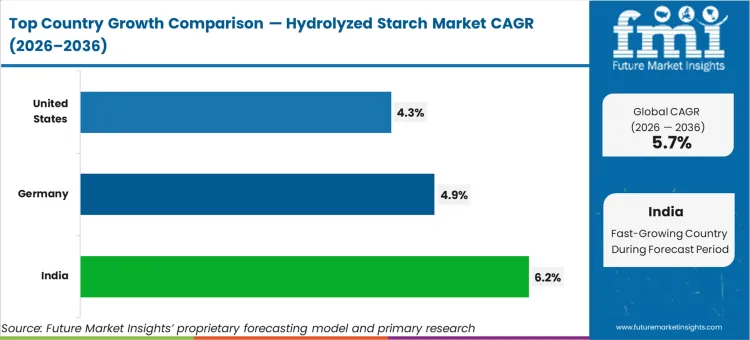
The following table shows the estimated growth rates of the significant three geographies sales. USA, Germany and India are set to exhibit high consumption, recording CAGRs of 4.3%, 4.9%, and 6.2% respectively, through 2036.
.webp "Top Country Growth Comparison Hydrolyzed Starch Market Cagr (2026 2036)")
| Countries | CAGR 2026 to 2036 |
|---|---|
| United States | 4.3% |
| Germany | 4.9% |
| India | 6.2% |
On the Role of Functional Ingredients in Food and Non-alcoholic Beverages
In the USA, ‘better-for-you’ products - that is, foods and beverages containing functional ingredients - remain a key growth factor. Due to a growing trend in the population’s health-consciousness, they demand not only nutritional value for their products but more health benefits. This trend has spiralled into increased usage of starch derivatives such as hydrolyzed starch in an attempt to improve texture and functionality of foods.
The increase in the number of people observing gluten-free, low calorie, and no sugar diets has seen an upgrade of starch based products for thickening and sweetening. Moreover, it is currently being used in the beverages and snacks for enhancing mouth feel and get longer shelf life on the products. From this, analysts foresee a further propelling in the sector due to this demand for functional ingredients.
Concerned strategies and sustainable production practices by manufacturers in Germany
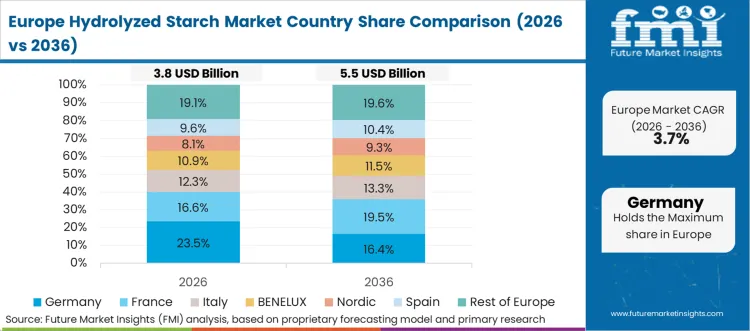
There has been a good trend towards sustainability especially more observed in the food industry and the personal care segment which customers are insisting on clean label products. Manufacturers in the region are trying to adapt to impact by using more sustainable material like sourcing of starch from renewable and eco-friendly sources. The consumers in the German market are becoming more conscious of the environmental repercussions of the products they buy resulting in lots of demand for ingredients that are organically sourced.
Being derived from renewable resources such as corn, hydrolyzed starch is becoming increasingly popular owing to its environmental friendly properties. In the same measure, the consciousness of environmentally sensitive consumption has taken a driving seat; the German manufacturers fall in line to offer clear value chains regarding sourcing of raw materials and their processing hence straining the demand for virgin starch in the food and cosmetics Industry.
Rising trend of quality checks for ingredients by consumers in India
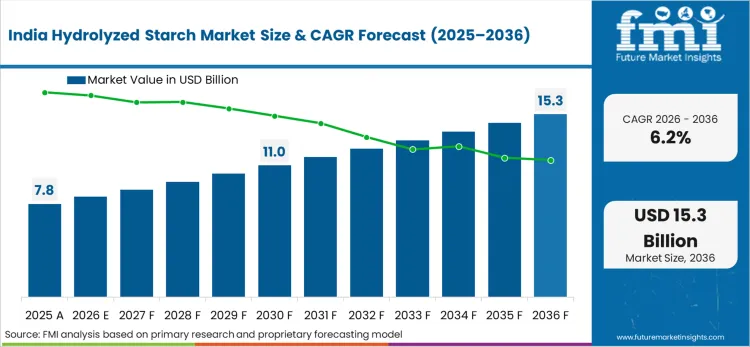
One of the new trends in the Indian market is the desire for healthy food and cosmetic products, which will contribute to the development of hydrolyzed starch. Owing to the increasing population density and expanding economy, people have gradually put more focus on the food and drinks with physiological function. It is being used in diabetic products, obesity management products, and nutrient fortified foods.
The size of the middle class and the consumption of healthy food products have expanded the call for lower sugar, lower calorie, and gluten free products infesting starch derivatives within these products. Also, it is gradually entering traditional Ayurvedic and natural health supplements markets of India and stays popular. Based on this trend towards wellness and preventive medicine, there is also a corresponding and growing need in the country.
Category-wise Insights
Dominance in Moisture Retaining ingredients elevating the sales in global business landscape
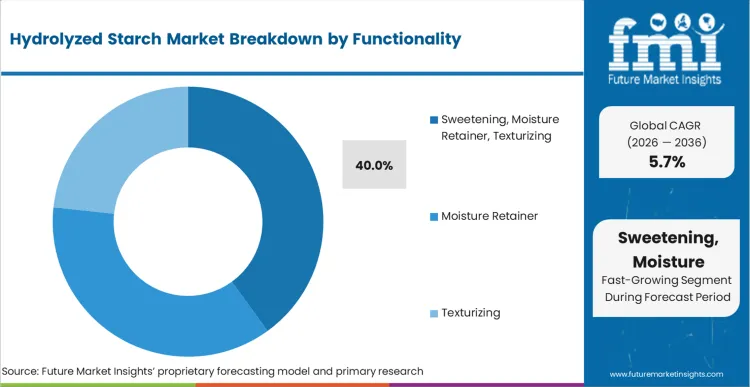
| Segment | Moisture Retainer (Functionality) |
|---|---|
| Value Share (2026) | 40.0% |
Among the various key drivers associated with increased utilization of hydrolyzed starch, is the role it plays as a water absorber. This characteristic hence makes it suitable to be used in foods, cosmetics and pharmaceutical industries where water content is crucial for the products stability and texture. It swells and retains moisture in the product to reduce the risk of it evaporating reducing the shelf life of the product.
The essential function in food is that it improves mouthfeel and moistness in baked products, sauces, and vinaigreases. Likewise, in cosmetics target product which is used in lotions creams and mask to give a slippery feel and moisture content to the end products. Because of its versatility in now enabling the formulations to retain moisture, it has become a favourite of companies that seek to enhance the sensory characteristics and functions of the products.
Physical properties Attracting the skin care product manufacturers
| Segment | Personal care (End-Use) |
|---|---|
| Value Share (2026) | 35.0% |
Hydrolyzed Starch has recently gained popularity in many products within the field of personal care. Due to change in consumer preference and trend in choosing natural and environmentally friendly products and components to use in their consumption as well as GMI, the need for organic and skin-friendly compositions for the production of these products has experienced a commendable upturn.
Starch which has been hydrolyzed is emerging on the market in products such as shampoos, conditioners, face masks, and moisturizers because of its mild cationic nature, its non-irritating property, and its ability to improve the body of a product. Some of its functions include: acting as a binder, thickener and stabilizer of personal care formulations enhancing feel. It also has excellent moisture retention characteristics which make it well suited for use in refreshing other skin care products.
Further, in relation to its efficacy, new better-said clean beauty and environmental friendly formulations are preferred to be derived from natural sources like target product. This trend is expected to further enhance its usage throughout the whole personal care industry.
Competition Outlook
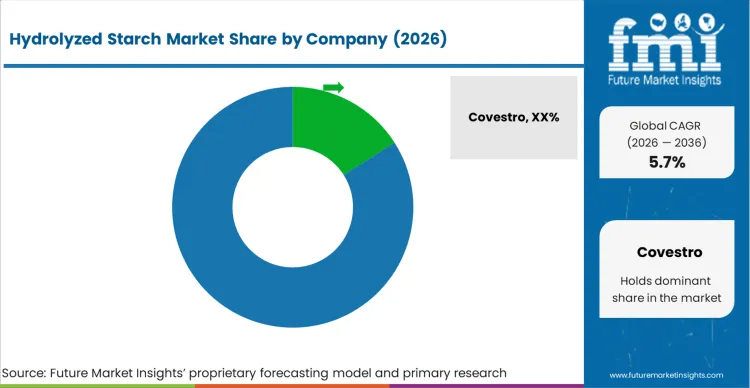
The business landscape around the world is growing and is backed by some vital actions of the leading players active in the market. Industries like Cargill, Ingredion, ADM and Roquette are shifting towards the expansion of their portfolio in natural and clean label product which is currently on higher demand as a result of rising health consciousness among people and increasing interest from food producers on usage of natural and transparent food resources.
The suppliers are diversifying their product range and invest in further development of enzymatic hydrolysis to enhance properties. Also, sustainability remains a major reason with many companies pledging responsible sourcing practices of sustainable agricultural inputs besides working to minimize the effects on the environment.
The players are also enhancing their industry dominating capabilities through the formation of strategic business ties and partnerships with sectors such as the food and pharma plus, feed sector. It also assists in the development of their technological skills, formulation of the products offered, and satisfying various industries.
In addition, the performance is further being supported by the diversification into the emerging segments like processed food, personal care, and animal feed where the demand is experiencing growth. The market is also changing due to the increasing demand for functional ingredients in the various sectors such as the formulation of medicines, starch hydrolyzed in this manner, for animal feed for enhanced digestive system.
Recent Developments
The report includes full coverage of key trends from competitive benchmarking. Some of the recent developments covered in the reports:
- In November 2025, Tate and Lyle expanded its regenerative agriculture program into Europe, partnering with French corn farmers to implement AI-driven solutions improving soil health and resilience for its corn-based starch and sweetener supply chains. [1]
- In March 2025, Cargill inaugurated a new corn starch milling plant in Gwalior, Madhya Pradesh, India, set up by Saatvik Agro Processors to supply high-quality starch inputs for regional confectionery, infant formula, and dairy industries. [2]
- In February 2026, Ingredion confirmed its 2026 strategic focus on purposeful evolution in texture solutions targeting Gen Z and Millennial preferences for immersive and layered snack experiences, reinforcing investment in high-functionality hydrolyzed starch applications. [3]
Leading Manufacturers
- Covestro
- Lyckeby
- Cargill Inc.
- BASF
- DowDuPont
- Lanxess Aktiengesellschaft
- Mitsui Chemicals
- Shell International
- Stepan Company
- Sweetener Products Company
- SPI Polyols, Inc.
- Roquette America Inc.
- Tereos Starch & Sweeteners
- Archer Daniels Midland
- Tongaat Hulett Starch
Scope of the Report
| Metric | Value |
|---|---|
| Quantitative Units | USD 15.52 billion (2026) to USD 27.01 billion (2036), at a CAGR of 5.7% |
| Market Definition | The hydrolyzed starch market comprises globally traded enzymatically and acid-hydrolyzed starch products including glucose syrups, maltodextrins, and dextrins used as sweeteners, humectants, and texture modifiers across food, beverage, pharmaceutical, and industrial applications. |
| Nature Segmentation | Organic, Conventional |
| Functionality Segmentation | Sweetening, Moisture Retainer, Texturizing (including multi-functional combinations) |
| Application Coverage | Food and beverage sweetening, moisture retention in baked goods and confectionery, texturizing in sauces and dairy, pharmaceutical excipients, industrial carriers |
| Regions Covered | North America, Latin America, Europe, East Asia, South Asia, Oceania, Middle East and Africa |
| Countries Covered | United States, Germany, France, Netherlands, China, Japan, South Korea, India, Brazil, Australia and 40 plus countries |
| Key Companies Profiled | Cargill Inc., Lyckeby, BASF, Mitsui Chemicals, Sweetener Products Company, SPI Polyols Inc., Roquette America Inc., Covestro, DowDuPont, Lanxess Aktiengesellschaft, Stepan Company |
| Forecast Period | 2026 to 2036 |
| Approach | Hybrid top-down and bottom-up market modeling validated through primary interviews with corn wet milling operators and food ingredient buyers, supported by Corn Refiners Association data, UN Comtrade statistics, and crop production benchmarks |
Key Segments of the Report
By Nature:
By Nature, Industry Has been categorised into Organic and Conventional
By Functionality:
Different functionalities like Sweetening, Moisture Retainer, Texturizing are included in the report.
By End-use:
Different end uses like Bakery, Confectionary, Dairy, Jams and Spreads, Beverages, Pharmaceuticals, Personal care & cosmetics and Others are considered after exhaustive research.
By Source:
Key sources like Rice, Wheat, Potato and Others considered after the research.
By Form:
Three forms which Powder, Coarse-Grain and Granulated are included in the report
By Region:
Industry analysis has been carried out in key countries of North America, Latin America, Europe, Middle East and Africa, East Asia, South Asia, and Oceania
Bibliography
- [1] Tate and Lyle. (2025). Tate and Lyle extends its regenerative agriculture programme into Europe with French corn farmers. November 2025.
- [2] Cargill. (2025). Cargill news: corn starch milling plant inauguration in Gwalior, India. March 2025.
- [3] Ingredion Incorporated. (2026). Ingredion 2026 strategic focus on texture solutions. February 2026.
- [4] Corn Refiners Association. (2025). Annual Report on Corn Wet Milling Production and Trade. Washington DC, 2025.
This Report Addresses
- Market intelligence to enable structured sourcing, production optimisation, and channel strategy decisions across sweetening, moisture retention, and texturizing hydrolyzed starch applications
- Market size estimation and 10-year revenue forecasts from 2026 to 2036, supported by validated corn wet milling production data and international trade benchmarks
- Growth opportunity mapping across nature and functionality segments with emphasis on multi-functional starch development, organic certification, and regenerative agriculture sourcing credentials
- Segment and regional revenue forecasts covering sweetening, moisture retention, and texturizing functionality applications across 40 plus countries
- Competition strategy assessment including AI-driven production optimisation, regenerative agriculture program development, and emerging market capacity positioning
- Regulatory impact analysis covering organic certification standards for starch ingredients, food additive approval frameworks, and clean-label documentation requirements
- Supply chain risk assessment covering corn origin concentration, climate exposure, and new Asian capacity impact on commodity margin compression
- Market report delivery in PDF, Excel, PPT, and interactive dashboard formats for executive and operational use
Frequently Asked Questions
How large is the demand for Hydrolyzed Starch in the global market in 2026?
Demand for Hydrolyzed Starch in the global market is estimated to be valued at USD 15.52 billion in 2026.
What will the market size of Hydrolyzed Starch be by 2036?
Market size for Hydrolyzed Starch is projected to reach USD 27.01 billion by 2036.
What is the expected CAGR for the Hydrolyzed Starch Market between 2026 and 2036?
Demand for Hydrolyzed Starch is expected to grow at a CAGR of 5.7% between 2026 and 2036.
Which Nature segment leads the Hydrolyzed Starch Market?
Conventional production holds the majority of market share, while Organic accounts for 35.0%, reflecting growing clean-label and sustainability certification demands from premium food and beverage manufacturers.
What Functionality segment is the most valuable in the Hydrolyzed Starch Market?
The combined Sweetening, Moisture Retainer, and Texturizing multi-functional segment captures 40.0% of demand, representing the highest-margin application tier in food and beverage manufacturing.
What is the United States CAGR for Hydrolyzed Starch?
The United States grows at a 4.3% CAGR through 2036, generating USD 5.59 billion in 2026 demand as the world's largest corn wet milling base and primary hydrolyzed starch producing nation.
Why does Japan hold the largest individual country value in this market?
Japan holds USD 11.13 billion in 2026 market value, reflecting extensive hydrolyzed starch use across processed food, confectionery, and functional beverage manufacturing.
What does Tate and Lyle's regenerative agriculture expansion into Europe signal?
The November 2025 AI-driven corn farmer partnership signals that leading operators are building upstream agricultural technology advantages that create supply chain differentiation and input cost resilience unavailable to commodity starch producers.
What is included in the scope of this report?
Scope covers enzymatically and acid-hydrolyzed starch products including glucose syrups, maltodextrins, and dextrins used as sweeteners, humectants, and texture modifiers across food, beverage, pharmaceutical, and industrial applications.
What is excluded from this report's scope?
Unhydrolyzed native starches, finished consumer food products, non-starch derived sweeteners, bioethanol feedstock starch, and non-food industrial applications are excluded.
How does FMI validate its Hydrolyzed Starch Market forecast?
The forecast uses a hybrid model validated through primary interviews with wet milling operators and food ingredient buyers, cross-checked against Corn Refiners Association data, UN Comtrade statistics, and major processor annual reports.
Preview the report firsthand - request a free sample
Get SampleGet the brochure for pricing and purchase details.
Get PDFTable of Content
- Executive Summary
- Global Market Outlook
- Demand-side Trends
- Supply-side Trends
- Technology Roadmap Analysis
- Analysis and Recommendations
- Market Overview
- Market Coverage / Taxonomy
- Market Definition / Scope / Limitations
- Research Methodology
- Chapter Orientation
- Analytical Lens and Working Hypotheses
- Market Structure, Signals, and Trend Drivers
- Benchmarking and Cross-market Comparability
- Market Sizing, Forecasting, and Opportunity Mapping
- Research Design and Evidence Framework
- Desk Research Programme (Secondary Evidence)
- Company Annual and Sustainability Reports
- Peer-reviewed Journals and Academic Literature
- Corporate Websites, Product Literature, and Technical Notes
- Earnings Decks and Investor Briefings
- Statutory Filings and Regulatory Disclosures
- Technical White Papers and Standards Notes
- Trade Journals, Industry Magazines, and Analyst Briefs
- Conference Proceedings, Webinars, and Seminar Materials
- Government Statistics Portals and Public Data Releases
- Press Releases and Reputable Media Coverage
- Specialist Newsletters and Curated Briefings
- Sector Databases and Reference Repositories
- FMI Internal Proprietary Databases and Historical Market Datasets
- Subscription Datasets and Paid Sources
- Social Channels, Communities, and Digital Listening Inputs
- Additional Desk Sources
- Expert Input and Fieldwork (Primary Evidence)
- Primary Modes
- Qualitative Interviews and Expert Elicitation
- Quantitative Surveys and Structured Data Capture
- Blended Approach
- Why Primary Evidence is Used
- Field Techniques
- Interviews
- Surveys
- Focus Groups
- Observational and In-context Research
- Social and Community Interactions
- Stakeholder Universe Engaged
- C-suite Leaders
- Board Members
- Presidents and Vice Presidents
- R&D and Innovation Heads
- Technical Specialists
- Domain Subject-matter Experts
- Scientists
- Physicians and Other Healthcare Professionals
- Governance, Ethics, and Data Stewardship
- Research Ethics
- Data Integrity and Handling
- Primary Modes
- Tooling, Models, and Reference Databases
- Desk Research Programme (Secondary Evidence)
- Data Engineering and Model Build
- Data Acquisition and Ingestion
- Cleaning, Normalisation, and Verification
- Synthesis, Triangulation, and Analysis
- Quality Assurance and Audit Trail
- Market Background
- Market Dynamics
- Drivers
- Restraints
- Opportunity
- Trends
- Scenario Forecast
- Demand in Optimistic Scenario
- Demand in Likely Scenario
- Demand in Conservative Scenario
- Opportunity Map Analysis
- Product Life Cycle Analysis
- Supply Chain Analysis
- Investment Feasibility Matrix
- Value Chain Analysis
- PESTLE and Porter’s Analysis
- Regulatory Landscape
- Regional Parent Market Outlook
- Production and Consumption Statistics
- Import and Export Statistics
- Market Dynamics
- Global Market Analysis 2021 to 2025 and Forecast, 2026 to 2036
- Historical Market Size Value (USD Million) Analysis, 2021 to 2025
- Current and Future Market Size Value (USD Million) Projections, 2026 to 2036
- Y-o-Y Growth Trend Analysis
- Absolute $ Opportunity Analysis
- Global Market Pricing Analysis 2021 to 2025 and Forecast 2026 to 2036
- Global Market Analysis 2021 to 2025 and Forecast 2026 to 2036, By Nature
- Introduction / Key Findings
- Historical Market Size Value (USD Million) Analysis By Nature , 2021 to 2025
- Current and Future Market Size Value (USD Million) Analysis and Forecast By Nature , 2026 to 2036
- Organic
- Conventional
- Organic
- Y-o-Y Growth Trend Analysis By Nature , 2021 to 2025
- Absolute $ Opportunity Analysis By Nature , 2026 to 2036
- Global Market Analysis 2021 to 2025 and Forecast 2026 to 2036, By Functionality
- Introduction / Key Findings
- Historical Market Size Value (USD Million) Analysis By Functionality, 2021 to 2025
- Current and Future Market Size Value (USD Million) Analysis and Forecast By Functionality, 2026 to 2036
- Sweetening, Moisture Retainer, Texturizing
- Moisture Retainer
- Texturizing
- Sweetening, Moisture Retainer, Texturizing
- Y-o-Y Growth Trend Analysis By Functionality, 2021 to 2025
- Absolute $ Opportunity Analysis By Functionality, 2026 to 2036
- Global Market Analysis 2021 to 2025 and Forecast 2026 to 2036, By Region
- Introduction
- Historical Market Size Value (USD Million) Analysis By Region, 2021 to 2025
- Current Market Size Value (USD Million) Analysis and Forecast By Region, 2026 to 2036
- North America
- Latin America
- Western Europe
- Eastern Europe
- East Asia
- South Asia and Pacific
- Middle East & Africa
- Market Attractiveness Analysis By Region
- North America Market Analysis 2021 to 2025 and Forecast 2026 to 2036, By Country
- Historical Market Size Value (USD Million) Trend Analysis By Market Taxonomy, 2021 to 2025
- Market Size Value (USD Million) Forecast By Market Taxonomy, 2026 to 2036
- By Country
- USA
- Canada
- Mexico
- By Nature
- By Functionality
- By Country
- Market Attractiveness Analysis
- By Country
- By Nature
- By Functionality
- Key Takeaways
- Latin America Market Analysis 2021 to 2025 and Forecast 2026 to 2036, By Country
- Historical Market Size Value (USD Million) Trend Analysis By Market Taxonomy, 2021 to 2025
- Market Size Value (USD Million) Forecast By Market Taxonomy, 2026 to 2036
- By Country
- Brazil
- Chile
- Rest of Latin America
- By Nature
- By Functionality
- By Country
- Market Attractiveness Analysis
- By Country
- By Nature
- By Functionality
- Key Takeaways
- Western Europe Market Analysis 2021 to 2025 and Forecast 2026 to 2036, By Country
- Historical Market Size Value (USD Million) Trend Analysis By Market Taxonomy, 2021 to 2025
- Market Size Value (USD Million) Forecast By Market Taxonomy, 2026 to 2036
- By Country
- Germany
- UK
- Italy
- Spain
- France
- Nordic
- BENELUX
- Rest of Western Europe
- By Nature
- By Functionality
- By Country
- Market Attractiveness Analysis
- By Country
- By Nature
- By Functionality
- Key Takeaways
- Eastern Europe Market Analysis 2021 to 2025 and Forecast 2026 to 2036, By Country
- Historical Market Size Value (USD Million) Trend Analysis By Market Taxonomy, 2021 to 2025
- Market Size Value (USD Million) Forecast By Market Taxonomy, 2026 to 2036
- By Country
- Russia
- Poland
- Hungary
- Balkan & Baltic
- Rest of Eastern Europe
- By Nature
- By Functionality
- By Country
- Market Attractiveness Analysis
- By Country
- By Nature
- By Functionality
- Key Takeaways
- East Asia Market Analysis 2021 to 2025 and Forecast 2026 to 2036, By Country
- Historical Market Size Value (USD Million) Trend Analysis By Market Taxonomy, 2021 to 2025
- Market Size Value (USD Million) Forecast By Market Taxonomy, 2026 to 2036
- By Country
- China
- Japan
- South Korea
- By Nature
- By Functionality
- By Country
- Market Attractiveness Analysis
- By Country
- By Nature
- By Functionality
- Key Takeaways
- South Asia and Pacific Market Analysis 2021 to 2025 and Forecast 2026 to 2036, By Country
- Historical Market Size Value (USD Million) Trend Analysis By Market Taxonomy, 2021 to 2025
- Market Size Value (USD Million) Forecast By Market Taxonomy, 2026 to 2036
- By Country
- India
- ASEAN
- Australia & New Zealand
- Rest of South Asia and Pacific
- By Nature
- By Functionality
- By Country
- Market Attractiveness Analysis
- By Country
- By Nature
- By Functionality
- Key Takeaways
- Middle East & Africa Market Analysis 2021 to 2025 and Forecast 2026 to 2036, By Country
- Historical Market Size Value (USD Million) Trend Analysis By Market Taxonomy, 2021 to 2025
- Market Size Value (USD Million) Forecast By Market Taxonomy, 2026 to 2036
- By Country
- Kingdom of Saudi Arabia
- Other GCC Countries
- Turkiye
- South Africa
- Other African Union
- Rest of Middle East & Africa
- By Nature
- By Functionality
- By Country
- Market Attractiveness Analysis
- By Country
- By Nature
- By Functionality
- Key Takeaways
- Key Countries Market Analysis
- USA
- Pricing Analysis
- Market Share Analysis, 2025
- By Nature
- By Functionality
- Canada
- Pricing Analysis
- Market Share Analysis, 2025
- By Nature
- By Functionality
- Mexico
- Pricing Analysis
- Market Share Analysis, 2025
- By Nature
- By Functionality
- Brazil
- Pricing Analysis
- Market Share Analysis, 2025
- By Nature
- By Functionality
- Chile
- Pricing Analysis
- Market Share Analysis, 2025
- By Nature
- By Functionality
- Germany
- Pricing Analysis
- Market Share Analysis, 2025
- By Nature
- By Functionality
- UK
- Pricing Analysis
- Market Share Analysis, 2025
- By Nature
- By Functionality
- Italy
- Pricing Analysis
- Market Share Analysis, 2025
- By Nature
- By Functionality
- Spain
- Pricing Analysis
- Market Share Analysis, 2025
- By Nature
- By Functionality
- France
- Pricing Analysis
- Market Share Analysis, 2025
- By Nature
- By Functionality
- India
- Pricing Analysis
- Market Share Analysis, 2025
- By Nature
- By Functionality
- ASEAN
- Pricing Analysis
- Market Share Analysis, 2025
- By Nature
- By Functionality
- Australia & New Zealand
- Pricing Analysis
- Market Share Analysis, 2025
- By Nature
- By Functionality
- China
- Pricing Analysis
- Market Share Analysis, 2025
- By Nature
- By Functionality
- Japan
- Pricing Analysis
- Market Share Analysis, 2025
- By Nature
- By Functionality
- South Korea
- Pricing Analysis
- Market Share Analysis, 2025
- By Nature
- By Functionality
- Russia
- Pricing Analysis
- Market Share Analysis, 2025
- By Nature
- By Functionality
- Poland
- Pricing Analysis
- Market Share Analysis, 2025
- By Nature
- By Functionality
- Hungary
- Pricing Analysis
- Market Share Analysis, 2025
- By Nature
- By Functionality
- Kingdom of Saudi Arabia
- Pricing Analysis
- Market Share Analysis, 2025
- By Nature
- By Functionality
- Turkiye
- Pricing Analysis
- Market Share Analysis, 2025
- By Nature
- By Functionality
- South Africa
- Pricing Analysis
- Market Share Analysis, 2025
- By Nature
- By Functionality
- USA
- Market Structure Analysis
- Competition Dashboard
- Competition Benchmarking
- Market Share Analysis of Top Players
- By Regional
- By Nature
- By Functionality
- Competition Analysis
- Competition Deep Dive
- Covestro
- Overview
- Product Portfolio
- Profitability by Market Segments (Product/Age /Sales Channel/Region)
- Sales Footprint
- Strategy Overview
- Marketing Strategy
- Product Strategy
- Channel Strategy
- Lyckeby
- Cargill Inc.
- BASF
- DowDuPont
- Lanxess Aktiengesellschaft
- Mitsui Chemicals
- Shell International
- Stepan Company
- Sweetener Products Company
- SPI Polyols, Inc.
- Roquette America Inc.
- Tereos Starch & Sweeteners
- Archer Daniels Midland
- Tongaat Hulett Starch
- Covestro
- Competition Deep Dive
- Assumptions & Acronyms Used


