

- Market Size (2026)
- USD 420.6 Mn
- Forecast (2036)
- USD 711.7 Mn
- CAGR (2026 to 2036)
- 5.4%
How big is Hydroseeding Tackifiers Market in 2026?
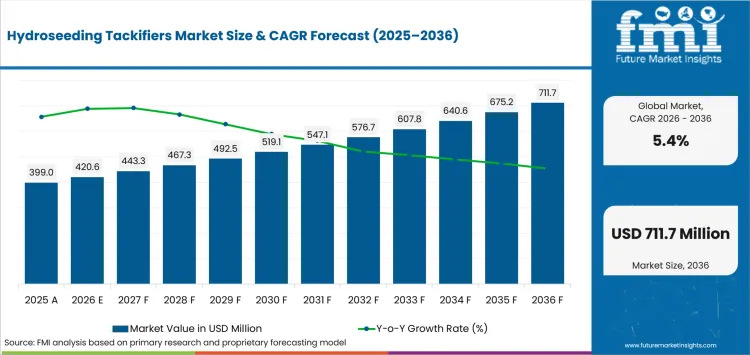
USD 420.6 million in 2026 and USD 711.7 million by 2036 at a 5.4% CAGR.
Demand for hydroseeding tackifiers is projected to expand at 5.4% CAGR between 2026 and 2036, increasing valuation from USD 420.6 million in 2026 to USD 711.7 million by 2036. Project demand is tied to disturbed-soil stabilization, revegetation schedules and the need to keep hydraulically applied seed and mulch in place during the establishment period.
Public erosion-control guidance keeps tackifiers inside defined field practices. USDA Natural Resources Conservation Service guidance describes hydromulching as a mix of water, fiber mulch and tackifier sprayed on burned slopes for erosion control or revegetation. Caltrans likewise defines hydroseeding as hydraulic application of seed, fiber and tackifier on disturbed soil, particularly on cut and fill slopes where surface erosion must be controlled before vegetation provides longer-term cover.
Key Takeaways of Hydroseeding Tackifiers Market
- Infrastructure earthworks and restoration programs support recurring demand where exposed soil must be stabilized before vegetation establishes.
- Guar gum tackifiers are projected at 34.0% of Tackifier Type demand in 2026 because organic binding chemistry fits established hydraulic application practices.
- Powder is estimated at 46.0% of Form demand in 2026 as bagged concentrates reduce transported water and allow field dosing by project conditions.
- Highway slopes are forecast at 31.0% of Application demand in 2026 as road grading creates broad disturbed surfaces with formal revegetation requirements.
- Performance varies with slope, rainfall and slurry preparation, which can move severe sites toward fiber matrices or structural erosion-control systems.
- Profile Products LLC, LSC Environmental Products, LLC, Rantec Corporation, Chemstar Products Company, JRM Chemical, Inc., Innovative Turf Solutions, LLC, FINN Corporation, Bowie Industries, Inc. and Verdyol International AG participate across formulation or hydraulic application workflows.
Analyst Perspective
"Hydroseeding tackifiers create value when a formulation remains pumpable in the tank, bonds mulch to the soil surface and satisfies the project specification. Suppliers should treat mixing guidance and application support as part of the product because failed dispersion or the wrong dose can turn a low-cost additive into rework after the next rainfall event."
- Nikhil Kaitwade, Principal Consultant, Future Market Insights
How is the Hydroseeding Tackifiers Market segmented?
The hydroseeding tackifiers market is segmented by tackifier type, form, application, erosion severity, sales channel and region.
Tackifier Type covers guar gum, psyllium, polyacrylamide, starch-based and cellulose fiber formulations. Form includes powder, granular, liquid concentrate and fiber-tackifier blends. Application spans highway slopes, mine reclamation, residential landscaping, landfill covers and wildfire restoration. Erosion Severity separates moderate, low, steep and severe rainfall or channel conditions. Sales Channel covers erosion-control distributors, hydroseeding contractors, landscape supply dealers and government project supply.
Why do highway slopes account for 31.0% of the Application category?
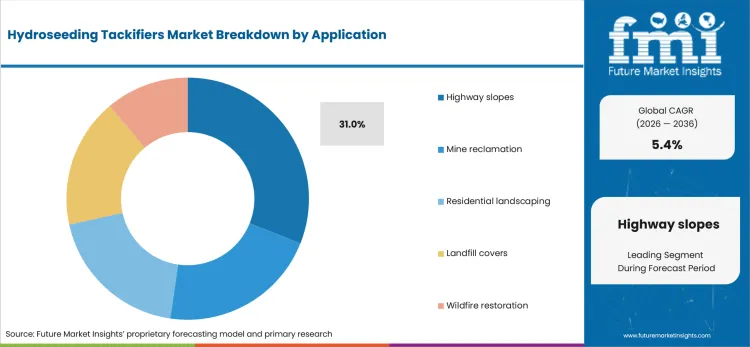
Road construction repeatedly creates cut slopes and embankments before vegetation has time to establish. Hydraulic application lets crews cover irregular ground from accessible equipment positions while applying seed, fiber and binder in a planned sequence. Caltrans lists hydroseeding and hydromulching for disturbed areas and identifies cut and fill slopes as a common use case. Spanish transport specifications also recognize hydroseeding as an initial route to permanent herbaceous cover on restored road surfaces. Where surface treatment alone cannot address load or confinement needs, designers may specify systems covered in the geocells market for separate stabilization functions.
- Highway slopes are forecast to account for 31.0% of Application demand in 2026 because road earthworks create recurring revegetation and erosion-control tasks.
- Transport-agency specifications make hydraulic stabilization a contract requirement on defined disturbed areas, which supports repeat procurement through civil works programs.
Why do guar gum tackifiers account for 34.0% of the Tackifier Type category?
Guar gum provides viscosity and surface adhesion without turning the treated area into a rigid cover. That balance suits hydroseeding because seed still needs moisture and contact with the soil while the mulch remains anchored. USDA NRCS guidance for burned slopes cites typical guar-based tackifier application alongside wood fiber mulch, and current Caltrans guidance treats tackifier as the binder that keeps hydroseed materials in place. Similar qualification logic appears in the erosion control polymers category, where soil condition and runoff exposure influence the binder selected for a project.
- Guar gum tackifiers are projected to account for 34.0% of Tackifier Type demand in 2026 due to established use in hydraulic erosion-control mixes and compatibility with organic specifications.
- Current product specifications from Profile Products and Rantec show guar-based tackifiers remain commercially active for hydromulch binding, slurry viscosity and temporary erosion control.
Why does powder account for 46.0% of the Form category?
Powder concentrates the binding ingredient into a format that contractors can store dry, transport without added water and meter by weight at the hydroseeder. The economics are practical on project work because application rates can be adjusted by slope or specification without changing equipment. Dry handling still requires disciplined loading and agitation. A formulation that hydrates too quickly can clump, while poor dispersion can create uneven viscosity or blocked spray paths.
- Powder is expected to represent 46.0% of Form demand in 2026 as compact shipping and weight-based dosing fit contractor workflows.
- North Dakota DOT soil-stabilizer provisions use product-specific pounds-per-acre rates, illustrating why dry formulations fit specification-based field measurement.
Why does moderate slope account for 38.0% of the Erosion Severity category?
Moderate slopes sit where surface binding can still provide a practical temporary control without automatically requiring a blanket, matrix or reinforced system. Treatment intensity rises as grade and runoff energy increase. Current North Dakota DOT soil-stabilizer provisions illustrate this by varying application rates by slope for approved products. The same decision logic limits unnecessary material use on easier ground while preserving a path to stronger systems where concentrated flow or steepness exceeds the performance envelope of a basic tackifier.
- Moderate slope is projected at 38.0% of Erosion Severity demand in 2026 because tackifier can address common washout risk while vegetation establishes.
- Steeper or high-flow sites can require higher application rates or a shift to bonded fiber matrices and other engineered controls.
Why do erosion-control distributors account for 39.0% of the Sales Channel category?
Erosion-control distributors combine local inventory with the specification knowledge needed to match chemistry, mulch and application rates before a crew mobilizes. Contractors often buy against weather-sensitive work windows, so availability can matter as much as unit price. Specialist distributors also reduce the risk of substituting a product that does not meet the job specification. Residential and commercial revegetation demand overlaps with the broader landscaping supply chain, but infrastructure and reclamation projects place more weight on technical documentation and field support.
- Erosion-control distributors are expected to account for 39.0% of Sales Channel demand in 2026 because contractors need stocked material plus application and specification support.
- Direct government project supply remains relevant where approved-product lists or contract schedules define the acceptable formulation and application rate.
What are the drivers, restraints and opportunities in the Hydroseeding Tackifiers Market?
Infrastructure revegetation and erosion-control obligations support demand, while site-specific performance and substitution risk constrain conversion as integrated hydraulic products reduce field dosing steps.
- Driver: Roadwork, reclamation and restoration programs create repeat stabilization needs on exposed soil before permanent vegetation is established.
- Restraint: Slope, rainfall, soil condition and slurry preparation can change tackifier performance enough to require different rates or another erosion-control system.
- Opportunity: Pre-blended fiber-tackifier products and better application guidance can reduce field mixing steps while preserving specification compliance.
Infrastructure is the main commercial trigger because disturbed land becomes a scheduled stabilization task rather than an optional landscape treatment. EPA construction-stormwater guidance requires effective erosion and sediment controls, while transport agencies use hydroseeding or hydraulic mulch inside their own specifications. The same project pipeline supports adjacent soil stabilization materials where civil contractors need ground improvement beyond surface binding.
The restraint is performance variability at the site. Tackifier is a surface treatment, so it does not correct weak soil structure or concentrated-flow problems. Caltrans notes that hydroseed and hydromulch remain surface treatments and that steeper slopes can require higher application rates. On locations where stronger reinforcement or filtration is required, project demand can shift toward the geosynthetics market, reducing the area addressed by stand-alone tackifier.
The clearest product opportunity is to reduce jobsite complexity. Pre-blended fiber and tackifier products can remove a separate dosing step, while dosing charts and equipment-specific guidance can lower mixing errors. Main Roads Western Australia specifies hydro-mulch as water, cellulose fiber mulch, binder and dispersing agents, showing how the binder already sits inside a defined system rather than as an isolated chemical purchase. Suppliers that make this system easier to specify and apply can improve repeat use without changing the underlying erosion-control objective.
Which country CAGRs are included in the Hydroseeding Tackifiers Market?
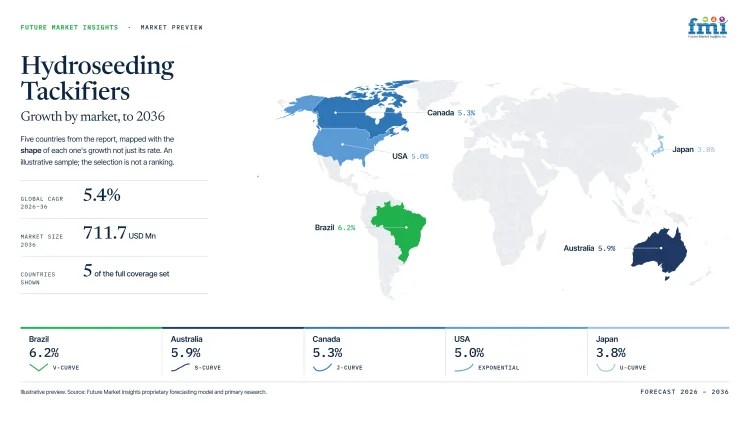
| Country | CAGR |
|---|---|
| Brazil | 6.2% |
| Australia | 5.9% |
| Chile | 5.6% |
| Canada | 5.3% |
| USA | 5.0% |
| Spain | 4.7% |
| Japan | 3.8% |
How do country-level CAGRs compare in the Hydroseeding Tackifiers Market?
The seven country CAGRs span 2.4 percentage points. The difference reflects the pace of new restoration and infrastructure activity, specification practice and contractor adoption rather than the absolute size of each national market.
- Brazil is set to grow at 6.2% CAGR as formal degraded-area recovery plans keep revegetation and monitoring requirements visible in environmental restoration work.
- Australia is anticipated to expand at 5.9% as road revegetation specifications continue to recognize hydro-mulch systems that include a binder.
- Chile is likely to advance at 5.6% as post-fire restoration and soil-conservation programs increase the amount of disturbed land requiring stabilization and revegetation.
- Canada is expected to grow at 5.3% as project approvals continue to include hydroseeding or tackifier among measures available for erosion mitigation during reclamation.
- USA is set to expand at 5.0% as state transport specifications and construction-stormwater controls keep hydraulic erosion-control treatments within recurring civil work.
- Spain is anticipated to grow at 4.7% as road restoration specifications retain hydroseeding for establishing herbaceous cover on affected surfaces and slopes.
- Japan is likely to advance at 3.8% as slope-greening methods remain established in infrastructure work, producing steadier replacement and project demand rather than rapid category expansion.
Comparable growth rates can produce different entry conditions. The full report provides country-level analysis across North America, Latin America, Western Europe, Eastern Europe, East Asia, South Asia and Pacific, and the Middle East and Africa.
Country-wise Analysis
- Brazilian demand is supported by formal restoration planning. IBAMA Instruction 14/2024 establishes procedures for preparing, executing and monitoring recovery plans for degraded or altered areas across Brazilian biomes. This framework creates a recurring need for revegetation methods where disturbed soil must be stabilized and monitored. Brazil is set to grow at 6.2% CAGR through 2036, with conversion depending on site access, rainfall exposure and whether hydraulic stabilization fits the approved recovery plan.
- Australian demand is tied closely to civil specifications. Main Roads Western Australia Specification 304 defines hydro-mulch as a mixture containing water, cellulose fiber mulch, binder and dispersing agents unless an annexure states otherwise. That wording gives tackifier or binder a clear place inside road revegetation procurement. Australia is anticipated to expand at 5.9% CAGR through 2036 as contractors continue to use hydraulic systems for broad disturbed surfaces where equipment access and project timing favor spray application.
- Chile is likely to grow at 5.6% CAGR through 2036 as restoration programs address fire-affected land and soil degradation. CONAF reported soil and water conservation work in Quebrada Escobares during 2025 after the 2024 fire, alongside native planting and erosion-control measures. Tackifier demand will depend on where revegetation plans choose hydraulic application over mechanical barriers, but the underlying project pipeline supports broader use of temporary surface stabilization during establishment.
- Canada is expected to expand at 5.3% CAGR through 2036. The federal decision statement for the Springbank Off-Stream Reservoir requires follow-up on revegetation and allows wind-erosion mitigation through measures such as hydroseeding or tackifier application if monitoring shows additional treatment is needed. This type of conditional requirement favors suppliers that can document the formulation, mixing procedure and field dose for a defined mitigation task.
- USA is set to grow at 5.0% CAGR through 2036 as transport and construction programs keep tackifier inside formal erosion-control practice. Caltrans describes tackifier as the binder for hydroseed materials, while current North Dakota DOT provisions list approved soil stabilizers and application rates. The market therefore converts through state specifications and contractor execution, with stronger demand where disturbed acreage is large enough to justify hydraulic application.
- Spain is anticipated to advance at 4.7% CAGR through 2036. A Ministry of Transport technical specification for Barcelona road works states that recovered topsoil should support permanent herbaceous cover, initially through usual hydroseeding techniques, and links the soil to revegetation of construction-affected areas and slopes. This preserves a public-works route for hydraulic seeding, although tackifier use still depends on the detailed treatment design and rainfall conditions.
- Japan is likely to grow at 3.8% CAGR through 2036. Ministry of Land, Infrastructure, Transport and Tourism monitoring for the Chokai Dam documented spray-applied vegetation-base work and seed application on slopes during FY2025. The practice shows that engineered slope greening is already embedded in infrastructure work. Growth is therefore expected to come from project turnover and specialized formulation needs rather than first-time adoption of hydraulic revegetation methods.
Who are the notable companies in the Hydroseeding Tackifiers Market?
Profile Products LLC, LSC Environmental Products, LLC, Rantec Corporation, Chemstar Products Company, JRM Chemical, Inc., Innovative Turf Solutions, LLC, FINN Corporation, Bowie Industries, Inc. and Verdyol International AG are notable companies serving formulation or hydraulic application workflows in the hydroseeding tackifiers market.
Competition is split between formulation suppliers and equipment or application-workflow providers. Product suppliers compete on organic or polymer chemistry, pumpability, application rate and specification access. Equipment companies influence demand by setting the practical tank capacity, agitation and spray conditions under which tackifier-containing slurries are mixed and placed. The market therefore rewards technical fit with a project method rather than corporate scale.
- Profile Products LLC, Rantec Corporation, Chemstar Products Company, JRM Chemical, Inc. and Innovative Turf Solutions, LLC compete directly through tackifier or soil-stabilization formulations.
- LSC Environmental Products, LLC combines spray-applied erosion-control and revegetation products under one operating platform; Terra Novo and Mat Inc. are not treated as separate competitors because both were integrated into LSC.
- FINN Corporation, Bowie Industries, Inc. and Verdyol International AG influence formulation selection through hydraulic seeding equipment, application workflow and contractor support.
Competitive Benchmarking: Hydroseeding Tackifiers Market
| Company | Tackifier formulation breadth | Hydraulic application integration | Specification / channel access | Geographic Reach |
|---|---|---|---|---|
| Profile Products LLC | High | High | High | North America and international project channels |
| LSC Environmental Products, LLC | High | High | High | North America with international environmental-solutions activity |
| Rantec Corporation | High | Medium | High | United States with distributor and specification channels |
| Chemstar Products Company | Medium | Medium | Medium | United States with industrial and environmental product channels |
| JRM Chemical, Inc. | Medium | Medium | High | United States with public-specification presence |
| Innovative Turf Solutions, LLC | Medium | Medium | Medium | United States erosion-control channels |
| FINN Corporation | Low | High | High | North America with international dealer access |
| Bowie Industries, Inc. | Low | High | Medium | United States with contractor and public-sector users |
| Verdyol International AG | Medium | High | Medium | Europe with international project activity |
Key Developments in the Hydroseeding Tackifiers Market
- In June 2026, FINN Corporation re-launched the T400 HydroSeeder with a 3,975-gallon liquid tank and 3,600-gallon working capacity for highway, pipeline, reclamation and other high-capacity seeding work. Larger tank capacity can reduce refill frequency on broad projects and raises the importance of tackifier formulations that remain easy to mix at higher batch volumes.
- In May 2026, FINN Corporation selected LHP Telematics for its Terralink platform, with integrated telematics being deployed across selected machine lines. Connected equipment can improve visibility into utilization and maintenance while giving material suppliers another route to align mixing and application guidance with the equipment used in the field.
- In April 2022, LSC Environmental Products acquired Mat Inc. and Mat NuWood, adding spray-applied erosion-control and revegetation products to its portfolio. Together with LSC’s earlier integration of Terra Novo, the transaction consolidated several formulation brands under one operating company and removed the need to treat those names as independent competitors.
Key Players in the Hydroseeding Tackifiers Market
Direct Tackifier Formulation Suppliers
- Profile Products LLC
- Rantec Corporation
- Chemstar Products Company
- JRM Chemical, Inc.
- Innovative Turf Solutions, LLC
Integrated Erosion-Control Platforms
- LSC Environmental Products, LLC
Hydroseeding Equipment and Application Workflow Providers
- FINN Corporation
- Bowie Industries, Inc.
- Verdyol International AG
Hydroseeding Tackifiers Market - Report Scope
| Coverage field | Report scope |
|---|---|
| Market breakdown | By tackifier type, form, application, erosion severity, sales channel and region. |
| Quantitative Units | Revenue in USD million and CAGR in %. |
| Market Definition | Tackifier products and tackifier-containing blends sold for hydraulic seeding, hydromulching or related spray-applied erosion-control use. |
| Regions Covered | North America, Latin America, Western Europe, Eastern Europe, East Asia, South Asia and Pacific, and Middle East and Africa. |
| Countries Covered | Brazil, USA, Japan, Australia, Canada, Spain, Chile, and 25+ additional countries included in the full report. |
| Key Companies | Profile Products LLC, LSC Environmental Products, LLC, Rantec Corporation, Chemstar Products Company, JRM Chemical, Inc., Innovative Turf Solutions, LLC, FINN Corporation, Bowie Industries, Inc., Verdyol International AG. |
| Forecast Period | 2026 to 2036. |
| Approach | Primary and secondary research with market triangulation. |
Hydroseeding Tackifiers Market - Research Methodology
| Method | Approach |
|---|---|
| Primary Research | FMI analysts gathered input from tackifier manufacturers, hydraulic mulch suppliers, erosion-control distributors, hydroseeding contractors, civil procurement teams and restoration specialists. Interviews examined formulation choice, application rates, pricing, qualification requirements, equipment compatibility and repeat-purchase conditions. |
| Desk Research | Desk research covered transport specifications, environmental restoration rules, construction-stormwater guidance, public project documents, technical literature, company filings, product information and official corporate announcements. Evidence was reviewed for direct relevance to hydraulic seeding and tackifier use. |
| Market Sizing and Forecasting | The market model combined the baseline value with segment structure, product pricing, contractor activity, specification practice, restoration demand and country-level project conditions. Forecast assumptions considered infrastructure work, land-restoration programs, substitution risk and changes in application efficiency. |
| Data Validation | Estimates were checked against public specifications, company activity, channel evidence and findings from primary interviews. Validation excluded hydroseeding equipment revenue, seed, fertilizer, stand-alone mulch without tackifier and adjacent erosion-control systems outside the defined market boundary. |
Hydroseeding Tackifiers Market by Segments
Hydroseeding Tackifiers Market segmented by Tackifier Type:
- Guar gum tackifiers
- Psyllium tackifiers
- Polyacrylamide tackifiers
- Starch-based tackifiers
- Cellulose fiber tackifiers
Hydroseeding Tackifiers Market segmented by Form:
- Powder
- Granular
- Liquid concentrate
- Fiber-tackifier blends
Hydroseeding Tackifiers Market segmented by Application:
- Highway slopes
- Mine reclamation
- Residential landscaping
- Landfill covers
- Wildfire restoration
Hydroseeding Tackifiers Market segmented by Erosion Severity:
- Moderate slope
- Low slope
- Steep slope
- Severe rainfall / channel
Hydroseeding Tackifiers Market segmented by Sales Channel:
- Erosion-control distributors
- Hydroseeding contractors
- Landscape supply dealers
- Government project supply
Hydroseeding Tackifiers Market by Region:
- North America
- United States
- Canada
- Latin America
- Brazil
- Chile
- Mexico
- Rest of Latin America
- Western Europe
- Germany
- United Kingdom
- Italy
- Spain
- France
- Nordics
- Benelux
- Rest of Western Europe
- Eastern Europe
- Russia
- Poland
- Hungary
- Balkan and Baltic States
- Rest of Eastern Europe
- East Asia
- China
- Japan
- South Korea
- South Asia and Pacific
- India
- ASEAN
- Australia and New Zealand
- Rest of South Asia and Pacific
- Middle East and Africa
- Kingdom of Saudi Arabia
- Other GCC Countries
- Türkiye
- South Africa
- Other African Union Countries
- Rest of Middle East and Africa
Research Sources and Bibliography
- USDA Natural Resources Conservation Service. After the Fire - Hydromulching.
- California Department of Transportation. Erosion Control Toolbox: Hydroseed and Hydromulch.
- California Department of Transportation. Erosion Control Toolbox: Tackifier.
- North Dakota Department of Transportation. (2026, May 8). Job 24685 Request for Proposal - Temporary Soil Stabilizer Special Provision.
- Main Roads Western Australia. (2025, May 22). Specification 304 - Revegetation.
- Brazilian Institute of Environment and Renewable Natural Resources (IBAMA). (2024, July 1). Instrução Normativa 14.
- Impact Assessment Agency of Canada. Springbank Off-Stream Reservoir Project Decision Statement.
- Ministry of Transport and Sustainable Mobility, Spain. (2024, May 14). Barcelona Road Works Technical Specifications, Key 39-B-5220.
- Ministry of Land, Infrastructure, Transport and Tourism, Japan. (2026, February 13). Chokai Dam Environmental Monitoring Survey Results.
- National Forestry Corporation of Chile (CONAF). (2025, August 11). Soil and water conservation work in Quebrada Escobares.
- Profile Products LLC. ConTack Organic Tackifier and Tackifiers product information.
- Rantec Corporation. HF5000, SPECTAC and erosion-control product information.
- Chemstar Products Company. StarTak 600 environmental product information.
- FINN Corporation. (2026, June 9). T400 HydroSeeder re-launch.
- FINN Corporation. (2026, May 11). Terralink telematics announcement.
- LSC Environmental Products, LLC. (2022, April 15). Acquisition of Mat Inc. and Mat NuWood LLC.
- Bowie Industries, Inc. Bowie Hydro-Mulchers product information.
This bibliography is provided for reader reference and is not exhaustive. The full report contains the complete reference list and detailed citations.
This Report Answers
- How large is the Hydroseeding Tackifiers Market in 2026 and 2036?
- Which infrastructure and restoration conditions support recurring demand for hydroseeding tackifiers?
- Why do guar gum tackifiers account for 34.0% of Tackifier Type demand in 2026?
- How does powder form influence transport, storage and hydroseeder dosing?
- Why do highway slopes account for 31.0% of Application demand in 2026?
- How do erosion severity and site conditions change tackifier selection?
- How do country growth rates differ across Brazil, Australia, Chile, Canada, USA, Spain and Japan?
- Which companies supply tackifier formulations or support hydraulic application workflows?
Frequently Asked Questions
How big is the Hydroseeding Tackifiers Market in 2026?
USD 420.6 million represents the hydroseeding tackifiers market value in 2026. Demand is tied to hydraulic erosion-control and revegetation work across infrastructure, reclamation and restoration projects as the market advances toward USD 711.7 million by 2036.
What is the CAGR of the Hydroseeding Tackifiers Market from 2026 to 2036?
A 5.4% CAGR is projected for the hydroseeding tackifiers market between 2026 and 2036. Growth depends on recurring disturbed-land stabilization, specification acceptance and the ability of tackifier formulations to remain compatible with hydraulic application equipment.
Which tackifier type accounts for 34.0% of the Hydroseeding Tackifiers Market?
Guar gum tackifiers are projected to account for 34.0% of Tackifier Type demand in 2026. Their role is supported by established use as organic binders in hydromulch and hydroseeding applications where mulch adhesion and slurry handling both matter.
How much will the Hydroseeding Tackifiers Market add between 2026 and 2036?
USD 291.1 million is expected to be added to the hydroseeding tackifiers market between 2026 and 2036. The increase reflects broader project demand while substitution by fiber matrices, geosynthetics or other erosion-control systems continues to limit some applications.
Which companies are active in the Hydroseeding Tackifiers Market?
Companies active in formulation or hydraulic application workflows include Profile Products LLC, LSC Environmental Products, LLC, Rantec Corporation, Chemstar Products Company, JRM Chemical, Inc., Innovative Turf Solutions, LLC, FINN Corporation, Bowie Industries, Inc. and Verdyol International AG.
Preview the report firsthand - request a free sample
Get SampleGet the brochure for pricing and purchase details.
Get PDFTable of Content
- Key Takeaways
- Market Size and CAGR
- Top Growth Driver
- Fastest Growing Segment
- Leading Region
- Key Companies
- Emerging Opportunities
- Executive Summary
- Global Market Outlook
- Demand-side Trends
- Supply-side Trends
- Technology Roadmap Analysis
- Analysis and Recommendations
- Analyst Perspective (What is happening? Why now? What should investors know?)
- Key Questions Answered
- How large is the market?
- What is the CAGR?
- What are key trends?
- Which region dominates?
- Who are the leaders?
- Market Overview
- Market Coverage / Taxonomy
- Market Definition / Scope / Limitations
- Research Methodology
- Chapter Orientation
- Analytical Lens and Working Hypotheses
- Market Structure, Signals, and Trend Drivers
- Benchmarking and Cross-market Comparability
- Market Sizing, Forecasting, and Opportunity Mapping
- Research Design and Evidence Framework
- Desk Research Programme (Secondary Evidence)
- Expert Input and Fieldwork (Primary Evidence)
- Tooling, Models, and Reference Databases
- Data Engineering and Model Build
- Quality Assurance and Audit Trail
- Market Background
- Market Dynamics (Drivers, Restraints, Opportunity, Trends)
- Scenario Forecast (Optimistic, Likely, Conservative)
- Impact Analysis
- AI Impact
- Sustainability Impact
- Regulatory Impact
- Technology Impact
- Consumer / Buyer Analysis
- Purchase Drivers
- Adoption Barriers
- Buyer Journey
- Opportunity Map Analysis
- Product Life Cycle Analysis
- Supply Chain Analysis
- Investment Feasibility Matrix
- Value Chain Analysis
- PESTLE and Porter's Analysis
- Regulatory Landscape
- Regional Parent Market Outlook
- Production and Consumption Statistics
- Import and Export Statistics
- Global Market Analysis and Forecast, 2021 to 2036
- Historical Market Size Value (USD Million) Analysis, 2021 to 2025
- Current and Future Market Size Value (USD Million) Projections, 2026 to 2036
- Y-o-Y Growth Trend Analysis
- Absolute $ Opportunity Analysis
- Global Market Pricing Analysis, 2021 to 2036
- Global Market Analysis and Forecast, By Tackifier Type, 2021 to 2036
- Introduction / Key Findings
- Historical Market Size Value (USD Million) Analysis By Tackifier Type, 2021 to 2025
- Current and Future Market Size Value (USD Million) Analysis and Forecast By Tackifier Type, 2026 to 2036
- Guar gum tackifiers
- Psyllium tackifiers
- Polyacrylamide tackifiers
- Starch-based tackifiers
- Cellulose fiber tackifiers
- Guar gum tackifiers
- Y-o-Y Growth Trend Analysis By Tackifier Type, 2021 to 2025
- Absolute $ Opportunity Analysis By Tackifier Type, 2026 to 2036
- Global Market Analysis and Forecast, By Form, 2021 to 2036
- Introduction / Key Findings
- Historical Market Size Value (USD Million) Analysis By Form, 2021 to 2025
- Current and Future Market Size Value (USD Million) Analysis and Forecast By Form, 2026 to 2036
- Powder
- Granular
- Liquid concentrate
- Fiber-tackifier blends
- Powder
- Y-o-Y Growth Trend Analysis By Form, 2021 to 2025
- Absolute $ Opportunity Analysis By Form, 2026 to 2036
- Global Market Analysis and Forecast, By Application, 2021 to 2036
- Introduction / Key Findings
- Historical Market Size Value (USD Million) Analysis By Application, 2021 to 2025
- Current and Future Market Size Value (USD Million) Analysis and Forecast By Application, 2026 to 2036
- Highway slopes
- Mine reclamation
- Residential landscaping
- Landfill covers
- Wildfire restoration
- Highway slopes
- Y-o-Y Growth Trend Analysis By Application, 2021 to 2025
- Absolute $ Opportunity Analysis By Application, 2026 to 2036
- Global Market Analysis and Forecast, By Erosion Severity, 2021 to 2036
- Introduction / Key Findings
- Historical Market Size Value (USD Million) Analysis By Erosion Severity, 2021 to 2025
- Current and Future Market Size Value (USD Million) Analysis and Forecast By Erosion Severity, 2026 to 2036
- Moderate slope
- Low slope
- Steep slope
- Severe rainfall / channel
- Moderate slope
- Y-o-Y Growth Trend Analysis By Erosion Severity, 2021 to 2025
- Absolute $ Opportunity Analysis By Erosion Severity, 2026 to 2036
- Global Market Analysis and Forecast, By Sales Channel, 2021 to 2036
- Introduction / Key Findings
- Historical Market Size Value (USD Million) Analysis By Sales Channel, 2021 to 2025
- Current and Future Market Size Value (USD Million) Analysis and Forecast By Sales Channel, 2026 to 2036
- Erosion-control distributors
- Hydroseeding contractors
- Landscape supply dealers
- Government project supply
- Erosion-control distributors
- Y-o-Y Growth Trend Analysis By Sales Channel, 2021 to 2025
- Absolute $ Opportunity Analysis By Sales Channel, 2026 to 2036
- Global Market Analysis and Forecast, By Region, 2021 to 2036
- Introduction
- Historical Market Size Value (USD Million) Analysis By Region, 2021 to 2025
- Current Market Size Value (USD Million) Analysis and Forecast By Region, 2026 to 2036
- North America
- Latin America
- Western Europe
- Eastern Europe
- East Asia
- South Asia and Pacific
- Middle East & Africa
- Market Attractiveness Analysis By Region
- North America Market Analysis and Forecast, By Country, 2021 to 2036
- Historical Market Size Value (USD Million) Trend Analysis By Market Taxonomy, 2021 to 2025
- Market Size Value (USD Million) Forecast By Market Taxonomy, 2026 to 2036
- By Country
- USA
- Canada
- By Tackifier Type
- By Form
- By Application
- By Erosion Severity
- By Sales Channel
- By Country
- Market Attractiveness Analysis
- By Country
- By Tackifier Type
- By Form
- By Application
- By Erosion Severity
- By Sales Channel
- Key Takeaways
- Latin America Market Analysis and Forecast, By Country
- Historical Market Size Value (USD Million) Trend Analysis By Market Taxonomy, 2021 to 2025
- Market Size Value (USD Million) Forecast By Market Taxonomy, 2026 to 2036
- By Country
- Brazil
- Mexico
- Chile
- Rest of Latin America
- By Tackifier Type
- By Form
- By Application
- By Erosion Severity
- By Sales Channel
- By Country
- Market Attractiveness Analysis
- By Country
- By Tackifier Type
- By Form
- By Application
- By Erosion Severity
- By Sales Channel
- Key Takeaways
- Western Europe Market Analysis and Forecast, By Country
- Historical Market Size Value (USD Million) Trend Analysis By Market Taxonomy, 2021 to 2025
- Market Size Value (USD Million) Forecast By Market Taxonomy, 2026 to 2036
- By Country
- Germany
- UK
- Italy
- Spain
- France
- Nordic
- BENELUX
- Rest of Western Europe
- By Tackifier Type
- By Form
- By Application
- By Erosion Severity
- By Sales Channel
- By Country
- Market Attractiveness Analysis
- By Country
- By Tackifier Type
- By Form
- By Application
- By Erosion Severity
- By Sales Channel
- Key Takeaways
- Eastern Europe Market Analysis and Forecast, By Country
- Historical Market Size Value (USD Million) Trend Analysis By Market Taxonomy, 2021 to 2025
- Market Size Value (USD Million) Forecast By Market Taxonomy, 2026 to 2036
- By Country
- Russia
- Poland
- Hungary
- Balkan & Baltic
- Rest of Eastern Europe
- By Tackifier Type
- By Form
- By Application
- By Erosion Severity
- By Sales Channel
- By Country
- Market Attractiveness Analysis
- By Country
- By Tackifier Type
- By Form
- By Application
- By Erosion Severity
- By Sales Channel
- Key Takeaways
- East Asia Market Analysis and Forecast, By Country
- Historical Market Size Value (USD Million) Trend Analysis By Market Taxonomy, 2021 to 2025
- Market Size Value (USD Million) Forecast By Market Taxonomy, 2026 to 2036
- By Country
- China
- Japan
- South Korea
- By Tackifier Type
- By Form
- By Application
- By Erosion Severity
- By Sales Channel
- By Country
- Market Attractiveness Analysis
- By Country
- By Tackifier Type
- By Form
- By Application
- By Erosion Severity
- By Sales Channel
- Key Takeaways
- South Asia and Pacific Market Analysis and Forecast, By Country
- Historical Market Size Value (USD Million) Trend Analysis By Market Taxonomy, 2021 to 2025
- Market Size Value (USD Million) Forecast By Market Taxonomy, 2026 to 2036
- By Country
- India
- ASEAN
- Australia & New Zealand
- Rest of South Asia and Pacific
- By Tackifier Type
- By Form
- By Application
- By Erosion Severity
- By Sales Channel
- By Country
- Market Attractiveness Analysis
- By Country
- By Tackifier Type
- By Form
- By Application
- By Erosion Severity
- By Sales Channel
- Key Takeaways
- Middle East & Africa Market Analysis and Forecast, By Country
- Historical Market Size Value (USD Million) Trend Analysis By Market Taxonomy, 2021 to 2025
- Market Size Value (USD Million) Forecast By Market Taxonomy, 2026 to 2036
- By Country
- Kingdom of Saudi Arabia
- Other GCC Countries
- Türkiye
- South Africa
- Other African Union
- Rest of Middle East & Africa
- By Tackifier Type
- By Form
- By Application
- By Erosion Severity
- By Sales Channel
- By Country
- Market Attractiveness Analysis
- By Country
- By Tackifier Type
- By Form
- By Application
- By Erosion Severity
- By Sales Channel
- Key Takeaways
- Key Countries Market Analysis
- USA
- Pricing Analysis
- Market Share Analysis, 2025
- By Tackifier Type
- By Form
- By Application
- By Erosion Severity
- By Sales Channel
- Canada
- Pricing Analysis
- Market Share Analysis, 2025
- By Tackifier Type
- By Form
- By Application
- By Erosion Severity
- By Sales Channel
- Mexico
- Pricing Analysis
- Market Share Analysis, 2025
- By Tackifier Type
- By Form
- By Application
- By Erosion Severity
- By Sales Channel
- Brazil
- Pricing Analysis
- Market Share Analysis, 2025
- By Tackifier Type
- By Form
- By Application
- By Erosion Severity
- By Sales Channel
- Chile
- Pricing Analysis
- Market Share Analysis, 2025
- By Tackifier Type
- By Form
- By Application
- By Erosion Severity
- By Sales Channel
- Germany
- Pricing Analysis
- Market Share Analysis, 2025
- By Tackifier Type
- By Form
- By Application
- By Erosion Severity
- By Sales Channel
- UK
- Pricing Analysis
- Market Share Analysis, 2025
- By Tackifier Type
- By Form
- By Application
- By Erosion Severity
- By Sales Channel
- Italy
- Pricing Analysis
- Market Share Analysis, 2025
- By Tackifier Type
- By Form
- By Application
- By Erosion Severity
- By Sales Channel
- Spain
- Pricing Analysis
- Market Share Analysis, 2025
- By Tackifier Type
- By Form
- By Application
- By Erosion Severity
- By Sales Channel
- France
- Pricing Analysis
- Market Share Analysis, 2025
- By Tackifier Type
- By Form
- By Application
- By Erosion Severity
- By Sales Channel
- India
- Pricing Analysis
- Market Share Analysis, 2025
- By Tackifier Type
- By Form
- By Application
- By Erosion Severity
- By Sales Channel
- ASEAN
- Pricing Analysis
- Market Share Analysis, 2025
- By Tackifier Type
- By Form
- By Application
- By Erosion Severity
- By Sales Channel
- Australia & New Zealand
- Pricing Analysis
- Market Share Analysis, 2025
- By Tackifier Type
- By Form
- By Application
- By Erosion Severity
- By Sales Channel
- China
- Pricing Analysis
- Market Share Analysis, 2025
- By Tackifier Type
- By Form
- By Application
- By Erosion Severity
- By Sales Channel
- Japan
- Pricing Analysis
- Market Share Analysis, 2025
- By Tackifier Type
- By Form
- By Application
- By Erosion Severity
- By Sales Channel
- South Korea
- Pricing Analysis
- Market Share Analysis, 2025
- By Tackifier Type
- By Form
- By Application
- By Erosion Severity
- By Sales Channel
- Russia
- Pricing Analysis
- Market Share Analysis, 2025
- By Tackifier Type
- By Form
- By Application
- By Erosion Severity
- By Sales Channel
- Poland
- Pricing Analysis
- Market Share Analysis, 2025
- By Tackifier Type
- By Form
- By Application
- By Erosion Severity
- By Sales Channel
- Hungary
- Pricing Analysis
- Market Share Analysis, 2025
- By Tackifier Type
- By Form
- By Application
- By Erosion Severity
- By Sales Channel
- Kingdom of Saudi Arabia
- Pricing Analysis
- Market Share Analysis, 2025
- By Tackifier Type
- By Form
- By Application
- By Erosion Severity
- By Sales Channel
- Türkiye
- Pricing Analysis
- Market Share Analysis, 2025
- By Tackifier Type
- By Form
- By Application
- By Erosion Severity
- By Sales Channel
- South Africa
- Pricing Analysis
- Market Share Analysis, 2025
- By Tackifier Type
- By Form
- By Application
- By Erosion Severity
- By Sales Channel
- USA
- Market Structure Analysis
- Competition Dashboard
- Competition Benchmarking
- Market Share Analysis of Top Players
- By Regional
- By Tackifier Type
- By Form
- By Application
- By Erosion Severity
- By Sales Channel
- Emerging Startups
- Innovation Benchmarking
- Competition Analysis
- Competition Deep Dive
- Profile Products
- Overview
- Product Portfolio
- Profitability by Market Segments
- Sales Footprint
- Strategy Overview
- Marketing Strategy
- Product Strategy
- Channel Strategy
- LSC Environmental Products
- Finn Corporation
- Bowie Industries
- Pennington Seed
- Terra Novo
- Verdyol
- Mat Inc.
- Granite Seed
- JRM Chemical
- Profile Products
- Case Studies
- Success Stories
- Recent Developments
- Competition Deep Dive
- Assumptions & Acronyms Used


