

- Market Size (2026)
- USD 2.6 Bn
- Forecast (2036)
- USD 5.3 Bn
- CAGR (2026 to 2036)
- 7.5%
How big is the Immunochemistry Products Market in 2026?
USD 2.6 billion in 2026, reaching USD 5.3 billion by 2036 at a 7.5% CAGR
The immunochemistry products market is estimated at USD 2.6 billion in 2026 and is forecast to reach USD 5.3 billion by 2036 at a 7.5% CAGR. Immunochemistry analyzer accounts for 61.8% of product type revenue in 2026, while Hospitals and Clinics leads end user at 47.3%. Demand is shaped by buyers consolidating purchases around the immunochemistry analyzer category to control cost and qualification effort.
Growth reflects steady replacement and upgrade cycles across healthcare end users rather than one-off spikes. Adoption is increasing due to the premium buyers place on continuity of supply over headline price. The fastest expansion sits in Japan at 7.9% CAGR, followed by USA at 7.8%, where buying centers prioritize PMDA approval timelines and JIS conformity.
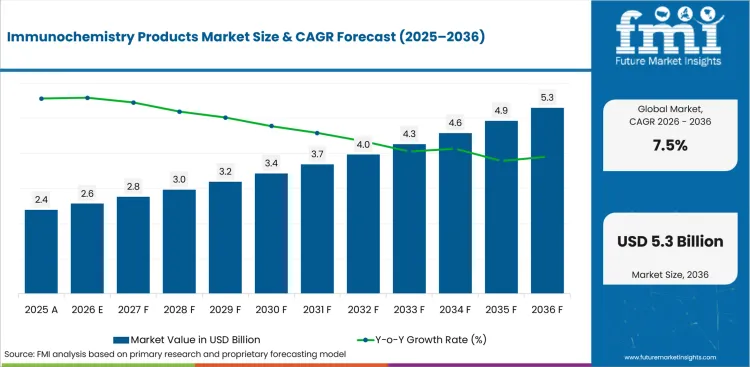
| Metric | Value |
|---|---|
| 2025 Market Size | USD 2.4 billion |
| 2026 Market Size | USD 2.6 billion |
| 2036 Market Size | USD 5.3 billion |
| Forecast CAGR (2026-2036) | 7.5% |
| Product Type Focus | Immunochemistry analyzer |
| Immunochemistry analyzer Share (2026) | 61.8% |
| End User Focus | Hospitals and Clinics |
| Hospitals and Clinics Share (2026) | 47.3% |
Summary of the Immunochemistry Products Market
| Market Signal | Commercial Impact |
|---|---|
| Demand and Growth Drivers | Recurring replacement demand and high switching costs keep immunochemistry analyzer procurement durable.
|
| Product and Segment View | Immunochemistry analyzer and Hospitals and Clinics lead their respective segments in 2026.
|
| Geography and Competitive Outlook | Japan is expected to remain the key growth market, with Thermo Fisher Scientific and Abbott Laboratories leading competition.
|
| Analyst Perspective | Buyers now judge immunochemistry analyzer on performance and total cost of ownership, not headline price.
|
Why is the Immunochemistry Products Market growing?
Rising Immunochemistry analyzer and Hospitals and Clinics demand across healthcare end users
- Sustained procurement of immunochemistry analyzer is shaped by replacement cycles and capacity additions among healthcare buyers in both established and emerging markets.
- Japan leads growth at 7.9% CAGR, supported by PMDA approval timelines and JIS conformity and long supplier qualification cycles in keiretsu-linked hospitals.
- Hospitals and Clinics holds 47.3% of end user revenue, indicating where standardization is concentrating buyer spend.
Demand is shaped by buyers seeking consistent immunochemistry analyzer supply across multiple sites while limiting requalification. Adoption is increasing due to the operational cost of switching suppliers, which favors incumbents with broad product type coverage and responsive service.
How is the Immunochemistry Products Market segmented?
By Product Type, End User, Application, Technology and Distribution Channel
- Immunochemistry analyzer leads the product type category with 61.8% share in 2026 on the strength of buyer familiarity and supply availability.
- Hospitals and Clinics leads the end user category with 47.3% share as specifications standardize across buyer sites.
- Infectious Disease Testing anchors the application category, marking where incremental volume is consolidating.
Why does Immunochemistry analyzer lead the Immunochemistry Products Market?
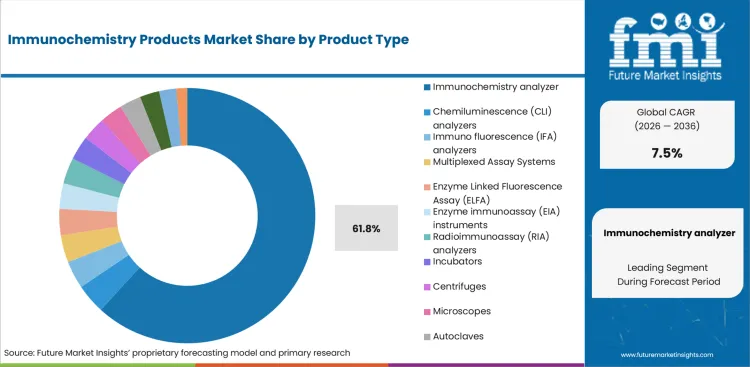
- Immunochemistry analyzer is expected to hold 61.8% of product type revenue in 2026 because buyers retain it for predictable performance and lower requalification effort.
How big is the Hospitals and Clinics segment in the Immunochemistry Products Market?
About 47.3% share, led by Hospitals and Clinics
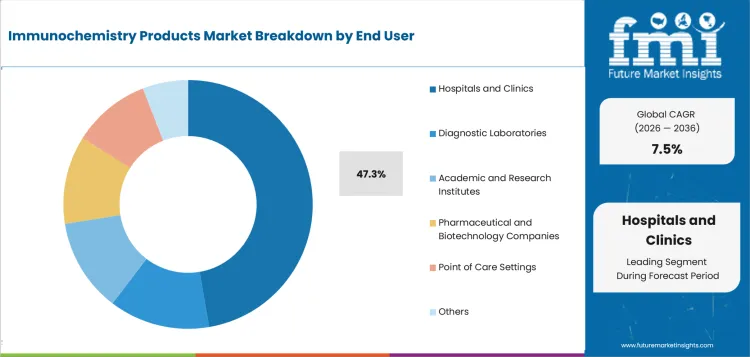
- Hospitals and Clinics is forecast to hold 47.3% of end user revenue in 2026.
How do the remaining segments shape the Immunochemistry Products Market?
- By application, Infectious Disease Testing is the leading category in 2026.
- By technology, Enzyme Linked Immunosorbent Assay is the leading category in 2026.
- By distribution channel, Direct Sales is the leading category in 2026.
What drives and restrains the Immunochemistry Products Market?
Driven by immunochemistry analyzer replacement demand; restrained by qualification and cost barriers
Recurring product type procurement supports expansion, while upfront cost and certification effort limit faster adoption among smaller buyers.
- Driver: Hospitals and Clinics sustain immunochemistry analyzer demand through replacement and capacity additions, keeping procurement recurring across the forecast period.
- Restraint: Certification and requalification effort for new product type specifications slows substitution, particularly for smaller buyers with limited engineering capacity.
- Opportunity: Suppliers offering hospitals and clinics configurations that drop into existing workflows can widen adoption without full replacement.
Demand is shaped by buyers protecting continuity of supply, which rewards incumbents with broad product type portfolios.
Which factors support expansion in the Immunochemistry Products Market?
Replacement demand, standardization and service coverage support market value
- Market value is supported by immunochemistry analyzer replacement purchases before aftermarket and service revenue accrues.
- Supplier pricing reflects product type performance and availability before service coverage affects renewal demand.
- Buyers compare qualification time and support response before committing to multi-site standardization on hospitals and clinics.
Which countries are growing fastest in the Immunochemistry Products Market?
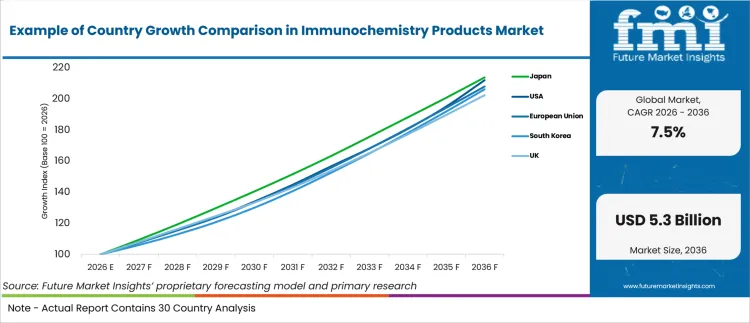
| Country / Region | CAGR |
|---|---|
| Japan | 7.9% |
| USA | 7.8% |
| European Union | 7.6% |
| South Korea | 7.5% |
| UK | 7.3% |
Source: FMI's proprietary forecasting model and primary research
How do country-level CAGRs compare in the Immunochemistry Products Market?
Country growth in the Immunochemistry Products Market is expected to vary through 2036, with Japan at 7.9%, USA at 7.8%, European Union at 7.6%, South Korea at 7.5%, and UK at 7.3%. Japan is projected to grow fastest among the profiled countries and UK the slowest. Higher-growth markets are shaped more by new demand formation, while established markets weigh documented performance and supply continuity before account expansion.
- Japan is projected at 7.9% CAGR through 2036. Japan demand rests on PMDA approval timelines and JIS conformity, with long supplier qualification cycles in keiretsu-linked hospitals adding a second pillar of support. Buyers cite PMDA approval timelines and JIS conformity as the reason hospitals and clinics budgets are released ahead of schedule. Where long supplier qualification cycles in keiretsu-linked hospitals applies, specification activity concentrates in the Greater Tokyo and Kansai regions.
- USA is projected at 7.8% CAGR through 2036. Buyers in USA weight IRA drug-pricing pressure on integrated providers heavily when committing to new specifications. FDA clearance pathways and CMS reimbursement codes widens the qualified buyer base for hospitals and clinics beyond the largest accounts. IRA drug-pricing pressure on integrated providers is the primary pull, converting policy intent into firm hospitals and clinics orders.
- European Union is projected at 7.6% CAGR through 2036. In European Union, EU MDR conformity assessment is the structural driver buyers organize around. EU MDR conformity assessment is the primary pull, converting policy intent into firm hospitals and clinics orders. Buyers cite cross-border procurement harmonization as the reason hospitals and clinics budgets are released ahead of schedule.
- South Korea is projected at 7.5% CAGR through 2036. MFDS device approval and HIRA reimbursement listing and tertiary hospital concentration in the Seoul Capital Area together shape how South Korea buyers plan procurement. MFDS device approval and HIRA reimbursement listing underwrites multi-year demand visibility rather than spot purchasing. Tertiary hospital concentration in the Seoul Capital Area widens the qualified buyer base for hospitals and clinics beyond the largest accounts.
- UK is projected at 7.3% CAGR through 2036. In UK, NHS Supply Chain framework agreements is the structural driver buyers organize around. NHS Supply Chain framework agreements is the primary pull, converting policy intent into firm hospitals and clinics orders. Buyers cite NICE technology appraisal thresholds as the reason hospitals and clinics budgets are released ahead of schedule.
Who are the leading companies in the Immunochemistry Products Market?
Thermo Fisher Scientific, Abbott Laboratories, Roche Diagnostics, Siemens Healthineers and Bio-Rad Laboratories
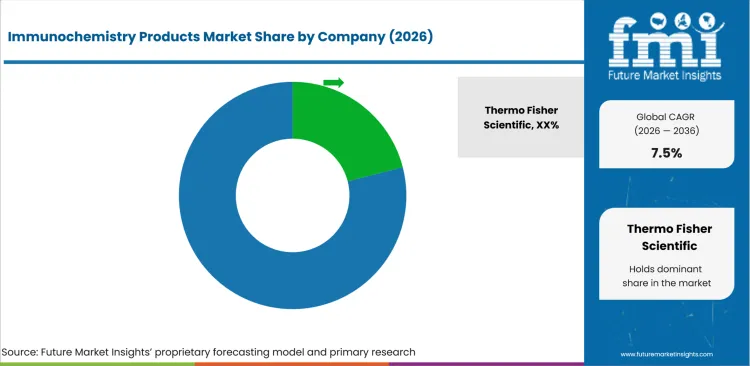
Thermo Fisher Scientific and Abbott Laboratories compete through supply depth and qualification support across healthcare buyers. Roche Diagnostics maintains position through portfolio breadth, while service coverage and lead-time reliability are further competitive levers.
Who are the key players in the Immunochemistry Products Market?
Key global companies leading the market include:
- Thermo Fisher Scientific, Abbott Laboratories, Roche Diagnostics, Siemens Healthineers and Bio-Rad Laboratories maintain leading positions through established manufacturing, portfolio breadth and direct procurement relationships.
- PerkinElmer, Ortho Clinical Diagnostics and BioMérieux compete through specialized configurations, competitive pricing and localized distribution in high-growth markets.
- Danaher Corporation (Beckman Coulter) targets underserved applications and regional markets to establish initial procurement positions.
How do top Immunochemistry Products Market companies compare?
Thermo Fisher Scientific and Abbott Laboratories lead on scale; Roche Diagnostics also has a global footprint, while Siemens Healthineers and Bio-Rad Laboratories are more regionally concentrated.
| Company | Portfolio Breadth | Qualification Depth | Supply Scale | Geographic Footprint |
|---|---|---|---|---|
| Thermo Fisher Scientific | High | High | Strong | Global |
| Abbott Laboratories | High | High | Strong | Global |
| Roche Diagnostics | Medium | Medium | Moderate | Global |
| Siemens Healthineers | High | Medium | Moderate | Regional |
| Bio-Rad Laboratories | Medium | Medium | Moderate | Regional |
Source: Future Market Insights competitive analysis, 2026.
Key Players in the Immunochemistry Products Market
Device and Equipment Manufacturers
- Thermo Fisher Scientific
- Siemens Healthineers
- Ortho Clinical Diagnostics
- Danaher Corporation (Beckman Coulter)
Consumable and Specialty Suppliers
- Abbott Laboratories
- Bio-Rad Laboratories
- BioMérieux
Emerging and Regional Providers
- Roche Diagnostics
- PerkinElmer
- Agilent Technologies
- DiaSorin S.p.A.
- Beckman Coulter (Danaher)
- Sysmex Corporation
Immunochemistry Products Market - Scope & Definition
| Attribute | Detail |
|---|---|
| Market Definition | Products and solutions within the immunochemistry products market spanning Product Type, End User and Application categories |
| Key Segments Covered | Immunochemistry analyzer, Hospitals and Clinics and Infectious Disease Testing and related healthcare applications |
| Applications Covered | Infectious Disease Testing, Oncology Testing, Endocrinology Testing and Cardiology Testing |
| End-Use Industries | Hospitals and Clinics, Diagnostic Laboratories, Academic and Research Institutes and Pharmaceutical and Biotechnology Companies |
| Inclusions | Commercially sold product type, end user and associated configurations |
| Exclusions | Custom one-off systems, standalone services and raw inputs outside the immunochemistry products market boundary |
Immunochemistry Products Market - Research Methodology
| Method | Description |
|---|---|
| Primary Research | FMI analyst interviews with healthcare suppliers, distributors and procurement teams across major markets |
| Desk Research | Review of official activity data, regulatory releases, company disclosures and production statistics |
| Market Sizing & Forecasting | Bottom-up sizing using segment revenue, adoption rates, replacement demand and country-level activity |
| Data Validation | Cross-verification against public evidence, supplier portfolios and official indicators |
What does the Immunochemistry Products Market report cover?
2021 to 2025 history and 2026 to 2036 forecasts across all segments and 30+ countries
| Parameter | Details |
|---|---|
| Forecast period | 2026 to 2036 |
| Historical period | 2021 to 2025 |
| Quantitative unit | Revenue in USD billion |
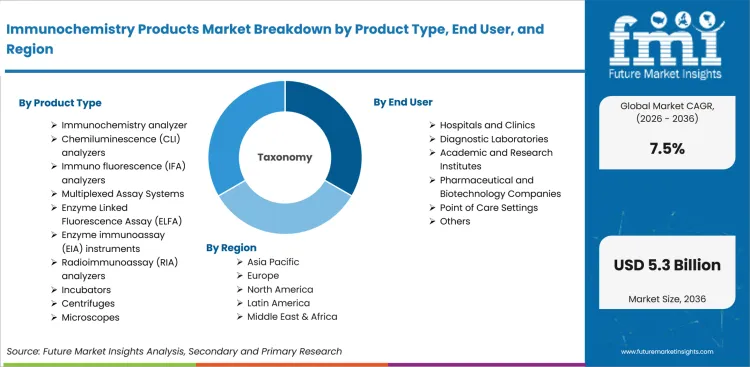
| By Product Type | Immunochemistry analyzer, Chemiluminescence (CLI) analyzers, Immuno fluorescence (IFA) analyzers, Multiplexed Assay Systems, Enzyme Linked Fluorescence Assay (ELFA) and Enzyme immunoassay (EIA) instruments |
| By End User | Hospitals and Clinics, Diagnostic Laboratories, Academic and Research Institutes, Pharmaceutical and Biotechnology Companies, Point of Care Settings and Others |
| By Application | Infectious Disease Testing, Oncology Testing, Endocrinology Testing, Cardiology Testing, Autoimmune Disease Testing and Therapeutic Drug Monitoring |
| By Technology | Enzyme Linked Immunosorbent Assay, Chemiluminescence Immunoassay, Fluorescence Immunoassay, Radioimmunoassay and Rapid Immunoassay |
| By Distribution Channel | Direct Sales, Distributor Sales and Aftermarket Services |
| Regions covered | North America, Latin America, Western Europe, Eastern Europe, East Asia, South Asia and Pacific, Middle East and Africa |
| Countries covered | USA, Japan, European Union (Western and Eastern Europe), South Korea, UK |
| Key companies profiled | Thermo Fisher Scientific, Abbott Laboratories, Roche Diagnostics, Siemens Healthineers and Bio-Rad Laboratories |
| Approach | Bottom-up segment-boundary approach using adoption, replacement demand and supplier disclosures |
Market Segmentation Analysis
Immunochemistry Products Market Segmented by Product Type:
- Immunochemistry analyzer
- Chemiluminescence (CLI) analyzers
- Immuno fluorescence (IFA) analyzers
- Multiplexed Assay Systems
- Enzyme Linked Fluorescence Assay (ELFA)
- Enzyme immunoassay (EIA) instruments
- Radioimmunoassay (RIA) analyzers
- Incubators
- Centrifuges
- Microscopes
- Autoclaves
- Consumables
- Antibodies
- Primary antibodies
- Secondary antibodies
- Antigens
- Enzymes Reagents
- Stains
- Buffers
- Others
Immunochemistry Products Market Segmented by End User:
- Hospitals and Clinics
- Public Hospitals
- Private Hospitals
- Diagnostic Laboratories
- Reference Laboratories
- Independent Laboratories
- Academic and Research Institutes
- Universities
- Research Centers
- Pharmaceutical and Biotechnology Companies
- Drug Development
- Clinical Trials
- Point of Care Settings
- Clinics
- Outpatient Centers
- Others
Immunochemistry Products Market Segmented by Application:
- Infectious Disease Testing
- Viral Disease Detection
- Bacterial Disease Detection
- Oncology Testing
- Tumor Marker Detection
- Cancer Screening
- Endocrinology Testing
- Hormone Testing
- Metabolic Disorder Testing
- Cardiology Testing
- Cardiac Biomarker Detection
- Heart Disease Monitoring
- Autoimmune Disease Testing
- Autoantibody Detection
- Immune Disorder Diagnosis
- Therapeutic Drug Monitoring
- Drug Level Measurement
- Drug development
- Drug and abuse testing
- Others
Immunochemistry Products Market Segmented by Technology:
- Enzyme Linked Immunosorbent Assay
- Direct Assay Systems
- Indirect Assay Systems
- Chemiluminescence Immunoassay
- Enhanced Sensitivity Systems
- Automated Assay Systems
- Fluorescence Immunoassay
- Fluorescent Label Detection
- Multiplex Assay Systems
- Radioimmunoassay
- Radioactive Label Detection
- Rapid Immunoassay
- Lateral Flow Assays
- Point of Care Assays
Immunochemistry Products Market Segmented by Distribution Channel:
- Direct Sales
- Hospital Procurement Contracts
- Laboratory Agreements
- Distributor Sales
- Diagnostic Distributors
- Regional Suppliers
- Aftermarket Services
- Maintenance Services
- Reagent Supply Contracts
Immunochemistry Products Market by Region:
- North America
- USA
- Canada
- Mexico
- Latin America
- Brazil
- Chile
- Rest of Latin America
- Western Europe
- Germany
- UK
- Italy
- Spain
- France
- Nordic
- BENELUX
- Rest of Western Europe
- Eastern Europe
- Russia
- Poland
- Hungary
- Balkan & Baltic
- Rest of Eastern Europe
- East Asia
- China
- Japan
- South Korea
- South Asia and Pacific
- India
- ASEAN
- Australia & New Zealand
- Rest of South Asia and Pacific
- Middle East & Africa
- Kingdom of Saudi Arabia
- Other GCC Countries
- Türkiye
- South Africa
- Other African Union
- Rest of Middle East & Africa
Research Sources and Bibliography
- World Bank. (2026, March). World development indicators database.
- International Trade Centre. (2025, November). Trade statistics for international business development.
- OECD. (2026, February). Economic outlook and industry statistics.
- World Health Organization. (2025, December). Global health observatory data repository.
- USA Food and Drug Administration. (2026, January). Medical device databases.
This bibliography is provided for reader reference and is not exhaustive.
This Report Answers
- Market size estimates for 2026 and forecasts through 2036 for the immunochemistry products market.
- Segment demand across product type and end user with leading sub-segment shares.
- Country-level growth analysis covering USA, Japan, European Union, South Korea and other markets.
- Company positioning across Thermo Fisher Scientific, Abbott Laboratories and Roche Diagnostics and regional players.
- Assessment of drivers and restraints with procurement patterns across end-use buyers.
Frequently Asked Questions
Which option suits first-time buyers in the Immunochemistry Products Market?
Immunochemistry analyzer is usually the starting point, because buyers retain it for predictable performance and lower requalification effort. Within product type it carries the widest supply availability, which shortens qualification for a first order.
What should buyers assess when shortlisting suppliers?
Procurement leaders should evaluate specification evidence, second-source availability, service response, price discipline and fit with product type requirements across hospitals and clinics, diagnostic laboratories, academic and research institutes and pharmaceutical and biotechnology companies.
What is the upside case in the immunochemistry products market?
Suppliers offering hospitals and clinics configurations that drop into existing workflows can widen adoption without full replacement. That widens adoption without forcing a full replacement cycle, which is the slowest part of any buying decision.
What slows buyers down in the immunochemistry products market?
The main restraint is proof burden. Buyers slow down when immunochemistry products lacks the specification evidence, testing records or supplier response needed for account approval. Certification and requalification effort for new product type specifications slows substitution, particularly for smaller buyers with limited engineering capacity.
Why does the Immunochemistry Products Market matter at board level?
Executives should track the market because Immunochemistry analyzer decisions affect access to infectious disease testing, oncology testing, endocrinology testing and cardiology testing, qualification effort and continuity of supply. Those points influence margin and switching risk.
Preview the report firsthand - request a free sample
Get SampleGet the brochure for pricing and purchase details.
Get PDFTable of Content
- Key Takeaways
- Market Size and CAGR
- Top Growth Driver
- Fastest Growing Segment
- Leading Region
- Key Companies
- Emerging Opportunities
- Executive Summary
- Global Market Outlook
- Demand-side Trends
- Supply-side Trends
- Technology Roadmap Analysis
- Analysis and Recommendations
- Analyst Perspective (What is happening? Why now? What should investors know?)
- Key Questions Answered
- How large is the market?
- What is the CAGR?
- What are key trends?
- Which region dominates?
- Who are the leaders?
- Market Overview
- Market Coverage / Taxonomy
- Market Definition / Scope / Limitations
- Research Methodology
- Chapter Orientation
- Analytical Lens and Working Hypotheses
- Market Structure, Signals, and Trend Drivers
- Benchmarking and Cross-market Comparability
- Market Sizing, Forecasting, and Opportunity Mapping
- Research Design and Evidence Framework
- Desk Research Programme (Secondary Evidence)
- Expert Input and Fieldwork (Primary Evidence)
- Tooling, Models, and Reference Databases
- Data Engineering and Model Build
- Quality Assurance and Audit Trail
- Market Background
- Market Dynamics (Drivers, Restraints, Opportunity, Trends)
- Scenario Forecast (Optimistic, Likely, Conservative)
- Impact Analysis
- AI Impact
- Sustainability Impact
- Regulatory Impact
- Technology Impact
- Consumer / Buyer Analysis
- Purchase Drivers
- Adoption Barriers
- Buyer Journey
- Opportunity Map Analysis
- Product Life Cycle Analysis
- Supply Chain Analysis
- Investment Feasibility Matrix
- Value Chain Analysis
- PESTLE and Porter's Analysis
- Regulatory Landscape
- Regional Parent Market Outlook
- Production and Consumption Statistics
- Import and Export Statistics
- Global Market Analysis and Forecast, 2021 to 2036
- Historical Market Size Value (USD Billion) Analysis, 2021 to 2025
- Current and Future Market Size Value (USD Billion) Projections, 2026 to 2036
- Y-o-Y Growth Trend Analysis
- Absolute $ Opportunity Analysis
- Global Market Pricing Analysis, 2021 to 2036
- Global Market Analysis and Forecast, By Product Type, 2021 to 2036
- Introduction / Key Findings
- Historical Market Size Value (USD Billion) Analysis By Product Type, 2021 to 2025
- Current and Future Market Size Value (USD Billion) Analysis and Forecast By Product Type, 2026 to 2036
- Immunochemistry analyzer
- Chemiluminescence (CLI) analyzers
- Immuno fluorescence (IFA) analyzers
- Multiplexed Assay Systems
- Enzyme Linked Fluorescence Assay (ELFA)
- Enzyme immunoassay (EIA) instruments
- Radioimmunoassay (RIA) analyzers
- Incubators
- Centrifuges
- Microscopes
- Autoclaves
- Immunochemistry analyzer
- Y-o-Y Growth Trend Analysis By Product Type, 2021 to 2025
- Absolute $ Opportunity Analysis By Product Type, 2026 to 2036
- Global Market Analysis and Forecast, By End User, 2021 to 2036
- Introduction / Key Findings
- Historical Market Size Value (USD Billion) Analysis By End User, 2021 to 2025
- Current and Future Market Size Value (USD Billion) Analysis and Forecast By End User, 2026 to 2036
- Hospitals and Clinics
- Public Hospitals
- Private Hospitals
- Diagnostic Laboratories
- Reference Laboratories
- Independent Laboratories
- Academic and Research Institutes
- Universities
- Research Centers
- Pharmaceutical and Biotechnology Companies
- Drug Development
- Clinical Trials
- Point of Care Settings
- Clinics
- Outpatient Centers
- Others
- Hospitals and Clinics
- Y-o-Y Growth Trend Analysis By End User, 2021 to 2025
- Absolute $ Opportunity Analysis By End User, 2026 to 2036
- Global Market Analysis and Forecast, By Application, 2021 to 2036
- Introduction / Key Findings
- Historical Market Size Value (USD Billion) Analysis By Application, 2021 to 2025
- Current and Future Market Size Value (USD Billion) Analysis and Forecast By Application, 2026 to 2036
- Infectious Disease Testing
- Viral Disease Detection
- Bacterial Disease Detection
- Oncology Testing
- Tumor Marker Detection
- Cancer Screening
- Endocrinology Testing
- Hormone Testing
- Metabolic Disorder Testing
- Cardiology Testing
- Cardiac Biomarker Detection
- Heart Disease Monitoring
- Autoimmune Disease Testing
- Autoantibody Detection
- Immune Disorder Diagnosis
- Therapeutic Drug Monitoring
- Drug Level Measurement
- Drug development
- Drug and abuse testing
- Others
- Infectious Disease Testing
- Y-o-Y Growth Trend Analysis By Application, 2021 to 2025
- Absolute $ Opportunity Analysis By Application, 2026 to 2036
- Global Market Analysis and Forecast, By Technology, 2021 to 2036
- Introduction / Key Findings
- Historical Market Size Value (USD Billion) Analysis By Technology, 2021 to 2025
- Current and Future Market Size Value (USD Billion) Analysis and Forecast By Technology, 2026 to 2036
- Enzyme Linked Immunosorbent Assay
- Direct Assay Systems
- Indirect Assay Systems
- Chemiluminescence Immunoassay
- Enhanced Sensitivity Systems
- Automated Assay Systems
- Fluorescence Immunoassay
- Fluorescent Label Detection
- Multiplex Assay Systems
- Radioimmunoassay
- Radioactive Label Detection
- Rapid Immunoassay
- Lateral Flow Assays
- Point of Care Assays
- Enzyme Linked Immunosorbent Assay
- Y-o-Y Growth Trend Analysis By Technology, 2021 to 2025
- Absolute $ Opportunity Analysis By Technology, 2026 to 2036
- Global Market Analysis and Forecast, By Distribution Channel, 2021 to 2036
- Introduction / Key Findings
- Historical Market Size Value (USD Billion) Analysis By Distribution Channel, 2021 to 2025
- Current and Future Market Size Value (USD Billion) Analysis and Forecast By Distribution Channel, 2026 to 2036
- Direct Sales
- Hospital Procurement Contracts
- Laboratory Agreements
- Distributor Sales
- Diagnostic Distributors
- Regional Suppliers
- Aftermarket Services
- Maintenance Services
- Reagent Supply Contracts
- Direct Sales
- Y-o-Y Growth Trend Analysis By Distribution Channel, 2021 to 2025
- Absolute $ Opportunity Analysis By Distribution Channel, 2026 to 2036
- Global Market Analysis and Forecast, By Region, 2021 to 2036
- Introduction
- Historical Market Size Value (USD Billion) Analysis By Region, 2021 to 2025
- Current Market Size Value (USD Billion) Analysis and Forecast By Region, 2026 to 2036
- North America
- Latin America
- Western Europe
- Eastern Europe
- East Asia
- South Asia and Pacific
- Middle East and Africa
- Market Attractiveness Analysis By Region
- North America Market Analysis and Forecast, By Country, 2021 to 2036
- Historical Market Size Value (USD Billion) Trend Analysis By Market Taxonomy, 2021 to 2025
- Market Size Value (USD Billion) Forecast By Market Taxonomy, 2026 to 2036
- By Country
- USA
- Canada
- By Product Type
- By End User
- By Application
- By Technology
- By Distribution Channel
- By Country
- Market Attractiveness Analysis
- By Country
- By Product Type
- By End User
- By Application
- By Technology
- By Distribution Channel
- Key Takeaways
- Latin America Market Analysis and Forecast, By Country
- Historical Market Size Value (USD Billion) Trend Analysis By Market Taxonomy, 2021 to 2025
- Market Size Value (USD Billion) Forecast By Market Taxonomy, 2026 to 2036
- By Country
- Brazil
- Mexico
- Chile
- Rest of Latin America
- By Product Type
- By End User
- By Application
- By Technology
- By Distribution Channel
- By Country
- Market Attractiveness Analysis
- By Country
- By Product Type
- By End User
- By Application
- By Technology
- By Distribution Channel
- Key Takeaways
- Western Europe Market Analysis and Forecast, By Country
- Historical Market Size Value (USD Billion) Trend Analysis By Market Taxonomy, 2021 to 2025
- Market Size Value (USD Billion) Forecast By Market Taxonomy, 2026 to 2036
- By Country
- Germany
- UK
- Italy
- Spain
- France
- Nordic
- BENELUX
- Rest of Western Europe
- By Product Type
- By End User
- By Application
- By Technology
- By Distribution Channel
- By Country
- Market Attractiveness Analysis
- By Country
- By Product Type
- By End User
- By Application
- By Technology
- By Distribution Channel
- Key Takeaways
- Eastern Europe Market Analysis and Forecast, By Country
- Historical Market Size Value (USD Billion) Trend Analysis By Market Taxonomy, 2021 to 2025
- Market Size Value (USD Billion) Forecast By Market Taxonomy, 2026 to 2036
- By Country
- Russia
- Poland
- Hungary
- Balkan & Baltic
- Rest of Eastern Europe
- By Product Type
- By End User
- By Application
- By Technology
- By Distribution Channel
- By Country
- Market Attractiveness Analysis
- By Country
- By Product Type
- By End User
- By Application
- By Technology
- By Distribution Channel
- Key Takeaways
- East Asia Market Analysis and Forecast, By Country
- Historical Market Size Value (USD Billion) Trend Analysis By Market Taxonomy, 2021 to 2025
- Market Size Value (USD Billion) Forecast By Market Taxonomy, 2026 to 2036
- By Country
- China
- Japan
- South Korea
- By Product Type
- By End User
- By Application
- By Technology
- By Distribution Channel
- By Country
- Market Attractiveness Analysis
- By Country
- By Product Type
- By End User
- By Application
- By Technology
- By Distribution Channel
- Key Takeaways
- South Asia and Pacific Market Analysis and Forecast, By Country
- Historical Market Size Value (USD Billion) Trend Analysis By Market Taxonomy, 2021 to 2025
- Market Size Value (USD Billion) Forecast By Market Taxonomy, 2026 to 2036
- By Country
- India
- ASEAN
- Australia & New Zealand
- Rest of South Asia and Pacific
- By Product Type
- By End User
- By Application
- By Technology
- By Distribution Channel
- By Country
- Market Attractiveness Analysis
- By Country
- By Product Type
- By End User
- By Application
- By Technology
- By Distribution Channel
- Key Takeaways
- Middle East and Africa Market Analysis and Forecast, By Country
- Historical Market Size Value (USD Billion) Trend Analysis By Market Taxonomy, 2021 to 2025
- Market Size Value (USD Billion) Forecast By Market Taxonomy, 2026 to 2036
- By Country
- Kingdom of Saudi Arabia
- Other GCC Countries
- Türkiye
- South Africa
- Other African Union
- Rest of Middle East and Africa
- By Product Type
- By End User
- By Application
- By Technology
- By Distribution Channel
- By Country
- Market Attractiveness Analysis
- By Country
- By Product Type
- By End User
- By Application
- By Technology
- By Distribution Channel
- Key Takeaways
- Key Countries Market Analysis
- USA
- Pricing Analysis
- Market Share Analysis, 2025
- By Product Type
- By End User
- By Application
- By Technology
- By Distribution Channel
- Canada
- Pricing Analysis
- Market Share Analysis, 2025
- By Product Type
- By End User
- By Application
- By Technology
- By Distribution Channel
- Mexico
- Pricing Analysis
- Market Share Analysis, 2025
- By Product Type
- By End User
- By Application
- By Technology
- By Distribution Channel
- Brazil
- Pricing Analysis
- Market Share Analysis, 2025
- By Product Type
- By End User
- By Application
- By Technology
- By Distribution Channel
- Chile
- Pricing Analysis
- Market Share Analysis, 2025
- By Product Type
- By End User
- By Application
- By Technology
- By Distribution Channel
- Germany
- Pricing Analysis
- Market Share Analysis, 2025
- By Product Type
- By End User
- By Application
- By Technology
- By Distribution Channel
- UK
- Pricing Analysis
- Market Share Analysis, 2025
- By Product Type
- By End User
- By Application
- By Technology
- By Distribution Channel
- Italy
- Pricing Analysis
- Market Share Analysis, 2025
- By Product Type
- By End User
- By Application
- By Technology
- By Distribution Channel
- Spain
- Pricing Analysis
- Market Share Analysis, 2025
- By Product Type
- By End User
- By Application
- By Technology
- By Distribution Channel
- France
- Pricing Analysis
- Market Share Analysis, 2025
- By Product Type
- By End User
- By Application
- By Technology
- By Distribution Channel
- India
- Pricing Analysis
- Market Share Analysis, 2025
- By Product Type
- By End User
- By Application
- By Technology
- By Distribution Channel
- ASEAN
- Pricing Analysis
- Market Share Analysis, 2025
- By Product Type
- By End User
- By Application
- By Technology
- By Distribution Channel
- Australia & New Zealand
- Pricing Analysis
- Market Share Analysis, 2025
- By Product Type
- By End User
- By Application
- By Technology
- By Distribution Channel
- China
- Pricing Analysis
- Market Share Analysis, 2025
- By Product Type
- By End User
- By Application
- By Technology
- By Distribution Channel
- Japan
- Pricing Analysis
- Market Share Analysis, 2025
- By Product Type
- By End User
- By Application
- By Technology
- By Distribution Channel
- South Korea
- Pricing Analysis
- Market Share Analysis, 2025
- By Product Type
- By End User
- By Application
- By Technology
- By Distribution Channel
- Russia
- Pricing Analysis
- Market Share Analysis, 2025
- By Product Type
- By End User
- By Application
- By Technology
- By Distribution Channel
- Poland
- Pricing Analysis
- Market Share Analysis, 2025
- By Product Type
- By End User
- By Application
- By Technology
- By Distribution Channel
- Hungary
- Pricing Analysis
- Market Share Analysis, 2025
- By Product Type
- By End User
- By Application
- By Technology
- By Distribution Channel
- Kingdom of Saudi Arabia
- Pricing Analysis
- Market Share Analysis, 2025
- By Product Type
- By End User
- By Application
- By Technology
- By Distribution Channel
- Türkiye
- Pricing Analysis
- Market Share Analysis, 2025
- By Product Type
- By End User
- By Application
- By Technology
- By Distribution Channel
- South Africa
- Pricing Analysis
- Market Share Analysis, 2025
- By Product Type
- By End User
- By Application
- By Technology
- By Distribution Channel
- USA
- Market Structure Analysis
- Competition Dashboard
- Competition Benchmarking
- Market Share Analysis of Top Players
- By Regional
- By Product Type
- By End User
- By Application
- By Technology
- By Distribution Channel
- Emerging Startups
- Innovation Benchmarking
- Competition Analysis
- Competition Deep Dive
- Thermo Fisher Scientific
- Siemens Healthineers
- Ortho Clinical Diagnostics
- Danaher Corporation (Beckman Coulter)
- Abbott Laboratories
- Bio-Rad Laboratories
- BioMérieux
- Roche Diagnostics
- PerkinElmer
- Agilent Technologies
- DiaSorin S.p.A.
- Beckman Coulter (Danaher)
- Sysmex Corporation
- Case Studies
- Success Stories
- Recent Developments
- Competition Deep Dive
- Assumptions & Acronyms Used


