

- Market Size (2026)
- USD 141.4 Mn
- Forecast (2036)
- USD 341.0 Mn
- CAGR (2026 to 2036)
- 9.2%
How big is Immunocompromised Patient Meal Market in 2026?
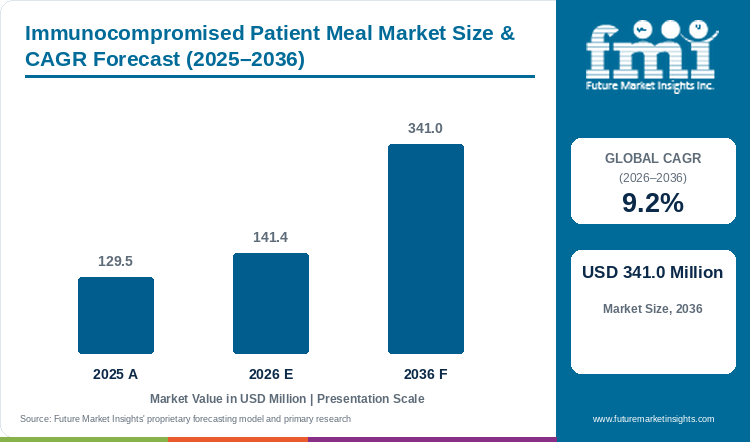
USD 141.4 Million in 2026 and USD 341.0 Million by 2036 at a 9.2% CAGR.
The immunocompromised patient meal market stands at USD 141.4 Million in 2026 and is projected to reach USD 341.0 Million by 2036, growing at a 9.2% CAGR. The 2025 market value is estimated at USD 129.5 Million. Over the decade, that adds USD 199.6 Million, averaging roughly USD 20.0 Million annually, and lifts total revenue to 2.41 times its 2026 level. Demand typically originates with a treatment event. Chemotherapy can suppress neutrophil counts during parts of a treatment cycle, and the National Cancer Institute's guidance, asks patients to cook food thoroughly and to keep hot food hot and cold food cold. [2] Treatment also disrupts appetite. Taste changes, appetite loss, mucositis and swallowing difficulty can all limit what a patient is willing or able to eat. [3] A meal sold into this market therefore has two jobs at once: controlled preparation, and food that a symptomatic patient will actually eat.
FMI estimates revenue from prepared meals, shelf-stable meals and in-scope snack or side products sold for immunocompromised patients through the defined channels. Oral supplements and enteral formulas belong to the adjacent medical nutrition market, and raw groceries, counseling fees and other substitute products are excluded as well. California's Medi-Cal Community Supports category for medically supportive food lists prepared-meal delivery next to groceries, vouchers and nutrition education. [4]
Market Size and Forecast
Table 1: Market Size and Forecast for the Immunocompromised Patient Meal Market (USD Million and percentage), 2025 to 2036
| Metric | Value |
|---|---|
| 2025 Market Size | USD 129.5 Million |
| Estimated Market Size in 2026 | USD 141.4 Million |
| Projected Market Size by 2036 | USD 341.0 Million |
| CAGR, 2026 to 2036 | 9.2% |
| Added Revenue, 2026 to 2036 | USD 199.6 Million |
| Market Expansion Multiple | 2.41x |
Key Takeaways
- Oncology (Neutropenic) represents 49.0% of Patient Group in 2026. Chemotherapy can lower neutrophil counts during parts of a treatment cycle, [2] making the timing and duration of support important to repeat ordering.
- Clinical evidence puts pressure on restriction-based positioning. Low-Microbial Prepared Meals hold 48.1% of Product Type, but the NCI PDQ review found no infection advantage for a restrictive neutropenic diet over a regular diet in the studies it cites. [3] Suppliers need to demonstrate suitable preparation and food choices rather than rely on the category label alone.
- Homecare's 49.7% share and Home Meal Delivery's 47.2% share place the household at the center of service design. A South Dakota directory lists FedEx meal delivery with phone, online and app ordering, [5] illustrating the practical choices involved in reaching a patient at home.
- Online / DTC leads Sales Channel at 45.4%, alongside referral and program routes. Eligible California Medi-Cal members can receive prepared-meal delivery through Community Supports offered by their plan. [4] Authorization and payment arrangements therefore influence access as well as the ordering interface.
- Germany's January 2026 S3 guideline recommends structured nutrition and food-hygiene counseling and advises against a restrictive neutropenic diet. [7] The opportunity is to preserve adequate intake while making preparation and home handling manageable.
- Profiled companies: Mom's Meals (PurFoods); Magic Kitchen; ModifyHealth; Hormel Health Labs; BistroMD; Nestle Health Science; Abbott; Medtrition.
Analyst Perspective
Preparation controls and food the patient can tolerate belong in the same service specification. Cook temperatures, cold-chain limits and reheating steps need to be usable by a caregiver, while portions and textures must accommodate mouth sores or poor appetite. The infection evidence reviewed by NCI and the German guideline gives little support to restrictive neutropenic diets. [3] [7] A supplier's stronger proposition is reliable handling combined with meals patients can actually eat.
- Anurag Sharma, Future Market Insights
How is the immunocompromised patient meal market segmented?
The market is segmented by Product Type, Patient Group, Delivery Model, End User and Sales Channel.
Product Type comprises Low-Microbial Prepared Meals; Fully Cooked Shelf-Stable Meals; Pasteurized Snack & Side Products; Others. Patient Group comprises Oncology (Neutropenic); Transplant Recipients; Advanced HIV & Immunodeficiency; Others. Delivery Model comprises Home Meal Delivery; Hospital Discharge Programs; Retail; Others. End User comprises Homecare; Hospitals; Others. Sales Channel comprises Online / DTC; Health Plan Referral; Hospital Programs; Retail; Others.
Why do Low-Microbial Prepared Meals lead the Product Type category?
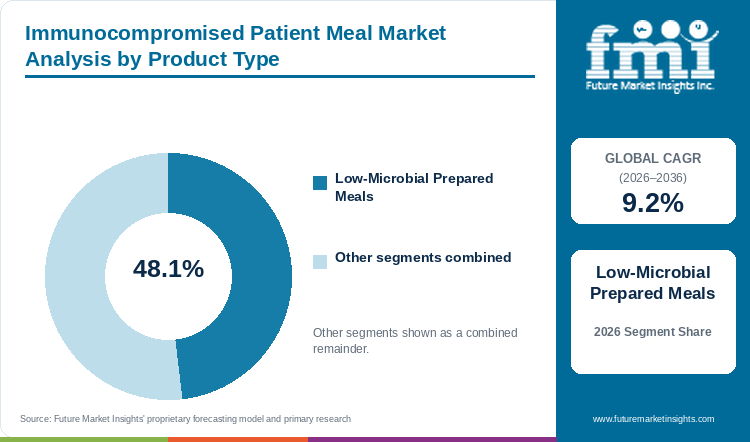
Low-Microbial Prepared Meals hold 48.1% of Product Type in 2026.
At 48.1% of Product Type in 2026, Low-Microbial Prepared Meals account for about USD 68.0 Million. Their practical proposition centers on preparation and handling: clean, separate, cook and chill, including thorough cooking of meat and eggs. [1] The category name alone establishes neither sterility nor an infection benefit. NCI's PDQ review found no advantage for a restrictive neutropenic diet over a regular diet in the infection studies it cites, while supporting safe handling and avoidance of higher-risk foods. [3]
Fully Cooked Shelf-Stable Meals offer a different storage proposition. CDC identifies sealed shelf-stable alternatives as safer substitutes for particular foods. [1] Pasteurized Snack & Side Products also sit near the wider ready-to-eat food market, although suitability for an immunocompromised patient depends on the individual food and its handling.
- Low-Microbial Prepared Meals account for 48.1% of Product Type in 2026.
What supports Oncology (Neutropenic) as the leading Patient Group?
Oncology (Neutropenic) holds 49.0% of Patient Group in 2026.
At 49.0% of Patient Group in 2026, equal to roughly USD 69.3 Million, Oncology (Neutropenic) is a narrower population than oncology as a whole. The National Cancer Institute describes neutrophil counts falling during parts of a treatment cycle, [2] so the buying window opens and closes with treatment and the same household may reorder cycle after cycle. Intake adds a second layer of demand, familiar from the oncology nutrition market: taste changes, appetite loss, mucositis and swallowing difficulty reduce what patients can eat, [3] and a meal that meets a handling standard but goes uneaten delivers no nutrition.
Transplant Recipients add another source of preparation needs. Health Canada's April 2012 food-handling video features an organ-transplant recipient and emphasizes separating raw animal foods from other food and using a digital cooking thermometer. [8] These tasks remain relevant after a delivered meal reaches the household.
- Oncology (Neutropenic) accounts for 49.0% of Patient Group in 2026.
What are the growth analysis, future potential and risk assessment of the immunocompromised patient meal market?
Treatment-linked precaution periods support growth, referral-ready meal design shapes future potential, and conditional payment routes with thin evidence for restrictive diets frame the risk.
Growth Analysis
Treatment-related immune suppression and eating difficulties can create preparation needs in the same weeks. Chemotherapy can lower neutrophil counts during parts of a cycle, [2] while taste changes, appetite loss, mucositis and swallowing difficulty can reduce intake. [3] Korea recorded 288,613 new cancer cases in 2023 compared with 281,317 in 2022. [16] Those incidence counts provide care-population context; the relevant meal population depends on immune status and nutritional need. FMI forecasts market growth at a 9.2% CAGR through 2036.
Future Potential
Future potential rests on taking work out of the household. The National Cancer Center in Korea describes nutrition planning by physicians, dietitians, pharmacists and nurses for patients with inadequate intake, [17] a referral point at which a meal can be specified instead of left to chance. California's Community Supports search tool gives eligible members a plan-based route to prepared-meal delivery, [4] and the South Dakota directory puts ordering and authorization in one listing. [5] Texture matters as much as logistics. China's national dietary guide for cancer patients, effective February 1, 2018, recommends soft, finely divided animal foods after radiotherapy or chemotherapy-related gastrointestinal injury, [18] and Gustave Roussy adapts hospital meals to eating difficulties. [13] A supplier that offers portion and texture options, preparation instructions and an eligibility pathway in one order covers all three needs. The infusion-clinic pilot marks the gap such design has to close: receipt among those offered medically tailored meals fell from 100% in month 1 to 67% across all months, and the authors suggested co-location and longer support for future studies. [10]
Risk Assessment
Risk assessment starts with the weakest claim in the category. The PDQ review found no advantage for a restrictive neutropenic diet in the infection studies it cites. [3] The German S3 guideline reached the same reading from four randomized trials and recommends against the diet because of possible nutritional deterioration and quality-of-life restrictions. [7] Oxford's haematology department avoids the diet to maintain nutrition, which is one trust's practice and not NHS-wide policy. [19]
Tolerance can change during treatment. Gustave Roussy assesses nutrition individually and turns to artificial nutrition where needed, [13] while China's guide calls for additional nutrition support when dietary guidance is insufficient. [18] Separately sold supplements and enteral formulas fall outside this meal market. Access has its own limits: South Dakota's listing includes prior authorization, [5] and California's route depends on member eligibility and plan offerings. [4] At home, Japanese guidance ties hygiene precautions to individual condition, [11] and Australian guidance advises short storage of leftovers. [9] Instructions need to remain practical when the patient or caregiver is having a difficult day.
What potential future risks could pull the immunocompromised patient meal market down?
Several changes could cause revenue to fall short of the 9.2% forecast path. The following are potential mechanisms over 2026 to 2036.
- Guideline diffusion: Germany's S3 guideline of January 2026 advises against restrictive neutropenic diets. [7] If recommendations of this kind spread through other national and hospital practice, buyers would pay less for restriction alone. Revenue tied to a restriction-based claim carries the exposure, while handling documentation and nutritional suitability would keep their value.
- Payer changes: The HHS guidance portal records the rescission on March 4, 2025 of CMS's December 10, 2024 guidance on health-related social needs in Medicaid and CHIP. [6] State and plan benefits have their own terms, but changes to policy or authorization could interrupt a supplier's payment route.
- Shorter precaution periods: Neutrophil counts fall during parts of a treatment cycle, [2] and Japanese cancer-center guidance ties hygiene requirements to the individual's condition and physician advice. [11] Earlier recovery or earlier release from precautions would shorten the period in which a household buys special meals. Demand per patient follows how long that condition lasts.
- Participation drop-off: In the infusion-clinic pilot, receipt among those offered medically tailored meals was 100% in month 1 and 67% across all months. [10] Difficulty sustaining participation could reduce revenue per enrolled patient. The small feasibility study provides a reason to examine retention rather than a market-wide dropout estimate.
- Safe home food as the substitute: Health Canada's video shows a transplant household separating raw animal foods and using a digital thermometer, [8] and Brazil's INCA guide describes basic household cooking hygiene. [12] Where a caregiver can do this reliably, ordinary food handled safely remains an available alternative to a prepared meal.
- Delivery or storage lapse: CDC guidance rests on cooking and chilling steps, [1] and Australian guidance advises short storage of leftovers. [9] A late delivery or an unclear reheating instruction can damage confidence in a supplier even when the meal was prepared correctly, which makes delivery tracking and reheating instructions part of the product.
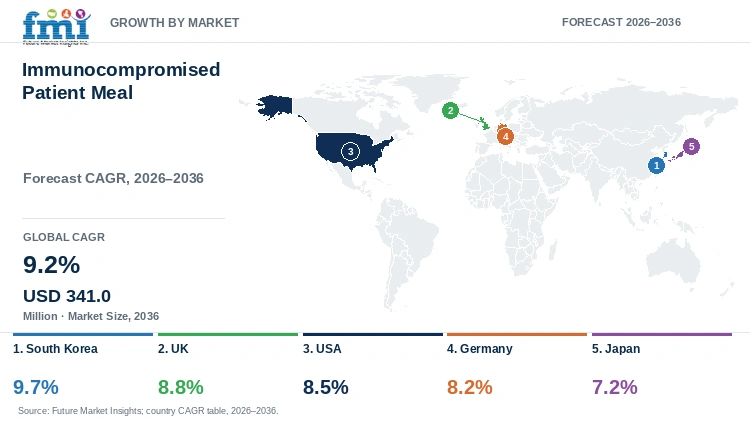
Which country CAGRs are profiled in the immunocompromised patient meal market?
The following country CAGRs cover 2026 to 2036.
Table 2: Country CAGRs for the Immunocompromised Patient Meal Market (CAGR, %), 2026 to 2036
| Country | CAGR |
|---|---|
| South Korea | 9.7% |
| UK | 8.8% |
| USA | 8.5% |
| Germany | 8.2% |
| Japan | 7.2% |
Country-wise Analysis
South Korea
Korea recorded 288,613 new cancer cases in 2023, 7,296 more than in 2022. [16] Within that wider care population, immune status and nutritional need determine which patients require meal support. The National Cancer Center's Clinical Nutrition Office describes multidisciplinary planning for inadequate intake or poor nutritional status, together with education tied to disease and treatment. [17] Such services offer a potential point for identifying meal requirements. FMI projects South Korea to lead the five profiled countries at a 9.7% CAGR over 2026 to 2036. Turning identified needs into continued orders depends on practical referral, delivery and payment arrangements.
UK
Oxford University Hospitals' haematology department avoids a restrictive neutropenic diet to help maintain nutrition and notes little evidence that food restriction reduces infection. [19] This local practice favors menus that preserve energy, variety and acceptability while supporting safe handling. Requirements can differ between institutions. Against the UK's 8.8% forecast CAGR for 2026 to 2036, suppliers have to offer a useful service beyond food a caregiver can prepare safely: convenient delivery on treatment days, workable textures or reliable preparation controls.
USA
US access takes several forms. South Dakota's directory lists Magic Kitchen's FedEx-delivered meals, Medicaid or private payment and prior authorization, with a listing last assured on February 18, 2026. [5] California offers eligible Medi-Cal members plan-specific Community Supports whose food category includes meals, groceries, vouchers and nutrition education. [4] VA's Medtrition contract provides a separate institutional procurement example, effective November 1, 2025 through October 31, 2026. [15] FMI forecasts an 8.5% US CAGR for 2026 to 2036. For suppliers, the opportunity depends on meeting each route's requirements.
Germany
Germany's January 2026 S3 oncology nutrition guideline addresses patients with prolonged neutropenia, graft-versus-host disease or comparable significant immunosuppression. Section 8.1 recommends structured nutrition and food-hygiene counseling by qualified professionals. It also recommends against a restrictive neutropenic diet after four randomized trials showed no reduction in clinically relevant infections, citing possible nutritional deterioration and quality-of-life restrictions. [7] Suppliers selling into this care setting need menus and handling instructions that clinicians can assess and patients can use. FMI forecasts Germany's market to grow at an 8.2% CAGR over 2026 to 2036; nutritional suitability and preparation controls give a more credible product basis than restriction alone.
Japan
Japan's National Cancer Center Hospital East handout makes hygiene precautions dependent on individual condition and physician advice. [11] Its instructions address the cook's health, raw-food separation, washing and protection of ready-to-eat food from contamination. For meal suppliers, this points to adjustable support and clear instructions for home use rather than a fixed menu restriction for every customer. FMI's forecast CAGR for Japan is 7.2% over 2026 to 2036, the lowest of the five profiled rates.
Who are the notable companies in the immunocompromised patient meal market?
Mom's Meals (PurFoods), Magic Kitchen, ModifyHealth, Hormel Health Labs, BistroMD, Nestle Health Science, Abbott, Medtrition are the notable companies profiled in this market.
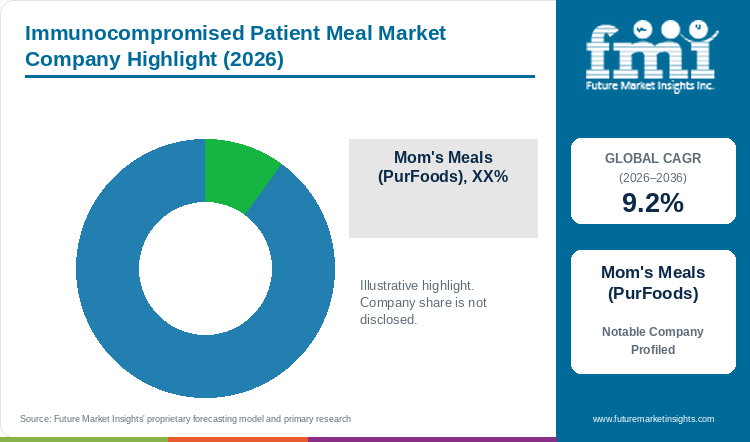
Government directories describe menus and ordering routes for Mom's Meals (PurFoods), Magic Kitchen and Silver Cuisine by BistroMD. [5] [14] VA's Medtrition record provides a dated institutional supply arrangement. [15] ModifyHealth, Hormel Health Labs, Nestle Health Science and Abbott also form part of the profiled company roster.
- Directory-listed meal suppliers: Mom's Meals (PurFoods); Magic Kitchen; BistroMD.
- Institutional supply arrangement: Medtrition.
- Other profiled companies: ModifyHealth; Hormel Health Labs; Nestle Health Science; Abbott.
Competitive Benchmarking: Immunocompromised Patient Meal Market
Table 3: Documented supplier entries for the Immunocompromised Patient Meal Market (dated public records), 2025 to 2026
| Company | Documented entry | Program or geographic scope | Source and date |
|---|---|---|---|
| Mom's Meals (PurFoods) | Premade delivery and a Cancer Support menu category; ordered online or by phone. | Listed in Jefferson County, Wisconsin's senior resource guide. | Jefferson County Senior Nutrition Program, 2025 Food Access & Resource Guide for Seniors, July 7, 2025. [14] |
| Magic Kitchen | Special-diet menus; FedEx-delivered meals ordered by phone, online or app; Medicaid and private pay, with prior authorization in the application process. | South Dakota service area (state directory); also listed in Jefferson County, Wisconsin. | South Dakota Department of Human Services, Dakota At Home, listing last assured February 18, 2026. [5] |
| BistroMD | Listed as Silver Cuisine by Bistro MD, with heart-healthy, diabetic and other diet options. | Listed in Jefferson County, Wisconsin's senior resource guide. | Jefferson County Senior Nutrition Program, 2025 Food Access & Resource Guide for Seniors, July 7, 2025. [14] |
| Medtrition | Listed in the US Subsistence Prime Vendor Program under contract 36W79725D0005: awarded September 8, 2025, effective November 1, 2025, expires October 31, 2026. | US Subsistence Prime Vendor Program; product scope is not specified as immunocompromised-patient meals. | US Department of Veterans Affairs, National Acquisition Center, contract record, September 8, 2025. [15] |
The comparison uses listed menu categories, ordering and payment routes, and dated contract terms. These fields describe different supplier arrangements rather than comparative clinical performance.
Key Developments in the Immunocompromised Patient Meal Market
- Medtrition was awarded VA contract 36W79725D0005 on September 8, 2025. The US Subsistence Prime Vendor Program record gives a term from November 1, 2025 to October 31, 2026. [15]
- In January 2026, the German Guideline Program in Oncology published long version 1.0 of its S3 oncology nutrition guideline. Section 8.1 recommends structured nutrition and food-hygiene counseling for patients with prolonged neutropenia, graft-versus-host disease or comparable significant immunosuppression, and advises against a restrictive neutropenic diet. [7]
Key Players in the Immunocompromised Patient Meal Market
- Directory-listed meal suppliers
- Mom's Meals (PurFoods)
- Magic Kitchen
- BistroMD
- Institutional supply arrangement
- Medtrition
- Other profiled companies
- ModifyHealth
- Hormel Health Labs
- Nestle Health Science
- Abbott
Immunocompromised Patient Meal Market - Report Scope
Table 4: Report scope for the Immunocompromised Patient Meal Market (USD Million), 2026 to 2036
| Coverage field | Report scope |
|---|---|
| Market breakdown | Product Type; Patient Group; Delivery Model; End User; Sales Channel |
| Quantitative Units | USD Million |
| Market Definition | Revenue from prepared meals, shelf-stable meals and in-scope snack or side products sold for immunocompromised patients through the defined channels. Separately sold oral supplements, enteral formulas, raw groceries, counseling fees and adjacent substitute products are excluded. |
| Regions Covered | North America; Latin America; Western Europe; Eastern Europe; East Asia; South Asia and Pacific; Middle East and Africa |
| Countries Covered | USA; UK; Germany; Japan; South Korea |
| Key Companies Profiled | Mom's Meals (PurFoods); Magic Kitchen; ModifyHealth; Hormel Health Labs; BistroMD; Nestle Health Science; Abbott; Medtrition |
| Forecast Period | 2026 to 2036 |
| Evidence Basis | FMI market estimates read alongside dated clinical, government, registry and procurement publications from noncommercial sources. |
Immunocompromised Patient Meal Market - Research Methodology
Table 5: Research methodology for the Immunocompromised Patient Meal Market (USD Million), 2026 to 2036
| Method | Approach |
|---|---|
| Market Estimates | FMI provides the 2026 market value, 2036 forecast, global CAGR, five leading-segment shares and five country CAGRs. Monetary values are stated in USD Million. |
| Public Evidence | Clinical guidelines, cancer-center and health-authority publications, government program and procurement records, and peer-reviewed research from noncommercial publishers. Each citation carries its publication, review or access date. Historical data keep their original period even when a recent document repeats them. |
| Interpretation of Evidence | Clinical guidance informs the assessment of preparation and nutrition needs. Government directories and procurement records describe ordering, payment and institutional supply arrangements. The infusion-clinic pilot informs discussion of participation and access. |
| Time Basis | Market estimates cover 2026 to 2036. Cited evidence is dated between 2012 and 2026, and the analysis reflects public records available by October 9, 2026. |
Immunocompromised Patient Meal Market by Segments
Immunocompromised Patient Meal Market segmented by Product Type:
- Low-Microbial Prepared Meals
- Fully Cooked Shelf-Stable Meals
- Pasteurized Snack & Side Products
- Others
Immunocompromised Patient Meal Market segmented by Patient Group:
- Oncology (Neutropenic)
- Transplant Recipients
- Advanced HIV & Immunodeficiency
- Others
Immunocompromised Patient Meal Market segmented by Delivery Model:
- Home Meal Delivery
- Hospital Discharge Programs
- Retail
- Others
Immunocompromised Patient Meal Market segmented by End User:
- Homecare
- Hospitals
- Others
Immunocompromised Patient Meal Market segmented by Sales Channel:
- Online / DTC
- Health Plan Referral
- Hospital Programs
- Retail
- Others
Immunocompromised Patient Meal Market by Region:
- North America
- United States
- Canada
- Latin America
- Brazil
- Mexico
- Argentina
- Chile
- Western Europe
- Germany
- France
- United Kingdom
- Italy
- Spain
- Benelux
- Nordics
- Eastern Europe
- Poland
- Czech Republic
- Romania
- Hungary
- East Asia
- China
- Japan
- South Korea
- South Asia and Pacific
- India
- ASEAN
- Australia and New Zealand
- Middle East and Africa
- GCC Countries
- South Africa
- Türkiye
- Israel
Research Sources and Bibliography
- [1] Centers for Disease Control and Prevention (2024, May 2). Safer Food Choices for People With Weakened Immune Systems. https://www.cdc.gov/food-safety/foods/weakened-immune-systems.html
- [2] National Cancer Institute (reviewed 2020, January 23). Infection and Neutropenia during Cancer Treatment. National Institutes of Health. https://www.cancer.gov/about-cancer/treatment/side-effects/infection
- [3] PDQ Supportive and Palliative Care Editorial Board, National Cancer Institute (2024, September 20). Nutrition in Cancer Care, Health Professional Version.
- [4] California Department of Health Care Services (n.d.). Community Supports Search Tool. Accessed October 9, 2026.
- [5] South Dakota Department of Human Services, Dakota At Home (2026, February 18; listing last assured). Home Delivered Meals | Magic Kitchen.
- [6] U.S. Department of Health and Human Services, Guidance Portal, issued by the Centers for Medicare & Medicaid Services (2024, December 10; rescinded 2025, March 4). Coverage of Services and Supports to Address Health-Related Social Needs in Medicaid and CHIP. https://www.hhs.gov/guidance/sites/default/files/hhs-guidance-documents/AID/cib12102024_rescinded_0.pdf
- [7] German Guideline Program in Oncology (German Cancer Society, German Cancer Aid, AWMF) (2026, January). S3-Leitlinie Klinische Ernährung in der Onkologie, long version 1.0. Section 8.1, recommendations 8.1 to 8.3.
- [8] Health Canada (2012, April 20). Safe food handling for people with weakened immune systems. Video and transcript.
- [9] Food Standards Australia New Zealand (n.d.). Food safety for vulnerable people. Accessed October 9, 2026.
- [10] Hollis-Hansen, K., Khan, A., Haskins, C., Turcios, J., Naucke, J., & Pruitt, S. L. (2025, November 12). Food assistance strategies for patients of an infusion clinic: a pilot randomized controlled trial. Supportive Care in Cancer, 33(12), 1049. DOI 10.1007/s00520-025-10077-9; PMID 41222612. https://pubmed.ncbi.nlm.nih.gov/41222612/
- [11] National Cancer Center Hospital East, Japan, Nutrition Management Office (n.d.). Hygienic handling of meals when white blood cells decrease [translated title]. Anticancer treatment support recipes, session 16. Accessed October 9, 2026.
- [12] Brazilian National Cancer Institute, INCA (2015). Guia de nutrição para pacientes e cuidadores.
- [13] Gustave Roussy (n.d.). Diététique et nutrition. Accessed October 9, 2026.
- [14] Jefferson County, Wisconsin, Senior Nutrition Program (2025, July 7). 2025 Food Access & Resource Guide for Seniors. Human Services Board handout, printed pages 16 to 17.
- [15] U.S. Department of Veterans Affairs, National Acquisition Center (2025, September 8). Medtrition contract 36W79725D0005. Effective 2025, November 1; expires 2026, October 31.
- [16] Republic of Korea National Cancer Information Center (n.d.). Cancer incidence [translated title]. 2023 incidence data. Accessed October 9, 2026.
- [17] National Cancer Center, Republic of Korea, Clinical Nutrition Office (n.d.). Nutrition support [translated title]. Accessed October 9, 2026.
- [18] National Health and Family Planning Commission of the People's Republic of China (2017, August 1). Dietary guide for cancer patients, WS/T 559-2017 [translated title]. Effective 2018, February 1. Hosted by the National Health Commission.
- [19] Oxford University Hospitals NHS Foundation Trust (n.d.). Food safety when immunocompromised. Patient leaflet 75634P. Accessed October 9, 2026.
This Report Answers
- How big is the immunocompromised patient meal market in 2026 and what is forecast for 2036?
- Which treatment and care conditions support demand for immunocompromised patient meals?
- Why do Low-Microbial Prepared Meals lead the Product Type category?
- Why does Oncology (Neutropenic) lead Patient Group?
- How do growth rates differ across the five profiled countries?
- Which companies are profiled, and what does the public record document about them?
- What payment, evidence and storage limits restrict adoption of prepared meals for immunocompromised patients?
- What should hospitals, health plans and caregivers ask a meal supplier before ordering?
Frequently Asked Questions
How big is the immunocompromised patient meal market in 2026 and what is forecast for 2036?
The market is estimated at USD 141.4 Million in 2026 and forecast to reach USD 341.0 Million by 2036, an increase of USD 199.6 Million. These FMI estimates cover prepared meals, shelf-stable meals and in-scope snack or side products; supplements, enteral formulas and raw groceries are outside the boundary.
What is the CAGR of the immunocompromised patient meal market from 2026 to 2036?
The forecast CAGR is 9.2% from 2026 to 2036, which takes the market to 2.41 times its 2026 value. The path depends on treatment-linked demand and on payment routes that stay in place.
Which Product Type leads the immunocompromised patient meal market?
Low-Microbial Prepared Meals lead Product Type with 48.1% in 2026. The category name does not establish an infection benefit: the NCI PDQ review found no advantage for a restrictive neutropenic diet in the studies it cites. [3]
Which Patient Group leads the immunocompromised patient meal market?
Oncology (Neutropenic) leads Patient Group with 49.0% in 2026. Neutrophil counts fall during parts of a chemotherapy cycle, so not every cancer patient is neutropenic at a given time. [2]
Which delivery, end-user and sales-channel segments lead the market?
Home Meal Delivery leads Delivery Model with 47.2%, Homecare leads End User with 49.7% and Online / DTC leads Sales Channel with 45.4% in 2026.
Which profiled countries have the highest immunocompromised patient meal market growth rates?
South Korea has the highest forecast CAGR at 9.7%, followed by the UK at 8.8%, the USA at 8.5%, Germany at 8.2% and Japan at 7.2% from 2026 to 2036.
Which companies are profiled in the immunocompromised patient meal market?
The profiled companies are Mom's Meals (PurFoods); Magic Kitchen; ModifyHealth; Hormel Health Labs; BistroMD; Nestle Health Science; Abbott; Medtrition.
Preview the report firsthand - request a free sample
Get SampleGet the brochure for pricing and purchase details.
Get PDFTable of Content
- Key Takeaways
- Market Size and CAGR
- Top Growth Driver
- Fastest Growing Segment
- Leading Region
- Key Companies
- Emerging Opportunities
- Executive Summary
- Global Market Outlook
- Demand-side Trends
- Supply-side Trends
- Technology Roadmap Analysis
- Analysis and Recommendations
- Analyst Perspective (What is happening? Why now? What should investors know?)
- Key Questions Answered
- How large is the market?
- What is the CAGR?
- What are key trends?
- Which region dominates?
- Who are the leaders?
- Market Overview
- Market Coverage / Taxonomy
- Market Definition / Scope / Limitations
- Research Methodology
- Chapter Orientation
- Analytical Lens and Working Hypotheses
- Market Structure, Signals, and Trend Drivers
- Benchmarking and Cross-market Comparability
- Market Sizing, Forecasting, and Opportunity Mapping
- Research Design and Evidence Framework
- Desk Research Programme (Secondary Evidence)
- Expert Input and Fieldwork (Primary Evidence)
- Tooling, Models, and Reference Databases
- Data Engineering and Model Build
- Quality Assurance and Audit Trail
- Market Background
- Market Dynamics (Drivers, Restraints, Opportunity, Trends)
- Scenario Forecast (Optimistic, Likely, Conservative)
- Impact Analysis
- AI Impact
- Sustainability Impact
- Regulatory Impact
- Technology Impact
- Consumer / Buyer Analysis
- Purchase Drivers
- Adoption Barriers
- Buyer Journey
- Opportunity Map Analysis
- Product Life Cycle Analysis
- Supply Chain Analysis
- Investment Feasibility Matrix
- Value Chain Analysis
- PESTLE and Porter's Analysis
- Regulatory Landscape
- Regional Parent Market Outlook
- Production and Consumption Statistics
- Import and Export Statistics
- Global Market Analysis and Forecast, 2021 to 2036
- Historical Market Size Value (USD Million) Analysis, 2021 to 2025
- Current and Future Market Size Value (USD Million) Projections, 2026 to 2036
- Y-o-Y Growth Trend Analysis
- Absolute $ Opportunity Analysis
- Global Market Pricing Analysis, 2021 to 2036
- Global Market Analysis and Forecast, By Product Type, 2021 to 2036
- Introduction / Key Findings
- Historical Market Size Value (USD Million) Analysis By Product Type, 2021 to 2025
- Current and Future Market Size Value (USD Million) Analysis and Forecast By Product Type, 2026 to 2036
- Low-Microbial Prepared Meals
- Fully Cooked Shelf-Stable Meals
- Pasteurized Snack & Side Products
- Others
- Y-o-Y Growth Trend Analysis By Product Type, 2021 to 2025
- Absolute $ Opportunity Analysis By Product Type, 2026 to 2036
- Global Market Analysis and Forecast, By Patient Group, 2021 to 2036
- Introduction / Key Findings
- Historical Market Size Value (USD Million) Analysis By Patient Group, 2021 to 2025
- Current and Future Market Size Value (USD Million) Analysis and Forecast By Patient Group, 2026 to 2036
- Oncology (Neutropenic)
- Transplant Recipients
- Advanced HIV & Immunodeficiency
- Others
- Y-o-Y Growth Trend Analysis By Patient Group, 2021 to 2025
- Absolute $ Opportunity Analysis By Patient Group, 2026 to 2036
- Global Market Analysis and Forecast, By Delivery Model, 2021 to 2036
- Introduction / Key Findings
- Historical Market Size Value (USD Million) Analysis By Delivery Model, 2021 to 2025
- Current and Future Market Size Value (USD Million) Analysis and Forecast By Delivery Model, 2026 to 2036
- Home Meal Delivery
- Hospital Discharge Programs
- Retail
- Others
- Y-o-Y Growth Trend Analysis By Delivery Model, 2021 to 2025
- Absolute $ Opportunity Analysis By Delivery Model, 2026 to 2036
- Global Market Analysis and Forecast, By End User, 2021 to 2036
- Introduction / Key Findings
- Historical Market Size Value (USD Million) Analysis By End User, 2021 to 2025
- Current and Future Market Size Value (USD Million) Analysis and Forecast By End User, 2026 to 2036
- Homecare
- Hospitals
- Others
- Y-o-Y Growth Trend Analysis By End User, 2021 to 2025
- Absolute $ Opportunity Analysis By End User, 2026 to 2036
- Global Market Analysis and Forecast, By Sales Channel, 2021 to 2036
- Introduction / Key Findings
- Historical Market Size Value (USD Million) Analysis By Sales Channel, 2021 to 2025
- Current and Future Market Size Value (USD Million) Analysis and Forecast By Sales Channel, 2026 to 2036
- Online / DTC
- Health Plan Referral
- Hospital Programs
- Retail
- Others
- Y-o-Y Growth Trend Analysis By Sales Channel, 2021 to 2025
- Absolute $ Opportunity Analysis By Sales Channel, 2026 to 2036
- Global Market Analysis and Forecast, By Region, 2021 to 2036
- Introduction
- Historical Market Size Value (USD Million) Analysis By Region, 2021 to 2025
- Current Market Size Value (USD Million) Analysis and Forecast By Region, 2026 to 2036
- North America
- Latin America
- Western Europe
- Eastern Europe
- East Asia
- South Asia and Pacific
- Middle East and Africa
- Market Attractiveness Analysis By Region
- North America Market Analysis and Forecast, By Country, 2021 to 2036
- Historical Market Size Value (USD Million) Trend Analysis By Market Taxonomy, 2021 to 2025
- Market Size Value (USD Million) Forecast By Market Taxonomy, 2026 to 2036
- By Country
- United States
- Canada
- By Product Type
- By Patient Group
- By Delivery Model
- By End User
- By Sales Channel
- By Country
- Market Attractiveness Analysis
- By Country
- By Product Type
- By Patient Group
- By Delivery Model
- By End User
- By Sales Channel
- Key Takeaways
- Latin America Market Analysis and Forecast, By Country
- Historical Market Size Value (USD Million) Trend Analysis By Market Taxonomy, 2021 to 2025
- Market Size Value (USD Million) Forecast By Market Taxonomy, 2026 to 2036
- By Country
- Brazil
- Mexico
- Argentina
- Chile
- By Product Type
- By Patient Group
- By Delivery Model
- By End User
- By Sales Channel
- By Country
- Market Attractiveness Analysis
- By Country
- By Product Type
- By Patient Group
- By Delivery Model
- By End User
- By Sales Channel
- Key Takeaways
- Western Europe Market Analysis and Forecast, By Country
- Historical Market Size Value (USD Million) Trend Analysis By Market Taxonomy, 2021 to 2025
- Market Size Value (USD Million) Forecast By Market Taxonomy, 2026 to 2036
- By Country
- Germany
- France
- United Kingdom
- Italy
- Spain
- Benelux
- Nordics
- By Product Type
- By Patient Group
- By Delivery Model
- By End User
- By Sales Channel
- By Country
- Market Attractiveness Analysis
- By Country
- By Product Type
- By Patient Group
- By Delivery Model
- By End User
- By Sales Channel
- Key Takeaways
- Eastern Europe Market Analysis and Forecast, By Country
- Historical Market Size Value (USD Million) Trend Analysis By Market Taxonomy, 2021 to 2025
- Market Size Value (USD Million) Forecast By Market Taxonomy, 2026 to 2036
- By Country
- Poland
- Czech Republic
- Romania
- Hungary
- By Product Type
- By Patient Group
- By Delivery Model
- By End User
- By Sales Channel
- By Country
- Market Attractiveness Analysis
- By Country
- By Product Type
- By Patient Group
- By Delivery Model
- By End User
- By Sales Channel
- Key Takeaways
- East Asia Market Analysis and Forecast, By Country
- Historical Market Size Value (USD Million) Trend Analysis By Market Taxonomy, 2021 to 2025
- Market Size Value (USD Million) Forecast By Market Taxonomy, 2026 to 2036
- By Country
- China
- Japan
- South Korea
- By Product Type
- By Patient Group
- By Delivery Model
- By End User
- By Sales Channel
- By Country
- Market Attractiveness Analysis
- By Country
- By Product Type
- By Patient Group
- By Delivery Model
- By End User
- By Sales Channel
- Key Takeaways
- South Asia and Pacific Market Analysis and Forecast, By Country
- Historical Market Size Value (USD Million) Trend Analysis By Market Taxonomy, 2021 to 2025
- Market Size Value (USD Million) Forecast By Market Taxonomy, 2026 to 2036
- By Country
- India
- ASEAN
- Australia and New Zealand
- By Product Type
- By Patient Group
- By Delivery Model
- By End User
- By Sales Channel
- By Country
- Market Attractiveness Analysis
- By Country
- By Product Type
- By Patient Group
- By Delivery Model
- By End User
- By Sales Channel
- Key Takeaways
- Middle East and Africa Market Analysis and Forecast, By Country
- Historical Market Size Value (USD Million) Trend Analysis By Market Taxonomy, 2021 to 2025
- Market Size Value (USD Million) Forecast By Market Taxonomy, 2026 to 2036
- By Country
- GCC Countries
- South Africa
- Türkiye
- Israel
- By Product Type
- By Patient Group
- By Delivery Model
- By End User
- By Sales Channel
- By Country
- Market Attractiveness Analysis
- By Country
- By Product Type
- By Patient Group
- By Delivery Model
- By End User
- By Sales Channel
- Key Takeaways
- Key Countries Market Analysis
- United States
- Pricing Analysis
- Market Share Analysis, 2025
- By Product Type
- By Patient Group
- By Delivery Model
- By End User
- By Sales Channel
- Canada
- Pricing Analysis
- Market Share Analysis, 2025
- By Product Type
- By Patient Group
- By Delivery Model
- By End User
- By Sales Channel
- Mexico
- Pricing Analysis
- Market Share Analysis, 2025
- By Product Type
- By Patient Group
- By Delivery Model
- By End User
- By Sales Channel
- Brazil
- Pricing Analysis
- Market Share Analysis, 2025
- By Product Type
- By Patient Group
- By Delivery Model
- By End User
- By Sales Channel
- Chile
- Pricing Analysis
- Market Share Analysis, 2025
- By Product Type
- By Patient Group
- By Delivery Model
- By End User
- By Sales Channel
- Germany
- Pricing Analysis
- Market Share Analysis, 2025
- By Product Type
- By Patient Group
- By Delivery Model
- By End User
- By Sales Channel
- United Kingdom
- Pricing Analysis
- Market Share Analysis, 2025
- By Product Type
- By Patient Group
- By Delivery Model
- By End User
- By Sales Channel
- Italy
- Pricing Analysis
- Market Share Analysis, 2025
- By Product Type
- By Patient Group
- By Delivery Model
- By End User
- By Sales Channel
- Spain
- Pricing Analysis
- Market Share Analysis, 2025
- By Product Type
- By Patient Group
- By Delivery Model
- By End User
- By Sales Channel
- France
- Pricing Analysis
- Market Share Analysis, 2025
- By Product Type
- By Patient Group
- By Delivery Model
- By End User
- By Sales Channel
- India
- Pricing Analysis
- Market Share Analysis, 2025
- By Product Type
- By Patient Group
- By Delivery Model
- By End User
- By Sales Channel
- ASEAN
- Pricing Analysis
- Market Share Analysis, 2025
- By Product Type
- By Patient Group
- By Delivery Model
- By End User
- By Sales Channel
- Australia and New Zealand
- Pricing Analysis
- Market Share Analysis, 2025
- By Product Type
- By Patient Group
- By Delivery Model
- By End User
- By Sales Channel
- China
- Pricing Analysis
- Market Share Analysis, 2025
- By Product Type
- By Patient Group
- By Delivery Model
- By End User
- By Sales Channel
- Japan
- Pricing Analysis
- Market Share Analysis, 2025
- By Product Type
- By Patient Group
- By Delivery Model
- By End User
- By Sales Channel
- South Korea
- Pricing Analysis
- Market Share Analysis, 2025
- By Product Type
- By Patient Group
- By Delivery Model
- By End User
- By Sales Channel
- Poland
- Pricing Analysis
- Market Share Analysis, 2025
- By Product Type
- By Patient Group
- By Delivery Model
- By End User
- By Sales Channel
- Hungary
- Pricing Analysis
- Market Share Analysis, 2025
- By Product Type
- By Patient Group
- By Delivery Model
- By End User
- By Sales Channel
- Türkiye
- Pricing Analysis
- Market Share Analysis, 2025
- By Product Type
- By Patient Group
- By Delivery Model
- By End User
- By Sales Channel
- South Africa
- Pricing Analysis
- Market Share Analysis, 2025
- By Product Type
- By Patient Group
- By Delivery Model
- By End User
- By Sales Channel
- United States
- Market Structure Analysis
- Competition Dashboard
- Competition Benchmarking
- Market Share Analysis of Top Players
- By Regional
- By Product Type
- By Patient Group
- By Delivery Model
- By End User
- By Sales Channel
- Emerging Startups
- Innovation Benchmarking
- Competition Analysis
- Competition Deep Dive
- Mom's Meals (PurFoods)
- Overview
- Product Portfolio
- Profitability by Market Segments
- Sales Footprint
- Strategy Overview
- Marketing Strategy
- Product Strategy
- Channel Strategy
- Magic Kitchen
- BistroMD
- Medtrition
- Directory-listed meal suppliers
- Institutional supply arrangement
- Other profiled companies
- ModifyHealth
- Hormel Health Labs
- Nestle Health Science
- Abbott
- Mom's Meals (PurFoods)
- Case Studies
- Success Stories
- Recent Developments
- Competition Deep Dive
- Assumptions & Acronyms Used


