

- Market Size (2026)
- USD 240.0 Mn
- Forecast (2036)
- USD 1486.0 Mn
- CAGR (2026 to 2036)
- 20.0%
How big is Patient Transfer & Nursing-Assist Robots Market in 2026?
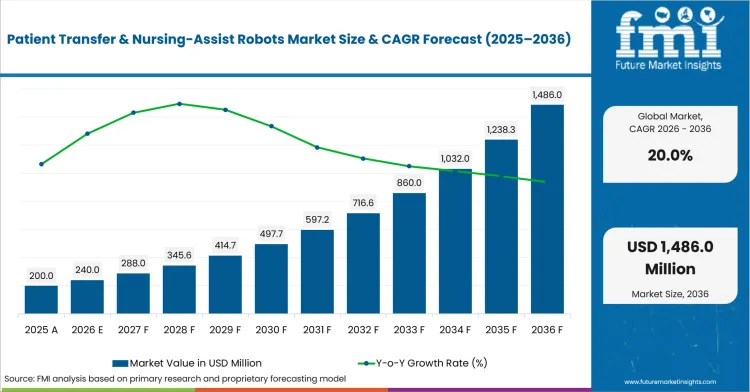
USD 240.0 million in 2026 and USD 1,486.0 million by 2036 at a 20.0% CAGR.
Demand for patient transfer & nursing-assist robots are projected to rise from USD 240.0 million in 2026 to USD 1,486.0 million by 2036 at 20.0% CAGR. Regulatory and deployment requirements are reinforcing this growth by shifting adoption beyond small pilots. China’s Ministry of Industry and Information Technology reported in June 2025 that institutional care robots must be tested across 20 communities or facilities with 20 units. This threshold turns a pilot into a repeatable operating test and gives manufacturers clearer evidence for later orders. The medical robotics outlook shows how care systems are progressing from isolated trials toward equipment budgets tied to defined clinical work.
Japan and the United States fund adoption through different routes that place risk with different institutions. Japan connects care technology with national support programmes and facility grants that reduce the initial equipment burden. American hospitals often build the financial case through worker safety costs and existing capital equipment budgets. A CDC-hosted study published in May 2024 reviewed 10,839 accepted nurse injury claims in Washington State that exceeded USD 65 million. The documented cost shows why repeated lifting exposure can justify equipment spending without a dedicated robot subsidy. Care managers must examine room size and staff training requirements before approving a purchase for routine use. Eldercare automation demand therefore depends on practical workflow fit as much as mechanical performance during investment planning.
Key Takeaways of Patient Transfer & Nursing-Assist Robots Market
- Demand for patient transfer and nursing-assist robots is driven by workforce pressure and public funding, creating defined purchasing cases for robots that remove identified care tasks from understaffed shifts.
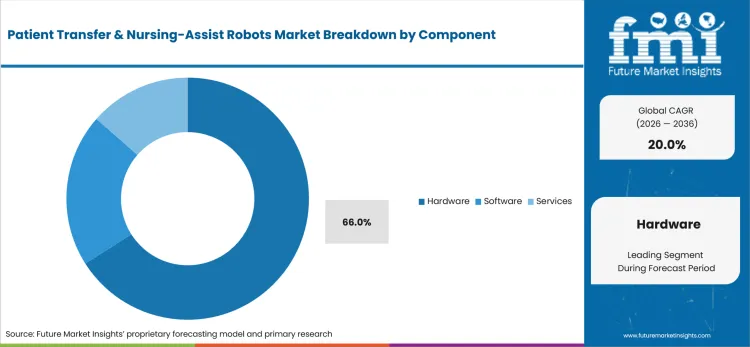
- By component, hardware is expected to lead with 66.0% share in 2026, owing to the need for load-bearing frames and integrated safety controls in every installed unit.
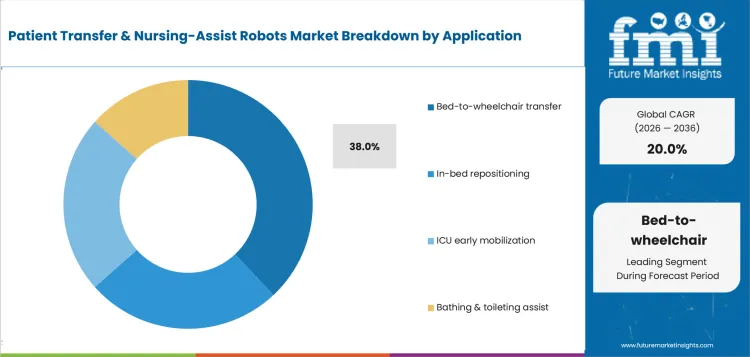
- Bed-to-wheelchair transfer is the dominant application segment, projected to hold 38.0% share in 2026, driven by the task's role in linking routine nursing care with recovery and mobility goals.
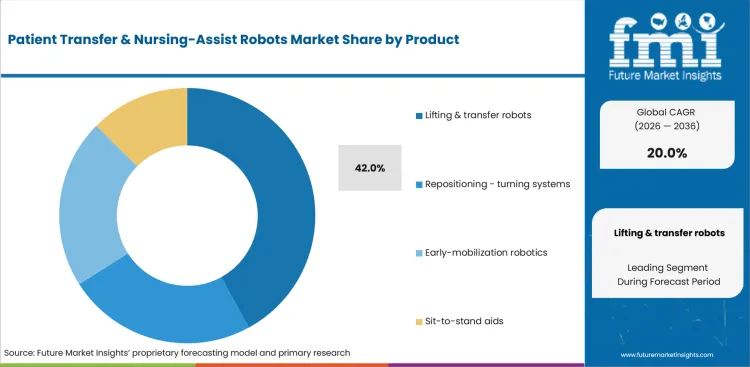
- Lifting and transfer robots are estimated to lead the product category with 42.0% share in 2026, supported by powered frames that assist frequent patient movements across routine care settings.
- Software and service income is expected to grow as facilities need device records, training, and maintenance across a wider installed base.
- Japan, South Korea, and the European Union are expected to grow at 21.0%, 21.0%, and 19.0% CAGR respectively through 2036, shaped by policy routes connecting care shortages with field use versus research-network support for rehabilitation robotics.
- Competition centers on Arjo, FUJI CORPORATION, Panasonic, Reactive Robotics, DIH, German Bionic, Diligent Robotics, and Relay Robotics, with vendors differentiating through transfer equipment, integrated care-bed solutions, clinical mobilization systems, and wearable/mobile nursing support.
Analyst Perspective
"Patient transfer robots will earn wider acceptance only when they demonstrate measurable improvements in caregiver productivity and patient handling across routine hospital operations rather than controlled evaluations. Clinical teams assess these systems through workflow continuity, infection-control compatibility, and staff safety, while hospital administrators weigh utilization rates against long-term operating costs. Vendors that shorten implementation time, support multidisciplinary clinical adoption, and maintain high equipment availability through dependable service will hold a stronger position as healthcare providers expand automation investments."
- Anurag Sharma, Principal Analyst at Future Market Insights
Source: FMI's proprietary forecasting model and primary research.
How is the Patient Transfer and Nursing-Assist Robots Market segmented?
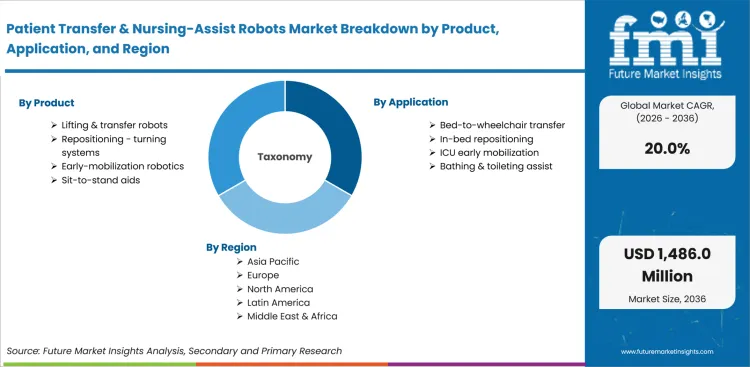
The patient transfer and nursing-assist robots industry is segmented by product, application, component, end user, business model and region.
The report compares six dimensions that explain how care work becomes measurable demand for equipment and ongoing service. Product coverage includes transfer systems and turning devices alongside early mobilization equipment plus supported standing and nursing workflow robots. Application analysis follows bed-to-wheelchair movement and in-bed repositioning together with ICU mobilization plus hygiene and routine delivery support. Component analysis separates hardware from software and services that support each installed system throughout its working life. End-user coverage includes hospitals and nursing homes together with home care and rehabilitation centres across different care settings. Business models compare direct purchase with rental and insurance funding, and public pilots provide a separate testing route before larger orders. Regional analysis tests these choices against local policy and service capacity through the rehabilitation equipment outlook.
What supports demand for lifting and transfer robots within the product category?
Lifting systems address a care task that can injure staff and unsettle patients during the same movement. Japan’s Ministry of Health, Labour and Welfare reported in February 2025 that wearable transfer support reduced combined setup and direct care time by about five minutes. The result shows that equipment creates value if preparation remains shorter than the labour it removes. Wearable care devices offer another route for reducing physical strain during repeated care tasks across long working shifts.
- By product, lifting and transfer robots are forecast to represent 42.0% of revenue in 2026 due to their role in frequent patient movements. Their share reflects the cost of powered frames and support surfaces that must carry weight safely. Hospitals often prioritise this category since the task creates an immediate staffing and injury problem.
- Hospitals and nursing homes are expected to purchase systems that fit existing beds and allow safe approach angles inside patient rooms. Demand weakens if setup adds several minutes to every movement and disrupts other care tasks. Manufacturers gain commercial value by showing that one trained caregiver can complete the task across normal shifts and room layouts.
How does bed-to-wheelchair transfer influence purchasing within the application category?
Bed-to-wheelchair movement is a frequent care transition during hospital recovery and long-term residential support periods. Panasonic reported in September 2019 that Resyone changed a task using two or three caregivers into a movement managed by one caregiver. The design combines part of the bed with an electric wheelchair and removes a separate lifting step. This stable operating example remains useful because newer evidence for this exact workflow is limited. Therapeutic robot demand depends on proving similar gains under current room and staffing conditions in everyday practice.
- In 2026, bed-to-wheelchair transfer is expected to account for 38.0% of application revenue due to its link with daily mobility goals. A combined bed and wheelchair can remove one lifting stage and reduce handling around the patient. The business case improves if the system reduces handling without delaying medication rounds or other bedside work.
- Care units are expected to favour systems that match bed height and doorway clearance across the facility. Training must cover patient eligibility and emergency release so that the device remains useful beyond demonstration cases. Purchase activity rises as different shifts repeat the workflow without depending on one specialist operator during routine care.
Why does hardware account for a large share of component spending?
Hardware remains the main cost layer because patient support depends on frames and controls that work together under load. German Bionic introduced the Exia system for healthcare in December 2025 and stated that it supports mobilization plus repositioning and bed-to-wheelchair transfers. The announcement shows how sensing and powered assistance can be combined in one wearable platform. Clinical automation spending becomes more attractive if one system serves several physical tasks without adding separate equipment for every movement.
- By component, hardware is estimated to represent 66.0% of revenue in 2026 due to powered frames and safety controls. Every unit needs a complete mechanical platform that can support a patient through repeated cycles. Software can be shared across devices more easily than the physical structure can be reused across multiple care sites.
- Care facilities are anticipated to increase software and service spending as the installed base grows across several wards. Device logs can guide maintenance and training review across shifts without replacing the physical transfer mechanism. Companies that pair dependable hardware with local service can reduce downtime that would return the task to manual handling.
What are the drivers, restraints, and opportunities in the Patient Transfer and Nursing-Assist Robots Market?
Workforce pressure is expected to expand demand. Facility fit is anticipated to slow adoption. Clinical evidence is projected to improve the commercial case.
- Driver: Workforce pressure is expected to support robots that remove defined physical or logistical tasks from each nursing shift.
- Restraint: Facility fit and preparation time are anticipated to delay purchase decisions across mixed room layouts.
- Opportunity: Better clinical evidence is projected to support wider use beyond isolated trials and research budgets.
Workforce pressure is creating demand for robots that remove defined physical or logistical tasks from each shift. Diligent Robotics reported in July 2025 that Moxi had completed more than 300,000 pharmacy deliveries across United States hospitals. This scale shows that nursing support can produce value without replacing clinical judgement or touching patients. Hospitals can use delivery automation to preserve staff time for transfers and bedside care during each working shift. The broader robotics forecast shows that purpose-built systems need clear ownership and service targets to create lasting value.
Facility fit remains a commercial restraint if transfer equipment adds work through slow preparation during routine care. Japan’s Ministry of Health, Labour and Welfare reported in February 2025 that non-wearable transfer support increased combined preparation and direct care time by about 12 minutes. The result shows that mechanical capability alone cannot justify a purchase for routine care settings. Room access and cleaning steps must fit normal shifts together with the stated patient limits. Companies need site assessment and staff instruction that prevent the robot from becoming unused equipment.
Hospital adoption can widen if early-mobilization vendors build evidence that fits clinical protocols and capital reviews. Critical Care published an April 2024 cohort study covering 16 robot-assisted patients and 13 controls. The study found no significant outcome difference and called for larger trials across varied patient groups. That result does not prove that hospitals or insurers are ready to fund routine use, but it identifies the evidence gap that companies must close. Remote clinical systems can help hospitals test training and data review before a larger equipment purchase.
Which country CAGRs are profiled in the Patient Transfer and Nursing-Assist Robots Market?
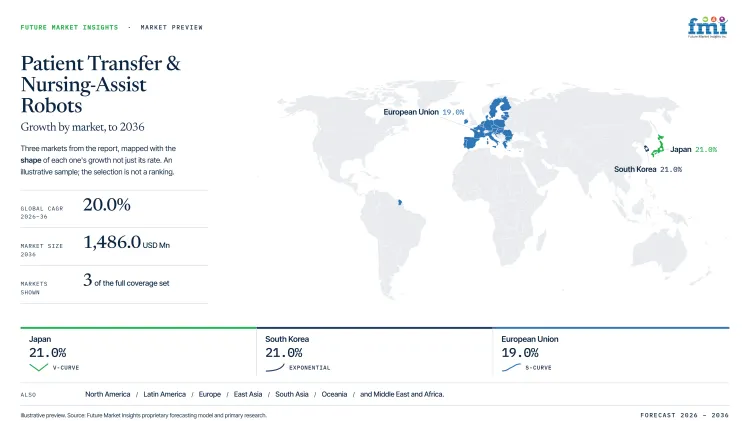
| Country | CAGR |
|---|---|
| Japan | 21.0% |
| European Union | 19.0% |
| South Korea | 21.0% |
Source: FMI's proprietary forecasting model and primary research.
How do country-level CAGRs compare in the Patient Transfer and Nursing-Assist Robots Market?
The comparison spans 2.0 percentage points and indicates a tightly grouped outlook across the patient transfer and nursing-assist robots market. Japan and South Korea share the highest CAGR at 21.0%, while the European Union follows at 19.0%. The limited spread suggests that healthcare providers across these markets are increasingly evaluating robotic assistance for patient handling, although healthcare workforce dynamics and care delivery models influence adoption in different ways.
- Japan records a CAGR of 21.0%. Hospitals and long-term care facilities are placing greater emphasis on robotic systems that assist with patient transfers, mobility support and routine caregiving tasks, helping reduce physical strain on healthcare professionals while improving patient handling practices.
- South Korea also posts a CAGR of 21.0%, matching Japan's growth rate. Continued investment in digital healthcare and hospital automation is encouraging the adoption of nursing-assist robots that support patient movement, rehabilitation activities and daily care within clinical and residential care environments.
- The European Union reaches a CAGR of 19.0%, standing 2.0 percentage points below Japan and South Korea. Healthcare providers across the region are exploring robotic assistance to improve workforce efficiency and support safe patient transfers, although implementation varies among member states because hospital infrastructure, reimbursement frameworks and healthcare priorities differ.
Comparable CAGRs do not necessarily create identical commercial opportunities. Differences in healthcare staffing, hospital automation strategies, long-term care infrastructure and regulatory requirements influence deployment decisions and long-term market potential. The full report provides country-level CAGR analysis across North America, Latin America, Europe, East Asia, South Asia, Oceania and the Middle East and Africa.
Country-wise Analysis
Country growth depends on the route that turns care pressure into a funded equipment decision. Japan and South Korea connect workforce shortages with public testing and facility support that can guide later purchasing. European activity places more weight on research networks and clinical integration across several health systems. These differences affect order timing and the type of local partner needed for market entry. Humanoid care systems provide a related reference because countries differ in their need for local service or transferable clinical studies.
- Japan connects care technology with a national support system that names transfer assistance as an eligible task. The sector is projected to record 21.0% CAGR from 2026 to 2036 with public support linked to facility use. A Ministry of Health, Labour and Welfare document dated December 2025 listed JPY 20 billion in supplementary funding for care technology introduction and joint operating support. The budget gives care homes a clearer route for pairing equipment grants with workflow improvement. Panasonic and FUJI CORPORATION offer verified transfer systems that address bed conversion and supported standing. Facility managers must compare grant rules with room access and local maintenance before committing funds. Japanese orders should therefore favour systems that arrive with training and practical installation support for staff.
- European procurement develops through research networks that connect robotic assistance with clinical rehabilitation across national systems. Demand in the European Union is forecast to rise at 19.0% CAGR between 2026 and 2036 through this evidence-led route. CORDIS updated the ReHyb project record in March 2025 and listed EU support of EUR 7.154 million for a wearable rehabilitation system combining robotics with nerve stimulation. The project links robotic help with daily activity support and structured home rehabilitation across several clinical partners. DIH and Reactive Robotics bring relevant capabilities in rehabilitation systems and early ICU mobilization programmes. Hospitals still face different purchasing rules across member states and need service plans that match local clinical practice. Commercial progress should favour companies that can transfer evidence between health systems without rebuilding the case for every site.
- South Korea is building care technology around field use rather than leaving robotics inside research programmes. The Ministry of Health and Welfare stated in April 2026 that near-term projects should reach field use within three years. Adoption is estimated to expand at 21.0% CAGR through 2036 as ministries connect research with care delivery. The same strategy plans later robotic systems that support mobility and direct care within normal care settings. This timetable gives hospitals a clearer view of products that may receive policy support during adoption. German Bionic shows how wearable systems can reduce physical strain during supported movement across care settings. Korean health organisations need local service and training in the local language before national support becomes routine equipment use.
Who are the notable companies in the Patient Transfer and Nursing-Assist Robots Market?
The report profiles Arjo AB, FUJI CORPORATION, Panasonic Holdings Corporation, Reactive Robotics GmbH, DIH Holding US Inc., German Bionic Systems GmbH, Diligent Robotics Inc., and Relay Robotics Inc.
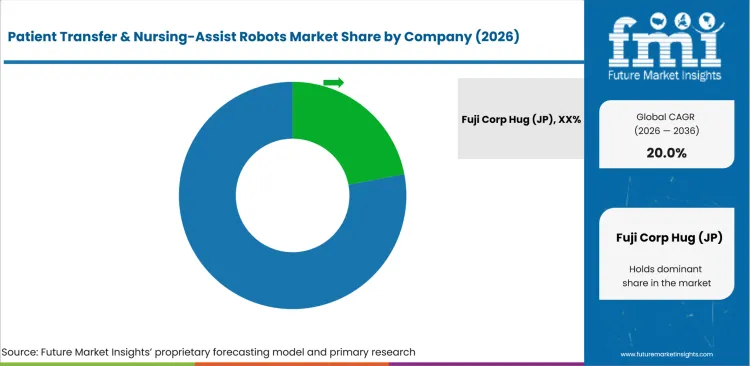
Competition spans four technical roles that require different evidence and service models across care settings. Arjo and FUJI CORPORATION build transfer equipment for repeated patient movements across hospitals and long-term care facilities. Panasonic combines a care bed with wheelchair conversion through Resyone and removes a separate handling stage. Reactive Robotics and DIH focus on mobilization systems that must fit clinical therapy routines and defined patient selection. German Bionic provides wearable assistance during demanding care tasks across hospitals and long-term care facilities. Diligent Robotics and Relay Robotics remove non-clinical delivery work through mobile systems that connect patient handling budgets with Hospital service automation. Commercial position therefore depends on workflow proof plus staff training and dependable local service coverage for every installation.
- Arjo and FUJI CORPORATION compete around repeated transfers that create physical strain and positioning risk across different care settings. Arjo supplies powered floor lifts for institutional handling, whereas FUJI builds Hug systems for supported standing and transfer tasks in home or care settings. Their commercial value depends on room fit and reliable service that keeps equipment available across daily care routines.
- Panasonic and Reactive Robotics address different points in the mobility pathway from bedside transfer to early clinical movement. Resyone changes part of a care bed into a wheelchair, whereas VEMOTION brings early mobilization to the ICU bed. Both designs reduce physical movement around the patient but require different clinical and maintenance support.
- German Bionic uses wearable assistance to reduce physical demand during mobility or demanding care work. DIH focuses on robotic rehabilitation systems that guide repeated movement under clinical supervision and defined patient selection. Training plans must match each device with the correct user and care task before regular operation begins.
- Diligent Robotics and Relay Robotics compete through nursing workflow support rather than direct patient handling within hospital wards and pharmacy operations. Their robots carry medication and supplies across hospital buildings so licensed staff can spend more time on bedside work. This model requires dependable navigation and clear integration with pharmacy plus supply operations during every shift.
Competitive Benchmarking: Patient Transfer & Nursing-Assist Robots Market
| Company | Transfer & Positioning | Early Mobilization | Nursing Workflow Support | Geographic Reach |
|---|---|---|---|---|
| Arjo AB | High | Medium | Low | International |
| FUJI CORPORATION | High | Low | Low | Japan |
| Panasonic Holdings Corporation | High | Low | Low | Japan |
| Reactive Robotics GmbH | Medium | High | Low | Europe and selected international markets |
| Relay Robotics Inc. | Low | Low | High | United States |
| DIH Holding US Inc. | Low | High | Low | Global |
| Diligent Robotics Inc. | Low | Low | High | United States |
| German Bionic Systems GmbH | Medium | Low | Medium | Europe and North America |
Scoring basis: High indicates a verified core capability. Medium indicates a verified adjacent capability. Low indicates limited direct evidence within the assessed function.
Source: Official company websites and dated corporate announcements reviewed through July 2026.
Key Developments in the Patient Transfer & Nursing-Assist Robots Market
- April 2025, Arjo AB introduced the Maxi Move 5 floor lift for hospitals and long-term care settings. The system supports lifting plus transfer and repositioning through powered controls that reduce effort during repeated patient movements. Arjo reported up to 68% lower accumulated transfer forces against comparison devices in an independent laboratory study. The launch gives care providers measurable handling evidence and a dated product option for procurement reviews in hospitals and long-term care facilities.
- March 2026, FUJI CORPORATION announced the Hug L1-02 mobility support robot and planned order intake for that month. The home-care model added faster sit-to-stand movement and a removable battery with about twice the life of its predecessor. FUJI stated that approximately 5,500 Hug units had been sold across the series by that announcement. The update extends transfer support into smaller homes that need compact equipment and a practical rental service route.
- February 2025, DIH Holding US Inc.expanded its Zahrawi Group partnership to include Saudi Arabia. The arrangement extended sales and service coverage across the United Arab Emirates plus Qatar and Bahrain together with Saudi Arabia. Local technical support gives rehabilitation robotics more commercial value since each installation requires staff training beyond the original product shipment. The wider route can help health systems obtain service without relying on distant technical teams.
- June 2026, Relay Robotics Inc.expanded its BayCare partnership through two new delivery robots at Winter Haven hospitals in Florida. The systems carry lab specimens plus medication and clinical supplies across hospital buildings without taking licensed staff away from bedside work. Relay projected more than 500 deliveries and over 150 clinical hours saved each month across the two sites. The expansion gives hospital leaders an example of nursing workflow automation expanding beyond a single pilot into a wider care network.
Key Players in the Patient Transfer & Nursing-Assist Robots Market
Patient Transfer and Handling Systems
- Arjo AB
- FUJI CORPORATION
- Panasonic Holdings Corporation
Clinical Mobilization and Caregiver Support Systems
- Reactive Robotics GmbH
- DIH Holding USA Inc.
- German Bionic Systems GmbH
Nursing Workflow Systems
- Diligent Robotics Inc.
- Relay Robotics Inc.
Patient Transfer & Nursing-Assist Robots Market - Report Scope
| Coverage field | Report scope |
|---|---|
| Market breakdown | Product, application, component, end user, business model, and region. |
| Quantitative Units | Revenue in USD Million and CAGR in %. |
| Market Definition | Robots and powered robotic systems that support patient transfers, early mobilization, caregiver physical assistance, or routine nursing workflow tasks in care settings. |
| Regions Covered | North America, Latin America, Europe, East Asia, South Asia, Oceania, and Middle East and Africa. |
| Countries Covered | United States, Canada, Japan, China, India, major European countries, and more than 20 countries within the regional model. |
| Key Companies Profiled | Arjo AB, FUJI CORPORATION, Panasonic Holdings Corporation, Reactive Robotics GmbH, DIH Holding US Inc., German Bionic Systems GmbH, Diligent Robotics Inc., and Relay Robotics Inc. |
| Forecast Period | 2026 to 2036 with a 2025 base year and a 2026 estimate. |
| Approach | Hybrid bottom-up and top-down market sizing supported by primary interviews and official desk research. |
Patient Transfer & Nursing-Assist Robots Market - Research Methodology
| Method | Approach |
|---|---|
| Primary Research | FMI analysts gathered input from manufacturers, service providers, technology developers, distributors, end users, procurement teams, and subject-matter experts. Interviews examined purchasing decisions, product or service evaluation, adoption barriers, approval requirements, pricing considerations, and expectations for technical or commercial support. Respondents were also asked what evidence is required before a trial, pilot, or initial order develops into regular purchasing. |
| Desk Research | Desk research covered government statistics, regulatory publications, trade data, industry associations, technical literature, standards, company filings, product information, and official corporate announcements. Sources were reviewed for relevance, publication date, geographic coverage, and consistency with the defined market scope. Claims relating to performance, applications, approvals, capacity, investment, and commercial activity were retained only when supported by credible public evidence. |
| Market Sizing and Forecasting | The market model combined the baseline value with historical performance, segment structure, pricing and volume indicators, adoption levels, company participation, and country-level demand conditions. Forecast assumptions considered economic activity, investment trends, regulatory developments, technology adoption, purchasing cycles, supply availability, and barriers to wider market use. Segment and regional estimates were reconciled before the final market total was calculated. |
| Data Validation | Estimates were checked against multiple independent indicators, including public data, company activity, trade patterns, industry developments, and findings from primary interviews. Validation also tested whether products, services, applications, and company revenues fell within the defined market boundaries. Adjacent categories, unsupported claims, overlapping revenues, and activities without direct market relevance were excluded to reduce double counting and maintain consistency across segments and countries. |
Source: Future Market Insights (FMI) analysis, based on proprietary forecasting model and primary research
Patient Transfer & Nursing-Assist Robots Market by Segments
By Product
- Lifting & Transfer Robots
- Repositioning & Turning Systems
- Early Mobilization Robots
- Sit-to-Stand Aids
- Nursing Workflow Assist Robots
By Application
- Bed-to-Wheelchair Transfer
- In-bed Repositioning
- ICU Early Mobilization
- Medication & Supply Delivery
- Monitoring & Routine Support
- Bathing & Toileting Assistance
By Component
- Hardware
- Software
- Services
By End User
- Hospitals
- Nursing Homes
- Home Care
- Rehabilitation Centres
By Business Model
- Direct Procurement
- Lease or Rental
- Insurance-funded Procurement
- Hospital or Government Pilot Programmes
Patient Transfer & Nursing-Assist Robots Market by Region:
- North America
- United States
- Canada
- Latin America
- Brazil
- Mexico
- Argentina
- Europe
- Germany
- United Kingdom
- France
- Italy
- Spain
- East Asia
- China
- Japan
- South Korea
- South Asia
- India
- Thailand
- Indonesia
- Oceania
- Australia
- New Zealand
- Middle East and Africa
- GCC Countries
- South Africa
- Türkiye
Research Sources and Bibliography
- Amberson, T., Graves, J. M., and Sears, J. M. (2024, May 1). Overview of occupational injuries among registered nurses in Washington State, 2007 to 2019. CDC Stacks.
- Chongqing Municipal People’s Government. (2025, June 18). Intelligent elderly-care service robot pilot applications.
- Ministry of Health, Labour and Welfare. (2025, February 10). Care workforce and technology productivity reference material. Government of Japan.
- Ministry of Health, Labour and Welfare. (2025, December 11). Measures to improve productivity in long-term care. Government of Japan.
- Ministry of Health and Welfare. (2026, April 17). Full-cycle support strategy for AI care technology. Government of the Republic of Korea
- European Commission. (2025, March 19). Rehabilitation based on hybrid neuroprosthesis: ReHyb project fact sheet. CORDIS.
- Press Information Bureau. (2025, December 16). Department of Science and Technology year-end review 2025. Government of India.
- Panasonic. (2019, September 9). Interview with the developer of Resyone, a robot that helps users get out of bed.
- Hübner, L., and colleagues. (2024, April 6). Effects of robotic-assisted early mobilization versus conventional mobilization in intensive care unit patients. Critical Care, 28, 112.
- Arjo AB. (2025, April 16). Arjo introduces the Maxi Move 5 patient floor lift.
- FUJI CORPORATION. (2026, March 2). Fuji launches the Hug L1-02 mobility support robot for home care.
- DIH Holding USA Inc. (2025, February 4). DIH expands its strategic partnership with Zahrawi Group.
- Relay Robotics Inc. (2026, June 3). BayCare expands autonomous hospital delivery with new Relay robots at Winter Haven hospitals.
- Diligent Robotics. (2025, July 16). Diligent Robotics reports 300,000 hospital pharmacy deliveries by Moxi.
- German Bionic Systems GmbH. (2025, December 4). Exia robotic exoskeleton for healthcare and nursing.
- German Federal Ministry for Economic Affairs and Energy. (n.d.). Success story: Reactive Robotics GmbH.
- Diligent Robotics Inc. (n.d.). Moxi hospital assistant robot.
This bibliography is provided for reader reference and uses primary government, standards-body, official trade body, and company sources.
This Report Answers
- What market value is estimated for 2026 and 2036?
- What CAGR is projected between 2026 and 2036?
- Which product and application segments account for the stated 2026 shares?
- How do hardware and service requirements affect operating cost?
- Which workforce and public funding factors support adoption?
- How do country CAGRs differ across Japan, the European Union, and South Korea?
- Which verified companies participate in transfer assistance and nursing workflow robotics?
- How are company capabilities compared across transfer and clinical support functions?
- What facility conditions should care organisations resolve before installation?
Frequently Asked Questions
What is driving growth in the Patient Transfer & Nursing-Assist Robots Market?
Workforce shortages are increasing demand for robots that reduce repeated handling and routine delivery work across care settings. Government programmes can convert field tests into funded use through clear operating goals and purchasing routes.
Who are the key players in the Patient Transfer & Nursing-Assist Robots Market?
Arjo and FUJI CORPORATION supply transfer systems for hospitals and long-term care facilities with verified patient handling products. Diligent Robotics and Relay Robotics address nursing workflow support through mobile robots that carry medication and supplies.
What is a notable restraint in the Patient Transfer & Nursing-Assist Robots Market?
Poor room fit can add preparation time and reduce routine use across wards with different layouts. Training needs plus device responsibilities can raise installation costs and delay approval for regular operation.
Why should executives track the Patient Transfer & Nursing-Assist Robots Market?
The sector links staff safety with available care capacity across hospitals and long-term care facilities during daily operations. Growth shows whether robotics is entering funded workflows that continue beyond short trials and research budgets.
What business problem does the Patient Transfer & Nursing-Assist Robots Market address?
Patient transfer robots reduce physical effort during movements that can expose staff and patients to handling risk. Nursing support robots remove routine delivery tasks so licensed staff can spend more time on direct care.
What should care organisations evaluate before selecting a system?
Care organisations should compare room access and patient limits with training requirements and local service capacity. A lower purchase price loses value if downtime returns routine work to manual handling during busy care shifts.
What limits return on investment for purchasers?
Underused equipment weakens returns if staff cannot fit the system into normal shifts and existing rooms. Narrow patient eligibility and poor maintenance access reduce the number of tasks completed during routine operation.
What supports long-term commercial confidence?
Repeated clinical use and dependable service create confidence that a system can support routine care. Safety evidence plus training across different shifts gives organisations a clearer basis for later orders.
Preview the report firsthand - request a free sample
Get SampleGet the brochure for pricing and purchase details.
Get PDFTable of Content
- Key Takeaways
- Market Size and CAGR
- Top Growth Driver
- Fastest Growing Segment
- Leading Region
- Key Companies
- Emerging Opportunities
- Executive Summary
- Global Market Outlook
- Demand-side Trends
- Supply-side Trends
- Technology Roadmap Analysis
- Analysis and Recommendations
- Analyst Perspective (What is happening? Why now? What should investors know?)
- Key Questions Answered
- How large is the market?
- What is the CAGR?
- What are key trends?
- Which region dominates?
- Who are the leaders?
- Market Overview
- Market Coverage / Taxonomy
- Market Definition / Scope / Limitations
- Research Methodology
- Chapter Orientation
- Analytical Lens and Working Hypotheses
- Market Structure, Signals, and Trend Drivers
- Benchmarking and Cross-market Comparability
- Market Sizing, Forecasting, and Opportunity Mapping
- Research Design and Evidence Framework
- Desk Research Programme (Secondary Evidence)
- Expert Input and Fieldwork (Primary Evidence)
- Tooling, Models, and Reference Databases
- Data Engineering and Model Build
- Quality Assurance and Audit Trail
- Market Background
- Market Dynamics (Drivers, Restraints, Opportunity, Trends)
- Scenario Forecast (Optimistic, Likely, Conservative)
- Impact Analysis
- AI Impact
- Sustainability Impact
- Regulatory Impact
- Technology Impact
- Consumer / Buyer Analysis
- Purchase Drivers
- Adoption Barriers
- Buyer Journey
- Opportunity Map Analysis
- Product Life Cycle Analysis
- Supply Chain Analysis
- Investment Feasibility Matrix
- Value Chain Analysis
- PESTLE and Porter's Analysis
- Regulatory Landscape
- Regional Parent Market Outlook
- Production and Consumption Statistics
- Import and Export Statistics
- Global Market Analysis and Forecast, 2021 to 2036
- Historical Market Size Value (USD Mn) Analysis, 2021 to 2025
- Current and Future Market Size Value (USD Mn) Projections, 2026 to 2036
- Y-o-Y Growth Trend Analysis
- Absolute $ Opportunity Analysis
- Global Market Pricing Analysis, 2021 to 2036
- Global Market Analysis and Forecast, By Product, 2021 to 2036
- Introduction / Key Findings
- Historical Market Size Value (USD Mn) Analysis By Product, 2021 to 2025
- Current and Future Market Size Value (USD Mn) Analysis and Forecast By Product, 2026 to 2036
- Lifting & transfer robots
- Repositioning - turning systems
- Early-mobilization robotics
- Sit-to-stand aids
- Lifting & transfer robots
- Y-o-Y Growth Trend Analysis By Product, 2021 to 2025
- Absolute $ Opportunity Analysis By Product, 2026 to 2036
- Global Market Analysis and Forecast, By Application, 2021 to 2036
- Introduction / Key Findings
- Historical Market Size Value (USD Mn) Analysis By Application, 2021 to 2025
- Current and Future Market Size Value (USD Mn) Analysis and Forecast By Application, 2026 to 2036
- Bed-to-wheelchair transfer
- In-bed repositioning
- ICU early mobilization
- Bathing & toileting assist
- Bed-to-wheelchair transfer
- Y-o-Y Growth Trend Analysis By Application, 2021 to 2025
- Absolute $ Opportunity Analysis By Application, 2026 to 2036
- Global Market Analysis and Forecast, By Component, 2021 to 2036
- Introduction / Key Findings
- Historical Market Size Value (USD Mn) Analysis By Component, 2021 to 2025
- Current and Future Market Size Value (USD Mn) Analysis and Forecast By Component, 2026 to 2036
- Hardware
- Software
- Services
- Hardware
- Y-o-Y Growth Trend Analysis By Component, 2021 to 2025
- Absolute $ Opportunity Analysis By Component, 2026 to 2036
- Global Market Analysis and Forecast, By End User, 2021 to 2036
- Introduction / Key Findings
- Historical Market Size Value (USD Mn) Analysis By End User, 2021 to 2025
- Current and Future Market Size Value (USD Mn) Analysis and Forecast By End User, 2026 to 2036
- Hospitals
- Nursing homes
- Home care
- Rehab centers
- Hospitals
- Y-o-Y Growth Trend Analysis By End User, 2021 to 2025
- Absolute $ Opportunity Analysis By End User, 2026 to 2036
- Global Market Analysis and Forecast, By Business Model, 2021 to 2036
- Introduction / Key Findings
- Historical Market Size Value (USD Mn) Analysis By Business Model, 2021 to 2025
- Current and Future Market Size Value (USD Mn) Analysis and Forecast By Business Model, 2026 to 2036
- Direct
- Lease - rental
- Insurance-funded
- Pilot programs
- Direct
- Y-o-Y Growth Trend Analysis By Business Model, 2021 to 2025
- Absolute $ Opportunity Analysis By Business Model, 2026 to 2036
- Global Market Analysis and Forecast, By Region, 2021 to 2036
- Introduction
- Historical Market Size Value (USD Mn) Analysis By Region, 2021 to 2025
- Current Market Size Value (USD Mn) Analysis and Forecast By Region, 2026 to 2036
- North America
- Latin America
- Western Europe
- Eastern Europe
- East Asia
- South Asia and Pacific
- Middle East & Africa
- Market Attractiveness Analysis By Region
- North America Market Analysis and Forecast, By Country, 2021 to 2036
- Historical Market Size Value (USD Mn) Trend Analysis By Market Taxonomy, 2021 to 2025
- Market Size Value (USD Mn) Forecast By Market Taxonomy, 2026 to 2036
- By Country
- USA
- Canada
- By Product
- By Application
- By Component
- By End User
- By Business Model
- By Country
- Market Attractiveness Analysis
- By Country
- By Product
- By Application
- By Component
- By End User
- By Business Model
- Key Takeaways
- Latin America Market Analysis and Forecast, By Country
- Historical Market Size Value (USD Mn) Trend Analysis By Market Taxonomy, 2021 to 2025
- Market Size Value (USD Mn) Forecast By Market Taxonomy, 2026 to 2036
- By Country
- Brazil
- Mexico
- Chile
- Rest of Latin America
- By Product
- By Application
- By Component
- By End User
- By Business Model
- By Country
- Market Attractiveness Analysis
- By Country
- By Product
- By Application
- By Component
- By End User
- By Business Model
- Key Takeaways
- Western Europe Market Analysis and Forecast, By Country
- Historical Market Size Value (USD Mn) Trend Analysis By Market Taxonomy, 2021 to 2025
- Market Size Value (USD Mn) Forecast By Market Taxonomy, 2026 to 2036
- By Country
- Germany
- UK
- Italy
- Spain
- France
- Nordic
- BENELUX
- Rest of Western Europe
- By Product
- By Application
- By Component
- By End User
- By Business Model
- By Country
- Market Attractiveness Analysis
- By Country
- By Product
- By Application
- By Component
- By End User
- By Business Model
- Key Takeaways
- Eastern Europe Market Analysis and Forecast, By Country
- Historical Market Size Value (USD Mn) Trend Analysis By Market Taxonomy, 2021 to 2025
- Market Size Value (USD Mn) Forecast By Market Taxonomy, 2026 to 2036
- By Country
- Russia
- Poland
- Hungary
- Balkan & Baltic
- Rest of Eastern Europe
- By Product
- By Application
- By Component
- By End User
- By Business Model
- By Country
- Market Attractiveness Analysis
- By Country
- By Product
- By Application
- By Component
- By End User
- By Business Model
- Key Takeaways
- East Asia Market Analysis and Forecast, By Country
- Historical Market Size Value (USD Mn) Trend Analysis By Market Taxonomy, 2021 to 2025
- Market Size Value (USD Mn) Forecast By Market Taxonomy, 2026 to 2036
- By Country
- China
- Japan
- South Korea
- By Product
- By Application
- By Component
- By End User
- By Business Model
- By Country
- Market Attractiveness Analysis
- By Country
- By Product
- By Application
- By Component
- By End User
- By Business Model
- Key Takeaways
- South Asia and Pacific Market Analysis and Forecast, By Country
- Historical Market Size Value (USD Mn) Trend Analysis By Market Taxonomy, 2021 to 2025
- Market Size Value (USD Mn) Forecast By Market Taxonomy, 2026 to 2036
- By Country
- India
- ASEAN
- Australia & New Zealand
- Rest of South Asia and Pacific
- By Product
- By Application
- By Component
- By End User
- By Business Model
- By Country
- Market Attractiveness Analysis
- By Country
- By Product
- By Application
- By Component
- By End User
- By Business Model
- Key Takeaways
- Middle East & Africa Market Analysis and Forecast, By Country
- Historical Market Size Value (USD Mn) Trend Analysis By Market Taxonomy, 2021 to 2025
- Market Size Value (USD Mn) Forecast By Market Taxonomy, 2026 to 2036
- By Country
- Kingdom of Saudi Arabia
- Other GCC Countries
- Türkiye
- South Africa
- Other African Union
- Rest of Middle East & Africa
- By Product
- By Application
- By Component
- By End User
- By Business Model
- By Country
- Market Attractiveness Analysis
- By Country
- By Product
- By Application
- By Component
- By End User
- By Business Model
- Key Takeaways
- Key Countries Market Analysis
- USA
- Pricing Analysis
- Market Share Analysis, 2025
- By Product
- By Application
- By Component
- By End User
- By Business Model
- Canada
- Pricing Analysis
- Market Share Analysis, 2025
- By Product
- By Application
- By Component
- By End User
- By Business Model
- Mexico
- Pricing Analysis
- Market Share Analysis, 2025
- By Product
- By Application
- By Component
- By End User
- By Business Model
- Brazil
- Pricing Analysis
- Market Share Analysis, 2025
- By Product
- By Application
- By Component
- By End User
- By Business Model
- Chile
- Pricing Analysis
- Market Share Analysis, 2025
- By Product
- By Application
- By Component
- By End User
- By Business Model
- Germany
- Pricing Analysis
- Market Share Analysis, 2025
- By Product
- By Application
- By Component
- By End User
- By Business Model
- UK
- Pricing Analysis
- Market Share Analysis, 2025
- By Product
- By Application
- By Component
- By End User
- By Business Model
- Italy
- Pricing Analysis
- Market Share Analysis, 2025
- By Product
- By Application
- By Component
- By End User
- By Business Model
- Spain
- Pricing Analysis
- Market Share Analysis, 2025
- By Product
- By Application
- By Component
- By End User
- By Business Model
- France
- Pricing Analysis
- Market Share Analysis, 2025
- By Product
- By Application
- By Component
- By End User
- By Business Model
- India
- Pricing Analysis
- Market Share Analysis, 2025
- By Product
- By Application
- By Component
- By End User
- By Business Model
- ASEAN
- Pricing Analysis
- Market Share Analysis, 2025
- By Product
- By Application
- By Component
- By End User
- By Business Model
- Australia & New Zealand
- Pricing Analysis
- Market Share Analysis, 2025
- By Product
- By Application
- By Component
- By End User
- By Business Model
- China
- Pricing Analysis
- Market Share Analysis, 2025
- By Product
- By Application
- By Component
- By End User
- By Business Model
- Japan
- Pricing Analysis
- Market Share Analysis, 2025
- By Product
- By Application
- By Component
- By End User
- By Business Model
- South Korea
- Pricing Analysis
- Market Share Analysis, 2025
- By Product
- By Application
- By Component
- By End User
- By Business Model
- Russia
- Pricing Analysis
- Market Share Analysis, 2025
- By Product
- By Application
- By Component
- By End User
- By Business Model
- Poland
- Pricing Analysis
- Market Share Analysis, 2025
- By Product
- By Application
- By Component
- By End User
- By Business Model
- Hungary
- Pricing Analysis
- Market Share Analysis, 2025
- By Product
- By Application
- By Component
- By End User
- By Business Model
- Kingdom of Saudi Arabia
- Pricing Analysis
- Market Share Analysis, 2025
- By Product
- By Application
- By Component
- By End User
- By Business Model
- Türkiye
- Pricing Analysis
- Market Share Analysis, 2025
- By Product
- By Application
- By Component
- By End User
- By Business Model
- South Africa
- Pricing Analysis
- Market Share Analysis, 2025
- By Product
- By Application
- By Component
- By End User
- By Business Model
- USA
- Market Structure Analysis
- Competition Dashboard
- Competition Benchmarking
- Market Share Analysis of Top Players
- By Regional
- By Product
- By Application
- By Component
- By End User
- By Business Model
- Emerging Startups
- Innovation Benchmarking
- Competition Analysis
- Competition Deep Dive
- Fuji Corp Hug (JP)
- Overview
- Product Portfolio
- Profitability by Market Segments
- Sales Footprint
- Strategy Overview
- Marketing Strategy
- Product Strategy
- Channel Strategy
- Arjo assist systems (SE)
- Reactive Robotics (DE)
- Fuji Corp Hug (JP)
- Case Studies
- Success Stories
- Recent Developments
- Competition Deep Dive
- Assumptions & Acronyms Used


