

- Market Size (2026)
- USD 618.8 Mn
- Forecast (2036)
- USD 1664.3 Mn
- CAGR (2026 to 2036)
- 10.4%
How big is Patient-Specific Surgical Implant Design Market in 2026?
USD 618.8 million in 2026 and USD 1,664.3 million by 2036 at a 10.4% CAGR.
Demand in patient-specific surgical implant design market is projected to rise at a 10.4% CAGR through 2036. Industry valuation is projected to increase from USD 618.8 million in 2026 to USD 1664.3 million by 2036. Complex reconstructions require imaging data and engineering review plus validated manufacturing controls before a surgeon approves one device for one patient. The FDA explains that patient-matched devices use individual imaging data and remain subject to the same regulatory pathways as conventional devices. The regulatory structure favors providers that connect 3D-printed medical devices with documented design limits and dependable case support. Commercial value therefore depends on reducing design revisions and protecting surgical schedules through medical device regulation with complete traceability.
American hospitals can purchase cleared patient-matched implants through established device pathways, whereas European hospitals may also develop controlled point-of-care manufacturing. North Bristol NHS Trust opened a center in June 2025 that combines scanning with design and printing for patient-specific devices. Hospital-based production can shorten engineering communication and improve access for complex cases across surgical navigation platforms. Local teams also assume greater responsibility for software validation and material control plus post-processing records under medical-device requirements. Investment choices therefore differ between outsourced case services and internal production cells with trained engineers and validated quality systems. A hospital should compare turnaround time with validation burden rather than assume internal printing automatically reduces total case cost.
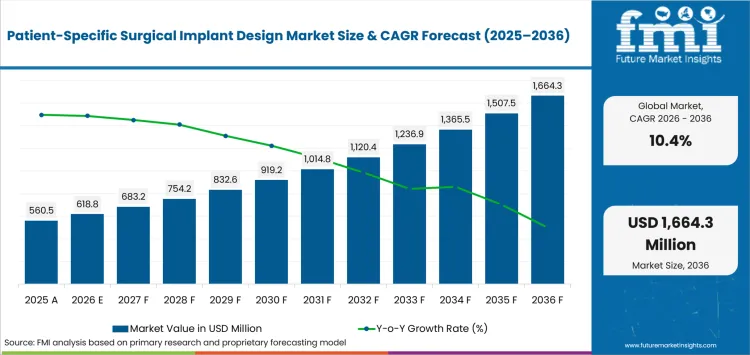
Key Takeaways of the Patient-Specific Surgical Implant Design Market
- Complex revision and tumor reconstruction cases support patient-specific implant demand where severe bone loss prevents standard catalog components from achieving stable fixation; orthopedic implants are projected to hold 34.6% of implant type demand in 2026, driven by joint revision, oncology, and selected spinal procedures.
- 3D printing is estimated to account for 33.2% of technology demand in 2026, valued for its ability to translate approved digital geometry into complex porous or contoured forms without dedicated tooling, though manufacturers must validate every material and finishing step through documented production controls.
- Titanium is forecast to represent 41.8% of material demand in 2026, preferred for its strength-to-weight balance and compatibility with porous surface additions and thin anatomical contours across demanding cranial and orthopedic reconstructions.
- Hospitals are set to account for 39.1% of end-user demand in 2026, supported by their direct control over imaging and operative scheduling, though adoption depends on trained biomedical engineering staff and validated software across the complete case workflow.
- Germany leads country-level growth at a 12.7% CAGR, attributable to structured implant oversight and a mature specialist care base, while Japan follows at 12.5% CAGR supported by precision-oriented clinical planning and disciplined approval requirements.
- Materialise and 3D Systems anchor integrated digital planning and patient-specific manufacturing, while Stryker, Johnson & Johnson MedTech, Zimmer Biomet, and Medtronic extend patient-specific components across broader surgical and orthopedic portfolios.
Analyst Perspective
"The patient-specific surgical implant design market is increasingly shaped by the ability to balance anatomical precision with reliable case execution. Clinical teams are evaluating design turnaround, revision requirements, and coordination across imaging, engineering, and surgical planning. Companies that streamline customization, establish clear escalation processes, and maintain dependable case-specific support will be better positioned to scale adoption."
- Anurag Sharma, Principal Analyst at Future Market Insights
Source: FMI's proprietary forecasting model and primary research
How is the Patient-Specific Surgical Implant Design Market segmented?
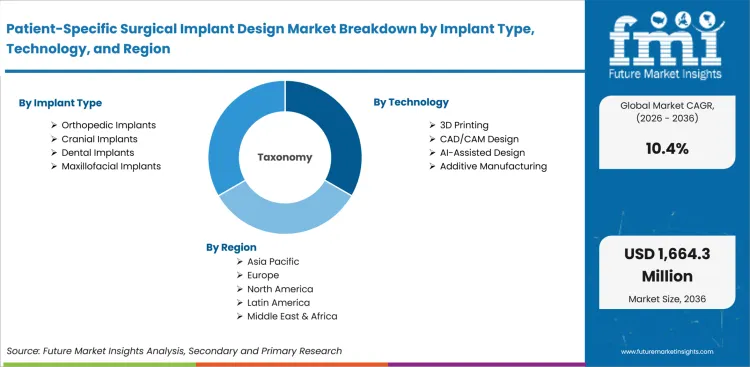
The Patient-Specific Surgical Implant Design Market is segmented by Implant Type, Technology, Material, End User, and Region.
Implant type separates orthopedic and cranial products from dental and maxillofacial reconstruction devices within the commercial boundary. Technology distinguishes 3D printing from CAD/CAM design and AI-assisted planning plus other additive production methods. Material analysis compares titanium with polymers and ceramics plus composite options used in approved finished devices. End-user categories separate hospitals from specialty clinics and medical device manufacturers plus research institutes across global care pathways.
What supports demand for orthopedic implants within the implant type category?
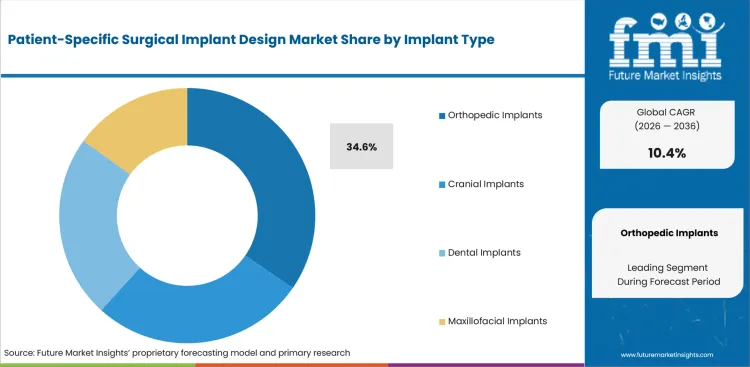
Severe bone loss and irregular anatomy can prevent standard orthopedic components from achieving stable fixation without additional reconstruction. The FDA cleared the DeGen Medical Patient Specific Implant System on April 4, 2025 for orthopedic use through the 510(k) pathway. The clearance confirms a regulated route for implants designed from individual anatomy rather than proving the approved market share. Orthopedic teams therefore compare orthopedic implant systems with imaging quality and delivery time before scheduling complex revision procedures.
- Orthopedic implants are projected to account for 34.6% of implant type demand in 2026, supported by reconstructive cases where severe bone loss limits standard components across joint revision and oncology plus selected spinal procedures. Case-specific geometry can preserve remaining bone and support fixation around defects that catalog sizes cannot address reliably.
- Revision surgeons use patient-specific orthopedic implants to convert CT-defined defects into an approved fixation plan before production begins. Adoption depends on clinical engineering support and rapid design review because anatomy can change between imaging and surgery. Hospitals also require a documented standard fallback strategy for unexpected findings during the scheduled surgical procedure.
How does 3D printing influence manufacturing within the technology category?
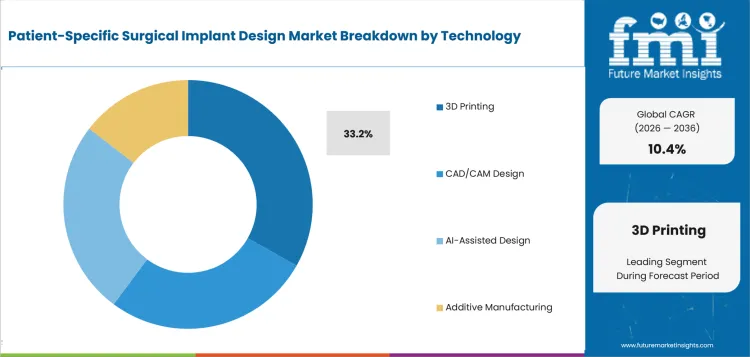
Patient-specific production needs geometries that conventional machining may create slowly or with unnecessary material waste. The FDA issued final guidance in May 2026 for patient-matched guides used with orthopedic implants and emphasized consistent design processes. Additive methods can translate approved digital geometry into complex porous or contoured parts within controlled manufacturing limits. Providers must integrate additive manufacturing systems with validated software and post-processing rather than treat the printer as a complete workflow.
- 3D printing is estimated to hold 33.2% of technology demand in 2026, owing to flexible geometry and direct digital production. Low-volume production supports complex contours without requiring dedicated tooling for every individual approved patient design. Manufacturers gain value from design freedom but must validate every material and finishing step through documented production controls.
- Medical device manufacturers select 3D printing for porous structures and anatomical shapes that would require extensive machining through conventional methods. Commercial adoption depends on repeatable build quality plus inspection records that connect each finished implant with the approved patient design.
Why does titanium remain central to the material category?
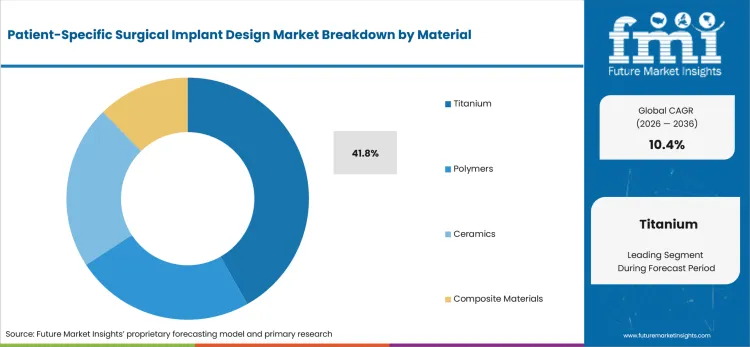
Load-bearing implants need strength and corrosion resistance without excessive weight across long-term contact with bone and surrounding tissue. The FDA cleared the METICULY patient-specific titanium mesh implant on January 14, 2026 for preformed cranioplasty use. The decision shows that titanium remains compatible with regulated patient-specific cranial reconstruction under defined device specifications. Material selection also shapes imaging artifacts and finishing requirements used for patient-specific reconstruction within complex craniomaxillofacial devices workflows.
- Titanium is forecast to represent 41.8% of material demand in 2026, attributable to its strength-to-weight balance and established implant use. Patient-specific production can add porous surfaces and thin anatomical contours while retaining mechanical support for demanding cranial and orthopedic reconstructions.
- Reconstructive surgeons prefer titanium for cases requiring rigid fixation around irregular cranial or orthopedic defects in complex reconstruction. Adoption depends on controlled powder specifications and validated heat treatment plus machining that protect surface quality and dimensional accuracy through documented final inspection.
How do hospitals evaluate the end user category?
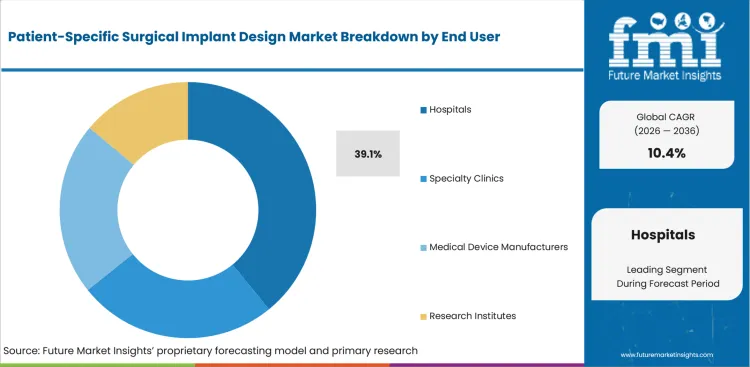
Hospital adoption depends on whether imaging and engineering teams can manage each case without disrupting scheduled surgical capacity. A Cardiff and Vale University Health Board tender published on April 3, 2025 requested custom implantable devices and cutting guides across five surgical specialties. The procurement model requires suppliers to print hospital-generated designs under an ISO 13485 quality system. The procurement structure connects medical implant printing directly with institutional design expertise and formal purchasing controls. The same route also links dental implant workflows with local CAD/CAM expertise and secure manufacturing portals.
- Hospitals are set to account for 39.1% of end-user demand in 2026, enabled by their control over imaging and operative scheduling. Tertiary centers can coordinate surgeons with radiology and biomedical engineering teams for complex cases that require several approval steps.
- Hospital networks adopt patient-specific implant services to shorten communication between clinical teams and external manufacturers. Investment remains practical where case volume supports trained engineers and validated software plus secure data transfer across the complete design workflow for every scheduled case.
What are the drivers, restraints, and opportunities in the Patient-Specific Surgical Implant Design Market?
Complex reconstruction supports demand for anatomy-matched implants while regulatory validation and case turnaround constrain routine use. Integrated design services create an opportunity to broaden material choice and reduce coordination risk across each surgical case.
- Driver: Complex revisions and tumor reconstructions create demand for implants that fit anatomy unavailable through standard component ranges.
- Restraint: Design validation and manufacturing lead times can disrupt care when imaging changes or approvals require repeated revisions.
- Opportunity: Integrated planning and multi-material manufacturing can reduce handoffs while giving surgeons clearer choices for demanding anatomical defects.
Complex orthopedic trauma and revision cases generate purchasing pressure when standard implants cannot address a unique defect without extra operative work. NHS Scotland published a 2025 procurement lot for 3D-printed or customized orthopedic items that are specific to individual patients and catalogued for repeat purchasing. The requirement demonstrates a formal route from exceptional cases into structured procurement rather than ad hoc laboratory work. Manufacturers must therefore provide transparent case pricing and repeatable ordering details that hospital boards can evaluate against local clinical needs.
Validation burden slows routine adoption because every patient-specific device depends on accurate imaging and controlled design translation. The FDA states that printed medical devices require validated software workflows plus material controls and device-specific testing before commercial use. A geometry error can therefore affect manufacturing accuracy and surgical fit within the same patient case. Providers need disciplined revision controls and release records that distinguish a clinical design change from a production deviation.
Material choice creates a practical opening for providers that can preserve one approved digital workflow across different implant materials. Materialise states that its aMace implant uses titanium alloy and remains commercially available across Europe and Australia through direct or distributor channels. The product route shows how personalized reconstruction can combine case engineering with established regional access. Companies can capture this opening by offering clear material criteria and local reimbursement support through one accountable service model.
Which country CAGRs are profiled in the Patient-Specific Surgical Implant Design Market?
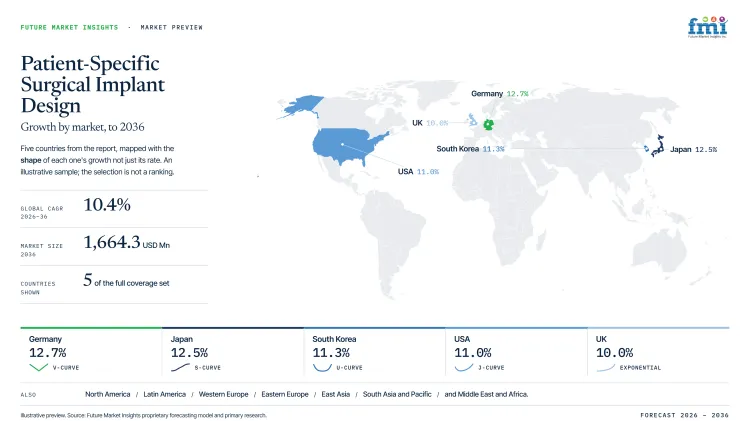
| Country | CAGR |
|---|---|
| USA | 11.0% |
| UK | 10.0% |
| Germany | 12.7% |
| Japan | 12.5% |
| South Korea | 11.3% |
How do country-level CAGRs compare in the Patient-Specific Surgical Implant Design Market?
The country comparison spans 2.7 percentage points between Germany and the United Kingdom across the approved forecast period. Germany and Japan form a close upper cluster separated by 0.2 points within the country profile. South Korea and the USA occupy the middle range with a 0.3-point gap between them. The United Kingdom sits outside that group by at least one full point through 2036. The measured spacing suggests broadly positive expansion but materially different entry conditions for engineering support and regulated purchasing.
- Germany’s position reflects structured implant registration and dense specialist care, though providers must support hospital reporting and documented product traceability.
- Japan remains close to Germany because precision-oriented surgical programs can support complex planning under disciplined clinical controls. Limited local service capacity and formal approvals can lengthen market entry for unfamiliar foreign implant providers.
- South Korea occupies the middle cluster through strong digital infrastructure and formal device review, although import licensing and local quality requirements add operating work.
- The USA remains near South Korea through broad specialist capacity and multiple 510(k) pathways, yet reimbursement and hospital contracting differ across provider systems.
- The United Kingdom’s measured rate reflects public purchasing and concentrated specialist centers, with tender requirements placing greater weight on evidence and predictable case pricing.
Similar CAGRs do not create identical sales routes because each country assigns approval and service responsibility differently. A provider may need direct clinical engineering in one country and distributor-led support in another. The full report provides country-level CAGR analysis across North America, Latin America, Europe, East Asia, South Asia, Oceania and the Middle East and Africa.
Country-wise Analysis
- United States hospitals access patient-matched implants through established FDA pathways and specialized engineering services for complex reconstruction. The patient-specific surgical implant design market in the USA is projected to grow at an 11.0% CAGR through 2036, supported by broad orthopedic and cranial surgical capacity. The FDA cleared Synthes Patient Specific Implants for cranioplasty on November 12, 2025 through the 510(k) pathway. The clearance provides a direct commercial route but hospital reimbursement and contract approval can differ across health systems. Manufacturers need regional case support and transparent turnaround commitments before surgical teams can rely on patient-matched devices for scheduled procedures.
- United Kingdom purchasing routes concentrate complex implant cases within NHS specialist centers and formal tender frameworks. The UK market is anticipated to advance at a 10.0% CAGR over the assessment period, attributable to public procurement and growing in-house design capability. MHRA guidance published in 2025 states that custom-made devices require a written prescription with design characteristics for one patient. The rule provides a direct legal route but manufacturers must maintain technical documentation and traceability for each order. Commercial entry depends on dependable delivery plus local training and a pricing model that separates base material from case customization.
- German hospitals operate within a national implant registry that links high-volume procedures with formal traceability obligations. Germany’s market is estimated to post a 12.7% CAGR during the forecast period, strengthened by specialist engineering and mature implant manufacturing. The Federal Ministry of Health reported in July 2025 that facilities submit more than 35,000 implant procedures to the registry each month. National reporting improves quality surveillance but adds data and product-identification work for hospitals and manufacturers. Market access therefore requires registry-compatible documentation and reliable local service for design revisions before surgery.
- Japanese university hospitals combine precision imaging with specialized neurosurgical teams for custom cranial reconstruction in complex tumor cases. Demand for patient-specific surgical implant design in Japan is forecast to rise at a 12.5% CAGR between 2026 and 2036, influenced by disciplined clinical planning. A Japanese neurosurgical article published in December 2025 documented four patients treated through navigation-guided resection and custom-made implants. The cases demonstrate local technical capability but also show that tumor progression changed planned resection margins in two procedures. Providers need rapid redesign routes and stereotactic planning software support for cases with evolving anatomy.
- South Korea combines advanced digital hospitals with a centralized medical-device approval system and formal import licensing requirements. The South Korean sector is predicted to advance at an 11.3% CAGR by 2036, enabled by digital imaging capacity and specialist tertiary care. MFDS published its 2025 Medical Device Approval Report on June 24, 2026 to summarize national authorization activity. The review system supports documented commercialization but technical files and quality management requirements can slow unfamiliar foreign providers. Successful entry requires a licensed local operator and service coverage that can manage design questions across tightly scheduled hospital cases.
Who are the notable companies in the Patient-Specific Surgical Implant Design Market?
Materialise, 3D Systems, Stryker, Zimmer Biomet, Johnson & Johnson MedTech, Medtronic, restor3d, KLS Martin, Onkos Surgical, and Osteo3D are notable companies shaping this market.
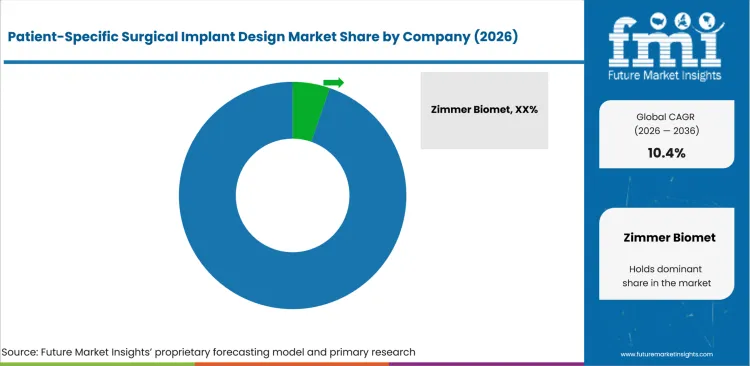
Competition separates integrated implant manufacturers from specialized digital-design providers and anatomy-focused reconstruction companies within complex surgical pathways. Current portfolios differ through anatomical coverage and material choice plus engineer involvement during case approval. Materialise reports annual support for more than 50,000 patients through its healthcare business each year. The company also reports more than 400,000 personalized models and devices produced through established digital workflows. The scale illustrates the operating advantage of reusable software and case workflows without establishing market leadership. Smaller specialists can compete through narrow clinical expertise and faster design communication across carefully selected anatomical applications. Selection therefore depends on exact implant fit and local service across craniofacial implant workflows rather than corporate size.
- Materialise and 3D Systems provide integrated planning plus patient-specific manufacturing across several anatomical areas used in complex reconstruction. restor3d and KLS Martin combine surgeon collaboration with dedicated implant design workflows for orthopedic or craniofacial reconstruction.
- Stryker and Johnson & Johnson MedTech supply patient-specific cranial or facial implants within broad surgical portfolios. Zimmer Biomet adds patient-matched shoulder and acetabular reconstruction through CT-based case design for complex revision procedures.
- Medtronic applies patient-specific design to spinal rods and planning services for complex spinal deformity procedures. Onkos Surgical focuses on oncology reconstruction, while Osteo3D supports Indian hospitals through virtual planning and custom implants.
Competitive Benchmarking: Patient-Specific Surgical Implant Design Market
| Company | Patient-Specific Implant Portfolio | Digital Planning Workflow | Manufacturing and Clinical Support | Geographic Reach |
|---|---|---|---|---|
| Materialise | High | High | High | Europe, Australia, and selected global markets |
| 3D Systems | High | High | High | Global |
| Stryker | High | Medium | High | Global |
| Johnson & Johnson MedTech | Medium | High | Medium | Global |
| Zimmer Biomet | High | High | High | Global |
| Medtronic | Medium | High | High | Global |
| restor3d | High | High | High | United States |
| KLS Martin | High | High | High | Global |
Key Developments in the Patient-Specific Surgical Implant Design Market
- In February 2026, Materialise added custom-made PEEK implants to its cranio-maxillofacial portfolio within the existing Mimics planning and case-management workflow. Surgeons can now choose between titanium and PEEK through one engineering process, which broadens material selection without creating a separate design platform. The expansion strengthens Materialise’s role in cases where imaging behavior or mechanical requirements influence material selection.
- In April 2025, 3D Systems supported the first MDR-compliant PEEK facial implant designed and manufactured at University Hospital Basel through its EXT 220 MED system. The implant was used during surgery on March 18, 2025 and demonstrated a hospital-based pathway that joins clinical engineering with controlled production. The project expands practical point-of-care options for complex facial reconstruction under controlled hospital manufacturing systems.
- In June 2026, Onkos Surgical received FDA 510(k) clearance to apply NanoCept antibacterial technology to titanium implants within the ELEOS limb salvage system. The clearance adds a surface-treatment option to a complex reconstruction platform and can influence selection where infection risk carries major clinical and financial consequences. The development broadens Onkos Surgical’s oncology offering without changing the underlying patient-specific case-planning workflow or service model.
- In December 2025, DeGen Medical: The FDA cleared the company’s Patient Specific Implant System for lumbar intervertebral fusion under 510(k) K251829. The decision provides another regulated route for CT-informed orthopedic implants and documents continued product activity inside patient-specific spinal reconstruction. The clearance also increases competitive pressure on established spine providers to support dependable design review and case delivery.
Key Players in the Patient-Specific Surgical Implant Design Market
Personalized Implant and Planning Specialists
- Materialise
- 3D Systems
- restor3d
- KLS Martin
Integrated Orthopedic and CMF Companies
- Stryker
- Zimmer Biomet
- Johnson & Johnson MedTech
Spine and Regional Reconstruction Specialists
- Medtronic
- Onkos Surgical
- Osteo3D
Patient-Specific Surgical Implant Design Market - Report Scope
| Coverage field | Report scope |
|---|---|
| Market breakdown | By Implant Type, Technology, Material, End User, and region. |
| Quantitative Units | Revenue in USD Million, CAGR in %. |
| Market Definition | Patient-specific surgical implant design covers design services and finished implants created from individual patient imaging for orthopedic, cranial, dental, and maxillofacial reconstruction. |
| Regions Covered | North America, Latin America, Western Europe, Eastern Europe, East Asia, South Asia and Pacific, and Middle East and Africa. |
| Countries Covered | USA, UK, Germany, Japan, and South Korea. |
| Key Companies Profiled | Materialise, 3D Systems, Stryker, Zimmer Biomet, Johnson & Johnson MedTech, Medtronic, restor3d, KLS Martin, Onkos Surgical, and Osteo3D. |
| Forecast Period | 2026 to 2036. |
| Approach | Hybrid bottom-up and top-down market sizing supported by primary interviews and official desk research. |
Patient-Specific Surgical Implant Design Market - Research Methodology
| Method | Approach |
|---|---|
| Primary Research | FMI analysts gathered input from manufacturers, service providers, technology developers, distributors, end users, sourcing teams, and subject-matter experts. Interviews examined purchasing decisions, product or service evaluation, adoption barriers, approval requirements, pricing considerations, and expectations for technical or commercial support. Respondents were also asked what evidence is required before a trial, pilot, or initial order develops into regular purchasing. |
| Desk Research | Desk research covered government statistics, regulatory publications, trade data, industry associations, technical literature, standards, company filings, product information, and official corporate announcements. Sources were reviewed for relevance, publication date, geographic coverage, and consistency with the defined market scope. Claims relating to performance, applications, approvals, capacity, investment, and commercial activity were retained only when supported by credible public evidence. |
| Market Sizing and Forecasting | The market model combined the baseline value with historical performance, segment structure, pricing and volume indicators, adoption levels, company participation, and country-level demand conditions. Forecast assumptions considered economic activity, investment trends, regulatory developments, technology adoption, purchasing cycles, supply availability, and barriers to wider market use. Segment and regional estimates were reconciled before the final market total was calculated. |
| Data Validation | Estimates were checked against multiple independent indicators, including public data, company activity, trade patterns, industry developments, and findings from primary interviews. Validation also tested whether products, services, applications, and company revenues fell within the defined market boundaries. Adjacent categories, unsupported claims, overlapping revenues, and activities without direct market relevance were excluded to reduce double counting and maintain consistency across segments and countries. |
Patient-Specific Surgical Implant Design Market by Segments
Patient-Specific Surgical Implant Design Market segmented by Implant Type:
- Orthopedic Implants
- Cranial Implants
- Dental Implants
- Maxillofacial Implants
Patient-Specific Surgical Implant Design Market segmented by Technology:
- 3D Printing
- CAD/CAM Design
- AI-Assisted Design
- Additive Manufacturing
Patient-Specific Surgical Implant Design Market segmented by Material:
- Titanium
- Polymers
- Ceramics
- Composite Materials
Patient-Specific Surgical Implant Design Market segmented by End User:
- Hospitals
- Specialty Clinics
- Medical Device Manufacturers
- Research Institutes
Patient-Specific Surgical Implant Design Market by Region:
- North America
- United States
- Canada
- Latin America
- Brazil
- Mexico
- Argentina
- Chile
- Western Europe
- Germany
- France
- United Kingdom
- Italy
- Spain
- Benelux
- Nordics
- Eastern Europe
- Poland
- Czech Republic
- Romania
- Hungary
- East Asia
- China
- Japan
- South Korea
- South Asia and Pacific
- India
- ASEAN
- Australia and New Zealand
- Middle East and Africa
- GCC Countries
- South Africa
- Türkiye
- Israel
Research Sources and Bibliography
- USA Food and Drug Administration. (2026, May 6). Patient-Matched Guides for Orthopedic Implants: Guidance for Industry and Food and Drug Administration Staff.
- USA Food and Drug Administration. (2025, April 4). 510(k) Premarket Notification: DeGen Medical Patient Specific Implant (PSI) System (K250667).
- USA Food and Drug Administration. (2025, December 8). 510(k) Premarket Notification: DeGen Medical Patient Specific Implant (PSI) System (K251829).
- USA Food and Drug Administration. (2026, January 14). 510(k) Premarket Notification: METICULY Patient-Specific Titanium Mesh Implant (K252958).
- USA Food and Drug Administration. (2025, November 12). 510(k) Premarket Notification: Synthes Patient Specific Implants (K243715).
- North Bristol NHS Trust. (2025, June 17). North Bristol NHS Trust Opens a New Bristol 3D Medical Centre.
- UK Government. (2025, April 3). Provision of Dental Implants.
- UK Government. (2025, November 17). Purchase of Orthopaedic Trauma and Extremity Implants and Consumables.
- Medicines and Healthcare products Regulatory Agency. (2025). Custom-Made Devices in Great Britain.
- Bundesministerium für Gesundheit. (2025, July 17). Ein Jahr Betrieb des Implantateregisters.
- Osawa, S., Ohno, M., Yanagisawa, S., Miyakita, Y., Takahashi, M., Fujita, S., Tsuchiya, T., Iwata, S., Ogura, K., Arikawa, M., Akazawa, S., & Narita, Y.. (2025, December 15). One-Stage Surgery for Malignant Skull and Scalp Tumor: Navigation-Guided Tumor Resection and Cranioplasty Using Custom-Made Implants: Technical Note.
- Ministry of Food and Drug Safety. (2026, June 24). 2025 Medical Device Approval Report.
- Materialise. (n.d.). Healthcare Professionals.
- Materialise. (n.d.). aMace Personalized Acetabular Implants.
- Materialise. (2026, February 17). Materialise Expands CMF Portfolio with Custom-Made PEEK Implants.
- 3D Systems. (2025, April 8). Weltpremiere: 3D Systems bringt personalisierte Gesichtsimplantat-Fertigung direkt ans Patientenbett.
- Onkos Surgical. (2026, June 8). Onkos Surgical Receives FDA 510(k) Clearance for Application of NanoCept Antibacterial Technology to Titanium Implants in the ELEOS Limb Salvage System.
This bibliography is provided for reader reference and is not exhaustive. The full report contains the complete reference list and detailed citations.
This Report Answers
- How large is the patient-specific surgical implant design market in 2026 and 2036?
- Which clinical and manufacturing conditions support demand for patient-specific implants?
- Why do orthopedic implants hold the largest implant type share in 2026?
- How does 3D printing influence patient-specific implant production?
- Why does titanium retain a strong material position in complex reconstruction?
- How do country growth rates differ across the USA, UK, Germany, Japan, and South Korea?
- Which companies provide patient-specific implants and digital planning services?
- What limits routine adoption across hospital and manufacturer workflows?
- How should hospitals evaluate turnaround time and case-support responsibility?
Frequently Asked Questions
How big is the Patient-Specific Surgical Implant Design Market in 2026?
The patient-specific surgical implant design market is valued at USD 618.8 million in 2026 and is forecast to reach USD 1664.3 million by 2036.
What is the CAGR of the Patient-Specific Surgical Implant Design Market from 2026 to 2036?
The patient-specific surgical implant design market is projected to grow at a CAGR of 10.4% between 2026 and 2036, supported by complex revisions and tumor reconstructions creating demand for implants that fit anatomy unavailable through standard component ranges.
Which material leads the Patient-Specific Surgical Implant Design Market?
Titanium accounts for 41.8% of the patient-specific surgical implant design market by material in 2026, driven by its strength-to-weight balance and established implant use across demanding cranial and orthopedic reconstructions requiring rigid fixation around irregular defects.
Which segment is growing fastest in the Patient-Specific Surgical Implant Design Market?
Hospitals are the fastest-growing segment in the patient-specific surgical implant design market, holding 39.1% share by end user in 2026, driven by their control over imaging and operative scheduling and the growing adoption of patient-specific implant services to shorten communication between clinical teams and external manufacturers.
Who are the leading companies in the Patient-Specific Surgical Implant Design Market?
Leading companies in the patient-specific surgical implant design market include Materialise, 3D Systems, Stryker, Zimmer Biomet, Johnson & Johnson MedTech, Medtronic, restor3d, KLS Martin, Onkos Surgical, and Osteo3D, competing across personalized implant planning, integrated orthopedic and cranio-maxillofacial solutions, and spine and regional reconstruction services.
Preview the report firsthand - request a free sample
Get SampleGet the brochure for pricing and purchase details.
Get PDFTable of Content
- Key Takeaways
- Market Size and CAGR
- Top Growth Driver
- Fastest Growing Segment
- Leading Region
- Key Companies
- Emerging Opportunities
- Executive Summary
- Global Market Outlook
- Demand-side Trends
- Supply-side Trends
- Technology Roadmap Analysis
- Analysis and Recommendations
- Analyst Perspective (What is happening? Why now? What should investors know?)
- Key Questions Answered
- How large is the market?
- What is the CAGR?
- What are key trends?
- Which region dominates?
- Who are the leaders?
- Market Overview
- Market Coverage / Taxonomy
- Market Definition / Scope / Limitations
- Research Methodology
- Chapter Orientation
- Analytical Lens and Working Hypotheses
- Market Structure, Signals, and Trend Drivers
- Benchmarking and Cross-market Comparability
- Market Sizing, Forecasting, and Opportunity Mapping
- Research Design and Evidence Framework
- Desk Research Programme (Secondary Evidence)
- Expert Input and Fieldwork (Primary Evidence)
- Tooling, Models, and Reference Databases
- Data Engineering and Model Build
- Quality Assurance and Audit Trail
- Market Background
- Market Dynamics (Drivers, Restraints, Opportunity, Trends)
- Scenario Forecast (Optimistic, Likely, Conservative)
- Impact Analysis
- AI Impact
- Sustainability Impact
- Regulatory Impact
- Technology Impact
- Consumer / Buyer Analysis
- Purchase Drivers
- Adoption Barriers
- Buyer Journey
- Opportunity Map Analysis
- Product Life Cycle Analysis
- Supply Chain Analysis
- Investment Feasibility Matrix
- Value Chain Analysis
- PESTLE and Porter's Analysis
- Regulatory Landscape
- Regional Parent Market Outlook
- Production and Consumption Statistics
- Import and Export Statistics
- Global Market Analysis and Forecast, 2021 to 2036
- Historical Market Size Value (USD Million) Analysis, 2021 to 2025
- Current and Future Market Size Value (USD Million) Projections, 2026 to 2036
- Y-o-Y Growth Trend Analysis
- Absolute $ Opportunity Analysis
- Global Market Pricing Analysis, 2021 to 2036
- Global Market Analysis and Forecast, By Implant Type, 2021 to 2036
- Introduction / Key Findings
- Historical Market Size Value (USD Million) Analysis By Implant Type, 2021 to 2025
- Current and Future Market Size Value (USD Million) Analysis and Forecast By Implant Type, 2026 to 2036
- Orthopedic Implants
- Cranial Implants
- Dental Implants
- Maxillofacial Implants
- Orthopedic Implants
- Y-o-Y Growth Trend Analysis By Implant Type, 2021 to 2025
- Absolute $ Opportunity Analysis By Implant Type, 2026 to 2036
- Global Market Analysis and Forecast, By Technology, 2021 to 2036
- Introduction / Key Findings
- Historical Market Size Value (USD Million) Analysis By Technology, 2021 to 2025
- Current and Future Market Size Value (USD Million) Analysis and Forecast By Technology, 2026 to 2036
- 3D Printing
- CAD/CAM Design
- AI-Assisted Design
- Additive Manufacturing
- 3D Printing
- Y-o-Y Growth Trend Analysis By Technology, 2021 to 2025
- Absolute $ Opportunity Analysis By Technology, 2026 to 2036
- Global Market Analysis and Forecast, By Material, 2021 to 2036
- Introduction / Key Findings
- Historical Market Size Value (USD Million) Analysis By Material, 2021 to 2025
- Current and Future Market Size Value (USD Million) Analysis and Forecast By Material, 2026 to 2036
- Titanium
- Polymers
- Ceramics
- Composite Materials
- Titanium
- Y-o-Y Growth Trend Analysis By Material, 2021 to 2025
- Absolute $ Opportunity Analysis By Material, 2026 to 2036
- Global Market Analysis and Forecast, By End User, 2021 to 2036
- Introduction / Key Findings
- Historical Market Size Value (USD Million) Analysis By End User, 2021 to 2025
- Current and Future Market Size Value (USD Million) Analysis and Forecast By End User, 2026 to 2036
- Hospitals
- Specialty Clinics
- Medical Device Manufacturers
- Research Institutes
- Hospitals
- Y-o-Y Growth Trend Analysis By End User, 2021 to 2025
- Absolute $ Opportunity Analysis By End User, 2026 to 2036
- Global Market Analysis and Forecast, By Region, 2021 to 2036
- Introduction
- Historical Market Size Value (USD Million) Analysis By Region, 2021 to 2025
- Current Market Size Value (USD Million) Analysis and Forecast By Region, 2026 to 2036
- North America
- Latin America
- Western Europe
- Eastern Europe
- East Asia
- South Asia and Pacific
- Middle East & Africa
- Market Attractiveness Analysis By Region
- North America Market Analysis and Forecast, By Country, 2021 to 2036
- Historical Market Size Value (USD Million) Trend Analysis By Market Taxonomy, 2021 to 2025
- Market Size Value (USD Million) Forecast By Market Taxonomy, 2026 to 2036
- By Country
- USA
- Canada
- By Implant Type
- By Technology
- By Material
- By End User
- By Country
- Market Attractiveness Analysis
- By Country
- By Implant Type
- By Technology
- By Material
- By End User
- Key Takeaways
- Latin America Market Analysis and Forecast, By Country
- Historical Market Size Value (USD Million) Trend Analysis By Market Taxonomy, 2021 to 2025
- Market Size Value (USD Million) Forecast By Market Taxonomy, 2026 to 2036
- By Country
- Brazil
- Mexico
- Chile
- Rest of Latin America
- By Implant Type
- By Technology
- By Material
- By End User
- By Country
- Market Attractiveness Analysis
- By Country
- By Implant Type
- By Technology
- By Material
- By End User
- Key Takeaways
- Western Europe Market Analysis and Forecast, By Country
- Historical Market Size Value (USD Million) Trend Analysis By Market Taxonomy, 2021 to 2025
- Market Size Value (USD Million) Forecast By Market Taxonomy, 2026 to 2036
- By Country
- Germany
- UK
- Italy
- Spain
- France
- Nordic
- BENELUX
- Rest of Western Europe
- By Implant Type
- By Technology
- By Material
- By End User
- By Country
- Market Attractiveness Analysis
- By Country
- By Implant Type
- By Technology
- By Material
- By End User
- Key Takeaways
- Eastern Europe Market Analysis and Forecast, By Country
- Historical Market Size Value (USD Million) Trend Analysis By Market Taxonomy, 2021 to 2025
- Market Size Value (USD Million) Forecast By Market Taxonomy, 2026 to 2036
- By Country
- Russia
- Poland
- Hungary
- Balkan & Baltic
- Rest of Eastern Europe
- By Implant Type
- By Technology
- By Material
- By End User
- By Country
- Market Attractiveness Analysis
- By Country
- By Implant Type
- By Technology
- By Material
- By End User
- Key Takeaways
- East Asia Market Analysis and Forecast, By Country
- Historical Market Size Value (USD Million) Trend Analysis By Market Taxonomy, 2021 to 2025
- Market Size Value (USD Million) Forecast By Market Taxonomy, 2026 to 2036
- By Country
- China
- Japan
- South Korea
- By Implant Type
- By Technology
- By Material
- By End User
- By Country
- Market Attractiveness Analysis
- By Country
- By Implant Type
- By Technology
- By Material
- By End User
- Key Takeaways
- South Asia and Pacific Market Analysis and Forecast, By Country
- Historical Market Size Value (USD Million) Trend Analysis By Market Taxonomy, 2021 to 2025
- Market Size Value (USD Million) Forecast By Market Taxonomy, 2026 to 2036
- By Country
- India
- ASEAN
- Australia & New Zealand
- Rest of South Asia and Pacific
- By Implant Type
- By Technology
- By Material
- By End User
- By Country
- Market Attractiveness Analysis
- By Country
- By Implant Type
- By Technology
- By Material
- By End User
- Key Takeaways
- Middle East & Africa Market Analysis and Forecast, By Country
- Historical Market Size Value (USD Million) Trend Analysis By Market Taxonomy, 2021 to 2025
- Market Size Value (USD Million) Forecast By Market Taxonomy, 2026 to 2036
- By Country
- Kingdom of Saudi Arabia
- Other GCC Countries
- Türkiye
- South Africa
- Other African Union
- Rest of Middle East & Africa
- By Implant Type
- By Technology
- By Material
- By End User
- By Country
- Market Attractiveness Analysis
- By Country
- By Implant Type
- By Technology
- By Material
- By End User
- Key Takeaways
- Key Countries Market Analysis
- USA
- Pricing Analysis
- Market Share Analysis, 2025
- By Implant Type
- By Technology
- By Material
- By End User
- Canada
- Pricing Analysis
- Market Share Analysis, 2025
- By Implant Type
- By Technology
- By Material
- By End User
- Mexico
- Pricing Analysis
- Market Share Analysis, 2025
- By Implant Type
- By Technology
- By Material
- By End User
- Brazil
- Pricing Analysis
- Market Share Analysis, 2025
- By Implant Type
- By Technology
- By Material
- By End User
- Chile
- Pricing Analysis
- Market Share Analysis, 2025
- By Implant Type
- By Technology
- By Material
- By End User
- Germany
- Pricing Analysis
- Market Share Analysis, 2025
- By Implant Type
- By Technology
- By Material
- By End User
- UK
- Pricing Analysis
- Market Share Analysis, 2025
- By Implant Type
- By Technology
- By Material
- By End User
- Italy
- Pricing Analysis
- Market Share Analysis, 2025
- By Implant Type
- By Technology
- By Material
- By End User
- Spain
- Pricing Analysis
- Market Share Analysis, 2025
- By Implant Type
- By Technology
- By Material
- By End User
- France
- Pricing Analysis
- Market Share Analysis, 2025
- By Implant Type
- By Technology
- By Material
- By End User
- India
- Pricing Analysis
- Market Share Analysis, 2025
- By Implant Type
- By Technology
- By Material
- By End User
- ASEAN
- Pricing Analysis
- Market Share Analysis, 2025
- By Implant Type
- By Technology
- By Material
- By End User
- Australia & New Zealand
- Pricing Analysis
- Market Share Analysis, 2025
- By Implant Type
- By Technology
- By Material
- By End User
- China
- Pricing Analysis
- Market Share Analysis, 2025
- By Implant Type
- By Technology
- By Material
- By End User
- Japan
- Pricing Analysis
- Market Share Analysis, 2025
- By Implant Type
- By Technology
- By Material
- By End User
- South Korea
- Pricing Analysis
- Market Share Analysis, 2025
- By Implant Type
- By Technology
- By Material
- By End User
- Russia
- Pricing Analysis
- Market Share Analysis, 2025
- By Implant Type
- By Technology
- By Material
- By End User
- Poland
- Pricing Analysis
- Market Share Analysis, 2025
- By Implant Type
- By Technology
- By Material
- By End User
- Hungary
- Pricing Analysis
- Market Share Analysis, 2025
- By Implant Type
- By Technology
- By Material
- By End User
- Kingdom of Saudi Arabia
- Pricing Analysis
- Market Share Analysis, 2025
- By Implant Type
- By Technology
- By Material
- By End User
- Türkiye
- Pricing Analysis
- Market Share Analysis, 2025
- By Implant Type
- By Technology
- By Material
- By End User
- South Africa
- Pricing Analysis
- Market Share Analysis, 2025
- By Implant Type
- By Technology
- By Material
- By End User
- USA
- Market Structure Analysis
- Competition Dashboard
- Competition Benchmarking
- Market Share Analysis of Top Players
- By Regional
- By Implant Type
- By Technology
- By Material
- By End User
- Emerging Startups
- Innovation Benchmarking
- Competition Analysis
- Competition Deep Dive
- Zimmer Biomet
- Overview
- Product Portfolio
- Profitability by Market Segments
- Sales Footprint
- Strategy Overview
- Marketing Strategy
- Product Strategy
- Channel Strategy
- Stryker
- Johnson & Johnson MedTech
- Materialise
- Smith+Nephew
- Medtronic
- 3D Systems
- Renishaw
- Straumann
- Osteo3D
- Zimmer Biomet
- Case Studies
- Success Stories
- Recent Developments
- Competition Deep Dive
- Assumptions & Acronyms Used


